The episode begins like all good episodes with a slip of the tongue that derails the cast for ten minutes. When you hear that, you know it’s going to be a good one and this is no exception. Oath spoilers, talk about past technology and resolutions for the new year are all on the docket. There’s a reason this is your favorite podcast.
2005?
Discussion of iTech
Oath Spoilers!
Marcel’s clarification on the Cease and Decease notification
New Year’s Resolutions
Support our Patreon! DO IT. You know this cast makes you more than $1 a week
We’re serious about the Patreon. Expect new perks.
Whenever someone on the internet starts a conversation about what the best color pair is in Commander, you get a lot of diverse opinions with a myriad of reasons and arguments. “Izzet is basically a Batman and Superman team up,” they’ll say. “Yeah but Azorius is like Captain America and Thor in a helicopter!” another will post. “Ok but Golgari is like if The Hulk and Dracula were best buds and just opened up a small antique shop in rural Pennsylvania!” I’m pretty sure I’ve already seen on Reddit.
The same reasoning and raging online nerd debate doesn’t exist when the topic is flipped to what the worst color pairs are in commander. Instead, the sad and easy answer people seem to come back to is the dud brothers, the warm milk mixed with stale cereal, the 1995 Minnestoa Timberwolves of EDH, Boros.
Hey Gugliotta, maybe if you didn’t spend all your time singing your glamour shots you’d win a game.
So what is it that makes Boros such a weak colour pair in our format? Is it the keywords? The colour pie? The inevitable connection to Canada? (It’s ok guys, I’m Canadian) What is it? The answer of course is a combination of all of the above except the Canada thing – we’re good at Magic. Boros is made up of the two weakest stand-alone colours in EDH and while White is an excellent support colour, it struggles with the things you want to do in Commander and the same goes for Red. Neither can draw cards very easily and both have trouble ramping up. It’s sort of like when Danny Glover and Joe Pesci were in that fishing movie. You know both of these guys are good (and one of them is like, all time good) but together they just made some forgettable garbage that even your dad who loves fishing is disappointed in. In addition to what I will now call the Pesci-Glover effect, Boros’ abilities always seem to be based around combat, which when playing in a format that loves big, wacky cards that control and combo off, can seem less effective and not nearly as fun. This isn’t to say that Boros can’t put together a mean deck or one that isn’t fun, it’s just to say that if you want to do anything besides combat, you may be in for a less than decent time.
“YEAH RIGHT”
Of course all that could change if we just had a legendary creature who didn’t deal exclusively with combat. This is the main reason people didn’t seem excited about [card]Kalemne, Disciple of Iroas[/card] when she was spoiled. Sure, double strike and vigilance are powerful abilities and the new experience counter mechanic means she would make a solid voltron general, but we really wanted a commander that was completely different and would elevate Boros alongside the other guilds. The worst part of Kalemne’s reveal for me personally was that red-white’s non-legendary creature pool could easily have been treated as a road map of other great ideas to put on a commander. Seeing this, it’s tough to figure out why someone thought two more voltron, damage-based commanders were the way to go.
So let’s use the road map and take a look at some non-legendary creatures that prove Boros could be more than just combat-orietnted, face smashing, nonsense.
[card]Boros Reckoner[/card]
You’re not going to get away from damage-based effects as long as you include red in your colours. Combat damage, however is something we can avoid. Boros Reckoner has a really neat ability that you can build a sort of “deal damage to my own creatures” deck around. If you made the commander version of the Reckoncer have or gain indestructible or maybe it deals damage to each player I think we’re looking at a very interesting and cool new commander.
It doesn’t get much better than smashing the words “Minotaur” and “Wizard” together in the creature line.
[card]Soulfire Grand Master[/card]
One of the most frustrating things to happen in recent sets was the printing of Soulfire Grand Master without the word Legendary in its card type. I know this techincally is a Jeskai card, but it is Boros through and through. Buyback, lifelink, damage spells, come on! How can you give us busted stuff like Mizzix and Narset and then pullback on the commander powere level for a card so perfectly designed to add new spice to potentially Boros coommanders!?
[card]Soulfire Grand Master[/card]
Oh no, I’m not done with this one – Soulfire GM is so good as a potential Boros commander that you could split the card in two and still have two different and great generals. Take the lifelink on spells for a more lifegain, control-oriented deck and give me the buyback ability for finally using those red burn spells that I otherwise get no use out of in EDH. This is the card so nice they should have made it twice!
[card]Hostility[/card]
Speaking of ways to make burn spells viable in EDH, slap a “Legendary” on Hostility and you have yourself a card that begs to be built around. Big hastey creatures born from red burns, maybe toss in an anthem effect from the white side of the new card, play with some red sac outlets and you’re having a doesnt-have-to-be-combat-based laugh!
Sure it’s a weird duck-thing, but I swear it’d make an interesting general.
[card]Chief Engineer[/card]
Ok, so this card isn’t Red, White or any combination of both, so maybe I have no business mentioning it, right? Wrong. The question here is, what in the world is this card doing in blue? I know blue likes artifacts but convoke is a definite white (and green) ability, and artifacts are right at home with either red or white. Seriously, blue, bugger off with Chief Engineer, you get all the good cards as it is. Plus, blue is so filled with good artifact cards that no one even uses this for ANYTHING. This card is basically lost at sea surrounded by way more powerful blue cards that are actually being used. Red and White NEED this card and they need it as a legendary creature because [card]Jor-Kadeen[/card] should not be the only artifact commander Boros gets.
The list (in my own head) goes on too! What if [card]Anya, Merciless Angel[/card] wasn’t the flop many said she ended up being and instead had a Sunforger-like ability that let you search for cheap instants and sorceries? Or perhaps Kalemne had an experience counter mechanic that let her tutor for equipment or auras or deal that number of damage on upkeep or perhaps via an activated or triggered ability? Basically just anything that didn’t say, suit these guys up and attack. I love suiting up and attacking sometimes, too but these colours need and deserve more.
So normally I’d post a decklist here outlining a way to build around one of the featured commanders from earlier in the article but instead since I have featured no actual legendary creatures, I’ll instead give you a list of great Red and White EDH cards that you may or may not want to throw into future EDH decks. I’ll keep each card on the list under $5 and that way if Wizards ever decides to make a decent Boros general, we can refer back to this in order to find some great cards to use.
[card]Assemble the Legion[/card] – One of the craziest token producers in all of Magic. If it lives a few turns, it’s absolutely deadly, and not just because you’ll be hanging around with a bunch of
[card]Boros Charm[/card] – Surviving board wipes can be a game win – so can instant speed double strike on your beefed up commander.
[card]Sunforger[/card] – need your Swords to Plowshares? Sure! How about your Boros Charm? NO PROBLEM HERE IT IS MY NAME IS SUNFORGER AND I AM THE BEST.
[card]Aurelia’s Fury[/card] – I bet you thought you had blockers!
[card]Brightflame[/card] – Token decks fear this card, good against them at any stage of the game.
[card]Deflecting Palm[/card] – Whether it’s against an infinite Splinter Twin/Kiki-Jiki combo or just a gigantic trampling monster, Deflecting palm can sometimes read. RW: Kill the guy who’s attacking you. Plus the art is all “TALK TO THE HAND”
[card]Double Cleave[/card] – Not just something you’d see in an alien ballgown. Instant speed Double Strike can kill, so play safe.
[card]Duergar Hedge-Mage[/card] – Hey look its an ETB Artifact and Enchantment-busting creature in Boros!
[card]Fight to the Death[/card] – This one is quite situational but at the right time, this card can hose a lot of your oppnents’ creatures or just one of em. Either way its often a multiple-for-one.
[card]Orim’s Thunder[/card] – Recently included in the 2015 Commander set, you often get to kill an artifact or enchantment AND a creature! Value!
[card]Powerstone Minefield[/card] – This makes combat a bit of a nightmare for your opponents. It allows your smaller creatures to trade up and can turn off swarm strategies and the aformention Twin/Kiki combos!
[card]Shattering Blow[/card] – Sometimes you gotta exile that artifact.
[card]Waves of Aggression[/card] – A little more specific but when you control how many combat phases and when they happen, that’s a real good thing.
[card]Master Warcraft[/card] – Opponents board of creatures looking a little too good? Let’s fix that by controlling who attacks and blocks this turn. A bit of a mini-mindslaver if you think about it?
[card]Wear // Tear[/card] – It’s played in legacy for a reason guys.
That’s the article for this week! Keep reading and check me out on The Commander’s Brew Podcast for a new budget EDH deck every week!
2015 was a wacky year for this Children’s card game. Jobs were gained and lost, cards were leaked, tournaments were won, Vegas happened and what happened in Vegas needs to stay there for the most part. 2016 will be full of diaper changes and a lack of a core set and leaks being severely punished. It’s hard to know for sure what the future will hold, so the gang takes a look back at 2015 and what it all meant.
Cease and Desist?
Leakers PUNISHED
2015 retrospective
Support our Patreon! DO IT. You know this cast makes you more than $1 a week
We’re serious about the Patreon. Expect new perks.
This past week, @seantabares and @andyhullbone, the guys at The Commander’s Brew podcast talked about a really cool idea that I believe many kitchen table players could benefit from thinking about. That idea is the staple binder (Episode 22). A staple binder isn’t necessarily a binder with plastic card protector sheets. It is simply a collection of cards that are moved back and forth between decks, designed to reduce the cost of building new decks.
It’s easy to lose track of what your money is worth when buying Magic cards on the secondary market. Most gamers grimace when forking over $50 for a new board game with tons of miniatures, new rules, a board, dice, and even set pieces including furniture! An entire Settlers of Catan game is less than $40 and can be used by multiple people for endless hours of fun. $50 for any Magic deck is considered budget, and is the line that The Commander’s Brew uses when making new budget EDH decks. In order to keep the money from hemorrhaging to the point of wallet-death, the guys at @commandersbrew propose sharing cards between decks and to organize them into a a personal set called the staple binder. Well, I am not one hundred percent sure that they came up with the idea, but I can’t find reference to it anywhere else, so I am giving them the credit. Let me also say that I love this idea, and I am reorganizing all eight of my EDH decks with a staple binder per their suggestion. I’d like to tell you why.
How It Works
To get started with a staple binder, use your tappedout or deckbox lists to identify all the shared cards between your EDH decks that cost $1 or more. Make a list of these cards (staples) for each deck. Pull all of those cards from those decks, and place one copy of each into a box or binder (Staple Binder). Be sure to organize that box/binder in whatever way makes it easiest for you to pull and return the cards quickly. Before each game of Magic, check the list of staples in the deck you wish to play. Pull the staples from the Staple Binder and add them to the deck. Play Magic. After the game, check the list again and remove all of the staples from the deck and put them back into the binder. It’s that simple. It takes between two to five minutes to pull and switch staples to switch decks.
To make the staple binder more convenient, you can sleeve all of your decks with the same color and style sleeves so you don’t have to sleeve and unsleeve your staples. This seems like a no-brainer, but if you are the type that likes your sleeves to match your deck’s theme, this might be a tough pill to swallow. It is also an initial cost to setting up the staple binder that should be cosidered when determining if a staple binder is right for you. You can organize your staples in a box or binder depending on your preferences. The guys at @commandersbrew also recommend to keep a card-sized list of staples with each deck to easily identify the staples needed for each deck. This reduces the time you need to swap staples between decks.
Staple Binder Bonuses
Having a staple binder allows me to make new decks for far cheaper than I could previously. I included all of the fetches, shock-lands, temples, tri-lands, and other utility lands in my staple binder. I’ve included many of the artifact ramp cards like [card]Gilded Lotus[/card], [card]Sol Ring[/card], [card]Chromatic Lantern[/card], and the signets. Commander keepers like [card]Lightning Greaves[/card] and [card]Swiftfoot Boots[/card] are also in the binder. Granted, each of these cards isn’t that expensive, but added up, they can be $100 or more for each new deck. With a staple binder, I just use the same copy for each new deck, and that allows me to either save money on each deck or spend a little more on the cards that make each deck special.
The cards that my decks share currently make up approximately $1,700. If I sold the extra copies of those cards for 50% market value right now, I could recoup $500! I’d like to turn my extra copies into Zendikar fetches or other cards for my decks, both new staples and cards that go in just one deck.
One of the best bonuses to having a staple binder is that when considering whether to buy an expensive card to add to a Commander deck, I know that I can include it in more than one deck with just the one copy! That makes purchasing things like old dual lands or modern staples more enticing and makes multiple decks better with just one card.
Be Aware of the Potential Drawbacks
The guys in my playgroup are open to the idea of using a staple binder, but they are leery of some of the negatives. First, once you have a staple binder, your decks might start to look more and more like one another. The other side to this is that you can make new decks more cheaply and that will encourage more diversity in a particular playgroup. If you find that the games get predictable because the cards in play tend to be the same no matter what decks are being played, it’s time to have a conversation with your group about setting ground rules for the staple binder. You can limit the number of cards that can be used from the staple binder in each deck or limit the number of decks that any particular staple can be included in. There are options to use the staple binder responsibly. No one wants all the games to look the same.
Second, If you can include the “best cards” in every deck, why wouldn’t you? Won’t the power level of everyone’s deck get out of control? I don’t think this will be a problem with my group because we check each other pretty regularly about the 75% rule. If a deck feels too overpowering or oppressive, we talk about it and the pilot takes a little off the throttle. I don’t think that the staple binder will change that for us, but for other groups this may be a problem to look out for. There is a hidden benefit here as well. One of the worst feelings in EDH is getting mana screwed. If you are able to play better lands because you only need one of each for all your decks, you are less likely to have this feeling. If everyone plays better lands, then everyone gets to play more Magic, which is generally good for all.
If you want to transform your extra cards into playable decks and increase the deck-diversity of your playgroup, introduce the idea of a staple binder. I plan to post again on the Brew after my group has adopted it for a few months to see any additional benefits or drawbacks, so check back to see the update. If you have any suggestions of cards you would include in your staple binder, post them in the comments.
It’s been a while since I last checked in and the Legacy format has changed a lot since GP Seattle. Lands taking down the Grand Prix and Punishing Blue winning the Star City Games Legacy Open in November certainly showed that the format is in a position now where decks can get away with not running four copies of [card]Brainstorm[/card]. Legacy has slowed down a lot and midrange decks are king. Miracles has been one of the top dogs since Fate Reforged and even the Delver decks are slowing down with things like BUG and 4C Delver. At the SCG Player’s Championship, the Roanoke team brought Death and Taxes, saying that it was a deck that people were ignoring and could attack the format really well. So today I’m going to take a look at a couple of the non-blue decks that can take their own.
To begin with, the main reason non-blue decks aren’t as popular is the fact that Brainstorm allows decks to remove some level of variance and fix bad hands. It means that they’re not at the mercy of the top of their deck as much as decks without Brainstorm. They also tend to have poor combo matchups in the first game because of the lack of [card]Force of Will[/card]. Now they have different ways of attacking combo through cards like [card]Thoughtseize[/card], [card]Thalia, Guardian of Thraben[/card] and, against Storm and Reanimator, [card]Deathrite Shaman[/card]. They certainly aren’t as safe or powerful as Force, but they are the best way these decks have of tackling these decks without having access to the powerful countermagic that blue has to offer.
Death and Taxes
Possibly the best non blue deck in Legacy, and my personal favourite if I had to leave the Islands at home. The combination of mana taxation in the form of Thalia, and disruption with cards like [card]Mother of Runes[/card], [card]Wasteland[/card], and [card]Rishadan Port[/card] allows it to play a great mana denial game against most decks. All of those one mana cantrips that fuel Legacy are pretty bad when they cost two mana. Better yet, all of Death and Taxes’ disruptive creatures are exactly that: creatures. They’re able to beat down incredibly efficiently and combined with [card]Stoneforge Mystic[/card] and the usual equipment package of [card]Batterskull[/card], [card]Umezawa’s Jitte[/card], and [card]Sword of Fire and Ice[/card] provide a range of options depending on the matchup.
Death and Taxes is also often able to dodge countermagic thanks to [card]Aether Vial[/card] and occasionally [card]Cavern of Souls[/card], meaning it can completely foil Miracles’ [card]Counterbalance[/card] gameplan. So countering Vial is number one against this deck. Mother of Runes is also a key turn one play that can ruin someone’s day. If DnT gets to untap with Mom, you better hope you’ve got a plethora of removal spells or you’re going to be in for a bad time.
DnT does have some very sketch matchups against things like Punishing Jund, Lands, and especially Elves. The best way of beating them is by playing some kind of recurring value engine. [card]Punishing Fire[/card] and [card]Grove of the Burnwillows[/card] is a fantastic way of fighting DnT. Similarly, obscenely fast combo decks like Belcher and Dredge are great at taking down the army of dudes. On the flipside, if you’re expecting a lot of Storm, Sneak and Show, or Miracles, Death and Taxes is a great way of taking on the field.
Jund
There is never a purer or more visceral experience in Magic than when you get to Jund someone out. Jund is present in every format because it turns out when you have the reach of red, the removal and discard of black, and the threat power of green, you just play seventy-five good cards. And Legacy is no exception. Jund was one of the decks that got pushed out when [card]Treasure Cruise[/card] and [card]Dig Through Time[/card] were around but now that they’re both gone, it’s time to look at one of the oldest non-blue strategies in the game.
Jund’s gameplan is simple: trade one-for-one with cards like [card]Abrupt Decay[/card] and [card]Thoughtseize[/card], land a [card]Bloodbraid Elf[/card] or [card]Tarmogoyf[/card] to beat the tar out of the opponent with [card]Sylvan Library[/card] and [card]Dark Confidant[/card] keeping your hand nice and full, and eventually establish the [card]Punishing Fire[/card] + [card]Grove of the Burnwillows[/card] engine and grind out the opponent. The deck doesn’t mess about, it doesn’t get any fairer than this. And the versions that run [card]Hymn to Tourach[/card] are the only “unfair” versions, but it’s still just a two-for-one. Jund excels in heavy creature formats where people are running things like Death and Taxes, Maverick, or Merfolk. It can even out-attrition decks like Miracles and Shardless if played by a well-versed pilot.
The deck does suffer to combo though, as do most non-blue decks, as I’ve said. Though the heavy discard and fast clock can be incredibly potent against any combo deck. And if you can land a turn two [card]Liliana of the Veil[/card] it can just shred people apart. The deck does have a pretty poor Dredge and Burn matchup but those two decks aren’t as popular anymore. Despite having access to [card]Abrupt Decay[/card], Miracles is still a tough matchup for Jund. We are the premiere control deck of the format and we can grind and attrition just as well as Jund can. Liliana is great in this matchup because a Liliana ultimate is backbreaking. The absolute worst deck to get paired against is Maverick/Deadguy Ale/The Rock. These midrange decks are doing the exact same as Jund (roughly) but they have better tools: [card]Swords to Plowshares[/card] is better than [card]Lightning Bolt[/card], Mother of Runes can counter Abrupt Decay, [card]Green Sun’s Zenith[/card] allows for some incredible flexibility in the deck. But overall, Jund is a deck that, like Miracles, has no real bad matchups and there’s no card that just hoses Jund. There are cards that hurt, but don’t completely ruin the deck. A very, very solid choice.
Elves
I love this deck. I really do. And not just because Miracles has a completely dominating advantage against the deck, but because it’s a mono-green combo deck. That just sounds so freaking cool!
In all honesty, Elves is a very powerful deck that could see a return to form with Miracles on the decline. The deck is a combo deck that wins through a few different avenues. It can cast [card]Glimpse of Nature[/card] and fire out a load of small dudes, and draw half of its deck and make a boatload of mana in the process thanks to [card]Nettle Sentinel[/card] and [card]Heritage Druid[/card]; it can combo off with [card]Natural Order[/card] and [card]Craterhoof Behemoth[/card]; or it can play a fair creature matchup where it plays buckets of small creatures that can go incredibly wide. With Glimpse, every card you play is a cantrip, meaning that on turn three, the deck can vomit out creatures,slam a [card]Gaea’s Cradle[/card] and play a Craterhood or Green Sun’s Zenith for one. Oh, it also gets to run Green Sun’s Zenith, which in this deck is brutal. There are plenty of decks that play Zenith but Elves is one that gets to take huge advantage of it. Being able to spend two mana and get any of your combo pieces is just huge, and the toolbox element allows you to mould and sculpt your sideboard to your meta.
Elves is fantastic against fair decks. Against Delver, Elves can completely overrun them and make their Forces and [card]Daze[/card]s just terrible. And if you want to see a massacre, just look at Elves play against Death and Taxes. The little green men just destroy Thalia and Co. It’s actually kinda sad.
But not as sad as the Elves versus Miracles matchup.
A very good friend of mine is an Elves player so when I asked him about bad matchups the first thing he said to me was, “Miracles.” In our last Legacy night, I crushed him 2-0 in the first round and went 5-1 against him in our practice games beforehand. Counterbalance is obviously a problem when your deck is full of 1-CMC cards but it’s also the four copies of STP and the one-mana boardwipe in the form of [card]Terminus[/card]. The best way of dealing with this matchup is taxing the removal. If you can deploy two Nettle Sentinels or a Deathrite Shaman backed up with another creature to pressure the opponent can eventually whittle away the Miracles player. Elves also has a very hard time against fast combo decks like Storm and Reanimator. That being said, I think Elves is a fantastic deck and if you can pilot the deck well, the little green men will serve you well.
Who Needs Blue
These three decks are just a mere taste of what Legacy has to offer for those of us who want to leave the Brainstorms at home and sleeve up some Green Sun’s Zeniths or some Stoneforge Mystics. If this has whetted your appetite, there’s plenty more decks that have abandoned the Island life for a simpler, topdeck-ier game of Magic. You can continue down the midrange route with The Rock or Deadguy Ale, or perhaps aggro is more your style and you can play Burn or Maverick. Heck, you might even want to continue combo-ing off, in which case there’s a certain mechanic I think you might be interested in called Dredge.
Regardless of what you want to counteract the blue beast, Legacy has something for you. Just remember that you get to shuffle Green Sun’s Zenith back into your deck!
Corbin starts us off by regaling all of us with a tale of his pocket getting “picketed” and we’re off to the races with a great episode where clearly we know there isn’t a lot to talk about Magic-wise until we start discussing it and, holy crap there’s actually a lot to talk about. The episode goes a little long. These things happen. The important thing to remember is that we’re your favorite Magic podcast and Corbin getting robbed is hilarious. There’s time to discuss spoilers, why it’s terrible that we have so many spoilers, and why this set is going to be a real financial curveball.
Corbin’s picket-pocket story
SPERLERS! Sperlers galore!
Expeditions are discussed at length
Potential new fair dual lands?
Support our Patreon! DO IT. You know this cast makes you more than $1 a week
We’re serious about the Patreon. Expect new perks.
Topics include: Leaked spoilers, event coverage changes, cube, Aspic, weird historical riots, energy markets, the rate of technological change, and some of our favorite Money Draught moments.
Trick Jarrett published an interesting article today and having had some time to digest the piece and the feedback (blowback?) from it, I’ve decided my opinion on the matter would be laborious and difficult to Tweet. What’s the point of owning a soapbox if you only ever pay other people to stand on it? I happen to align my views with Trick, and while it may seem like I’m piling on, I have heard a lot of dissent and criticism of his viewpoints and the manner in which he expressed them. I didn’t think it would be controversial to come out on the side of “Don’t spoil cards that aren’t your cards to spoil, you enormous prick” but Donald Trump is leading in the polls, it’s raining in December and people who aren’t fans of Star Wars are targets of ridicule so nothing surprises me anymore.
Speaking of Star Wars and surprises, I saw the new movie on Monday night and it was incredible. Disney is a corporation who knows how to manage leaks pretty well and Wizards could take a page out of their book. Thousands of people worked on the movie and have seen it through all phases of completion from the script draft phase to the finished product and lots of people saw the movie Monday when I did but here it is Wednesday night and I still haven’t seen anyone online saying that Luke Skywalker wasn’t in any of the trailers because he is wearing his father’s old mask and going by the name “Kylo Ren,” a fact I’m really surprised hasn’t leaked online.
OK, I made that up. As far as I know that’s not true, but I bet I pissed a few people off when they thought I spoiled the movie before you got a chance to see it. And isn’t that kind of the point? I don’t know about you, but spoilers piss me off.
Is it the best possible defense of a subject to continue to make jokes and evoke “feels” rather than present facts? Obviously not, and I’m aware of that fact. In this case, though, it seems appropriate because if we’re trying to make the case that spoilers cause harm and I am making the further case that the harm caused is emotional harm, we need to talk about our feelings. Have you ever had anything spoiled for you? It’s a bittersweet feeling, like unwrapping all of your gifts on Christmas Eve. Sure, it’s fun, I guess, but then you come downstairs on Christmas morning to play with your new toys and you already know what everything is. The magic is gone. That’s why my parents had us open only one gift on Christmas Eve and the rest on Christmas Day. That’s how you handle “reveal” season. Give them a taste to whet their appetite and keep them wanting more.
The community has largely embraced the concept of getting spoilers fed to us slowly. We’re so numb to the concept that we haven’t even stopped using the word “spoiler” to describe what’s going on. It’s an ugly word.
This is what leaking a ton of cards all at one does, right? The word “harm” is even listed as a synonym for spoil.
Over the Line
I think a lot of people were a little shocked at the tone of Trick’s piece today. I think that is because people have very short memories. Remember Rancored Elf? If you’re not familiar, read this piece (actually, read it either way) and compare its tone to the tone of Trick’s piece today. They brought a law suit against a guy who was spoiling cards. For years, Rancored Elf was Magic the Gathering’s Loki, finding early images and spoiling them. I’m not sure what he got out of it, besides a lawsuit, but there had to have been some modicum of personal gratification and increased website traffic. While the lawsuit looks like a harsh reaction, Rancored Elf gave Wizards of the Coast the opportunity to do something pretty ingenious, and that was adopt a “If you can’t beat ’em, join ’em” mentality. Instead of wringing their hands and lamenting spoiled cards, they got out in front of it, strategically revealing cards to get people excited. You want the set to break sales records? Show everyone that the set will have fetch land reprints while there is still time to pre-order cases. This system worked pretty well for a while.
What’s interesting to me is that people were basically universally outraged when they heard about Guillaume Wafo-Tapa and his “God Book” shenanigans. When a pro player gave a teammate the entire set early to study and write about, people seemed to think an 18-month ban wasn’t enough and the unfair advantage he gave his team was deplorable.
Today, Trick says that Wizards is going to give much longer bans and describes early leaks as disenfranchising certain players and people seem to be categorically rolling their eyes. While I’m not inclined to defend every point Trick made in his article, because I don’t want to have to agree with all of them, I think the overall tone came through. Spoilers suck because they ruin the magic of reveal season. I like getting a few new cards every once in a while, with new mechanics being revealed at times of Wizards’ choosing and allowing them to tie in releases with their Uncharted Realms Vorthos series. They are building an experience for us, and that takes time and expense. That all goes to waste as does our potential enjoyment of the experience when someone jumps the gun. Not only did they jump the gun in this case, they spoiled 8 of the 9 remaining unspoiled mythic rares. Thanks, guy. Hope it was worth it.
TL;DR Culture
We certainly don’t like to wait, do we? There are a lot of people out there who are not only unsympathetic to those of us who preferred our cards revealed at a moderate pace to build excitement (and give some of us time to do some analysis), but they relish the spoiler dump. I’ve already likened that to opening your Christmas presents on Christmas Eve, but when you consider the fact that someone external to Wizards of the Coast made the dump, the metaphor shifts in my view. Someone didn’t just open your presents for you, they wrote a letter saying “Santa’s not real, neither is the Easter Bunny, neither is Jesus and you didn’t get an N64, you got a Sega Saturn and socks.” As a member of the content creation community as well as the MTG Finance community, I can’t just plug my ears and refuse to look at spoilers like I’m doing for Star Wars, (I’m seeing it in just under 36 hours and if one of you spoils anything for me… I have no recourse. Just don’t do it.) I am compelled to analyze the new cards and talk about their financial and gameplay impact. All of us do. Once the cards are spoiled, the spell is broken and there’s no un-ringing the bell or finding a third clumsy metaphor. It’s like eating candy for dinner – it sounds like it would be fun but afterward you’re left feeling sick. I guess that’s why I feel sort of sick when there is a big spoiler dump.
It isn’t just the content consumers who have their parade peed on, either. These dumps deprive websites who were granted exclusive spoilers of their traffic and ad revenue. The people who perpetrated these leaks quite literally stole money from people. I don’t think it’s silly or hyperbolic to say that, either. Why isn’t this obvious to everyone? Why are people so divided on this topic?
I think this is absolutely part of it. I think a fundamental lack of empathy among non-content creators (which is not a malicious lack of empathy nor am I deriding anyone) because from a content-consumer standpoint, they were always going to have every card revealed to them.
I think there are a few irrelevant arguments that are tripping (no pun intended) us up in this debate and we should identify what they are.
Irrelevant Point #1 – The Topic of “Blame”
Wizards of the Coast screwed up. They have to know they screwed up. What most likely happened is someone fished cards out of a dumpster or took pics of cards that were thought to have been destroyed. This has happened in the past and the fact that the cards seem damaged seems to support that theory.
See how jacked up the card looks on the edges?
Whether or not Wizards is to blame for not vetting the printer that allowed this fiasco to happen or the printer is to blame or the dumpster diver is to blame for being a scumbag is kind of irrelevant. Don’t let your debates get caught in this quagmire. WotC messed up and they are getting more punitive with people who leak these images. Hopefully they’ll try to see if they can run a tighter ship going forward. I want cards spoiled, but I want them spoiled on WotC’s terms. It’s a better experience. I’m old enough to know candy for dinner is bad for me and I don’t particularly enjoy the fact that the candy was gavaged down my throat in this instance.
Irrelevant Point #2 – “Professionalism”
A few people seemed jarred by Trick calling whoever perpetrated this dastardly offense against all of us a “terrible human being” by comparing them to someone who announced someone else’s pregnancy on social media. Maybe it’s unprofessional for someone in Trick’s position to call someone a terrible human being, maybe it’s not. What I do know is that I’m not in Trick’s position. Whoever did this is a terrible human being. I mean, that’s an opinion, but to imply that Trick can’t indirectly imply that what the leaker did was horrible and that by extension makes them a horrible human being doesn’t smack authentic to me. I’m glad some emotion made it through the editing process. He’s making an emotional appeal to people not to do antisocial things, after all.
Irrelevant Point #3 – The “Enfranchised”
This one is actually one of Trick’s points. He said;
Leaks create an unfair advantage as—because they do not go out over official channels—they are not as widely distributed to less-enfranchised players, thus creating an unfair advantage for some players.
and I think that’s a pretty specious argument. I’m not going to pretend it isn’t because he made other good points. Let’s leave this out of the debate and keep it on track. There’s no way he actually thinks the official channels have more reach than the whole of the internet when official channels use some of the same sites that published leaked photos eventually, which is where most of us saw them.
Irrelevant Point #4 – Scale
I think a lot of people got mired in the gigantic difference in the scale of spoiling someone’s pregnancy and therefore a huge, life event and ruining some surprises in a children’s card game played by adults for some reason. Don’t go too far down this rabbit hole. If you want to say the example failed because it was too hyperbolic, fine, but don’t let it derail the debate. Hindsight has probably made Trick realize this came across kind of tone-deaf.
But I actually don’t think it totally fails as a point. The truth is you wouldn’t spoil someone’s pregnancy announcement because you understand how inappropriate that is, and while spoiling these cards isn’t as bad, you’re still robbing someone of an experience, doing something it’s not your place to do and depriving everyone of a much better experience than some rando blurting out “They’s totes pregs, guise!” which is what dumping a bunch of grainy cell phone pics on your lame gamer blog equates to.
Hugging and Learning
I need to wrap this up, but I feel like there is a good debate to be had here. Let’s keep it civil, remember it’s mostly our friends we’re debating with and let’s remember that all of us lost in this situation. Whether you’re a “candy for dinner” kind of person or a patient person who wants to open all of their presents on Christmas morning and not have the new Star Wars movie spoiled for them, we all could have been treated to a much better spoiler season experience and someone deprived us of that, selfishly. Let’s remember that in an ideal world, we would have gotten the cards spoonfed to us, lots of different websites, publications and podcasts (Not my podcast, but, whatever) could have gotten their own exclusive spoilers and maybe a few bucks in ad revenue and increased traffic. We could have had the weird diamond mana symbol explained to us as soon as we saw it instead of wildly speculating amongst ourselves for weeks. Let’s try and do better next set and let’s try not to be horrible human beings.
This patch is no longer being distributed, it contained images which infringed WotC’s copyrights. I did not consider this was occurring, I apologize for my transgressions. -Marcel
I am working on a tutorial on how to custom the card art for any card on Magic Online, it should be live before the new year at: http://brainstormbrewery.com/modo-art/
This patch will restore the original art for every card that has updated art in the Vintage Cube. Play with the Power 9 how they were intended, bring back the nostalgic feelings of playing with iconic cards in their original glory. This simple patch is easy to apply and easy to remove if you don’t like the changes.
To revert the patched artwork, just go to the Tier 1 folder (location is in the instructions below) and delete all the patch files; It’s that simple.
With Magic Online, the program store the artwork for the card on your computer, it allows the program to run “smoothly” without bogging down their servers. With version 4 of Magic Online, it was slightly more difficult than before to change the artwork. Previously all that was required was changing the name of the file to the artwork you wanted to swap with. Now an .update suffix is required as well as making the file read-only to prevent Magic online from correcting the artwork changes. In order to view the patched files as a .jpg, just remove the .update suffix and it will display as normal.
It has been a while since I’ve contributed to the site and I’ve missed writing, missed seeing your comments, missed feeling like I’ve contributed to the community that I so enjoy being a part of. Due to some personal commitments, I haven’t been as active a participant in the current Standard season, though I have been keeping up with weekly Magic: The Gathering news over the course of this fall. When I have had a chance to play, I’ve been testing and brewing in Modern. I’m sure I’m not alone in investing countless hours trying to find a hidden gem in the format. I will say that, despite not being quite competitive enough, Bant Delver with [card]Tarmogoyf[/card], [card]Monastery Mentor[/card], and [card]Ojutai’s Command[/card] was an absolute blast to work on (hopefully we get another Modern-playable white removal spell at some point).
For the last couple of weeks, our community has been abuzz about the upcoming year’s Grand Prix promotional card selection, [card]Stoneforge Mystic[/card], and whether or not it’s foreshadowing some changes to the Modern banned and restricted list. Many writers whose content I read and whose opinions I respect have weighed in on what they believe could or should be banned or unbanned. I wanted to convey my own thoughts on what changes could or should be made and why.
To start off, let’s address the elephants in the room. The egregious violators of the “Turn 4” decree, the combo decks that you “can’t interact with.” Amulet Bloom and Grishoalbrand. While it is true that both decks are difficult to interact with and each have their own forms of resilience (despite reasonable fail rates), neither are oppressive in the current Modern metagame. They don’t REQUIRE changes in order to maintain a healthy format. That said, both decks do play very differently than the other combo decks in Modern. They feel as though they don’t belong, as though they should be relegated to some nonexistant purgatory, an ethereal format hovering somewhere between Modern and Legacy. There’s a reason for that feeling, for that sickening dread that befalls you when Borborygmos starts flinging [card]Temple of Malice[/card]s at you after watching your opponent goldfish for ten minutes on his or her second turn. There’s a reason why you shake in anger, becoming a Dragon Ball Z-esque personification of all things tilt when your opponent plays his or her THIRD (insert expletives here) [card]Primeval Titan[/card] on turn two while you’re literally crushing your Japanese foil [card]Abrupt Decay[/card] in your helpless little, white-knuckled hand. There is a spirit to the Modern format. There is a feel for what is and is not allowable, or acceptable, in the format. As I said, neither of these decks have to be addressed. But should they be addressed? I believe they should.
So, what do we drop the almighty banhammer on? Most writers have proposed that the cards that are most likely to be banned from Modern are [card]Summer Bloom[/card] and [card]Goryo’s Vengeance[/card]. This, in my opnion, would be a travesty. First of all, [card]Summer Bloom[/card] is, in terms of mana acceleration, the more problematic and bigger offender than its partner-in-crime, [card]Amulet of Vigor[/card]. It’s the obvious choice to ban. However, what [card]Amulet of Vigor[/card] fails to provide in terms of acceleration, it more than makes up for in terms of momentum. Both of these cards work in tandem to do broken things, but once that first Titan hits the battlefield, [card]Amulet of Vigor[/card] creates a ridiculous snowball effect, allowing the pilot to grab an untapped [card]Boros Garrison[/card] and [card]Slayers’ Stronghold[/card] to do the hasty Titan thing, which allows the pilot to attack with the Titan, which the let’s the pilot search out a [card]Tolaria West[/card] and a bounce land to. . . wait for it. . . bounce said [card]Tolaria West[/card] to Transmute for. . . Blah blah blah. A lot of shit happens when you cast [card]Primeval Titan[/card] with an [card]Amulet of Vigor[/card] out. We can leave it at that. The [card]Summer Bloom[/card] makes a whole series of unfair plays happen earlier, whereas [card]Amulet of Vigor[/card] allows all of these unfair plays to happen and then keep happening. When I present this observation to other players, the most frequent argument I get is “Amulet Bloom can still [card]Simian Spirit Guide[/card] into [card]Summer Bloom[/card] and win with [card]Hive Mind[/card] on turn two.” BOOM. EUREKA. We found the feelings offender. We’ve identified the One-Who-Breaks-the-Spirit-of-Modern. Now, let’s pause this Amulet Bloom conversation where we are (as an incomplete, somewhat rambling paragraph that almost went somewhere) and look at Grishoalbrand.
Grishoalbrand is so sweet about half the time you pilot it. Nothing feels better than spending two minutes trying to figure out if you can keep an insane abomination of a hand, figuring you have a way better chance with it than mulliganing to five cards, and then spending fifteen or so minutes playing perfectly and triumphantly chucking trees at people by the end of your second turn. The reason it feels sweet is because the deck is really sweet. You do fail… A LOT, but working your way through the shoaling and splicing and looting to victory feels great. You work really hard and make a lot of decisions to win games faster than you’re supposed to be able to in Modern. That said, your opponent has probably spent the last ten minutes wondering if her or she will get to fetch a third land. And then if a third land means anything. If anything means anything.
Do I even matter? You hear that Grishoalbrand players? Your deck causes people to have existential meltdowns during your second turn. All joking aside, the sweetness of the deck comes from playing really cool cards that should absolutely not be banned in Modern. [card]Goryo’s Vengeance[/card] is awesome and, in every deck OTHER than Grishoalbrand, it’s a cool tool that can generate value and does some pretty sweet things. [card]Nourishing Shoal[/card] + [card]Worldspine Wurm[/card] + [card]Through the Breach[/card] absolutely should be a thing in Modern. What I absolutely do not think should be a thing is [card]Simian Spirit Guide[/card]. Being able to start off a [card]Desperate Ritual[/card] chain with no prior mana floating violates this “spirit of Modern” I’ve proposed. [card]Simian Spirit Guide[/card] is unique, it’s the only free, mana source-speed way to create mana in the format. At the steep cost of a card, you don’t just bypass one turn’s worth of mana development. You negate your opponent’s chance to interact, to play a second land to [card]Remand[/card] that [card]Through the Breach[/card], to [card]Thoughtseize[/card] that [card]Hive Mind[/card] because your opponent’s [card]Inquisition of Kozilek[/card] revealed two [card]Summer Bloom[/card]s. You, Players-of-[card]Simian Spirit Guide[/card] violate what we, the Other Players of the Format Modern, know to be just, what we know to be fair (or at least acceptably unfair).
Okay, so the last couple of paragraphs were fairly hyperbolic, but what I wanted to express is that feeling of helplessness players experience when they do lose to either Amulet Bloom or Grishoalbrand. I wanted to try to capture why it has become almost assumed that there will be a DCI intervention concerning at least one of these decks before the next Pro Tour. What I don’t want to see happen are bannings that are only intended to handicap these decks. I wanted to uncover why these decks work the way the do, identify the series of plays that cause these intense feel-bad moments, and find the precise culprits that truly feel like they violate the spirit of Modern. I would be absolutely heartbroken to see [card]Goryo’s Vengeance[/card] leave the format. Michael Majors and Jeff Hoogland both did a lot of great work with this card independently. They both built and honed decks around [card]Goryo’s Vengeance[/card] to generate value, to gain notable advantages in advancing their game plan. But neither of them tried to win with it on turn two. Nobody plays [card]Simian Spirit Guide[/card] without aggressively trying to narrow his or her opponents’ opportunity to play an interactive game. It feels like a Legacy card, or at least supports the kind of strategies that are deemed appropriate for that format. I also think that without [card]Simian Spirit Guide[/card] and [card]Amulet of Vigor[/card], Titan Bloom could still be a shell that’s competitive, but would then have to interact with its opponents rather than let [card]Amulet of Vigor[/card], in conjunction with [card]Primeval Titan[/card], bury its opponent in card and tempo advantage. [card]Summer Bloom[/card] and [card]Primeval Titan[/card] should be allowed to be played together.
Now let’s change gears to the fun stuff. New toys! The idea of seeing some unbannings makes me feel like a six year old on Christmas Eve. Let’s get the obvious out of the way: there are reasonable, logical objections to removing any card from the Modern banned list. The amount of excitement and anticipation created by the announcement of the Grand Prix promo [card]Stoneforge Mystic[/card] has been tremendous. However, I would not fault the DCI for choosing only to add to the ban list or make no changes prior to Pro Tour Oath of the Gatewatch. With all of that said, I think many of the cards on said list could be removed based on their power level and the power level of the Modern format. I want to look at some candidates I think could be unbanned, but what I will not do is take all factors for the health of the format into account, like the chance of a card becoming ubiquitous, average game length issues, etc.
[card]Sword of the Meek[/card] – I’m just going to defer to all other articles about the upcoming ban list announcement. The consensus seems to be that this card should be unbanned.
[card]Stoneforge Mystic[/card] – I don’t believe this card is too powerful for the Modern format. It does infringe on future equipment design space, but I think [card]Umezawa’s Jitte[/card] and [card]Skullclamp[/card] already ensured that Wizards R&D would give equipment a second look before getting the nod. Turn three [card]Batterskull[/card] is good but easy to interact with. If casting [card]Tasigur, the Golden Fang[/card] on turn two has not been oppressive, I don’t think [card]Batterskull[/card] will be.
[card]Bloodbraid Elf[/card] – This card probably never should have been banned, but I understand the DCI’s hesitation at unbanning it. Cascade is an incredibly powerful ability and borders on being inherently unfair. With that in mind, we are still talking about a ban list for an eternal format. We should expect almost every card that doesn’t contribute to a game-ending combo or blisteringly fast aggressive strategy to have a significant payoff.
[card]Jace, the Mind Sculptor[/card] – Jace is a really hard card to consider allowing back in the format. He’s undeniably powerful and introduces a [card]Brainstorm[/card] effect into Modern. Four mana is a hefty cost though, and [card]Lightning Bolt[/card] is one of the most dominant cards in the format. Overall, he would warp the format but I don’t think he would end up dominating it. Based on the casting cost and the overall pace of the format, I think [card]Jace, the Mind Sculptor[/card] could be unbanned.
As a final note, the last card I want to briefly touch on is [card]Blood Moon[/card]. There is a very vocal portion of the Modern player base that despises this card. I would not count myself among them (though I definitely wouldn’t consider myself a fan of the card), but their calls for a banning based on the notable percentage of noninteractive games that occur once [card]Blood Moon[/card] has resolved is at least worth noting. [card]Blood Moon[/card] and [card]Choke[/card] are relics of a different era in Magic. Land destruction, mana denial, and prison-strategy enablers have been phased out of R&D’s design based on the feedback of players and what they consider to be enjoyable gaming experiences. That said, [card]Blood Moon[/card] does require that the vast majority of decks must have a broad enough sideboard to deal with it and, perhaps in the eyes of the DCI, there should be constraints on the manabases players choose to play with.
Magic: The Gathering does a lot of good things for a lot of good people; it gives them an avenue to socialize, a hobby to be passionate about and a game to love and enjoy. In local game stores all around the world, long-standing friendships and relationships, deep cutting rivalries and meaningful senses of belonging are formed every Friday night, so it’s almost redundant to say that Magic has an impact on people. It had an impact on me too, but not in a way you might expect. Magic awoke something in me that I wasn’t aware existed before. A passion, a drive, an obsession with problem solving.
Magic is set up in such a way that it involves solving huge amounts of tiny problems; Which card do I pick in this draft, do I keep or mull this hand, which land do I play first, should I attack this turn etc. The whole game is an almost infinitely long sequence of decisions that, if enough of them are made correctly, lead you to winning the game, most of the time. This idea is incredibly attractive to me, and the little injection of variance that distinguishes Magic from games like chess keeps it fun and fresh where other games get stale and routine. Not to detract from one of the oldest games in history, but chess just isn’t interesting for me. Magic is. Magic rewards you making the correct decisions, making lots of them in a row, and punishes you if you make the wrong ones.
I decided that I would apply this to my entire life – not consciously, I never sat down and thought “well this is what we’re doing from now on, Denis.” but it just turned out that way. As I played more Magic, I started to think more and more in these terms of expected value, percentage chance of success, “outs” etc.
Every single scenario, every problem I was faced with, would be broken down subconsciously into a decision – What if I do X, what if I do Y, how happy will each of them make me, what’s the percentage chance that X will succeed rather than Y etc. I didn’t just become obsessed with this approach in relation to Magic, it changed the lens through which I viewed my whole life. Everything was a series of decisions, and life was no different. In Magic, if I made the right decision enough of the time I would win the game. In life, I thought that if I made the right decisions often enough that I would be happy.
That’s not how life works.
I’ve always been a somewhat obsessive person. I have a tendency to wrestle with things in my head and overthink them, over-analyzing scenarios and decisions long past the point of usefulness and quickly approaching the point of damaging. This had never been a real issue for me before, but when I started playing Magic, and more importantly continued to play it for a few years, it fed and nurtured that obsessive part of my brain.
Two years ago I started a YouTube channel called Windmill Slam with a good friend of mine called Oisin Lyons. We would record ourselves doing a draft every week, and every second week we’d record one for MTGO Academy. This meant that I was drafting a lot. Now this doesn’t sound like all that often, but I’d play in my own time too. I’d do 3 – 4 drafts a day at some times, like when a new set had just come out, and I’d grind value out on Magic online – my mood was dependent on my success in the drafts that I was doing. This isn’t a piece about game addiction, though that is a very real thing and something that a lot of Magic players suffer from, just like any other game, but this repeated play altered the way I looked at the world.
This was all fine, honestly. I prided myself on being decision-focused, rather than results-focused (as preached by Limited Resources) and I thought that this was the best way to live ones life; by breaking things down into tiny decisions and trying to make those decisions as effectively as possible. I still think this is a great way to live, and it’s still a part of me, but I hit a wall.
I hit a problem that I couldn’t solve.
These issues are personal to me, and I wouldn’t mind sharing them except that they involve other people and I don’t think it’s fair to talk about them in detail here for their sake. Long story short, I hit a problem that didn’t have a solution. It was a situation that I was in, and some issues from my past, that I just had to learn to live with. There was no action that I could take to change them, there was nothing I could do “fix” what was happening and what had happened – there was no decision to be made. My brain couldn’t handle that.
I obsessed. I had anxiety attacks, I lost huge amounts of sleep and I’d be plagued by this niggling little machine churning away in the back of my head, and every couple of minutes it’d spew forth some little piece of worry, anxiety or guilt. These would wear away at me, day in day out, for over a year. I had spent so much time training my brain to push itself to make correct decisions that when it hit a problem that didn’t have a solution, it just ran the problem over and over again, hammering at it with everything it had and achieving no result. This put strain on my happiness, my work and the relationships in my life, but I did all I could to keep it hidden – which was a huge mistake. There’s a stigma associated with men not sharing their feelings and emotions, and mental health issues are so prevalent in young males as a result. We’re taught from a young age to “toughen up” and “deal with it,” and while this might work for a scraped knee or a dinged elbow, when your mind is rattling against the side of your skull 24 hours a day trying to solve an unsolvable problem – it can get a little tiring to say the least. Anyone reading this that knows me personally will likely be surprised that this even happened to me, I shared with almost no one.
Eventually, it made me depressed. Not in a constantly-being-upset sort of way, but in a way that I didn’t feel like anything mattered anymore. Things that usually made me happy didn’t faze me anymore, things that would make me upset usually I just shrugged off. I felt like I was floating through my life on auto-pilot with friends, family and the whole world just rolling off of me like water off a duck’s back. I started to realize how serious this was, and I started to get a little scared, when I couldn’t think of a series of events that would ever make me feel happy again.
So I went and got help. I went to a counselor on the recommendation of a good friend of mine, and it is probably the smartest decision I have ever made. They didn’t provide me with some magical cure or piece of sage advice that wiped my mental lens clean, I did most of the talking in fact. I poured everything that I was worried about, everything that caused me anxiety, everything that had driven my will and spirit down over the past year, and it looked ridiculous. Laying it out like that made it look like the stupidest things that no one should worry about, and that I should be able to just get over them and move on with my life. It wasn’t easy, and it certainly wasn’t quick, but that’s what I’ve learned to do now. I’ve learned to let go.
Magic teaches a lot of good things, critical thinking , strategy, adaptability and probability to name a few, but it can also teach a dangerous obsession with these things if you let it. Magic is a game. It’s competitive, there are high ranking tournaments in it and people put a lot of emotion and soul into it, but it’s still just a game at the end of the day. I let it change the way I thought about myself and the world, and it almost ruined my life. Don’t let it ruin yours.
If you ask a typical Magic player what their favorite thing is in the game, one of the common answers you’ll hear is “drawing cards.” It’s why cards like Howling Mine have been in the game since it was created, and why that effect has stuck around since.
Ask a typical Magic player what the most powerful thing you can do in the game, and one of the common answers you’ll hear is “making mana.” After all, you have to make mana to play your spells, and this is why effects like Turnabout or Sword of Feast and Famine have always been so strong. Those two cards have been, at different times, key parts of the most powerful deck in their respective format.
But ask the typical Magic player how to combine both of those things into a competitive deck, and you’ll probably not get much more than a shrug or head scratch.
Well, we have the technology to do just that, and do it very well. As a sample, I’ve gone 12-3 in my last 15 Magic Online two-man queues with this deck. While these are by no means the defining measure of a deck, it’s assuredly a good sign for the deck’s competitiveness.
I present, Mono-Blue Turns.
(Remember you can subscribe to my YouTube channel for more Modern videos).
The Deck
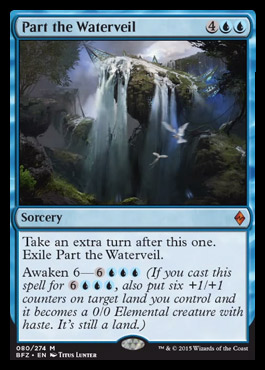
As you saw in the videos, Turns (seems like the easiest way to refer to it), has a very consistent and surprisingly resilient game plan: survive until Turn 5 and then begin taking all the turns available in the game. With a Howling Mine effect in play (Dictate of Kruphix is preferred), every turn nets you one card or more and allows you to chain turns until you eventually win with an awakened Part the Waterveil land.
I’m a big fan of Modern, and I’ve always followed the fringes of the format for new decks. For a long time, that’s where Turns existed. It ran downright weird cards like Savor the Moment to try and piece together extra turns. While the deck would often string together a lot of turns, it would mostly fail to string together a lot of wins. Sometimes it would draw the engine, sometimes it would draw the extra turns, sometimes it would draw the win conditions, but it had a very hard time consistently doing them together.
Part the Waterveil changes all that.
No longer does the deck have to split slots between ways to win and ways to take extra turns. Part the Waterveil isn’t a four-of in the deck, but it is vital in combining win condition and extra turn all into one, allowing the deck to cut more situational cards and function more smoothly.
And I’ve learned quite a bit about the deck in that time. For starters, the good and bad matchups, as well as the cards that over and underperform. In general, two types of decks give Turns trouble: extremely aggressive decks, and slower-but-still-aggressive decks that also pack disruption. In practical terms, that means Burn and Zoo and Affinity are hard matchups, and tempo decks like Merfolk or Bant-flavored aggro builds are nearly impossible to beat. While the pure aggro decks can be sideboarded against and raced, the other decks that represent a solid clock plus counterspells are a nightmare for the deck.
Luckily, those are only a part of the metagame. The rest is full of decks I consider good matchups for the deck: “fair decks.” Splinter Twin, Abzan, Grixis, Scapeshift, “big” Zoo are all favorable. Tron feels like a bye. Other combo decks are beatable, and even Jund must combine their hand disruption with a fast clock to defeat you. Basically, any deck trying to play “fair” midrange Magic has a tough time preventing you from completing your plan.
The Game Plan
Let’s talk about what makes the deck “work.” It’s no surprise that in a deck full of Time Walk effects, taking turns is the basis of its success. But what that means in practice may surprise you: it’s not all about taking extra turns yourself, it’s about denying your opponent a turn. From Spreading Seas to to Gigadrowse to Cryptic Command, the deck is full of virtual Time Walk effects long before it ever takes an extra turn. Seas can take your opponent off a key spell, buying you another turn. Cryptic Command is obviously great, oftentimes denying an attack step or countering a key spell.
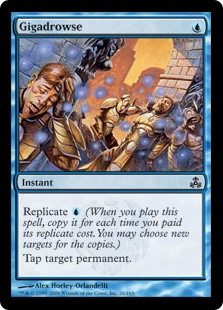
Gigadrowse is the best of the bunch, and probably the best card in the deck. It’s just so flexible, I’m honestly surprised it doesn’t see more play in Modern. It steals attack steps. It taps down opponents on their end step to set you up to go off. It taps down combo or Tron decks in their upkeep to steal a turn away from them. Better yet, due to how Replicate works (the copies go on the stack individually and resolve individually), counterspells are useless against it. A blue player can be sitting on all the counters in the world, but they’ll never get to use them when you Gigadrowse their mana before starting your turn. I even won a game against a Twin player by casting two of my three copies of Gigadrowse on their Deceiver Exarch when they cast Splinter Twin with counterspell backup. I tapped down the Exarch as well as one of their lands, used Cryptic Command to bounce the creature on my main phase, and went on to win the game. No other card does so much in that spot.
The deck is pretty straightforward in theory. Use the cantrips to set up your early turns (and occasionally plan out a timely Miracle Temporal Mastery), Spreading Seas to slow them down, hopefully flash in Dictate of Kruphix on their end step, untap and hold up Cryptic Command or Gigadrowse, and then cast Time Warp on Turn 5 and never pass the turn back to them.
The different Time Walk effects all have a purpose. Time Warp is the best for its mana cost, Temporal Mastery makes your early game more explosive and is fine late, Walk the Aeons allows you to chain together multiple turns off one card when you need it, Temporal Trespass can be absolutely clutch when you need to both Time Walk and play another Howling Mine effect, and Part the Waterveil is your win condition. Each one is good in its own way, and understanding how to sequence them will increase your win percentage with the deck.
The Cards
While many of the cards in the list are locked in, there are some flex spots. For instance, many lists run Thassa, God of the Sea. While it certainly has its advantages, I found that after a dozen or so matches with the deck I never once won with Thassa. While Scrying every turn is nice, the card serves to make your good matchups better, and does nothing in the difficult aggro matches that give you trouble. I went to Repeal to try and add a flexible spell that was good against both aggro and control, I’ve come around to Elixir of Immortality since it buys you a turn against aggro while also serving to prevent you from decking yourself, which is sometimes a concern.
There is a cost to cutting Thassa, and that is the fact that you have to be very careful with your Part the Waterveil. While you can freely cast the first, the second must be saved to win the game since the card exiles itself as part of its resolution. While in theory this can cause you to lose the game (as you saw in my match against Merfolk), the truth is it can almost always be played around, unless you run into the very rare situation where you have only the second Part the Waterveil left in hand and nothing to buy another turn, whether real or virtual. This hasn’t yet come up for me, and I suspect it’s a corner case that is more than offset by replacing Thassa with a card that helps in other places. And, in the match against Merfolk, I punted that game by forgetting about Harbinger and not Gigadrowsing his lands before I began to attack.
Because your deck has to get to nine mana to make a creature, you almost always have complete control of the game by the time you even present a creature for them to target. Whether it’s with Gigadrowse or Cryptic, by the time you’re ready to Awaken a land you’re ready to protect it as well.
Jace Beleren is something I’m not currently running but could find a home. It can buy you life against the aggro decks if they go for it, and it can theoretically present an alternate win condition. If you’re going to put a secondary win condition in the deck, this is the one I’d go with.
The Lands
This is another subject I want to touch on. I’ve seen several lists that run colorless sources like Dreadship Reef, Ghost Quarter or Mikokoro, Center of the Sea. While there is some merit to the effect each of those offers, I’m not sold. The deck has heavy need of blue
For starters, storage lands seem to hurt you more than they help. Yes, if you charge it twice it can speed you up by a turn, but if you’re playing a deck that allows you to charge it up twice you’re not going to need that extra mana as often as you’re going to need colored mana in the first few turns of the game. Testing with storage lands and Mikokoro, I’ve lost games to not being able to fully Replicate a Gigadrowse or cast Cryptic Command on the fourth turn. The deck can afford only a few colorless sources, and I prefer the straight lifegain of Radiant Fountain to those. I’ve even considered Skyline Cascade as another hedge against aggro, though I suspect it’s too risky to be worth it.
Oboro, Palace in the Clouds and Minamo, School at Water’s Edge weren’t in my list when I made the videos but there’s not much reason to not run them as small insurance against Choke.
The List
I’ve made you wait for the updated list because I know how these articles go. You find the list, cut a few cards you don’t like, and go to town. Feel free to do that, but at least this way you’ve hopefully read the reasons why the deck looks like it does.
[deck title=Mono-Blue Extra Turns]
[spells]
*1 Elixir of Immortality
*2 Howling Mine
*2 Gigadrowse
*4 Serum Visions
*3 Sleight of Hand
*4 Spreading Seas
*4 Dictate of Kruphix
*4 Cryptic Command
*4 Time Warp
*2 Part the Waterveil
*2 Walk the Aeons
*4 Temporal Mastery
*1 Temporal Trespass
[/spells]
[land]
*19 Island
*1 Oboro, Palace in the Clouds
*1 Minamo, School at Water’s Edge
*2 Radiant Fountain
[/land]
[/deck]
The Sideboard
There are several directions to go with the sideboard, and I’ll caution that mine is currently very experimental.
[deck title=Sideboard]
[spells]
*3 Dispel
*3 Dragon’s Claw
*3 Sun Droplet
*2 Whiplash Trap
*1 Laboratory Maniac
*1 Gigadrowse
*1 Boomerang
*1 Hibernation
[/spells]
[/deck]
Basically, you have to decide how you want to handle the aggro decks. The Dragon’s Claw/Sun Droplet give a chance against Burn, but they also eat up a ton of sideboard slots while not always even being that great, not to mention mediocre against creature-based aggro. While I did go 2-0 against Zoo in that 12-3 Magic Online run, it’s entirely possible you’re supposed to cut these cards and free up spots.
One of the things I’m testing in those spots is a few Traps. Whiplash Trap and Lethargy Trap accomplish some of the same things you’re looking for from the Claws and Droplets, while also being better mid-game topdecks. There’s a ton of room for experimentation here (Exhaustion and Aetherize come to mind), and I don’t want to presume to tell you what is best for your local metgame.
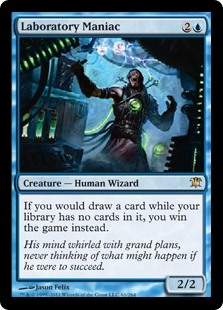
If you’re only running the Part the Waterveils to win in the main deck, I suggest Laboratory Maniac for the sideboard. It gives you a win condition that beats infinite life or Ensnaring Bridge, and can be protected late, even if it’s a bad draw early. Whether it’s Lab Maniac or Thassa or Jace Beleren, a secondary win condition is key to be able to beat Surgical Extraction.
Everything else is fairly generic, and should be localized to your expected metagame. Dispel and additional Gigadrowse are clutch against blue-based control or combo decks, while Hurkyl’s Recall or Hibernation give you additional game against the green decks.
When it comes to what to board out, I typically cut the Spreading Seas first. After that goes one of the Howling Mines, as well as the Elixir if I’m against a deck I’m bringing in Laboratory Maniac against. You can also cut a Walk the Aeons if need be.
Tips and tricks
Prioritize hands with early game over hands with late game. Serum Visions and Sleight of Hand are more important than Dictates, and both are more important than Time Walks.
Learn all your uses of Gigadrowse. Against the blue decks you generally want to save it for their end step, against the aggro decks you want to combat step it, while against the midrange decks it’s often best used in the upkeep just to tap down lands (Tron literally can’t interact at anything other than Sorcery speed). Don’t be scared to burn it to just tap down two of their lands on Turn 2 or 3 if the rest of your game plan is in place.
Always be aware of how many turns you have. If you can stack up turns with a miracle Temporal Mastery or cheap Temporal Trespass, make sure to keep a die to remind yourself.
Similarly, know how many turns it will take you to kill. Decking yourself is a real concern with the deck, and don’t be afraid to use your Cryptic Command to bounce your own Howling Mines once you’re in control.
Remember that Dictate of Kruphix has Flash. Obviously you want to end-step it against opponents, but sometimes when you’re going off you can flash it in during your upkeep to net an extra card before casting a Time Walk effect.
Don’t be afraid to Explore. There are definitely times when it’s okay to just cast a fifth-turn Time Warp to get an extra land into play before passing.
Once you start taking turns, don’t drain yourself to keep doing. There are plenty of times I take even a few turns before just passing back to the opponent with Cryptic Command up. It’s often better to pass with seven mana for Cryptic Command and Dictate of Kruphix up than it is to burn a Time Walk for marginal value.
Generally, this is a deck where you’ll want to wait until the last minute to go off. I’d rather play around as many things as possible than start going off too early — with Gigadrowse in the deck you are always live to give yourself an opportunity to off risk-free rather than take a chance. In practice, this means passing with mana open rather than tapping out to cast a Time Warp against an opponent who could possibly prevent it.
Have all the turns
I think that covers everything you’ll need to know. I strongly urge you to give this deck a shot, because it’s legitimately very competitive in the current Modern meta. It has play against almost all the field, and many opponents won’t know how to interact with your deck. While my absurd rate in two-mans is obviously a good run against average competition, this deck is proven to have play at any level of competition.
Let me know if you have any questions. I feel like this deck is very much a work in progress, and there are a lot of changes — large and small — worth testing. From tweaking cards in the mono-blue version to maybe going crazy and playing Green for Explore and Rites of Flourishing, Turns has a bright future in Modern.
Two podcasts, three hosts. What could go right? Jason chats with Marcel on Monday and Ryan on Tuesday because that’s how it could happen. Is Jason up for an interview-style cast? (No) Is Marcel willing to take the secondary role and allow himself to be passively interviewed? (No). Is this a good episode? (Yes)
Marcel and Jason discuss OotG spoilers. OotG is how I prefer to abbreviate it.
Are the new cards real? Good?
Marcel and Jason get real about the game,
Jason and Ryan talk some of the same topics
The future of finance?
The relevance of diamond mana?
Pick of the week may or may not happen
There’s plenty of potential after hours in what we cut
Support our Patreon! DO IT. You know this cast makes you more than $1 a week
We’re serious about the Patreon. Expect new perks.
England’s finest griddle cakes, whisking you away in a whirlwind of comfort. Can you handle the storm of wonderful being served up for you? Toss us in the toaster and see.
Who loves pauper? We love pauper.
The latest in GP shenanigoats.
Honey, WotC shrunk the information.
Charity streams.
Ken’s knife handling tips.
Seriously, go eat a crumpet. Thanks us in the comments.
I’m going to level with you. I don’t remember anything about recording this episode. I think it was a good one. We talked about a lot of non-Magic stuff, so, you’re welcome, I guess. We discussed Animorphs at one point? I’m not entirely sure that even made the cast. We talked about the weird new Wastes card (I think). I wish I could blame substances for not remembering but I literally just have no excuse. If you want to listen to the episode and send us show notes, we’ll send you tokens or something.
?
Support our Patreon! DO IT. You know this cast makes you more than $1 a week
Whipped Potatoes – 1) boiled potatoes that are blended using a whisk or an electric mixes to integrate air into the mixture. the process creates a creamier texture compared to mashed potatoes.
2) potatoes too timid to stand up to their wife.
The gang is lost without Marcel
Tournament results
PES a bad TO?
Yada Yada Yada
Pick of the Week is back! Except only Jason does one
Support our Patreon! DO IT. You know this cast makes you more than $1 a week
Streaming is a lot like a first date. You better watch what you say, and you can’t take it back. The Plan address a crummy incident and tries to find some sense in the nastiness and find a lesson in it all.
We stop pretending we are smart and drool about Overwatch.
Em is being woo.. err uhhh I mean enticed by Commander.
WotC dropped a flavour bomb of Tibalt hype.
SCG events changes are somewhat irritable, if not confusing for Shane.
Magic sure is funny. GP Atlanta was a Commander 2015 release party. Wizards doesn’t want MTG Goldfish providing MODO match data. Patrick Chapin is a corner case. It’s a weird children’s card game we play and weird stuff happens.
GP Atlanta recap
There was a middle part to this episode. I just re-listened and already forgot
MTG Goldfish ordered to not publish results?
How are the Commander 205 decks?
Pick of the Week is back!
Support our Patreon! DO IT. You know this cast makes you more than $1 a week
Woah. What a week it’s been for the format. In the week running up to GP Seattle, Legacy seemed to go from being relatively quiet and keeping to itself, to exploding with energy and buzz. I was hoping to do this week’s article on the new Jace and his place in Legacy but a lot has happened that I want to talk about. So let’s look at Legacy in the aftermath of the last Legacy GP of the year, and what lies ahead in 2016.
Let’s first take a look at GP Seattle and see what went down Stateside.
For a start, I was way off in my Top 8 prediction. I got half of it right but the other half completely threw me. Two Shardless decks Top 8’d, as well as Miracles and Grixis/4C Delver, but where I was wrong was in the other four. There was a second 4C Delver as well as a crazy Reanimator deck that I’ll get to in a bit, Lands, which took down the tournament, and Aluren. Yes. Aluren came out of nowhere and Top 8’d a GP. What a Top 8.
Both Shardless BUG lists and the Miracles list were fairly stock. Nothing super interesting to report on. Andrejs Prost decided to go for the [card]Scrubland[/card] in the sideboard to splash for [card]Meddling Mage[/card], a move that a lot of Shardless players are making, whereas Xin Sui chose not to, and decided to play a higher planeswalker count with two [card]Jace, the Mind Sculptor[/card] and three [card]Liliana of the Veil[/card], instead of the 1-2 split the deck usually favours.
The two Delver decks were more or less the usual lists with a few spicy exceptions. Christian Calcano made it to the finals with a version that resembled a Canadian Threshold deck, with a leaning towards [card]Stifle[/card] and [card]Wasteland[/card]. It evidently proved successful for the Calculator himself as he ended up finishing second. Gary Wong, on the other hand, decided to play a single [card]True-Name Nemesis[/card] and two [card]Abrupt Decay[/card] in the main. Wong’s list looked to be favoured against some of the slower decks however Calcano appeared to have the edge against Miracles, thanks to the inclusion of Stifle.
But that’s all boring, normal stuff for a Legacy GP. Now we can move on to the real meat of this Top 8.
In a turn of events I was not expecting in any way, Aluren made the Top 8 in the hands of Martin Goldman-Kirst. For those that aren’t aware, Aluren is a combo deck based around the card, [card]Aluren[/card]. The goal is to land the four mana enchantment and then combo off with [card]Cavern Harpy[/card] and [card]Parasitic Strix[/card], or just out-value the opponent with cheap creatures that are CMC 3 or less. His particular list included a playset of [card]Imperial Recruiter[/card] and [card]Shardless Agent[/card] as value cards, as well as a single [card]Eternal Witness[/card]. The deck is a perfectly fine choice but when your combo can go off on turn three at the earliest, you fall into some small issues in regards speed. However, Goldman-Kirst was able to pilot the deck to a great finish so perhaps, it’s time to bring the deck back? A man can dream.
After Aluren, the big head turner of the Top 8 was Chase Hansen’s Reanimator deck. Reanimator making the Top 8 wasn’t that much of a surprise. It’s become very popular in Legacy over the last few months and it’s got a good Shardless and a good Miracles matchup. But this particular build is very strange. Two maindeck copies of [card]Misdirection[/card] and three copies of [card]Izzet Charm[/card] immediately jump out to me. Charm is a card I’ve liked since it was first spoiled but it’s hard to find a home for two mana [card]Spell Pierce[/card]. Now the other modes are very relevant, but at two mana it’s not fantastic and is just outclassed by other options. Although if it does have a home, it might be in Reanimator. The [card]Faithless Looting[/card] mode is very good in this deck and having the ability to protect the combo or remove pressure in the form of [card]Insectile Aberration[/card], [card]Monastery Mentor[/card] or [card]Vendilion Clique[/card] is excellent. The Misdirections are probably a concession to the amount of [card]Abrupt Decay[/card]s that are seeing play, which is also why this deck is only running two [card]Animate Dead[/card].
I do quite like the singleton [card]Jace, Vryn’s Prodigy[/card] in this deck as it functions as a repeatable looting outlet which can be very good when you draw one too many reanimation targets. [card]Jace, Telepath Unbound[/card] is also a fine addition to the deck when he appears, helping to either stem the bleeding when you’re under fire or flashback a reanimation spell from earlier in the game. I’m not certain if I’d bump the wee lad to two copies as I’ve yet to do any testing with him in Reanimator.
I was surprised to see Lands win the tournament. It’s a deck that I find will often make the Top 8 consistently but will have difficulty closing out the tournament. I even said last week that I wouldn’t expect any kind of [card]Mox Diamond[/card] strategy but yet those words couldn’t be further from the truth. Jarvis Yu’s winning deck has nothing out of the ordinary, bar a very cool single copy of [card]Molten Vortex[/card], which was already starting to see play in Lands, and a juicy one of [card]Riftstone Portal[/card]. In many ways, I’m not surprised. It’s a deck that has a pretty good Miracles matchup and an equally good Shardless matchup, I find, seeing as it’s able to keep up the card advantage, albeit in different ways. Lands has also always been good at preying on fair decks, and now that the Delver decks are moving towards a [card]Young Pyromancer[/card] approach, [card]The Tabernacle at Pendrell Vale[/card] is just obscene. Though I don’t expect Lands to suddenly dominate considering how expensive the deck is, thanks to the aforementioned Tabernacle, as well as the playsets of both [card]Wasteland[/card] and [card]Rishadan Port[/card]. However when it does show up, I could definitely see it making a great run.
So that was GP Seattle. I don’t know how many people got a chance to see the coverage but Channel Fireball did a great job. The Timeshifted matches they had in between rounds were excellent, and something I think other broadcasters could definitely look at doing. Well done to them for the GP, they really ended the Legacy year on a bang.
Which brings me to my next point. And it’s a bit of an elephant in the room, but also not really.
Last week, after my article had been sent in, Star City Games announced their plans for the Open Series next year, including a brand change to the Open Tour and the removal of a season, going from four to three. But the big change that has a lot of people upset and angry is their Legacy support, or moreso, their waning support.
The company announced that they would be continuing with the mini-GP structure that they had introduced for the 2015 season, something I was generally happy with, even though I wasn’t a fan of the sudden drop in Legacy coverage. They also announced that they were dropping Legacy as an Invitational format, and so far, only one Legacy Open is scheduled to take place in Season One. To compensate, they are still running the Premier Invitational Qualifiers at each Open. However, the prize pool will not be money. Instead, they will be tickets for a Prize Wall, akin to what we have seen at GPs.
Now, I don’t want to sound subjective, and I’m going to do my best to not, but these changes are ridiculous. Cutting back on the amount of Legacy coverage was bad. The format wasn’t getting the regular attention it used to and we lost the regular big tournaments for data purposes. But I could understand this because the commentators were being overworked. And SCG’s coverage would lose a lot if Patrick Sullivan and Cedric Phillips were showing signs of weariness. But these changes are bad for the format. And not because we’ve only got one Open in the first third of the year, which is still pretty poor. Changing the PIQ prize payouts to non redeemable prize tickets, that can’t be “banked” from one event to another, is almost insulting. Several players used to fly or make long travel arrangements for these PIQs and now, SCG have decided to acknowledge that by giving you the chance of winning unsold Commander product and playmats, if what we’ve seen at GPs is anything to go by.
Now this has enraged the Legacy community, and not just in America. Over here in Europe, we’re angry. It doesn’t impact us but when we saw that there would be loads of people selling out of Legacy, we raised our voices just as much. It’s been clear that Legacy is an underdog format that hasn’t had fantastic support, especially in most of America. But things like this just make it harder to continue playing paper Legacy, for some people. And that makes me very sad.
But I’m not going to be one of those people yelling to the heavens, “Legacy is dead! Sell your duals! Sell your duals!” I’m keeping my duals, thank you very much because 2016 looks set to be cracking for Legacy. Not only are there three Legacy GPs next year (two of which are on the same weekend!) but Bazaar of Moxen announced, almost immediately after SCG made their announcement, that they would be hosting six (Yes, SIX.) Legacy Opens in Europe, each with a prize pool of 7,500 Euros. Just read that sentence again. I know I am.
That’s just amazing. I’ve already booked time off work for the one in London and the one in Germany, and maybe I might just book a third off. The BoM has always been a great supporter of Legacy and Vintage, part of the reason they were asked to organise GP Lille this year, so seeing them host six opens for the format is just huge. Plus, the MKM Open Series is starting to pick up traction and who knows, with enough success and time, we could see that becoming the European SCG Circuit.
So yes, the naysayers are out in full force, and people are mudslinging and badmouthing all around, but all they gotta do is take a look at what’s out there and see how much Legacy is happening. And how great it is to be playing the format right now. The format is diverse and filled with all kinds of great decks. People were saying the format was going to revert back to pre-Khans of Tarkir after the most recent banning, but that’s not even true because Canadian Threshold was the best deck back then, and I don’t even know if there is a best deck, let alone consider it to be Canadian Threshold.
If you guys have any suggestions for what you’d like me to chat about next time, let me know down below. Until then, remember: Let the Cascade trigger resolve!
People generally hate land destruction in EDH and I think that’s okay. Land destruction is not terribly fun for the affected and tends to make games last forever. So we’re a no go on land destruction – but what about land DESTRUCTION? As in, destroying people with your lands? That sounds about a million times better and way more fun. With Zendikar back in the MTG spotlight, so too is the spotlight back on lands and their effect on the battlefield. So let’s take a look at 5 commanders who give land destruction a whole new meaning.
[card]Kamahl, Fist of Krosa[/card]
Kamahl is one syllable away from having the same name as legendary wrestler Kamala so already this guy has a leg up on most opponents he’ll face. Kamahl is all well and good in an animate land strategy but let’s be honest, he turns the once mighty lands around him into little wiener creatures who get eaten by Sanctuary Cats. I guess it’s a pretty good thing he comes with an Overrun tacked right onto his muscular-dude body. Overrun on a pair of jacked up hams? Count me IN.
Kamala, claw of Uganda. Remember when he didn’t know how to pin guys? Oh Kamala, will you ever win?
[card]Titania, Protector of Argoth[/card]
Titania is a very trendy commander these days it seems, she’s basically the Chipotle of EDH, or maybe Narset is Chipotle and Titania is the term “Netflix and chill” of EDH. Either way, she’s a top trend these days and it’s probably mostly due to the fact that she is a build-around commander that employs a different strategy. Titania’s gameplan is one we haven’t seen much of in Commander and no other general quite recreates the feel of her abilities. Titania (by the way, don’t try and make up a shortened version of her name, it won’t end well) kills people by sacrificing and killing her own lands and if that isn’t doubling up on land destruction, I don’t know what is.
[card]Omnath, Locus of Rage[/card]
What are we calling this guy? The angry cloud? Fire arms? Blob man? For the record, I’m up for any of those but I will need full credit if one goes viral and somehow starts making money. This isn’t related but it really looks like Omnath, Locus of Rage is wearing flared pants in his BFZ card. Blob-bottoms? Omnath is only one of 2 commanders that have the landfall ability and his is by far the best. When you drop lands, this guy drops 5/5 elementals. I feel like we can make this work in EDH and in fact I did in a recent episode of The Commander’s Brew that you can check out on iTunes or your local podcast app.
Check out those slacks!
[card]Borborygmos Enraged[/card]
What is it that Gruul commanders are so upset about? Is it the not being able to remove creatures efficiently in EDH? Is it the not being able to use conjunctions and make full sentences? These guys live in the forest and just hunt, eat and have sex all day. It’s primal but Jesus, it’s basically paradise. Seriously, relax. Borborygmos especially has nothing to complain about, he turns lands into Lightning Bolts and is even getting some play in Modern and he costs 7. GET OVER YOURSELF PAL.
(Fun fact: Borborygmus is an actual word for the noise your stomach makes before you fart or something)
[card]Jolrael, Empress of Beasts[/card]
Jolrael is a commander I didn’t even know existed until recently, mostly because strategies where you animate lands into creatures scare me. I live in fear of turning all my precious mana producing lands into little dudes, having someone drop an instant speed Rout and then I quickly cry like I’m watching the end of Pixar’s Inside Out. While Jolrael does nothing to quell those fears, she does offer up the option to respond to someone’s Wrath of God with an activation that can kill one of your opponent’s lands. Hope you guys like kid’s movies because Sadness might be at the controls when they see Jolrael in your command zone.
Since we can clearly see Jolrael is the queen ofour brand of land destruction, (let’s just ignore Titania, admittedly) AND killing other people’s lands, let’s dive a little deeper into Jolrael and exactly what it is that makes her and her deckmates such a force to be reckoned with.
[deck title=Jolrael and the Killer Forests]
[creatures]
*1 Acidic Slime
1 Avenger of Zendikar
*1 Baru, Fist of Krosa
*1 Borderland Ranger
*1 Budoka Gardener
*1 Farhaven Elf
*1 Frontier Guide
*1 Garruk’s Packleader
*1 Genesis Hydra
*1 Giant Adephage
*1 Grazing Gladehart
*1 Hornet Queen
*1 Kamahl, Fist of Krosa
*1 Liege of the Tangle
*1 Moldgraf Monstrosity
*1 Nacatl War-Pride
*1 Ondu Giant
*1 Oran-Rief Hydra
*1 Patron of the Orochi
*1 Pelakka Wurm
*1 Rampaging Baloths
*1 Silverglade Elemental
*1 Soul of New Phyrexia
*1 Sporemound
*1 Thelonite Druid
*1 Walking Atlas
*1 Wood Elves
*1 Woodborn Behemoth
*1 Terastodon
*1 Yavimaya Elder
[/creatures]
[spells]
*1 Beacon of Creation
*1 Boundless Realms
*1 Collective Unconscious
*1 Desert Twister
*1 Explosive Vegetation
*1 Gaea’s Touch
*1 Harmonize
*1 Harrow
*1 Howl of the Night Pack
*1 Hunting Wilds
*1 Into the Wilds
*1 Khalni Heart Expedition
*1 Kodama’s Reach
*1 Life and Limb
*1 Natural Affinity
*1 Nissa’s Expedition
*1 Nissa’s Pilgrimage
*1 Overrun
*1 Overwhelming Stampede
*1 Ranger’s Path
*1 Reach of Branches
*1 Rites of Flourishing
*1 Rude Awakening
*1 Triumph of the Hordes
*1 Waiting in the Weeds
*1 Zendikar’s Roil
[/spells]
[land]
*39 Forest
*1 Myriad Landscape
[/land]
[/deck]
It’s often joked that the scariest turn one play is to play a basic Island. In this deck we’ll be taking that joke and turning it into a hilarious twisted nightmare akin to M. Night Shyamalan’s The Happening for our opponents by having them totally fear the forest. Since Jolrael turns our lands into attacking creatures, we definitely want as many Forests as possible and the more we have the more destruction they’ll cause and the more invisible gas they’ll make.
Cards that usually make people fear the basic forest are things like [card]Kalonian Twingrove[/card] or [card]Oran-Rief Hydra[/card] (both of which we have in this deck) but the real way to make your opponents tremble in fear isn’t to just plant a bunch of trees – it’s to plant a bunch of trees and then make your trees turn into monsters and decimate your competition. I’m talking about Shyamalan-levels of plant murdering creatures here. We’re going to make our opponents say “What? Noo!” like only Mark Wahlberg in a very unconvincing role in a horrendous motion picture can.
This guy is super confused. “Lands… are creatures?”
On the top of the “making forests monsters” card list is what I can only assume would be Ravishing Rick Rude’s all-time favourite Magic card, [card]Rude Awakening[/card]. I remember getting this card in a pack of Modern Masters and since I was just cracking them for “value” (I was new, okay?) I swear I could hear the Price is Right noise of people losing at Plinko ringing in my ears as I saw this in y rare slot. Animate lands? Entwine? I wanted a Kiki-Jiki! Well, lucky for us, years later Jolrael inspires me to build a deck and lo and behold, Rude Awakening pops its head out of my binder and becomes maybe the best card in my latest EDH deck.
The whole point of this deck is jam as many forests as possible on the battlefield, turn them into creatures and then swing in for a kill. Rude Awakening not only achieves this, but can also become a massive ramp spell while at the same time surprise blocking an invading army. Honestly, the value is like… wow… I just need a second okay?
Sorry about that, okay back on track here, Rude Awakening isn’t the only card in the deck that springs our lands into battle, in addition to Jolrael we’ve enlisted the help of the instant speed [card]Natural Affinity[/card], [card]Thelonite Druid[/card] which turns our lands into 2/3s but requires a sacrifice first and [card]Hunting Wilds[/card] which is a little mini Rude Awakening plus a bit of ramp. We also have [card]Life and Limb[/card], but I’ll be honest I think this one is a little risky, as once it’s out there, your lands are permanently creatures and thus very open to a mass removal… happening.
So if you haven’t figured it out by now, Jolrael and her forests are going to use a classic swarm strategy of making a million guys and then pumping them all up and swinging in huge. So let’s support it not only with token producers, but with token producers based on how many lands we have. [card]Beacon of Creation[/card], [card]Howl of the Night Pack[/card] and the totally, insanely good [card]Avenger of Zendikar[/card] all make as many tokens as we have lands and in this deck, we will have a LOT of lands. My personal favourite of these being [card]Waiting in the Weeds[/card] mostly because of the amazing art featuring the weirdest cats in the world. (Which apparently were supposed to be squirrels?)
“Well Jerry, your cat is fine but it got into a fight in the forest and now it’s ears are 3 feet long.”
Playing any mono-coloured strategy in EDH can be risky, so whenever you do it, it’s a good idea to really play to the strengths of that colour. In our case, Jolrael does exactly that by utilizing ramp as a way of building up an army. Any EDH player worth their salt knows a good amount of green ramp spells so I’ll just say that [card]Boundless Realms[/card] is so good it’s sort of like that scene in The Happening when the guy said he was bringing hotdogs on the trip for no reason. Some other ramp spells that may not come to mind right away include [card]Skyshroud Claim[/card], [card]Ranger’s Path[/card], [card]Silverglade Elemental[/card] and [card]Gaea’s Touch[/card]. All excellent ramp spells that you may not normally play in a multi-coloured deck, but really shine in mono-green.
So that’s how you destroy your friends with the very air-bringing trees around them. Throw a few landfall cards in there like [card]Zendikar’s Roil[/card], [card]Rampaging Baloths[/card] and [card]Sporemound[/card] for some reach, a few aforementioned [card]Overrun[/card] effects and watch as your army of tree-beast-monster things take down your enemies’ Commanders, power lines, ill-parked cars and bands of travelers outrunning a mysterious and ridiculous gas the trees are emitting because somehow they’re mad at people for global warming.
Topics include: A dalliance with Legacy, publishing match-up percentages, Legendary Cube, The Force Awakens fears, Slick’s gaming and e-sports outlook, video game nostalgia, JR’s Daily Fantasy Sports legal update, multiplayer Magic, the Goiânia accident, and the “Baghdad Battery”.
Control decks have lost their way in BFZ Standard. They currently represent Less than five percent of the winning meta game. Control often flounders in the early meta because the deck is made of answers. If the threats haven’t stabilized in the meta, it is hard to know which answers to include. There are a number of different lists being piloted in that tiny percentage of the field, and I’d like to take a look at them to find similarities and differences to help you design your own take on this extremely fun deck type.
Control decks are made primarily of answers to assumed threats. They grind down opponents by trading one card for two, drawing additional cards, and removing any important threats from the board. In the late game, control decks become heavily favored because their players will have more cards in hand, more options, and usually a consistent, hard-to-kill threat on the table. The Esper Dragons list from the previous Standard meta is a great example. The deck was made of removal spells like [card]Bile Blight[/card], [card]Hero’s Downfall[/card], [card]Languish[/card], and [card]Crux of Fate[/card], counterspells like [card]Silumgar’s Scorn[/card] and [card]Dissolve[/card], card draw spells like [card]Dig Through Time[/card], and one monster threat in [card]Dragonlord Ojutai[/card]. There were other role players in the deck, but essentially we removed threats and plopped an Ojutai on the table once we had that mana to play and protect him. Then he became an opponent-damaging, card-drawing machine. If you could play and protect him, the game was pretty much over. A few key cards like [card]Hero’s Downfall[/card], [card]Bile Blight[/card], and [card]Dissolve[/card] rotated with Theros block. There are a few replacements, but they are deceptively much worse in most situations than their Theros counterparts.
Playing control has been tough lately because of GW Megamorph’s ability to gain card advantage through Deathmist Raptor recursion, Den Protector antics, and Mastery of the Unseen’s manifests. Recently, the renewal of Crackling Doom has made sticking a late game threat more challenging, forcing Ojutai control players to turn to different strategies. The midrange strategies like Jeskai Black and GW Megamorph pose trouble for control’s strategy. What is a control player to do? I’d like to bring a few of the control options in BFZ that are waffling for supremacy to light and see what makes them tic, and what deck combinations might be possible as the format matures.
Here are a number of different control lists that have some promise in the new format. Most of these won’t see significant competitive play, but you never know when an odd list might break out against a shifting field. They are listed in order of their current meta game percentage as measured on MTGGoldfish.com.
Top Control Deck Lists by current meta game percentage
One thing jumps out at me when I look over all of these lists. Even though they don’t all attack along the same lines of offense nor utilize the same defensive measures, they all play white and most count white as a core color making up a significant portion of their deck.
The second thing I notice is that the most competitive deck (Esper Dragons) runs 4 [card]Jace, Vryn’s Prodigy[/card]s while only two other decks run Jace at all, and then only as a two of. Jace has been a hot button in the Standard crowd over the past month as his price has skyrocketed to over $70. Even though he fits right into the control strategy, brewers are maneuvering around him possibly because of the extremely high price tag. So far, the lists without Jace haven’t seen much success.
Top Ten Cards by number played
[card]Dig Through Time[/card]
[card]Scatter to the Winds[/card]
[card]Stasis Snare[/card]
[card]Planar Outburst[/card]
[card]Ojutai’s Command[/card]
[card]Arashin Cleri[/card]c
[card]Silkwrap[/card]
[card]Duress[/card]
[card]Jace, Vryn’s Prodigy[/card]
[card]Dispel[/card]
[card]Dig Through Time[/card] is everyone’s favorite card drawing engine. Cast spells, draw more cards! The number two card, [card]Scatter to the Winds[/card], which also happens to be a [card]Dissolve[/card] minus the scry is a blue answer with upside. [card]Stasis Snare[/card] is a one-size fits all answer to your opponent’s creatures. [card]Planar Outburst[/card] is the new wrath of choice leaving behind any land creatures you might have made with a previous Outburst or with Scatter. [card]Ojutai’s Command[/card] shines brightly with Jace and [card]Arashin Cleric[/card]. [card]Silkwrap[/card] is a great answer for an opponent’s Jace, and considering everyone is playing this little bugger, it is a good idea to have some cards designed specifically to deal with him. [card]Silkwrap[/card] also prevents an opponent from using [card]Ojutai’s Command[/card] to get their Jace back on the battlefield. [card]Duress[/card] helps us prevent Gideon from hitting the table and also the various commands from interfering with our card dominance. [card]Jace, Vryn’s Prodigy[/card] is in just about everybody’s deck. He is a card drawing, pitching, and then recurring engine. Lastly, [card]Dispel[/card] is an efficient counter for our opponents’ spells.
The only black card in the top ten list is duress, and I think that overall the control strategy for BFZ is shedding black. The black removal isn’t as good with the loss of [card]Hero’s Downfall[/card], [card]Bile Blight[/card], and [card]Drown in Sorrow[/card]. White removal has jumped way ahead with [card]Stasis Snare[/card], [card]Silkwrap[/card], [card]Planar Outburst[/card], [card]Quarantine Field[/card], and [card]Suppression Bonds[/card]. Hand disruption is strictly worse with the loss of [card]Thoughtseize[/card]. Black just isn’t as powerful in the control shell as it was in the last season.
The thing that this top ten doesn’t take into account are the finishers and role players. [card]Dragonlord Ojutai[/card] is certainly a star, as well as [card]Secure the Wastes[/card], and [card]Ugin, the Spirit Dragon[/card]. We can find multiple examples of these finishers throughout the deck lists.
As far as role players go, I think we include at least one copy of [card]Valorous Stance[/card] mostly as removal, but also to prevent our precious creatures from being removed. This can be quite a surprise to an opponent in game two or three when they have seen no copies yet.
What if we took all the most played cards in these control decks and made a list? It might look something like this. Maybe W/U Hodgepodge Control will show up in your meta next week?
Topics include: Breaking news on pack-mapping to locate BFZ Expeditions, population growth and economics, the CNBC debate fiasco, some Commander 2015 cards, Shadows over Innistrad, Star City’s diminished Legacy support, and the Travis Woo fiasco.


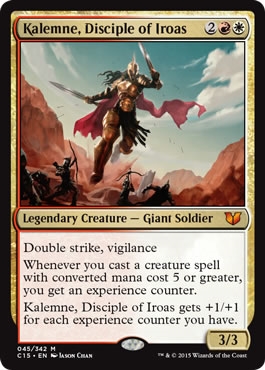



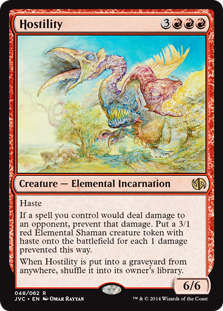






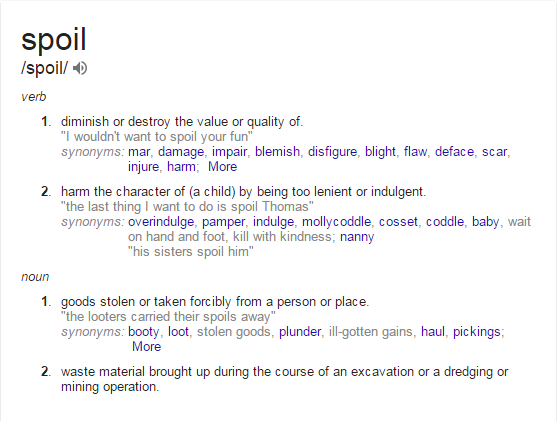




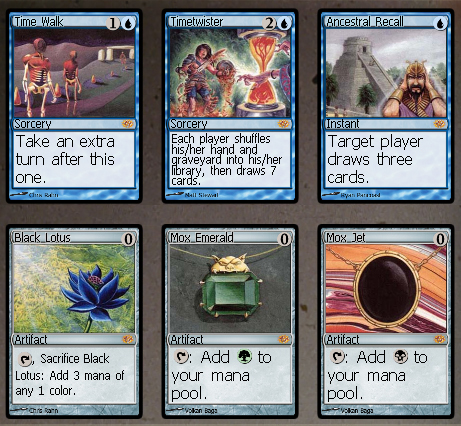

 To start off, let’s address the elephants in the room. The egregious violators of the “Turn 4” decree, the combo decks that you “can’t interact with.” Amulet Bloom and Grishoalbrand. While it is true that both decks are difficult to interact with and each have their own forms of resilience (despite reasonable fail rates), neither are oppressive in the current Modern metagame. They don’t REQUIRE changes in order to maintain a healthy format. That said, both decks do play very differently than the other combo decks in Modern. They feel as though they don’t belong, as though they should be relegated to some nonexistant purgatory, an ethereal format hovering somewhere between Modern and Legacy. There’s a reason for that feeling, for that sickening dread that befalls you when Borborygmos starts flinging [card]Temple of Malice[/card]s at you after watching your opponent goldfish for ten minutes on his or her second turn. There’s a reason why you shake in anger, becoming a Dragon Ball Z-esque personification of all things tilt when your opponent plays his or her THIRD (insert expletives here) [card]Primeval Titan[/card] on turn two while you’re literally crushing your Japanese foil [card]Abrupt Decay[/card] in your helpless little, white-knuckled hand. There is a spirit to the Modern format. There is a feel for what is and is not allowable, or acceptable, in the format. As I said, neither of these decks have to be addressed. But should they be addressed? I believe they should.
.jpg/revision/latest?cb=20140804120720) Do I even matter? You hear that Grishoalbrand players? Your deck causes people to have existential meltdowns during your second turn. All joking aside, the sweetness of the deck comes from playing really cool cards that should absolutely not be banned in Modern. [card]Goryo’s Vengeance[/card] is awesome and, in every deck OTHER than Grishoalbrand, it’s a cool tool that can generate value and does some pretty sweet things. [card]Nourishing Shoal[/card] + [card]Worldspine Wurm[/card] + [card]Through the Breach[/card] absolutely should be a thing in Modern. What I absolutely do not think should be a thing is [card]Simian Spirit Guide[/card]. Being able to start off a [card]Desperate Ritual[/card] chain with no prior mana floating violates this “spirit of Modern” I’ve proposed. [card]Simian Spirit Guide[/card] is unique, it’s the only free, mana source-speed way to create mana in the format. At the steep cost of a card, you don’t just bypass one turn’s worth of mana development. You negate your opponent’s chance to interact, to play a second land to [card]Remand[/card] that [card]Through the Breach[/card], to [card]Thoughtseize[/card] that [card]Hive Mind[/card] because your opponent’s [card]Inquisition of Kozilek[/card] revealed two [card]Summer Bloom[/card]s. You, Players-of-[card]Simian Spirit Guide[/card] violate what we, the Other Players of the Format Modern, know to be just, what we know to be fair (or at least acceptably unfair).
Do I even matter? You hear that Grishoalbrand players? Your deck causes people to have existential meltdowns during your second turn. All joking aside, the sweetness of the deck comes from playing really cool cards that should absolutely not be banned in Modern. [card]Goryo’s Vengeance[/card] is awesome and, in every deck OTHER than Grishoalbrand, it’s a cool tool that can generate value and does some pretty sweet things. [card]Nourishing Shoal[/card] + [card]Worldspine Wurm[/card] + [card]Through the Breach[/card] absolutely should be a thing in Modern. What I absolutely do not think should be a thing is [card]Simian Spirit Guide[/card]. Being able to start off a [card]Desperate Ritual[/card] chain with no prior mana floating violates this “spirit of Modern” I’ve proposed. [card]Simian Spirit Guide[/card] is unique, it’s the only free, mana source-speed way to create mana in the format. At the steep cost of a card, you don’t just bypass one turn’s worth of mana development. You negate your opponent’s chance to interact, to play a second land to [card]Remand[/card] that [card]Through the Breach[/card], to [card]Thoughtseize[/card] that [card]Hive Mind[/card] because your opponent’s [card]Inquisition of Kozilek[/card] revealed two [card]Summer Bloom[/card]s. You, Players-of-[card]Simian Spirit Guide[/card] violate what we, the Other Players of the Format Modern, know to be just, what we know to be fair (or at least acceptably unfair). As a final note, the last card I want to briefly touch on is [card]Blood Moon[/card]. There is a very vocal portion of the Modern player base that despises this card. I would not count myself among them (though I definitely wouldn’t consider myself a fan of the card), but their calls for a banning based on the notable percentage of noninteractive games that occur once [card]Blood Moon[/card] has resolved is at least worth noting. [card]Blood Moon[/card] and [card]Choke[/card] are relics of a different era in Magic. Land destruction, mana denial, and prison-strategy enablers have been phased out of R&D’s design based on the feedback of players and what they consider to be enjoyable gaming experiences. That said, [card]Blood Moon[/card] does require that the vast majority of decks must have a broad enough sideboard to deal with it and, perhaps in the eyes of the DCI, there should be constraints on the manabases players choose to play with.
 record ourselves doing a draft every week, and every second week we’d record one for
 Eventually, it made me depressed. Not in a constantly-being-upset sort of way, but in a way that I didn’t feel like anything mattered anymore. Things that usually made me happy didn’t faze me anymore, things that would make me upset usually I just shrugged off. I felt like I was floating through my life on auto-pilot with friends, family and the whole world just rolling off of me like water off a duck’s back. I started to realize how serious this was, and I started to get a little scared, when I couldn’t think of a series of events that would ever make me feel happy again.