Episode Archives

The Grandest Truths: An Origin Story

In the beginning, there was Jesus. Adrian De Jesus. Adrian is a friend of mine, who I first met towards the end of my freshman year of university. He’s been a pretty influential figure in my Magic life, having been the one who first introduced me to the Commander format.

When we first met, I was just a budding FNM grinder, battling my heart out each Friday with whatever pile of garbage I was playing at the time (Likely this pile). He showed me a brand-new casual format that he and his roommate were playing: EDH. I didn’t actually have any Legendary Creatures at the time, so being the generous guy he is, he traded me the one that truly spoke to my inner Timmy: [card]Mayael the Anima[/card].

From that point on, I was hooked. I built as many as I could afford, and then more. I went from just one Mayael deck, to a [card]Riku of Two Reflections[/card] deck, a [card]Volrath the Fallen[/card] deck, a “Bant-chantments” deck with [card]Treva, the Renewer[/card] at the helm, a pile of forests led by [card]Azusa, Lost but Seeking[/card] and an almost-completed [card]Jarad, Golgari Lich Lord[/card] dredge strategy.

But then Modern happened.

I sold the majority of those cards. Bought the [card]Mox Opal[/card]s and [card]Arcbound Ravager[/card]s that have brought me so much joy (and moderate competitive success).

But enough of that nonsense. Let’s talk Mayael.

Mayael

Mayael is a cross between a mana cheat deck and a good-stuff deck. It boasts a pile of ways to generate extra value and “draw cards”. The goal of the deck is to simply try and hit every land drop every turn and eventually grind its way into a winning position with its bevy of extremely powerful creatures.

[deck title=Bryan’s Mayael the Anima]

[Creatures]

*1 Dryad Arbor

*1 Sakura-Tribe Elder

*1 Eternal Witness

*1 Yavimaya Elder

*1 Solemn Simulacrum

*1 Spellbreaker Behemoth

*1 Surrak, the Hunt Caller

*1 Baneslayer Angel

*1 Xenagos, God of Revels

*1 Endbringer

*1 Greenwarden of Murasa

*1 Steel Hellkite

*1 Sun Titan

*1 Wurmcoil Engine

*1 Angel of Serenity

*1 Balefire Dragon

*1 Dragonlord Atarka

*1 Eternal Dragon

*1 Gisela, Blade of Goldnight

*1 Gruul Ragebeast

*1 Krosan Tusker

*1 Spearbreaker Behemoth

*1 Windbrisk Raptor

*1 Archetype of Endurance

*1 Bogardan Hellkite

*1 Magmatic Force

*1 Terastodon

*1 Woodfall Primus

*1 Ulamog, the Infinite Gyre

*1 Worldspine Wurm

[/Creatures]

[Spells]

*1 Green Sun’s Zenith

*1 Sensei’s Divining Top

*1 Sol Ring

*1 Swords to Plowshares

*1 Worldly Tutor

*1 Cream of the Crop

*1 Rampant Growth

*1 Cultivate

*1 Deep Reconnaissance

*1 Domri Rade

*1 Elemental Bond

*1 Fires of Yavimaya

*1 Kodama’s Reach

*1 Nissa’s Pilgrimage

*1 Oblivion Ring

*1 Birthing Pod

*1 Day of Judgment

*1 Explosive Vegetation

*1 Greater Good

*1 Nevinyrral’s Disk

*1 Return to Dust

*1 Wrath of God

*1 Asceticism

*1 End Hostilities

*1 Hallowed Burial

*1 Austere Command

*1 Garruk, Caller of Beasts

*1 Guild Feud

*1 Lurking Predators

*1 See the Unwritten

*1 Warstorm Surge

*1 Insurrection

[/Spells]

[Lands]

*1 Blighted Woodland

*1 Canopy Vista

*1 Cinder Glade

*1 Command Tower

*7 Forest

*1 Homeward Path

*1 Jungle Shrine

*1 Kessig Wolf Run

*1 Krosan Verge

*1 Mosswort Bridge

*4 Mountain

*4 Plains

*1 Reliquary Tower

*1 Rootbound Crag

*1 Sacred Foundry

*1 Spinerock Knoll

*1 Stomping Ground

*1 Sunpetal Grove

*1 Temple Garden

*1 Temple of Abandon

*1 Temple of Plenty

*1 Temple of Triumph

*1 Temple of the False God

*2 Wastes

[/Lands]

[Commander]

*1 Mayael the Anima

[/Commander]

[/deck]

The Commander

Mayael is a commander that places a fairly strict restriction on deckbuilding. She absolutely requires a pile of five power or greater creatures in order to take advantage of her powerful ability. My version runs 27 creatures that fit the bill, giving me approximately an 80% chance to hit on average (Aside: Hypergeometric calculators are super useful in Magic. In my case, you’d want to input a population of 99 cards, 27 successes, a sample size of 5, and a number of successes in sample of 1. This should result in a probability of about .8044).

Beyond that, I’ve decided to include a bit of “top control” to the deck, allowing me to keep the top card of the deck what I want it to be. This is done most often with [card]Cream of the Crop[/card] and [card]Worldly Tutor[/card], but beyond that, [card]Sensei’s Divining Top[/card] combined with the large amount of shuffle effects in the deck can create a similar effect.

Getting to the end game

    With nine ways to generate extra mana, Mayael has no trouble getting up to the six-plus range she needs to start really moving the game plan forward. Beyond that, with the five board sweepers, she has little trouble slowing down opponents who get too far ahead. A few cards allow Mayael to take huge leaps forward in cards and mana, notably [card]Birthing Pod[/card] and the two planeswalkers, [card]Domri Rade[/card] and [card]Garruk, Caller of Beasts[/card]. These cards are highly effective at bridging the gap from early to late game.

How to end a game of Commander

    By smashing in faces with an army of dragons, beasts, elementals and spaghetti monsters! Mayael has all the tools needed to turn the corner from just playing some random dork every turn into a huge advantage that can dominate a game. The best way she has to do this is the combination of two durdly six-mana enchantments that are very close to my heart: [card]Lurking Predators[/card] and [card]Warstorm Surge[/card]. Lurking Predators allows Mayael to churn out threat after threat, and the Surge makes sure that even if there is something preventing combat, the creatures will still get to do something.

Matchups

Graveyard decks

    This is easily the worst matchup for Mayael. Notably, the card [card]Grave Pact[/card] and its kin can easily hose Mayael due to her reliance on creature combat to end games. Beyond that, their ability to repeatedly wipe the board via cards like [card]Living Death[/card] and [card]Living End[/card] combined with [card]Eternal Witness[/card] or [card]Skullwinder[/card] can be devastating to this strategy.

Voltron decks

    This matchup, admittedly, doesn’t come up too much around my own group, but at the events I’ve brought Mayael to, I’ve played against this strategy a few times. It’s a fair, but not great matchup. The board sweepers do a good job of helping shore up the matchup, and the deck presents enough threats that the Voltron player can have a hard time breaking through.

Big Mana decks

    This is a matchup I would call positive. Wraths and answers are everywhere in this list, and the threats do a good job pressuring the big mana decks to be reactive instead of developing their own position, which is not what the strategy is designed to do. It is possible for Mayael to flounder in the early game, and this style of deck is the archetype that is most punishing of missteps.

Mana Cheat decks

    In the mirror match, the sheer card advantage built into the deck can usually be used to leverage a win. Most mana cheat decks tend to be a “one-and-done” kind of strategy: playing out their first 10 to 15 cards and then scrambling to regain the lost card advantage they spewed putting their threats down early. Mayael may cheat on mana slightly, but the steady stream of value from cards like [card]Domri Rade[/card], [card]Elemental Bond[/card], and [card]Sun Titan[/card] can help overwhelm them going long.

Good Stuff decks

    Mayael can sometimes struggle with having enough answers for all of their threats, but overall, the matchup feels good, as we’re making so much extra mana and card advantage compared to them on average. Still, enough [card]Sphinx’s Revelation[/card]s can undo any strategy, so there’s always a chance for them to out-card us.

Possible Improvements

    This deck can go in many directions given the multitudes of giant creatures available in Naya colors. Some ideas include going a bit bigger and more aggressive with cards like [card]Craterhoof Behemoth[/card], [card]Avatar of Slaughter[/card], or [card]Kozilek, the Great Distortion[/card]. Alternatively, the deck can play a bit more defensive with choices like [card]Avacyn, Angel of Hope[/card], [card]Vorinclex, Voice of Hunger[/card], and [card]Blazing Archon[/card]. There are tons of options available and if anyone has any they’re particularly fond of, I highly encourage them to post it in a comment below.

    And there it is. My first Commander deck. A never-ending work of love. The deck has undergone as many changes are there are changes to make, and then some. In my eyes, a Commander deck is never truly done. Each list I post is simply a snapshot in time. A look into what decisions and ideas went into the deck at that time, ready to change as soon as a new spoiler or a sick reprint is announced (Are you hyped for Eternal Masters? Because I’m hyped for Eternal Masters.) I truly hope each and every reader gets a small something out of each one of these articles, whether it be a new card for their favorite deck, or inspiration for their latest and greatest project.

All the best,

Bryan

Brainstorm Brewery #183 – Masters, Eternally

Eternal Masters is announced and there literally isn’t much else to talk about. Really. Check below if you think we talked about more because we didn’t.


  • Help us prep for episode 200. Seriously. Hit us up to find out how to help.
  • Baby finance!
  • No more duel decks?
  • Eternal Masters. Alllll day.
  • New format?
  • Conspiracy?
  • Legacy the same as modern?
  • Pick of the WEEEEEK!
  • Support our Patreon! DO IT. You know this cast makes you more than $1 a week
  • Need to contact us? Hit up [email protected]


Contact Us!

Brainstorm Brewery Website – E-mail – Twitter Facebook RSS iTunes Stitcher

Ryan Bushard – E-mail – Twitter Facebook

Corbin Hosler – E-mail – Twitter Facebook MTGPrice

Jason E Alt – E-mail – Twitter FacebookMTGPrice

Marcel White – E-mail – Twitter

Lena Dunham and the Nude Goats of EDH!

So there’s a Magic: The Gathering Movie in the works and everyone from pros, to casuals, former players to current ones and even WOTC employees and the artists are all thinking the same thing: CASTING. Who will play Jace? Who will play Karn? Who will play Fblthp? (My votes on these go: Joseph Gordo-Levitt – yes I call him Gordo, Vin Diesel, and Bobcat Goldthwait, respectively.)

Sorry but this guy sucks.

Sorry but this guy sucks.

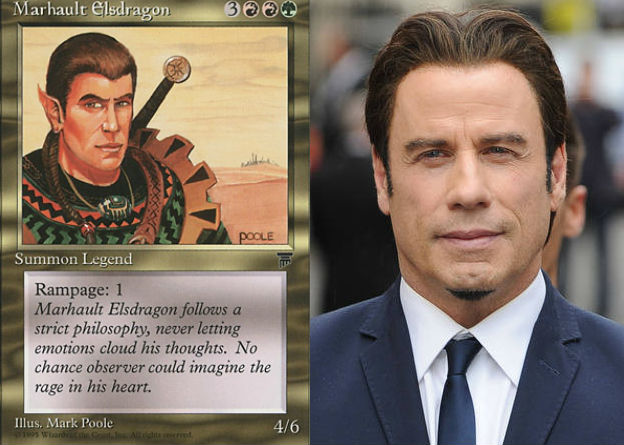
I can tell one thing, artists have been thinking about the Magic movie since the game’s inception. You can tell because they’ve been not-so-secretly casting actors and celebrities to play the parts of legendary creatures in their cards since there has been such thing as a legendary creature. But is anyone really interested in a movie about [card]Marhault Elsdragon[/card] starring the always questionably hair-plugged John Travolta? No, of course not. That sounds terrible. But what about some other Legends who resemble celebs? Could their movies turn out to be the cash-cow Hasbro is looking for? Let’s check out 5 commanders who look like celebrities and then build a deck around the one we think is the least terrible.

Look, there's nothing not cool about Sean Connery playing Odric holding a glowing sword, but the guy is like 100 now.

Look, there’s nothing not cool about Sean Connery playing Odric holding a glowing sword, but the guy is like 100 now.

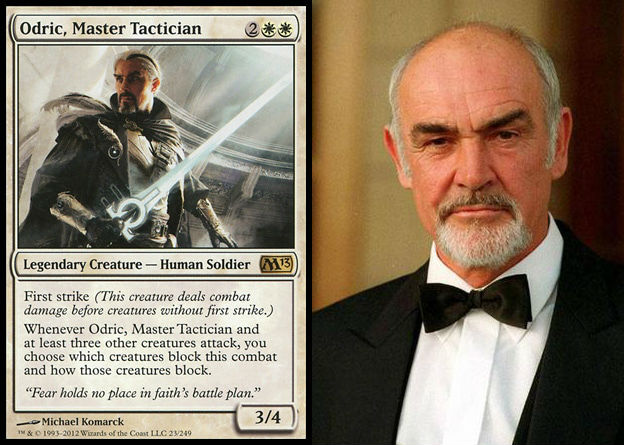
[card]Odric, Master Tactician[/card] – Sean Connery

This is the classic as far as I’m concerned. Sean Connery as Odric leading an army of soldiers into battle against some evil presence, probably something that looks like orcs but we’re not going to call them orcs because we don’t want to be accused of ripping off LOTR even though we fully are. Not a terrible pitch, but we can’t use Connery as Odric, because this movie would have to end up with Odric deciding for the orcs that they just wouldn’t block/fight back and the movie would only last as long as it takes for 3 other dudes to join him.

Lena Dunham was born to drive goats.

Lena Dunham was born to drive goats.

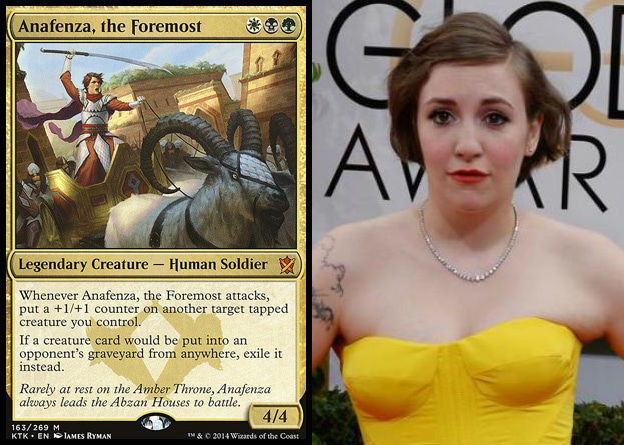
[card]Anafenza, the Foremost[/card] – Lena Dunham

I’d watch a movie about Anafenza just to see Lena Dunham ride a chariot pulled by goats, so I’m going to say this sounds strong to me. I’m not so sure about the clause that I’m positive Lena would write into the contract however; that Anafenza must get sloppily nude at least once in the film. I mean, I’m all for getting tastefully nude, but something about the proximity to the goats is making me uneasy. Wait, the goats are always naked! Lena will LOVE this!

This casting also works out if we ever need someone to play "bored person waiting for storm player to finish turn".

This casting also works out if we ever need someone to play “bored person waiting for storm player to finish turn”.

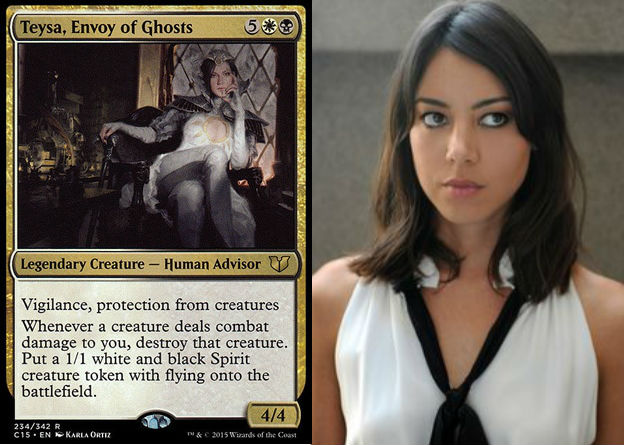
[card]Teysa, Envoy of Ghosts[/card] – Aubrey Plaza

When it comes to an actor who;s mastered looking bored and angry sitting in a chair, look no further than grumpy cat’s human form, Aubrey Plaza. Her job on Parks & Rec was to basically act as disinterested as possible and if I can judge anything about the character of Teysa by purely going on the art from her card and not reading any of the books or anything, it’s that she is mighty indifferent about most things – especially that chair and possibly even that old cane she is holding. But does all this add up to a Blockbuster film? Probably not, right?

Jason Momoa was on Baywatch. I found that out writing this article.

Jason Momoa was on Baywatch. I found that out writing this article.

[card]Daxos of Meletis[/card] – Fat Jason Momoa

Big Daddy Daxos, or more like Big Dad-Body Daxos could easily be an action star, we just need to get Momoa to eat nothing but burritos and spray cheese for a few months first. Look I’m not saying Daxos is fat, but when he took his shirt off Elspeth tried to jump behind him and choke him out with a chain. Seriously folks, Daxos is so fat when Olivia Voldaren bit him she got diabetes. For real, the guy gets no respect, no respect at all.

How could you go wrong with a Sith Airbender? Wait he's Bant colours? And he sucks!?

How could you go wrong with a Sith Airbender? Wait he’s Bant colours? And he sucks!?

[card]Johan[/card] – Darth Maul mixed with Avatar, the Last Airbender

Gone are the days when you could ask a 7th grader to draw you a picture of a “rude demon”, put it on a magic card where the colours make no sense and have an ability that I get tired of trying to understand about 2 seconds into reading it. No, nowadays the people in charge of Magic make sensible creatures like Chromanticore and make reasonable abilities like Annihilator. Seriously, the text on this card is so brutal whoever writes the Oracle text couldn’t even figure out how to just say “Creatures you control get Vigilance if Johan is untapped” without their head turning into a mashed turnip. I don’t want to make a movie about this card based purely on spite.

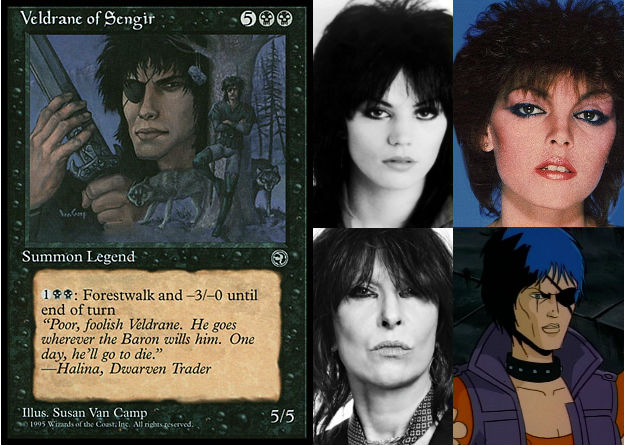
Look this hairstyle was obviously as popular in Sengir as it was here in the 1970's... and in the Morlock's Tunnels.

Look, this hairstyle was obviously as popular in Sengir as it was on Earth in the 1970’s… and in the Morlock’s Tunnels.

[card]Veldrane of Sengir[/card] – Joan Jett/Chrissy Hynde/Pat Benatar/Callisto from the 90’s X-Men cartoon

In a bizarre chain of events, if Wizards really wanted to mess everything up, they could go a real “The Imaginarium of Dr Parnassus” route and have this obscure character played by 3 former rock goddesses and a fairly obscure cartoon character. Now THIS is the movie I want to see. Admittedly, there’s never ever been a good movie made with the word “Imaginarium” in it’s title, but I think this time it could work. “The Imaginarium of Veldrane of Sengir” is a title that just screams TAKE MY MONEY, does it not?

So which one of these magnificently bad movie ideas/celebrities should I build a budget deck for? Well I’m going to go with Lena Dunham and her nude goats for what I think are pretty obvious reasons. Despite the pure bliss that making a deck around Veldrane would be, I’ll pick something that you may actually be able to win with once and a while.

[deck title= Lena Dunham as Anafenza in NUDE GOATS, the Magic: the Gathering Movie]
[Creatures]
1 Anafenza, the Foremost
1 Abzan Battle Priest
1 Abzan Falconer
1 Ainok Bond-Kin
1 Anafenza, Kin-Tree Spirit
1 Archetype of Courage
1 Archetype of Finality
1 Attended Knight
1 Bane of Progress
1 Bloodflow Connoisseur
1 Bloodspore Thrinax
1 Butcher of Malakir
1 Captain of the Watch
1 Champion of Lambholt
1 Crowned Ceratok
1 Dauntless Escort
1 Elite Scaleguard
1 Farhaven Elf
1 Fertilid
1 Forgotten Ancient
1 Goldnight Commander
1 Gyre Sage
1 High Sentinels of Arashin
1 Knight-Captain of Eos
1 Longshot Squad
1 Mazirek, Kraul Death Priest
1 Mentor of the Meek
1 Mer-Ek Nightblade
1 Mikaeus, the Lunarch
1 Mirror Entity
1 Mycoloth
1 Odric, Master Tactician
1 Pathbreaker Ibex
1 Sigil Captain
1 Skullmulcher
1 Springjack Shepherd
1 Tuskguard Captain
1 Viscera Seer
[/Creatures]
[Spells]
1 Abzan Ascendancy
1 Abzan Charm
1 Arachnogenesis
1 Ashnod’s Altar
1 Cathars’ Crusade
1 Collective Unconscious
1 Conqueror’s Pledge
1 Decree of Justice
1 Deploy to the Front
1 Dictate of Erebos
1 End Hostilities
1 Hardened Scales
1 Kodama’s Reach
1 Martial Coup
1 Mobilization
1 Nature’s Resurgence
1 Nomads’ Assembly
1 Ordeal of Nylea
1 Palace Siege
1 Rampant Growth
1 Return to Dust
1 Shamanic Revelation
1 Sol Ring
1 Titania’s Boon
1 Trading Post
[/Spells]
[Lands]
1 Blighted Fen
1 Blighted Woodland
1 Blossoming Sands
1 Evolving Wilds
7 Forest
1 Golgari Guildgate
1 Golgari Rot Farm
1 Grasslands
1 Grim Backwoods
1 Jungle Hollow
1 Orzhov Basilica
1 Orzhov Guildgate
7 Plains
1 Sandsteppe Citadel
1 Scoured Barrens
1 Selesnya Guildgate
1 Selesnya Sanctuary
1 Spawning Bed
1 Springjack Pasture
4 Swamp
1 Temple of the False God
1 Terramorphic Expanse
[/Lands]
[/deck]

So Anafenza likes to attack, place counters on things, and she doesn’t let our opponents’ creatures hit the graveyard, so naturally, lets get some things that care about counters, let us attack and kill the other guys’ creatures.

So let’s start things off by playing to the Abzan colours’ strengths and build around token producing and mass +1/+1 counter addition. This is something Green & White love to do and since we have access to black, let’s add some sacrifice benefit since that also synergizes with our token theme. We’ll sac tokens to draw cards and also to force our opponents to sacrifice their creatures. Finally, we’ll use some creatures like [card]Abzan Falconer[/card] to give our team a mass ability like flying and see everyone just sail over our opponents and put them out of their misery.

Of course since we’re in green, ramp should be no problem, especially when we get great synergy out of cards like [card]Gyre Sage[/card] and [card]Fertilid[/card]. The more counters the better on these guys and Fertilid even takes advantage of Bolster triggers which generally look pretty weak in EDH.

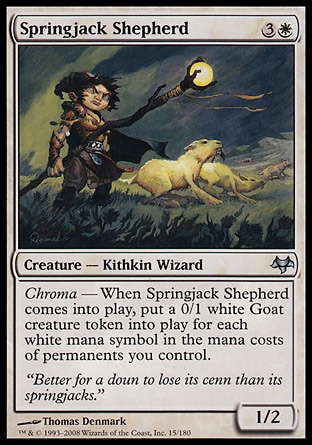
As far as token producers go, it just doesn’t get too much better these days than [card]Mycoloth[/card]. Since his reprinting in C15, he’s had a drop in price, and really, if you’re running a sacrifice/tokens build, you just can’t go wrong with the big fungus. Other budget token makers I love are [card]Conqueror’s Pledge[/card], [card]Mobilization[/card], and since we need to represent Lena’s goats, [card]Springjack Shepherd[/card]. Goats are a bit of a theme in this deck and when I say “theme” I mean “joke”.

Release the goats!

Release the goats!

So with an army of tokens, and probably a lot of other guys, the best thing to do is mass pump them all and swing for the win, right? Well, since this strategy tends to ramp up instead of explosively going off in one turn, we’ll take a lot of creatures that add incremental value to the creatures we have out on our board. Something like [card]Elite Scaleguard[/card] or the aforementioned Abzan Falconer do a good job of arriving on the battlefield and letting you win of you have a decent state already, but they also add value to your board state as you get ready to swing for the win with adding damage over many turns and even Outlasting. [card]Crowned Ceratok[/card] is another solid way to add evasion to your creatures with counters and once you get your [card]Bloodspore Thrinax[/card] up and running, everything is huge anyways, so let the nude goats run free!

Finally, you’re not always going to be on the attack in EDH. We know this, Lena Dunham knows this, and certainly [card]Butcher of Malakir[/card] knows this. Naturally, since Anafenza sports a Junk/Abzan colour scheme we’ve included some sacrificing effects that work well with our numerous tokens. Sac outlets like [card]Viscera Seer[/card] and [card]Ashnod’s Altar[/card] are staples in the format and Butcher of Malakir (played by Adam Driver? Nice Girls synergy there.) and [card]Dictate of Erebos[/card] help us out when the board stalls and/or we’re staring down any hexproof voltron generals.

Just picture the Kylo Ren voice: "Ok, so my token dies and now you have to sac a creature".

Just picture the Kylo Ren voice: “Ok, so my token dies and now you have to sac a creature”.

A few hidden gems that help keep this deck competitive but also under $50 are [card]Palace Siege[/card] – now you can sac your non-token creatures too, [card]End Hostilities[/card] – arguably better than [card]Wrath of God[/card] in decks not running much equipment and [card]Titania’s Boon[/card] – not a super powerful effect, but one you will often wish you had in this deck. Put those beside limited all stars like [card]High Sentinels of Arashin[/card], [card]Ainok Bond-Kin[/card] and [card]Abzan Battlepriest[/card] and you have a sub $50 deck that can swing with the big boys in your playgroup. Also you can act out a weird movie starring Lena Dunham as Anafenza, Adam Driver as the Butcher of Malakir, a host of goats and Andy Serkis as the lovable [card]Mazirek, Kraul Death Priest[/card]! You’re Welcome, HOLLYWOOD.

Brainstorm Brewery #182 – Eldrazi Spawning?

Sleep is for the weak. At least that is what Jason and Marcel want you all to believe as they both pick the first week of February to have their kids. Marcel has to bow out this week due to child-related obligations so the gang gets a very special guest to fill in – Mr. Frank Lepore (@FrankLepore), hot off of his first ever PT where he finished Top 8 which we hear is pretty good. Frank has a lot to talk about and the gang wastes no time interrogating him. Want to know the future of Modern? Look no further.


  • Frank Lepore (@franklepore) is our guest this week
  • How did the PT go? (Spoiler Alert – Top 8)
  • How did the Eldrazi deck perform
  • Bans necessary?
  • What stops the Eldrazi decks?
  • Shadows over Innistrad discussion!
  • Pick of the WEEEEEK! It’s baaaaack!
  • Support our Patreon! DO IT. You know this cast makes you more than $1 a week
  • Need to contact us? Hit up [email protected]


Contact Us!

Brainstorm Brewery Website – E-mail – Twitter Facebook RSS iTunes Stitcher

Ryan Bushard – E-mail – Twitter Facebook

Corbin Hosler – E-mail – Twitter Facebook MTGPrice

Jason E Alt – E-mail – Twitter FacebookMTGPrice

Marcel White – E-mail – Twitter

Money Draught #53 – Equilibrate Up

Topics include: The impact of Oath of the Gatewatch on Modern, “garbage tier finance”, Legacy Cube, JR’s art and mid-century credenza search, the Great Molasses Flood of 1919, The London Beer Flood of 1814, and a call for favorite parliamentary brawls.


** This cast is for mature listeners**


Your Hosts:
Jason Alt — @JasonEAlt
Slick Jagger — @slickJagger
JR — @time_elemental

Money Draught RSS

Best Laid Plans #11 – Chair Stanky Leg

A new year is upon us and the Plan must go on. Em, Shane, Tommy, and Ken all managed to get some streaming in but schedules continue to elude us. Then we briefly check in on Proxypocaplyse 2016 and the series of related missives from WotC. Oath of the Gatewatch has everyone juiced to play with some new cardboard. If you won the lottery, would you buy Wizards? So sit down, get the not delicate wine, and get ready for the stanky leg.


Contact Us!

Best Laid Plans – @BestLaid_Plans

Em – @sheMehay

Shane  – @CreatureMystery

Tommy – @T_Moles

Ken – @Load3r

Kozilek and the Four Es of Running a Commander Night

Life is hectic. Our schedules are conflicting. We can never seem to find the time to get a group together for a game. Many people have trouble trying to get games together, or are forced into Commander nights at local game stores (LGSs) that can often involve griefing or gaming whatever prize support system is in use. I’ve been very proud of my accomplishment of having a recurring, weekly Commander game night with my friends, and I want to share with the world how we got to where we are.

Being the huge nerd/communications major that I am, I developed a series of steps to help start up your very own Commander night. I call them the 4 Es.


  1. Expand your methods of communication
  2. Examine your schedules to find a good time
  3. Enjoy your time playing the games
  4. Evaluate what was successful, and what needs to be changed.


Right out of a 90s corporate training video! Let’s dive in a bit further to see what each one means.

Expand

Many people communicate with their friends via text or in person. That’s fine, but it’s difficult to arrange larger meetings with those tools. My group uses Facebook Messenger, a perfectly reasonable organizational tool, to arrange our game nights. Most important about these tools is that they are instantaneous. It’s crucial to ensure that all group members have up-to-the-minute information about the goings-on of the group as a whole.

One good tool is Whatsapp: an app designed to act as an SMS replacement. It has a very solid group chat option and is used by a small community in my town to discuss all sorts of magical nonsense.

Another good tool I’ve recently discovered is Slack. It’s similar to the other messenger apps, but also similar to IRC (A web based chat client) because it allows for multiple chat channels to separate various discussion topics.


Examine

Take some time out of your day (A bit longer for the first discussion) to discuss exactly when and where your group will meet. Ideally, one member can host, but if the situation doesn’t allow for it, then a communal meeting place like an LGS or even a bar! (Make sure the establishment is okay with you taking up a table for a few hours)

Make sure to discuss specifics and not just generalities, and ideally, this should be a time and place that your group could meet at week in and week out. Be careful not to interfere with work and personal matters. I frequently have to wake up very early in the morning for my job, and the days where I play Commander before having to open the store in the morning can be hell on me. This all might seem obvious, but having made these mistakes, I want to help all my wonderful readers avoid them.

goblin

Enjoy

This is the fun part! Part of being a good organizer and/or host is providing for your guests/group. I’m a big fan of the potluck as a way to break the ice at a new location or with a new group. After moving into my new apartment, the first night of Commander I hosted was accompanied by chips, dip, drinks, and a delicious cardamom chicken dish from the wonderful Jerusalem: A Cookbook. (Recipe can be found at http://tinyurl.com/gu525qy) It went over extremely well, and all my players were excited to return for more the following week. (Spoilers: Week 2 didn’t involve chicken. Just a lot of great games.)

Providing for one’s group doesn’t always have to take the form of home-cooked meals or alcoholic libations. The most important thing a group organizer can provide is a welcome and open environment to have fun and play Magic. To ensure that the guy playing 5-Color Slivers under [card]Sliver Legion[/card] can sit at the game table as the lady playing mono-wraths [card]Oros, the Avenger[/card] and still both have a blast in the game.

Evaluate

This is the most important part of maintaining a group environment and ensuring all your players are interested in returning week after week. In a single word, feedback. Feedback is of the utmost importance. If something dominated every game you played, and you think it might be too oppressive, then bring it up with the group. If your group works together, you can craft a style of game that perfectly matches the group.

This can also include positive feedback on a play or a card you felt was particularly fun or engaging. If your terrifying [card]Kozilek, Butcher of Truth[/card] player is about to go ham on the table, but is timely dealt with by an [card]Insurrection[/card] into a pump with [card]Xenagos, God of Revels[/card] to one-shot the Kozilek player with their own Commander, feel free to compliment them on their sweet play! If your [card]Geth, Lord of the Vault[/card] player uses his brand-spanking-new [card]Yawgmoth’s Will[/card] to cast a flurry of mana doublers out of their graveyard before casting [card]Rise of the Dark Realms[/card] to end it in one fell swoop, that deserves some recognition! Compliment each other’s awesome decisions and plays and critique those that are oppressive to help form an environment that people will want to play games in over and over again.

Deck of the Week

[deck title= Jim Casale’s Kozilek, the Great Distortion]

[Creatures]

*1 Artisan of Kozilek

*1 Blight Herder

*1 Breaker of Armies

*1 Burnished Hart

*1 Colossus of Akros

*1 Conduit of Ruin

*1 Desolation Twin

*1 Duplicant

*1 Endbringer

*1 Endless One

*1 Kozilek’s Channeler

*1 Kozilek, Butcher of Truth

*1 Matter Reshaper

*1 Oblivion Sower

*1 Reality Smasher

*1 Platinum Angel

*1 Solemn Simulacrum

*1 Thought-Knot Seer

*1 Ulamog’s Crusher

*1 Ulamog, the Ceaseless Hunger

*1 Ulamog, the Infinite Gyre

*1 Void Winnower

*1 Walker of the Wastes

*1 Wurmcoil Engine

[/Creatures]

[Spells]

*1 Alhammarret’s Archive

*1 All Is Dust

*1 Basalt Monolith

*1 Chromatic Lantern

*1 Crucible of Worlds

*1 Darksteel Forge

*1 Dreamstone Hedron

*1 Everflowing Chalice

*1 Expedition Map

*1 Gilded Lotus

*1 Grim Monolith

*1 Hedron Archive

*1 Karn Liberated

*1 Lightning Greaves

*1 Mana Vault

*1 Mind Stone

*1 Mind’s Eye

*1 Mox Opal

*1 Nevinyrral’s Disk

*1 Orbs of Warding

*1 Perilous Vault

*1 Relic of Progenitus

*1 Scour from Existence

*1 Seer’s Lantern

*1 Sol Ring

*1 Staff of Nin

*1 Swiftfoot Boots

*1 Thought Vessel

*1 Thran Dynamo

*1 Titan’s Presence

*1 Ugin, the Spirit Dragon

*1 Unstable Obelisk

*1 Unwinding Clock

*1 Ur-Golem’s Eye

*1 Urza’s Incubator

*1 Vedalken Orrery

*1 Voltaic Key

*1 Worn Powerstone

[/Spells]

[Land]

*1 Ancient Tomb

*1 Arcane Lighthouse

*1 Blasted Landscape

*1 Blinkmoth Nexus

*1 Darksteel Citadel

*1 Dust Bowl

*1 Eldrazi Temple

*1 Eye of Ugin

*1 Ghost Quarter

*1 Haven of the Spirit Dragon

*1 Homeward Path

*1 Maze of Ith

*1 Mirrorpool

*1 Radiant Fountain

*1 Reliquary Tower

*1 Ruins of Oran-Rief

*1 Sanctum of Ugin

*1 Shrine of the Forsaken Gods

*1 Strip Mine

*1 Tectonic Edge

*1 Temple of the False God

*1 Thespian’s Stage

*1 Urza’s Mine

*1 Urza’s Power Plant

*1 Urza’s Tower

*12 Wastes

[/Land]

[Commander]

1* Kozilek, the Great Distortion

[/Commander]

[/deck]


Alrighty, so this deck is a new creation by Jim Casale, a writer over at our sister site, MTGPrice.com and an overall pretty awesome human being. When I mentioned I wanted to write articles, Jim was the guy who helped me get my foot in the door, so I’m glad I could have one of his decks to be one of the first I evaluate.

Overall Impressions

If I had to classify this deck into one of the archetypes I listed in my previous article, I would describe this one as a linear Big Mana deck. It uses a plethora of mana rocks like [card]Worn Powerstone[/card], [card]Ur-Golem’s Eye[/card], and [card]Dreamstone Hedron[/card] to power out Eldrazi and other game-ending threats.

The End Game

The Legendary Eldrazi quartet tends to make short work of games, along with various other powerful and expensive colorless cards, such as [card]Wurmcoil Engine[/card], [card]Ugin, the Spirit Dragon[/card], [card]Karn Liberated[/card], and [card]Colossus of Akros[/card] (Super spicy). This deck is very linear in its win condition, relying almost exclusively on creature and commander damage to finish games.

How It Gets There

This deck is jam-packed with mana! I don’t have to list out all the 23 non-land ways this deck makes extra mana to drive that one home. This deck can easily make upwards of 8 mana on turn 4 in Magical-Christmas-Land and can cast its commander with no problems early in the game to refill after having dumped its hand of most mana onto the field in the early stages of the game.

Matchups

Graveyard Decks

Jim’s matchup against fair graveyard decks looks average. His gameplan is fast, proactive, and uses exile as his main removal type. Beyond that, he has a [card]Relic of Progenitus[/card] to help stave off the undead menaces. However, these decks are used to a small bit of hate and will be able to power through it despite being slowed down.

Voltron Decks

With only four wrath effects and Arcane Lighthouse, Jim’s chances against Voltron may seem bad, but his Commander and plethora of Eldrazi with Annihilator help to keep their permanent count, and therefore, their buff count low. Jim shouldn’t have too much trouble with these decks

Big Mana Decks

In a mirror match, Jim should be able to power out his large threats as fast as any [card]Korlash, Heir to Blackblade[/card] or [card]Omnath, Locus of Mana[/card] player, but Eldrazi tend to be a bit bigger than the others. In Magic, generally, when it comes to a mirror match, the deck that goes a bit bigger is usually the winner. Drawing up to seven on a regular basis gives Jim the gas he needs to power through the usually grindy mirror matches.

Mana Cheat Decks

This match-up is where Jim might struggle a bit. With only a few wraths and minimal spot removal, he will have a decent amount of trouble playing from behind when [card]Mayael the Anima[/card] cheats a [card]Godsire[/card] into play or [card]Kaalia of the Vast[/card] drops in [card]Rakdos, the Defiler[/card]. Unfortunately, this is a factor of the deck being a Big Mana deck, which means it’ll struggle when faced with something faster.

Good Stuff Decks

Jim should have little to no trouble going way, WAY over the top of these decks. Even with raw card power, they should be no match for a pile of flying spaghetti monsters coming their way.

Possible Improvements

One thing I noticed was a decided lack of recursion in the deck, outside of an [card]Artisan of Kozilek[/card] and [card]Haven of the Spirit Dragon[/card]. Perhaps adding [card]Haunted Fengraf[/card] or [card]Scarecrone[/card] to help continue the assault. Beyond that, [card]Scorched Ruins[/card] might be a bit better than [card]Blinkmoth Nexus[/card] in this deck, especially as there doesn’t seem to be a way to pump up the Nexus.

Conclusions

This week’s article was a bit different, and I’m excited to hear feedback on it. In my time online, I’ve seen a lot of reference to a Commander group, but little about the nitty-gritty of organizing one, so I hope the mini-guide helps at least one person create their own regular group. Feel free to share any feedback you might have about the it, whether it be positive or negative.


All the best,


Bryan

Nothing but Value: An Introduction to Ephara, God of the Polis

I’ve been struggling to put words on the page. For years now, I’ve been wanting, nay, dreaming of being a Magic writer. Until now, I’d not found a topic I’ve really wanted to write about. Due to ever-tightening life constraints, I’ve been forced from grinding 4 local tournaments and a PPTQ or an SCG Open a week, down to just a weekly Commander game and the occasional FNM (if I’m lucky).

And you know what? I’m really happy about it. Commander has been a very liberating experience for me as a Magic player. I’m no longer invested in winning. I don’t have to spend upwards of $50 a weekend, driving upwards of two hours on most trips (Northern Florida isn’t exactly buzzing with events), and just losing in yet another PPTQ top 8. I can be free to do anything I want, in any style I want, and can feel great knowing that as long as the games were interesting, I succeeded.

My name is Bryan Scholl. I’ve been playing casually for over 10 years, playing competitively for over six and judging somewhat actively for two, and in that time I’ve top 8’d seven PPTQs, an old-style PTQ and a Star City Games Open. I would like to think I’m pretty alright at Magic, but nothing too far from an average grinder. What I believe I do more than the average grinder, however, is consume Magic content. I read, listen to, evaluate, and digest more Magic content than I can handle, most likely. On every drive to school or work, I’m devouring a podcast. On every break, catching up on the latest articles and news. My life has been dedicated to our wonderful game since the first time I opened a booster pack.

For the past six months, I’ve been running a weekly Commander game with a small group of friends. We’re a fairly diverse crew: a pair of kitchen-table exclusive casual players, a pair local tournament grinders, and myself. Each of us has a relatively unique play style and approach to the format, and I plan to examine each one thoroughly over the coming weeks. This first deck is my own. It’s the first Commander deck I built after coming back to the format, and its proven itself to be one of the more successful decks in our metagame

This deck’s commander is [Card]Ephara, God of the Polis[/Card]. It’s a hybrid deck, based around tokens, blink effects, and value creatures. The idea behind it was “How can I best use my commander in order to leverage her powerful set of abilities?”. Typically, it tries to control the early game by using its counterspells and spot removal before deploying Ephara and beginning to draw cards. Most commonly, I’ll find myself trying to reuse my early value creatures as much as possible (via [Card]Crystal Shard[/card], [card]Whitemane Lion[/card] or other similar effects) to ensure I hit my land drops during the early and mid games. The list is slightly tailored to my own metagame, so don’t take it as an example of a completely optimized list, but more a groundwork with which one can create their own take on the commander.

Deck Evaluation and Critique

[deck title=Ephara, God of the Polis]

[Creatures]

*1 Aetherling

*1 Aethersnipe

*1 Angel of Finality

*1 Archaeomancer

*1 Chasm Skulker

*1 Clever Impersonator

*1 Flickerwisp

*1 Heliod, God of the Sun

*1 Karmic Guide

*1 Meloku the Clouded Mirror

*1 Mirror Entity

*1 Mistmeadow Witch

*1 Mizzium Meddler

*1 Mulldrifter

*1 Phyrexian Metamorph

*1 Riftwing Cloudskate

*1 Solemn Simulacrum

*1 Stonecloaker

*1 Sun Titan

*1 Thraben Doomsayer

*1 Trinket Mage

*1 Whitemane Lion

*1 Wall of Omens

*1 Wonder

[/Creatures]

[Spells]

*1 Cathars’ Crusade

*1 Control Magic

*1 Detention Sphere

*1 Faith’s Fetters

*1 Luminarch Ascension

*1 Mastery of the Unseen

*1 Mobilization

*1 Oblivion Ring

*1 Opposition

*1 Propaganda

*1 Sacred Mesa

*1 Capsize

*1 Counterspell

*1 Cyclonic Rift

*1 Day of Judgement

*1 Dig Through Time

*1 Dismiss

*1 Exclude

*1 Force of Will

*1 Martial Coup

*1 Momentary Blink

*1 Path to Exile

*1 Pongify

*1 Spell Crumple

*1 Supreme Verdict

*1 Swords to Plowshares

*1 Bident of Thassa

*1 Crystal Shard

*1 Everflowing Chalice

*1 Mimic Vat

*1 Skullclamp

*1 Sol Ring

*1 Trading Post

*1 Vedalken Orrery

*1 Wayfarer’s Bauble

*1 Elspeth, Sun’s Champion

*1 Jace, Architect of Thought

*1 Venser, the Sojourner

[/spells]

[Land]

*1 Azorius Chancery

*1 Azorius Guildgate

*1 Coastal Tower

*1 Emeria, the Sky Ruin

*1 Faerie Conclave

*1 Flooded Strand

*1 Glacial Fortress

*1 Hallowed Fountain

*7 Island

*1 Kjeldoran Outpost

*1 Moorland Haunt

*1 Nykthos, Shrine to Nyx

*11 Plains

*1 Prahv, Spires of Order

*1 Prairie Stream

*1 Reliquary Tower

*1 Sejiri Refuge

*1 Springjack Pasture

*1 Strip Mine

*1 Temple of Enlightenment

*1 Tranquil Cove

[/land]

[Commander]

*1 Ephara, God of the Polis

[/Commander]

[/deck]

    Well, that’s a lot to take in at once, so let’s break down exactly what went into crafting this deck.

The Commander

Ephara is a commander that asks a decent amount of the deck to make her good. Her triggered ability wants a way to repeatedly generate creatures entering the battlefield, such as with token makers. However, her devotion ability asks for a way to have permanents with mana costs on the battlefield. Most token creatures don’t provide devotion, so I went with a mix of token producers, value creatures and flicker effects to generate the necessary enter-the-battlefield triggers that let this deck snowball enough to take over a game.

Token Makers

[card]Luminarch Ascension[/Card]; [card]Sacred Mesa[/Card]; [card]Mobilization[/Card]; [card]Thraben Doomsayer[/Card]; [card]Heliod, God of the Sun[/Card]; [card]Mastery of the Unseen[/Card]; [card]Meloku the Clouded Mirror[/Card]; [card]Elspeth, Sun’s Champion[/Card]; and [card]Kjeldoran Outpost[/Card] do the heavy lifting here providing fuel for the engine, as well as a win condition when combined with [card]Opposition[/Card], [card]Mirror Entity[/Card] or [card]Cathars’ Crusade[/Card]. The deck is looking to generate at least one token during each players’ turn, so having cheap, repeatable ways to generate tokens is key.

Value Creatures

[card]Æthersnipe[/Card], [card]Angel of Finality[/Card], [card]Archaeomancer[/Card], [card]Flickerwisp[/Card], [card]Karmic Guide[/Card], [card]Mizzium Meddler[/Card], [card]Mulldrifter[/Card], [card]Riftwing Cloudskate[/Card], [card]Solemn Simulacrum[/Card], [card]Stonecloaker[/Card], [card]Sun Titan[/Card], and especially [card]Trinket Mage[/Card] are my value suite. Each one is exceptional in their own right, and when combined with [card]Venser, the Sojourner[/Card] or [card]Mistmeadow Witch[/Card], they represent a ton of value over the course of the game.[card]Archaeomancer[/Card] being blinked repeatedly to recur overloaded [card]Cyclonic Rift[/Card] is a fairly common way to end the game quickly.

Controlling the game

Blue and White excel at controlling the pace of games, and this Ephara deck is no exception. With five counterspells, four wrath effects, and a generous amount of targeted removal, Ephara is set up to dictate exactly how and when spells are played. In a typical four-player Commander game, counterspells are at a premium, and they mesh very well with the game plan of leaving up mana to produce tokens or flash in a creature.

Victory Conditions

The deck has many avenues to victory. [card]Mirror Entity[/Card], [card]Opposition[/Card] and [card]Capsize[/Card] can often win games all on their own. The main win condition, however, is raw card advantage. By continuing to generate resources at a very quick pace over the course of the game, Ephara has the ability to grind out her opponents with ease. Her ability to essentially have 5 draw steps instead of 1 can put the pilot way ahead of their opponents and allow them to take control of the game, ending it however they please.

Matchups

There are infinitely many different commander archetypes, however, a few key archetypes stand out to me as being common across multiple play groups:

  1. Graveyard decks (Ghave, Karador, Meren, Jarad)
  2. Voltron Decks (Geist of Saint Traft, Uril, Zur)
  3. Big Mana Decks (Mono-Black, Mono-Green)
  4. Mana Cheat decks (Mayael, Kaalia, Reanimator)
  5. Good Stuff decks

Graveyard Decks

These are typically fair, grindy decks that rely on the graveyard as an additional resource. These are typically black and green, using commanders such as [card]Ghave, Guru of Spores[/Card] or [card]Karador, Ghost Chieftain[/Card]. Ephara has a good amount of game against these decks by having her primary removal spells exile, and has [card]Angel of Finality[/Card] along with [card]Stonecloaker[/Card] for additional ways to keep the graveyard under control.

Voltron Decks

These decks use their difficult-to-interact-with commanders in order to take advantage of the commander damage rule. Some of the more common Voltron commanders incluse [card]Geist of Saint Traft[/Card], [card]Uril the Miststalker[/Card], and [card]Rafiq of the Many[/Card]. Ephara has a few ways to combat this powerful strategy. Her suite of counterspells will help contain the most powerful buffs to the commander, and the wraths available should help to have interaction with even the hexproof commanders. Most valuable, however, is the token generation and instant speed flicker effects, which allow for a large amount of chump blockers. If the commander keeps running into 1/1 soldier tokens, then it won’t deal any commander damage to the face, which is really all that matters against those strategies.

Big Mana Decks

Most decks in Commander have the ability to generate a large supply of mana, however, some decks are dedicated to the task, then leveraging their vast amount of resources into a win. The most common commanders in this archetype would be [card]Azusa, Lost but Seeking[/Card]; [card]Omnath, Locus of Mana[/Card]; and many mono-black commanders. I know I’ve mentioned the counterspells a lot, but they really are the key to slowing down the unfair decks in the format. If one of the opponents spends their whole turn on a huge [card]Exsanguinate[/Card] or an Eldrazi, one counterspell might as well be a [card]Time Walk[/Card]. Beyond the counterspells, several of the targeted removal spells are useful against any non-land permanent, slowing their mana development. Lastly, there is [card]Strip Mine[/card] (and any other land-death land one might care to include) to help stop that pesky [card]Cabal Coffers[/Card] or [card]Nykthos, Shrine to Nyx[/Card].

Mana Cheat Decks

An archetype near and dear to my heart, Mana Cheat decks look to subvert traditional ways to cast spells and instead simply put them into play. Commanders such as [card]Kaalia of the Vast[/Card]; [card]Sedris, the Traitor King[/Card]; and my first Commander, [card]Mayael the Anima[/Card] all look to circumvent the idea of a mana cost. These decks have a tendency to run out of steam a bit quickly, so Ephara’s controlling nature already makes her a bit of a favorite against this strategy. The wraths and spot removal do a good job of delaying the big mana spells until you no longer care about them

Good Stuff Decks

A very common archetype amongst grinders who want to just jam games in between rounds at larger events, these decks tend to be made up of all-stars from Standards past and a smattering of Modern and Legacy staples. What they lack in synergy, they tend to make up in raw card power. There are no particularly common commanders for this strategy, but I’ve noticed they tend to be either 5-color or some combination with blue in it. Luckily for us, Ephara is a synergy deck, and has a significantly larger ability to snowball than most of the decks using this strategy. The normal gameplan of drawing a ton of cards, then taking control should be more than enough to take down decks like this.

Potential Upgrades from Oath of the Gatewatch and other changes

A few cards from the upcoming set stand out as exceptional in a strategy that plays heavily to the board, and seem like they’ll fit very well into the blink-value-token strategy that this deck plays.

[card]Reflector Mage[/Card] is an insane value creature that will easily upgrade [card]Riftwing Cloudskate[/Card]. The ability that prevents casting is part of the enter-the-battlefield trigger, so even when the Mage is flickered, the restriction is still in place!

[card]Eldrazi Displacer[/Card] looks amazing not only for Standard and Limited, but also for Commander. The blink-on-command ability has a ton of uses and with the deck’s eight dedicated colorless sources, it isn’t too hard to find the mana to use the ability.

[card]Meandering River[/Card] is nothing too exciting, but it is +1 dual land, and those are always welcome in any Commander Deck

Out of older sets, a few cards that deserve looking at include: [card]Duplicant[/Card]; [card]Ghost Quarter[/Card]/[card]Tectonic Edge[/Card]/[card]Dust Bowl[/Card]; [card]Sphinx’s Revelation[/Card]; [card]Elspeth, Knight-Errant[/Card]; [card]Monastery Mentor[/Card]; and any of the new Myriad creatures from Commander 2015.

Moving Forward

In the coming weeks, I plan on breaking down not only my decks, but also those of the group. There are some very interesting ideas and decklists floating around, especially with the new release of Oath of the Gatewatch. This column is still in its infancy, and has many directions it could take. Leave a comment if there was anything you especially enjoyed, or if there’s a question I can answer.

All the best,

Bryan

Why Linear Decks are Not a Bad Thing.

Splinter Twin got banned, Summer Bloom got banned, players raged at the world, at their family, at their lives, but mostly they just raged. I feel it was a net positive for the Modern format to grow and adapt. I think unbans should have occurred with [card]Bloodbraid Elf[/card] and [card]Ancestral Visions[/card] but thats not what I want to get into today.

Its been awhile since I’ve had the itch to write but I’ve been seeing this argument for a long time and nobody is stepping up to support the idea of linear decks in Modern being a net positive. the Merriam-Webster definition which I assume is a good source because its pretty high up on google is a (1) :  of, relating to, resembling, or having a graph that is a line and especially a straight line :  straight (2) :  involving a single dimension” The part pertaining to Modern is latter half that speaks about a single dimension. A term I like to use when describing my decks and something I look for in a deck is elasticity. I want a deck that can hit the ground running but stretch itself in the late game to get the most out of its cards. This is why I gravitate towards midrange decks like Jund and Big Zoo or more aggressive combos like Grishoalbrand. The main culprits that fall into the category of linear are as follows in no particular order.

  1. Burn (okay actually #1)
  2. Bogles
  3. Affinity
  4. Infect
  5. Ad Nauseam
  6. Grishoalbrand

In this list we do have some of the big players in the format but half of them are combo decks which help differentiate the format from being a midrangefest like standard and the other half are the hyper aggressive decks that are here to keep us honest. Overall this list holds only a 30% of market share of the format.

Outside of Bogles which is just dudes with pants and Burn which is just angry people throwing fire at stuff, all of these decks contain a certain amount of the elasticity that I look for during deck building. Affinity has the tools to slog through a [card]Stony Silence[/card] with cards like [card]Ghirapur Aether Grid[/card] or [card]Etched Champion[/card], Ad Nauseam can just punch you with a [card]Grave Titan[/card], Grishoalbrand can attack you with a 15/15 Wurm, and Infect moves to a more conservative tempo based attack.

Why is it bad to be linear?

Seriously why is it a bad thing? The goal in a game of Magic in its broadest sense is to win the game. There are those amazing games out there with a beautiful give and take from both sides that usually end in a savage top deck causing a memorable end for all parties involved. These games feel great to play every now and then but they are exhausting. If the goal of your deck is to be as efficient as possible to help you win a long tournament you can’t let these epic games happen. You need to be tight and go for the jugular. The argument against this is that the long drawn out games allow people to leverage their superior play skill to beat their opponents into submission. This may be true in formats like Legacy which I don’t play and hold no knowledge on or some standard formats but for as long as I have played Modern it has been about metagaming, deckbuilding and sideboarding.

Sideboard Cards

This is the thing that I encounter the most outrage on and I feel like people think that It’s not okay to have dedicated hate cards. In large formats we need to keep the degenerate decks in check somehow. We need a strong push and pull and sideboarding is the best way to do that in Modern. Just because this hasn’t been the norm in Magic before doesn’t make it wrong. I have heard the arguments for Force of Will but I think our free counterspells in [card]Pact of Negation[/card] and [card]Disrupting Shoal[/card] provide solid options for different types of shells although I would love to see [card]Misdirection[/card] make an appearance in the format I will leave that for another article. Overall our hate cards are just as powerful as our synergies, Stony Silence for Affinity, Rest in Peace for Grishoalbrand, Rule of Law for Ad Nauseam and Storm, Night of Souls Betrayal for Infect, etc. Our format is strong but there is a tool to deal with everything if you try and look hard enough.

Being Linear

Without linear decks in our format the great Eldrazi Menace will start to lurk in our top 16s and Tron will step into the limelight. We need them to keep the big mana threats down and keep the format in its rock, paper, scissors state. Linear decks are the real glue that holds Modern together so it really isn’t that bad to be linear. People will bring strong synergistic decks to the table and you need to be prepared to break their synergy. Every deck is capable of packing some hate cards and ways to fight the hate which include alternative win conditions but a good old punch to the face and a kick below the belt is what keeps Modern honest and out of the hands of the big mana decks.

In the next week or so I hope to get a write up of my new Grishoalbrand and Zoo lists put together as well as an article about my ideal Modern format. Thanks for reading and I hope this helped provide an insight into linear strategies being a good thing for Modern.

Brainstorm Brewery #181 – What Do You Call eBay in Canada?

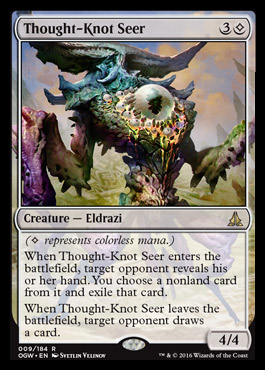
The eldrazi are great, but their names could be a lot more distinct. World Crusher? Reality Bruiser? I sometimes think the price of Thought-Knot Seer is so high because it’s the only Eldrazi people are able to identify and buy on purpose without trying to buy something else. The gang keeps getting tripped up on the names. Listen and laugh at them as they get confused. Come for their confusion, stay for one of the most insightful episodes in a long while. I figure like 10% of our total listeners read the show notes and those who do are the most dedicated. I don’t know why I preach to the choir. Still, I’m making the case for this episode whether you like it or not, so strap in. We discuss Standard and Modern and read some e-mails and make fun of Corbin and he tries to make fun of us back and we laugh at him and we even do Pick of the Week. Remember that segment? Well it’s back! You knew there was a reason this was your favorite podcast. It’s because it’s the best. Now stop reading like a nerd and put our audio entertainment in your head holes already. Brainstorm Brewery OUT.


  • Weird intro. It’s hard to know what will make the final cut.
  • Standard results!
  • Modern results!
  • E-mails! Send us your e-mails and we’ll read them!
  • Pick of the WEEEEEK! It’s baaaaack!
  • Support our Patreon! DO IT. You know this cast makes you more than $1 a week
  • Need to contact us? Hit up [email protected]


Contact Us!

Brainstorm Brewery Website – E-mail – Twitter Facebook RSS iTunes Stitcher

Ryan Bushard – E-mail – Twitter Facebook

Corbin Hosler – E-mail – Twitter Facebook MTGPrice

Jason E Alt – E-mail – Twitter FacebookMTGPrice

Marcel White – E-mail – Twitter

Is Stoneforge Mystic Really That Good?

Let’s face it. Commander can be expensive. Though commander is a casual format, it is becoming harder and harder to build a good commander deck without draining your wallet. As much as we want to, we don’t have unlimited amounts of money. There are often cards that would make your deck really powerful, but are on the other hand, really expensive. Commander shouldn’t be as expensive as formats like Standard. I believe there is a way to find the effects you need in your commander deck without having to pay too much to do it.

Let me introduce myself. I’m Kai Chang, and my mission is to try to help commander players in the same situation as myself, by writing about ways you can save money playing commander. I want this series to cover cheap, underrated commander cards, alternatives to expensive commander cards, which ultimately leads you to be able to have more powerful decks, play more commander, and have more fun playing Magic. Let’s dive right into it! Voltron decks, decks focused on killing your opponents with commander damage, need to suit up their commander with lots of equipment, to do more commander damage to win more quickly. Well, you don’t just need any equipment, you need certain equipment to get through certain board states. Well, how do you find the equipment in your deck? Tutors.

When thinking of equipment tutors, what first card comes to mind is [card] Stoneforge Mystic [/card], but [card] Stoneforge Mystic [/card] is a 25$ card, too expensive for many commander players. So, let’s look at some cheaper alternatives. We’re not going to look at equipment tutors like [card] Stonehewer Giant [/card] or [card] Steelshaper Apprentice [/card], because they are already heavily played as equipment tutors, and the goal of this series is to help uncover hidden gems, underrated commander cards, not to promote already heavily played equipment tutors.

First, we have [card] Godo, Bandit Warlord [/card]. It has the same enter the battlefield as [card] Stoneforge Mystic [/card], so that’s not any worse than [card] Stoneforge Mystic [/card] in that aspect. It does not have [card] Stoneforge Mystic [/card] ’s second ability, and costs considerably more to cast. Commander is a slower format, so
Godo’s high mana cost isn’t very much of a downside.

Though Godo is red, Boros are the best Voltron colors, including Tajic, Aurelia, and more recently Kalemne, so they can usually include both [card] Stoneforge Mystic [/card] and Godo, but I want to convince you that Godo isn’t just a budget substitution, that it’s even better than [card] Stoneforge Mystic [/card].

[card] Stoneforge Mystic [/card] ’s second ability isn’t very powerful in commander, because, when you think about it, many of the powerful equipment in commander are two or less mana to cast already, such as [card] Umezawa’s Jitte [/card], [card] Lightning Greaves [/card], [card] Trailblazer Boots [/card], [card] Skullclamp [/card] et cetera. Sure, you can drop the Swords one turn earlier, but in commander, [card] Stoneforge Mystic [/card]’s second ability is near useless. [card] Stoneforge Mystic [/card]’s second ability also requires it to tap, so limiting it to only be able to drop only one equipment per turn isn’t very strong. The second ability does have one upside though; the equipment played by it can’t be countered, but Godo’s effect already automatically puts the fetched equipment onto the battlefield, so the downside of not having the second effect is lessened by that.

On the other hand, at first glance, Godo’s second ability seems very weak. It seems like something you wouldn’t play outside of a Samurai tribal deck, but, in fact, the ability is very strong in commander. Though they aren’t Samurai, vigilance creatures can still attack during the extra combat phase, because they are still untapped from the first combat phase. What good vigilance creatures are already played in commander? Well, as I mentioned earlier in the article, [card] Stonehewer Giant [/card] is usually in this sort of deck, and that has Vigilance, so it can take advantage of Godo’s second combat phase. Another card that you probably are including in your deck is [card] Sun Titan [/card]. Don’t tell me that attacking twice with [card] Sun Titan [/card] isn’t good. When your commander is suited up with some equipment, it probably also has vigilance. Attacking twice
with your commander is huge.

Let’s look at Godo versus Stoneforge Mystic in a Tajic decklist generated by EDHREC:
[deck title= Tajic Commander Deck]
[Creatures]
*1 Tajic, Blade of the Legion
*1 Agrus Kos, Wojek Veteran
*1 Angelic Overseer
*1 Anger
*1 Archetype of Courage
*1 Aurelia, the Warleader
*1 Avacyn, Angel of Hope
*1 Boros Reckoner
*1 Captain of the Watch
*1 Firemane Avenger
*1 Frontline Medic
*1 Gisela, Blade of Goldnight
*1 Hero of Bladehold
*1 Iroas, God of Victory
*1 Legion Loyalist
*1 Mentor of the Meek
*1 Odric, Master Tactician
*1 Puresteel Paladin
*1 Purphoros, God of the Forge
*1 Silverblade Paladin
*1 Solemn Simulacrum
*1 Stoneforge Mystic
*1 Stonehewer Giant
*1 Sun Titan
*1 Sunhome Guildmage
[/Creatures]
[Spells]
*1 Assemble the Legion
*1 Cathars’ Crusade
*1 Gleam of Battle
*1 Glory of Warfare
*1 Land Tax
*1 Legion’s Initiative
*1 Mobilization
*1 Oblivion Ring
*1 True Conviction
*1 Elspeth, Knight-Errant
*1 Elspeth, Sun’s Champion
*1 Boros Cluestone
*1 Boros Keyrune
*1 Boros Signet
*1 Darksteel Ingot
*1 Lightning Greaves
*1 Loxodon Warhammer
*1 Skullclamp
*1 Sol Ring
*1 Sunforger
*1 Swiftfoot Boots
*1 Sword of Feast and Famine
*1 Sword of Fire and Ice
*1 Worldslayer
*1 Aurelia’s Fury
*1 Boros Charm
*1 Chaos Warp
*1 Condemn
*1 Enlightened Tutor
*1 Master Warcraft
*1 Oblation
*1 Path to Exile
*1 Return to Dust
*1 Swords to Plowshares
*1 Austere Command
*1 Blasphemous Act
*1 Day of Judgment
*1 Martial Coup
*1 Steelshaper’s Gift
*1 Wrath of God
[/Spells]
[Lands]
*1 Battlefield Forge
*1 Boros Garrison
*1 Boros Guildgate
*1 Clifftop Retreat
*1 Command Tower
*1 Evolving Wilds
*1 Mountain
*1 Plains
*1 Rugged Prairie
*1 Sacred Foundry
*1 Slayers’ Stronghold
*1 Sunhome, Fortress of the Legion
*1 Temple of the False God
*1 Temple of Triumph
*1 Wind-Scarred Crag
[/Lands]
[/deck]
Out of the eight equipment in the deck, five are worth putting onto the battlefield with Stoneforge. Though more than half of the equipment are worth Stoneforging (new word), you are usually saving one or two mana, which is not very powerful. Meanwhile there are five vigilance creatures. Having five creature that can attack twice is better than having five equipment that you can play at a cheaper price, so in this decklist of Tajic, Godo would well outclass [card] Stoneforge Mystic [/card], and should probably have [card] Stoneforge Mystic [/card]’s spot in the deck.

Let’s take a look at another deck, this time a EDHREC generated [card] Aurelia, the Warleader [/card] deck:

[deck title= Aurelia Commander Deck]
[Creatures]
*1 Agrus Kos, Wojek Veteran
*1 Angelic Overseer
*1 Anger
*1 Archetype of Courage
*1 Aurelia, the Warleader
*1 Avacyn, Angel of Hope
*1 Boros Reckoner
*1 Captain of the Watch
*1 Firemane Avenger
*1 Frontline Medic
*1 Gisela, Blade of Goldnight
*1 Hero of Bladehold
*1 Iroas, God of Victory
*1 Legion Loyalist
*1 Mentor of the Meek
*1 Odric, Master Tactician
*1 Puresteel Paladin
*1 Purphoros, God of the Forge
*1 Silverblade Paladin
*1 Solemn Simulacrum
*1 Stoneforge Mystic
*1 Stonehewer Giant
*1 Sun Titan
*1 Sunhome Guildmage
[/Creatures]
[Spells]
*1 Aggravated Assault
*1 Assemble the Legion
*1 Land Tax
*1 Legion’s Initiative
*1 Oblivion Ring
*1 True Conviction
*1 Austere Command
*1 Steelshaper’s Gift
*1 Waves of Aggression
*1 World at War
*1 Wrath of God
*1 Argentum Armor
*1 Boros Keyrune
*1 Boros Signet
*1 Darksteel Ingot
*1 Darksteel Plate
*1 Lightning Greaves
*1 Loxodon Warhammer
*1 Skullclamp
*1 Sol Ring
*1 Sunforger
*1 Swiftfoot Boots
*1 Sword of Feast and Famine
*1 Sword of Fire and Ice
*1 Sword of Light and Shadow
*1 Aurelia’s Fury
*1 Boros Charm
*1 Chaos Warp
*1 Enlightened Tutor
*1 Master Warcraft
*1 Oblation
*1 Path to Exile
*1 Return to Dust
*1 Savage Beating
*1 Swords to Plowshares
*1 Wear // Tear
*1 Ajani Vengeant
*1 Elspeth, Knight-Errant
[/Spells]
[Lands]
*1 Arid Mesa
*1 Battlefield Forge
*1 Boros Garrison
*1 Boros Guildgate
*1 Clifftop Retreat
*1 Command Tower
*1 Evolving Wilds
*1 Mistveil Plains
*1 Mountain
*1 Plains
*1 Rugged Prairie
*1 Sacred Foundry
*1 Slayers’ Stronghold
*1 Sunhome, Fortress of the Legion
*1 Temple of the False God
*1 Temple of Triumph
*1 Terramorphic Expanse
*1 Wind-Scarred Crag
[/Lands]
[/deck]
Out of the ten equipment in the deck, seven are Stoneforgable. In all the creatures, four have vigilance. Though there are more Stoneforgable equipments than vigilant creatures, the commander has vigilance, so that makes Godo super worth it in this deck. This generated deck squeezed in Godo, though it’s only played in 33% of the Aurelia decks. I think it would probably still be profitable to cut Stoneforge from the decklist and add another different card, and save some money. So, in this deck, since the commander has vigilance, Godo is better than [card] Stoneforge Mystic [/card].

To maximize the juice you can get out of Godo, try including some of these vigilance ­enablers: A good equipment that grants us vigilance is Ring of Thune, which is also just a great Voltron card Even if the card doesn’t do much or anything else other than to grant vigilance, if you have Godo out, those equipment become pure powerhouses, so cards like Avacyn’s Collar and Accorder’s Shield are also great additions to any deck with Godo. One last card that synergizes extremely well with Godo is Slayer’s Stronghold, because you can choose a new target every turn, so if your commander already has vigilance, you can your other big dude vigilance for the turn. These cards work fantastically well with Godo, but with Stoneforge, these cards are pretty trashy.

After looking at these two decklists and concluding that Godo is better in both decks, I think it’s worth it to play Godo over Stoneforge. Godo is only 3$, it’s one eighth as expensive as [card] Stoneforge Mystic [/card], so not only is it better than [card] Stoneforge Mystic [/card], it’s also cheaper. I hope this article has helped illustrate why Godo is so good in commander, and why you should play it over [card] Stoneforge Mystic [/card].

Unified Theory of Commander: Synergy

Repeat after me:

“Synergy is not the same thing as having a game plan.”

No. No. Don’t just read it. Say it out loud with me. For real. Let’s say it again:

“Synergy is not the same thing as having a game plan.”

Good! Now that we’ve got that in your head, we can really dig into why synergy is the last element of the Unified Theory of Commander. Throughout the writing of this articles series, this has been the most hotly contested part of the structure we’ve put forth for building decks. But once we’ve properly defined synergy and explained how it differs from your deck’s game plan, I think the reason for its position in the My Deck Tickled A Sliver mnemonic will become more clear.  

So how should we define synergy? Google’s dictionary gives us this:

syn·er·gy

?sin?rj?/

noun

  1. the interaction or cooperation of two or more organizations, substances, or other agents to produce a combined effect greater than the sum of their separate effects.

It’s easy to see the definition of synergy within the context of Magic emerge from this dictionary entry. We can replace “organizations, substances, or other agents” with “cards.” So when two or more cards interact to produce an effect that’s greater than they could create on their own, we can call that synergy. To put it in context of our previous articles, you are creating a kind of card advantage by pairing these cards together to exceed their normal value.

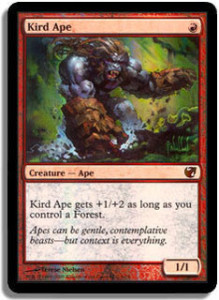
Kird-Ape FOREST

The simplest version of this is when one card just makes another one stronger. The usual example given for this in magic circles is Forest paired with [card]Kird Ape[/card]. By having a forest in play, Kird Ape gets stronger. In Commander, a more clear version of this kind of linear, obvious synergy is putting an enchantment on [card]Uril[/card]. This is what I would call “programmed synergy,” since it was the obvious intent of the card designers, but it’s a solid place to start to understand interactions that produce value.

Synergy Still Requires a Game Plan

Relying on this kind of synergy to build a deck for you can function as a limited kind of game plan. Uril, lands, and a bunch of enchantments can certainly feel like a game plan. It’s also very often not enough to get your deck over the finish line. Let’s look at a couple examples that show us why not.

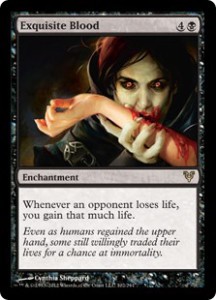
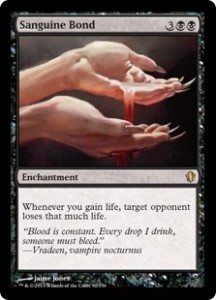
[card]Exquisite Blood[/card] and [card]Sanguine Bond[/card] are a pair of cards whose synergy can instantly win the game, assuming you can find a way to make an opponent lose life or find a way to gain some. They create an infinite combo that drains all your opponents for all their health. That’s a potent interaction that is obviously synergistic.

ExBlood SanBond

So if that’s your win condition, how do you intend to get both cards into play and trigger their effects before your opponent’s win the game? How do you plan to stay alive until those cards hit the board? Can you deck produce enough to mana to get them both into play? The synergy between those cards can only produce the desired value for your deck if you’re able to effectively turn them into a threat. Without a gameplan to support the synergy, it’s random at best, and at worst… useless.

Support The Game Plan

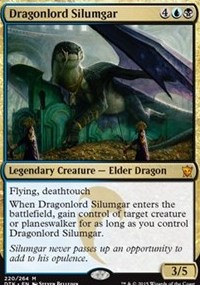
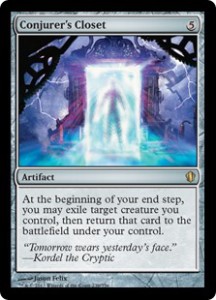
When [card]Dragonlord Silumgar[/card] enters play, it allows you to take control of a creature or planeswalker an opponent controls. At first glance, the UB dragonlord appears to pair quite well with [card]Conjurer’s Closet[/card]. Flickering Silumgar allows you to always grab the best threat in the game and turn it against your opponents, stealing something else at the end of turn if that threat is somehow lost. I see Conjurer’s Closet on quite a few of these decklists. It’s a nice piece of synergy with the commander of their deck.

DragonSil ConjCloset

Yet if the deck’s strategy doesn’t include ETB effects on many other creatures, how often do you think that Conjurer’s closet is actually a dead draw? If the commander is not available and there are no other cards that benefit from Conjurer’s Closet being in play, then you’ve not only lost the synergy between it and Dragonlord Silumgar, but you’ve lost the majority of the card’s actual value in the first place. You’d be better off having another card in that slot.

This is how synergy can become a trap. If you select cards for your deck based on synergy alone, but don’t consider their place in the broader game plan of the deck, then you’re losing value any time those brilliant interactions aren’t possible. Not only does the game plan need to support your synergy, but the synergy needs to support the overarching game plan as well to maximize value. Otherwise attempts at synergy can simply become a waste of a draw step.

Game Plans Without Synergy

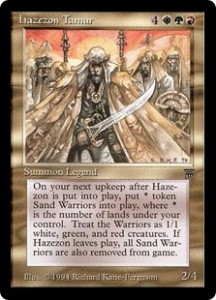
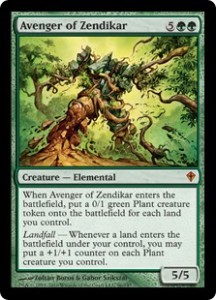
Let’s use another example to drive home our point about synergy vs strategy. [card]Hazezon Tamar[/card] is a commander that cares a great deal about the number of lands you control, and where you find lots of lands, you tend to find [card]Avenger of Zendikar[/card]. These two cards do not synergize with each other. You gain no additional value from casting one before the other or by having them on the battlefield at the same time. Instead, these cards are both working towards the same game plan.

Hazezon AvengerZ

The flavor of Hazezon’s deck is not compromised by having two different cards that care about lands and make tokens. You’d be hard pressed to find someone who sees you cast Avenger in this deck and responds by accusing your deck of just being a pile of “good stuff.” It’s obvious from your card selection that there’s a theme. The support cards that synergize with Hazezon, also happen to synergize with big green EDH staple you put in the deck as well. This is bigger than “programmed synergy,” that vaguely points your deck in a direction. It’s a game plan that uses synergy to create value all the way down to the tactical level.

So no, synergy does not define your game plan. It doesn’t define the theme of your deck either. It can support those things or be supported by them, but synergy is not the first order of operation in construction. It’s not the ultimate goal of a commander deck. It’s actually just one element, and its less important than having threats, answers, and the resources to use them. Decide what the deck is doing first, then use synergy as a tool to edit, not as your primary guiding principle.

Conclusion

When this series first launched, some critics argued that the Unified Theory homogenizes decks and reduces fun interactions. It should become very clear now that this isn’t the case. More themes and strategies are actually opened up to players when they build around a strong game plan first. This allows us to explore new design space while knowing the core elements of their deck are still going to work.

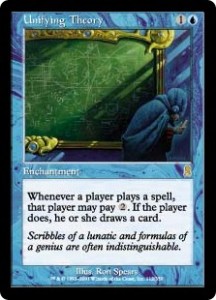
UnifyingTheory

A unifying theory opens up new opportunities in deck building

This obsession with synergy can be why many decks fall back on aggressively using tutors and gradually stop being fun or flavorful. A deck that is relying on a few synergistic pieces to “get there” is going to become quite frustrating to pilot when those pieces aren’t coming together. Tutors are a shortcut that let players lean on narrower, less interesting deck designs that rely too much on synergy and not enough on an effective game plan.

Ultimately, synergy should be about editing a deck and finding ways to squeeze more flavor and more value out of every draw and every interaction, supporting the deck’s goals, themes, and game plan. It’s last in the Unified Theory because it has to work in support of all the other elements for the deck to be effective. No matter how much synergy you stick into the 99 card pile next to your commander, it’s all worthless if you don’t have the resources the cast those cards or a way to turn that pile into victory before someone else does.

But hey, let’s not forget why we’re playing Commander in the first place. We’re playing to have fun and bond with other players over a game of cardboard make-believe. Never be afraid to make some sacrifices to this proposed structure if it means you’ll have more fun. If eventually the deck just isn’t working anymore, the Unified Theory is always here waiting to help you diagnose the problem and make some adjustments. So good luck, have fun, and keep brewing!

I Find Your Lackey of Faith Disturbing

So I was kind of hoping that there would be some updates to the Legacy Banlist I could look at the new format, brew some new decks, and hope that [card]Show and Tell[/card] would finally get banned. But no, all is well. So what is there to talk about? Well my last article looked at some of the non-blue alternatives in the format but there’s one that I wanted to save all on its own because I’ve been playing it an awful lot lately, and it deserves more love. The deck in question is Goblins.

The tribe is a Magic mainstay, appearing in almost every set released, and for a long time, the tribe dominated Legacy. However, in recent years the little red men have had a hard time dealing with changes to the format. That being said, it has had a history of punishing blue midrange and control decks and seeing as the format is currently favouring those decks, it looks like it could be a good time for Goblins to make its return.

Goblins is a deck that can perform one of two functions. It can either play a hyper aggressive role with cards like [card]Goblin Piledriver[/card], [card]Goblin Warchief[/card] and [card]Goblin Chieftain[/card], or it can slow the game down and grind out a win with superior card and board advantage using [card]Goblin Ringleader[/card], [card]Goblin Lackey[/card] and [card]Goblin Matron[/card]. It also functions as a strong mana denial deck with four copies of [card]Wasteland[/card] and [card]Rishadan Port[/card].

The Core

No matter what list you see, every Goblins list is going to contain a playset of five cards that are ever present in the seventy-five.

Goblin Lackey

Goblin Lackey is possibly the best card in the deck and is the primary way the deck generates board advantage. A turn one Lackey off of [card]Cavern of Souls[/card] is the best opening play Goblins has and can lead to some absolutely blistering starts. Having the ability to drop a Ringleader on turn 2 is not only a way of filling up your hand for the early game and establishing card advantage, but it can also make mulligans less harsh.

Lackey does have a big problem, though, in that it is blocked by [card]Deathrite Shaman[/card]. The printing of Deathrite was one of the last nails in the coffin for Goblins as the powerful start of a turn one Lackey, was countered by an equally powerful turn one Deathrite. There are ways around it, of course, but it certainly made the format hostile to the red one-drop. That being said, all Lackey ever needs to do is connect once and it’s provided you with some from of advantage and is the primary reason the deck still has game.

Goblin Matron

Tutor effects in Eternal formats are nuts. And this one is no exception. Goblin Matron is part of the reason this deck functions so well as a control deck. Most of the time, you’ll be fetching a Goblin Ringleader but including four copies of Matron allows you to build the deck to have a suite of one-of silver bullets that you can fetch when you need to. Allowing this to resolve can often times swing the game in your favour, picking up a much needed Ringleader or perhaps a [card]Siege-Gang Commander[/card] or [card]Tuktuk Scrapper[/card]. Not playing Matron in Goblins is a move that you need to have a good reason for doing.

Guys, trust me. Seriously.

Goblin Ringleader

Very few four mana cards get high praise in Legacy and Ringleader is one people always seem to ignore. Yes, it’s not got amazing stats but it effectively draws you 2-3 cards when it enters the battlefield. There is nothing more satisfying than flashing in a Ringleader with [card]Aether Vial[/card]. Ever since it was printed it’s been included in Goblins lists wherever it can. It’s one of your best cards against Shadless BUG and it can often be the way you turn a near unwinnable game to one you are in full control of. And yes, it does whiff. But being able to clear four non-Goblin cards from the top of your deck is at least somewhat of a plus, surely?

Goblin Warchief

This is another card that facilitates blisteringly fast starts from Goblins. The cost reduction is incredibly significant and granting all of your Goblins haste is an incredibly overlooked ability. Being able to activate a [card]Krenko, Mob Boss[/card] the turn he drops is insane. I’ve seen some lists run Warchief as a three-of but I honestly think that he enables such an aggressive strategy and allows you to get multiple Goblins in play a turn is reason enough to play the full four copies.

Aether Vial

Vial is a card that just fits right at home in tribal strategies, from Merfolk to Slivers to Goblins. The ability to dodge countermagic and operate at instant speed means that you free up your lands and can instead spend your mana activating Wastelands and Rishadan Ports. Vial is also key in getting your mana intensive Goblins into play, like Siege-Gang Commander and Goblin Ringleader, though hardcasting them is not an impossibility. Regardless, Vial is another automatic playset.

So that’s the glue of the deck. The above cards should be present in every Goblins list you see or build and should be the foundation from where you build your rabble. But what do we use to fill out the rest of the sixty?

A good place to start is removal and with that I believe everyone should be running four copies of [card]Tarfire[/card]. The presence of cards like Deathrite Shaman, [card]Stoneforge Mystic[/card] and [card]Delver of Secrets[/card] means you need to have cheap creature removal and Tarfire is the perfect answer. Not only does it deal with most every creature in the format, it can also be found off of Ringleader and Matron, which is huge. However, do remember that you can’t cast Tarfire off of Cavern of Souls as it specifies that it can only be used for creature spells. Still, Tarfire is, what I believe to be, the best removal spell that Goblins has access to.

Most lists will often include some number of [card]Goblin Chieftan[/card]. Chieftan is often times a finisher, turning your Siege-Gang tokens into legitimate threats. Cheating this into play with Lackey can often set you up for an early kill and demands that your opponent answers the lord. I’m currently running it as a two-of but I’ve seen people play as much as four copies in the main.

You’ll also find people playing some number of [card]Mogg War Marshall[/card] as a general value card and way of chumping big threats like [card]Tarmogoyf[/card]. [card]Gempalm Incinerator[/card] is a card that used to see much more play but is now usually there as a single Matron target. While I’m not a huge fan as it can often be a dead card, it is one of the few ways that Goblins can deal with Tarmogoyd or [card]Batterskull[/card].

Goblins also packs some form of artifact hate in the form of either Tuktuk Scrapper or [card]Tin-Street Hooligan[/card]. There are pros and cons to both. Scrapper costs four mana but can be played in monocolored versions, where Tin-Street costs less but means you have to be playing green and also has some serious anti-synergy with Goblin Warchief. I prefer Scrapper as I’m not running green but both cards are excellent additions.

There are tons of other Goblins that you can include, most often as Goblin Matron targets. The ones that I’m including in my list are Krenko, Mob Boss, [card]Grenzo, Dungeon Warden[/card], [card]Kiki-Jiki, Mirror Breaker[/card], Siege-Gang Commander, and [card]Goblin Piledriver[/card]. I’ve also seen people run [card]Goblin Rabblemaster[/card], [card]Warren Weirding[/card] and [card]Skirk Prospector[/card]. These utility cards are all excellent and depending on what your meta is like, you can tailor your main deck to have the perfect angles of attack.

The Lands

Goblins plays a great mana denial game and is often compared to Death and Taxes in some ways. To start, the deck plays four copies of Wasteland and Rishadan Port. Using Aether Vial to get your creatures into play frees up your mana to be used to take care of the opponent’s mana base. Having the ability to grind out the opponent using card advantage and mana denial is one of the reasons this deck still has an awful lot of game.

Goblins also runs four copies of Cavern of Souls, for obvious reasons. Most any tribal deck should be running four Cavern but especially so in Legacy where [card]Counterbalance[/card] and other forms of cheap countermagic rule the roost. In the post board games, it can also be set to human and you can get through a copy of [card]Thalia, Guardian of Thraben[/card], a card that has found its way into Goblins sideboards since it was printed.

Finally, the last few slots go to any fetchlands that can fetch a mountain, 2-3 duals if you’re splashing any colour, and then a few basics to round out the sixty.

And that’s Goblins! The deck is relatively cheap to put together and has a low skill barrier, meaning that it won’t bite you for not playing absolutely 100%. That being said, a skilled Goblins player is a geniune threat and putting in the reps with the deck can make you a formidable enemy, even in the face of the pesky Golgari mana elf.

Until next time!

Brainstorm Brewery #180 – You’re Not Even A Judge

There were lots of happenings the last few weeks and since we didn’t get to talk about anything last week due to the set review, we decided to jimmy jam everything into one action-packed episode and get caught up. There were prerelease weekend shenanigans, GP Oakland was a thing, multiple bannings happened and Reddit showed how bad they are at reading comprehension and how good they are at pillorying innocent WotC employees. There’s a lot to cover, so why not stop reading the show notes because reading is for nerds, and sit back and put this podcast in your head holes. You’re about to be taken to value town.


  • Salty Corbin
  • Gp Oakland stories
  • Prerelease weekend!
  • Bannings? What do they mean?
  • Ryan and Corbin talk about homebrews and it’s Jason’s turn to be salty
  • Prophet of Kruphix was banned, it’s barely discussed
  • Pick of the WEEEEEK
  • Support our Patreon! DO IT. You know this cast makes you more than $1 a week
  • Need to contact us? Hit up [email protected]


Contact Us!

Brainstorm Brewery Website – E-mail – Twitter Facebook RSS iTunes Stitcher

Ryan Bushard – E-mail – Twitter Facebook

Corbin Hosler – E-mail – Twitter Facebook MTGPrice

Jason E Alt – E-mail – Twitter FacebookMTGPrice

Marcel White – E-mail – Twitter

Money Draught #52 – Jon Finkel

All-time great Jon Finkel joins us in a very special episode where discussion includes: the state of Magic and its viability as an E-sport, Jon’s thoughts on Cube and Storm, “mtg finance”, hedge fund styles, our recurring debate on the pace of technological change, and Scotch.

** This cast is for mature listeners, and contains spoilers **

Your Hosts:
Jason Alt — @JasonEAlt
Slick Jagger — @slickJagger
JR — @time_elemental

Money Draught RSS

Brewing With Oath of the Gatewatch

Welcome back for Brewing With Oath of the Gatewatch. After an insane thirty decks last time, we have a much more reasonable ten decks for Standard. These decks only have “Sideboard Suggestions” other than the Atarka Red list, which is where I plan to start when the set is released.

This had been the scariest deck in Standard for a few months due to being able to deal nearly twenty damage in one turn. Now it gets another creature to help with burst damage when you can’t try to combo.
I’m still trying to figure out how to fit [card]Nissa, Voice of Zendikar[/card] somewhere in the deck, but I’m not sure I can manage it.

[deck title= Atarka Red]
[Creatures]
4 Monastery Swiftspear
4 Zurgo Bellstriker
2 Lightning Berserker
4 Abbot of Keral Keep
4 Reckless Bushwhacker
[/Creatures]
[Spells]
2 Fiery Impulse
4 Titan’s Strength
4 Dragon Fodder
4 Atarka’s Command
3 Temur Battlerage
4 Become Immense
[/Spells]
[Land]
2 Cinder Glade
4 Bloodstained Mire
4 Wooded Foothills
2 Windswept Heath
1 Forest
8 Mountain
[/Land]
[Sideboard]
2 Firey Impulse
3 Rending Volley
2 Boiling Earth
4 Roast
2 Hordeling Outburst
2 Outpost Siege
[/Sideboard]
[/deck]

I call it “Big Red”, but it will play like a control deck most of the time. Every creature is a value creature, making it very difficult for your opponents to really gain an advantage in the game.

[deck title= Big Red]
[Creatures]
4 Hangarback Walker
4 Abbot of Keral Keep
4 Thought-Knot Seer
4 Thunderbreak Regent
2 Pia and Kiran Nalaar
3 Goblin Dark-Dwellers
[/Creatures]
[Spells]
3 Fiery Impulse
4 Draconic Roar
3 Exquisite Firecraft
2 Outpost Siege
2 Sarkhan, the Dragonspeaker
1 Chandra, Flamecaller
[/Spells]
[Land]
2 Blighted Gorge
2 Sea Gate Wreckage
4 Haven of the Spirit Dragon
16 Mountain
[/Land]
[Sideboard Suggestions]
1 Rending Volley
2 Roast
3 Kozilek’s Return
4 Scab-Clan Berserker
[/Sideboard Suggestions]
[/deck]

This deck got a huge bump from the Eldrazi spells from this set. I expect to see a lot of this as people try to figure out the format. It is a little low on power, but can just grind out the game with incremental card advantage.

[deck title= B/W Eldrazi]
[Creatures]
4 Hangarback Walker
4 Knight of the White Orchard
4 Hidden Dragonslayer
4 Bearer of Silence
2 Eldrazi Displacer
4 Wasteland Strangler
4 Thought-Knot Seer
[/Creatures]
[Spells]
4 Silkwrap
2 Stasis Snare
3 Gideon, Ally of Zendikar
2 Sorin, Solemn Visitor
[/Spells]
[Land]
4 Shambling Vent
4 Caves of Koilos
2 Sea Gate Wreckage
4 Evolving Wilds
1 Wastes
6 Plains
2 Swamp
[/Land]
[Sideboard Suggestions]
1 Duress
2 Surge of Righteousness
3 Transgress the Mind
4 Utter End
[/Sideboard Suggestions]
[/deck]

This deck just wants to live the dream of casting the same spells over and over again. This deck will likely be good, but I expect it to end up as four colors for a more diverse array of spells.

[deck title= Jund Midrange]
[Creatures]
4 Hangarback Walker
4 Sylvan Advocate
4 Rattleclaw Mystic
4 Den Protector
2 Thunderbreak Regent
2 Goblin Dark-Dwellers
1 Tasigur, the Golden Fang
[/Creatures]
[Spells]
2 Fiery Impulse
2 Ultimate Price
1 Roast
3 Kolaghan’s Command
2 Painful Truths
1 Ruinous Path
2 Murderous Cut
1 Sarkhan, the Dragonspeaker
[/Spells]
[Land]
4 Hissing Quagmire
4 Bloodstained Mire
4 Wooded Foothills
2 Cinder Glade
2 Smoldering Marsh
3 Forest
3 Mountain
3 Swamp
[/Land]
[Sideboard Suggestions]
1 Duress
2 Roast
3 Flaying Tendrils
4 Exquisite Firecraft
[/Sideboard Suggestions]
[/deck]

Abzan got a lot of great cards to replace some of its already really good cards. It will be the most heavily played deck again, especially since it got better ways to deal with the Rally decks. I’ll be glad when [card]Siege Rhino[/card] rotates out of Standard.

[deck title= Abzan Aggro]
[Creatures]
4 Warden of the First Tree
4 Sylvan Advocate
2 Den Protector
4 Anafenza, the Foremost
4 Siege Rhino
1 Kalitas, Traitor of Ghet
1 Wingmate Roc
1 Linvala, the Preserver
[/Creatures]
[Spells]
1 Silkwrap
4 Dromoka’s Command
4 Abzan Charm
4 Gideon, Ally of Zendikar
1 Murderous Cut
[/Spells]
[Land]
3 Shambling Vents
2 Hissing Quagmire
2 Canopy Vista
1 Sunken Hollow
1 Smoldering Marsh
4 Wooded Foothills
4 Windswept Heath
4 Flooded Strand
2 Forest
2 Plains
[/Land]
[Sideboard Suggestions]
1 Duress
2 Surge of Righteousness
3 Transgress the Mind
4 Flaying Tendrils
[/Sideboard Suggestions]
[/deck]

This is another deck that got some great new toys. Fortunately most of them are just sideboard cards, but some could end up being huge in the main in the right meta. I expect to see a lot of this deck in the near future, and I may even end up playing it myself.

[deck title= R/G Ramp]
[Creatures]
4 Hangarback Walker
4 Jaddi Offshoot
1 World Breaker
2 Dragonlord Atarka
2 Ulamog, the Ceaseless Hunger
2 Kozilek, the Great Distortion
[/Creatures]
[Spells]
4 Ruin in their Wake
2 Sylvan Scrying
4 Nissa’s Pilgrimage
4 Explosive Vegetation
2 Hedron Archive
4 Ugin, the Spirit Dragon
[/Spells]
[Land]
4 Sanctum of Ugin
2 Shrine of the Forsaken Gods
1 Sea Gate Wreckage
4 Evolving Wilds
9 Forest
2 Mountain
3 Wastes
[/Land]
[Sideboard Suggestions]
1 Spatial Contortion
2 Kozilek’s Return
3 Nissa, Voice of Zendikar
4 Thought-Knot Seer
[/Sideboard Suggestions]
[/deck]

This deck is a lot like the G/W Aggro decks from a few months ago that got hated out of the format. The new toys it got may push it back into being competitive again, but either way it looks like a lot of fun to play.

[deck title= G/W Tokens]
[Creatures]
4 Hangarback Walker
4 Warden of the First Tree
4 Den Protector
4 Knight of the White Orchard
4 Deathmist Raptor
4 Whisperwood Elemental
[/Creatures]
[Spells]
2 Dromoka’s Command
4 Oath of Gideon
3 Nissa, Voice of Zendikar
4 Gideon, Ally of Zendikar
[/Spells]
[Land]
4 Canopy Vista
4 Blossoming Sands
2 Foundry of the Consuls
4 Windswept Heath
5 Forest
4 Plains
[/Land]
[Sideboard Suggestions]
1 Arashin Cleric
2 Mastery of the Unseen
3 Surge of Righteousness
4 Valorous Stance
[/Sideboard Suggestions]
[/deck]

Now we have an update of my Enchantress list I was running a while back. The worst card was always [card]Suspension Field[/card], and a very good replacement is [card]Oath of Chandra[/card] which in long games could end up being recurred every turn to kill a creature. This deck is really good as long as Esper and R/G Ramp aren’t seeing a lot of play, as they are terrible matchups.

[deck title= Enchantress]
[Creatures]
4 Herald of the Pantheon
[/Creatures]
[Spells]
4 Myth Realized
4 Oath of Chandra
4 Silkwrap
4 Stasis Snare
2 Outpost Siege
4 Starfield of Nyx
4 Sigil of the Empty Throne
4 Quarantine Field
[/Spells]
[Land]
4 canopy Vista
2 Cinder Glade
2 Needle Spire
4 Windswept Heath
4 Wooded Foothills
2 Forest
8 Plains
[/Land]
[Sideboard Suggestions]
1 Celestial Flare
2 Surge of Righteousness
3 Radiant Flames
4 Suppression Bonds
[/Sideboard Suggestions]
[/deck]

With the printing of [card]Monastery Swiftspear[/card]s big brother [card]Stormchaser Mage[/card] a U/R Tempo decks seems like it could be a thing again. I’m very excited about the card myself, but am not sure it is competitive at the moment.

[deck title= U/R Tempo]
[Creatures]
4 Monastery Swiftspear
4 Zurgo Bellstriker
4 Stormchaser Mage
4 Jeskai Elder
4 Abbot of Keral Keep
[/Creatures]
[Spells]
4 Titan’s Strength
2 Fiery Impulse
4 Wild Slash
4 Dragon Fodder
2 Exquisite Firecraft
4 Treasure Cruise
[/Spells]
[Land]
4 Wandering Fumarole
4 Shivan Reef
4 Wooded Foothills
2 Island
6 Mountain
[/Land]
[Sideboard Suggestions]
1 Dispel
2 Rending Volley
3 Boiling Earth
4 Roast
[/Sideboard Suggestions]
[/deck]

This is the likely home for [card]Goblin Dark-Dwellers[/card], and being backed by a ton of lifegain will be hard to race. I expect a lot of Abzan players to make the leap to this if only to have an edge in the mirror.

[deck title= Abzan Red]
[Creatures]
4 Sylvan Advocate
4 Den Protector
3 Soulfire Grandmaster
4 Anafenza, the Foremost
4 Siege Rhino
2 Goblin Dark-Dwellers
1 Wingmate Roc
1 Tasigur, the Golden Fang
[/Creatures]
[Spells]
2 Painful Truths
3 Kolaghan’s Command
2 Crackling Doom
3 Abzan Charm
1 Murderous Cut
[/Spells]
[Land]
4 Shambling Vents
2 Hissing Quagmire
2 Canopy Vista
1 Cinder Glade
1 Smoldering Marsh
2 Bloodstained Mire
4 Windswept Heath
2 Wooded Foothills
2 Forest
1 Mountain
2 Plains
3 Swamp
[/Land]
[Sideboard Suggestions]
1 Duress
2 Roast
3 Self-Inflicted Wound
4 Flaying Tendrils
[/Sideboard Suggestions]
[/deck]

That’s all I have for now. I’ll see you again for Brewing With Shadows Over Innistrad. If you have any questions or comments, please feel free to leave them below and I will do my best to answer them.

Thanks for reading,

Josh Milliken

Why the Banning of Splinter Twin is Good for You, New Modern Player

If you haven’t already heard that [card]Splinter Twin[/card] was banned from Modern play this weekend after being spoiled (yes, another inadvertent spoiler!) by an overzealous Magic Online playtester, then, my friend, you are just the player for which I am writing this article. Typically, I write about casual stuff like Commander and how I like to play budget decks in Standard, but this week we have something spicy and delicious to devour, Competitive Magic ban lists.

Modern is a format, like Commander, where cards do not rotate over time. It was devised by those geniuses at Wizards of the Coast to allow newer players without the deep pockets or longevity in Magic to compete in a non-rotating format outside of Legacy and Vintage. Legacy and Vintage decks include the oldest, rarest, and hence the most expensive cards in Magic. It isn’t uncommon for Vintage decks to break the $20,000 mark. It isn’t likely that newer Magic players will be forking out that kind of cash to purchase one deck to participate in one format. Modern was supposed to help solve that problem. For the most part, it has. Most modern decks come in under $800, and some competitive decks can even be purchased for just a fraction of that cost. Modern is a fun format with a wide diversity of, so called, Tier 1 decks. Tier 1.5 or 2 decks (slightly less competitive, but still able to beat Tier 1 decks on occasion) add dimension to the format’s diversity as well. I, myself, play one of these less competitive decks in the format called Death and Taxes, with my latest list below. It is a blast to play and I beat my buddies Tron deck regularly.

[deck title= Modern Death and Taxes]
[Creatures]
4 Flickerwisp
1 Kitchen Finks
4 Leonin Arbiter
3 Loxodon Smiter
4 Noble Hierarch
1 Qasali Pridemage
2 Restoration Angel
4 Scavenging Ooze
1 Tarmogoyf
3 Thalia, Guardian of Thraben
[/Creatures]
[Spells]
4 Aether Vial
4 Path to Exile
1 Sword of Fire and Ice
[/Spells]
[Land]
*1 Cavern of Souls
*2 Forest
*2 Gavony Township
*4 Ghost Quarter
*1 Mutavault
*2 Plains
*3 Razorverge Thicket
*1 Tectonic Edge
*4 Temple Garden
*4 Windswept Heath
[/Land]
[Sideboard]
1 Dragonlord Dromoka
1 Eidolon of Rhetoric
1 Gaddock Teeg
1 Linvala, Keeper of Silence
1 Melira, Sylvok Outcast
4 Mirran Crusader
1 Qasali Pridemage
3 Sunlance
1 Sword of Light and Shadow
1 Vryn Wingmare
[/Sideboard]
[/deck]

[card]Splinter Twin[/card] was a “pillar of the format” according to many Magic writers and Modern players. It has been played in the Modern format since it’s inception, and decks featuring the card have been top eighting tournaments left and right. I am not going to get into the “should Twin have been banned” argument here, but what you need to know as someone who may want to start playing Modern, is that the format is going to be very fun and somewhat unpredictable for a while as dew decks take their place in the sun.

[card]Splinter Twin[/card] decks were everywhere in the format. There were many shells that the card with its other combo friends, [card]Pestermite[/card] and [card]Deceiver Exarch[/card] lived in, which helped to mask its overall prevalence in the format. Now that Twin is gone those shells are going to have to find ways to live on their own or die off. New decks that were held in check by Twin before will now start to rise again. I am no expert on the Modern format, but I think you, as a new player, might be able to find a cheaper entry way into the competitive format right now than at any other time. Here are some of the decks that you have to choose from. Hint: Ignore the ones that have [card]Splinter Twin[/card] and [card]Summer Bloom[/card] as both of these cards were recently banned. These decks are all considered Tier 1 and 1.5.

  • Tron
  • Living End
  • Scapeshift
  • Jund
  • Junk
  • Bogles (predicted by some to be much better post-Twin banning)
  • Affinity
  • Burn
  • Infect
  • Eldrazi
  • Merfolk
  • Abzan Company
  • Control
  • Kiki Chord
  • Zoo
  • Lantern Control
  • Grishoalbrand
  • Elves
  • Ad Nauseum

There are other budget decks that are likely less competitive in large paper tournaments, but that I have found success with on MTGO. I’ve been playing the Evoke Control deck on MTGO, and it is a blast! I’ve won more than 50% of my games, which I take to be a success considering I am often playing against deck lists similar to or exactly the same as the lists found in large tournament top eights.

Budget decks are a great way for you to get a feel for the format and certain kinds of decks that inhabit it. You can build a budget deck, invest into some of the staple lands of the format, play in a tournament or two, and start to see what it is like. You might like it, or you might not, but there has never been a better time to try!

Hurry up if you plan to buy into any of the tier one decks, as Modern season is upon us. The staple cards in the format will be rising in price over the next few months as the Modern Pro Tour gets underway and many other tournaments across the country follow suit. If you acquired many of the fetch lands from Khans of Tarkhir, then you will be happy to note that those cards will play nicely in Modern. Older and popular cards like [card]Snapcaster Mage[/card], [card]Tarmogoyf[/card], [card]Liliana of the Veil[/card], and [card]Cryptic Command[/card] are very pricey right now, and I would avoid them during the turmoil of the format finding itself again.

Play a budget deck for now to see if you enjoy Modern play. For the time being, everyone else will be “figuring out” the format along with you. It is a good time to enter as you won’t feel like the only one who isn’t sure about what is happening in the game in front of you. Modern is quite different than Commander and Standard, but a blast nonetheless. Go one, give it a shot. What is the worst that could happen, ending up with a handful of [card]Mulldrifter[/card]s and [card]Esper Charm[/card]s with no place to play them? They will still be fun in your Commander games.

Brainstorm Brewery #179 – Oath of the Gatewatch Set Review

  • Oath of the Gatewatch Set Review
  • Support our Patreon! DO IT. You know this cast makes you more than $1 a week
  • We’re serious about the Patreon. Expect new perks.
  • Need to contact us? Hit up [email protected]


Contact Us!

Brainstorm Brewery Website – E-mail – Twitter Facebook RSS iTunes Stitcher

Ryan Bushard – E-mail – Twitter Facebook

Corbin Hosler – E-mail – Twitter Facebook MTGPrice

Jason E Alt – E-mail – Twitter FacebookMTGPrice

Marcel White – E-mail – Twitter

Best Laid Plans #10 – Never Ending Triangle of CEOs

We made it to 10 episodes. Pigs have frozen over and hell is flying. Sorry about that. The gang recaps what 2015 meant to us all. Em gets dizzy remembering how much has actually happened. Tommy and Shane battle over our Naughty & Nice list. WotC drops the mic about spoilers and we are awash in the feedback. Ken gets noticeably more intoxicated by the time we get to the year end shout-outs to everyone who helped us get where we are. Twenty fifteen, we out.

Contact Us!

Best Laid Plans – @BestLaid_Plans

Ken – @Load3r

Tommy – @T_Moles

Em – @sheMehay

Shane  – @CreatureMystery

No Time to Waste – Brewing for Oath of the Gatewatch Standard

The spoilers are out.  All of them. The complete card list for Oath of the Gatewatch was finally released just a few days ago. A lot of cards caught my eye. A devoid, conditional [card]Rampant Growth[/card] variant looks to push the ramp decks’ abilities to get their game plan rolling faster than ever, despite putting heavy restrictions on deck building. Black gets a very solid, cheap piece of instant-speed removal, though it requires BB to cast. The Oaths themselves, legendary enchantments that represent the commitment of Nissa, Jace, Gideon, and Chandra to defend Zendikar from the Eldrazi, all look to be possible role-players in the upcoming Standard format. Despite having a tumultuous spoiler season plagued by unintended leaks (and the consequences for said leaks threatening to tear apart our community), I’m quite excited and impressed by this set.

ruinintheirwakegraspofdarknessoathofjace


So, why am I so impressed with Oath of the Gatewatch? This set offers a LOT to each type of player. Whether you’re a Timmy, Johnny, or Spike, you’re going to find a large number of cards you can’t wait to play with. Furthermore, this set looks to have not just a fairly high power level with some eternal format implications, but from the perspective of Standard playability, it looks like it has a fairly flat power level.  At various times in the modern history of Standard, many of the cards from Oath would be highly playable. As of late, Wizards of the Coast seems very committed to having a high level of deck diversity available in Standard, with multiple competitive options for both Timmy and Johnny, not just Spike. The reason I bring this up is I have some very serious Timmy and Johnny tendencies.  I like doing big things and I absolutely love brewing to maximize synergy and value.  That said, I like to win.  What’s of even more personal value to me than winning is brewing or tuning decks that others win with.  The ultimate accomplishment for a brewer is to create a deck that not just wins a tournament, but becomes a known part of a metagame. It’s a very difficult goal to achieve as the Magic community as a whole is very intelligent, competitive, and innovative. So, as a brewer, I have to analyze my brews through the lens of a Spike.

I know I have an affinity for Jund decks and had moderate success with them shortly after Battle for Zendikar was released.  Before the community saw the first spoilers, I was hoping there would be more support for a Jund strategy in Oath of the Gatewatch, and was the color combination in which I wanted to brew.  The first card that really caught my attention was Goblin Dark-Dwellers.

No, it’s not [card]Snapcaster Mage[/card], but I don’t care.  It’s like Snapcaster Mage.  That’s all I need.  As soon as I saw the potential for value I was hooked.  I knew I would be brewing around it.

goblindarkdwellers


I made a mental short list of every instant and sorcery I could see myself flashing back with it and filed it in the back of my mind, waiting for additional spoilers before writing down potential deck lists.

The next card I was impressed by was Chandra, Flamecaller.

chandraflamecaller (1)

Chandra is really interesting.  As other writers have pointed out, you almost need to look at her minus ability first.  It’s the board-impacting ability, the ability that actually helps when behind on board.  At her base level, Chandra is similar to an overloaded [card]Mizzium Mortars[/card].  That is a card worth considering in the format.  The other abilities are, in my opinion, upside.  If 4RR for a sorcery that deals 4 damage to each creature is playable, then Chandra is playable.  The fact that she can be both a potent threat on an empty board and a source of card selection and card advantage are icing.  I don’t know if Jund becomes the best shell for her, but she definitely stood out as a possible curve-topper in the right deck.

The card that almost forced me to put pen to paper was Sylvan Advocate.  Without trying to abuse its ability to pump land creatures, this card screams midrange.  Right now, the Standard format is full of cards that cost three, four, and five mana that are good rates, powerful for their respective costs, and offer some form of card advantage.  What we have been missing are powerful two-drops.  Sylvan Advocate is precisely what many decks have, in my opinion, been screaming for.  Abzan Aggro has tested [card]Snapping Gnarlid[/card], [card]Heir of the Wild[/card], and [card]Hangarback Walker[/card] in that role and none seem impressive.  I would be surprised if Sylvan Advocate is not immediately adopted to replace the other options.  When playing with Jund shells over the last few months, I’ve been frustrated by the lack of a solid green, red, or black midrange two-drop creature and have felt it was a slot that had to be filled before I considered revisiting the color combination.  Sylvan Advocate looks to be the precise card I’ve been wanting (short of a [card]Fleecemane Lion[/card] reprint with a different mana cost).

SylvanAdvocate

The other realization I came to when playing Jund is that [card]Ruinous Path[/card] has felt solidly playable, if not outright good, in this color combination.  Although it’s seen little play in Standard, it’s been very good as a late top deck and very serviceable so long as it’s not your first play of the game on turn three.  The Jund color combination also lacks a better catch-all removal spell.  What stands out to me is not only the synergy between Sylvan Advocate and awaken cards like [card]Ruinous Path[/card], but the fact that support cards that make either Sylvan Advocate or [card]Ruinous Path[/card] better generally make them both better.  The card I feel most strongly ties Goblin Dark-Dweller, Sylvan Advocate, and Ruinous Path together is [card]Map the Wastes[/card].

[deck title= Map the Wastes Jund]

[Creatures]

*2 Hangarback Walker

*2 Den Protector

*4 Sylvan Advocate

*2 Nissa, Vastwood Seer

*4 Goblin Dark-Dwellers

*1 Tasigur, the Golden Fang

[/Creatures]

[Spells]

*2 Duress

*2 Fiery Impulse

*1 Roast

*1 Grasp of Darkness

*1 Read the Bones

*3 Ruinous Path

*2 Kolaghan’s Command

*4 Map the Wastes

*2 Murderous Cut

*1 Ob Nixilis Reignited

*1 Chandra, Flamecaller

[/Spells]

[Land]

*4 Bloodstained Mire

*4 Wooded Foothills

*1 Polluted Delta

*4 Hissing Quagmire

*2 Llanowar Wastes

*2 Swamp

*1 Mountain

*3 Forest

*3 Smoldering Marsh

*1 Cinder Glade

[/Land]

[Sideboard]

*3 Transgress the Mind

*1 Outpost Siege

*3 Pitiless Horde

*2 Kalitas, Traitor of Ghet

*2 Ultimate Price

*1 Dark Petition

*1 Infinite Obliteration

*1 Virulent Plague

*1 Tainted Remedy

[/Sideboard]

[/deck]


kalitastraitorofghethissingquagmire

This deck may be a little too linear, a little “too cute”, but it’s built to take advantage of a moderate amount of ramp in the form of [card]Map the Wastes[/card] with creatures that work well with +1/+1 counters.  By ramping your land drops, you’re able to speed up the process of growing Sylvan Advocate, awakening with [card]Ruinous Path[/card], and generating more resources than your opponent.  Goblin Dark-Dwellers has a host of removal spells to flash back when it isn’t allowing you to replay disruptive spells like [card]Duress[/card] in the main or [card]Transgress the Mind[/card] out of the sideboard. The Dark-Dwellers is also able to flash back [card]Map the Wastes[/card] to potentially grow to be bigger than [card]Siege Rhino[/card] or just continue to ramp towards powerful cards like Chandra, Flamecaller.

The sideboard is a rough draft.  I haven’t established a predicted metagame or built a gauntlet.  I have not proxied this list and started testing to see how many cards are actively bad in each match-up.  What I do have is a number of silver bullets for 4C Rally decks (in light of its recent success).  Kalitas, Traitor of Ghet plays the [card]Anafenza, the Foremost[/card] role and the combination of [card]Dark Petition[/card] with [card]Infinite Obliteration[/card] and [card]Tainted Remedy[/card] work as ways to stop [card]Zulaport Cutthroat[/card] in its tracks.  [card]Transgress the Mind[/card] is very powerful against midrange and control decks, its power level increased substantially when combined with Goblin Dark-Dwellers.  Stealing a page out of Logan Mize’s playbook, I am relying on [card]Pitiless Horde[/card] to provide a very substantial clock to attack control and Eldrazi ramp decks alike.  [card]Outpost Siege[/card] is a great mirror-breaker in the midrange, attrition match-ups. The match-up that has the fewest dedicated sideboard slots allocated for it is Atarka Red.  Relying only on a pair of [card]Ultimate Price[/card], and, to a lesser extent, Kalitas, only makes so much of an impact.  After testing, I may conclude that the match-up requires more interaction, but Sylvan Advocate appears to be somewhat of an ideal two-drop against red.

There are a lot of other intriguing cards in the set, but the aforementioned Jund list seemed to build itself in my head.  The other, perhaps flashier, cards in the set include a new wave of Eldrazi.

realitysmasherthoughtknotseermatterreshaper

Reality Smasher is the card that speaks to me most. Thundermaw Eldrazi (ish). What we have here is a very aggressive, efficient beatdown creature that generates value if your opponent chooses to target with a removal spell. Your opponent should, in most cases, swallow their medicine and choose to remove it. I’ve heard more talk of this card and the potential to cheat it’s mana cost with [card]Eldrazi Temple[/card] and [card]Eye of Ugin[/card] in Modern, but I believe it will also have an impact in Standard.

Similar to Reality Smasher, Thought-Knot Seer is also surrounded by lots of Modern hype. It’s an efficient creature, if not the most impressive rate. It’s been described my many as a “delayed [card]Vendilion Clique[/card].” It’s disruptive, provides immediate value, and is a card that will see play if the right shell emerges. Thought-Knot Seer can also be utilized as another enabler for the Eldrazi processors, which did not receive much help in Oath of the Gatewatch.

Matter Reshaper is somewhat less powerful than the preceding cards, but is still a noteworthy value creature. It’s been pointed out that it’s a solid [card]Collected Company[/card] target, and looks to be a reasonable curve-filler.

In the upcoming Standard format, I see a potential divergence occurring.  The GR Eldrazi ramp decks will most likely continue to focus on playing out [card]Ugin, the Spirit Dragon[/card], [card]Ulamog, the Ceaseless Hunger[/card]. and potentially Kozilek, the Great Distortion.  With the addition of Kozilek’s Return, it seems like flex spots will be few an far between, leaving little or no room for some of these midrange Eldrazi threats.

kozilekthegreatdistortionkozileksreturn

I do see the midrange Eldrazi showing up in decks containing Khans of Tarkir wedge colors.  Each wedge has access to two playsets of painlands, becoming pseudo tri-colored lands in terms of casting Eldrazi with colorless casting cost requirements.  Each wedge seems to offer pros and khans, i mean cons, as far as support goes.  My initial inclination is to explore Mardu Eldrazi.

[deck title= Mardudrazi]

[Creatures]

*4 Forerunner of Slaughter

*4 Eldrazi Mimic

*2 Eldrazi Obligator

*2 Matter Reshaper

*3 Wasteland Strangler

*4 Thought-Knot Seer

*4 Reality Smasher

[/Creatures]

[Spells]

*2 Fiery Impulse

*3 Silkwrap

*2 Transgress the Mind

*1 Kolaghan’s Command

*3 Stasis Snare

*1 Murderous Cut

[/Spells]

[Land]

*4 Caves of Koilos

*4 Battlefield Forge

*4 Nomad Outpost

*4 Shambling Vent

*2 Evolving Wilds

*1 Mountain

*2 Swamp

*2 Plains

*1 Wastes

*1 Sea Gate Wreckage

[/Land]

[Sideboard]

*2 Bearer of Silence

*3 Arashin Cleric

*2 Radiant Flames

*1 Surge of Righteousness

*2 Transgress the Mind

*3 Hallowed Moonlight

*Painful Truths

[/Sideboard]

[/deck]

bearerofsilence (1)eldrazimimiceldraziobligator

I’m not entirely sure this list is optimized or even quite quick enough with its manabase. Despite that, many of the Eldrazi are reasonably priced and create either value or tempo. If it gets off to a fast start, this deck has the tools necessary to stay ahead. Ahead on board, ahead on resources, ahead in general. Curving [card]Transgress the Mind[/card] into [card]Wasteland Strangler[/card] was a successful combination for Craig Wescoe at GP Indianapolis a few months ago. When you’re able to follow that up with Thought-Knot Seer and Reality Smasher, it should be a curve that lines up well with most of the midrange decks that are currently dominating the Standard format.

This is but one of many options for creating a wedge-colored Eldrazi midrange deck.  Temur and Abzan also offer their own advantages, but Mardu seems well-equipped in terms of diversity of threats and enablers for playing with Eldrazi processors. I’d love to see your take on midrange Eldrazi lists including what will most likely be my favorite creatures in the set: Reality Smasher and Thought-Knot Seer.

Money Draught 51 — That’s a Moiré

Topics include: “Reverse power creep”, Bx Eldrazi’s breakout in Modern, Vintage Cube, JR’s Mizzix’s Mastery Dragonstorm brew, Romanesco broccoli, Jenkem, sources of iridescence, Moiré patterns, Shepard tones, and thoughts on The Force Awakens (MODERATE SPOILERS).


** This cast is for mature listeners, and contains spoilers **


Your Hosts:
Jason Alt — @JasonEAlt
Slick Jagger — @slickJagger
JR — @time_elemental

Money Draught RSS

Brainstorm Brewery #178- Don’t Use the B-Word

Stop saying “Buyout” because you’re almost certainly using it incorrectly. There were some price corrections, some runs and some hype this week and the gang gets to the bottom of what happened. With Oath of the Gatewatch nearly spoiled and EDH cards heating up in Financial markets, there is a to to discuss. You won’t want to miss a nanosecond.


  • Marcel’s typical intro
  • Buyouts?
  • EDH Finance?
  • Oath Spoilers!
  • Pick of the Week is back! You’re welcome
  • Support our Patreon! DO IT. You know this cast makes you more than $1 a week
  • We’re serious about the Patreon. Expect new perks.
  • Need to contact us? Hit up [email protected]


Contact Us!

Brainstorm Brewery Website – E-mail – Twitter Facebook RSS iTunes Stitcher

Ryan Bushard – E-mail – Twitter Facebook

Corbin Hosler – E-mail – Twitter FacebookMTGPrice

Jason E Alt – E-mail – Twitter FacebookMTGPrice

Marcel White – E-mail – Twitter

Gruul Blitz – The Most Underrated Deck in Modern

First off, a belated happy holidays and a happy New Year to everyone!  As I mentioned in my previous article about the Modern ban list, I have spent the limited amount of time I’ve had to enjoy Magic: The Gathering testing different brews in Modern.  Lately I’ve been going off the deep end trying to make [card]Death’s Shadow[/card] work in Grixis Delver, have tried [card]Knight of the Reliquary[/card] + [card]Life From the Loam[/card] shells with [card]Ghost Quarter[/card], and have made every terrible Sultai midrange build possible.  What I keep coming back to, especially when I need to recoup lost player points on MTGO, is Gruul Blitz.  This style of deck is also known as “Little Zoo”  or “Green/Red Aggro”, but I feel Gruul Blitz best encompasses the feeling you get when stampeding over your opponent before they’re able to establish any sort of meaningful advantage.  Right now, there’s a very wide spectrum of playable red-based Naya strategies in the format.

The most commonly played Naya build is the much maligned burn deck.

[deck title= Naya Burn by Jasper Johnson-Epstein Top 8 GP Oklahoma City]

[Creatures]

*4 Goblin Guide

*2 Grim Lavamancer

*1 Vexing Devil

*4 Monastery Swiftspear

*4 Eidolon of the Great Revel

[/Creatures]

[Spells]

*4 Lightning Bolt

*4 Lava Spike

*4 Rift Bolt

*1 Shard Volley

*4 Atarka’s Command

*4 Boros Charm

*2 Searing Blaze

*2 Skullcrack

[/Spells]

[Land]

*2 Arid Mesa

*3 Bloodstained Mire

*1 Copperline Gorge

*4 Sacred Foundry

*3 Scalding Tarn

*2 Snow-Covered Mountain

*2 Stomping Ground

*3 Wooded Foothills

[/Land]

[Sideboard]

*2 Searing Blaze

*1 Skullcrack

*3 Kor Firewalker

*1 Electrickery

*1 Grafdigger’s Cage

*1 Path to Exile

*2 Rending Volley

*1 Deflecting Palm

*3 Destructive Revelry

[/Sideboard]

[/deck]

Here’s a pretty straightforward, powerful version of the Naya burn deck.  It’s consistent, fast, and has several match-ups that are almost guaranteed wins in the format.  Despite its strengths, it is, in my opinion, one of the easier decks to hate out in the format.  When playing bigger Naya zoo decks or Abzan lists, every time I’ve resolved a [card]Kor Firewalker[/card], I’ve gone on to win the game.  Cards like [card]Kitchen Finks[/card] and [card]Voice of Resurgence[/card] put the burn list at a tremendous disadvantage.  When Jund can [card]Inquisition of Kozilek[/card] to see if the coast is clear to [card]Feed the Clan[/card], the burn deck has basically just been 3-for-1’d.

As a way to combat the card disadvantage a more streamlined burn list faces, many players started adding more threats.  Most coverage commentators refer to the creatures in the lists as the “sources of renewable or consistent damage” as opposed to spells that simply trade for an opponent’s life points.  The most widely adopted threat has been [card]Wild Nacatl[/card] to quickly eat three, six, or even nine life from the opponent.  The following list is an example that 5-0’d a Modern event recently:

[deck title= Naya Burn by STREJDA]

[Creatures]

*4 Goblin Guide

*4 Kird Ape

*4 Monastery Swiftspear

*4 Wild Nacatl

*2 Grim Lavamancer

*4 Eidolon of the Great Revel

[/Creatures]

[Spells]

*4 Lightning Bolt

*2 Mutagenic Growth

*4 Atarka’s Command

*4 Boros Charm

*2 Lightning Helix

*2 Searing Blaze

[/Spells]

[Land]

*2 Arid Mesa

*4 Bloodstained Mire

*1 Mountain

*3 Sacred Foundry

*3 Stomping Ground

*3 Windswept Heath

*4 Wooded Foothills

[/Land]

[Sideboard]

*2 Lightning Helix

*2 Ancient Grudge

*4 Destructive Revelry

*4 Path to Exile

*2 Rending Volley

*1 Skullcrack

[/Sideboard]

[/deck]

On Christmas day, a highly refined list was posted by Brian Demars on ChannelFireball that eschews the widely adopted inclusion of [card]Eidolon of the Great Revel[/card]

[deck title= Burning Zoo by Brian Demars]

[Creatures]

*4 Kird Ape

*4 Wild Nacatl

*4 Goblin Guide

*4 Monastery Swiftspear

*2 Grim Lavamancer

[/Creatures]

[Spells]

*4 Lightning Bolt

*4 Lava Spike

*4 Rift Bolt

*4 Boros Charm

*3 Searing Blaze

*4 Atarka’s Command

[/Spells]

[Land]

*2 Mountain

*2 Sacred Foundry

*2 Stomping Ground

*4 Bloodstained Mire

*4 Wooded Foothills

*4 Scalding Tarn

*1 Arid Mesa

[/Land]

[Sideboard]

*4 Skullcrack

*2 Path to Exile

*2 Rending Volley

*4 Destructive Revelry

*2 Ancient Grudge

*1 Searing Blaze

[/Sideboard]

[/deck]

The iterations of burn decks that were widely popular a few months ago have slowly begun to adopt more creatures, looking to deploy multiple threats as early as possible. Many of the creatures dodge [card]Pyroclasm[/card] by having three toughness and these decks have the capability to kill an opponent before he or she is able to cast a four mana sweeper.

I’ve been a big proponent of pushing the creature blitz strategy even further, cutting sacred cows like [card]Monastery Swiftspear[/card] and [card]Grim Lavamancer[/card] completely.  Currently, [card]Anger of the Gods[/card], probably the best card against a deck that looks to empty the vast majority of its hand by turn two or three, is seeing very little play right now.  There are sufficient playable cheap threats available to Gruul and so few ways to combat them.  Creatures also dodge a lot of the interactive cards that decks like Grixis Control, Abzan, and Jund looks to employ against a more spell-heavy version of Naya.  [card]Dispel[/card], [card]Duress[/card],  and [card]Feed the Clan[/card] are all either very narrow or have limited effectiveness against an all-out creature rush.

[deck title= Gruul Blitz]

[Creatures]

*4 Experiment One

*4 Kird Ape

*4 Wild Nacatl

*4 Goblin Guide

*2 Vexing Devil

*2 Flinthoof Boar

*4 Burning-Tree Emissary

*3 Tarmogoyf

*2 Ghor-Clan Rampager

[/Creatures]

[Spells]

*4 Lightning Bolt

*3 Path to Exile

*4 Atarka’s Command

*1 Searing Blaze

*1 Domri Rade

[/Spells]

[Land]

*4 Wooded Foothills

*4 Windswept Heath

*3 Arid Mesa

*3 Stomping Ground

*1 Temple Garden

*1 Sacred Foundry

*1 Forest

*1 Mountain

[/Land]

[Sideboard]

*3 Kor Firewalker

*1 Plains

*1 Lightning Helix

*2 Ancient Grudge

*1 Stony Silence

*1 Kataki, War’s Wage

*2 Destructive Revelry

*2 Rending Volley

*1 Gruul Charm

*1 Pillar of Flame

[/Sideboard]

[/deck]

Several of the creatures are not format staples and should be discussed.

[card]Experiment One[/card]:  This is the ideal one-drop for the “nut draw” and obviously is what should be played on turn one for ideal sequencing.  In this list, there are multiple ways to push Experiment One to become a 4/4, making it the best rate for size in the deck.  It’s also very comparable to [card]Wild Nacatl[/card] as it attacks fairly consistently for three on turn two.  Experiment One led me down a path of building this deck to optimize everybody’s favorite human ooze.  I didn’t want any creatures that would fail to evolve it, so it was a big reason for cutting [card]Grim Lavamancer[/card].

[card]Vexing Devil[/card]:  I’m typically not a fan of this card.  Allowing your opponent to choose whether it is sacrificed or not is generally pretty bad, though its synergistic reasons for inclusion outweigh its potential drawbacks.  First of all, whether your opponent chooses to allow the devil to live or not is irrelevant in terms of evolving [card]Experiment One[/card] and is one of the few ways to actually allow it to evolve to a 4/4.  Secondly, the damage rate on Vexing Devil (as most frequently, your opponent chooses to have it sacrificed) is amazing for the one mana investment.  Finally, with the inclusion of [card]Domri Rade[/card] as the one way to build card advantage in a prolonged game, the fact that Vexing Devil is a creature helps to keep that count very high.  During the course of the game, you’ll be fetching lands and will generally have at least a fifty percent chance of flipping a creature with Domri’s +1.

[card]Burning-Tree Emissary[/card]:  This is the highest variance card in the deck (as it’s usually one of the worst topdecks if the game runs long), but is the best card to include when you want to maximize your chance of having a turn three kill.  Playing a turn one Experiment One, turn two Burning-Tree Emissary into a [card]Kird Ape[/card] and [/card]Wild Nacatl[/card], and a turn three [card]Atarka’s Command[/card] will kill your opponent and nearly all of the one-drops in the deck are interchangeable so long as you have the Atarka’s Command, the Burning-Tree Emissary, and enough one-drops.

*On a side note, be wary of playing Burning-Tree Emissary into an untapped blue source on turn two.  One of the easiest ways to lose a tremendous amount of tempo and potentially the game is running Burning-Tree Emissary into a [card]Spell Snare[/card].  In those situations, I generally opt to play two one-drops on turn two and pressure the opponent into dealing with that board state and opening up the opportunity for another big tempo push with Burning-Tree Emissary into a [card]Tarmogoyf[/card] or [card]Flinthoof Boar[/card].

[card]Flinthoof Boar[/card]:  This pig is just big and fast enough to earn its keep.  Having the activated ability to give it haste allows this card to win when there’s a board stall or if both players are in topdeck mode.

[card]Tarmogoyf[/card]:  Potentially the biggest single threat in the deck, though it is somewhat clunky and is generally a 3/4 until turn four or five.  By no means is Goyf needed to make this deck competitive, but it does edge out its competition to earn its place in what I would consider the optimal build.  Goyf is also generally the best topdeck in an attrition war.

**If your budget does not allow for Tarmogoyf, substitute either two [card]Flinthoof Boar[/card] and a [card]Ghor-Clan Rampager[/card] or one [card]Vexing Devil[/card], one boar, and one Ghor-Clan Rampager.  Goyf is only a modest upgrade from the testing I’ve done.

[card]Ghor-Clan Rampager[/card]:  The Rampager really shines in this list.  The number of threats this deck spits out at the speed that it does forces your opponent’s hand.  This deck has such a speed advantage (even on the draw), that you can force your opponent to use his or her instant-speed removal before committing to Bloodrush.  Ghor-Clan Rampager is great as a topdeck, is a great combat trick that can be flipped with Domri, and is another way to continue evolving an Experiment One past being a 3/3.

So, what are some reasons to play this list?  It’s one of the most proactive decks in Modern, which is definitely a good thing.  I remember one day this last summer when I was watching Michael Jacobs streaming Jund in a Modern event on MTGO.  He was discussing various cards and strategies that the chat, myself included, were asking him about.  At one point he said “Stop talking about strategies that win on turn six or seven.  Modern is all about having a strong game plan and winning as quickly as possible.”  That stuck with me.  Despite a few rare exceptions, like Lantern Control, it’s been a perspective on the format I’ve adopted as well. You need to be fast.  You want to win quickly.  And this deck is among the fastest in the format.

GR ZooT3Kill

GruulBlitzT3vBeldrazi2

As I mentioned before, much of the hate that targets burn decks is far less effective against this list.  One observation that reaffirms my passion about this list is its threat density and the fact that its threats are just the right size to avoid being two- or three-for-one’d.  Historically, most all-out, pure aggressive strategies that aren’t able to win by turn four or five see their expected win percentage tank drastically by each passing turn.  This deck feels as though it strikes a beautiful balance of having strong removal, just enough reach, and such a massive number of threats that it can easily win a twelve turn game.  It’s very hard for many of the highly competitive decks in the format to truly stabilize against this strategy and turn the corner.

If you’re new to the Modern format, this is a list highly recommend.  It teaches good fetch sequencing, hones your ability to make mulligan decisions and rewards you for making good choices in that regard.  Gruul Blitz affords you the luxury of not needing to play around many of your opponent’s cards, but rewards you immensely when you recognize when it’s advantageous to do so.

As far as the sideboard goes, most of it is pretty standard, though there are exceptions.  There’s the typical Affinity hate in the form of  [card]Destructive Revelry[/card], [card]Ancient Grudge[/card], [card]Kataki, War’s Wage[/card], and [card]Stony Silence[/card], as well as a hidden gem I’ll discuss a bit later.  I like having a broad mix of hate in the match-up, as playing a [card]Kataki, War’s Wage[/card] and then casting a [card]Ancient Grudge[/card] after your opponent has paid the upkeep cost on his or her artifacts is back-breaking.  Since this deck relies on playing so many threats itself, drawing multiple [card]Stony Silence[/card] is pretty abysmal and is an easy way to allow your opponent to turn the game around.

Many sideboard cards for Affinity are also brought in against Tron.  For that match-up, I tend to sideboard minimally and only look to add 1-2 [card]Destructive Revelry[/card] and the single [card]Stony Silence[/card].  This deck is incredibly fast and [card]Pyroclasm[/card] only kills a few threats out of this list, so it’s a favorable match-up.

For the Splinter Twin match-up, you have the ubiquitous [card]Rending Volley[/card].  Having three [card]Path to Exile[/card] maindeck along with these bullets solidifies the removal base for the format’s most widely played combo deck.

Burn will always be a race for a strategy like this, and a race I hope to win.  During a recent StarCityGames Modern event, I saw a deck tech with Steven Long (whose list, along with other similar decks, was my jumping off point for testing and honing this final 75) and he had an interesting plan for the match-up.  [card]Kor Firewalker[/card] is my favorite tool against burn and apparently it’s Long’s as well.  He also added a Plains to the sideboard to reduce the damage taken to fetch double white mana (and increase the total number of white sources in the deck) to pay for the Firewalker.  I’ve also adopted his choice to play the singleton [card]Lightning Helix[/card] out of the sideboard for that match-up.

The last match-up, and potentially worst match-up, for this deck that I’ve allocated sideboard slots for is Abzan.  [card]Kitchen Finks[/card], [card]Siege Rhino[/card], and when it’s played, [card]Voice of Resurgence[/card] are very difficult to beat.  [card]Pillar of Flame[/card] is not the highest impact card in the sideboard, but it does offer a cheap way to deal with Finks and Voice.  [card]Gruul Charm[/card] is incredible against Abzan.  It can sweep away [card]Lingering Souls[/card] spirits or it can be a [card]Falter[/card], letting you bypass their powerful creatures.  I’ve also found [card]Gruul Charm[/card] to be a great way to combat the nexuses out of Affinity and Infect, and another answer to [card]Vault Skirge[/card] with an attached [card]Cranial Plating[/card].  I wish the third mode on Gruul Charm was relevant in the format, but the other two modes have been great in the right match-ups.

There are several other cards that could be added based on an expected meta.  [card]Electrickery[/card] is another great choice for dealing with [card]Lingering Souls[/card] and is also powerful against [card]Timely Reinforcements[/card].  It also has applications against Infect and Affinity.  Additional copies of [card]Searing Blaze[/card] is great if you anticipate smaller creature strategies.  If the new Green/Black Infect deck continues to rise in popularity and replaces the Blue/Green Infect list in the metagame, some number of [card]Dismember[/card] may be necessary to deal with [card]Phyrexian Crusader[/card].

I wanted to look at another possible addition to the deck; Reckless Bushwhacker. This freshly spoiled beauty from the upcoming Oath of the Gatewatch looks like it could be incredibly powerful in this shell. After goldfishing with it, it creates several new opportunities for turn three kills when combined with [card]Burning-Tree Emissary[/card]. Whether or not it earns its keep in the deck after testing is still to be seen, but I can’t wait to test it out!”

There could easily be meta shifts that are less hospitable to a deck like this.  Until that time, I’ll happily continue to grind Battle for Zendikar packs on MTGO to fund my next trainwreck of a Modern brew.  If you have any questions about the list or want to discuss the Modern format in general, don’t hesitate to leave a comment.  I hope everyone has a great to start to the new year!

The Eldrazi Mythos: The Past and Possibilities of Magic’s Eldritch Monsters

There are two things that are constant about me. The first being that I love Magic and the second being that I love a good Lovecraft story. I’ve read most of the classics and some of the more obscure ones. But that’s enough about me. I’m here today to talk to you about how Wizards has decided to handle these cosmic horrors in Magic. While Wizards has incorporated some of Lovecraft’s creations into D&D, they have taken a different approach in Magic. I am of course talking about the eldrazi.

With the announcement of Shadows Over Innistrad, people are speculating as to what the set name means. We know that Emrakul figured out how to move between planes and many are speculating that she traveled to Innistrad. This is due to the similarities in the name of the Lovecraft story The Shadow Over Innsmouth and Shadows Over Innistrad, coupled with the fact that the eldrazi are similar to Lovecraft’s beasties. But how similar are the eldrazi to the Great Old Ones? Turns out they have quite a few similarities.

Cthulhu

Cosmic Horrors

Anyone who knows Lovecraft is aware of that fact that his monsters are cosmic horrors that have no regard for humans in general. Most of the creatures in his stories hail from the stars and were alive long before any other life on Earth. So how does this relate to the eldrazi? I’m glad you asked. We know that the eldrazi are from the Blind Eternities, which is the space between planes in the Multiverse. So this basically means that they are from outer space, same as the Great Old Ones. They also hold a disregard for anything that gets in the way of their consumption of mana, including humans. No one seems to know the origin of the eldrazi or where they came from, only that they are ancient beings just like the Great Old Ones.

Merfolk and the Deep Ones

We also know that the three eldrazi titans Ulamog, Kozilek, and Emrakul were worshipped by the merfolk of Zendikar as the gods Ula, Cosi, and Emeria respectfully. This is actually what inspired me to write this article. I went back and read The Shadow Over Innsmouth again and was very surprised when I remembered what the story is actually about. The actual “shadow” in Innsmouth is more symbolic than any real monster looming over a small New England town. The people of Innsmouth had made a deal long ago with beings known as the Deep Ones. These beings were anthropomorphic fish creatures that would come to land to mate with the people of Innsmouth to create freakish hybrids. The most important fact here is that these Deep Ones resemble merfolk quite a bit. Coincidence? I think not. This fact actually lends credence to Emrakul actually traveling to Innistrad.

Slumbering Ancient Beings

When we talk about Lovecraft the most prolific member of his mythos is Cthulhu. Actually most people who I have talked to and say they like Lovecraft have only read about Cthulhu (shame on you people, there are many great stories). We know from The Call of Cthulhu that the big baddy himself is trapped under the sea in his ancient city of R’lyeh. Hm, now where have we heard about ancient beings being trapped in ancient structures? Oh yeah that’s right, the eldrazi were trapped in those pesky hedrons before their release onto the plane of Zendikar.

Let’s head back to our story of the Shadow Over Innsmouth and take a closer look at the people involved in that tiny New England coastal town. We know that the people of Innsmouth were mating with the Deep Ones to create a horrid hybrid human/merfolk race. Now these hybrids would be born to look like normal humans but as they matured would become more and more like the Deep Ones and would descend back into the sea. Sort of like a grotesque reverse of The Little Mermaid. So how would the appearance of Emrakul on Innistrad relate to this story?

A Shadow Over Innistrad

We all know that Emrakul is known as the Titan of Corruption, affecting all living things that she comes into contact with. The point I’m making here is that I think that if she does appear on Innistrad then maybe she begins to corrupt the denizens of Innistrad. I really do hope that we begin to see the corruption of the folks of Innistrad and the creation of an eldrazi hybrid army. Imagine having a werewolf/eldrazi monster, I’m shivering in my seat. This could also mean the return of flip cards that are normal Innistrad denizens on one side and then Emrakul’s minions on the other side. The design space here is very intriguing indeed.

However, if this is the case then how did Emrakul know to travel to Innistrad? There are no merfolk residing on Innistrad, so what could possibly draw a great and powerful tentacle monster to this plane? If I had to take a guess I would say that she is summoned to Innistrad by a person or a group of people to the plane. This has happened in Lovecraft’s stories so if WotC is loosely following his work in their world building it isn’t out of the question. Perhaps a certain book made out of skin could be imagined into the Magic universe and I’m not talking about the Grimoire of the Dead.

Where Wizards went wrong

You know now that I think about it, I think WotC screwed up as to where they introduced the eldrazi. I feel like they should have initially been introduced on Innistrad. I know that they had their storyline with the vampires and demons and angels (oh my!) but this would have been the perfect place to introduce eldritch monsters. Especially since most of the stories pertaining to the Great Old Ones and such are based out of the New England region of the US. What better place to introduce Magic’s eldritch monsters than on the dark scary world of horror tropes?

I hope that I am right and Wizards is going to introduce eldrazi on Innistrad. I feel like the story from Zendikar was not the place for these monsters to initially appear. The whole original vibe of Innistrad was cool and all but now it’s time for something more sinister. Demons and vampires are fearsome and all, but a horror world needs to have an abhorrent monstrosity that makes even the original tribes of Innistrad retreat into their darkened holes.

The whole continuing story that Wizards has going is a step in the right direction to get the eldritch monsters onto Innistrad. If Emrakul does come to Innistrad are we going to see the various tribes of that plane unite like we are in the midst of on Zendikar? I hope so because I would love to see the vampires and humans fighting against Emrakul and her minions. Like I’ve said earlier I hope that means that normal Innistrad denizens are corrupted by the big bad momma Emrakul herself.

The bottom line here is that WotC must have realized they messed up where the eldrazi should be introduced and are working towards fixing that problem. I mean come on, tentacle monsters look so much better next to that sweet gothic infrastructure of Innistrad right?

Well folks, there you have it. I certainly hope that this article has helped relate Magic’s eldritch monsters to Lovecraft. That is of course assuming you didn’t get bored and think ‘Who is this nerd? How much time does he have on his hands to compare all this fake nonsense?’ My answer to that is everyone has their thing, mine is Magic and Lovecraft. Anyway, I hope that you enjoyed reading this and would love to hear any feedback from you guys in the comments below.

Mono Brew #1 – A Brewer’s Manifesto

No matter the stakes, no matter the format, the only thing you’ll find in this player’s hands is a brew. It might be the pet deck they’ve been tweaking and tuning for months, or it might be something new and spicy every week. Either way, playing a popular or “tier 1” deck is completely off the table for this kind of magic player. In the competitive magic scene you might call this kind of player insane, but for the sake of simplicity I’ll refer to them as a “brewer”.

If you’re an active member in your local magic community, chances are good that you can picture several players who fit this description. If one of those players is you, then you’ve come to the right place. This article series will be all about testing and analyzing brews with competitive promise. Being a brewer doesn’t disqualify you from being competitive, it just means that for one reason or another you simply have to win with something different.

Do you have a reason for being a brewer? Is it pride? Budget? A desire to be unique?

For me, brewing has always been an elementary decision.

My Magic Origins


I learned to play Magic in 4th grade while attending a small private school. Almost half of the boys in my class would play Magic during recess. I remember that my only decks were mono green 7-drops and five color slivers, that Spiritmonger dominated the recess meta, and not much else from this era.

spiritmonger

In 6th grade I moved to a larger and significantly less nerdy school, where none of my new classmates knew how to play Magic. Without other kids to play the game with me, I spent the majority of my formative magic years designing new decks and posting them on internet forums. Brewing decks and arguing with strangers on the internet was the only way for me to stay in touch with the game I loved, so that’s what I did.

Since I spent more time designing decks than actually playing the game, I completely lacked the context for which strategies and cards were effective in practice. My first question when looking at a new card wasn’t “is this good?”, it was “how can I break this?”. I was a brewer without a cause. Consequently, I tended to build linear, fragile, and complicated decks that were fun to goldfish but rarely competitive. Though I’ve since shifted my focus towards competitive decks, deep down I’m still the kid who’s wondering “how can I break this?”.

I attended only one constructed tournament before returning to Magic during RTR block, it was an Onslaught/Mirrodin standard event the week after Mirrodin’s release. As a 12 year old with virtually no practice against real opponents, I was thoroughly convinced that the deck I had stumbled on was completely unbeatable. Over a decade later I still remember the tournament like it was yesterday.

Some of you old school players might remember the deck I brought. Its goal was to make infinite mana with Wirewood Channeler, an elf, and a Pemmin’s Aura, then use some combination of Aphetto Alchemist, Viridian Longbow, and Wellwisher to deal infinite damage or gain infinite life, and Xanthid Swarm to protect itself.

wirewoodpemmin

Though I didn’t win the tournament (I believe I finished 2-2), I had tasted the sweet joy of going infinite against an unsuspecting opponent. In a weird way, I enjoyed the deck I played that day more than I enjoyed the game of Magic itself. It felt like my opponents were playing Magic the way it was intended to be played, while I was meddling with something entirely different and more nefarious. Piloting the deck made me feel like an evil villain that was building a doomsday device, and I loved every second of it.

To me, the game of Magic and the act brewing are inextricably tied. I played a janky brew at my first ever competitive tournament, and have played janky brews at every competitive event since.

Winning with Brews


Can you truly be a brewer, and a spike? Let’s start with the facts.

Fact #1 – The majority of top magic professionals only play tiered decks at tournaments.

Most of today’s top players will test, tune, and practice almost exclusively with decks that have already proven themselves to be winners. The logic here is sound – if you aren’t spending your time on designing and testing new decks, you can get in way more reps with the established deck of your choice.

Without question, playing tiered decks is the safest and easiest way to take down a tournament. I’m not here to convince anyone to be a brewer by outlining the competitive benefits of brews, because that would be foolish. A true brewer requires no convincing to eschew conventional wisdom.

Fact #2 – Brews win major tournaments.

At Pro Tour Battle for Zendikar, Sam Black and his team played a Bant Tokens list of his own design which posted the single highest win percentage of any deck at the Pro Tour. Let that sink in, a brew was the best deck at the most recent Pro Tour. True to his form as a brewer, Sam was making changes to his deck all the way up to the morning of the Pro Tour.

Sam’s Bant Tokens deck isn’t the only brew to put up results at a big tournament, nor will it be the last. To provide another recent example, Zac Elsik took down Grand Prix Oklahoma City with his Lantern Control deck. Though they’ll never account for as many tournament wins as tiered decks, brews are unquestionably capable of bringing home a trophy.

Fact #3 – Some of the world’s best Magic players are stubborn brewers.

Sam Black, Patrick Chapin, Jeff Hoogland, and many others successful pros design their own decks, bring them to tournaments, and post strong results with them.

Patrick Chapin, known as “The Innovator”, has arguably had a much larger impact on the game of Magic with his deck construction skills than with his tournament results. Patrick is well known for his ability to discover powerful cards and play them in decks of his own design long before they gain popularity. This gives him a serious edge on the competition in open metagames, especially after a new set is released.

After several strong finishes with his Grixis Control deck Patrick’s former brew is now a mainstay of the Modern metagame, and Gurmag Angler is a multi-format force to be reckoned with. In my own opinion, introducing a new card or deck to the zeitgeist of competitive Magic is a far more impactful accomplishment than winning a GP. To accomplish both in one fell swoop, as Zac Elsik did with his Lantern Control deck, is the brewer’s wet dream.

gurmag

Can you be a brewer and spike? Absolutely. The real question is a little more complicated that. If you’ve already made the decision to be a brewer, how can you leverage that into a competitive advantage?

The Brewer’s Edge


In a recent Standard PPTQ I played a brew which I registered as “Esper Green Tokens”, and finished the tournament in 2nd place. The deck was similar to the Esper Tokens list that is currently played in Standard, but splashed green for 4 maindeck copies of Abzan Charm.

Even though Abzan Charm was the only green card in the deck, my opponents would look at the lands I had in play and put me on Siege Rhino, making game decisions as though Rhino was all but guaranteed to be in my hand. How am I so sure this happened? A couple of my opponents that day asked me about the Rhinos that never came while we were between games, perhaps hoping to gain some sideboarding insight. 

“Did you not draw any of your Rhinos that game?” asked one opponent after a long and grindy game one against Abzan.

“Yeah, didn’t draw any Rhinos that game.” I replied, truthfully.

There are several key advantages to fielding a brew over tiered decks. The largest of which is the practice advantage you will have against the majority of your opponents. When your opponent has never played against your deck before, they are much more liable to make poor strategic decisions. It’s easy to know who’s the beatdown when you’ve played a matchup several dozen times, but how do you confidently make that evaluation when you don’t even know what cards are in your opponent’s deck? Incorrectly evaluating your role in a matchup can lead to critical strategy errors, and critical strategy errors can be easily leveraged into a victory.

Another major advantage to playing brews is the lack of knowledge your opponent will have on the individual cards in your deck. Even if you’re only playing a modified version of an existing deck (like my Esper Green Tokens list), opponents of a brew are forced to play around a wider range of cards. This is especially true after sideboarding, and its all too common for me to hear my opponents remark that they lost a game because they played around the wrong card.

Brews force your opponents to make uncomfortable decisions, and uncomfortable decisions lead to mistakes. As a lifelong brewer, I can confidently say that these mistakes have accounted for several points of my overall competitive win percentage. In competitive magic, a couple of percentage points is all it takes to separate the good players from the great ones.

The Brewer’s Dilemma


In reality, most brewers probably don’t consider the competitive advantages and disadvantages to brewing when choosing their deck. To play Magic is to brew, prevailing wisdom be damned.

I justify my competitive brewing habits by my belief in this principal:

The “best deck” to win a given tournament does not currently exist. If the “best deck” does currently exist and can be prepared for, then by definition it is no longer the best deck to win a tournament.

This so-called “best deck” will almost never be a tier 1 deck, since tier 1 decks are thoroughly expected and prepared for (possible exceptions to this might be pre-ban standard decks such as Affinity and Caw Blade, where the power level of certain cards were simply too oppressive for other decks to keep up with). In the abstract, the best deck to take down a tournament is always dependent on the current state of the metagame, and will employ the strategy that attacks the highest percentage of decks that will be at the tournament.

As a thought experiment, imagine a meta that consisted only of Infect decks. The best deck in this meta-from-hell wouldn’t be a tiered strategy with a plus matchup against Infect, it’d be some funny pile of cards that main-decked 4 copies of Melira, Sudden Shock, and Pyroclasm. See where I’m going with this?

Herein lies the brewer’s dilemma. If you believe there’s always a better deck out there than what currently exists, will you really be the one to find it? If you can find it like Sam Black did at Pro Tour BFZ, there payoff is there. If you can’t, then you probably would have been much better suited playing an established deck. For every Bant Tokens list there’s a long list of brews that fell flat.

Mono Brew #2? 


I hope you enjoyed my brewer’s manifesto! Going forward, Mono Brew will focus on analyzing, dissecting, and testing brews with competitive promise. I’ll pick a brew, test it against the top decks in the meta, and give my opinion on whether or not it can hang with the tier 1 overlords. Feel free to shoot me an email at [email protected] if you have a Modern or Standard deck you’d like me to consider for this series.

What constitutes a brew? To borrow the supreme court’s definition of pornography, I know it when I see it. As a general guideline, hop on to mtggoldfish and check out the first page of decks. If you don’t see the deck you’re thinking of then it’s probably safe to call it a brew.

In the spirit of the holidays, I’ll be “Bringing Gifts” to Brainstorm Brewery very soon. Stay tuned for a full primer on my Modern pet deck – 5 color Gifts Ungiven with Bring to Light!

Happy Brewing,

Aleco Pors