Episode Archives

Just. Play. Jund. …Well sorta.

To quote Todd Anderson,

“Just. Play. Jund.

Just do it.

Stop being an idiot and go pick up the cards you need to play it.”

While Todd was speaking about Standard back in 2013 I feel as if this applies more than ever to Modern right now.

SCG Columbus Invitational.

I’ve been playing Infect for awhile now to some very strong results but this tournament was abysmal. I managed to make Day 2 with a record of 5-2-1 but I was carried by Dragon Megamorph in standard giving me a 3-0-1 record with my new best friend [card]Dragonlord Silumgar[/card]. On day 2 I managed to bring my Modern record to a pitiful 4-4 including a massive punt against Ben Friedman in round 10. After round 13 I dropped having been knocked out of prizes with a loss in standard. The Modern metagame in Columbus was not what I was expecting and was incredibly hostile towards Infect as a result. I had seen the rise of Jund in the weeks before so my initial goal was to beat the rock paper scissors of Tron, Jund, and Infect while having game against most forms of Splinter Twin as well. I played against every flavor of Grixis, Twin, Delver, and Control and they all felt horrible to play against especially when they got to cast [card]Kolaghan’s Command[/card]. On top of that picking up a loss to Jund made me feel as though I was on the bad side of the metagame and I needed to change for GP Charlotte.

GP Charlotte

Picking up a deck with only a week to learn it is not something I am a big fan of but after messing around with Zoo for a little bit I decided I should just play Jund. Our Jund however is just a little bit spicier.

Before I reveal the decklist I just want to give credit where credit is due. This deck was designed by Barrett Goss who played it in the Invitational and went 6-2 in Modern beating Brad Nelson in a pseudo mirror and taking the only match in Modern off of Luis Alfonso who went 7-1 with Grixis Control.

[Deck title=Jund]
[creatures]
4 Tarmogoyf
4 Dark Confidant
2 Scavenging Ooze
1 Snapcaster Mage
2 Huntmaster of the Fells
1 Olivia Voldaren
1 Tasigur the Golden Fang
[/creatures]
[Spells]
3 Inquisition of Kozilek
2 Thoughtseize
3 Terminate
2 Abrupt Decay
4 Lightning Bolt
2 Kolaghan’s Command
1 Maelstrom Pulse
3 Ashiok, Nightmare Weaver
[/spells]
[Lands]
4 Verdant Catacombs
3 Bloodstained Mire
3 Wooded Foothills
1 Overgrown Tomb
1 Stomping Ground
1 Blood Crypt
1 Watery Grave
1 Steam Vents
2 Forest
2 Swamp
2 Raging Ravine
4 Blackcleave Cliffs
[/Lands]
[Sideboard]
4 Fulminator Mage
2 Feed the Clan
1 Damnation
1 Bonfire of the Damned
1 Night of soul’s Betrayal
1 Engineered Explosives
1 Golgari Charm
1 Outpost Siege
1 Keranos, God of Storms
2 Ancient Grudge
[/Sideboard]
[/deck]

So you may have noticed a sever lack of [card]Liliana of the Veil[/card] and the strange addition of Blue mana. The main thinking behind this is  you will beat the mirror and most creature decks by playing Ashiok including beating the CoCo combo deck even after they have achieved infinite life. You also get to attack the Grixis decks from a different angle in the long games and use their utility creatures like [card]Snapcaster Mage[/card], [card]Young Pyromancer[/card], and [card]Vendilion Clique[/card] against them. While our maindeck is the same my sideboard is incredibly different as I chose to play Keranos and a more diverse suite of board sweepers while Barrett was more conservative with his mana base besides being an idiot and sideboarding Blood Moon.

I do want to make some key changes to the list. I feel like Bonfire of the Damned is just not what we need to be doing especially because Anger of the Gods is infinitely better against the Collected Company decks while also being very strong vs both Elves and Merfolk which I expect to both see an upswing in popularity after their recent success in the Invitational and at the GP. I also feel that we need some type of graveyard hate but I am still testing out whether [card]Grafdigger’s Cage[/card] or [card]Leyline of the Void[/card] is the correct play.

In the GP I ended up dropping at 4-3 after losing to a turn 1 Blood Moon against affinity followed by a beating from GR Tron. Barrett ended the day at a solid 6-3. In the Super Sunday Series I ended 6-3 while he finished at 7-2 good for prizes but nowhere near Top 8 contention. Overall I think this deck is very real and will be playing it in a bunch of PPTQs this summer and hopefully some SCG 5ks if I can make it out.

Five Cards You Should Be Playing in Legacy Right Now

Grand Prix Lille is coming up and we’re doing our best to figure out the metagame in order to get an advantage. The hope is that by making accurate predictions we will be better able to construct our decks to beat what other people are bringing to the tournament. While metagames vary depending on your location, it’s clear that the two most popular decks are Miracles and Omnitell. Both decks play a lot of library manipulation and are highly consistent as a result. Omnitell in particular is centered around this advantage, with stock lists rocking a full sixteen cantrips alongside both Dig Through Time and Cunning Wish. Rounding out the ‘decks to beat’ section over at ‘The Source’ we have Team America, Blade Control, Grixis Control and Death & Taxes. This doesn’t necessarily mean that these are the decks that will see the most play at GP Lille (although I’m confident both Miracles and Omnitell will be highly represented). For this reason I’m more interested in looking at the recurring themes – the shared characteristics between these decks – than I am at targeting specific decks (with Miracles and Omnitell being the exceptions). This article is a list of cards that are well positioned in today’s metagame, similar to what Carsten Kotter has done in the past. Some of these cards are all around well positioned against the current metagame, whereas some are strong in specific strategies, where they solve a particular problem for the deck.

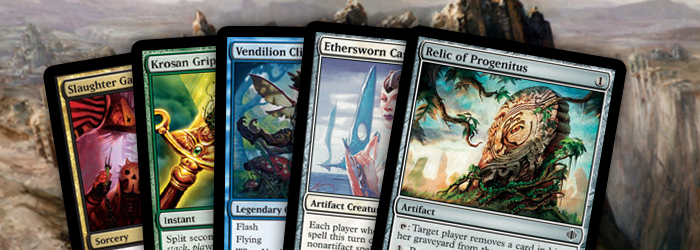
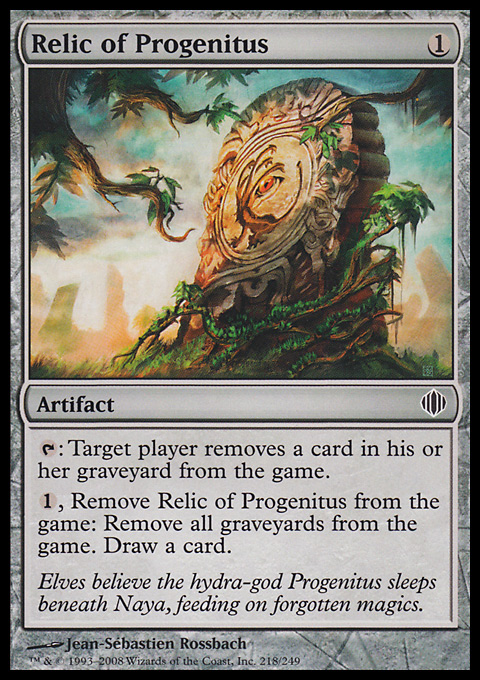
Relic of Progenitus

Looking at the top decks at the moment, they all utilize the graveyard to some extent. Dig Through Time has proven to be one of the strongest cards in Legacy, and BUG Delver and Shardless BUG still have Tarmogoyf. During the Treasure Cruise era a number of people experimented with graveyard hate to fight the powerful, new Ancestral Recall. I was never a fan of this as that would often require you to play slower cards, losing tempo to the very aggressive Viking Funeral deck. Dig Through Time however is a different animal, making for a slower metagame.

The other issue I would normally have with using graveyard hate to fight delve spells is that you’re playing a card that deals with only a few of theirs, and only if you draw it before they can deploy them. Relic of Progenitus neatly circumvents this problem by requiring a very low investment. A one mana card that also cantrips is one that you will almost never be unhappy to have in your hand.I prefer Relic over Nihil Spellbomb for its ability to keep the graveyard empty, which is what you want in drawn-out games versus a Dig Through Time deck.

The main reason Relic doesn’t see more play at the moment is that not every strategy can realistically afford to include it. Many decks take advantage of their own graveyards and can’t afford to pop Relic to blow it up. In addition to this Relic is also often a low power card that doesn’t win you the game, making it difficult to fit into the decks that are already skimping on victory conditions in favor of library manipulation as they would rather play more copies of Ponder or Preordain. In the decks where it does fit however I’m always happy to have it in my opening hand. If you’re on Goblins, Merfolks, Death & Taxes I would strongly recommend this card.

Ethersworn Canonist

With Omnitell taking over as the number one combo deck of the format we must also adapt to these changes, making sure we have the most effective disruption. Omnitell is a combo deck that is both highly consistent and highly resilient, especially to more traditional means of fighting combo, such as Thoughtseize and Force of Will. While they do have ways to deal with permanents through the power of their Cunning Wish sideboards, it is a much more awkward task for a deck that is used to things always running smoothly. Ethersworn Canonist slots nicely into existing creature strategies, particularly Death & Taxes, but there are other cards that will accomplish the same thing for you. Eidolon of Rhetoric is the more expensive option, but it survives cards like Massacre. The mana cost isn’t too much of a drawback against Omnitell either, as it’s usually safer to put it into play off of Show and Tell than risk it getting countered.

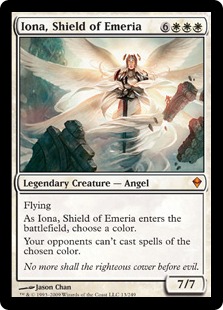
If you’re on a Reanimator strategy or something similar I would go with Iona, Shield of Emeria as she already fits so nicely into your own game plan. Trinisphere is quite strong in many of the decks designed to beat up on fair decks, such as Pox, Food Chain and MUD, and is often even stronger than Ethersworn Canonist against Omnitell due to them being able to cast spells on your turn as well. Rule of Law and Arcane Laboratory do not see much play at the moment, but they fulfill a similar role.

Vendilion Clique

Vendilion Clique provides both instant speed disruption and a clock, making it ideal for decks with little need to tap out on their own turn, such as Miracles. It also happens to be very well positioned against the format’s top two decks. You can cast Vendilion Clique in response to a miracle trigger or during their end step to make sure the coast is clear for you to resolve a powerful spell on your own turn. Casting it in response to a Show and Tell and stripping away their Omniscience is the dream, as you will not only have dealt with one of their combo pieces, but they will have wasted another, as well as a turn’s worth of mana.

There are so many tricks you can do with a Vendilion Clique that the potential for outmaneuvering maneuvers that will quickly cripple their plan is high. The best part is that it’s by nature a proactive card, meaning it’s very much live even when the ability doesn’t add much value! Did I mention it does a pretty good job at carrying an Umezawa’s Jitte?


Krosan Grip

Krosan Grip answers Sensei’s Divining Top, Counterbalance and Omniscience, as well as various equipments and powerful one-ofs, such as Sylvan Library. Krosan Grip doesn’t go into as many decks as Disenchant would, but it’s particularly strong when the decks you want it against all have the ability to counter it, flip a top, or bounce a Batterskull. Just keep in mind that Counterbalance will still trigger and counter it if they have a three on top.

If you don’t feel like keeping three mana up at all times you could go with Seal of Cleansing or Seal of Primordium instead. Put one into play off of Show and Tell and you will be able to respond to their Cunning Wish Dig Through Time by blowing up their Omniscience, forcing them back to square one. As for creature decks I would strongly consider maindecking two to three copies of Qasali Pridemage, as it’s already a powerful threat on its own. Golgari Charm is an elegant option for black green players as it also answers their sideboard plan of Young Pyromancer.


Slaughter Games


This is one of those cards that if you resolve it against Mono Blue Omnitell it will almost certainly win you the game. A powerful effect indeed, hence why it’s priced at four mana. Four mana is a lot in Legacy, and since Omnitell can easily go off before turn four, I’d usually stick to other hate. However, for slower decks that normally pose a poor combo matchup this type of ‘I-win-the-game-spell’ is precisely the type of card you need, especially if you’re able to reach four mana earlier than normal, slow your opponent down for a turn, or both. Just take a look at Niklas Kronberger’s Abzan Loam list that claimed first place at Prague Eternal last week.


[deck title=Abzan Loam by Niklas Kronberger, 1st place at Prague Eternal]
[Creatures]
1 Deathrite Shaman
4 Dark Confidant
1 Scavenging Ooze
1 Gaddock Teeg
4 Knight of the Reliquary
[/creatures]
[Noncreature Spells]
4 Mox Diamond
4 Chalice of the Void
2 Sylvan Library
2 Life from the Loam
3 Punishing Fire
3 Abrupt Decay
2 Green Sun’s Zenith
3 Liliana of the Veil
[/noncreature spells]
[lands]
2 Bayou
1 Scrubland
1 Taiga
1 Forest
3 Windswept Heath
3 Verdant Catacombs
3 Grove of the Burnwillows
1 Urborg, Tomb of Yawgmoth
4 Wasteland
1 Maze of Ith
1 Karakas
1 Tranquil Thicket
2 Barren Moor
1 Dryad Arbor
[/lands]
[Sideboard]
1 Maelstrom Pulse
2 Slaughter Games
2 Choke
1 Reclamation  Sage
2 Ethersworn Canonist
2 Golgari Charm
2 Thoughtseize
3 Leyline of the Void
[/sideboard]
[/deck]

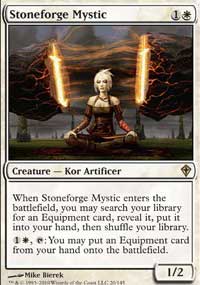
The deck plays cards like Deathrite Shaman, Green Sun’s Zenith and Mox Diamond to ramp its mana, alongside powerful disruption in the form of Thoughtseize and Chalice of the Void (among other cards). Versus fair, blue decks that skimp on action cards in favor of cantrips being able to snipe their best cards can prove to be a great advantage. Miracles is a lot less scary when you no longer have to fear Entreat the Angels for example. This is why many Goblins players have adopted Earwig Squad as a one-of, myself included. Storm opponents scoop when their namesake cards are taken away. Stoneforge Mystic turns into a mere Squire when you take away their equipments. Another option is to play Slaughter Games as a Burning Wish target, effectively granting you access to multiple copies even in game one.


This weekend I will be participating in the Scandinavian Open in Malmö, Sweden. My last big tournament before GP Lille. You can catch the stream over at twitch.tv/svmtv and hopefully see me doing battle in the top 8. If you happen to be at the tournament site, be sure to stop by my friend who makes amazing alters. She will be taking commissions on site, and I strongly encourage you to check out her Facebook page; MTG Alterations & Art by P.G. Berg

Brainstorm Brewery #151 – Cunning Gisch

This episode is all about the subtle mistakes in printing that can lead to big financial gains for those patient, and cunning enough to take advantage. Are you as totally mystified by the world of miscuts, misprints, crimps and screw-ups as the rest of the Brew Crew? Fear not, misprint expert Preston Gisch (@prestongisch) is on the case and he breaks it down for everyone. Not much else is discussed, honestly. You’re welcome for the value.


  • The gang is joined by misprint expert Preston Gisch (@prestongisch)
  • Who is Preston?
  • Finance 101 is all about rotation
  • Preston schools the gang on misprints
  • Pick of the Week.
  • Support our Patreon


Cabe Riseau produced the intro and outro music for Brainstorm Brewery.

Contact Us!

Brainstorm BreweryWebsiteE-mail TwitterFacebookRSSiTunesStitcher

Ryan Bushard – E-mail –TwitterFacebook

Corbin Hosler – E-mail –TwitterFacebook

Jason E Alt – E-mail –TwitterFacebook

Marcel White – E-mail –Twitter

Weekend Magic: 6/19-6/21

The major events of last weekend included Grand Prix: Providence, Grand Prix: Copenhagen, and Star City Games: Indianapolis. GP Providence and  SCG Indianapolis focused on Standard while GP Copenhagen was Modern. Of course, SCG Indianapolis also had Modern in addition to Legacy results. Let’s dive in and see what happened.

Grand Prix: Providence (USA)

Decklists

Format – Standard

R/G Devotion took down the field at Providence piloted by Sky Mason. R/G seems to be the top deck these days, with it also putting two more people into the Top 8 as well. Key cards in this strategy included [card]Genesis Hydra[/card], [card]Hornet Queen[/card], [card]Whisperwood Elemental[/card], and [card]Dragonlord Atarka[/card]. Pretty much just ramp out into a win condition and take it down from there. Green decks are very solid in Standard these days so expect to see them until the format is shaken up a bit more.

Rounding out the Top 8 were an interesting smattering of decks, two of which were based on four or more colors. Four-Color Whip was playing green as the main color but splashing for cards like [card]Torrent Elemental[/card] and [card]Dragonlord Atarka[/card]. You need three colors to play [card]Sidisi, Brood Tyrant already so splashing one more color in this Standard environment doesn’t seem like a big deal especially in lieu of the Five-Color Dragons deck appearing.

Yes, the Five-Color Dragons deck is based around mostly green and black spells however every color of dragon is included in the deck, as it packs two [card]Dragonlord Atarka[/card], two [card]Dragonlord Dromoka[/card], three [card]Dragonlord Ojutai[/card], and one [card]Dragonlord Silumgar[/card]. Using green’s color fixing [card]Sylvan Caryatid[/card] and [card]Satyr Wayfinder[/card], you can easily find the colors you need to cast these dragon lords. Also, the deck packs four [card]Haven of the Spirit Dragon[/card] for fixing and to get dragons in the graveyard back to the hand. Talk about maximizing potential! The deck is definitely an interesting way to make use of all the new dragon lords.

Grand Prix: Copenhagen (Denmark)

Decklists

Format – Modern

Looking at Copenhagen, Merfolk took down the Modern GP. Key components of the deck included [card]Mutavault[/card], [card]Aether Vial[/card], [card]Master of the Pearl Trident[/card] / [card]Lord of Atlantis[/card], and [card]Master of Waves[/card]. Protection from red in field full of Burn and Grixis seems support important, and [card]Master of Waves[/card] provides that alongside of a team of creatures that it summons upon entering the battlefield. [card]Hibernation[/card] seems like a great sideboard choice as it can completely wreck green decks out of nowhere.

The runner up Hatto was playing Scapeshift, which isn’t unexpected but seemed poorly positioned in a field fuller of faster [card]Griselbrand[/card] fueled combo decks. However, I’m sure Hatto was an expert Scapeshift pilot and so was able to do exceptionally well with the deck even on Day 2 of the GP. Key components of Scapeshift include of course [card]Scapeshift[/card], [card]Cryptic Command[/card], [card]Sakura-Tribe Elder[/card], [card]Search for Tomorrow[/card], and [card]Valakut, the Molten Pinnacle[/card].

Rounding out the Top 8 were Jund, Mono White Death & Taxes, another Merfolk, Grixis Control, Grixis Twin, and Grixis Delver – lots of Grixis decks in other words.

Mono White Death & Taxes was interesting deck choice. It include cards such as [card]Dryad Militant[/card], [card]Thalia, Guardian of Thraben[/card], [card]Leonin Arbiter[/card], [card]Serra Avenger[/card], [card]Flickerwisp[/card], [card]Blade Splicer[/card], as well as two main decked [card]Spellskite[/card]s and four [card]Ghost Quarter[/card] and three [card]Tectonic Edge[/card]. Quite a punishing deck for the unprepared!

Star City Games Open: Standard (Indianapolis, IN, USA)

Decklists

Deck Finish Player Deck Finish Player
G/R Dragons 1st Eric Rill G/R Devotion 9th Michael Gould
Mardu Dragons 2nd Jamie Kelly Mardu Dragons 10th Matthew Longville
Abzan Midrange 3rd Raja Sulaiman Temur Dragons 11th Andy Ferguson
G/B Dragons 4th Kent Ketter R/G Aggro 12th Jessy Hefner
Bant Heroic 5th Ziang Chen G/R Devotion 13th Jacob Baugh
G/R Devotion 6th Chris Andersen Esper Dragons 14th Daniel Unger
G/W Devotion 7th Corey Castelli Abzan Megamorph 15th Boris Pan
Mardu Dragons 8th Derek Monk Mardu Dragons 16th Marty Williams

In Indianapolis, R/G also ruled the day in the form of G/R Dragons piloted by Eric Rill. Key components of the strategy included [card]Deathmist Raptor[/card], [card]Goblin Rabblemaster[/card], [card]Rattleclaw Mystic[/card], [card]Stormbreath Dragon[/card], and [card]Thunderbreak Regent[/card]. Planeswalkers were left out of the main deck and relegated to the sideboard, but they did include one [card]Chandra, Pyromaster[/card], two [card]Nissa, Worldwaker[/card], and two [card]Xenagos, the Reveler[/card].

Mardu Dragons was the runner up, which featured [card]Goblin Rabblemaster[/card], [card]Stormbreath Dragon[/card], and [card]Thunderbreak Regent[/card] as the main creatures. Similar to the G/R dragons deck, Stormbreath and Thunderbreak seem to be the best red dragons to include in Standard decks. With Mardu, you also get [card]Crackling Doom[/card] and access to [card]Foul-Tongue Invocation[/card] and [card]Thoughtseize[/card] which is nice.

Rounding out the rest of the Top 8 were Abzan Midrange, G/B Dragons, Bant Heroic, another G/R Devotion, G/W Devotion, and another Mardu Dragons deck.

G/B Dragons seems like it is something new and exciting however the name is kind of misnomer. It’s the same Five-Color Dragons as talked about before from GP Providence.

Looking at the Top 16 we have two more G/R Devotion, two more Mardu Dragons, Temur Dragons, R/G Aggro, Esper Dragons, and Abzan Megamorph. Temur Dragons made good use of [card]Savage Knuckleblade[/card] alongside [card]Stubborn Denial[/card]. It’s also nice to see Esper Dragons still in the picture without being too dominating.

Star City Games Premier IQ: Modern (Indianapolis, IN, USA)

Decklists

Deck Finish Player Deck Finish Player
Grixis Delver 1st Mat Bimonte U/R Twin 9th Lauren Nolen
Jund 2nd Mitch Blankespoor Grixis Control 10th Hayden Passarelli
scapeshift 3rd CJ Steele Burn 11th Jackson Smith
Grixis Control 4th Jeremy Bush Grixis Control 12th Cody Murray
Jund 5th Keir Haley Grixis Twin 13th Tony Hess
Zoo 6th Matt Ayers Temur Delver 14th Brett Bennett
Bant Hexproof 7th Austin Bates Zoo 15th Derek Madlem
Affinity 8th Tracy Loeffler Infect 16th Noah Strasler

Looking at Modern, we see that Grixis Delver took down the IQ. [card]Gurmag Angler[/card] seems to be the Delve creature of choice along with [card]Tasigur, the Golden Fang[/card] in the U/R decks that can quickly amass a ton of cheap instants and sorceries in their graveyard. [card]Shadow of Doubt[/card] is also a nice trick to include these days as it can hose a wide variety of strategies such as Tron and Scapeshift, and can even blank a fetchland in a pinch.

Jund was the runner up and was packing [card]Dark Confidant[/card] and [card]Tarmogoyf[/card] as always, but no [card]Olivia Voldaren[/card]. Two [card]Huntmaster of the Fells[/card] were present across the main deck and sideboard, and Blankespoor even opted to play two [card]Fulminator Mage[/card] main deck in order to have a better matchup against Tron and other nonbasic land strategies.

Rounding out the Top 8 were Scapeshift, Grixis Control, another Jund, Zoo, Bant Hexproof (aka Bogles), and Affinity. I think it was interesting that Grixis Control played four [card]Cryptic Command[/card]s. Zoo is now packing [card]Geist of Saint Traft[/card] along with [card]Tasigur, the Golden Fang[/card], [card]Siege Rhino[/card], [card]Ghor-Clan Rampager[/card], and [card]Tribal Flames[/card] in order to maximize the total amount of damage.

Rounding out the Top 16 were U/R Twin, two more Grixis Control, Burn,Grixis Twin, Temur Delver, another Zoo, and Infect. Temur Delver is still packing [card]Hooting Mandrills[/card] and [card]Disrupting Shoal[/card] main deck, and makes good use of [card]Mana Leak[/card] and [card]Stubborn Denial[/card] to help control the game – even [card]Tarfire[/card] was seen as a two-of in the main deck to help [card]Tarmogoyf[/card] out! The second Zoo list was very different than the Top 8 list. Madlem elected to go with the [card]Burning-Tree Emissary[/card], [card]Kird Ape[/card], [card]Loam Lion[/card], and [card]Wild Nacatl[/card] plan and not play any spells costing more than two mana in the main deck – in the sideboard, [card]Dromoka’s Command[/card] seems interesting as a way to help counter spell damage removal as well as provide your own removal spell with a creature in play.

Star City Games Premier IQ: Legacy (Indianapolis, IN, USA)

Decklists

Deck Finish Player Deck Finish Player
Burn 1st Adam Minniear Omni-Tell 9th Zachary Byrd
Death and Taxes 2nd Evan Smith Elves 10th James Hess
Ad Nauseam 3rd Caleb Scherer Temur Delver 11th Jesse Pick
Temur Delver 4th Ben Wienburg Ad Nauseam 12th Benjamin Ball
Manaless Dredge 5th Dan Lashbrooke U/W Stoneblade 13th Bernie Wen
Omni-Tell 6th Chris VanMeter Infect 14th Joe Ehrman
U/W Control 7th Jacob Coffey Sultai Delver 15th Justin Brickman
Jund 8th Dan Mercer Temur Delver 16th Andrew Shrout

Burn took down the Legacy portion of Indianapolis piloted by Adam Minniear. A force to still be reckoned with in Legacy, Burn can still quite well in Legacy thanks to the printing of [card]Eidolon of the Great Revel[/card]. [card]Sulfuric Vortex[/card] and [card]Price of Progress[/card] are components that Legacy Burn players love to sling since they can amass tons of damage over a few turns very quickly.

Death and Taxes was the runner up deck and featured [card]Phyrexian Revoker[/card], [card]Mother of Runes[/card], [card]Stoneforge Mystic[/card], and [card]Thalia, Guardian of Thraben[/card]. D&T is also still one of the top Legacy contenders.

Rounding out the Top 8 were Ad Nauseam, Temur Delver, Manaless Dredge, Omni-Tell, U/W Control, and Jund (which is also similar to the archetype Nic Fit). Key cards from Manaless Dredge include [card]Bloodghast[/card], [card]Phantasmagorian[/card], and [card]River Kelpie[/card] which distinguish it specifically from regular Dredge builds. Jund / Nic Fit key components include [card]Veteran Explorer[/card] to ramp up into cards such as [card]Huntmaster of the Fells[/card], [card]Primeval Titan[/card], and [card]Thragtusk[/card] – also, cards like [card]Sensei’s Divining Top[/card], [card]Pernicious Deed[/card], and [card]Grove of the Burnwillows[/card] / [card]Punishing Fire[/card] synergy work well at controlling the board until you drop a huge dude.

Rounding out the Top 16 were another Omni-Tell, Elves, two Temur Delver, another Ad Nauseam, U/W Stoneblade, Infect, and Sultai Delver. All of these decks have had extensive Legacy coverage previously so no new updates here.

That’s it for this week! As always, thanks for reading.


Money Draught #33 – The One About GP Vegas ’15

Yup, it’s the One About GP Vegas ’15.


** This cast is for mature listeners **

Your Hosts:
Jason Alt — @JasonEAlt
Slick Jagger — @slickJagger
JR — @time_elemental

Money Draught RSS

Brainstorm Brewery #150 – Nothing Special

In honor of Brainstorm Brewery episode #150, we’re celebrating by doing absolutely nothing. No special episode. No guest. No clips previously unheard. Nothing. Oh, I’m sorry, is a boilerplate episode of the world’s best Magic the Gathering finance podcast not enough for you? “Wow, all I get is witty banter, solid financial advice, a finance 101 segment to help me navigate the ever-changing landscape of buying and selling and a Pick of the Week that will make me money if I time it right? That’s the worst!” Yeah, we’re sorry. That’s all. If that does happen to be enough for you, check out and support our Patreon. We’ve made it very clear we’ll do more stuff like video content and more merch if we hit our goals. Use some of the money you made selling Blackcleave Cliffs for $10 all weekend.


  • Dogs are expensive and worth it
  • Finance 101 is all about how not to spend your money
  • GP Charlotte was a thing
  • What are prices going to do?
  • Origins talk!
  • San Diego Comic Con Planeswalkers spoiled
  • Pick of the Week.
  • Support our Patreon


Cabe Riseau produced the intro and outro music for Brainstorm Brewery.

Contact Us!

Brainstorm Brewery Website – E-mail – Twitter Facebook RSS iTunes Stitcher

Ryan Bushard – E-mail – Twitter Facebook

Corbin Hosler – E-mail – Twitter Facebook

Jason E Alt – E-mail – Twitter Facebook

Marcel White – E-mail – Twitter

New is Always Better – Over the Top with Twelvepost

Hello and welcome back! It’s time for another segment of segment of New is Always Better. Last time we had a look at a couple of innovative takes on Death and Taxes. The concept was simple; take an established archetype and study the different ways in which people have put their own twists on it.

In a format as diverse as Legacy the sheer amount of decks out there can seem overwhelming to newer players. Still, the format has been around for a long time, and experienced legacy players tend to be familiar with a large portion of the decks. If you’ve been playing Legacy for long enough you will likely have stumbled upon even the roguest of decks at least once. Being familiar with a deck however is far from the same thing as being up to date on it, and you don’t want to be the person missing out on day two because the last time you saw a certain deck in action was two years ago. While it’s practically impossible to keep up with everything that’s going on in Legacy, there are things one can do in order to learn how to look for signs that something new is going on.

A few weeks ago I was playing versus an Esper Control deck during a weekly legacy tournament at my local game store. My opponent showed me multiple Gitaxian Probes, as well as a copy of Darkblast. With this information in mind I was able to deduce the presence of Monastery Mentor, allowing me to sideboard accordingly. I still made errors due to my inexperience playing against the card and because I failed to fully trust my intuition, but at least when the first Monastery Mentor arrived I was prepared for it.

Being able to make these connections and deduce information about your opponent’s deck can be very important when figuring out what you need to play around. In this case it was easier for me because I had spent a lot of time of my own brewing with the mentor, and knew which cards I would have wanted to play alongside it. How to best make these connections and draw conclusions about the contents of your opponent’s deck is a complex topic that would require far more discussion to fully explore. What you can do is think like a deck builder and use your intuition and reasoning skills to the best of your abilities. If a Shardless BUG player is playing the full set of Baleful Strix, maybe that means they don’t have maindeck Toxic Deluge. If an Esper Stoneblade opponent plays Cabal Therapy, that likely means they also have Lingering Souls.

The ability to figure out what your opponent is up to is a valuable skill to develop, but just like deducing Monastery Mentor was easier for me, keeping an eye out for how decks change can help us come prepared. Legacy is a format ripe for brewing and trying new things. People do it all the time! What we really need to be aware of is when many people begin to adopt a new tech. Sometimes it’s because that tech is legitimately good. Sometimes it’s because it’s new and exciting. Sometimes it’s a meta call. Meddling Mage out of the sideboard of a Shardless deck is an example of such a twist. A light splash changes how several matchups play out post board, and if you’re unaware of that change you might find yourself operating under false presumptions, losing to a surprise blowout.

Examining these new twists to established archetypes is what New is Always Better is all about. Today I want to take a closer look at a deck at an admittedly powerful deck that doesn’t see too much play in legacy: Twelvepost. Twelvepost in all its variations utilize the Locus lands Cloudpost and Glimmerpost to generate an abundance of mana in order to ramp into a very powerful endgame, often in the form of an eldrazi. For reference, here is Jeremiah Rudolph’s list from 2014.

[deck title=12-Post by Jeremiah Rudolph]
[Creatures]
4 Primeval Titan
1 Emrakul, the Aeons Torn
1 Kozilek, Butcher of Truth
[/creatures]
[Spells]
4 Brainstorm
4 Sensei’s Divining Top
4 Crop Rotation
3 Expedition Map
2 Candelabra of Tawnos
3 Pithing Needle
3 Show and Tell
4 Repeal
2 Moment’s Peace
[/spells]
[Lands]
1 Forest
2 Island
1 Bojuka Bog
1 Glacial Chasm
4 Glimmerpost
4 Cloudpost
2 Vesuva
1 Eye of Ugin
1 Karakas
4 Misty Rainforest
4 Tropical Island
[/spells]
[/deck]

I didn’t include the sideboard here as the individual card choices there are likely more of a reaction to a specific metagame. If people are abandoning Sneak and Show in favor of Omnitell you’re going to want to switch up your sideboarding strategy. This certainly applies to maindeck decisions as well, but to a lesser extent. Generally decks will be more focused at executing their own strategy game one, whereas post sideboard games tend to be more interactive, as reactive/disruptive cards are brought in to target specific matchups.

Speaking of focusing on executing one’s own game plan, take a look at Jeremiah’s list again. This deck doesn’t just play a bunch of Locus lands which will sooner or later allow it to start casting fifteen-mana spells. The deck plays the full four copies of Crop Rotation and even has three Expedition Maps to help ramp up the mana. Granted, the deck also plays a number of utility lands, so the tutors aren’t there solely for the purpose of ramping, but fact remains that this is a build that is very focused on progressing its own plan.

A quick look at the “Turbo Eldrazi” thread over at the source shows two fairly popular builds, namely the blue green one, and the green white one. The color blue offers some consistency in the form of Brainstorm, as well as the option to play counter magic out of the sideboard. Show and Tell provides a nice way to accelerate your own game plan, but many have started moving away from the card, as Omnitell has gotten very popular, which makes resolving a Show and Tell of your own a very risky proposition.

Twelvepost is very well known for its strong matchup against Miracles, also known as ‘the best deck in legacy’, and for good reason. If you expect a field heavy with Miracles, there are a lot of arguments for Twelvepost. Miracles is a control deck that aims to win through inevitability – a strategy that folds easily when your opponent’s plan consists of building towards a superior endgame.

The combo matchup will still be an uphill battle, and many players are looking for ways to fight this Omnitell menace. Some have chosen to go with more all around good cards, such as Force of Will, Flusterstorm and Krosan Grip. Others play more dedicated hate. One way to go about things is to make sure the creatures you ramp into match up well versus the Omnitell decks. This could mean playing something like Iona, Shield of Emeria (if you’re in white) or Tidespout Tyrant (if you’re playing blue). Venser, Shaper Savant is also a strong card that goes very well with your own Karakas. If you’re holding Iona when they cast Show and Tell you simply put her into play and name blue before they get the chance to do anything. With Tidespout Tyrant you can bounce their Omniscience in response to them casting a spell by casting a spell of your own, such as Brainstorm or Crop Rotation. As for Venser, keep in mind that sometimes it’s preferable to keep him in hand rather than put him into play off of Show and Tell, as they can often go off in response to the trigger, in which case you’d rather be the one to react when they make a move.

[deck title=UG Twelvepost by Sandro Rajalin]
[Creatures]
1 Emrakul, the Aeons Torn
1 Kozilek, Butcher of Truth
2 Tidespout Tyrant
4 Primeval Titan
1 Venser, Shaper Savant
[/creatures]
[Spells]
4 Sensei’s Divining Top
3 Expedition Map
4 Brainstorm
2 Ponder
3 Repeal
3 Flusterstorm
4 Crop Rotation
2 Ugin, the Spirit Dragon
[/spells]
[Lands]
4 Cloudpost
4 Glimmerpost
2 Vesuva
4 Misty Rainforest
1 Polluted Delta
4 Tropical Island
1 Island
1 Forest
1 Karakas
1 Bojuka Bog
1 Glacial Chasm
1 Eye of Ugin
1 Cavern of Souls
[/lands]
[/deck]

This is a rough draft of mine and a collection of some of the ideas that I like going into a tournament with the deck at the moment. Flusterstorm is a bit narrow, but I wanted to keep the instant count high for Tidespout Tyrant, and Flusterstorm works beautifully for that purpose.

Twelvepost has a formidable matchup against the most popular deck in the format, and it has recently gotten a new and powerful toy to play with in the form of Ugin, the Spirit Dragon. Neither Wasteland nor Blood Moon see much play today either, as the top two decks (Miracles and Omnitell) both play a lot of basic lands.

Bonus Lists!

Following are some interesting and innovative Twelvepost lists that I’ve come across, to show just how much room for innovation there really is. Enjoy!

This list was played at my LGS a couple of months ago by a very proficient 12 Post player who’s done a lot of experimenting with the deck. After first having faced off against this list I asked him about the deck, and he shared with me the following insight; “the more I play the control role, the more I win”. An interesting point with regards to how one should approach the fundamental strategy of the deck.

Skimming through the ‘Turbo Eldrazi’ primer on the source I quickly found the same sentiment expressed in other words; “the most successful variant of the deck is as a Control deck that has the ability to combo finish.” This particular list utilizes the white splash alongside a slightly lower curve of creatures for more early game interaction versus the fair decks.

[deck title=Bant Post by Anton Torefeldt]
[Creatures]
4 Primeval Titan
2 Thragtusk
1 Restoration Angel
1 Ulamog, the Infinite Gyre
1 Emrakul, the Aeons torn
[/creatures]
[Spells]
4 Sensei’s Divining Top
4 Brainstorm
3 Crop Rotation
3 Repeal
3 Show and Tell
1 Oblivion Ring
4 Terminus
2 Ugin, the Spirit Dragon
[/spells]
[Lands]
4 Cloudpost
4 Glimmerpost
1 Eye of Ugin
1 Glacial Chasm
1 Karakas
4 Misty Rainforest
3 Flooded Strand
3 Tropical Island
1 Savannah
1 Tundra
1 Island
1 Forest
1 Plains
1 Flagstones of Trokair
[/lands]
[/deck]

This version takes a much more controlling approach to the game than Jeremiah’s list does. The white splash for Terminus gives the deck a tool for fighting opposing creature decks, buying more time to set up your own late game, which will in all likelihood be superior to theirs in strength.Thragtusk, as well as Restoration Angel, also offers more ways of interaction in the early game, making this list better fit for fighting fair creature decks. In addition to this the deck has abandoned Vesuva completely, as the card is much less impressive when you’re looking to cast a bunch of interactive spells early on, rather than simply ramping as fast as you can. Granted, this deck is still capable of ramping very fast, which is one of the reasons for why it’s able to compete. After all, a hardcast Emrakul, the Aeons Torn is a pretty good answer to most things in Legacy. Up next we have an interesting BUG Post list, splashing for removal spells in the form of Abrupt Decay and Pernicious Deed, as well as a couple of attractive cards in the sideboard.

[deck title=BUG Post]
[Creatures]
4 Deathrite Shaman
2 Sylvan Caryatid
4 Primeval Titan
1 Emrakul, the Aeons Torn
[/creatures]
[Spells]
4 Abrupt Decay
2 Pernicious Deed
2 Ponder
4 Brainstorm
3 Crop Rotation
2 Show and Tell
4 Green Sun’s Zenith
3 Ugin, the Spirit Dragon
[/spells]
[Lands]
1 Island
2 Forest
3 Tropical Island
1 Underground Sea
1 Bayou
4 Misty Rainforest
2 Polluted Delta
2 Verdant Catacombs
4 Cloudpost
4 Glimmerpost
1 Dryad Arbor
1 Eye of Ugin
[/lands]
[Sideboard]
2 Notion Thief
3 Flusterstorm
3 Thoughtseize
1 Pernicious Deed
1 Reclamation Sage
3 Pithing Needle
2 Extirpate
[/sideboard]
[/deck]

This list is an example of a Twelvepost deck favoring the black splash. Deathrite Shaman allows for more early game acceleration, and Pernicious Deed is a way to slow down creature decks, as well as dealing with various problematic permanents. Abrupt Decay is even stronger here, and can be an invaluable tool if you expect people to bring dedicated hate cards such as Blood Moon. In addition to the usual cantrips, this list also runs two copies of Ponder, as well as the full set of Green Sun’s Zenith to increase consistency. It does accomplish this by moving away from Sensei’s Divining Top though, which hurts, although this means that you can now bring in Pithing Needle to fight Miracles, not that we needed much additional help in that matchup. Overall this list is more similar to the BUG Control or BUG Nic fit decks, with a lower curve and more ways to permanently deal with opposing creatures. This approach certainly seems a lot stronger when you have access to eight copies of Primeval Titan.

If the goal is to be a control deck, this is one possible approach. I wouldn’t go with this version in the current meta game, but if you’re a dedicated Twelvepost player this list provides a way to keep up a fight even in the face of cards like Blood Moon. Thoughtseize out of the sideboard is also a nice addition as it allows us to diversify our combo hate, making it more difficult for them to answer. It’s also an all-around strong card.

These particular lists are a couple of months old by now, and the metagame has evolved since then. It is up to us as players to keep up and adapt to those changes in order to stay ahead. Legacy is in a state of constant flux, and we must be constantly reexamining and reevaluating our previously formed ideas about the nature of the format if we are to remain flexible and open.

Next week I’ll be back with a new article where I’ll talk about some cards that I think are very well positioned in Legacy at the moment. Until then you can find me on Twitter at @SandroRajalin if you’re up for more legacy content!


Until next time,

Sandro Rajalin

 

Weekend Magic: 6/12-6/14

GP Charlotte has come and gone, and the Modern landscape has been shaken up again by its results! Elves took down the tournament, which I certainly didn’t see coming, and there was plenty of innovation to be seen in the Top 8 – after all, not a single Top 8 deck played even one copy of [card]Tarmogoyf[/card]! Let’s take a look at the results.

Grand Prix: Charlotte

Decklists

Deck Finish Player Deck Finish Player
Elves 1st Michael Malone Grixis Control 9th Patrick Chapin
U/R Twin 2nd Wesley See Naya Company 10th Paul Rietzl
Affinity 3rd Andrew Wagoner Abzan Company 11th Riley Curran
Ad Nauseam 4th Darien Elderfield Burn 12th Joe Rittiner
Goryos Vengeance 5th Zach Jesse G/R Tron 13th Michael Ingram
Abzan Company 6th Ian Bosley Abzan Company 14th Mark Klusa
U/R Twin 7th Samuel Pardee Lantern Control 15th Zac Elsik
Burn 8th Donald Smith Abzan Company 16th Bradley Robinson

Let’s highlight some key parts of the Elves strategy:

  • [card]Elvish Archdruid[/card] – A key component to the strategy, this card accelerates your mana while also providing a lord effect for your team. It allows you to easily cast [card]Chord of Calling[/card] or [card]Collected Company[/card] for even more elves to continue the beatdown.
  • [card]Heritage Druid[/card] – Another card that allows fast mana acceleration, Heritage Druid makes elves that you cast immediately be available for more mana to continue playing spells
  • [card]Nettle Sentinel[/card] – This card synergies with [card]Heritage Druid[/card], by allowing you to tap it for mana and then when you cast a green spell it will untap immediately and allow you to again tap it for mana or even attack since it is a 2/2.
  • [card]Ezuri, Renegade Leader[/card] – Probably the most pivotal card in the deck, this guy allows you to pretty much win on the spot if you untap with him in play.
  • [card]Nykthos, Shrine to Nyx[/card] – This Standard card fits right in with what the deck is trying to accomplish and allows you to keep making that green mana all day long.
  • [card]Cavern of Souls[/card] – Uncounterable Elves are pretty good, I hear.

All in all, this is pretty cool deck that can win extremely fast if left unchecked. In the sideboard, [card]Kitchen Finks[/card] and [card]Burrenton Forge-Tender[/card] help you stabilize against Burn and [card]Beast Within[/card] is a nice catch-all answer that can take care of any troubling permanent in a pinch to help finish the game.

U/R Twin was the runner up, playing the usual [card]Deceiver Exarch[/card] / [card]Pestermite[/card] and [card]Splinter Twin[/card] game winning combination. One trend I’ve noticed amongst Twin players (even the three color Grixis / Temur variety) is that they’re playing at least one [card]Roast[/card] main deck these days – five damage to a creature for two mana is really good! Most of the time this kills [card]Tarmogoyf[/card] and will always take out [card]Tasigur, the Golden Fang[/card].

[card]Ad Nauseam[/card] came in fourth place, which is a great result for such a large field. The deck is somewhat difficult to pilot but can win out of nowhere since the deck has several ways of keeping the player alive until they can win with [card]Lightning Storm[/card]. [card]Phyrexian Unlife[/card] and [card]Angel’s Grace[/card] are both key parts of the combo, and [card]Spoils of the Vault[/card] is also an important card because it allows you to easily search for any card you need for only one mana (and you don’t have to worry about dying because of the Unlife/Grace that is keeping you alive). [card]Angel’s Grace[/card] also works nicely with [card]Pact of Negation[/card], and you could even use multiple Pacts on the same turn and only need to pay one white mana during your upkeep! Finally, [card]Lotus Bloom[/card] helps with any mana issues by allowing you to suspend it on turn one or two and then have an explosive turn four or five.

[card]Goryo’s Vengeance[/card] has taken a completely new direction this tournament – the deck is now focused on drawing out your entire library with a combination of [card]Nourishing Shoal[/card] and [card]Worldspine Wurm[/card], followed by cheating into a play a [card]Borborygmos Enraged[/card] and then discarding a bunch of lands that you just drew to kill your opponent. [card]Griselbrand[/card] is the key piece of this combination, and you can help filter your deck to get him by using [card]Faithless Looting[/card], [card]Night’s Whisper[/card], and even the newer [card]Tormenting Voice[/card]. Strangely enough, there is enough actual support in the deck to actually utilize the Splice onto Arcane ability of several of the cards – splicing [card]Goryo’s Vengeance[/card] seems especially important if you have two legendary creatures in the graveyard that you want to get into play in a single turn. All in all, this deck looks really fun to play and I can’t wait to jam some games with or against it if given the chance.

In the Top 16, the most unique deck is the mill strategy [card]Lantern Control[/card]. This deck utilizes the cards [card]Codex Shredder[/card] and [card]Ghoulcaller’s Bell[/card] along with tons of “top of the library” manipulation in order to ensure that the opponent never draws a useful card again throughout the rest of the match. Quickly dropping an [card]Ensnaring Bridge[/card] means that your opponent will never be able to attack you as long as you have zero cards in hand, and afterwards all you do is sit back, take their best cards (or cards that could remove Bridge), and then win through milling them.

Several [card]Collected Company[/card] decks made the Top 16 of the event, which means that [card]Collected Company[/card] is officially “in” as a card to expect in Modern from this point out. Even if the math doesn’t seem to work out in theory for the number of creatures you need to run vs. the number of creatures that that are actually in the deck, [card]Collected Company[/card] has put up amazing results in one of the largest Modern tournaments of the year. Remember everyone, if you opponent has four mana open at any point during your turn, you can pretty much bank on Collected Company being cast if they’re playing green and have already dropped one or two small creatures throughout the game so far.

Looks like Modern is shaping up quite nicely. Combo and control were well represented at this event, and even aggro and creature based strategies did quite well. It looks like Modern has hit a nice spot where no one deck or strategy is overtly more powerful than another. Sure, it can feel rock-paper-scissors at times, but Modern overall looks really healthy to me after seeing the results from this weekend. That’s all for this week, thanks for reading.s


Best Laid Plans #1 – Fear and Ruse-ing in Las Vegas

You are about to bear witness to the Inaugural episode of Best Laid Plans. Best Laid Plans is a new podcast covering different types of gaming. We’re real gamers. We go to tournaments, stream, and enjoy games with our friends. On this week’s episode we cover each of our gaming backgrounds, our trip to GPVegas, Goyf-gate, and a magic player winning a tournament on mushrooms. We ask Ken for some judge clarifications and give our Punts of the week!

Contact Us!

Best Laid Plans – @BestLaid_Plans

Ken – @R3daoL

Tommy – @T_Moles

Em – @sheMehay

Shane – @deathritemagus

Brainstorm Brewery #149 – Gerry T Pities the Fool

Finance talk seems like it might be light given the guest of such a high caliber as the gang is joined by Gerry Thompson (@G3RRYT) but you’d be wrong. There is plenty of time to pick Gerry’s brain and hear about where he came from and what’s next for him, but his insights are invaluable to financiers of every stripe. How does a pro like Gerry feel about the “Maynard Goyf” debacle? How is he doing in the SSL? What’s the future of MODO and Modern and Magic? It’s all here. Strap in and put this podcast in your head holes.


  • The gang is joined by Pro phenom Gerry Thompson (@G3RRYT)
  • Who is Gerry T, really?
  • How did he get started?
  • What was working at Wizards like?
  • How is Gerry doing in the SSL?
  • 6 decks in the Top 8 of a Modern event? Oh my!
  • Fake tournament reports?
  • How does Gerry feel about the “Maynard Goyf”?
  • Pick of the Week.
  • Support our Patreon


Cabe Riseau produced the intro and outro music for Brainstorm Brewery.

Contact Us!

Brainstorm Brewery Website – E-mail – Twitter Facebook RSS iTunes Stitcher

Ryan Bushard – E-mail – Twitter Facebook

Corbin Hosler – E-mail – Twitter Facebook

Jason E Alt – E-mail – Twitter Facebook

Marcel White – E-mail – Twitter

Weekend Magic: 6/5-6/7

This weekend brought us the Invitationals, which includes the 2015 TCGPlayer Invitational (Standard) and the Star City Games Open Series Invitational (Standard and Modern). Let’s see what the best Magic deck pilots are playing these days.

2015 TCGPlayer Invitational (Standard)

Decklists

Deck Player Finished
GR Devotion Chris Fennell 1st
Esper Dragons Paulo Vitor Damo de Rosa 2nd
Mono Red Aggro Anthony Armenio 3rd – 4th
GR Devotion John Dwyer 3rd – 4th
Abzan Midrange Simon Harnden 5th – 8th
GR Devotion Robert Pisano 5th – 8th
Mardu Dragons Yam Wing-Chun 5th – 8th
UB Control Adrian Sullivan 5th – 8th
GR Devotion Seth Mansfield 9th – 16th
Sidisi Whip Jeremy Barbeau 9th – 16th
Mardu Dragons Eric Froehlich 9th – 16th
Esper Dragons Bayani Manansala 9th – 16th
Esper Dragons Sonny Aparicio 9th – 16th
UW Heroic Cody Lingelbach 9th – 16th
Red Deck Wins Tommy Harding 9th – 16th
RG Dragons Timothy Rivera 9th – 16th

Chris Fennell took down the even piloting G/R Devotion, the deck that is all about ramping up into giant threats in order to overwhelm the opponent. Key cards in Chris’ list include [card]Whisperwood Elemental[/card], [card]Rattleclaw Mystic[/card], [card]Nykthos, Shrine to Nyx[/card], [card]Dragonlord Atarka[/card], and [card]Genesis Hydra[/card].

Paulo Vitor Damo de Rosa was the runner up piloting Esper Dragons. Key cards in this deck include [card]Dragonlord Ojutai[/card], [card]Dig Through Time[/card], and [card]Silumgar’s Scorn[/card].

Rounding out the Top 8 we have Mono-Red Aggro, GR Devotion, Abzan Midrange, Mardu Dragons, and UB Control. Very diverse for a field full of some of the top players in Magic. The most distinct deck of the Top 8 was Mardu Dragons, which featured [card]Goblin Rabblemaster[/card] alongside [card]Stormbreath Dragon[/card], [card]Thunderbreak Regent[/card] and [card]Kolaghan, the Storm’s Fury[/card] with spells [card]Crackling Doom[/card] and [card]Draconic Roar[/card].

The Top 16 included decks GR Devotion, Sidsi Whip, Mardu Dragons, Esper Dragons, UW Heroic, and Red Deck wins. Notable decks here are Sidisi Whip and UW Heroic. Key pieces of Sidisi Whip include [card]Sidisi, Brood Tyrant[/card], [card]Whip of Erebos[/card], [card]Satyr Wayfinder[/card], [card]Tasigur, the Golden Fang[/card], [card]Doomwake Giant[/card], and [card]Dragonlord Atarka[/card]. Key pieces of UW Heroic include [card]Hero of Iroas[/card], [card]Battlewise Hoplite[/card], [card]Temur Battle Rage[/card], and [card]Ordeal of Thassa[/card]. Even though key components of these decks are on the horizon to rotate in the fall, based on these results you should still expect them in the summer months to come!

Star City Games Open Series Invitational – Standard

Decklists

Deck Finish Player
Naya Dragons 1st Ali Aintrazi
G/R Devotion 2nd Chris VanMeter
Abzan Megamorph 3rd Joshua Ravitz
Mardu Dragons 4th Richard Adams
G/R Devotion 5th Christopher O’Bryant
G/R Devotion 6th JB Milo
G/R Devotion 7th Tariq Patel
Esper Dragons 8th Kyle Boggemes

GR Devotion was the story of the SCG Invitational Standard results, with four of the Top 8 players piloting the deck in the Standard portion of the tournament. Naya Dragons was the choice of Ali Aintrazi, the winner of the Invitational. This features of this deck are [card]Hidden Dragonslayer[/card], [card]Dragonlord Atarka[/card], [card]Dragonlord Dromoka[/card], and [card]Xenagos, God of Revels[/card]. Looks like the goal of the deck is to ramp up into either [card]Dragonlord Atarka[/card] or [card]Dragonlord Dromoka[/card] and finish the game with with [card]Xenagos, God of Revels[/card]. Of course, the [card]Whisperwood Elemental[/card] backup plan is still relevant along with twelve mana dorks to accelerate victory. [card]Dromoka’s Command[/card] is in the sideboard of this deck, but four copies can come in against decks with lots of removal or direct damage.

Star City Games Open Series Invitational – Modern

Decklists

Deck Finish Player
G/R Tron 1st Ali Aintrazi
Amulet Bloom 2nd Chris VanMeter
Jund 3rd Josh Ravitz
Merfolk 4th Richard Adams
G/R Tron 5th Christopher O’Bryant
Abzan Company 6th JB Milo
Amulet Bloom 7th Tariq Patel
Grixis Twin 8th Kyle Boggemes

Looking at the Modern results, Tron put both the finalist Ali Aintrazi and Christopher O’Bryant into the Top 8. Key components of the Tron deck include [card]Wurmcoil Engine[/card], [card]Karn Liberated[/card], [card]Ugin, the Spirit Dragon[/card], [card]Expedition Map[/card], [card]Sylvan Scrying[/card], and [card]Oblivion Stone[/card]. The runner up Chris VanMeter along with Tariq Patel were on Amulet Bloom, further cementing the deck’s presence in Modern. Key cards from this deck include [card]Primeval Titan[/card], [card]Amulet of Vigor[/card], [card]Hive Mind[/card], [card]Summoner’s Pact[/card], and [card]Summer Bloom[/card].

Jund is well positioned in Modern these days, which I’m sure helped Josh Ravitz along in snagging third place. Key cards here include [card]Dark Confidant[/card], [card]Tarmogoyf[/card], [card]Scavenging Ooze[/card], [card]Liliana of the Veil[/card], and [card]Kolaghan’s Command[/card]. Out of the sideboard, [card]Fulminator Mage[/card] is important as is [card]Huntmaster of the Fells[/card] and [card]Kitchen Finks[/card].

Merfolk allowed Richard Adams to snag 4th place. Key cards here are [card]Lord of Atlantis[/card], [card]Master of the Pearl Trident[/card], [card]Master of Waves[/card], [card]Mutavault[/card], [card]Aether Vial[/card], and [card]Spreading Seas[/card]. Out of the sideboard, [card]Unified Will[/card] is an interesting choice – I’m not sure I’ve seen that one before! Seems good though against control and combo decks that are running few to no creatures.

Rounding out the Top 8 are Abzan Company and Grixis Twin. Both of these decks have been doing great in Modern recently. Key cards in Abzan Company include [card]Birds of Paradise[/card], [card]Chord of Calling[/card], and [card]Collected Company[/card] (along with a host of toolbox creatures of course). Key cards in Grixis Twin include [card]Snapcaster Mage[/card], [card]Splinter Twin[/card], [card]Kolaghan’s Command[/card], and [card]Tasigur, the Golden Fang[/card].

That’s all for this week! Key coming back for more weekend summaries.

Kitchen Table Magic – Love and Hate in Multiplayer Magic Part 1

Multiplayer Magic is very different than traditional head to head Magic. Because more humans are involved, more emotion is involved. Every time you have a choice to attack or target a permanent or player, you have many more options. Each comes with its benefits and costs. One cost of any action in a multiplayer game is table hate. In this article, I will explore the concept of hate and what actions generate it. In Part Two, we will examine the opposing force, love.

Hate

Every time one player makes a move against another, they generate some amount of hate from that player or the entire table. Those of you who are familiar with MMORPGs should be familiar with the concept of “hate.” If you have never accidentally pulled the attention of a boss monster with a 5x rogue strike, hate is a quantity like a life total. You can think about it like a counter that starts at a particular value and counts up or down based on your actions and the game state. When Sue attacks you with [card]Dragonlord Atarka[/card], the counter with her name on it in your mind tics up a few notches. When Anthony chooses you as the target of his [card]Diabolic Edict[/card], his counter goes up. These hate counters represent feelings. When one of our internal hate counters is high, we feel more compelled to get back at that person. Many players use these feelings to make decisions, sometimes at the expense of an obvious and more strategic path..

Humans are emotional creatures. We tend to take things personally. When I am chosen as the target among two other opponents, I wonder, “why me?” If you generate more hate than your opponents, you will likely lose the game as your opponents chose to attack and target you more. I find that one of the most rewarding things I’ve done in multiplayer Magic is to convince another player to act against their better judgement and attack my opponent instead of me. Hate generation often keeps competitive Magic players from winning multiplayer games. They just don’t understand this component of the game and throw their hands up in frustration. It makes sense to try and understand table hate and use it to our advantage to have more fun and win.

There are a number of actions that generate hate. Some of them are pretty obvious, others, less so.

Commander Hate

One of the most underrated and influential hate generators is your commander. Commander or Elder Dragon Highlander, as it is also known, is one of the most commonly played multiplayer Magic formats. When you reveal your commander for the game, do any of your opponents groan or comment on it? If so, you have likely already generated some amount of commander hate. You may smile and say, “Heck yes, I am playing [card]Sliver Overlord[/card]. Come get some.” You should also be taking notes. Identify who hates your commander, because those opponents will likely chose you as a target when the option presents itself. They simply do not like how your deck interacts with the game or their deck. Try to divert attention away from your commander by pointing out interactions in other player’s decks that are powerful or infinite. You don’t want all the players gunning for you right out of the gate.

<h3>Combat Hate</h3>

When you attack an opponent, you will generate some hate. This hate is unavoidable, but you can sometimes deflect some of it if you are savvy. On a recent episode of the Command Zone, a wonderful podcast that covers all things EDH, Jimmy Wong and Josh Lee Kwai talk about some subtle political maneuvers to reduce attack hate. One suggestion they had was to roll a die to randomly determine the defender of this turn’s attack. You can then blame chance for the attack. Another suggestion from the boys was to ask the group, “Who should I attack?” If Anthony responds, “You should attack Sue,” then you can attack Sue and blame Anthony. Anthony gets the attack hate from your attack! Clearly you can’t use this trick every time, but using political strategies to deflect the hate is a good way to have fun and reduce the hate at the same time.

Spell Target Hate

When you target the permanents, hands, life totals, library, and graveyards of your opponents, you will generate some amount of hate. As long as you can offer a solid reason for targeting Sue’s permanent, you can reduce the hate you generate when you target it. You could also ask Anthony again, “Should I remove Sue’s [card]Griselbrand[/card] or John’s [card]Avenger of Zendikar[/card]?” If Anthony gives you feedback and you follow it, you can deflect some of the hate to him.

Won Last Game Hate

You won the last game, the other players will want to take you out first this game. This is natural, and will often show up most at the beginning of the next game. When players have a choice between targets, they will attack you and your permanents because you are the Yankees this game. I have found that this form of hate wears off when players get their board presence established. It is important to avoid taking an early lead the game after you win. You don’t want to establish a dynasty. It will cause the others to gang up on you for a longer period of time.

You Killed Me Last Game Hate

This form of hate is similar to the won last game variety, but there are differences. It only affects the players you personally took to zero life and is more personal. Winning is something other players often excuse with time, but if you killed a player and then lost, you will likely feel the hate more acutely from that player. Some players are very susceptible to this form of hate. This is especially potent when you kill a player first, and when you could have chosen to attack someone else. Some players will carry this chip on their shoulder for at least the next game. You better believe that if they get the chance to eliminate you, they will take it even if the action is detrimental to their chances of winning the game. You need to take this into account as you calculate what the actions of the other players will be in response to your plays. You can actively avoid attacking or targeting the hater’s permanents and draw attention to it at the beginning of the game to help mitigate the hate, “I am going to attack Jessie instead of Bill. I killed Bill last game, so I’ll give him a break.”

You Convinced Him to Attack/Target Me/My Permanents/Hand/Graveyard/Library Hate

When you respond to another player asking, “Who should I attack?” you put yourself in a position to receive some of the hate from the attack. If there is a permanent on the board that is preventing you from playing, [card]Iona, Shield of Emeria[/card] I am looking right at you, you should speak up. If the cards in question are fairly equally detrimental to you, keep your trap shut! There is no reason to share in the hate unless you absolutely need to.


In the next article, we will explore the opposite of table hate, table love.

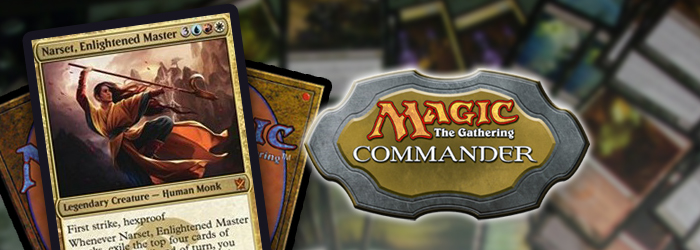
Commanding Opinion: Narset, Enlightened Master

I may have accidentally jumped on the bandwagon way too early on this one. Though on the financial side of things, that’s probably a good thing.

narsetenlightenedmaster

This little card has caused the majority extra combat card/extra turn cards to spike ridiculously in price.

[card]Aggravated Assault[/card] – $3.00 to $10.50 as of now

[card]Beacon of Tomorrows[/card] – $3.51 to $8.30, settled at $6.99

[card]Savage Beating[/card] – $1.97 to $5.12 as of now

[card]Seize the Day[/card] – $0.50 to $4.97, now settled at $3.22

[card]Time Stretch[/card] – $6.50 to $9.08, now settled at $8.55

[card]Waves of Aggression[/card] – .$1.59 to $7 dollars; now settled at $6.17

[card]World at War[/card] – $0.38 to $0.70 as of now

All of these prices are directly influenced by the printing of Narset – but why?

Well, [card]Narset, Enlightened Master[/card]. regardless of her $1.16 price tag, is influencing prices all the way across the board, and for just one reason – Commander.

Since there are so few Wedge-colored Legendary creatures, they’re all getting some attention. Sadly, the majority of the new Wedge Legendaries are actually fairly disappointing. [card]Tasigur, the Golden Claw[/card] and [card]Yasova Dragonclaw[/card] are the only other commanders from Khans of Tarkir Block that I’m really interested in.

For 3URW, Narset is a 3/2 Legendary Human Monk with First Strike and Hexproof. While the power and toughness are a little low for the mana cost, the ability is the real reason why.

Whenever Narset, Enlightened Master attacks, exile the top four cards of your library. Until end of turn, you may cast noncreature cards exiled with Narset this turn without paying their mana costs.

As a Johnny, any card that lets me cast cards for free gets my attention pretty quickly. The limitation of noncreature is easily fixed – just don’t play any creatures!

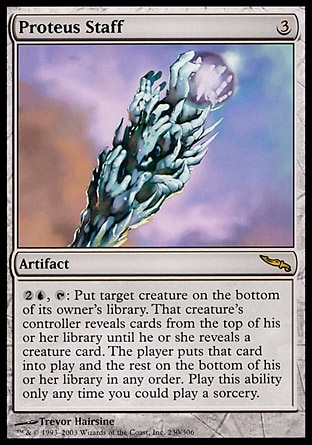
Since we’re in blue and going creatureless, we already have access to a very powerful card in [card]Proteus Staff[/card].

proteus staff


While regular ones have just been gradually going up, foil ones spiked to 15 around the same time as the rest of the cards mentioned here.

2U, tap: Put target creature on the bottom of its owner’s library. That creature’s controller reveals cards from the top of his or her library until he or she reveals a creature card. The player puts that card into play and the rest on the bottom of his or her library in any order. Play this ability only any time you could play a sorcery

At a first glance, it seems like a way to tuck annoying creatures or dig through your deck for a cool creature (which are definitely other uses in other decks) – until you realize the second to last line.

Since you go all the way to the bottom of your library to get Narset back off of Proteus Staff, you get to put your entire library back in whatever order you want – allowing you to set up as many attacks with Narset as you want.

Something like this:

[Deck]
[Swing 1]
Waves of Aggression
Swords to Plowshares
Arcane Denial
Eel Umbra
[/Swing 1]
[Swing 2]
Eldrazi Conscription
Time Warp
Fury of the Horde
Savage Beating
[/Swing 2]
[Swing 3]
Time Stretch
Steel of the Godhead
Howl of the Horde
Walk the Aeons
[/Swing 3]
[Swing 4]
Remand
Omniscience
Sword of Feast and Famine
Seize the Day
[/Swing 4]
[Swing 5]
Counterspell
Aggravated Assault
Sol RIng
Mana Vault
[/Swing 5]
[/Top of Library]
[/Deck]

And so on. You can space the cards out to get pretty much as many combats as you want, and then go for an infinite combat combo with these two cards:

Aggravated Assault sword of feast and famine

[card]Aggravated Assault[/card] allows us to pay 3RR in order to take an additional Combat Phase, and [Card]Sword of Feast and Famine[/card] untaps all of your lands every time the equipped creature deals combat damage. As long as you have lands tappi9ng for a total of 5 or more mana, you have infinite combats, letting Narset swing at players until everyone (other than you, of course) is dead.

crab umbra eel umbra

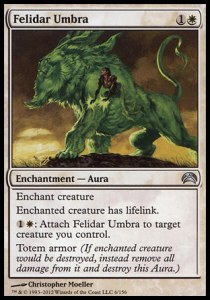
The umbra, [card]Crab Umbra[/card], [card]Eel Umbra[/card], [card]Felidar Umbra[/card], and [card]Hyena Umbra[/card] are less for the added abilities and more for the added Totem Armor, giving Narset another layer of protection while swinging in. [card]Drake Umbra[/card] , [card]Elend Umbra[/card] and [card]Mammoth Umbra[/card] are all more options that you’re free to play, I decided to stick with just these 4.

felidar umbrahyena umbra

At the very least, [card]Crab Umbra[/card] adds the utility of being able to untap Narset to block other players from hitting you, and [card]Eel Umbra[/card] can flash in to surprise someone expecting to wipe Narset off the board with a board wipe like [card]Damnation[/card] [card]Wrath of God[/card].

eldrazi conscriptionsteel of the godhead

In addition to extra combats, [card]Eldrazi Conscription[/card] makes sure the players you’re swinging at will be out of permanents and are unable to block her what-so-ever. Meanwhile [card]Steel of the Godhead[/card] makes her unblockable and gives your life a boost with the added lifelink.

[deck title=Narset Enlightened Master]
[Creatures]
Narset, Enlightened Master
[/Creatures]
[Spells]
Aggravated Assault
Arcane Denial
Aura of Silence
Azorius Signet
Basalt Monolith
Batterskull
Beacon of Tomorrows
Boros Signet
Coalition Relic
Chromatic Lantern
Commander’s Sphere
Counterspell
Crab Umbra
Cyclonic Rift
Darksteel Ingot
Darksteel Plate
Eel Umbra
Enlightened Tutor
Expedition Map
Eldrazi Conscription
Felidar Umbra
Fury of the Horde
Gilded Lotus
Grim Monolith
Hammer of Purphoros
Howl of the Horde
Hyena Umbra
Izzet Signet
Karn Liberated
Long-Term Plans
Mana Vault
Mass Hysteria
Mystical Tutor
Omniscience
Pact of Negation
Path to Exile
Proteus Staff
Reiterate
Relentless Assault
Remand
Rewind
Savage Beating
Scroll Rack
Seize The Day
Sensei’s Divining Top
Sol Ring
Spelljack
Steel of the Godhead
Supreme Verdict
Sword of Feast and Famine
Swords to Plowshares
Swan Song
Temporal Mastery
Temporal Trespass
Tezzeret the Seeker
Thran Dynamo
Time Stretch
Time Warp
Unstable Obelisk
Walk the Aeons
Waves of Aggression
Wild Ricochet
World at War
Worn Powerstone
[/Spells]
[Land]
Ancient Den
Battlefield Forge
Cavern of Souls
Celestial Colonnade
City of Brass
Command Tower
Flooded Strand
Glacial Fortress
Great Furnace
Hallowed Fountain
4 Island
3 Mountain
Mystic Monastery
NImbus Maze
Opal Palace
3 Plains
Reflecting Pool
Sacred Foundry
Seachrome Coast
Seat of the Synod
Shivan Reef
Slayers’ Stronghold
Steam Vents
Sulfur Falls
Temple of Enlightenment
Temple of Epiphany
Temple of the False God
Temple of Triumph
[/Land]
[/deck]

Overall, the deck is to just swing with Narset and have hilarity ensue. The land count is on the low side and there are no creatures to maximize the number of cards that Narset’s ability is able to hit. The very high density of mana rocks is to both get mana off of Narset’s ability and to rush her into play quickly by playing them early to ramp as fast as possible.

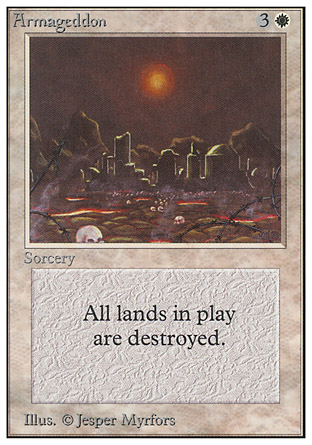
armageddoncataclysm

Personally, I’m choosing to avoid the land destruction package – but that doesn’t mean you have to! It’s really up to your play group if you’re going to play them, but I personally don’t. When I’m attacking as many times as I want, there’s no real reason to nuke the board. However, the deck plays very well with them, especially with the huge number of mana rocks.

[deck title=Land Destruction]
[Spells]
Armageddon
Boom // Bust
Cataclysm
Catastrophe
Impending Disaster
Obliterate
Ravages of War
Razia’s Purification
[/Spells]
[/deck]

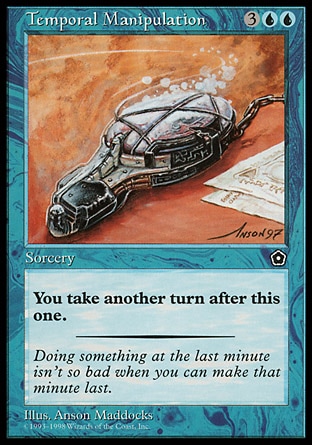
temporal manipulationcapture of jingzhou

[card]Temporal Manipulation[/card] is definitely a note-worthy card that I’m excluding from my list, only based on the availability of the card. They’re around $90 dollars right now, but if you’re playing on MTGO, they’re closer to $7 and aren’t too unreasonable. [card]Capture of Jingzhou[/card] on the other hand is $500 in paper, but is also still only about $2.50 on MTGO.

Now, this is mostly a deck that’s fun to solitaire and is built for larger groups that )hopefully) don’t gang up on players based on their Commander choice. In 1v1, as long as they don’t kill you before you get out Narset is pretty easily your game if you get a decent swing.

Until next time,

David M. Rowell

PS: f you personally decide not to go creatureless, here’s the few creatures I’d recommend playing.

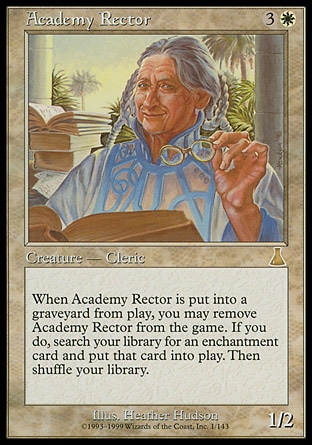
academy rector

[card]Academy Rector[/card] is an easy way to tutor out [card]Omniscience[/card] and [card]Aggravated Assault[/card].

generator servant

A turn 2 or turn 3 [card]Generator Servant[/card] is an easy turn 4 Narset as long as you’re hitting your colors fine.

nomad mythmaker

Mostly important to a Aura-heavy build, but being able to recover the umbras and [card]Eldrazi Conscription[/card] is pretty solid.

sovereigns of lost alara

Giving Narset +1/+1 and searching out a [card]Eldrazi Conscription[/card] or a helpful umbra? Count me in on [card]Sovereigns of Lost Alara[/card].

stoneforge

One of the strongest tutors in Magic, [card]Stoneforge Mystic[/card] tutors out [card]Sword of Feast and Famine[/card] and [card]Batterskull[/card] to name a few.

Pitt Imps Podcast #121 I Didn’t New What It Dud

This week we found out last minute that Angelo would be flying solo. Luckily for him, a couple guys jumped right in there to pick up the slack. The each go over Pet Decks of theirs as well as what they are currently playing in Standard. They go over the SCG Legacy Open. Angelo sends his good buddy Tangent not really hidden messages through out the show. They also0 tackle the MM2015 Pack fiasco.

Host Angelo     Twitter   @ganksuou

Guest Mascot     Buttercup   (Dave)  Twitter  @NinjaDave04

Guest Kyle      Twitter  @ArcaneWarrior

Email   [email protected]

Brainstorm Brewery #148 – Salmon Ball

Pascal Maynard ruined Magic for everyone by taking a foil Tarmogyf in a Booster Draft. This will set the scene perfectly for a podcast from the ruins of a post-Magic-ruination landscape. Vegas is over, finance is wrecked and some dude managed to win an SCG Open high on mushrooms. The world may never be the same again.


  • Goyf controversy!
  • What are Modern Masters prices doing?
  • Can MKM really sue buyers?
  • Pick of the weeeeeeeeeeeek
  • Support our Patreon! DO IT. You know this cast makes you more than $1 a week

Need to contact us? Hit up [email protected]


Cabe Riseau produced the intro and outro music for Brainstorm Brewery.

Contact Us!

Brainstorm BreweryWebsiteE-mailTwitterFacebookRSSiTunesStitcher

Ryan BushardE-mailTwitterFacebook

Corbin HoslerE-mailTwitterFacebookQuietSpeculation

Jason E AltE-mailTwitterFacebookQuietSpeculation

Marcel WhiteE-mailTwitter

Weekend Magic: 5/22-5/24

This weekend brought us Star City Games: Worcester, which featured Legacy as the main event with a side of Standard and Modern. Let’s take a look at the results and see which Legacy decks did best in a larger field.

Star City Games Open: Legacy (Worcester, MA, USA)

Decklists

Deck Finish Player Deck Finish Player
Grixis Delver 1st Noah Walker Sultai Delver 9th Ben Feingersh
Elves 2nd Andrew Jessup Miracles 10th Sam Roukas
Lands 3rd David Long Sultai Delver 11th Ross Merriam
Grixis Control 4th Paul Lynch Miracles 12th Joe Lossett
Death and Taxes 5th Michael Derczo U/R Delver 13th Eli Kassis
Infect 6th Zachary Koch Grixis Delver 14th Ed Demicco
Jeskai Stoneblade 7th Kevin Jones Omni-Tell 15th Chris VanMeter
Miracles 8th Joe Spanier Grixis Control 16th Eric English

Grixis Delver took down the event piloted by Noah Walker. Key cards in this deck included [card]Deathrite Shaman[/card], [card]Delver of Secrets[/card], and [card]Young Pyromancer[/card] backed up by twenty-eight cheap spells that help fuel huge Delve targets [card]Gurmag Angler[/card] and [card]Dig Through Time[/card]. [card]Cabal Therapy[/card] is a nice inclusion in the sideboard, as you can make good use of it with [card]Young Pyromancer[/card] tokens. Overall, the sideboard is pretty transformational and can be used to update the deck for a variety of matchups. It’s a solid deck, so expect to see more Delver lists in Legacy for the foreseeable future.

Elves was the runner up, which still shows that it is one of the best decks in the format. Key cards in the Elves strategy include [card]Heritage Druid[/card], [card]Nettle Sentinel[/card], [card]Wirewood Symbiote[/card], [card]Glimpse of Nature[/card], and [card]Natural Order[/card]. These cards all allow the deck to ultimately combo off by fetching a [card]Craterhoof Behemoth[/card] with [card]Green Sun’s Zenith[/card] in order to kill your opponent off in one huge turn. The sideboard includes black cards that allow it to transform into a more attrition-style deck with [card]Abrupt Decay[/card], [card]Cabal Therapy[/card], and [card]Thoughtseize[/card], along with one copy of [card]Progenitus[/card] in order to get around targeted removal.

Rounding out the rest of the Top 8 were a wide variety of decks. Lands is a classic Legacy standby deck; Grixis Control is a newer deck based on planeswalkers [card]Dack Fayden[/card] and [card]Jace, the Mind Sculptor[/card] along with a ton of spells to control the game; Death and Taxes is the white punisher deck seen in Legacy often these days; Infect is a solid creature based on combo deck; Jeskai Stoneblade is a more recent addition to the Legacy pantheon that has established itself as a dominant archetype; and Miracles is the de facto control deck in Legacy these days.

Rounding out the rest of the Top 16 were lots of control and tempo decks but only one combo deck. Surprisingly, plenty of grindy and tempo decks made it into the Top 16 of this tournament while combo sort of got left out. No Storm decks means that players were definitely prepared to face combo that weekend.

Star City Games Premier IQ: Standard (Worcester, MA, USA)

Decklists

Deck Finish Player Deck Finish Player
Abzan Aggro 1st John McCarthy Abzan Control 9th Peter Nguyen
Mono-Red Aggro 2nd Greg Lanzillotta R/W Dragons 10th Devon O’Donnell
G/R Devotion 3rd Jared Dimascio G/R Dragons 11th Oliver Dyakov
Abzan Control 4th Matthew Wong Esper Dragons 12th Marius Cholewa
Abzan Control 5th Roger Bulmer Abzan Megamorph Control 13th Adam Riley
Abzan Aggro 6th Jake Bartlett Abzan Megamorph Control 14th Mike Sigrist
Bant Megamorph 7th Julian Flury Bant Megamorph 15th Oliver Tiu
Abzan Aggro 8th Chris Kvortek Temur Dragons 16th John Lubrano

Abzan Aggro took down the Standard portion of the tournament, along with putting two others into the Top 8 spots of the event. Along with Abzan Control, Abzan strategies accounted for five of the Top 8 finishes in the Standard Preimier IQ. Key cards in Abzan Strategies include [card]Siege Rhino[/card], [card]Abzan Charm[/card], [card]Fleecemane Lion[/card], [card]Dromoka’s Command[/card], and [card]Hero’s Downfall[/card].

Mono-Red Aggro, G/R Devotion, and Bant Megamorph all are also good strategies to watch out for. Bant Megamorph makes best use of the enchantment [card]Mastery of the Unseen[/card] along with [card]Whisperwood Elemental[/card] in order to keep churning out more 2/2 Manifests every turn.

The rest of the Top 16 included decks such as R/W Dragons, Esper Dragons, Temur Dragons, and Abzan Megamorph Control. Dragons decks are still doing quite well these days, even though Esper Dragons seems to have fallen out of favor since players are more prepared to play against the deck. Temur Dragons is the most unique deck, featuring cards such as [card]Savage Knuckleblade[/card], [card]Whisperwood Elemental[/card], and [card]Stubborn Denial[/card].

Star City Games Premier IQ: Modern (Worcester, MA, USA)

Decklists

Deck Finish Player Deck Finish Player
Temur Delver 1st Jordan Boisvert Jund 9th Julian Wildes
Amulet Bloom 2nd Micah Greenbaum Zoo 10th David Lin
U/R Twin 3rd Brian Swatkins Jund 11th Adam Snoot
Jund 4th Frank Moon Jund 12th Jarvis Yu
Grixis Twin 5th Matthew Tellier Burn 13th Patrick Byrne
Zoo 6th Cheng Gong U/R Twin 14th Justin Harpin
Esper Zur 7th Timothy Fay G/W Hatebears 15th Dave Covino
G/R Tron 8th Dylan Plourde Abzan 16th Nick Yanofsky

Temur Delver took down the Modern part of the weekend piloted by Jordan Boisvert. The deck very different than your typical Temur Delver lists – included were four [card]Hooting Mandrills[/card], two [card]Curiosity[/card], four [card]Disrupting Shoal[/card], three [card]Stubborn Denial[/card], and one [card]Simic Charm[/card]. Also, there are three [card]Blood Moon[/card] in the sideboard of this deck that come in to crush… other three color decks I presume? Certainly an interesting spin on Temur Delver that is sure to have players discussing these choice for a while.

Rounding out the Top 8 were a nice assortment of decks, including Jund, Zoo, and something called Esper Zur. Esper Zur is definitely an interesting deck – playing four of the namesake card [card]Zur the Enchanter[/card], this deck aims to get out [card]Detention Sphere[/card], [card]Spreading Seas[/card], and [card]Steel of the Godhead[/card] (along with other enchantments in the sideboard) in order to lock down the game and finish the opponent off with a powered up Zur or [card]Geist of Saint Traft[/card].

Zoo is still packing [card]Collected Company[/card], so if you start seeing small creatures attacking your face be on the lookout for a potentially backbreaking combat or end of turn trick. Getting a [card]Loxodon Smiter[/card] and [card]Knight of the Reliquary[/card] off of a [card]Collected Company[/card] is no joke!

Jund is now pretty much the only deck playing [card]Dark Confidant[/card], as the deck needs a source of card advantage since it is trying to control the game through spells like [card]Abrupt Decay[/card], [card]Lightning Bolt[/card], [card]nquisition of Kozilek[/card], and [card]Terminate[/card]. [card]Liliana of the Veil[/card], [card]Tarmogoyf[/card], and [card]Scavenging Ooze[/card] are also mainstays in the deck due to their versatility in the format. [card]Fulminator Mage[/card] and [card]Choke[/card] out of the sideboard help against multicolor and blue decks, while cards like [card]Feed the Clan[/card] and [card]Anger of the Gods[/card] are great against hyper aggressive strategies.

Rounding out the rest of the Top 16 it appears that Jund did very well for itself in this event. No new decks this week in the Top 16, so that’s about it for Modern coverage.

That’s all for this week, stay tuned for more future Magic coverage.


Pitt Imps Podcast #120 No News

Well its a good thing we had 3 major tournaments to cover because this show would of been very short. We fought through Angelo’s computer issues to put out a good episode. We talked about our testing gauntlets and the major gap in coverage between SCG and Wizards. Its really bad. Host Angelo    Twitter   @ganksuou Co Host   Mike    Twitter   @Huntmaster_Mike Email  [email protected] Pitt Imps is brought to you each week by Brainstorm Brewery and Taitan Game Shop

Brainstorm Brewery #147 – #SVUHQBBQ

Sometimes we predict the future on this cast. Last week, on a Monday Jason said that Serum Visions was likely to be an FNM in the future and the next day it was announced. This week Jason pretended to fall asleep in the intro and Ryan actually fell asleep during the outro. Want to hear some more future predictions? The gang talks about the fate of foil Promo Thunderbreak Regent, the future of Collected Company, the bottom falling out of cards inflated on Tiny Leaders hype that never panned out and even threw in 75% of the Pick of the Week action you expected. All that and they sound good doing it. Doing get the impression that this episode is phoned in – that’s next week when the cast will be recorded live from Las Vegas. Get. Hype.


If you like the cast and want it to maintain its level of excellence and are honest with yourself and can admit it’s made you a lot of money, consider giving back, Patreon style.


  • Corbin doesn’t hate his wife. He feels the need to say so
  • Finance 101 concerns foil promo Thunderbreak
  • Collected Company? What’s going on?
  • Why is Smokestacks tanking?
  • Pick of the Week.
  • Vegas
  • Ryan naps
  • Support our Patreon

Sometimes we predict the future on this cast. Last week, on a Monday Jason said that Serum Visions was likely to be an FNM in the future and the next day it was announced. This week Jason pretended to fall asleep in the intro and Ryan actually fell asleep during the outro. Want to hear some more future predictions? The gang talks about the fate of foil Promo Thunderbreak Regent, the future of Collected Company, the bottom falling out of cards inflated on Tiny Leaders hype that never panned out and even threw in 75% of the Pick of the Week action you expected. All that and they sound good doing it. Doing get the impression that this episode is phoned in – that’s next week when the cast will be recorded live from Las Vegas. Get. Hype.


If you like the cast and want it to maintain its level of excellence and are honest with yourself and can admit it’s made you a lot of money, consider giving back, Patreon style.


  • Corbin doesn’t hate his wife. He feels the need to say so
  • Finan
  • ce 101 concerns foil promo Thunderbreak
  • Collected Company? What’s going on?
  • Why is Smokestacks tanking?
  • Pick of the Week.
  • Vegas
  • Ryan naps
  • Support our Patreon


Cabe Riseau produced the intro and outro music for Brainstorm Brewery.

Contact Us!

Brainstorm BreweryWebsiteE-mailTwitterFacebookRSSiTunesStitcher

Ryan BushardE-mailTwitterFacebook

Corbin HoslerE-mailTwitterFacebookQuietSpeculation

Jason E AltE-mailTwitterFacebookQuietSpeculation

Marcel WhiteE-mailTwitter

Money Draught #32 – The One About Trains

Topics include: Trains

** This cast is for mature listeners **

Your Hosts:
Jason Alt — @JasonEAlt
Slick Jagger — @slickJagger
JR — @time_elemental

Money Draught RSS

Pitt Imps Podcast #119 Mind Your Business

This week we fight through tech problems but manage to go over both GP’s and all the news. Angelo rants again. Seriously, why keep pissing him off? Then Angelo and Mike tell you how they each did at their respective PPTQ/IQ that they attended.

Host Angelo   Twitter  @ganksuou

Co-Host Mike     Twitter   @Huntmaster_Mike

Email   [email protected]

We Got Shirts Again

The Pitt Imps is brought to you by Taitan Game Shop and Brainstorm Brewery

Weekend Magic: 5/15-5/17

Last weekend brought us Grand Prix: Shanghai and Star City Games: Dallas. In other words, plenty of Standard action with a side of Modern and Legacy. Let’s see what the results were.

Grand Prix: Shanghai

Format – Standard

Decklists

“Abzan Megamorph Control” is quite a mouthful yet is an apt name for the deck that won GP Shanghai. Yuuki Ichikawa had the full playset of [card]Deathmist Raptor[/card]s and [card]Den Protector[/card]s in this build in order to generate tons of value together along with board clear [card]Crux of Fate[/card] and spells [card]Abzan Charm[/card] and [card]Hero’s Downfall[/card]. [card]Elspeth, Sun’s Champion[/card] is the big finisher in the deck with [card]Nisa, Worldwaker[/card] and [card]Sorin, Solemn Visitor[/card] coming in from the sideboard to help clean things up against control mirror matches.

The rest of the Top 8 wasn’t very diverse. Two other Abzan decks and five G/R decks made it in. Notably absent is Esper Dragons – it seems that G/R dragons and Abzan decks are good counters to the control deck’s counterpart.

Some notable cards from the G/R lists include [card]Thunderbreak Regent[/card], [card]Stormbreath Dragon[/card], [card]Dragonlord Atarka[/card], [card]Whisperwood Elemental[/card], and [card]Rattleclaw Mystic[/card].

Star City Games Open: Standard (Dallas, TX, USA)

Decklists

Deck Finish Player Deck Finish Player
G/R Dragons 1st Nathan Fabilenia Abzan Aggro 9th Edward Eng
Abzan Control 2nd Jon Lim U/B Control 10th Nick Schoolcraft-McCuen
Abzan Aggro 3rd Gabe Joglar Mardu Dragons 11th Clifton Beech
Atarka Red 4th Nathan Zamora Mardu Dragons 12th Josh Crowe
Mardu Dragons 5th Michael Villavicenci Abzan Megamorph 13th Nathan Waxer
G/W Megamorph 6th Jonathan Berg Abzan Megamorph 14th Richard Shade
Esper Dragons 7th Sam Berkenbile Bant Heroic 15th Logan Mize
Mono-Red Aggro 8th Drew Iafrate G/B Constellation 16th Erick Ramirez

G/R Dragons took down the Standard portion piloted by Nathan Fabilenia. There are plenty of example G/R Dragons decks from GP Shanghai, so we’ll focus on other lists that made the Top 8.

Mardu Dragons made an appearance in the Top 8, along with two other Top 16 appearances. After being featured in the finals of GP Toronto the deck is still doing well in the Standard metagame. Key players in this deck include [card]Stormbreath Dragon[/card], [card]Thunderbreak Regent[/card], [card]Kolaghan, the Storm’s Fury[/card], [card]Crackling Doom[/card], [card]Draconic Roar[/card], and [card]Foul-Tongue Invocation[/card].

Abzan decks also did well in Dallas last weekend, so you should continue to expect them in the Standard metagame. G/W Megamorph featured four [card]Avatar of the Resolute[/card] this time, along with a playset of [card]Collected Company[/card] however no [card]Mastery of the Unseen[/card] in the main deck (though it still made the sideboard). Mono-Red Aggro is still looking as fast as ever though interestingly only two [card]Goblin Rabblemaster[/card]s were main deck with the other two relegated to the sideboard to increase the clock against slower decks.

Rounding out the Top 16, Bant Heroic and G/B Constellation made appearances. Though becoming more “old school” Standard as the days go on, they can still put up impressive results if the pilot is skilled enough. Cards like [card]Hero of Iroas[/card], [card]Doomwake Giant[/card], and [card]Eidolon of Blossoms[/card] are still powerful in the right build and you should still expect to see these decks pop up from time to time until rotation.

Star City Games Premier IQ: Modern (Dallas, TX, USA)

Decklists

Deck Finish Player Deck Finish Player
Grixis Twin 1st Roland Hinajosa Abzan 9th Dylan Backham
Affinity 2nd Christopher Arico Burn 10th Matthew Hudson
Grixis Control 3rd Dan Jessup Jund 11th Todd Anderson
Affinity 4th Brandon Borowicz Obliterator Rock 12th Jason Blackmor
Slivers 5th Bryan Dubois Jund 13th Jason Clark
Merfolk 6th Ty Elrod Restore Balance 14th Robert Garza
Abzan Company 7th JB Milo U/R Twin 15th Benjamin Autin
Jund 8th Eddie Leza Burn 16th Anderes Hernandoez

Moving on to the Modern portion of the weekend, Grixis Twin took down the event piloted by Roland Hinajosa. Remember, the black splash is for [card]Tasigur, the Golden Fang[/card] and [card]Kolaghan’s Command[/card] main deck with multiple sideboard options including [card]Engineered Explosives[/card], [card]Murderous Cut[/card], and [card]Bitterblossom[/card], and more copies of [card]Kolaghan’s Command[/card].

Rounding out the rest of the Top 8, Slivers has finally made a break into Modern and even Merfolk was able to place well. Grixis Control is nicely tuned deck that made third place. It is able to take advantage of cards like [card]Vedalken Shackles[/card] and [card]Blood Moon[/card], along with [card]Cryptic Command[/card] and other Modern powerhouses to take control of the game and prevent the opponent from advancing their game plan.

Slivers is all kinds of out there – with so many one-of’s in the deck, it would be better to check it out for yourself rather than have me list them all here. The core slivers which were played as four copies include [card]Galerider Sliver[/card], [card]Predatory Sliver[/card], and [card]Sinew Sliver[/card], along with three copies each of [card]Homing Sliver[/card] and [card]Manaweft Sliver[/card]. Of course, cards like [card]Cavern of Souls[/card] are insane in this deck and even four copies of [card]Sliver Hive[/card] and [card]Reflecting Pool[/card] are pretty awesome too for rainbow mana. [card]Aether Vial[/card] seems pretty important for this deck, and of course [card]Collected Company[/card] is going to pretty much always get you two slivers off the top at instant speed.

Merfolk seems to be appearing more and more in the Top 8 of the Modenr IQ’s, so it is definitely a deck to watch out for these days. Elrod’s version is very streamlined, with pretty much every copy of the card in the deck being a playset (even in the sideboard!). [card]Kira, Great Glass-Spinner[/card] just seems so broken in this deck – if you have at least three creatures in play and if you resolve it, it can be very sad times for the opponent.

Rounding out the rest of the Top 16, Obliterator Rock and Restore Balance are the innovative decks that did well this week. Cards to watch out for in Obliterator Rock include [card]Phyrexian Obliterator[/card], [card]Vampire Nighthawk[/card], [card]Liliana of the Veil[/card], and [card]Abrupt Decay[/card]. Cards to watch out for in Restore Balance are [card]Greater Gargadon[/card], [card]Geist of Saint Traft[/card], [card]Huntmaster of the Fells[/card], and [card]Restore Balance[/card].

Star City Games Premier IQ: Legacy (Dallas, TX, USA)

Decklists

Deck Finish Player Deck Finish Player
Storm 1st Dustin Carriere U/R Delver 9th Dustin Buckingham
U/R Delver 2nd David Houghton Grixis Control 10th Harold Williams
Reanimator 3rd Austin Palmer Miracles 11th Patrick Tierney
Storm 4th Caleb Scherer Miracles 12th Shane Remelt
Miracles 5th Collin Rountree Sultai Delver 13th William Lo
Miracles 6th Bo Zhang Sultai Delver 14th Tannon Grace
Miracles 7th Skyler Goy Show and Tell 15th Kayleb Koslowsky
Omni-Tell 8th Nick Loiacono Omni-Tell 16th Dennis Wilder

Storm took the top spot in Legacy piloted by Dustin Carriere. Storm is always a Legacy staple, so if you play Legacy you know to expect it fairly often. You must be careful and counter key parts of the combo in order to slow them down enough to kill them. Key cards include [card]Lion’s Eye Diamond[/card], [card]Infernal Tutor[/card], and the various rituals that the deck uses to get enough mana to combo off.

The rest of the Top 8 is not very diverse, and includes many decks that have been seen in Legacy over the past several months. Miracles made numerous showings throughout the Top 16, as did Omni-Tell / Show and Tell builds along with U/R Delver and Sultai Delver builds. Not a ton of innovation in Legacy this week, however Legacy is a fairly stable format and doesn’t change that much from week to week.

That’s all for this week! Stay tuned for future Magic updates.

The Status of Women in Magic: Let’s Talk About “Rape”

Trigger Warning

This article is going to be about the use of “rape” and other references to sexualized violence in our community. In lieu of a formalized all-encompassing trigger warning, I believe it is more productive to be transparent about the direction in which I am leading this discussion. If you feel you would be traumatized or re-victimized by reading details of a sexual assault case or general conversation about rape, I recommend you avoid reading this article. If you decide to march forward any way and end up feeling upset, I am sorry for your pain. Please know you are not alone, and you will endure! May I direct you to these resources.

The Impetus…

Just over ten years ago, Zachary Jesse plead guilty to aggravated sexual battery, a felony, due to charges resulting from non-consensual vaginal and anal contact he forced upon another undergraduate student. Why is this relevant? Because this past Sunday, on May 10, Zach Jesse was a top-eight competitor at Grand Prix Atlantic City.

He was featured on screen without comment. In response, Drew Levin distributed news media links alerting other viewers to Jesse’s history and the coverage team’s oversight in including him. Immediately and unsurprisingly, Twitter erupted in a flurry of conversation. While many professional players and Magic: The Gathering talking heads displayed their disgust at the coverage team’s decision to feature Jesse, much of the playerbase involved in the conversation rejected the notion that Wizards had erred.

…and the Broader Problem

The Zach Jesse debacle is not isolated. Many of you may recall when Lucas Florent threatened to rape Director of Global Organized Play Helene Bergeot in 2011. His “lifetime” ban lasted all of six months. Jackie Lee has also been vocal about the rape threats she has faced for daring to be a woman who plays Magic well and visibly.

Each of these three situations are extreme examples of a problem I believe the MTG community faces regularly: alienating potential participants and active players through threats or relying on outmoded, offensive language that associates being defeated in a card game with a grave crime.

While it may be tempting to cast aside my concerns by attributing this disgraceful behavior to the social distance the internet provides, the players who tweet ferociously in defense of Zach Jesse or sling rape threats online patronize local game shops, too. I routinely hear players in my LGS and at tournaments say things like, “Oh, you just got raped!” usually with a gleeful smile on their faces. I am tying together a common trend and exemplary incidents because I believe the former cultivates an environment in which the latter can occur.

You may inquire: what does this have to do with women playing MTG? Women are disproportionately affected by sexualized violence. If you have more than a few women in a room, statistically, it is likely at least one of them has encountered rape or sexual assault. When you are flippant about your utilization of language or—as I saw repeatedly on Twitter this weekend—you defend a convicted rapist’s “right” to play a game, you signal to those present that you are not a safe person from whom to seek solace. You are not empathetic. You are not deliberate with your actions. You have not achieved a level of emotional maturity where you can be conscientious and distinguish between governmental censorship and a care-centered ethos that builds community. Now, if you would like to continue to reproduce these patterns of behavior and erect strawmen decrying a fabricated vision of institutional enforcement that very few MTG players have ever seriously endorsed…that’s fine. But I don’t want to play with you. I do not trust you. And you shouldn’t be surprised when other women [Editor’s note: or men!] don’t want to, either.

homewardpath

Fostering a hostile environment toward rape victims can dissuade women from participating, but it also has implications outside of exploring women’s limited role in Magic. Men experience sexualized violence at stunning rates, too.

Imploring fellow players and MTG community members to self-examine their behavior isn’t borne from of a desire to stamp out difference, eradicate fun, or be a wet blanket—it is about compassion and breeding an environment where the highest number of people can maximize their enjoyment. It is a matter of acknowledging that others have experiences that differ from your own and which may have lasting impacts of varying degrees. It is an issue of mutual respect and appreciation.

MTG is necessarily a social game, which means our interactions within the context of playing constitute the gaming environment. If it were not, you would be solely satisfied with emulators that mimic decision trees. Reducing the harm we enact against others is a complex process rife with competing interests. In this instance, however, I think the mental calculus is a simple weighing of costs and benefits. It costs you very little to be purposeful with your language. For someone suffering with PTSD, your failure to exert what will ultimately be a negligible effort for you, this seemingly small mistake can cost a great deal.

priviligedposition

“Free Speech” and “Being Offended” versus Community Cultivation

To those whose fingers itch to unload on me, whose internal cogs whirl like a cartoon character’s feet before they again gain traction and dash forward, as a bastion of “PC culture,” please evaluate what made you so bitter and eager to incite pain.

If your only line of logic is, “They’re denying my freedom of speech,” you are willfully misunderstanding the First Amendment of the Bill of Rights. To those detractors who would reply with a slippery slope argument of, “If I can’t say ‘rape,’ what next?” I ask that you appraise why you are so analytically lazy. If you would like to relish and praise your inability to identify gradation between institutionally imposed bans and self-inspection, you have only fulfilled the claims of those who accuse trading card players of being stunted.

“Oh, does this mean next we can’t say ‘kill’?”

Typically, murder victims are unable to hear jokes surrounding their abuse, because they are, well, dead. Unfortunately, they are not able to participate in the massive multiplayer game we call life or the MTG community any longer. Furthermore, rates of murder are notably lower than sexualized violence:

National or state crime in 2012
State Population Murder and nonnegligent manslaughter rate Forcible rape rate
United States-Total 313914040 4.7 26.9

Source

It is rather unlikely you would encounter an attempted murder victim in your LGS, while the same cannot be said of victims of sexualized violence. Lastly, people do not generally attribute murder to the behavior or past actions of murder victims, while rape survivors are routinely blamed for their victimization. There is no cultural ambiguity about the nature of murder, but confusion over the “boundaries” of consent is still regularly levied as a legal defense.

Rape victims are not figments of “misandrists’” imaginations. We exist. You play with us at LGSs, online, and around your kitchen tables. You trade with, buy from, and sell to us. We are members of the MTG community and we deserve to reap the rewards that a solidified subcultural environment can provide—camaraderie, fun, support, and growth—just the same as those who have not had to endure sexualized violence.

Drew Levin posed some questions on Twitter on which I would like all naysayers and doubters to reflect:

IMG_6164

IMG_6165

IMG_6166

IMG_6167

IMG_6168

IMG_6169

IMG_6170

Possible Solutions

Of course, it is misguided to identify a problem without proposing a solution.

longtermplans

What language should replace the offending language people are currently employing?

Some replacements I have heard recommended are “owned” and “rekt.” I would encourage you to be even more creative! May I point you toward a Shakespearean insult generator?

Now, I have heard claims that “rekt” or other variations are at risk of becoming substitutes that maintain the original meaning of the offensive language in question. You know your own intentions. If your trash talk is a loosely-veiled allegory for sexualized violence consider revising your statement before you speak. If your trash talk relies upon cultural scripts surrounding gendered patterns of dominance, reevaluate! Ask yourself why you would wish to inflict that sort of trauma on someone with whom you are playing a game. Hell, remove the final qualifier of that sentence. Why would you wish to inflict pain on anyone?

What should you do when you hear someone else use this language?

Speak up! Be polite but firm. In most instances I have personally experienced it suffices to say something along the lines of, “Hey, could you please not use that word?” Rarely have I encountered negative responses to that request, at least in person.

As for online play, I have no suggestions that have proven efficacious. Once in an online MTG interface, I asked nicely and at least four of the draft members proceeded to independently message me grotesque and detailed rape threats. Social desirability bias of in-person interactions obviously renders some techniques less effective online. As to what will rectify this beyond programmer-inserted chat filters, your guess is as good as mine. We have to be accountable to each other. The buck needs to stop somewhere.

I look forward to reading your responses to my thoughts, to the Zach Jesse scandal, and to the issue of the use of “rape” in our community.

Brainstorm Brewery #146 – Comet Storm

We realize you rely on these show notes to get a grip on what’s in the episode. Doesn’t that feel a bit like a spoiler, though? Speaking of spoilers, that person who “leaked” Modern Masters 2015 early sure did get most of his information right. It’s too bad getting some of it wrong pretty much means that it was all guessing. And that’s too bad. The gang discusses that, the future of Tarmogoyf, the controversial inclusion of Comet Storm in the set and even some picks of the week. Because we’re good to you like that.


  • A rolling start? Hot damn! It’s been a while since we did that
  • Finance 101 is all about foreign cards
  • Vegas talk is smothered in the cradle. You’re welcome
  • Modern Masters!
  • What is the future of Tarmogoyf
  • Pick of the Week.

Support our Patreon


Cabe Riseau produced the intro and outro music for Brainstorm Brewery.

Contact Us!

Brainstorm BreweryWebsiteE-mailTwitterFacebookRSSiTunesStitcher

Ryan BushardE-mailTwitterFacebook

Corbin HoslerE-mailTwitterFacebookQuietSpeculation

Jason E AltE-mailTwitterFacebookQuietSpeculation

Marcel WhiteE-mailTwitter

Unified Theory of Commander: Political Answers

You may have noticed that the further we’ve progressed into the Unified Theory’s MDTAS system, the more we’ve discussed the “character” of your deck. This isn’t a coincidence. Every deck needs mana sources, and the rules that help players improve their mana base can be broadly applied. Every deck wants card draw, so resource acquisition is an easy topic to tackle from a general point of view.

However, as we progressed past resource acquisition and into resource selection and utilization, it’s become more necessary to identify the specific goals of our decks. This allows us to make focused card selections that keep each deck functional and fun. So to wrap up our discussion on Answers, it’s important to shine a light back on that topic and make sure our selected answers are genuinely working in service of our goals.

Answers to Answers

The easiest way to introduce this topic is to go back to the example of [card]Soul of New Phyrexia[/card] from our previous conversation on answers. While[card]Wrath of God[/card] or [card]Path to Exile[/card] are answers that address threats, Soul of New Phyrexia might be better seen as an answer to an opponent’s answer. A tokens deck is most vulnerable to board wipes, so running a card that grants immunity to those sets up an army of 1/1 soldiers, elves, or goblins for victory.

Answer to Answers

Answer to Answers

Pause a moment and consider what makes [card]Swiftfoot Boots[/card] an EDH staple. Sure, it can allow an aggro general to swing in a turn sooner, but is that really why it’s so ubiquitous in decks that focus on the commander? I would argue Swiftfoot Boots more important function is being a cheap, near-universal answer to single-target removal. Granting haste is just gravy. What players really want is to know their commander, or another critical threat, is safe from most instant-speed answers.

To retread the most beaten path in Magic scholarship, this is what makes counterspells so immensely powerful and annoying. The “universal answer” isn’t just an answer to threats. It’s an answer to answers too. Consider how often you’ve heard the phrase “I was holding [THREAT] until I had a counterspell to back it up.” So while an aggro deck might have to pick between a removal spell or some kind of defense for their threats, a blue mage can use one slot to cover both. Answers to answers are incredibly valuable.

Bringing the Pain

Taken too far, this “answers to answers” concept can create some of the most powerful and frustrating decks in the format. A prime example would be the “stax” deck archetype. These decks are often helmed by commanders such as [card]Grand Arbiter Augustin IV[/card] or [card]Derevi[/card] and are packed with cards like [card]Winter Orb[/card], [card]Smokestack[/card], and [card]Tangle Wire[/card]. They lock down resources, prevent opponents from getting threats online and make it virtually impossible to answer their own threats. I’m sure you can see why these decks have a reputation for being the least fun in Commander.

Sorry, dude. No one likes you.

Sorry, dude. No one likes you.

You may have heard similar complaints about decks that rush a threat online, then activate mass land destruction to prevent answers. Watching an unchallenged [card]Jor Kadeen[/card] topple one player after another or a [card]Narset, Englightened Master[/card] play solitaire while being unable to keep lands online just isn’t fun. Mass discard decks like [card]Nath of the Gilt-Leaf[/card] also tend to have a crummy reputation for putting the rest of the table into topdeck mode for the entire game. So aggressively pushing answers to answers in other ways can clearly create bad feelings over time.

Cards such as [card]Painful Quandary[/card] or [card]Sadistic Sacrament[/card] don’t feel that mean when you are putting them into your deck. They feel like answers, and in some situations they really can function that way. In practice, they tend to push their controllers to play more competitively and require judicious utilization to not be incredibly frustrating. Aggressively and preemptively answering everything can produce obvious results. It can win you games. It just might not win you very many friends.

Prevention vs Reaction

So this brings us back to the goals we’ve set for our decks and the environments in which we expect to be piloting them. Most answers tend to be reactionary, which allows them to be used contextually and politically to your advantage. Holding a board wipe until someone has presented themselves as a major threat is not only wise, but it can also position you as an ally to the rest of the table and garner some goodwill that can be utilized to advance your own gameplan later. This is another great reason to always include answers of some kind in your decks.

Reactionary answers can be risky though. They require the right threat to target and sit in your hand until that threat presents itself. This  is why players tend to include preventative answers in their decks as well. Preventative answers can be the “answers to answers” we discussed above, but they can also be cards that slow down opponents like [card]Aura of Silence[/card], remove their resources like [card]Strip Mine[/card], or provide general protection like [card/]Avacyn, Angel of Hope[card]. While these preventative answers can frustrate opponents,  they generally aren’t bad choices and many decks should consider them to meet specific goals.

Be aware that how far do you go with prevention is going to characterize your deck in the minds of other players and will skew the way you pilot the deck too. Taking prevention to its extremes, we find cards such as [card]Iona, Shield of Emeria[/card] and [card]Contamination[/card], which can lock out opponents and make your deck not only seem more aggressive, but also make it quite hard to play politically. If the rest of your table isn’t expecting to play that competitively, you may find yourself playing archenemy instead of EDH, and rightly so. Don’t play cards that preventative and potent and then complain when the table teams up to stop you. You made those card choices and if playing solo against the table isn’t your goal, then you made some bad decisions during deck construction.

Prevention to the Extreme

Prevention to the Extreme

If your goal is to be as competitive and aggressive as possible (and there’s nothing wrong with that in the right setting) then select answers that support that goal and don’t be sheepish about including them. But if your regular table is very political, has mixed power levels, or just prefers a friendly game of spellslinging to nuclear war and you want to build a deck for that environment, then make sure to pick answers that fit the zeitgeist. Skew more reactionary and save the preventative answers for the stuff your deck just cannot  answer otherwise.

Conclusion

Deciding what kind of deck you really want to be playing isn’t just about selecting the right threats. Answers have a tremendous impact on the power level and character of your deck as well. You may have built a deck to be “friendly” by skipping certain potent threats and format staples, but selected more aggressive answers that frustrate your friends anyways. You may have tried to build a genuinely potent deck, but failed to identify the threats you need to prevent instead of simply answer. Both mistakes will leave your deck feeling unsatisfying and produce uneven results.

So make sure to run answers, but choose them carefully and be certain they align with the goals you set for the deck. Do your answers support or interfere with the deck’s plan? Are they meeting your expectations for potency and reliability? Most importantly, are you still having fun? If the answer to any of these questions is unclear, don’t be afraid to make some edits and experiment until it feels right again.