Episode Archives

Brainstorm Brewery #111 – Runs On The Market

Grand Prix Portland is in the books, and Corbin and Marcel are back to regale you with tales of the Grand Prix Portland house. Ryan’s back from Gen Con to give you the inside track on the biggest weekend in gaming. Jason went to neither and has plenty of stories about what it’s like to not do anything fun. So what made Portland so great? What should people do at rotation? Why didn’t they record last week? Find out the answer to some of these questions and more on an episode of your favorite podcast that will leave you asking, “Is Corbin actually surprised that he was blamed for B-Dubs?” This is Brainstorm Brewery.

  • Grand Prix Portland is wrapped up.
  • How was Gen Con?
  • Finance 101 deals with pickups at rotation.
  • Mailbag time!
  • Why even listen to the podcast when someone puts the Pick of the Week on Twitter?
  • Remember to check out the articles on BrainstormBrewery.com.
  • Questions? Concerns? The address is brainstormbrew at gmail dot com.


Cabe Riseau produced the intro and outro music for Brainstorm Brewery.

Contact Us!

Brainstorm BreweryWebsiteE-mailTwitterFacebook

Ryan BushardE-mailTwitterFacebook

Corbin HoslerE-mailTwitterFacebookQuietSpeculation

Jason E AltE-mailTwitterFacebookQuietSpeculation

Marcel WhiteE-mailTwitterFacebook

Conjured Currency #27: Checking in the Closet

Welcome back, everyone! I hope you all enjoyed the discussion on the potential for Modern Masters 2 last week, as well as my quick thoughts on the Organized Play changes.

Wizards of the Coast announced the original Modern Masters on October 18, 2012, so if they follow a similar trend for the set’s sequel, we can expect to hear an announcement in about two months. I personally loved drafting Modern Masters when it was more readily available, so I hope that the stars are aligning as WOTC appears to be granting us a second shot. Due to the fact that MM was an experiment (and therefore an extremely limited print run), it’s more likely that MM2 will be more easily available, allowing cheaper boosters and more individuals accessing the Draft format. I don’t care if the set spans from Eighth Edition to Theros, Zendikar to Khans, or whatever. I just want to jam a Limited format like that again.

Speaking of Modern Masters, I sold my sealed box a couple weeks ago. For clarity, it wasn’t because of any of my speculation in last week’s article, and it wasn’t because of anything that I’m going to say this week. I was bored at a friend’s house with several other Magic players, and he was scrolling through eBay on his phone looking up prices for a box because he was itching to do a draft. I half-jokingly offered that I had a box at my house and would sell it for $375, which caused a great stir in his mind and wallet. $300 cash and $75 in buylist value from his binder later, we were on the way to my house to pick up the box and crack it open, enjoying a good night and draft with friends. I lost.

Sealed Product Investments

I’ll spare you the details of the draft (unless you really want to know in the comments), and explain why I sold the box. The simplified version is that I was just following my own personal golden rule of, “If you can sell your Magic cards for full retail, and don’t need them in the immediate future, it’s almost always a good idea.” I can invest that $300 cash towards other collections and singles at buylist value, and sell those singles out of my case. If I put even a small amount of effort in, I’ll make a lot more than the slow and steady creep of the box that was just sitting under my bed for the past year.

After selling the box, I decided to do some checking up on some of the other sealed product I own to see where my investments were heading. You know how the general advice to people when buying sealed product is, “Throw it in a closet and forget about it for X years”? Well, let’s remember what we tried to forget, and see if our investment could have been put in a better place.

From the Vault: Twenty

FTVTwentyBox
I currently own five of these. I noticed them while digging past to grab the Modern Masters box in my tote of “sealed stuff to forget about.” I bought them around September of last year soon after they came out, from an extremely good friend and aspiring store owner who sold them to me for a pretty good $100 each. Like all FTV products, there was an extremely limited print run of these, and they include multiple old-school foils like [card]Swords to Plowshares[/card] and [card]Dark Ritual[/card], and last but not least, [card]Jace, the Mind Sculptor[/card]. There was no way this box wouldn’t be $200 in a year, and I believe I remember Ryan Bushard agreeing with me. I was confident. Easy money: just wait.

Fast forward about five months, to the winter of 2014. The cheapest Buy-It-Now eBay listing was around $140, still approximately the average price of when I bought them. I thought, “No big deal, I just need to wait longer. Forget about them.”

Fast forward several more months, to today. The current lowest Buy-It-Now listing on eBay for a sealed From the Vault: Twenty is $135, free shipping. These have moved zero dollars. At this point, I guess I’m just keeping them sealed to see if I can sell them for that to a friend, or sell a playset of Jaces for full retail if someone needs them.

What Could I Have Done Differently?

In the summer of 2013, a [card]Tundra[/card] from Revised could be found for slightly more then $100. Yeah. Remember that? [card]Underground Sea[card] was less than $200, and the world was full of lollipops and rainbows. I could have easily thrown that $500 toward a set of [card]Tundra[/card] plus a [card]Taiga[/card] and jumped the boat when Tundra hit $200. There’s the real easy money. Those dual lands would’ve also been much easier to sell than a sealed box, which will cost me at least $10 to ship with tracking, and can’t be listed on TCGplayer or buylisted.

Commander 2013

mindseize

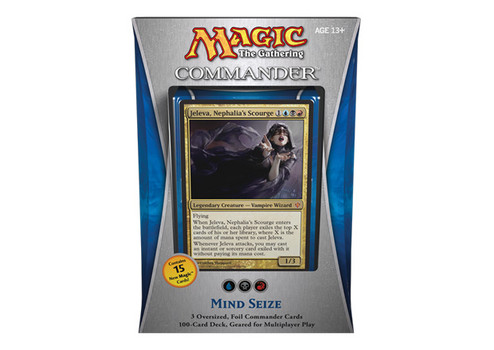
I currently have at least five Mind Seize decks under my bed in that tote, and three each of the other four. You can find the non-[card]True-Name Nemesis[/card] ones on eBay (or at your local LGS) for as low as $20, and the Mind Seize no longer towers above the rest at its $60 price tag. Thanks to the en masse second printing (with a special emphasis on making sure casual players could buy the Grixis deck, since it was printed more than the rest), these decks flooded the market until buying them for instant flips was no longer profitable.

At this point, I think I’m just in it for the long haul with all of the decks. I obviously should have dumped the Mind Seizes at $50 when I had the chance, but I decided to be greedy and am paying the price (metaphorically and literally). Plan A is now to wait and cross my fingers, hoping that the other four decks that initially went under the radar begin to be noticed as casual gold mines. The Jund one looks especially nice with [card]Ophiomancer[/card] and [card]Primal Vigor[/card]. Still, buying every single deck at release with the intention of waiting for an extremely long time was a pretty large blunder. Let’s rewind the clock and see where changes should have been made in my battle plan.

What Could I Have Done Differently?

With Wizards having announced the release of a new Commander set every single year, I should have realized that stuff like [card]Sol Ring[/card] would not just be a $10 card every single year. That alone negates a lot of the safety of the future value of these decks. Also, Mark Rosewater warned us at the start that they were 100-percent willing to reprint these until they had enough to bury a dead horse with. They did just that. After seeing the community turn into [card]wild nacatl[/card]s and [card]raze[/card] through the Wal-Marts and Targets, the hindsight play is to wait until that promised reprint, and start grabbing $15 Power Hungry decks for the long-term instead of paying that $30 on release day.

Cracking Mind Seizes and immediately dumping the TNN to get a free other 99 cards looks like it was the correct call (speaking of which, [card]Army of the Damned[/card] is a $1 card. Even though it was printed in Mind Seize, that does not seem right to be at all). Want to see a Legacy staple that was criminally underpriced during the winter of Mind Seize?

rishadanport

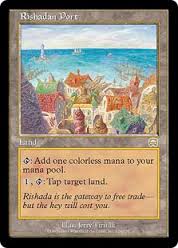
During the Commander release, this card was approximately $60. In hindsight, a Legacy staple with very few reprint possibilities seems like a safer place to put money than two pre-confirmed reprintable sealed Commander decks. I don’t like to put all of my eggs in one basket, and I don’t even like buying staple singles for the purposes of long-term speculation, but it would have worked out much better in this case for me. Ports sit at $115 now, where they’ve [card]plateau[/card]ed for several months. To be honest, I can see them hitting $150 in a few months, unless Wizards does something weird like put them in the mono-colored Commander decks this year.

A Bit About Booster Boxes

I currently have two booster boxes each of Dragon’s Maze and Avacyn Restored sitting on the top of the armoire in my dorm room. Weird choice? Yeah, kind of. I didn’t exactly buy them for speculation purposes: they’re remnants of a store’s collection that I bought out a little over a year ago, and I just haven’t put a whole ton of effort into selling them (by the way, if anyone’s interested in buying DGM boxes at $80 or AVR at $130…*cough cough*). Just like in the previous situations, they’ve both sat at this price for the entire time that I’ve owned them, and they could and should have been sold immediately for the profit, or transformed into a more safe and more liquid asset of singles.

The Time of Sealed Product has Come to an End

Well, probably not entirely. Things that are explained to be experimental, have a very low likelihood of being reprinted, and are enjoyable to draft are still probably safe investments, especially if you want something that you don’t have to micromanage. If Modern Masters 2 rears its head, picking up sealed boxes is probably safe if you have the change to spare. Just be aware that dual lands also exist, have zero likelihood of being printed again, and will always be in demand. The number of sealed products that can be shoved into the closet and aged for free money is becoming extremely small.

The Reserved List combined with playability in EDH and/or Legacy are powerful weapons for the financier, and I trust them more then the next new, shiny toy that Wizards drops into our playpen. I think most people got the hint not to hoard boxes of Conspiracy, because WOTC made it loud and clear that the set was designed to be drafted [card]ad nauseum[/card] and not to be taken advantage of. The next time you’re about to hoard something away in your closet and forget about it for a year or more, consider all of your options and the other places you could be putting your money.

It’s getting to that special time of the week when I should wrap up here before I start to bore you, so let’s take the conversation elsewhere, where you can provide your own input! Hit me up in the comments section below, the Reddit thread for the article, Twitter, or Facebook (feel free to add me, just message me beforehand explaining that you’re a reader). I appreciate that you’ve taken the time to read my thoughts and opinions on Magic finance once again. Until next week!

Learning Legacy: Lessons from Losing

Welcome back to Learning Legacy, brewers. Last time, we took a look at the RUG Delver deck that I decided to champion. I truly believe that to be successful in Legacy, you really need to pick a deck and stick to it. RUG Delver is what I will stick with. This series is dedicated to showcasing my journey out into the Legacy wild: what I learned, how I tried to get better, what worked, and what didn’t. For reference, here is the list that I have been playing.

[deck title= RUG Delver]
[Creatures]
*4 Delver of Secrets
*4 Nimble Mongoose
*4 Tarmogoyf
[/Creatures]
[Spells]
*4 Brainstorm
*4 Ponder
*4 Force of Will
*4 Daze
*2 Spell Pierce
*2 Spell Snare
*4 Lightning Bolt
*2 Forked Bolt
*4 Stifle
[/Spells]
[Land]
*4 Misty Rainforest
*4 Scalding Tarn
*4 Wasteland
*3 Tropical Island
*3 Volcanic Island
[/Land]
[/deck]

When you’re just starting out in a format, you’re going to lose. Trust me: I lost a lot. This is normal and you should not let it discourage you. You should, however, learn from it. With this article, I’ll be going over several games I lost while testing and what I learned from them.

Losing to Learn

“If you learn from a loss you have not lost.” –Austin O’Malley, Keystones of Thought

“I should not have done that.” –Ryan Archer, Said numerous times while testing

Belching Victories

Let’s set the scene. We are playing against Belcher. This is a combo deck that tries to get lots of mana and either kills you with [card]Goblin Charbelcher[/card] or storms for a lot and casts [card]Empty the Warrens[/card]. Either way, RUG Delver is very good against this kind of deck. We have early pressure and lots of counter magic. Its game two, our opening hand is double fetch land, [card]Volcanic Island[/card], [card]Delver of Secrets[/card], [card]Spell Pierce[/card], [card]Brainstorm[/card], and [card]Tarmogoyf[/card]. It’s not the best hand, but we have both early pressure and a counter. We are on the play because somehow we lost game one. My thinking is to play the Delver and then follow it up with counter magic and [card]Brainstorm[/card] on the next turn to refuel our hand. So we lead with [card]Volcanic Island[/card] (saving the fetch land for [card]Brainstorm[/card]) and cast Delver.

So what happened? Because I was tapped out, my opponent went for it and was able to cast an [card]Empty the Warrens[/card] for 12 goblins. I lost. The most important thing to do against this kind of combo deck is survive. I didn’t have a free piece of counter magic, so I should have left mana open and played a threat when I could back it up with counters.

empty the warrens

Lesson learned: respect your combo opponents and their ability to go off. Even with a deck full of counter magic, you can still lose. Play slowly and make sure you stick a threat when you are able to.

Almost a Mirror

Next up, we are playing against Blue-Red Delver. Like ours, this is a tempo deck full of cheap creatures backed up with counter spells and burn. This is game one and we trade spells back and forth. I have a Tarmogoyf in play (a 4/5) and my opponent casts a [card]Young Pyromancer[/card]. I have [card]Force of Will[/card] in hand but would have to remove my only other card, a [card]Brainstorm[/card], to cast it. I choose not to.

So what happened? He was able to chain some spells together to make lots of 1/1s. These are enough for him to block the Goyf and eventually find enough burn to make me lose.

Round two, same opponent. I have him on the ropes. I have drawn a lot of my green creatures, which he has a tough time burning out. I play my fourth land (two Volcanics and two Tropicals in play now) to cast another [card]Tarmogoyf[/card] and a [card]Nimble Mongoose[/card]. I am at 16 life and my opponent has one card. I now have lethal on my next turn.

So what happened? He cast end-of-turn [card]Price of Progress[/card], putting me to eight. He untapped, played [card]Snapcaster Mage[/card], targeted [card]Price of Progress[/card], and killed me.

price of progress

Lesson learned: always understand which cards are important in each match. This is especially important in Legacy because there are so many powerful cards.  In the first match, I should have realized that the [card]Young Pyromancer[/card] was a fantastic way of blocking my ground creatures, so I should have countered it. In the second match, I should have realized that burn decks play [card]Price of Progress[/card]. I should have paid more attention to the lands I was playing to try to play around Price if I could (and in that match, I totally could have played around it).

Miracles Happen

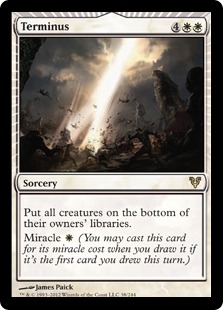
Last example. We are playing against Miracles. Miracles is a UW control deck that plays [card]Entreat the Angels[/card] as a win condition and [card]Terminus[/card] as a one-mana miracle wrath effect. We get our opponent down to three life, mostly on the back of a thresholded [card]Nimble Mongoose[/card] that dodges [card]Swords to Plowshares[/card] all day long. Our opponent is dead next turn if our Mongoose survives. He has been digging and looking for a [card]Terminus[/card]. He’s down to just one card in hand (a [card]Swords to Plowshares[/card]). He needs a miracle. Our hand is a [card]Stifle[/card], a [card]Volcanic Island[/card], and a [card]Spell Pierce[/card]. He has seven lands and goes to untap, upkeep, and draw…he then reveals the [card]Terminus[/card].

terminus

So what happened? Our opponent revealed the [card]Terminus[/card] and then went to cast it for one mana. We could’t counter it because he had too many lands in play. We cursed our opponent for his awesome luck and proceeded to lose as we drew nothing and he controlled the game from there.

Lesson learned: always understand how your cards interact with their cards. In Legacy, there are a lot of different cards. Some of the interactions may not seem intuitive, but this is just another reason to stick with one deck. Miracling a card uses a trigger. With that trigger on the stack, we could have [card]Stifle[/card]d the [card]Terminus[/card]. Our opponent would have drawn it as normal and he would have had to cast it for six mana. We would have been ready with [card]Spell Pierce[/card] and attacked for the win on the next turn.

So Pay Attention

Thanks for joining me on this little Legacy life lesson. In the future, I will not make these same mistakes. You should also learn from your mistakes to make sure you don’t repeat them. In the above examples, I was just playing practice games, but you better believe this will help me in the next large tournament.

“Sometimes by losing a battle you find a new way to win the war.” –Donald Trump

This Week On: You Can Stifle That?

Did you know that you can [card]Stifle[/card] the living weapon trigger on equipment? This comes up most of the time in Legacy with [card]Batterskull[/card]. When it enters play, the living weapon trigger will go on the stack. If you [card]Stifle[/card] it, they are left without a germ token. This is important for RUG because it gives us much-needed time to attack though without a blocker and without them gaining life. Just be careful, because they can always pay mana and return it to their hand.

Thanks for reading.

Burninating the Field: A PTQ Win

So yeah, I won a PTQ. I get to play on the Pro Tour again…in Hawaii! Sadly, I was a traitor, giving up Zoo for Burn after a couple dismal PTQ performances. The Zoo deck was performing amazingly at the TCGplayer and SCG IQ tournaments I had been playing in, but I was not able to translate that success to a PTQ.

The Deck


After PTQ Columbus last week, where I went 2-2-drop, I decided I needed to give Burn a try. Why would you want to give Burn a try you might say? Well, to be honest I felt like it had good matchups against most of the decks that are seeing a lot of play right now and could race the bad matchups well enough. All I had to do to stand a chance was avoid having [card]Leyline of Sanctity[/card] in my opponents’ opening hands. Also, most people don’t test against Burn and don’t expect to see it, so you can typically get in a few extra points of damage because they don’t know what to do.

This list saw a few changes from my testing with it, most notably adding black for [card]Bump in the Night[/card] so I didn’t have to run [card]Shard Volley[/card] anymore. I ran into a lot of issues where I simply couldn’t afford to cast [card]Shard Volley[/card] because I couldn’t afford to lose the land for my next turn, which in turn cost me a lot of games. The final list I decided on has a few funky sideboard cards that I will explain.

[deck title= Burn]
[Creatures]
*1 Grim Lavamancer
*4 Goblin Guide
*4 Eidolon of the Great Revel
*4 Hellspark Elemental
[/Creatures]
[Spells]
*4 Lightning Bolt
*4 Lava Spike
*4 Bump in the Night
*4 Searing Blaze
*4 Skullcrack
*4 Rift Bolt
*4 Flames of the Blood Hand
[/Spells]
[Land]
*4 Blood Crypt
*4 Arid Mesa
*11 Mountain
[/Land]
[Sideboard]
*2 Relic of Progenitus
*4 Smash to Smithereens
*3 Satyr Firedancer
*2 Shrine of Burning Rage
*2 Dismember
*2 Hammer of Purphoros
[/Sideboard]
[/deck]

I decided to not splash white or green in an attempt to combat [card]Leyline of Sanctity[/card], but I also chose to not completely ignore it. I knew that if they landed it I would be in trouble regardless, and out of all the options that I could think of at the time, [card]Hammer of Purphoros[/card] seemed like my best option since it provided a stream of threats in a tough situation. If I could go back, I would likely replace it with [card]Koth of the Hammer[/card] since [card]Wear // Tear[/card] doesn’t kill him.

I also initially had [card]Molten Rain[/card] and [card]Searing Blood[/card] in my sideboard, but decided Tron didn’t actually need sideboard cards, and that [card]Satyr Firedancer[/card] and [card]Dismember[/card] would be enough for the aggro decks that weren’t Affinity. Cutting those cards allowed me to also add in [card]Relic of Progenitus[/card] to assist in matchups like Storm, Living End, and Junk.

From the beginning, I knew I wanted some number of [card]Satyr Firedancer[/card] in the sideboard to make my life easier against the aggro decks, and I felt like three was a good number since I only wanted to draw one per game.

satyrfiredancer

The PTQ

Round 1 – U/R Twin 2-0

Game 1: I started off on the play with a [card]Goblin Guide[/card] that immediately revealed a [card]Kiki-Jiki, Mirror Breaker[/card], which told me he was some flavor of combo. His turn was [card]Island[/card] into [card]Sleight of Hand[/card], telling me that he was U/R/x Twin. Unfortunately for my opponent, the [card]Goblin Guide[/card] connected three times, and combined with the burn spells I was able to play, left him dead before he was really able to do anything.

Sideboarding
In
2 [card]Smash to Smithereens[/card]
2 [card]Dismember[/card]

Out
4 [card]Searing Blaze[/card]

Game 2: My opponent opted to be on the play, and while he mulliganed to five, I mulliganed to six. He did nothing for the first couple turns, while I cast a turn two [card]Eidolon of the Great Revel[/card] to put a ton of pressure on his slow hand. He eventually cast his [card]Snapcaster Mage[/card] for no value just to have a creature on the board, and followed it up with a [card]Vendilion Clique[/card]. I jumped the gun and revealed my hand to only to have him target himself—whoops. It didn’t matter, though, as I had plenty of burn to finish him off two turns later after he blocked my [card]Eidolon of the Great Revel[/card].

Round 2 – R/W/U Control 0-2

Game 1: My opponent started on the play, but I was first out of the gate with a [card]Goblin Guide[/card]. Unfortunately, he had a [card]Lightning Helix[/card] to kill it on his second turn. With no creatures left and my opponent not doing anything, I began throwing burn at his face. He was able to sequence his spells in a way to make my burn spells fail miserably, with three [card]Snapcaster Mage[/card]s to get him a second [card]Lightning Helix[/card] and a total of three [card]Sphinx’s Revelation[/card]s, totaling ten cards and seven life (since I was finally able to sneak in a [card]Skullcrack[/card] through his [card]Spellsnare[/card]). In the end, I died to two [card]Snapcaster Mage[/card]s and a [card]Celestial Colonnade[/card] beating me down.

Sideboarding
In
2 [card]Shrine of Burning Rage[/card]
2 [card]Hammer of Purphoros[/card]

Out
4 [card]Searing Blaze[/card]

Game 2: I finally got to be on the play, and my opponent didn’t hit a [card]Leyline of Sanctity[/card], so I felt like I was in a good spot. I opened on a [card]Goblin Guide[/card] and followed it up with a [card]Shrine of Burning Rage[/card]. He only had one mana available on my next turn, so I decided to try to put maximum pressure on with an [card]Eidolon of the Great Revel[/card], but he had a [card]Spellsnare[/card]. On his turn, he cast [card]Wear // Tear[/card] on my [card]Shrine of Burning Rage[/card]. If I hadn’t tapped out it would have won me the game. He went on to [card]Lightning Helix[/card] me three times and beat me down with a pair of [card]Snapcaster Mage[/card]s while I hit six lands to lose the game.

EN MTGHOP Cards V3.indd

Round 3 – Melira Pod 2-0

Game 1: We both mulliganed to six with my opponent on the play. My hand wasn’t really good other than a turn one [card]Goblin Guide[/card], but his wasn’t very good against me. I was able to get in three attacks with [card]Goblin Guide[/card] before he put up his defenses, and I was fortunately able to burn him out the turn before he was able to kill me.

Sideboarding
In
3 [card]Satyr Firedancer[/card]
1 [card]Dismember[/card]

Out
4 [card]Hellspark Elemental[/card]

Game 2: He opted for the play again, and we both got to keep seven cards. My hand was really bad, though, and a turn-two [card]Sin Collector[/card] showed him two [card]Flames of the Blood Hand[/card] and a [card]Skullcrack[/card]. He made the wrong decision of taking the [card]Flames of the Blood Hand[/card], allowing me to keep casting my burn spells on curve. He landed a [card]Gavony Township[/card] the next turn and ran a [card]Kitchen Finks[/card] into my [card]Skullcrack[/card], leaving me to have to race. I drew yet another [card]Flames of the Blood Hand[/card] and he played his [card]Spellskite[/card], leaving me in a tough spot. Fortunately, I was able to take advantage of him tapping out trying to life combo me instead of going for the on-board kill that he didn’t see, allowing me to steal the win.

Round 4 – Scapeshift 2-0

Game 1: My opponent chose to be on the play, and promptly mulliganed to five while I kept a pretty good six. He played a [card]Misty Rainforest[/card] on his turn and passed, giving me very little information. My turn one was [card]Lava Spike[/card], which he likely should have conceded to so he could have a better post-sideboard game. His follow up was a [card]Search for Tomorrow[/card], which gave me far more information than should be given in this matchup—Scapeshift is at such a disadvantage against Burn. A couple burn spells later, I had the game.

Sideboarding
In
2 [card]Shrine of Burning Rage[/card]

Out
2 [card]Searing Blaze[/card]

Game 2: We both kept seven card with him on the play. I knew going into this game that all I needed to worry about were a few [card]Obstinate Baloth[/card]s, which prompted me to keep a hand full of [card]Skullcrack[/card]s and [card]Flames of the Blood Hand[/card]. He ended up stumbling on mana on one of his turns, which made me decide to just start firing them off at the end of his turns. He did not withstand my assault and the game was mine fairly quickly.

Round 5 – Affinity 2-1

Game 1: I got to start on the play while my opponent mulliganed to six. I quickly got to work on his life total with [card]Lava Spike[/card], and he revealed that he was Affinity with a relatively slow hand. I followed up with a [card]Goblin Guide[/card] and another burn spell. He dropped half his hand on the table suddenly. Fortunately, I was able to win the race since he didn’t hit a [card]Cranial Plating[/card] to finish me off.

Sideboarding
In
4 [card]Smash to Smithereens[/card]
3 [card]Satyr Firedancer[/card]

Out
4 [card]Eidolon of the Great Revel[/card]
3 [card]Flames of the Blood Hand[/card]

Game 2: He had a pretty lackluster turn one, but followed it up with two [card]Ensoul Artifact[/card] on turn two. As hard as I tried, I just couldn’t race it even though I was able to kill one of his 5/5s.

Game 3: I kept a pretty insane turn-four kill hand, consisting of two land and five burn spells. He kept a very slow hand that did absolutely nothing. I executed the turn-four win perfectly while he floundered around and did one damage to me with a [card]Memnite[/card]

ensoulartifact

Round 6 – Affinity 2-0

Game 1: I started on the play with neither of us mulliganing. I opened on [card]Goblin Guide[/card], which got in for eight damage this game, while he had a fairly slow draw. I was easily able to race his mechanical men from there with the burn spells that were waiting in my hand, leaving me needing to win only one more game to be able to draw into top eight.

Sideboarding
In
4 [card]Smash to Smithereens[/card]
3 [card]Satyr Firedancer[/card]

Out
4 [card]Eidolon of the Great Revel[/card]
3 [card]Flames of the Blood Hand[/card]

Game 2: I mulliganed to five this game on the draw while my opponent mulliganed to six. I kept an opener of [card]Mountain[/card], [card]Arid Mesa[/card], [card]Satyr Firedancer[/card], [card]Lava Spike[/card], and [card]Skullcrack[/card], and knew that to win this game I was going to need to ride that [card]Satyr Firedancer[/card] as hard as I possibly could. Fortunately, my opponent was unable to kill it, and I was able to sit back and nuke every creature he played. With his threats neutralized, I was able to cruise to victory with just a few more burn spells.

Round 7 – Scapeshift Intentional Draw

After looking at the standings, it was obvious that my opponent and I were going to be able to intentionally draw into top eight, so we did just that.

The Top 8

Top 8 – Junk 2-1

Game 1: My opponent started off on the play because he was the higher seed, and I started off with a mulligan to six. We both knew what the other was playing card for card, which led him to opening on [card]Inquisition of Kozilek[/card]. I top decked a [card]Goblin Guide[/card] and got in once with it the entire game. He followed up with a [card]Dark Confidant[/card], which I decided not to kill. Instead, I followed up with an [card]Eidolon of the Great Revel[/card] to punish him for anything he might play. He played another [card]Dark Confidant[/card] after reveleaing land from the first one. I decided this would just be a waiting game with two [card]Dark Confidant[/card]s on his side of the field. Fortunately for him, he only took three damage total off of the multitude of triggers for his [card]Dark Confidants[/card], but he did take a ton off of my two copies of [card]Eidolon of the Great Revel[/card], allowing me to quickly close the game with a couple burn spells.

Sideboarding
In
2 [card]Relic of Progenitus[/card]
2 [card]Dismember[/card]

Out
4 [card]Hellspark Elemental[/card]

Game 2: My opponent started off on the play against my fairly lackluster hand. He played nothing on his turn one, and I suspended a [card]Rift Bolt[/card] on mine. He also decided to not do anything on his turn two, so I cast a [card]Lava Spike[/card] and [card]Relic of Progenitus[/card], which he immediately destroyed with [card]Abrupt Decay[/card]. His turn three was a [card]Tarmogoyf[/card], which I was unable to deal with. He swung a couple times leaving me to draw a bunch of lands and no way to win.

Game 3: I started on the play while my opponent mulliganed to six. I started on a turn-two [card]Eidolon of the Great Revel[/card] which dealt about ten damage just from its triggers, leaving him dead to just a couple of burn spells.

eidolonofthegreatrevel

Top 4 – R/G Tron 2-0

Game 1: We both mulliganed to six with my opponent on the play. This game wasn’t even a little close, as I had turn-one [card]Goblin Guide[/card], which met a [card]Pyroclasm[/card], into turn-two [card]Eidolon of the Great Revel[/card]. He was unable to do anything in time and just died to a fist full of burn.

Sideboarding
In
4 [card]Smash to Smithereens[/card]

Out
4 [card]Searing Blaze[/card]

Game 2: He played a [card]Chromatic Sphere[/card] on his turn one, and I retaliated with a [card]Goblin Guide[/card]. The next turn I hit him with two burn spells, leaving him at 11 already. On turn three, I cast [card]Hellspark Elemental[/card] and took him to five. He hit tron and cast a [card]Wurmcoil Engine[/card] and an [card]Expedition Map[/card]. I untapped, slammed a land, and got him with two more burn spells.

Finals – Affinity 2-0

Game 1: We both kept our opening hands with him on the play. He opened on a [card]Vault Skirge[/card] and I raced out with a [card]Goblin Guide[/card]. He followed with a [card]Steel Overseer[/card] that I had to dispose of with a [card]Searing Blaze[/card]. Next turn he played a second [card]Steel Overseer[/card]. I removed it and dealt him another three. After that, I was finally able to deal with the [card]Vault Skirge[/card], and he ran out of gas. I quickly finished the game from there.

Sideboarding
In
4 [card]Smash to Smithereens[/card]
3 [card]Satyr Firedancer[/card]

Out
4 [card]Eidolon of the Great Revel[/card]
3 [card]Flames of the Blood Hand[/card]

Game 2: I kept my opener, which included [card]Satyr Firedancer[/card], four lands, and two burn spells, while he mulliganed to five. He exploded out of the gates anyway, playing almost his whole hand on turn one/ I was unable to accomplish anything but a land drop. The next turn, I was able to resolve [card]Satyr Firedancer[/card], but he then cast an [card]Arcbound Ravager[/card] that I would have to deal with. He swung in with a handful of damage, and left mana up to turn an [card]Inkmoth Nexus[/card] into a creature. I had two burn spells up and had no choice but to fire off at the [card]Arcbound Ravager[/card] which he started sacrificing to. Once it got to three counters, I tried to kill it again in response to the fourth activation, which forced him to put three counters on his [card]Inkmoth Nexus[/card]. My opponent then got in two turns in a row with [card]Inkmoth Nexus[/card], leaving me at eight infect. This leads us to the best topdeck of the day:[card]Smash to Smithereens[/card] to kill the [card]Inkmoth Nexus[/card], and thanks to the Firedancer, also the other [card]Inkmoth Nexus[/card] that he was attacking with. Next turn, I drew a [card]Hellspark Elemental[/card], unearthed another, and won the PTQ.

inkmothnexus

Victory

I couldn’t believe it, and everyone in the room was excited for me. Thanks for all the support from the guys working at the PTQ that I talked to most of the night—they were almost as excited as I was.

That’s all I’ve got at the moment, but I’ll see you all very soon with a Brewing with Khans of Tarkir article and hopefully some amazing stories from Hawaii. The brews article will be slightly delayed this time, because the decks will be what I’m working on for Pro Tour Hawii.

Thanks for reading,

Josh Milliken

Edit – Since people are asking, the event was in Morgantown, WV.

Pitt Imps Podcast #82 Mutavault Is A….

This week, Ryan had to step out due to some technical difficulties. So in his place, I got Mike Hardy and Jon Celso to fill his shoes. We went over the results to the two recent GPs and SCG Cuse. We then went ahead and touched on a couple news moments and then, well, let’s face it. We rambled for a while.

Host Angelo Twitter @ganksuou

Guest #1 Jon Celso  Twitter @balduvianbears

Guest #2 Mike Hardy  Twitter @Mhardy1987

Show Email [email protected]

Show RSS Feed : http://mtgcast.com/topics/mtgcast-podcast-shows/active-podcast-shows/pitt-imps/feed

Negotiating in Magic Finance

Improving your negotiation skills is a great way to level up at Magic finance. The ability to make better deals, even just slightly better, will pay huge dividends over time because you can use it again and again. Today I’m going to talk about keys to successful negotiation at the dealer booths and trade tables.

A Common Mistake

The most common negotiating mistake that I see is confusing the type of negotiation one is involved in. For our purposes, there are two types. The first is a forced-action negotiation. This is where a deal must be reached by some deadline. It’s the “ticking time bomb” or “gun to the head” scenario. These types of negotiations lend themselves to hard-line tactics, eleventh-hour deals, and so on. Every negotiation you see on TV or in the movies is this kind.

Forced-action negotiations are often win-lose by nature (meaning one party gets what they want and one doesn’t). Since a deal must be met, the negotiating parties jockey until one is able to force the other to take less.

You are never in a forced-action negotiation when dealing Magic cards. This is super important.

A lot of people think that all negotiations are forced-action and act accordingly. That’s just wrong. All Magic negotiations are voluntary-deal negotiations, the second type. Either party can get up and walk away at any point for any reason or no reason at all. Don’t forget it.

If you try to use forced-action techniques in a voluntary-deal negotiation, the other guy will get up and walk away more often than not. A hard-line approach usually just signals to the other party to move along.

Think about it: if you go into a negotiation thinking you are going to “win,” that means the other guy is losing. Why would the other guy make a losing deal with you?

In order to be a good negotiator in the realm of Magic finance, you have to master the win-win negotiation.

Let’s Make A Deal

The truth is that working with a good negotiator is easy, not hard. You walk away happy and generally feel that the deal was fair, not like he forced you into a bad trade. The reason for this is simple: a good negotiator will give you what you want. He does this because giving you what you want is the easiest way for him to get what he wants. That’s the essence of a win-win negotiation.

It isn’t about forcing the counterparty to take less. It’s about finding an arrangement that makes both parties happy. At its core, it’s problem solving—maximizing value under the constraints presented by you and your trading partner. How can you make a deal that works for both of you?

Approaching negotiation like this will lead to more efficient transactions and a higher volume of completed deals. Below, I’m going to cover what I think are the most important elements of win-win negotiating.

Discrepancies in Valuation

You need to find something he wants more than you and exchange it for something you want more than him. Ultimately, all deals are born of this.

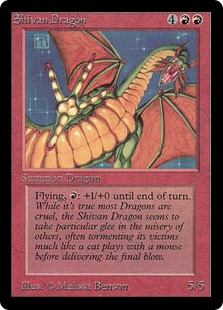
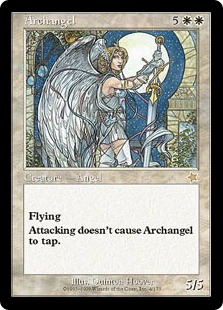
If you played Magic as a kid and think back to that time, it’s clear—you traded the dragons to the guy who loved dragons, the angels to the guy who loved angels, etc. Everyone decided how they valued these things based on their personal preferences. The fact that everyone was different led to discrepancies in valuations and lots of trades. Generally, people went home happy.

shivan archangel

It’s a bit more complex in the Magic finance world, but you still want to have this mindset. You have to understand how you value things and then you have to find out how he values things. I don’t have enough space in this article to talk about how to properly value your own cards (beyond a price guide), but you need to have a handle on it. If someone asks you what you want for any card in your trade binder, you ought to have an answer.

Valuing your own cards is the easy half of that equation, anyway. The challenge in negotiating is figuring out how a stranger values his cards in the span of a few minutes. If you can do that, the rest is just connecting the dots.

Learning About the Counterparty

Stop and think for a minute about trading with the guy who doesn’t bother to understand how you value cards. This is the guy who keeps trying to trade you the [card]Jace, Living Guildpact[/card] he just cracked even though you told him you only play Modern. This is the guy who keeps asking for cards out of your current PTQ deck, or who keeps trying to trade his Standard cards into your dual lands despite the fact that you told him you only trade Legacy for Legacy.

Trading with this guy is painful at best and impossible at worst. He definitely knows what he wants, but he doesn’t seem to care what you want or how you value cards.

This is the exact opposite of a good negotiator. A good negotiator finds out what the other person wants and finds a way to make that happen while capturing value for himself. But it’s not as simple as sitting down and saying, “Tell me all the things you overvalue so I can trade them to you.”

Good negotiation starts with understanding your partner. What do you know about him, if anything, prior to coming to the table? Is he a casual player, a grinder, a speculator, a dealer? What formats does he play? Why is he here today? What is he trying to accomplish at the table?

Ask. The goal is to give him what he wants, so you should find out what that is. Don’t interrogate the guy, just start up a casual conversation. Flipping through binders in silence is a very inefficient way to find out. As you collect information, start connecting it to the cards in your binder.

Knowing the basics about the other person is a good start, but you’re not there yet. “I play EDH,” doesn’t immediately tell you what you should offer. You need to dig deeper.

Understand Cost Structure

This is where you will make your money as a negotiator. You already understand who you are dealing with and why he is here. If you can figure out his financial motivation, you can make an offer that will be hard to refuse.

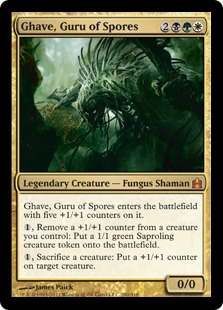
Let me start with an example. A few months ago, Travis Allen wrote a great article about the costs associated with speculating. In summary: Travis bought 37 copies of [card]Ghave, Guru of Spores[/card] at $3.35 cash and while the TCG-mid price went to $10, the buylist was still only $5 which didn’t net him much money after shipping.

Ghave has dipped a little since then but I want to use these numbers, so just imagine you bumped into Travis the day after he wrote that article. You want a few copies of Ghave for yourself and for trade fodder and know the price is now $10 TCG-mid. One way to approach it is to hand him your binder and ask him to take a look, but you can do better.

If you had read Travis’s article, you would have known that Ghave was a spec that didn’t quite pan out for him. You would also know that he isn’t really trying to trade his Ghaves, he would much prefer to sell to a buylist and get his cash out. You also know what he paid and what buylists are offering.

You now have enough information at your disposal to make an offer that gives both you and Travis what you want.

You can offer Travis, say, $6.50 cash each on eight copies, and reasonably expect him to take it. Why? Because he approximately doubles up in cash on those copies while avoiding shipping charges, and substantially reduces the money he has tied up in Ghaves. That’s what he wants.

ghave

For your work, you get your Ghaves for $6.50 instead of whatever the dealers are charging now (say, $9) and can go trade them out to your friends at $10 TCG-mid. That is value for both of you.

Deals like this are there all the time and people constantly miss them because they aren’t digging deep enough. This deal happened because you knew more than what Travis had in his binder, but how it got there, why it was there, how much he paid, etc.

It’s an easy one because the article told us everything. Your ability to make these deals in real life depends on how good you are at extracting those details. If you ask the right questions, you can get there.

One more example and then I’ll wrap up. You are at a tournament and you have two [card]Nissa, Worldwaker[/card]s that you are particularly eager to unload, so you go over to the dealer table to see what he is offering. He makes a very strong offer, much better than you were expecting. You can happily accept and walk away, but why not take a minute to talk to the dealer?

There could be lots of reasons for offering a great buy price on Nissa, and some of them are opportunities for you. Maybe it turns out that business was super slow for the dealer today. He was looking to scoop up a lot of inventory but it didn’t happen. He’s offering good prices as the event winds down to get whatever is left for sale in the room.

What does this dealer want and how can you do business with him? He wants inventory, he wants to put his money to work, and he wants to do that today so the money he spent on his booth isn’t wasted. Can you help him out? If you can get him the stock he wants, he’ll pay you well for your effort.

Maybe you pull out your Legacy collection. You didn’t come to the table to sell that, but now you have a chance to negotiate a sale at a premium over normal buylist prices. If it’s not your collection, maybe you call a friend who has a lot to sell (you can negotiate a finder’s fee later). Maybe you can’t help him at all, but at least you know for sure.

Negotiation is about finding the deal, and that is much easier when you understand the costs on the other side of the table. I promise you will make deals this way that you would never find through the iterative process of, “How about if I throw X in instead?”

negotiations

Rethink Your Strategy

If you still have the “how can I win this deal?” mindset, I strongly recommend giving this approach a try. Mastering the win-win negotiation style will bring easier deals, more deals, and much better value in the long run.

That’s all I have for today. If you have any questions, find me on Twitter at @acmtg or here in the comment section. Thanks for reading.

Grinder Finance 102

So now that we know when to buy new cards, there are still some topics to discuss when it comes to grinder finance. I’d like to point out that this is not the only way that it can be done, but merely a recommendation of one way.

Protecting Your Investment

A lot of players don’t invest in proper sleeves or change them often enough. Unfortunately, the life of a grinder involves tournament entry fees plus around $10 for a new package of good sleeves. For any competitive REL tournament, it is strongly recommended  that you use new sleeves to avoid any unnecessary judge scrutiny due to dings, dents, or scuffs that may imply cheating. A good way to invest in the future is buying in bulk!  I order my sleeves from Potomac Distribution and the savings can add up quickly. The cost of a pack of KMC Hyper Matte sleeves (my sleeve of choice) is about $9.  If you order a case from a distributor, you can get them for as low as $4.50 plus tax and shipping.

41uTv6qXKeL._AA160_

Many people use just basic sleeves to protect their cards, but I would highly recommend also double sleeving your deck.  A lot of players are turned off by the idea because it seems excessive and causes your deck to bulge, but it’s really something I cannot recommend enough. Double sleeving your deck makes the outer sleeves fit better and ensures the cards move around less. The extra sleeve can be the difference between a played card and a near-mint card after a few weeks of play. Since the inner sleeves never get dirty, you almost never have to replace them, and if they keep even one chase mythic from becoming played, the sleeves have basically paid for themselves. Other benefits from double sleeving include an easier deck to side shuffle, an extra layer of protection if an outer sleeve splits, and increased protection for foil cards against bending or curling.

Investing Your Winnings Properly

Most local game stores offer prize support (and hopefully yours does) and what you do with that can make a big impact on your bottom line. My store offers booster packs as prize or store credit equal to $2.50 for each booster pack you would have won. My suggestion to everyone is to get store credit when you can. If your store doesn’t offer it as an option, ask if they can have it for future events.

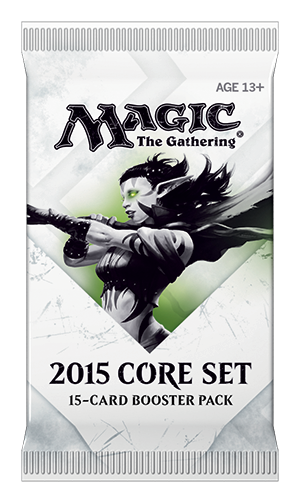
Store credit options allows you to focus your reinvestments where they count the most. I personally am not in the market for enough Standard cards that any booster pack is really much of a gain for me. Even if the expected value of the booster is higher than its value in store credit, you are not guaranteed to open anything worthwhile. If I save up $200 in store credit, I could have opened 80 booster packs instead. Those 80 boosters may include $200 or more worth of cards, but if they’re filled with cards you don’t need or you can’t trade, is it really a gain?  If I buy one [card]Tarmogoyf[/card] that I need to finish my deck, isn’t that a better investment? If you were to open 2.2 boxes of M15 right now with that store credit, you may open enough Nissas or Garruks to make it up in retail pricing.  The problem is that in the long run, those cards may not hold their value as much as a Modern staple or even a pack of sleeves will.

tarmogoyf M15-Booster-Nissa

The other thing that store credit is very useful for is entering events. A lot of stores allow you to use your credit for entry fees. If yours doesn’t, hopefully you can ask them to change it.  If you make a habit out of winning, you can reinvest your winnings in more entry fees and save money for those new staples in the coming fall set, or just have a nice savings account for emergencies. Not letting Magic take over your personal finances is a big deal and being able to play a hobby essentially for free is not something a lot of people can do.

Be Outgoing and Cheerful at All Times

Your attitude says a lot about you as a person.  If you are always negative and complaining about stuff, then people don’t want to be your friend or be around you. Make sure you are presentable (shower, comb your hair, shave or comb your beard, use deodorant, brush your teeth, etc.) and don’t drive people to dislike you.  A big thing that a lot of Magic players don’t realize is that if you do these things, it gives you access to making much better friends.

Similarly, people who make an effort are more likely to be outgoing and help you when you need it. A solid group of friends that you can trust and enjoy spending time with make Magic that much better. Having a solid core of grinding friends also allows you to borrow cards you might be missing for an event or bounce sideboard ideas off of. In the end, this will make you a better player and a happier person. A word from the wise: sometimes it doesn’t matter who’s right. A lot of arguments I hear between players with negative attitudes involve subjective topics that there is no clear right or wrong to. It just ends up making them both sound like idiots because they’re arguing over an irrelevant topic. Good friends are an invaluable asset that everyone needs.

I hope I have brought to light some money saving tips and you all enjoy playing Magic without breaking the bank! If you have questions or comments, you know what to do.

Conjured Currency #26: RAMPANT SPECULATION (and Organized Play Changes)

Welcome back, recently christened experts of personal budgeting and finance! Well, experts probably isn’t the word I should use. All I did was recommend three possible methods of categorizing your personal spending and income, but I’m curious to hear if any of those worked for you. Have you started jotting down your transactions into Google Drive? Or did you start doing your own research, and find something that works for you? I was hoping to receive a bit of feedback (positive or negative) on the second part of last week’s article, so hopefully someone somewhere learned something.

Changes in Organized Play

Even though I’ve decided to drop off the competitive scene, I begrudgingly still try to keep up to date on the updates to the Organized Play (OP) system to discern possible financial information heading forward. Even though I only play lower-level paper Magic, keeping up with the changes in things that don’t concern me personally (MTGO and OP) are still relevant to the part of the finance game that I consider myself strong at. If you’re in the same situation as I am, remember to keep up to date with MTGGoldfish.com for updates on Magic Online, and wait for the links on Twitter for information about Organized Play (unless you want to try and navigate the labyrinth of the Wizards home page).

PTStandards

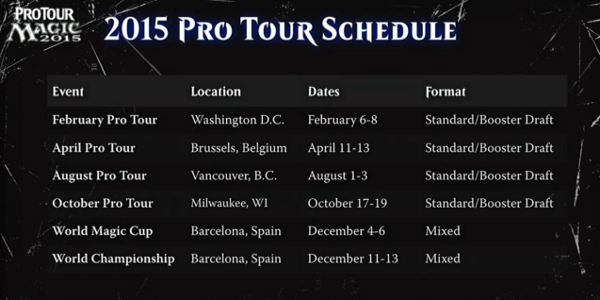
On August 2nd, Wizards of the Coast announced the upcoming schedule for grands prix and pro tours of 2015. One of the biggest glaring omissions in the schedule was a Modern pro tour—every pro tour heading forward for the entire year would be Standard. Seeing as how Standard is the best way to advertise the newest set, and the pro tour is one of the best ways to advertise Standard, it’s understandable as a company that they wanted to make the most of their advertising budget and highlight the newest set as often as possible. Even though it’s a beloved format, Modern doesn’t exactly allow a ton of newcomers from Journey into Nyx or M15 into its clique. However, thanks to the fact that WOTC is slightly better than Hitler and anthrax combined, they decided to make their customers hate them less and change Pro Tour D.C. to Modern.

What Does It Mean?

Well, for starters, it means that WOTC doesn’t hate you. As Helene said, they value your opinion and have proven that they are willing to change their program (and potentially lose a bit on advertising via Standard pro tours) to convince you to lower your pitchforks. It’s also another sign that reinforces a fact that should be obvious: Wizards is not giving up on Modern. It is their lovechild, it is their golden goose, it’s the single largest force to create demand in eternal cards in years. Your Modern collections are safe as a whole, and there’s no reason to fire-sell Modern decks.There are even more Modern grands prix next year than last, and LGS owners have the ability to decide the format of their own PTQ qualifiers.

Yep, that’s right. Pro tour qualifier qualifiers are a thing now. Instead of PTQ invites being a highlander contest, there will be a locally run event where the winner qualifies for a regional PTQ, of which the top X players will score a plane ticket to the big leagues. Due to the fact that store owners get to cherrypick the format for their own PTQQs, the whole concept of “Modern season” or “Standard season” gets thrown out the window. Instead of jumping from Kiki-Pod to RG Aggro because of a season change, a grinder has to lock in those decks for the long haul if he or she plans on attending a large number of PTQQs, since each could be Modern, Standard, or Sealed.

Blocked Out

If you didn’t realize, three Standard PTs and one Modern PT leaves one little format leaving lost and alone on the street like an abandoned puppy. There will be no Block pro tour in 2015. However, unlike the Modern incident, where players showed their addiction to casting [card]Dark Confidant[/card], no one cared enough about Block to see a complete backpedal to the old schedule.

And personally, I’m okay with that. Instead of a crystal ball that shows us which cards will be powerful when their predecessors leave, we have a whole new world to play with, and it will be a lot harder to predict what cards will leave a lasting impact in their second year of play. I think it’ll be more interesting for the average FNM-goer to watch the pro tour if it’s a format they actually know and enjoy, rather then something that will most likely never be relevant to them.

Mystery Prix

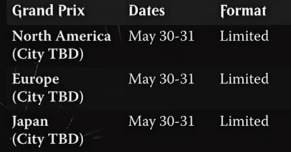
If you skimmed down over the list of grand prix locations because you didn’t care and weren’t going to 90 percent of them anyway, then you did what I did. Check out Season 3, on the weekend of May 30-31. Three simultaneous grands prix occurring across multiple continents, almost exactly two years after the release of Modern Masters?

STUFF

I think assuming that Modern Masters 2: Electric Boogaloo will exist is safe now. Wizards saw the results of its experiment with the first set, and deemed that the waters were safe to go full force on a sequel after what happened in 2013. What happened in Vegas will not stay in Vegas.. Unless Wizards decides that they’re allergic to money, proceed from this point forward with the assumption that Modern Masters 2 will exist, and will be in players’ hands earlier than May 30, 2015.

What’s In It?

The first Modern Masters contained cards spanning from Eighth Edition (2003) to Alara Reborn (2009). For those of us who have been playing a while, it’s kind of shocking to realize that almost the same amount of time from Zendikar to Khans of Tarkir will have passed that did between Eighth and Alara. As such, the Zendikar fetches are looking like prime reprint candidates for the set, most likely as rares. After printing the enemy cycle of pain lands in M15, it seems unlikely that an immediate followup of enemy fetchlands in Khans will happen. If we get fetches in Khans, they’ll be Onslaught allied ones, which leaves Zendikar reprints in MMA2.

I’m starting to go down the rabbit hole a bit here, but could Zendikar fetches aid in a landfall-themed environment for Modern Masters 2? Landfall was widely received as a great Limited mechanic, much like suspend helped hold together the first Modern Masters. If we have a landfall-themed Modern Masters 2, what are some of the reprints that we could expect from between Zendikar and current day?

[card]Scapeshift[/card]

scapeshift

Cornerstone of a competitive Modern deck? Check. Price has been steadily increasing over the past year? Check. No prior reprints? Check. Land-themed to potentially help with landfall? Check. If you’re holding onto any [card]Scapeshift[/card]s and don’t plan on jamming them into a deck, I recommend starting to look into selling/trading them off in the near future in search of greener pastures.

[card]Birthing Pod[/card]

pod

This is the card in Magic that has given me the most euphoria and the most stress. Every banned and restricted announcement is a heart attack waiting to happen to hear if my cardboard lover has received the cold text of the executioner. All drama aside, you should probably trade/sell these off before the card gets banned/reprinted. Yes, it’s weird and hard to reprint Phyrexian mana, but stranger things have happened.

[card]Celestial Colonnade[/card] and friends

celcol

Would it be weird and awkward for Limited purposes to have both Zendikar fetches and Worldwake manlands in the same set together? Yeah, probably. However, if MM2 doesn’t have fetches for whatever reason, these are the most likely runner-up.

[card]Goblin Guide[/card]

 goblinguide

See [card]Scapeshift[/card] reasons. Literally, all of them.

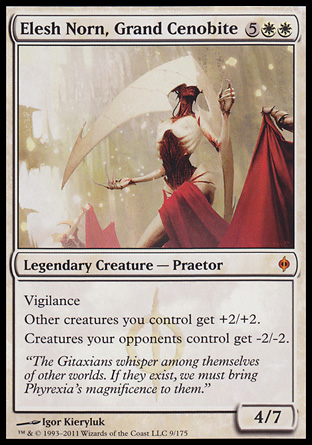
[card]Elesh Norn, Grand Cenobite[/card] and friends

eleshnorn

If we’re going by the assumption that we’ll get a cycle of legendary mythics (SO MANY ASSUMPTIONS), I don’t think the praetors are a bad place to start. Norn has seen quite a bit of love from EDH/eternal players alike, and most of her friends are casual all-stars as well. Then again, Norn did just get that absolutely gorgeous judge foil…

[card]Spellskite[/card]

spellskite

Same as [card]Birthing Pod[/card]. Phyrexian mana is hard to reprint, but if the mechanic gets the green light, I can see them throwing as many reprints as possible that don’t destroy the Limited format with free spells. This might be their only chance for a long while to prevent the 0/4 lifesaver to stop growing into [card]Fulminator Mage[/card] territory down the road.

[card]Liliana of the Veil[/card]

lilianaoftv

With Vess hanging around in Standard for the next year, it’s safe to say that’s not where this $60 damsel will be making her reprint appearance. She’s definitely had enough time in the spotlight with a single printing to the point where another wave of copies would be expected, and I don’t think something like a Commander product would be appropriate for the multi-format winner.

[card]Mox Opal[/card]

moxopal

[card]Progenitus[/card] wasn’t exactly reprinted for the sake of its Limited format, and I don’t think this would be either. This is more of a safety valve reprint instead of a casual “WOW” reprint, but there feels like a ton of risk in holding onto something like this, even if it would be a dud in Limited.

Just to Be Clear

Just as a reminder, my recommendation is not to immediately fire-sell all of your Modern cards that could potentially be reprinted. The entire point of Modern is to be able to reprint these cards, get them into the hands of players, and jam games in a fun, diverse environment. I’m just trying to pick some of the tallest growing money trees that Wizards could have their eyes on trimming. I don’t expect a situation like [card]Cryptic Command[/card] or [card]Dark Confidant[/card], where the low print run is overrun by the hunger and demand for the cards. If Modern Masters 2 comes true, the printing presses will be on full blast, and the value of the reprinted cards will drop as a whole. If you currently run your [card]Goblin Guide[/card]s or [card]Liliana of the Veil[/card]s in your only Modern deck, don’t just dump the deck because of a potential reprint. I just think holding onto extra copies is a risky decision financially.

Even if every single assumption here is wildly incorrect, I think it will be fun to look back at this article around May of next year to see where things went wrong and why. If I’m hitting the nail on the head with my predictions, then I get to yell and scream, “I TOLD YOU SO!!!” to everyone (not really). It seems that rampant speculation articles get the most controversial discussions rolling, so let’s see if this one is any different. Let me know in the comments section or via social media whether you hate me for being bored by Block, or if I’m insane for thinking Modern Masters 2 is now all but a guaranteed event in our future. Thanks for reading!

Rollin’ with my Clique

Modern is an eternal format. Legacy-light to some, perhaps, but regardless a format with a high skill cap that rewards knowing the cards, the format, and how interactions work. This will be my first entry in a series where I cover some of the more widely played cards that I see both new and old players incorrectly use—which seriously undermines the virtues of running them in the first place.

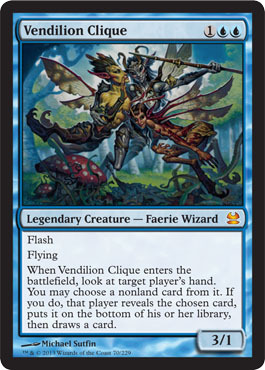
vendilionclique

Faerie Posse

[card]Vendilion Clique[/card] is a staple of the Modern format. It’s arguably blue’s best three-drop, as it does so much for so little. Some cards prices are artificially inflated due to a plethora of reasons: casual use, limited supply, competitive play in multiple decks, etc. Clique’s value is where it is for the sole reason that it’s one of the format-defining cards of Modern. So why do people spend $70 dollars on a card only to play it as a $1 dollar bulk rare?

Clique doesn’t lend itself to self-explanatory play, I will admit. The card has a large body of text that a lot of players tend to glaze over in a way that seriously undermines the extreme and borderline-overpowered ability this seemingly innocuous 3/1 provides. The chance to look at an opposing player’s hand is one of the most under-appreciated abilities amongst casual and pro-aspiring players. Information in Magic can put you far ahead, even when you may be down in card advantage. Being able to shape your game plan according to known information can induce blowouts that can put you back in the driver’s seat of a game almost out of nowhere. Always write down your opponent’s hand, always update yourself on the X unknown cards, and think of every possible card those unknowns could be. Modern rewards tight play and knowledge of the format—[card]Vendilion Clique[/card] takes you one step closer to that before you even resolve the ability!

A Little Strategy Goes a Long Way

Before we cover the best times to cast Clique, let’s discuss the initial stumble I see a plethora of players make with regards to the “bottom a card” choice. I see them agonize over what to take, wasting time and possibly tilting themselves when the choice isn’t obvious. One of the best things you can do is tell your opponent, “You can keep them.” The cards I look to take upon Clique-ing are ones that I have absolutely zero ways to answer or interact with, completely ruin my game plan, or swing the game in their favor. Apart from that? “Keep em, bro.” Tilt is a good way to induce mistakes, as is frustration. Being told by your opponent, in not so many words, “Your hand sucks, keep it,” is a great way to have your opponent overthink the rest of the entire game. If these cards don’t beat him, what does? Don’t be afraid to ship his hand back with a smile on your face over taking a mediocre card and catching a grin when he draws a more relevant card.

Image

Timing is everything in Magic. Sometimes the difference between a winning and losing game can be as seemingly minor as casting a spell on their end step as opposed to their upkeep. Clique may not be a card that can provide us with such a drastic ultimatum, but correct timing is how you get the full value out of this faerie.

The first mistake is the old, “Draw step, Clique you.” The instances you want to be doing this are so few that I could probably count the amount of times I have on two hands. Draw step Clique-ing (outside of obvious instances that explaining on here would sound like a bad beat story mixed with the best play you ever made story) should be reserved for select times that come up in a few different scenarios.

If your opponent is down to the point she needs to topdeck, you want to be casting Clique on the turn that you deem she needs to find it. If your opponent has three draws to hit an out before you win, you want to be Clique-ing her draw step in order to hopefully catch the needed card and ship it to the bottom. An unknown card has better odds to not be it. Clique-ing on a draw step when she is on five or more cards in hand will usually leave you with an agonizing decision and an open window (depending on the turn) to resolve spells or win the counter magic war. Don’t Clique draws unless you absolutely need to dodge a card that will beat you.

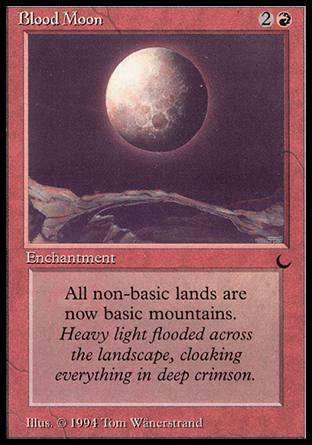
Apart from an in-combat Clique to surprise a blocker (which is a case-by-case decision, so you are on your own for that one!), the end step is the perfect time to resolve this card. Coming from the perspective of a UR [card]Splinter Twin[/card] player, opponents are usually hesitant to fight on their end step over it—and if they do, you usually get to resolve a spell uncontested. You’d be surprised by the amount of players who, afraid of you getting information or having a flying 3/1, immediately kill or counter it, leaving you open to slam a [card]Blood Moon[/card] or another relevant card that they now face palm over getting tricked into. And don’t rush to announce the target! It can be beneficial to target yourself, bottoming a dead card. If you wait for a response before targeting yourself, they may play as if you were targeting them, possibly inducing various misplays!

bloodmoon

It’s a One-Card Gang

[card]Vendilion Clique[/card] is a very non-linear card that provides an answer that is unique to itself—and arguably better than straight discarding or similar effects. The card gives you so many choices and options that knowing exactly the best times to play it make it even more valuable than it lets on. It is a Swiss Army knife in a format that requires answers to so many different cards and game plans. Knowing the ins and outs of the format is crucial to correct usage of the 3/1 powerhouse. You wouldn’t walk down a seedy, dark alley without your clique, would you? So don’t play a game of Magic without them at their best, either!

Pitt Imps Podcast #81 PT M15

Welcome to our PT M15 coverage show. The format we use changes for PT episodes, so if this is the first one you’ve listened to, it might shock you. We go very in depth on what happened in Portland as well as all the news that came out during the tournament. PT shows are also longer than our normal episodes. The fact is that you don’t need to watch coverage or read anything to know exactly what happened at the PT.


Host Angelo Twitter @ganksuou

CO-Host Ryan Twitter @brotheryan

show email [email protected]

The Spike Feed B-Side: Waxing Poetic Over Robocop

We pride ourselves on releasing tight, concise shows…just not this week. We knew we’d be on vacation, so we recorded an “off the cuff” episode for your listening pleasure. We cover Inquest magazine, our favorite films, retro video games, and Kansas City BBQ. We’ll be back to our normal shenanigans next week. Thank you for your honor.

Music by Micah Jones

Philly Zoo 2 – Electric Zoogaloo

Our r/Spikes series is still going strong. Max is back with a second effort. He’s still plugging away with his deck he’s dubbed “Philadelphia Zoo” and a Primer on the deck may be coming soon. Enjoy! – J

Hey, everybody, I’m back with another entry and updated version of the Philadelphia Zoo!

I headed into GP Worcester a couple weeks ago, itching for a large Magic tournament after doing pretty well in local tournaments this summer. I felt like I could make a good run and possibly make a day two push. Unfortunately, all I have to report there is that the Mexican food across from the DCU Center is phenomenal, Iron Man Drafting (where you rip up your cards) with friends is exciting, and random Magic players are really fun to play The Resistance with. I made a push to win a grinder running the list featured here, except with the [card]Spellskite[/card]s swapped out for [card]Eidolon of Rhetoric[/card]. Unfortunately, I got Boggled to death after beating a field of UWR and Twin to get to the finals. I went 2-3 on day one of the GP, beating Jund and Merfolk in rounds one and four while losing to Melira Pod, Jund, and Boggles in rounds two, three, and five.

TCGPlayer Modern State Championships aka “The Most Underwhelming Tournament”

The deck I played:

[deck title= Philadelphia Zoo]
[Creatures]
*4 Knight of the Reliquary
*4 Noble Hierarch
*4 Qasali Pridemage
*4 Scavenging Ooze
*4 Tarmogoyf
*1 Thrun, the Last Troll
*1 Thundermaw Hellkite
*4 Wild Nacatl
[/Creatures]
[Spells]
*2 Chandra, Pyromaster
*4 Lightning Bolt
*2 Lightning Helix
*4 Path to Exile
[/Spells]
[Land]
*4 Arid Mesa
*2 Forest
*1 Horizon Canopy
*1 Kessig Wolf Run
*1 Marsh Flats
*4 Misty Rainforest
*2 Plains
*1 Sacred Foundry
*2 Stomping Ground
*1 Temple Garden
*3 Verdant Catacombs
[/Land]
[Sideboard]
*2 Batterskull
*2 Blood Moon
*2 Choke
*2 Eidolon of Rhetoric
*2 Engineered Explosives
*2 Grafdigger’s Cage
*3 Stony Silence
[/Sideboard]
[/deck]

I made the trip to States the weekend after GP Worcester at Top Deck Games in Westmont, New Jersey, with my constant travel companion, Barrett Goss. He was fresh off on an 11-3-1 showing at GP Worcester and really should write a report. Going in, I expected a large turnout and was surprised to see 19 people. I cringed at the thought that I might actually end up state champion of New Jersey; a truly horrific honor for anyone born and raised in Philadelphia.

I started off 3-0 before double drawing into Top 8 as the second seed. I played against Living End, UW Fish, and Melira Pod in the Swiss. In round one of the Top 8, I encountered my Living End opponent and basically played a repeat 2-0 of our round one match. In the semifinals, I played against fellow Pennsylvanian Greg Chen, who was on Blue Tron and clobbered me on his way to eventually taking down the whole thing, claiming the state championship of New Jersey for Pennsylvania.

By the way, the Sideboard I played was because I saw the small meta I was in and wanted to make sure I could blow out every opponent in the field. I do not recommend that sideboard plan. At all.

A Tournament That People Actually Attended

Now, on to the main event: the SCG 5k Premier IQ at Tales of Adventure Comics and Games located in Coopersburg, Pennsylvania. I had made some changes to my deck and I was really excited to test them out.

[deck title= Philadelphia Zoo Two]
[Creatures]
*4 Knight of the Reliquary
*4 Noble Hierarch
*4 Qasali Pridemage
*4 Scavenging Ooze
*4 Tarmogoyf
*1 Thrun, the Last Troll
*1 Thundermaw Hellkite
*4 Wild Nacatl
[/Creatures]
[Spells]
*2 Chandra, Pyromaster
*4 Lightning Bolt
*2 Lightning Helix
*4 Path to Exile
[/Spells]
[Land]
*3 Verdant Catacombs
*4 Arid Mesa
*2 Forest
*1 Horizon Canopy
*1 Kessig Wolf Run
*1 Marsh Flats
*4 Misty Rainforest
*2 Plains
*1 Sacred Foundry
*2 Stomping Ground
*1 Temple Garden
[/Land]
[Sideboard]
*2 Batterskull
*2 Blood Moon
*3 Choke
*2 Engineered Explosives
*2 Grafdigger’s Cage
*2 Stony Silence
*1 Creeping Corrosion
*1 Bow of Nylea
[/Sideboard]
[/deck]

I felt really solid with my removal and I decided one less kill spell main deck in exchange for the most resilient threat in the modern format was a good exchange. This was emphasized when another local player in round four exclaimed, “Really? Main deck Thrun?” when I dropped him on turn three against Jund in game one.

My sideboard changes were the addition of [card]Engineered Explosives[/card], [card]Creeping Corrosion[/card], and [card]Bow of Nylea[/card], which are all rock star cards in their own right and could help me shore up some of my weaker matchups. [card]Ancient Grudge[/card] is still the strongest card against Affinity in the format, save for turn-two Stony Silence. I felt that I would be fine without it, though, by adding a copy of Creeping Corrosion and playing my Engineered Explosives wisely.

Round 1: Matthew Bunko, UWR Kiki Control

Game 1: I got blown away by the combo even after I answered his turn five [card]Kiki-Jiki, Mirror Breaker[/card] with a [card]Lightning Bolt[/card]. He was just able to play another one on turn six and jam the combo for the win.

Game 2: I was greeted by my favorite sideboard card and played the turn-two [card]Choke[/card]. After it resolved, I was able to kill him when he didn’t realize he had me dead with a [card]Celestial Colonnade[/card] swing and instead left his mana up to block, allowing [card]Path to Exile[/card] and [card]Kessig Wolf Run[/card] to wombo-combo him to death game two.

Game 3: I slow-rolled a [card]Blood Moon[/card] from my opener and waited until the coast was clear and jammed it. A player in the match next to us quipped, “What if he has Choke the next turn?” Guess what I top decked? A [card]Choke[/card]-[card]Blood Moon[/card] lock and a [card]Knight of the Reliquary[/card] ended the game soundly and I was proudly off to a 1-0 start.

Round 2: Adam Bruce, Affinity

Adam began our match by lamenting that he was only 1-0 because his round one opponent had shown up late and gotten a game loss. I tried to assure him that probably wasn’t the case as we shuffled up and presented our decks.

Game 1: I was able to see an absurd amount of removal and blank every threat he could commit before I rode a [card]Knight of the Reliquary[/card] to victory.

Game 2: I think I made my favorite play of the tournament this game. At the end of his turn, he had a tapped [card]Ornithopter[/card] and an untapped [card]Spellskite[/card], [card]Arcbound Ravager[/card], and [card]Vault Skirge[/card] with his lands and [card]Springleaf Drum[/card] tapped. I cracked a fetch and made red to bolt his Ornithopter, which he sacrificed to Ravager. I untapped, dropped a land, and played [card]Engineered Explosives[/card] on two. I cracked it and went to town with my two [card]Wild Nacatl[/card]s. Game over. 2-0.

Round 3: Zach Dobbin, BG Rock

Collision course/grudge match time!

I had been looking at my Planeswalker Points a few days prior and realized Zach had beaten me in a Limited PTQ before we had gotten to know each other. I was livid that my all-time record against him was 1-2 instead of 1-1. I knew I needed to even the score.

After a few collision course jokes, we shuffled up and began our match.

Game 1: I don’t remember much except being amused when he led off with a [card]Treetop Village[/card] when I was expecting the BW Midrange deck he was on the last time we played. I was able to pull away from him with more creatures and live draws to take game one.

Game 2: Zach was able to put me on my back foot and soundly defeat me.

Game 3: I dropped a [card]Batterskull[/card] and was able to quickly pull away from him and take the match. 3-0.

Round 4: Kyle Brock, Jund

Kyle is a player I have known for a good while and is a far better player than I am, as well as an incredibly nice person.

Game 1: I resolved [card]Thrun, the Last Troll[/card] on turn three and was able to bash in a few times to steal game one.

Game 2: Kyle was able to land [card]Scavenging Ooze[/card] and keep my Goyfs in check to even the score.

Game 3: I started with a large flurry of creatures and removal, but when the dust cleared, I had the last [card]Scavenging Ooze[/card] in play. What I have found with most BGx matchups is that the last Scooze standing wins. 4-0.

At this point I ran into my favorite judge in the area, Erik Mulvaney, who greeted me by asking me how I was at the top tables. I responded by telling him I had no clue, but I semi-jokingly promised I would make the Top 8.

Round 5: Eddie Slimak, Junk

Game 1: I was able to play [card]Scavenging Ooze[/card]s and Knights with little opposition, allowing me to beat down to take the game.

Game 2: I was greeted with turn-four [card]Garruk Wildspeaker[/card] into [card]Abrupt Decay[/card], followed by [card]Liliana of the Veil[/card] the following turn. I scooped at 19 life after he resolved [card]Lingering Souls[/card].

Game 3: I was able to commit an early Knight plus [card]Batterskull[/card] and used them in tandem with [card]Kessig Wolf Run[/card] to Wolf-Run away with the match. 5-0.

Round 6: Ben Green, Junk

Game 1: The board was flooded with [card]Lingering Souls[/card] and I limped off into sideboards.

Game 2: I was able to combine [card]Batterskull[/card] and [card]Kessig Wolf Run[/card] to blast through the wall of spirit tokens he had built for himself, soundly taking this game.

Game 3: This was more of the same from game two. I wished him luck in the rest of the tournament, but I got the vibe that he didn’t want to hear any words coming from the mouth of the kid playing Zoo that just demolished him. 6-0

After the match I went and joked around with all of my friends, who are far better players than I am, noting that whenever I run well they do horribly. Erik Mulvaney told me I better be playing at table one in round seven. I told him I truly hoped not and wanted to just draw into Top 8.

Round 7: Connor Rice, Kiki Pod

Going into round seven, I was the second seed and Connor was the third. I asked Connor if he would like to draw in and he told me he was confident in his ability and wanted to play it out.

Game 1: Connor was able to run out the combo after depleting my removal and quickly took a firm grasp of the match.

Game 2: I mulliganed low and just didn’t have the resources to play the value game with him. I took my first match loss of the tournament.

I was a little bummed that my undefeated run had ended, but I knew a draw or a win would lock me for Top 8 of my first large event. 6-1.

Round 8: Mario Diliberto, Boggles

I encountered Mario at the pairings board and offered him the draw, noting that he would be a higher seed than I was going in. Mario declined the draw and said he wanted to play it out, but would revisit this decision it if I beat him in game one.

Game 1: I went turn-one [card]Noble Hierarch[/card] into turn-two [card]Knight of the Reliquary[/card], followed by a second Knight and a [card]Qasali Pridemage[/card]. I started trampling with [card]Kessig Wolf Run[/card] and beat him game one. He seemed to be visibly shaken and when I offered him the draw for the match he took it and ran.

6-1-1. Locked for Top 8.

I was elated to have made Top 8, but a few seats down, my friend Ryan was battling for his tournament life. I was intrigued because the winner of that match would claim the third seed and be paired against me for the quarterfinals. Unfortunately, Ryan’s TarmoTwin fell short and, even worse, his breakers landed him in the godforsaken 17th place.

Top 8, Quarterfinals: Joshua Taylor, Merfolk

Game 1: I knew he was on Merfolk going in, so I kept a hand full of removal with [card]Scavenging Ooze[/card] to clean up the mess my [card]Lightning Bolt[/card]s left. I stole game one and felt confident after sideboarding—[card]Choke is pretty good against all those [card]Island[/card]s.

Game 2: Josh got a [card]Spreading Seas[/card] on my [card]Stomping Ground[/card] before I played [card]Choke[/card] on turn two. He was able to follow it with [card]Cavern of Souls[/card] and [card]Mutavault[/card] after I mana screwed myself and didn’t draw out of it.

Game 3: Josh again is able to [card]Spreading Seas[/card] a turn before I [card]Choke[/card]d, but I am able to deploy more lands and threats and march off into the semifinals. 7-1-1.

Top 8, Semifinals: Connor Rice, Kiki Pod

Game 1: I misplayed against his [card]Zealous Conscripts[/card] and didn’t eat his [card]Voice of Resurgence[/card] from the graveyard with [card]Scavenging Ooze[/card]. He stole my Ooze, podded it for [card]Eternal Witness[/card], and broke me on his immense pile of value.

Game 2: He kept a risky one-land, three-[card]Birds of Paradise[/card] hand and I started slowly with just a turn-three [card]Knight of the Reliquary[/card]. He cast [card]Path to Exile[/card] on my Knight, letting me play my turn-four [card]Thundermaw Hellkite[/card] and stranding him with only a land and [card]Spellskite[/card] in play.

Game 3: I kept a risky six cards with five lands and a [card]Grafdigger’s Cage[/card] and unfortunately didn’t draw the gas I needed to battle back. 7-2-1

Not a Bad Day

I feel pretty good about how I played, losing to just one player the entire day, and he just so happened to take down the whole tournament. I got to walk away with $400 (which I owed to my dad for helping me with car troubles), so it was a great takeaway for the weekend. I really like this new build of the sideboard and the main deck change. I want to find room for a second Thrun in the 75, and I want to see [card]Bow of Nylea[/card] in action, but overall it felt like a very solid list and a strong metagame call for the day.

Thank you all for reading, and thanks to Brainstorm Brewery for giving me a venue to share my experiences and love for the game. See you next time!

-Max Perlmutter

Brainstorm Brewery #109 – PTQQ More

The way players qualify for the Pro Tour is about to change radically. Who better to join the discussion than Brainstorm Brewery’s #1 Super Fan? You’ve heard him called Zander Bandersbee, Bander Sandersbee and every possible variation by Ryan and Marcel, but there can be only 1- the man, the myth, the legend; Brainstorm Brewery.com finance writer, Dutch idiom expert and now…PTQ winner? That’s right Sander Van Der Zee (really guys, how hard is that?) joins the cast to discuss the changes to the PTQ structure, Khans of Tarkir, Finance 101 – Sander’s even got a pick of the week locked and loaded. That’s more than we can say for the rest of the cast for the past few weeks, isn’t it? Strap yourself in and hook up your value pipe because this episode is going to be all up in your grill with so much information you’re going to need to call in sick to work on Monday because you spent the whole weekend recovering from having your mind blown. Who snags Ryan’s pick of the week? What does Sander do when he’s not winning PTQs? What are the Khans of Travis? Find out the answer to all these questions and more in an episode that goes a little long but you won’t even mind that will have you saying “I get the feeling we’re getting an After Hours pretty soon”. Join us for Brainstorm Brewery.


  • The gang is joined by Sander Van Der Zee (@themeddlingmage)
  • Finance 101 is here with GP finance tips
  • How was GP Boston? Was it even in Boston?
  • Mailbag time!
  • How will Khans shake things up?
  • What are the impending changes to the PTQ system?
  • Pick of the Week is BAAAAACK
  • Are judges about to get shafted?
  • New prerelease foils. How does THAT work?
  • Remember to check out the articles on BrainstormBrewery.com
  • E-mail Sander at [email protected]
  • Questions? Concerns? The address is [email protected]


Cabe Riseau produced the intro and outro music for Brainstorm Brewery.


Contact Us

Brainstorm Brewerywebsiteemailtwitterfacebook

Ryan Bushardemailtwitterfacebookgatheringmagic.com

Corbin Hosleremailtwitterfacebook – quitespeculation.com

Jason E Altemailtwitterfacebookgatheringmagic.com – quitespeculation.com

Marcelemailtwitterfacebook

Brainstorm Brewery #110 – Finance 110

It was a somewhat light week for news, but the gang goes deep on some Finance 101 to compensate. Even finance veterans will benefit from the veritable knowledge-bombing campaign as the gang talks about the condition of cards as well as whether to have cards professionally graded. Sit yourself down, and strap in for another face-melting episode of your favorite podcast that will have you saying, “I didn’t know they had a website.” Join us for Brainstorm Brewery.

  • Finance 101 goes very long, but there is a lot to cover.
  • Mailbag time!
  • What are the impending changes to the Pro Tour system?
  • Pick of the Week is baaaaack!
  • Remember to check out the articles on BrainstormBrewery.com.
  • Questions? Concerns? The address is brainstormbrew at gmail dot com.


Cabe Riseau produced the intro and outro music for Brainstorm Brewery.

Contact Us!

Brainstorm BreweryWebsiteE-mailTwitterFacebook

Ryan BushardE-mailTwitterFacebook

Corbin HoslerE-mailTwitterFacebookQuietSpeculation

Jason E AltE-mailTwitterFacebookQuietSpeculation

Marcel WhiteE-mailTwitterFacebook

Conjured Currency #25: Less Magic, More Finance

Welcome back, conjurers of currency! Pro Tour M15 was several days ago, but I’m writing this on Sunday afternoon, so any financial information that arises between now and Tuesday night is something that won’t be discussed until next week. Anyway, let’s do a quick rundown of some of this week’s winners. We haven’t seen spikes like these in months.

Winners of This Week

[card]Goblin Rabblemaster[/card]

rabblemaster

“I keep getting excited about this guy, then realize that he just sends the hasted token he made to its death. Kind of sad. Anyway, that’s one of the more prevalent reasons that he’ll be sitting in my $.25 box in September if I can’t dump off the one I own now. Predicted price: Bulk rare.” –Douglas Johnson, two weeks ago.

Oops. Well, then. I’m glad I didn’t find a way to get rid of the one I ripped open at my prerelease, I guess. If you didn’t check your MTGstocks recently, this guy jumped to $4 on the back of several brutally fast and efficient red decks that reared their heads last weekend in Portland. I think my biggest mistake in failing to predict this card’s price was not taking into account the Standard playability, only associating tribal mechanics with eternal and casual playability. [card]Mental note[/card]: Consider all tribal possibilities in Standard when new lords are printed

If you still have them, or managed to buy out a chunk of the internet or your LGS at a dollar or less, I recommend dumping them now. [card]Legion Loyalist[/card] also saw a a bit of a bump this weekend, and these two cards happen to work extremely well together. Loyalist jumps the Standard boat in a few months, and I’m not expecting Khans of Tarkir to be loaded with the tools for goblin tribal to be a thing in Standard. There’s more risk than reward here involved with holding onto Rabblemaster for a long period of time.

[card]Flames of the  Blood Hand[/card]

Image

Doubling to be one of those $5 [card]Serum Visions[/card] or [card]Path to Exile[/card] non-rares, it looks like the supply was just incredibly low and not enough people noticed until there were almost none left. I’m sure that a bunch of people were scrambling around at Modern PTQs looking for the card and none of the dealers had any. The only printings were Betrayers of Kamigawa and the PDS Fire & Lightning deck, so I think the price is here to stay. What other Modern commons and uncommons of this power level do you think could see a price increase?

[card]Xenagos, the Reveler[/card]

Image (1)
Looks like Xenagos wins the award of “most number of copies of a Planeswalker in the top eight of Pro Tour M15.” He hasn’t spiked yet, and he’s only $8. Something doesn’t seem right about that, and it kind of reminds me of the situation where [card]Jace, Architect of Thought[/card] was sub-$10 until his second year of Standard, when he reached $20 to $30. Yes, Xenagos is multicolored, but he wins the game on his own if left unanswered, and I think there’s room for growth by picking these up now.

Here ends the Magic, and begins the Finance

Anyway, let’s get to the real point of this week’s article. I’m sure you’ve already heard this at least once in a college economics class, but allow me to repeat it for the sake of the article and financial stability in general: keeping a viewable record of where your money goes in and out of your life is extremely useful. It lets you plan ahead, know your limits, and budget such that you’re not stressing out over money issues. The meat of this week’s Conjured Currency will be used to show you my own personal method of keeping track of my finances (Magic and non-Magic alike), and put the spotlight on a couple of alternate methods.

Google Drive

As a college student, Google Drive is one of the best things to ever happen to me. I can write papers without having to worry about losing my work, because everything is saved automatically. It’s simple, easy to navigate, and can be synched with your laptop and phone. I’m writing my article on Google Docs right now, and I’m going to paste it into WordPress for Danny to hack away at. Similarly, I use Google Spreadsheets to keep track of every single financial transaction I make. I have one sheet for all income in a single month, and another for all spending in a single month. Here’s a look at my August sheet:

example

I have a row for each transaction, and a column for descriptive factors about the purchase or instance of income. Every purchase is marked with a reason, so I know to think twice next time when purchasing the same item if I wrote down a stupid reason like “candy” or “impulse purchase.” It took a little while to get in the habit of doing all this, but it’s well worth it in the long run. At the end of each month, I go back and read through each transaction in the spending spreadsheet, and mark whether or not it was worth spending money on. In July, I spent a bit too much money on unnecessary snacks or junk food, so I’m making an active attempt in August to prepare lunch ahead of time if I’m going out, or bring a water bottle instead of buying one.

This method has also saved me a lot of money when I make a trip to a grand prix or other large-scale Magic event. After recording each individual expense from the entire trip to Grand Prix Richmond, I now have an approximate budget for future, similar trips. I know exactly how much of my monthly income is available to spend on singles at the dealer booths, how much is allocated for food and drink while I’m there, and I noted the names of all of the restaurants we ate at so I can compare prices next time.

If you’re looking for a fast and easy way to get a general visual indicator of where you put your money and why, this is what I recommend. You don’t have to spend hours on the computer setting it up, looking at graphs, or syncing various bank accounts up to your applications. I always keep a pen and paper on hand, so I just scribble down “+” or “-” a number, a date, and an item, or if I have time I can input it to my phone immediately. It’s just a quick way to realize that you spent $50 more than you needed to on food last July, and recognize to tone that down in August.

Mint.com

Although I’ve never used this one personally, I asked around on Twitter and the review was universally positive. Unlike my Drive spreadsheets, it allows you to look at each individual category that you create, and gives you neat little pie charts and percentages of where your money is going. Apparently it also has the ability to synchronize with several larger credit unions. You can set timers to trigger on your phone or computer when you need to pay bills, notify you of fees, and warn you when an account is getting low. It lets you keep track of your investments (but probably just stocks, not Magic cards), budget your funds, and so much more. The best part about it is that it’s free! Based on a quick look over the website and reviews I got from users, I might have to start using this myself.

Based on my quick run through of the website, Mint.com is for those who want absolute control over every single part of their financial lives. Don’t take that the wrong way, it’s a great thing. I might start using this considering how obsessive I can be about saving and making sure I know exactly where every penny goes.

You Need a Budget

Well you do, but the program is actually just called “You Need a Budget.” While Mint is free, YNAB costs $60. Yeah, yeah, it’s spending money on a program that’s supposed to help you keep track of your finances and save you money, but I still figured I should mention the fact that it exists. As a matter of fact, if you’re a college student (and can prove it), the program is free, which is why I’m currently trying it out. You start out by inputting the amount in each of your various accounts (cash on hand, checking account, savings account, etc), and then just record each transaction like the other programs, from X account into Y payee.

You can also create a payment calendar for scheduled bills and future payments, which is easier to manipulate and keep track of than what I do now (Google Calendar). Although I’ve never used them, the program also comes with online classes to teach you how to use and make the most out of YNAB, handling credit cards, and working with variable incomes. Some of the classes are free without having to buy the product, and there’s also a trial version if you just feel like testing the waters. Overall though, I wouldn’t just drop $60 on the program without a pre-existing routine of keeping track of your money. The last thing you want to do is purchase it and realize it’s not for you.

That’s All, Folks

There’s only so much I can go over in one article, but the fun doesn’t have to stop here. Are there any popular budgeting applications that you use that the world should know about? Are there any features in the ones I did spotlight that everyone should be aware of? Leave a comment or hit me up on the social media, and let’s have a talk this week about personal finance and budgeting control.

Pitt Imps Podcast #80 — So Much News

Where do I begin? I swear, for weeks we struggle to fill time, then Wizards dumps everything on us all at once. In this episode, we go over all of it. We also manage to cover the two GPs plus the SCG event, and even read and respond to three different emails.  Sheesh! Buckle up—this show has a bunch of stuff in it.


Host Angelo   Twitter @ganksuou

Co-Host Ryan   Twitter @brotheryan

Show Email [email protected]

Grinder Finance 101

So maybe you dabble in MTG finance. You buy a few cards here and there and turn them in for some store credit when you’re short on cash. Maybe you’re just a player who wants to balance between buying a playset of every set that comes out and not being able to play the deck you want for two months. The grinder’s outlook on finance is different that people looking to speculate and turn a profit.

The grinder is a fickle person because his needs conflict. Grinders naturally want access to every card so they can play any deck, but also don’t want to be burned or overpay for cards that may go down or be less useful. This leads to a different mentality when it comes to buying cards—one that deserves some talk. I have a few rules I usually follow when new sets come out, allowing me to be competitive in Standard while still maintaining a savings account.

Stay away!

  • Don’t buy any planeswalkers. This rule may change in a few years, but generally speaking, most planeswalkers will go down from their release price and usually very quickly. Some go up or stay the same, but the chances of that being the case are far less likely than a planeswalker’s price tanking on release day. Generally these cards are busts and will be easy and cheap to pick up when the next set nears release.
  • Don’t buy mythics over $15. It’s really hard for any mythic rare to sustain that kind of price for any amount of time. It needs to be a four-of in many top-tier decks to see that kind of price tag (unless it is a planeswalker or a casual card). Ignore this rule if the card fits into one of our “buy” categories.
  • Be careful when buying “similar” cards to older cards. [card]Courser of Kruphix[/card] is a recent example of a card that is similar to [card]Oracle of Mul Daya[/card] but could have ended up being very bad. In this case, the stars aligned and made it a $20-retail card for some time, but this is an extreme case. I would wait until after the first two weekends of SCG Opens before purchasing these kinds of cards. People will test them and if there is not a significant number in top eights, then they’re probably not good enough.

Invest!

  • Consider buying sub-$5 mythic rares. Most bulk mythics will stay about $3 or $4, but if you think one is better than its price tag suggests, pick it up. It likely won’t get much cheaper.
  • Buy powerful, proven reprints. These cards are usually Modern all-stars or cards that carry a heavier price tag due to availability issues.  Most of these cards fall dramatically from their previous price points but keep price tags close to that of their release day, at least throughout their set’s life cycle.  These cards are impactful and powerful—multi-format players allowing you to unlock the maximum number of deck choices for the minimum amount of investment.  Recent cards that fit into this category are [card]Thoughtseize[/card], [card]Mutavault[/card], [card]Scavenging Ooze[/card], etc.  Avoid immediately picking up competitive cards that are buoyed too much by availability and casual demand, like [card]Urborg, Tomb of Yawgmoth[/card].
  • Buy the dual lands. No seriously, just get it over with. Over the course of the lifetime of a block, the dual lands will only increase in price as the set in which they’re printed is drafted less and less.  You need lands to play decks and everyone needs dual lands to be competitive. If you don’t own a reprinted land, buy those too. First printings of lands usually go up more, but even if reprints see a small dip, it won’t be enough that you should care. You should even buy the ones you don’t think you’ll use. At the end of the day, buying a full set of duals keeps the price at a minimum even if some go up and down.
  • Buy cards with unique, powerful, and cost-effective abilities. Cards with effects that have never been done before, are not done often, or have not been done at that mana cost are worth investing in.  These cards are most likely to be early spikers (assuming they are not already an exorbitant amount of money). Examples of this are [card]Boros Reckoner[/card] and [card]Hero’s Downfall[/card].
  • Buy the powerful uncommon. They’re not likely to get cheaper than their preorder prices. Would you rather spend $1 on a card you may be able to buy for $0.50 later or $1 on a card that might cost you $3 or $4 later?  Chase uncommon are becoming more expensive as they become harder to open in quantity.  Starting with Magic 2015, Wizards of the Coast has increased the number of uncommons in large sets to help the draft environment. Sometimes these are similar to older cards but with different names, which drives demand up. An example of this is [card]Banishing Light[/card] (which is functionally an [card]Oblivion Ring[/card]).

Try following these tips during the release of Khans of Tarkir and compare how much you spent to how much everything is worth with the release of the second set in the block.  You will be surprised at how close these two numbers will end up being.

Brainstorm Brewery #108 – Ray’s the Alarm

Trailing in the Rookie of the Year hunt but not out entirely, Ray “Future Pro” Perez Jr. takes time out of his busy schedule of practicing for the Pro Tour and preparing for Grand Prix Boston (it’s Worcester; don’t let them lie) to drop in on the gang for a jam-packed episode. Wizards announces they’re clamping down on Chinese counterfeit cards, Magic Online is still having issues, a Pro Tour is coming up, and Standard is full to bursting with legal sets; it’s a big week for finance. How do you deal with a trade situation you’re not comfortable with, and should you be as worried as you are? What cards does Ray see being important going forward? Has Wizards won the gang over with their announcement about counterfeiting? Find out the answers to all of these questions and more on an episode of your favorite cast that will have you asking, “Is it libel or slander if it’s on a podcast?” Join us for Brainstorm Brewery.

  • Finance 101 is back with trading tips.
  • How is Wizards dealing with counterfeits?
  • Mailbag time!
  • What are Ray’s favorite cards, and why is it Chord of Calling?
  • Can Ray still make Rookie of the Year?
  • Have you seen the new Zombie tokens on the website?
  • Remember to check out the articles on BrainstormBrewery.com.
  • Questions? Concerns? The address is brainstormbrew at gmail dot com.


Cabe Riseau produced the intro and outro music for Brainstorm Brewery.


Contact Us

Brainstorm Brewerywebsiteemailtwitterfacebook

Ryan Bushardemailtwitterfacebookgatheringmagic.com

Corbin Hosleremailtwitterfacebook – quitespeculation.com

Jason E Altemailtwitterfacebookgatheringmagic.com – quitespeculation.com

Marcelemailtwitterfacebook

Conjured Currency #24: The Art of Negotiation

Welcome back, everyone! As we close the book on M15’s set review, I’d like to address a couple pieces of feedback that I received on these last two articles, and how my opinions might have been influenced since then. I’m certainly not perfect in my card evaluation skills, and that’s one of the reasons I kept away from doing a set review for so long. Let’s take a quick peek at a few potential nitpicks and adjust our strategies from there.

[card]Liliana Vess[/card]: Turns out this card is actually playable in Standard this time around! Granted it’s only as a 1-2 of in the sideboard of mono-black devotion, but that happens to be one of the most powerful decks in the format right now, from what I hear. I predicted that she’d only be $5 come September, but her average on TCGplayer right now is closer to $7. Don’t expect that to drop before rotation, but start grabbing as many as possible in trades if she goes back to $5.

[card]Genesis Hydra[/card]: When writing my review last week, I tried to check that this card had seen no competitive play in week one before writing it off as a casual-only hydra. Somehow I missed that it had been a four-of in the ninth place list at that week’s SCG Open. While a single ninth place finish isn’t a prophecy of being the next [card]Nightveil Spectre[/card], it shows that the card probably isn’t something to write off completely. I’m joining the hype train with the BSB cast’s Ryan Bushard and giving thumbs up if you trade for these at $3 expecting $5 in the future.

Back to Square 1.5

Alright, back to the topic at hand. While I was scrolling through my Google Drive folder of my past articles, I came to a certain realization. While many of my past publications have been along the general line of “Here’s what to do with these cards that you own”, I’ve written very little on the subject of “Here’s how to get a good price on all of these cards that will fill up your entire living room and take control of your life”. Conjured Currency #12 went over how to get singles for inventory at buylist prices, but not entire collections. About a month ago, I discussed where to find piles of bulk treasure troves that you can spend a weekend digging through for picks.

Somewhere in between getting the phone call saying, “I have a collection to sell, are you interested?” and sitting down in front of the TV with 100,000 Magic cards are the processes of negotiation and bartering—ancient arts honed by used-car salesmen around the world. It’s in your best interest to talk the owner of your targeted collection down to a reasonable price that both allows for your profit margins, and for him to not be horribly ripped off. Let’s go over some tips and tricks to ensure both of those things happen, and that your customer recommends you to his friends when they need to cash out of the game.

Transparency

This is a big issue that I think is appropriate to be addressed first. Before going forward, you need to be comfortable with revealing your entire process to the individual you’re buying from. A common response I often receive when talking about a price is. “Well I could get a lot more if I went and sold this on eBay!” Yes, you could. I’ll tell you that right now. If you took this entire collection and pieced it out, and sold the singles on something like eBay or TCGplayer, you would make a lot more than what I am offering you. However, you still have to wait up to weeks before you receive your money, you have to package and ship each card or playset individually, and still take into account the fees that these websites will take.

“This card is worth $10 on SCG, you’re doubling your money if you pay me $5. Can’t you give me $7?” Break down your outs to that person, and explain that ordinary people can’t charge full retail and make a living. “Sorry man, I don’t have the ability to sell for SCG’s retail prices. If someone wanted those prices, they’d go to SCG. The cards I’m buying from you will likely be buylisted to other websites like SCG, and I’lll probably only make $7 myself from selling that card. I usually sell for around TCG low, and have fees even after that.”

“Why do you want to buy all of these bulk commons and uncommons?” There’s no need to lie to him, tell him you’re Santa Claus and give them away for free, or anything like that. Explain plain and simple: “I’m going to dig through this box while watching Netflix for cards that are worth a dime or quarter each, sell the rest off for a dollar more per thousand than what I paid, and eventually take an entire day to buylist all of the nickels and dimes for a good price all at once.” Trust me, they’re not going think, “Oh, that’s a great idea and amazing use of my time. I should do that myself”. Explaining your process will only make you appear more reputable and knowledgeable, and your customer will feel safer that they’re discussing this matter with someone who knows what they’re doing.

Your Time Isn’t Free

Here’s another common tactic I’ve heard: “I played a lot during Ravnica block. I’m pretty sure you’ll find at least a half dozen [card]Remand[/card]s in there, so I think you could do better than $5 per thousand. There are definitely some gems in there.” My response? “Great, pull them out. If you can show me that there are [card]Remand[/card]s, [card]Sensei’s Divining Top[/card]s, or [card]Lightning Helix[/card]es in those boxes, pull them and I’ll pay you the appropriate prices for the singles. However, I’m not going to do that for you right here. My time is worth money to me, and it’s going to take me a while to sort through this entire collection. I can’t just search through all of this bulk and pull out the good cards for you, only for you to tell me you decided not to sell it.” Keep your flat rate for unseen cards. Treat everything as a [card]Sanctuary Cat[/card] until you have physical proof otherwise.

One of the best ways to avoid this situation beforehand, is to tell that person in advance to pull out anything that they want to sell separately as a single card. Don’t worry, they’ll have missed some Guildgates and [card]Exsanguinate[/card]s, and probably a bunch of [card]Electrolyze[/card]s.

As a matter of fact, there are quite a few questions you want to ask the seller beforehand, if at all possible.

“Did you separate the rares?”

“I pay a flat rate of $4.00 per thousand on unseen bulk commons and uncommons, and $.10 on bulk rares. Are you willing to accept that rate?”

“Where did you come up with the number for your total price?”

Just in Case

Most of the time, a seller will be vastly overpricing his collection. However, there are those glimmers of hope when you finish up a nice buy, and you hear these magic words: “Hey, something something more cards, something something nearby, something something if you’re interested.” Why, yes, you are interested. You’re very interested and you brought some extra money in your sock (or someplace else safe, because it’s Craigslist. Probably wise to bring a buddy—so you can get murdered together instead of alone).

Sometimes, a seller knows what he has is valuable but doesn’t have an exact number on individual cards. He’s completely willing to let you take the wheel on all of his binders and accept your fair offer because he trusts you. You might be sitting on a couch going through binders and doing quick math in your head for at least an hour. A huge lesson I’ve learned after hours of awkward silences is to not be a robot. Strike up a conversation about how long they’ve been playing, what some of their favorite formats were, or maybe the story behind the deck that you’re currently dismantling. Fewer awkward silences turns the encounter into a more casual conversation, making both parties less on edge.

Be Okay With Walking Away

Unfortunately, some people can’t be reasoned with. They think that if they leave the ad up on Craigslist long enough, a bright-eyed puppy of a new player will show up on their doorstep with $700 in cash to buy their Standard RG Monsters deck and binder of bulk rares that they priced up to be exactly TCGplayer mid (not including sleeves, though). No matter how much you explain the concept of buying a collection, or how thin your profit margins are, they won’t budge. Someone will buy it, they’re sure.

And that’s okay. It sucks to get hyped up thinking you can pull some strings and talk them down only to have the door metaphorically slammed in your face, but it’s much better to tell them, “Good luck, let me know if you decide to lower your price. I’m always available,” than to strong arm yourself into believing you can pull a miracle and flip the collection for that last five-percent profit.

That’s Probably not Everything, but Oh Well

This is the kind of topic that I feel like I could write another 1500 words on, but I’m out of space for today. There are a ton of other nuances to the subject, and I’d be glad to listen to any questions, comments, or additions to the discussion. If you have any stories about your own collection buying adventures, share those too! There’s always something to be learned from each experience.

Getting LUCKy: Mulligans

If I had to guess why most games are won and lost in Magic,  the first stop on the blame train would be mulligans. A good number of players have a hard time knowing what is keepable and what would be better as a random six.  An even larger number of players don’t know when to go down to five. While a chunk of this is based on metagame, matchup, format, decks being played, and other variables that I can’t address without 8,000 different 10-page articles, there are some common rules to live by. Mulliganing shouldn’t be based on feelings and intuition—instead, a purely information-based outlook should be used to make decisions. If what you “feel” always works out, then you don’t have to change a thing. But if seven-land starting hands just repetitively do poorly for you, let’s bring in my favorite guest star: math.

Mulligans the Right Way

For today’s exercise, we are going to use Limited, the most “LUCK”-based format  that exists. Take a normal 40-card deck with 17 lands, 16 creatures, and 7 spells. The CMC breakdown looks like this:

1CMC = 1

2CMC= 4

3CMC = 7

4CMC= 6

5+CMC= 4

Lets draw a few hands with this deck.  First on the list is the five-land hand. It contains a three-drop and a five-drop. The three-drop is a  creature  and the five-drop is a kill spell (welcome to Theros block Limited). The question is: do I mulligan to six?  Our first thought might be, “There are only 12 lands left, so odds are that I don’t flood here.”

Let’s let our friend math take over from here. You are on the draw. On turn one, you have a 36.4-percent chance of drawing a first land and a 12.5-percent chance of drawing a second land. That means that more than 10 percent of games you start with five lands, you will get flooded out.  Yes, 63.6 percent of the time, we will draw either a land or something costing four or more. For your second draw, you are looking at 39.75 percent of the time where you will not have drawn anything relevant to play in your first three turns.

If our opponent is playing a two-drop on turn two, a three-drop on turn three, a four-drop on turn four, and either a five or a combination of two- and three-drops on turn five, it will feel as though we got flooded. If that turn two is [card]Vanguard of Brimaz[/card] and they bestow onto it turn three or four, or if their turn three is a [card]Wingsteed Rider[/card]  into a turn-four strive card, you can’t play around it almost 40 percent of the time.

I don’t know about you, but I’m not willing to keep a hand that only has a 60-percent chance at having a shot at winning. If I mulligan to a six-card hand with three lands and three spells, my chances of flooding go down drastically. I only have a 42.4-percent chance of drawing a land turn one and a 17-percent chance of getting two land draws in a row. This means on turn two I will have five lands and three spells, which is still better than the over-60-percent chance that I will draw into six lands plus three spells or seven lands plus two spells by keeping a hand of five lands. I like 73 percent way better than 40 percent for my ability to play a game of Magic. I’m not saying that there are not exceptions to the rule, but in general, five land are too many for me.

How about the one land hand?  Your odds of not drawing a land in your first two turns are 25 percent. That means that by the time you draw a land, 25 percent of the time it will be too late. At this point, it is not appropriate for you to tell me that you got mana screwed.

I think that it is safe to say that any one-land hands or five-or-more-land hands are almost an automatic mulligan in a Limited environment. This doesn’t mean that you can’t get there with them, but the odds of getting there are against you. At that point, Magic is only based on skill in 75 percent of games. If you are equally matched to the field, that means that you will win  fewer than 40 percent of your games. I’m not a Magic pro, but I would much rather play a game based on skill than luck. The rest of the time is a bit less clear.

Some Questions to Ask Yourself

When deciding whether to mulligan or not, there are a few questions that we need to ask ourselves.

Can this hand get me through the first five turns of the game? If the answer to that is no, then we really need to look at taking a mulligan. In most formats, I need to be present in a game within the first five turns. If we are  playing Legacy, we need to determine if we can survive if our opponent is running a combo deck. Do I have a way to deal with a turn-three [card]Batterskull[/card]?A turn-two [card]Heritage Druid[/card]? A turn-two [card]Show and Tell[/card]? Do I stand a chance against most of the field with this hand? If the answer is no, then you are probably ready for a mulligan. By the way, if you can combo off before they get a Batterskull, that is most likely an okay hand.

Can I survive a mana flood or mana screw? In Magic the true test of a player isn’t if she can play her deck when it’s working optimally. The true test is whether she can power through the bad hands as well. That’s the difference between the folks that get a top eight once at an SCG Open and Raymond Perez, Jr. I would bet if you asked any pro, they could tell you a story about how they were getting mana flooded or mana screwed and still won that game.

We should also define what a mana flood or a mana screw is. There have been plenty of situations where I have had an opponent complain about mana flooding with eight lands and twelve non-land cards. Just because you didn’t draw all spells doesn’t mean you’re getting flooded. Similarly, I’ve seen someone start with one land in their opening hand and get stuck on three until turn seven or eight. Statistically, this is supposed to happen in both cases. Neither are what I would call a severe mana flood or a severe mana screw. Just because your plays weren’t as good as your opponent’s, or the last thing you drew before you died was a land, doesn’t mean that you got screwed or flooded.

It all begins with your starting hand.  If my current hand cannot survive a few lands or a few non-land cards off the top, is it really worth keeping? Take into account the cards in your hand. If you have four lands, a six-drop creature, [card]Divination[card], and  [card]Wrath of God[/card], you are going to be fine most of the time. If you draw five lands off the top, you will live. If you draw five non-land cards off the top, you’ll be good. If you have four lands and three one-drops, it’s time to Mulligan.

Would an random hand of six (or five) look better than this? If the average six-card hand is better than your current hand, consider taking a mulligan. If the average five is better than your current seven, ship that hand as fast as you can. If your current hand of seven isn’t great, but it’s better than any five card hand you could get, it might not be worth the risk. But think intellectually about it—don’t make decisions based on that one time when you kept a one-land hand and ripped everything you needed off the top of your deck.

The only way to know what the average hand of five or six looks like is to look at them. It is much easier to make the decision to mulligan if you know what you are getting into. The scariest part of mulliganing is not knowing what you are going to get. The fear of the mulligan goes away once you know that you can take a hand of six cards and still win.

There’s an app for that! With technology where it is, we now have apps for our phones that can figure out odds and statistics. They make these for Magic: The Gathering if you look hard enough, or you can download a statistics app on your phone and start plugging in numbers yourself. When I’m playtesting, I love being able to see what my odds of drawing lands, creatures, spells, etc. are. Once you play with it enough, you start to intuitively know what the probability of any given play is at any given moment. It probably won’t be as accurate as a calculator, but if your brain says 40 percent and it’s actually 41, it shouldn’t change your decision.

Take the blame.  I don’t discount games where I got flooded or screwed like some do. It may or may not be my fault, but if I don’t take responsibility for it, I can’t fix it. Get some practice taking mulligans and you will get better. There are times when you should be playtesting hands of six against someone with seven.  If you know what to expect out of a six or five card hand, mulligans aren’t nearly as scary. Put the labor in to get the correct knowledge so that you can start getting LUCKy.

The Spike Feed Episode 48 – Professionally Intense

It’s the week of SCG KC, and we take the opportunity to record a show while being in the same room. Cameron tries a brew at the Standard Open, Curtis shares his thoughts on [card]Frost Lynx[/card], and Dustin reacts to some of the information that came out of San Diego Comic-Con. Thank you for your honor.

Your hosts:

Dustin Gore

Cameron McCoy – @Cameron_McCoy

Curtis Nower – @CurtisNow

Our show – @SpikefeedMTG

Music by Micah Jones


Pitt Imps Podcast #79 — Good Podcasts

This week on the Imps, we get our first look at Standard with M15. We also get the first bit of Modern at an SCG event. Then we take the time to fill you guys in on what podcasts we listen to in our free time. We also spend more time than we honestly should have trying to figure out what exactly a rules lawyer is.

Host Angelo Twitter @ganksuou

Co-Host Ryan  Twitter @brotheryan

Show email [email protected]

Magic and Personal Finance

How do Magic finance and personal finance fit together? I haven’t seen too much written on the subject, but I think it’s worth discussion. Personal finance is incredibly important to success in life, so the degree to which Magic finance can aid or derail you along the way is very relevant.

I’ve seen people engage with Magic finance different ways. Some in the Magic finance community come from finance backgrounds, or at least have a strong interest in it. These people usually take a sophisticated approach and use their general finance knowledge to educate Magic decisions.

I’ve also seen people with no apparent knowledge of finance or economics dive into Magic finance. If they are disciplined enough to keep their monetary commitment small, Magic is as good a place as any to learn the basics. If they lack that discipline, Magic can very easily get tangled with personal finance and lead to major problems. This may be a kid’s game, but we are often talking about adult money.

Magic demographics don’t help—the majority of Magic players I encounter are in their twenties or thirties. This is exactly the time to be developing your personal finance goals and executing on your plans, and Magic can be a distraction. I feel it would be less of an issue if most Magic players were, say, in their fifties and much further along in their personal finance journey.

Indeed, my biggest worry is that some people are unwittingly overexposed to Magic under the guise of “investing” at a time in their lives when this can really compromise personal finance goals. I realize that there is a lot to talk about relating to Magic and personal finance, but today I’m going to talk specifically about this aspect of it.

The Holy Grail Test

Let’s start with a hypothetical situation to get us thinking. Imagine you have a near-mint Alpha set. This set is your golden ticket—you are planning to hold it until the time is right, then sell it for something important like a house or to pay for your kid’s college or your retirement.

It’s a great investment, right?

Here’s the catch. The set is locked up in a vault and you can’t get it out. You can’t see it, can’t touch it, can’t display the cards, can’t take pictures to show off to your friends, can’t put any of the cards in your cube or build a Vintage deck, nothing. The set condition has been verified, but essentially all you have is a certificate of ownership similar to a stock certificate. The Alpha set is completely intangible to you.

How much less interested are you in owning this Alpha set now that you can’t enjoy it?

You might be thinking, “If I can’t even look at it, what’s the point? I’d rather dump it and buy/invest in something else with that money.”

Or you might be thinking, “I’m retiring early off that set whether or not I ever lay eyes on it. I’ll frame the certificate in the meantime.”

There is no right answer, of course. The purpose of the exercise is to get you to think honestly about how you view the set as a real investment, detached from the personal value you place on owning Magic’s holy grail.

Would your opinion of owning an Alpha set as an investment change substantially if you didn’t have physical possession of it? Would you keep it if you had possession, but be willing to let it go if your only connection was the deed? If all you had was a piece of paper, would you rather just own some Apple stock?

Remember, you don’t play with an investment. Your investments don’t provide entertainment. You don’t show your investments off at the card shop, and you certainly don’t develop a deep personal attachment to an investment (if you are smart).

As Magic players and financiers, we often want to have it both ways. We want to believe that an Alpha set (or whatever item in question) is a great investment and that we can display it and enjoy it every day. We want it to be something we love and a smart decision.

If having possession of the set would influence your decision to any degree, you are thinking at least partially with your heart. That’s a bad thing when it comes to investing.

It is very, very hard to look at something like this objectively. A near-mint Alpha set might be literally the coolest thing on the planet to own for many people reading this article, and for me too. We would all value it very highly from a personal perspective. It would bring us great happiness and pride. Very few of us can afford an item like this, but all of us would love to own it.

In truth, very few of us can afford something like that as part of our hobby. Many more of us can afford something like that as an investment. Funds are much more likely to be available for investments than they are for hobbies—you didn’t save all that money for nothing. Thus, for many, the obstacle to owning something awesome is not coming up with the money, but justifying it as an investment. I can certainly come up with $5,000 for a [card]Black Lotus[/card] if it’s an investment.

Now take a look at your collection. You probably don’t own a near-mint Alpha set, but many people own some number of “high end” Magic cards. Did you, at any point, justify the purchase of some of your cards by saying that they would be good investments? Maybe this is what convinced you to jump into Legacy, or to plow a bunch of money into Reserved List cards. You’ll get to play Legacy and by the time you are done, you’ll make some money too, right? This logic conveniently gave you access to your savings and not just the hobby money you set aside this month.

Ask yourself: Would I be willing to lock my Legacy deck away in the same way as the Alpha set? If it really was an investment, you should be able to do that. Again, we don’t play with investments. Heck, if it was really an investment, you should want to lock away your Legacy deck to protect it. The last thing you want is to damage it.

The truth is that virtually no one buys Magic cards purely for investment reasons without placing at least some personal value on them. We love this game and can’t deny it.

Where is the line?

The Magic Finance Trap

What does it matter if your cards are investments or not? So you sprung for a Beta [card]Black Lotus[/card]. You wanted it, saved for it, and bought it. It’s your money, and it is a good investment, in your opinion.

Let’s back up for a minute. To start, you should have a personal finance plan. If you don’t, go see a financial planner and figure that out immediately. It’s very important to your success and happiness in life.

Next, check to see if the Beta Lotus is in your personal finance plan. Oh, it’s not?

Things that derail you from your personal finance plan are very dangerous. Seemingly small lapses now can have large cumulative effects over time and can prevent you from achieving your long-term goals.

The path to retirement that you laid out, with or without a financial planner, almost certainly does not include high-end collectibles. Most likely, your financial plan requires you to save money at a certain rate and then invest that money into an age-appropriate mix of stocks and bonds while keeping enough cash on hand for things that might come up.

You fall into the Magic finance trap when you stop executing on your personal finance plan so that you can participate in Magic finance (or even just Magic the game). There is nothing wrong with owning a Black Lotus by itself. The issue is that if you are in your twenties or thirties, spending $5,000 of savings on a Magic card (or on a bunch of specs) might hurt your long-term financial goals more than you realize. If you are in your fifties and financially secure, buy your Lotus, buy your Jaguar convertible, buy whatever you want.

Don’t get me wrong, I’m not saying Magic finance isn’t profitable. I’m not saying the Lotus or other specs won’t appreciate in value. I’m not arguing that stocks and bonds will give you better returns. And I’m not saying you don’t know what you are doing.

I’m saying it’s not part of the typical plan. A financial plan is created to get you where you want to go in life with as much certainty as possible. It is designed to get you an average annual return that will allow you to retire on time. The investment mix is chosen to give you the mix of growth and stability that you need.

How does a Lotus change the retirement equation? What is the expected average annual return on Beta power over the next 30 years? I have no earthly idea and honestly, neither do you. By diverting any significant amount of savings toward Magic, you are factoring a big fat question mark into your retirement equation. I’m guessing that’s not something you want to do.

Your Magic Number

How much of your personal wealth do you have committed to Magic or Magic finance? I’m talking about anything you put significant monetary resources into. That might include your cube, your Legacy deck, your Modern collection, your specs, etc.

Do this calculation: Total up all your savings and investments (forget debt for now) and divide it by the total cash value of your entire Magic portfolio (as described in the last paragraph). It can be a rough estimate—no need to go checking buylists on every card. This ratio is going to tell you how many dollars you have saved for each dollar of Magic cards you own. Please don’t post your number or share it with anyone.

I bet if we plotted the results, one data point for every reader of this article, they would be all over the chart.

For some, the number would be huge. These people have big savings and modest Magic collections. Their magic numbers would be 25, 50, maybe 100+. To clarify, a ratio of 25 might mean that I have $25,000 in savings compared to a $1,000 collection.

For some, the number would be lower, maybe even close to one. Their collections rival their entire non-Magic savings. This could be a young person with $10,000 saved up and $10,000 in Magic stock, or it could be an older, high-end collector with $100,000 in investments and $100,000 in Beta power.

For the grinder in his early twenties who scraped together everything he had to buy a Legacy deck to play the SCG circuit, his number might be approaching zero. He has a $4,000 Legacy deck but his biggest problem is finding gas money to get to the next event because his checking account is empty.

There is no right answer—but I think there are some wrong ones. If your ratio is very low, say if you are the grinder in the above example, you really can’t afford to be doing what you are doing. The higher the ratio, the less money you have tied up in Magic and the easier it will be for you to succeed in personal finance using conventional means. Wherever you stand, increasing this ratio is a good goal to have. That means you are increasing savings faster than your Magic collection.

It’s valuable just to know where you stand. Consider it a victory if you had a pretty good idea what your ratio would be prior to doing the math. Worst case is you had no idea how deep you were into Magic and just got blindsided.

There is going to be a group of people reading this article who feel like it doesn’t apply to them because they know better. Some of them are wrong, some of them are right. “It’s okay that I have most of my money tied up in Magic because…” seems like a risky line to take, but maybe you know what you are doing.

There is plenty more to be said about Magic and personal finance. This article attempted to help you answer only one high-level question: “Am I in over my head?” If there is interest, I will write more on the subject.

Find me on Twitter at @acmtg or leave a comment here at BSB.

Thanks for reading.

Old-Man Magic: SCG Standard Open, Pretty Awesome for Old Guys by Quillian Rutherford

It’s been a long time,
Since I’ve seen a su-u-u-u-u-u-unny day.
– Cake, Long Time

I’ve been playing Magic a long time: since Fifth Edition/Weatherlight. For a while, I was grinding PTQs, but there was no MTGO, no local Magic scene in my college town, and basically nothing but rolling up to the tournament after a cross-Texas drive with an untested deck and sleep deprivation. It was great. The good thing is that if you show up to PTQ-type events most weekends, you will get better over time. It’s slow-going, but taking a beating week after week from people that regularly qualify for the PT will rub off on you. I was actually at a point where I was getting into top eight contention in later rounds and even made a couple top eights. That was over a decade ago as chronicled by yours truly here, back when the editor was a lovable rodent. This is semi-important, because many of you are probably in the same or a similar boat. Kids, job, school: it all eats into Magic time, and at some point you wake up and realize you haven’t played sanctioned Magic in months, then years. One day, though, one of your friends says they are drafting online, or you read the latest spoiler—something. The fire is only banked, it just needs a little kindling and it’ll burn again. For me, since about 2003 (my last memorable Magic tournament from that era I can recall), it’s play a bit, drift away, play a bit, drift away. A year or so ago, my son came home from school and asked if we could go draft. I figured sure, one hit won’t hurt…

It turns out that after un-rusting and devouring all the internet magic news fit to read over the course of a few months, I felt pretty good about going to FNM, at least. I even flew out to GP Dallas back in December to try and see some friends, and played UW. Sadly it was an icy mess; most of my old friends from Texas didn’t want to risk the ice storm and I managed a miserable 0-3 record (0-4 according to Wizards—I couldn’t even check the drop box right that weekend). To rub salt in these wounds, I booked a hotel room once in town and it was obvious I wouldn’t be staying with said friends, only to meet a fellow wizard about five minutes later who had a spare bed. To top it all off, the room I ended up with at the hotel looked out on part of the roof, which contained a giant evaporator or something that kept firing up and thrumming like a jet engine every few minutes. So, now I have what I refer to as an “$800 play mat.” I’ve never used one before, but this one’s special, always there, reminding me of that traumatic weekend.

I made it to a PTQ in Portland after staying out too late, played UW again, started off in the draw bracket and conceded to my friend Wade when it became obvious I was in no shape to battle and just needed to find some lunch. I played a Sealed Win-a-Box tournament, lost in the first round, and headed home. A week later, I grabbed my backpack and sifted through it to look at my deck for something, only to find out I had managed to lose it at the PTQ. This was the turning point. Lacking the will to replace the cards I needed for UW, I gave in to the darkness, borrowed what I needed to complete Black Devotion from my buddy Wade, and finished ninth in a TCG Platinum event. I played it a couple more times in small tournaments and settled in with it for Standard. I managed a couple more efforts at PTQ’ing, going to a Modern and a Sealed event with no results to show. Finally, I saw in my inbox an email from Star City Games reminding me there was an Open here in Portland. I’ve never managed to attend any of the SCG events before and felt it might be a good experience. Maybe I’d even make some new Magic friends.

Preparing for the Open

I began preparing for the Open in earnest…by playing Skyrim every night instead of MTGO. For some reason, I haven’t beaten Skyrim yet and I have an urge to finish it. I did manage to go to an FNM and went 3-0-1, splitting the finals with a nice kid named Ben, who wasn’t even aware of the Open until I asked him if he was going. After actually looking over things, I saw Yutu Takahashi’s deck from GP Chicago and instantly re-kindled my love affair with main-deck [card]Duress[/card]. Upping the number of ways to protect your [card]Pack Rat[/card]s just seemed pretty solid. The version of Black Devotion I had been playing was one that had made the top eight of a South American GP a few months ago. It splashed blue for a copy of [card]Notion Thief[/card], which is a really great card if you get it off at the right time even once in the matchups where [card]Sphinx’s Revelation[/card] makes an appearance. I decided to copy Yutu’s main deck with two differences: I kept six blue sources (four Temples and two [card]Watery Grave[/card]s) and I didn’t manage to find a fourth [card]Devour Flesh[/card], so I ended up with a copy of [card]Ultimate Price[/card] instead. I also don’t happen to have any [card]Drown In Sorrow[/card], but I’m not sure that’s necessary unless lots of white starts showing up.

I managed to play and win a match on MTGO in a two-man queue and decided I was ready to battle. I see a lot of complaints about Standard being stale, which may be true, but for me it’s been nice to be able to get comfortable with a list and not have to scramble at the last minute to play a deck I’m not familiar with. Friday night came and I managed to not stay out too late or drink too many cocktails. I was in bed and trying to sleep by 11:30 p.m. after making sure my deck was re-sleeved. I didn’t have a complete sideboard, but figured I’d have time on the train to figure it out. I had printed out a deck registration sheet, at least. Saturday morning I woke up right on time, about 7:40 AM, remembered to actually eat some breakfast, made myself some coffee, and managed to find a mug to take it with me on the train. My lovely wife was nice enough to drop me off at the train station and I started scribbling down my deck list as the train rolled across downtown. I was particularly worried about red, so I made sure I had [card]Pharika’s Cure[/card] in the sideboard and then randomly decided [card]Master of Waves[/card] could have slot 15. I only played one red deck and didn’t cast Master, but I’m pretty sure it would have been better as something else, for the curious. [card]Notion Thief[/card], while awesome when it works, is probably overkill. [card]Cyclonic Rift[/card], on the other hand, is great. I sideboard it in very often. It didn’t get cast too much, but it got me a match win when I needed it.

The Tournament Site

The tournament site was the Oregon Convention Center, which is pretty nice. From the train, it’s only about a five-minute walk with only a few hobos to navigate around. I had a very short line to stand in to hand over my $40, and then I was ready. I made a seriously next-level move by filling my coffee mug with water, a winning move I proceeded to make every single round. I’d say continuously hydrating was my strongest play all day. My weakest play was concentrating so hard on the number column on my deck list I was already starting the day with a game loss, but didn’t know it. In the end, my luck was running too high and it didn’t end up mattering, but giving away games before you start the tourney is not normally a winning move; embarrassing. I have not played regularly enough to really develop the requisite magic friendships, so I said hello to a few of the locals I do know a little and just milled around until the player meeting.

Despite my having scheduled this day for Magic a couple of weeks ago, my wife had scheduled us to go to a dinner party at a friend’s house. I sized up my odds and said, “Don’t worry honey, I’ll probably be done by round three or four anyway, I should be ready to go on time. No problem.” In reality, I wasn’t looking forward to having to go through 10 rounds of Magic, but I had packed a couple granola bars and knew there was food on site. I’ve noticed I tend to do the best when I don’t care about winning too much. I mean, I like to win, but if I just concentrate on playing and enjoying the game, I tend to do much better. Rather than stress out about how hard it would be to get to the end, I made the decision to just try and enjoy myself and play friendly Magic. For the most part, I succeeded.

The Deck

[deck title= B/u Devotion. Mostly Black—SCG Open Portland] [Creatures] *4 Desecration Demon *4 Gray Merchant of Asphodel *4 Nightveil Specter *4 Pack Rat [/Creatures] [Spells] *4 Underworld Connections *2 Bile Blight *3 Devour Flesh *3 Hero’s Downfall *1 Ultimate Price *2 Duress *4 Thoughtseize [/Spells] [Land] *15 Swamp *4 Mutavault *4 Temple of Deceit *2 Watery Grave [/Land] [Sideboard] *3 Lifebane Zombie *1 Master of Waves *1 Notion Thief *1 Cyclonic Rift *1 Dark Betrayal *2 Doom Blade *2 Pharika’s Cure *2 Erebos, God of the Dead *2 Duress [/Sideboard] [/deck]

The Tournament

There are a bunch of primers for this archetype out there, so I’ll just hit the highlights of the rounds.

Round 1 – Matt Griffen with Monoblue

Matt was a younger kid, maybe my son’s age or a little older. I bantered a bit about where he lives (my part of PDX metro it turns out) and he was surprised he hasn’t seen me at the local shop, but since they don’t do store credit for prizes, I don’t play there too often. He started off well and took game one and I figured this is it, but I pulled out game two. Game three, Nightveil Specter stole a [card]Hall of Triumph[/card], which made all my creatures too large for him to handle. I got in lethal despite a Jace activation. I realized later I had sideboarded wrong, as [card]Pharika’s Cure[/card] is a lot worse against [card]Temple of Triumph[/card]. Matt played his deck well and I wished him luck (when I saw him later he was 5-2).

Round 2 – Peter Sundholm with Blue Devotion splashing White

Peter was a nice older guy not unlike myself. I [card]Thoughtseize[/card]d turn two into his double [card]Judge’s Familar[/card]; he tanked for a moment and then sacrificed both Familiars. Next turn he played out the Thassa he was protecting, which I’m not sure was the right play. Losing Thassa hurts, but I feel the explosive attack from blue is the biggest threat, so I’m not sure I would have done the same. Game two was interesting, as I had a Nightveil with his Nightveil under it. I opted to Thoughtseize him and saw double Thassa, [card]Banishing Light[/card], [card]Rapid Hybridization[/card], and [card]Detention Sphere[/card]. I pondered for a moment and took Detention Sphere, since it dealt with my rats. I’m not sure that was the right play, as he only had two land in play and none in hand, but I thought I’d rather have the 3/3 than risk a Sphere blowout later. Peter forgot to play [card]Rapid Hybridization[/card] during my upkeep, so I played the Nightveil I stole from him with my own. I ended up using his own [card]Domestication[/card] against him to take a [card]Frostburn Weird[/card], which sealed the deal. He felt he had a good matchup against Black Devotion, so maybe my luck was with me. Regardless, it’s nice to start out 2-0 instead of 0-2-drop.

Round 3 – Daniel Waldholz with Esper

I won game one with an assortment of creatures and [card]Mutavault[/card]s and sideboarded in [card]Notion Thief[/card] and [card]Cyclonic Rift[/card] for game two. He never really got going and couldn’t keep his planeswalkers on the table.

Round 4 – Daniel Joyax with Boss Sligh

This round I was maybe a little too competitive. Game one I managed to snag his only enchantment in his opening hand with [card]Duress[/card], but he just made an army and commenced beats. It turns out that [card]Pack Rat[/card] tokens don’t help much versus [card]Legion Loyalist[/card]. When I killed his [card]Akroan Crusader[/card] in response to him using a [card]Rubblebelt Maaka[/card] bloodrush, he tried to put a token into play. A judge was called and we resolved he gets no token—not a big deal. However, the next attack, he came in with [card]Rakdos Cackler[/card], which had no counter on it. I moved to take damage as if Cackler was a 1/1, but he said it had +1/+1—he just didn’t have a counter but did announce it. I was pondering my hand or something, so hadn’t really been paying attention to it when he cast it, assuming he was casting it with the counter. But since he didn’t place one on it, I wasn’t sure how it went down, so I called the judge again. It didn’t make sense that he wouldn’t have put the counter, so it wasn’t a big deal, but I wanted clarification that if you announced something like this, but failed to actually keep track of the game state with a counter, if that was fine. It turns out it was.

It’s stuff like this I’m a little hazy on—drawing cards is no longer a game loss, and Magic is just a lot nicer in general these days. So he took game one, I sideboarded in my removal and [card]Master of Waves[/card], but it was Desecration Demon that did the trick. Although many players suggest it’s correct, I almost never sideboard out [card]Desecration Demon[/card] or [card]Pack Rat[/card].

I think it was at this point I managed to go grab food. Two well-dressed ladies in front of me were contemplating what to get—one really wanted the hamburger, but resolved to get the chicken wrap as all that bread on the burger made her sleepy. I decided that was great advice and opted for the chicken wrap myself, plus a banana. Between walking around in between rounds and this move, I was a veritable health nut all day. I even ate only half the wrap!

Round 5 – Greg Galloway with Jund Reanimator

I’m not sure if Reanimator is the right deck name, but he had [card]Underworld Cerberus[/card]. Game one he ran me over with creatures and I thought, “Well, at least I started 4-0.” [card]Lifebane Zombie[/card] tagged in from the board, but really I didn’t have a big game plan versus this deck. However, his Domri whiffed and he never drew much after that, so I managed to get there. I have no idea how good this deck is against Black Devotion, but I didn’t think it was something I wanted to play every round.

Round 6 – Justin Miller with Bant Walkers

So far, getting to 5-0, I felt pretty lucky. However, it was pretty obvious I had hit the stage of the day where you start encountering Mini Bosses. Justin seemed to have a pretty good handle on how this goes down and absolutely destroyed me game one with a triple planeswalker board state that resembled the army of a small country. In from the board came the extra [card]Duress[/card]es, Rift, and Thief.

In game two, he kept answering my cast threats, but couldn’t overcome triple [card]Mutavault[/card]. In game three, he kept and I looked down at a hand containing Swamp, Thoughtseize, two Pack Rats, and three business spells. Normally I don’t keep one-land hands, and I don’t recommend it most of the time. This game, I was on the play, and I just needed a second land to get my engine started. If I was going to win, I probably needed to get a little lucky anyways, so I kept. It was greedy, but a Swamp came right off the top. I [card]Thoughtseize[/card]d and Justin had kept a six-lander himself, hating to mulligan against my discard. On turn two, I resolved [card]Pack Rat[/card] and almost licked my lips in anticipation of the savage rat tokens I was imagining, only to have Justin draw [card]Pithing Needle[/card] off the top and play it naming Pack Rat. Luckily, my hand was still full of business and I managed to snag something with a Lifebane, drop an Erebos (and draw twice off it before it was exiled), play out Desecration Demon, and replace my Lifebane after the first went into exile with Erebos. Justin manage to [card]Detention Sphere[/card] the Demon, but I was getting in for four a turn with the Lifebane and the 1/1 rat, while he was tapping out for Jace and using the -2 to pick up a [card]Sphinx’s Revelation[/card]. With no other business in his hand, the coast was clear, and on his end step I Rifted his Detention Sphere off Desecration Demon, allowing me to attack for lethal the next turn before he could recover. I’d done it: somehow I defeated a Mini Boss to get to the next level.

Round 7 – Gabe Carleton-Barnes with Black Aggro

We shook hands and introduced ourselves. I noted to Gabe that he’s a bit of a local Magic celebrity; he chuckled and took it in stride. This is another Mini Boss level. I’m pretty sure I’m 0-X lifetime versus several of the PT regulars from back in Texas, so winning here would be a new thing for me: two Mini Bosses defeated? Gabe won the flip, but mulled to five with a wince. I had an okay hand, so I thought this was going to work out. Then I died to his triple [card]Tormented Hero[/card] draw in short order. It wasn’t even close.

In game two, I [card]Pharika’s Cure[/card]d something and hung on until I took over the game, trying to play around taking any extra damage, just in case. I wasn’t sure if there was a haymaker I’d forgotten in the format, muttering, “There isn’t a Hatred in this set, is there?” at some point. Luckily, there didn’t seem to be. Game three, Gabe drew no removal and Specter held off his troops long enough for [card]Desecration Demon[/card] to make short work of his life total. I was actually stunned to have won. By this point, I had long missed my dinner party, and my wife was texting me about it. I told her about the lack of losses and that I would likely make top eight if I win either of my next two rounds. When I tell her about the prize support numbers, she just says, “That better not be store credit!” Sigh.

Round 8 – Michael Felps with Black Devotion

As we shuffled up, we heard a Conspiracy draft announcement and Michael asked me if I had ever drafted it. I hadn’t, and he told me he’d like to, but it would end up everyone versus him at his local shop. I mentally noted I was pretty much in continuous Mini-Boss land at that point.

Game one came down to a turn where Michael had down two [card]Gray Merchant of Asphodel[/card]s, two [card]Underworld Connections[/card]es, and most likely a Gray Merchant in hand, to my three [card]Pack Rat[/card]s, my own Gray Merchant, and [card]Underworld Connections[/card]. I had another Connections, Gray Merchant, and [card]Hero’s Downfall[/card] in hand and was at six life, while Michael was at 13 or 14. I noted out loud that if he had a Merchant, I would die the next turn, then tanked for a moment. I could have played a Connections and a Merchant with Downfall backup. I decided for some reason that trying to live another turn by draining wasn’t the right way out and attacked with the Rats, killing one Merchant in combat and Downfalling the other. I passed and, of course, he had another Merchant. In retrospect, I should have probably just played out Connections and Merchant, putting me barely out of Merchant range for another turn.

Game two was interesting, as I managed to misplay into the win. After a [card]Thoughtseize[/card], I drew [card]Mutavault[/card] and a Gray Merchant. Michael started getting in with a Nightveil, so I shrugged and dropped my Merchant. He had flipped [card]Bile Blight[/card] with the Nightveil and I couldn’t attack with the [card]Mutavault[/card]s. Next, he flipped an Erebos off my deck and put it into play. I commenced Gray Merchant beats and sent for eight. The next turn, he tapped four again for the [card]Desecration Demon[/card] I’d seen in his hand, but I was ready with [card]Ultimate Price[/card] in hand, Michael ended up at three life. He held up mana the next turn and passed. I couldn”t attack with Mutavault, but I drew another Gray Merchant. I pondered. I decided if he had removal I was just going to have to walk into it and cast the Merchant. He scooped up his cards. Wow. After that game, I realized I had held back my own Nightveil for a couple of turns thinking it would get [card]Bile Blight[/card]ed, forgetting it would kill both of our Specters. Better lucky than good, sometimes.

Our last game was uneventful, as he mulliganed into a one-lander and didn’t draw mana before I had an army going. That was it. 8-0! I was starting to get a little bit giddy, as I’ve never been 8-0 before that I can recall. Maybe 6-0, but not 8-0. I tried to remain calm, telling myself I might get paired down, be forced to play, and not make top eight.

Round 9 – Ben Warschauer with Black Devotion

Here is where my focus on just playing one round at a time and not thinking about the bigger picture wasn’t optimal. My last name starts with R, and the board with my pairings was in the farthest corner of the room from table one. I wear glasses and I followed the judge who was posting the pairings, but had to wait a few seconds behind others until I could get close enough to read the sheet. There were also standings, but I was just focused on the pairings and didn’t look at the standings. At that point, having read other SCG event coverage, I was thinking I should be able to draw twice into the top eight, but I wasn’t sure. I should have checked the standings then, but I didn’t.

I walked up to table one and my opponent was none other than Ben “That Nice Kid from the Store, Who I Drew with Last Week” Warschauer. I knew his record was 7-1 and I thought I must have been paired down, but I wasn’t sure. There was a judge standing at table one watching as I sat down. I think you only have three minutes after pairings were posted or something. I inquired with the judge if we could see a standings sheet, but he said he thought we should begin playing. However, I was confused as to why I was playing someone with a loss and realized the pairings board for the low alphabet was a few feet away. I walked over, found Ben in 12th and me in first, and walked back, realizing there were no other undefeated people. I got a warning for slow play, which wasn’t too big of a deal, but it irked me a little that I had followed the person posting the papers and I didn’t have enough time to read all the information.

Secure in the knowledge Ben could not draw into the top eight, we started playing and I won game one. Before game two, they stopped us and we were deck checked. Despite staring at my deck registration sheet for a fair amount of time before handing it in, I had managed to leave a line blank, although it had the number two next to it. Turns out I had not written down the [card]Watery Grave[/card]s, only their quantity. While it’s never fun to get a game loss, it was a lot better to get a game loss here, in a round that didn’t matter that much, than later on in the top eight. Ben and I shuffled up and went to game three, where he managed to [card]Pack Rat[/card] me out. I might have just scooped to him if I’d understood exactly how the standings were, but in the end it worked out fine anyways.

Round 10 – Mitchell Gross with Mono-Blue

I was still in first place and actually checked the standings this time, and determined I was able to intentionally draw the last round.

People had already been congratulating me for a couple rounds, but I had kept my focus on just playing games of Magic, trying not to drift off with dreams of taking it all down. It was getting late by that time, so my mind wasn’t nearly as sharp anymore. I talked a bit with Justin out in the hall about how my luck had been pretty strong this day, and we both agreed we probably should have mulliganed in our match.I found the banana I bought earlier and ate it, hoping to get a little extra energy. Ben had to play again and won, making him the first seed going into the top eight, meaning I was going to be matched up against the Junk deck in the quarterfinals. People were saying it seemed like a bad matchup for Black Devotion, and I certainly wasn’t prepared for it, but after having time to think about it, I don’t think it was as bad as it seemed at the time. We all had our pictures taken and milled around waiting for the quarters to start.

The Top Eight

Quarterfinals – Jesse Harper with Junk Midrange

I had a sinking feeling as I sat down, with the comments about the matchup and [card]Voice of Resurgence[/card] echoing around my brain. Game one started fine. I got out a Demon and handled his Voice tokens, but he found a [card]Blood Baron of Vizkopa[/card] and [card]Obzedat, Ghost Council[/card], which won before I could find an answer. In game two, Erebos shut down his Blood Baron lifelink shenanigans and he succumbed to an army of rats despite his two Blood Barons as blockers.

In game three, my opening hand consisted of a [card]Thoughtseize[/card], five lands, and a [card]Gray Merchant of Asphodel[/card]. Two of the lands were Temples, so I ended up keeping, which was a mistake in retrospect. I cast the [card]Thoughtseize[/card] on turn one, revealing Jesse’s hand of four lands, [card]Sylvan Caryatid[/card], [card]Voice of Resurgence[/card], and [card]Courser of Kruphix[/card]. I opted to take the Voice, although now I believe I should have taken the Courser. I proceeded to draw lands and put non-business cards on bottom (although I missed one scry from a Temple), but I couldn’t find an answer for the turn-four Obzedat Jesse drew. If we played again, I think I would mulligan for a more aggressive draw, as my removal wasn’t going to match up correctly every time, and he had only a few answers to [card]Pack Rat[/card].

After packing up, I confirmed my prize would be mailed to me. Riki Hayashi shook my hand and congratulated me on making top eight and getting to go to an invitational. That’s when it hit me: I now have to play Legacy. The last time I played, it was still Type 1.5 and the competition level was…lower. Perhaps I can borrow a deck.

The Takeaway

I think the deck choice I made was pretty good, mono-black or black with a splash has a small amount of variance, and if you are better than me, you’ve probably already decided whether you want a splash or not. The amount of variance from scry lands and a splash is low enough that I don’t think most people will notice, especially if you are FNM’ing or the like. I think [card]Duress[/card] in the main deck is the way to go, especially if you want to go down to 25 lands. I would probably run another [card]Pharika’s Cure[/card] or [card]Lifebane Zombie[/card] in the sideboard over [card]Master of Waves[/card], but the rest I’d probably let ride. A lot of people are playing more [card]Bile Blight[/card] or [card]Ultimate Price[/card] over some number of [card]Devour Flesh[/card], so I don’t think I’d actually change the main deck at all if you want the blue splash.

The two “unusual” decks that made top eight are going to be fun to play, but they look to me like they have a lot more variance. The next couple of weeks of Standard might be stale, but the silky-smooth reliability of the black deck is a lot more to my taste. M15 might shake things up a little, but so far, I still predict a lot of [card]Pack Rat[/card]s and [card]Desecration Demon[/card]s until September. I do want to play some M15 Limited, though. However, I might just be grinding online with Legacy. I only have about five months to prepare…

I’d like to thank all my opponents for being outstandingly nice the whole day, and SCG for running a really smooth tournament.

–Quillian Rutherford

P.S. Also, I’m fairly certain half the top eight was over 30 (*cough* 29? *cough*): take that, youngsters!

Brainstorm Brewery #107 – Sexability

It always feels like it’s a slow news week at first, but once the floodgates open, an hour just flies by. With new sealed product, new Magic Online clients, new e-mail questions, and a new core set, there’s no shortage of topics to discuss. How will the change to the new client, the new Magic Online promo, the extension of Vintage Masters Drafts, and a general ennui about Magic Online affect the market? Will the clash packs be big sellers? In Finance 101, how do we handle the prerelease? Find out the answer to all these questions and more on a jam-packed episode of your favorite podcast that will have you saying, “Marcel sure tried his damnedest to have this end up named “Ranting and Raving,” didn’t he?

  • Finance 101 is back with prerelease postgame tips.
  • How did everyone enjoy the prerelease?
  • The gang goes deep into the mailbag to make up for the past few weeks.
  • What do the clash packs mean?
  • What is the future of Magic Online finance?
  • Remember to check out the articles on BrainstormBrewery.com.
  • Questions? Concerns? The address is brainstormbrew at gmail dot com.


Cabe Riseau produced the intro and outro music for Brainstorm Brewery.


Contact Us

Brainstorm Brewerywebsiteemailtwitterfacebook

Ryan Bushardemailtwitterfacebookgatheringmagic.com

Corbin Hosleremailtwitterfacebook – quitespeculation.com

Jason E Altemailtwitterfacebookgatheringmagic.com – quitespeculation.com

Marcelemailtwitterfacebook