Episode Archives

Conjured Currency #20: Buying Bulk

Sequels are Always Better than the Original


Welcome back, speculators and players alike. Normally I’d use this segment to look back at last week’s article and amplify a specific point that I failed to mention, or answer a question from a reader. Instead, this whole week’s article aims to be a part two of last week’s starting piece on how to deal with bulk common and uncommon parts of collections. We’ve already gone over the basics of “picking” through bulk for the dimes and dollars that others have left behind, and done a quick overview of your quickest methods available to exchange those cards for cash.

This week, I’ll answer a couple of questions from readers regarding how we can find collections containing bulk commons and uncommons, and alternative methods to sell than the “1k boxes sold on Craigslist or Facebook” option.

Buying Lots of Cards for Little Money

Other players:

One of the best reasons to deal with bulk commons and uncommons is that the cards are ones that 99.99998% of the Magic population doesn’t give a damn about (source of statistic withheld for safety of experimenter). Your average PTQ grinder and FNM goer don’t care what happens to their [card]Skull Rend[/card]s or their [card]Charging Badger[/card] after the draft or sealed event is over. After Johnny opens a booster box and has his pile of rares and mythics sleeved and in his binder, the chaff is often taken home and thrown in a closet to forget about or donate to a new player years down the road. Being offered cash for these cards becomes highly appealing when they’re doing nothing but collecting dust. As usual, don’t go offering to buy stuff while at your LGS without the owner’s permission. In my experience, store owners usually don’t care if you want to buy bulk commons and uncommons, but always ask first; better safe than sorry.

Due to the fact that those cards will never see the light of day, you need to make other people aware that you’re in the market for that particular product. Hang around after a booster box opening or draft, and offer $2.00 for the leftovers. A booster box has 36 packs, multiplied by 14 commons and uncommons per pack, equals roughly 500 cards, depending on the foils and [card]Banishing Light[/card]s that they remove. Your friend doesn’t have to carry the box home and throw it under his/her bed, and they get an extra soda and candy bar out of it.

As long as you don’t pay more than $4.00 for bulk that you know is probably devoid of [card]Banishing Light[/card]s, you’ll do fine. I personally pay $5.00 per thousand on collections that could have some spicier numbers; usually anything printed before Innistrad. That’s where you’ll find the [card]Exsanguinate[/card]s, [card]Go for the Throat[/card]s, and [card]Palladium Myr[/card]. Find a buy price, and stick to it.

Store Owners:

Not every LGS owner has multiple employees to help them sort through the stuff that they buy. If you’ve been following my column for a while, you know I’m a huge fan of setting up deals with the proprietor of the establishment where you play cards, and this is no exception. I’ve found [card]Might of Old Krosa[/card]s in a bulk box before, and if you make your presence known to the owner of the store, you can set up an agreement where you get to take home the thousands of cards that the owner doesn’t want to deal with at a bulk rate, and pull some nice gems out. Overall, it’s extremely important to make yourself known, and ensure that other people are aware you want their bulk. There are many ways to bring up the subject: “Looks like we’re $5 off in my favor in this trade. Do you have any bulk commons and uncommons at home you can bring next Friday? I’m always interested in picking up extra cards, and we can call it even at 1,000 bulk cards.”

Garage Sale Hunting:

This probably has the lowest success rate out of anything in Magic finance, but it’s still fun to take a weekend and go yard sale-ing, hoping that the next house has the dust-covered binder full of dual lands with a $20 sticker on it. It’s certainly the season for garage sales, so take a friend who might be interested in something else at the sales, and enjoy the summer weather. Considering Magic players and console video gamers are often in the same parts of the Venn diagram, you can usually score some great deals on retro video games as well!


Easy Estimating


You’ll remember from last week (or maybe you won’t, if you didn’t read the article or have extremely short-term memory loss) that a trick for estimating the number of cards in a stack is to use the side of an unsleeved card as a measuring stick that is 200 cards wide. I highly recommend that you spread this tip like wildfire, because it makes it much more likely for your friends and customers to guesstimate stacks of 200 than laboriously count to 20,000. If you own a portable kitchen scale, you can also weigh 1,000 cards. I have a cheap scale that I bought at Wal-Mart for $10, and it says that a 1k box with approximately 1,000 cards in it weighs 3 pounds and 8 ounces. This makes the whole process quicker for everyone. As an aside, the kitchen scale also helps when weighing packages to ship via PayPal, so it’s not a bad item to have on hand. 

Craigsrisk?

That’s a pretty horrible play on words, but Craigslist is often viewed as a risk for buyers. What if you buy 5,000 cards, then get home and you find 4,999 white-bordered [card]Circle of Protection: Black[/card] and one [card]Goldmeadow Dodger[/card]? Well, that kinda sucks. But it’s ok, as long as you follow a single golden rule. If you take one thing from these two articles, or any Magic finance article really, be it this: Don’t overpay. If you paid $16 for those 5,000 cards, go find someone who pays $5.00 per thousand, use the extra $4 to buy a gallon of gas to cover a part of the trip, and enjoy the fact that you got to get outside and enjoy the fresh air from sitting in your room and looking at Magic cards for 14 hours straight. We’ve all bought mediocre to bad collections, but as long as you pay less than what you can immediately flip it for, you’ll do fine. If you plan on doing some weekend Craigslist hunting, you’ll want to know a few signs to look for in a good advertisement.

Good CL example lot


I actually just contacted the creator of this ad, and am awaiting his response. 27,000 commons and uncommons is $135, and 1,000 bulk rares would be $100 at the least. His initial asking price is a bit higher than what we’d like to pay, but he does have the magic words “or make me an offer” included, so he probably needs the money. In addition, there were some other notables as I scrolled through the list, like [card]Braid of Fire[/card], [card]Defense Grid[/card], and [card]Porphyry Nodes[/card]. Depending on what else I see when I meet with the owner, there’s a good chance that I’ll be able to make an offer somewhere around $250 cash, and drive home with the collection. Even if there’s literally nothing in the 28,000 pieces of bulk (which I highly doubt), we didn’t overpay, and we can make our money back immediately to any number of buylists if we have to.


Abracadabra

New players and parents alike love the term “instant collection”, and you probably have the pieces to make them. All we need is a bunch of mixed color commons and uncommons, long boxes, basic lands, a few bulk rares, and maybe a decent rare that’s worth a couple of dollars. Throw it all together, and we have the magic power to turn “bulk” into a “collection”. Let’s take a look at an ebay listing that has over 150 completed sales, so we know that it works:
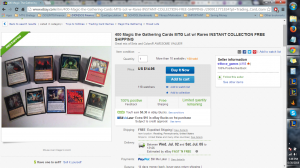
ebay instant collection


If you put 400 cards in a box, you can probably ship for just over $5. After ebay fees, you’re probably making $7-8 dollars, but that’s certainly better than $6 per thousand by throwing them up on Craigslist. However, this path certainly involves more effort. You have to set up the eBay account, create the listing, constantly make enough collections to sell, make sure that there’s not more than a playset of each card, and deal with online feedback and such. I personally already feel like shooting myself after dealing with bulk commons and uncommons, so I don’t want to put more effort into something like this. I have, however, created instant collections to sell locally. It’s much more rewarding and satisfying to sell to someone who will continue to be a friend and customer as they progress in their Magic lifetime.
For a quick recap before I head out to climb a mountain in the Alps and meditate alone while trying ot come up with a topic for next week: Craigslist, Facebook, and other dealers are your fastest methods to dump bulk commons and uncommons that you’ve picked over. If you’re interested in getting creative and putting more effort in, try your hand at eBay or Amazon lots, price competitively, and play the waiting game. In order to buy the lots that you want to pick and sell, be sure to never go above your decided rate, never pay for what you don’t see, and be vocal. Thanks for reading, i’d love to hear stories of your past collection buys, and tips that you used to make the most to turn [card]trash to treasure[/card]!

Pitt Imps Podcast #76 – One More Than 75

As the title says we passed no. 75 and we barely mentioned it last week. Oh well. We get to go over the last 2 Theros Limited GP’s ever. It kinda makes me sad. Anyway SCG was sitting in Portland and streaming Magics all weekend so we cover that. Then a bunch of M15 news and spoilers are there for us to go over. Well anyway free magic content so go listen.

Host – Angelo  Twitter – @ganksuou

Co-Host – Ryan   Twitter – @brotheryan

Show Email  [email protected]

Brainstorm Brewery #104 – Finance Fun01

The gang is joined by Kevy Metal (@kevymetal) from Heavy Meta, improbably, to talk about M15, Vorthos and Finance 101. Spoilers are discussed and much merriment is had at a Brew Crew member’s expense, though probably not the one you’d assume.


  • Finance 101 is still an important topic each week.
  • M15 spoilers are discussed at length.
  • The gang gets to quite a few e­mails.
  • Kevy Metal (@kevymetal) is the guest this week.
  • The address is [email protected]


Cabe Riseau produced the intro and outro music for Brainstorm Brewery.


Contact Us

Brainstorm Brewerywebsiteemailtwitterfacebook

Ryan Bushardemailtwitterfacebookgatheringmagic.com

Corbin Hosleremailtwitterfacebook – quitespeculation.com

Jason E Altemailtwitterfacebookgatheringmagic.com – quitespeculation.com

Marcelemailtwitterfacebook

Unified Theory of Commander: Draw Part 2 – Tutors

There are ways around just about every rule ever made by mankind. We’ve all learned to push the boundaries and discover which rules really apply and which ones are not fully enforced. Kids learn which parent to ask to get that extra TV show before bed. Students figure out which teachers are pushovers that let them turn in assignments late. And let’s face it, rich people with high-powered lawyers have learned which laws they can skirt thanks to their wealth and influence.


Magic players skirt the rules too. Commander is supposed to be a format of 100 singleton cards, creating a high degree of variance in each match. In reality, players are able to search their library for specific cards and gain access to them more reliably. This is thanks to a class of cards known as “tutors” that can grab cards from the library and put them into hand, the top of the library, the graveyard or even directly into play. This reduction in variance obviously increases the consistency of a deck, if not its outright power, which is why tutors are highly controversial and why they are necessary to address as we continue our discussion on card draw in our Unified Theory of Commander.


Troublemaker

Troublemaker


Teach the Controversy


Once again, we need look no further than the Commander Rules Committee’s own Sheldon Menery for some important thoughts about the topic at hand. Sheldon has gone almost completely tutorless in his own EDH decks and had this to say about it:


One of the reasons I developed the format the way I did was because of the sometimes-random nature of the 100-card singleton design. I really wanted there to be a looser, more open-ended format for multiplayer. When I’m playing, I want my decks to be able to do many different things or to do the same thing multiple different ways. Going tutorless helps squeeze in more opportunity.

source


Here’s where the controversy tends to really heat up. Commander was crafted with the intent of being a social format, with a relatively high degree of variance, encouraging players to create fun interactions in more than a single way. So there is a certain group of players that find just about any tutor objectionable and in conflict with what they consider the “Spirit of Commander.”


The opposing view tends to come from an equally fair position. Regardless of the intent of a game designer (or Rules Committee, as the case may be), a great game can usually be played in more than one way. In fact, I’d argue that a huge part of Magic’s wild success has to do with its virtually unlimited ability to be remixed and enjoyed the way players want to experience it. That’s how we got EDH in the first place, isn’t it? So even if the judges and players who first gathered together to create the format had one idea about what it should look like, the reality is that its going to look like what players in any given group make it into. Since tutors are part of the magic cosmos and they aren’t officially banned, they are entirely fair game when building an EDH deck.


Gideon (The Good)


The fact is tutors do bring some good elements to the game that simply cannot be overlooked. First of all, most mana ramp spells count as a tutor, don’t they? Take a look at [card]Lay of the Land[/card] or [card]Skyshroud Claim[/card] and what do they say? “Search your library.” That technically makes those cards into tutors that allow players to reach the critical mana needed to cast fun spells. Sure, mana ramp can be a problem for the table when its twelve mana on turn three, but most of the time its used to smooth out mana draws and create the good kind of interaction at the table. So right off the bat it looks like tutors aren’t all bad.


Not exactly a problem card, is it?

Not exactly a problem card, is it?


Tutors also leave players an opportunity to search for answers that let them escape sticky situations and even better, help the entire table out in a bind. Say the player to your left cast [card]Ulamog the Infinite Gyre[/card] and after a quick chat the table realizes that no one has an answer in hand. Someone is sacrificing four permanents on the next turn unless you can find an answer right now. You could always pray to top-deck a [card]Path to Exile[/card], but a tutor gives you the option to grab a specific solution instead of appealing to the EDH gods for your out to be on top the of deck. By blowing your tutor on an answer, you score some political points with the rest of the table and get to play the hero.


Remember in our first discussion on card draw, we demonstrated how drawing cards is like increasing the sample size in our hypergeometric calculations for success. I pointed out that this is great because its difficult to increase the number of successes in a population across all our elements of the Unified Theory. We can’t just keep devoting more cards to Mana, Draw and Answers because our decks are limited to 100 cards. Well, tutors actually hack the calculation and do a little bit of both for us. They can serve as functional duplicates of important cards in our deck by searching them out.  So the options a tutor presents to an EDH deck are incredibly potent.


Nicol Bolas (The Bad)


There is some danger associated with relying too heavily on tutors though and its something new players to the format need to consider as they construct their first decks. The simplest challenge tutors present is the risk being “two-for-oned” by a smart opponent that is holding a counterspell or a piece of spot removal. If you cast [card]Diabolic Tutor[/card] in your [card]Karador, Ghost Chieftain[/card] deck to go get a combo piece like [card]Karmic Guide[/card], a clever control player is going to let you spend the mana on the tutor and then spend more mana to cast the creature, only to toss a two mana [card]counterspell[/card] at your angel spirit. So you just spent nine mana and likely your entire turn only to end up with nothing. The same can happen when the [card]Avacyn, Angel of Hope[/card] you pulled from your deck with [card]Chord of Calling[/card] ends up on the bottom your library thanks to an opponent’s well-timed [card]Terminus[/card].


Tutors also run the risk of making a deck particularly boring and predictable. Most players enjoy the social aspects of the multiplayer format and the variety offered by singleton deck construction. Run too many tutors and your shiny new commander deck might start to feel old hat to you and to your playgroup after only a couple games. If a deck rushes to exactly the same combo pieces, exactly the same way at the start of every game, then you might find yourself wondering why you are playing EDH instead of just playing a more consistent format like Modern.


Aren't...

A Nuke in the EDH Arms Race


The deck may also fall on hard times when the local playgroup learns which cards to remove on sight. If that Karador deck is looking to [card]Tooth and Nail[/card] into [card]Mikaeus the Unhallowed[/card] and [card]Triskelion[/card] in every game, we can be certain that the table is going to look for ways to exile those cards from the deck before the tutor even gets into your hand. It’s not the playgroup’s fault if they decide to answer your deck that way either. They aren’t being mean to turn off the instant-win combos in your deck. They want to win the game too and if the only way to make sure you don’t win first is to remove the non-interactive parts of your deck, that’s a good decision on their part. Which brings us too…


Garruk (The Ugly)


Here’s where tutors can become a problem in certain playgroups. The consistency they create in a deck can lead to frustration for the rest of the playgroup, who see themselves losing to the same pieces over and over again. It’s not an immature response for those players to then tweak their decks to respond to the potency of a consistent deck filled with tutors. Of course this can lead to an arms race that spirals into hurt feelings and accusations that one side or the other forgot about the “Spirit of Commander.”


No Man is an Island. Neither is an EDH deck.  But this is...

No Man is an Island. Neither is an EDH deck.


It’s important in these instances that everyone in the group can take a step back and have a mature conversation about the situation. Commander is a game, and if its stopped being fun then then healthy communication broke down somewhere and the group is missing the point of sitting down at the table together in the first place. It’s OK for power levels to go up over time, but its important to have conversations about it and make sure the players are communicating their expectations of fun and fairness. That’s the real spirit of the format, whether you are playing pre-con decks straight out of their boxes or piloting thousand-dollar decks that would make a Spike at a Legacy tournament laugh maniacally. Don’t let things get ugly because you are unwilling to talk about your expectations for the game or unable to accept that your version of fun might not be entirely compatible with every player at the table.


My Advice


Tutors can do good things. They can also do bad things. Tutors can help your deck hit its land drops and play a savvy political game, but they can also make a deck boring to pilot and annoying to the other players. So what should you do? My advice is to set some clear goals.


Before you build or adjust any deck, take a few minutes to consider what you want the deck to do and just how consistent you really want it to be. I showed you in our article on mana how some basic math can make your deck hit its land drops and cast its big spells. We also discussed in our first article on card draw how this second element can increase options over the course of a game.  But you don’t have to dial these elements all the way up to 100% in every deck, do you?


Certain deck archetypes really need tutors to function. So if you goal is to play some kind of combo deck, then tutors are going to be necessary to hit those combo pieces. That’s got to be part of your goals for the deck, even if some players aren’t going to be happy about it. They can’t force you to play a different archetype because they have fun a different way than you do. But be aware that if your deck is too consistent, you may become the table archenemy and be forced to play 1v3 each time you pull it out. If that falls outside your vision for the deck, you should consider reducing the consistency so the deck aligns with the playgroup and your overarching goal.


Please Tutor Responsibly

Please Tutor Responsibly


Likewise, you might find your deck a bit underpowered and inconsistent for your playgroup, violating your goal for the deck by failing to be competitive at all. If your voltron deck is having a hard time pushing damage through for the win, you may need to consider adding a card like [card]Stoneforge Mystic[/card] or [card]Idyllic Tutor[/card] to go digging for auras or equipment to keep the commander swinging and picking up its fair share of wins. Don’t be afraid to add a little consistency to the deck if you feel like a tutor is a necessary addition.


Unified Tutor Theory


So this continued discussion on card draw actually brings us back to utilizing the My Deck Tickled A Sliver mnemonic to edit our decks. Tutors allow a deck to hit its land drops and to draw the threats and answers it needs to be successful. Utilizing the right tutors for the deck’s archetype taps into the synergy element and helps a deck meet its stated goals. Using too many or the wrong kinds of tutors just because they are available in the deck’s colors can result in a boring, noninteractive experience that leaves the entire table underwhelmed. It might not even make the deck functionally stronger either, as you may become too predictable or be grabbing the wrong pieces simply because you drew into a tutor.


So set some goals and then don’t be bashful about using a tutor to help achieve them. Just make sure your deck is actually meeting its stated purpose and that you aren’t becoming the instigator in an arms race that leaves an entire playgroup unhappy. As I’ve said before, editing an EDH deck is a process, even using our Unified Theory. Finding the right balance of tutors for your deck might be as well. So make sure to review after each game and after each adjustment and keep asking yourself if the deck meets your standards for fun and interaction. You and your playgroup will be happier with the deck and the EDH experience if you do.


Playing Magic for Free #2: From Trading to Trader

Read Part 1 of this series – here!

Completing the Transformation

land taxI was talking to a friend, Kevin Grigsby, who has bought and sold cards off and on since well before my start in the game. We discussed a story dating back to the unbanning of [card]Land Tax[/card]. It was the first time I was on top of the unbanning news, so I arrived at my local shop bright and early the next morning.  [card]Land Tax[/card]es were still in the case for around $6 a piece. With eight copies in the case, I told the manager, who I was friendly with, to hook me up with all of them. We’ll call the manager Jim. As he checked the price on the computer, I puffed my chest out and enlightened him on the unbanning that happened the night before. I didn’t know anything about the Legacy format, but I was proud of myself for going out of my way to pick up a recently unbanned card before the price spiked. Jim handed me my cards and I left for work.

After work, I came by the shop to trade and play in that evening’s draft.  Jim walks up to me while I’m standing with four of my friends next to about ten other Magic players waiting for the tournament to start.

Jim: “Hey, man, those [card]Land Tax[/card]es you bought this morning were supposed to be $40 a piece. You owe the store a lot money!”

Confused Me: “I didn’t think they had went up yet.  Did you not check them on the computer beforehand?”

Jim: “Of course, but I just looked it up wrong. Plus I thought we had more, ’cause I need four for my new deck”

Suspicious Me: “If you messed up, why should the customer have to pay for it 10 hours later when you catch it? I didn’t look them up before I came in.  I just knew what they were in the case last time I was here and told myself if they were the same price it would be a decent pickup.”

Jim: “Well, you ripped off the store.  How ’bout I just give you your money back and we can call it even?

Me: “No, thanks”

satisfactionJim: “Will you at least trade them to me so I can play my deck? You don’t even play legacy.”

Me: “Sure, man. I’ll gladly trade some to ya.  $30 a pop or $100 for the playset.”

Jim: “Come on, man! You bought those for $6 a piece! We’re friends, right? Why won’t you do $6 or $7 each on them?”

Me: “Because then I got up at the crack of dawn and drove here just to pay tax on cards I could trade off 10 hours later for less then what I bought them for.”

Jim: “F#*&ing thief.” *stomps away*

Yes, I was sort of being a prick about it all, but I thought if anyone would understand business, it would be the manager of a retail store.  I left for college a few weeks later and that manager told every local MTG player the story about the ginger that stole from the store. I will cut out all the drama talk, but what really hurt was my trading connections.  Since I wasn’t in town to defend myself, only a few of my friends knew my side of the story.  I came back to town receiving a large amount of weird looks and everyone seemed scared to trade with me.  To be honest, I’m a 6’2’’ muscly ginger with hair to my shoulders and a five-inch beard, so I can understand a mild amount of intimidation.  By then, I could tell the difference though.

So, when Grigsby and I talked about this story, he said, “I know you may think what you did is justified, but you went about it all wrong.”

What?!?

He continued, “By now, you obviously understand the importance of networking and how to avoid burning bridges, but here’s what you should have done.  Before you call the manager over to buy the [card]Land Tax[/card]es, look up the current price.  Say its $30 and they are in the case for $6.  Call the manager over and tell him that you are looking to buy some [card]Land Tax[/card]es but you know the price has went up to $30.  Then ask if they would sell them to you for $15.  This enables the store to make double than the price in the case and also enables you to double your money by trading them away for the full $30.  Most managers will appreciate the honesty and hook you up with a deal.  It’s not always guaranteed, but its keeps you from potentially setting a bridge ablaze and ruining your reputation in a 50-mile radius.”

“Wow,” I said, “That sounds so easy but makes a lot of sense. I never thought of it that way.”

Identifying Steps

I tell this story not to say, “Look what I can do.” This glimpse into the past shows the correct steps while also revealing the incorrect steps I thought at the time were correct.  Knowing what I know now, I decided to share the top three of both correct and incorrect steps I made along my journey.

stairway to heavenCorrect Steps

Knowing Prices – It’s a lost art, even for myself. Smartphones stole a lot of advantage but knowing prices can still save you a lot of time and money.

Networking – Talk with everyone you can. Trade numbers and tell them to hit you up if they are looking for a card.  If they have a trade binder, ask to look through. Listen to their stories about that one time that dollar rare saved them from certain death while you archive any notable cards among their trades.  Let’s be honest though, we all love telling those stories.

Value Trade – Trading for cards you don’t need but still hold value (AKA format staples). It makes your binder look sexier and minimizes the chance of your trades decreasing over time, especially in Standard. Value trades are a great way to build relationships.  The fact that you traded for something you didn’t need to help them inch one step closer to their goal means a lot to people.

*Keep in mind trading for value from local players and trading for vendor value can have vast differences.  This highlights a term called “spread.” Another topic for another time.

lego steppingBonus Tip: If you’ve been networking, value trades become easier because you know what the other person plays.

Incorrect Steps

Forced Trading – Just because you open up someone’s binder doesn’t mean a trade must happen before you can close it.  I struggled with this when I started trading.  It sounds silly, but I felt like it would irritate them if I didn’t make some sort of trade.

Unkind Exits – If you see nothing, then politely say something like, “I didn’t really see anything I was interested in. I appreciate you letting me look. Great talking with you.” Don’t say, “I didn’t see anything I like/want/needed.” It implies they have nothing of value while also implying you only trade for stuff you need and not for value.  It took me a long time to learn this one.  It seems small and irreverent, but eventually became something I noticed after a year of trading.

Creating Cognitive Dissonance

Don’t lie about prices.  It’s shameful for me to admit, but I ripped numerous people off in my early years.  Sad thing is, if someone trusts you to value a card and you place it at $10 instead of $20, they will most likely still leave the shop happy.  But all it takes is one friend or a few clicks online to find out they were jipped.  Should they know the prices of their cards while trading? Of course! Do they deserve to get jipped? Probably.  It depends on how much money was lost in the transaction. But some traders will think, “It’s my fault for not knowing the prices. I’ll be more careful next time.”  Most traders will think, “That a$$h*!# ripped me off! Never trading with him again!”  Now, not only will they most likely avoid trading with you, but will also inform other players around the store about your dishonesty.  It sounds like an exaggeration, but it really can happen that fast.

trade secretsWrap-Up

Identifying the correct steps toward developing consistent trade flow is important, but pinpointing the “speed bumps” that burn bridges or create dissonance make a larger impact in the long haul. You don’t have the luxury of a store, warehouse storage, or staff.  Your reputation and inventory is dependent on the opinions of players and traders in your area. Correct your imperfections and build a list of guidelines.

Next week, I’ll share the guidelines I use to keep myself on track.  In trading, just like Magic, there can always be bad luck, forgetfulness, and an exception to the rules, but creating a plan of action to follow can help keep trade goals achievable. Hopefully my lines of play toward trading can help you start playing Magic for free.

As always, thanks for reading.

Investment 207: Ryan vs Marcel

“Half a denier for my bloody life story?!”
“You can’t expect to wield supreme executive power just because some watery tart threw a sword at you.”
“Gentlemen, you can’t fight in here—this is the war room!”

It's all fun and games while someone's losing eye

It’s all fun and games while someone’s losing eye

A while back, we analyzed the different investment strategies implied by the Pick of the Week segment on the Brainstorm Brewery podcast. Let’s recap our conclusions from season one:

Marcel and Ryan are classic Alex-profile investors. Their picks traditionally favor low-risk, long-term growth. While they are buy-and-hold investors, they are not buy-and-forget.

Since we previously pitted the two more aggressive crew members against each other, that means we can now see what happens when the two more conservative crew members are put side by side.


Ryan’s base stats:
30-day call rate: 37 percent;
Season-ending call rate : 50 percent
30-day average return: 14 percent
Season-ending average return: 1.1 percent

Marcel’s base stats:
30-day call rate: 70.4 percent
Season-ending call rate: 17.65 percent
30-day average return: 41 percent
Season-ending average return: .89 percent

These results seem at odds with their previous results. Both of our slow-and-steady investors turned in modest long-term gains, but at the other end of the spectrum, they both crushed their 30-day results:

Marcel:
[card]Blood Baron of Vizkopa[/card]: +37 percent
[card]Ash Zealot[/card]: +76 percent
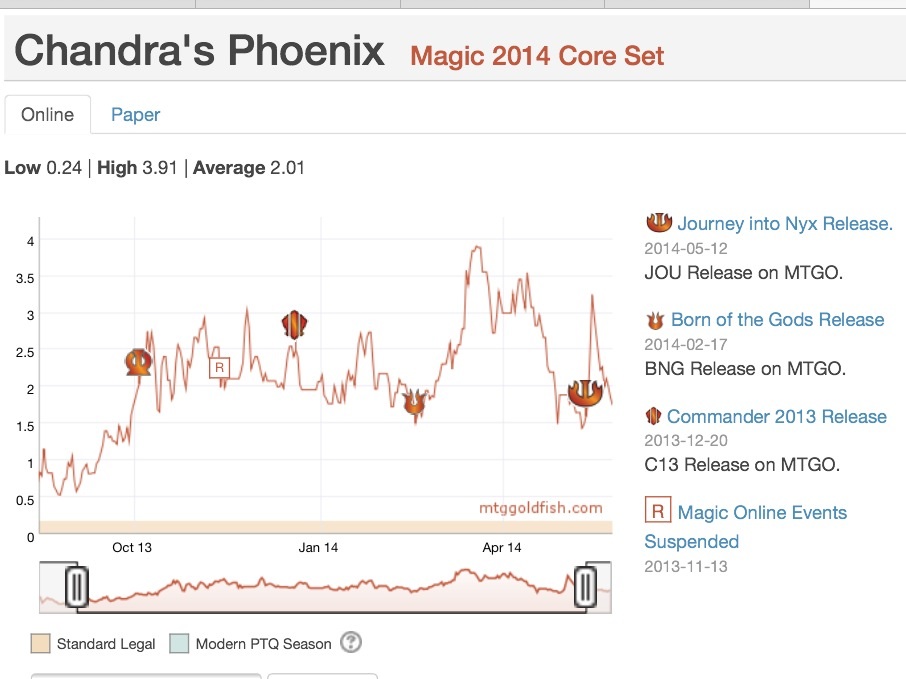
[card]Chandra’s Phoenix[/card]: +100 percent

Ryan:
[card]Chandra, Pyromaster[/card]: +255 percent
[card]Beck // Call[/card]: +100 percent

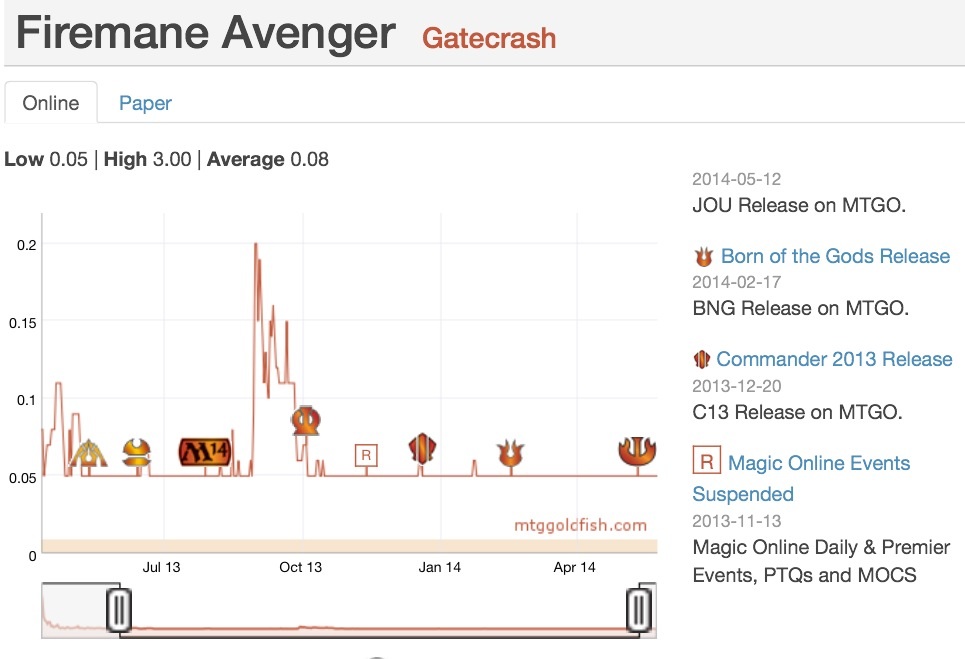
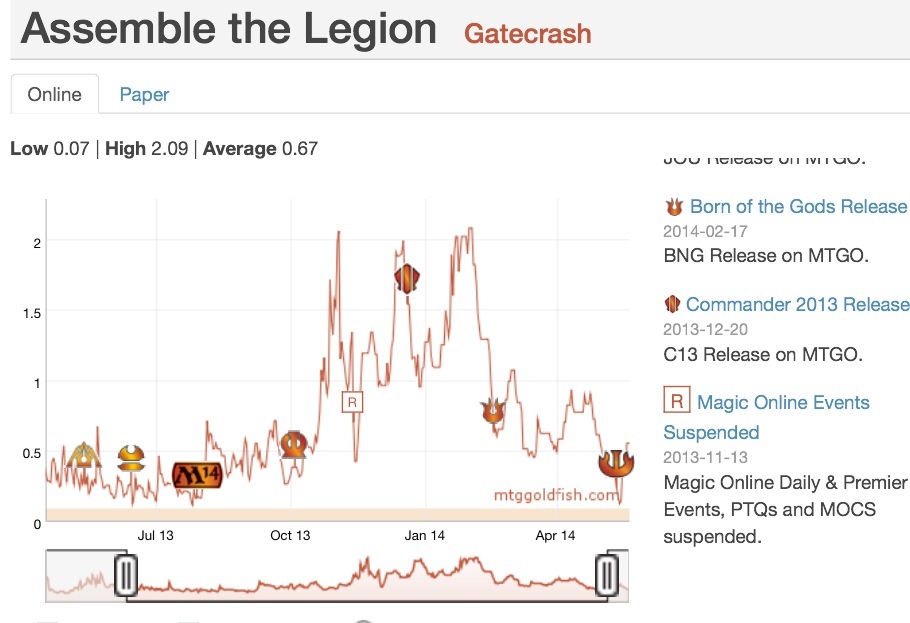
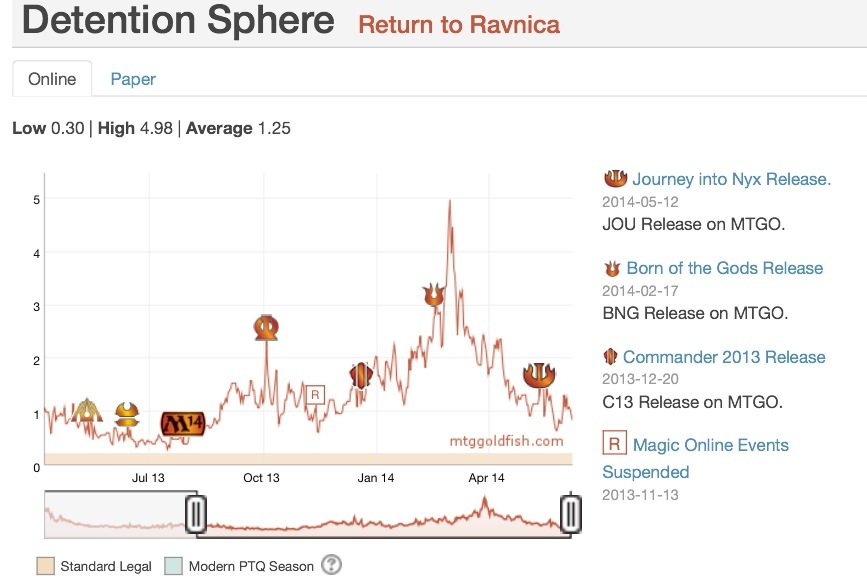
At the other end, Ryan’s average pick ended up yielding over 50 percent and Marcel’s calls fell to just above positive. This might be indicative of rotation leading folks to make blind shots at cards that are strong but unplayed. Yet even as we see uneven results, there are trends emerging. In Ryan’s 30-day time frames, roughly six out of ten of his picks failed to move upward, but he still averaged 14-percent profit per trade. Marcel’s picks started out strong and collapsed under the weight of rotation, with eight out of ten of his picks failing to gain any profit during the season. But again, the concept of Beta (see Investing 205) is coming into play here. In each case, the losses per trade were kept tightly under control and the gains per trade were outsized, resulting in returns that were much better then expected considering the number of missed calls.

Missed Calls

Here’s a few examples of Marcel and Ryan missing:

Marcel

[card]Firemane Avenger[/card]: +/-0 percent
image
[card]Assemble the Legion[/card]: -16 percent

image
[card]Whispering Madness[/card]: +/-0 percent
image

[card]Detention Sphere[/card]: -15 percent
image

Ryan

[card]Sword of Light and Shadow[/card]: -9 percent

image
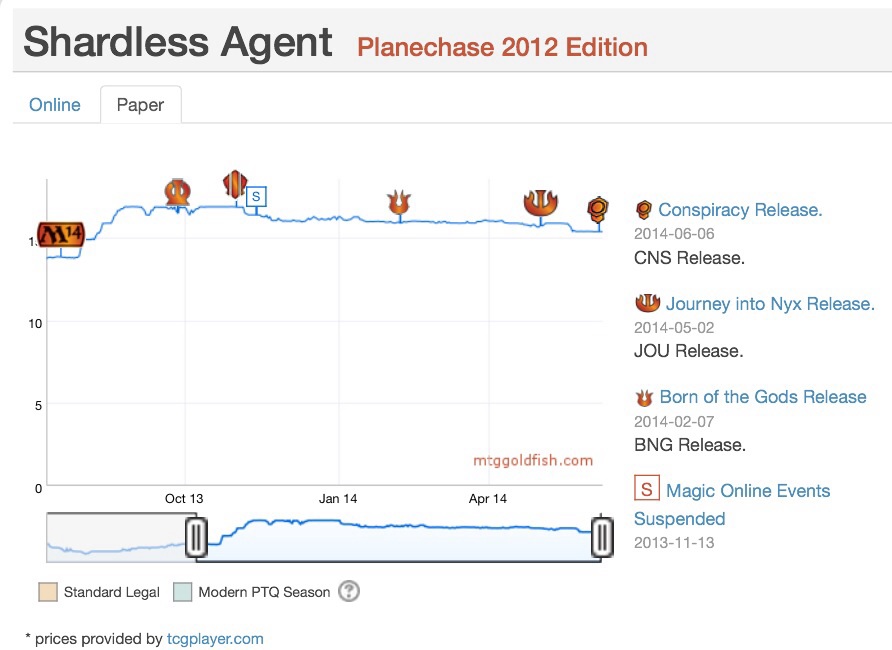
[card]Shardless Agent[/card]: +/-0 percent

image


The Good ‘Uns

Compare those misses to the upside on these calls:

Ryan

[card]Mutavault[/card]: +93 percent

image

[card]Burning Earth[/card]: -79 percent (this was a sell call)
image

Marcel

[card]Chandra’s Phoenix[/card] : +300 percent
image
[card]Garruk, Caller of Beasts[/card]: -64 percent (this was a sell call for the paper version)
image
As we discussed previously, it is a little difficult to pick one over the other, as Marcel sticks almost entirely to MTGO. In this matchup, though, we see that Marcel seems to have drifted over into Jason’s side of MTG finance. While Ryan has continued his previous pattern of low-risk and value-driven picks, Ryan’s calls were less incremental then before. A gambler (Gordon profile) will more than likely find Ryan’s pick unsatisfying. As for Marcel, his picks were much more aggressive and short-term compared to his previous season. While an Alex profile might have become uncomfortable with the level of volatility this time around, the returns were still with in the range of both Ryan’s and Marcel’s spectrum of comfort.

Good luck always helps

Serum Visions: Lager is Beautiful

Hello, everyone, and welcome to Serum Visions!

This week, we are going to be talking about the most popular beer in the world: the lager. There is a beautiful and interesting history behind this type of beer that is hidden behind its most recognizable brand, Budweiser. While finding its roots in Austria in the mid 1500s, it has become one of two umbrella catagories for more than twenty-five very unique styles. The research and development that went into making it more easily produced actually led to a German knighthood. Hopefully by the end of this article, you’ll see the lager as a real thing of beauty that is much deeper than the fizzy yellow water it is so often associated with.

“The brewer surely has an intention, but the wort itself is agnostic as to its destiny— it is the yeast that decides its future.” Garrett Oliver et. al

This quote so perfectly sets up what is to be said about the lager. The brewer’s intention has been infinitely cleared up for him in the last hundred or so years since yeast strain isolation has been fully understood. The brewer’s intention was still quite clear to them for the previous three hundred or so years, but not to the same degree. In the time leading up to around 1550, the brewer’s intention was being understood and honed.

The “agnosticism” of the wort, or unfermented beer, means that it will be whatever kind of beer that it is coerced by nature to be. During the early stages of understanding and honing, brewers would mash their grains and boil in their hops, knowing that in a few weeks the wort would bubble away and end up as the sweet nectar, beer. The process by which that happened was still largely unknown to them. We now know, of course, that the process is fermentation by way of yeast. In the days of old, pre-1553, it was the atmospheric temperature that would determine the type of beer being either an ale or a lager. If it was during the summer months, it would be an ale, and during the colder winter months, it would be a lager. This is because there are two main strains of beer yeast which are active at differing temperatures. Saccharomyces cereveisiae, which is the ale yeast, ferments between 60 and 75 degrees Fahrenheit and saccharomyces pastorianus, the lager yeast, ferments between 13 and 42 degrees. 

i-TPSP3QS-L

A Brief History

In 1553, the Duke of Bavaria, Duke Albrecht V, decreed that no beer was to be produced between April 23, St. George’s day, and September 29, St. Michael’s Day. These are the summer months. They had figured out that the beer produced during the summer was far more likely to spoil than that made during the cold winter months. This was because sanitization was not fully understood yet, so the bacteria that would invade the brew was usually uncontested and thus ruined the beer. In the winter months, it was too cold for these bacteria to survive, so the beer would remain unspoiled. 

The name of lager comes from the German verb lagern, which means to store. This is because once the beer has been fermented, it needs to be stored, or lagered, for three weeks to three months. During this time, the beer would be stored at or just below freezing, and the off-flavor and aroma compounds would be reabsorbed by the yeast and then settle to the bottom. It’s during this time when the beer achieves its clean, crisp profile. The beers that were made coming up to the production time of late April would need this treatment as well, regardless of how warm it was. To ensure these temperatures were kept, the brewers would pack their fermentation cellars full of ice blocks from frozen lakes and ponds during the winter. This practice was kept until the practice of artificial refrigeration was implemented around 1870.

03The implications of this are quite far-reaching. This means that any beer brewed in Bavaria during these three hundred

years had to be a lager. We could not possibly imagine for a moment that this region only drank what the general population considers a lager for three hundred years. No, they without a doubt would have wanted variety. This means that there would have been everything from light and refreshing beers to heavy and contemplative beers. Pale and dark, high alcohol and low alcohol, hoppy and not—to every variation of beer we are familiar with today made as a lager. There are 27 different styles of lagers listed by Beer Advocate, all of which undoubtedly have their origins in Bavaria during this time.

Innovation & Knighthood

asset_upload_file942_36858_thumbnailIn 1868, Carl von Linde joined Weihenstephan. Weihenstephan is the world’s oldest continuously operating brewery and arguably the worlds foremost brewing university. Establish by Benedictine monks in 1021 as an abbey and brewery, it has become a part of the Technical University of Munich that has been offering doctoral degrees since 1920. Linde was the first person to take seriously the idea of keeping beer at colder temperatures using artificial refrigeration. He based his “ammonia cold machine” off a principle called vapor-compression refrigeration (wiki here), which is still used to air condition cars and homes to this day. Most of the funding for this research came from a brewery in Munich called Spaten Brewery. This brewery was the first to install the system, in 1873. In 1879, Linde went on to start a business called  Ice Machine Company, which sold almost 750 cooling systems in eleven years! This company is still around and employs 48,000 people in more than 100 countries. Linde was knighted in 1897 and died in 1934. He made great strides in the manipulation of gases that included the liquifying of oxygen and nitrogen. However, it is his advances in beer cooling technology that may his be most enduring innovation.

The world and history of lagers is so much larger than it appears at first glance. I’d encourage you to dig in and try as many different kinds as you can. When you find one you love, or if you have one you already love, please hit me up on Twitter at @awcolman or leave a comment below! I’d love to hear what discoveries you have made.

As always, thanks for hangin’.

Andrew

Style of the Week

American Amber / Red Lager, American Double / Imperial Pilsner, American Malt Liquor, American Pale Lager, California Common / Steam Beer, Czech Pilsener, Euro Dark Lager, Euro Pale Lager, Euro Strong Lager, Bock, Doppelbock, Dortmunder, Eisbock, German Pilsener, Kellerbier / Zwickelbier, Maibock / Helles Bock, Märzen / Oktoberfest, Munich Dunkel Lager, Munich Helles Lager, Rauchbier, Schwarzbier, and Vienna Lager

These are all of the lagers listed on Beer Advocate that exclude Bud-Miller-Coors. Go to wherever you get your craft beer and ask for a lager made by a local microbrewery. If for some strange reason your local microbrewery does not make a lager, talk to the person helping you about finding one of the styles listed above. They should be able to help you find one that you will enjoy. 

The Magic Word: A Capital Idea

Greetings, Brainstorm Brewery readers! I am the editor of ye olde BSB, and though I have lurked in the background until now, I figure it’s time for me to come out of the shadows, at least momentarily. You may know me from my work on Quiet Speculation, but I’m not here today to talk about MTG finance.

No, today I’m going to discuss writing about Magic. As editor for the site, it’s my job to make sure that words you are reading on this webpage are comprehensible. This doesn’t mean that everything you read here is always error-free, because much as I hate to admit it, I am fallible (and just to be clear, our writers are completely infallible). That said, I really, really care about things on the site being readable, consistent, and technically correct.

I’ve read a whole lot of MTG articles on dozens of different sites, and let me tell you: it’s much easier to take someone seriously when he concisely, correctly makes his point. Whether it is to improve your articles, blog posts, or tweets, being aware of some of the quirks of Magic writing can really help you come off in an intelligent way—and who doesn’t want that? It’s easy to find writing tips online, but deep discussion of Magic-specific style decisions is woefully absent from the web. My goal with this (potential) series is to start a dialogue between Magic writers, editors, and fans. I know I’ve had some questions about the correct way to write about Magic, so let’s work together and see if we can arrive at some universal guidelines.

A Capital Idea

Do you know the name of the game you play so devotedly? Judging by what I’ve seen basically across the entire internet, you do not. What does “Magic the Gathering” even mean? What gathering are we magic’ing, exactly? And since when is magic a verb? This seems questionable. Not nearly as annoying but just as wrong is Magic: the Gathering. The first word of a subtitle gets capitalized, folks. The name of the game is Magic: The Gathering. Only the mothership gets this right consistently. I almost never see it correctly elsewhere.

That’s a pretty cut-and-dry example about which I obviously feel rather strongly, but there are quite a few questions of capitalization that are not at all straightforward. Do I top eight a Daily Event or do I Top Eight a daily event? I’m a pretty big proponent of recognizing when something is a generic term, since most people capitalize far too many words (and I’m not just talking about the MTG community here. I mean most people). I fight back against this rampant upper-casing by generally taking a stance that non-specific terms are generic.

So the answer, in my mind, is that I top eight a daily event. Daily event and top eight both have special meanings in the MTG community and I often see them capitalized. I’m willing to be convinced to change my philosophy, but it’s hard to imagine more generic terms than these. Do they lose their meanings when written this way? I say no—but would love to hear arguments to the contrary.

It’s the same with pro tours and grands prix. Those are just types of tournaments. But Pro Tour Journey into Nyx gets capitalized, as does Grand Prix Portland, because they’re referring to specific events. They’re straight-up names, and thus proper nouns.However, writing that you played the pro tour in Atlanta and then stayed for the grand prix the following week is just fine. Pro tours and grands prix are not even exclusive to Magic. Don’t waste the energy it takes to hit that shift key.

Then we get to the really interesting stuff. Should we write Cube or cube? Is it Draft or draft? The answer is yes. As Magic writers, we capitalize format titles: Legacy, Modern, Draft. That said, we don’t Draft Innistrad. We draft Innistrad (if we’re lucky). Similarly, I might refer to my cube and be correct, but if I tell you my favorite format is Cube, I’m also correct (assuming that is factually accurate, which it is, because Cube). It all comes down to context. A little critical thinking goes a long way.

Whether or not we capitalize specific words is a surprisingly deep topic, and this is just skimming the surface of what kind of style decisions go into writing and editing a Magic article. Though it may seem inconsequential, people notice these things, and not just in Magic writing, either. In a down economy with a ton of applicants for every job, employers are looking for every excuse to eliminate candidates. You can be sure that many qualified applicants across industries of all types have been overlooked for small grammatical errors on a cover letter or resume. So even if you’re not a writer, there’s every reason to take this stuff seriously.

Where’s the Appeal?

I’m legitimately unsure if this kind of article will garner any interest. These are topics I constantly consider, but then, I deal with them on a near-daily basis. The casual reader may never give these kinds of things a second thought. If you’re a current or aspirational writer, these types of ideas may be a little more useful to you, but maybe it’s just me who thinks that.

In my experience, it’s extremely hard to find information on Magic-specific style questions. It’s easy to find the answer to general grammar questions, but once you get into something specific to Magic, it gets much harder to find a definitive source. I hardly have all the answers myself, but I do have opinions, logic, and the desire to be correct. And like I said, ideally this results in a running dialogue—I have just as much to learn as I do to teach, so let’s all work together.

If you are interested in seeing more articles like this, let me know! I’m not the type of person who lives and dies by comments (to be honest, I often don’t even read them), but in this case, I’m worried that this topic is only interesting to me. If you want to see more, let me know in the comments or on Twitter at @dbro37. If you have an element of Magic style you’d like me to discuss, name it! Let’s get a dialogue going and see if we can elevate Magic writing a tier or two. Thanks for reading.

Brainstorm Brewery #103 – Conspiracy Theories

Vintage Masters Drafts are in full swing, Power is bought and sold, and StarCityGames announces a scene change for Sunday afternoons. Don’t be caught with your pants down; hear the facts from your favorite MTG finance podcast. Wall-to-wall value is the hallmark of this cast, and this installment is no exception. Whose cricket friend returns to punctuate uncomfortable silences with his mocking chirp? Who completed a set of power on Magic Online? Who tells a story so anticlimactic that it may not even make the final cut of the episode and will end up relegated to the worst After Hours segment in history? Find out the answer to all these questions and more on an episode of your favorite podcast that will have you asking, “How low can Dack Fayden go?”


  • In Finance 101 this week, the topic of trading is introduced.
  • A reader e-mail allows the gang the chance to discuss the importance of the metagame.
  • How was Vintage Masters Draft?
  • Can Conspiracy hold a candle to Vintage Masters?
  • Conspiracy finance is a big topic indeed.
  • StarCityGames announces the addition of Modern events on Sunday. What will this affect?
  • Got some friends who aren’t necessarily finance aficionados but who may benefit from Finance 101? Make sure you’re indoctrinating them into our cul?.?.?.?fan base.
  • Our e-mail is brainstormbrew at gmail dot com.


Cabe Riseau produced the intro and outro music for Brainstorm Brewery.


Contact Us

Brainstorm Brewerywebsiteemailtwitterfacebook

Ryan Bushardemailtwitterfacebookgatheringmagic.com

Corbin Hosleremailtwitterfacebook – quitespeculation.com

Jason E Altemailtwitterfacebookgatheringmagic.com – quitespeculation.com

Marcelemailtwitterfacebook

Conjured Currency #19: Bulk Pickings
(Cold)snap Back to Last Week

Welcome back, readers of Brainstorm Brewery material. I think I’m getting into a routine where at the beginning of each article, I’ll bring up an insightful comment from the previous week to bring full attention to it. Last week we scratched the surface of token finance, and I forgot to mention one of the more expensive tokens that currently exists. Reddit user one_among_the_fence brought up the Marit Lage token from Coldsnap. Made by [card]Dark Depths[/card], this 20/20 creature is the second-most expensive item from Coldsnap, coming in at $20, losing only to [card]Dark Depths[/card] itself. Not everyone wants to use Gerry Thompson as their Legacy Lands win condition, and because it was a promo for the release of the set, I highly doubt that we’ll see any more printings of the token. If you plan on putting 20/20 flyers into play and want to use the real thing, I don’t think picking them up now is a bad idea.
Bulk What?

The week before Tokens, we briefly went over the definition of the word bulk when referring to Magic cards. However, I didn’t go into detail on what financial relevance bulk commons and uncommons can have. These aren’t the cards you see in your local FNM binders, or in the display case at your LGS. In this article, I want to start talking about how you can make money off of the four or five opened Return to Ravnica booster boxes sitting in your friends’ closets that are full of [card]Catacomb Slug[/card]s, [card]Sellers of Songbirds[/card], [card]Axebane Guardian[/card]s, and [card]Izzet Guildgate[/card]s. We’ll go over methods of picking your bulk, how to organize it, and the various methods to get rid of it for a profit.

Different Types of Picks

Literally forever ago (well, back in January), I wrote an article about a bunch of commons and uncommons that were worth “picking” out of your collection to sell or trade separately, but I never really went over how you should go about it. If you buy a collection of commons and uncommons and you know it hasn’t been touched since the owner pulled all of the rares out, you want to have a definitive strategy to maximize your profits and minimize time spent on the project. Set a baseline for the value of cards that you’ll pull out from your bulk. My personal number is $.10, and you can find that price on a buylist aggregator like mtg.gg or mtgprice.com. I took some advice from our own Jason Alt on this matter, and separate my picks into multiple different piles. I have a separate pile for actual “picks” like [card]Lightning Bolt[/card], [card]Springleaf Drum[/card], and [card]Go for the Throat[/card], one for cards that don’t sell on a buylist for more than a dime but I know people at my LGS will need on a regular basis ([card]Titan’s Strength[/card], [card]Gods’ Willing[/card], [card]Spiteful Returned[/card]), a pile for each basic land, tokens, random foils, and anything considered MP or worse in condition.

The “picks” box gets alphabetized and sorted by color, as do the tokens, and the “not yet picks.” This makes them easy to buylist, and easy to find when a friend needs a set of [card]Grey Merchant of Asphodel[/card] five minutes before FNM. The MP/HP cards get thrown out, and bulk foils get their own box to eventually be bulked off as well. I sort the basic lands by type, because I often make custom starter decks for new players, and I plan on running local drafts at my college soon, so it will be easy to grab handfuls of a specific color. If you don’t give a damn about your basic lands, you’re in luck: we’ll go over how to get rid of those in bulk later on, because this article will probably be a two-parter.

Who Wants These Cards?

Now you’ve got your box of picks, and a ton of Magic’s forgotten heroes. The draft leavings that we deserve, but not the ones we need, or something to that effect. The stuff that people who have attended a $40 tournament won’t think twice about ripping in half. Who could possibly want these cards? Believe it or not, there are Magic souls whose hearts haven’t been tainted by the seriousness of competitive play. They play on a level of casual further than any [card]Hermit Druid[/card] EDH player could imagine. They just like owning cards and building as many 78 card unsleeved decks as possible—and there’s nothing wrong with that. So how do we make sure our cards get to them?

  • Dealers

Most people already know this, but it deserves to be said anyway. The absolute baseline for what you should be getting for 1,000 Magic: The Gathering cards is $5.00. I would never sell for anything less than this, just because there are so many stores and aspiring dealers who will pay that amount to either turn and resell, or go treasure hunting themselves. There’s no shame in accepting this price and saving yourself a ton of time, especially if you have a massive amount of cards. I’m currently sitting on at least 100,000 extra cards myself, and considering just accepting a $5 per thousand flat rate if the person is willing to pick them up at my place. If you want to dump them off at a GP, be sure to check with all of the attending vendors well in advance to set up a time and number that they’ll accept. You don’t want to be driving back with all those cards after learning none of the vendors are interested.

  • Craigslist

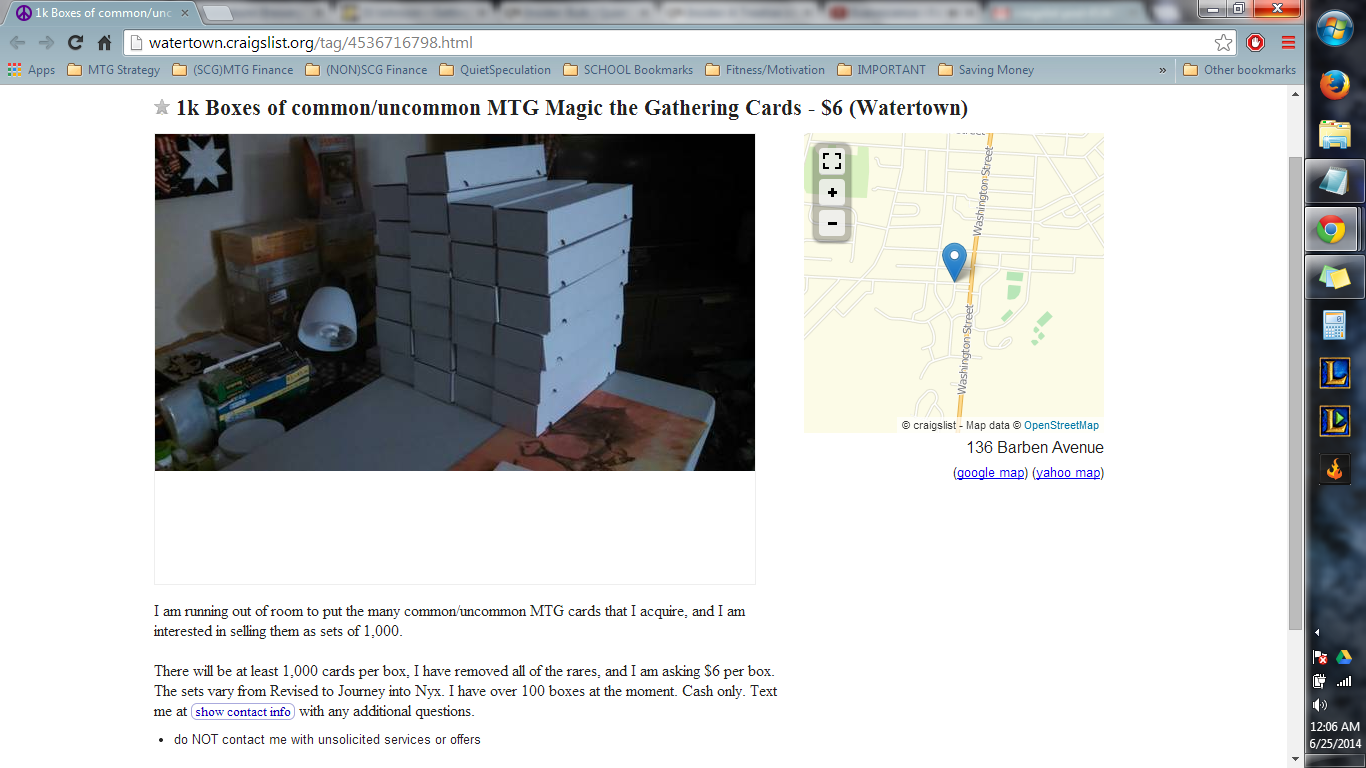
Yes, I bring up Craigslist and Facebook in almost every article, and you’re probably sick of it. But selling directly to another individual who is interested in your product to actually use and not resell, without having to go through a secondary vendor that costs money (read: eBay), is honestly the best way to go. Let’s look at an example advertisement:

CL ad

Our title is informative, we gave a price, a sample picture of what the customer will be receiving, and made sure they know that it’s not just a billion cases of Born of the Gods. I also recommend that you remember to put the words “cash only” in your advertisement, or else you’ll be constantly spammed with scam offers who want to PayPal you after you ship the cards to god knows where.

I am Not Counting 1,000 Cards Over and Over Again

What if I told you that you don’t have to? Another trick that I learned from our Jason Alt is that the height of a Magic card on its side is exactly 200 unsleeved cards wide. This makes it much easier to estimate piles of 200 (err on the side of caution and estimate in the customer’s favor), and fill your long boxes that you bought in bulk with approximately 1,000 bulk Magic cards, ready to ship or do what you want with.

I’m out of space this time, so I’ll be back next week with part two of dealing with your bulk commons and uncommons. In the meantime, hit me up with any questions on Facebook, Twitter, Reddit, the comments section here, signal flare, or telepathic Morse code.

P.S. This is the Part Where I Give You Names of Cards to Speculate On

Except I don’t have any this week. If you’ve been checking your mtgstocks.com every day and have been following MTG finance for a while, you’ll know that summer is generally a very boring time of year for price changes. Other than Conspiracy and upcoming M15, we’re in a rut where we don’t see Modern prices rocketing all over the place. My advice for the next few weeks is to stop looking for the “next big spike” and take some time to organize your collection. Ship off those bulk boxes, do your huge buylist orders now, and set up that online trading list you always wanted to make. Come autumn, we’ll be getting back into a spoiler season people actually care about, and a brand new Standard metagame. Get your busywork done now so you’re cleaned up and ready for the rush when it hits!

Pitt Imps Podcast #75 – Tagged by 1866

This week we had our logo contest winner on to discuss how he came to that logo and he gives us a little bit of details on his artistic back round. We covered all that mono-black that owned GP Chicago and give SCG Vegss it’s rightful amount of time as well. We announced our teespring campaign for t-shirts (go buy). Also, have you tried to navigate the new Mothership website that WOTC put up? It’s terrible, so we do what magic players do, complain.

Angelo’s Twitter: @Ganksuou

Ryan’s Twitter: @brotheryan

Guest Pat   Twitter @oneeightsixsix


Show email [email protected]


Teespring Campaign


Rss Feed http://mtgcast.com/topics/mtgcast-podcast-shows/active-podcast-shows/pitt-imps/feed

The Spike Feed Episode 43 – Shield of the Avatar, The Last Airbender

This week, we talk M15 Spoilers and go deep into Modern. Dustin shares his trials and tribulations at GP Chicago. Curtis tries to go back to U/W Control only to come back again. Cameron throws every bit of Curtis’s advice out the window when it comes to U/B Fairies. And Dustin reveals the bureaucratic nightmare of trying to contact him. Thank you for your honor.

Unified Theory of Commander: Draw

Let’s continue our discussion of the Unified Theory of Commander with a simple question. Would you generally rather be the player at the table with zero cards in hand or the player with a full hand of seven cards?

Yup. That's me.

Yup. That’s me.

No, this isn’t a trick question. It’s a thought exercise to make sure you are in the right frame of mind for the next element in our Unified Theory. I’ve had to invest a lot of effort convincing players why mana is important enough to be first in the My Deck Tickled A Sliver mnemonic, but pretty much everyone nods in agreement when I mention that drawing cards is the next most important element. It just seems obvious. Yet one of the most common pieces of advice I have to give to players looking for help with their decks is to include more ways to reload their hand. So ask yourself again, do you want to have seven cards in hand or zero? Good. Now let’s figure out how to be the player with the hand full of awesome cards.

Card Draw is Mathematical

We spent a lot of time doing hypergeometric calculations in the first discussion on mana, so I don’t want to dive too deep into that again, although we can use that math to demonstrate exactly why card draw is so valuable. Remember that we defined “success” in those calculations based on the percent chance that we’ll hit the right number of mana sources by a specific turn. That calculation was done by using the population (size of the deck), number of successes in the population (amount of mana sources), and the sample size, which is the number of cards you’ve drawn from the deck by the time you reach the target turn.

In the mana article, we adjusted our probability of success by increasing the number of successes in the population. By going from 40 mana sources to 43, we increased the the chance of hitting our critical mana from 72 percent to 97 percent and made our fictional aggro deck more consistent.  Card draw can also improve our chances of success, but it does so by adjusting a different variable. Drawing cards increases our sample size, giving us more chances to hit the mana we need to cast our big, battlecruiser spells.

Deck construction is...

Deck construction is…

This is important to remember because Commander decks are a fixed size. So while I can advocate devoting more cards in the deck to mana production, its impossible to devote “more” slots to each of the other elements as well. We cannot just increase the number of successes in the population for both Threats (element #3) and Answers (element #4) without taking from somewhere else. Drawing more cards to adjust the sample size instead provides a better, more flexible means of creating consistency.

In practical terms, drawing cards is actually creating options for an EDH deck. In any particular game state, your deck might want a specific creature on the table to threaten an opponent. It might need a specific answer in hand to deal with a scary enemy board. It also might desperately need to draw another land so you can play a blocker and leave mana up for a counterspell after. The more cards you can get into hand, the more likely those favorable options will be available when needed.

Crayons (AKA – Drawing with Colors)

Just like you don’t have to play green to achieve the right amount of mana, you also don’t have to play blue to find satisfactory card draw options in the format. That doesn’t mean blue isn’t the best color for drawing cards, because that’s specifically its slice of the color pie. [card]Blue Sun’s Zenith[/card] and similar options are always going to be the easiest, most cost-efficient ways to get cards. What it does mean is any deck builder playing with any color combination can find ways to reload their hands. Thanks to twenty years of printing cards and artifact-based draw, every color has a fair amount of available options.

Turning Blue All the Way Up to 11

Turning Blue All the Way Up to 11

Black is second-best at drawing cards, although those cards usually come at a price. [card]Necropotence[/card] and [card]Phyrexian Arena[/card] are the quintessential black card draw options, asking you to pay life to get cards into your hand. Fortunately, players start with 40 life and black provides access to spells like [card]Exsanguinate[/card] that refill your life total, so paying one per card usually isn’t too painful.

Green tends to draw cards based on creatures. [card]Greater Good[/card] and [card]Garruk, Primal Hunter[/card] draw cards based on a creature’s power, while [card]Soul of the Harvest[/card] and [card]Primordial Sage[/card] draw based on creatures coming into play under your control. Thanks to the color-shifted cards in the Time Spiral block, Green also has access to [card]Harmonize[/card], providing three cards for just four mana. Seems like pretty good card draw options for the color that is sometimes accused of being “Magic for Dummies,” doesn’t it?

Red’s options are a bit more limited, getting access to “rummage” effects (allowing players to draw cards if they discard first) or temporary card advantage effects like [card]Prophetic Flamespeaker[/card]. It also has cards such as [card]Wheel of Fortune[/card] and [card]Reforge the Soul[/card] that reward players for getting cards out of their hands. By making everyone discard their hand and draw seven more, the mage who puts more permanents onto the battlefield first gains a significant advantage.

White tends to have the most narrow draw options, with cards like [card]Kor Spiritdancer[/card] or [card]Mentor of the Meek[/card] that fall into very specific deck archetypes. Otherwise, white has to fall back on colorless draw, such as [card]Staff of Nin[/card], [card]Skullclamp[/card], and [card]Mind’s Eye[/card]. These artifact-based draw cards generally work quite well in white due to the color’s ability to search for artifacts and enchantments. Getting these into play will help even a mono-white deck keep the cards flowing freely.

Draw in Action: Ephara

So what does a deck that satisfies this element of our theory look like? My friend Swag has an [card]Ephara, God of the Polis[/card], deck that I think epitomizes this particular element in our Unified Theory. While he professes to “hate card draw” during our games, what he really means is that he hates when other people draw cards. He’s pretty happy to be drawing them for himself. I made the mistake of trading him an Ephara and he ended up putting together this deck:

[deck title= Ephara’s Flash Mob]

[Creatures]

*1 Snapcaster Mage

*1 Deputy of Acquittals

*1 Whitemane Lion

*1 Suture Priest

*1 Spellstutter Sprite

*1 Silverchase Fox

*1 Vedalken Plotter

*1 Pestermite

*1 Aven Mindcensor

*1 Stonecloaker

*1 Dewdrop Spy

*1 Deceiver Exarch

*1 Ethersworn Shieldmage

*1 Venser, Shaper Savant

*1 Phyrexian Metamorph

*1 Dust Elemental

*1 Thistledown Liege

*1 Restoration Angel

*1 Glen Elendra Archmage

*1 Kor Cartographer

*1 Hollowhenge Spirit

*1 Voidmage Husher

*1 Ephara, God of the Polis

*1 Sturmgeist

*1 Teferi, Mage of Zhalfir

*1 Darksteel Sentinel

*1 Deadeye Navigator

*1 Draining Whelk

*1 Angel of Serenity

*1 Phyrexian Ingester

*1 Diluvian Primordial

*1 Luminate Primordial

*1 Trench Gorger

[/Creatures]

[Spells]

*1 Saving Grasp

*1 Wayfarer’s Bauble

*1 Enlightened Tutor

*1 Flickering Ward

*1 Sol Ring

*1 Swords to Plowshares

*1 Scout’s Warning

*1 Mystical Tutor

*1 Hoofprints of the Stag

*1 Confound

*1 Talisman of Progress

*1 Remand

*1 Azorius Signet

*1 Into the Roil

*1 Fellwar Stone

*1 Forbid

*1 Hinder

*1 Cackling Counterpart

*1 Repulse

*1 Sphinx’s Revelation

*1 Dream Fracture

*1 Capsize

*1 Detention Sphere

*1 Return to Dust

*1 Cloud Cover

*1 Dismiss

*1 Evacuation

*1 Desertion

*1 Austere Command

[/Spells]

[Lands]

*1 Academy Ruins

*1 Adarkar Wastes

*1 Azorius Chancery

*1 Command Tower

*1 Calciform Pools

*1 Celestial Colonnade

*1 Eiganjo Castle

*1 Glacial Fortress

*1 Hallowed Fountain

*1 Halimar Depths

*1 Homeward Path

*1 Kor Haven

*1 Maze of Ith

*1 Minamo, School at Water’s Edge

*1 Mystic Gate

*1 Reliquary Tower

*1 Skycloud Expanse

*1 Springjack Pasture

*1 Strip Mine

*1 Temple of Enlightenment

*1 Temple of the False-God

*1 Vesuva

*5 Plains

*11 Islands

[/Lands]

[/Deck]

Swag focuses on playing a control game with this deck and uses a whole host of flash creatures to repeatedly trigger Ephara’s ability to draw cards. As very few of his cards require being cast on his own main phase, Swag is able to leave mana open to threaten a counterspell or a bounce effect during everyone else’s turns. The counter spells, flicker effects, and untapped mana serve as excellent rattlesnakes that tend to keep this deck in the game all the way to the very end. The repeatable card draw also means he rarely misses a land drop, satisfying the first element in our Unified Theory of Commander without using green at all.

The biggest takeaway from this should be the value of recurring card draw compared to one-time effects. It’s nice when you get to cast [card]Divination[/card] and draw a couple cards, but its nicer still when [card]Rhystic Study[/card] sticks around and draws you ten. Even if your deck isn’t a well-oiled competitive EDH machine, it can benefit tremendously from having a recurring source of card draw on the table. Whatever your plan for the deck is, it’s more likely to be able to accomplish its goal if you see more cards. So even if you aren’t trying to “win” exactly, drawing more cards lets you put your own janky, ridiculous plans into action.

To Be Continued…

Of course, taking cards off the top of your deck isn’t the only way to hit the cards you need or to produce a resource advantage in Magic. Card advantage is a troublesome, much debated topic in Magic circles and a challenging one to tackle in terms of a multiplayer format like EDH. Utilizing tutors, graveyard recursion, and other effects to create additional value from your cards all support the elements of our Unified Theory. Unfortunately, those topics will have to wait for a future article.

For now, remember that including ways to reload your hand is vitally important in Commander. Getting cards into your hand creates options that allow you to execute your game plan and respond to others. There isn’t a hard and fast rule for how many draw options to put into your deck, but I’d argue you want to see at least one in every single game you play. So take a look at your deck again and ask yourself: does this deck turn me into the player with zero cards or the one with a full hand of options? You already know which player you want to be, so make sure you are piloting a deck that helps you get there.

Back to Basics

Greetings and welcome back! Before I get started on today’s topic, I’m going to address a few comments I saw on Reddit concerning my last article. A small portion of the comments asked me to be more specific with the picks I shotgunned. I chose cards that I felt were underpriced, were readily available, or otherwise weren’t getting a lot of attention. What I should have stressed with those picks was that there is no timeline on how or when I think those cards are going up. All are playable and should rise over time. A crystal ball I am not. So let me be proactive and ask you, the reader, to please respond in the comments in how I can better serve you with my articles. I really want to foster communication and cooperation. More importantly, I want you to be critical in your decisions and rely on your own logic salted with my advice.

The ABC’s of Picking and Buying a Spec

First and foremost, there are no specs without information. So before any of you decide you want to get into finance, you need to look at how and where you are getting your info. If you are reading articles on this site, you are well ahead of your peers. I first started becoming familiar with Magic finance when I started reading Brian Grewe and Kelly Reid. What I found most appealing was that they provided well-written articles and had great personalities. While I encourage you to start your search through our articles, it is not a bad idea to look at what other writers have to say. A lot of educated people are getting into finance and they often have good advice to impart.

I like using forums and social media because it sometimes makes looking for picks easy. Forums on Quiet Speculation (QS) or Reditt are useful, but I urge caution when acting on cards you see there .You definitely want to do your own research before sinking cash or cards into picks. Remember the saying, “If its on the internet it must be true.” Well, imagine putting your faith in someone else’s spec and hoping they put the same amount of effort into it that you would have. On that same note, I like to look at #mtgfinance on Twitter and the accompanying writers who contribute to see what trends they notice.

Looking at other people’s picks is nice, but I really enjoy doing the research myself. Usually when my wife and I sit down to watch TV or a movie, I will pull out my laptop and start looking at cards just for the fun of it. I usually start by looking at Magic: The Gathering Online (MTGO) results here. Wizards of the Coast (WOTC) publishes decks that do 3-1 or better in many of the online events (these can be found by following any of the links on the right of the linked page). I like to look at the different formats and find cards that are new or just emerging as new “tech.” Outside of access to a professional team, this can be one of the best ways to find cards that everyone will be talking about the week of the big event. On a side note, don’t be fooled by cards that are heavily favored against a certain meta. Budget decks usually thrive on MTGO, so players are willing to test subpar lists just to run good hate.

The fun part about surfing through daily results is that it usually starts me surfing around for card prices to see if there are any good opportunities. Insider access at QS will get you unfettered access to the buyers and sellers on mtg.gg, but if you don’t want to pay, I like the resources at mtgprice.com. This site lets you search for any card and generates a list of all the shops that deals with it. It provides current selling and buying prices and a nifty graph that shows the price history. No reason to buy into a card that looks like it has been stagnant for a couple weeks now! Not wanting to limit myself, I will usually swing by Bidwicket and TCGplayer (TCG) as well. Bidwicket and MTG Price are nice because they both show buy and sell prices but also because they feature sites that are not always listed on TCG. Most big names like Card Kingdom and Star City Games (SCG) aren’t listed on those sites, so it’s nice to just swing by and look at what the “big” guys are charging. True story time: a couple months ago, I was looking at foil [card]Gavony Township[/card]s on TCG and eBay. They were ranging around $10 per copy and I was debating on pulling the trigger because there weren’t too many copies. I decided to buy in for a playset on TCG and then on a whim went to SCG and lo and behold they have three in stock at $5.99 each. Sure enough, I filled my cart, but it taught me that major retailers aren’t always the most expensive.

I do want to mention that looking at live coverage can be helpful but with the caveat that sites are moving away from honoring orders placed on those weekends. So it is less likely that [card]Huntmaster of the Fells[/card] or [card]Master of Waves[/card] will pay your rent unless you’re on it well in advance. I think the only way to benefit from those cards is trading at local events or buying out your game stores before they notice the upward movement.

PayPal, Not the Post Office, is Your Friend

I believe that if you are taking the time to read my articles you are probably a low- to mid-level speculator, so the following advice should be the most applicable to you. The quickest and easiest way for me to out cards is on either eBay, TCG, or Facebook. All have their pros and cons that far more eloquent writers have gone into; instead, allow me to briefly discuss shipping.

When I first started selling on eBay, my biggest headache was shipping costs. There is a very fine line on whether or not to include tracking and then how much to charge for shipping. The motivation to include tracking on eBay was that sellers had virtually no protection if your buyer claimed you had not shipped. After moving to TCG, the situation was somewhat better because you (the seller) are protected to some degree for dollar amounts under $20. The point of this is that if you are a seller on the above sites or you trade cards on Facebook or any web forum, I want to make sure you are paying as little as possible to do so.

All you need is access to a computer and printer and you can save as much as $1 for every card you send out. Start by using your PayPal to create a shipping label through the United States Postal Service. I wasn’t able to find a good link to paste in here without it routing you to my PayPal, but when you log in, enter “ship now,” and the first result will allow you to create labels. I have been buying and selling for a while now so I have a large amount of toploaders and penny sleeves stocked up, but you can find toploaders here and penny sleeves here. Based on volume, you are looking at adding $.10 to .20 per package for both. I lucked out at the dollar store near me and found padded envelopes for $.20 a piece. Not counting your time or the costs of paper and ink, it should run you $.40 in supplies and $1.98 for shipping to send any padded envelope with tracking in the continental US—for a grand total of $2.38. What works the best is that you just slap the label on your envelope, put the envelope in the mail, and forget about it.

While this article wasn’t heavy with picks, I hope I have shed some light on my thought process. I would love to hear from you guys on Twitter at @spellbombftw, Facebook (Justin Waller), or in the comments below. Thank you as always for your time and I look forward to writing the next article.

Investing 206: Jason vs Corbin

Last time, we outlined the environment that these picks were made, so if you haven’t read that article, please do so here. With that out of the way, today we can start digging deeper into how each host’s choices panned out. This time around, rather than compare opposite styles, we are putting the two more aggressive Crew members head-to-head.

But first, here’s a recap of our conclusions from season one:

Jason and Corbin are almost single-handedly building the Gordon psychographic (see Investing 201) from scratch.

 Mtgfinance fights need better battle music

MTG finance fights need better battle music

Corbin’s picks tend to be more high-risk and high-reward. Timing was less important than the huge potential for a swing in value. If you prefer to flip short-term specs, however, Jason seems to have this down. His picks turned fast and furious, as he is looking at trends and requests from his customers.

Corbin’s base stats:
30-day call rate: 18 percent
Season-ending call rate: 54.5 percent
30-day average returns: 3.5 percent
Season-ending average returns: 19.9 percent

Jason’s base stats:
30-day call rate: 62.5 percent
Season-ending call rate: 56.25 percent
30-day average returns:19.3 percent
Season-ending average returns:14 percent

Jason Today

Jason starts this season with returns that are similar to his previous results. With two-thirds of his picks going up in the first 30 days, he has constantly been able to predict what cards are going to be hot in the minds of buyers. His picks then drift down through the next six months. Below are a few examples that illustrate some picks that are quintessential Jason.

Ex.
[card]Advent of the Wurm[/card]: 30 day, +25 percent; end of season, -57 percent

image
[card]Desecration Demon[/card]: 30 day, +25 percent; end of season, -52 percent

image
[card]Boon Satyr[/card]: 30 day, +122 percent; end of season, -44 percent

image

After viewing these picks, it’s a wonder Jason isn’t accused more often of manipulating the market. A counterargument could be made here too: when Jason picks a card, you should be looking for an exit within two to three weeks. Think of him as the proverbial canary in the MTG finance coal mine.

Corbin Today

Now on to Corbin. Corbin’s numbers start small and move up over the next six months. This is very similar to his past performance, but as before, the devil is in the details.

Here are a few examples of what makes Corbin’s numbers so wild:

[card]Deadbridge Chant[/card]: -77 perecent

image
[card]Underworld Connections[/card]: +258 percent

image
[card]Dark Depths[/card]: -83 percent (this was a sell call)
image

Corbin’s track record of swinging for the fences is intact. What’s interesting is that more than half of his picks didn’t move in the first 30 days. That’s something like predicting which S&P companies are going to have surprise news next quarter—it’s just that he doesn’t know whether the news is good or bad.

Again, a counterargument can be made here. Such large movements tend to be sustained. Waiting a few weeks may confirm the trend direction that he has called, but it would mean leaving a few dollars on the table in order to reduce your risk. His picks in general have such large swings that missing the first 20% doesn’t hurt you as much as the downswing might.

Conclusions

Corbin’s picks during this round continue to be more high-risk, high-reward. An investor (Alex profile) who fears risk more than he desires gains will jettison Corbin’s picks too quickly to realize maximum profit.

If you want to flip short-term specs, Jason seems to have it down. He continues to focus on short-term “hot” picks. Remember, his picks turn fast, so “leave the last 10% for the next guy.”

Until next time, folks!

Pitt Imps Podcast #74 – Oh Jam! New Logo

This week Chewie from “The Mana Pool” and Monday Night Magic joins us to reveal some big news on his side and help go over SCG Columbus. We wanted to go over GP Moscow but my notes are not as good as the cheat sheet wizards puts on the mothership and that was undergoing a face lift. Sigh. We touched on Modern IQ’s and WNM?!?!. Then we finally got to revealing who won the Logo Contest. This thing is sick.

Your hosts: Angelo & Ryan

Angelo’s Twitter: @Ganksuou

Ryan’s Twitter: @brotheryan

Show’s Email: [email protected]

Guest Chewie  Twitter @themanapool

RSS Feed http://mtgcast.com/topics/mtgcast-podcast-shows/active-podcast-shows/pitt-imps/feed

Puzzle Box – Twos Four-Man Format, Red Section

Hello, everyone, and welcome back to the Puzzle Box!

This week we are going to be looking at the red section substitutions as we continue building our cube to optimize it for the four-man format called Twos. If you have been following along, there is a good chance that you will have a pretty good idea of the swaps we are going to be making and the reasons for them. I am going to go through them card by card to give you a a solid foundation on how you can evaluate cards that are going to be released in the future, or just so you can go digging in the trove of cards we already have and find a hidden gem. Twos is a little-discussed format across the internet, so there are sure to be a pile of great cards for the format still out there.

If you are joining us part way through this series, you can go and find the introduction to this format here. It’s fast, really complex, and a lot of fun.

Let’s Get to the Cards!

Image[card]Torch Fiend[/card] —> [card]Forge Devil[/card]: Swapping out Torch Fiend for Forge Devil is easy here. It will be a theme in the red section to find lots of cards being swapped for ones that deal an efficient one damage to a creature. Because this is such a fast-moving format, cheaper creatures will be more valuable than more expensive ones. You’ll often find that those cheaper creatures have one toughness. So Forge Devil will always come down and kill a guy and proceed to be a good blocker because of his one power!

[card]Stormblood Berserker[/card] —> [card]Cunning Sparkmage[/card]: Stormblood Berserker is a really good card—it even stands up to the [card]Gut Shot[/card] test most of the time. But Cunning Sparkmage can blank an aggro player’s whole hand. 

[card]Keldon Vandals[/card] —> [card]Taurean Mauler[/card]: Taurean Mauler will not be a 2/2 for three for very long. It gets the benefit of having two opponents to pump it up. It is very possible that it will be attacking for four or five on turn four. Regarding the cuts of all of the artifact-destroying creatures: I am working within the gameplay of the Puzzle Box. There are no backbreaking swords or fast mana artifacts. If you have decided to add those to your own cube, you are going to want to find a way to fit these creatures in, as they are important for the balance of the format. This may mean that you’ll need to move up from a 270-card cube.

[card]Blistering Firecat[/card] —> [card]Purphoros, God of the Forge[/card]: Blistering Firecat is alright, although it is in the Puzzle Box list as filler as we were shaving pennies to get under the $200 mark. With the Twos list, we are letting loose a bit. Purphoros is nuts and super fun! He deals two damage to each opponent whenever you play a creature. That turns every creature following the god into four damage. How about curving from this guy into [card]Spectral Procession[/card], [card]Lingering Souls[/card], or a few copies of [card]Empty the Warrens[/card]?

[card]Gore-House Chainwalker[/card] —> [card]Hellspark Elemental[/card]: Hellspark will almost always deal six damage. You’ll often have an opponent with no blocker and they will be discouraged from using a removal spell on something that is going to die right away anyway.

Image-1[card]Burst Lightning[/card] —> [card]Gut Shot[/card]: Being able to kill the glut of X/1’s for free is way better than a shock with an upside that you will almost never use. Easy swap!

[card]Searing Spear[/card] —> [card]Lava Dart[/card]: Again, being able to do one damage twice, and more flexibly, is more important than being able to deal three damage all in one shot.

[card]Arc Lightning[/card] —> [card]Arc Trail[/card]: We have all seen Arc Lightning get a three-for-one in cube, and it is so good when it happens. So why am I swapping out an effect that we have been bending over backwards to get? Arc Trail is one mana cheaper and will often be a two-for-one. In Twos, you will just be happier getting a two-for-one a turn sooner.

[card]Fireblast[/card] —> [card]Flame Rift[/card]: Fireblast does four damage to an opponent while Flame Rift deals four to each player!  Yes, this does mean that your team is taking eight as well, but if you have the red deck, you should be ahead on life so it won’t be a problem. The ability to sacrifice two mountains is less appealing in a faster format because you may not have the time to get out those extra lands. Also, you will certainly be playing sixteen land in this deck, so those extra lands might not be so extra.

[card]Char[/card] —> [card]Guttersnipe[/card]: In Twos, Guttersnipe is absolutely pack one, pick one material! This card, like so many others, specifies that it deals two damage to each player. So… counter that spell and four you, bolt that creatures and four you, loot faithlessly and four you, [card]Brainstorm[/card] and four you. Just tack on “and four you” to every card in your Izzet deck and smile. This card wins games!

[card]Wildfire[/card] —> [card]Slagstorm[/card]: Think of Slagstorm as a mini Wildfire minus the sac lands effect. Hmm, that’s not really a Wildfire. How about a red [card]Wrath of God[/card] that has the ability to deal six to each team for three mana? Maybe it’s just Slagstorm. This card can go in the red control deck and in the burn deck. Again, because all of our creatures are so cheap, the toughness is going to be low, so it will be rare that a creature survives through a Slagstorm!

Image-2[card]Sulfuric Vortex[/card] —> [card]Empty the Warrens[/card]: Sulfuric Vortex is worthy of pack one, pick one in regular Cube. We are going to swap it out for a card that highlights one of the fun parts of Twos. The teamwork aspect really shines with this card. Imagine that you draw this on your third turn and ask your opponents if they have anything they can do on your next turn. They respond with, “Oh, you have Empty?” and you reply with, “Yeah.” Then you both talk about how you are going to sequence your next turn or whether you should wait a turn because you think you can live for one more. All the while, your opponents are looking at each other trying to figure out it they can do anything. When you pass the turn, they get to have a discussion on what it is they are going to to do try and stop their impending doom.

Green with Anticipation

If you haven’t tried this format, take whatever cube you have, in whatever configuration, and give it a try! If you enjoy the experience, you should think about adding these Twos-specific cards as a subset of cards for your cube. This is what I am doing right now. The play experience is so much different when you have an optimized list for the format. I will post a Puzzle Box Twos list on Cube Tutor when this project is complete. Until that time, let me know if you’ve given it a try on Twitter. You can find me at @awcolman. Hope to hear from you soon!

Thanks for hangin’, everyone.

Andrew

Brainstorm Brewery #102 – An Excellent Vintage

Back on track and in rare form, the gang launches headlong into the old format as seamlessly as a Marcel segue. Promised segments are delivered, old favorites are revisited, and so many knowledge bombs are dropped you’ll need the UN to help you put the pieces of your previous worldview back together. It’s all value all the time on an episode that will go down in history as “the episode between 101 and 103 of a popular podcast.” Who will punctuate awkward silences with a genuine cricket chirping in his house? Whose tangents threaten to derail the cast the most? With a recording session that promises to leave as much on the cutting room floor as it does in the can, and with four hosts who are all raring to go after so many weeks of very structured episodes, the relief is almost palpable, like taking your pants off after a long day at work. Take your own pants off, pull up a pew, and listen to an episode of your favorite cast that will have you asking, “When are they going to read my e-mail?”


  • The intro gets off to a rocky start, as usual.
  • Finance 101 is a regular segment, this week with advice on shipping.
  • A listener e-mail kicks off the cast on the right foot.
  • Remember Pick of the Week? The gang does, and they ship their first picks in months.
  • Vintage Masters is the elephant in the room. What’s this going to do to Magic Online?
  • Conspiracy has been out for a while. How do you draft this thing?
  • Contests are announced, and prizes are offered.
  • With any number of potential outros possible, it’s anyone’s guess to see how it ends.


Cabe Riseau produced the intro and outro music for Brainstorm Brewery.


Contact Us

Brainstorm Brewerywebsiteemailtwitterfacebook

Ryan Bushardemailtwitterfacebookgatheringmagic.com

Corbin Hosleremailtwitterfacebook – quitespeculation.com

Jason E Altemailtwitterfacebookgatheringmagic.com – quitespeculation.com

Marcelemailtwitterfacebook

Conjured Currency #18: Turning Tokens into Treasure

Note on last week: Welcome back, new buyers and sellers of bulk shipping supplies! Before I go on this week’s  rant, I want to take a moment of reflection on last week, and bring up a comment that Reddit User and store owner TheCardNexus brought to my attention. I showed you guys a place to order mass amounts of toploaders (Cardboardgold.com), but neglected to mention that you should always consider the size of the toploader, and how many cards each one can safely hold. The website I directed you to sells ones that will safely and easily hold two cards in one soft sleeve; anything more than that is a stretch. One method of packaging with toploaders that I have used in the past for larger orders is to use one soft sleeve per two cards, then sandwich the sleeves in between two empty toploaders. Lastly, wrap them up nice and safely with tape. I go for the sandwich route if the order is at least 6+ cards, but you can decide your own method that works for you. As long as the cards don’t move at all in transit, you should be fine.

Diamonds in the Rough

Magic players have a divided opinion on everything. The Reserved List, what deck is strong in a given metagame, fetch land reprints, and personal EDH banned lists. However, this week’s piece is going to discuss a certain subset of players who want to make their decks pretty, while also helping to clear up board staes. Some players are content to use coins, scraps of paper, or the back side of a draft common to represent their Spirits, Soldiers, and Angels. Others prefer to make their own tokens, as evidenced by the hundreds of custom-made [card]Voice of Resurgence[/card] Elementals on eBay right now:

Voice Tokens

Then there are the players who want the exact token from the original set featuring the token-maker. They want to use the blindfolded halo Angels from Zendikar for their [card]Luminarch Ascension[/card] (those are the best Angel tokens, by the way), original Wurms from Scars of Mirrodin for their [card]Wurmcoil Engine[/card]s, and the official 9/9 Kraken for [card]Kiora, the Crashing Wave[/card]. Some of these tokens are harder to come by than others, and therefore they cost money. If other people are willing to drop cash on tokens, then there’s definitely money in it for us to dig out the good, the bad, and even the ugly ones (seriously though, you couldn’t pay me to use a Scars of Mirrodin Goblin). Today, let’s learn something about token finance.

SOM Goblin

So ugly

What am I Looking For?

Traditionally, tokens that have been made by rare or mythic cards are harder to come by in the token slot. The previously mentioned [card]Voice of Resurgence[/card] Elemental is bought by SCG and Card Kingdom at $2.00 cash, and you can probably slide it in your trade binder and have people biting at a $4 price tag. Kiora’s Kraken goes for $1.20 to Card Kingdom, and the Wurmcoil twins sell for around $1 each, but I can always ship these in trades at $3. Another  good marker to go by for token value is whether the token is unique. There are many different variants of the 1/1 white Soldier, but there’s only one printing of the 1/1 lifelink Vampire from Dark Ascension, so it’s worth around a dollar.

However, it never hurts to check and be thorough with your search. Some stores are willing to buy random tokens for more than what you would expect. Card Kingdom is buying Modern Masters Elspeth Soldiers for $.54 each, which seems great considering that’s not even new 1/1 white Soldier art. Just off the top of my head, SCG, Card Kingdom, and ABUgames all have tokens on their buylists. I know SCG is infamous for being the “lowest of the low,” but I’m perfectly fine with dumping an infinite number of 1/0 water ponies from [card]Master of Waves[/card] on them for a quarter each.

Promo and Old Tokens

After scanning a couple of stores’ buylists, it looks like even more recent promo tokens from events like the Magic League can have value. That Sliver token from M14 looks absolutely amazing, and if you have zero interest in owning it, it can be turned into 50 cents cash very easily. Centaurs were handed out at the Return to Ravnica prerelease and birds for Dragon’s Maze, so it wouldn’t hurt to go around collecting any of the spares that players don’t care about at future prereleases. If you happen to own any of the older Unglued tokens, or perhaps some promos from years ago sitting in a box, I highly recommend you dig those out and look up some of the values. [card]Squirrel’s Nest[/card] just got a reprint, and some of those squirrel players will be wanting the old Odyssey token to pimp out their decks. As a general rule of thumb: If your token is old-bordered, it’s worth at least a few dollars.

Emblems

Also found in the token slot of some packs, the right planeswalker emblems can fetch a pretty penny. Elspeth’s [card]Indestructibility[/card] emblem from Modern Masters sells for almost $4.00 to Card Kingdom! If you leave the other emblems in your binder close to their respective planeswalkers, you can get a dollar or two extra out of a trade by offering the emblem to go with it (depending on the emblem, of course). Liliana’s [card]Lake of the Dead[/card] emblem might be worth less than a quarter to a buylist, but there are definitely other ways to find non-monetary value out of it. Sometimes when I sell a planeswalker over Facebook or TCGplayer, I include the emblem with the order as a special gift/surprise. A small amount of effort and care leads to some of the nicest feedback on my TCGplayer store, which leads to customers being more likely to do business with me in the future. I’ve also hidden emblems in the sleeve behind the respective ‘walker in my binder, so the person I’m trading with gets a pleasant surprise when she unsleeves it to put in her deck.

Other Alternatives

While eBay recently took down its option of free “Buy It Now” listings for those of us who aren’t large-scale sellers, there are still other options. Instead of posting a Craigslist ad of bulk commons and uncommons, try making one for tokens instead and see if you get any bites. Mix up a thousand random tokens after picking out the gems, and name a price you’re comfortable with getting per creature. Facebook very rarely lets me down when I’m trying to move something, and though I haven’t tried using it for selling tokens, it doesn’t hurt to make some lots and post on your groups to find the token enthusiasts of your community.

Closing Words

Normally I’d post about a card or two that I think is a strong pickup going forward. In the spirit of the theme this week, I’m going to suggest a couple of tokens to scavenge from your draft tables throughout the remaining time of Theros block. There are two gods who make tokens ([card]Heliod, God of the Sun[/card] and [card]Pharika, God of Affliction[/card]), and the Cleric and Snake seem to fit into their respective sets as a “rare” token. Don’t be surprised if a year from now these two enchantment creatures are among the ranks of Wurmcoil Wurms. The gods will always see EDH and casual play, and these two are in the three strongest token colors.

Thanks for reading!

The Spike Feed Episode 42 – People Can’t See Your Thumbs-Up

In our latest episode, Cameron talks about his star-studded weekend, Curtis dips his toe into trading, and Dustin starts buying collections. There’s also some serious hand wringing with regards to SCG’s adoption of Modern and WOTC’s bizarre sample pack policy. Thank you for your honor.

Your hosts:

Dustin Gore

Cameron McCoy – @Cameron_McCoy

Curtis Nower – @CurtisNow

Our show – @SpikeFeedMTG

Music by Micah Jones

Investing 205: Blind Shot Calling

“I took the liberty of bullshitting you.”
“Excuse me while I whip this out.”
“I have half a mind to join a club and beat you over the head with it.”

Hello, Brainstorm groupies! When last we left our intrepid heroes, we were learning about the investment styles that each host was using to amass his Magic fortune. We learned that Marcel likes to take his time and Jason likes to bang it out as quick as possible. We discovered that Ryan likes to “play it safe” and Corbin is willing to take risk in order get the payoff he is hoping will be delivered by a beautiful amphibian creature.

Have you plied your trades based on their advise? Are you following one of them or all of them? Have you been picking trades based on your own opinion and then using their opinions as reinforcement?

Well, it’s time for a  brand new season, but this time we are dealing with a different environment. In the previous season, the trades were from the release of the fall set until May. We then tracked those picks through the six months leading into the next rotation. This meant that all the picks were made with almost complete knowledge of the cards that were shaping the Standard and Modern formats. This allowed our protagonists to evaluate EV based on the thousand or so cards that mattered and the five or so tier-one decks running though tournament top eights. This gave them the picks that ended up significantly outperforming the market.

But this season, they had the exact opposite situation. Picks were chosen between May and the fall rotation (2013), and then we followed those picks from the release of Theros until the release of Journey into Nyx. Think about that: almost all the picks during this time period were made with zero-percent knowledge of devotion or gods, and half these picks were made before M14 was spoiled! If you don’t understand how hard it is to predict something with missing information, check this out:

Selling low and buying high?

Selling low and buying high?

This chart shows people plowing money into the stock market after it rises (peaks) and pulling money out of the market at the bottom of its cycles (valleys). As you can see by this graph, millions of people who do nothing but try to predict the stock market 24/7 literally bought high and sold low every time!

Before digging into today’s results, I also want to point out something know as The Observer Effect . The Brew Crew began tracking their picks in mid-2013 and I previously went over their individual results in the middle of their “season two” picks. This leads to some subtle changes in their behaviors you may notice as we dig in deep.

During this season, each individual made a different number of calls. This leads to some uneven comparisons if we compared each pick against each other pick. So we are going to instead pretend like you went out and spent $100 on each and every card they said buy, and by coincidence you sold exactly $100 worth of every card they said to sell (If your are spazzing about the math here, please read Investing 201). Then we divided the profits by the number of trades each of them sent your way. There are few discrepancies to sort out as well. If a host said something like “all Modern Masters rares” or “the 99 cards from Mind Seize not named [card]True-Name Nemesis[/card],” we did not include these as picks. Without naming a specific card, we can’t really specify a pick. We’ll consider those calls to be more general guidance and not, strictly speaking, actionable advice. Also, in the few instances where a target price was given, we assumed you followed directions and sold it even if the card price continued to go up afterwards.

Results

Let’s start with some short-term results. First, I calculated what would have happened if you had purchased each pick of the week and then checked the value 30 days later.

Corbin’s picks averaged just 3.47 percent profit per trade, and he only correctly predicted the direction of his picks 18 percent of the time.

Ryan’s picks averaged 14.02 percent profit per trade, and he correctly called the direction of his picks less than 35 percent of the time.

Let’s pause and look at these for a second. Corbin was not able to give the correct guidance over 80 percent of the time but was still able to produce a positive return. His losses were so small and gains so large that his low call percentage was completely overwhelmed by the gains on his hits. Ryan missed his mark two-thirds of the time and still managed double-digit monthly returns. It’s like a pitcher who leads the league in both walks and strikeouts. End aside.

Jason earned an average of 19.32 percent profit per trade and correctly called a card’s price direction 62 percent of the time.

Marcel was able to average 37.01 percent profit per trade and only made a call about 33 percent of the time.

Jason had only one pick that dropped more then 20 percent in the first 30 days and Marcel had two picks that hit triple digits in the same period!

Dear Marcel,

So now we are looking at returns where the crew predicted with greater then 50-percent accuracy what cards were going to rise in the next 30 days. This produced the kind of results that most fund managers would give their left nuts for (presumably the right ones are worth more?). What’s interesting is that each has his own style, but it appears that each is subconsciously using one of two investment concepts: Alpha or Beta (no, not that Alpha and Beta).

You see, when they evaluate their picks, they are not only calculating value in a vacuum—they are calculating your gain/loss potential versus a host of other cards. If five different cards can each go up by 50 percent, the best pick is actually the one with the lowest downside risk (Beta). If 10 different rares are all printed in the same quantity, the one that’s played as a four-of has a higher possible demand and a higher potential price (Alpha).

In the next couple articles, we will explore some longer-term results and see if the Crew has continued its previous performance and patterns. It will be interesting to see if their previous results have caused big changes to the way they see MTG finance. Until next time.

Junk Midrange Tournament Report

Junk Midrange has been one of the fastest-growing decks in Standard of late, especially after Jeff Hoogland’s third-place finish at SCG Cincinnati. You can see his list here. I first saw this deck shell when Ryan Gerhart posted a top four at SCG Detroit with his list. I fell in love. The [card]Underworld Connections[/card] plus [card]Courser of Kruphix[/card] interaction is sweet, and the chance of going off with an [card]Archangel of Thune[/card] and the multiple sources of incremental life gain are a constant threat during late game. [card]Scavenging Ooze[/card] is versatile, and the sideboard toolbox is amazing for coming back against the weaker control matchups and dominating other midrange decks. Aggro can be walled by turn-two [card]Sylvan Caryatid[/card] into a turn-three [card]Courser of Kruphix[/card], playing a land to kick off a virtual [card]Nyx-Fleece Ram[/card] with turn-by-turn life gain. [card]Advent of the Wurm[/card] seals the deal game one, especially if you are lucky enough for them to be swinging with a [card]Satyr Firedrinker[/card](happened one time!).

I played around with this deck over five small tournaments, leading into my recent SCG Indy run. I settled on a very awkward decklist, resolving to accept at least a 6-4 run and seeing how each card fared in various matchups. The idea here was that I could arrive at a compact, efficient list afterwards.

[deck title= Junk Midrange: SCG Indianapolis]
[Creatures]
*3 Scavenging Ooze
*4 Sylvan Caryatid
*3 Courser of Kruphix
*1 Brimaz, King of Oreskos
*1 Polukranos, World Eater
*1 Archangel of Thune
*2 Blood Baron of Vizkopa
*2 Obzedat, Ghost Council
[/Creatures]
[Spells]
*3 Abrupt Decay
*3 Advent of the Wurm
*4 Hero’s Downfall
*2 Banishing Light
*2 Underworld Connections
*2 Ajani, Mentor of Heroes
*2 Elspeth, Sun’s Champion
[/Spells]
[Land]
*3 Forest
*3 Godless Shrine
*1 Mana Confluence
*4 Overgrown Tomb
*4 Temple Garden
*3 Temple of Malady
*4 Temple of Plenty
*3 Temple of Silence
[/Land]
[Sideboard]
*2 Bile Blight
*1 Deicide
*2 Lifebane Zombie
*3 Mistcutter Hydra
*1 Pithing Needle
*2 Sin Collector
*3 Thoughtseize
*1 Underworld Connections
[/Sideboard]
[/deck]

This was the list I ran, which pains me every time I look at it. So many one-ofs! The upside was that I got very specific experience playing each card against a variety of decks. I felt lucky that I played a very diverse field: two Naya Aggro decks, two Burn, one U/W/g Control, one Mono-Black Devotion, one B/r Aggro, one U/w Aggro, and one Junk list with some interesting card choices.

Round 1: Naya Hexproof

Hexproof is a matchup I haven’t really tested against and don’t see my deck performing well against unless I can catch ,my opponent off guard with an [card]Advent of the Wurm[/card] or start pumping out [card]Elspeth, Sun’s Champion[/card] tokens. My opponent started game one with a mulligan to six, but he found a remarkably efficient hand. I probably should have mulliganed my [card]Temple of Silence[/card]-[card]Temple of Silence[/card]-[card]Temple of Plenty[/card]-[card]Courser of Kruphix[/card]-[card]Advent of the Wurm[/card]-[card]Hero’s Downfall[/card]-[card]Elspeth, Sun’s Champion[/card] hand, but it had three mana and I was playing the first match of my first-ever premier tournament. He beat me quickly when I drew a [card]Temple of Malady[/card] on turn turn three to play a turn-four Courser into an Advent of the Wurm that ended up blocking what became a 14/14 double striking, trampling [card]Witchstalker[/card], handing me lethal damage. I lost game two after a mulligan to five, something that will occasionally happen to a midrange deck with a weaker manabase.

0-1

Round 2: Brave Naya

I felt nervous but also more confident after round one. My opponent had lost his first game, I had a tad of experience playing this matchup, and I wasn’t going to make the wrong mulligan decisions because I was apprehensive. I lost quickly to an aggressive, drawing zero [card]Sylvan Caryatid[/card]s and only one Courser in two games. I had no real answer in my deck to a monstrous [card]Fleecemane Lion[/card]. Both of these games made me reconsider my deck’s position against the explosive aggro decks that exist in the metagame.

0-2

Round 3: R/w Burn

I was distraught. How could I have lost? Was my list that awkward? I was completely distracted leading into the third round, but I had practiced the Burn matchup and felt more confident in my ability to beat this deck. My opponent was unlucky his first matches and seemed very competent (I believe he went on to 7-3 the open). He won with a fairly awkward hand after I whiffed on two [card]Thoughtseize[/card]s, lost a [card]Scavenging Ooze[/card] to a [card]Searing Blood[/card], and lost a Courser to [card]Lightning Strike[/card] plus [card]Searing Blood[/card]. I was beating myself up to the extreme after game one, and I knew even then that my chances of winning two more in this mental state were slim. I basically resigned game two after playing the wrong lands to make my turn-two Caryatid into turn-three Courser start.

0-3

I wasn’t prepared to fail this badly. I definitely considered dropping, but that would have totally invalidated my trip. I knew all but one of my game losses were to avoidable, basic mistakes that I would deride any other player for making. I went and watched Kent Ketter, a fellow Bloomington resident, narrowly beat out Jeff Hoogland, one of my favorite players and the innovator for the list I was running. The winning attitudes of these powerful players definitely inspired me to sit down, think through a better sideboard plan, compose myself, eat, and basically prep myself for a comeback.

Round 4: Mono-Black Devotion

Luckily, I finally got matched up against the deck mine was designed to beat. I kept a great hand, Downfalled his first [card]Pack Rat[/card], slammed a turn-five [card]Blood Baron of Vizkopa[/card], and won easily. My opponent definitely went on tilt when faced with the prospect of starting the tournament 0-4. He missed two [card]Pack Rat[/card] activations on my end step and had some other minor technical issues, eventually losing to my [card]Underworld Connections[/card] drawing gas to outrace his removal spells.

1-3

Round 5: B/r Aggro

My opponent was nearly silent the entire match. I started game one with an awesome curve, getting a turn-two Caryatid, turn-three Courser, turn-four [card]Hero’s Downfall[/card] on his [card]Master of the Feast[/card] to draw into a turn-five [card]Obzedat, Ghost Council[/card], for a fast win. Game two I won after my flustered opponent put two [card]Madcap Skills[/card] on one [card]Herald of Torment[/card], which I [card]Abrupt Decay[/card]ed immediately. Obzedat was able to swing for exactly lethal on the pass back.

2-3


Round 6: Junk Midrange

I was on track now! I kept a fairly bad opening hand and the game turned into a long, grindy match where I eventually resolved an Obzedat drawn due to my engine of [card]Underworld Connections[/card] and [card]Ajani, Mentor of Heroes[/card] pumping gas. Game two, I took a mulligan to five, something that almost always dooms this deck. I feel like I gave him a good fight, stabilizing the board well but drawing into lands just when he started hitting flyers. Game three went the route of game one: extremely long and stupidly grindy. He played an [card]Angel of Serenity[/card], hitting my Obzedat that I had left back as a blocker, only to have me [card]Hero’s Downfall[/card] it at the end of that turn and push through sufficient damage to end game three. We discussed various card choices, and I felt confident after winning the mirror against a more solid opponent.

3-3

Round 7: Bant Control

Game one went 35 minutes long, finally ending with [card]Aetherling[/card]. I had gotten him to one life before he chained three [card]Sphinx’s Revelation[/card]s back to 20. Meanwhile, I had burned through nearly all of the threats in my deck. I won game two with Obzedat on turn five after he [card]Dissolve[/card]d my end-of-turn [card]Advent of the Wurm[/card]. With two minutes in the round, he told me his record was 2-1-3 and conceded, knowing a fourth draw would definitely knock him out of prize contention. This encouraged me greatly to win the rest of my matches, and I had the most fun in this match the whole tournament. My opponent was sportsmanlike, funny, and gave me the chance I needed to top 64.

4-3

Round 8: W/u Aggro

I was definitely surprised to find myself in a position where I could still make top 64. But then my opponent played [card]Soldier of the Pantheon[/card], [card]Precinct Captain[/card], [card]Brimaz, King of Ereskos[/card], [card]Ephara, God of the Polis[/card], and [card]Archangel of Thune[/card]. I lost that game. Game two, I had calculated that I could swing for lethal, but he pulled a [card]Mutavault[/card] out of the one pile all his lands were in, activated it, chump blocked, and swung back for the win. That is the type of mistake that every Magic player has a story about, where you want to blame your opponent for playing a tad shadily but you know that the blame really rests on yourself. I definitely felt a little bit cheated, especially because my hopes of hitting prize at my first ever open were gone, but I decided to play out the rest of my rounds to practice with my deck more.

4-4

Round 9: Mono-Red Burn

I was weary but cheerful. These games were disgusting, starting with a great hand leading into seven consecutive lands. Game two was in my control when he drew the exact burn spells he needed to take me from nine life while in topdeck mode, but I had made enough small misplays that I felt justified having lost. Note: I did get to play an [card]Advent of the Wurm[/card] into a swinging [card]Firedrinker Satyr[/card], costing him five life. At this point, my tournament partner and ride back home was pressing me to leave, soI decided to drop and watch the top eight from home.

4-5

Lessons

My experience in this tournament taught me a hell of a lot about my preparation, mental state, and attitude. I would like to think I lost a bunch but also learned a bunch. My 4-0 streak after feeling so down on myself definitely felt good, and knowing I had a chance in round eight had I been paying more attention definitely helped. I learned a good amount about my deck too, mainly deciding that my list was trying to do a bunch of different things and if I wanted to succeed, I would need to trim the list to more four-ofs for consistency.

I decided that there were two routes I could take with the deck, either going into a more consistent, lower-curve build, or top-loading the curve to have more power in the mirror. Most of my prototype lists, as well as feedback on my original article on Reddit, revealed that going lower-curve is something that turns the deck into a mono-black variant or a G/W aggro deck, as wanting to play [card]Brimaz, King of Oreskos[/card], [card]Courser of Kruphix[/card], and [card]Hero’s Downfall[/card] all in the same low-curve list isn’t going to work out. My current list cleans up the one-of’s, puts in [card]Golgari Charm[/card]s (which are absolutely invaluable, so one in the main for now), and tweaks the sideboard.

[deck title= Junk Midrange Version 2.0]
[Creatures]
*2 Archangel of Thune
*2 Blood Baron of Vizkopa
*4 Courser of Kruphix
*2 Obzedat, Ghost Council
*1 Sin Collector
*2 Scavenging Ooze
*4 Sylvan Caryatid
[/Creatures]
[Spells]
*3 Abrupt Decay
*4 Advent of the Wurm
*4 Hero’s Downfall
*1 Golgari Charm
*2 Banishing Light
*1 Underworld Connections
*2 Ajani, Mentor of Heroes
*1 Elspeth, Sun’s Champion
[/Spells]
[Land]
*3 Forest
*3 Godless Shrine
*1 Mana Confluence
*4 Overgrown Tomb
*3 Temple Garden
*3 Temple of Malady
*4 Temple of Plenty
*4 Temple of Silence
[/Land]
[Sideboard]
*2 Bile Blight
*1 Duress
*1 Golgari Charm
*2 Lifebane Zombie
*2 Mistcutter Hydra
*2 Nyx-Fleece Ram
*1 Sin Collector
*2 Thoughtseize
*2 Underworld Connections
[/Sideboard]
[/deck]

Sideboard Changes:

I moved an [card]Underworld Connections[/card] to the side, feeling that it is dead in too many game-one matchups. Having two in my opening hand is definitely not where I want to be in almost any game one. I moved a [card]Sin Collector[/card] to the main deck as a slight concession to the control matchup, but it’s also useful against some midrange decks as a cheap disruption spell. [card]Mistcutter Hydra[/card], while unpopular amongst the competitive community, continues to be a house against Burn as a racer, control as a powerful threat, and a card that just feels unfair against Mono-Blue Devotion. I just can’t justify cutting it just because it isn’t in the current trendy decklists. [card]Lifebane Zombie[/card] stays in to deal with those annoying Naya decks and also to help out in the mirror midrange matchups. [card]Bile Blight[/card] remains powerful against the ever-present black devotion decks. [card]Nyx-Fleece Ram[/card] is my most contentious choice, as it exists only for the burn matchup. I considered stocking additional copies of [card]Duress[/card] for versatility against control, but I think at this point that Burn will make up enough of the metagame to warrant two copies of this absurd turn-two play. I cut a [card]Thoughtseize[/card] to include more Burn hate, as I rarely found myself siding in all three copies.

Thanks for reading. Let me know if you have any comments or question on the deck!

Zane Grube lives in Bloomington, Indiana, and recently started playing magic competitively. His accomplishments include winning three pro tours playing in one SCG Open, sitting next to Chris VanMeter while charging his phone, and winning an FNM booster draft “that one time.”

Serum Visions: Bottling Day!

Hello, everyone, and welcome back to Serum Visions!

First things first, I must apologize for my absence these last two weeks. My wife and I are moving to Toronto and just did the big packing blitz. It left absolutely no room for writing. But here we are, back and ready to bottle! 

This week we’re going to be following up on Brew Day in 15 Steps. If you by chance actually brewed your first beer on that day, it’s time to bottle. I know this because I started a brew not long after that article was published, and it’s time to bottle that one. 

There are a few things that you need to do before you bottle your beer to ensure that you aren’t creating little exploding brew bombs. You are going to need to check your final gravity (FG) at least twice with your hydrometer, to make sure it has finished fermenting. If you remember from the brew day, we check the Starting Gravity (SG) to find out how much sugar is in the wort. This lets us know approximately what the final alcohol percentage will be. We check the gravity again, once the air lock has mostly stopped bubbling (probably seven to fourteen days after the brew), to find out how much sugar is left. Then we check again a few days later to make sure that the amount of sugar has not gone any lower: say from 1.013 down to 1.011. If you find this has happened, this means that the beer has not finished fermenting. Once you have checked your gravity twice a couple of days apart and it has not changed, you are ready to bottle.

BottleBombsTo understand why this is so important—because it is very important—I’ll need to explain what happens during the actual fermentation. Yeast is a living organism that feeds on sugar. Like all living organisms, it produces waste from what it eats. In the case of yeast, that waste is alcohol and carbon dioxide. Yeast will continue to consume the sugar until all of the digestible stuff is gone. So, if you bottle your beer before all of the initial sugar has been digested, and then, add more during the bottling process, there will be too much carbon dioxide inside of the bottle and it will explode. 

Steps to Bottling 

Step One: Clean and sanitize everything that will come in contact with your beer! Everything that touches, or even could touch, the beer at this point must be sanitized—no exceptions!

Step Two: Place your fermentor of beer on a raised surface, like a table or countertop. Then place your six-gallon bottling bucket right underneath a carboy on the floor (this is best done in the kitchen where you can get things wet with out being worried about it).

Step Three: Place your sanitized racking cane (which will be connected to about four to five feet clear vinyl tubing) into the brew. Try to keep the bottom of the cane about three to four inches away from the surface of the beer.

3282903853_cfa8b1603a_mStep Four: Syphon the beer from the fermentor into your bottling bucket. Try to leave as much of the sediment, or trub, on the bottom of the fermentor as possible. You will have to tilt your fermentor to keep your racking cane as far away from the trub for as long as possible. Don’t worry to much about getting every drop of beer.

A couple notes on this step:

    a. Many people (including myself) start the syphon with their mouths. If you are going to do this, you must sanitize you mouth and lips. I personally use some bad tequila as a mouth wash just before starting the syphon. 

     b. You must syphon “quietly.” This means you minimize the amount of splashing that happens during the transfer. If you mix in too much air/oxygen into your beer at this point, it will taste like green apples and you will be more inclined to dump your beer rather than drink it.

Step Five: Add priming sugar to your beer (the sugar that will make your beer carbonate). There are a couple different options for this step:

     Option 5A: Carbonation Drops – These are drops of sugar that are pre-made to be the correct amount of sugar to carbonate a single bottle of beer. To use these, you simply put one drop into each bottle and then fill each bottle. This is by far the easiest and safest way of carbonating beer for a beginner.

     Option 5B: Malt Extract or Dextrose Priming Sugar

Step 5B.1: Measure out 3/4 cup dextrose priming sugar or 1-1/4 cup of dry malt extract.

Step 5B.2: Boil chosen priming sugar with a cup or so of water for five minutes to sterilize.

Step 5B.3: Add to beer in bottling bucket and stir gently for ten to fifteen seconds. Do not mix in any air!

Step Six: Wash and sanitize all bottles! This means getting all debris and dirt out of the bottles and thoroughly coating the inside of the bottle with no-rinse sanitizer. Try to get as much of the sanitizer out as you can, but do not rinse.

Step Seven: Syphon beer into the bottles quietly: do not mix in air! Fill the bottles until the beer reaches the very top of the bottle—when you remove the bottling wand you’ll be left with the perfect amount of empty space.

For this step, you’ll be attaching your bottling wand to the other end of your tube that is connected to you racking cane. The bottling wand makes it so you have a controlled flow of beer into your bottles.

Again, if you are starting the syphon with your mouth (a great opportunity to have a couple of mouthfuls!), you need to sanitize your mouth and lips. 

KONICA MINOLTA DIGITAL CAMERAsuper-agata-bench-capper
Step Eight:
Cap bottles using sanitized caps. There are many types of cappers for glass bottles. If you get a floor capper, where you use a lever to push the caps on to the bottle, you can use any pop top beer bottle. If you are going to use a butterfly capper, you need to use bottles with short ridges underneath the top lip of the bottle. The easiest bottles like this to find are MGD, Heineken, Stella, and Corona. 

Please do not go out and buy a fresh case of these. You can go to vendors or local watering holes and ask to buy cases of empties. Not everyone will do this, but there’s a good chance that someone in your area will help you out.

Do not use twist-off style bottles! These may or may not seal. If they don’t, it will result in flat and oxidized beer!

Step Nine: Put your beer in a warm place to let it carbonate for two weeks. I do encourage you to try your beer after it has been in the bottle for only a week. It probably will not be very good, but you will start to learn what beer tastes like during different stages of its life. 

Step Ten: Your beer will be drinkable after two weeks in the bottle, pretty good after three to four weeks, and at its peak (most likely) from five to seven, depending on what kind you have made. One thing is always for certain: the longer you wait, the better it will be. And the last bottle is always the best!

[deck title= Bottling Apparatus List]
1 Bottling Bucket
1 Racking Cane
1 Bottling Wand
1 No Rinse Sanitizer
1 Priming Sugar or Carbonation Drops
1 Beer Bottle Capper
6 feet of vinyl tubing
56 Caps
56 Pop Top Bottles
[/deck]

This is the bare minimum set up one needs for bottling. If you would like to cut the bottle cleaning time by 75 percent, I recommend a bottle washer that you screw on to your tap in your kitchen, as well as a wonderful contraption called a Vinator bottle washer. If you are planning on getting into this hobby with any vigor, these two pieces are a must!

Now Drink

So there you have it! In Twenty-five steps and a little waiting is all it takes to have 56 beers that you crafted yourself! I love this hobby, and if you get into it, I know you’ll love it too!

If you noticed that I have missed anything, please let me know. If you have any questions or need any help, you can hit me up on Twitter at @awcolman.

Thanks for hangin’, everyone.

Andrew

Brainstorm Brewery #101 – Finance 101

Episode 100 is in the rearview mirror, and the gang looks forward to the next hundred. With that new focus comes a new focus on the basics. New people join the listenership all the time, and even veterans who have listened for years could use a refresher. Starting with this episode, the gang will be doing a few new segments. First is Finance 101, a brief look at a basic finance topic that some take for granted and others might want explained in detail. Is the world of Magic finance a little daunting? Do you listen to Brainstorm Brewery despite the finance content? Fear not—topics will be broken down and covered in detail. Also upcoming, the gang will commit to reading one listener-submitted e-mail per week. Do you have a question you’d like answered? A spec you want to suggest? A trade you’d like evaluated? Send your letters to brainstormbrew at gmail dot com. Episode 101 and the start of Finance 101 in an episode so good you’ll be left asking, “Wait, was that just a weird coincidence?”


  • Finance 101 is starting in a big way with a ton of topics!
  • The gang covers a few terms that they use every week and make sure they’re defined.
  • What constitutes a “staple”?
  • Why would anyone sell to a buy list?
  • What is spread, and how is it calculated?
  • Where does the gang receive its finance info?
  • What constitutes bulk?
  • What is a pick?
  • When is rotation, and what does it mean?
  • What are seasons, and how do they differ from rotation?
  • The gang reads an e-mail from a listener looking to trade into Modern. Send us one!
  • The address is brainstormbrew at gmail dot com.


Cabe Riseau produced the intro and outro music for Brainstorm Brewery.


Contact Us

Brainstorm Brewerywebsiteemailtwitterfacebook

Ryan Bushardemailtwitterfacebookgatheringmagic.com

Corbin Hosleremailtwitterfacebook – quitespeculation.com

Jason E Altemailtwitterfacebookgatheringmagic.com – quitespeculation.com

Marcelemailtwitterfacebook

Vintage Masters Original Art Swap – Magic Online Patch

This patch is no longer being distributed, it contained images which violated WotC’s intellectual property rights.  I apologize for my transgressions. -Marcel

I am working on a tutorial on how to custom the card art for any card on Magic Online, it should be live before the new year at: http://brainstormbrewery.com/modo-art/


Change the art for MODO Holiday Cube back to the original artwork, see the Power 9 in their true glory. This file reverts all “modernized” artwork back to it’s first printing. Truly a beautiful thing.  UPDATED Version 1.1 – 6/13


Power New


By @MarcelMTG co-host of the Brainstorm Brewery podcast


**** To restore default art settings launch “Kicker.exe” and select “Repair” on the main screen ****

**** This works with Version 3 of MODO & the Beta Version, thanks to Jonas Hellström aka @Jonas_Hellstrm ****


Download the original art for every card that has new art for Vintage Master. Play with the Power 9 how they were intended, bring back the nostalgic feelings of playing with iconic cards in their original glory.  This simple patch is easy to apply and easy to remove if you don’t like the changes.


Myth OG


Included is a “skin” that switches Modern card frames to look like old border cards. Due to how the MODO client works the text boxes and art window have been adjusted to fit the Modern text alignment.

Because Modern cards use black text instead of white, card names & card types can be difficult to read on darker card frames i.e Black and Artifacts. The skin also swaps dual lands so they look like the original dual with the two color text box.


The Following Cards have an Art Swap:

cHANGED


Instructions for Original Art Swap

1- Close Magic Online if it is open.

2- Locate “Pics” folder: (main directory) > Program Files (x86) > Wizards of the Coast > Magic Online > Graphics > Cards > Pics

3- Open the Original Art Swap folder that came with this zip

4- Either select all or individual files in the Original Art Swap folder then drag and drop them into the Pics folder

5- Select Copy & Replace in the popup window

6- Launch Magic Online


 Instructions for Original Art Swap (Beta Client)
*** Make sure hidden files are visible: Control Panel > Folder Options > click “View” tab > under “Advanced Settings” click “Show hidden files,
folders, or drives.” ***

1- Close Magic Online if it is open.
2- Locate “Tier 1” folder: (Main Directory) > Users > (User Name) > AppData > Local > Wizards of the Coast > Magic Online > Images > ArtInFrame > Tier 1
3- Open the Original Art Swap folder that came with this zip
4- Either select all or individual files in the Original Art Swap folder then drag and drop them into the Pics folder
5- Select Copy & Replace in the popup window
6- Open the Beta Original Art Swap folder that came with this zip
7- Either select all or individual files in the Beta Original Art Swap folder then drag and drop them into the Pics folder
8- Select Copy & Replace in the popup window
9- Launch Magic Online


Instructions for Old Border Frame Swap

1- Close Magic Online if it is open.

2- Locate “Frame” folder: (main directory) > Program Files (x86) > Wizards of the Coast > Magic Online > Graphics > Cards > Frame

3- Open the Old Border Frames folder that came with this zip

4- Either select all or individual files in the Old Border Frames folder then drag and drop them into the Frame folder

5- Select Copy & Replace in the popup window

6- Launch Magic Online


If you have any questions or find any errors please contact me via Twitter at @MarcelMTG or email at [email protected]