Episode Archives

Conjured Currency #50: Artificial Spikes

Pro Tour Fate Reforged happened. While I know it was just last week, I don’t really want to talk about it. Well, I’m probably still going to talk about it, but I don’t want to do an identical analysis to what’s already out there. There will be several other articles out there for you to read that recap the weekend, in both the Magic financial world and in the Magic playing world. Our Brainstorm Brewery version of the weekend recap can be found here. If you had your ear even relatively close to the floor over the past several days, you’ve noticed that there were several price spikes with very little obvious rationale behind them. But I want to discuss something a bit more controversial that’s been upsetting the community recently, and that’s the legitimacy of each of the savage increases and decreases in price that have been occurring in the past few weeks.

Attached is a screencap of MTGstocks.com’s top Interests of the past week, sorted by percentage gains:

busyfinanceweek

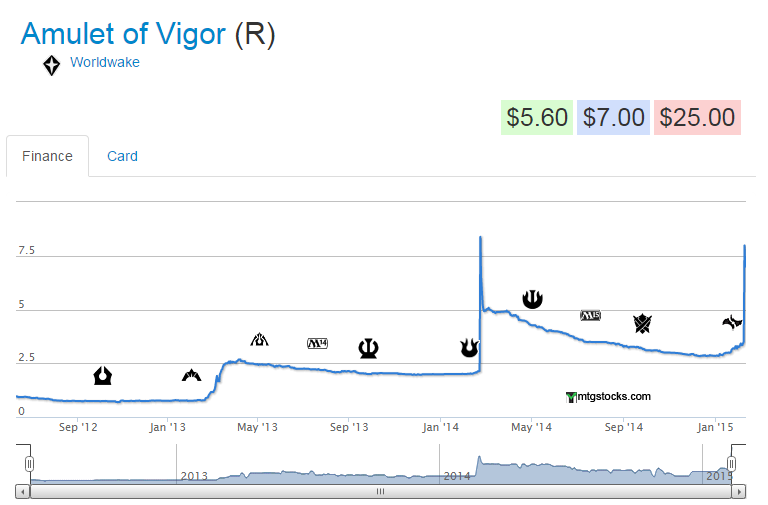
We know that the Bloom Titan deck showed up once in the top eight (and once more just outside of the top 16), and several of its pieces increased in price across the board. [card]Amulet of Vigor[/card], [card]Azusa, Lost but Seeking[/card], [card]Pact of Negation[/card], [card]Summoner’s Pact[/card], and [card]Summer Bloom[/card] all show up here as “winners” due to the fact that they are overall more expensive than in the weeks before the pro tour. However, does one single deck being in the top eight justify all of these crazy price spikes? The deck isn’t new, it’s been around for at least a couple of years. In fact, we can track the price of Amulet and see that this is the third time it’s done this.

Amuletprice

Although that picture says that the magic number is $7, you can be sure that it’ll creep back down to $5 relatively quickly, just like it did eleven months ago. The individuals who bought in at $4 or $5 will race to the bottom of TCGplayer’s low price, trying to break even or avoid getting stuck holding the burning ashes that used to be their imaginary “profits.”

Unfortunately, I have a theory that a growing number of Magic players see the pro tour more as an opportunity to make money while sitting at home in front of their computer, rather than as an event to watch for entertainment. On Friday and Saturday, they have their eyes on Twitter and their fingers on the mouse, ready to buy multiple copies of whatever card someone says “could be doing well.” I have a very hard time believing that all of the copies of Azusa, Amulet, and Pact of Negation that were purchased over the weekend will be sleeved up and jammed at events. The Amulet deck is touted as extremely hard to play—even Luis Scott-Vargas had some trouble with the deck’s lines during the event. Some of the hype has worn off already: Azusa hit an imaginary high of $50 during the end of the weekend, but has since crept down to $38, and will probably settle close to $35.

azusaprice

On the other hand, some of these spikes have nothing to do with the pro tour whatsoever. [card]Leonin Shikari[/card] happened to have fewer then 20 copies available on TCGplayer for $5 each, so it ended up being pretty easy for an individual to buy all of them and then relist them for as high as $12 each. Does that mean that a single person has the ability to change the price of this card to $12 permanently? Of course not. If you had checked eBay the day of the price spike, you would have seen that there were still multiple copies of the card available for its pre-spike price. Strikezone, Channelfireball, SCG, and hundreds of other stores exist for you to check. In fact, Magic Card Market (one of the largest European open marketplaces for MTG cards) still appears copies available for the pre-spike price, to this day.

The true demand for Leonin Shikari didn’t randomly increase drastically, it just happened to have a low supply on TCGplayer. That’s it. While several years ago it wasn’t believed that a single person could manipulate the market like this, this example is one of the most recent that shows that it’s quite possible, as long as you have enough people willing to buy into the artificial hype you’ve created for the card. If people think that Shikari is spiking because of Tiny Leaders, or because of some weird combo deck in Modern, you can maintain a higher post-spike price, and trickle out your copies for a higher profit.

The Truth about Buyouts

If you’re a normal player and not primarily a financier, I can feel your hatred from here. Financiers are evil, right? They buy out innocent Magic cards, and force the casual players to pay more for them in order to make a profit for themselves. Magic financiers are the [card]Tundra Wolves[/card] of the [card]Steel Wall[/card] [card]Street Sweeper[/card], and must be stopped.

As a matter of fact, not all of us are the worst human beings on the planet. While some people like this guy exist…

this guy..

…they’re rare and far between. The majority of Magic financiers just want to either use the game to finance playing it themselves, or simply buy and sell cards without trying to manipulate the market. Just as there are scumbag cheaters in Magic, there are scumbags in Magic finance, and we want to do our best to get rid of them, because they give the good ones a bad name. Please don’t buy out TCGplayer just because it’s the most commonly referred to site for pricing cards. And please don’t assume that every person who dabbles in Magic finance has the intention of buying out TCGplayer.

Before I go for the week, I want to give an example of a card that has the potential to be bought out (please don’t go buy it out after reading this article). [card]Doran, the Siege Tower[/card] saw a decent amount of play at the pro tour, and is very powerful and popular in the rapidly spreading Tiny Leaders format. He’s from a set that’s pretty old at this point, and hasn’t had a reprint on a mass scale as of yet (he has an FTV and Champs promo printing, but neither of those are exactly substitutes to the cheaper Lorwyn copies).

There are fewer than 40 copies on TCGplayer and only 20 sellers, so it’s possible for someone with a fat enough wallet to decide that the artificial price sticker on Doran needs to go up, to justify after the fact that he saw some play at the pro tour. If you’re interested in picking up any number of copies to play with, I recommend that you get into them now, so you don’t have to bite the bullet at a future date. While buyouts of a particular store are real, they very rarely maintain their peak price, and will be available for cheaper in the days afterwards.

Reddit Finance

There’s a high likelihood that  you’re reading this article because I posted it on the /r/mtgfinance subreddit, or the /r/mtgmarketwatch subreddit, like I do every week. Recently, there’s been a bit of a controversy as to whether or not these subreddits have the power to tamper with the prices of cards when “spike” or “buyout” threads are posted. While these types of threads were banned from /r/mtgfinance due to an obvious ability to manipulate the prices of stupid random cards like [card]Fist of Suns[/card], the marketwatch subreddit allows them, as long as there is explanation as to a possible reason that the card is being bought out.

Now, there’s a discussion being raised that the lack of aggressive moderating on /r/marketwatch is causing the same trend that happened with Fist of Suns. We recently saw [card]Ghostway[/card] spike to over $15 due to hype of a brand new Modern deck, but the deck didn’t even end up performing very well. However, the buyout happened, and Ghostway will likely be stuck somewhere between its pre- and post-spike price. This ends up hurting the EDH and casual players who just wanted to flicker a bunch of allies or soul sisters.

However, I want to assure everyone that no one person has the ability to completely manipulate the market. Financiers can’t make bad cards spike with sheer dollars and willpower. If we could, there’s a high probability that copies of [card]Seance[/card] would be $5 each right now, and I would be buying a much nicer car. As you’ll often see me mention on Reddit or in my other articles, I tend to avoid speculating, only occasionally buying a couple sets of a card for fun.

Full disclosure: my pro tour speculation purchases are listed below.

8x [card]Hive Mind[/card]

That’s it. I didn’t try and buy out Azusa, or Ghostway, or Leonin Shikari. It’s not worth it to me, because almost everything I buy is at buylist prices anyway. There’s a lot more to be made in having a consistent cash flow of collections, singles, and value trading. I’d much rather have my name be clear of this buyout brigade nonsense, as well as my fellow writers at BSB. I can only try and reassure you that all financiers aren’t evil, and that there are good people out there who just want to try and help you play the game we all love and care about.

Final (Positive) Note

I can’t believe that this is my 50th article here on Brainstorm Brewery. I want to thank everyone on the site that allowed me this opportunity, and I want to thank all of my readers for sticking with me (through the good articles and the awful ones). I’m still a bit young and trying to get better at writing every week, so every bit of feedback and all your suggestions help me a lot. Thanks again!

Casually Infinite – About the MTGO Closed Beta with Chris Kiritz, MTGO Business Manager

In early December, Wizards of the Coast posted that it will be moving forward with leagues on Magic Online and began testing them during December in the closed beta environment. Along with this, the company posted the link to sign up for the closed beta. If you haven’t applied for it yet, you should do so here. Personally, I have been greatly enjoying a month of free league play. I have found the closed beta to be a wonderful opportunity and something that everyone seeking to play casually infinite. In the past, the closed beta has offered an advance look at cards, free drafts, and one of the most advanced formats available, the BET limited.

My Experience in Closed Beta

While I can’t predict the future of the closed beta, I can explain some of the things WOTC has offered in the past, offers I can only assume are likely to continue. I contacted WOTC and had the chance to speak to Chris Kiritz, the Magic Online Business Manager, regarding the closed beta and the future of beta play. Here’s what he says about the chances of people who apply for the beta:

“Many players who take the effort to apply will get in, but we take steps to prevent disruptive players where appropriate. In addition, we trust our players to follow some conduct and confidentiality guidelines, and will take actions to remove players who cannot do so. Players who are interested can find the requirements and the application here.”

Because stability improvements are generally tested first on the closed beta, the stability changes seem to run a few weeks ahead of the main client. My experience on the beta has generally provided me with a more stable game than the release version. This may seem like a small issue, but with my aging computer, it is a pretty big deal. I generally feel that I’m more able to play queues to completion without disconnects than I am on the live servers. According to Kiritz, this is a pretty important area of focus:

“We’re continually looking for ways to improve how well Magic Online performs in each area, both in responsiveness and stability, and have some major adjustments in flight now to help address these issues. Our primary goal is to ensure that players can successfully play games of Magic whenever they want without crashing or experiencing major game-impacting issues.

For the most part, we’ve been making steady progress, though maybe not as quickly as we all would like. For stability, we recently released an update that fixed many of the deck submission errors that players had been encountering, which has been a big player frustration.”

Advantages in Closed Beta

Users of the closed beta often get the first look at digital cards, generally a few weeks before they release on MTGO. While cards are just coming out in paper, your closed beta account is likely to be filled up with a playset of the newest sets. Interestingly enough, playing with these cards is exactly what Wizards wants you to do. Got a random deck idea in Standard? Throw it together and give it a swing. There have even been times when playsets of Vintage cards have been made available in my beta account, allowing me to make some of those awesome crazy decks I remember playing with back in 1995. While Standard isn’t normally my thing, it can be fun to see what Black-White Warriors looks like for a couple games without having to pick up four [card]Bloodsoaked Champion[/card]s over release weekend.

My big thing is Limited, and it has come in two forms in the beta client. One of the things that show up occasionally in the closed beta are new set draft queues. These have generally shown up around paper release weekend for past sets. Beta testing is a quick way for WOTC to test numerous interactions of the new cards in the most common environment they’ll be played in: Limited. There have also been a few times that older formats have become available to play in both Sealed and Draft formats. I feel like I even remember drafting Seventh Edition at one point. When these drafts are available, you’ll see the numbers spike and queues firing much more quickly. Kiritz explained the things likely to come online to me:

“Since closed beta is used most often for testing card sets, you can expect to see a lot of beta drafts and Sealed Deck. When we are looking for targeted testing on a specific feature not specifically related to card sets, we’ll try and choose formats that we think either emphasizes what we are testing or are fun for our closed beta players. We’ve done everything from Core Set Constructed to Holiday Cube over the years, so you never know what you are going to get. The beta email that we send out prior to the start of every major closed beta will let players know what to expect.

Currently our focus is joining and playing through leagues. Next, it will be the Fate Reforged card set. Testing this focal area is important, but where the closed beta players can really provide benefit is with “halo” testing, essentially testing and experimenting with the systems that are related to the primary test area.”

When there isn’t any specific set that WOTC feels needs to be tested, there are always beta drafts available. I’ve found beta drafts to be among the most skill-testing of any format. The beta pool is usually available in either sealed heads up play or a four-man draft pod.

Cards in the beta draft boosters are about half cards from the most recent release or two, and half cards from the entire history of Magic. This is sort of like playing a chaos draft in which half the packs are Khans of Tarkir and the other half consist of one of every other pack ever made, which are then shuffled together and dealt back out. I’ve seen some truly crazy combos, I’ve seen some disgusting cards, I’ve passed tournament-playable Legacy cards in my color because I couldn’t figure out how they were good in my deck. It really teaches you everything about the new format because you know there’s a good chance of combat tricks from the most recent set, but it makes you think about how these cards interact with cards long-forgotten. These drafts include a very unique combination of cards. According to Chris, beta drafts are made up of the following:

“We essentially split each pack evenly between the newest card set and all of the cards ever printed in Magic Online. We then tweak the pack to have additional mana fixing, such as the vivid lands. If we know there is a combination of cards that could cause problems, we have the ability to adjust how frequently cards appear, but for the most part, our players are really good at uncovering obscure card interactions that could be problematic.”

Once You’re In

Once you’re in the beta, there is usually a specific area of focus that WOTC is looking for testing in. While there may be significant availability of cards in your beta account, most of players will be working in the focus area. But the most important thing you can do when you’re in is play. Play whatever there is to play. Contact your friends and play with them. A significant number of problems are caught by playtesters who were playing a fairly normal game of Magic until something strange happened. In my experience, this is fairly rare. It doesn’t feel like you’re alpha testing a game—the builds you’re on are really stable. To actively help out, Kiritz suggests doing the following:

“If a closed beta player encounters a bug, a crash, or even a design element that doesn’t seem correct and is not on the known issues list, the most important thing they can do is report it using the bug reporting system (we have a selection for Beta Bug Report). While an issue might appear so obviously broken we must already know about it, our players continually surprise us with all the different ways they use Magic Online, and reporting issues ensures that someone from our QA team will see them. In addition, how often players report an issue can help inform how often it is happening and increase the priority of getting it fixed.

We get metrics on when the client crashes automatically, so just getting a lot of play on the closed beta is useful for understanding how stable any given build is and where in the code an issue may be, but entering details into the crash dialog and submitting a bug report can help us narrow down what caused a crash by providing context we may not have otherwise.”

The final point here is that you shouldn’t just use the beta to fine tune your standard build. While Standard cards are available, what helps the system most is playing games with as many interactions as possible. Also be aware that at any point your account may get wiped, along with your beta decks. For me, this just means more time to build a new deck or jump into a BET draft. But it is important that you’re helping out the game by doing more than just trying to kill your opponent as quickly as possible. The philosophy for the beta is this:

“Essentially, we want players to do many of the things they might do when playing Magic Online on the regular production environment, but with a critical eye towards where something may go wrong. This philosophy also includes placing less emphasis on winning or finishing matches quickly and more on watching the outcomes of actions. A simplified example is the end of combat. While conceding when your opponent attacks for lethal damage and you have no blockers should be tested, as it is a common scenario, occasionally you should also let combat finish and damage resolve to ensure the game finishes correctly.”

Sweeten the Deal

Once or twice, the closed beta participants have been rewarded in their live MTGO accounts for participating in specific events. These rewards have been given out for playing a certain number of Draft and Standard events, making a number of trades, or testing whatever else needs to be tested. Rewards are usually MTGO cards in your account in thanks for helping WOTC out. Personally, I can’t think of anything more awesome that playing Magic for free and being rewarded with more Magic cards. The closed beta offers both free play and occasional real-world rewards. If you haven’t signed up, you should.

If you’d like to read the article on leagues by Chris Kiritz on the MTG website you can find it here.

To sign up for the MTGO Closed Beta click here.

Thanks for reading!

Weekend Magic: 2/6-2/8 (PT Fate Reforged Edition)

Hey, guys, I’ve got some sweet Modern action to cover this week based on the results that have come in from Pro Tour Fate Reforged. Let’s take a look at the standings, what cards were featured in some of the best-performing decks, and if there are any undervalued pieces left after all the spikes and card buy outs that happened in real time as players saw cards being used on screen.

Pro Tour Fate Reforged (Washington, DC)

Format – Modern

Decklists

Top 8 By the Numbers

Mythic Rare (25) Rare (238) Uncommon (90)
8x [card]Tarmogoyf[/card] 16x [card]Scalding Tarn[/card] 12x [card]Lingering Souls[/card]
7x [card]Liliana of the Veil[/card] 12x [card]Verdant Catacombs[/card] 9x [card]Path to Exile[/card]
4x [card]Voice of Resurgence[/card] 12x [card]Siege Rhino[/card] 8x [card]Monastery Swiftspear[/card]
4x [card]Primeval Titan[/card] 9x [card]Windswept Heath[/card] 8x [card]Deceiver Exarch[/card]
1x [card]Vesuva[/card] 9x [card]Thoughtseize[/card] 8x [card]Boros Charm[/card]
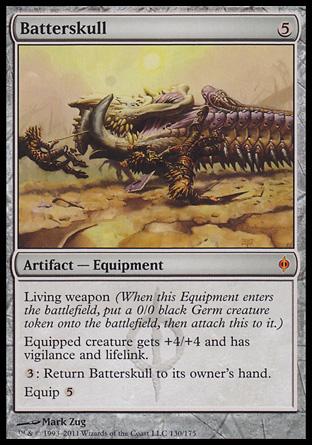
1x [card]Batterskull[/card] 8x [card]Wooded Foothills[/card] 7x [card]Remand[/card]
8x [card]Splinter Twin[/card] 6x [card]Skullcrack[/card]
8x [card]Goblin Guide[/card] 6x [card]Inquisition of Kozilek[/card]
8x [card]Eidolon of the Great Revel[/card] 5x [card]Lightning Helix[/card]
7x [card]Snapcaster Mage[/card] 4x [card]Summer Bloom[/card]
7x [card]Noble Hierarch[/card] 4x [card]Spell Snare[/card]
7x [card]Marsh Flats[/card] 3x [card]Tolaria West[/card]
7x [card]Abrupt Decay[/card] 3x [card]Kitchen Finks[/card]
6x [card]Steam Vents[/card] 3x [card]Electrolyze[/card]
6x [card]Sacred Foundry[/card] 2x [card]Dismember[/card]
6x [card]Misty Rainforest[/card] 1x [card]Tectonic Edge[/card]
5x [card]Overgrown Tomb[/card] 1x [card]Sunhome, Fortress of the Legion[/card]
5x [card]Gavony Township[/card]
5x [card]Cryptic Command[/card]
5x [card]Bloodstained Mire[/card]
5x [card]Arid Mesa[/card]
4x [card]Tasigur, the Golden Fang[/card]
4x [card]Summoner’s Pact[/card]
4x [card]Sulfur Falls[/card]
4x [card]Scavenging Ooze[/card]
4x [card]Gemstone Mine[/card]
4x [card]Birds of Paradise[/card]
4x [card]Amulet of Vigor[/card]
3x [card]Wilt-Leaf Liege[/card]
3x [card]Twilight Mire[/card]
3x [card]Temple Garden[/card]
3x [card]Stomping Ground[/card]
3x [card]Razorverge Thicket[/card]
3x [card]Loxodon Smiter[/card]
3x [card]Hive Mind[/card]
3x [card]Grim Lavamancer[/card]
3x [card]Godless Shrine[/card]
2x [card]Urborg, Tomb of Yawgmoth[/card]
2x [card]Stirring Wildwood[/card]
2x [card]Pact of Negation[/card]
2x [card]Flooded Strand[/card]
2x [card]Cavern of Souls[/card]
2x [card]Blood Moon[/card]
2x [card]Azusa, Lost but Seeking[/card]
1x [card]Vault of the Archangel[/card]
1x [card]Tendo Ice Bridge[/card]
1x [card]Slayers’ Stronghold[/card]
1x [card]Slaughter Pact[/card]
1x [card]Mana Confluence[/card]
1x [card]Maelstrom Pulse[/card]
1x [card]Desolate Lighthouse[/card]
1x [card]Breeding Pool[/card]


Common (89) Sideboard (120)
16x [card]Lightning Bolt[/card] 7x [card]Destructive Revelry[/card]
12x [card]Serum Visions[/card] 6x [card]Stony Silence[/card]
8x [card]Rift Bolt[/card] 6x [card]Molten Rain[/card]
8x [card]Lava Spike[/card] 6x [card]Leyline of Sanctity[/card]
7x [card]Searing Blaze[/card] 6x [card]Kor Firewalker[/card]
4x [card]Treetop Village[/card] 6x [card]Fulminator Mage[/card]
4x [card]Simic Growth Chamber[/card] 4x [card]Batterskull[/card]
4x [card]Shard Volley[/card] 4x [card]Ancient Grudge[/card]
4x [card]Pestermite[/card] 3x [card]Zealous Persecution[/card]
4x [card]Ancient Stirrings[/card] 3x [card]Smash to Smithereens[/card]
3x [card]Gruul Turf[/card] 3x [card]Path to Exile[/card]
2x [card]Sleight of Hand[/card] 3x [card]Dispel[/card]
2x [card]Qasali Pridemage[/card] 3x [card]Blood Moon[/card]
2x [card]Mana Leak[/card] 3x [card]Aven Mindcensor[/card]
1x [card]Simian Spirit Guide[/card] 3x [card]Anger of the Gods[/card]
1x [card]Selesnya Sanctuary[/card] 2x [card]Wurmcoil Engine[/card]
1x [card]Radiant Fountain[/card] 2x [card]Thragtusk[/card]
1x [card]Peek[/card] 2x [card]Thoughtseize[/card]
1x [card]Khalni Garden[/card] 2x [card]Sword of War and Peace[/card]
1x [card]Golgari Rot Farm[/card] 2x [card]Spellskite[/card]
1x [card]Flame Slash[/card] 2x [card]Skullcrack[/card]
1x [card]Dispel[/card] 2x [card]Pyroclasm[/card]
1x [card]Boros Garrison[/card] 2x [card]Nature’s Claim[/card]
2x [card]Keranos, God of Storms[/card]
2x [card]Fracturing Gust[/card]
2x [card]Firespout[/card]
2x [card]Deflecting Palm[/card]
2x [card]Damnation[/card]
2x [card]Chalice of the Void[/card]
1x [card]Vendilion Clique[/card]
1x [card]Vedalken Shackles[/card]
1x [card]Timely Reinforcements[/card]
1x [card]Threads of Disloyalty[/card]
1x [card]Swan Song[/card]
1x [card]Sorin, Solemn Visitor[/card]
1x [card]Slaughter Pact[/card]
1x [card]Sigarda, Host of Herons[/card]
1x [card]Shatterstorm[/card]
1x [card]Searing Blaze[/card]
1x [card]Seal of Primordium[/card]
1x [card]Scavenging Ooze[/card]
1x [card]Rule of Law[/card]
1x [card]Relic of Progenitus[/card]
1x [card]Negate[/card]
1x [card]Liliana of the Veil[/card]
1x [card]Lightning Helix[/card]
1x [card]Jace, Architect of Thought[/card]
1x [card]Hornet Queen[/card]
1x [card]Ghost Quarter[/card]
1x [card]Flame Slash[/card]
1x [card]Feed the Clan[/card]
1x [card]Engineered Explosives[/card]
1x [card]Creeping Corrosion[/card]
1x [card]Choke[/card]
1x [card]Ajani, Mentor of Heroes[/card]

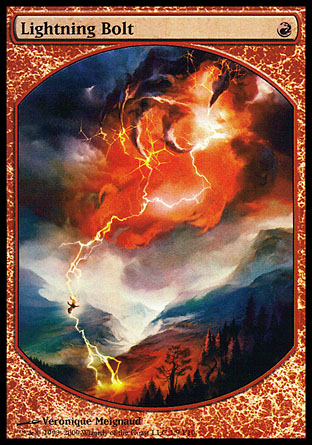
mprlightningbolt

From the data, we see that:

  • The largest number of main deck cards from the Top 8 were:
    • Sixteen copies each – [card]Scalding Tarn[/card] and [card]Lightning Bolt[/card]
    • Twelve copies each – [card]Verdant Catacombs[/card], [card]Lingering Souls[/card], [card]Siege Rhino[/card], [card]Serum Visions[/card]
    • Nine copies each – [card]Windswept Heath[/card], [card]Thoughtseize[/card], [card]Path to Exile[/card]
    • Eight copies each – [card]Tarmogoyf[/card], [card]Wooded Foothills[/card], [card]Splinter Twin[/card], [card]Goblin Guide[/card], [card]Eidolon of the Great Revel[/card], [card]Monastery Swiftspear[/card], [card]Deceiver Exarch[/card], [card]Boros Charm[/card], [card]Rift Bolt[/card], [card]Lava Spike[/card]
    • Seven copies each – [card]Liliana of the Veil[/card], [card]Snapcaster Mage[/card], [card]Noble Hierarch[/card], [card]Marsh Flats[/card], [card]Abrupt Decay[/card], [card]Remand[/card], [card]Searing Blaze[/card]
  • The largest number of sideboard cards from the Top 8 were:
    • Seven copies – [card]Destructive Revelry[/card]
    • Six copies each – [card]Stony Silence[/card], [card]Molten Rain[/card], [card]Leyline of Sanctity[/card], [card]Kor Firewalker[/card], [card]Fulminator Mage[/card]
    • Four copies each – [card]Batterskull[/card], [card]Ancient Grudge[/card]

The question here becomes: where is the value? Plenty of cards are already expensive and others are poised for a price drop once Modern Masters 2 rolls around.

In my humble opinion, value lies in foils more than non-foils at this point. For example, foil commons or uncommons that aren’t completely overpriced should be good good pickups. Good examples here include [card]Lingering Souls[/card], [card]Path to Exile[/card], [card]Boros Charm[/card], and [card]Searing Blaze[/card] (the Player Rewards textless version is also a good pickup at $2.50). Other foils that are pricier but are still undervalued are [card]Eidolon of the Great Revel[/card], foil Khans fetchlands, and even foil [card]Abrupt Decay[/card]s, which still have a chance of growing since they will not be present in MM2.

eidolon

Looking at the sideboards, we see that [card]Destructive Revelry[/card] was the most-played card but only saw action in Burn sideboards. Regardless, foils at $1.50 or less seem like a great pickup to me. [card]Destructive Revelry[/card] also sees Legacy play and will derive foil demand from that format as well. [card]Kor Firewalker[/card] is also a nice target, due to the popularity of Burn in the format. I like foils and non-foils if you can get them on the cheap.

Which cards didn’t spike from the weekend? Cards in this category include [card]Primeval Titan[/card], [card]Splinter Twin[/card], [card]Goblin Guide[/card], and [card]Summoner’s Pact[/card]. Land cards also didn’t really see an uptick in price, even though lands such as [card]Stirring Wildwood[/card], [card]Razorverge Thicket[/card], [card]Gemstone Mine[/card], and [card]Gavony Township[/card] all saw play, their prices didn’t increase from the weekend. [card]Tolaria West[/card] has actually been trending downward in price recently from its highs of $7 retail at one point.

Potentially undervalued cards that saw some play in the Top 8, and probably more throughout the other decks at the Pro Tour, include [card]Scavenging Ooze[/card], [card]Skullcrack[/card], [card]Inquisition of Kozilek[/card], [card]Lightning Helix[/card], [card]Kitchen Finks[/card], [card]Dismember[/card], [card]Grim Lavamancer[/card], [card]Loxodon Smiter[/card], [card]Birds of Paradise[/card], and [card]Voice of Resurgence[/card]. All of these cards are great in the new format and should be watched for price movements and any potential future reprints.

smiter

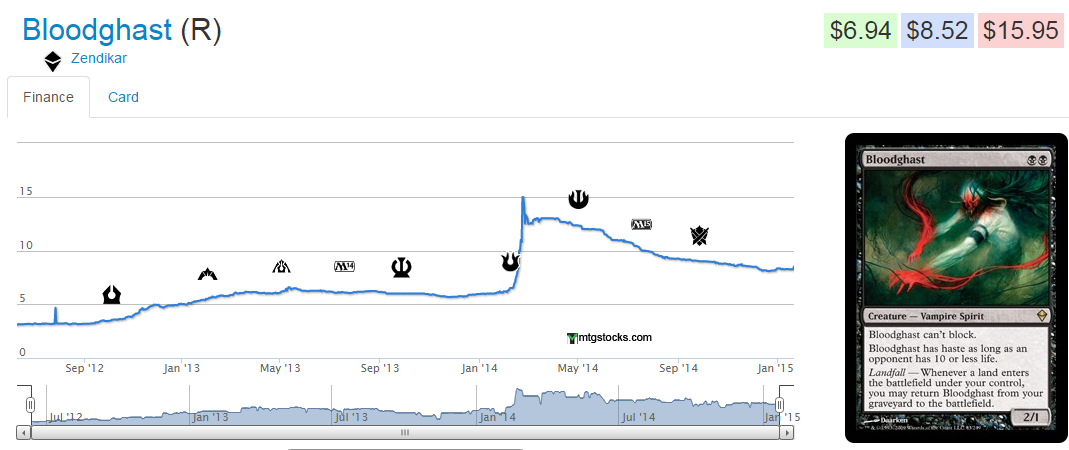
What cards didn’t see play this weekend that were really hyped up? [card]Geist of Saint Traft[/card] has to be on the top of list, along with [card]Restoration Angel[/card], [card]Vengevine[/card], [card]Bloodghast[/card], [card]Grove of the Burnwillows[/card], [card]Chord of Calling[/card], [card]Golgari Grave-Troll[/card], and [card]Ghostway[/card] (which was bought out for some reason, I guess as a [card]Birthing Pod[/card] replacement maybe?). Not that you should liquidate any of these cards right away, but they aren’t increasing in price in the near future. Some of them could even see a significant downward trend in price if their play continues to be suppressed.

In Summary

That’s it for Pro Tour action. We’ll have to keep our ears to the ground to see if more innovations in Modern are discovered. Some decks that didn’t make the Top 8 but were featured in camera matches include Infect, Merfolk, Living End, Affinity, and B/W Tokens. Abzan was about one third of the field even though [card]Birthing Pod[/card] is banned, which speaks volumes. The plethora of decks featured at the Pro Tour shows that Modern is healthy and diverse format despite all the shakeups from bannings and unbannings. I look forward to see where Modern is going to go next.

Episode 74 – Everything is Zen

Pro Tour Fate Reforged just happened…that’s a lot of Siege Rhinos. We talk the Pro Tour, our weeks, and the announcement of the new core set, Magic Origins. Obviously, this means Black Lotus will be reprinted. We examine the card Metal Worker, and 5.4% of this podcast is dedicated to ’90s post-grunge music. Thank you for your honor.

Cameron McCoy – @Cameron_McCoy

Curtis Nower – @CurtisNow

Dustin Gore – @mtgdustin

Our show – @SpikeFeedMTG

Music by Micah Jones

Pitt Imps Podcast #105 Very Limited

This week on the cast, we got to go over two Limited GPs. These are the first ones since Fate Reforged was released and there is plenty that we can take from them. Wizards announced a new policy that effects more than likely nobody you know. If you do know people that it effects, the number is  probably very small. Then me and Will go ahead and try to predict the future of Magic. These predictions are all bound to be wrong, but it was fun nonetheless.

Host Angelo  Twitter @ganksuou

Co-Host Will  Facebook

Help the Imps

Show Email [email protected]

The Zoo is Dead, Long Live The Zoo!

After falling short of top eight at a Modern IQ/PPTQ that I played in recently, I was itching to play some more Magic. Luckily, SCG Philly was right around the corner. I was still up in the air about what I should play for the Sunday Premier IQs: either Constellation in Standard or some form of Zoo in Modern. I stuck to my guns and my best deck and played Zoo.

[Deck Title=Slightly Bigger Zoo]
[creatures]
4x Wild Nacatl
4x Noble Hierarch
4x Tarmogoyf
4x Scavenging Ooze
4x Qasali Pridemage
4x Knight of the Reliquary
2x Thrun, The last Troll
[/creatures]
[spells]
4x Lightning Bolt
4x Path to Exile
2x Ajani Vengeant
1x Garruk Wildspeaker
1x Gideon Jura
[/spells]
[lands]
4x Wooded Foothills
4x Windswept Heath
4x Arid Mesa
2x Stomping Ground
1x Temple Garden
1x Sacred Foundry
2x Forest
2x Plains
1x Horizon Canopy
1x Kessig Wolf Run
[/lands]
[Sideboard]
3x Blood Moon
3x Ancient Grudge
2x Choke
2x Engineered Explosives
2x Spellskite
2x Batterskull
1x Back to Nature
[/sideboard]
[/deck]

So as you can see, it is my normal Zoo list, but with the key change of cutting [card]Lightning Helix[/card] for the two planeswalkers, [card]Gideon Jura[/card] and [Card]Garruk Wildspeaker[/card]. I ended up going 5-2-1 on the day, good for a top 32 finish which equated to two open points and $50 cash money. The decks I played against were as follows

Round 1: Affinity, W

Round 2: Junk Pod, W

Round 3: RG Aggro, L

Round 4: Delver, L

Round 5: Junk, W

Round 6: Junk, T

Round 7: Affinity, W

Round 8: Affinity, W

I won every post sideboard game against Affinity and I can safely say that was due 100 percent to having three copies of [card]Ancient Grudge[/card] to bring in.

My two losses on the day came at the beginning and the middle of a grueling headache. I feel like I punted at least a portion of each match, but I decided to stay in and try to grind it out. Luckily, after wandering the floor asking every single player and judge that I knew (easily over 30 people), I was able to acquire something [Ed. note: Drugs, most likely] to make my headache subside marginally.

[card]Garruk Wildspeaker[/card] and [card]Gideon Jura[/card] were overachievers on the day and I’m glad I made the decision to play them roughly 30 minutes before the start of the tournament.

Overall, it felt like a decent day, but I knew I needed to be doing something more powerful, so I set my eyes on [card]Birthing Pod[/card] because I owned most of the deck already. As of January 19, 2015, though, this became a terrible idea as Pod just got the banhammer.

On To The Next Idea

Naya Zoo is just not cutting it anymore. I need to go big and I need to hit hard. I took some inspiration from Craig Wescoe and his top-16 finish at GP Omaha and crafted the new Zoo, featuring our new lord and savior Dr. Siegeman Rhinoceros.

Siege-Rhino-Khans-of-Tarkir-Spoiler

My New List

[Deck Title=Tribal Zoo]
[creatures]
4x Wild Nacatl
4x Noble Hierarch
1x Birds of Paradise
4x Tarmogoyf
4x Knight of the Reliquary
4x Siege Rhino
[/creatures]
[Spells]
4x Lightning Bolt
4x Tribal Flames
3x Path to Exile
2x Abrupt Decay
2x Bant Charm
1x Garruk Wildspeaker
1x Gideon Jura
[/spells]
[Lands]
4x Verdant Catacombs
4x Windswept Heath
3x Flooded Strand
2x Bloodstained Mire
1x Stomping Ground
1x Temple Garden
1x Breeding Pool
1x Sacred Foundry
1x Godless Shrine
1x Watery Grave
1x Forest
1x Plains
1x Kessig Wolf Run
[/lands]
[Sideboard]
3x Ancient Grudge
3x Slaughter Games
2x Negate
2x Flashfreeze
2x Spellskite
2x Engineered Explosives
1x Batterskull
[/sideboard]
[/deck]

I have only just begun fleshing this deck out, but it feels immensely powerful and I am excited to see how the Modern metagame will adapt with the fall of Delver and Pod, and presumably the rise of BGx and Splinter Twin.

I will keep updating my progress in Modern and Standard and my quest to meet my obscene goals for 2015. Thank you all for reading, and until next time, do yourself a favor and just start casting Siege Rhino—assuming you aren’t already.

Privileged Perspective 13: Beginning to Look to the Future

Sometimes it is difficult to get the writing process started, and other times the words flow out as if someone else already did everything for me. There are weeks, like this one, where I have fragments of the piece I wish to assemble, but they are adrift of each other and devoid of interlocking context. For example, I know that I want to talk about my Modern experience from Saturday (it wasn’t great!), as well as touch briefly on a couple of things that have been on my mind over the course of the weekend. Perhaps the best course of action in a time like this is to compose a succinct, introspective introduction and then just get at the issues I want to discuss, continuity be damned.

Ugh, Modern

I am having a difficult time putting my finger on Modern. Unlike its older cousins Legacy and Vintage, Modern feels in some ways like Standard. There are a lot of decks that are focused on developing a board state and casting very strong-but-believable threats like [card]Siege Rhino[/card]. The decks that feel unfair are those like Tron and Affinity—the ones where sometimes their plan comes together so quickly that you instinctively backpedal into survival mode, which is an overwhelmingly losing proposition.

The only deck that feels truly oppressive to me, however, is Burn. It is not the best deck in the format, but it has enough critical redundancies that it is able to execute its plan at a very high consistency. The fact that fetches into shocks make up the bulk of the format’s foundation only makes that plan more viable. I have a lot of written and unpublished pages about burn (from a more comparative historical perspective) saved on this computer, so maybe we’ll have Burn week someday.

The deck I played in the event did not feel overall to be bad. Starting in round two, I mulliganed every opening hand except two for the rest of the tournament (I played three more rounds and left). Some of the mulls were the usual “right amount, wrong color” or “no curve” hands that you teach yourself are unfortunate but happen, and some were the “draw four copies of one card and three of another” hands where you seriously think you are doing something totally wrong. I don’t want to sound superstitious, but I was using a new, unproven brand of sleeves. Maybe they’re defective? Or evil? Maybe I would have won the tournament and the respect of my father if I had just used yellow Dragon Shields? When you comin’ home, Dad? I don’t know when, but we’ll have a good time then. You know we’ll have a good time then.

At the heart of my list is something very powerful, and it’s good enough that I have decided to continue to develop it. [card]Burning-Tree Emissary[/card], one of my all-time favorite cards, saw some success in Standard alongside [card]Lightning Mauler[/card]. Two mana for four damage across two bodies is an incredible rate, especially in a format where most removal is in the form of [card]Abrupt Decay[/card]. However, the deck has now added a third element to that synergy in [card]Jund Hackblade[/card]—worse in terms of overall damage output by one a turn, but better overall than any other creature on the curve. While it may ultimately be cut, [card]Rakdos Cackler[/card] was an excellent second source of turning on Hackblade, allowing for an impressive five damage on turn two. [card]Ghor-Clan Rampager[/card] was also a crucial element, and I will be gaming with four of them every time. The rest of the deck, however, will need an inspection. Here is the core of what I believe to be a workable archetype:

[Deck title=Gruul Shell]
[Creatures]
*4 Rakdos Cackler
*4 Burning-Tree Emissary
*4 Jund Hackblade
*4 Lightning Mauler
*4 Ghor-Clan Rampager
[/creatures]
[Spells]
*4 Lightning Bolt
[/Spells]
[/Deck]

If you have any thoughts, let me know. The existence of Rampager pulls us toward red/green, but Naya and Jund are both valid options.

Futures Sight

Author’s Disclaimer: We are not going to come close to finishing what I want to say here, so be prepared to have this topic spill over into future articles.

I feel like a lot of people are trying to make money by seeing the future. The problem with this, of course, is that it is impossible. I’m not sure if I have ever really expressed my thoughts on speculating or buy-outs, but I am typically against them. Now, that doesn’t mean that I don’t speculate at all, it just means that I have a very conservative approach to buying what are essentially card futures. When I do plan to move in on something, I consider the following.

“Where is it at now?” Many of the cards I move in on are, at the time of the buy, between bulk price and $3 (the typical cost of an in-print booster pack).

When you get a card at the floor price, you don’t have to wait for it to hit the ceiling to be able to get a return. It may mean leaving a percentage on the table, but that is just the tax you pay for not having to sell a card at its ceiling to make a gain. You are also tying up less of your Magic capital (assuming you have a limited amount to spend on Magic at any particular time, or have insulated your Magic spending in any other way). This gives you the ability to wait longer on a card, which is a check against doing something you will regret later. To guarantee getting in on the floor of newer cards, I advise waiting until about December or January for large fall sets, and one or two months post-release for small sets. Typically Game Day is the earliest for small sets.

BRIEF MISTAKE ASIDE: Remember Overextended? That was the proto-format that existed during the lead-up to Modern. Anyways, there was serious hype for a format to bridge the gap between Legacy and Standard that wasn’t Extended, but Wizards stayed pretty quiet on the situation until the announced creation of Modern. In the months before their announcement, Overextended (a Gavin Verhey joint) took off as a possibility, and savvy traders slowly started to move in on staples. It was during this point that I moved in on Ravnica shocklands (then hovering around $7 to $10, depending on colors and condition). I made a big move on them early, but WOTC’s continual silence on the format made me anxious—I had a lot of my eggs in this basket! At GP Providence, I was able to out them for just over cost to a smaller vendor. Not much later was the announcement of Modern, along with a huge spike on the lands. Yes, this story (which, gosh, I really ramble, don’t I?) could also be about staying disciplined to a buy, but it’s also about not tying up too much at once. I could have gotten involved in a lot of other options during that time that my money was essentially frozen in shocklands, but I was lucky to break just north of even.

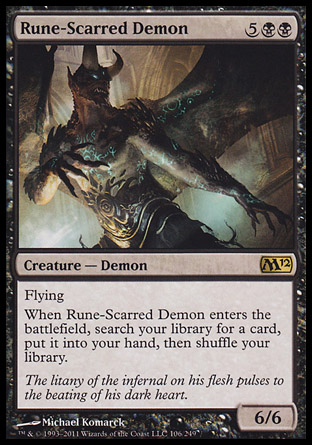
That $3 I mentioned earlier? That cap is more in place for foils, although I will move on things that are floating in the $3 range if I think they are relatively safe in the long term. The overall understanding of foil pricing is very off in my opinion, but my rule of thumb for a foil rare or mythic spec is this: “Is it less than the pack it comes in?” If it is, then it is most certainly a good candidate for a target. My most recent target was [card]Rune-Scarred Demon[/card], which I bought aggressively under $3, and was able to out for a little over $4 each at GPNJ. I didn’t realize going into it that the card was also a precon foil, which is likely what kept it from going to $10 in the years since printing.

runescarreddemon

But how do you know if you have a good target? Certainly playability is a factor, but that means different things to different people. A card may even be very good in a particular deck or style of deck, but be a bad speculation target.

BRIEF PREDICTIVE ASIDE: I don’t think there will be a good Dredge deck at the Pro Tour. A “true” Dredge list would need at least Dread Return to be considered viable, and that ain’t happening this week (or ever, hopefully). The lists that do exist are incredibly fragile and unable to operate outside of their single axis. I know Magus of the Bazaar has been popular lately, but I don’t suspect it will be hoisting a trophy come Sunday. If anything, we will see a Vengevine deck that gets extra press going into day two.

Playability is, as I mentioned, extremely subjective. Prior to the EDH boom, casual and multiplayer decks were often built around things like Underworld Dreams, a card that has always traded well to casual mages, but I would never deign to call “playable.” Rather, I prefer to look for “uniqueness,” or at least scarcity in terms of ability. [card]Caged Sun[/card], a card I have been well-stocked on for a while1, is one of only a handful of cards that rewards you for playing a mono-color deck, and fits firmly in the Commander philosophy. A card that I went deep in on last year was [card]Dictate of Karametra[/card]—it’s not unique, but it is certainly in rare company. So far there hasn’t been growth, but I got in so low on them, that I am neither rushed to out them, nor do I have much to lose.

BRIEF MUSING ASIDE: You know this game is getting huge, right? You and I may have decades of cards memorized, but newer and casual players still rely heavily on things like Gatherer and friends to learn about new cards for their decks. Until the Orzhov introduce SEO for Gatherer cards (which they will charge the other guilds for what they feel are very fair prices!), visibility is going to favor some cards much more than others. This is another big reason to target something that is at least semi-unique. It may buoy bottoms a little bit, but the upside is better.

We are gonna wrap for today, but when we come back next week, we are going to talk about losing, in all facets of Magic, and how to not do it as much.

VERY QUICK HITS FEATURING BONUS DECKLIST!

[Deck title=Jund Graveyardigans]
[Creatures]
*4 Elvish Mystic
*4 Satyr Wayfinder
*4 Sultai Emissary
*2 Tymaret, the Murder King
*4 Alesha, Who Smiles at Death
*1 Mogis’s Marauder
*4 Nighthowler
*4 Undergrowth Scavenger
[/Creatures]
[Spells]
*4 Commune With The Gods
*4 Grave Strength
*3 Tormenting Voice
[/Spells]
[Lands]
*4 Bloodstained Mire
*4 Forest
*4 Llanowar Wastes
*2 Mountain
*3 Swamp
*2 Urborg, Tomb of Yawgmoth
*3 Wooded Foothills
[/Lands]
[/Deck]

  • This deck is extremely raw. But who cares? I’m playing it at FNM tonight anyways! And in case you didn’t realize, Alesha can grab Undergrowth Scavenger and Nighthowler (their P/T are 0/0 in the graveyard, which is less than 2/X), and the Mogis’s Marauder number may go up since she can grab it too (it will be too late for haste, but the intimidate will still get in before blockers are declared).
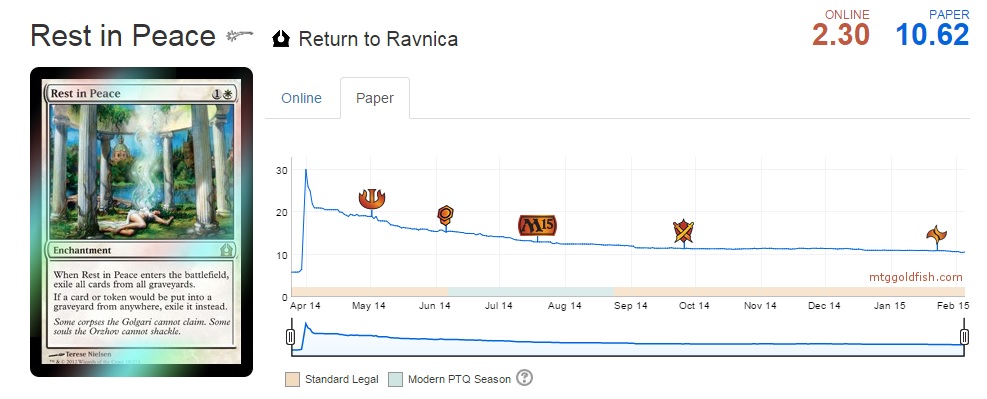
  • [card]Rest in Peace[/card] is probably one of my favorite long-term holds. They are very slowly creeping up, but I certainly think their floor as a multi-format staple is somewhere between $1 and $1.50. If player population continues to push print-run size, then this will start to trend upward at a higher clip.
  • Speaking of Rest in Peace, this is the best example (see below) I can give you for a card to trade for and stash away. A lot of people complain that finance people aren’t straightforward enough, but read my lips: “TRADE FOR THESE AND TUCK THEM AWAY”.

RiPFoil

  • I try my best every week, but next week’s topic has been rattling around since the beginning. Be here.

1Damn you, black Commander 2014 deck!

Friday Night Brainstorm: Dissecting FKK Drafting

FKK (Fate Reforged – Khans of Tarkir – Khans of Tarkir) drafting has been quite a joy for me the past couple of weeks. I’ve drafted the format quite a bit and learned a lot about it along the way. It isn’t an easy format, though, so I’ve dissected it down to share my understanding of it.

Fate Reforged Pack – Enemy Color Decision

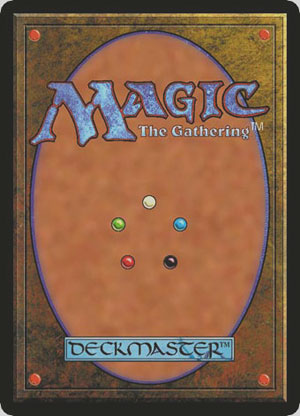
Going into pack one, you should have one thing on your mind: be in two enemy colors. For those of you who don’t know, enemy colors are any color symbols that are not adjacent on the back of a magic card,  meaning the enemy pairs are white/black, blue/red, black/green, red/white, and green/blue. So, why should you be in enemy colors?

The common dual-colored cards in Fate Reforged are all in enemy colors, and all have decently powerful effects (some more than others). The cards I’m referring to are [card]Grim Contest[/card], [card]Harsh Sustenance[/card], [card]War Flare[/card], [card]Ethereal Ambush[/card], and [card]Cunning Strike[/card].They’re powerful enough to be early picks in a draft, and can give you direction to what you want your final deck to look like. If I had to compare, they’re a lot like the common cycle of picks from Dragon’s Maze ([card]Beetleform Mage[/card], [card]Tithe Drinker[/card], [card]Viashino Firstblade[/card], [card]Zhur-Taa Druid[/card], and [card]Pilfered Plans[/card]). As with both cycles, there is a card that doesn’t quite measure up with the rest, the two being [card]Pilfered Plans[/card] and [card]Cunning Strike[/card], which can both be late picks without giving any signals.

I want to quickly discuss why you should take the two-colored cards very early and force a two-color combination. As Ben Stark has mentioned, unless pack two is more important than pack three, you should remain open to signals after your first pack. But the thing about FKK drafting that is so fascinating is that pack two is more important than pack three, and the reasons are much more subtle, since pack two and three are from the same set.

During pack one, your plan should revolve around setting up for your Khans of Tarkir packs. Odds are that you’re going to end up with a three-color deck. Khans of Tarkir provides quite a few powerful three-color cards that reward you for splashing. If you’re in enemy colors, there will be two clans you can choose from, which means you’re going to be open for signals to move in on either clan. For example, if you’re in black/green after your Fate Reforged pack, you’re open to move in on either Abzan or Sultai in your Khans packs, so if you open a bomb rare or get passed a late clan card, you now have an easy direction to go in for your splash color.

The Exceptions

As with most rules, there are exceptions to this. Wizards also printed a cycle of rare dragons that are all in allied colors. These dragons are all incredibly powerful (with the exception of [card]Atarka, World Render[/card]). If you pull one, I would say to try to pick up cards in the colors of your dragon, since they get better if you can cast them with your two main colors. If one of the colors is being cut, simply move in to the enemy color pair that matches the one clan of your dragon (for example, move to white if you get [card]Kolaghan, the Storm’s Fury[/card]) and try and force your way into it, so you can play your dragon and pick up clan cards in Khans. (For more, see Case 1 under Pack 2 below).

The second exception to this rule is blue/white. Blue/white is a naturally aggressive combination and [card]Jeskai Runemark[/card], which is eternally underrated, goes right into the deck. Since your aggressive decks are going to want to be two colors (in order to cast their spells on time), being in blue/white and not being open to move in on a clan in your Khans pack is a perfectly fine move to make, from what I’ve seen. Blue/white has its own plan in the Khans packs, since it really doesn’t want to play a clan. This follows along with Case 3 under Pack 2 (below), since there is a chance you’ll splash, but you have a large incentive to remain two colors (aggressively casting your spells on time).

Pack 2 – The Signal Pack

As I talked about in my discussion of the Fate Reforged pack, you should most likely be in two enemy colors going into your first Khans of Tarkir pack. A large portion of the time, this first Khans of Tarkir pack you open is what I call The Signal Pack, and this is where the paths begin to diverge in the decisions you make, based on what is in the pack you open and what you get passed. I’ll talk about this pack for a while, as this is actually the most important pack in the draft for most players, where everyone settles into a deck. If the draft is played correctly, pack three should have little to no competition over what you’re playing, since FKK drafting at its core encourages a healthy mix of players who force a deck and players that pick up signals.

When you open your pack, you will find one of three things:

  1. You opened a bomb and requires you to play an additional color
  2. You opened a bad rare or rare that would require two or more other colors
  3. You opened a great rare that won’t require you to play any other colors

Case 1: The Automatic Signal – Forcing a Clan

If you are in black/green moving into pack two and open an [card]Abzan Ascendancy[/card] (or a similarly powerful card), you’re going to be in this position. Your role at the table has now been defined. The people who end up in this direction are going to have a great reason (a bomb rare) to pursue a clan.

Opening this third color direction means you know which splash lands you want ([card]Sandsteppe Citadel[/card], [card]Scoured Barrens[/card], and [card]Blossoming Sands[/card] in this example), so you will likely be able to pick them up before others know what splash they’re looking for (and are picking up cards like [card]Longshot Squad[/card] in the meantime). This means you will be able to play more of your splash color and can be liberal with your picks of cards like [card]Armament Corps[/card], which are normally harder to play.

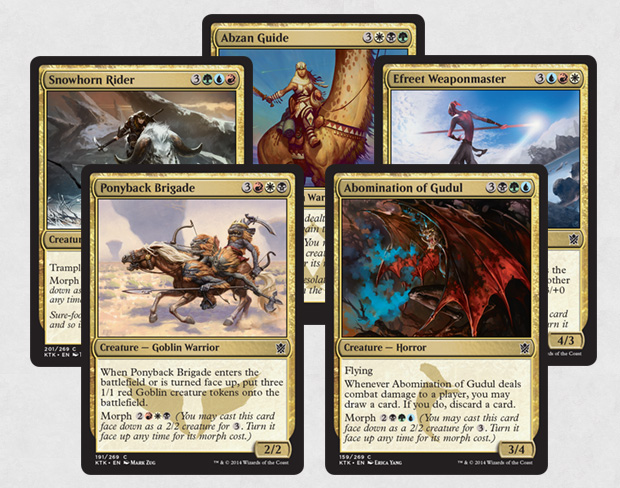
Without opening a bomb rare (or powerful uncommon in a really bad pack), I think forcing a clan is generally a bad option. You don’t know what you’re going to see halfway through the pack. If you take an [card]Abzan Guide[/card] pick one, for instance, and see a [card]Sultai Charm[/card] and two [card]Abomination of Gudul[/card]s, you’re going to regret not remaining open for the signals. You need a powerful reason to move into a third color straight off the bat in pack two, but the people who do so should plan accordingly, and their presence is very important to people who want to get signals.

Case 2: The Common Case – Remaining Open

This is going to be the most common case, and the reason I call pack two The Signal Pack. Most people at the table (roughly four to seven of them) are going to be in this situation. The first thing you can do is recognize your role at the table. You’re going to remain open to signals that are being sent. Until then, you should take cards that are in your two primary colors over fixing that is geared towards one clan (for instance, if you’re red/white, take a [card]Hordeling Outburst[/card] over a [card]Mystic Monastery[/card] or an [card]Ainok Bond-Kin[/card] over a [card]Bloodfell Caves[/card]). One of the reasons you picked enemy colors in your Fate Reforged pack was to remain open to two clans, so taking fixing for one clan without having a reason to play that fixing isn’t where you want to be.

One of two things will then happen. Either the guy to your left decided to play four colors and is cutting any clan options you have, or you will see some clan cards come up. Odds are in the favor of the latter, but you’re fine in either case.

If the guy passing to you is in both of your clan options, he’ll be picking up a lot of multicolored cards and lands. This means you can just shift very easily into a two-color deck, since a lot of powerful one-color cards will be making it through him. In fact, this situation may be better since it will result in almost no competition in pack three, since most of your colors got cut in pack two.

But, in the more common case, you will see something like a [card]Bear’s Companion[/card] or a [card]Ponyback Brigade[/card] at some point in the pack. This will clue you in to your splash direction. It takes practice to tell just when to move in on a clan, so it won’t always be obvious. The general rule is if the power level of a card in your colors is about the same or a little worse than a card that would move you into a third color, take the one in your colors. Most of the time, around picks five to eight, you’re going to look find a card from the common morph cycle, the rest of the pack won’t have anything good for you, and that will inform your splash direction.

The Common Morph Cycle

Since you will have a little more than a pack to pick up fixing, and you don’t want to prioritize it over powerful on-color cards for your first two colors, you generally won’t have more than two to four lands. This means your deck will be heavily in two colors, only splashing a clan for a couple powerful effects or morph cards (which are naturally easy to splash). You ideally won’t have to play any basic lands for your splash color, so try to stay geared towards your primary colors unless there is a really good reason to dip into a third color. If fixing is rampant and powerful clan cards are everywhere, you can go heavier on your splash than normal, so remain open to land signals.

Case 3: Well, That’s Lucky – Remaining Open with Incentive

This is basically case two with a couple of differences. Since the great rare you opened is already on color, you will want to try and remain in those two colors, to a degree, to enable you to cast your bomb faster and more often than you would with a heavy splash. Your deck is already packing more of a punch than most decks at the table, so you can wait until later to pick up on signals. Try and remain on-color for now (you’ll be able to cast your spells on time without sacrificing much of the raw power of a three-color card).

Since you can wait until late for signals, there is a higher chance those signals will hold true in future packs, since you’re picking up signals from what people closer to your right are sending as well. This is obviously the best case, but will be quite rare.

Pack 3: The Concluding Pack

All of your strategy for what deck you’re playing should have boiled down to packs one and two. This pack is primarily to provide a few extra cards to round out what you’re missing for the deck. Go into the pack knowing how many creatures you need (you want 14 to 15 total), how much removal you want (Ideally at least four ways to interact, largely interchangeable with combat tricks in aggressive decks), an idea of what your curve looks like (if you only have one two-drop, look to pick up a couple more), and how many lands you will need to have a consistent, well-rounded deck.

If you already have 18 or so good cards, you should also prioritize lands more highly, since you don’t need a lot from the third pack and achieving more consistency for the cards you do have is very important.

Just as a note, every time I have done this strategy, I have ended up with at least 16 playable cards going into pack three, and usually more like 18. This makes your reliance on and the importance of this pack pretty negligible, since picking up five to seven good cards from a 14-card pack won’t be hard to do. This is another reason why this pack is not as important as pack two, besides the reasons listed above.

I hope this primer on the FKK format was helpful. What do you think about this strategy? Have a different approach to the format? Let me know what you think in the comments.

Conjured Currency #49: Rent-a-Car(d)

Throughout the first few weeks of a set’s release, there is one single question that every single well-known financier is asked to no end. While the exact words might vary each time, and the specific card in question will differ, there’s few general models to this tricky question:

Goyfsforstuff

Ifyouhad100

Zencase

There are common pieces of information in each of these questions that get excluded, but it’s not the fault of the players asking. In each of these questions, there’s a general theme of asking me, “What would you do?”

Unfortunately, that’s a difficult question to answer. It would be impossible for them to tell me everything for me to assess their exact situation and make a decision. I would have to know their exact degree of wanting the card (or the money they could obtain by selling the card), how often they plan to play with the card in the immediate and long-term future, their financial situation, and how much utility they got when playing (or holding onto) the cards.

This week, I’m going to go over a few examples of how everyone’s situation is different, and focus a bit more on the difference between “needs” and “wants.”

Renting a Card

Although it would be an interesting concept, there is no business that allows a player to rent Magic cards for weeks or months at a time with a payment plan model. There are multiple issues with condition, risk of the card being stolen, and countless other problems. Not even SCG could keep track of that type of system. However, if you’re a Standard player looking to get into the new set, you can theoretically rent the cards you need for the first few weeks of the new season. Let’s break this down a bit.

Ryan intends on playing four copies of [card]Soulfire Grand Master[/card] in Standard Jeskai Burn at his weekly FNM every single week. He already had the rest of the deck built, and he’s just adding Grandmaster to his list to update it. In addition to the weekly Standard FNM, he plans on attending two PPTQs during this month, both of which are also Standard. Ryan goes onto MTGPrice.com and notices that he can buy [card]Soulfire Grand Master[/card] for $25 per copy, making the playset cost $100. However, Ryan is also aware that almost every card in the new set is driven by large amounts of hype with little supply, so he expects that SGM will drop down to around $15 one month after the release of Fate Reforged. While SGM is hyped, Ryan believes that it is still a very powerful card and that $15 is the cheapest it will be during its Standard lifetime.

The cost of the playset one month from now is $60, meaning he theoretically loses $40 if he buys in today and plays with the cards during his Standard events. We said that Ryan is planning on playing a total of at least six events during this first month. We could throw in the possibility of Ryan playtesting the deck with his friends, but that’s what proxies are for, so we’ll only count real sanctioned events.

I think you can see where I’m going from here: the calculations are pretty simple. We divide the $40 cost of “renting” the playset by the number of events Ryan will be playing. Assuming our numbers hold true throughout the month, Ryan pays $6.66 to rent a playset of Grand Masters for each event.

Is that worth the cost? I have no idea, as I’m not Ryan. Maybe Ryan is a prodigy with the next tier-one Standard list in his pocket, and is going to take home the trophy every time, winning back every penny and more. Maybe Ryan’s a scrub, and his deck is terrible. If he asked me whether or not he should buy the cards right now, I’ll just tell him that I have no idea, it’s up to him. I can tell that you’re thinking: “Wait, we just did all that work to realize that there was no concrete answer?” Yeah, pretty much. While there’s not a black and white answer, having a price tag on how much it costs to rent the cards for the specified duration should be able to help some Standard grinders make the decision for themselves on whether or not it’s worth it to grab cards that they think will decrease in value over time.

In Reverse

Let’s look at the second theoretical question. Jason opens up two copies of [card]Ugin, the Spirit Dragon[/card] in his prerelease pool. Jason happens to have [card]Glissa, the Traitor[/card] and a [card]Karn, Silver Golem[/card] EDH decks that these Ugins would fit in perfectly. Good for Jason. However, Ugin’s sitting at a theoretical prerelease hype price of $40. Jason is fairly confident that the planeswalker tax on Ugin is the cause of the high price tag, and he expects Ugin to slowly go down to $20 as one month’s worth of the set is opened. The thing is, he’s not sure if he wants to go through the trouble of selling and reacquiring the card later on.

In this example, Jason isn’t a Standard player, so he has no plans to win prize packs with these Ugins. They’re going to stay in his deckbox until his playgroup’s bimonthly EDH night, where they crack a few warm Bud Lite Limes [Ed. note: Jason isn’t going to be happy that you implied he would drink Bud Light Lime, DJ] and stay up until the wee hours of the morning. If we expect Ugin to drop $20, then he’s losing out on $40 total by not selling his copies as soon as possible. If Jason only plans on playing them a couple of times before their price is cut in half due to increased supply, we don’t need to do math to see that there’s a very high likelihood that Jason would be better off dumping them until a later date. After all, EDH is a 99-card format, and he’s only replacing one percent of the deck, instead of a playset of cards in a 60-card deck.

This concept currently applies to the Zendikar fetchlands, as well. I’ve been getting a lot of questions along the lines of, “Should I trade for/buy/hold them now? I’m going to play with them a bit, but I don’t want to lose money when they’re reprinted.” A card obviously loses value when it’s reprinted, but the amount can vary widely. If we want to use the Onslaught and Khans of Tarkir fetchlands as an (albeit rough) guideline, we can see that the original fetchlands plummeted to 50 percent their previous values, and sometimes even less, thanks to the high print run of Khans of Tarkir.

One difference between the two sets of fetches is that the older Onslaught versions will retain some degree of value simply by being old-bordered, but the Zendikar versions won’t have that luxury when their attractive, reprinted copies come crashing into the market. If we tie together the theory we just went over, you can decide for yourself where you think the Modern Masters 2015 fetchlands (I’m pretty confident that this is where we’ll see them) will land compared to the Zendikar ones. Personally, I think all of the reprinted versions will be between $10 and $15, and the ZEN ones will retain a small premium of $5 or so on their new counterparts.

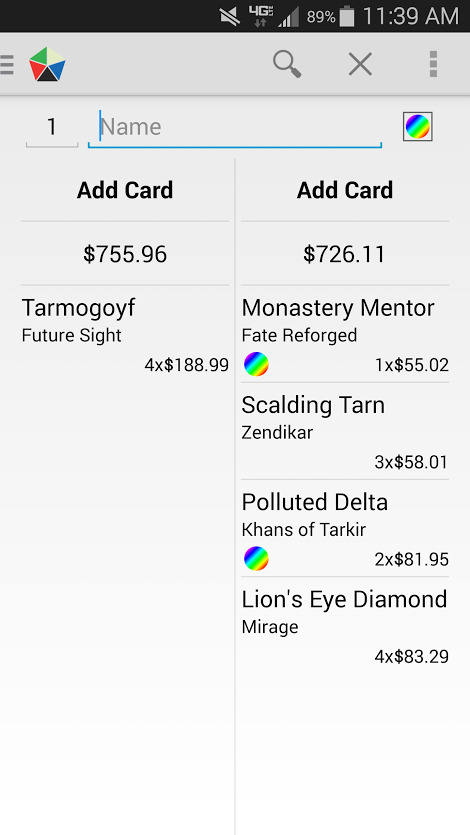
To further examine this, let’s look at one of the trades I posted early on in the article:

Tradeworth

From a pure numbers standpoint, it looks like the individual receiving the Goyfs is “winning” the trade, to use an ugly word. He’s getting about $30 extra in trade value, and he’s turning a foil Standard card into copies of the most expensive Modern-legal card in the format. In addition, those [card]Scalding Tarn[/card]s are probably going to be reprinted soon in MM15.

However, let’s look at a few possibilities that make this trade worth it for the [card]Lion’s Eye Diamond[/card] receiver. Maybe his LGS is slowing down on Modern events as his playgroup starts to shift more towards Legacy. From the appearance of the trade, he looks like he’s trying to build some type of Legacy combo deck (hopefully one that doesn’t include [card]Monastery Mentor[/card]…). If the guy giving up Goyfs logically believes that he needs the LEDS and Tarns to play with, and if he’s going to receive a lot of utility from playing the deck, then I think it’s perfectly acceptable for him to “lose” money on this trade, especially if nobody else in his playgroup had the Lion’s Eyes that he needed.

While the above “renting” examples with Ryan and Jason were a bit extreme and on the far ends of the spectrum, I hope that there’s something to be taken out of them for analyzing your own personal situation, and making the decision of whether or not to “rent” cards during the course of their descent in price.

The situation doesn’t always boil down to, “Yes, I should sell this card/wait on buying this card, because it will go down.” My answer might be vastly different than yours, and we can both be correct.

Thanks for reading!

Pitt Imps Podcast #104 Back to Basics

This week, the Imps make their triumphant return to BSB by taking the time to see what happened over at SCG DC. Its seemed right, since it was the first week of the bannings in Modern and the first weekend of Standard with Fate Reforged. We then talked briefly about the Sunday Super Series Championship. Then a little new,s followed by a segment about going back to the fundamentals of the game with the topic being mana curves. Then we ramble and stuff. By the way, I’m well aware I messed up the trivia. I was sick and I read it directly from a bad website that did MTG trivia. Oh well.

Host Angelo  Twitter @ganksuou

CO-Host Will           He’s on Facebook

Pitt Imps Facebook Page

Show Email    [email protected]

Help The Imps get a Real Studio

Brewing With Fate Reforged

Welcome back for Brewing With <i>Fate Reforged</i>! Unfortunately, this set didn’t lend itself to a lot of diversity for me, but hopefully you’ll enjoy the lists I did come up with. Also, I must apologize for my lack of content lately—I did not do quite as well as I had hoped at Pro Tour Khans of Tarkir in Honolulu and have not done well at anything larger than a Preliminary Pro Tour Qualifier since then. In my eyes, my performance at the Pro Tour was so poor and I made so many mistakes that I just couldn’t bring myself to write about it. But I did have a very good run last year, making top eight in 17 of the 47 events I played in, winning a PTQ along the way.

As usual I’m only providing some sideboard suggestions, as I don’t have time to tune all these decks and test the matchups. Hopefully I’ve come up with something you’ll like.

Get to the Lists, Josh

This is the first list I thought about creating. I liked the idea of being able to cast [card]Crackling Doom[/card] every turn, and also the ability to sideboard into [card]Thoughtseize[/card]. Burn decks with [card]Soulfire Grand Master[/card] and [card]Monastery Mentor[/card] should be quite strong for much of Standard,

[deck title= Mardu Burn]
[Creatures]
4 Soulfire Grand Master
4 Monastery Mentor
[/Creatures]
[Spells]
4 Wild Slash
4 Magma Jet
4 Lightning Strike
4 Mardu Charm
4 Crackling Doom
3 Read the Bones
4 Stoke the Flames
2 Murderous Cut
[/Spells]
[Land]
4 Temple of Triumph
2 Temple of Malice
4 Nomad Outpost
4 Bloodstained Mire
2 Caves of Koilos
3 Battlefield Forge
2 Mountain
2 Swamp
[/Land]
[/deck]

Sideboard Suggestions: [card]Erase[/card], [card]Thoughtseize[/card], [card]Hushwing Gryff[/card], and [card]Utter End[/card].

[card]Wild Slash[/card] gives the red decks something it’s been missing for a while now: a turn-one burn spell that can go to the dome. With the extra burn spell in the mix, it is now easier to burn your opponent out.

[deck title= Red Deck Wins]
[Creatures]
4 Monastery Swiftspear
4 Firedrinker Satyr
4 Frenzied Goblin
4 Eidolon of the Great Revel
4 Goblin Rabblemaster
[/Creatures]
[Spells]
4 Wild Slash
4 Titan’s Strength
4 Magma Jet
4 Lightning Strike
4 Stoke the Flames
[/Spells]
[Land]
4 Wooded Foothills
4 Bloodstained Mire
12 Mountain
[/Land]
[/deck]

Sideboard Suggestions: [card]Arc Lightning[/card], [card]Break Through the Line[/card], [card]Satyr Firedancer[/card], and [card]Searing Blood[/card].

While you probably won’t be buying [card]Treasure Cruise[/card] back much, you may find yourself spamming [card]Jeskai Charm[/card] to overwhelm your opponents. The blue splash over the black splash seems like it might not be as powerful, but it does open up other options that black doesn’t have access to. Beware though, Jeskai was a very popular deck for much of the season, and people love to run those colors.

[deck title= Jeskai Burn]
[Creatures]
4 Monastery Swiftspear
4 Soulfire Grand Master
4 Monastery Mentor
2 Goblin Rabblemaster
[/Creatures]
[Spells]
4 Wild Slash
4 Magma Jet
4 Lightning Strike
4 Jeskai Charm
4 Stoke the Flames
3 Treasure Cruise
[/Spells]
[Land]
4 Temple of Epiphany
2 Temple of Triumph
4 Mystic Monastery
4 Flooded Strand
4 Battlefield Forge
2 Island
2 Mountain
1 Plains
[/Land]
[/deck]

Sideboard Suggestions: [card]Disdainful Stroke[/card], [card]Erase[/card], [card]Reality Shift[/card], and [card]Satyr Firedancer[/card].

Gruul Aggro is already a fairly known quantity in the format, but I think it gets access to quite a few new potent cards like [card]Yasova Dragonclaw[/card], [card]Flamewake Phoenix[/card], [card]Shaman of the Great Hunt[/card], and [card]Shamanic Revelation[/card]. This version may be what is needed to keep up once all the burn decks flood the format.

[deck title= Gruul Aggro]
[Creatures]
4 Elvish Mystic
4 Rattleclaw Mystic
4 Heir of the Wilds
4 Flamewake Phoenix
2 Yasova Dragonclaw
4 Goblin Rabblemaster
4 Shaman of the Great Hunt
3 Ashcloud Phoenix
4 Stormbreath Dragon
[/Creatures]
[Spells]
4 Lightning Strike
[/Spells]
[Land]
4 Temple of Abandon
4 Wooded Foothills
4 Mana Confluence
4 Forest
7 Mountain
[/Land]
[/deck]

Sideboard Suggestions: [card]Fated Conflagration[/card], [card]Reclamation Sage[/card], [card]Shamanic Revelation[/card], and [card]Wild Slash[/card].

Boros Burn seems like it will be very good for a while. Being able to run a lot of high-impact, low-investment creatures, means you’ll get quite a few wins from just resolving a creatures and burning your opponent out from there. One cards that this deck gets to make great use of is [card]Collateral Damage[/card], since it pumps out a ton of tokens on the way to victory.

[deck title= Boros Burn]
[Creatures]
4 Soulfire Grand Master
4 Eidolon of the Great Revel
4 Monastery Mentor
4 Goblin Rabblemaster
[/Creatures]
[Spells]
4 Wild Slash
3 Collateral Damage
4 Magma Jet
4 Lightning Strike
4 Searing Blood
4 Stoke the Flames
[/Spells]
[Land]
4 Temple of Triumph
4 Battlefield Forge
8 Mountain
5 Plains
[/Land]
[/deck]

Sideboard Suggestions: [card]Chained to the Rocks[/card], [card]Chandra, Pyromaster[/card], [card]Erase[/card], and [card]Hushwing Gryff[/card].

This deck gained access to a couple of new toys that may or may not push it into competitive range, the biggest is [card]Brutal Hordechief[/card], which is very reminiscent of [card]Hellrider[/card], which was very good when it was Standard legal. Another key card this deck gained is [card]Mardu Woe-Reaper[/card], which is a great one-drop that fights against the decks that abuse their graveyards. And the final cog is [card]Harsh Sustenance[/card], which acts as removal or a way to kill your opponent through a board stall.

[deck title= Orzhov Warriors]
[Creatures]
4 Bloodsoaked Champion
4 Tormented Hero
4 Mardu Woe-Reaper
4 Mardu Skullhunter
4 Chief of the Edge
3 Chief of the Scale
4 Brutal Hordechief
[/Creatures]
[Spells]
4 Bile Blight
4 Harsh Sustenance
2 Sorin, Solemn Visitor
[/Spells]
[Land]
4 Temple of Silence
4 Caves of Koilos
2 Mana Confluence
1 Urborg, Tomb of Yawgmoth
5 Plains
7 Swamp
[/Land]
[/deck]

Sideboard Suggestions: [card]Banishing Light[/card], [card]Erase[/card], [card]Merciless Executioner[/card], and [card]Utter End[/card].

Orzhov Tokens may look more like just a creature deck, but it has more permanent ways to generate tokens like [card]Brimaz, King of Oreskos[/card] and [card]Monastery Mentor[/card]. I could easily see a deck like this making life difficult for the multitude of burn decks that show up this season. The only real issues I see are that it doesn’t have enough to do in the early game.

[deck title= Orzhov Tokens]
[Creatures]
4 Bloodsoaked Champion
4 Monastery Mentor
3 Brimaz, King of Oreskos
4 Brutal Hordechief
2 Wingmate Roc
[/Creatures]
[Spells]
4 Thoughtseize
3 Launch the Fleet
4 Raise the Alarm
4 Harsh Sustenance
3 Sorin, Solemn Visitor
2 Elspeth, Sun’s Champion
[/Spells]
[Land]
4 Temple of Silence
4 Caves of Koilos
2 Scoured Barrens
2 Mana Confluence
1 Urborg, Tomb of Yawgmoth
5 Plains
5 Swamp
[/Land]
[/deck]

Sideboard Suggestions: [card]Bile Blight[/card], [card]Brain Maggot[/card], [card]Erase[/card], and [card]Utter End[/card].

That’s all I have for now, I’ll hopefully see you again for Brewing With Dragons of Tarkir. If you have any questions of comments, pleases feel free to leave them below and I will do my best to answer them.

Thanks for reading,

Josh Milliken

@joshuamilliken on Twitter

Weekend Magic: 1/30-2/1

Last weekend brought us some Legacy action with Star City Games: Indianapolis, along with side events for Standard and Modern. Let’s see how the weekend turned out after the [card]Treasure Cruise[/card] banning.

Star City Games: Indianapolis – Legacy Open (Indianapolis, IN)

Decklists

Deck Finish Player Deck Finish Player
Sultai Delver 1st Jim Davis U/W Control 17th Jacob Coffey
Storm 2nd Ben Wienburg Sneak and Show 18th Kyle Houtman
Elves 3rd Christopher Hall Storm 19th Benjamin Ball
Storm 4th Caleb Scherer Sneak and Show 20th Jonathan Anghelescu
Shardless Sultai 5th Rudy Briksza Death and Taxes 21st Jamie Scheffer
Mono-Red Burn 6th Cameron Ramsay Sultai Delver 22nd Peter Tragos
Elves 7th Matthew Hoey Death and Taxes 23rd Thomas Enevoldsen
Infect 8th Zachary Koch Maverick 24th Michael Belfatto
Maverick 9th Michael Antrim Esper Deathblade 25th David Elden
Shardless Sultai 10th Lewis Brook Storm 26th Jacob Baugh
Jeskai Delver 11th Marc Castillo Lands 27th Thomas McLeod
Death and Taxes 12th Gregory Schafer Death and Taxes 28th Colin Logan
Thopter Foundry 13th Chris Andersen Deathblade 29th Jessy Hefner
Maverick 14th Brian Epplin Maverick 30th Thomas Herzog
Sultai Delver 15th Noah Cohen Esper Delver 31st Steve Mann
Jeskai Delver 16th Brandon Penn Reanimator 32nd Joe Lossett

Star City Games entered the top 32 decklists into their database for this event, so there is a ton information available about the decks that did well during the previous weekend. 

Top 8 Highlights

  • [card]Dark Confidant[/card] is back in business! Three copies were found in the winning Sultai Delver decklist.
  • [card]Stifle[/card] also appears to be back on the charts with three copies in the winning decklist.
  • [card]Marsh Casualties[/card] is a card to watch—the winning decklist had two copies in the sideboard.
  • Two Elves and two Storm decks were in the Top 8. Combo seems to be making a resurgence, at least at Indianapolis.
  • Shardless Sultai made the Top 8. Cards to watch here include [card]Shardless Agent[/card], [card]Tasigur, the Golden Fang[/card], [card]Dig Through Time[/card], and [card]Ancestral Vision[/card].

Top 16 Highlights

  • Two copies of Maverick made the Top 16. Cards to watch in this deck include [card]Knight of the Reliquary[/card], [card]Mother of Runes[/card], [card]Thalia, Guardian of Thraben[/card], and [card]Green Sun’s Zenith[/card].
  • Two copies of Jeskai Delver made the Top 16. They have reverted to the [card]Stoneforge Mystic[/card] package in vogue before the banning of Treasure Cruise. One deck featured two copies of [card]Dig Through Time[/card]. [card]Meddling Mage[/card] is still a popular sideboard choice, and happens to be great against all the combo that seems to be popping up in Legacy.
  • An Esper Control deck called Thopter Foundry made the Top 16. Besides the featured [card]Thopter Foundry[/card] card that the deck was named after, other cards to watch include Dig Through Time, [card]Mental Note[/card], and [card]Thought Scour[/card]. A [card]Counterbalance[/card] package was also featured in the sideboard and should be noted.

Top 32 Highlights

  • A deck identified as U/W Control barely missed the Top 16. This deck featured three copies of the new [card]Monastery Mentor[/card], along with [card]Snapcaster Mage[/card], [card]Jace, the Mind Sculptor[/card], [card]Dig Through Time[/card], and many counterspells and cantrips in order to win the game. Could this be the direction that Monastery Mentor decks take in Legacy and possibly Vintange? It’s hard to tell at this point, but out of all the decks played during the weekend, this deck should be watched the closest for results over the next few months.
  • Three copies of Death and Taxes made the Top 32 in addition to a Top 16 appearance. Death and Taxes is still a strong choice even after the Treasure Cruise banning.
  • Two copies of Sneak and Show made the Top 32. Two copies of Dig Through Time were found in both decks.

All in all, it looks like new brews featuring Dig Through Time popped up during the weekend, so Khans is still making an impact on the metagame. Dig Through Time can still be used to great success in Sneak and Show and control decks in order to help find answers in the late game. Even Monastery Mentor is making a mark with a new type of deck showing up that featured it.

Star City Games: Indianapolis – Standard Premier IQ (Indianapolis, IN)

Decklists

Deck Finish Player Deck Finish Player
W/U Heroic 1st Nathaniel Bass U/B Control 9th Donnie Wise
4-Color Soul 2nd Patrick Cowe Jeskai Aggro 10th Donivan Abraham
Temur Aggro 3rd Jacob Eckert Aabzan Aggro 11th Matt Guido
U/B Control 4th Marcus Fitzgerald G/R Aggro 12th Ross Abel
Sultai Control 5th Craig Bargo 4-Color Midrange 13th Ethan Powell
Abzan Aggro 6th Nicholas Hale Temur Ascendancy 14th James Wager
Abzan Midrange 7th Galen Whittaker G/R Devotion 15th William McMurtrie
U/B Control 8th Michael Hamilton Temur Ascendancy 16th Michael Medley

First place in Standard went to W/U Heroic, which didn’t include anything new from Fate Reforged. Four-Color Soul took second place, featuring four [card]Soul of Theros[/card] and three [card]Tasigur, the Golden Fang[/card] main deck. Tasigur is the real deal, as we’ve also seen in Legacy, and his price should be watched very carefully over the next few weeks (especially foils).

Rounding out the Top 8, other cards to watch out for include:

  • [card]Ashcloud Phoenix[/card], [card]Flamewake Phoenix[/card], [card]Frost Walker[/card], [card]Rattleclaw Mystic[/card], [card]Savage Knuckleblade[/card], and [card]Shaman of the Great Hunt[/card] in Temur Aggro.
    • I still think Crater’s Claws[/card] is going to continue to be good moving froward, especially going into the next Standard later in the year.
  • Crux of Fate[/card] out of U/B Control and Sultai Control.
  • [card]Rakshasa Deathdealer[/card], [card]Warden of the First Tree[/card], [card]Anafenza, the Foremost[/card], and [card]Valorous Stance[/card] out of Abzan Aggro.

From the Top 16, cards to watch include:

  • [card]Heir of the Wilds[/card], [card]Stormbreath Dragon[/card], and [card]Whisperwood Elemental[/card] out of G/R Aggro.
  • [card]Butcher of the Horde[/card] out of 4-Color Midrange.
  • [card]Temur Ascendancy[/card], [card]Genesis Hydra[/card], [card]Temur Sabertooth[/card], [card]Eidolon of Blossoms[/card], and [card]Chord of Calling[/card] out of Temur Ascendancy.
  • [card]Polukranos, World Eater[/card], [card]Nykthos, Shrine to Nyx[/card], and [card]Xenagos, the Reveler[/card] out of G/R Devotion.
    • Jason indicated that Nykthos is near an all time low price for such a powerful effect—get your copies now if you plan to play any of these devotion based strategies such as G/R Devotion or Temur Ascendancy combo.

Standard has been shaken up a bit, with some new players now battling it out with the old. U/W Heroic seems to be solid in a metagame that is still being established, but will it last?

Star City Games: Indianapolis – Modern Premier IQ (Indianapolis, IN)

Decklists

Deck Finish Player Deck Finish Player
Amulet Combo 1st Stephen Speck Elves 9th John Ostrem
G/W Hatebears 2nd Nick Hanna Dredgevine 10th Robert Beneteau
Jeskai control 3rd Jacob Kessler Bant Aggro 11th Chris Wynes
Mono Red Burn 4th Jacob Ross Dredge 12th jacob medley
Affinity 5th David Long Death and Taxes 13th Tom Judge
Naya Zoo 6th Christopher O’Bryant R/B Burn 14th David Gill
Affinity 7th Ian Losch Rack 15th Pete Casella
R/W Burn 8th Alan Eryman Merfolk 16th Paul Brooks

While Stephen Speck couldn’t win GP Omaha, he certainly won this event piloting Amulet Combo! It seems regardless of the variance of the deck’s hands that as long as you have experience piloting the deck, you can do very well with it (not having to play against Birthing Pod is quite nice though!). Cards to watch here include [card]Primeval Titan[/card], [card]Azusa, Lost but Seeking[/card], [card]Amulet of Vigor[/card], [card]Hive Mind[/card], and [card]Summer Bloom[/card].

G/W Hatebears took second place. This deck seemed to be a popular choice amongst a potential field of Dredge decks which players were sure to test out. Cards to watch out for from this deck include [card]Leonin Arbiter[/card], [card]Loxodon Smiter[/card], [card]Voice of Resurgence[/card], [card]Wilt-Leaf Liege[/card], and [card]Thalia, Guardian of Thraben[/card].

Rounding out the Top 8, other cards to watch out for include:

  • [card]Geist of Saint Traft[/card], [card]Young Pyromancer[/card], and [card]Shadow of Doubt[/card] out of Jeskai Control.
  • [card]Shard Volley[/card] out of Mono Red Burn—this seems to be a burn spell that is being included in Modern lists these days. Watch out for cheap foils especially.
  • [card]Ghostfire Blade[/card] in Affinity.
  • [card]Ghor-Clan Rampager[/card], [card]Wild Nacatl[/card], and [card]Become Immense[/card] out of Naya Zoo (which is a very weird Zoo list that I haven’t seen before). Sideboard cards to watch here include [card]Seeker of the Way[/card], [card]Chained to the Rocks[/card], [card]Destructive Revelry[/card] (is this Standard!?), [card]Dismember[/card], and [card]Gut Shot[/card].
  • [card]Monastery Swiftspear[/card] was included as a playset in the the Burn lists and the Zoo list—Swiftspear looks like it will be a strong performer in Modern. Even [card]Young Pyromancer[/card] appeared in some lists.

From the Top 16, cards to watch include:

  • Cards from Elves
    • [card]Arbor Elf[/card], [card]Devoted Druid[/card], [card]Heritage Druid[/card], [card]Nettle Sentinel[/card], and especially foil [card]Ezuri, Renegade Leader[/card] (which has received additional hype from Tiny Leaders discussions)
  • Cards from Dredgevine and Dredge
    • Dredgevine included a whole host of creatures that haven’t been seen before. Financially relevant cards include [card]Death’s Shadow[/card] , [card]Gravecrawler[/card] , [card]Skaab Ruinator[/card] , and [card]Vengevine[/card].
      • Ancient Ziggurat should also be noted, since it appeared as playset due the Dredgevine deck consisting of only 40 creatures and 20 lands. Foils of this land should be watched closely.
    • Dredge was a more spell-based list, but it also used Golgari Grave-Troll,  Gravecrawler, and Vengevine as the base along with [card]Grisly Salvage[/card] and [card]Faithless Looting[/card] to help play a quick Tasigur, the Golden Fang
  • [card]Knight of the Reliquary[/card], [card]Lotus Cobra[/card], [card]Sovereigns of Lost Alara[/card], [card]Geist of Saint Traft[/card], and [card]Eldrazi Conscription[/card] out of the Bant Aggro list.
  • [card]Blade Splicer[/card], [card]Dryad Militant[/card], [card]Judge’s Familiar[/card], [card]Ghost Quarter[/card], and [card]Tectonic Edge[/card] out of Death and Taxes (which now exists in Modern, apparently!)
  • [card]Tombstalker[/card] and [card]Bump in the Night[/card] out of R/B Burn. [card]Rain of Gore[/card] is a notable sideboard card in this deck.
  • [card]Nyxathid[/card], [card]The Rack[/card], [card]Terminate[/card], and [card]Wrench Mind[/card] out of the Rack deck

There’s a lot to keep an eye on this week. Until next time!


Wow, the Top 16 was extremely diverse at this Modern Premier IQ! Plenty of innovation appeared due to the recent bannings and unbannings in the format, with the opportunity to see more when Pro Tour DC happens from 2/6-2/8. Old lists did well but the banning of Birthing Pod and Treasure Cruise has certainly been felt and has taken Modern in a new direction.


That’s it for this week. Next weekend is the Pro Tour, which will provide further information about what decks are now viable in Modern.


Financial Five: Fate Reforged

With each new set it seems like retailers are getting better at pre-pricing cards to fit card hype and demand. I look past the chase rares/mythics and find the diamonds in the rough. Below are five cards I think are worth investing in.

[card]Alesha, Who Smiles at Death[/card]($2)alesha

The list of “bring-backable” creatures seems be longer than a Transformer movie.  Bringing back a [card]Seeker of the Way[/card] or a [card]Frenzied Goblin[/card] doesn’t seem like bad value.  Aggressive decks want to play her to recur the fallen creatures from previous combat steps. She’s great in the aggressive mirror where her first-striking three-power body stops almost any aggressive creature in its tracks. For only 2R, she can be splashed into any self-mill brew to try out her reanimation abilities (I’m looking at you [card]Hornet Queen[/card]!).

What holds her back is the lack of impact on the board when she’s cast. You have to wait a turn, spend non-red mana, and declare her attacking to gain card advantage. Does that make her a sideboard option for aggro versus aggro mirrors? I’m not sure, but the first strike really wins me over. She’s legendary, so she may not always be a four-of, but could still make for a fun EDH deck. Timmys love her, Spikes see potential, and Johnnys want her to achieve a battlefield of brokenness .  I don’t see her going lower than $2, but I can’t see her exceeding $5.

flamewake[card]Flamewake Phoenix[/card] ($3)

I recently compared [card]Flamewake Phoenix[/card] to [card]Chandra’s Phoenix[/card] (here), but since they won’t be in the same Standard format (so far), we’ll just have to focus in on Flamewake for the time-being.  R/G Monsters has been in and out of top eights for almost a year now, taking many different forms and sometimes splashing to become Temur or Naya.

What seems to stay consistent is its ability to activate ferocious.  In combination with [card]Ashcloud Phoenix[/card], I think these hot-headed squawkers wouldn’t mind crossing feather for some aerial assaults in Standard.   I hope they don’t forget to wave down at an allied [card]Polukranos, World Eater[/card] as they fly by. Add [card]Sarkhan, the Dragonspeaker[/card] or [card]Stormbreath Dragon[/card] for a crimson air show.  I see price potential at $5 or $6 in future Standard, since you’ll always play four and it fits in [card]Titan’s Strength[/card] aggro decks and even more synergy with aggressive midrange “monster” strategies.


[card]Yasova Dragonclaw[/card] ($1.5)yasova

This was one of the first cards spoiled from Fate Reforged.  I wasn’t much of a fan when I saw the two toughness, but I might be looking at the wrong number. As He-Man would say, “I HAVE THE POWER!”… to activate ferocious.  I remember saying on the show, “If ferocious is relevant, Yasova is relevant.” She works extremely well with [cardFlamewake Phoenix[/card].

Turn 3: Cast Flamewake, opponent destroys Flamewake

Turn4: Cast Yasova, cast Flamewake during combat, opp. destroys Flamewake

Turn 5:  Threaten a creature (Yasova’s ability), cast Flamewake

Rinse, repeat, and cast other spells when needed.

Of course your opponent will likely kill the Yasova as soon as possible, but this works with any four-powered creature and is still better than casting a [card]Boon Satyr[/card]. It’s as close to extort as R/G will ever get. Instead of draining for one, you’ll just attack with a two-powered creature. She is easy to kill because she takes over the game if you don’t kill her. That worth more than a $1.50, right?! I’ll pick these up all day long and might even score her as a throw-in.

silumgarthedriftingdeath[card]Silumgar, the Drifting Death[/card] ($2)

If you took the best qualities of [card]Wall of Denial[/card] and [card]Doomwake Giant[/card], you’d end up with this monstrosity. This 3/7 is always defensive until you don’t need it to be. Its only weakness is needing to attack to get the -1/-1 ability, although I doubt this weakness would encourage the addition of other Dragons in your deck.

U/B Control is its obvious home, but I could see a Sultai Midrange using it to win board stales without having to worry about hornet tokens.  Not sure if it is worth playing four copies, but $2 for a format staple should already be on your list of pick-ups. It’s another rare that can only go up from here.  By the way, $22 foils should convince you card slingers are already playing him.

The legendary cycle of dragons seemed to be common at the prereleases I attended, so I’m sure this will be easy to find for the next couple weeks.

[card]Crux of Fate[/card] ($5)crux of fate

When’s the last time we had a playable black sweeper? [card]Black Sun’s Zenith[/card]? [card]Mutilate[/card] doesn’t count.

When I picked this card for the article, it was sitting at $3, but is already up to $5 after prerelease weekend. So it’s turned into a long-term pick-up instead of a “buy all you can while you can” pick-up.

As far as playability, the obvious deck is U/B Control, since we’re all aware of its existence and strategies. But what about the B/G decks that don’t want to splash for white?  I’m a fan of the one-horned villain myself ([card]Siege Rhino[/card]), but you know how Wizards of the Coast is. They want the Standard environment to constantly change (I’m looking at you Siege Rhino & [card]Courser of Kruphix[/card]). The fact is, B/G Midrange wouldn’t mind sweeping for value to set up a delve or [card]Whip of Erebos[/card] activation.

I expect this card to settle at $5, but it could see some spikes throughout its time in Standard.  You can’t go wrong with picking up a few extra to take advantage of a potential increase in demand. Though, since this is from a small set and we only require one Fate Reforged pack for the next two draft environments, the supply could be lower than expected.

Uncommons

What uncommons could break $1? I’d put my faith in [card]Valorous Stance[/card].  It’s defensive, offensive. currently in a highly played color, easy to cast (1W instead of WW), and plays at instant speed.  If you’re not convinced, pick up a couple sets of [card]Reality Shift[/card]s and see if they’ll find a deck.

As always, thanks for reading

@TNSGingerAle


Episode 72 – A Self-Help Guide to Magic

[soundcloud url=”https://api.soundcloud.com/tracks/188133292″ params=”color=ff5500&auto_play=false&hide_related=false&show_comments=true&show_user=true&show_reposts=false” width=”100%” height=”166″ iframe=”true” /]

With Fate Reforged officially out, it’s a new Standard. Curtis suits up UB Control and Cameron tweaks Jeskai Tokens. We talk about some of the new decks and cards making a splash. Think about this: what do you do when you lose a lot (like Cameron-levels of losing)? Curtis gives you three easy steps to becoming a better tournament grinder. Thank you for your honor.

Cameron McCoy – @Cameron_McCoy

Curtis Nower – @CurtisNow

Dustin Gore – @mtgdustin

Our show – @SpikeFeedMTG

Music by Micah Jones

Privileged Perspective 12 – The Real PP12

Okay, so last week was a long one, as well as the start of my first meta-series. Today is going to basically be an extended edition of Quick Hits, where we touch on a bunch of different stuff at once (this hides the frequent loss of focus that comes with running WoW1 in the background). Also, I’ve been sick all week, so I’ve been pretty in and out when it comes to cognitive writing ability. This should be fun.

Recent PucaTrade Finance

PucaTraders (or at least, the finance-minded ones) are getting smarter. The pricing algorithm that Puca uses is great for mapping steady prices, but it tends to lag behind on spikes. Twice in the past two weeks (fortnight? Can I use that there?), there have been spikes on cards, and by the time their point total caught up, all the wants were gone. The first was Golgari Grave-Troll, who had tons of people wanting them at ~300 points when the price elsewhere was starting to touch $10, but by the time it refreshed, you couldn’t send one off to save your life. The same thing happened with Tasigur after this weekend. As of right now, nobody wants either card for their current point total (675/1055 for non-foil Troll printings, and 1299 for Tasigur). I don’t think the price update times are public, so these people are either:

  • Taking a big hit when they turn over (a loss for them),
  • Getting a ton of cards shipped to them for their pre- or mid-spike prices (a potential win/loss depending on outs)
  • Taking the wants off as soon as they see the prices adjust to avoid the first situation (a win from them).

Seriously, We Need to Talk About Shipping Cards

I’ve received a lot of cards with pretty poor shipping jobs, and it has got to stop. I’ll preface by saying that this applies only to small quantities of cards, since once you’re shipping over 4 cards at once, things get trickier. Let’s go through this nice and easy, and hopefully we won’t have any more problems.

  • First, put the card you are mailing in a sleeve. This is non-negotiable.IMG_3645
  • Second, put the card into a toploader, with the TOP of the card going in first. This means the bottom of the card (and therefore, the sealed bottom of the sleeve) will be the by the open end of the toploader.

IMG_3646

  • Tape the open end of your toploader, but use enough tape that you can create a pull-tab on one side, to allow for easy opening. To do so, simply fold one end of the tape in on itself. I like to have my tabs on the front of the card, since it will contrast with the card and be more apparent.

IMG_3647

  • You can typically fit two sleeved cards in a toploader (depending on the type of sleeve), and usually no more than two toploaders in a sealed plain white envelope. Be careful though, because sometimes the Post Office will get cute and send it back wanting extra postage.
  • Always write “Non-Machinable” and “Do Not Bend” on the front and back of your envelope. The USPS has a machine that they run envelopes through for faster sorting that destroys toploaders.IMG_3649
  • For PucaTrades, I always write the trade number on the back of the envelope. This way the recipient knows it’s not bills or junk mail.

IMG_3648

  • A lot of people wrap their sends in paper, but I don’t.
  • I always tape the envelope after I seal it. If you have some, I prefer the ReadyPost tape they sell at the Post Office (clear tape with a blue dispenser thing), since it won’t lose adheasion in the cold or moist weather like regular tape will.
  • Shoutout to @Hackworth, who had the first (and best) explainer on how to ship cards.

Modern Is Still a Thing

And I am playing it this Saturday! In a PPTQ, even! I am pretty excited, although a little unsure still in terms of deck selection. I have been playing Gifts in Modern for a while (although I have never played the format consistently), but I traditionally want to be aggressive in a “new” format. I don’t expect this particular event to be very large, and I suspect that Gifts is probably better in a smaller setting. My Gifts deck is built around Smallpox, which may be good in these first couple of weeks, although I can’t resolve more than one without already having Loam up and running. My other deck choice, the aggressive one, is a modified version of the Jund Aggro deck I played in my Extended tournament last month:

[deck title= Modern Experiment Jund]
[Creatures]
*4 Experiment One
*4 Rakdos Cackler
*4 Burning-Tree Emissary
*4 Jund Hackblade
*3 Flinthoof Boar
*3 Lightning Mauler
*3 Falkenrath Aristocrat
*4 Ghor-Clan Rampager
[/creatures]
[Spells]
*4 Lightning Bolt
*3 Abrupt Decay
[/spells]
[Lands]
*4 Wooded Foothills
*2 Verdant Catacombs
*2 Bloodstained Mire
*3 Stomping Ground
*2 Overgrown Tomb
*2 Blood Crypt
*1 Woodland Cemetery
*1 Dragonskull Summit
*2 Rootbound Crag
*2 Mountain
*1 Forest
*1 Kessig Wolf Run
[/lands]
[Sideboard]
*1 Abrupt Decay
*3 Bonfire of the Damned
*4 Thoughtseize
*7 ???
[/sideboard]
[/deck]

The upside here is that I am strongly familiar with the deck: some of the numbers that may seem odd here are the results of tuning and retuning. The huge percentage of fetchlands means that our already low land count is functionally going to have a much harder time hitting four than the deck did in Standard. This means we want to draw fewer Aristocrats, since multiples will be painful. [card]Ghor-Clan Rampager[/card] is a fine two-mana card, however, so he got bumped back up to a four-of. He’s probably a better two-mana card than a four-mana card in this deck.

The sideboard is (so far) a deckbuilding experiment for me. Since I am already playing the most effective creatures on curve, I only expect to be sideboarding in or out from that 7 card subset of non-creature spells. Therefore, I want to make sure that the effects I am boarding in or out are similar on curve, but varied in effectiveness towards a certain style of matchup. I won’t be bringing in things like Creeping Corrosion or Thrun, but I plan on Bonfire coming in to replace Abrupt Decay in matches against token decks (and replacing Bolt if they have Jeskai Ascendancy). Ancient Grudge may take three of those currently open slots. Liliana, too. Let me know if you think I’m missing something!

Something for Later

If you haven’t read Travis’s article about his trip to Japan already, you should do that. After you read this, I mean. Well, and comment on this on our site or Reddit. And tweet about it. Anyways, here’s the link (for later).

[Ed. Note: Dammit, Ross, You Stole My Elton John Pun]

I’ve built my first Tiny Leaders deck! The archetype is lands, although not having access to any five-color idiot as a general disallows such degeneracy as [card]Inkmoth Nexus[/card] plus [card]Kessig Wolf Run[/card]. My general is the Sultai Placeholder, which is pretty disappointing. I plan on making something more fun to look at to fill the time. Here’s my list:

[deck title= Hold Me Closer, Tiny Leader]
[Creatures]
*1 Terravore
*1 Satyr Wayfinder
*1 Haakon, Stromgald Scourge
*1 Laboratory Maniac
[/creatures]
[Spells]
*1 Crop Rotation
*1 Life From The Loam
*1 Liliana of the Veil
*1 Nameless Inversion
*1 Villainous Wealth
*1 Engineered Explosives
*1 Elixir of Immortality
*1 Raven’s Crime
*1 Mulch
*1 Rites of Flourishing
*1 Grisly Salvage
*1 Compulsive Research
*1 Oblivion Stone
*1 Exploration
*1 Zuran Orb
*1 Entomb
*1 Treasure Hunt
*1 Syphon Life
[/spells]
[Lands]
*1 Volrath’s Stronghold
*1 Island
*1 Opulent Palace
*1 Overgrown Tomb
*1 Bojuka Bog
*1 Academy Ruins
*1 Polluted Delta
*1 Tranquil Thicket
*1 Barren Moor
*1 Breeding Pool
*1 Glacial Chasm
*1 Lonely Sandbar
*1 Ghost Quarter
*1 Nephalia Drownyard
*1 Forest
*1 Cephalid Coliseum
*1 Bazaar of Baghdad
*1 Command Tower
*1 Swamp
*1 Urborg, Tomb of Yawgmoth
*1 Cabal Coffers
*1 Wasteland
*1 Tolaria West
*1 Watery Grave
*1 Cabal Pit
*1 Verdant Catacombs
*1 Misty Rainforest
[/lands]
[/deck]

The Quick Hits of the Quick Hits Article

  • I will never type out a Commander deck.
  • I have no clue what SCG tournaments I’m supposed to play in anymore. I get their emails telling me about events “in the area,” but I’ve definitely fallen behind in knowing how their structure works. There is no reason to play in an Open Trial, right? And IQ events are the ones that people can grind for points? But it’s really only worth it to win one or play a whole bunch? And is anyone doing Game Night? I feel like this is City Champs all over again, except I liked City Champs.
  • This is going to be one of the better Super Bowls of the past decade. Of course, we thought that last year, too. If Seattle can win defensively upfront and hit Brady early or get Gronkowski arrested, then I would expect them to repeat. Both teams have great corners and terrible receievers, so expect a lot of running plays to be called, especially in the first half. The halftime show will be flat and uninspired.
  • I know a lot of people like the Super Bowl commercials, but I think they are starting to lose the allure they once had. They’re still super expensive, but I can’t think of any recently that have better than that Pepsi one with the skydiver and the ducks. I think that was ’97, because I’m pretty sure Green Bay won that night. Either way, the game will be better than the commercials, which will be better than the halftime show. Actually, Super Bowl, Puppy Bowl, Commercials, Halftime. That’s better.
  • Oh crap, can we say Super Bowl? /Roger Goodell bills Marcel $10,000.

I’ll be back next week with my results from Modern, some more finance talk, and the devastating emptiness inside that comes with the end of football season.


1If anyone is interested, I found a free Blizzlike program that has Vanilla (Classic) WoW and BC. I would love to have some people to quest with! For the Alliance! Check out Wow-one.com for info.

Conjured Currency #47: I Bought a Collection—Now What?

Welcome back, everyone. I hope you all managed to make a bit of money off of [card]Golgari Grave-troll[/card], [card]Worldgorger Dragon[/card], and the other cards that jumped all over the place last weekend. While I did write about the Modern changes to the banned and restricted list last week and what they meant, articles like that one aren’t my favorite ones to write. Similar to how I dislike writing articles about speculation, I prefer the things I write to be timeless, and still be relevant for the months and years to come. As such, you may have noticed that my favorite topic is definitely the specifics of what to do with specific parts of the collections you buy. I’ve discussed price negotiations, what to do with the bulk commons and uncommons, the expensive staples, and everything in between. However, I don’t think I’ve ever made a step-by-step guide that details my exact process while going through a collection. I’m going to rectify that with this week’s article, with a lot of pictures for examples of what I’m talking about. I’m hoping that this can be an article I can link to newer MTG financiers every time I get asked about how they should go through a collection.

The pictures you’re about to see are approximately three different “collections” that I purchased in the span of a few days, that I decided to sort all at once for simplicity’s (and for this article’s) sake. The first collection was pretty much entirely commons and uncommons, with a few rares scattered throughout. The other two were lots of singles that I either pulled out of binders of friends and bought at buylist prices, or found on Facebook through one of the Magic trading groups and bought at a bulk rate after a bit of negotiation. I didn’t get the idea to start recording my process until I was partially finished sorting, but let’s go over what we have here.

So, You Just Bought a Collection

You grabbed a binder or two from a friend who was quitting the game, in addition to some boxes of commons and uncommons that haven’t been touched in ages. Now what? You know you got a pretty good deal just based on the binder, but we want to maximize value while minimizing time and effort.

That stain is so annoying..

That stain is so annoying..

Ironically, I bought this as a blank playmat a while ago from a collection, at an extremely discounted price. After getting frustrated due to not having a consistent sorting system, I took a sharpie to it and now have a rough guideline when hastily going through thousands and thousands of cards. Most of the sections are pretty self-explanatory, but I did leave enough room for two miscellaneous categories should I need them to change from collection to collection. For me, only cards that are worth at least $3 TCG mid get to make it into my binder. I have separate boxes for cards that are approximately $1 and $2 respectively, and the “unknown” category usually gets filled with alters, foreign foils, or even just “normal” cards that I don’t know the exact value of at the time.

Phase 1 Complete.

Phase 1 Complete.

Unfortunately, I didn’t decide to record my progress until I was partially done sorting the collections, and I missed a few opportunities to take pictues of what kinds of cards go into each category. So far, I’ve separated:

  • The nice, expensive stuff that’s going into my trade/TCGplayer binders. I try to keep an organized set of binders, and clean them out to reorganize every couple of months. It’s extremely annoying to have a set of [card]Polukranos, the World Eater[/card], but have to dig through eight pages of green cards just to find the damn things. Remember to keep your pages tidy and transactions will go smoother.

Binder stuff

  • The bulk rares. These will be alphabetized and color sorted into long boxes, for casual players to pick through. Due to the fact that I sell bulk rares for a quarter each, I tend to be aggressive with what I consider a bulk rare. For more information on bulk rares, I feel like I wrote a solid piece about them here.
  • The $1 and $2 rares. [card]Hive Mind[/card] isn’t a bulk rare, but it’s not attractive enough for me to take up space in a binder. Of course, everyone can set their own metrics on what deserves to be in their own binders, and many of you will probably want to keep your $1 or $2 cards in your binders because you’ll have room for them, and it’ll be easier to carry around. However, if you notice that your collection is growing to the point where you need to pull things out, try and start with the lower value stuff.
$1 stuff

$1 stuff

$2 stuff

$2 stuff

  • The common and uncommon “picks.” From [card]Dispatch[/card], to [card]Stinkweed Imp[/card], to [card]Unmake[/card], and even the [card]Golgari Rot Farm[/card]s, I tend to be extremely thorough with my picks. That stack with [card]Wretch Mind[/card] at the top will be broken down alphabetically, and sorted into boxes that will eventually be buylisted to sites such as Card Kingdom, Troll and Toad, or ABUgames. Even if the card doesn’t have a buylist price, I tend to pull it if it sees play in any sort of casual or competitive deck. I even pick all of the [card]Murderous Cut[/card]s, just in case I get asked for them at an event. Being “that guy” who has the niche pickups will get you places.
  • The stack with the Innistrad flip card would be where all of the tokens go. While I enjoy picking out emblems, vampires, krakens, and other “rare” tokens that can be buylisted. I’ve yet to find a suitable bulk outlet for the rest of the bulk tokens. For now, I just color sort them and throw them into labeled boxes that I keep at home. If anyone knows of a great buylist for mass amounts of tokens, feel free to let me know!
  • Foil bulk rares get their own box, which usually gets buylisted off at a Grand Prix if I can find a vendor paying $.35 or higher per foil rare. Still, I tend to color sort them out of habit. EDH and Cube players love sifting through the box to find random foils that I only charge $1 for.
blurry foils

Blurry foils

  • Do you see that stack of sleeves? I’ve gotten in the habit of sleeving every single card I own that’s worth at least $1, and then labeling it with any condition issues, language variety, or foiling. If you have extra sleeves lying around, I highly recommend sleeving every card that goes into your binder to prevent as much damage as possible to the cards.

Now we’re getting to my favorite part of collections. It’s not about finding the [card]Vampiric Tutor[/card] in the haystack, it’s about the solid, consistent return that bulk commons and uncommons bring. Due to the fact that I buy them for $4 per thousand from competitive spikes and retiring players, I can’t lose out. The standard buylist that many in-person stores will offer is $5, so anything I find in the bulk is just icing on the cake.

I actually prefer them unsorted, because they're more fun for casual players to go through

I actually prefer them unsorted, because they’re more fun for casual players to go through.

Basic lands get their own sections

Basic lands get their own sections.

I also remove every basic land from the bulk, and sort them by land type. Basic lands aren’t exciting to find when you’re a casual player looking for sweet creatures and spells, so I find it easier to sell the basics separately. This is easier for me because I have a display case and physical store location, but you can also just give them to newer players to help ease them into the game. Interestingly enough, most stores will pay higher for basic lands than common and uncommon bulk. Your LGS needs them to run drafts with, and we all know how often players leave the event without putting back their basic lands.

Still not as much mana as Sliver Queen+Mana Echoes..

Still not as much mana as Sliver Queen + Mana Echoes…

Where were we? Oh right, bulk commons and uncommons. If you buy the 800-count white longboxes from BCW supplies, you should be able to fit around 1100 cards in each box. The fastest and easiest way to guesstimate 1000 cards is to use an unsleeved card as a measuring tool.

---------- From left to right, this is 200 cards exactly --

From left to right, this is 200 cards exactly.

I fill up these boxes with approximately 1000 cards each, and then label them “RA” for random. This is only because I still have a few boxes left that were entirely color sorted when I received them, and labeled them “W,’ “U,” etc. I try to keep any foreign cards or moderately played cards out of the boxes, to keep them looking pristine. Casual players don’t want cards that they can’t read.

Random boxes

Randomboxes2

Once they’re all packaged up, I list them on Craigslist and put them in the store for $6 a box. Let me tell you, casual players freak out about getting 1000 cards for six dollars. If a booster pack gives you 15 cards for four dollars, this is a billion times better! I’ve been selling these like this for at least two years now, and have yet to find the bottom of this wellspring of casual players who just want to put together unsleeved Wurm decks and jam against their friends.

Here's my ad that I just relisted a few days ago.

Here’s my ad that I just relisted a few days ago.

With that all set, you should now have the entire collection assimilated into your own, and ready to sell in an efficient manner! Although good collections can be hard to find, they’re easily the most profitable aspect of Magic finance that provides the biggest percentage profits. Good luck hunting, and let me know about any other interesting tips on dissecting a collection!


Brainstorm Brewery #133 – Greater Fools

There’s a lot to talk about. Things are upside-down right now, and it’s hard to know what to make of it. No one on the cast saw Tasigur, the Golden Fang coming. There is an Ascendancy combo deck, and it’s not in Jeskai colors. Corbin’s drinking actual beer. Finance experts are being used to Kiblergoogle the price of cards. How do you navigate such a topsy-turvy world? Obviously, it’s with the aid of your favorite Magic podcast. Tune in to an episode that will help you put your life in perspective.


  • Corbin drinks real beer?
  • Jason and Ryan teach you to Google.
  • E-mails bring up good questions about cards like Scion of the Ur-Dragon and Sunforger.
  • Finance 101 is all about the Greater Fool Theory.
  • Modern is recovering from the bans.
  • Standard is shaping up nicely.
  • Questions? Concerns? E-mail brainstormbrew at gmail dot com.

Cabe Riseau produced the intro and outro music for Brainstorm Brewery.

Contact Us!

Brainstorm BreweryWebsiteE-mailTwitterFacebook

Ryan BushardE-mailTwitterFacebook

Corbin HoslerE-mailTwitterFacebookQuietSpeculation

Jason E AltE-mailTwitterFacebookQuietSpeculation

Marcel WhiteE-mailTwitterFacebook

Commanding Opinon: Stitcher Geralf

As per WUBRG order, I’ll be talking about [card]Stitcher Geralf[/card] before talking about [card]Ghoulcaller Gisa[/card]Be forewarned, however: this is not a strictly competitive deck. If you want a competitive mono-blue deck, play [card]Azami, Lady of Scrolls[/card] or [card]Teferi, Mage of Zhalfir[/card]. This deck will be focusing more on the flavor aspect of stitching zombies together with Geralf himself

I’ll go over him once again, just for recollection’s sake.

Stitcher Geralf

For this deck, our Commander is a five-drop. He costs 3UU for a 3/4 legendary human wizard. These aren’t fantastic stats, but they’re not bad either. His ability reads as follows:

2U, tap: Each play puts the top three cards of his or her library into his or her graveyard. Exile up to two creature cards put into graveyards this way. Put an X/X blue zombie creature token onto the battlefield, where X is the total power of the cards exiled this way.

As I said before, having the effect of hitting all players gives him a lot more versatility than [card]Ambassador Laquatus[/card] (though one thing I forgot to mention is that Laquatus has more range than Geralf does due to the fact that he doesn’t have to tap for his ability, letting you mill out everyone with an infinite mana combo).

As far as Geralf’s ability is concerned, he fits flavorfully with the rest of his skaabs from Innistrad by putting your deck in the graveyard to feed your other skaabs. He’s essentially the same as his mono-blue creations, which all either mill you to make it easier to cast some of your other skaabs or require creatures to be exiled from your graveyard as additional casting costs. One small problem, however, is the fact that putting your creatures in the graveyard with your other skaabs makes Geralf weaker due to being unable to mill those creatures himself.

Skaab RuinatorStitched Drake

Based on flavor and draft reasons, the blue Zombies in Innistrad block have to interact with your graveyard, which does conflict with our new Geralf. These creatures are well-costed, especially given that mono-blue doesn’t care about that double blue cost all that much. I think the flying is really important, especially with [card]Skaab Ruinator[/card] being recastable out of the graveyard as a 5/6 flyer for 1UU.

armored skaab geralf's mindcrusher

As for self-mill, [card]Armored Skaab[/card] and [card]Geralf’s Crusher[/card] give some pretty good rates as well as being creatures.

The main problem with creating a Geralf deck is that it’s very difficult to build it as zombie tribal—there’s very few in just blue.

[deck title=Stitcher Geralf]

[Creatures]
Armored Skaab
Bonded Fetch
Deadeye Navigator
Deranged Assistant
Fatestitcher
Guile
Havengul Skaab
Jin-Gitaxias, Core Augur
Kozilek, Butcher of Truth
Laboratory Maniac
Palinchron
Peregrine Drake
Phyrexian Dreadnought
Screeching Skaab
Skaab Ruinator
Snapcaster Mage
Stitched Drake
Stitcher Geralf
Stitcher’s Apprentice
Stormtide Leviathan
Teferi, Mage of Zhalfir
Trinket Mage
Ulamog, the Infinite Gyre
Undead Alchemist
Wonder
[/Creatures]

[Spells]
Blue Sun’s Zenith
Brainstorm
Caged Sun
Counterspell
Cyclonic Rift
Dig Through Time
Elixir of Immortality
Evacuation
Expedition Map
Extraplanar Lens
Forbid
Gauntlet of Power
Hinder
Intruder Alarm
Jace, the Mind Sculptor
Long-Term Plans
Mana Vault
Memory Lapse
Mystical Tutor
Ponder
Pongify
Preordain
Psychic Surgery
Reality Shift
Rooftop Storm
Sensei’s Divining Top
Sol Ring
Spell Crumple
Spin into Myth
Stroke of Genius
Submerge
Swan Song
Tamiyo, the Moon Sage
Temporal Trespass
Treasure Cruise
Rapid Hybridization
[/Spells]

[Land]
Cavern of Souls
Minamo, School at Water’s Edge
Nykthos, Shrine to Nyx
Reliquary Tower
Rogue’s Passage
Seat of the Synod
30 Snow-Covered Island
Riptide Laboratory\
Soldevi Excavation
Terrain Generator
[/Land]
[/deck]

The majority of this list is flavorful, but it focuses on a few combos, too. As a Johnny, I have no choice but to play mono-blue with a few combos I can’t help but love. The main problem I had in building this deck was trying to find a niche for Geralfthat I liked—he doesn’t do a whole lot as a commander, and he is a terrible zombie commander, due to the fact that there are very few mono-blue zombies. Most of the good blue Zombies are black and blue. We’ll get to a list for that soon, though.

Stitcher Geralf

[card]Stitcher Geralf[/card] is the center of the deck. His abilities are what the deck is mostly built around, from both a flavor and mechanical point of view. His army of skaabs are built from the corpses he can rummage up and stitch together. The ones he makes on his own card, however, are from any graveyard.

kozilek butcher of truth ulamog the infinite gyre

For this deck, the big stuff I’ve opted to play are the eldrazi titans that are legal in this format: [card]Kozilek, Butcher of Truth[/card] and [card]Ulamog, the Infinite Gyre[/card]. Their abilities to shuffle your graveyard back into your library are great. As Geralf turns your library into a resource, having a few reset switches is nice to have.

stormtide leviathan

[card]Stormtide Leviathan[/card] is mostly to be exiled off of Geralf’s ability, but combos very well with [card]Wonder[/card] due to giving your creatures flying, turning the game into a one-sided fight.

palinchroncaged sun

The main combo for this deck is [card]Palinchron[/card] with any of the mana doublers in the deck ([card]Caged Sun[/card], [card]Extraplanar Lens[/card], and [card]Gauntlet of Power[/card]) to generate infinite mana by getting an overall gain of mana from each time you play, bounce, and replay [card]Palinchron[/card].

deadeye navigator

[card]Peregrine Drake[/card] or [card]Palinchron[/card] with [card]Deadeye Navigator[/card] also achieves the same end-goal of infinite mana, but is easier to interrupt due to soulbond having to completely bond before blinking either creature, making the combo open to disruption by either creature getting killed or exiled.

This combo enables us to use Deadeye Navigator with any of our zombies that make us mill cards from the top of our library to completely empty our decks. Bonus points if you do it with [card]Geralf’s Mindcrusher[/card], as you can then do it to any player and not just yourself.

laboratory maniac

Then we win the game by attempting to draw a card with an empty library with [card]Laboratory Maniac[/card] in play. Laboratory Maniac replaces the state-based action of losing with winning, which is always fun, and it’s difficult to prevent without killing Laboratory Maniac.You can help prevent that by playing [card]Teferi, Mage of Zhalfir[/card] to prevent your opponent from interfering during your turn, or to play Laboratory Maniac at instant speed to help sneak him in just in time.blue sun's zenith stroke of genius

Aside from the combo, having infinite mana lets you play every card in your deck regardless, and you’ll find a way to win that way. [card]Blue Sun’s Zenith[/card] and [card]Stroke of Genius[/card] are both in here for that exact purpose, or just to draw yourself some cards at instant speed.

intruder alarm

With infinite mana and Intruder Alarm in play, we can continuously make zombies with Geralf’s ability, as long as we hit at least one creature per mill from Geralf. As a creature enters off of Geralf’s ability, the Intruder Alarm will trigger and untap all creatures in play.

fatestitcher

[card]Fatestitcher[/card] with this combo also lets you tap every permanent your opponent’s control, which is always a good option. The rest of the time, Fatestitcher gives you the ability to untap Stitcher Geralf, or to tap down an opposing blocker for any reason.

Another thing to note is that if you make no creatures, you still get a 0/0 blue zombie token. With an anthem effect (like [card]Caged Sun[/card] or [card]Gauntlet of Power[/card]) you can make tokens even if you completely miss on his ability.

On top of the combos, we always have counter magic when we’re playing blue. I tried to go a little light on the ones that didn’t make sense for Geralf to be using, so I stuck to ones that made sense for the deck.

10counterspell2

[card]Counterspell[/card] is the only regular counterspell we’re playing. It’s the standard counterpsell for blue, and I can’t see not including it in a mono-blue deck.

swan song

[card]Swan Song[/card] is a less likely one, but I figured that transfiguring a spell felt more like Geralf than a regular counterspell.

spell crumplememory lapse

Our other counters are [card]Spell Crumple[/card], [card]Hinder[/card], [card]Memory Lapse[/card], and [card]Forbid[/card]. The first 3 are all tuck spells, and Hinder and Memory Lapse let you put them to the top of the library, allowing you to mill that card with Geralf’s ability.

forbid

Forbid is mostly there as a reusable version of [card]Cancel[/card]. As it’s not difficult to end up with a lot of cards in hand, you can always discard your extras to keep returning this one to your hand,

snow-covered island mouth of ronom

As always, it’s up to you if you want to play snow-covered or regular Islands. If you go the snow-covered route, I always recommend [card]Mouth of Ronom[/card] and [card]Scrying Sheets[/card], as they just give you a few more options as a reward for playing snow-covered lands. Granted, there isn’t a ton of snow on the plane of Innistrad…

Until next time.

– David Rowell

Weekend Magic: 1/23-1/25

With a new Standard set and recent Modern and Legacy bannings  and unbannings, this weekend is sure to bring attention to several cards that were previously flying under the radar. We’ll also see old decks coming back again. Let’s take a look at Star City Games: DC to see what the outcome of it all was. In addition, the Super Sunday Series Championship took place. This event can also provide more insight into the direction that Standard will be going since Fate Reforged has been released.

Star City Games: DC – Standard Open (Washington, DC, USA)

Decklists

Deck Finish Player Deck Finish Player
Sultai Control 1st Gerard Fabiano G/B Constellation 9th Brian Braun-Duin
R/W Aggro 2nd Danny Goldstein Mardu Aggro 10th Benjamin Nikolich
Abzan Aggro 3rd Hunter Nance Temur Ascendancy 11th Mark Toepfner
W/U Heroic 4th Logan Mize Abzan Midrange 12th Jeremy Bowman
Sultai Ramp 5th Ali Aintrazi Jeskai Tokens 13th Tom Ross
Abzan Aggro 6th Andrew Boswell U/B Control 14th Ryan Phraner
Abzan Midrange 7th Dan Musser Abzan Midrange 15th Steve Rubin
Jeskai Aggro 8th Michael Walewski W/R Heroic 16th Zach Jesse

Gerard Fabiano took down the event piloting a Sultai Control list. The deck was focused around planeswalkers and featured two copies of the mighty [card]Ugin, the Spirit Dragon[/card] in the main deck. [card]Garruk, Apex Predator[/card] also made an appearance alongside [card]Kiora, the Crashing Wave[/card] and [card]Ashiok, Nightmare Weaver[/card].

Also present were two [card]Tasigur, the Golden Fang[/card] out of his sideboard. This card has already spiked from its lows of $3 or $4 to upwards of $12 or $13. The current spike is due to the low supply of the card in the market—if you have any extra copies, I would sell now and then buy back in later once the price has lowered a bit. It seems that eternal formats could also be driving the demand of Tasigur and raising the price, since he was seen briefly in Modern. However, he is legendary and many players are opting to play only one or two copies of the card between their main decks and the sideboards.

Next up is Danny Goldstein’s R/W aggro deck, which featured [card]Monestary Mentor[/card], one [card]Soulfire Grand Master[/card], two [card]Outpost Siege[/card], two [card]Collateral Damage[/card], and two [card]Valorous Stance[/card]. [card]Hushwing Gryff[/card] was a two-of in the sideboard as well. Gryff is a notable card in the new format because it can help white decks out against the surge of Sultai that is sure to show up over the coming months due to Tasigur, in addition to the already existing [card]Siege Rhino[/card]s and Abzan cards.

Other notable appearances in the Top 8:

  • Tasigur also appeared as a two-of in the third place Abzan Aggro list.
  • [card]Frontier Siege[/card] appeared as a three-of in the Sultai Ramp list, and Ugin appeared as two-of in this list.
  • Abzan Aggro featured a full playset of [card]Warden of the First Tree[/card] and four [card]Valorous Stance[/card].
  • Abzan Midrange featured one Tasigur and one Ugin.
  • Jeskai Aggro featured two [card]Shaman of the Great Hunt[/card], two [card]Stormbreath Dragon[/card] (also one the sideboard), three [card]Abzan Advantage[/card] (also one in sideboard—foils could be a good target here), two [card]Valorous Stance[/card] (also two in the sideboard), and three [card]Wild Slash[/card].

Patrick Chapin made a Twitter comment about the number of Fate Reforged cards that saw play in the Top 8, and he wasn’t kidding! Usually, this many cards from a second set don’t see Standard play. However, Fate Reforged seems to have bucked this trend.

Notable Top 16 cards include:

  • A playset of Frontier Siege in BBD’s G/B Constellation deck.
  • Three [card]Brutal Hordechief[/card] and two Wild Slash in the 10th place Mardu Aggro list.
  • A [card]Temur Ascendancy[/card] combo deck, featuring four [card]Temur Sabertooth[/card] alongside Nykthos and [card]Temur Ascendancy[/card].
  • Three [card]Whisperwood Elemental[/card] in the 12th-place Abzan Midrange deck.
  • Three Monastery Mentor and two Soulfire Grand Master in Tom Ross’ Jeskai Tokens list, with a [card]Citadel Siege[/card] and a [card]Mastery of the Unseen[/card] out of the sideboard
  • One [card]Silumgar, the Drifting Death[/card] and Ugin, along with three [card]Crux of Fate[/card], out of the U/B Control list.
  • Three [card]Temur Battle Strength[/card] out of the W/R Heroic list, which is an interesting spin on the U/W Heroic that is usually seen.

Star City Games: DC – Modern Premier IQ (Washington, DC, USA)

Decklists

Deck Finish Player Deck Finish Player
Auras 1st David Heilker Burn 9th Gary Nunes
Abzan Midrange 2nd Kevin Vanevery Mefolk 10th Cristo Yanez
Zoo 3rd Pat Cox Jeskai Flash 11th Timothy Taylor
Storm 4th Stan Smith Abzan 12th Oscar Sardinas
G/R Tron 5th Brad Carpenter Temur Twin 13th Allen Norman
Storm 6th Joshua Everly Scapeshift 14th Jonathan Goldman
Jund 7th Karl Delatorre Abzan 15th Chad Kastel
Affinity 8th Lance Hartbarger Zoo 16th Eli Loveman

Auras took down the Modern portion piloted by David Heilker. Looks like this deck is back on the radar now that Treasure Cruise and Dig Through Time are banned. Nothing new appeared in this deck—it was a classic Boggles list that was able to win due to the sheer speed of the clock it presents.

Tasigur made an appearance in the Abzan Midrange deck that took second place at the event. Also appearing in the deck were [card]Liliana of the Veil[/card], Stirring Wildwood, and [card]Voice of Resurgence[/card] along with two [card]Creeping Corrosion[/card] and four [card]Fulminator Mage[/card] out of the sideboard.

Rounding out the Top 8 were Zoo, two Storm decks, G/R Tron, Jund, and Affinity. Notables from these decks include Geist of Saint Traft, Pyromancer Ascension, Past in Flames, and Chandra, Pyromaster. Not much innovation from Fate Reforged, so it looks like Modern has gone back to the way it was post-Khans.

Rounding out the Top 8 were Burn, Merfolk, Jeskai Flash, two Abzan decks, Temur Twin, Scapeshift, and Zoo. Notables from these decks include Restoration Angel, Thalia, Guardian of Thraben, Wanderwine Hub, Seachrome Coast, Gifts Ungiven, Knight of the Reliquary, and Blood Moon.

Star City Games: DC – Legacy Premier IQ (Washington, DC, USA)

Decklists

Deck Finish Player Deck Finish Player
Show and Tell 1st Daniel Cosiem Miracles 9th Gavin Schober
Lands 2nd David Long Jeskai Stoneblade 10th Kevin Jones
Lands 3rd TJ Martin Temur Delver 11th Daniel Signorini
Abzan Maverick 4th Doug Azzano G/B Midrange 12th David Richardson
Metalworker 5th James Wohlmacher Temur Delver 13th Zack Kanner
Dredge 6th Erik Copenhaver Esper Stoneblade 14th Shaheen Soorani
Temur Delver 7th Myles Housman Shardless Sultai 15th Harlan Firer
Grixis Control 8th Jeff Mcaleer Temur Delver 16th Cody Shoemaker

Show and Tell took down the Legacy portioned piloted by Daniel Cosiem. Dig Through Time managed to avoid the banhammer in Legacy, yet it wasn’t used in the winning Show and Tell list. Lands took second and third place—cards to watch from this deck include Mox Diamond, Gamble, and The Tabernacle at Pendrell Vale. Wasteland could also see an uptick in demand since U/R Delver is no longer a deck based on the Top 16 we see here.

Other cards to watch from the Top 8 include Deathrite Shaman, Stoneforge Mystic, Thalia, Guardian of Thraben, Living Wish, Metalworker, City of Traitors, Grim Monolith, Golgari Grave-Troll, Lion’s Eye Diamond, Nimble Mongoose (which seems to be making a resurgence), Baleful Strix, and Dack Fayden. All of these cards were important pieces of their respective decks in the Top 8 results of the Legacy portion of the weekend.

From the Top 16, G/B Midrange is the rogue deck of the week. Cards to watch from this deck include Obstinate Baloth, Titania, Protector of Argoth, Choke, Green Sun’s Zenith, and Rolling Spoil.

Super Sunday Series Championship

Decklists

Back to Standard. Luis Salvatto took down the Super Sunday Series Championship by piloting a R/W Midrange list very similar to the R/W Aggro deck that took second place at the SCG Open. Notables from Salvatto’s deck include Chandra, Pyromaster, Brimaz, King of Oreskos, Ashcloud Phoenix, Valorous Stance, and Stormbreath Dragon.

Second place went to Oscar Christensen playing R/G Monsters. Notables from this deck include Boon Satyr, Ashcloud Phoenix, Stormbreath Dragon, two Yasova Dragonclaw, and Crater’s Claws.

Rounding out the Top 8 were two Abzan midrange decks, Jeskai Ascendancy Combo, BG Constellation, Sidisi-Whip and Abzan Aggro. Notables here included three Tasigur and one Torrent Elemental out of Matt Costa’s Sidisi-Whip main deck, along with another Torrent Elemental and Crux of Fate out the sideboard.

Other notables from the Top 8 include Shamanic Revelation out the BG Constellation sideboard, two Monastery Siege out of the Jeskai Ascendancy Combo sideboard, and lots of copies of Nissa, Worldwaker and Drown in Sorrow across multiple sideboards.

Last Thoughts

Modern and Legacy seem to have reverted back to post-Khans, barring any future innovations from Fate Reforged, and Standard appears to have a ton of possibility for the future! There are plenty of cards to watch from Fate Reforged, but current themes suggest that we should watch Tasigur, Ugin, and Monastery Mentor the closest. These three cards seem to be the most powerful from Fate Reforged—so far!

Collectibles: Why Magic is One of the Best and Nintendo is One of the Worst

As far as collectibles go, Wizards of the Coast has one of the best systems in place in the gaming industry to support its customers. This position may sound weird, given all the cries for reprints and the soaring costs of eternal formats, but Magic has one of the greatest distribution methods and most finely tuned market practices to offer long-term support to this great game. Recently, I’ve been looking to acquire some other game collectibles, Nintendo’s Amiibos, and it’s been one of the most frustrating things I’ve ever done.

yoshi

Nintendo’s newest collectible product, for those unaware, are miniature statues that can hold data and unlock things in other games (this varies wildly by game). Their most marketable trait is their ability to save data from the wildly popular Super Smash Brothers franchise and bring it with you to other consoles. This makes them uniquely different than other collectible statues because they have an in-game impact. Rather than just having them on a shelf to look pretty when you have guests over, they are an active part of your game experience. Sound familiar? Magic cards are similarly appealing to collectors as they are to players of the game.

Something we take for granted as Magic players is the speed and efficiency of new card releases. Each product has a page where very simple but very important information is listed—set name, release dates, languages it’s printed in, number of cards, Twitter hashtag–pretty much everything except for the cards themselves.  Anyone can derive from that information when and what they should expect from a given set.

Modern Masters

On the flipside, Nintendo’s Amiibo information is a disaster. The official information page for Amiibos has every figurine listed, even if it hasn’t yet been released! There is no breakdown of release by wave (as they are known by collectors). There is no exact release date—just a month. You don’t know when they may be in stock and when to go to stores to buy them. This, coupled with the fact that there is actually a rarity for some figures, just compounds the problem.

Have you ever picked up a card from pre-Stronghold and tried to figure out the rarity?  It’s pretty miserable not knowing which ones will be difficult to find and which aren’t. And to top it all off, four of the eleven figurines in wave three will be in-store exclusives! How miserable would you be if you could only buy packs of cards with [card]Flooded Strand[/card]s from StarCity Games, only [card]Polluted Delta[/card]s from Channel Fireball, and [card]Siege Rhino[/card]s from Card Kingdom? I’m pretty sure many people would outright quit.

One of my biggest gripes is the print run for these figures. Certain Amiibos were deemed to be mainstay characters and received several times more figures than other characters. Outside of Mario and Peach, it’s pretty much a crap shoot trying to find other characters in stores. This is basically like Wizards saying they think Mountains are more popular and printing more of them than Plains. We know when a new set is released that sometimes there is a small shortage if it’s very popular on the release weekend, but I’ve never seen an in-print set ever be out of stock for more than a week. If this has happens at your LGS, it’s most likely a problem with their ordering habits than actual availability.

pikachu

“But wait, there are tons of Magic products with limited print runs. Why aren’t you complaining about those?”  It’s because they’re all reprints. The Amiibo shortage problems are on brand-new toys! According to some sources, the Rosalina and Luma figurines from Target sold out of pre-orders in less than a day. Today, much of Magic’s short-printed products are promotional cards (like judge foils) and limited-edition products (From the Vault, Duel Decks Anthologies, etc).  These are not first-time printings of cards, so they are purely for collector value. They don’t inhibit the players of the game or force them to shell out lots of money for premium versions.

Not every collectible works that way. About a week ago, I was looking online for a Captain Falcon Amiibo. I had long ago decided I wasn’t going to collect them all and limited myself to 4 of the 29 previewed up until that point. I was lucky and got a Donkey Kong one on release day at Wal-Mart when I was picking up my copy of Pokemon Alpha Sapphire. The remaining three (Diddy Kong, Captain Falcon, and Bowser) were not released then. It was unclear when they might be released and I didn’t think much more of it. Then people figured out some figures got short printed: Marth, Villager, and Wii-Fit Trainer are extraordinarily rare.

Nintendo did the equivalent of printing fewer [card]Bloodstained Mire[/card]s because they wouldn’t be as popular as the other fetches. Obviously, this caused a problem and now each of those figures can fetch upwards of $140 on eBay. Now, I’ve apparently missed Captain Falcon’s release day by about a week and they are sold out everywhere. And it’s extremely unlikely any retail store will get them in stock within the foreseeable future.

The difference from Magic with this situation is that these figures are not promotional versions. It’s not like it’s the super shiny, alternate pose, neon-colored Captain Falcon figure. It’s the only version available and now that I  don’t have it, I probably never will. The amount of “feel bad” this creates is pretty impressive.

pack rat

Even when Standard legal-cards reach prices out of the grasp most people’s wallets, we can still buy a pack and open one. It’s not guaranteed we will open the cards we want or need, but each pack will contain some rare or uncommon someone needs. This fuels the secondary market. That’s why fall sets typically reach record low prices for singles around December. This is when the most significant amount of product has been opened and cards are readily available.

By intentionally short printing some figures, Nintendo has guaranteed they will be sold out—but it leaves a sour taste in the mouths of people who couldn’t get them. The company also caused artificial inflation in the secondary market, because people will buy them only looking to sell them immediately for several times the retail price.

So next time you complain because of the price of [card]Tarmogoyf[/card] or how shops don’t sell From the Vaults for MSRP, know that it could be much worse.

Brainstorm Brewery #132 – Gains & Loses

Those who didn’t value it less than a Garth Brooks concert were able to play the prerelease this last weekend and look forward to Monday morning when the DCI dropped a bomb and banned Treasure Cruise, Dig Through Time, and Birthing Pod and ruined lives. We help you navigate the post-ban landscape.

We do all the normal podcast episode stuff, too. Finance 101? Boom, nailed it. Pick of the Week? Happened. Was it a jumbled mess and it’s unclear in what order things will appear in the final episode once it’s been through the editing process? You guessed it. Do we alienate half of our listeners? Maybe. You’ll have to listen to find out.

  • No guest. No need.
  • Finance 101 is going strong but needs suggestions. E-mail us.
  • Prerelease!
  • Picks of the Week happen, and everyone comes up with one.
  • Questions? Concerns? E-mail brainstormbrew at gmail dot com.


Cabe Riseau produced the intro and outro music for Brainstorm Brewery.

Contact Us!

Brainstorm BreweryWebsiteE-mailTwitterFacebook

Ryan BushardE-mailTwitterFacebook

Corbin HoslerE-mailTwitterFacebookQuietSpeculation

Jason E AltE-mailTwitterFacebookQuietSpeculation

Marcel WhiteE-mailTwitterFacebook


Order Fate Reforged boxes and singles from CoolStuffInc.com today!

Privileged Perspective 12 – Facilitating Value

When I first accepted my prestigious and highly paid position here at Brainstorm Brewery, this article was one of the ones on my mind. So much so that I have taken several months to ruminate over some of my points. This will not be an all-encompassing treatise on Magic finance, but rather the humble beginnings of a likely meta-series on valuable fundamentals.

Some of the segments of this article will be more or less applicable for different types of traders. If you own a game store or are a vendor, then you have some firmly established means of moving cards, and you probably already knows what moves and what doesn’t for your particular markets. Most of you, however, are probably much more like me: an honest, blue-collar guy, who loves his country and just wants to make playing this children’s card game a bit more affordable.

Having Options

Let’s say you have a card that you want to sell. What are your options? And I mean you, personally, not a ficticious amalgamation of all Magic players. You, reading this now. Think about all the different ways you know you could sell a card today if you had to.

I’ll wait.

waitingintheweeds

Done? Awesome. The different options are part of what I consider a person’s Magic Network. Now, which option you choose will largely depend on what type of card you are looking to sell, which is something you need to make sure you are aware of. Some network options are stores, some are individuals, and some are websites.

  • Stores as Options: Stores are an important option, because they are often the only option that will put 100-percent cash in your hand today. The downside, of course, is that they are not in the charity business, so you will be buylisting, and therefore eating a considerable percentage as a cost. We will talk about buylisting more in depth in a little bit, because I think it is often maligned, when it really shouldn’t be.
  • Inviduals as Options: It’s rather callous and impersonal to treat human beings as merely some sort of financial tool, but that’s not what this article is about. Individuals are often excellent options for moving cards, because you will typically know what a person is willing to buy before you ask them. Oh, and for the record, I don’t consider everyone I’ve ever FNMed with as an option. These are the people who spring immediately to your mind when you know you have something they want. If you stumble upon a NM Alpha [card]Lich[/card], who is your out? A JP foil [card]Havengul Lich[/card]? Japanese non-foil [card]Blackcleave Cliffs[/card]? Individuals are often your best choice when you are trying to out something that has high value and low demand, or fits squarely in a niche market. You may not have your personal directory developed yet, but it is a great tool for having quick outs for hard to move cards.
  • The Internet: This is tricky, because there are several different platforms for selling cards, and they all have unique aspects. Let’s try this again…
  • Twitter as an Option: Ah, that’s better. For the last few years, Twitter has been an excellent way for me to out cards. The cards that I have the easiest time moving are typically foils and higher-end Constructed staples, as well as foreign copies of (typically Commander) cards. Rather than tell you what to look for, let’s go over a couple of my handy rules for trying to sell cards on Twitter:
      • Your price should take several factors into context. You will not get 100% market rate on your card, which means you may want to set a minimum threshold for what you sell. I typically tend to price things between 70 and 80 percent, depending on the spread between SCG and TCGplayer and eBay. If SCG has a card for $20, TCGplayer mid is $18.50, and copies are clearing on eBay for about $16 or $17? I’m going to ask for $15, but include shipping (in the US). The goal is to get better than buy list rates, not retail rates.
      • Expect shipping to be worth about a buck for the US, and about $2 to $3 anywhere else in a plain white envelope (PWE). If it’s a high-ticket item that you (or they) don’t feel safe shipping it like a letter to Santa, then I offer $5 for the priority plus tracking through USPS (it’s actually $5.75, but I eat the extra as a courtesy for them buying from me). We will touch on shipping some day, because SO MANY OF YOU DO IT WRONG. Well, not you, you’re actually one of the good ones, but some of these other clowns make it look like rocket surgery. How have you been, by the way? Good? That’s good.
      • They pay first using PayPal gifts to friends and family. Don’t do goods and services, they’ll ping you for extra fees. As far as I can tell, this is fine since none of us are actual businesses.
      • When you are posting things for sale, always include pictures and make sure to mention if there are any condition issues. Don’t purposefully try to minimize a crease or wear with some fancy sleight of hand. Even though there is no rating system involved, be forthcoming and respectful with every trade—they are doing you a favor, after all.
      • Hashtags are okay, but you typically don’t need more than #mtg or #mtgfinance. I know some people (hi, Cory!) are trying to push #mtgbuysell, which is a good idea, but it hasn’t gotten traction yet. Also, never, ever, ever say or imply anything that makes it seem like you will be selling, or will sell, cards at an event site. The old rules of no sales at a tournament apply online, and SCG especially is very vigilant in terms of making sure their #SCG[place] tags aren’t being used for people to sell cards. Got that? Never use a tournament’s hashtag to sell cards.
      • I would say that these rules apply to Facebook, too, but I don’t care what my dad’s cousin’s wife or some dumbass I went to high school with thinks about Obamacare, so I don’t use Facebook.

We will come back to more of my finance fundamentals in the future. I would rather spread them out over several weeks to keep getting paid to make sure that every subject gets its fair due, and to address any questions or concerns that may arise. Let’s talk about the [card]Siege Rhino[/card] in the room and address what happened this week with the bannings.

About Those Bannings

A lot of people are coming out of the past week with feelings of regret and frustration. With the popularization of “Magic finance,” ban list update time usually brings a rare frenzy of activity1.

BRIEF PHILOSOPHICAL ASIDE: I was thinking about Tuesday morning, and the following came to me. You know that famous Gretzky quote, “You miss 100 percent of the shots you don’t take”? I think so many people on the finance side are so afraid to miss taking a shot that they don’t realize that all of their shots won’t make it.

a-quote-i-once-said-wayne-gretzky-michael-scott-op

Because the B&R announcement has historically caused spikes immediately after its publication, speculators have attempted to anticipate the announcement by going deep on cards as early as a week before publication. This is stange on several levels, which we will address progressively. This time, it was [card]Bloodbraid Elf[/card], which actually maintained semi-realistic prices (outside of the promo copy), and [card]Stoneforge Mystic[/card]. The previous B&R announcement, it was [card]Skullclamp[/card].

What do these three cards have in common?

There Is No Chance in Hell These Cards Will Ever Be Allowed in Modern

Of course, many people felt that this same sentiment applied to [card]Bitterblossom[/card], which was the first such card to get the “Pre-Announcement Buzz,” and was the only one people actually got right2. Bitterblossom was a menace in Standard, and everyone who was playing then definitely has an opinion of the card. Of course, Modern is not Standard, and since Morningtide, [card]Abrupt Decay[/card] has become a multi-format all-star. I’ve actually played against the Modern Fae decks a bit, and they don’t have nearly as much bite as they did then. The deck is still mostly small value creatures, counters, and disruption, but they are extremely weak to [card]Thoughtseize[/card] and Decay, and they get relatively little that wasn’t available to them when the deck was in Standard (besides better mana). Fae games back then were always defined by sticking Bitterblossom on turn two or not, and when you can just Decay it? You didn’t just slow them down a turn, you took out their incremental advantage engine.

BRIEF COMPARATIVE ASIDE: “Ross, if Abrupt Decay is so great, then what’s the big deal with Stoneforge Mystic?” That’s an excellent question, Straw Man! While the two cards are notorious, Stoneforge Mystic is more than a powerful card; it represents two things that WOTC doesn’t want to push in modern design. Stoneforge tutors for a card and then helps you cheat it into play, and is priced so aggressively that you are often saving mana on the cheat (several, in the case of [card]Batterskull[/card], your most likely target). The card is a development error, and Wizards does not this format to be represented by “mistake” cards like Stoneforge or Jace. Sure, Abrupt Decay will hit Stoneforge, but you still got to pay 1W to [card]Demonic Tutor[/card] for your likely win condition.
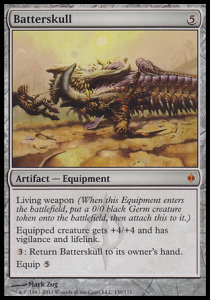
batterskull

Count Your Many Bannings

Smarter people than me have talked about this before, but there are some cards on the Modern banned list that could theoretically come off. There are some, however, that are clear development errors that will literally never see the light of day in Modern. If your Magic background is not very deep, and you don’t have familiarity with all of these cards, then it may be difficult to tell the difference. The small run on Skullclamp last year is an example of people thinking that a card they weren’t familiar with contextually could come off the list. We are going to highlight the cards on the current list and briefly touch on whether or not they are candidates to make it back.

[card]Ancestral Vision[/card]: This could come off, possibly soon. The card trades cost for time, which means that combo decks can’t abuse it without either having to delay going off or target a single turn for attempting to go off. It’s a card that fits more with control, which prefers raw draw power to filtering, but I think the biggest fear is that combo would somehow appropriate it, which would land it back in the penalty box.

[card]Birthing Pod[/card]: I have surprisingly little experience with this deck, with or against it. I could see it coming back as a potential shot in the arm if popularity wanes in the long term, or if people complain too much about it leaving. The format is probably better without it, though.

[card]Blazing Shoal[/card]: This was allowing players to combo off as early as turn 2 in GP Philly. Fragile or not, that’s good enough to get a life sentence in Modern.

[card]Bloodbraid Elf[/card]: Cascade is so good that I’m surprised we are allowed to have [card]Captured Sunlight[/card]. This is not the card that made Jund the menace it was, but it did let a middle schooler top eight a standard GP. One of the more likely candidates to come off the list, if just by virtue of how many are here for life.

[card]Chrome Mox[/card]: I wish I could tell you that Chrome Mox fought the good fight, and WOTC let it get unbanned. I wish I could tell you that, but Modern is no fairy tale world. This card would give Storm more ritual mana (although at the cost of another card), and I think currently Wizards wants to play it safe. I like the card, but I’m not gonna get my hopes up.

[card]Cloudpost[/card]: My first Modern deck was 12=Post, and it was fun. That said, Cloudpost is very unlikely to come back—the Tron engine has a fairer drawback system, while still rewarding you for playing situationally terrible lands.

[card]Dark Depths[/card]: Now that this card has two ways of going off ([card]Thespian’s Stage[/card] and [card]Vampire Hexmage[/card]), I think it’s safe to say Depths won’t be coming back ever, especially since the Stage route is counter-proof.

[card]Deathrite Shaman[/card]: This is the card that made Jund what it was, and he is going to be locked up for a very long time. This card is way too good.

[card]Dread Return[/card]: This is one of the key pieces that the dredge/sundry graveyard strategies are missing. Dread Return won’t come back, because several other things (including the recently paroled [card]Golgari Grave-Troll[/card]) would have to simultaneously get locked back up.

[card]Glimpse of Nature[/card]: All the other pieces for Elves are already in Modern (besides Cradle, which is admittedly a big one), but the deck doesn’t see play. I’m afraid WotC may someday unban this as a litmus test, where they will discover that it is still way too good. Regardless of your opinions on the card, I think it is too expensive as a buy-in for a “maybe someday” gain.

[card]Great Furnace[/card] (and the other artifact lands): I would actually like to see Great Furnace come off the list—not the whole set, just Furnace. There is some utility to playing four in mono-red, which was a thing in Extended to turn on [card]Shrapnel Blast[/card]. Affinity (or Robots, or whatever) makes this extremely unlikely. Sorry, guys, you’re too much of a developmental whoopsy.

[card]Green Sun’s Zenith[/card]: Be thankful you have Chord of Calling. I’d like to see this card come back, but it does something that Wizards doesn’t really like to have in the spotlight so often, and it creates repititive game states.

[card]Hypergenesis[/card]: Wizards wants the crucial turn in Modern to be roughly turn four, and this is a turn-three combo. Sorry, but at least [card]Living End[/card] is a thing?

[card]Jace, the Mind Sculptor[/card]: Seriously?

[card]Mental Misstep[/card]: If they won’t let you play it in Legacy, you probably won’t get to play it in Modern. To quote High Fidelity: “It was like trying to borrow a dollar, getting turned down, and asking for 50 grand instead.”

[card]Preordain[/card]: Somehow this card is not restricted in Vintage. Long story short, it makes Storm and the other combo decks just a bit too consistent. Sorry not sorry.

[card]Ponder[/card]: See above, except this one is restricted in Vintage.

[card]Punishing Fire[/card]: This pushes aggro decks out of the format, so while development-wise it is fine on its own, having [card]Grove of the Burnwillows[/card] makes this a bit too oppressive.

[card]Rite of Flame[/card]: Ha, yeah right.

[card]Second Sunrise[/card]: Rather than play a statistically significant amount of matches to determine whether Second Sunrise is safe for unbanning, many Wizards employees would rather kill themselves.

[card]Seething Song[/card]: See also: Rite of Flame.

[card]Sensei’s Divining Top[/card]: HAHAHAHAHAHAHAHAHAHAHAHA.

[card]Stoneforge Mystic[/card]: We talked about her earlier. Ain’t ever happening.

[card]Skullclamp[/card]: The day of Regionals in 2004, I added a few of these to my cleric combo deck. The sheer increase in speed was indescribable. I knew then that this card was never meant to see print as is. You’re lucky they let you play this in Commander.

[card]Sword of the Meek[/card]: Maybe? The fact of the matter is, this combo is not as scary or oppressive as people viewed it before, and the decks it was good in were primarily using it as a back-up plan for Dark Depths. Financially, it’s not a great target since it’s just an uncommon, and the deck is probably not good enough to push out Splinter Twin or other, better combo kills.

[card]Treasure Cruise[/card]: See also: Mental Misstep.

[card]Dig Through Time[/card]: This is some sort of Minority Report precog thing, where Organized Play saw a grim future of Dig Through Time just taking over the Treasure Cruise slot. I strongly doubt either come back.

I have to say, looking at this list and breaking it down card by card, it feels like Wizards has got a better feel for the format a couple years in. I don’t have any major issues with it as is, and nothing on the list desperately feels like it needs to come off. Let’s finish off this bad boy (we had a long one today! [Ed. note: I’ll say]) with some Quick Hits.

quick-hits

http://paulblow.tripod.com/quick-hits.jpg

Quick Hits

  • One of the undermentioned features of PucaTrade is that you are able to send and receive cards immediately, in terms of prereleases. You can out the stuff you expect to fall, and people can send you what you want so your deck is ready in time for the first FNM! I got a [card]Brutal Hordechief[/card] mailed out at 6 a.m. Saturday morning, and it was here Tuesday.
  • Speaking of Brutal Hordechief, if you have him, assign blockers to your Heir of the Wilds—then you get to just kill their two or three best dudes.
  • [card]Golgari Grave-Troll[/card] sets are selling for silly amounts. My-friend-and-local-store-owner Eric and I were watching his get bought up Monday. I do not expect the card to have an immediate impact on the format, but you may see more graveyard decks in your local Modern tournaments. [card]Leyline of the Void[/card] and [card]Rest in Peace[/card] haven’t had big upticks in price, and I doubt they will, but they’re the two best tools for fighting Dredge.
  • I literally just discovered the card [card]Sudden Reclamation[/card], and I am in love. It doesn’t really go in anything, but I need about 100 JP Foil copies just in case.
  • Am I the only one guilty of this? I see a card, usually an uncommon, and I think, “Eh, card’s not that good.” Then I see a JP foil copy of that uncommon, and I think, “Hey, maybe that’s a spicy one of!” I am not good at decks.
  • I always appreciate your feedback!

Best,

Ross

 

1I hate that DailyMTG updates at 11 AM EST now, EXCEPT for the fact that these announcements are no longer made at midnight.

2Scary to think about how many poor decisions can be made in the wake of success.

Conjured Currency #46: A Modern Modern Format

One of the downsides of my writing deadline being Tuesday evening is that my articles can’t go up until Thursday morning. In a world where a new influx of information causes prices to spike hundreds of percentage points in a matter of hours, a two-day delay is less than helpful for in-the-moment action. This past Monday, Wizards of the Coast announced that [card]Birthing Pod[/card], [card]Treasure Cruise[/card], and [card]Dig Through Time[/card] were banned in Modern. At the same time, [card]Worldgorger Dragon[/card] dusted off its wings to rejoin the Legacy crowd, and [card]Golgari Grave-Troll[/card] (GGT) gets to shamble into Modern decks for the first time since the format’s inception. 

This is obviously old news to anyone reading, so there’s not any money to be made buying the two cards that got unbanned. Grave-troll and Dragon both jumped to $10 within hours of being unleashed, and my Duel Deck copies of GGT were quickly selling on TCGplayer for $8 each. Is Dredge a viable deck in Modern without [card]Dread Return[/card]? I have no idea, but I think there’s room for GGT to slowly drop until there’s an actual performing list confirmed at an event.

If there is a graveyard-based deck fueled by GGT, there are some peripheral cards to keep an eye on. [card]Vengevine[/card] is the most obvious one, and already jumped a few dollars from $12 to $15 with the help of some hype-train fuel. I’m still comfortable trading for them at the current price, because there are so many people wanting to brew new lists, and you have an easy out in this wild west format. In the best case scenario, there’s a real deck and you get to jump out at $20 or $25. Worst case scenario, nothing happens and you trade them to the people on PucaTrade who still want to build a tier-two deck because [card]Birthing Pod[/card] is no longer a thing.

PucaPriced

Speaking of PucaTrade, I want to talk for a moment about why using the website to grab currently underpriced cards (or to speculate on future price changes) is not the best use of your time or money. If you’ve never heard of PucaTrade, you can check it out and sign up here, or read this one for a relatively recent and well-thought out article on the “how-to” aspect of the website.

If you saw that [card]Bloodbraid Elf[/card] foils were climbing in the weeks prior to the banned and restricted update, you might have looked at their PucaTrade price and thought, “Wow, Alara Reborn foil BBEs are only $3.99 in PucaPoints, but they’re $15 on TCGplayer! I’ll just add them to my want list, and some sucker will ship me those Bloodbraid Elves so I can resell them for a huge profit!”

If you weren’t one of the players with that line of thought, let me explain how that worked out for them: First of all, there’s an extremely low likelihood that many (if any) 399-point Elves were shipped. Why, you ask? Because the one guy who happens to have the card notices on his send-a-card page that there are twenty other users who all want the card at once. That’s enough of an alarm bell for anyone to check the current price of the card, and see what all the fuss is about.

Anyone who ended up not getting those foil BBEs are the lucky ones. On PucaTrade, there’s no setting to remove a card from your want list when the system updates and changes the price of the card. If you had $20 worth of PucaPoints, and wanted five BBEs for the purpose of speculating or flipping,  you might be shocked when the system updates while you’re sleeping, and the price correction occurs. Now they’re worth the correct value of 1000 points, and more people are willing to send them. But you didn’t want them to play with, you wanted to speculate. The unlucky players got stuck with normally priced cards that they can’t unload, because the hype is over.

Untitled

What’s the Next Spike?

Now let’s go back to speculating. Everyone loves speculating, right? The feeling of being correct on a spec is so much fun, everyone wants to be ahead of the trend and one of the cool kids. I’ve mentioned before that I no longer buy cards for speculative purposes, and that’s still true. However, I’ll throw around some ideas on what could happen to the prices of certain cards now that the format got turned upside down.

[card]Bloodghast[/card] seems like an obvious inclusion to the Dredgevine deck, but it’s already $9 on casual graveyard/vampire appeal by itself. To complement that, I believe it’s a strong inclusion possibility in Modern Masters 2015. My belief is that MM15 will involve a heavy landfall theme, complete with Zendikar fetches and a high percentage of Zendikar-block cards, akin to the original MMA’s focus on Future Sight and Suspend. I’m actually selling Bloodghast, and hoping to avoid a reprint bomb this summer. I don’t see much upside to buying in now, especially if nothing comes of the deck

Untitled

[card]Faithless Looting[/card] foils can be found on TCGplayer for as low as $3, and that just doesn’t seem correct to me. It’s from a small set that wasn’t opened much, it sees play in a couple Legacy and Modern decks, and will be a likely edition to any new brew that features GGT. While there is a comic book promo that hovers around the same price, that promo is not foil. If there’s any deck at all to support Grave-Troll, I can see foil Lootings trending up to $7 to $10. I’d buy them if you’re going to play with them, and trade for them aggressively if you’re looking to speculate.

[card]Snapcaster Mage[/card] was a pretty obvious pick-up with the details of Modern Masters 2015 being revealed, because the cards added to the set stop right before Innistrad. However, Snap has the potential to become even stronger in the new Modern metagame, due to the fact that all of his targets won’t be costing eight or being delved away. These seem like strong pickups via trading at $30 to $33, holding until at least $40.

[card]Animate Dead[/card] is only $1 for its cheapest edition, and it hasn’t moved in the days since the dark day that Pod left this Ear—er, I mean the bannings. It used to be the other piece of the combo with [card]Worldgorger Dragon[/card], where you would make infinite mana by tapping your lands before they were exiled over and over, and eventually do something silly to kill your opponent. That was God knows how many years ago (seriously, I tried a few Google searches and can’t even find how long Worldgorger has been banned), and nowadays we have the ability to put Emrakuls and Griselbrands into play, who just win the game by turning sideways once or twice. I don’t think Worldgorger makes the cut in Legacy anymore, and will go the way of [card]Land Tax[/card]. I don’t recommend speculating on any of the old or new Worldgorger pieces like [card]Entomb[/card], [card]Dance of the Dead[/card], or [card]Necromancy[/card], and sell any Worldgorgers that you have.

Image

Don’t even think about it.

While there are some great speculation targets out there, I’d like to point out that there won’t be anything to replace [card]Birthing Pod[/card]’s slot in the deck. Does that sound obvious to you? It should, but I recently saw a Facebook post on my feed that suggested [card]Yisan, the Wandering Bard[/card] as a spec target to replace Pod in Modern. Please don’t buy copies of that card expecting them to be played. It costs a lot more mana, a lot more time, and is much easier to kill than Pod.

Sleeping Banned Cards

We’ve already learned from past experiences, such as [card]Wild Nacatl[/card] and [card]Bitterblossom[/card], that a card doesn’t have to make an impact on a format to shoot up in price after its unbanning. GGT and Worldgorger were both sleeping in $1 boxes, and weren’t on many people’s radars. They were easy to pick up, and had very low risk of dropping in price during their slumbers. Suddenly, they became easy money and profit. Since we’re already on the subject, let’s take a look at the Modern banned list for cards that also have low risk and might eventually be unbanned.

[card]Sword of the Meek[/card] stands out to me the most in this situation. Back in the day, it was known for comboing with [card]Thopter Foundry[/card] in order to create an engine of flying creatures and life, and being exceedingly hard for aggressive decks to break through. I can imagine that a shell nowadays might include [card]Tezzeret, Agent of Bolas[/card] for an easy tutor package and fast win condition. However, Modern is a format where you can easily get blown out on turn four by [card]Splinter Twin[/card], or torn to pieces by a [card]Delver of Secrets[/card] while having all of your spells denied by cheap countermagic. Even [card]Siege Rhino[/card] will likely trample through the banning of Birthing Pod and live on in an Abzan shell of some sort. I don’t think that the Thopter-Sword combo stands to overshadow this type of metagame, and I wouldn’t be surprised to see it come off the banned list at the next update. Although the card is an uncommon, it’s also from Future Sight with no alternate printings. An unbanning could see us into a world of $10 Swords, just like with our rare friends this time around. I’m definitely willing to invest in these in trades at $1 each.

Untitled

[card]Jace, the Mind Sculptor[/card]. Big Jace. One of the most iconic cards printed in recent memory, Jace never even had a chance to shine in Modern, as he was slapped with a BANNED sticker as soon as the format came to exist. Is that correct? This single topic probably holds enough discussion to produce an entirely separate article, but I’ll keep it to a minimum here. Personally, I don’t think it’s correct for Jace to come off the banned list, and I wouldn’t recommend trading into him expecting him to be unbanned. Even if his power level isn’t oppressive to the format, I’d argue that Wizards doesn’t want another Tarmogoyf-level price running around if they have the ability to contain it. While they can’t ban ‘Goyf at this point, they can take a passive approach to keeping the Mind Sculptor inside his cage.

Predicting Future Bannings

It’s not exactly a secret that I love [card]Birthing Pod[/card], and I’ll admit that I still have quite a few copies that are leaving a bad taste in my mouth right now. I took apart my Modern deck several months ago, but didn’t end up getting rid of very many Pods since then. Whoops. When I pieced out Kiki-Pod, I rationalized that Pod could very well be banned in the Khans of Tarkir update. To support my claim, I looked to the reason that Wizards of the Coast decided to ban [card]Green Sun’s Zenith[/card]:

On turn one, this can give the acceleration of a Llanowar Elves by getting a Dryad Arbor. On later turns, it can get a large creature or a one-of “toolbox” creature such as Gaddock Teeg. While this is interesting, it is also too efficient. If one intends to build a deck that has turn-one accelerants, Green Sun’s Zenith is a great choice. If one wants to more access to utility green creatures, Green Sun’s Zenith is a great choice. If one wants to more reliably get a large green creature, such as a Primeval Titan, onto the battlefield, Green Sun’s Zenith is a great choice. However, this ends up with fewer different decks being played in practice, as Green Sun’s Zenith is such a good choice that there are fewer green decks that do anything else. The DCI hopes that banning Green Sun’s Zenith increases diversity among Modern green decks.

Although Pod can’t tutor on turn one, it certainly spawned its own family of decks over the course of its lifetime: Melira Pod, Kiki-Pod, Spike Feeder Pod, eventually ending up with Rhino Pod. There were only really two or three different green shells in the entire format, and Pod was almost mandatory if you wanted to compete on the highest level of play—similar to how GSZ was in 2011. Looking back, I should have realized that the time for Pod was coming to an end and gotten rid of my copies a long time ago. While hindsight is 20/20, it’s still important to use this information and look towards the future as to what might be banned. That’s nearly impossible to do in a brand new format like this one, but it should still be kept in mind as the format develops. Go back and read the past updates to the banned and restricted lists, and find cards that tend to break the goals that Wizards has set for the format.

Restricting my Word Count

Normally I hate going over 2,000 words for fear of boring my readers, but the banned and restricted list updates are definitely worth going the extra mile for, especially when there’s a lot of interesting information to digest. Do you have a personal spec target based on the result of these bannings? Are you going to tell me to buy Yisan? Do you think JTMS has earned parole? Tell me more.

Commanding Opinion: Stitcher Geralf, Ghoulcaller Gisa, and the Innistrad Storyline

Before I begin, I should introduce myself. I’m David Rowell, formerly SolemnParty over at WinTargetGame, where I began the Commanding Opinion series a few years ago and never quite got to where I wanted to with it. A couple of months ago, the site finally closed down for good. While some of my old articles are at Life… Successfully, Brainstorm Brewery is the new home of my articles. If you want a sneak peak of some of the articles I’ll be uploading here, or if you just want to take a look at my brother’s writing, check the gaming section out.

I’ve been playing Magic only since New Phyrexia—the first event that I ever played in was a New Phyrexia Sealed event that I ended placing eighth out of forty-something people with a decent pool (all I remember for sure is a foil [card]Carnifex Demon[/card] and a [card]Molten-Tail Masticore[/card]). I wasn’t entirely new to competitive card games. I had played Yu-Gi-Oh! for a few years (gave up a little after Synchro Monsters were introduced) and then played the Pokemon TCG competitively for quite a while (which I ended up dropping for Magic due to the erratic rotation cycle of Pokemon).

After that, I played Standard for quite a while, playing junky decks and then finally leaving Standard after the rotation of [card]Birthing Pod[/card], and that’s when I truly got into Commander. My brother bought all five of the original Commander pre-cons, and I immediately fell in love with the format. The first deck I ever built from scratch was a [card]Nicol Bolas[/card] Commander deck (which quickly turned into [card]Sedris, the Traitor King[/card] after playing in a Commander league with that deck and never playing Nicol Bolas). Sometimes I’ve gotten up to 10 decks at one time.

Although I started in New Phyrexia, the first full block I really played was Innistrad. I had just started writing for WinTargetGame when the set was announced, and I was throwing spoilers out like crazy. However, I kept seeing a couple names that never got used to their full potential: Geralf and Gisa. All we knew about them from the set was that they were necromancers, and that Geralf was some kind of Dr. Frankenstein.

Victor Frankenstein - Once Upon a Time

Geralf has a uncanny resemblance to this particular version of Frankenstein…

I’ll be doing double duty in these first few installments, talking about both [card]Stitcher Geralf[/card] and [card]Ghoulcaller Gisa[/card]—but I’ll be starting with their stories.

Tell Us About Geralf and Gisa, David

Little is known of their actual origins, besides that Geralf and Gisa are brother and sister who are cousins to [card]Mikaeus, the Lunarch[/card]. They were essentially two sides of a coin: Geralf embodied the blue aspect of Innistrad’s zombies by being a mad scientist, stitching corpses together to his own ends, while Gisa was a necromancer, just animating bodies to torment the living.

The flavor of Innistrad’s blue-black zombie tribe was to encompass all different kinds of zombies. The blue aspect was that of Frankenstein: beings stitched together from corpses and given life through lightning or magic. These zombies tended to be stronger and more intelligent, as the stitcher can use only the best materials if they so wish. The black aspect was that of the more modern zombies: the slow, shambling zombies of Dawn of the Dead that just exist to kill the living.

Before the siege of Thraben, Geralf and Gisa simply played games, called the Moorland Necrowars. They waged their necromantic armies against each other to see who the better ruler of the undead was. Seeing as there were no deaths (well, aside from those necessary to make the zombies and skaabs), these really were practically games. Of course, any living humans in the way would be turned into more corpses for future contests. But eventually, the siblings moved beyond simple fun and games.

Together, they agreed to take down one of the few sanctuaries for living human kind: Thraben. They created Grimgrin, a giant zombie the height of two men that easily took down the gates of Thraben by himself. Their goal was to conquer the city and to kill [card]Mikaeus, the Lunarch[/card], so that Geralf could become the ruler of Thraben itself.

This plan failed. [card]Thalia, Guardian of Thraben[/card], managed to rally her forces and fight back the undead overcoming the city. Sadly, [card]Mikaeus, the Lunarch[/card] was still killed by Geralf, but the city was in no state for him to take it for himself. At this point, he met [card]Liliana Vess[/card], who showed great interest in the corpse of the Lunarch. Being a necromancer, we can already assume where that led.

But enough of that. Let’s talk about the cards.

How Good are They?

Stitcher Geralf

[card]Stitcher Geralf[/card] is a 3/4 legendary human wizard for 3UU. Solid typing, stats, and costing.  3UU is a little on the high side for a commander, but his deck doesn’t need to revolve around him. His ability is unique, but similar to Gisa’s: for 2U and tap,  each player sends the top three cards of their decks to the graveyard, and then you can exile up to two creature cards milled this way to stitch together a zombie with power and toughness equal to the total power of the creatures exiled this way.

One thing to note about this ability is that you can exile eldrazi with it before they are able to shuffle back into the library. Overall, Geralf is a pretty solid mill commander compared to something like [card]Amabassador Laquatus[/card], who isn’t bad, but isn’t anything special, either.

From a flavor standpoint, I really like the fact that Geralf literally stitches the zombie tokens together from the creatures that are milled with his ability. It captures his Frankenstein vibe really well. The only problem I have is that he is mono-blue—there are so few mono-blue zombies that a zombie tribal deck with him as a Commander isn’t very good, and blue also tends to have the smallest (and least) creatures when it comes to any mono-colored deck. He works well alongside his sister, though.

ghoulcaller gisa

[card]Ghoulcaller Gisa[/card] was revealed before her brother, and I like her a little bit more.

For 3BB, you get a 3/4 Legendary Human Wizard—the same stats as her brother, she’s just black instead of blue. Her ability is also pretty decent, like her brother’s. For B, tap, sacrifice a creature, you get a number of 2/2 zombie creatures equal to the power of the creature you sacrificed.

Again, I love the flavor of this card. Gisa just wants as many zombies as possible to overwhelm humanity, rather than stitching fewer, stronger zombies together.

She actually works very well with her brother: he makes a huge zombie with his ability, and then Gisa breaks his huge zombie down into a ton of 2/2 zombies. I’m not exactly sure how two things stitched together give rise to a whole ton of things not stitched together, but I”m not going to complain about flavor when the synergy is so powerful.

In the few installments, we’ll be talking about the individual commanders, and after that, what they can do together.

Until next time,

–David Rowell


Diary of a Former-but-Relapsing Competitive Player

A little-known fact about me: I am not much of a writer.  Growing up, everything came fairly easy to me in terms of school. A perfect storm of introversion and private schools during my elementary years made the remainder a bit of a cake walk once I moved to a rural public school. College taught me a few lessons about how to formulate thoughts and process what I can only declare as a circus that runs through my head when I go to type.

Fast forward a few years to a chance meeting with Kelly Reid, at that point an orchestrator of an idea and vision in the form of Quiet Speculation.  I found Kelly to be one of the more fascinating people I had met within the finance community.  After our first encounter, I touched base with him again, and the results can be found in the archives of both Quiet Speculation and Gathering Magic.  Before this point, I was more of a limited PTQ grinder who utilized Magic as a way to fund his hobby—and sometimes himself during rough times. Over the years, I have grown more distant from Kelly, but if he reads this, I just want to tip my hat in his direction for getting me motivated and in some way thank him for what I have now.

quietspeculation

I knew how the game worked, and though I am not savvy with technology in most senses, I was very good at being who I needed to be at that point, and an online presence was not that far of a stretch. I have rarely been the best at many things—I tend to excel in most areas of life but rarely master more than what is needed to be proficient. I don’t believe I will ever be a world champion or the leading role in anything, but I will be there competing. Even if I may not be the best in the room, I understand how to study situations and derive the best odds of success.

This idea that I will likely never be the top dog is a major part of what drove me from Magic competitively in the first place: the idea that I had finally gotten to the Pro Tour and fell short of anything but mediocrity. After a conversation and a weekend of bad beats, I brought things back around as I always seem to manage, and began expanding Magic finance to be more than just a hobby. I have found a sense of love for this game and this community I did not fully realize while I lived it all those years as a kid.

As a quick aside for anyone who does not visit card shops on a regular basis or takes issue with a kid hanging out there too often, I beg you to reassess the situation.  It is one thing if you do not have time, but if you believe you enjoy Magic enough to want to share that concept, I urge you to visit an LGS on a semi-regular basis. The first time I walked into a real game store, now long since closed, I remember taking it all in, everything from the Spawn action figures to the wall of comics.  Though I was entranced in the moment, it was not until much later I would realize just how much this place would mean to me. Though most of these people will fade from your life, it is amazing how many will remain. Even after Magic fades from the forefront, these friends will still be there.  It has been a number of years now since I have been a regular patron of any one store, but there were periods of my life that I spent more time in those stores than at home or work: it just begins to feel more comfortable.

tirelessmissionaries

Given my clear enthusiasm for the group of people I now call friends, and for every other group out there just like us, that is what has kept me going all these years.  I still in many ways love the game. I just put a Commander deck together to start playing again and managed to make a PTQ this weekend. Which, as it happens, is what has brought me once again to this place: the keyboard beckons.

When I decided to quit, I stashed most of my reasoning away, it was easy to claim that I just found finance to be more profitable, and believe me, it is. The honest truth is that I did not think I had what it took to be at the top level of play at that point in my life. I still do not believe I will ever be the first rank or even the second, but these past five years of refocus have taught me a great deal about myself as a competitor. I do not want to turn this into a tournament report, but I think a few things clicked this weekend and the moments require some insight into what I have been doing as a competitive player.

masterwarcraft

Anyone who reads my series on Gathering Magic already knows that I have been changing some of my focus from the world of finance back to the more competitive scene. This started as a bit of an experiment to liven up the series. No one needs basic lessons anymore, and for everything else I can teach, so few people would be able to utilize the information that it hardly demands a regular series. I figured if I started to play more Magic Online, I would be a little more in tune with the average player as far as Standard pricing was concerned.

Though my series has certainly helped me, and everyone else I hope, it has also given my competitive nature a taste of the game again and, as anticipated, it had a bit of cabin fever. The first outlet was to get a Standard deck built. I had not realized this before finding U/W Heroic, but I don’t know that I have ever played a Standard net deck that fit my play style until now.  Who would have thought I would be mimicking Craig Wescoe when I am such a diehard combo player? But this is something I can get behind.  I always used to be a strictly Limited player until Pro Tour Kyoto when I was forced to pick up Boat Brew having never played a game before getting on the plane. I borrowed the deck from a friend, as I was a broke college kid, and it went about as well as one could hope given how little experience I had.

I am not terrible at Constructed. In fact, I am likely better at Constructed than Limited if given the right deck. Any Legacy combo will keep me interested, and finding lines of play that do not seem plausible or calculating odds and mana is right up my alley.  Of course, it is rare we get a playable combo in Standard so when Jeskai Ascendency combo was revealed, I was instantly locked in. Then, between a few hundred games and some rough beats with the deck, I switched to U/W and up until this weekend, have just been running well online quietly.

quietcontemplation

Then on Friday night, Ray Perez convinced me to go play in FNM. It was nice to be back in that shop atmosphere again. Over the past year, I have not had much access or time, so I was grateful for the opportunity, and I believe that lent itself well to my mood going into Saturday.

The early morning feeling of being half dead as you drag yourself to the car for the two-hour drive is one you will always hate in the moment but miss down the road. As I managed to fight the urge to sleep much more, we talked shop and got crazy in the car on our way to Fort Wayne. In these moments, I regret nothing. There may or may not have been some twisted version of karaoke, or whatever you want to call it.

On site, we got locked in and after walking the vendor line, it was clear I was solely here to play—no need to work this weekend.  I managed to dispatch my first opponent without much issue and my confidence finally hit a little bit of a spike. Up until that point, I have kind of looked at myself as this washed-up player who quit years ago: we are our own toughest critics, they say.

From this point, I remember getting rocked two rounds in a row. The first was by old-school Jeskai: [card]Mantis Rider[/card]s, Stormbreaths, and the ilk. I pulled out game one but lost two and three while having him near lethal both games. I always feel like I made a mistake if my opponent beats me while at one, but I have replayed this game in my head more than Nassif’s topdeck, and I cannot find it.

cruelultimatum

The next round, I had to make a few mulligans and dropped two quick games to what I have decided is the toll of playing my list.  I found that I regularly drop a game out of every twenty or so to the fact that my land count is so low. This leads to excessive mulligans, and in this case, they sadly both managed to be in the same round.

This was the real breaking point for me. I was certainly out of top eight given how bad my breaks would be, but I realized I didn’t care. A few months ago, I played an event and quickly dropped after falling from contention in the first few rounds. Disappointed and ashamed, I went to work when I got home, testing like crazy. This event, however, I wanted to play. I felt like I made no play mistakes in either match and was not ready to call it there. From that point, I rallied and ended 5-2: enough for thirteenth place. Sure, it wasn’t the top eight I was hoping for, but if it was going to be my last run, it was at least respectable.

With each Ordeal played correctly and each bluffed counter, I felt myself gaining more confidence. Much like the power and toughness of the creatures I was voltroning, so too did my confidence grow. I announced every trigger (a skill these past few years of Magic Online has helped with), I managed every point of damage, and I saw lines I would have otherwise missed, given how little play time I normally have with a deck. By the end of the day, even with the disappointment the morning brought, I was the second best in the car on the way home. That thought inspired me to do better next time, but I did not let not being first-best consume me. We exchanged stories, enjoyed impromptu karaoke again, and found ourselves back home.

imprompturaid

The truth is the passion to play has never faded. Every time I hear the announcement for round one pairings, part of me mentally wanders to go check for my name. I always quickly snap to reality, but it never fails: for that split second, I remember the rush.

This weekend brought more than just that back. It also brought an understanding I lacked five years ago: sometimes showing up to compete is all that matters. Before, I did not just want to play—I had to win. That mentality was unhealthy and was a burden I put on myself.  Plain and simple, I quit enjoying the game. For the past five years, I have driven myself from situations in which that matters, taking up new hobbies I know I cannot be the best at and focusing on work.

But it has all come full circle now. I feel it may be time to give it another shot. I no longer need to work 70 hours a week or go to every event to work. I do not know that I have what it takes to compete again at the highest levels, but I know if I spend enough time dedicated to working on it, I can at the very least find out. For me, it is no longer about winning, it is about finding my passion for the game itself again—something I have been missing for a many years.

I do not know how I will move forward with this. Perhaps a new series or maybe a new podcast, but I know the only way I will dedicate myself to something is to write it down and get it done. As much as I am writing this to help readers, it is also something I’m doing to inspire myself. I do not intend to be the best in the world, and I am alright with that now. I just feel that I knew there would come a time and a place for me to start again—no one quits forever.

I have an understanding of competitive Magic outside of the percentages. No longer do I feel the need to win with my own brew. The drive to win is not there in the same capacity, but it is crawling out of the cellar, slowly. I do not know that I will move toward the PPTQ scene, as that is a bit rough on my schedule, but I will be looking to play in more Opens this coming year. It will take some time to knock the rust off, and I have wavered greatly this past year on if this is even what I wanted, but after this weekend, I don’t think I can sit back and play casual Magic any longer.