
Episode Archives

Blackhat

A taut, cat-and-mouse tech thriller set in the aftermath of a fictional but plausible attack on a Chinese nuclear reactor, Michael Mann’s Blackhat is easily the most underrated movie of 2015. The January release of the film makes it easy to make such a declaration, but a combination of trailer that was far from compelling and its release in January, historically a graveyard for mediocre film projects (the exception being the critically-lauded American Sniper which became the second film in a week to become the “highest grossing January release ever” after the banal and predictable Taken 3) have all but condemned the film to obscurity. The film deserved better, but its release speaks to Hollywood’s tiring of Michael Mann’s shtick as much as the merits of the film itself.

Love it or hate it, Michael Mann has a shtick. His penchant for formulaic protagonists and an almost pathological adherence to the same major plot points have earned him both acclaim as a technically proficient and successful director and also, as Slate film critic Daniel Engber put it so eloquently, “Hollywood’s greatest hack.” In Engber’s view, the greatest feat of hacking in Blackhat isn’t accomplished at a computer terminal but rather behind the camera. Is Engber right? Well, yes, and I’m not going to argue that. That’s actually not an altogether bad thing.

The word “hack” has negative connotation but there is a bit more nuance to its use than is typically applied. The dictionary definition of a hack is “a writer or journalist producing dull, unoriginal work”. It’s impossible to discuss Mann’s work, even to laud him, without confronting the fact that it’s not terribly original.  After all, being discussed is a director who literally made the same movie twice; 1989’s made-for-TV film LA Takedown amounted to little more than the rough draft for the full-length motion picture that was released as 1995’s Heat, a film that earned both critical acclaim and $70 million at the box office in the United States alone. Not content with the legacy of Miami Vice as one of the 1980s most entertaining television series Mann inspired himself to make a Miami Vice motion picture, set in 2006 and complete with a modern cover to Genesis’ “In the air tonight”, the musical backdrop to one of the television program’s most memorable scenes. The film hardly broke new ground or tied up loose ends, rather it was a cash-grab reboot of the series which ran from 1984-1990 which banked on appealing to nostalgia. Bank on nostaliga it did, grossing $63 million domestically (impressive but less than half of its reported $135 million runaway budget). If all Michael Mann seems to want to do is tell the same story over and over again, why do we keep letting him?

The answer is that even though Mann relies on a lot of the same tropes and tricks, it’s unfair to say he hasn’t matured as a filmmaker. Nowhere is that more evident than in Blackhat, a film that applies the “Mann filter” to the most ambitious story to date. Rather than chronicle the activities of a police department trying to catch drug runners and pimps or detail the “catch me if you can” story of a medium-time crook and the cops who want to nail him (a trope seen in 1981’s Thief, 1986’s Manhunter and, most famously, 1995’s Heat) Blackhat is the story of a grandiose world domination plot that spans the entire globe. In a lot of ways the complexity of the story shows development in the kinds of projects Mann wants to tackle and in others, Blackhat feels like branching too far out of his comfort zone makes it seem like he is in over his head.

Make no mistake; Blackhat is vintage Mann. All of his signatures are present from his gorgeous, helicopter-assisted establishing shots of the vibrant lights of a bustling metropolis cutting through the night sky to his use of a crescendo of synthesizer music to punctuate pauses in conversation, especially when the male protagonist first meets the love interest. The film is an ecstatic visual feast and every scene in the 148 minutes is integral to the plot even if every shot is not. No one sets a mood better than Mann who has mastered the art of using low-light filters and a lot of nighttime shots to make even a city as large as Los Angeles seem utterly abandoned and the characters in it utterly alone. Mann’s up to all of his old tricks and fans of his work will feel right at home in the mood he creates, a real feat if you consider how the backdrop shifts rapidly to cities all around the globe, a real departure from his conventional film which is usually encapsulated in one major city. As much as a lot of the film felt old and familiar, though, a lot felt new, and that wasn’t always a good thing.

Tom Cruise in Collateral

Blackhat centers around a sudden cyber attack on a nuclear facility and the involvement of the one man who can bring the perpetrator to justice; played by “Thor” himself, Chris Hemsworth. Hemsworth’s Nick Hathaway is in the physical condition of his life and up-to-date on all of the latest technological advancements despite spending years locked in a maximum security prison, a facility which doesn’t manage to stop him from using a smuggled cell phone to get up to hijinks like hacking into the prison’s commissary to pad the balances of himself and his friends. As adept a hacker as ever, Hathaway is also lethal in hand to hand combat and nearly indestructible which he demonstrates in scenes where he fights off several armed thugs in a Chinese restaurant or survives the extreme heat of the control room in the damaged nuclear reactor while everyone else is succumbing to heat stroke. This is familiar fare for Hemsworth who is used to portraying the omnipotent, handsome lead in Hollywood movies who can shrug off bullets and keep his hair perfectly coiffed. It’s unfamiliar ground for Mann, though, a director who is used to keeping the odds more heavily stacked against the protagonist. The real threat to Hathaway in Blackhat is uncertainty and the knowledge that if he fails to bring the perpetrator to justice, his chances of getting his prison sentence commuted vanish.

DeNiro in Heat

It’s apparent that Mann is in unfamiliar territory with the story arc of the character and Hathaway is treated differently than almost any Mann film protagonist ever. Two of the best Mann protagonists are undoubtedly Collateral’s Vincent played by Tom Cruise and Heat‘s Neil McCauley played by Robert DeNiro (though Mann borrowed the name “Vincent” from Pacino’s Heat character, Detective Vincent Hanna; he borrows from himself quite a bit). Part of what made those characters so compelling was the dispassionate way Mann told the story from the side of the criminal and how his refusal to condemn those characters cloaked them in a kind of moral ambiguity. Mann went even farther, cloaking them in a costume that personified the moral grey area quite literally. The characters in both Heat and Collateral wear an identical grey suit in a not-so-subtle blurring of the line between black and white, good and evil.

No such nuance exists in Blackhat’s Hathaway who spends the entire film clad in clean, pastel shirts and khakis that make him look more like a cashier at Banana Republic than a convicted computer hacker doing hard time in a super max when he’s not getting out on furlough to engage in hand-to-hand combat with thugs and foil global terrorism plots.

Speaking of the terrorism plot, it’s a much more ambitious premise than Mann’s used to tackling and feels more like it should have been left up to James Bond to thwart, not an MIT dropout and his college roommate. The sheer grandiosity of the plot that reveals itself slowly as the heroes chip away at its layers and try to get to its heart feels like an unwelcome departure from Mann’s usual fare. I was reminded of the movie Adaptation where Charlie Kauffman created a fictional twin brother to represent the desire to take the easy way out and make the boring, formulaic plot that Hollywood wanted. In a way, Michael Mann has discarded one predictable formula for another, and it looks unlikely that he’ll be rewarded at the box office for his efforts.

It’s not all “bad new”, though. As much as the film centers around the prototypical, indestructible Hollywood badass, the film’s love interest played by Wei Tang is a radical departure from Mann’s typical device of using the female love interest as an Achilles Heel. Wei Tang is Hathaway’s partner as well as lover and her involvement in the unraveling of the sinister plot serves to focus Hathaway and remind him that the stakes are incredibly high if he should fail. The bad guy gets away, he goes back to prison and to quote another  character in the film, Wei Tang’s brother Chen played by Leehom Wang, “what kind of life would that be for her?” Not only is Wei the most three-dimensional female character Mann’s ever portrayed, this may be the first of Mann’s films that passes the Bechdel Test.

Blackhat’s biggest crime of all is its trailer. Audiences were turned off by a trailer that attempted to summarize an intricate plot but instead served to marginalize it. It got across the point that this was a movie about a “Blackhat hacker named Hathaway” but not that it’s not not the formulaic “hack the Gibson” movie that they’re expecting. The problem? It is kind of the formulaic “hack the Gibson” movie that they’re expecting, and there isn’t enough footage in the movie to disabuse people of that notion with a better trailer. As awkward as Mann felt with Hemsworth’s nigh-invincible Ubermensch hacker who can also kung fu fight he’s even less comfortable extolling the virtues of his own work in the trailer and ticket sales have suffered greatly with a disappointing $4 million opening weekend for a movie with a $100 million budget. Chris Hemsworth is a box office draw, but not in every context.

In a lot of ways, Hemsworth is even more of a liability than all that. He’s not believable as an MIT-educated computer hacker any more than he’s believable as someone who won’t spend the whole movie punching faces. Those who give the movie a chance beyond the trailer are treated to Hemsworth using the same look on his face to regard a difficult puzzle as he does his female costar; a look that comes off more bewildered than pensive. Instead of looking like he’s concentrating on divining the significance of a signal transmitter he finds in a potted plant he looks like a Chimpanzee examining an iPad for the first time. Hemsworth’s involvement in the film only seeks to give the film’s detractors more ammunition, and it doesn’t help that it sounds like he took American-accent elocution lessons from John Wayne. Mann gambled with Hemsworth’s box office cachet and lost.

All in all, Blackhat is a very enjoyable film. It’s hard to know whether Mann was thrown off course by a predictable Hollywood plot written by Morgan Davis Foehl or if he made it his own and gave it his thumbprint. What is clear is that this is a beautiful and carefully-crafted film. While long at 148 minutes, it’s also dense and engaging and doesn’t drag on like many films of similar lengths might. Whether you consider Mann being a hack a good thing or a bad one (It might be fairly obvious that I don’t mind if he only knows how to make one movie because I love that movie), Blackhat is one of the year’s best efforts so far and well worth the investment of your time. On a scale from 1-10, I give it a B-

Privileged Perspective 11 – The Combine: Fate Reforged Edition

I like a lot of games, but very few are able to truly grab the full focus of my attention (a side-effect of attention deficit disor—*checks Twitter*). Magic, first and foremost, is one of those games: its pull on me is so powerful that it has singlehandedly pulled me away from other games like World of Warcraft. There is another game, however, that is able to enrapture me for weeks on end, and that is professional football.

Many sports get kind of a bum rap in nerd communities, which is unfortunate. Football especially is often considered a “meathead” sport, where a bunch of idiots smack into each other chasing a ball—probably because to many non-fans, much of their exposure is high school football (which is terrible). In actuality, football, especially at its highest level, has a lot in common with strategy games like Magic: you evaluate your team’s strengths and weaknesses, exploiting opponent deficiencies while minimizing your own. Even though many players may play the same position, their individual skills and attributes can be radically different ([card]Siege Rhino[/card] and [card]Polukranos[/card] are both green four-drops, but don’t always belong in the same deck).

Just like when new cards enter the public sphere, new football players undergo intense scrutiny. The athletes leaving college go through a series of interviews and exercises called the “NFL Combine,” and are then drafted (or not!) by NFL teams. Today, we are going to give Fate Reforged cards the NFL Combine treatment, and joining me today are three NFL legends to evaluate this class of rookies:

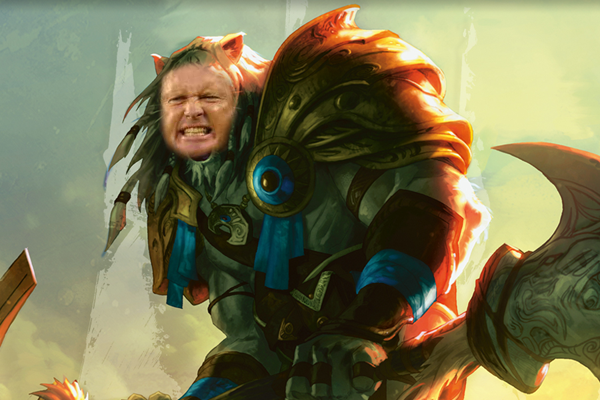
AJANIGRUDENAJANI GRUDEN: Mr. Gruden is the former head coach of both the Oakland Raiders and Tampa Bay Buccaneers, which is a statement that becomes less and less impressive every year. He is perhaps best known for being one of the current analysts for ESPN’s Monday Night Football, as well as being “Gary Busey level” insane. He is also an anthropomorphic cat planeswalker from Lorwyn or whatever.


PHILSIMMIC


PHIL SIMMIC: Many consider the quarterback position to be the most intellectually and athletically challenging of any position in all of sports. That Phil Simms was able to succeed there is a strong argument to the contrary. He is currently breathing loudly with his mouth open on CBS.


EMBERSMIFF


EMBERSMITH: Hall-of-Fame running back Emmitt Smith helped the Dallas Cowboys win three Super Bowls during his fifteen-year career. He is also the least articulate human being on planet Earth.


Together, the four of us will review some of the more intriguing cards in the new set, as well as some Twitter requests. May God help us all.

[card]Mastery of the Unseen[/card], as requested by @ChasAndres:

MasteryoftheUnseen

This is probably one of the more difficult cards in the set to grade. If red decks are a problem at your FNMs, then you can probably skip ahead. But if this format slows down, then this could be somewhere between “Card Advantage Engine” and “Takes Over Games By Itself.” Many of the Ux control decks have had trouble playing significant threats, but this lets you just tick out guys at the end of their turn and eventually just get there. There’s also the possibility of building around this in a deck with actual creatures, but it could just as likely be a control mirror trump that lets you sandbag your counters and draw spells. I’m personally still not on the Trail of Mystery/Hooded Hydra/Master of Pearls hype train, but those people are out there and they will return—and in greater numbers.

sandperson

[card]Sage’s Reverie[/card], as requested by @LochCorrigan:

SagesReverie

You know he says crap like this all the time, right? Like, briefly breaking the fourth wall or whatever, but Phil Simms spews useless filler like this all the time. Even on Madden, he’ll be like, “And it’s always better to win the game than to lose it!” like we somehow didn’t know that. I don’t know what’s going on with the Giants, but all of their best QBs seem to have the IQ of a rock.

[card]Sage’s Reverie[/card] is an obvious foil target for Uril, Bruna (or whichever of those angels it is), and a few other decks. I don’t think there are enough auras seeing play right now (bestow aside, which is difficult to predict) to get this to see Constructed use. Financially, this set would have to be ludicrously under-opened for non-foils to have any real value, and even then, they are best in decks that only want one. Even if this gets picked up by Bogles players in Modern, it won’t be enough to drive them outside of foil.

[card]Crux of Fate[/card]:

CruxofFate

This was one of the first cards we saw from Fate Reforged, and I have been salivating over it ever since. While dragon is definitely getting pushed in terms of flavor and ASFAN (did I spell that right? Is there a hyphen somewhere?), it’s still going to be a top-heavy creature type in terms of converted mana cost. This is mostly going to kill non-dragons, and then your mix of [card]Hero’s Downfall[/card]s, [card]Utter End[/card]s, or [card]Murderous Cut[/card]s will deal with any creatures that you can’t counter after that. It’s worth noting that against a deck like Abzan Aggro, this is just a [card]Wrath of God[/card]. It’s even better if you somehow have a Dragon out! I think the 3/7 hexproof dragon is too slow to be a control finisher, but maybe the UW one could see play? It costs seven, which is where [card]Pearl Lake Ancient[/card] sits on the curve, but it’s easier to kill. More importantly, this card is good. Next!

[card]Warden of the First Tree[/card]:

WardenFirstTree

I was really hard on this guy at first, and I am not too proud to admit I was wrong for the first time in my life. This card is not terrible, he is just misleading (and possibly okay but not great). The obvious comparison here is to [card]Figure of Destiny[/card], a Red Deck Hall of Fame enshrinee who has a very similar mechanical structure. I’ve played with Figure of Destiny, and I can tell you this man is no Figure of Destiny. In actuality, [card]Warden of the First Tree[/card] is more of a 3 or 7 drop, who can sometimes sneak in when you have otherwise unused mana on earlier turns (I played Abzan Aggro for the first time last week, and there were a definitely few turns where I had to pass with a useless G open). His top end is obviously better than Figure of Destiny, but everywhere else along the scale he is about the same or worse. If you are able to activate him more than once, you are probably winning the game, but you may never have to as long as he is played in just the best good stuff decks of the format. Color me cautiously optimistic.

Tasigur, the Golden Fang:

Tasigar

…What?

Anyway, this is probably one of the biggest wild cards of the set—delve influences our traditional evaluations of converted mana costs, but it’s very situationally dependent. This guy could seriously cost anywhere from B to 6. The earlier you cast him, the more likely you are to lean on the fact that he’s a 4/5, which is certainly a Tarmogoyf statistic (although since our new friend is legendary, you can’t rely on two of them doing clean-up duty). Later in the game, he becomes a very weird pseudo card-advantage engine: mana-intensive and random, but repeatable and somewhat controllable through delving. This guy certainly has Commander appeal (I’d play him), but it is almost impossible to come up with more than best-case scenarios for him at this point. I expect he will get a lot of practice reps from players to try and evaluate his intangibles, and maybe see some significant playing time his rookie season.

[card]Soulfire Grand Master[/card]:

SoulfireGrandMaster

I honestly have to assume that part of the inspiration for this card was putting an Xzibit meme on a white creature. This card almost feels tailor-made for the white-red deck Mike Flores was pumping on Top Level Podcast a few weeks back, where you are just able to pick up incidental value off the life gain, and then eventually have the last ability on SGM allow you to loop your burn spells as a way to end possible stalled board states. I don’t think this card is a major pillar of the format, and I don’t think the last ability will make or break many significant games, but there will always be attractive financial value on him as long as that middle ability remains unique in Magic.

One thing that I haven’t seen mentioned is that this could maybe see sideboards in Modern burn, since they are already splashing white for Boros Charm and Lightning Helix. I don’t know enough about that list or its mirror tech to say for sure, but if it is ever going to be a slam dunk in Modern, it’ll be in the burn deck.

[card]Grave Strength[/card]:

GraveStrength

If you’ve learned anything about me by now, you probably know that I have a strong predilection for graveyard synergies. This card is certainly something that is up my alley, and could be another push towards letting [card]Nighthowler[/card] end the second half of his playing career with some sustained success (which I guess makes Nighthowler Larry Fitzgerald). Three cards is not major in terms of fueling these types of decks, but by stapling it on a card that is good at multiple phases in the game (sometimes you just want to make your Elf a 2/2 or a 3/3 early on, or late game you want one big swing), it’s definitely good enough to start as a four-of in my lists. I expect the foils to look insane.

[card]Mob Rule[/card]:

Just me this time. I just wanted to point out that this card shares it’s name with a Dio (well, technically Black Sabbath) album. That is all.

[card]Orc Sureshot[/card]:

CAUSE YOU CAN’T YOU WON’T AND YOU DON’T STOP.

[card]Brutal Hordechief[/card]:

BrutalHordechief

I really think this guy is awesome. He makes the black aggro decks respectable on his own, and is probably good enough to steal a couple slots in Abzan Aggro. The first ability is great at messing with combat math, as well as giving you the occasional free drain for three or so, and should not be underrated. The last ability is very mana intensive (and possibly just unobtainable for the Black Aggro lists), but it will be a clear game breaker in the Abzan Aggro mirror. By forcing bad blocks, you can choose to wrath their board (or make the most favorable trades) while still getting damage in off the first ability, or you can assign all their blockers to your smallest guy and end the game by everyone else getting through! Either one will be a realistic play depending on the life total and hand size of your opponent, and I seriously expect this guy to do some major work in the format. I wish he was a rare so I could get my four for cheap right away, but he is way too good.

[card]Ghostly Conscription[/card], as requested by @Lowbeyonder:

GhostlyConscription

I think this will ultimately be another good-but-not-Great black Commander card, where the foil copies will maintain a premium,while the regular ones sink to near bulk-mythic price. A lot is made of the fact that you probably won’t be able to get the full value out of flipping the manifested cards, but I think that if you look at the card as a graveyard hoser plus army in a can, then the ability to possibly flip some is just upside. Black has few massive token generators ([card]Army of the Damned[/card] and [card]Empty the Pits[/card] come to mind), but they are always swingy and demand an instant answer. If that’s your thing, then this is a good card—just don’t bother trying to make this work in Standard.

[card]Plains[/card], as requested by @HRSlaton:

Plains

I hate you so damn much.

~~~

Well everybody, just like Peyton Manning, we are done! Thanks for reading to those of you that actually made it this far, and I will see you next week!

Brainstorm Brewery #131 – Fate Reforged Set Review with Conley Woods

  • Fate Reforged set review with Conley Woods (@Conley81)

Cabe Riseau produced the intro and outro music for Brainstorm Brewery.

Contact Us!

Brainstorm BreweryWebsiteE-mailTwitterFacebook

Ryan BushardE-mailTwitterFacebook

Corbin HoslerE-mailTwitterFacebookQuietSpeculation

Jason E AltE-mailTwitterFacebookQuietSpeculation

Marcel WhiteE-mailTwitterFacebook

Conjured Currency #45: Pack to Square One

Have you ever heard of the phrase “Pack to Power”? For those who are new to the world of Magic finance, or just never came across the term, let me explain. Back in April of 2010, Jonathan Medina (known to some as one of the forefathers of the Magic finance lifestyle), began an article series on Gathering Magic called Pack to Power.

Basically, he wanted to open a single booster pack (at the time the most recent set was Rise of the Eldrazi), and trade the contents of that booster pack as a bubble collection separate from his own inventory, eventually picking up a piece of the Power Nine. He wasn’t allowed to accept charity cards to increase the value of his “pack” collection, and he wasn’t allowed to rip off unknowing/new players. On August 27, 2010, the final installment of his series went up, where he showcased his newly acquired [card]Mox Pearl[/card]. He had turned a $4 investment into a piece of the Power Nine. Aspiring Magic financiers around the world were in shock: if he could do it, why couldn’t they? It couldn’t be that hard to continuously grind for value—it was like free money!

Author’s aside: Looking back at some of those prices is just mindblowing. $10 [card]Vendilion Clique[/card] and $8 Inferno Titan[/card]? [card]Chains of Mephistopheles[/card] at barely over $50?

Now about $350...

Now about $350…

From $10-$70. Will it be in MM2015?

From $10-$70. Will it be in MM2015?

Currently sitting in my $1 rare box, waiting for an EDH player

Currently sitting in my $1 rare box, waiting for an EDH player

Unfortunately, it wasn’t free money. While some other players managed to replicate the project (sometimes with their own sets of rules only loosely based on Medina’s), it eventually tapered off as smartphones became a staple of the Magic trading floor. It became a much rarer instance to use one of Medina’s trademark phrases, “What do you value this at?” when the truth was a few button clicks away instead of having to rely purely on price memory. Knowledge of casual gems became less of a way to make massive jumps in value, so you can no longer trade for $10 [card]Mana Reflections[/card] because you knew the Standard player thought they were bulk rares.

While Pack to Power is now more commonly seen as a “this is a thing some guy did almost five years ago” piece of Magic history, attempts to complete the project have not entirely died down to zero. Newer players enjoy hearing war stories like this one, and think, “I could do that.” Just recently, I saw a post on Facebook in one of the “Buy/Sell/Trade” groups, where a player was attempting to do a Pack to Power project, through the mail. He posted a picture of his binder page to Facebook containing a bulk rare from Khans of Tarkir, an uncommon Charm, a foil common card, and a token. He also made absolute sure that everyone knew he was doing a Pack to Power, and everyone should “help him out to finish the project.”

Yes, that’s a bad idea

I can already feel what you’re thinking. I can taste the disgust in the future when this goes live on Thursday. “Why on earth should I give this guy value and trade through the mail just so he can fail his pack to power two weeks in when he runs out of money for stamps?”

The answer is simple: you shouldn’t. I’ve only actually traded with a few people who were trying to complete this project on the floor of an event, and none of them were a very pleasant experience. The phrases, “Come on, buddy,” and “Help me out here,” were thrown around more often than I was comfortable with, and at one point one of them even added a card from his own collection into the pile I was getting, and then put [card]Sphinx’s Revelation[/card] that I gave him into his pack to power binder, breaking one of the cardinal rules. Now that smartphones exist, it’s much more rare for players to misvalue their own cards, or accept a number that strays too far from what their phone says is even. And that’s a good thing.

This is Not a Green Light

Now, there might be a select few of you reading this who are thinking, “Wow, that Jon Medina guy is a legend. I sure want to be like him when I grow up. I think that this article DJ is writing is a great way for me to learn what not to do when I do my P2P, because I’m not a jerk and I’ll be the best there ever was!”

I’m writing this paragraph to tell you that doing a P2P nowadays isn’t worth it. Stop now, before you start. It’s not just because of my poor experience with those who have tried, either. Isolating the contents of a single booster pack and trying to turn them into a piece of the Power Nine (or any other high-dollar card) just isn’t worth it for you, financially or time-wise.

Time is Money

It took Medina from April until August to turn $4 worth of Magic cards into his Mox Pearl, valued at $360 (how times have changed). That was over four months of constant binder grinding, looking for value, and using questionable trade tactics to slowly accumulate value.

Now that we live in smartphone land and more players than ever are up to date on the financial side of the game, it would take infinitely longer for you to finish the project. Power costs a lot more money now, you probably don’t have the reputation that Medina did back in the day, and your margins will be thinner on every single trade. It’ll take way too long, just for the bragging rights of getting a gold star to hang on your fridge at home.

Juggling Collections

For the entirety of his project, Medina kept his “pack” in an entirely separate bubble from his real inventory, so as to not contaminate the exercise. If someone wanted one card from each collection, he would have to make two separate trades, which became awkward if the values in the person’s binder didn’t make that possible. If player A wants one card from each of your collections that costs $15, and the only thing in his binder worth anything is a [card]Snapcaster Mage[/card], what do you do? This is a trade that would be a lot easier if the P2P wasn’t getting in your way, especially since Snapcaster is looking like a pretty juicy pickup due to the fact that it can’t be included in Modern Masters 2015.

Modern Value Trading

While the wild west days of “What do you value this at?” and “I think this is worth X, do you agree?” are pretty much dead and gone, there’s still room to make that invisible “value” on trades that we financiers enjoy. It doesn’t have to rip off your trade partner, and both parties can walk home happy. You don’t have to shout to the world that you’re doing a pack to power project for people to toss in free value, or any other sort of similar project.

For example, if you tend to buylist cards back to stores a lot when you’re not using them, you can trade for cards based on the buylist price. Two different cards might both be $10 based on the TCG mid, but one of them probably has a higher buylist price than the other. If you were going to sell to that buylist anyway, trade for the card that will give you a higher cash value. Your trade partner didn’t lose anything, and you got more actual money out of the deal.

Alternatively, you can act as your own personal buylist for your community if you have the inventory and reputation for it. This is a mantle that I’ve personally accepted in my college town, because we don’t have a store that buys or sells singles. If you’re in the same boat as I am, get the word out that you’ll trade for (or buy) anything and everything, as long as you get that margin.

Cracking up

Value trading does not have to be a project where you become famous through turning a booster pack into a Mox. There are so many more ways to save money and make money in this game that I can’t possibly go over all of them.

However, I can cross the terrible ones off of your list: stop doing Pack to Power, or you’ll end up pack to square one. As always, if you have any questions, comments, or concepts that you think can be written about, let me know!


Weekend Magic: 1/9-1/11

Let’s take a look at another weekend of Magic action. This weekend featured two constructed events, Grand Prix: Omaha and Star City Games: Philadelphia. The Grand Prix was Modern so we will be able to add more Modern data to our analysis of the format before the new banned and restricted announcements are revealed. The SCG Open featured Legacy as the main event, which is exciting because Legacy events are becoming rarer and rarer every day. Time to get down into the Magic.

Grand Prix: Omaha (NE, USA)

Decklists

Pod took down the tournament piloted by Erik Peters. Despite the success of U/R Delver in Modern from the one and only Treasure Cruise, Pod still seems to be taking Modern by storm. LSV and others still tote it as one of the most popular decks in Modern, and the power of Birthing Pod can’t be denied even in a field full of fast, aggressive decks. Highlights from Peters’ deck include Voice of Resurgence and Siege Rhino (foils are a good target now). Siege Rhino has quickly made itself a mainstay of Modern, at least in the current format, and foils are good target both for Standard applications and the the predicted usability of the card in Modern moving forward.

Second place went to Amulet Combo, a deck that is notoriously hard to pilot but does great in a field full of fast, aggressive decks since it can kill your opponent quicker than an aggro deck if the proper sequence of plays are executed correctly. Such were the skills of Stephen Speck that he was able to place in the finals of a Grand Prix with such a deck. Cards to look out for in the deck include [card]Primeval Titan[/card], [card]Amulet of Vigor[/card], [card]Summer Bloom[/card], and [card]Hive Mind[/card]—all cards essential to the deck’s operation.

Rounding out the Top 8 were a diverse listing of decks which included R/G Tron, Merfolk, two U/R Delver lists, Four-Color Zoo, and something called R/G Breachscape. Let’s take a look more closely at Merfolk, Zoo, and Breachscape since the other lists are Modern mainstays that have been documented extensively in past articles.

  • Merfolk – Many pieces of Merfolk have already stabilized in price over time due to the success of this deck in Modern. This means that some have a high chance of being in Modern Masters 2, like Cursecatcher and Silvergill Adept. Others like Master of the Pearl Trident have already increased in price due to Merfolk also popping up from time to time in Legacy, further increasing demand for the core components. Even Cavern of Souls and Aether Vial keep going up over time, since they are casual favorites in addition to being key parts of the deck. Mutavault is probably the most undervalued card of the deck due to the recent M14 printing.
  • Four-Color Zoo – Cards to look out for here include [card]Anafenza, the Foremost[/card], [card]Siege Rhino[/card] (again!?), [card]Loxodon Smiter[/card], [card]Lightning Helix[/card], and [card]Path to Exile[/card].
  • Breachscape – Cards to keep an eye on in this deck are Chalice of the Void (which just experienced another buy out and spike in price), Obstinate Baloth, Anger of the Gods, Summoning Trap, and Through the Breach.

All in all, GP Omaha was very exciting for Modern as it showcased seven different archetypes that have done well since Khans of Tarkir was printed. However, as some pros were quick to point out, there were two common trends amongst the decks – you either played [card]Treasure Cruise[/card] or played [card]Chalice of the Void[/card] main deck or sideboard to deal with TC decks (unless you’re Zoo, obviously).

Star City Games: Philadelphia – Legacy (PA, USA)

Decklists

Deck Finish Player Deck Finish Player
Temur Delver 1st Daryl Ayers Elves 9th Bobby Colegrove
Storm 2nd Ross Merriam Sultai Control 10th Gerard Fabiano
Sneak And Show 3rd Peter Johnson Shardless Sultai 11th Joseph Herrera
Lands 4th David Long Dredge 12th Eric Copenhaver
Temur Delver 5th Ralph Betesh Shardless Sultai 13th Rudy Briksza
Grixis Control 6th Ed Demicco Jeskai Stoneblade 14th James Pogue
Omnitell 7th Nick Cummings Temur Delver 15th Kemper Pogue
Elves 8th Ross Prajzner Ad Nauseam 16th Nick Eldering

The Legacy Open this weekend featured some very interesting finishes. I see that Ross Merriam decided to ditch Elves this weekend in favor of Storm – what a chump, if he just would have played Elves he would have won! I mean, the guy that won was playing Kird Ape in his main deck! That hasn’t happened since like 1995. All joking aside, let’s take a look at the outliers here.

Besides [card]Kird Ape[/card] in Daryl Ayers’ winning list there wasn’t anything financially relevant in the Top 4. Storm is pretty straightforward, as is Sneak and Show. Lands also didn’t give us anything new.

Grixis Control again featured [card]Dack Fayden[/card], a trend that should be noted. Also, Omnitell featured a full playset of [card]Dig Through Time[/card] rather than just the usual one-of or two-of that is normally seen.

Two Shardless Sultai decks made the Top 16, along with Dredge and Sultai Control. Standouts from these decks include Shardless Agent, Ancestral Vision (especially if it is unbanned in Modern like some are predicting), Toxic Deluge, and.. Courser of Kruphix!? Yes, that’s right folks Courser has now moved into Legacy along with Dig Through Time and Treasure Cruise. Neat. Dredge again had Mana Confluence as a playset and Sultai Control showed how a bunch of one-of and two-of’s along side Counterbalance seems to work out nicely.

Star City Games: Philadelphia – Standard (PA, USA)

Decklists

Deck Finish Player Deck Finish Player
Mardu Midrange 1st William Grogan Abzan Reanimator 9th Bradley Robinson
Jeskai Aggro 2nd Noah Walker Abzan Midrange 10th Jon Goss
Abzan Aggro 3rd Kellen Pastoore Abzan Midrange 11th Andrew Boswell
Abzan Midrange 4th Spencer Assiff R/W Aggro 12th Lonny Warner
W/R Aggro 5th Robert Sabol Jeskai Heroic 13th Chase Petersen
Abzan Reanimator 6th Randy Ball G/R Aggro 14th Richard Anderson
W/U Heroic 7th Joe Lossett R/W Aggro 15th Ben Schoenbrun
Abzan Aggro 8th Phil Pratt Abzan Midrange 16th Joshua Halmagyi

Not a whole lot of news from this front, with the approach of Fate Reforged and all. Here are some notable cards to keep in mind moving forward:

  • [card]Butcher of the Horde[/card] – Pretty cheap at $1.50 or less, and a lot of upside going into the new format with the new tool Monastery Mentor.
  • [card]Chained to the Rocks[/card] – Solid removal and still around $1, definitely room to move up.
  • [card]Hushwing Gryff[/card] – Seen in many white sideboards and only around $2.50. Looks undervalued to me.
  • [card]Eidolon of Countless Battles[/card] – Seems like a good target if it continues to see play in W/R Aggro decks that have been placing well lately. Definitely a card to watch.
  • [card]See the Unwritten[/card] – Showed up in Abzan Reanimator and is a cheap mythic with a lot of upside later this year.

Star City Games: Philadelphia – Modern (PA, USA)

Decklists

Deck Finish Player Deck Finish Player
R/G Tron 1st Thomas Riker Temur Control 9th Luis Alfonso
Abzan Midrange 2nd Erik Smith 4-Color Zoo 10th Jessy Hefner
Temur Delver 3rd Cody Shoemaker Melira Pod 11th Anthony Lebron
Jeskai Control 4th Robet Seder Ascendancy Combo 12th Jarvis Yu
Affinity 5th Joe Fasano Affinity 13th Thomas Conmy
Scapeshift 6th Andrew Vorel Abzan Pod 14th Robert Pompa
Scapeshift 7th Michael Mapson Abzan Pod 15th Vincent Pau
Abzan Pod 8th Yi Min Wang U/R Delver 16th Charles Hagaman

Here’s some more Modern action for you courtesy Star City Games. R/G Tron took down the event with Abzan Midrange coming in second. The rest of the Top 8 included a decent mixing of decks. Notables include:

  • [card]Scavenging Ooze[/card] in Abzan Midrange. Copies are still floating around $5-$6, which is cheap for this important Modern role player.
  • [card]Geist of Saint Traft[/card] in Jeskai Control. A full playset was played in this build, showcasing the power of the card.
  • [card]Courser of Kruphix[/card] out of Michael Mapson’s Scapeshift list. The time to target Coursers will be upon Theros block rotation.

Out of the Top 16, other notables include:

  • [card]Keranos, God of Storms[/card] out of Temur Control
  • [card]Geist of Saint Traft[/card] and [card]Arc Trail[/card] out of 4-Color Zoo
  • [card]Fatestitcher[/card], [card]Jeskai Ascendancy[/card], and[card] Dig Through Time[/card] out of the Jeskai Ascendancy combo deck

That’s it for this week! Fate Reforged is coming out shortly so more coverage will be arriving next week based on those results. Until next time.


Cards to Keep an Eye on in Anticipation of a Banned List Update

With the banned and restricted list update looming in January, I’m surprised at the lack of discussion about it. Major changes could have a huge impact, especially on Modern.

The last time that the Modern banned list changed was right before Pro Tour Valencia last February. Preceding the unbanning of [card]Bitterblossom[/card] and [card]Wild Nacatl[/card] and ban of [card]Deathrite Shaman[/card], speculation was all over the internet. Whether it was Brian Kibler or Josh Utter-Leyton, everyone had a say in what they thought were the most reasonable unbanning(s) and banning(s), [card]Deathrite Shaman[/card] being on the top of the list of potential bannings and [card]Wild Nacatl[/card] dying to be released. But it was to the surprise of everyone when [card]Deathrite Shaman[/card] was actually banned and [card]Bitterblossom[/card], a card previously thought to be too powerful for Modern, was unbanned.

There is no good way of accurately predicting what will be banned or unbanned, but that doesn’t mean there weren’t clues along the way. Before the B&R announcements on February 3, prices were well in flux. Although bans do affect the format, the biggest potential money makers will be the unbans. Here are the graphs for the two unbans for the previous announcement.

Bitterblossom
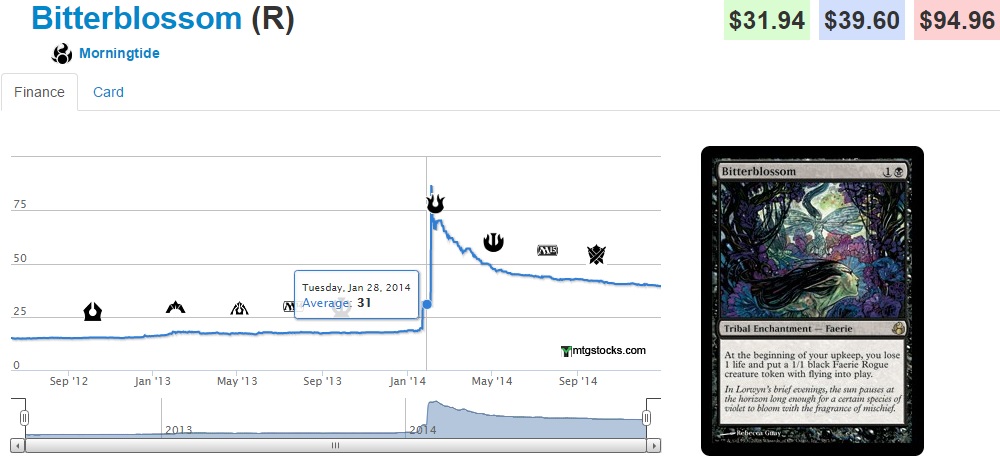
[card]Bitterblossom[/card] showed the most obvious movement, though it was never clear whether the movement was the result of insider buyouts or speculation. [card]Bitterblossm[/card] jumped from about $18 to $31 a week before the announcement, and at the highest point, reached $70 before settling down.

Wild Nacatl
There was plenty of talk about a [card]Wild Nacatl[/card] unban, and I personally bought into the speculation. [card]Wild Nacatl[/card] also saw increases in price leading into its unbanning, most pronounced in the FNM version of the card. The prices also abated after it was discovered Zoo wasn’t really the deck to beat in the format.

Unbans

So the million-dollar question is, what are the potential unbans coming up this year, if any?

I’m not saying it’s going to happen, but here’s the only card that I picked up on my radar.

Bloodbraid Elf
There’s been a good amount of movement on FNM copies of [card]Bloodbraid Elf[/card], a card that has proved to be powerful in the Modern format. There is currently only one copy of FNM [card]Bloodbraid Elf[/card] on TCGPlayer at $9.25, and it’s not even near mint. Last time [card]Bloodbraid Elf[/card] was legal in Modern at Pro Tour Return to Ravnica, Jund was far and away the most popular deck in the format, sporting almost a third of the metagame. I would be shocked if [card]Bloodbraid Elf[/card] was unbanned, but then again, the B&R Announcement has been more about shaking up the format for the Modern Pro Tour rather than equalizing the field.

Ancestral Vision
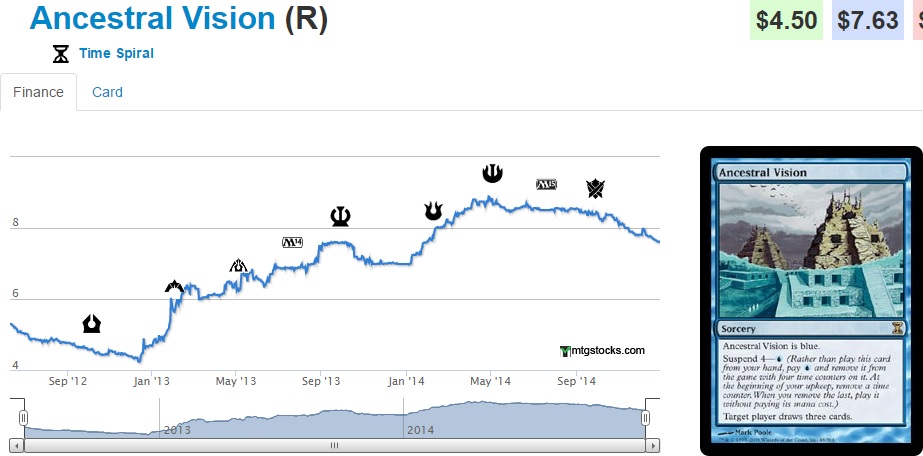
In a world where [card]Treasure Cruise[/card] exists, [card]Ancestral Vision[/card] for all intents and purposes is safe to come out to the party. While the price has only gone down since its Duel Deck Anthology reprinting, [card]Ancestral Vision[/card] would give blue-based control decks a foothold in the metagame by providing them with a much needed source of card advantage. I don’t think there is a good money to be made speculating on [card]Ancestral Vision[/card], foil copies are already $55 on TCGPlayer, suggesting that speculators have already moved in to the card. While prices will certainly move in the case of an unban, there are plenty of copies available that it would be difficult to make money off the buylist.

Bans

Treasure Cruise
It should come as no surprise to anyone that [card]Treasure Cruise[/card] is on top of the potential banlist. It’s not so much that the card is overly powerful for the format, the Modern meta is quite able to adjust to any card, broken or not. I would attribute the [card]Chalice of the Void[/card]’s 180% growth and [card]Choke[/card]’s 700% growth to this one card. But the fact of the matter is that [card]Treasure Cruise[/card] has sufficiently warped the format such that it’s really come down to either playing [card]Treasure Cruise[/card] or finding the combination of cards to beat [card]Treasure Cruise[/card]. The fact that Burn is running [card]Treasure Cruise[/card] should be alarming, because the last time that Burn splashed a color, [card]Deathrite Shaman[/card] was banned. There’s already a precedent for a card being banned in Modern while it’s still in Standard, so that argument is right out the window. If Wizards wanted to shake up the Modern format, banning [card]Treasure Cruise[/card] would be the way to do it.

It’s anyone’s guess what would happen if [card]Treasure Cruise[/card] were to go, but I would say that Pod would displace UR Delver as the deck to beat, which has already been the case on Magic Online. As is the case for decks that become public enemy number one, hate cards will invariably come around. I liked [card]Grafdigger’s Cage[/card] at below $2, and I still like [card]Grafdigger’s Cage[/card] at $3.50 especially in the case that [card]Treasure Cruise[/card] is banned and [card]Birthing Pod[/card] remains untouched. Will [card]Birthing Pod[/card] be banned? Eventually, but who knows when?

Dig Through Time
The next card is a lot less uncertain because an argument can be made for and against its banning. [card]Dig Through Time[/card] gives blue combo decks a fighting chance against [card]Thoughtseize[/card], [card]Inquisition of Kozilek[/card], and [card]Liliana of the Veil[/card]. It’s also not as degenerate as [card]Treasure Cruise[/card] as a draw engine, though arguably a much more powerful effect even at twice the mana cost. In the scenario that both draw engines are banned, [card]Steam Vents[/card] decks would once again be left to the whims of [card]Overgrown Tomb[/card] decks, and will presumably go back to the [card]Grim Lavamancer[/card] plan. In the case that [card]Treasure Cruise[/card] is the only ban, UR Delver will likely step back to its previous spot as a tier-two deck. Combo decks will definitely benefit from this shift in the metagame, particularly [card]Splinter Twin[/card] and [card]Scapeshift[/card], which have hugely benefited from the addition of [card]Dig Through Time[/card]. Because of this uneven exchange, if [card]Treasure Cruise[/card] is banned, I would expect [card]Dig Through Time[/card] to also go as it would otherwise pigeonhole blue decks to play the midrange, control, or combo game without elements of aggro or tempo.

Jeskai Ascendancy
There have been discussions on a [card]Jeskai Ascendancy[/card] ban, but I just don’t see it, especially in the case of a [card]Treasure Cruise[/card] and/or a [card]Dig Through Time[/card] ban, and I’ll leave it at that.

Whatever the B&R Announcement brings, I hope that the Modern metagame will become as engaging as it was when [card]Treasure Cruise[/card] and [card]Dig Through Time[/card] were first released into the format. Khans of Tarkir has done much to shake up the Modern format, and here’s to hoping that more goodies for eternal formats will come out of this block!

Hello from GP Omaha!

We’re at GP Omaha this week. After an exhausting day of Modern, Cameron and Curtis fell asleep, but then decided to record a podcast in the middle of a lucid dream. We give our takeaway from the event and discuss the ups and downs of the format. We also go over some new Fate Reforged spoilers, including a horrible [card]Suntail Hawk[/card] impersonator which we shall not name. Thank you for your honor.

Cameron McCoy – @Cameron_McCoy

Curtis Nower – @CurtisNow

Dustin Gore – @mtgdustin

Our show – @SpikeFeedMTG

Music by Micah Jones

[soundcloud url=”https://api.soundcloud.com/tracks/185611541″ params=”color=ff5500&auto_play=false&hide_related=false&show_comments=true&show_user=true&show_reposts=false” width=”100%” height=”166″ iframe=”true” /]

Stoking The Flames

Feeding The Fire

I just lost my win-and-in for top eight and I’m two hours away from home. This sucks.

I played some of the best Magic I have played in a long time today and I desperately wanted this win more than any tournament before. I won games and matches off of bluffs, strategies, and good old-fashioned luck, but in the end I got beat by variance—and those are the losses that hurt the most. The thing is: this one was different. I was told I looked basically dead, empty, despondent. While, yes, it did create those feelings, this one poured gas on the fire. I don’t know why it did, but I’m excited that this is the life I’ve chosen to lead for at least the next few years.

My Goals

Going into 2015, I set some goals for myself to improve as a player and I put some big-ticket items on my wishlist.

1. Win a Star City Games Open

This one is huge and just one of the big-ticket items sitting on the list

2. Day two all four Star City Games Invitationals.

Thanks to my late-in-the-year successes from 2014, I found myself qualified for the next three, and picking up a fourth invite shouldn’t be that hard.

3. Top eight multiple Star City Games Premier Invitational Qualifiers.

These are where I first found success and I feel at home in a tournament of this size.

4. Have fun with friends new and old traveling and grinding the Open Series.

I love to travel and see new places and I love to play Magic. I love small towns and weird cities, and grinding IQs on the weekends lets me visit these places. When an Open is in driving distance, I’ll happily go do battle.

The Tournament Today

Today, to me, felt like it was supposed to be the start to this journey, and I guess it was just not the way I wanted it to play out. I’m still gathering my thoughts and piecing it all together as I write this, so please bear with me. I, of course, battled today with my usual Zoo list and a couple sideboard changes (like adding a third [card]Choke[/card] and experimenting with different Affinity hate in my sideboard for the observed field of Delver, Affinity, UWR Geist, and Pod).

Round one I beat Bogles. This one is still sinking in. My boogieman, my nemesis, my worst nightmare: and I slew it. I felt good and nearly unstoppable afterwards. Following that, I beat Tribal Zoo thanks to outplaying an opponent who didn’t know how to play the deck or the matchup as well as I did. I lost the next round to RG Tron. I got to battle against UWR Geist and Pod after that, and while the UWR Geist matchup was close, I was able to keep the Lightning Angels at bay and just 2-0 smash my mana-screwed Pod opponent. My deck likes to mulligan to five far more than theirs does.

Round six, and I’m in ninth place. I have a clear-cut win-and-in for top eight: 5-1 is in and 4-2 is out. Every single person in the building was there for a PPTQ, but I wanted those Open points more than anything else. The short story is I lost. I was lax about watching my opponent shuffling my deck this round and I lost to the mono-lands draw. You know, the one I’m all too familiar with. Crack fetch, draw fetch, crack fetch, draw fetch and repeat until they find a threat to kill me with or I fetch every fetchable land from my deck.

While I don’t have any concrete proof of anything fishy going and I do blame myself for not being as vigilant as I was during the other five rounds, I feel like something must’ve been happening—or that when the variance gods strike their vengeance down upon me, they do it in the most heartbreaking fashion possible.

The New Fifth Goal

This brought me to a fifth goal for the year, and a list of five looks much nicer than four.

5. Promote good clean play on the Open Series and within any other tournaments I happen to play in.

Simply put, Magic is a game and I feel it should be played for enjoyment and not just money and prizes. I have been a victim before and I don’t want others to have to go through the heartbreak of being cheated.

Moving Forward

I’m up in the air about what I want to do with Modern. I was talking on the long drive home with my friend Barrett about Modern and he was pointing out that maybe some variation would be good for me. He recently set his Faeries aside for Pod and I feel like because of this and how we have dealt with our decks quite similarly, he knows what he is talking about. I know Zoo is good for me and I can attack the format very well with it, but I autopilot far more matches than I should and I win a lot based on surprise factor and play skill with my deck—which isn’t necessarily a bad thing, but I do see how it can definitely hinder growth to be just a Zoo player.

I own most of the cards to build a Junk Pod list and I have easy access to the few I am missing. Maybe it is time for me to branch out and learn more of the format and attack it from different angles instead just for three damage on turn two. I’m still planning on developing Zoo lists, and I have a fun five-color list in the pot right now, but it’s still cooking and needs time to thicken. This will all shake itself out. I love this deck and all it has done for me, but I think I need to branch out and grow as a player more. I’m still going to be battling with Zoo for SCG Philly’s Modern Premier IQ, but I don’t know after that. The Baltimore Open is coming up in a month and hopefully I’ll have a better idea by then.

For Standard, I toyed with the idea of playing Jeskai Tempo right before the deck came screeching to a halt and died. I realized I wouldn’t enjoy myself playing a deck that to me always felt like it was digging for a win and just barely getting there. I’m now on the Constellation deck and I’m loving it. I think a third color would be amazing, though, and I am debating moving the shell into an Abzan Whip deck or jumping more towards a Sultai Sidisi Whip. I’ll be watching the format closely, but I don’t think I want to be doing anything besides slamming [card]Doomwake Giant[/card]s and drawing my entire deck off of [card]Eidolon of Blossoms[/card]. Maybe I’ll add a crash of Rhinos to the deck, because for lack of a better term: [card]Siege Rhino[/card] is sweet!

Well, thats all for now so thank you for reading and I hope I can keep you all updated throughout the year and hopefully the successes of last year were just the beginning. I feel a fire under my ass, and no, it isn’t just the seat heaters from my new car. I want to win and I want to succeed, but most importantly I want to have fun.

P.S. I know I still owe you guys a few Zoo combo matchups. Life has been hectic and hopefully I’ll be able to set some time aside and bang out those last few matchups for the guide.


Privileged Perspective 10 – My 100% Totally Legit Preview Card Spectacular

Welcome back! I hope your holidays were as relaxing and unproductive as mine were. Even though Christmas is typically Magic’s downtime, there was a lot going on with the beginning of spoiler season. Next week I’m going to talk more about what we are seeing out of Fate Reforged and how to contextualize it, but I do want to start this week with my preview card!

ROSS’S TOTALLY LEGIT FATE REFORGED PREVIEW CARD THAT WAS FOR REAL GIVEN TO HIM BY WIZARDS BUT THEY MUST HAVE LIKE FORGOT OR SOMETHING

So this happened:

previewtweet

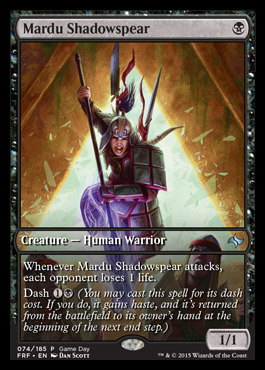
So what I am going to do is assume the Game Day promo is my preview card, and I will do this AS LONG AS IT TAKES until Trick or Gleemax or the corporate fat cats at Hasbro give it to me for real. We can even keep score (starting next time). So let’s see what card I get to start with!

mardushadowspearpromo

It’s actually fitting that this is my preview card this time around, because I’ve been playing some Mono-Black Aggro lately, and this card is a seemingly obvious inclusion.

There are some deck construction conflicts here, because black now has four playable one-drops, as well as two conditionally playable ones in [card]Cruel Sadist[/card] and [card]Ruthless Ripper[/card]. If you decide to build your deck more synergistically, you can play Shadowspear with [card]Bloodsoaked Champion[/card] and [card]Tormented Hero[/card], which then pushes you pretty strongly towards a small white splash for [card]Chief of the Edge[/card] (and consequentally, some of the better combat tricks). Prioritizing power gives you Gnarled Scarhide over the Tormented Hero, which is essentially a [card]Savannah Lions[/card]/[card]Falter[/card] split card and doesn’t pressure you into playing a very sketchy manabase (likely including some number of tapped lands) in your small creatures deck. I would not recommend playing more than 10 to 12 one-drop creatures in your list, unless you are confident you won’t see Anger of the Gods. If you decide to do that, however, [card]Pain Seer[/card] becomes even more of an automatic four-of than it was already (and it was a pretty big deal before).

Let’s look at my list:

[deck title= Just Win Baby]
[Creatures]
*4 Bloodsoaked Champion

*4 Gnarled Scarhide

*4 Pain Seer

*4 Mardu Skullhunter

*4 Mogis’s Marauder

*3 Mardu Shadowspear
*3 Master of the Feast

[/Creatures]
[Spells]

*4 Thoughtseize

*3 Despise

*1 Hall of Triumph

*3 Murderous Cut

*4 Sign in Blood
[/Spells]
[Land]

*11 Swamp

*4 Bloodstained Mire

*4 Polluted Delta
[/Land]

[/deck]

This is the kind of deck I would never pay time and money to play with in a large event, but it is more than capable of stealing wins in smaller, less tuned environments (you know, like FNM). It has some of the qualities that I look for when playing an aggro deck in a small format, but it hasn’t been able to check all of the boxes yet. Here are some of the things going for this archetype that make it well suited to play at FNM.

  • Critical Redundancies: Mardu Shadowspear is just one example of critical redundancies in this deck. You always want to make sure you hit your aggressive one-drop in a creature-heavy aggressive deck, and having several to choose from solves that problem easily. [card]Thoughtseize[/card] and [card]Despise[/card] do work as proactive removal spells for difficult to answer permanents, especially in the board-presence-heavy format we are in now. Thoughtseize also allows you to keep the control decks from casting their removal on time, forcing them to either dig up more or otherwise commit resources to staying alive rather than progressing a game plan. The top end for this deck is pretty unimpressive, but there are options available, including the Fate Reforged offering [card]Brutal Hordechief[/card].
  • You Get To Cast Thoughtseize: You know this card is insane, right? Being able to cast a guy turn one, then play another guy and take their best card is a strong opening line against most archetypes, but sometimes you start with more than one Thoughtseize. You never play it turn one in this deck since you need to lead off with a threat (there isn’t enough raw damage in the deck to allow you to skip an attack), but you should still be able to resolve it before anything dangerous comes online.
      • This also lets you play the old JSS game of “Let’s See How Good My Opponent Is.” Looking at their hand will obviously give you an advantage of structuring your lines of play for the next several turns, but it will also allow you to determine future choices in the match. Did they keep an obviously bad opening hand? Are there any unusual card choices that seem like they may be substitutions? Are there tapped lands instead of fetchlands? Are there too few or too many lands in their hand? Are they obviously playing something cobbled together from M15 packs? Figuring this out can influence sideboarding options and keeps in the remaining games.
  • It Has Foolproof Mana: Temples, refuges (the “+1 life” lands), and tri-lands are so good that they encourage the midrange decks to basically do nothing in the early phase of the game. By sticking to one color (even though I want this deck to play [card]Butcher of the Horde[/card] SO BAD), you prevent yourself from having to waste mana on scrys or future fixing. Also, since our curve is so low, you’re able to keep most two-land hands. Also, you don’t have to play Urborg, which would only benefit your opponent and cause you corner case headaches in multiples.
  • It Has A Clear And Consistent Gameplan: A lot of the decks that you see people bring to FNM are scattershot in terms of operational objective, but this is not. While this strongly limits the flexibility of play, it also prevents you from making a lot of mistakes. This is especially good if you are FNMing after a long day of work, you haven’t played in a while, or you had a couple of grownup drinks before the tournament started.
  • It’s Cheap! …Well, it’s cheap for a Standard deck. You know, assuming you own Thoughtseizes and fetchlands by now. You should really own Thoughtseizes and fetches by now. The beautiful thing about this deck is that if you don’t own the fetches, you can just play 18 Swamps (not a typo, I would shave one for either the last Despise or Shadowspear).Otherwise, the majority of the pieces are uncommons or easily acquirable rares.

Overall, there are not many changes I would make to the list, but that may change with the final reveal of Fate Reforged. Brutal Hordechief is a very likely candidate for making the list (although we will need to figure out how to make that off-color activation work), as well as [card]Mardu Strike Leader[/card]. It is worth noting that all of them are warriors (including the token generated by Strike Leader), so Chief of the Edge may be worthwhile on his own. Also, judges, correct me if I’m wrong, but you can use Brutal Hordechief’s ability to force their entire team to all block one creature of yours, as long as they are satisfying the blocking requirement. That’s a pretty impressive diversion if so. Speaking of the Hordechief…

RARITY REFORGED

There is something seriously concerning with the rarity situation in Fate Reforged. Many of the apparent tournament staples (like our aforementioned friend Brutal Hordechief) are at mythic, with several legends at rare. This is concerning, given that the understanding when the change in rarity happened was that the tournament staples ([card]Char[/card] was the example cited at the time) would largely remain at rare. I understand that the situation is nuanced, and it seems many cards are at mythic simply because they are very long and boring to read from beginning to end (I assume Robert Jordan is posthumously given a design credit).

It’s confusing, at least in part, since some of the mythics don’t seem out of the realm of possibility of being rare. [card]Warden of the First Tree[/card], which appears to be Casey Affleck’s Invitiational card, is only mythic in the sense that it is eventually very good and also costs G to cast. [card]Monastery Mentor[/card] is likely only mythic because it says “prowess” one too many times—it’s less that the card is too good to be rare (although as printed it basically is), and more that creating tokens with prowess creates an on-board math nightmare that WOTC only wants showing up occasionally in Limited. [card]Temporal Trespass[/card] is mythic partially as a means of prestige: it’s a callback to an extremely powerful card, although the “fixed” text of exiling itself (and also costing a bunch to cast in multiples) keeps it from being oppressive as is.

Ultimately, Magic is not in danger from Fate Reforged—but it will be if every set is like Fate Reforged.

Next week, we will be addressing card evaluation more fully (with guest stars!), but I just wanted to touch on this subject today since it is pertinent. Now, let’s close this thing out with some quick hits!

  • 2015 is starting off pretty strong with an early set release, as well as a stacked Clash Pack. Sure, the next few FNM promos aren’t close to [card]Stoke the Flames[/card] quality, but the Elspeth vs. Kiora Duel Deck will make up for that.
  • Speaking of that Clash Pack, here’s what worries me about the rarity thing in Fate Reforged. If rares are fair game for reprints (as we are learning, apparently), then it’s pretty scary that a lot of the important cards for Standard seem to be sitting at mythic in this set. I can’t seem to think of any mythic promos outside of… Zendikar block? I know GP promos kind of alternate, but in terms of any other type, have we seen mythic promos? Is that infringing on FTV sets? I can tell I’m rambling.
  • There were a lot of really awesome pictures of great gifts in the PucaTrade Secret Santa program this year. Unfortunately, they all dried up and what we’ve been left with is a bunch of people (like me!) wondering where their present is. I will still plan on participating next year, since I believe that most PucaTraders are really great people, but I wonder if there is a way to filter out the people who aren’t in it for the right reasons. Shout out to the people who went above and beyond this year.
  • Bonus shoutouts to @DamageDirect and @TheProxyGuy, who helped make next week’s article possible. It is not PP6, that’s the week after next (I promise! Unless it isn’t).
  • Top Level Podcast is the best podcast I think I’ve ever listened to in terms of understanding the dynamics of Standard (or any other format). You’re leaving money on the table if you play Standard and don’t listen regularly.
  • The second installment of #BTBExt will be January 31, 2015, at Premier Sports Cards in Orange City, Florida! $5 entry (all of it going into the prize pool), and bonus prizes will be raffled off! Registration begins at 12, with the event starting at 1. If you’re in the area that weekend, we’d love to have you! Fate Reforged will be legal, so that will be exciting.

Therefore, be excited! See you next week.

Brainstorm Brewery #130 – Dargons

So. Here you are—the half of the original listener base that wasn’t alienated last episode. That’s excellent. We’re glad to have you back. You passed our test, and you can be our friend now. This was an episode just for you, the fans. We talk about Grand Prix Denver, spoilers, and Finance 101, and we even make time for Picks of the Week. We hope you like it. If you don’t, keep it to yourself.

We can actually use the exact same bullet points from last week, and they (basically) line up. That’s fun. This is not out of laziness, but rather because we have a winning formula and we are not going to tamper with it. We’re professionals.

  • No guest. No need.
  • Finance 101 is going strong but needs suggestions. E-mail us.
  • Spoilers!
  • Picks of the Week happen, and almost everyone comes up with one.
  • Questions? Concerns? E-mail brainstormbrew at gmail dot com.


Cabe Riseau produced the intro and outro music for Brainstorm Brewery.

Contact Us!

Brainstorm BreweryWebsiteE-mailTwitterFacebook

Ryan BushardE-mailTwitterFacebook

Corbin HoslerE-mailTwitterFacebookQuietSpeculation

Jason E AltE-mailTwitterFacebookQuietSpeculation

Marcel WhiteE-mailTwitterFacebook

Pitt Imps Podcast #100 You Will Be Missed Ryan

Welcome to Pitt Imps #100. Holy crap. We got here. In this episode, we celebrate the show, the listeners, and Ryan. This being his last episode with us as a permanent host created a very touching moment which we quickly snuffed out. We answered questions from the listeners, and Angelo, unknown to the other hosts, put in a drinking game. Every time Angelo says, “I feel ya,” you drink. Good luck getting to the end if you choose to play. Angelo plots the next two-year vision of what he perceives the show will become and how you guys can help him reach his vision. A bunch of other podcasters jumped on to help us celebrate this occasion and Chris Lanci (posse member) sent us all a nice cigar to smoke during the celebration. Pitt Imps will now be taking a brief hiatus during the holidays and maybe an extra week. From all of us to all of you Happy Holidays. Don’t die on New Years Eve please.

Host  Angelo  @Ganksuou

Co-Host Ryan  @brotheryan

Co-Host Will   He don’t do the Twitter thing.

Facebook

Show Email  [email protected]

Special Thanks to (in order of appearance) Chewie  @TheManaPool   Find him on MNM, The Mana Pool, and TMP News Jack LaCroix   @jacklacroix   Find him on MNM, Not Another Magic Podcast, and MTGBroDeals.com Jon Celso   @BalduvianBears  Find him on Tap’N’Sac and a writer on MTGBrodeals.com Calvin Layfield   @Zero_Layfield    Find him on Direct Damage Cast on zerofortitude.com Kaesi Corne   @GirlOnNerds   Find her on Direct Damage Cast on zerofortitude.com Marcel  @MarcelMTG  Find him Brainstorm Brewery Cast on BrainstormBrewery.com Matty   @MattyStudios  Find him on the Heavy Meta Podcast on manadeprived.com David Moline  @raginggumby   Find him on the Heavy Meta Podcast on manadeprived.com TSG   @TristanGregson  Find him on the Heavy Meta Podcast on manadeprived.com Ryan Bushard  @CryppleCommand  Find him on Brainstorm Brewery Cast and as a writer at Gatheringmagic.com Jason Alt   @JasonEAlt    Find him on Brainstorm Brewery Cast, Money Draught, and as a writer for QuietSpeculation.com Houston   @TNSGingerAle  Find him on Tap’N’Sac Podcast on TapNSac.com

Always and Never in Magic Finance

Today I want to talk about one of the great traps in Magic finance, or really any kind of investing. The trap is forgetting about, or just ignoring, this statement: past performance does not indicate future results. To take it to the extreme, it’s the trap of “always” and “never.”

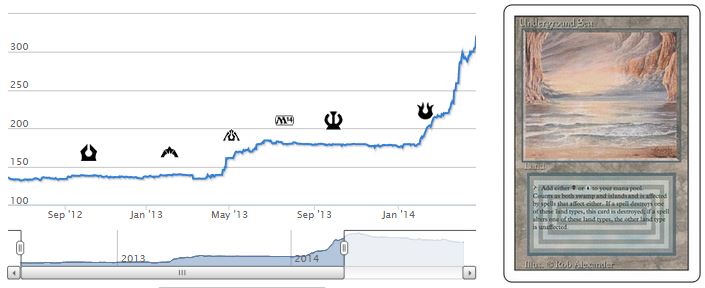
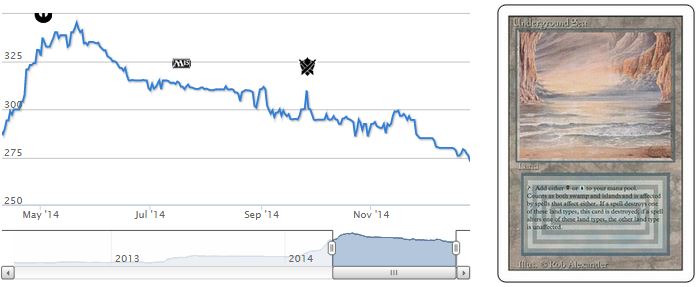
Let’s start with an example. Take a look at the following chart, which is the price of a Revised [card]Underground Sea[/card] circa May of 2014 (just before Journey Into Nyx hit). Before you continue reading, take a few mental notes on what you see.

Underground Sea 1

Here are my notes for comparison:

  • [card]Underground Sea[/card] has seen about a 150% gain since June of 2012.
  • It has not seen a meaningful decrease in price during that time.
  • It has recently seen a dramatic increase in price (January to May of 2014) and has not leveled off.
  • The last significant jump was about one year ago, in May of 2013.

That is a pretty matter-of-fact interpretation of the data. Importantly, it’s entirely focused on what the card has done in the past and doesn’t make any predictions about the future. Let’s be honest, not many of us were quite so level-headed about duals at the time.

You were much more likely to see the following comments on [card]Underground Sea[/card]’s price movement from Magic financiers last May:

  • [card]Underground Sea[/card] has never dropped in price meaningfully and likely never will.
  • Based on the current trajectory, the price will certainly climb to $400 soon and $500 eventually.
  • Duals now appear to have a seasonality (see May of 2013 and 2014) as people sell out of Standard in the spring and want to preserve their capital.
  • Reserved List cards, with duals among the most desired, are truly the only safe haven in Magic finance.
  • There is no ceiling.
  • Sea, like other duals, is a good buy at any price since they will never drop.

You might notice that these bullets are made up of observations and conclusions smashed together. The support for these conclusions comes from a false equivalency of past performance and future results. Dual lands have never gone down in price so dual lands will never go down in the future. [card]Underground Sea[/card] has increased dramatically in price so it will increase further in price.

Now let’s look at how things unfolded (if you don’t already know) and then go back and take another look at the analysis.

Underground Sea 2

[card]Underground Sea[/card] (like most of the duals) has dropped by about 20 percent since May and does not appear to have leveled off.

The Mistake of Always and Never

This is not an “I told you so” article. No one that I’m aware of called for a substantial decline in the dual lands this year. I certainly did not.

This is not a “we should have seen it coming” article, either. There was every reason to think that duals would continue to climb in price based on the trend. There was nothing, at least that I can tell, that forecasted this drop. Vague statements and doomsaying like “they can’t go up forever” do not count as forecasting a 20 percent decline, either.

The mistake was turning probably into always and turning probably not into never. If you deployed money based on those equivalencies, you lost and maybe lost big.

It’s a subtle distinction on paper but a massive change to mindset. We will make drastically different investment decisions when looking at probably than we will when looking at always.

Probably calls for an investment coupled with the usual safeguards: diversification, properly sized investments, and other risk mitigators.

Always is a sure thing, a stone-cold mortal lock. Always means safeguards are not necessary, that caution can be thrown to the wind, because it is 100 percent. If you ever find one, go ahead and bet it all—no one would argue against pushing all-in when your opponent is drawing dead. Good luck finding these opportunities, if they even exist.

You really can’t afford to confuse “always” and “probably” when a lot of money is on the line.

Variance in Investing

To be clear, the correct read on that first chart (May 2014) is that Underground Sea would continue to increase in price. There was nothing to support a call for a decline or a break in the trend.

The thing is, we often forget that there is massive variance in investing in Magic, just like there is variance in the game itself. In fact, there is massive variance in any kind of investing.

You can’t solve an investment any more than you can solve a game of Magic. Perfect play loses to timely top decks from your opponent, and sometimes cards drop in price that “shouldn’t” drop or have never dropped before. You can stare at charts and spreadsheets until your eyes pop, but you will never get the variance out.

Everything indicated duals were safe and would continue to go up, but they went down instead. Are there reasons for this? Maybe. Somewhere buried in a thousand variables there might be an answer, but we are not going to solve it and we are certainly not going to predict it. Call it variance.

These things just happen. Duals always go up until they go down. At some point we may get confused and think they can’t go down. The same was true of the U.S. housing market a few years ago.

The good news is that this is all very easy to work around, at least in Magic finance. Just plan for variance in your Magic investments. You can do that in a lot of ways, but here is the executive summary: never make an investment that will break you if you lose it. It’s only really a problem if you are making large bets.

Dual lands are a great example to use here because they, more than almost any other set of cards, entice financiers to make those huge bets. You don’t have to worry about variance very much when you pick up a hundred copies of a bulk rare. Your safeguards come built in in the form of a low price. A single Underground Sea costs more than that spec, and the financiers investing in duals are buying lots of dual lands. It’s adult money.

If you have a playset of Underground Seas that you can use in a Legacy deck, big deal, they are worth less now. If you dove headfirst into Magic finance by buying $5000 in duals, well, that’s a lot tougher. It could be quite a while before you break even, let alone turn a profit.

“Always” and “never” are not words that should be in your vocabulary if you are investing serious money in Magic. Top Magic pros don’t say, “There’s only one card that beats this line but I haven’t seen it yet so he’ll never have it now.” They painstakingly play around the one card that the opponent, in all likelihood, doesn’t have in his hand or maybe even his deck because they risk losing everything if they don’t.

Invest the same way. Press yourself into finding the scenarios where you lose big and don’t dismiss any of them as too unlikely. Don’t take the shortcut of simply extending the trend line.

Upcoming Opportunities

This isn’t just a dual land thing. I see it elsewhere in Magic finance. Here is a short list of investments where I regularly see people turning probably into always. If you are thinking about putting real money into one of these, be sure you aren’t making assumptions.

1) Sealed Product – Many people did well holding sealed product during the Magic boom. That has morphed into the perception that sealed product always goes up, always gives you a good return, and never drops.

Avoid This Mistake: Don’t be the one with a closet full of recent booster boxes when the paradigm on sealed product changes. Eventually it will—there are already cracks in the foundation.

2) Modern Masters 2015 – Whatever you think you know about this set, forget it. In fact, forget it is even called Modern Masters because it will behave radically different than its predecessor. Forget what you think you know about the cards that will be included and what it will do to their price.

Avoid This Mistake: Don’t empty your checking account for [card]Tarmogoyf[/card]s and other Modern Masters reprints if they show up in MM2015 and dip in price. Yes, they spiked majorly after the first reprint and turned out to be a great buy, but you are working with one data point. A repeat is far from a given, and this really could be the time that Goyfs go down and stay down.

3) Legacy Staples – If I asked every reader of this article what dual lands are going to do next, I bet some of them would say, “Duals are going back up because duals always go up.” Re-read the article. Maybe [card]Underground Sea[/card] bounces, maybe it drops another 10 percent.

Avoid This Mistake: Don’t assume that a 20 percent drop eliminates the risk from buying duals and make the same mistake this article is about by plowing all your money into them now. It very well could be a buying opportunity ([card]Volcanic Island[/card] is already ticking up) but a deeper decline is not impossible, so please use caution. Make sure your buys are appropriately sized and you are not overextending.

That’s all I have for today. You can find me on Twitter at @acmtg if you have any questions or just want to discuss Magic finance.

Thanks for reading.

Unified Theory of Commander: Threats Part 2 – Your Commander

Imagine for a moment that your commander is an actual living being someplace out in the Magic multiverse. He, she, or it wants something. Can you say what that something is? Does she want to grab a sword and slice someone open? Does he want to make it impossible for his enemies to cast a spell? Maybe it just wants to consume and destroy anything in its path? Whatever it is your commander wants, its your job to provide it when you are building your deck.

Who’s #1?

In our first discussion on threats, we talked about setting goals and asking yourself a few important questions as you select the cards that will define your deck. What kind of deck do you really want to build? Generally, the answer to that question revolves around your choice of commander. That doesn’t necessarily mean you have to start every deck concept with a commander in mind. Perhaps you picked up an [card]Assemble the Legion[/card] in a trade and it inspired you to build a Boros tokens deck. Maybe there’s a tribal deck like Goblins or Treefolk that you are just dying to play. But unless you are picking a commander  just for the colors, that card is generally going to be your number-one threat.

Inspiration... but not your #1 Threat

Inspiration… but not your #1 threat

The reason should be perfectly clear. Unlike any other card in your deck, your commander is available any time you have the mana necessary to cast it. Even with the clever tricks we outlined earlier in the series to make sure our mana sources are correct in every deck, we can’t even be certain that a particular basic land is going to be in a given opening hand. So sometimes the randomness of the shuffle keeps particular threats out of reach, but the big boss of your deck is waiting for you in the command zone  as soon as you are ready to produce a threat and advance your game plan.

Commanding Threats

This unique  availability of your commander is obviously a useful part of picking the threats that will define your deck, but it doesn’t come cost-free. The stacking command tax of two colorless mana begins to add up if you are forced to recast your commander multiple times. Lose your commander to removal or a bad combat phase enough times, and suddenly your number-one threat could be out of reach. So knowing the right time to bring your commander into play is an important part of executing a gameplan.

A cheap, aggressive commander such as [card]Rhys the Redeemed[/card] or [card]Edric, Spymaster of Trest[/card] wants to come online as soon as possible. This type of commander’s goal is to start putting pressure on the board right away and generating card advantage. With a good start, they can force an entire table’s worth of opponents to expend their answers instead of developing their own board states. Picking other threats that align with this strategy can help this type of commander run away with the game and pick up quick victories.

Not every commander wants to be this fast.

Not every commander wants to be this fast.

However, not every commander should be played that way. One of the most common mistakes I see made by new players is casting their commander as soon as they have the mana, but before their board state is in a position to take advantage of the commander’s  presence.

Even other seemingly aggressive commanders require some consideration before being cast. [card]Aurelia, the Warleader[/card], the commander we discussed in our last article on threats, is a great example. With a converted mana cost of six in colors that do not naturally ramp into huge amounts of mana, she wants to be aggressive, but casting her before you are ready to kill or cripple one of your opponents is generally a bad idea. She wants a suite of equipment or a supporting army waiting when she comes online to maximize the damage she can inflict and minimize the number of times she needs to be cast.

Going back to our initial question helps us determine when to cast our commanders. [card]The Mimeoplasm[/card] wants to eat something awesome in the graveyard, so casting it before there is something delicious to consume is not generally the right choice. [card]Teferi, Mage of Zhalfir[/card] is best used once there’s enough mana available to combo out or lock down the table. And sad to say it, but [card]Oloro, Ageless Ascetic[/card] doesn’t want to be cast at all. He just wants to keep feeding you life every turn and let the other threats in your deck benefit from the value.

This guy doesn't even want to get out of his chair to play with you.

This jerk doesn’t even want to get out of his chair to play with you.

So to refine our question even further, perhaps you should ask yourself, “What kind of board state does my commander want to see when it joins the battle?” Then pick threats and play hands to set up that condition before calling the big boss into action.

Optimizing Threats

Now that we know what our commander wants and when we really want to bring them into play, we can start refining our other threats to maximize their value. Let’s go back to our Aurelia example for an illustration. She wants to enter the battlefield with the ability to quickly eliminate an opponent, so having potent equipment waiting for her is obviously important. Equipping those artifacts can be expensive, though, and Aurelia already costs at least six mana to bring online. So cutting a bigger, more threatening creature in lieu of a [card]Puresteel Paladin[/card] might make Aurelia much faster and stronger. This isn’t synergy in the traditional sense: it’s optimization. The paladin improves Aurelia’s potential to threaten the table even though the two cards by themselves don’t directly interact to create card advantage.

Small Body. Big Threat.

Small body. Big threat.

Optimizing our threats also means deciding which “version” of a deck we want to run. Consider [card]Hazezon Tamar[/card]. Some versions of this sand warrior’s deck are meant to play him early, then cast threats that benefit from the tokens he produced. Cards such as [card]Regal Force[/card] or [card]Slate of Ancestry[/card], that care how many creatures you control, are fantastic in this version of the deck. Hazezon’s deck can also be tuned to be a bit more combo-focused. Cards like [card]Food Chain[/card] and  [card]Goblin Bombardment[/card] become much more threatening in this version, allowing Hazezon to produce a massive number of tokens and then shoot the table for the win.

This highlights again why synergy is last in our “My Deck Tickled a Sliver” method for deck building. All of the cards above synergize with Hazezon Tamar’s token generation, and it’s certainly possible to build a hybrid deck that uses all of them, but that doesn’t mean including them all creates the best-performing version of the deck. By picking threats that optimize towards a primary strategy first, we improve each draw and greatly simplify the decisions we need to make while piloting our decks.

Conclusion

So does your deck make its commander happy? Does it have a gameplan? Do all the other threats point the deck in that particular direction? Your number one threat is wasted if the deck doesn’t produce the type of board states that create card advantage when you cast it from the command zone. If you disappoint your commander, the deck will likely disappoint you. So align the other threats in your deck with your commander’s desires and you’ll find that even a budget deck can be fun to pilot—and pick up some wins along the way.

Pitt Imps Podcast #99 Worlds

Join our dynamic duo (Will had work issues and couldn’t make it) as they regale you with the events that occurred as the world’s eyes were upon France. Top decks for wins. A bunch of other crap. My experiment proved that most don’t read this anyway. If just one person would have responded last week to the show summary you would of won a prize. Nobody did. So due to that, I must assume that you guys don’t read this. By the way next week is episode 100. That’s crazy!

Host Angelo    Twitter @ganksuou

Co-Host Ryan    Twitter @brotheryan

Co-Host Will    He’s not on Twitter

email   [email protected]

Weekend Magic: 1/2-1/4 (with Discussion of Possibilities from Fate Reforged!)

Happy New Year! Welcome back to Weekend Magic coverage here at Brainstorm Brewery. Plenty of Magic action happened last weekend with Star City Games Columbus, Grand Prix Denver, and Grand Prix Manila. Let’s get right down to business and check out the results.

Grand Prix Denver (CO, USA)

Format – Standard

Decklists

Until Fate Reforged becomes legal in Standard, we only have the same type of decks to look at until the new set makes its impact. The issue now is whether the Standard decks that exist currently will maintain their dominance, or will new archetypes emerge that make use of recently spoiled cards from the new set?

The first-place deck at GP Colorado, U/B Control piloted by Andrew Brown, certainly has one card that could be added to it: [card]Silumgar, the Drifting Death[/card].

Silumgar

This card has many players excited about its Standard applications since it is great against token strategies in addition to having Hexproof, making it harder to kill than most things. I don’t think you can go wrong picking these up for $0.25 or less. Dragons are a very popular creature type amongst the Magic crowd and the dragons from Fate Reforged will also follow this trend, ensuring that you could still out them later if it doesn’t pan out initially.

Cards of note from Brown’s deck included [card]Pearl Lake Ancient[/card], [card]Ashiok, Nightmare Weaver[/card] (four across the maindeck and sideboard), [card]Perilous Vault[/card], and [card]Dig Through Time[/card]. All of these cards should be watched moving into the future.

Second place was taken by Matt Sperling piloting Abzan Aggro, a deck that we’re intimately familiar with at this point. Again, however, Fate Reforged has given it another possible tool in [card]Warden of the First Tree[/card].

Warden of the First Tree

An Abzan [card]Figure of Destiny[/card]? Close, but it is slightly different in several ways, and any one of those differences could exclude it from Standard play. There are so many other options that already exist for the Abzan decks, but Warden’s abilities are certainly powerful and it only costs one mana to cast—this is good for instances where you need to play a Temple on turn one or two. I’ll be keeping an eye on this guy moving forward.

Current notables from Sperling’s build include [card]Fleecemane Lion[/card], [card]Rakshasa Deathdealer[/card], [card]Siege Rhino[/card], and [card]Anafenza, the Foremost[/card].

Grand Prix Manila (Manila, PH)

Format – Standard

Decklists 

First place here went to Joseph Sclavzero playing Mardu Midrange. Notables from his deck include [card]Butcher of the Horde[/card], [card]Crackling Doom[/card], and [card]Chained to the Rocks[/card]. [card]Anger of the Gods[/card] out of the sideboard is also notable.

Which cards spoiled so far might be well-positioned in a deck like this? None spoiled so far really stand out to me except [card]Monastery Mentor[/card], which would primarily shine in Jeskai token strategies but could also have a place in Mardu decks.

Monastery Mentor

Mentor could take the place of [card]Seeker of the Way[/card] in the Mardu and Jeskai decks, since lifelink can be granted to [card]Butcher of the Horde[/card] and given by [card]Sorin, Solemn Visitor[/card] currently as well. There is no doubt that this card is much strong than [card]Seeker of the Way[/card], and given enough time, like [card]Goblin Rabblemaster[/card, can eventually take over a game with all of the prowess that will be going towards the tokens and Mentor.

But does strength outclass efficiency? Three mana versus two mana is a huge difference. Whether the card explodes in price or drops significantly, [card]Monastery Mentor[/card] is definitely a card to watch out for in the new Standard.

Second place went to Abzan Midrange, which also took three other spots in the Top 8 and four other spots in the Top 16. The story of the tournament was told by the strength of Abzan Midrange, but Makihito Mihara’s third-place Devotion to Constellation build contained four [card]See the Unwritten[/card], a card that could break out in Standard if given the right tools.

SCG Columbus – Standard (OH, USA)

Decklists

Finish Deck Player Finish Deck Player
1st W/U Heroic Joe Lossett 9th U/W Heroic Adam Johnson
2nd R/W Aggro Matt Anderson 10th Abzan Aggro Dylan Jones
3rd Jeskai Tokens Bruce Edelman 11th U/B Control Jerry Gillman
4th U/W Control Jim Davis 12th R/G Monsters Christopher O’Bryant
5th Abzan Reanimator Rudy Briksza 13th 4-color Soul Adrian Throop
6th Four-Color Delve Chris Andersen 14th Abzan Reanimator Andrew Sparger
7th W/U Heroic Steve Mann 15th Jeskai Tokens Jadine Klomparens
8th W/U Heroic Logan Mize 16th W/U Heroic Kyle Rocco

If the story of Manila was Abzan Midrange, then the story of Columbus was U/W Heroic. The deck put five people into the Top 16 and took down the event.

Two interesting decks were Four-Color Delve and Four-Color Soul. [card]Soul of Theros[/card] appeared as a playset in both decks, so I will be watching this card very closely over the coming weeks for any sign of a price increase.

No other important trends were seen in Columbus that we haven’t seen already. Let’s get to Fate Reforged already for a shakeup!

SCG Premier IQ – Modern (OH, USA)

Decklists

Finish Deck Player Finish Deck Player
1st U/R Delver David Nolan 9th Abzan Midrange Ben Weiner
2nd Amulet Combo Stephen Speck 10th Blue Moon Alex Zurawski
3rd Necrotic Ooze Combo Garett Young 11th Storm Caleb Scherer
4th Jeskai Delver Ryan Forsberg 12th Jeskai Burn Jonathon Custer
5th Affinity Jaime Jarvis 13th U/R Delver Carter Newman
6th Tribal Zoo Matt Ayers 14th Abzan Midrange Michael Farrell
7th U/R Delver Elliot Mork 15th Abzan Midrange James Grendell
8th Storm Stu Somers 16th Affinity Corey Filburn

Modern, on the other hand, is as diverse as ever. A new deck to appear in a Top 8 spot is [card]Necrotic Ooze[/card] Combo piloted by Garett Young. There is a whole list of cards that should be watched for from this deck:

  • [card]Necrotic Ooze[/card]
  • [card]Borborygmos Enraged[/card]
  • [card]Goryo’s Vengeance[/card]
  • [card]Soul Spike[/card]
  • [card]Zombie Infestation[/card]
  • [card]Lightning Axe[/card] – FOIL
  • [card]Grisly Salvage[/card] – FOIL

Even four [card]Pack Rat[/card]s were included in the sideboard. This deck seems like a great metagame choice to combat the [card]Treasure Cruise[/card] decks that have been showing up these days in Modern.

Other notables from the results are the appearance of [card]Geist of Saint Traft[/card] in the Zoo and Jeskai Delver builds, [card]Primeval Titan[/card] and other pieces of the Amulet Combo deck ([card]Amulet of Vigor[/card], [card]Summer Bloom[/card], and [card]Hive Mind[/card]), and [card]Scavenging Ooze[/card] out of the Abzan strategies. Storm also got two spots in the Top 16, which speaks to its power in the new Treasure Cruise format.

SCG Premier IQ – Legacy (OH, USA)

Decklists

Finish Deck Player Finish Deck Player
1st Ascendency Combo Robert Graves 9th Storm Jacob Redfern
2nd Bant Deathblade Marcus Perez 10th Mono-Black Pox Kurtis Frazier
3rd Omni-Tell Eric English 11th Lands Hayden Brass
4th Death and Taxes Jeff Dickens 12th U/R Delver Nathaniel Snyder
5th Grixis Control Kevin Jones 13th Jeskai Stoneblade Nick Cowden
6th Jeskai Delver Lauren Nolen 14th Sultai Delver John Wiley
7th Jeskai Stoneblade Joe Bernal 15th Jeskai Stoneblade William Wingler
8th Storm Benjamin Ball 16th Shallow Grave Reanimator Robert Cremeans

Ascendency Combo took down the Legacy portion piloted by Robert Graves. As the new kid on the Legacy block, the Ascendency Combo deck is the real deal that isn’t easily going away. It turned [card]Fatestitcher[/card] into a $4 uncommon and Jeskai Ascendancy itself will eventually go up in price (barring a banning) due to its sheer power in this deck.

Bant Deathblade is something that hasn’t been seen in some time. [card]Geist of Saint Traft[/card] made an appearance in this build, the only card of note. [card]Omniscience[/card] is another card to watch due to third place finish of Omni-Tell.

Grixis Control is now a recurring deck that is putting up results in Top 16s these days. [card]Dack Fayden[/card] appears as a two-of in this deck and is certainly a card to watch moving forward.

Mono-Black Pox made an appearance in the Top 16, along with Shallow Grave Reanimator. Cards to watch from these decks include [card]Cursed Scroll[/card], [card]Chains of Mephistopheles[/card] (which is already a very pricy card), [card]Sinkhole[/card], [card]Nether Void[/card], [card]Mishra’s Factory[/card], and finally, [card]Shallow Grave[/card].

That’s it this week. Soon we’ll have Fate Reforged to shake up Standard, and maybe Modern and Legacy, too. Until then…

Conjured Currency #44: The Common Rares

Welcome back, everyone! It’s been a while since I’ve actually written a finance article that revolved around buying and selling actual Magic cards. Last week I was on break for Christmas, but if you listen to the Brainstorm Brewery podcast like you should, then you’ll have heard my beautiful voice berating my personal sub-hosts Ryan Bushard and Corbin Hosler. While I was on the cast, I talked a bit about bulk rares during the Finance 101 section. If you’ve been reading this column for as long as I’ve been writing it, you’ll know that I pepper in the phrase “bulk rare” into almost every article I create, but I’ve never really dedicated an entire week to talking about what exactly constitutes a bulk rare, what you should be doing with them, or why they’re some of my favorite investments in Magic.

Different Types of Bulk Rares

Let’s start by trying to create an exact set of conditions for what constitutes a  true “bulk rare.” I’ll grab a random rare from my alphabetized box and analyze it: [card]Labyrinth Champion[/card]. It’s a four-mana 2/2, already expensive for a body, but it requires additional investment to gain any sort of value. There’s zero Standard demand, close to zero EDH demand, and Theros, up until recently, was the most-opened Magic set of all time. Due to these facts, Labyrinth Champion has a TCGplayer mid of $.24, and there are currently zero buylists on the Trader Tools app that show interest in purchasing the card. If you took the card to SCG, ChannelFireball, or several other large stores at a Grand Prix, they would offer you a flat $.10 cash for the card as long as it was English and in Near Mint condition. On rare occasions, you’ll find dealers aggressively buying bulk rares for as high as $.11 to $.13, but that’s about it. True bulk rares can often be noted by the fact that they have a price of $.49 on SCG’s website.

labyrinth

The most this card has ever done for me is teach me how to spell “labyrinth” correctly on the first try.

On the cast, I talked about certain cards having a TCGplayer mid price of close to $1.00, but their buylist price not reflecting their supposed retail value. [card]Ash Zealot[/card] is currently a great example of this, because it has a TCGplayer mid value of $.80, and an SCG value of $.75. While I didn’t have a name for these at the time of the recording, I’d like to consider them “fake” bulk rares. While you can’t even get a dime on a buylist for a card like [card]Chandra’s Phoenix[/card], people who trade using the retail price will offer closer to $1.00 for the card, allowing you to get rid of it in exchange for more liquid assets. You can trade for multiple “true bulk” cards, quadrupling up your cash value from $.10 to $.40, or you can trade the “fake” bulk rares for a different dollar rare, who’s buylist value is approximately half of the $1.00 TCGplayer mid price.

Lastly, there is an entirely different category of cards that often get bulked off to me that shouldn’t  be treated as bulk at all. These are cards similar to Ash Zealot or Chandra’s Phoenix: previous Standard staples with prices that didn’t decline after rotation, even though it’s assumed that they had. [card]Dreadbore[/card] is not a bulk rare, it actually has a buylist price of 80 cents. An even bigger surprise might be that [card]Thragtusk[/card] has a TCGplayer mid of exactly $2, and a high cash value of $1.35. Yes, that’s the same Thragtusk that was printed six trillion times in Event Decks, and barely sees occasional one-of play in Modern and Legacy.  It might seem tedious, but I highly recommend scanning through your piles of bulk rares every so often and checking if some still have some life left in them.

swagtusk

“You thought I was a bulk rare? Just who the hell do you think I am?” – Swagtusk

Why Do I Care?

Bulk rares can serve any number of different functions, depending on what the size of your collection is and how you tend to work toward your different outs. If you tend to trade more than you sell, and if you hate the prospect of dumping your copies of [card]Heartless Hidetsugu[/card] to a vendor en-mass for a dime each, I highly recommend separating them entirely from the rest of your trade binder, and creating an organized bulk rare box for the casual players in your community to dig through. I personally have multiple $.25 boxes that I throw all of my true bulk and fake bulk rares into, and they have an extremely high success rate for both new and experienced players finding cards that they can’t wait to jam into 99- and 60-card decks alike. It works out for everyone, because the people that find the fake bulk rares remember them being $1.00, so they get a great deal at 75 percent off, while I get to liquidate the stuff that’s not going anywhere else.
If you want to keep this box appealing, I recommend combing through and eviscerating all of the completely unplayable bulk rares, and shipping those to a dealer separately. While [card]Myr Battlesphere[/card] is an adorable bomb that fits perfectly into multiple decks, [card]Vizzerdrix[/card] and [card]Goblin Hero[/card] are not. No casual player is going to want these, unless they’re trying to collect 800 copies of the worst cards in Magic for style points. Pull out anything that seems like it doesn’t have a home, and try to ship off cards that you have more than four copies of. While I consider [card]Tower of Fortunes[/card] to be an amazing bulk rare in ramp-heavy EDH decks, I don’t need 15 copies to fill the goal of supplying everyone who needs one.

If you truly don’t mind going through your entire collection with a microscope, you can find some bulk rares that have randomly high (high is subjective here) buylist prices. Some true bulk rares happen to have a store looking to purchase them for upwards of $.25, and you can squeeze every single possible penny of value out of all of those dregs of Standards past. While I don’t recommend this if you value your time extremely highly, it’s probably fine to check the semi-playable bulk rares if you already have a large buylist process preparing to be shipped to multiple different stores.

Speculating with Bulk

Although I don’t buy cards to speculate on anymore, being able to buy bulk rares for $.10  is a great way to speculate on a low-value card without the risk of having to resell for less than you bought it for. During the Block Constructed Pro Tour where [card]Prognostic Sphinx[/card] was a hit, there were a number of community members suggesting it would be a strong card to spike post rotation in a control shell where it could act as a finisher. Instead of going out and risking $.50 to $1.00 a copy, I simply stashed them away while I was buying bulk rare lots instead of throwing them into my quarter boxes. I currently own more than 20 copies of the card, and while it hasn’t panned out exactly the way I wanted it to, there’s always the ability to bulk them back out for anywhere between $.10 and $.13 each at the next Grand Prix I attend.

PrognosticSphinx

There’s still time…..

How Do I Buy Bulk Rares?

A lot of you probably read that last paragraph and are now going to ask me the question: “But DJ, how do I buy bulk rares for $.10 when the cheapest available copy on TCGplayer is $.35 plus shipping?” The answer to this question is similar to my methods of buying bulk common and uncommons: there are very few Magic players who care about owning large amounts of bulk rares that they’re not currently using, and many players are willing to turn these [card]Drakestown Forgotten[/card] from their Conspiracy days into actual cash, or trade them up towards useful cards that they’ll actually play in Standard.

While I’m going to add my usual disclaimer of, “Please don’t try this at your LGS without discussing the policy with the store owner first,” I’ve learned that many local card stores don’t want to deal with buying bulk rares and taking the time to sort them, similar to bulk commons and uncommons. Just let them pick out what rares they want to bulk to you, and kindly push back the [card]Felidar Sovereign[/card] that they think is a bulk mythic at $.25. Let them know the real value of cards that are ridiculously out of the range of true bulk, and you’ll have more customers in the long run. That reminds me: buy splashy mythics like [card]Necropolis Regent[/card] and [card]Essence of the Wild[/card] for $.25 from players who don’t care, and then resell them for $.50 to $1.00 to the casual crowd.

Wrapping Up

While bulk rares aren’t as exciting as finding the next hot Standard or Modern tech, they’re a consistent source of income that can keep casual players happy if you know how to work with them. You’ll always have cheap cards to help newer players into the game with, and you can occasionally hit a gold mine on cards you specced on for dirt cheap.

It feels good to be back with a real finance article that I feel proud of. If you have any comments, questions, or suggestions for next week, feel free to hit me up on Twitter at the link below. I’ll also be hanging around on Facebook, Reddit, and in the comments section. Thanks for reading!

Brainstorm Brewery #129 – Manifest Destiny

Spoilers have started, confusing mechanics are announced, the new year is upon us, and audiences are alienated. Some of you are going to reread that last sentence and try to figure out where it changed tense. Some of you are going to disagree with a few of the Picks of the Week. Some of you will not care that someone didn’t come up with one. The important thing is that you’re tuning in to the number-one MTG finance podcast in the world. You’ve read the show notes, and doing so was a solid decision. Keep the good-decisions train rolling, and put the podcast in your headholes for the next hour or so, and be whisked away to a land where no one cheats with manifest creatures, Soulflayers are powered with Chromanticore blood, and that has all of your densities and manafests. Join us for Brainstorm Brewery.

  • No guest. No need.
  • Finance 101 is going strong but needs suggestions. E-mail us.
  • Spoilers!
  • Picks of the Week happen, and almost everyone comes up with one.
  • Questions? Concerns? E-mail brainstormbrew at gmail dot com.


Cabe Riseau produced the intro and outro music for Brainstorm Brewery.

Contact Us!

Brainstorm BreweryWebsiteE-mailTwitterFacebook

Ryan BushardE-mailTwitterFacebook

Corbin HoslerE-mailTwitterFacebookQuietSpeculation

Jason E AltE-mailTwitterFacebookQuietSpeculation

Marcel WhiteE-mailTwitterFacebook

Brainstorm Brewery #128: Getting With the Times

This week, the guest is Douglas Johnson (@Rose0fthorns). Doug is a finance writer for Brainstorm Brewery‘s content website, penning the wildly popular Conjured Currency series that is nearing its milestone fiftieth iteration. If you haven’t been reading, checking the backlog now and getting caught up is an acceptable use of your time. If you’re enjoying this podcast in audio form during some holiday traveling, you’re not reading the show notes, so I’m not sure why I’m even pretending I can interact with someone whose activities preclude reading this. It’s pretty clear you’re at a computer right now, since you’re reading the show notes, so I will make this very simple for you: His articles are at this link.

When he’s not writing a finance series described by the readers on Reddit as “informative” and “groundbreaking” and “easier to read on the toilet than trying to do a crossword puzzle,” he attends university, partially subsidized by the Gamers Helping Gamers scholarship. It’s true; they even wrote an article about it in the New York Times, a publication Corbin refers to as “The Times”—presumably lingo he picked up in a 400-level journalism class.

Strap in, nerds, because we’re about to take you to value town with a four-financier blitzkrieg of information that will make you so good at Magic finance that you stop playing the game altogether, citing “poor EV.” Learn how to sell collections, what constitutes bulk, and how to apply for a GHG scholarship of your very own on an episode of the best conceivable Magic podcast that will leave you asking, “Did Doug really nail Jason’s pick of the week or was that staged?” This is Brainstorm Brewery.

  • Our guest was Douglas Johnson (@Rose0fthorns). Yes, he spelled it out on the episode.
  • Finance 101 is all about bulk rares. Yes, it’s new stuff. Don’t worry.
  • What’s Doug Johnson all about? No, seriously. Who is this guy?
  • Doug made it sound like it’s easy to get on this podcast. It isn’t. He’s special.
  • We read so many e-mails. No, it’s the right amount—probably. It’ll be fine; relax.
  • Picks of the Week happen, and the guest goes first. Guess whose pick he steals.
  • Apply for a scholarship at GamersHelpingGamers.org if you’re eligible.
  • There’s a special cameo at the end of the episode.
  • Questions? Concerns? E-mail brainstormbrew at gmail dot com.

Cabe Riseau produced the intro and outro music for Brainstorm Brewery.

Contact Us!

Brainstorm Brewery – Website – E-mail – Twitter – Facebook

Ryan Bushard – E-mail – Twitter – Facebook

Corbin Hosler – E-mail – Twitter – Facebook – QuietSpeculation

Jason E Alt – E-mail – Twitter – Facebook – QuietSpeculation

Marcel White – E-mail – Twitter – Facebook


Weekend Magic: 12/19-12/21

The only event that happened last weekend was the Star City Games Players’ Championship, an event exclusively dedicated to sixteen incredible players that have done exceptionally well at Star City Games events across the country. There are sixteen Standard and sixteen Legacy decks that come out of the event, so lets see how well the decks did against each other when only the pro’s were around to pilot them.

SCG Players’ Championship – Standard (Roanoke, VA)


Decklists


Finish Deck Player Finish Deck Player
1st Sultai Reanimator Brad Nelson 9th Mardu Midrange Kent Ketter
2nd Sultai Reanimator Gerard Fabiano 10th Jeskai Tokens Chris VanMeter
3rd Sultai Reanimator Reid Duke 11th Jeskai Tokens Dylan Donegan
4th Abzan Aggro Brian Braun-Duin 12th R/G Monsters Logan Mize
5th W/U Heroic Tom Ross 13th Jeskai Tokens Kevin Jones
6th Jeskai Tokens Ross Merriam 14th Temur Midrange Jeff Hoogland
7th W/U Heroic Joe Lossett 15th U/W Control Jim Davis
8th W/U Heroic Steve Mann 16th Abzan Reanimator Derrick Sheets


Wow: three Sultai Reanimator decks taking the top three spots of the Standard portion really speaks to the power of the deck. Even in a field of excellent players, the Sultai Reanimator deck reigns supreme. Lets take a look at which cards were included across those decks.


Maindeck
Mythic Rare Uncommon
6x Pharika, God of Affliction 12x Whip of Erebos 15x Murderous Cut
4x Sidisi, Brood Tyrant 12x Thoughtseize 12x Opulent Palace
1x Soul of Innistrad 12x Sylvan Caryatid 7x Sultai Charm
12x Courser of Kruphix 2x Reclamation Sage
10x Llanowar Wastes
8x Temple of Malady
8x Eidolon of Blossoms
8x Doomwake Giant
6x Yavimaya Coast
6x Hornet Queen
4x Temple of Deceit
4x Nykthos, Shrine to Nyx
3x Urborg, Tomb of Yawgmoth
3x Hero’s Downfall
2x Windswept Heath
2x Polluted Delta
1x Temple of Mystery
1x Mana Confluence


Sideboard


7x Disdainful Stroke
6x Hero’s Downfall
5x Bile Blight
5x Ashiok, Nightmare Weaver
4x Read the Bones
4x Negate
4x Kiora, the Crashing Wave
2x Treasure Cruise
2x Thoughtseize
2x Sultai Charm
2x Silence the Believers
1x Reclamation Sage
1x Drown in Sorrow


OK, so the first thing that pops out to me is the lack of [card]Sidisi, Brood Tyrant[/card]. Yes, Brad Nelson did play them and he won the overall Players’ Championship with the help of his particular build. However, with two other competitors Gerard Fabiano and Reid Duke opting not to play them it is quite clear that the Sultai Brood doesn’t need the tyrant in order to still place well. What is important are the [card]Whip of Erebos[/card], [card]Thoughtseize[/card], and [card]Sylvan Caryatid[/card]s found across the decks. Other notables include eight [card]Eidolon of Blossoms[/card], eight [card]Doomwake Giant[/card]s, six [card]Pharika, God of Affliction[/card]. These are all cards that could be potentially undervalued going into the new year based on the results here.

Let’s also analyze U/W Heroic, as this deck appeared three times in the Top 8 along with Sultai Reanimator.


Rare Uncommon
12x Hero of Iroas 12x Ordeal of Thassa
8x Temple of Enlightenment 12x Favored Hoplite
8x Flooded Strand 12x Battlewise Hoplite
3x Mana Confluence 7x Seeker of the Way
1x Eidolon of Countless Battles 5x Ordeal of Heliod
3x Stubborn Denial
2x Triton Tactics


Sideboard
9x Stubborn Denial
7x Glare of Heresy
5x Treasure Cruise
5x Erase
4x Ordeal of Heliod
4x Ajani’s Presence
3x Lagonna-Band Trailblazer
2x Mortal’s Ardor
2x Mortal Obstinacy
2x Aqueous Form
1x Triton Tactics
1x Dig Through Time


The deck is very straightforward in order to stay on the aggro tempo plan based on the linear numbers and lack of mythics. The most important cards include [card]Hero of Iroas[/card], [card]Ordeal of Thassa[/card], [card]Favored Hoplite[/card], and [card]Battlewise Hoplite[/card]. [card[Flooded Strand[/card] has been trending upwards over the past few weeks on the success of this deck. Many of the fetchlands have stabilized in price for now, so keep the ones that you’ve already acquired. The low point for fetches will come starting next spring and going into the summer, so I would only recommend picking up Flooded Strand and the rest if you plan on playing with them until then.

Four players opted to play Jeskai Tokens at the Championships, and while it only put one player into the Top 8, the deck still remains a competitive choice for players. Notables from Jeskai Tokens include [card]Goblin Rabblemaster[/card], [card]Jeskai Ascendency[/card], and [card]Hordeling Outburst[/card].

Only one player decided to play Mardu Midrange despite its recent successes. I don’t think this means it is going to be the end of the deck but unfortunately it means that there isn’t much analysis on what higher level players would play in their Mardu Midrange builds. [card]Bloodstained Mire[/card] and [card]Wooded Foothills[/card] are still the cheapest fetchlands, and if B/R/G decks prove popular next year we can expect these fetchlands to start climbing like [card]Flooded Strand[/card] has.


SCG Players’ Championship – Legacy (Roanoke, VA)


Decklists


Finish Deck Player Finish Deck Player
1st Sneak and Show Brad Nelson 9th Reanimator Kent Ketter
2nd Sultai Control Gerard Fabiano 10th Reanimator Chris VanMeter
3rd Miracles Reid Duke 11th U/R Delver Dylan Donegan
4th Jeskai Stoneblade Brian Braun-Duin 12th Omni-Tell Logan Mize
5th Infect Tom Ross 13th Grixis Control Kevin Jones
6th Elves Ross Merriam 14th Death and Taxes Jeff Hoogland
7th Reanimator Joe Lossett 15th Storm Jim Davis
8th Temur Delver Steve Mann 16th Deathblade Derrick Sheets


Just like many SCG Legacy Opens that we’ve seen in the past, the Top 8 of the Legacy portion also reflects the diversity of Legacy’s metagame compared to formats like Standard. Brad Nelson’s Legacy go-to choice is Sneak and Show. Two main deck [card]Overmaster[/card] are the notable cards from this build. Everything else reflects the typical Sneak and Show decks but with the addition of three main deck [card]Flusterstorm[/card] in anticipation of Storm and Delver builds. One card with a surprising price is [card]Boseiju, Who Shelters All[/card] which is $9.50 TCG Median. This card just got a reprint in the FTV series, so I would not expect Boseiju’s price to move for quite some time.

Sultai Control is a spin on the old Team America decks, which is focused on controlling your opponent until you can drop a game-ending threat and win from there. Fabiano’s take on the deck includes two [card]Sensei’s Divining Top[/card] and two [card]Counterbalance[/card] to help against faster decks while also playing Legacy staples such as [card]Abrupt Decay[/card], [card]Treasure Cruise[/card], [card]Tarmogoyf[/card], and [card]Thoughtseize[/card].

The players’ decks reflected what they were most comfortable with, which makes sense give Legacy’s extremely diverse format. However, Reanimator was the most popular choice with three players piloting the deck. Kent Ketter and Joe Lossett were both playing four [card]Gemstone Cavern[/card]s main, which is a land that if you’re not playing first you can begin the game with the land in play with a luck counter on it by exiling a card from your hand (if you have it in your opener). The luck counter allows the land to tap for any color rather than colorless, which means that you are essentially playing a pseudo-[card]Chrome Mox[/card] on your first turn. This allowed them to have faster clocks on the draw; sometimes the difference between a win and a loss in a format like Legacy. Non-foil Caverns are $2 while foils are $10, so if this version of Reanimator continues to show up at Legacy events I would expect non-foils to rise in price since it only has one printing.

Keter and Lossett also both played two [card]Firestorm[/card] main deck. This could mean upward mobility for the card’s price, since it is now seeing additional play outside of Dredge.

Other notables from Legacy include four Overmaster between the main deck and sideboard of Omni-Tell, two [card]Dack Fayden[/card] in Grixis Control, and three [card]Knight of the Reliquary[/card] in Deathbalde.

Wrapping Up

That’s all for this weekend! Players and spectators had high hopes for the SCG Players’ Championship and Star City certainly delivered on them. We got plenty of great Magic action along with some interesting deck choices that could ultimately spell changes financially for select cards that played important roles in the decks.

Privileged Perspective 9 – Magical Christmas Land

The calendar of a Magic player is pretty different from most other people’s, and this time of year is probably the single best example. While many people have been anxiously counting down the days until Santa Claus comes to town, December is typically the slowest part of Magic‘s entire year. There are fewer tournaments to watch as the circuits take a rare break from hosting events, and FNM attendance dips as people (especially if you live in a college town) flock home to be in the warmth of kith and kin and kithkin.

It’s a little bit ironic that for people who get four spoiler seasons a year (that many people call some amalgamation “Magic Player Christmas”), that the real thing is our down period (although I think Fate Reforged spoilers are gonna start right around Christmas, due to the bumped release). Now maybe the reason Magic slows down at Christmas is so we can have the opportunity to cherish our loved ones and spend time in quiet reflection of the life of our savior Jesus Christ.

Or maybe we just haven’t optimized it yet! We are gonna explore a few ways to try and buck this trend, and make sure that you’re “Simply Having A Wonderful Christmastime”!

Ugh, I am so sorry. That was totally uncalled for. Like, I thought I would be kinda hipstery and just sort of pull it off and move on, but I literally feel sick having written that. That song is the worst. …or is it?

BRIEF HOLIDAY POWER RANKINGS: The Six Worst Christmas Songs!

6. “Last Christmas” by Wham! 

I don’t remember anybody asking George Michael to make a Christmas song, yet he did. The ’80s are over, and this should have been destroyed along with the Berlin Wall and Brigitte Nielsen.

5. “Do They Know It’s Christmas” by Bob Geldof and a bunch of drunk ’80s musicians

 George Michael makes the list twice, which is either pretty surprising or not surprising at all. The biggest problem with this song is that yes, they (Ethiopia) do know it’s Christmas, since Africa contains almost a quarter of the world’s Christian population (23.6 percent as of 2010). Possibly almost excusable (but still super ignorant) the first time, the song was remade this year, much to the delight of literally nobody but Bono.

4. “Baby It’s Cold Outside” 

What. The. Hell. This is not even remotely okay. I had to sit through a freshmen orientation program when I started college, and every scenario they described when talking about consent is literally in this song. Season three of True Detective should be Ewan McGregor and Matthew Lillard tracking down whoever wrote this before it’s too late. If this song wasn’t somehow tangentially tied to the holiday season, this would have been banished to the Phantom Zone with all those racist Tom & Jerry cartoons.

3. “The Chipmunk Song (Christmas Don’t Be Late)” by Alvin and the Chipmunks, apparently

All I can say is that I was genuinely surprised this song was not listed somewhere in the CIA torture report as a means of enhanced interrogation.

2.  “Simply Having a Wonderful Christmastime” by Paul McCartney and “Happy Xmas (War is Over)” by John Lennon

It’s a tie. Say what you will about the legacy of The Beatles, but these songs are lazy, tedious, and painful to listen to. You know what band never broke up and then made crappy holiday songs? That’s right, RUSH—the greatest band of all time. Shout out to Canada.

…Oh, and if RUSH ever did make a Christmas song, it would be badass, and you know it. And you know Neil would do a sick drum solo and Geddy would sing about the trees coming to life and Alex would just be shredding like he was during “Working Man” on the Time Machine tour. Man, RUSH is the best.

1. “Christmas Shoes” by NewSong 

Okay, so I was wrong before: this is the worst Christmas song. You may not be religious, but follow my logic here: Christmas is a time for celebrating the birth of Jesus, who decried materialism and the self-serving, sinful nature of man. In the song, the guy does a nice thing for a kid who is about to lose his mother. Awesome, except it feels less like “doing the right thing” and more like “let me tell you what I did.” The song becomes a smash hit, gets to #1 on the Adult Contemporary charts, and spawns a movie with Rob Lowe! And you know Rob Lowe isn’t working for cheap—Rob Lowe works for Rob Lowe. Unless 90 percent of the profits from this “song/movie/probably a book” went to some sort of heartbreaking poor kids charity, then “Christmas Shoes” shall remain atop this list forever. Do the right thing, NewSong.

Holiday Trading

With FNM attendance down for the season, it has previously been hard to capitalize on the low, low prices that accompany this time of year. Fortunately, the solution is PucaTrade. I’m not going to write a whole long piece on how great PucaTrade is, but this is the time of year to capitalize on being a member. As I mentioned, this is the time of year where store attendance will typically bottom out, drying up your opportunities to trade aggressively. The hidden costs for using PucaTrade any time of the year are going to be shipping (postage and supplies) and time (most trades will take at least a few days to complete), but the benefits include a wider card availability and access—you don’t need to wait at your store for other people to show, and you can mail out cards from wherever you spend the holidays.

Price Memory is something that ends a lot of trades this time of year, especially when prices bottom out harder than people expect. Even though more players are whipping out their smart phones at the start of a trade, most will hesitate to pull the trigger if it doesn’t feel right. If your trade partner1 is appalled at your offer of 13 on his [card]Goblin Rabblemaster[/card], it’s not because you’re too low—it’s that they still associate it with the spike the card saw a month ago.

Rabbles

The beauty of the PucaTrade system is that once they’ve listed the card for trade, they’ve already partially pulled the trigger. Sure, they still have to send it, but once you see those juicy points on the side of the screen, it becomes a lot easier.

BRIEF PRICING ASIDE: Also, and I can’t speak for anyone but myself here, but I’ve started using their point values for the majority of my pricing. A lot of people argue over using SCG, TCGMid, or whatever, but when someone asks me a price, I will usually look it up on Puca and then move the decimal space two to the left. Anybody else doing this?

So if we are operating under the assumption that the benefits of availability exceed the costs of shipping and sunk time, how can we optimize the experience? Well, I would strongly suggest constructing a PucaBox, especially if you plan on taking it with you on holiday travels. Here’s how to do it:

  1. If you haven’t already, determine what you want listed on your Haves. Make sure to sleeve every card individually. Finally, a great way to get rid of all those extra sleeves!
  2. Get a long box that is big enough to fit all of your cards, but still has space for toploaders. If you know you will be traveling with it, make sure to not get something so big it becomes a hindrance.
  3. Fill as much of the extra space with toploaders as you can. They won’t fit perfectly, but they’re crucial. Also, you may want to throw a page of stamps in there, and pack a box of envelopes. Your mom shouldn’t have to give up her perfectly good envelopes.
  4. If you’re going out of town, make sure to either empty your Wants list or turn on Vacation Mode, especially if you expect to be gone for a long while.

The PucaBox is good for traveling, but it also really helps if you decide to just dedicate a portion of your tradable collection to Puca. Don’t forget, PucaTrade is like a sewer—what you get out of it is based on what you put into it.

Another tip? If you’re traveling home for the holidays, but you have some down time when you get there, make sure to look up your old friends and see if they have any cards they want to get rid of. These are all warm leads on collections where you should have an idea of what is inside (at least in terms of a year range).

Holiday Playing

So with everything dying down for the holidays, how can you keep actually playing Magic?

hearthstone-heroes-of-warcraft-loading-screen

Very funny. No, besides that.

HSshot1

Stop.

HSshot2

DAMMIT, I WILL TURN THIS CAR AROUND.


…That’s better. So, if you want to play Magic over the holidays, what can you do? Well, Hearthstone and MODO are options, but that’s kind of a cop out. And let’s be real, you can’t just jump into either of those if you weren’t at least considering it already. If you plan on spending a lot of time with family or friends, have you considered building a Portal Cube?

The idea behind this is simple: having a box of sleeved Magic cards that you can play out of that scales down a lot of the complexity, but also doesn’t devolve into playing the same beginner decks a bunch of times until cabin fever sinks in. If you need to teach people (or give a quick refresher course to a lapsed player), you can quickly build some two color decks to show people the ropes, and get them familiar with the mechanics of the game. Then, depending on the skill level (or bravery) of the people you are playing with, you can move on to drafting.

BRIEF DRAFTING ASIDE: What we’ve done with my Portal Cube is a modified Rotisserie Draft, much like deck-building games use (think Ascension). You lay out six or seven cards, and when one gets picked, replace it out of the cube with another one. This makes it to where newer players don’t get bombarded with a bunch of different cards for the first several picks, and encourages open discussion during the process about how cards work. Newer players (especially kids or drunk adults) will be less embarrassed to asked how something works if everyone is puzzling over it together.

Why is it called a Portal Cube? Well, there was once a terrible supplemental product called Portal that tried to teach people Magic by changing a lot of the rules and wording to make cards worse (I can’t believe it flopped!). Anyways, in an attempt to lower complexity, they stripped the game down to basic lands, creatures, and sorceries.

Now, my cube doesn’t limit itself to those three types, but it does keep in the spirit of Portal in other ways. Creatures are kept less complicated, and I have tried to err towards having versions of cards with reminder text when possible. Instants appear, but at a lower frequency than sorcery. Cards are meant to be understood quickly, so I’ve tried to limit combos in the Spike sense (“Splinter Twin my Deceiver Exarch, kill you”), and gone more towards combos in the sense of interactions (Conjurer’s Closet plus a thing!). “The less text, the better” is a good rule of thumb for putting something like this together. The complexity of Magic will be there regardless.

BRIEF MARK ROSEWATER ASIDE: MaRo says in Drive to Work a lot that the complexity in Magic is always there, and playing the Portal Cube proves his point unequivocally. It is amazing how much is going on, even in these “watered down” games. So try to keep it simple, you can always add more stuff later.

Oh, and there’s one other interesting thing about my Portal Cube, see if you can spot it.

When I first started putting it together a few years back, my wife remarked to me that a lot of the artwork for the black cards I was including was likely a bit too scary for the kids that were going to be playing with it. After about five fruitless minutes of trying to find less scary black cards, my inner developer kicked in: “Can I balance a cube and exclude a color?”

So far the results have been positive, although white seems to be way better in this cube than in any other I have ever built. Personally, it’s also a good challenge since so many of my other cubes have been very black-heavy, and it’s definitely the color I play the most in Constructed. Red has also stepped up as being the other good removal color, which is what happens when you make [card]Flametongue Kavu[/card] better. Eventually I’ll add black in, but for now it is kind of fun seeing what creativity is bred from that giant restriction. Oh, and enchantress is a viable strategy in this cube, so I’m sure it’s going to be Zak Whyte’s favorite.

Well, I think that does it for this week. If you have any feedback on my Portal Cube or you’ve built your own, I’d love to hear about it. Or if you want to talk about RUSH, I’m always down for that. Otherwise, I’ll see you next week*!

*No you won’t, I’ll be off for Christmas. Same for the following week. See you in January!


1 Freudian Slip: I typed “opponent” the first time through—which goes to show how I feel about trading these days.

Brainstorm Brewery #127 – Bergeowned

The gang was joined by a very, very special guest this week: director of organized play for Wizards of the Coast Helene Bergeot! Helene answers some questions about Modern Masters (2015 Edition) and changes to the Friday Night Magic structure, and she hints at some possibilities for the future of the game! You won’t want to miss this.

  • Questions? Concerns? E-mail brainstormbrew at gmail dot com.


Cabe Riseau produced the intro and outro music for Brainstorm Brewery.

Contact Us!

Brainstorm BreweryWebsiteE-mailTwitterFacebook

Ryan BushardE-mailTwitterFacebook

Corbin HoslerE-mailTwitterFacebookQuietSpeculation

Jason E AltE-mailTwitterFacebookQuietSpeculation

Marcel WhiteE-mailTwitterFacebook

Conjured Currency #43: Lessons Learned in 2014

Welcome back, everyone. I just now realized that this is probably going to be the last article of mine that goes up on Brainstorm Brewery for the year of 2014. Next week I’ll be off for the holiday, and the Thursday after that will be the first day of the new year. To end 2014, I’m going to go over some of the things I’ve learned since January about Magic finance, or maybe just Magic in general.

Lesson #1: Learn your Role

When discussing matchups between two different decks, a common piece of advice given to a player is for them to “know their role” in that matchup. Most of us are aware of the “combat triangle” in Magic of aggro, combo, and control, but it takes time and practice to learn exactly how controlling and how aggressive one needs to be in a particular matchup.

I recently learned that the same holds true for a person’s place in a community. I wanted to do it all in Magic: I wanted to be on the Pro Tour, I wanted to travel the world going to every possible event, and I wanted to buy collections and run a small singles business. I couldn’t do it all, and I started to get worn down. I found my niche in buying and selling cards in my local area, picked up writing about finance, and dropped the competitive side of the game. My stress levels have thanked me since. If you have dreams for the Pro Tour, that’s great! If you want to just grind FNM every week and just keep ahead of the trade prices so you can afford a Standard deck, more power to you. I just learned from experience that it might not be the best idea to try and do everything at once.

Lesson #2: Creature Tokens (Reprints) are Important

Tokens allow us to traverse the vast abyss of the Multiverse and prevent players from misrepresenting the board state with a rubber band and a red solo cup that are supposed to invoke the image of a savage 2/2 Wolf and a 5/5 Giant. They restore balance in the world. Either that, or some people just like to make their deck look more “official”.

Either way, Tokens can make us some money, and you can read more about that here. However, they’re not immune to reprint. That’s kind of obvious for common ones like soldiers and angels, but even the $3 wurm tokens made by [card]Wurmcoil Engine[/card] got hit with the reprint hammer in the red Commander deck, as I recently found out. I had been holding onto a few of them in hopes of finding a buyer, but I probably should have gotten rid of them when I got the chance. If you’ve got “rare” tokens you’re not using that could be jammed into supplemental products, I recommend buylisting them when you have the chance so you’re not stuck with them.

Lesson #3: Dual Lands Are Their Own Kind of “Power”

While a large majority of us will never own real [card]Mox Jet[/card]s or [card]Black Lotus[/card]es, [card]Savannah[/card]s and [card]Plateaus[/card] are much more affordable and still have that “piece of Magic history” flair to them, even if they’re not played in competitive Legacy decks.

For this reason, it’s often acceptable to ask for a premium when trading them away for lower-end Standard cards, or even bulk rares. Everyone values cards differently on a personal level, and not every deal made by a financier has to be “ripping someone off.” Would you rather have 2,500 bulk rares, or one Revised NM Tundra? I don’t think there’s a true correct answer to this question—it depends entirely on who you are, and your own personal goals.

Lesson #4: Sticking to What I Know

My specialty does not lie in Standard specs. If it did, [card]Duskmantle Seer[/card] would’ve been reprinted in every set, and I would be living like a king. Some people are much better at figuring out the Standard metagame before it changes, and those are the people who can capitalize on [card]Dig Through Time[/card] and [card]Siege Rhino[/card] a couple of weeks in advance.

On the other hand, I do have a knack for buying collections, and picking out the most unexpected cards from bulk. Since earlier this year, I’ve learned to stray away from buying and selling Standard cards unless they’re at buylist prices and I am planning to resell them immediately on TCGplayer or in my display case. Instead of trying to cover every base, I’m focusing only on what I have the most control over. While it’s good to have multiple revenue streams open at once, it’s only efficient if you have a strong grip on each and every one of them.

Lesson #5: Sealed Product is Not a Guarantee

I was always taught the mantra of “Sealed product is like interest at a bank. It never goes down, as long as you don’t touch it.” When I tried this myself with From the Vault: 20, Avacyn Restored booster boxes, and Commander 2013 decks, I found myself with basically zero gain over the course of a year, realizing that there were much better places to plant my money. Also, sealed product takes up a real amount of space in a college dorm room. While some limited-print-run sets will still likely be a good investment (like Modern Masters and its newly announced successor, Modern Masters 2015), the majority of sets will be printed to demand, and we won’t see the gains we expect.

Lesson #6: Social Media is One of the Best Places to Sell Magic Cards on the Entire Internet.

There are at least a dozen Facebook groups dedicated solely to the buying, selling, and trading of Magic cards, so taking a half hour out of your day to post some binder pictures can net you sales while avoiding the fees that will be incurred by selling on TCGplayer or eBay. While avoiding scammers and rippers is a necessity, there’s a network of individuals dedicated to keeping an up-to-date list on shady individuals to stay away from when trying to buy or sell cards. It’s also a great place to get rid of niche things that you can’t find a buyer for elsewhere, like playmats, sleeves, deck boxes, or collectables related to Magic history. 

Lesson #7: Prepare for the Worst

It’s a great life lesson overall, but I’m more specifically referring to any trips you make to large tournaments or other Magic events. Things will go wrong. Your car might break down, you might get lost, a deck might get stolen. Come prepared with extra emergency spending money and a backup plan. And than have a backup plan for your backup plan. While I’ve had many amazing people help me along the way when I ran into trouble, it’s a good idea to be ready in advance.

Lesson #8: Understanding Bias

It took me a while to realize that over 75% of the cards in my speculation box at one point were green. It just so happens that green is the color I play most with, and it gives me an unhealthy obsession with [card]Life from the Loam[/card] and [card]Eternal Witness[/card]. Even though both of these cards’ expensive price tags were mutilated by reprints, I kept them in my “hold” box, stuck in my belief for the longest time that they could both reach $5 someday soon. After having other people take a look at my box of shame, they finally knocked some sense into me and helped me realize that I should just be buying them at buylist, and selling them as soon as possible.

Looking Forward

As you may have been able to tell, I’ve run into a bit of a writer’s block for new material going into next year. I want to write about things that you all are interested in reading, but I’m not sure exactly where that falls. Should I go deeper into the steps to buylisting? Would a step-by-step guide to sorting a collection be helpful? I’m willing to take any questions for my first article of 2015. Let me know in the comments section, or hit me up on Twitter. Hopefully I’ll get enough questions to do an entire Q&A type article, and I’ll go from there.

Thank you all for reading what I wrote this past year, and I hope everyone has a happy holiday!

Weekend Magic: 12/12-12/15

Last weekend was a big one. Star City Games provided plenty of action in Seattle, where the Invitational and an Open were held. Legacy at Star City Games is now classified under the Premier IQ umbrella, so we’ll review those results as well. Finally, this weekend also featured Grand Prix Milan, the Modern event that many have been anticipating. Let’s dive in and take a look at the action.

GP Milan – Modern (Milan, IT)

Decklists

Magnus Lantto took down the event piloting a classic [card]Birthing Pod[/card] list. This just proves that if you’re a great Pod player, [card]Treasure Cruise[/card] decks just don’t matter that much.

The rest of the top eight included another Birthing Pod deck, a Bloom Titan deck, two Jeskai Ascendancy decks, RUG Aggro, Burn, and Affinity.

Cards to watch out for that were showing up in the lists included pieces from:

  • Bloom Titan
    • [card]Gemstone Mine[/card], [card]Primeval Titan[/card], [card]Azusa, Lost but Seeking[/card], [card]Summer Bloom[/card], [card]Amulet of Vigor[/card], [card]Hive Mind[/card]
  • Jeskai Ascendancy
    • [card]Fatestitcher[/card], [card]Jeskai Ascendancy[/card], [card]Gifts Ungiven[/card] out of the sideboard, [card]Glittering Wish[/card]
  • Affinity
    • [card]Contested Warzone[/card], [card]Myr Enforcer[/card], [card]Frogmite[/card], [card]Mox Opal[/card], [card]Welding Jar[/card], [card]Scale of Chiss-Goria[/card], [card]Chalice of the Void[/card]
      • What was interesting about this build is that it was very light on lands, with only 11 played in the deck! It seemed to play a bunch of free artifacts and then lots of affinity-for-artifacts cards in order to quickly kill. Definitely an interesting take on Affinity.

Overall, Milan was very exciting with fewer [card]Treasure Cruise[/card]s than expected coming in the top eight. Modern may have started adapting to this card more quickly than anticipated.

SCG Invitational – Standard, Legacy (Seattle, WA)

The invitational featured both Standard and Legacy lists. Let’s first cover the Standard portion of the tournament.

Finish Deck Player
1st Jeskai Tokens Dylan Donegan
2nd Abzan Midrange Dan Jessup
3rd U/W Control Jim Davis
4th W/U Heroic Caleb Scherer
5th R/W Tokens Sam Black
6th Abzan Reanimator Ryan Fleisher
7th Mardu Tokens Phillip Braverman
8th G/B Constellation Bradley Yoo

This is about as diverse as you’re going to get in Standard. Eight different decks showing up in the top eight is the sign of a healthy environment.

Notable cards include:

  • [card]Chandra, Pyromaster[/card] and Treasure Cruise in Dylan Donegan’s Jeskai Tokens
  • [card]Dig Through Time[/card] in the U/W Control
  • [card]Hero of Iroas[/card] in W/U Heroic
  • [card]Eidolon of Countless Battles[/card], Chandra, Pyromaster, and [card]Chained to the Rocks[/card] in R/W Tokens
  • [card]Soul of Theros[/card] in Abzan Reanimator
  • [card]Butcher of the Horde[/card] and [card]Doomwake Giant[/card] in Mardu Tokens
  • [card]See the Unwritten[/card] and [card]Arbor Colossus[/card] in G/B Constellation

Now let’s check out Legacy.

Finish Deck Player
1st U/R Delver Dylan Donegan
2nd U/R Delver Dan Jessup
3rd Storm Jim Davis
4th Storm Caleb Scherer
5th Jeskai Ascendancy Combo Sam Black
6th Storm Ryan Fleisher
7th Miracles Phillip Braverman
8th Jeskai Stoneblade Bradley Yoo

Surprisingly, the Legacy lists were much less diverse than the Standard. Two U/R Delver and three Storm decks were played, with the only outliers being Jeskai Ascendency Combo, Miracles, and Jeskai Stoneblade.

Notable cards include:

  • [card]Fatestitcher[/card], [card]Wind Zendikon[/card], [card]Gut Shot[/card], [card]Mental Note[/card], and [card]Pact of Negation[/card] in Jeskai Ascendancy Combo.
  • Card to watch that showed up across multiple decks:
    • [card]Lion’s Eye Diamond[/card]
    • [card]Infernal Tutor[/card]
    • [card]Grim Tutor[/card]
    • Dig Through Time

SCG Open: Seattle – Standard (Seattle, WA)

Star City Games also hosted an Open the same weekend as the Invitational. Let’s see the results of the Standard Open.

Finish Deck Player Finish Deck Player
1st Sultai Reanimator Eric English 9th Abzan Aggro Andrew Tenjum
2nd R/W Aggro Erik Pei 10th Abzan Aggro Thea Steele
3rd U/W Heroic Zachary Jesse 11th Jeskai Tokens Michael Boland
4th R/G Monsters John Bolt 12th Abzan Reanimator Mani Davoudi
5th Abzan Reanimator Steve Mann 13th Abzan Midrange Shawn Tabrizi
6th Abzan Reanimator Mike Boyd 14th Jeskai Tokens Dylan Nollen
7th Temur Monsters Jeff Hoogland 15th U/B Control Christopher Gordon
8th Abzan Reanimator Christopher Morris-Lent 16th Jeskai Tokens Terry Steier

Breaking down the top 16, there were two Abzan Aggro, four Abzan reanimator, three Jeskai Tokens, and a mix of other decks.

Sultai Reanimator took down the event piloted by Eric English. Second place went to R/W Aggro, a form of the Jeskai Tempo decks that forgoes blue to instead focus more on the beatdown. This allows the deck to play more color-intensive cards, like [card]Brimaz, King of Oreskos[/card], [card]Stormbreath Dragon[/card], [card]Chandra, Pyromaster[/card], and [card]Hordeling Outburst[/card] together. It also helps with being able to reliably cast [card]Chained to the Rocks[/card] since odds are you will have more mountains in play with this deck.

R/G Monsters featured a playset of [card]Fanatic of Xenagos[/card], a card we haven’t seen in a while in a top eight build. [card]Boon Satyr[/card], [card]Crater’s Claws[/card], and Stormbreath Dragon are a few other cards to watch from this deck.

[card]Doomwake Giant[/card] is a card that appears in all of the reanimator lists. [card]Prognostic Sphinx[/card] and [card]Ashiok, Nightmare Weaver[/card] made an appearance in U/B Control. The rest of the Top 16 were cards and strategies that we’ve seen before in the previous weeks.

SCG Premier IQ: Seattle – Legacy (Seattle, WA)

Now the Legacy portion of the SCG Open in Seattle.

Deck Finish Player Deck Finish Player
Miracles 1st Joe Bass Goblins 9th Richard Chembars
Grixis Painter 2nd Jonathan Salem Jeskai Stoneblade 10th Michael Nixon
Maverick 3rd Shawn Yu Miracles 11th Brent Traut
Lands 4th Rob Hunsaker Shardless Sultai 12th Daniell Baker
Storm 5th Jesse Hampton Storm 13th Tyler Lytle
U/R Delver 6th Jeffrey Tang Esper Stoneblade 14th Jordan Short
Omni-Tell 7th Andrew Johnson Temur Delver 15th nick johnson
Elves 8th Daniel Nguyen Miracles 16th Mike Kiesel

Unlike the Invitational, the Premier IQ for Legacy was quite diverse. Some of the notable decks include Grixis Painter, Maverick, Omni-Tell, Goblins, and Shardless Sultai.

Grixis Painter by Jonathan Salem is something I haven’t seen before. The plays a heavy control matchup and then is able to combo off with the [card]Painter’s Servant[/card] and [card]Grindstone[/card] combo when it is ready to win. The deck can also win through sheer attrition with [card]Jace, the Mind Sculptor[/card]. Notable cards from the deck include [card]Baleful Strix[/card], [card]Painter’s Servant[/card], [card]Imperial Recruiter[/card], and a [card]Sensei’s Diving Top[/card] plus [card]Counterbalance[/card] package.

Maverick again did well this week placing third in Seattle. Notables from Maverick include a playset of [card]Aether Vial[/card], three [card]Weathered Wayfarer[/card], two [card]Sylvan Safekeeper[/card], two [card]Scryb Ranger[/card], three [card]Qasali Pridemage[/card], three [card]Gaddock Teeg[/card], and the full playset of both [card]Deathrite Shaman[/card] and [card]Thalia, Guardian of Thraben[/card]. Out of the sideboard, [card]Zealous Persecution[/card] and [card]Containment Priest[/card] are the notable cards.

Omni-Tell is the last outlier that hasn’t been seen in a top eight in quite some time. The notables from Omni-Tell include [card]Omniscience[/card], [card]Dream Halls[/card], [card]Cunning Wish[/card], and [card]Show and Tell[/card].

Goblins made a ninth place appearance with a more traditional list that included [card]Goblin Piledriver[/card] and [card]Goblin Warchief[/card] for hasty goblin beats. [card]Cavern of Souls[/card] is also a notable from this deck to help get your goblins into play without getting countered.

Finally, the Shardless Sultai Deck featured [card]Liliana of the Veil[/card], [card]Thrun, the Last Troll[/card], [card]Pernicious Deed[/card], and [card]Ancestral Vision[/card].

BONUS – SCG Premier IQ: Modern – Legacy (Seattle, WA)

There was more than just GP Milan for Modern action this weekend. SCG also hosted a Modern Premier IQ, so lets see what the results of that tournament yielded.

Deck Finish Player Deck Finish Player
Abzan Midrange 1st Jeff Fung Abzan Midrange 9th Nate Sletteland
U/R Delver 2nd Gerry Thompson U/R Delver 10th Bradley Richmond
Abzan Midrange 3rd Percy Fang Affinity 11th Cody Beamish
Abzan Pod 4th Matthew Tickal U/R Delver 12th Samuel Pardee
Jeskai Flash 5th Nick Watson G/W Auras 13th Julian Burke
Scapeshift 6th Paul Cuillier Jeskai Burn 14th Alec Runyan
Zoo 7th Soren Wellman Abzan Pod 15th Tyler Gardner
G/R Tron 8th Maxwell Sibert U/R Splinter Twin 16th Luke McGrath

The top 16 of the Modern Premier IQ was more diverse than expected. It featured three Abzan Midrange, two Abzan Pod, three U/R Delver, and generous mix of different archetypes.

Abzan Midrange is a deck that has popped up due to the recent surge of Treasure Cruise decks in Modern. Cards to watch out for in this archetype are [card]Scavenging Ooze[/card], [card]Liliana of the Veil[/card], [card]Abrupt Decay[/card], and [card]Dismember[/card]. Sometimes also seen are [card]Fulminator Mage[/card] and [card]Dark Confidant[/card].

Abzan Pod is where the Birthing Pod decks had to shift in order to compete against Treasure Cruise. Notables in this deck include [card]Voice of Resurgence[/card] and Abrupt Decay.

Jeskai Flash continues to do well and is the direction that the U/W/r archetypes had to shift for Treasure Cruise. Notables from this deck include [card]Geist of Saint Traft[/card], [card]Dig Through Time[/card], and a playset of [card]Remand[/card].

Zoo is a deck that I haven’t seen place top eight at a Star City event in some time. Notables from this deck include [card]Knight of the Reliquary[/card] and [card]Wild Nacatl[/card], along with two [card]Domri Rade[/card].

That’s a wrap from this weekend! Plenty of Magic action to go around for all.

Pitt Imps Podcast #98 BOGO

This week is much like any other. We go over the tournaments and the news. Look, it’s episode 98—by now, you guys should know what this show is about. If not, just listen to it and you’ll figure it out pretty quick. We ramble about our lives after the tournaments. Smurfs are blue. Stop sign. Wind Chimes. I wonder if anyone reads this. Rainbows tastes like watermelon. I got a pen. Exo-planets fascinate me. Oh, yeah: Ryan missed this week due to reasons.

Host Angelo @ganksuou

Co-Host Will  Facebook

Co-Host  Ryan  @brotheryan

Email  [email protected]

Privileged Perspective 8b: Packs

This is the article that was supposed to go up last week, but due to assorted delays, didn’t. Sadly, the biggest loser in this case was the time-sensitive information I had touched on up front—the Walgreen’s booster sale that happens every year on the week after Black Friday. If you aren’t familiar, the premise is simple: booster packs were buy one, get one free (“BOGO” from here on out), with no limit. Walgreen’s doesn’t carry a deep stock of packs, so the “no limit” part can be a bit deceptive, and not every store I went to had Khans packs. The crazy part is that this sale puts the packs individually below wholesale, so if you’re able to buy enough, it can be a great opportunity to stock up.

The downside to going deep on Khans packs right now? That set is about to hit its bottom. That’s right, this is that mythical time of year that newer finance people are always asking about: “When should I buy in?” The best answer is this month, probably in about a week or two, but you won’t lose anything significant moving in now. Khans rares are at their all-time low right now, with the possible exception of the blue fetchlands and possibly [card]Windswept Heath[/card]. Those may dip down a little more after Christmas, but if they don’t, go ahead and move in. I bought all the fetchlands I was missing last week, with the exception of Windswept Heaths, because green-white decks are dumb and I am cool.

windsweptheath

BRIEF EXTENDED ASIDE: These fetches have the rare honor of being known quantities in literally every format on Earth and reprinted1 for the first time in over a decade. They will follow a trajectory similar to the Return to Ravnica shocklands, in that I expect them to maintain a somewhat artificial inflation, at best hovering around $10 for the majority of their life cycle. Most players will realistically aim to get a personal set of all five, and conservative or kiddie pool investors will target them in trade as safe long-term holds. Every aspiring financier will tell you how they went deep on shocklands, and that steady demand really kept their price stable, especially during the run-up to rotation that I expect will kill the Temples. Modern and Legacy beginners will want access to sets, especially as a short-term replacement for the currently much higher Zendikar fetches. Wooded Foothills does a decent enough impersonation of Misty Rainforest that most people would rather save the $40 difference. If you think you’re the type of person who is going to become an overnight hundredaire or thousandaire buying all the fetches, know that they won’t ever take off percentage-wise like the Zen ones did, and that it will likely be two years before you can move them for a worthwhile gain. I’ve already begun outing some of my excess sets of shocklands because I don’t like having that much of my Magic money tied up in dead weight.

Yes, We’re Talking About Packs Today

Packs are a kind of an interesting topic to discuss. Typically, one of the early signs of becoming a “good” Magic player is when one stops cracking all one’s packs, either in the interest of having lots of available draft sets, or just being able to brag that you are one of those guys who doesn’t open his packs. If you live in a place where drafts fire often, then this has measurable practicality—I drafted up to six nights a week in my college years, and having spare sets made it a lot easier. Sealed packs also maintain their value independent of ownership: as long as they aren’t open, you can pretty easily get $9 or $10 for a draft set anywhere in the world. If you don’t draft or have the exposure to easily sell your packs, though, you may as well open them.

Magic casts a pretty wide net these days, and it is really interesting to see how the swaths of new players treat things that have, to people like me, have become akin to muscle memory. The store I play at gets a lot of these new players, as well as what Mark Rosewater and company would call “casual players.” There has developed, strangely, an almost folk wisdom regarding opening booster packs, cultivated by a jovial store owner who has no problem encouraging people to open “just one more.” Opening packs and boxes is a thing in the sports cards community, primarily because it is one of the only things you can do with sports cards (sick burn), and I feel like some of that mentality has bled into my local Magic environment. Here are just a few things I’ve learned from them:

  • Always open the top left pack, and the one right below it. That’s typically where the foil rare is.
  • Always go for the very middle of the box. That’s typically where the foil rare is.
  • With M10, only open packs with [card]Captain of the Watch[/card] on them. Those have the best rares. I’ve heard more stories of which art work has the “best” packs, but the Captain of the Watch one has always stuck with me for some reason.
  • Always go for the bottom right of a box. That’s typically where the foil rare is.
  • Boosters from Fat Packs are better than packs out of boxes. You’ll get better rares from them.
  • Always feel the weight and thickness of the boosters. The thickest and heaviest ones have foils in them, and you can tell the difference.
  • Never leave one last pack in the box.

The last one is my favorite, and I’ll tell you a story why. Friend of the program and former Naya human Joe Herrera had built up a small amount of credit at our old game store, somewhere around 25 to 30 packs worth. He decided to “cash in,” taking packs of Worldwake, the newest set at the time. Anyways, he has just enough credit to take all but one pack from the open box behind the counter. The store owner asks him if he wants to buy it, he declines. The store owner (Roger) asks Joe if he’s sure, since the store is going to open it otherwise. Again, Joe declines, thereby breaking the above cardinal rule. Sure enough, Roger opened the Jace, and Joe’s heart sank. He immediately tried to return the packs.

joetms

I don’t advocate any of the “flip it or rip it” games, but I do advocate all forms of Pack Wars. There are two primary forms: the MTG finance version and the one where you actually play Magic.

The first type of Pack Wars is the one that you see in the sports cards community. Every participant opens a pack (they should all be the same set), and the player with the highest price rare or mythic wins all of the opened packs. Some people don’t include the foil, but I think you should—it’s painful to open a foil [card]Polluted Delta[/card] and lose it because your [card]Temur Ascendancy[/card] didn’t beat their [card]Mantis Rider[/card]. This is also the form of Pack Wars that you can play with non-Magic players who are also compulsive gamblers.

The second type of Pack Wars is the one most commonly known to Magic players, although there is no codified set of rules. I’m here to fix that, by publishing the well-circulated Florida Rules that have been in place here in the Sunshine State for the last several years.

  • Each player opens one booster pack and removes the basic land and token without looking at any of the other cards (inasmuch as possible). Hint: usually the top two cards facing down are the land and the token, although this isn’t always the case.
  • Turn order can be determined any way you choose, although traditionally it will be whoever got the better (or cooler looking) token goes first. Subsequent matches will have turn order determined by the loser. You always want to go first.
  • You start with no cards in hand. You draw one card a turn. You can cast one card a turn, and X can be anything you want. Some people say X can only be a maximum of 5 when targeting players (Blaze becomes Lava Axe, not Door to Nothingness), but that’s lame.
  • You get one free “Cycle” per turn, so if you draw a crappy card (or a non-basic land, which is often useless), you can discard it and draw a new card for free. You can do this on your opponent’s turn as well, but only once.
  • Once per game, you can declare “Desperation Mode.” This allows you to cycle as many times as you want on the turn you declare it. The implication is that you are looking for your out, because otherwise you are about to die. You should never declare Desperation Mode while you are winning the game, as it goes against the robust spirit of the game.
  • Depending on who you are playing with, the winner will get both packs.
  • Yes, you can Kick Sadistic Sacrament in Pack Wars, and yes, it is a beating.

sadisticsac

I strongly encourage you to play more Pack Wars, both varieties.

Extended is Still a Thing (Sort Of)

Speaking of packs, I gave away some sweet packs in the Extended tournament I ran last Saturday! If you were following my coverage of the event online, then you know already that while the event was small, it was well-received. We currently have more people wanting to preregister for the next tournament than participated in the last one. I won’t go through round by round coverage, but I will through out some quick hits, as well as my decklist from the event. Then we will close with a couple of quick finance bits.

  • There was one guy playing RDW in the event, and I have to imagine that had he played one or two more lands, he would have taken the entire thing down. He did around 13 damage (enough to kill me) to me on turn four. That’s insane.
  • [card]Deathrite Shaman[/card] and fetchlands are really good. So much so that I don’t think Shaman will ever see Modern play again. That being said, it is probably a really good long-term hold, especially at around $8 in trade.
  • The first website to put [card]Restoration Angel[/card]s on sale is going to sell me a playset. The card is good, especially with [card]Thragtusk[/card] and [card]Siege Rhino[/card].
  • The deck that I expected to have a better performance was Elves! I don’t know if the deck was just a little too slow, or if there were sequencing or construction issues, but it was the 2014 New Orleans Saints of the weekend: hyped coming in, but failed to beat Cam Newton at home.
  • Everyone who played the format had fun, and everyone who came to watch remarked that they wanted to play in the next one. If you’re looking to flex your brewer muscles, evaluating unexplored formats is a great way to build your skills. Trying to crack an admittedly useless format (for now…) won’t win you a PTQ, but it will help you develop some of the skills that make you better at Magic. Plus, it’s fun!

Here’s what I played:

[deck title= Experiment Jund Rides Again]
[Creatures]
*4 Experiment One

*3 Bloodsoaked Champion

*4 Burning-Tree Emissary

*4 Gorehouse Chainwalker

*4 Flinthoof Boar

*3 Lightning Mauler

*3 Ghor-Clan Rampager

*4 Falkenrath Aristocrat

[/Creatures]
[Spells]

*3 Lightning Strike

*3 Abrupt Decay

*2 Dreadbore
[/Spells]
[Land]

*1 Kessig Wolf Run

*4 Bloodstained Mire

*4 Wooded Foothills

*2 Blood Crypt

*2 Overgrown Tomb

*2 Stomping Ground

*2 Mountain

*1 Forest

*1 Swamp

*1 Dragonskull Summit

*1 Woodland Cemetery

*2 Rootbound Crag
[/Land]

[Sideboard]

*3 Thoughtseize

*3 Liliana of the Veil

*3 Lifebane Zombie

*3 Deathrite Shaman

*3 Firefist Striker

[/Sideboard]

[/deck]

The only thing I would change is I would cut the Strikers from the sideboard (they never came in). This deck felt so consistent and aggressive that I plan on trying out a modified version of it in my next Modern tournament. [card]Falkenrath Aristocrat[/card] and [card]Bloodsoaked Champion[/card] happened enough that I’m fine letting [card]Rakdos Cackler[/card] hit free agency. In Modern, the Deathrite Shamans will become [card]Obstinate Baloth[/card]s. Liliana was unreal good and might belong in the main deck, although there aren’t any ways to truly abuse her, 

MTG Finance Quick Hits

  • Remember when I mentioned Restoration Angel, Thragtusk, and Siege Rhino? Of course you do, quit playing dumb. All three of those feel like they either are, or will be, at their cheapest this month. Buy the last two now, and Restoration Angel when it goes on sale. Thragtusk is more of a speculative buy, but Siege Rhino is going to do a lot of work soon, and this is its floor for the next two years.
  • [card]See the Unwritten[/card] is the card I expect to break out. It’s not in a deck yet, but when it is, it’s going to be a See the Unwritten deck. This is in contrast to something like [card]Empty the Pits[/card], which will just be a one- or two-of in a control list. Get literally every See the Unwritten at $2 in trade that you can.
  • A guy at my FNM played an end-of-turn [card]Dictate of Karametra[/card] into [card]Villainous Wealth[/card]. Not sure either of those cards will ever get far outside of the bulk zone while in Standard, but both are attractive Commander foils.
  • [card]Savage Knuckleblade[/card] is the kind of card that people really like, but I’ve learned not to be too afraid of it when it gets played against me. It’s possible that this is the kind of card that requires a higher level of skill and familiarity to maximize (like how Pack Rat really cost five), but it’s popular with the FNM crowd regardless. It may be worthwhile to buy a couple extra sets now at the bottom, just to know you’ll have copies in your binder for the next year and a half.
  • SCG has [card]Utter End[/card]s for $1.35. That’s almost three for the price of a booster pack. Obviously “[card]Vindicate[/card]’s Less Handsome Cousin” isn’t the best a card can be, but it’s probably the best that a $1.35 card can be.
  • [card]Whip of Erebos[/card] has been sneaking up in price, so try and get your set now before it settles in for its senior year of Standard. Sidisi is crucial to that deck’s success, and she’s only $3. [card]Soul of Innistrad[/card] is really good in the list, but I’m not sure if most lists want four. Most of the key pieces to that deck rotate in the fall, so watch to see if there are any graveyard enablers in Fate Reforged (previews start in two weeks!).
  • I’ve picked up mono-black aggro in Standard, and it’s dumb and I hate it.

Next week will be that big article I was supposed to run a couple weeks back, I promise. Unless it isn’t. But it should be! I think.

Best,

Ross

1No, Judge Foils, you don’t count.