Episode Archives

Pitt Imps Podcast #94 The Rickets

Seriously, people, stop cheating. I can’t believe I got to go over another suspension this week. Oh, well. We also got a couple GPs and SCG Oakland, which had the real breakout deck of the week. Plenty of news came out of the Aussie PAX and Angelo goes off on a rant about Modern. You’ve been warned.

Host Angelo  Twitter @ganksuou

Co-Host Ryan   Twitter @brotheryan

Show Email  [email protected]

Welcome to the Jungle: Sideboarding Versus the Aggressive

Welcome back, everybody!

I assume since you are here you want to learn how to sideboard with my Zoo deck against the more aggressive decks in Modern. If not, tough luck. Against these decks, you want to start off as the control deck and stabilize before transitioning into being the beatdown to close the game.

The Deck

[deck title= AZooni (Big Zoo) ]
[Creatures]
4 Wild Nacatl
4 Noble Hierarch
4 Tarmogoyf
4 Qasali Pridemage
4 Scavenging Ooze
4 Knight of the Reliquary
2 Thrun, the Last Troll
[/creatures]
[Spells]
4 Path to Exile
4 Lightning Bolt
2 Lightning Helix
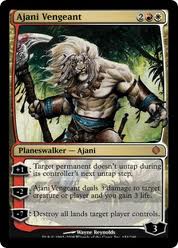
2 Ajani Vengeant
[/spells]
[Lands]
4 Wooded Foothills
4 Windswept Heath
4 Arid Mesa
2 Stomping Ground
1 Temple Garden
1 Sacred Foundry
1 Horizon Canopy
1 Kessig Wolf Run
2 Forest
2 Plains
[/lands]
[Sideboard]
2 Spellskite
3 Blood Moon
2 Choke
2 Ancient Grudge
1 Deflecting Palm
1 Bow of Nylea
2 Batterskull
2 Engineered Explosives
[/sideboard]
[/deck]

Sideboard Breakdown

[card]Blood Moon[/card]

Blood Moon is a fantastic card out of the sideboard and is there to give you free wins or stall the game until you can reach a dominant position. This card is a must against all three-or-more-color decks and can even dominate two-color decks.

[card]Choke[/card]

If your opponent plays [card]Island[/card]s, you play Choke. I don’t think it can be any clearer than that.

[card]Spellskite[/card]

I really like Spellskite. It stonewalls aggro early on and can help you win the burn matchup. I like Spellskite especially in game three of the control and Pod matchups to protect your [card]Blood Moon[/card]s and [card]Choke[/card]s from their removal.

[card]Engineered Explosives[/card]

Board sweepers are really good and Explosives is no different. If they play creatures, you should play Explosives.

[card]Batterskull[/card]

Burn, midrange, control: all of these are matchups where Batterskull can shine. It is your most resilient threat (next to Thrun) and when paired with your creatures can be very potent.

[card]Ancient Grudge[/card]

Good versus artifacts.

[card]Bow of Nylea[/card]

I think this card is the best card in my sideboard. Every ability on the card is good. The graveyard one, although you use it the least, can be very strong. It lets you bottom some strong cards from your graveyard, and with your large amount of fetch lands, you can shuffle and redistribute your used powerful spells back into your deck.

[card]Deflecting Palm[/card]

If you expect to get hit with a lot of damage from a single source, play this card. Creatures holding [card]Cranial Plating[/card], Tron’s creatures, Bogles, Ascendancy Combo (choose the creature, and yes, you can choose Caryatid) are great sources for this card to choose. Palm also has bonus points versus Burn, where it basically acts as an extra [card]Lightning Helix[/card].

To Begin, Let’s Start Off With UR Delver

UR Delver is a very interesting matchup that I feel lands in the favor of Zoo 60 percent of the time. The main goal for Delver is to play a tempo game versus you. To counter that, you should try to kill every creature they play on sight and try to go wide with your threats. An uncontested creature from them can spell the end for you, but as long as you have two or three blockers and some of your 12 removal options, you should be fine.

Sideboard out: 4 [card]Qasali Pridemage[/card], 3 [card]Scavenging Ooze[/card]

Sideboard in: 2 [card]Choke[/card], 2 [card]Engineered Explosives[/card], 2 [card]Spellskite[/card], 1 [card]Bow of Nylea[/card]

Out of their sideboard, I would expect counterspells and maybe combust for Knights.

Pro tip: [card]Insectile Aberation[/card] has a converted mana cost (CMC) of 0, and therefore will die along with [card]Young Pyromancer[/card] tokens to [card]Engineered Explosives[/card].

Next Up At Bat: Burn

[Deck Title=Burn]
[Creatures]
4 Goblin Guide
4 Monastery Swiftspear
4 Eidolon of the Great Revel
[/Creatures]
[Spells]
4 Boros Charm
4 Lightning Bolt
4 Skullcrack
4 Lava Spike
4 Rift Bolt
4 Treasure Cruise
2 Shard Volley
2 Searing Blaze
[/Spells]
[Lands]
5 Mountain
4 Scalding Tarn
4 Wooded Foothills
2 Arid Mesa
2 Steam Vents
2 Sacred Foundry
1 Stomping Ground
[/Lands]
[Sideboard]
3 Destructive Revelry
4 Dragon’s Claw
2 Searing Blood
2 Smash to Smithereens
[/Sideboard]
[/Deck]

Burn is one of your rougher matchups, and can be a deterrent to playing Zoo, but after you learn the matchup, it isn’t that bad. I would consider it 45 percent pre-board, and post-board it is completely draw dependent on your end.

In game one of each match, once you find out your opponent is playing Burn, you want to try not to kill yourself with your lands. Basic lands are your best friends, making [card]Windswept Heath[/card] your best fetch. Every single creature that they play is worth killing with any removal spell you have, so don’t be picky. [card]Scavenging Ooze[/card], [card]Lighting Helix[/card], and [card]Ajani Vengeant[/card] are how you stay alive in game one, so please try your best not to get [card]Skullcrack[/card]ed.

Sideboard out: 4 [card]Qasali Pridemage[/card], 2 [card]Path to Exile[/card]

Sideboard in: 2 [card]Batterskull[/card], 1 [card]Bow of Nylea[/card], 1 [card]Deflecting Palm[/card], 2 [card]Spellskite[/card]

Just like your plan versus Delver, you are going to try to stonewall their aggressive creatures. Spellskite helps block the aggressive starts and subtracts one damage from most burn spells (except when coupled with Hierarch and you are able to pay the blue mana to activate its ability). [card]Deflecting Palm[/card] is basically another Lightning Helix in this matchup—it is better than your other cards so you play it. [card]Batterskull[/card] and [card]Bow of Nylea[/card], if unanswered, basically read, “You win the game.”

Pro Tip: Although you board them out for games two and three, you should remember that Qasali Pridemage kills [card]Eidolon of the Great Revel[/card].

Affinity for Affinity

[deck title=Affinity]
[Creatures]
2 Etched Champion
2 Master of Etherium
2 Memnite
3 Steel Overseer
4 Arcbound Ravager
4 Ornithopter
4 Signal Pest
4 Vault Skirge
[/creatures]
[spells]
4 Cranial Plating
4 Mox Opal
4 Springleaf Drum
3 Ensoul Artifact
3 Galvanic Blast
[/spells]
[Lands]
1 Island
4 Blinkmoth Nexus
4 Darksteel Citadel
4 Glimmervoid
4 Inkmoth Nexus
[/lands]
[Sideboard]
2 Thoughtseize
1 Whipflare
2 Ancient Grudge
1 Gut Shot
1 Dismember
1 Nature’s Claim
1 Blood Moon
2 Spellskite
1 Relic of Progenitus
1 Grafdigger’s Cage
1 Torpor Orb
1 Etched Champion
[/sideboard]
[/deck]

Affinity is a race, and one you are primed to lose. Disruption and killing all of their threats is key to winning this matchup. [card]Qasali Pridemage[/card] is a three-mana removal spell that sometimes sits around to block, but if your board is full of them, you are doing something wrong. One-for-one removal on key threats and two-for-oneing your opponents when they use [card]Ensoul Artifact[/card] are your best ways to get any semblance of card advantage. [card]Scavenging Ooze[/card] is a champ and helps you stick a big threat while you try not to die.

Sideboard out: 2 [card]Thrun, the Last Troll[/card], 2 [card]Ajani Vengeant[/card], 1 [card]Noble Hierarch[/card]

Sideboard in: 2 [card]Engineered Explosives[/card], 2 [card]Ancient Grduge[/card], 1 [card]Deflecting Palm[/card]

Engineered Explosives and Ancient Grudge are how you get your card advantage here. The same thing is true here as in the previous matchups: you just try not to die until you can close out the game. Kill everything on sight, and if they crack in with a [card]Cranial Plating[/card] or even just an Ensouled Artifact, throw it back at their face.

Pro tip: Be mindful of [card]Arcbound Ravager[/card]. You can use removal to coax them into going all in on a creature if you have another removal spell to kill its target. Never let a [card]Steel Overseer[/card] untap or you will lose the game.

Brainstorm Brewery is a Great Place for Merfolk

[deck title=Merfolk]
[creatures]
4 Cursecatcher
4 Silvergill Adept
4 Master of the Pearl Trident
4 Lord of Atlantis
1 Phantasmal Image
4 Merrow Reejerey
2 Kira, Great Glass-Spinner
3 Master of waves
[/creatures]
[spells]
4 Aether Vial
4 Vapor Snag
2 Spell Pierce
4 Spreading Seas
[/spells]
[lands]
14 Island
4 Mutavault
2 Cavern of souls
[/lands]
[sideboard]
2 Grafdigger’s Cage
4 Gut Shot
2 Spellskite
2 Steel Sabotage
2 Swan Song
3 Tidebinder Mage
[/Sideboard]
[/deck]

Merfolk is a matchup that is never close. If you let them develop a board, you can plan on getting blown out, while if you keep their board clear and don’t let them establish three lords, you should be fine. I don’t have a percentage for this matchup because it is so draw-dependent, but I feel favored.

Sideboard out: 4 [card]Qasali Pridemage[/card]

Sideboard in: 2 [card]Choke[/card], 2 [card]Engineered Explosives[/card]

Post-board, you really just want to Choke them out or decimate their board with Explosives, but otherwise play the same as game one. If they are on a UW build rather than a mono U build you can bring in Blood Moon to decimate them. 

Bogles, AKA Your Worst Nightmare

[deck title=Bogles]
[Creatures]
4 Slippery Bogle
4 Gladecover Scout
4 Kor Spiritdancer
[/creatures]
[Spells]
2 Path to Exile
4 Spider Umbra
4 Rancor
4 Ethereal Armor
3 Hyena Umbra
1 Spirit Link
3 Spirit Mantle
4 Daybreak Coronet
2 Unflinching Courage
[/Spells]
[Lands]
4 Razorverge Thicket
4 Temple Garden
4 Windswept Heath
3 Sunpetal Grove
1 Dryad Arbor
1 Forest
1 Plains
1 Wooded Foothills
[/Lands]
[Sideboard]
2 Supression Field
1 Grafdigger’s Cage
2 Relic of Progenitus
1 Torpor Orb
4 Leyline of Sanctity
1 Rest in peace
2 Stony Silence
1 Nature’s Claim
[/Sideboard]
[/deck]

You have four cards to interact with this deck, period. Prepare for a beating and losing game one. I’d call it a 10-percent chance to live past turn five in game one.

Sideboard out: 2 [card]Ajani Vengeant[/card], 2 [card]Lightning Helix[/card], 4 [card]Lightning Bolt[/card]

Sideboard in: 2 [card]Spellskite[/card], 2 [card]Engineered Explosives[/card], 3 [card]Blood Moon[/card], 1 [card]Deflecting Palm[/card]

I leave [card]Path to Exile[/card] in for games two and three over [card]Lightning Bolt[/card] because it gives me a way to deal with [card]Kor Spiritdancer[/card], but I think they are interchangeable if you would rather burn faces.  Your game plan post-board is to stick an early [card]Spellskite[/card] to steal their enchantments or to [card]Blood Moon[/card] them out of the game ASAP. It doesn’t matter if you lock yourself out, either—just hope you draw basics before them. Explosives is your reset switch on one or two, usually to try and rip apart their Voltron. Good luck, because you will need it.

Pro tip: Funerals and coffins are a waste of money, just get cremated because there wont be anything besides a bloody pulp to see at a viewing.

Little Zoo: It Ain’t No Big Zoo

[Deck Title=Little Zoo]
[Creatures]
4 Wild Nacatl
4 Steppe Lynx
4 Tarmogoyf
2 Scavenging Ooze
2 Qasali Pridemage
4 Knight of the Reliquary
4 Ghor-Clan Rampager
[/creatures]
[Spells]
4 Lightning Bolt
4 Path to Exile
4 Lightning Helix
[/Spells]
[Lands]
4 Arid Mesa
4 Wooded Foothills
4 Windswept Heath
3 Horizon Canopy
2 Temple Garden
2 Stomping Ground
1 Forest
1 Kessig Wolf Run
1 Misty Rainforest
1 Sacred Foundry
1 Plains
[/Lands]
[Sideboard]
1 Scavenging Ooze
1 Grafdigger’s Cage
2 Ethersworn Canonist
3 Molten Rain
2 Wear//Tear
1 Magma Spray
2 Boros Charm
1 Ancient Grudge
2 Stony Silence
[/Sideboard]
[/deck]

Historically, Big Zoo was built to prey upon Little Zoo, and that is what you do. I played this exact matchup at SCG Worcester in the quarterfinals and got a quick 2-0 victory. As long as you don’t get blown out by a [card]Ghor-Clan Rampager[/card], you should be able to win game one off of having more [card]Scavenging Ooze[/card]s.

Sideboard out: 4 [card]Qasali Pridemage[/card], 4 [card]Noble Hierarch[/card]

Sideboard in: 3 [card]Blood Moon[/card], 2 [card]Batterskull[/card], 1 [card]Bow of Nylea[/card], 2 [card]Engineered Explosives[/card]

In games two and three, you should just kill them. Sweep their board and play stronger and more resilient threats until they die. Thrun is a card they have a lot of trouble with, and locking them out with a Blood Moon is just GG.

Now You Know

Thank you all for reading. I’ll be back soon with another installment, where I will talk about sideboarding against more midrange and control-oriented decks. If you have any questions, please leave them in the comments and I will try to get to them as soon as I can.

Privileged Perspective 4: The Mana From Another Place

One of my favorite aspects of Magic finance is the one that is very likely the least discussed. People will pore endless hours over set reviews, Modern breakouts, and Reserve List buyouts, but there is, comparatively, nothing written about foreign foils and obscurities. There are several different factors that contribute to this, but in an era where it feels like Magic information is being homogenized and disseminated faster than ever1, it’s strange that the foreign markets have so little to go off of. We’ll touch a little bit on how the foreign foil premium works (spoiler alert: it’s pretty random!), some of the resources that you can use to grow your reach with niche markets, and we will get to look at lots of pictures of cool cards! Let’s rock!

Grasping at Straws; or “Known Knowns and Known Unknowns”

When you are operating with unknown or incomplete information, it is best to look at everything that you know is concrete, and extrapolate from that. In the context of today’s theme, this means we want to look at everything we do know when trying to determine the price of a card that we don’t know.

FIRST OF (SURPRISINGLY FEW!) BRIEF ASIDES: Very rarely will a site like SCG have a published price on a foreign foil or rarity. If they do, treat this as one possible price, not the correct one—it may be several months old or predicated on unavailable information (like what their buyer paid for it). Also, they are likely to tack on a “Star City Premium” (and I don’t mean the kind where they charge you money to watch Todd Anderson videos), because most people simply wouldn’t know where else to find these types of cards.

The very first thing I figure out is what language a card is in. This will give us some idea of the scarcity/demand relative to its standard counterpart, the English copy. While almost all languages receive shorter print runs than English2, not all of them experience the same influences when it comes to final price. Here is a handy cheat sheet when it comes to identifying languages:

  • With European languages (excluding Russian, but including Spanish and Portuguese even though the majority of their speakers live in Central and South America), the price is typically going to be lower than English. While supply is lower, demand is lower as well, and many players prefer English copies as they typically trade better, especially internationally. The caveat here is any card where the translation makes the name of the card hilarious. Popular examples include Spanish [card]Sarkhan the Mad[/card] (Sarkhan, El Loco), French [card]Delay[/card] (Retard, which I personally don’t think is funny, but I’m just presenting facts), and for a brief period, German [card]Huntmaster of the Fells[/card] (which many expected to include the word “Jagermeister” in the name). There are also occasional misprints for specific languages, the most notorious being Spanish Meloku, who makes 2/2 tokens, instead of 1/1s (because that card wasn’t good enough already).
  • Chinese cards are actually printed in larger quantities than English cards (you would know this already if you were reading the footnotes). This results in lower prices on the majority of cards, but things like foil [card]Abrupt Decay[/card] are typically in line with the English price. When I am preordering or buying cards just to play with in Standard, I will typically buy Chinese copies to get a little bit of a better deal on them. Ignore the stigma of potential counterfeits by buying from trusted, reputable vendors: I buy exclusively from MTGMintCard, because they have great pricing and are (I think) based in the US, allowing for cheaper and faster shipping. My most recent purchase from them was a preorder of four Chinese [card]Temple of Enlightenment[/card], which were almost $2 less a piece than the English price. In the wild, I am able to identify Chinese cards by comparing the bulkier printing style to Japanese lettering. Chinese lettering in the name of the card often appears thicker than any other language.
  • Japanese has long been the “cool” language, and so it sees a price increase by virtue of being Japanese. Because the Japanese Magic community travels well, there is a great arbitrage opportunity trading English cards to Japanese players at events. English cards often fetch higher prices overseas, and there is a large subset of American players who like the look of Japanese cards. Foils will always outpace the pricing on English copies, and tournament staples for Modern or Legacy can have even stronger premiums attached. The easiest way to tell Japanese from any other language is by checking the card name (top left)—there will often be a small row of characters on top of the name. Japan, moreso than Korea or Russia (to my knowledge), has an extremely strong Magic community, and so there are some easy-to-find store sites with prices on #JPFoils (a hashtag I invented along with Zak, Heiko, and a couple others—shout out!). My personal preference is TokyoMTG.com.
  • Korean was a supported language for a few years (starting with Visions and then ending with Urza’s Saga), before it was discontinued. It has since been resumed (as of M12 and Innistrad), and is a popular choice with people who like foreign cards. For some reason, the beginning of the new Korean printings seem prone to several typos and misprints, including [card]Gideon Jura[/card] and Ashiok.
  • Russian is the last of the premium languages. It has a very small printing, and started around Gatecrash. Because these last two languages are relatively new, they have had a hard time ousting Japanese as the de facto cool language. I’m not going to make a lame Yakov Smirnoff joke, BECAUSE I AM A PROFESSIONAL, DAMMIT.
  • Henceforth, I will refer to Japanese, Korean, and Russian as “prestige languages.” This is in no way, shape, or form an endorsement of Hugh Jackman.

Once you have determined the language of a card, find out the price on the English equivalent (in the case of a foil, you will want both the foil and non-foil prices). For cards with either of the “modern” frames, the foreign and English prices on non-foils will be roughly the same (I might pad the sale price a little bit for prestige languages). If you are working with foils, then what you are looking for isn’t the price of the English card, but rather the foil premium between English versions. We will use two cards from Ravnica: City of Guilds as an example, with all prices coming from Star City Games.

[card]Blood Funnel[/card] is listed at 99 cents for non-foil and $1.99 for foil. These are, after doing some cursory research, about the lowest prices SCG will list older rares (and foil rares) at. We can establish the minimum foil premium at 100-percent markup, or double the price of the non-foil.

[card]Life from the Loam[/card], on the other hand, has a non-foil price of $4 (and out of stock!) and a foil price of $40. This means that the perceived value for [card]Life from the Loam[/card] (in spite of several additional printings and another foil printing!) is so high, that the foils are able to fetch ten times the non-foil price!

If I was presented with an opportunity to determine the prices on Japanese copies of these two cards (let’s say I’m somewhere without cell reception, like a giant concrete convention building or Mississippi), then I am going to value the [card]Blood Funnel[/card] about on par with the foil English copy (I’d probably settle on $3 in trade, which is pretty good for freakin’ Blood Funnel).

The Loam, however, is going to be trickier. Despite being unable to find any JP foil copies of Loam for sale with a quick Google search, I can tell you its typical sale price is about $180. The foreign premium will not always be the same percentage as the foil premium (thank God), but if there’s a foil premium in excess of the standard3, then the foreign premium for prestige languages will be in excess as well. I wish I could tell you exactly how the Loam got to $180, but it isn’t an exact science. A lot of times, however, it seems the rule of thumb is “double it, then double it again.”

Acquisitions

The growth of Magic’s presence on the internet has made getting foreign foils and niche cards much easier over the last couple of years. The expansion of eBay into other countries (with PayPal serving as a financial Tower of Babel in easily converting currencies) and social media have largely replaced the old system of, “Go to a GP and try and trade with the Japanese players.” While that original system of arbitrage is still largely in effect, the majority of my recent acquisitions have been from my phone, typically while pretending to work. Look, let’s just bullet point these so we can get on to the cool pictures of foils and stuff, okay?

  • You already know about eBay, but make sure you’re able to see foreign sellers as well (I think sometimes this gets disabled in settings, I don’t know, I always look at it on my phone). Here’s a great tip: type “Japanese Foil” or “Japanese Foil MTG” into eBay and just read through all of the listings some time when you’re bored living in the most technologically advanced civilization to ever exist. Not only will this help you familiarize yourself with the kinds of prices and margins you’ll be dealing with, but it makes a fantastic car game on the way to a tournament. You, the phone person (and hopefully not driver), say, “How much is Japanese Foil [CARD NAME] worth?” and the other people in the car try to guess closest without going over.
  • Another quick eBay tip: Make sure to write down the names of some of the more frequent users you see dealing in foreign/niche cards. If you are going to be getting into this stuff, it’s good to know who the other players are, and you will likely buy from them repeatedly, so build a friendly rapport. This will allow you to build a network of people who are able to find things for you across the globe, which is pretty cool.
  • In a future portion of this article, I will tell you about a website called Magic Librarities. One of the things listed on it is every printing of every FNM/Arena/Gameday promo in every language it was printed in. I personally like Japanese FNM promos ([card]Grisly Salvage[/card] especially), so you can browse that website for promo cards to see what language they are in. I also have a sweet Japanese [card]Slave of Bolas[/card]. Will you deliver a message to future Ross for me? Tell him, “The owls are not what they seem.”
  • Websites like TokyoMTG and MTGMintCard are great if you know what language you are looking for. MTGCardMarket is a good source of European language cards, but you have to live in Europe to be a member. Therefore, I recommend either making a friend in Europe who doesn’t mind being a middle-man in facilitating trades, or committing international identity theft. Actually, you should probably just do the first one.
  • I literally just have a little blurb at the end of my PucaTrade profile that says, “If you have any foreign or weird foils that you don’t know what to do with, I’ll take ’em,” and people message me out of the blue all the time with cards they want to get rid of. It’s sweet!
  • I’ll let you in on a secret: your LGS can get foreign boxes from WOTC. They can’t get much (and I believe it is partially dictated by your store level), but if you’re the only person in your town that likes Korean cards, then make friends with the store owner. Be willing to pay up front if this is something they don’t do often—many small stores have a hard time selling foreign packs to casual players.
  • Trade with foreign players at large events! There are a lot of great guys like Saito who have been doing this for a while, and will be happy to scratch your back if you scratch theirs. DISCLAIMER: do not actually scratch another attendee’s back without consent. Can we look at cool cards now? Awesome.

The Sweetness

Do you ever scroll through Librarities? If you aren’t familiar with it, it’s a website that catalogs all of the rare obscurities of Magic’s past, as well as a comprehensive collection of every promotional card ever printed. It’s MagicLibrarities.net and you should really go check it out after finishing my article and leaving me a comment about how great this was. Don’t worry, the link will still be there. Now, grab a cup of damn fine coffee and settle in, we’re gonna check out some sweet cards!

Tenth Edition Foils

Were you aware that foils in Tenth Edition didn’t have reminder text? This was before core sets featured new cards, so all the cards that got this treatment were reprints. The most famous is [card]Time Stop[/card], which sells for about $30, twice the price of the original set foil! Many of the cards with this treatment also received flavor text that otherwise didn’t fit. [card]Time Stop[/card] just looks sweet though.

1374_10E_Timestop_foil

Test Foils/Test Prints

While foils weren’t introduced to Magic until after Urza’s Saga, Wizards spent some time internally developing how they would look, including printing some test versions of cards that already existed. These are rare, and are not even technically supposed to exist. Likewise, right before the card frame overhaul in Eighth Edition, Wizards tried a couple different templates, including some that made it to print. These were never intended to leave the building, but a few made it out alive. We know these are legit because they were featured in an Arcana on the Mothership. Featured below are two scans of actual test prints: a basic Plains with a frame for Eighth Edition that was ultimately scrapped (as well as the Unglued set symbol, and the art for Parallax Tide), and a test foil [card]City of Traitors[/card], with a red text box.

testprints

Bear in mind that neither of these were ever expected to be seen by the public eye, so these aren’t mistakes—they are just attempts to see every possible permutation before announcing a change to the public. Obviously, when you get to this level of the game, things like price become much less concrete. I’m posting a couple of links to test prints that are on eBay. The high-end Magic crowd doesn’t play around.

The auction for that Plains I showed you

Giant Growth Test foil, for the best-looking Infect list ever

Here is a Counterspell with a price tag higher than some credit card limits

A Somehow Even Less-Playable Shivan Dragon

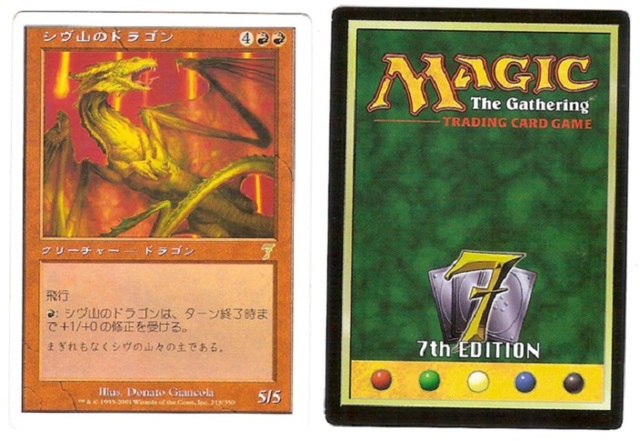
One of the more interesting things about Magic obscurities is that they can sometimes become lost, even to the hyper-aware Magic finance crowd. Featured below is the CoroCoro Magazine Shivan Dragon promo that was released in Japan to celebrate the upcoming Seventh Edition. (Note for young people: magazines were like the internet, but strictly worse. But sometimes they came with crap inside!)

corocoro shivan

Notice the alternate card back. This card is literally unplayable in sanctioned Magic (sweet gift, thanks!). The great thing about older, unimpressive regional promos like these is that they don’t stay in the public eye. Because people aren’t trolling eBay and such for these niche cards, it makes it possible to pick them up for surprising prices. I snatched one of these of eBay for $10, and was able to flip it for double. SCG actually has quite a few of them in stock, all for between $25 and $30 based on condition, but these were going for about $40 NM a while back. While demand is not very high, it’s still a collectable, and I imagine SCG is just content owning a bunch of them and moving them whenever. I’m still a buyer at $10, but not much higher.

More Expensive Promos. Like, Much More

It’s interesting to me that Wizards seems to be moving away from the regional distribution of promotional cards. Every GP gives away a [card]Batterskull[/card], every PTQ gives away a Liliana (I want yours, by the way), but it wasn’t always like that. I’ll lead off with what is likely the most high-profile example of a regional promo:

mutavaultEA

Only 32 of these exist, and they are going for roughly the same price as a beat up Unlimited Mox. If you didn’t make top four of Champs (which was basically States before “States” meant “eight-hour win-a-box tournament”) in England or Ireland, you likely don’t have one. Why these were not the selected promo for all Champs events is beyond me (I got a Doran).

Do you know what the JSS was? It was a tournament series for kids too young to understand the moral severity of cheating in Magic tournaments, but old enough to watch Rounders during FNM to ranch fish for scholarship money. No joke, many people still refer to, “Swamp, Duress” on turn one as the “JSS Opening,” since: #1. Duress was a great card 10 years ago, and #2. You immediately got to see your opponent’s hand to determine if he was playing an actual deck or not. Anyways, WOTC gave out a bunch of promos for JSS events, some of which are really expensive today. The program was later extended to be internationally run, and its somewhat abrupt end4 caused some promos to be under-distributed (or not given away at all). The best such example is the APAC Glorious Anthem, which was never given out, but has slowly leaked into the market through other means (supposedly, a former Wizards employee was given one as a parting gift). The APAC version is only identifiable by the APAC stamping on the foil watermark (I highlighted it for you).

APACAnthem

I saw one of these close recently on eBay for about $650, although they’ve been known to go for much more.

The last thing I’ll leave you with is the Hachette or “Pegasus” cards. There was a program in Italy (and/or possibly Spain?) where you could basically register for a “Magic Encyclopedia Program” and they would mail you terrible decks to play with your friends. The cards were all white-bordered, had a unique Pegasus set symbol, and were part of a terrible system that nobody signed up for. Fast forward to our times, and the cards sell as yet another collectible oddity. The most playable card printed for this program was probably Marrow-Gnawer, although there was a Sliver deck with Riptide Replicator. You can find all of the decks (with card images) here.

I will see you again in 25 years. Or next week. Whatever. Actually, I’ll see some of you at GPNJ!

BEST,

Ross


1 Nowhere is this more pronounced than Magic Online, where WOTC is literally restricting the amount of decklists that get published to try and delay format stagnation.

2 The only one I know of that has a larger printing is Chinese. More on this later!

3 Remind me some time to tell you why the foil premium is BS.

4 It was actually “redesigned” as the Magic Scholarship Series in ’07, and the Glorious Anthem was for that, and not the JSS. That said, the redesign only lasted a year, so meh. Everyone just called it the JSS then anyways.

Brainstorm Brewery #122 – Moneystorm Draughtbrew

You’re not hearing things; Brainstorm Brewery has been invaded! Determined to bend the universe to his will in the interest of making his own life easier, Jason records Money Draught and Brainstorm Brewery back to back this week and brings JR (@Time_Elemental) and Slick Jagger (@Slickjagger) with him. Two’s company, but five’s a crowd as Marcel ducks out to do grownup-people stuff. With no one to drive the train, does the gang go off the rails or are you in for a podcast meet-up that is greater than the sum of its parts? Can’t it be both?

With Slick keeping the gang on track and JR offering his trademark finance insights, this could be the best Brainstorm Brewery to date. The list of guests who have been back on the cast more than once is a short one. So who ends up driving the train? Who has the most controversial Pick of the Week? Who dozes off? Find out the answer to all of these questions and more on an episode that will have you asking, “Why haven’t I been checking prices on MTGGoldfish?” Join us for Brainstorm Brewery.

  • Guestravaganza! Money Draught millionaires Slick Jagger (@slickjagger) and JR (@Time_Elemental) join their cohost Jason and invade the BSB!
  • Finance 101 comes naturally this week.
  • Slick tries to derail the cast with questions and ends up accidentally adding value.
  • Listener e-mails are insightful as ever.
  • Questions? Concerns? E-mail brainstormbrew at gmail dot com.


Cabe Riseau produced the intro and outro music for Brainstorm Brewery.

Contact Us!

Brainstorm BreweryWebsiteE-mailTwitterFacebook

Ryan BushardE-mailTwitterFacebook

Corbin HoslerE-mailTwitterFacebookQuietSpeculation

Jason E AltE-mailTwitterFacebookQuietSpeculation

Marcel WhiteE-mailTwitterFacebook

Conjured Currency #39: The Nekusar Effect

Hey, everyone! I’m going to take a moment and assume that not all of you reading this article have been playing for longer than a year. For those who are unaware of what the title of this article is referring to, let me give you a brief refresher: [card]Nekusar, the Mindrazer[/card], was one of the three legendary creatures that came attached to the Mind Seize Commander 2013 deck last year. While almost all of the people who purchased Mind Seize ripped open the packaging for [card]True-Name Nemesis[/card] and threw the other cards to the wind, there were a tiny number of players who realized that [card]Underworld Dreams[/card] on a stick in Grixis colors made for a damn good commander.

Just kidding, that “tiny” number of players was enough to make [card]Forced Fruition[/card] jump from $1 to $7 almost overnight, because making people eat a [card]Searing Wind[/card] every turn was fun. Not only Fruition, but [card]Wheel of Fortune[/card], [card]Teferi’s Puzzle Box[/card], and [card]Winds of Change[/card] also managed to skyrocket past their previous slumbering bulk box prices. Meanwhile, Nekusar himself drifted down to bulk status, and remains there a whole year after his release. The card’s only other printing is a $35 judge foil, so it’s safe to assume that there are enough Mindrazers to go around for people who want him.

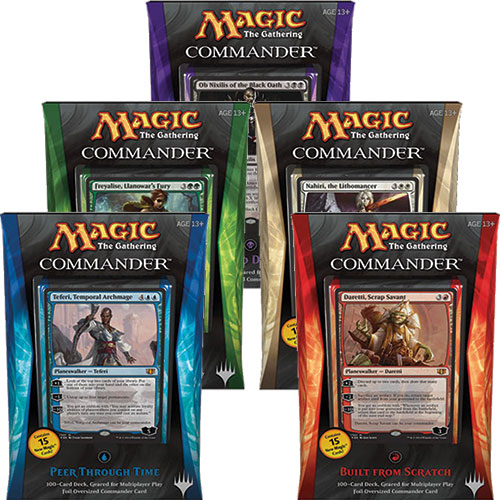
Now, where does that leave us with Commander 2014? While I don’t think any of the new (or reprinted) legendary creatures will be above single dollar status a year from now, its’ entirely possible that EDH players find a common ground in one of the cards from the set to build around. Just like with Nekusar, there will be weird, old cards that have low supply and a sudden spike in demand. Let’s try and have a discussion to see if we can pinpoint which general can rise to the top, and the older cards that will end up supporting him or her!

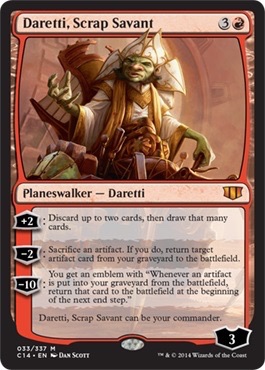
[card]Daretti, Scrap Savant[/card]

daretti

While I don’t recommend buying in at $11 at all, I do think this will be the most opened deck by far. The mono-red deck has goodies such as [card]Wurmcoil Engine[/card], [card]Dualcaster Mage[/card], [card]Chaos Warp[/card], [card]Goblin Welder[/card], [card]Reliquary Tower[/card], and [card]Solumn Simulacrum[/card]. While you can definitely expect these to drop in the coming months, that doesn’t mean players won’t rush out to buy the deck because they believe it to be “more than worth it.”

If we run with this assumption, then there will be tons of spare Feldons and Darettis lying around once people figure out he’s not good in Legacy. For what it’s worth, it looks like Wizards tried really hard with this deck to dispel the (currently true) myth that “mono-red is the worst color choice in Commander.” Where should we look for potential “artifact matters” mono red EDH pieces?

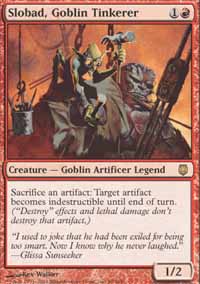
[card]Slobad, Goblin Tinkerer[/card]

Slobad_Goblin_Tinkerer
Chas Andres of SCG made an excellent point on a recent Reddit thread discussing this topic, and suggested this as a pickup. As someone who already likes bulk rare specs, I support this 100 percent. It’s strong in the deck, has an extremely low chance of reprint, and is running on a very low comparative supply, considering it’s only been printed once, back in the original Mirrodin block. Although there are a few hundred copies on TCGplayer, it’s a very low-risk pickup with high reward potential.

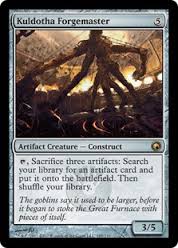
[card]Kuldotha Forgemaster[/card]

forge
I talked about this card a few weeks ago, about how it was a bulk rare that really only needed one more card to be absolutely broken. I’m assuming it’s incredibly powerful in the Daretti deck, and I really don’t think you have long before this card starts gaining financial traction. It’s freaking [card]Tinker[/card], people. If you untap with it, you basically win. Out of every card in this article, I’m loving this more and more as a spec each day.

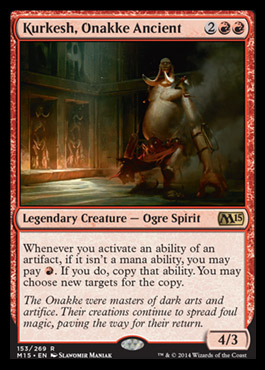
[card]Kurkesh, Onakke Ancient[/card]

kurkeshonakkeancient

Besides having a stupid name and looking like a boss monster out of Legend of Zelda, this seems like it deserves a spot in the mono-red deck. I don’t think this is poised for an immediate spike, like Fruition or any of Nekusar’s buddies, but I also don’t think it deserves to be a bulk rare a year or two from now. Definitely something to grab out of bulk rare bins and set aside for later. M15 had quite the low supply, as we could tell from $40 Nissas and $20 Rabblemasters.

While the red deck definitely seems to be the winner of “most popular,” I don’t think the green deck is too far behind. They reprinted almost all of everyone’s favorite elves this time around, and I wouldn’t be surprised if there were many a Johnny looking at the below card, wondering how to break it.

card]Titania, Protector of Argoth[/card]

titaniaprotectorofargoth

I admittedly wasn’t super excited about any of the new cards in Commander 2014, at least until I saw this baby. For those who don’t know me, I have a five-color [card]Child of Alara[/card] deck that runs approximately 60 lands, and runs entirely off of land-based engines. Titania seems absolutely absurd in any sort of land-themed deck, although I think she works better as one of the 99 instead of as a commander. Still, maybe her existence is enough to spike interest in land-themed decks. Let’s see if there are any old cards that could see a resurgence due to her interesting mechanics!

[card]Zuran Orb[/card]

zuranorb
Quite possibly the easiest way to sacrifice your own lands in the entire game, and a quick way to get an army of 5/3s at the end of your opponent’s turn. While I don’t think Titania is going to make Orb spike to $7, it’s still probably worth having the interaction on your radar just in case the deck does become popular.

[card]Realms Uncharted[/card]

realms
A bulk rare designed to be a land version of [card]Gifts Ungiven[/card], but it never really got anywhere. I play it in my Child deck to great effect though, so maybe I’m biased when I argue in favor of its power level. You can search a number of different fetch lands to crack for elemental tokens, or go full utility and grab stuff like [card]Thespian’s Stage[/card], [card]Maze of Ith[/card], and [card]Vesuva[/card].

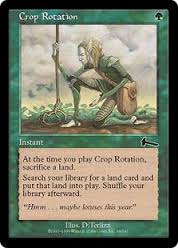
[card]Crop Rotation[/card]

crop
It’s always been an extremely powerful tutor at first glance, but having a 5/3 attached at instant speed seems worth enough to be an auto-include in any Titania decks, and most decks that include her. You only get to play one [card]Gaea’s Cradle[/card], and this finds it quickly and easyily.

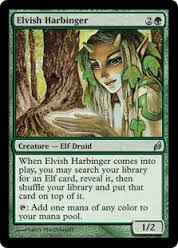
[card]Elvish Harbinger[/card]

elvishharbin

For all of the new elf Commander decks out there, this is one that I control-F’d on the decklist page and didn’t end up seeing. It’s not quite [card]Fauna Shaman[/card] in terms of power level, but it’s one card that you don’t have to worry about unloading as a result of the massive number of reprints. She’ll most likely continue to slowly creep up until she hits $5 like [card]Imperious Perfect[/card] did.

It’s a Gruul Kind of Week

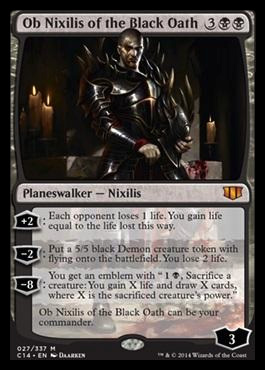
Unfortunately, there’s not the same “build around me” feel in the blue or black decks as there is in the green, white, or red. The Teferi and Ob Nixilis decks feel much more generic instead of having a dedicated theme. This is something you might want to take into account if you feel that’s a strong enough reason for one deck to be opened less than the rest. Personally, I believe that the mono-red deck has the largest room to have a Nekusar effect, either with Daretti or Feldon.

Do you have any pet specs that you think have a chance to shine because of the new legends and planeswalkers? Let me know in the comments section, Reddit, or on Twitter. Also, I’ll be off at Grand Prix New Jersey this weekend, selling cards to dealers and enjoying the vacation. Message me if you want to hang out, talk finance, or play Commander!

Pimp My Deck: Commander 2014Guided by Nature (the Green Deck)

Hey, everyone, I’m here to bring you a brand-new article series to help newer players get into Commander.  I’m planning on covering all the new decks over the course of a few articles, and today I’m going to start with the green one, Guided by Nature. The first thing I’m going to do is break down the article based on which Commander we’re going to use and keep the cost of our upgrades within a specific range.

[card]Ezuri, Renegade Leader[/card] – The $30 Upgrade

What to remove:

-[card]Titania, Protector of Argoth[/card] – Titania is sweet, but she really doesn’t fit with our theme. We need to cut cards to add cards, so she’s getting the swift axe.

-[card]Terramorphic Expanse[/card], [card]Crystal Vein[/card], [card]Evolving Wilds[/card], [card]Myriad Landscape[/card] – We want to shave a few lands from the 37 we’re playing, and these are mostly in the decks to work with Titania.

-[card]Harrow[/card] – also a card that is best with Titania

-[card]Hunting Triad[/card] – Yeah, it makes elves, but it’s one of the worst elf cards in our deck.

-[card]Elvish Skysweeper[/card] – This guy is pretty bad for a one-mana elf.  He doesn’t make any mana and should be replaced with an elf who can!

-[card]Seer’s Sundial[/card] – This card is fine, but it’s pretty slow in this deck and we’d rather be playing elves.

-[card]Assault Suit[/card] – I’m not honestly sure why this card is in this deck, but it’s not particularly good.

-[card]Rampaging Baloths[/card] – We’re getting rid of all the land stuff, so this guy is going, too.

-[card]Loreseeker’s Stone[/card] – We’re replacing this with a more mana-efficient artifact.

-[card]Sylvan Safekeeper[/card] – It’s blasphemous that they aren’t using the sweet Olle Rade art, but since we’re removing Titania, this guy gets a lot worse (and he’s not even an elf!).

-[card]Moss Diamond[/card] – We’re going to have plenty of elves to make mana. We don’t need this.

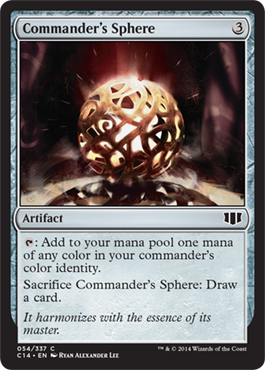
-[card]Commander’s Sphere[/card] – This is often going to be three mana: draw a card.  We can do better.

What to add:

-[card]Forest[/card] – FREE – You should have one of these.

-[card]Slate of Ancestry[/card] – $1.50 – We need some card drawing once we dump all our cheap elves into play.  Not much better in tribal decks than this.

-[card]Caller of the Claw[/card] – $1.50 – Much like [card]Fresh Meat[/card], we need some contingencies for sweepers. This one also happens to be an elf.

-[card]Fierce Empath[/card] – $0.75 – Oh, hey, it’s an elf.  It also draws a card!  And the card is a sweet one!

-[card]Birchlore Rangers[/card] – $0.50 – Unlike its $6 cousin, [card]Heritage Druid[/card], this guy makes a bunch of mana and helps power our sweet turns. It’s important to note that you can use summoning-sick elves to power its ability.

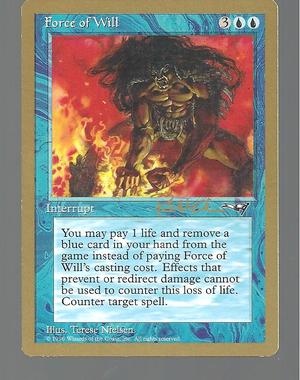
-[card]Wirewood Symbiote[/card] – $3.50 – Much like [card]Birchlore Rangers[/card], this guy is a Legacy staple. Yep! Legacy, the format with [card]Force of Will[/card], [card]Wasteland[/card], [card]Show and Tell[/card], etc. That should tell you how good this 1/1 insect is.

[card]Wirewood Channeler[/card] – $1.00 – Oh, well, what do you know? It’s a sweet elf to untap with [card]Wirewood Symbiote[/card]. This guy can make a ton of mana in short order.

[card]Arbor Elf[/card] – $0.25 – A guy that makes some more mana. Can’t ever have too many of those, right?

[card]Joraga Treespeaker[/card] – $2.00 – Shhhh. The trees are speaking. They said this makes all of your elves into [card]Sol Ring[/card]s.  That’s a good deal, right?

[card]Coat of Arms[/card] – $8.00 – The most expensive card on this list. I was trying to figure out a way to squeeze in [card]Craterhoof Behemoth[/card], but you really need tutors to make the most of that monster.  This card is pretty good in a tribal deck.

[card]Triumph of the Hordes[/card] – $0.25 – This has elves in the art!  But seriously, it’s one of the best green win conditions in EDH, and for a quarter, you can’t get much more bang for your buck.

[card]Elvish Harbinger[/card] – $2.00 – Makes mana, check. Is an elf, check. Brings more elves to the party, check. Seems like a slam dunk in this deck.

[card]Nylea, God of the Hunt[/card] – $6.00 – This goddess loves green mana symbols in play and green mana in your mana pool. Elves provide these.

[card]Bow of Nylea[/card] – $2.00 – [card]Nylea, God of the Hunt[/card] combined with her bow completes the one-two punch of deathtouch and trample.  It makes blocking all our little dorky guys exceptionally hard.

[card]Yeva, Nature’s Herald[/card] – $0.5 – This is one big girl.  A 4/4 elf is nothing to sneeze at, but it also gives our deck tons of play against sweepers because we can flash in creatures during the end step.

What’s the Damage, You Say?

It’s $29.75 on most retail websites. Just a touch under $30 before shipping. We’ve focused the deck by removing most of the extraneous stuff that combos with Titania and streamlined our elf theme. I’m going to assume you make these upgrades before you move onto my [card]Freyalise, Llanowar’s Fury[/card] section. Both Ezuri and Freyalise play well into the elf theme, so you can do both sets of upgrades with either general.

[card]Freyalise, Llanowar’s Fury[/card] – The $100 Upgrade

What to remove:

[card]Terastodon[/card] – This guy is pretty good for most budget decks, but we’re going to replace him with a creature that doesn’t give our opponents elephants when we blow up their stuff.

[card]Sylvan Ranger[/card] – This card’s effect is pretty marginal.  It’s just a worse [card]Elvish Visionary[/card] most times.

[card]Drove of Elves[/card] – This card is slow and klunky.  It can be big, but a lot of the time, it plays naturally into cards that kill it ([card]Wrath of God[/card], etc).

[card]Grim Flowering[/card] – This card is really expensive and slow.  Ideally we don’t want to draw cards after all our guys are dead.

[card]Desert Twister[/card] – This card is also, you guessed it, really slow.  Paying six mana to destroy what is likely going to be an enchantment or artifact is pretty expensive.  Occasionally, you’ll want to kill a creature, but we should have the biggest guys in town.

[card]Sylvan Offering[/card] – This puts a lot of dudes into play but also gives our opponents blockers.  I don’t think its mana cost justifies it.

[card]Emerald Medallion[/card] – It might be wrong to take this out, but we’re planning on casting a lot of cards with only green mana symbols in their costs. This card doesn’t reduce those cards’ mana costs.

[card]Wolfcaller’s Howl[/card] –  I know there’s a mini wolf theme in the deck, but this is easily the worst card.  It’s not guaranteed to trigger, and I think there are better things we can be doing with four mana.

[card]Whirlwind[/card] – There’s already a [card]Predator, Flagship[/card], [card]Silklash Spider[/card], and [card]Tornado Elemental[/card] in the deck. [card]Whirlwind[/card] is overkill after our additions.

[card]Masked Admirers[/card] – Four mana to draw a card and have a 3/2 is not a great deal in Commander.

[card]Thornweald Archer[/card] – This guy is a pretty effective rattlesnake-style card. I want us to be able to do bigger and stronger things, though, so he’s going to get the axe.

What to add:

[card]Genesis Hydra[/card] – $2.50 – We’re getting this guy in here to help find our more powerful permanents. It scales well with elf mana and can put a lot of our most powerful cards into play for free!

[card]Eternal Witness[/card] – $2.50 – Being able to rebuy any of our spells is pretty awesome! It also dies to [card]Skullclamp[/card].

[card]Oracle of Mul Daya[/card] – $12.00 – If you’ve played with [card]Courser of Kruphix[/card] in Standard, you know how powerful playing lands from the top of your library is. Oracle also happens to ramp and be an elf, so it seems like a win/win situation in this deck.

[card]Craterhoof Behemoth[/card] – $12.00 – This card is the number-one reason why people concede to a green deck in Commander. Its power and grace cannot be matched.

[card]Chord of Calling[/card] – $5.00 – Thanks to the recent reprint, this card is more affordable than ever!  It allows us to tutor up corner-case creatures or just find a big [card]Regal Force[/card] for value!

[card]Green Sun’s Zenith[/card] – $6.00 – Much like above, this card is also a lot less mana so we can find cheap mana elves to accelerate us more easily.

[card]Heritage Druid[/card] – $6.00 – The big poppa of making mana.  This elf rivals [card]Priest of Titania[/card] in the sheer volume of mana that can be generated. Also, it’s a legacy all-star.

[card]Glimpse of Nature[/card] – $26.00 – If you’ve never cast a [card]Glimpse of Nature[/card] with a hand full of cheap elves, you haven’t lived.  This is the most expensive card we’re adding, but its power speaks for itself.  The only card that I would say is more important is [card]Gaea’s Cradle[/card], but that’s a little out of our price range.

[card]Woodfall Primus[/card] – $4.50 – The gift that keeps on giving!  Don’t be afraid to blow up your opponents’ dual lands with this guy. All is fair in love and war and Commander.

[card]Regal Force[/card] – $15.00 – This will likely be your second-most tutored creature after [card]Craterhoof Behemoth[/card] because of the sheer volume of cards it can draw.

[card]Tooth and Nail[/card] – $8.00 – The most powerful green card in Commander.  For the low, low cost of nine mana, you can tutor up [card]Regal Force[/card] and [card]Craterhoof Behemoth[/card], and on the off chance you don’t immediately win the game, your hand is full of cards. I almost always start green Commander decks with [card]Tooth and Nail[/card]

Damage on the Stack?  

The total cost of these upgrades is $99.50, and along with the Ezuri upgrades, you’ve got yourself a very competitive Commander deck.  Now that we’ve got the elf theme done, we’re going to work on the hard deck.  [card]Titania, Protector of Argoth[/card] is not a commander that is supported very well in this product. I’d say you need to start from scratch if you want to make a truly good deck. With that said, you can just remove your 15 least favorite elf cards and play the 15 I’m going to list below to make it a lot better.

[card]Dryad Arbor[/card], [card]Wasteland[/card], [card]Strip Mine[/card], [card]Petrified Field[/card], [card]Tectonic Edge[/card], [card]Dust Bowl[/card] – What? You weren’t expecting a ton of lands in the deck that revolves around putting lands into play and sacrificing them? These lands will serve as a base for the rest of the deck to revolve around.

[card]Crop Rotation[/card] – Searches up one of our best lands, puts a land into the graveyard. Pretty much everything Titania wants to be doing. It’s good before you cast her because you can return the sacrificed land to play, and it’s good after you cast her because you get an elemental.

[card]Constant Mists[/card] – The buyback is the really appealing part.  It helps protect our life total as we grind our lands into 5/3s and enables Titania.

[card]Crucible of Worlds[/card] – Well, if we’re going to sacrifice a ton of lands, we need a way to get them back into play, right? Unlike most decks that play [card]Strip Mine[/card] and [card]Crucible of Worlds[/card], this deck will kill you quickly with the 5/3s it’s generating.

[card]Exploration[/card] – As close to the banned [card]Fastbond[/card] as we can get. More land drops will lead to more lands being sacrificed and more elementals!

[card]Scapeshift[/card] – This may look like a weird card, but it lets us [card]Armageddon[/card] ourselves to make a bunch of elementals and search up our most powerful lands to close out the game.

[card]Natural Balance[/card] – I’ll be honest, I did not know this card existed until I was searching for cards that had “sacrifice” and “land” in their rules text.  It’s a sweet little balance that helps you recover from sacrificing a bunch of lands and curbs your opponents’ mana development. If you’re confused by the wording, basically: everyone has five lands when the spell resolves.

[card]Overlaid Terrain[/card] – Okay, seriously. Read this card again. It’s so sweet in this deck, right!  I’m about to pick up a foil as I’m writing this article.  It’s only ever going to be in Titania, but it’s a really cool way to make an army of elementals.

[card]Life From the Loam[/card] – Good way to get back lands, keep the wheels turning, and find more important lands.

[card]Terravore[/card] – Fine, we got a boring one to round it out. This is a big creature with sweet art.

Honorable Mentions

-Any green fetchland (ie [card]Misty Rainforest[/card])

-Multi-lands with a drawback of sacrificing a land (e.g., [card]Lotus Vale[/card] and [card]Scorched Ruins[/card])

-[card]Smokestack[/card]

Thanks for reading, and I hope you all enjoyed it. I’d like you to vote on the bottom of the article for which deck I’ll work on next.

[poll id=”8″]

Weekend Magic: 11/07-11/09

Magic coverage this week includes highlights from Star City Games Columbus. As usual, the Open this week includes Standard and Legacy, with a side of Modern in the form of a Premier Invitational Qualifier. Let’s see what results came out of the weekend.

SCG Open Columbus – Standard (OH, USA)

Decklists

Steve Rubin took down the Standard portion piloting Abzan Midrange, a familiar deck that we’ve all seen before. Two copies of [card]Brimaz, King of Oreskos[/card] in the main deck is the only thing that pops out to me from his list. Everything else is your stock Abzan Midrange build.

Second place was a Mardu Aggro deck piloted by Andy Ferguson. Notables out of this deck included four [card]Bloodsoaked Champion[/card]s and four [card]Thoughtseize[/card]s in the main deck, as well as three [card]Hushwing Gryff[/card]s out of the side. Hushwing Gryff is a card that many players are keeping their eye on because it’s from M15 and is a great card in the right metagame. It’s pretty cheap if you can pick copies up for $2.50 or less. The TCGplayer mid price is getting pretty close to the Star City Games listing at $3, which is a sign to me that this card could see some upward price mobility in the near future.

Third place went to UW Heroic, a deck we’ve seen in a Pro Tour Khans deck tech video but haven’t seen since (barring the Jeskai Ascendency combo version of the deck that took down the Star City Games Open in Oakland last weekend). These results have made [card]Hero of Iroas[/card] a card of interest and have taken it out of the $1 range into $2 and beyond.. Another card to look out for is Eidolon of Countless Battles, which was a two-of in the deck and hasn’t put up any results until now. All in all, it is a very budget friendly deck since Hero and Eidolon are the only rares outside of the manabase.

UB Control resurfaced again to put up another Top 8 Result. [card]Pearl Lake Ancient[/card] has gone down significantly since spiking after Pro Tour Khans. However, as long as the UB Control deck remains alive, the card will continue to see play throughout its life in Standard. [card]Perilous Vault[/card] was a playset in the deck and could continue to trend upward if UB control remains a metagame regular due to scarce M15 supply.

SCG Open Columbus – Legacy (OH, USA)

Decklists

Jeskai Stoneblade took down the event, piloted by Rudy Briksza. Instead of three [card]Treasure Cruise[/card]s, Rudy chose instead to include two of the old standby, [card]Jace, the Mind Sculptor[/card], and only one Cruise. He also put in a [card]Snapcaster Mage[/card] to help him recast such classics as [card]Brainstorm[/card], [card]Pyroblast[/card], [card]Counterspell[/card], and [card]Swords to Plowshares[/card] among others. This is a much more controlling version of other Jeskai Legacy builds I’ve seen. It is a strange deck in a sense, because it plays like a Jeskai Miracles deck without the Miracles pieces. I think Briksza opted not to play a Miracles build of Jeskai because there are so many [card]Cavern of Souls[/card] running around in Legacy these days. The land nerfs Jeskai Miracles pretty hard if they don’t have an answer for it.

We also got our first glimpse at [card]Containment Priest[/card] this weekend. Instead of the loud fanfare that [card]True-Name Nemesis[/card] got when it was printed and became Legacy-legal upon its release, [card]Containment Priest[/card] has immediately been relegated to the sideboard in Briksza’s build. The 12th-place Maverick deck also played [card]Containment Priest[/card], and even it couldn’t find two spots in the main deck for the creature among its motley cast of characters (such as one [card]Mirran Crusader[/card], one [card]Brimaz, King of Oreskos[/card], three [card]Judge’s Familiar[/card]s, and two [card]Flickerwisp[/card]s). Unless you’re planning on playing a deck with white mana at Grand Prix New Jersey, I would stay far away from [card]Containment Priest[/card] at $15 to $20. Commander 2014 is going to be printed into oblivion just like the previous Commander 2013 release. You don’t want to get stuck holding the bag, especially if the white and red deck are released in greater numbers due to casual demand.

Of [card]Dualcaster Mage[/card], the other $15 card from the Commander 2014 series, we have seen nothing so far. Now would be the time to dump these as well, since the price can only go down from here as more Commander 2014 product is opened.

Going back to the tournament results, Elves came in second place along with UR Delver at both third and fourth places. The only thing of note here is that some red decks are opting to play [card]Electrickery[/card] out of the sideboard to fight against UR Delver. Foils are less than $1 and seem like a good pickup to me. I thought [card]Mizzium Skin[/card] out of Jared Rice’s board was a nice, “Gotcha!” card for targeted removal, but I think [card]Electrickery[/card] is a better foil target.

The rest of the Top 8 included Sneak and Show, a deck called Mono-Red Moggcatcher, Miracles, and another UR Delver deck. Brad Nelson decided to main deck two [card]Overmaster[/card] in his Sneak and Show build for the tournament. This is a neat way to get around counter magic. I’m not going to go deep on regular copies, since it is from Odyssey block and could be reprinted at some point in the future. However, picking up foil copies is certainly an option. The foils also have Commander appeal since the card also works in that format to get around pesky counterspells.

Mono-Red Moggcatcher is an interesting deck. A spin on the old mono red Dragon Stompy decks, Marshall Arthurs decided to take it into… experimental territory. The deck seems to be based around a toolbox package of [card]Goblin Rabblemaster[/card], [card]Murderous Redcap[/card], [card]Siege-Gang Commander[/card], [card]Tuktuk Scrapper[/card], and [card]Kiki-Jiki, Mirror Breaker[/card], along with four [card]Imperial Recruiter[/card]s and four [card]Moggcatcher[/card]s to get them out. [card]Simian Spirit Guide[/card], [card]Chrome Mox[/card], [card]Ancient Tomb[/card], and [card]City of Traitors[/card] help with speeding up the clock, and at the same time, [card]Chalice of the Void[/card], [card]Trinispshere[/card], [card]Magus of the Moon[/card], and [card]Blood Moon[/card] are slowing the clock down for opponents. [card]Koth of the Hammer[/card] seems to be a nice finisher if the goblins can’t get the job done.

If you like the deck, I would pick up pieces before GP New Jersey happens and some cards have a chance to spike. [card]Moggcatcher[/card] is a pretty random card that is poised to have the most significant spike if the deck also makes waves at New Jersey. This deck could also take [card]City of Traitors[/card] into the $100 range, and could also randomly make [card]Gemstone Cavern[/card]s spike, since it is below $2 TCG Mid and is a two-of in Arthur’s sideboard.

Outside of the Top 8, Mono-Black Pox made an appearance along with Maverick and ANT. Maverick and ANT were basically standard lists, barring some of the cards I mentioned before for Maverick. Pox is an interesting deck that came out of nowhere and seems pretty good in the format. The end game of Pox is [card]Cursed Scroll[/card], [card]Nether Spirit[/card], and [card]Mishra’s Factory[/card], along with discard spells, land destruction, and sacrifice effects to control the game until the win conditions come online. Surprisingly, the deck doesn’t play its namesake Pox from Ice Age and the only pox in the deck was [card]Smallpox[/card]. Smallpox is played in Modern as well, so picking up foil copies of the card seems good to me. This deck is definitely a pet deck for now, though [card]Cursed Scroll[/card] could also see a spike if it places well at New Jersey.

SCG Premier IQ Columbus – Modern (OH, USA)

Decklists

Three copies of UR Delver made the Top 8, along with Jeskai Ascendancy Combo, UR Twin, RG Urzatron, Jeskai Control,and Mono-Red Burn.

There were four [card]Dragon’s Claw[/card]s in the winning deck’s sideboard. Foils of this card are generally under $1, which could be a good pickup due to the rise of Burn and UR Delver in Modern.

[card]Forked Bolt[/card] has spiked recently, going from $0.50 to $4 with foils going for $25. Be on the lookout for [card]Forked Bolt[/card]s, since they will be used heavily in Modern and Legacy (as long as [card]Treasure Cruise[/card] remains in the format). I also like [card]Gut Shot[/card] in the post-Khans Modern format as well. This was a $4 uncommon during its time in Standard, and I think there is a good chance it could be adopted in Modern if Delver starts taking over the format. Foils of this card are around $3, which I think is a great price point for long-term gains.

Jeskai Ascendancy Combo came in second and looks to be a combo deck that is going to stick around. The combo is disruptable, but it can win very fast with the correct hand. The card [card]Jeskai Ascendency[/card] seems to be on a downward trend, and I will be looking to pick them up at the floor based on the results the deck has put up.

Summary

Standard

  • [card]Bloodsoaked Champion[/card] and [card]Hushwing Gryff[/card] are cards to watch from Mardu Aggro.
  • [card]Hero of Iroas[/card] and [card]Eidolon of Countless Battles[/card] are cards to watch from UW Heroic.
  • [card]Pearl Lake Ancient[/card] and [card]Perilous Vault[/card] are cards to watch from UB Control

Legacy

  • [card]Containment Priest[/card] seems to be sideboard only at this point. Sell into the hype, and buy in later once she bottoms outs.
  • [card]Dualcaster Mage[/card] didn’t even show. Sell into the hype here as well.
  • Foil [card]Electrickery[/card] is a sideboard card to watch.
  • Foil [card]Overmaster[/card] is a good pickup if you like the card.
  • Two innovative archetypes did well, Mono-Red Moggcatcher and Pox.
    • [card]Moggcatcher[/card] is pretty cheap. However, the cost of the deck mostly goes into [card]Imperial Recruiter[/card]s and [card]City of Traitors[/card]. Still should keep an eye on Moggcatchers for future results.
    • [card]Cursed Scroll[/card] is the card to watch from Pox, along with foil [card]Smallpox[/card] since it also has Modern appeal

Modern

  • Tools to fight UR Delver are cards to watch currently. They include [card]Forked Bolt[/card], [card]Gut Shot[/card], [card]Smallpox[/card], and [card]Dragon’s Claw[/card]s—especially foils of these cards.
  • Look to pick up [card]Jeskai Ascendency[/card] once it bottoms out due to the Modern appeal of the Ascendency combo deck.

See you next week!

Pitt Imps Podcast #93 Eternal

Yes, it’s a long one. Not my fault. Way too much crap to go over, with everything from saying goodbye to cheaters to Eternal Weekend. We got GPs, SCGs, and even Commander spoilers. Let’s not forget the MTGO policy changes. It took a while, even with Will taking the night off.

Host Angelo   Twitter @Ganksuou

Co-Host Ryan Twitter @brotheryan

Email [email protected]

Welcome to the Jungle!

Hello, everybody! I’m back, but this time, instead of a tournament report, I am here to teach you how to play Big Zoo in Modern.

[youtube http://www.youtube.com/watch?v=o1tj2zJ2Wvg]

It All Started Here

To give you all a background of where this deck came from, I’ll give you my background as a player. I was introduced to Magic: The Gathering by two of my teachers in my sophomore year of high school. This was when I was going through a very bad, depression-filled period of my life. Magic gave me an outlet where I could have fun showcasing my creativity in my own style.

From the beginning, I was trying to find a way to play insanely large creatures while still playing silver-bullet cards to help me beat my friends. A memory that I now look back on fondly was when a friend built a deck based around [card]High Tide[/card] and the “free” mechanic featured on blue cards in Urza’s Saga block. I eventually got sick and tired of the deck and played a deck with four copies of each of [card]Red Elemental Blast[/card], [card]Pyroblast[/card], and [card]Choke[/card], along with every creature in the deck having protection from blue. Unbeknownst to me, this was my first foray into what is now my favorite part of Magic: metagaming.

The summer of 2013 is when I finally took the plunge into competitive Magic. I had seen Brian Kibler’s Hate Bears decklist from Worlds earlier that summer and I had fallen in love with it. I traded every card I owned that was worth any money, and by September, I had GW Hate Bears built and was ready to take on Modern. I didn’t have a clue what I was doing at first, but in time, I learned how to properly tune my main deck and sideboard to help me maximize my matchups. I started to finally make the top eight of a bunch of Grand Prix Trials in preparation for Grand Prix Richmond.

A Fateful Meeting

In February 2014, I was introduced to my friend [card]Wild Nacatl[/card] right when she got back from her long vacation. We hit it off pretty quickly. I ended up lucking into a GPT win for Richmond at the last possible moment with a crude Zoo list, a lot of luck, and the help of my friend Barrett running blocker for me and giving me a quarterfinals concession. On Thursday, March 6, 2014, the day before I had to drive down to my first Grand Prix ever, I finalized my decklist, with the help of  some friends and the best players in my area.

[Deck title=Old Zoo*]
[Creatures]
4 Noble Hierarch
4 Wild Nacatl
4 Tarmogoyf
3 Qasali Pridemage
2 Scavenging Ooze
4 Knight of the Reliquary
3 Loxodon Smiter
1 Thundermaw Hellkite
[/creatures]
[Spells]
4 Path to Exile
4 Lightning Bolt
2 Lightning Helix
1 Naya Charm
2 Ajani Vengeant
[/spells]
[Lands]
4 Verdant Catacombs
2 Misty Rainforest
4 Arid Mesa
2 Stomping Grounds
2 Temple Garden
2 Sacred Foundry
2 Forest
2 Plains
1 Mountain
1 Kessig Wolf Run
[/lands]
[Sideboard]
1 Thundermaw Hellkite
1 Batterskull
1 Scavenging Ooze
2 Rule of Law
2 Ancient Grudge
2 Stony Silence
2 Combust
2 Spellskite
2 Engineered Explosives
[/sideboard]
[/deck]

*This list is so bad and so out of date. You can read my report that I wrote up for Reddit here

After losing my first two rounds of the tournament, I was 2-2 and looking at elimination. Long story short, I ended up closing out the tournament with a 9-1-1 record, finishing at 11-3-1 and in 75th place. I had fallen in love with my deck and I was hooked on Zoo.

Since Richmond, I have played different iterations of Zoo in tournaments at least once a week in a mix of small local affairs, Star City Games IQs, and whatever other Modern tournaments I could find within a reasonable driving distance (80 to 120 miles in my case).

Now for the Reason You Came Here

With how the Modern metagame has shifted since Khans of Tarkir, I feel that my deck is no longer my rogue pet deck and is poised to make a real dent in the format. Now let’s break it down.

[deck title=Current Zoo]
[Creatures]
4 Wild Nacatl
4 Noble Hierarch
4 Tarmogoyf
4 Qasali Pridemage
4 Scavenging Ooze
4 Knight of the Reliquary
2 Thrun, the Last Troll
[/creatures]
[Spells]
4 Path to Exile
4 Lightning Bolt
2 Lightning Helix
2 Ajani Vengeant
[/spells]
[Lands]
4 Wooded Foothills
4 Windswept Heath
4 Arid Mesa
2 Stomping Ground
1 Temple Garden
1 Sacred Foundry
1 Horizon Canopy
1 Kessig Wolf Run
2 Forest
2 Plains
[/lands]
[Sideboard]
2 Spellskite
3 Blood Moon
2 Choke
2 Ancient Grudge
1 Deflecting Palm
1 Bow of Nylea
2 Batterskull
2 Engineered Explosives
[/sideboard]
[/deck]

I have made one change since SCG Worcester: I replaced [card]Grafdigger’s Cage[/card] with [card]Spellskite[/card].

[card]Noble Hierarch[/card]

Noble Hierarch is my mana dork of choice for this deck. Although it doesn’t cover all of your colors, it can help power out turn-two Knights and turn-three Thrun or Ajani. Its exalted triggers are fantastic for helping win a Tarmogoyf battle, and when facing down an [card]Ensnaring Bridge[/card], she can crawl under and still get in damage. Although for budgetary reasons you may play [card]Birds of Paradise[/card] over Hierarch, the power-level dropoff is insane.

[card]Wild Nacatl[/card]

What more could you ask for from only one green mana? Wild Nacatl is some of the best early pressure in the Modern format and can win games by itself. Nacatl is an integral part of the deck’s early game and is still a solid top deck late in the game when you want a threat.

[card]Tarmogoyf[/card]

This is #bigdumbidiot, also known as the greatest creature ever printed. It is a threat at every point in the game, and if you need me to explain how good Tarmogoyf is to you, then you shouldn’t be playing Modern.

[card]Scavenging Ooze[/card]

This little Ooze doesn’t stay little for long. I have found this card alone can make bad matchups winnable. Against [card]Living End[/card], which is one of Zoo’s worst matchups, an early Scavenging Ooze can neuter them. In the BGx matchup, it boils down to who is able to have their Ooze stick around the longest. Being relevant versus [card]Kitchen Finks[/card] is also just value.

[card]Qasali Pridemage[/card]

This card is fantastic! Because [card]Splinter Twin[/card], [card]Birthing Pod[/card], and Affinity decks still run around in Modern, you need four of this cat. The synergy of him killing himself and Scavenging Ooze eating him is fantastic and provides a lot of the disruption you need in the format so you can hang around long enough to kill your opponents. He is my most sideboarded-out card, although when he is relevant, all four need to stick around.

[card]Knight of the Reliquary[/card]

Brian Kibler has great taste in cards, and his signature covers the text box of my Knights, annoying my opponents who basically never remember its abilities (yes, of course, I explain it and offer to call a judge for oracle text). This deck of mine is built around Knight and making her huge. We will address my mana base further down, but basically, she is the reason I run every single land in my deck. A beatstick, combat trick, and mana accelerant all rolled into one, I feel Knight is the best card in the deck.

[card]Thrun, the Last Troll[/card]

At GP Worcester, I got beat badly by a Jund deck packing main-deck Thrun. I figured if you can’t beat them, join them, so for awhile I replaced one of my [card]Thundermaw Hellkite[/card]s. As BGx died and Delver started to take over, I realized Thrun was a near unbeatable threat as long as you had the mana to regenerate. He is now no longer a refugee of Mirrodin and has found a home.

[card]Lightning Bolt[/card]

Lightning Bolt is the premier removal spell in Modern. It is quite rare to find a red deck in the format that isn’t packing at least three or four somewhere in its 75. Always bolt the bird or other mana dork that they play in the early game, and close the game out by hitting their face.

[card]Lightning Helix[/card]

Lightning Helix in this list is just Bolts five and six, with an obvious upside versus Burn, Delver, and other aggressive strategies.

[card]Path to Exile[/card]

What Lightning Bolt is to red, Path to Exile is to white. Path is a card that should be saved to deal with troublesome creatures, like anything with four or more toughness that can’t be killed in combat.

[card]Ajani Vengeant[/card]

Like most of this deck, Ajani is a pet card of mine. Because this deck has very little card advantage, I like running two to four planeswalkers in each of my builds. I was running [card]Chandra, Pyromaster[/card] for most of the summer, but with the metagame change and how many two-or-more-toughness creatures are running around, I felt swapping her for Ajani would be stronger. Since most Delver and Burn decks are light on mana, you can sometimes drop him and immediately mana screw them, or just use him as a four-mana [card]Lightning Helix[/card] that they need to waste an attack step on killing. He is very good right now and will be as long as blue decks are popular.

Mana Base Time

[card]Wooded Foothills[/card]

[card]Windswept Heath[/card]

[card]Arid Mesa[/card]

[card]Stomping Ground[/card]

[card]Temple Garden[/card]

[card]Sacred Foundry[/card]

[card]Forest[/card]

[card]Plains[/card]

[card]Kessig Wolf Run[/card]

[card]Horizon Canopy[/card]

I don’t feel like I need to do a card-by-card breakdown here, as it should be pretty easy to understand. I play [card]Knight of the Reliquary[/card], and because of that, I play 12 fetch lands. The basic lands that I play are only Forests and Plains. This helps not only provide more fodder for Knight to sacrifice, but it also helps me play around or with [card]Blood Moon[/card] post sideboarding. [card]Kessig Wolf Run[/card] is a premium combat trick and [card]Horizon Canopy[/card] is for when you need an extra card to get back in the game. Learning all of the tricks with Knight is the quickest way to master the deck.

Next week, we’ll cover sideboarding. Thanks for reading and let me know if you have any questions or comments!

The Puzzle Box: Personalizing Your Cube

Hello, everyone, and welcome back to the Puzzle Box!

Now, that is probably more of a welcome back for me, rather than you, as I’ll have to assume that you have been around these parts more than I have as of late. Last time I showed up here, I was winding up my life in Winnipeg, preparing for a really big adventure across the the ocean in Europe. The trip was fantastic and will actually be the topic of my article today. This will resemble a bit of a travel blog, but it all has its point rooted in building and personalizing your cube.

MORThe Start of the Addiction 

I’m going to rewind for a moment and talk about the night that I bought my [card]Mother of Runes[/card]. I remember talking to the guy behind the counter and saying, “Mother of Runes is a cube card right?”

He laughed and said, “Of course it is!”

I replied, “I’ll take one.”

He asked me which one I wanted, and I responded by asking for the cheapest one possible. He laughed again and said, “You say that now, but later you’ll want the foil one, then the foreign foil one, then the altered foreign foil one and then… and then… and then…”  

“No, not me,” I said.

A few years and a foil [card]Liliana of the Veil[/card], [card]Flickerwisp[/card], [card]Falkenrath Aristocrat[/card], [card]Pack Rat[/card], [card]Lone Missionary[/card], [card]Vendillion Clique[/card], [card]Thirst for Knowledge[/card], [card]Snapcaster Mage[/card], [card]Cryptic Command[/card], and any other cube foil I have laid my eyes upon later, I am now looking for my foil [card]Mother of Runes[/card].

The Trip

I wanted to have a really cool article to write, either while on my trip or as soon as I got back, which was two and half months ago. I had to think of something I could do for my cube throughout the whole trip. My idea was this: in each city that I could buy Magic cards in, I would buy a foil that matched the theme of that city or country, or however I could justify buying a foil for my cube. Perfect! We were gone for 45 days in five different countries. I should have had my cube totally finished by the time we got back. Alas, this is not how it worked out.

irealnd

My wife and I landed in Dublin. As soon as we got off the plane, we dropped our bags off at the hostel and headed to a pub for some dinner. (Here I had my first Guinness, but that is a whole other story. In short, in North America I am embarrassed when a friend orders a Guinness at my table. In Ireland, it is the nectar of the gods! From there, we headed to the Guinness factory, which was amazing, but again, a story for another time.)

It was the next day that my wife and I scouted out the local MTG shop. Forgive me, but I forget the name. It was a small, quaint place and the guy working there was wonderful. I told him I was from Canada and what my cube mission was and we dove into their singles binders straight away.

I asked him what he thought a themed cube card could be and he said, “Anything to do with drinking, vikings, or leprechauns.” We dug through Lorwyn looking for a foil [card]Glen Elendra Archmage[/card] to no avail. After a while, he gave up and left me on my own to scour the binders while we chatted.

Eventually, I came across an [card]Oath of Druids[/card], but it was non-foil. I asked him, “Druids are Irish right?” He went on to tell me all about the druids that had lived in Ireland thousands and thousands of years ago and I was sold! I left with a non-foil Oath of Druids that I cannot imagine ever replacing with even a free, altered, foreign foil, because I got it from the land of the druids with all of the stories attached to it. I now have one of the coolest conversation pieces I own in my cube and I get to use it and talk about when ever someone flips something crazy off of it. I can say, “You know that Grislebrand was summoned from Dublin, eh?” and let Magic do what it does best and create an awesome social atmosphere!

High-Power Personalization

It was after this visit with the guy in Dublin that I Untitledrealized that this idea fit right into the Puzzle Box ethos: high-powered play without a high-powered budget. With this concept of personalizing your cube, you can have high-powered personalization without a high-powered budget!

I plan on finding little stickers of the flags for each country where I bought cube cards and putting them on the perfect fit over each card’s set symbol to try and further spark the conversation. If you are talented and buy a card like [card]Cogwork Librarian[/card] in Alexandria, you could paint an Egyptian or Minnesota flag on it and have your own Librarian of Alexandria.

Of course, you don’t need to travel to other countries to buy themed cards that you can attach a story to. If you come to Canada during winter, you can get an [card]Icy Manipulator[/card] from Ice Age and tell people how bloody cold it gets here. Or if you go to Florida, you can get a [card]Mother of Runes[/card] next door to your grandmother’s summer home. If you are in Paliano, which is actually a place just a little to the southeast of Rome, you could perhaps pick up a Paliano and find the mayor or any citizen to sign it for you.

Another Souvenir Another Reflection

One of my favorite parts of this whole exercise was that it really got me thinking about what I was seeing. When we were in Paris and went through the Louvre, we went on a tour through Napoleon’s apartment. It was a spectacle! Everything was dripping in gold and covered in the most plush of upholstery.

One thing that my wife noticed was that most of the many, many paintings were of hunting scenes. Not just scenes of men riding with guns and dogs, but the actual moment when the prey that was being stalked was being killed, either by gunshot or dog bite. It was quite violent. As we walked around and heard bits of the tours describing how the monarchy taxed and taxed and taxed and gave nothing back but misery, it occurred to me that that felt very Orhsovish. It was rich and took on the official appearance of religion and benefit for its people, but their actions resembled more the themes of the paintings: death.

After the Louvre, we had planned on going to find the Magic shop to find the card for my cube. There was a perfect choice: [card]Mortify[/card]. It was black and white, it killed creatures and enchantments.  It’s no [card]Vindicate[/card], but that’s okay. To be fair to France, in a small town called Altkirch, where my wife’s family is from and there are no opportunities to buy cards, I would have bought an [card]Eternal Witness[/card]: it was beautiful!

That’s what I have for this installation of the Puzzle Box. There are lots of other souvenir cards to talk about and really, really cool stories and lessons to attach to them. Next time: London, the Graffiti Tunnel, Lambeth, and Thalia.

Thanks for lettin’ me come and hang!

Andrew

Brainstorm Brewery #121 – The Real Diva

Ray’s the rookie, Jeskai Ascendancy continues to evolve, and Commander (2014 Edition) is the stones. Sometimes, everything is right in the world and you start firing on all cylinders. With a few topics to cover, the gang got right into it. Who’s the real diva on the cast? What’s the rarity on Jason’s Pick of the Week, and who gets it wrong? How long has it been since the gang read an e-mail? Find out the answer to all of these questions and more on an episode of your favorite podcast that will leave you asking, “What does “take the piss” mean?” Join us for Brainstorm Brewery.

  • Jeskai Ascendancy continues to evolve.
  • Pick of the Week is a real barn burner this week.
  • Finance 101 comes in the form of listener e-mails.
  • What to do about Commander (2014)?
  • It sounds like not a lot happened because of the few bullet points, but it’s fine.
  • Questions? Concerns? E-mail brainstormbrew at gmail dot com.


Cabe Riseau produced the intro and outro music for Brainstorm Brewery.

Contact Us!

Brainstorm BreweryWebsiteE-mailTwitterFacebook

Ryan BushardE-mailTwitterFacebook

Corbin HoslerE-mailTwitterFacebookQuietSpeculation

Jason E AltE-mailTwitterFacebookQuietSpeculation

Marcel WhiteE-mailTwitterFacebook

Conjured Currency #38: Finance 101, Arbitrage

Arbitrage. Noun. The simultaneous purchase and sale of the same securities, commodities, or foreign exchange in different markets to profit from unequal prices.

In “Finance 101” terms, this basically means that we’re going to buy something at one price from some entity, then immediately turn around and sell that exact same thing to somebody else for a higher price. As such, this tactic would be most commonly found in the stock market, where an individual can make make dozens of transactions in a single minute.

While the stock market has razor-thin margins where fractions of a penny are made in each transaction, Magic corrects itself far more slowly. While it’s true that [card]Mesmeric Orb[/card] can climb from a bulk rare to $4 in less than a day, that’s still much slower than the “real world economy.” Every single store and dealer doesn’t update its prices by the hour, so there are definitely opportunities to be taken advantage of.

“Free Money”

Maybe a vendor on TCGplayer has a $40 card listed for $25 (whether to rapidly increase his store level, or due to a mispricing, or any other reason). At the same time, a buylist might be offering to buy the same card for $30 cash. If we account for packaging and shipping, we’re still likely ahead for a couple dollars if we act fast enough. Now, is that honestly worth the initial money and effort? That’s up to you. There’s also the possibility that the buylist updates while you’re waiting for your purchase to come in the mail, and now you don’t have an immediate out for $30. Whoops.

Many other websites and authors have called this method “free money” in the past, and I’ve never been a fan of that analogy. It’s not free if you have an initial investment cost, and you’re still taking multiple risks along the way. For all we know, our buyer could just refuse our sale.

Where to Look?

I’m assuming you’ve realized this by now, but arbitrage is not exactly the secret golden goose of Magic finance. This isn’t like buying a collection where you can easily make a 200-percent profit when you’re finished. As a matter of fact, solid arbitrage opportunities are probably more rare than collections. You don’t want to spend all day scouring TCGplayer for every single card and checking it up against every single buylist. Thankfully, our friends at MTGprice.com have released a tool (still in beta) that can help with your search for “free money,” as some people call it: the arbitrage tool.

If you’re already in the habit of checking the MTG interests every day, adding one more webpage to the routine can’t hurt. Even if there aren’t any amazing buy-in opportunities, this page shows how absurd some buylist prices actually are. StrikeZoneOnline, for example, is buying foil [card]Breeding Pool[/card] right now for higher than retail! I know where I’m dumping my copies at Jersey this coming weekend.

If you have a Quiet Speculation Insider subscription, you can sort lists of entire sets on MTG.gg by the spread (the spread is the difference between the lowest sell price, and the highest buy price). If a card has a negative spread, then there should be red lights going off in your head that there’s an arbitrage opportunity. Just click on “lists,” pick your set in the dropbox, hit “View Edition,” and then click the “s%” column. Any negative spreads will jump to the top of the list, which can also be a great help while sorting through bulk.

Unfortunately, there’s still a lag in the time it takes for the card to arrive. Like we went over in our initial example, the price could have changed in the few days it took to be shipped. Thankfully, this is much less of an issue when on site at a Grand Prix. I think I’ve previously told the story in this column of when I bought eight copies of [card]Chromanticore[/card] from one vendor for $1 each, then walked across the hall and got $12 for all of them from a different dealer. Zero lag time, and minimal effort required. If you see one vendor advertising an absurd cash offer on a card and you don’t have any, it might pay (literally) to take a walk around the cases and see if someone else is selling the card for lower than the first store’s buy price.

Which Cards?

Often, the cards with the highest buylist prices will be the ones that haven’t been touched in ages, and nobody has bothered to update. Sometimes a store already has a buyer lined up for a very particular EDH foil, and they’re willing to offer retail or higher to get the card in stock, because they know their loyal customer will pay even more than that to get their hands on it.

If you look at the MTG Price arbitrage page, you’ll see (at least if you’re reading this on the week of the article’s release) that a large majority of the cards with an absurdly high buylist price are EDH foils that StrikeZoneOnline is willing to pay ridiculous amounts of money for. (Quick aside on StrikezoneOnline: Do not mail your cards to their buylist, even if you have a nice arbitrage opportunity. They will grade cards extremely harshly if you’re not there in front of them, and they will flat-out refuse any card that is not “NM” in their eyes, sending it back and charging you for the shipping. On the other hand, they’re a great store to sell to in person at events.) Often times, these are the cards that you can make an offer to if you find the correct store. If the dealer you’re talking to enjoys having new EDH foils that he’s currently out of stock of, don’t be afraid to create an arbitrage opportunity out of nothing.

Bulk rares can have an oddly low spread as well. If you can be the guy in your local area who buys them at $.10 apiece, you can find the strangest bulk rares with a buylist price of $.17-$.20. ABUgames and AdventuresOn seem to practice this the most, and I’m not sure why. If you were planning on shipping a buylist to a store anyway, there’s no harm in getting a few extra dimes for a few seconds of work.  I’m ok with getting $.27 for each of my [card]Myr Battlesphere[/card]s, and so should you be.

Arbitreasured Information

Hopefully I was able to teach you a little about the concept of arbitrage, and how you can use it to your advantage. You won’t make a fortune by being the quick middleman between two parties, but it’s easy money (not free money!) if you know where to look, and what tools to use. If you were left hanging with any questions, comments or concerns, feel free to let me know! I’m also looking for topics to write about for next week, because the week after that will be my return from New Jersey. Thanks for reading!

Last-Minute Interesting Things

[card]Chord of Calling[/card] has dropped down to about $5, even though it’s from M15. I don’t see how it can go lower, and I like this as a long-term pickup going forward. Nobody’s opening up any M15, and it’s poised to spike if it sees increased play in Standard.

[card]Mishra’s Bauble[/card] is a $3 uncommon. Did you know that? I didn’t know that. Buylist them if you have them, because you can put that money towards things that aren’t this card.

These are your last couple of days to buylist some of the commons and uncommons that are reprinted in the Commander 2014 decks for maximum value before the decks start being cracked. The green deck is absolutely full of casual elves like [card]Imperious Perfect[/card] and the black deck has [card]Dread Return[/card]. Get rid of them while you can.

Casually Infinite – Catching Cheaters

With the recent wave of bans for cheating dropping on various known Magic personalities, one of the most common questions I’ve seen is, “Why haven’t judges been catching these issues far earlier?” I’m going to break down the duties of a judge at large events to try to bring some perspective as to why people like this haven’t been caught by judges prior to this event.

Large Event Numbers

One of the basic rules of thumb for staffing large events is that one judge is needed for every 30 or so players, plus judges to handle external functions such as score-keeping, logistics, covering breaks, deck checks, handling product, and cash transfers. While there are numerous judges working on a specific event, there is a significantly lower number of floor judges that are responsible for cruising up and down the aisles, answering questions, and providing assistance where needed. It’s not uncommon that a single judge is responsible for being available for 50 players, or 25 ongoing matches. Generally these judges move around, making use of the old school teacher tactic that says proximity is one of the best ways to prevent problems.

Judges do stop to watch games, especially once time has been called or when they see a particularly interesting board state. But glancing down and totally understanding a board state takes a considerable amount of time, and the chance of catching an error simply by glancing at a game is pretty low. Additionally, if a table is shuffling, I don’t even bother to glance at what they’re doing. This is likely to change in the future, but there’s a general assumption that judges make that players are doing things right unless they see something to prove otherwise.

As a school teacher, I’m regularly responsible for a classroom of 30 students. I can tell you that it is impossible for me to catch every gum chew, food sneak, text message, note pass, rude gesture, or quiet comment that my students make. All of these things may be against the rules, but most of them are likely to pass by without my notice simply because of the volume of students I’m dealing with. Judging works very much the same way. What I’m looking for as I’m wandering through the tables is someone doing something out of the ordinary. When I notice a student sneaking a text message in class it’s not because I see their phone, it’s because I notice them staring at their crotch for a highly conspicuous amount of time. Catching every infraction isn’t a possibility.

While an argument could be made that more judges are necessary to provide better coverage, it is worth noting that judges are hired employees of the tournament organizer and cost a significant chunk of money to bring to an event. Generally, a significant number of judges travel to an event from outside the state because the available local judges are exhausted early in the process of bringing on staff. Bringing in more judges may mean having to pay more to cover additional costs of those traveling from further away. While bringing on more judges could be an option, the likely turn around effect would be a significant increase in event fees, which I’m sure most people don’t want.

Coverage Judges

But surely coverage judges are in a very different place. They’re generally watching over one to three games and can provide significant attention to what is happening in one.

One of the northwest judges I look up to most is frequently a GP coverage judge. Rarely does a weekend go by where I don’t see him on the stream at the coverage table. He’s a fantastic judge, incredibly knowledgeable of the rules, and catches stuff I feel I’d never notice. However, while sitting there, he’s responsible for fishing out tokens, entering life totals and cards in hand in the coverage computer, and communicating with the coverage team. While he’s in this spot, he is definitely available to handle rules calls, but his job at this point isn’t to watch each player like a pit boss at a casino. He’s got a lot of other stuff going on at the same time.

The Role of Judges and Players

Some people liken a judge to a casino pit boss, but this is far from the case. A casino pit boss is responsible for overseeing dealers that are stationed at each table. Cheating would require some very skilled manipulation or collusion with the dealer. This is a multi-tiered prevention system with people overseeing each level. In Magic, we’ve got a much higher ratio of oversight to players. In fact, most rules violations would go entirely unnoticed if it wasn’t for players calling for a judge. In reality, the first line of defense against cheating is not judges, but players.

Just as a judge is unlikely to catch a player that pays the wrong mana for a spell, a judge is unlikely to notice suspicious shuffling in one game out of twenty or more they are providing oversight for. In reality, it is the responsibility of your opponent that you play correctly. There’s even a Game Play Error violation that is given for Failing to Maintain Game State, which essentially equates letting your opponent break a rule and not noticing. The integrity of the game lies primarily with the players.

As judges, we assume that games are proceeding appropriately until we are called to assist. This doesn’t mean we don’t watch games for mistakes, but watching games ourselves is a very small percentage of how we find infractions. The vast majority of infractions are called by the opponent of the one committing the infraction, followed by a percentage of infractions called by players on themselves. Finally we have a small number of infractions issued by judges for errors they witness themselves.

Avoid Being Cheated

The best way to avoid being cheated is to know the rules yourself and watch your opponent’s play very closely. A large number of infractions aren’t intentional but still give the person committing them a notable advantage. Cheating only makes up a tiny percentage of infractions handed out at events. Even if you’re not catching a cheater, you might be catching a misplay that could significantly hurt you in the game. I wouldn’t work under the assumption that your opponent will do everything right. There’s often a significant advantage to catching their error and it makes the game fair for everyone involved. You can only do this with a strong grasp of the rules. I’d advise anyone looking to play in competitive-level tournaments read the Infraction Procedure Guide and the Magic Tournament Rules available on the Rules and Documents Wizard Play Network website.

Finally, if you’re interested in becoming a judge, strike up a conversation with someone wearing black (or blue and white at a SCG event). Or find the judge of a local FNM, prerelease, or other event. If you can’t find someone locally, you can shoot over an email to your friendly Regional Coordinator who can point you in the direction of a local judge.

Weekend Magic: 10/31-11/02

We’ve got some more Magic coverage for you from this weekend! Last weekend was Grand Prix Santiago and Star City Games: Oakland. Let’s see what happened.

GP Santiago (Santiago, CHI)

Decklists

Two Abzan Midrange decks battled it out in the finals, and Eduardo dos Santos Vieira was the top dog in the end. The two decks are significantly different. The winning deck included three copies of [card]Soul of Theros[/card], the somewhat forgotten about M15 mythic rare that dominated M15 Limited but as of yet has put up no results in Standard to talk about. Well, that time is over. Soul of Theros is a real card and could be expected to show up in future Abzan lists based on these results.

The winning deck seemed to be a cross between the GB constellation decks that used [card]Whip of Erebos[/card] to put out a [card]Hornet Queen[/card] and Ari Lax’s Pro Tour Khans winning list. Vieira even included two [card]Doomwake Giants[/card] and an [card]Eidolon of Blossoms[/card] in the main deck to provide some constellation action, along with a playset of [card]Satyr Wayfinder[/card]s and two [card]Commune with the Gods[/card] to have a self-mill plan. The deck is definitely stranger than most Abzan lists we’ve seen so far, but only proves that Abzan is a deep clan that can take many different directions based on the metagame.

The second place Abzan deck resembled the previous Abzan Aggro decks we’ve seen in the past. Three [card]Anafenza, the Foremost[/card]s were in the main deck along with [card]Rakshasa Deathdealer[/card] and [card]Fleeceman Lion[/card]. The sideboard of the runner up is quite a trip—almost every single card is a one-of and resembles something you might see from a Legacy High Tide or old Survival side board.

Rounding out the Top 8, we have another Abzan Midrange deck, three Temur Aggro decks, Red Deck Wins, and the Sidisi-Whip deck.

There were eleven copies of [card]Boon Satyr[/card] across all three Temur Aggro decks—definitely something to keep in mind if you plan on playing Temur Aggro in Standard. I like picking up Boom Boom Satyr at less than $1 in anticipation of future Standard play in this archetype.

Twelve of each of [card]Rattleclaw Mystic[/card] and [card]Savage Knuckleblade[/card] is also noteworthy. These guys might dip below $3 as more Khans is opened, but I’m not sure how much lower they can get. Rattleclaw is definitely going to be played during the post-Khans Standard, there is no question about that. Finally, eight [card]Ashcloud Phoenix[/card]es showing up continues to showcase the Phoenix’s power. There is room for the Phoenix to drop, and I like picking them up for post-Theros Standard play once that happens.

In terms of Sidisi-Whip, keep an eye on [card]Sidisi, Brood Tyrant[/card]. She is pretty strong but the deck doesn’t seem to be putting up consistent results. I think there is still room to drop but she could shine eventually.

SCG Open: Oakland, CA (USA) – Standard

Decklists

We have a new type of deck that was able to take down the Standard portion of the weekend by playing a unique combo strategy that isn’t the typical Jeskai Ascendency combo build. Ivan Jen took down the tournament piloting a deck called Jeskai Heroic Combo, which utilizes the power of the [card]Jeskai Ascendency[/card] enchantment to target your own creatures, which have heroic and prowess, and win based off targeting them several times in a turn and then attacking with huge creatures or lots of soldier tokens. This isn’t an infinite combo deck, but it still provides a turn where the player “goes off” so to speak and can get a huge creature and a bunch of soldier tokens that the opponent is unable to deal with.

Cards that defined this deck included the creatures ([card]Lagonna-Band Trailblazer[/card], whatt!?), [card]Jeskai Ascendency[/card], and lots of cheap cantrips paired with [card]Retraction Helix[/card] and [card]Gods Willing[/card]. Lands included a playset of both [card]Battlefield Forge[/card] and [card]Temple of Triumph[/card], along with three [card]Mana Confluence[/card]s. In the sideboard, three [card]Chasm Skulker[/card] are seen, which can help in the Abzan and other matches that play a large amount of creature removal.

More results need to be seen, but to me, this looks like a quirky combo deck that needs to be playtested quite a lot in order to know the optimal plays. I don’t think any cards in the deck are going to spike in the near future from these results. On the plus side, it is a cheap deck to build. Only the lands and Jeskai Ascendency are rares in the main deck, and Chasm Skulker is the only rare in the sideboard.

Rounding out the rest of the Top 8 were two Abzan Midrange decks, three GB Constellation decks, Jeskai Aggro, and Temur Monsters.

The second place Abzan Midrange piloted by Justin Porchas was much more straightforward than the fourth place deck that Alexander Lien built. Lien was trying to do what dos Santos Vieira did in Chile, while Porchas’s build was more controlling and opted to toe the line with the previously well-placing Abzan builds.

Joshua Velasco’s GB Constellation build was unique. The eighth-place list had a playset of [card]Genesis Hydra[/card] in the deck and was a fully stocked creature build that focused on ramping up quickly to deploy an early Polukranos to fight some guys. The other GB Constellation builds were very similar, playing the self-mill strategy to [card]Whip of Erebos[/card] out a threat in addition to ramping up to deploy [card]Doomwake Giant[/card] or [card]Hornet Queen[/card]. Noticeably absent from all three of these builds was [card]See the Unwritten[/card], the green mythic rare sorcery from Khans that many players were salivating over after Jon Finkel was seen playing it during the PT. It looks like See the Unwritten isn’t quite as good as players initially thought, so until more support is printed for the card, I don’t think we’ll be seeing players cast it for a while in Standard.

SCG Open: Oakland, CA (USA) – Legacy

Decklists

The story of this tournament is Dredge, which put three people into the Top 16 of the event and was the deck that took down the tournament. Joseph Moreno opted to play a land-light main deck that focused solely on the [card]Bridge from Below[/card] plan of generating tons of zombies. He only played one [card]Dread Return[/card] in the main deck without any reanimation targets like [card]Griselbrand[/card] or [card]Flame-Kin Zealot[/card]. Sometimes a huge [card]Golgari Grave-Troll[/card] gets there. His sideboard only made his deck faster by having three [card]Lotus Petal[/card]s to speed up his clock. I liked that he included three [card]Abrupt Decay[/card] as a catch-all to get rid of any hate that his opponent would sideboard in. He had a backup [card]Dread Return[/card] plan for Iona out of the board, though it was interesting he did not include a Dread Return game plan in the main deck.

Two of the Dredge decks had a full playset of [card]Mana Confluence[/card[ in the main deck. This bodes well for its foil price long-term. Currently foils are around $30, which is high, but I don’t think they are going to go lower than this. It is a third-set rare, which means regular copies are already harder to come by than usual. Foils will be even harder to find as time goes on. I’m assuming that this will be reprinted at some point. However, if you pick up foil copies, I don’t think you’re going to lose when the reprint happens.

ANT, Goblins, and Lands all made the Top 8 of this tournament as well. These decks are all very good in Legacy but I wasn’t sure if they would be able to go toe-to-toe with [card]Treasure Cruise[/card] and all of the U/R Delver that is flying around in Legacy right now. Looks like they were able to beat their fair share throughout the day.

ANT was a fairly typical build that Randolph Gille piloted to a third-place finish. He made a comment that black discard is really good in Legacy right now, as it helps stop a Treasure Cruise before it happens. He main decked three [card]Cabal Therapy[/card]s in a creatureless deck to back up this statement. Looks like it helped him that day, because even though he didn’t win, he still managed to get third place.

Goblins is something we haven’t seen in a while. Richard Liu preferred to draw four cards and have a 2/2 with haste rather than delving for Treasure Cruise and three cards. A main deck [card]Goblin Settler[/card] was an interesting choice. This random Starter 1999 uncommon is worth $45 TCGplayer mid, which is quite the hefty price tag. The card certainly isn’t [card]Grim Tutor[/card], but wow, did Starter 1999 really put upward pressure on some of the better cards.

Kiki-Jiki also made an appearance in this deck. Even though there weren’t any [card]Siege-Gang Commander[/card]s to copy, there were definitely some juicy targets in [card]Tuktuk Scrapper[/card], [card]Stingscourger[/card], [card]Mogg War Marshal[/card], [card]Goblin Ringleader[/card], and [card]Goblin Matron[/card]. Four copies of [card]Cavern of Souls[/card] is pretty much the only way this deck even has game against Miracles, but I thought including the two [card]Pendelhaven[/card] main deck was also pretty cute. Also, three [card]Pyrokinesis[/card] and two [card]Tarfire[/card] main deck were great tools to help fight against Delver. The sideboard had the white cards that Plateau can play, [card]Rest in Peace[/card] and [card]Thalia, Guardian of Thraben[/card], to help in difficult matchups.

The version of Lands that made the Top 8 was very grindy. It included such wonders as [card]Zuran Orb[/card], [card]Crucible of Worlds[/card], and [card]Engineered Explosives[/card] in the main deck, which along with [card]Punishing Fire[/card] and [card]Grove of the Burnwillows[/card] ensured that nothing with toughness two or less survived very long. Zack Wong opted to play many different one-of lands in the deck, such as [card]Academy Ruins[/card], [card]Bojuka Bog[/card], [card]Glacial Chasm[/card], and even [card]Urborg, Tomb of Yawgmoth[/card] to help lands that don’t make mana start making it. I bet this worked great with the [card]Intuition[/card]s to help him out in various situations.

The kill, of course, was [card]Thespian’s Stage[/card] and [card]Dark Depths[/card], but it seems like without [card]Crop Rotation[/card] it would take quite a while to get there. [card]Notion Thief[/card] out of the sideboard is pretty funny—guess I’ll draw those three cards off [card]Treasure Cruise[/card] instead of you. [card]Nephalia Drownyard[/card] is an interesting sideboard choice as well. It probably came in for the mirror match or against other control decks as an additional clock for victory.

Tin Fins made the Top 16 of the tournament. This deck relies on [card]Children of Korlis[/card] in order to assist [card]Griselbrand[/card] in drawing you cards so that eventually the deck can kill you with [card]Trendrils of Agony[/card]. This feels like a bad mashup of Sneak and Show and Storm but if you’ve never seen the deck than it could be pretty hard to fight against it. The deck plays four [card]Shallow Grave[/card]s, which spiked a while back to $25, but has now come back down to earth and settled at $8.50 TCGplayer mid. If you want to play the deck, I would pick up [card]Shallow Grave[/card]s before they go back to more than $10 if the deck puts up good results at GP New Jersey.

BONUS – SCG Premier IQ Oakland, CA (USA) – Modern

Decklists

At Oakland, Star City Games also hosted a Modern Invitational Qualifier and I’m interested in seeing the results of that. It has been a while since I’ve covered Modern and it would be helpful to see how Khans has impacted the format.

First place was taken by Alan Marling piloting Affinity. Affinity has been one of the mainstays of the Modern format since its inception. These days, Affinity is playing [card]Ensoul Artifact[/card] to help speed up the clock on the aggro plan. Marling’s deck also plays two copies of [card]Spell Pierce[/card] in the main deck, which I’m guessing is used to help fight the influx of [card]Treasure Cruise[/card] in Modern. I also noticed a playset of [card]Spellskite[/card]s in the main deck. It is pretty unusual to see a playset of Spellskite in any deck, but with Affinity I can understand this, due to it being an artifact and helping draw all of the removal away from cards like [card]Memnite[/card], [card]Ornithopter[/card], and [card]Signal Pest[/card]. Other than these additions, the list contains all the usual suspects like [card]Mox Opal[/card], [card]Cranial Plating[/card], [card]Steel Overseer[/card], and [card]Vault Skirge[/card].

Second place went to a Temur Midrange deck, which played everything but the Splinter Twin combo. This deck was a pure control deck, playing tons of spells and adding [card]Dig Through Time[/card] in order to pick the best spell for a particular situation. [card]Vedalken Shackles[/card] in the main deck is an interesting choice that probably surprised some folks, considering that this a three-color deck. There are nine islands in the deck, so on average, only about three to four them were on the field at any given time. However, Shackles worked well for Yiwen Song, who was able to take the deck to the finals.

Third place went to R/U Burn, an existing Burn archetype that got even better now that [card]Treasure Cruise[/card] has been added to the format. Based on the Burn deck that splashed white for [card]Boros Charm[/card] to take down GP Kobe, burn decks these days are adding blue as well in order to cast Cruise. So they’ve become these R/w/u monstrosities that are able to kill very quickly if you are not prepared for it.

Rounding out the rest of the Top 8 were WG Hexproof, Infect, another Burn deck, UR Twin, and another Affinity build. [card]Become Immense[/card] was a two-of in the Infect deck, which means that you should be on the lookout for it in Infect moving forward. The card is very powerful in the deck, but only two copies were played because if you get too many over the course of a game, eventually they will be uncastable.

Summary

Plenty of interesting results this weekend. Here’s some highlights:

  • Standard
    • [card]Soul of Theros[/card] looks to be a real card in Abzan. It’s still only $1.50 on TCGPlayer, which is pretty cheap for a backbreaking mythic rare that probably has plenty of casual appeal as well. I’ll be picking up a few copies because it is still essentially a bulk mythic rare at this price.
    • Anafenza is showing up in Abzan Aggro lists. She has some room to drop but I will be on the lookout for copies once they get to $3 or less.
    • Temur Aggro will be a deck moving forward. Keep an eye on [card]Rattleclaw Mystic[/card], [card]Savage Knuckleblade[/card], [card]Ashcloud Phoenix[/card], and especially [card]Boon Satyr[/card].
    • Like Anafenza, Sidisi has room to drop as well without more results. At $1.50 or less she gets more appealing to me.
    • Don’t fret too much over the Jeskai Heroic Combo deck. There isn’t much opportunity in the deck and it seems like a very hard deck to play once people start boarding in hate to deal with it. The only noteworthy rare is [card]Chasm Skulker[/card] out of the sideboard, but I feel like the boat has already passed for it at $2.
    • [card]See the Unwritten[/card] is less played than initially thought. Don’t expect much from this card financially until it reappears in a Top 8 deck sometime in the future.
  • Modern
    • [card]Spellskite[/card] has started rising again. It is $19 on TCGPlayer and could continue to go up until it sees a reprint. If Affinity starts adopting the playset in the main deck, it could continue to go up.
    • [card]Dig Through Time[/card] is also appearing in Modern alongside of [card]Treasure Cruise[/card]. At $7 TCGplayer mid, there is room to drop. Once this rare gets down to $3.50 or less, it will be time to move in and start picking up copies.
    • [card]Become Immense[/card] has made its way into Modern Infect builds. I would target foils accordingly at $1 or less.
  • Legacy
    • Foil [card]Mana Confluence[/card] looks good since Dredge has easily adopted this land over [card]City of Brass[/card], at least in main decks.
    • [card]Goblin Settler[/card] is $45 and hard to find. I don’t think these results are going to increase the card’s price by themselves, but if Goblins places well at GP New Jersey playing this card, you can definitely expect some increased interest in it.
    • [card]Shallow Grave[/card] has gotten more affordable lately. It could certainly spike if Tin Fins does well. I don’t like buying them at $8.50, but I would trade for them at that price.
    • C14 [card]Daretti, Scrap Savant[/card] could spur interest in the mono-red Painter decks. [card]Grindstone[/card], [card]Painter’s Servant[/card], and [card]Imperial Recruiter[/card] may become financially relevant if Painter starts showing up more.

Pitt Imps Podcast #92 Act Right!

This week, we go over GPLA and SCG Worcester. We discuss why to get the board game and decide to converse over how you should or should not act while playing this game. With the card manipulation at SCG and all the things said following Ari Lax’s win at the PT, we felt it was appropriate.

Host Angelo  Twitter @ganksuou

Co-Host Ryan  Twitter @brotheryan

Co-Host Will

Email [email protected]

Privileged Perspective 3 – Tired Legacy Pun

So I’m starting to get the handle on scheduling out my writing. Tuesday is my day, so it’s easier to schedule my own deadlines, allowing for more topical discussion. We are approaching what has traditionally been a slower time in Magic’s calendar, so for the most part, we aren’t missing much in terms of breaking developments. Of course, I’m also averaging more references to Billy Zane movies per article than decklists, so maybe I don’t quite have this down pat yet. Feel free to tell me how great I am in the comments below.

Last week, I talked about how to approach a Legacy GP from a finance perspective, but, like everything else in Magic, there is a lot more to it than that. Today is going to be my attempt at trying to explain everything I have learned about Legacy, from the perspective of a player and a… financier? Wait, is that right? Really? It does not sound right at all. We really gotta work on that—I get that #mtgfinance is too entrenched to stop, but it’s not like I’m writing Tezzeret a small business loan, or diversifying Garruk’s stock portfolio. Anyway, today is going to be my attempt at trying to explain everything I have learned about Legacy, from the perspective of a player and a… Magic buyer/seller/trader/make-money-occasionally person. Crap.

Legacy, An Incredibly Brief History

There was a very large stretch of time where Legacy was an irrelevant format, at least in the United States. It began in 2004, when Wizards split Type 1 into two formats: Legacy and Vintage (this is a gross oversimplification, but I’m fine with it). For years, it was essentially a sanctioned casual format, with cult followings scattered across the country, but not enough competitive level backing to make it a relevant format. In Europe, however, there was demand, and lots of dual lands crossed the Atlantic during the format’s down years. It is not inaccurate to say that the rise of Legacy stateside coincided with the beginnings of the SCG Open Series, and savvy players learned to look to European developments, which was at times weeks ahead of American environments (most notably, Maverick was a European strategy that later became popular in the US). For a period, Euro Legacy GP Madrid (2011) held the record of largest Magic event ever (replaced last year by Charlotte and then Vegas). Legacy has effectively existed for 10 years, but was only in the public consciousness for half of that. I won’t even bother telling you what has happened to the price tag on [card]Underground Sea[/card] between the release of Matchbox Twenty’s “Unwell” and now. I know right now you don’t care.

The next two sections will address the format from a player perspective and from a finance perspective—although it may be difficult to understand the former if you skip the latter. Brace yourselves, this is gonna be a long one.

Legacy, From the Player’s Perspective

Let’s rip the bandage off quickly and move on. Magic is expensive sometimes, and until you develop time travel, you will be forced to operate within the parameters of our current situation. WOTC is firmly behind the reserved list, even though they don’t seem to like it any more than we do. This, however, does not make getting into Legacy impossible—it just makes it require more work. Trust me, it is worth it.

Legacy and Vintage (and to a much smaller degree, Modern) are fascinating in the sense that there are an overwhelming amount of archetypes in the formats. This causes two things to happen:

  1. It rewards experience.
  2. It allows you to “level up” your deck over time, which grows experience.

That’s right, Legacy is actually a Spike’s Magic RPG!

BRIEF ASIDE: When I started really getting into Legacy a few years back, I started small. I was fortunate to be diving into the format alongside Zendikar, which allowed me immediate access to [card]Verdant Catacombs[/card] (GB has been, is, and forever will be my preferred color combination). The list I started with was a budget version of a deck called Eva Green, which is essentially a suicide black deck that someone (not me) named after the actress. I tried to look for my original list to no avail, but I can tell you it featured [card]Gatekeeper of Malakir[/card] and [card]Vampire Hexmage[/card] alongside [card]Tarmogoyf[/card] and [card]Thoughtseize[/card]. While I was fortunate to start out with Goyfs at my disposal, I can also tell you I have not played the card in Legacy in at least two years. Just because it is good doesn’t mean you cannot live without it.

Very few people get into Legacy with one fell swoop of a credit card. I certainly didn’t. What I always tell people who are serious is pick an archetype or strategy that you really like, and dedicate yourself to it (sounds like what we talked about in Privileged Perspective 1!). I started with the black deck, because [card]Dark Ritual[/card] into [card]Hymn to Tourach[/card] or [card]Hypnotic Specter[/card] is what I consider to be fun. If Delver or Infect is your cup of tea, so be it. A surprising percentage of cards that are good in Legacy have the modern card frame(s), so in terms of playing, you really don’t have to reach that far back in time. The absolute most important part is that you put something together, and start playing with it. You need to start grinding XP!

SECOND BRIEF ASIDE: A lot of people will tell you to just play red. While this is kind of a crummy, stereotypical thing that seems to compound the whole “Legacy is expensive” stigma, the real, under-articulated reason people say that is because it is the best deck in terms of raw percentage points that you can put together on a budget. You don’t lose games to sequencing errors (hopefully), your game plan is linear and redundant, and you won’t experience the same, “Long Round Fatigue” that sets in on Miracles players after round four. Some of the cards, like [card]Chain Lightning[/card], are rebounding from the PDS box, but the deck is still affordable since the majority of the cards aren’t even rares. This allows you to start grinding with a known quantity right out of the gate.

So you have a starting deck. It won’t be winning any beauty contests, but it is yours. You may be playing shock lands instead of duals, but the important part is that you find (or help cultivate) a local Legacy environment, and you start playing in events. It is one thing to read decklists, but until you see what CounterTop can do in person, or you feel the pressure exerted by Infect, you can’t really understand how to best defeat them. The more you get a feel for these matchups, the more you can tune your deck to more concisely shore up your weaknesses. You’ll also start racking up wins as you go, and the prizes can be turned into the cards you are missing! As you improve your game, you’ll be able to decide and determine whether you really need those Goyfs that were pricing you out of Legacy, or if it’s better to keep playing [card]Treasure Cruise[/card] and find another creature that is more synergistic with delve.

I had a long-winded diatribe on Twitter the other day about [card]Wasteland[/card]. More than anything, Wasteland is the key to getting into this format. I really, really, really hope we get a more generous printing of this card soon. You know how good Mono-Red is in Modern because everyone starts at 14 life? Well, whereas life is the check against greedy mana in modern, [card]Wasteland[/card] is the check against it in Legacy. It is also crucial in the fair/tempo decks, since it can prevent your opponents from progressing into the later phases of their game on time. If you buy or trade any big-ticket card to get into the format, there probably isn’t a better choice than Wasteland.

We’ll wrap up this section with one more Legacy secret. So, unless you’re the Cutler family or Jenny McCarthy, you understand how herd immunity works. [card]Force of Will[/card] is an important part of Legacy because it keeps the very unfair decks from overrunning the format, but it is also $100. If your small Legacy environment has fewer combo players than [card]Force of Will[/card] players, you will likely be fine without Force, since the people that do play them will suppress the overall success of the combo decks. If your environment doesn’t have [card]Force of Will[/card] players, however, this is your chance to play some Belcher (another one of the few decks where shock lands are literally just as good as duals!). If you can’t get Forces and you don’t play combo, then make sure you have a proactive game plan against combo decks, by which I mean disruption. [card]Thoughtseize[/card] is just as good as Force in that you can answer their bottleneck card, although you need to live long enough to cast it. [card]Spell Pierce[/card] is probably the best straight-up replacement for Force, since neither are great against creature decks, and the two-mana tax is typically significant enough to throw off their ability to combo off.

LEGACY, FROM THE (UGH) … FINANCIER’S PERSPECTIVE

Good news! If you are looking to Legacy as a way of diversifying your Magic portfolio, you don’t’ really need either Force or Wasteland! These, along with duals and some other things, are the equivalent of blue-chip stocks, which are great long term, but you really won’t see a huge ROI when you decide to move them. If you want to own sets for personal use, or are able to trade standard cards for them, then these are fine targets, but today I will mostly focus on more volatile options.

REALLY BRIEF ASIDE, I PROMISE: ALWAYS, ALWAYS, ALWAYS TRADE STANDARD CARDS FOR RESERVED LIST CARDS IF YOU CAN. Elspeth, the Whatever is expensive now, but [card]Bayou[/card] will be expensive forever. Take a little bit of a hit if you have to, but this is the safest thing you can do by far. Know what is and is not on the RL, and make this offer with every store owner you know—most LGSs would rather have fat stacks of Theros mythics than that dual land, anyway.

One thing I should get out of the way now is harp on condition. If you are buying these cards to play, like our friends from the previous section, then buy the most beat-to-hell copies that are still sleeve-playable. In fact, every big GP I go to, one of the first things I ask dealers during their slow time (early Saturday) is what super-beat cards they have, and what kind of a deal they can make me. My first three Forces were $50 for all of them. They looked like garbage, but I was still able to trade them away two years later for a healthy gain. If you are looking to have stuff to sell, however, you probably want as close to mint as you can get. Negotiating condition on anything below NM- on the internet is a pain in the butt, so if you are looking for stuff to sell, target quality condition.

So let’s talk about some things I do like: what makes a good eternal-format spec? Well, it has to either be on the reserved list, or be pre-Mirrodin. While there are some great eternal playables in the newer frames, the added pressures of a Modern reprint limits the long-term potential of many of these. The best example of a card I like as a target is [card]Cabal Therapy[/card]. Cabal Therapy is not on the reserved list and is not currently in Modern. Now, CT is one of my absolute favorite cards, and I wish they would have put it in Innistrad, but there is a problem: it’s way too good!

I had a brief exchange with a WOTC R&D member on Twitter recently (not disclosing your sources is legal, check the Patriot Act), where he/she/Ashiok described to me some of the myriad reasons why [card]Cabal Therapy[/card] is not a likely candidate for Modern. As a fan of the card, this is unfortunate, but as a collector and speculator, this tells me it is safe to move on these, even after the big price jump they made last year. The only versions of the card that exist are the set copies, FNM promos, and the PDS ones. I like all of them equally, but try to prioritize making sets, since this is a card that gets played as a four-of, and players will want matching sets (this avoids giving away free information to opponents). Also, since the only non-foils were from the set printing over a decade ago, those will stay strong with people trying to avoid foils.

There are few more criteria CT has going for it—first, the card is awful in Commander.

BRIEF ASIDE: [card]Goblin Welder[/card] would have been a decent recommendation from me up until last Friday, when it was spoiled in the Red C14 deck (called it!). This is great for the rest of the cards in the Welder decks (Painted Stone, UR Welder, assorted Forgemaster/Metalworker decks), but will probably keep Welder down for a while, given what I expect to be a healthy printing.

Cabal Therapy is beyond awful in Commander, which means it is a virtual 0-percent chance of a reprint in one of those supplemental products. After next year’s swan song core set, we are likely to see very few actual reprints appear out of nowhere (The Cabal, it should be mentioned, is a proper noun, making it even harder to get this into any given set. Thanks, Vorthos!).

The last thing I want to harp on here is something I touched on just a little bit ago—understand what is and is not acceptable by current design standards. [card]Cabal Therapy[/card] is way too good for Standard, which means it will never make it to Modern, which keeps it relegated to the land of Legacy. Understanding what is too good to exist in today’s game can help you find a lot of hidden gems. These are the things like [card]Shallow Grave[/card] that randomly spike and then stick, rather than things like [card]Summoner’s Egg[/card] that spike and then bottom back out.

So we just broke down the majority of Legacy Finance 101 by evaluating a single card! Now when you want to break down Legacy spec targets, you know the different variables to consider before doing so. Of course, this is just scratching the surface, so if you want a more in-depth breakdown, let me know in the comments, and we will do another Legacy special again sometime soon.

Let’s close out this week with some quick Legacy hits!

  • [card]Show and Tell[/card] is one of those cards that everyone suspects is probably a little too good for Legacy (or at least in post-Emrakul America). It’s too high to buy in with cash (I don’t like tying a lot of my cash up in stuff that I don’t expect to move), but if the format keeps pushing towards fast, aggressive decks, then S&T may slip a bit in popularity. Be careful though, I see S&T as a prime choice for a functional reprint (but at a much fairer mana cost) since the original doesn’t mention planeswalkers and the effect is interesting for multiplayer. If that happens, then the possibility of a S&T ban is not impossible.
  • All versions of [card]Entomb[/card] (especially the Judge Promo) feel too cheap to me. By the way, did you know that Entomb was supposed to be a Judge Promo right before PDS Graveborn came out? These are (according to a judge friend of mine) them.
  • In no world does [card]Rishadan Port[/card] feel like a $120 card. It is also terrible in this environment. It is probably fair enough to exist in some future Commander or Conspiracy type product. I wouldn’t keep any of my eggs in that basket.
  • [card]Cabal Coffers[/card] wasn’t in the Black C14 deck. If they haven’t spiked already, expect a possible price bump soon.
  • [card]Young Pyromancer[/card] is a pillar of the current format. Easily has more room to grow.
  • The two most immediately playable cards from C14 in Legacy are Containment Priest and Dualcaster Mage. I expect the former to see play in the majority of White decks- it is more than “just” another Hate Bear. The latter may make it into some of the more adventurous Red lists, since copying a Fireblast EoT and then untapping and attacking is a cool 10 damage. Expect to pay a premium if you plan to buy the White deck soon, especially if you’re in the Northeast in the next two weeks.

As always, thanks for reading!


BEST,

Ross


Commander 2014: A Financial Review

With the release of the newest Commander decklists, we are greeted with a few potent new cards, but also one of the nicest group of reprints in a sealed deck product in a long time.  I’m here to break down what you may have missed about this spectacular release!

decks

The New

p2 p3 p4 p5p1

The new centerpiece of these decks is a set of five mono-colored planeswalkers that all have an extra line of text: “~ can be your Commander.”  While the EDH/Commander governing body has stated there are no plans to allow other planeswalkers to become your commander, it would not surprise me if that stance is changed in the future (source).  These walkers will be highly sought after for their uniqueness in the casual format. None of them are playable in Modern, but there has been some interest in Daretti in Legacy and Vintage. Having a hasted [card]Goblin Welder[/card] (or as I would more accurately call a combo card of [card]Faithless Looting[/card] and [card]Trash for Treasure[/card]), is apparently a big deal. Its single red mana cost also makes it very effective in red prison-style decks (which already rely on [card]Blood Moon[/card], [card]Chalice of the Void[/card], and [card]Trinisphere[/card]).  I don’t know if this card is better than [card]Goblin Rabblemaster[/card] in those decks, but it’s something to keep on your radar. Daretti is pre-ordering for $18 or more on most retail sites, and unless it has a very dominant weekend, I don’t expect it to stay that high a month after release. None of these planeswalkers are particularly impressive and will likely not carry huge price tags after release.

b4 feldon g5 u1

The new legendary creatures (save for the white one, Jazal Goldmane) are all really unique and pretty strong build-around commanders. There is a precedent here, and those style commanders tend to be popular and good. These guys are much more in the realm of [card]Kaalia of the Vast[/card], [card]Animar, Soul of Elements[/card], and [card]Nekusar, the Mindrazer[/card] and less like [card]Basandra, Battle Seraph[/card] and [card]Oloro, Ageless Ascetic[/card]. One or more of these could become very popular, and I think they will all hit at least $5 long-term—the current $2 or $3 each seems unusually low.

b2 g4 r6

The lieutenant cycle is interesting, but I think these three are the most powerful.  One has haste, one has an ability that effectively has haste, and the last has hexproof.  The problem with the other two is that they have no way to affect the board before your commander comes onto the battlefield. They are much more just like big-stat sticks than anything else. [card]Tyrant’s Familiar[/card] is pretty oddly a non-bo with [card]Kaalia of the Vast[/card], but I think the upside most times is going to be so good that it won’t matter.  I think these guys can become staples of their respective decks, but it will take a while for them to become popular. Keep an eye out for bulk or near-bulk pricing to pick these up after Christmas.

w2g3 masterwork

These are the standouts for eternal formats.  [card]Containment Priest[/card] does a fine job of hosing powerful combo cards (such as [card]Goryo’s Vengeance[/card], [card]Through the Breach[/card], [card]Show and Tell[/card], [card]Sneak Attack[/card], [card]Reanimate[/card], etc).

[card]Song of Dryads[/card] could catch on if there is a need for flexibility. This card has so much utility that it’s hard to immediately write off a three-mana green sorcery speed removal. The only thing I see that might stop this card from seeing play is if all of your targets can also be killed by [card]Krosan Grip[/card]. The fact that it is equally effective against [card]Tarmogoyf[/card], [card]Griselbrand[/card], [card]Jace, the Mind Sculptor[/card], [card]Counterbalance[/card], [card]Batterskull[/card], and [card]Grove of the Burnwillows[/card] is a big deal. If there is a resurgence of Maverick-style green decks in Legacy, I could see this card seeing as much play as [card]Council’s Judgment[/card].

[card]Masterwork of Ingenuity[/card] is a very unique card.  There haven’t been any cards less than three mana that could copy equipment ([card]Phyrexian Metamorph[/card], and [card]Sculpting Steel[/card]), and one-mana artifacts are especially important because they can be searched up via [card]Trinket Mage[/card]. What does all this mean? Not much right now. All of the cards are pre-ordering for too much and are not necessarily slam-dunk picks. Wait until January before picking them up for cheap.

csphere g2g1  w1r2 r5reef worm

This last set of cards are new and have a lot of uniqueness, which drives card prices.  I think [card]Commander’s Sphere[/card] especially will be a very popular card.  It’s a [card]Darksteel Ingot[/card] with a lot more upside and probably will be played in every Commander deck going forward.  I don’t see a world where these aren’t $3-4 cards by the time Commander 2015 comes out. [card]Command Tower[/card] has four printings and still has a retail price of $2 to $3.

[card]Siege Behemoth[/card] is a very odd card because it plays a lot like an [card]Overrun[/card] but also has a lot of power and hexproof.  I expect this to join [card]Craterhoof Behemoth[/card] and [card]Triumph of the Hordes[/card] as finishers of choice in green Commander decks.  [card]Lifeblood Hydra[/card] joins the other supporting cast of great hydras post-Theros, including [card]Genesis Hydra[/card], [card]Polukranos, World Eater[/card], [card]Hooded Hydra[/card], and [card]Hydra Broodmaster[/card].  I don’t know if it dethrones any of them as the top hydra, but it gives them a run for their money.

[card]Angel of Dire Hour[/card] doesn’t have fateful hour (as seen on all-stars such as [card]Faith’s Shield[/card]), which is a flavor fail. But it also has a clause that doesn’t not allow you to pair this with [card]Deadeye Navigator[/card] for a creature shield. It’s one-time effect is still extremely powerful and will likely find a place in most decks with Plains in them.

[card]Reef Worm[/card] (which is notably not a wurm, which is a flightless dragon) is a very flavorful card and sure to be very popular among Cube enthusiasts and casuals alike. I don’t think the demand will be very high initially, but its uniqueness will make it a great long-term hold. There are also tokens included in these decks for the fish and the whale, which I would suggest picking up immediately. As the only two non-dollar rares, [card]Dualcaster Mage[/card] and [card]Scrap Mastery[/card] have obvious parallels in other colors ([card]Snapcaster Mage[/card] and [card]Living Death[/card]), but being in red is a big difference. You don’t often get cards this powerful in red and I hope to see more in the future. But right now, their prices are too high. Keep an eye on them, and if they drop off a lot and then start to creep back up, then it’s probably time to buy in.

Reprints!

r3 wurmcoil

While [card]Wurmcoil Engine[/card] is the most headlined reprint, it’s important to note that this is the first non-foil printing of [card]Goblin Welder[/card] in a modern border. It’s a no-brainer at this point to ship all non-foil [card]Wurmcoil Engines[/card] as this will make them worth 30 percent or less of their current value.

Notable new modern border additions:

[card]Stroke of Genius[/card], [card]Dregs of Sorrow[/card], [card]Collective Unconscious[/card] (in black border), [card]Desert Twister[/card] with Noah Bradley’s Vintage Masters art, [card]Predator’s Flagship[/card], the original Karoo lands ([card]Karoo[/card], [card]Everglades[/card], [card]Coral Atoll[/card], [card]Dormant Volcano[/card], and [card]Jungle Basin[/card]), and [card]Priest of Titania[/card]

Notable cards with new art:

[card]Exclude[/card], [card]Sacred Mesa[/card], [card]Sylvan Safekeeper[/card], [card]Wellwisher[/card], [card]Cathodion[/card], [card]Skullclamp[/card] with Vintage Masters art, the cycle of 5 diamonds (ex [card]Sky Diamond[/card], and 5 medallions (ex [card]Sapphire Medallion[/card])

All in all, this release seems to be chock-full of value, but I think the hype train is too strong right now for there to be any financial gains at this point. Give it a few months and then comb through the prices again to find the gems in the rough.

Burn-ninating Your Opponents in Cube

Welcome back, brewers. I know I write a lot of articles to make you a better Magic player. These articles are often focused on playing better, understanding your outs, and grinding out matches to understand what cards are important. I love to play this way. I love to learn and get better with a deck. But every once in a while, it’s nice to sit back and have fun for no other reason than you love Magic. This, ladies and gentlemen, brings us to the Cube format. Others have talked about what cubing is, so I won’t bore you with explaining it again. Just know it is a drafting format where you play with the most powerful spells in Magic history. There are very few formats where you will see a [card]Wall of Roots[/card] equipped with a [card]Skullclamp[/card]. You hardly ever see a super friends list with [card]Ral Zarek[/card], [card]Jace, the Mind Sculptor[/card], [card]Ajani Vengeant[/card], and Chandra, but it happens in Cube. Magic is all about having fun. Ajani Vengeant This week, I was fortunate enough to be able to draft a cube and I wanted to do a quick report about this awesome way to play Magic. Some things you need to know: People generally want to play midrange and control decks because of all the interactions and combos that can happen in Cube, but that means that one or two aggressive decks at the table can be very powerful. My cube is fully powered and plays all the best, most powerful spells in Magic, including [card]Black Lotus[/card], [card]Ancestral Recall[/card], [card]Moat[/card], [card]Mana Drain[/card], [card]Jace the Mind Sculptor[/card], [card]Demonic Tutor[/card], [card]Survival of the Fittest[/card], and… er… [card]Lightning Bolt[/card]? Sorry, red. Let’s quickly go through the draft portion. My first pack is very mediocre for such a powerful cube. I end up first picking [card]Thundermaw Hellkite[/card]. The next pack reveals one of my favorite cards, [card]Bloodbraid Elf[/card]. A red-green midrange deck sounds good, or so I thought, as the next few picks reveal some very good one-drops. [card]Greater Gargadon[/card], [card]Rakdos Cackler[/card], and [card]Wild Nacatl[/card] join the team. We round out pack one with some good burn and a few mana fixers. Pack two opens up with a [card]Black Lotus[/card]. “Don’t mind if I do,” I think to myself. The next pack we pick up [card]Skullclamp[/card]. We round out the deck with more of the same. Some (seven, to be exact) excellent burn spells, a few more four-drops including [card]Masticore[/card], [card]Flametongue Kavu[/card], and [card]Hero of Oxid Ridge[/card]. Plus at least eight one-drop creatures. We are solely lacking in the two- and three-drop spots, only finding a [card]Keldon Marauder[/card], [card]Manic Vandal[/card], and one other two-drop. But that’s okay as the plan quickly becomes apparent. One-drop, followed by one-drop, one-drop, followed by burn spell, followed by four-drop, followed by the next game.  We had to make some difficult decisions when deck building, but ultimately decided five-drop Chandra needed to stay on the bench.

chandranalaar

Round 1

We are playing against an opponent who was fortunate enough to draft the super friends planeswalker deck. He was on three colors and his deck had some very powerful cards, including [card]Jace, the Mind Sculptor[/card], [card]Ancestral Recall[/card], and [card]Wrath of God[/card] (must be nice). I open up game one with a quick start of three one-mana guys. He’s a little slow but is eventually able to deal with my guys with his own burn. He drops a planeswalker, which I have to burn out. He then drops another one and starts to gain some incremental advantage. I slowly start to lose and can never really recover. Game two is much better for me. I cast turn-one [card]Thundermaw Hellkite[/card] which does some damage before my opponent can send it on a [card]Journey to Nowhere[/card]. I am able to cast several more creatures, including [card]Bloodbraid Elf[/card], and my opponent is overwhelmed. Game three starts the same game one, but I am able to hold on and deal a sizeable amount of damage before my opponent is able to cast balance and wipe away my whole team. A [card]Jace, the Mind Sculptor[/card] the next turn is not enough to save him, because I have enough points of burn in my hand. The match is over.

Round 2

This time we are playing against a very grindy green-black deck. His deck included tons of black removal, [card]Primeval Titan[/card] to go get [card]Volrath’s Stronghold[/card], as well as some other cute lands. His deck also included the all-star enchantments of [card]Survival of the Fittest[/card] and [card]Recurring Nightmare[/card]. Each of those are a first pick in my book, but both… jeez. The first match opens up with me being offensive again. I get stuck on three lands and can’t seem to cast my four-drops.  Luckily, my opponent seems to be flooded. Not being able to mount an offense, I am forced to use two burns spells on a Primeval Titan, and another one on Ob Nixis. Eventually, I draw some land and start casting four-drops. My opponent has played a land every turn of the game and is left with twelve cards in his library, with sixteen of seventeen lands in play. He drops one more creature, and if he attacks with it, I’ll be dead next turn. Like a luck sack, I rip the burn spell off the top to finish him off. Game two is a little less exciting as we both trade off resources early, but I draw a good mix of lands and spells and am able to start casting my four-drop creatures. [card]Flametongue Kavu[/card] kills his only creature and a hasted Hero of Oxid Ridge later, we are off to the finals.

flametonguekavu

Round 3

The third round start off with us playing against a blue-black control deck. He has a lot of removal and permission in the form of [card]Mana Drain[/card] and Venser. We are on the play and again are able to turn one cast [card]Thundermaw Hellkite[/card] off [card]Black Lotus[/card]. It is only able to attack once, however, as he has [card]Snuff Out[/card] ready after his turn. I am able to keep playing threats and eventually can burn him out. The second game played out much like the other games. Because the deck has a lot of redundancy, I really felt like I was playing a constructed deck. So many one-drop creatures meant I was always able to pressure my opponent early and they always felt like they had to react instead of playing their game plan. Cube drafting is one great experience it combines the fun and randomness of drafting with the power of a constructed deck. If you haven’t yet tried it, I strongly urge you to do so. Thanks for reading.

Brainstorm Brewery #120 – #Ray4Rookie

Ray Perez Jr. is back on the cast, and we have important business to get down to. There is a possibility that Jared Boettcher may have cheated in his bid for Rookie of the Year. These claims are unsubstantiated and are currently being investigated by the DCI. In the event that Jared does receive disciplinary action, the Rookie of the Year spot at Worlds is set to go to the top player at large rather than the next-place Rookie of the Year, who is Ray. Use the hashtag #Ray4Rookie, and let Wizards know the Rookie of the Year spot should go to the Rookie of the Year. Finance is discussed as well, a listener letter is read, and people are teased. It’s a strong episode with a strong guest, and you’re going to feel spoiled by how much value you get this week. Support Ray for his bid to go to Worlds.

  • Ray Perez Jr. (@RayFuturePro) is our guest
  • Use the hashtag #Ray4Rookie.
  • Pick of the Week comes early as Marcel says, “I’m driving this train.”
  • Do we really want Ryan to talk about his 0–1–1 finish? (No.)
  • Listener e-mail rounds out a nice episode.
  • Questions? Concerns? E-mail brainstormbrew at gmail dot com.


Cabe Riseau produced the intro and outro music for Brainstorm Brewery.

Contact Us!

Brainstorm BreweryWebsiteE-mailTwitterFacebook

Ryan BushardE-mailTwitterFacebook

Corbin HoslerE-mailTwitterFacebookQuietSpeculation

Jason E AltE-mailTwitterFacebookQuietSpeculation

Marcel WhiteE-mailTwitterFacebook

Conjured Currency #37: Cheating 101, The Finance Edition

As you may be aware of, a recent cheating scandal has rocked our beloved game in the most recent weeks. Trevor Humphries was suspected of (and admitted to in a subsequent Facebook rant) cheating  at the SCG Open in Worcester, and the well-known Alex Bertoncini got thrown in the cell for another three years.

As I sat back and watched the community raise their pitchforks, I was saddened that people still have to resort to trying to game the system to obtain an unfair advantage. In the back of my mind, however, I thought for an instant (naively and stupidly, I know), “I’m so glad I switched to the finance game so I don’t have to deal with people cheating and lying to obtain an unfair advantage.” That thought bubble lasted for about two seconds before I realized that our finance game is no exception to the rule. We hear horror stories all the time of stores cancelling orders after a card spikes, as well as brag stories of, “Yo, I traded this 12-year-old a [card]Shivan Dragon[/card] for his [/card]Rishadan Port[/card] that his dad gave him. We both were happy with the deal, so it was totally fair, duuuude.” Neither of those are exactly the same thing as stacking an opponent’s deck during a match worth thousands of dollars, but I think we can agree that there’s a degree of scumbaggery in it all.

This week I’m gonna take advantage of the fact that everyone’s mind is focused on ethics and behavior for the moment, and take a look at some “Finance 101” dos and don’ts in order to avoid garnering a bad reputation (and to avoid being a jerk without realizing it). I recognize that everyone has their own ethical line in the sand, so if you disagree with my logic then feel free to leave a comment explaining your side of the argument.

Ship Your Damn Orders

If you’re relatively new to the world of Magic finance (well, you don’t even have to care about finance to have experienced this), then you might have had the following situation happen to you at some point: you order a playset of a card ([card]Master of Waves[/card], [card]Dig Through Time[/card], take your pick) off of a website like TCGplayer, only to get an email in the next couple of days that states that your order has been canceled. Some stores will use the reasoning of, “Our system wasn’t able to adjust our inventory in time,” and sometimes that’s true. Crystal Commerce often lags behind by five or ten minutes after a transaction on one site (e.g., eBay), and the inventory doesn’t change on TCGplayer until it’s too late. Other times, the store just uses that as an excuse to not send you the card, then just relists it at a higher price.

You might save 20 or 30 dollars by reslisting your [card]Dig Through Time[/card]s at $15 a piece instead of $4, but you’d best be prepared for the scathing negative reviews that customers will leave after getting shafted. If you’re not worried about that, be aware that TCGplayer has been cracking down hard on sellers who don’t ship, and you can have your account canceled, as failing to ship violates the terms and agreements you signed up for when you registered as a seller on their website.

Don’t Burn Your [card]Trade Routes[/card]

This will probably be a much more hotly debated topic than the previous “obvious” tip. If I get asked to flip through a kid’s dusty, beat up, three-ring binder filled with bulk rares and old stuff from the 1990s that was a present from his dad, I’m going to pull out that [card]Rishadan Port[/card], [card]Deserted Temple[/card], or any other card, and tell my trade partner what they’re worth (assuming that he or she doesn’t already know). If he’s a casual player, he probably would have been more than happy to dig through my box of $.25 rares, pull out five or ten cards, and call it even. Though “both parties are happy,” I don’t feel comfortable doing that. Even if he’s willing to take bulk rares and dragons, make it worth his while and let him take cards until the value is as even as possible.

This topic came up rather recently in a debate on a Facebook thread regarding Alternate 4th Edition cards, and accepting your trade partner treating them as regular cards. I’m taking Corbin’s side here, because I would much rather remove asymmetric information from an open trade than have my trade partner look at that [card]Rishadan Port[/card] online when he gets home and realize that he got scumbagged. Keep your trade channels open and mutually beneficial (for real), and the whole “friendship/respect/repeat customer” thing is going to follow.

Personal Grading

I sleeve every card I own that’s worth at least $1 TCGplayer mid, and I try to keep up-to-date labels on the sleeves with a Sharpie. I jot a little “sp,” “mp,” or “hp” on the sleeve to keep track of conditions, or use abbreviations like “jp” and “chi” for languages. If you’ve ever sold cards at a grand prix, many stores will instinctively trust you on grading simply because of the large volumes that are moved at once. They don’t have time to unsleeve everything and check every little imperfection on your $3 [card]Beastmaster Ascension[/card]s to see if they should knock off $.50. When I sold my [card]Caged Sun[/card]s at Richmond after the spike, the vendor scooped all of them up without even counting, trusting my number. I had expected him to double check their condition, so I had to stop and mention that two of the Suns were pretty beat up. A vendors’ job can be extremely tiring and chaotic over the weekend, so try and help them out by pointing out your own cards’ imperfections, and not tricking them into overpaying for played cards.

Most dealers that buy bulk rares do so as long as the cards are all NM and English. While I was in Philadelphia (yes, I only get to go to a couple of grands prix a year, so all of my stories involve Richmond and Philly at the moment), I watched a vendor start going through some of the bulk rares that he had purchased. He had trusted the seller to be honest about all of the cards being NM, but it turns out half of the cards were MP, and several were just unplayable beyond hope. You could argue that it was the store’s fault for not checking thoroughly enough, but his only real fault was trusting the seller to speed up the process so that he could get back to the table and not keep other people waiting. If you’re going to sell bulk, please don’t try and cheat the vendors by upping your own number or lying about condition or language.

One Simple Adage

Thankfully, this entire article can be summarized in a few short words: don’t be a jerk. Finance used to be a wild west, and the fresh meat went to the wolves who were vicious enough to bleed new players for their cards when they didn’t know the values. We’ve grown since than, and should work just as hard as when we play the game to eliminate cheating behavior and scumbaggery from our culture. Profits can be just as tantalizing as the glory of winning, but it’s not worth the sacrifice of other players’ fun and love of the game. Until next week!

On the Rookie of the Year Race and the World Championship

Given the recent events that have taken place, I wanted to express my personal views and opinions on the Rookie of the Year situation. This will not be an article talking about the incidents that took place, but rather about the aftermath that could happen—depending on what the DCI decides in the near future. This is my story.
raypereztoken
Rookie of the Year is a title only a rare few are able to have on their resumes. When I was finally able to qualify for the PT, I told myself to make sure to show everyone that I deserved to be there. I just so happened to end up qualifying for the first PT of the year, and thus had a very good shot at making ROTY myself. Rookie of the Year was not only something I wanted to attain for pride reasons. Starting this year, the title also rewards a slot at the Player Championship. The honor alone is a big deal, but with an entry to a major tournament, it’s worth so much more than it has been in the past.

I put in a lot of time for my first PT. So much, in fact, that it was taking a toll on me and my personal life. I wanted to give it my all and see where I could stand when it was all said and done. I ended up being featured in an article because I was winning so much and there happened to be a few of us rookies there. I ended my first PT in 11th place and had a great lead in the ROTY race. Fast forward to my third PT, in Atlanta, where I didn’t day two and was left with no invite for the last PT. I had come so far, and there was still hope to win the race, but I knew I needed to get to the last PT to even stand a chance. I had grinded hard the whole year and I wouldn’t go down without a fight. I ended up winning a PTQ and was featured in another article on the Mothership. This was my last chance at one last dance. All I needed to do to win the race was actually top eight or win the PT. I know that many think that is a tall order, but I was planning to give it my all like always, and after already making top 16 at a PT, a top eight was definitely not that far-fetched.

I ended up only in the top 50 of the last PT to end the season two points short of being a Gold Pro, as well as losing the ROTY race. I came to terms that I lost the race, but was content that I gave it my all and still had what most considered a great year. It felt good knowing that while I may have lost the rookie race in my eligible year, I would have won in almost any other past year (except for the year Hayne won a PT and thus won the rookie year very easily).

This past weekend I was attending the TCG Player 50K Championship in Indianapolis when someone mentioned that I could actually be the true Rookie of the Year. I won’t go into the details of what is going on, as that’s not the point of this article. This does, however, lead us to the main issue I want to discuss here.

If in the event that the current Rookie of the Year loses the ability to compete due to a suspension, there is nothing stating what happens to the title. Does the title get passed down to the next person? If it does, does that person now become the candidate who competes in the Player Championship? If you haven’t guessed by now, I am the next person in line to become Rookie of the Year.

I went to Twitter to see if there was any information out there, as this matters not only to me, but many other pros and individuals in the community. I found a thread where Helene Bergeot stated that in the event of the ROTY becoming suspended, the Player’s Championship slot would pass down to the next at-large pro in the standings. This made no sense to me at all. Why would that be the case when the spot was specifically made for the ROTY?

Clearly, the logical thing that I assumed would happen is not correct. I assumed that if the rookie slot is left vacant, it would get passed down to the person next in line. All the benefits would then also be passed down as its part of being the ROTY. How can it make sense to have a specific spot in a tournament and then not fill that spot when there is the ability to do so? It would be one thing if there was no one else in the category, since then you would have no other choice but to fill the spot with a fair applicant, like the next at-large pro.

This is a very unique situation. This is one instance that has never came up in the history of the game. There is no precedent to this situation, and thus I think that there needs to be one set. If the spot is designated for a rookie, first assign the next eligible person who is in the standings the ROTY title, and then use said rookie in the designated rookie place at the Player’s Championship. Simple enough, right? I guess not, and so here I am making sure that I at least get a chance to say something and once again give it my all. I have never gone down in anything in my life without a fight—and I do not plan to start now.

fighttothedeathI have worked hard and honestly to get to where I have in the world of Magic. I am not a savant at the game. I didn’t catch a hot streak out of no where to end up where I am at. I spent many weekends grinding PTQs, adjusting my hours at work to allow me to test, doing everything in my power to get better and better at this game. It means a lot to me. I had to put in hundreds, if not thousands, of hours to get to where I am today. When I read that I could be, in fact, cheated out of something that I would have otherwise earned, I was devastated. I was even more distraught when I became aware that even if I did get the title that I have earned, I would still in fact not reap the benefits of receiving it in the first place.

I just want something to be done. Even if this is all for nothing, in the event that the DCI concludes that there is nothing worth penalizing, I think there still needs to be language in Organized Play policies stating what would happen in the event that this situation ever arises again. I hope that WOTC does the right thing this time around, but even if they find a reason not to, I hope that anyone in a similar situation in the future can at least not have to endure the roller coaster of emotions that I have had to so far.

Weekend Magic: 10/24 – 10/26

We continue to dive deeper into the Standard metagame this week with three Standard tournaments. This weekend there was a Star City Games Open in Minneapolis, MN, in addition to Grand Prix Stockholm. We can’t discount the Legacy being played on Sunday at the Star City Open, so I will cover that as well. In addition, this weekend also featured the TCGPlayer MaxPoint Series $50,000 Championship tournament, which gives us even more data on the new Standard format.

Finally, this weekend also included an event called Eternal Weekend. This is a series of tournaments that is hosted once per year in Philadelphia, PA, that has both a Legacy Championship and Vintage Championship tournament back to back on Saturday and Sunday. Keep in mind, the Vintage Championships is sanctioned, so all players are playing with real Moxen, [card]Black Lotus[/card]es, [card]Time Walk[/card]s, and [card]Ancestral Recall[/card]s, which I think is pretty insane.

That’s a lot of information to cover! Let’s start with GP Stockholm.

Grand Prix Stockholm – Stockholm, SE

Format – Standard

Decklists

Since the format is so wide open for Standard at this point, I don’t think there is much difference between the European and American metagames just yet—I think many of the Standard lists are going to be similar to what we’ve seen already over the past month.

That being said, the winner of the tournament was a Jeskai list piloted by Matej Zatlkaj, which was based on Sean McLaren’s build at Pro Tour Khans of Tarkir—but with a few twists. Still included in the deck are your [card]Seeker of the Way[/card], [card]Mantis Rider[/card], and [card]Goblin Rabblemaster[/card], along with the burn package of [card]Magma Jet[/card], [card]Lightning Strike[/card], [card]Jeskai Charm[/card], and [card]Stoke the Flames[/card]. Different cards include [card]Brimaz, King of Orekos[/card], [card]Ashcloud Phoenix[/card], and a lack of [card]Dig Through Time[/card] (only one was in the decklist). Instead, there are one-ofs, [card]Gods Willing[/card] and [card]Banishing Light[/card], which seemed like they helped, since Zatlkaj won the tournament.

Good picks from this list include [card]Temple of Triumph[/card], which was found as a playset and is worth $4.75 (all prices cited in this article are based on TCGplayer mid). [card]Temple of Epiphany[/card] is worth $11.30 and is also a playset in the deck. There are probably more Triumphs than Epiphanys out there, given that Ephiphany is from Journey, but Temple of Triumph still seems like a good pickup to me if you can get copies for $4 or less. I think Temple of Triumph only has room to grow over the next few months with Jeskai being a very popular deck.

The second place deck was Temur Aggro, which is something to note because we haven’t really seen many Temur decks do that well at large-scale events yet. This Temur Aggro deck had playsets of [card]Savage Knuckblade[/card], [card]Polukranos, World Eater[/card], [card]Rattleclaw Mystic[/card], and [card]Boon Satyr[/card]. Boon Satyr is less than $1 right now, which means that it could be a good speculation target going into the winter, especially if Temur Aggro starts getting more popular. [card]Savage Knuckleblade[/card] is also an appealing pickup if you can get copies for less than $3. I believe that [card]Rattleclaw Mystic[/card] doesn’t have much room to climb, so wait until the market is flooded before you move on the Mystic. [card]Stormbreath Dragon[/card] and [card]Crater’s Claws[/card] have shown up in the deck similar to previous lists. I think you should get in on these cards before they start moving up in price.

The rest of the Top 8 included Abzan Midrange, two Golgari Constellation (BG Devotion) decks, another copy of Jeskai Tempo, Red Deck Wins, and Sultai Aggro.

The BG Devotion decks were slightly different in build. Lukas Blohon opted to go with a more consistent list that did not include [card]See the Unwritten[/card], while Matteo Cirigliano opted to cut a few creatures in order to include three See the Unwritten and an additional copy of [card]Whip of Erebos[/card]. Cirigliano was also more focused on the [card]Doomwake Giant[/card] endgame, since Blohon only included two Doomwake Giants and instead tried out [card]Brain Maggot[/card] and Pharika in the main deck. I’m not sure which version is better, but [card]See the Unwritten[/card] still looks good to me at $4 or less because the B/G devotion decks are trying to make it work, and with some success.

Sultai Aggro, also known as the “Sidisi-Whip” deck, since it included playsets of both [card]Sidisi, Brood Tyrant[/card] and [card]Whip of Erebos[/card], tries to get more advantage from a longer game and pseudo-dredge attrition. It looks like the Sidisi-Whip deck is finally a real deck, so Whip of Erebos could be worth picking up at less than $2 if it continues to do well. [card]Sagu Mauler[/card] also appeared in this deck, with two copies in the main deck and one in the sideboard. This seems like a great casual card in addition to being tournament playable. I think getting Maulers for $1 or less is a good pickup.

Star City Games: Minneapolis, MN (USA) – Standard

Format – Standard

Decklists

Next we have the SCG Open in Minneapolis, another Standard event that happened the past weekend. The winner of this tournament was Andrew Johnson, piloting Jeskai Aggro. Another win for Jeskai! His version was more control-oriented, so the aggro part of the name is somewhat of a misnomer. His only creatures were four [card]Goblin Rabblemaster[/card], four [card]Mantis Rider[/card], and two [card]Stormbreath Dragon[/card]. He was also main-decking two [card]Anger of the Gods[/card] with one in the board. He opted to play [card]Banishing Light[/card], similar to Matej Zatlkaj in Stockholm. There isn’t much financially relevant info based on the deck that hasn’t been mentioned before.

Second place went to Jeremy Bylander, who was piloting UW Control, a new archetype that we haven’t seen in a Top 8 list yet. Things to note in this deck are four main-deck [card]End Hostilities[/card], which has usually been a sideboard card in decks where we’ve seen it. However, the UW Control list wants to play it main deck to ensure the ability to wipe the board. [card]Prognostic Sphinx[/card] and [card]Elspeth, Sun’s Champion[/card] are the win conditions, but unfortunately, there is not a lot financially relevant there. If Prognostic Sphinx does go up in price, I don’t think it will go beyond $3. [card]Devouring Light[/card] is a card used in the deck that hasn’t been seen yet.

This UW Control deck used a lot of commons and uncommons so I wanted to know the price of the deck as a whole. If you want to play this deck, it will set you back $345. Pretty cheap for a Standard control deck right now.

The other decks rounding out the Top 8 include two copies of Abzan Midrange, GR Monsters, Mardu Midrange, another copy of Jeskai Aggro, and Temur Monsters. Abzan and Jeskai have been beaten to death at this point, so let’s take a look at the other decks.

Xenagos appeared in the GR Monsters list, which means he is still relevant in Standard. [card]Butcher of the Horde[/card] and [card]Sorin, Solemn Visitor[/card] appeared as three-ofs in Mardu Midrange, in addition to three [card]Chained to the Rocks[/card], which is looking like it will be played in the Mardu decks throughout Theros Standard. [card]Hordeling Outburst[/card] was a playset in this deck, which means that your Butchers can continue to be fed and your Goblin Rabblemaster will be extra pumped. Finally, Temur Monsters played the full playset of [card]Stormbreath Dragon[/card] and [card]Savage Knuckblade[/card], which to me signals that they will continue to see Standard play throughout their lifetimes. Also, [card]Crater’s Claws[/card] appeared in both the G/R list and Temur Monsters list. That makes me even more excited to pick up copies at $1 or less.

TCGPlayer Maxpoint Series $50,000 Championship (Indianapolis, IN – USA)

Format – Standard

Decklists

Yet another Standard tournament, the TCGPlayer Maxpoint Series $50,000 Championship was taken down by Mardu Midrange. You know, I really am disappointed that some form of Jeskai couldn’t pull a hat trick this weekend and take down all three large Standard tournaments. Guess Jeskai can’t have it all.

Not only did the winning deck, which was piloted by Andrew Baeckstrom, take down the tournament but second place was also a Mardu Midrange list, in addition to a third placing in the Top 8. Let’s take a look at the numbers of cards these decks played.

[deck title=Number of Copies Among Three Mardu Midrange Decks]
[Mythic Rare]
7 Sarkhan, the Dragonspeaker
6 Sorin, Solemn Visitor
4 Wingmate Roc
3 Elspeth, Sun’s Champion
[/mythic rare]
[Rare]
12 Bloodstained Mire
12 Butcher of the Horde
12 Crackling Doom
12 Goblin Rabblemaster
9 Battlefield Forge
9 Chained to the Rocks
9 Temple of Triumph
6 Caves of Koilos
6 Temple of Silence
[/rare]
[Uncommon]
12 Hordeling Outburst
12 Nomad Outpost
11 Seeker of the Way
3 Murderous Cut
2 Magma Jet
[/uncommon]
[Common]
12 Lightning Strike
[/common]
[/deck]

Apparently Brad Nelson was right: [card]Hordeling Outburst[/card] is indeed a card. If this token maker, along with the other pieces of the Mardu Midrange deck, was able to put three people into the Top 8 of a tournament, then Mardu is something I definitely want to keep an eye on moving into the future. Twelve copies of [card]Butcher of the Horde[/card] were played across all three decks, combining with Rabblemaster and Butcher to create some great game states for the Mardu player.

[card]Wingmate Roc[/card] isn’t played as much in these decks as it is in Abzan which is ironic since it has a Mardu watermark. Again, [card]Chained to the Rocks[/card] keeps showing up in these Mardu lists, so if you think you are going to play Mardu, you should pick up some of these for bulk since it will only get rarer once Theros stops getting printed.

Outside of Mardu, we have RG Midrange, Temur Midrange, and [card]Jeskai Ascendency[/card] Combo showing up in the Top 8, along with (of course) two Abzan Midrange decks. Again let’s talk about the non-Abzan decks.

The RG Midrange deck was interesting. It played four [card]Chord of Calling[/card] in addition to three [card]Setessan Tactics[/card] in the main deck, both of which combo with the four [card]Hornet Nest[/card]s the deck played. It was certainly an interesting build based on the surprise factor, since I’m sure not many people saw the Nest / Tactics combo coming. However, this can easily be played around if you’re aware of it. I don’t think either of these cards is going to see a substantial increase from the results, unless of course this combo is the real deal and I’m just not seeing it. Also present were two copies of [card]Nissa, Worldwaker[/card] in the main deck—she hasn’t been forgotten about yet, even though her results in Standard decks have been dwindling. Still, she hasn’t budged from around $35 regardless of the amount of play she has been seeing. Hold your copies for now, since I think she could still see play from time to time in Standard over her life.

The different part of this Temur build was that it was playing four [card]Ashcloud Phoenix[/card]es in the main deck, which is something to note if you like the card. Ashcloud has room to drop, but in the Standard of next year it could be quite the bomb. I will be targeting this card once the Khans lull hits us in anticipation of its play next Standard season. For now, pick them up if you want to play with them. However, I would not go too deep on the card.

Lastly, I want to mention the Jeskai Ascendency combo deck. There’s nothing new to note here, it is pretty much the list from the Pro Tour, however Jeskai Ascendency itself has taken a real dive from the $10 Pro Tour spike it experienced. It is back around $3, I guess because people have anticipated its banning in Modern for some reason? Either that or they know how to play well against it in order to beat it in Modern? Not sure, but I would stay away from Jeskai Ascendency for a while. Wait for more copies to hit the market and the price to stabilize a bit more.

Star City Games: Minneapolis, MN (USA) – Legacy

Format – Legacy

Decklists

Alright, we’ve finally gotten to the Legacy parts of the weekend. First up is the SCG Legacy Open in Minneapolis. Jeskai Delver (which, if you don’t know, is just the new name for what was previously American Delver), piloted by Anthony Leen, took down the event. Again, the only new thing is [card]Treasure Cruise[/card], which showed up as a three-of in the deck. Another thing to note is that [card]Meddling Mage[/card] was in the deck’s sideboard as a playset and is currently around $6. The Meddler seems to be popping up more and more in Legacy lists these days, and has gone from $2 to $6 over the last year, but it still has room to grow as long as it is not reprinted. The Modern implications are also present, but I feel like it can die much easier in that format.

Second place went to Miracles, which isn’t really that shocking. What is interesting is that this Miracles build played the [card]Helm of Obedience[/card]/[card]Rest in Peace[/card] combo in the main deck to kill people in one shot (essentially one shot—they would still have an untap step the following turn). Another interesting observation is that the deck played three copies of [card]Geist of Saint Traft[/card] in the sideboard. Both inclusions are not something you see in every Miracles build.

Third and fourth place were quite interesting. These spots went to Lands and Slivers respectively. Lands is definitely a pet deck, so even though cards like [card]Mox Diamond[/card] made an appearance again, I’m not sure if they are financially relevant quite yet. The win for Lands includes the [card]Thespian’s Stage[/card]/[card]Dark Depths[/card] combo while using the [card]Grove of the Burnwillows[/card]/[card]Punishing Fire[/card] synergy to help out with controlling the board until you get a Marit Lage token.

Slivers was the spiciest deck of this tournament. This version was a spin on the classic Counter Slivers strategy, playing [card]Force of Will[/card] and [card]Daze[/card] in addition to [card]Aether Vial[/card] and a ton of cheap slivers for value. It’s essentially another version of Merfolk, but with cheaper lords and better lord effects like [card]Crystalline Sliver[/card]’s “All slivers have shroud” or [card]Hibernation Sliver[/card]’s ability to save any of your slivers from death or exile at the cost of two life per sliver.

[card]Cavern of Souls[/card] and [card]Sliver Hive[/card] really make this four-color sliver deck’s mana smooth—the deck doesn’t even play any [card]City of Brass[/card] or [card]Mana Confluence[/card]! The four-color deck even played four [card]Mutavault[/card]s, which appears to be super greedy. The only financially relevant item from this deck is foil [card]Sliver Hive[/card], which can be had for $10 from TCGplayer. I think that is a fine buy-in price for foils of this land. I only see Sliver Hive gaining popularity in the future from casuals and potential Legacy enthusiasts that have a Slivers pet deck.

The rest of the Top 8 included U/R Painter, Storm, Reanimator, and U/R Delver—all decks that have been in the recent metagame in some form or another. Nothing much financially relevant in any of these decks right now.

Eternal Weekend – Legacy Championship (Philadelphia, PA – USA)

Format – Legacy

Decklists

The Eternal Weekend Legacy Championship also happened this weekend. U/R Delver took down the event, piloted by Kevin Jones. Nothing new financially relevant here, except that maybe [card]Treasure Cruise[/card] could be banned during the next update. I’m not saying it should or shouldn’t, but I can’t discount the rumors that have been floating around pertaining to its ban. If banned, it obviously has implications for the foil price.

Two Jeskai Aggro lists made the Top 8, along with Maverick, BUG Threshold, Canadian Threshold, Tez Control, and another U/R Delver list.

If Maverick makes a comeback in Legacy, expect [card]Knight of the Reliquary[/card] to see an uptick in price. Also expect [card]Green Sun’s Zenith[/card] to start seeing upward mobility. However, I think Maverick has been relegated to the pet deck category at this point, and I don’t think any cards in the deck are financially relevant outside Knight and Zenith.

Looking at Tez Control, we can see that there are plenty of Stax components to the deck, like [card]Chalice of the Void[/card] and [card]Trinisphere[/card]. However, the deck also plays four main-deck [card]Leyline of the Void[/card] along with two main-deck [card]Ensnaring Bridge[/card]. The deck also plays the [card]Thopter Foundry[/card]/[card]Sword of the Meek[/card] combo, which can be brought out with [card]Transmute Artifact[/card]. Unfortunately, Transmute Artifact already spiked once this deck started making waves in Legacy, so I don’t think there is opportunity there. The deck’s namesake, [card]Tezzeret, Agent of Bolas[/card], is around $17 and could continue climbing without a reprint if Tez Control garners a few more players amongst the Legacy crowd.

Eternal Weekend – Vintage Championship (Philadelphia, PA – USA)

Format – Vintage

Decklists

Mark Tocco took down the event playing [card]Oath of Druids[/card], with [card]Griselbrand[/card] and [card]Jace, the Mind Sculptor[/card] as win conditions. Griselbrand is seeing Legacy play as well, but unfortunately, he is next year’s GP Promo, so that will stabilize his price for at least the next year as more copies enter the market.

There isn’t much financially relevant in Vintage except for [card]Treasure Cruise[/card] making waves in this format too. Randy Buehler was extolling the virtues of the card all weekend and commented that he believes during the next B/R announcement that Cruise should be restricted in Vintage along with [card]Chalice of the Void[/card] (because I guess apparently Stax, the artifact prison deck, is getting out of hand in the format). UR Delver has become quite insane in Vintage due to Treasure Cruise. [card]Young Pyromancer[/card] and friends were nicking away at players’ life totals the entire tournament.

Another note to be made is that [card]Dack Fayden[/card] is quite nuts in Vintage due to all these Stax variants floating around. Foils have already climbed up to $280 and haven’t budged from there. Non-foils are around $20 now, about a third of the release price of $60. I think the time to pick up non-foil Dacks is approaching, especially since Conspiracy wasn’t opened nearly as much as people thought it was going to be. You also have to consider that Dack is a sweet planeswalker and is going to continue being a casual hit in the long run.

Summary

Wow, there were so many tournaments this weekend! Some of the highlights include:

  • Standard
    • Mardu is starting to do quite well for itself. Cards to watch out for include [card]Butcher of the Horde[/card], [card]Crackling Doom[/card], and [card]Chained to the Rocks[/card].
    • Temur is starting to appear in Top 8 lists. [card]Savage Knuckleblade[/card] should be on your radar in addition to [card]Stormbreath Dragon[/card] and [card]Boon Satyr[/card].
    • BG Devotion is still putting up results. [card]Whip of Erebos[/card] is a good pickup since it sees play in BG Devotion and the Sultai Aggro (Sidisi-Whip) deck.
    • [card]Sagu Mauler[/card] is a good spec if you can get copies for $1 or less
    • [card]Ashcloud Phoenix[/card] appears across multiple archetypes, though not as a playset. Definitely something to watch closely, but the price really shouldn’t spike until Standard season of next year since it is not included consistently in any one deck as a playset.
    • [card]Jeskai Ascendency[/card] has tanked in price. If you want to play the Standard combo deck, the card is quite cheap right now. However, if you want to speculate on it for Modern, I would wait a bit more until more copies enter the market to get the lowest price.
    • [card]Hornet Nest[/card] could be a decent spec if you can out them to casual players. Otherwise, I would avoid it for other cards.
  • Legacy
    • [card]Treasure Cruise[/card] is still doing quite well. Talk of a ban has been rumored but if it doesn’t get banned at the next B/R announcement, then I would suggest picking up foils.
    • If Maverick turns out to be more than a pet deck, then [card]Knight of the Reliquary[/card] could be a good pickup.
    • [card]Tezzeret, Agent of Bolas[/card] isn’t getting any cheaper without a reprint. Pick this guy up if you like him in anticipation for GP New Jersey.
    • Foils of [card]Sliver Hive[/card] look good to me for mostly reasons outside Legacy (Commander and casual appeal).
  • Vintage
    • Not much financially relevant here, except again watch out for foil [card]Treasure Cruise[/card] and both foils and non-foils of [card]Dack Fayden[/card].
    • Griselbrand would have been a good pickup if not for the GP Promo. Stay away until the market becomes saturated to get a good price.

Pitt Imps Podcast #91 PT Khans

First off, let me apologize for the bad sound quality this week. After multiple editing attempts, I was unable to fix it and still missed things. I’m sorry.

We go over the PT, because really, there is nothing else worth covering. Between the actual play and all the news that gets dropped at these things, that’s a full show.

Host Angelo  twitter @ganksuou

Co-Host Ryan   Twitter @ brotheryan

Co-Host  Will

Show Email   [email protected]

Privileged Perspective 2: A Fistful of Bullet Points

No time to chit-chat, we’ve got a lot to get to. What are you doing?! Go to the next paragraph, hurry!

FRIDAY NIGHT LIGHTS

I’ve lived through a lot of changes to Organized Play. I saw the fall of the Junior Super Series, the old States, Regionals, Player Rewards (I’ll mention these again later!), and more, but this is the strangest of them all:

FNMFormats

There are several interesting takeaways here.

  • First, the idea of consistently being able to fire a cube draft as a part of, rather than as opposed to, the FNM structure is exciting. It’s always hard to get enough people at the table all at the same time, and using the built-in attendance of Friday Night Magic is a great way to draft your cube with sketchy strangers and kids who don’t know what half your cards do.
  • They have just about every format but Vintage listed. Sure, it wouldn’t matter if they did, since they would almost never fire, but still—it’s disrespectful.
  • The fact that they have a choice called “Invent Your Own Format” followed immediately by “Any Combination of the Above” is possibly the most nihilistic thing I have ever seen. Screw it! LET THE PEOPLE PLAY WHAT THEY WANT. THERE ARE FANATICS OF XENAGOS TO BE WON.
  • If you’ve ever run FNMs, you know there is always a new kid who has a deck that is basically every white card he has ever seen, and there are usually some non-Standard cards in the mix. The first thing I thought of when I saw this announcement was, “Well, I guess I won’t ever have to worry about that again”. I’ll call my new format “Standard Plus Shitty Grab-Bag Commons for Middle Schoolers.”You can’t stop me!
  • Emperor is seriously underrated. That was my favorite multiplayer format, and I guess still is.
  • Story time: The only time I ever played Archenemy was at Pro Tour San Juan (what we would now call Pro Tour Rise of the Eldrazi), and they were debuting the format as a part of their “Summer of Multiplayer” program. I was pitted against Randy Buehler (the archenemy!), and my team was a couple of Puerto Rican kids who had come to visit the event site and spoke no English. Now, I speak enough Spanish to lie my way through a job interview, but trying to translate how to play actual Magic against a Hall of Famer who has, like, 1000 life and keeps drawing extra cards somehow wasn’t in my linguistic wheelhouse. So yeah, Archenemy sucks.
  • I’ve never heard of Wizard’s Tower before and it sounds dumb. I bet WUBRG the Muppet plays it a lot.

COMMANDER-ALT-DELETE

Now, I know what you’re thinking: “Ross, these stories are really great and entertaining, and I would love to send you money on Patreon, but what about the REAL NEWS? We can play Commander FNMs now!”

That’s true! But I don’t think that this is going to be a major change for the format as a whole. Like any good researcher, allow me to walk you though personal experiences I’ve taken from a small sample size:

There are a handful of guys that show up at my LGS to loiter play Commander on FNM night. They do not play in the Standard tournament. Most of them have what you would consider to be competitive or powerful decks, and they never fail to show up weekly, even though the only thing they are doing is taking up valuable table space and cursing loudly. Your first thought might be, as mine was, along the lines of ,“Now they can play FNM!”

But in reality, they may not want to.

As generous as these new formatting options may seem, they are still sanctioned Magic tournaments. Many players, for one reason or another, use proxied cards in their decks, and these guys are no exception. This is our first snag to getting people to play CMDRFNM: card availability. Card availability is always an annoying argument to make, and it exists to some degree in all formats. In this case, cards may be more than a decade removed from printing, and may not be available for purchase in the store at all. The players who want to participate will power down their lists, while the rest will continue to play unsanctioned, proxy Magic for free.

forceofwillgoldborder

What will happen to those that do play? Well, the local environment will quickly dissolve into Haves and Have Nots. Competitive Commander is in many ways less balanced than Legacy or Vintage, in the sense that the padded life totals and deck restrictions actually favor combo, while pushing out aggressive strategies almost entirely. This means that the winner of the events is going to consistently be the guy who shows up with Five-Color Tutors for Turn-Two Combos, which will get old fast. The idea of a “gentleman’s agreement” in this format goes out the window when you pay $5 to play. It won’t be long until the fish go back to playing free, proxied, unsanctioned Commander, and the sharks go back to Standard, sanctioned Draft, or Wizard’s Tower.

#MTGFINANCE INCARNATE

The best weekend of the year is coming up for MTG finance people, and you may not have even been aware of it. I don’t mean some sort of cyclical, Farmer’s Almanac sort of week where prices are at their lowest (I’ll take that secret to my grave!), but it’s a week where anything can happen, and where you can get really good deals on high-profile cards. It’s Legacy GP weekend! If you aren’t sure why these are a big deal, let me walk you through a couple quick points, and then we will dive in deeper from there.

  • This is one of the few high-profile Legacy events on the yearly calendar. Sure, SCG has their circuit, but these are typically more in line with the Bazaar of Moxen or Eternal Weekend (formerly just known as GenCon). You will see a lot of players fly in from out of the country for this.
  • This is the only grand prix where players have access to Reserved List cards, or anything else below the Mirrodin line. This creates some very interesting opportunities for floor-traders and dealers going into the weekend.
  • The dealer situation at these events is typically the best of the year. You may get the big boys at most of the GPs (SCG, CoolStuff, etc), but Legacy Weekend draws out more than usual, and they bring all their high-dollar items with them.
  • Those vendors I just mentioned? They typically end up with more stuff than they want to take back home, creating a great opportunity for buyers with cash in-hand. The smaller vendors that end up with high-dollar items are also more than happy to trade for Standard staples, if you’ve ever wondered how many Elspeths it would take to make a [card]Mox Emerald[/card].
  • If you have any interest in the niche Magic markets like #JPFoils, these are basically a family reunion. Who’s hungry for casserole!

briberyjap

Some of those are self-explanatory, but let’s walk through the important parts. Legacy is a tough format to crack, since it is one of the few formats that is still defined regionally (every store has Khans, but how many have Revised?). The list of decks in the format is staggering, but there are some that you will see more often because they are easier to assemble for newer players. The percentage of those decks appearing scales with player attendance. To put it plainly, the guy with the set of Candelabras is going to show up no matter what, but the majority of people who decide to come either on a whim or with friends is likely going to register some number of [card]Fireblast[/card]s. If Grand Prix New Jersey even comes close to its lofty attendance expectations (I’ve seen numbers that would put GP Vegas to shame), then the amount of people registering these more common decks becomes a serious metagaming consideration.

Let’s use an example of this to discuss the second bullet point. Grand Prix Providence was the Legacy GP in 2011, and the format was starting to see serious growth due to the SCG circuit in the US (Europe has, for various reasons, a much longer pedigree with eternal Magic). One of the better decks in the format at the time was Merfolk, which was (and still somewhat is) very easy to put together by Legacy deck standards. The deck was all over SCG streams, and was considered by many to be a known quantity going into the tournament*. Prior to the start of the main event, Merfolk pieces saw a rise to match the obvious demand, but what really shot up were the expected hate cards. I am not proud to say how much I spent on my two of [card]Llawan, Cephalid Empress[/card], but they were some of the only available copies left in the building. Dealers were paying great percentages on them because they knew they could make a quick flip before the event started, but by Sunday evening they were back to reality. One copy of Merfolk made the top eight of that event, and I played it twice on Saturday.

*If you are playing in a Legacy tournament, knowing that you will play a certain matchup at least once is a considerable advantage, since Sideboard space is limited. Knowing you may play it multiple times over the weekend? Valuable.

Let’s skip past the next bullet, but make sure you read it. Got it? Okay.

In 2014, it’s going to be rare that you go to a GP or equivalent-sized event in the US and don’t see some combination of Star City, Cool Stuff, Card Kingdom, Strike Zone, Troll & Toad, etc. At the very big events (like this one!) though, you’ll see smaller shops come out of the woodwork, and boy, do they want to make a splash. Come Sunday of Legacy GP weekend, though, and they are looking at a lot of cards they don’t want to lug back home. You see, Star City Games (and a very small percentage of their competitors) is large enough that they have the luxury of being able to “sit” on that crimped, miscut, artist-signed [card]Moat[/card] they bought Saturday morning—they know the right buyer will come along eventually, and when he does, they will get whatever they want for it. The vast majority of vendors, however, are going home to a much more predictable market. Maybe they are bringing back some beat up dual lands because they know there are a couple guys who will pay cash for them, but for the most part, they are burdened with a lot of stuff that is going to rot in a display case for a long time.

This creates the second great phenomenon of Legacy GP weekend—the buyer’s market. Bring cash, and negotiate prices (within reason. Being a jerk by offering insulting prices is the quickest way to lose out). When negotiating with a vendor, especially on high-dollar items, consider the following:

  • How much do they have in this already? Assume that they were likely buylisting for at least 55 percent. If they weren’t, who would have sold it to them? If it is a very unique or expensive item (think Power or an absurd foreign foil), it is not rude to ask what they have to get out of it to make a deal (although I wouldn’t ask anything much more probing than that unless you have an established relationship with this dealer).

  • Keep perspective of what you’re buying. The Reserved List isn’t going away, so these prices don’t have the same risks inherent in Modern cards. With the exception of Kai Budde’s house, dual lands don’t just show up out of the blue anymore, so getting 85 percent on an [card]Underground Sea[/card] is going to be a real value.

  • Condition is always negotiable. Again, don’t be a jerk, but if you honestly don’t feel happy paying $X for Y, tell them. They will either talk it down with you, or let you walk.

With all that being said, here’s a little cheat sheet on how to plan your weekend, if you are going to GPNJ and don’t care about actually playing in it:

FRIDAY: Sell into hype with vendors, trade with players (remember, no selling to players!)

SATURDAY: Trade with vendors (how many [card]Steam Vents[/card] for your [card]Time Walk[/card]?) since they have nothing to do during the early rounds anyway. Try to learn what they need, and build a rapport. Identify which ones you will want to check in on tomorrow.

SUNDAY: Starting around lunch time, have cash and make deals.

I hope this all helps! Legacy GP weekend is also a lot of fun, so don’t spend all your time wheeling and dealing.

Come back next time, when I answer all the questions you’ve ever had about Legacy (but were too afraid to ask).

Best,

Ross

Brainstorm Brewery #119 – Reunited

Corbin’s back, and he shows no signs of having any willingness to listen to last week’s episode. He still has time to use the code word (cricket) and not lose the bet, but we sure would love it if no one told him. He can almost be forgiven for his absence last week, as he comes correct with tales of coverage at the Pro Tour in Hawaii, a Pick of the Week, and his general tendency to fill dead spaces. In fact, every cast member brings his A game this week and delves into some important finance topics and discusses some of the goings on in the community at large. This cast will be more fun than being on the giving end of a fourteen-minute Jeskai Ascendancy combo turn. Who eats some crow about bad calls during the set review? Who has his Pick of the Week sniped? Who listens to Eminem with a regularity that would embarrass most people? Find out the answer to all of these questions and more on a very special episode of your favorite podcast that will leave you asking, “What does cricket mean?” Join us for Brainstorm Brewery.

  • After a few false starts, Finance 101 is launched into early.
  • Listener e-mails double-dip, knocking out a few letters from a dedicated fan.
  • Does Alex Bertoncini have competition in the Biggest Cheater Ever race?
  • Do we really want Ryan to talk about deck-brewing? (No.)
  • Corbin steals Jason’s Pick of the Week—not cool.
  • Questions? Concerns? E-mail brainstormbrew at gmail dot com.


Cabe Riseau produced the intro and outro music for Brainstorm Brewery.

Contact Us!

Brainstorm BreweryWebsiteE-mailTwitterFacebook

Ryan BushardE-mailTwitterFacebook

Corbin HoslerE-mailTwitterFacebookQuietSpeculation

Jason E AltE-mailTwitterFacebookQuietSpeculation

Marcel WhiteE-mailTwitterFacebook