Episode Archives

MtG After Hours #3 – Two Birds, One Stone

MtG After Hours is basically all the good shit that gets cut on the editing floor. Often while recording a podcast, the banter that’s not being recorded for the show can sometime be better than the actual episode. Get a rare behind the scenes in to the minds of your favorite podcasters, the featured podcast will rotate each week.

This weeks episode is what occurred after Heavy Meta episode 55 was recorded. Kevy Metal (@KevyMetall) tells Marcel (@MarcelMTG) about a time he was in a sticky situation.

0-2 Drop After Party at GP Oakland 2013

Sign In Blood presents the 0-2 Drop After Party at GP Oakland, August 24th 2013. Kevy Metal from Heavy Meta is performing with his band The Barstool Saints. They burn the building down playing songs from their unreleased album. Marcel from Brainstorm Brewery is behind the camera making sure you get to see all the action. Even Conley Woods from Channel Fireball stops by despite X-1 the event. Heavy Meta SVU this video is for you!

Andrew Colman – Serum Visions: #MTGOpocalypse

Last week we started from the absolute basics, but this time we are going to jump to the furthest reaches of craft beer, the extreme eisbeer beer movement.

As I said previously, all of the posts from now on will be inspired by the MTG community, and I would be remiss to look past the #MTGOpocalypse! The end of Magic as we know it…looks like WotC has killed Magic again! Part of me wonders if there is a running joke in the pit where the personification of WotC is the card [card]Zombie Infestation[/card]. Because it seems like the repeated situation is that a negative action results in a huge benefit for WotC because the change is structured correctly. I don’t know, it’s just a hypothesis, and probably a bad one at that. But enough preamble, here we go!

Question: What do Snake Venom, The Bismarck, Penguins, and the Apocalypse have in common?

Answer:

They all either are, or have been, the strongest beer in the world at one point or another. The weakest of all the previously-named beers is Tactical Nuclear Penguin, by the brewery Brew Dog in Scotland, weighs in at a massive 32% ABV (alcohol by volume)! Before we get into the exciting rivalry between the Scots and the Germans over the last few years, we’ll talk about how you get beer up to such a ridiculous alcohol percentage.

You may remember from my previous article that there are two main types of beer yeast, the first being lager and the second being ale. The most robust of these yeasts will only be able to ferment up to around 10-11% alcohol – and this is really pushing it – until the alcohol content becomes too high and the yeast just stops working (read: gets pass-out drunk). After the ale yeast is done fermenting to its capacity, brewers will use champagne yeast. This will dry the beer right out and push the alcohol up to around 16% if there is enough sugar left for the yeast to munch on. This is still a far, far cry from 32%.

In order to increase the alcohol content even higher, brewers use a process called freeze distilling. This works because alcohol freezes at a lower temperature than water. So at just the right temperature, the water turns to ice but the alcohol stays liquid. Once this slushy state has been reached, they separate the two. For Tactical Nuclear Penguin, the brewery does this process a number of times until they get to their target alcohol percentage.

I’m not sure which came first, the chicken or the egg, nor am I sure who made the “strongest beer in the world” claim before this madness got started, but it was Schorschbrau who was the first to strike back.

Schorschbrau is a German brewery that only makes Eisbeer. They retaliated against the Tactical Nuclear Penguin with a beer called called Schorschbock35, at a whopping 35% ABV. Brew Dog would then make a beer called Sink the Bismarck! (sic) at an outrageous 41% ABV. We have now gone above the standard spirits (like vodka and rum) alcohol percentage of 40% ABV. Schorschbrau quickly bounced back with Schorschbock43, at 43% ABV, continuing what I’m dubbing The Battle of Ridiculosity. There is a bit of a note to be made here.

Tactical Nuclear Penguin was a stout that was barrel aged for 18 months before it was put though the freeze-distilling process. This ensured that it had a full and round enough flavor profile to stand up to the much higher alcohol content that was intended for it. In the later parts of this war of high-booze beers, the response beers from each brewery were coming out faster and faster. I haven’t tried any of these beers, so I can’t say for certain, but I think that the shorter time frame might be at a bit of a sacrifice to the beer’s integrity – more on this later.

The battle does not end with Schorschbock43, though. Brew Dog fought back, but this time they were set on putting an end to it all, and thus they named their beer The End of History. The end of History is a beer pushed into the range of what actual distilled alcohol is when it comes from the still: 55% ABV. That it is just absolutely insane! We are well above spirits level at this point. But wait, it’s not even over here…

Brewmeister, another brewer from Scotland, decided to play God and show us that there was life after life after death. So they threw their hat into the ring and produced a beer at an “insert upper-limit adjective here” 65% ABV. However, apparently this wasn’t good enough, Brewmeister has announced yet a stronger beer called Snake Venom… are you getting bored yet? This beer is marked at 67.5% ABV. This beer comes with a big warning label on the neck of the bottle saying its dangerous to consume more than 35ml per sitting.

You may be wondering if these are still yet considered beers, and the answer is indeed, yes. Further pondering might yield the thought…are they worth drinking? Well if you take a look at all of these beers on ratebeer.com, you’ll find that the higher the alcohol percentage goes, the lower the rating. So I’ll put it to you: is there a point to all of this? I probably don’t need to express my opinion directly because I think it is fairly well laid out between the lines.

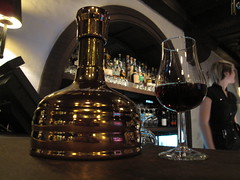
There is a light at the end of this frozen and refrozen tunnel, and I think it is appropriate that the beer is called Utopiasby. The Boston Beer Company from the good ol’ U.S.A. is responsible for this one. This beer is at a paltry 27% ABV but is not an Eisbock. This means that yeast, not temperature, did all the work, but how? To be honest, I’m not sure, but that’s not actually my point. The beer is a barley wine and it has been around for quite a long time. Where all of these other beers were made for the purpose of beating each other, this one was made to be beautiful. Some of the beers used during blending have been aged in the brewery’s barrel room for up to 20 years.

And there we have it. From beer basics last time, to beer ballistics this time. Who knows what it will be next time…maybe beer gymnastics or scholastics?

As always, thanks for hangin’.

Andrew

Style of the Bi-Week – Double IPA

Last week was pilsner, which is arguably the most accessible of respectable craft beers. If you are interested in a little bit more extreme beer, but still accessible, hunt down a double IPA. It will have a robust 8-12% ABV (which seems pitiful given the above beers) and if it’s a good one, 80-100 IBU’s of hoppy goodness. Most local craft breweries will usually have an offering at least seasonally. As far as tasting notes go, these can be all over the place depending on the hops and malts used by the brewery. Competition tasting notes are as follows:

14C. Imperial IPA: A prominent to intense hop aroma that can be derived from American, English, and/or noble varieties (although a citrusy hop character is almost always present). Most versions are dry hopped and can have an additional resinous or grassy aroma, although this is not absolutely required. Some clean malty sweetness may be found in the background.

The (self-proclaimed) holy grail of these beers is Dogfish Head’s 120 Minute Double IPA. If you can ever get your hands on it, snap it up and enjoy!

Brainstorm Brewery #78 – Apparently Sesquicentennial Means 150

Not a whole lot happened in the last week outside of a temporary decline in MODO prices brought on by the unscheduled maintenance and a lack of confidence in the long-term viability of MODO, but prices have already returned to normal mostly. The gang doesn’t want to take any of that out on you and manages to find quite a bit to talk about instead of resorting to a guest appearance or a gimmick to cope with the down time. Making like they’re employees at a Build-A-Bear workshop and your head is the limp, empty shell of some manner of stuffed animal and sweet nuggets of financial goodness are the stuffing, you’re going to get some wisdom piped into your dome whether you signed up for it or not. With questions about the viability of Legacy staples as long-term holds, financial opportunities in unexpected places and the sky falling on MODO, this won’t feel like an off week at all. It will feel like the boys are taking you to school.


  • MODO prices tanked briefly but seem to have stabilized for the most part. Is there still opportunity here? What could be causing the prices to come back up?
  • Pick of the Week covers all formats this week and deals with prices that make no sense.
  • The winner of the drawing will be announced soon, and all other entrants will be sent their consolation prizes. Stay tuned for the announcement on a future episode.
  • The T-shirts were printed this week. Thank you to all who supported the cast. Future merch is announced.
  • A Legacy Grand Prix happened in DC over the weekend. What was exciting about it?
  • Some Legacy cards appear to be going down and some going up. What should you do if you’re looking to invest? The gang presents several opinions.
  • Interested in contributing to Brainstormbrewery.com as a writer? Submit your credentials to [email protected]. Ā We have already published articles written by other fans- don’t miss your chance to be part of one of the fastest-growing brands in the game.


Cabe Riseau produced the intro and outro music for Brainstorm Brewery.


Contact Us

Brainstorm Brewerywebsiteemailtwitterfacebook

Ryan Bushardemailtwitterfacebookgatheringmagic.com

Corbin Hosleremailtwitterfacebook – quitespeculation.com

Jason E Altemailtwitterfacebookgatheringmagic.com – quitespeculation.com

Marcelemailtwitterfacebook

The Recession

Author’s Foreword

Due to the news of Premier Events returning to MTGO, the main premise of the article, that the MTGOĀ market may not yet be at its bottom, has become outdated. Certain parts of the article have been rewritten to fit with the new information. However, I feel that the thrust of the article, that the fundamental problems of MTGO’sĀ platform structure have not been resolved and that the market will be bearish in the long term, still stands.

The Stock Market

I first started speculating in the stock market freshman year of college during the 2008-2009 stock market crash.

Here is a graph of the Dow Jones Industrial Average (DJIA or Dow 30) over the period from August 1, 2008, to October 31, 2008, which was around the period that I first started speculating.

graph1

A quick introduction to the index used to create this graph. The Dow 30 is a stock market index that keeps track of 30 blue-chip stocks listed on the New York Stock Exchange.

You can see that there is a sharp drop of 25% over the course of a month from mid-September to mid-October. This isn’t your average day stock market that moves 1-2% up or down every day. After the crash, however, you can see the stocks beginning to stabilize by October.

The market crashed because the fundamentals for the stock market were lacking. Financial instruments backing mortgages were expected to continue an unreal rate of increase in value because houses were exponentially growing in value. When the housing market crashed, the value of these assets plummeted. To give you an idea, Citigroup, one of the largest bank holding companies in the US, lost over $27.7 billion in the year 2008. Without the US government to back up the giant bank through TARP and other regulatory programs, the third-largest bank in the US would most likely have gone bankrupt.

There are a lot of other things that happen during a bear market (bear because a bear mauls downwards, as opposed to bull markets because a bull thrusts its horns up).

  1. In a bear market, volatility goes way up because no one knows where the market is going. Volatility is defined as the variation of price of a financial instrument over time. Because any point in a bear market could be the turning point or just another point where the prices are ready to tank more, speculators tend to overreact to the changes in price from day to day.
  2. No one knows when a recession will end. This point is key as to why the sell offs continue in a recession. Prices go up and down without any regard for fundamentals of a stock’s value. To avoid being stuck with a stock that is diving in prices, shareholders exit their positions, adding to the already-depressed levels.
  3. This third point is huge. Recessions are the best opportunities to pick up on underpriced stocks, especially on stocks with good fundamentals and strong balance sheets/income statements. More on this point later.

So what happened next? Did the stock market stabilize like at the tail end of the graph?

graph2

Here is another graph of the Dow 30 over the period of October 31, 2008, to May 1, 2009, continuing from where we left off on the last graph.

The market continued to plunge over the course of another five months, reaching its lowest point on March 9, 2009, at 6,547, down from the highest point in 2007 of 14,164, or more than a 50% loss. Just because there was a previous drop and a stabilization doesn’t mean that trend will continue going forward.

Keep in mind that these aren’t your average stocks but the most conservative, the cream-of-the-crop stocks (e.g., Exxon Mobil, McDonald’s, Nike, Microsoft, Coca-Cola, etc.). The market can be unpredictable at times, and it’s difficult to tell where the turning points are.

The MTGOĀ Market

I will now bring the article back to MTGO. My point isn’t to say that the sky is falling and that everyone should sell all their cards on MTGO and hide their tickets under a couch. What I’m trying to convey is that there is a real possibility that we haven’t seen the worst yet. Ā Even though the Premier Events will be back, the MTGOĀ program being used is still as broken as ever.

There are a number of similarities between the stock market crash and the current market condition of MTGO. The fundamentals are lacking for both markets. MTGO is a terrible excuse of a program for the number of players throwing money at it. There is also a high degree of uncertainty about where the light at the end of the tunnel is, especially given that Wizards of the Coast doesn’t have a good track record in dealing with the software side of things.

However, I believe the other side has some very good reasons as to why it may be a good time to be buying in.

Here are what I believe are the points in favor that the worst has passed:

  1. Prices have depreciated enough from the previous level that even if prices drop further, you’ll still get cards at a discount. You might lose, but you probably won’t lose a whole lot.
  2. Prices seem to have become more stable over the past week now that we are past the initial sell-offs, most particularly due to the effects of redemption creating a price floor.
  3. Wizards of the Coast cannot leave PTQs and the Magic Online Championship Series down for too long because of the loss of potential profits.

I believe that the bearish outlook will continue as platform issues have yet to be resolved, although the near term will be bullish because of the incoming demand since Premier Events will be back.

  1. I highly recommend reading the articles from Hipsters of the Coast (see articleĀ here) and toordeforce (see articleĀ here). As it stands, the estimate for the downtime is anywhere from four to six months, and it may take up to three years for next version of MTGO to be available. The longer the systems are down, the more likely it is that card prices will go down further because fewer players will be playing the game.
  2. The central issue that there is only one master server for the multiple servers that are running the games. Until this key architectural flaw can be worked around, the delay and lag and time outs on MTGOĀ will be here to stay. MTGOĀ Version 4.0 has been around for more than a year and is expected to replace the current MTGOĀ Version 3.0, yet there has been little progress in improving MTGOĀ Version 4.0.
  3. There is a very careful balance between letting the servers go down for upgrades/redo’s and further agitating players because of the instability of the current servers. Wizards is in a tough spot because both neither option is pretty. Change in MTGOĀ is long overdue, but change isn’t going to be easy for a program on which hundreds of thousands of players are depending.

Whatever you decide to do with your MTGO cards, please do so with the fundamentals of MTGOĀ in mind. The truth of the matter is that MTGOĀ hasn’t been fixed yet and the root architectural problem is still unresolved. Whether Wizards announced that Premier Events to be back for revenue reasons or because the system is better now, there will come a time when the system will be down again.

Thank you for reading article, I hope that it was informative. You can find me on Twitter @fyawm

Marc DeArmond – Casually Infinite: Introduction

Did you say Infinite?

I did say infinite. By this I mean playing MTGO without having to constantly visit the store or purchase tickets from vendors. My form of infinite isn’t being able to draft back to back all night, dual queue, or even playing a queue every day. I am infinite by earning my tickets through critical planning, earning packs by winning queues, and making very careful trades. I want you to be able to go infinite as well.

Who is this Guy?

First off, I’m a casual player. There are a lot of different beliefs about what casual means across the Magic community, or the MMO community, or any gaming community, for that matter. For some, casual means anyone that isn’t pro or doesn’t attend PTQs. Others indicate it as the people they meet at FNM. For me, casual is even less than that: I don’t go to PTQs, I don’t make it to FNM, and honestly, I very rarely play paper MTG at all. I generally enter one or two queues a month on MTGO, sometimes more, sometimes less. But I never ever spend any money to play Magic.

I’m a casual MTGO player – my total collection is generally worth less than a couple hundred tickets. I can’t afford a top-tier Standard deck, but I’ve got a decent pauper one together. I might play a couple games on a regular weeknight. But whenever I want to draft, I have the tickets or packs to do so, and if I don’t, I’ll make a series of trades to earn them.

This series is about being an infinite casual MTGO player. A few people have written about going infinite through high levels of play while drafting, but many of their strategies require playing a lot. While a number of us would love to be able to play that much, some of us just don’t have the time.

I’m a school teacher that lives on a small, remote island in the Pacific Northwest accessible only by ferry. There’s nowhere to buy underwear on the island, much less a local FNM. But even beyond that, I probably don’t have the skill to back to back events and immediately sell off my packs to jump into the next draft. I’ve heard great players like Brian Wong talk about going infinite at around 1900 rating. My rating floats around 1700-1750. But I’m still able to play Magic without shelling out any cash.

My History in Magic

I started playing Magic in middle school. My first box was a starter box of Unlimited, my first boosters were Antiquities. My initial games were played with David Guskin, who is now in R&D at Wizards. In those days, [card]Icy Manipulator[/card] won games and [card]Force of Nature[/card] was unstoppable. Most of the cards I picked up were from Revised, The Dark, Fallen Empires, and Chronicles. By the time Ice Age and Homelands were released, my adolescent budget was broke. I held onto my cards and still played with some of my friends for a couple years. But the constant stream of new sets and the closing of the local game store had waned my interest. At 16, I started trading cards off for Warhammer miniatures. At the age of 24, I sold the remainder of my collection to pay for my honeymoon to Cabo San Lucas.

I discovered MTGO while teaching sixth-grade math. A number of my students were playing Magic so I offered to open my room after school on Mondays. Surrounded again by a game I had once loved, I began to play with their decks and they began to give me occasional packs or commons in which they weren’t interested. Sixth graders don’t innately see the value in cards like [card]Pacifism[/card] and [card]Essence Scatter[/card], so I built a deck from their discards to show them the error of their ways. Reinitiated into the game, I looked for a way to play Limited formats, my true love in Magic. MTGO provided me with the ability to play Limited games without having to find half a dozen people to draft – and I could do so at any point in the day or night.

In my original paper collection, I had a starter box that I kept separate and did not mix with any of the rest of my collection. The cards I traded from this box brought new cards into the mini collection I was building. Sometimes I would only bring this box with me to a gaming session. I traded my way into four copies of [card]Counterspell[/card] and got rid of my [card]Tropical Island[/card] for a [card]Tundra[/card] and a [card]Mahamoti Djinn[/card]. I ended up with a basically-playable deck with about 10 rare cards simply by trading up. When I signed up for MTGO, my plan was similar. I would only trade from my starting funds, I wouldn’t spend money on anything but set redemption, and I would play in Limited queues and other tournaments.

Into the Land of MTGO

Signing up for MTGO, I knew that I wanted to play Limited formats. The first goal I had was to draft. I’d never drafted but the idea of building a Limited deck from an extremely limited pool sounded great. I earned the funds for drafting through trades netting me .1 tickets at a time and eventually had enough to enter my first event. I managed to pull down two wins in a Swiss Draft, so apparently my fundamentals were still pretty strong. Shortly after learning about redemption, I decided to aim for the goal of completing a set of M12. I managed to put the set together within a year, all without spending any money (other than the $5 redemption fee).

MTGO provided me with a solution to everything I didn’t like about paper Magic. I’ve never had the ability to put large sums of money into my collection. I also really enjoy deck building. These two facts always frustrated me in paper Magic. Before, if I wanted to build a new deck I’d have to fish my dual lands out of one deck and throw them in the new one. Now on MTGO, I could stick my one Jace into any decks I made, without hurting the integrity of the other decks. Before, if there was a card I was seeking that no one in my play group owned, I’d have to struggle to find it, or even look at paying for it rather than trading. On MTGO, bots provided me with the ability to pick up any card, including many rares, at literally pennies, at any time I wanted.

Finally, there was the regular the option to play Limited, the main way I enjoy playing Magic. Back in high school, David Guskin had convinced his dad to invest in Magic cards. He had the power nine at his disposal, in multiples, and playsets of each dual land. I simply couldn’t compete. While it always felt triumphant to bring home a win, it was a rare occurrence due to the imbalance in deck power. In Limited, the playing field was essentially equal. The guy with $2000 to spend on Magic or even the guy with a $200 deck was stuck with the same limited options as me. Sometimes I’d have the more expensive cards, sometimes they would. But frequently, I’d have the better deck.

Casually Infinite

This series of articles is about how I play infinite Magic on MTGO. But it is about how I do so as a casual player. My primary rule is that I don’t invest any money into MTGO other than paying set redemption fees. I won’t buy tickets, Draft sets, or release boxes from the MTGO store. I’ll only play Limited and trade. Thus far I haven’t decided to enter Constructed tournaments. I’ve been looking into the pauper option for this but haven’t decided to make the jump. What I will be doing is explaining my investments and how I work for my tickets to pay for Limited queues.

If you’re the sort of player that would rather spend $15 and jump right into a Draft whenever you have the time, some of my advice is likely to seem overly tedious to you. But if you’re playing on a limited budget or want to learn how to make your hobby pay for itself, then this series is aimed at you. If you’re willing to work for 20 minutes to earn a couple of tickets, you’re like me. If you’re the kind of player that only manages to run a few queues a month, don’t worry. So am I.

I’m also a guy who’s very into gaming theory. When I worked at a local game store (Games Workshop), we called this Mathhammer. While the reality of the math never seems to meet with actual probability, it doesn’t mean that probability, averages, and numbers are to be ignored. Numbers are a big part of how I manage to play infinitely. If I’m squeaking out .5 tickets from each event I play, it adds up to more events. It is my goal to be putting more money (or tickets) back into your wallet so that you can spend less and play more. These articles will be focused on the little steps you can take to improve your game, your trading, and some of the mechanics that will help your bottom line. And finally, I’ll be discussing strategy for winning events, because winning queues is the end goal. Join me next time and we’ll get into the details.

DJ Johnson – A Smartphone is Only as Smart as its User

Hello everyone, and welcome to a new article series here on BrainstormBrewery.com. My name is Douglas (DJ) Johnson, and I’m here to aid the Brew Crew in the never-ending goal of helping you squeeze monetary value out of this card game that we all know and love. Seeing as I’m the new kid on the block, I’ll take a moment to introduce myself and explain my background, both in Magic and life in general.

I’m a 19-year-old college sophomore from upstate New York who has been playing competitive Magic for about three years now, since Scars of Mirrodin. I’m not a huge PTQ grinder, I’ve only been to one GP in my life, and I’ve only attended a few SCG Open Series events. I don’t get the chance to travel much between school, not having a car, and not having the capital to afford hotel/gas/entry for a large-scale tournament, at least not more than once or twice a semester. The most interesting or unique attribute about me is that I won a $20,000 scholarship from Gamers Helping Gamers because I play Magic. Lesson #1 if you’re a college-aged Magic player looking to save money: look for every scholarship possible, and apply for this one. I’m not here to give you a complete analysis of the current top five draft picks, or a sick new Modern brew that nobody has thought of yet. I want to explain the methods that I’ve utilized to go from “random FNM grinder kid” to “random FNM grinder with an abnormally huge collection for a 19-year-old kid who didn’t break the bank.”

Finally, Content!

Let’s start by reminiscing about the past. For those of you who have done a lot of trading, you probably remember participating in (or observing) some absurdly lopsided deals, on either side of a transaction. I remember when I first started playing years ago, I brought my Yu-Gi-Oh! tin full of Magic cards to an LGS in Syracuse. I let some people look through my pathetic collection, and I took out some sweet new cards from their binders for my GW token/life-gain deck, including a [card]Beastmaster Ascension[/card], [card]Celestial Mantle[/card], [card]Conquerer’s Pledge[/card], and [card]Emeria Angel[/card], plus a stack of commons and ucommons. The only thing my trade partner wanted at the time was a [card]Noble Hierarch[/card]. My thought was that I could probably just swap it out for another basic land, or a [card]Llanowar Elf[/card]. The exalted didn’t even matter that much in my deck, I thought…DONE! I walked away with a bunch of cards, none the wiser that I had given away a $20+ card for a bunch of sub-$1 rares (some of them are higher than $1 now, but you get my point). I didn’t learn until much later how bad of a deal I had gotten, and I resolved to never “lose” during a trade again.

Granted, we’ve all heard these kinds of stories, and I’ve done my share of taking advantage of deals that were way too good to pass up. What does that have to do with anything nowadays, though? Personally, I’ve noticed a drastic decrease in these opportunities in the past couple of years. You don’t see many insanely lopsided trades anymore, because there is a fairly recent tool that saves the newbie from total financial ruin. Some of you might know what I’m hinting at: the primary cause of this dry well of free money is none other than the smartphone. And you know what? That’s a good thing. There are far fewer opportunities for PTQ-grinder Spikes to see a [card]Death Baron[/card] or [card]Nightveil Specter[/card] in a 14-year-old’s plastic tin of cards and shark them out of it for nothing. Even brand-new players can say: “Let me check the value on that really quick.” Smartphones provide a failsafe to prevent value traders from taking greed too far, and that’s okay. When a greedy shark rips a new player off so badly that it makes him rage quit the game, us honest traders lose out on a future customer. I forget where I heard this, but it applies to the Magic finance world very nicely: “You can sheer a sheep as much as you like, but you can only skin it once.”

But what does that mean for us, though? Smartphones certainly aren’t without their downsides in the trading world. I’m sure that I’m not alone in being frustrated when trading and my trade partner, adding up the values on his smartphone, asks me, “Well, my cards are $0.49 more valuable than yours. Can I find a couple other things?” and then proceeds to check the value on every single bulk rare they pull out of the box I hand them. Traders like this walk away unhappy over losing out on $0.03, and believe that you sharked them. One of the downsides of these devices is that they increase the paranoia of the newer grinders. They have heard war stories and legends of trading bloodbaths where their friend got screwed over by not getting out his trusty phone, so they have to make sure everything is even. EXACTLY EVEN.

Based on what I’ve vomited onto the page so far, it probably sounds like these devices are the equivalent of a medieval chastity belt to people trying to make value from trading cards. But fear not! The situation is not as dire as one might think. There are still ways to increase the value of your collection while out on the trade floor, even when your partner is wielding what they think to be a piece of Verizon kryptonite. I’m here to give you some handy tips on exchanging pieces of cardboard with people who are afraid of being sharked, think they’re a value trader themselves, or are just plain out to shark you.

1. Let your partner decide what pricing system they want to use

If you start a trade with someone and they ask about how much a card in your binder is, offer to let them use whatever pricing system they like. Different websites and online stores use different pricing systems based on their own needs, and you can use this to your advantage. If you memorize which stores have certain prices for certain cards, you can create a serious advantage for yourself by knowing which price points are closest to the “true value” of the card. Let’s use an example to try and work out how we can take advantage of this.

Most players agree that Star City Games overprices their singles by a bit, yet there are a lot of traders out there who will agree to trade by SCG prices saying, “Yes, it’s overpriced, but it’s all overpriced by the same amount.” This is the mistake that can let you trade up. While there is one camp of players who abides by SCG’s rule of law, there are (in my personal experience) more traders out there who believe that the average price from TCG Player is the true market value of a card. The spread between these two price margins is where we can get rid of cards that are inflated by SCG’s prices, and obtain cards that are closer to the real market value. For a simple example, let’s say that our trade partner wants to use SCG prices, and they want our [card]Sphinx’s Revelation[/card]. By SCG pricing, the [card]Sphinx’s Revelation[/card] is $29.99, but the TCG average is only around $25. Now we can look for cards with prices that are much closer together. [card]Hallowed Fountain[/card]s are $9.99 each on SCG, but the average on TCGplayer is only about a dollar less. If we get rid of the [card]Sphinx’s Revelation[/card] at $30, for three [card]Hallowed Fountain[/card]s that also add up to $30, our trade partner is happy because the trade is even. However, we’re even happier, because we turned $25 in TCG Player value into $28.

Making trades like this one requires a lot of up-to-date knowledge on the larger websites’ prices, but there are opportunities for much larger profits than the one I outlined in the above example. Putting in the effort to know the price differences between sites can really help you raise the value of your collection, while keeping your trade partner left feeling satisfied. In addition, the potential for profit in each trade goes up a lot higher when your trade partner says, “I don’t care which pricing system we use, as long as it’s the same one.” Figure out what website to use based on their binder contents, and you’ll be able to trade for value that your partner won’t see. However, be careful with this tool when you spend a lot of time trading at a local level. If you constantly swap pricing when trading at a local level, your trade partners might start to think you are out to shark them by taking advantage of different price systems at different times. Try to focus on a single website when you’re asked to look up card prices, but always be aware of the other websites.

2. “Sold Out” (or close to it)

When checking the prices on a smartphone, sometimes it’s better to use the actual retail website instead of a third-party site or app that sources its info. One of the main reasons for this is to see how many copies of that card a vendor has in stock. If we check out SCG’s prices on Lorwyn [card]Thoughtseize[/card], they have the price set at $39.99, but they claim to have none left in stock. When SCG gets more Lorwyn copies in stock, they’ll most likely raise the price on them, because they sold out at the previous price. That’s all the more reason for you to try and get copies at the “sold out” SCG price. Additional evidence of this is that the TCG Player average of an old [card]Thoughtseize[/card] is $43 and change. There’s an advantage to be had for being the guy who looks up the actual listing of the card, instead of trusting a blank page with a number on it that a smartphone application might display.

Being 100% sold out isn’t a reason to stray away from a trade target, either. As my fellow BSB writer Enmou Gao wrote in a recent article, [card]Threads of Disloyalty[/card] is a great target to pick from the binder of a paranoid trader who trusts his phone more than anything. As I’m writing this, there is only a single page of listings of the card on eBay, only 25 sellers on TCGplayer selling the card, and only nine NM copies available. While the phone will still spit out a price of $7 from TCG average or $8 on SCG (sold out), the fact remains that there are very few copies of this card out there at the moment, and a spike in price seems likely. Targeting these in trade seems like a great plan with little to no downside.

3. Be honest, build a reputation.

This tip works less when trading at larger PTQs, GPs, and SCG opens, and more for your local FNMS, 1k events, and such. Trading with a phone takes time. It might sound minor, but if you add up each second spent typing in URLs, waiting for pages to load, or just waiting for your phone to start, you’ll find a lot of wasted time. If you spend enough time around the trade tables at your local store and are consistent with your pricing, eventually people might just start to trust your pricing (crazy, right?). Note that I am not saying this in order for you to form bonds and relationships, then to go abuse those once your partner is relaxed around you enough to not pull out their smartphone. This is not the goal. Ripping people off by intentionally misnaming prices will only lead to you being labeled as a shark. The goal is to simply save time.

You can still use the previous two suggestions in addition to searching for speculation targets if you are looking to make money off of trading. The point here is that by being honest and consistent with your pricing, you might just be able to get your trade partner to trust you, taking minutes off of each trade you make. Minutes off of each trade add up, and you’ll be able to get a lot more done in a shorter time span. Finance is about efficiency in time, as well as money.

Conclusion

Well, I hope I’ve helped some of you in your trading endeavors. I don’t want this to seem like an article designed to help you rip off players despite their smartphones, but as a way to still increase your own card value during a trade without the other person losing out. Join me next time when I discuss the possible outs you have as a player for your cards, no matter what scale of inventory you maintain.

On a personal note, this is my first article that’s not related to school or college applications, so I appreciate any and all constructive criticism on my writing style, content, or anything else of note. I may not (yet) be a grinder who top eights all of the local PTQs or travels across multiple states for a GP, but I want to start leaving my mark on this game in my own way. If that way happens to be writing an article series for an amazing podcast team who helps people to make money off of a trading card game, then so be it. Thanks for reading!

Sander van der Zee – Setting Your Goals

This week’s article is going a little bit off the beaten path. For the past two articles I’ve written solely about the practical applications of Magic finance. This week is going to be a little different. I want to share with you an important subject in Magic finance, but also the rest of our lives, with some practical examples and a little insight into my personal experiences.Our subject today is on setting your goals.

Sometimes I forget how easy it is to lose myself in the nitty-gritty work within what I know as a Magic lifestyle. Looking at sets to find hidden gems to turn a profit on, analyzing card price data from multiple websites throughout each day. I found myself struggling to take a step back and ask myself, “Why I am doing this?” The problem is that I was lacking goals.

Goals allow us to pace our way of life. We all want something deep down, and we can make that our goal. Most often, people have multiple goals they work on at the same time. Some may take a lifetime to fulfill, others might just take a month, and some may be accomplished in as short as a day. But setting goals isn’t all that easy once you actually start to think about the fact that you also need to achieve them, whether it is in Magic finance, your achievements as a Magic player, or your own future in regards to your job or your love life.

452_pic

The Big Picture

First you want to think of the broader picture. You really want to determine who you are, what you want, and what will make you happy. These are important questions for every person, not just Magic players. Answering these questions can set you on a straight path toward your pursuits. These questions help you set your goals for the long run, five, 10, maybe even 20 years from now. Recognizing what your broad life goals are will help you keep your focus and reach the things that you value – and we all know we can’t pass up some good value.

Back when I was 13 or 14, I used to ride my bike to school every day. However, my bike ride took an hour and fifteen minutes and I quickly grew bored of the landscape (highway), so I decided to find a solution to my solitary journey back and forth each day. I stumbled across a bunch of podcasts from an internet radio station about an incredibly popular MMO. I fell in love with the way these people interacted with such a large community that all enjoyed the same genre of hobbies. From that moment, I knew I wanted to make a positive impact on a community one day.

30_shardConSplash

Breaking Down

Look at some areas of your life and consider how you want to change or develop them over time. Start asking yourself what you want to achieve in each area and how you would like to approach those goals on a shorter term, like in five years, for example. With MTG financial goals you may want to think about where you make your money. Do you invest long term? Do you prefer flipping quickly to vendors? Do you buylist or will you open your own webshop? In terms of career, you might ask yourself what your ideal profession is, and whether you value a positive experience over a more monotonous job that provides better monetary compensation. Just take a step back and see what major decisions you can make in each area of your life.

So I knew I wanted to interact with the community, but I had to determine the most satisfying way to do it . I knew that I really only felt good when I helped people that enjoyed doing the same things I did. I felt like I had the expertise to know what was going on and was able to give advice in some areas. My interest in the MMO slowly faded over time and an older hobby returned in my life a couple of years ago: Magic.

I decided that I wanted to make a positive difference in the Magic community, but now I had to know at what scale! I knew that I really wanted to work on a big platform but at the time I had very few resources and connections to make it happen. Working on a smaller scale meant I would work on it locally which allowed me to be more hands-on with my work in the community. That’s when I knew that I could make a difference as a tournament organizer or judge.

judertghjrdojoigfdugfuydsgs

Getting SMART About It

SMART is a mnemonic device that can help you keep the goals that you set clear. It’s a way of formulating your goal-statement using five adjectives. Chances are you’ve heard of this method.

Specific. When setting goals, they should answer highly-specific questions of who, what, where, when, and why. “I want to make $500 through purchasing or trading Modern staples with my inventory and cash worth combined $300 by September 1, 2014,” is far more meaningful than, “I want to turn a profit selling cards.” These parameters keep your goals in one place and allow you to determine which tools you need to use. Discipline yourself to be clear and direct.

Measurable. In order to track progress your goals need to be quantifiable. “I’m going to go to more large events to trade more” isn’t quantifiable. What if you’ve gone to two grand prix within six months of setting this goal? How far are you? You can’t at any point say you are fifty percent on your way to your goal because your goal doesn’t have any parameters. “I am going to go to five large events to trade more,” on the other hand, says a lot more about where we want to go. Now we know we have reached forty percent of our goal.

Attainable. Even after you have determined what your goals are you still have to evaluate your situation and honestly recognize which of these goals are realistic and which may be a little far-fetched. I figured out that reaching out to a larger Magic community was going to be difficult, so I toned down my expectations.

While “make a positive impact on the Magic community” was an admirable goal, I was far from able to do that at the time. That’s when I toned it down and turned it into, “Make a positive impact on our local Magic community”. Changing my goal to be more attainable allowed me to reach that smaller goal, which was far more satisfying than failing at the larger (and more exciting) goal.

Relevant. Is the goal you’ve set relevant to your life and the big picture questions you have asked yourself? To determine what value the goals you set have, you need to take a step back and look at what value they add to your life. Does it seem worthwhile? Is this the right time? Does this match what you need from it?

My plans to make an impact on the local Magic community had already been set in motion at this time. After some drama at the local game store, many players disassociated themselves from the store and the brand it had created for itself. I took it upon myself to organize the weekly Friday Night Magic and keep a forum and Facebook community running. After a couple of months, the store owner approached me and asked if we could work out a way for all of us to be happy and still play in his store. We reached an accord and we returned the next month. During the next few months, I noticed that the store owner kept on breaking his promises. At first I just saw it through the fingers (Dutch idiom for “letting it slip”), until one day he told me he wasn’t interested in our agreement anymore and had just decided to do everything his own way.

At that point, I realized that there was no longer any value to helping him as a tournament organizer and community manager. I knew I would work my proverbial ass off trying to get things going, but now he could just throw my work out of the window in one fell swoop if he saw fit. Any further input would no longer further my cause. So I quit pursuing this goal.

Time-related. Much like measurability, a goal should also be quantifiable in time. If you set your goals without a time limit you are only keeping yourself from achieving that goal in a timely fashion as no pressure can exist without a deadline – you will get distracted. “I am going to go to five large events to trade more” is certainly quantifiable, but how can you determine by when you should have visited five grand prix? In one month? One year? One lifetime? “I am going to go to five large events within the next twelve months to trade more” is a far more quantifiable description. If you’ve gone to two grand prix in six months you can conclude that you have reached forty percent of your goals within fifty percent of the allotted time, meaning you should try to squeeze an additional grand prix in the next six months at this pace.

20050114_01_doordevingersThe Abrupt End

It appears I can only fit fifty percent of the subject in the article this week, but luckily, I have not set my goal to tell you all there is to know about setting goals in just a single week. I will return to the topic next time and round it up with more advice and personal stories related to the subjects. For now I hope you can enjoy this Dutch commercial about the idiom I spoke of earlier!

Caleb Gothberg – Getting L.U.C.K.Y: Luck- Labor Under Correct Knowledge

I got my start with Magic: The Gathering back in Worldwake. Many readers have probably been playing way longer than I have. I had a friend that was pretty cool and he had a group of nerd friends that would come over and play Magic for hours at a time. Finally, I got curious enough to give it a try. I lost for like three weeks straight. Those nerds started to seem like gods to me after losing to them every day for 21 days. Suddenly it went from a stupid card game to a battle for the multiverse. I locked myself in my room for three days and the Spike in me read every article on deck building that I could get my hands on. Since then I have been an avid lover of Magic.

About six months ago, I discovered the world of MTG finance. I was looking to get into Legacy and needed some dual lands. I had recently acquired a few collections of cards that I bindered up and was trying to trade up. Some guy came over to me and asked to see my trade binder. I started looking through his binder when I spotted a few pages of duals. I looked over at him with desperation in my eyes and said, “I know I probably don’t have anything that you need, but I really need these duals for my reanimator deck.” He said that I had some things that he could use but he would have to undervalue my stuff to get there. I was the happiest Magic player in the world at that point in time. He must have taken half of my binder and put it into piles from ten cents to five dollars till it added up to the two [card]Underground Sea[/card]s that I needed. When this happens, some people feel like they are getting ripped off, but I felt lucky to get access to cards I had only dreamed of owning. I wanted to figure out how he was able to do that and still have it be beneficial to him. I discovered buylists and online stores and immediately took my Spike nature into Magic finance. Since then, I have been trying to make my hobby pay for itself and even make profit from it. With help from friends and the community, I have not only made my money back in Magic, but have been able to enjoy the game like never before.

Luck

A subject that I am hugely passionate about in life in general, and especially in Magic, is luck. We are playing a game where you take 60 cards, draw them at random, and try to use those random cards to beat an opponent. The whole intent of everything I write is to try to take as much of that randomness out as I possibly can. Whether it relates to the financial end of that scale or the competitive end , the less random we can make things, the more success we can enjoy. The thing that I enjoy most about Magic is winning. It doesn’t matter whether it is in my speculations, my game play, or just winning at having fun, I like to win. The biggest thing that separates me from winning is luck. And by luck, I mean me. I figured out a long time ago that if I don’t take responsibility for my failures, I will keep on failing. Failing isn’t comfortable in any way, shape, or form, nor should it be. My goal is to lay out a plan to not prevent failure, but to learn from it in a way that will grow you not just as a brewist, but as a human being as well.

One of my favorite quotes of all time comes from a motivational video: “Luck is the last dying wish of those who want to believe that winning can happen by accident.” Every time I bring up my beliefs on luck, I always offend someone. The thing is, I don’t believe in luck. Whether it is not making it into a top eight, having bad draft results, losing out on a speculation, or not having the career that you want, luck has little to do with it. In fact, I cringe when anything like the above is blamed on luck. But if it’s not luck, what is it?

Taking Ownership

The first thing that you need to do is to be a man/woman and take the blame. If you keep blaming things on luck you will keep having bad luck. Until you figure out what you need to change, you will keep experiencing bad luck. If you are speculating on a card and it either never goes up or ends up going down, don’t play the blame game. Look at why that card went down. See what went up and why. I hear all the time that hindsight is 20/20, and it is. If you can’t learn from your mistakes you will never get any better at what you are doing. This comes from experience and whatever resources you have. It is about having the correct knowledge and using it.

Recently, a friend told me about a final round at a local FNM in which he was competing. He was playing GW and his opponent was running Esper. In game 3, he had a 5/5 wurm token in play. Neither he nor his opponent had cards in hand and his opponent was at two life with eight lands on the battlefield. He passed the turn and his opponent topdecked a [card]Hero’s Downfall[/card] and completely turned the game around by following up with a [card]Sphinx’s Revelation[/card] into [card]Elspeth, Sun’s Champion[/card]. Can you guess what he blamed it on? I went home and figured things out mathematically. If he was on turn nine he is drawing into his 17th card without a mulligan. So he has 44 cards left that he could draw. Out of those, if no [card]Hero’s Downfall[/card] has been played yet we are looking at two out of 44, or 4.5%. That statistic makes it look like luck, doesn’t it? But, oh wait, what about [card]Doom Blade[/card] and [card]Ultimate Price[/card]? Don’t those kill it? So that is five out of 44 or 11.4%. Still luck you say? Doesn’t Elspeth have a minus ability that kills the wurm? And what about [card]Detention Sphere[/card], doesn’t that take care of the problem? [card]Azorious Charm[/card]? [card]Devour Flesh[/card]? And how about gaining enough life off of [card]Sphinx’s Revelation[/card] to survive, but also drawing an answer? What about [card]Jace, Architecht of Thought[/card] finding an answer? [card]Supreme Verdict[/card] will also knock the socks off of that wurm. I looked at the Standard daily list on MTGO and there were 29 answers to the situation at hand without sideboard. Let’s say he played all of them in the first eight turns that he could. That leaves us at 21 out of 44 or almost 50%. But without playtesting or knowing what the opponent is running, it all looks like luck, doesn’t it? At the end of the day, the game was probably lost on turn six when my friend overextended on the board and got a [card]Supreme Verdict[/card] to the face.

When we actually take time and put in the work that it takes for this stuff, the “luckier” we’ll get. Before we go blaming everything on luck of the draw, let’s try to do some playtesting. My local group gets together every Monday evening and does serious playtesting with some of the best players in the area. The group gets online, looks at the top eight lists, puts them together (proxies for cards they don’t own), and play the crap out of Magic till the wee hours. A few of these guys have amazing tournament results and still play the same matchups over and over again. One in particular just recently placed top eight at states with RDW. He has been playing RDW for as long as I can remember. Guess where he is on Monday nights? Down at the local shop grinding out a deck he probably has the binary code for memorized. You know the last time I heard him complain about luck? It wasn’t when he drew in a final round with an opponent to be .5% out of a PTQ top eight. He took complete ownership of that mistake . That’s what the winners in life do.

Winners take ownership over all of their losses. They look at where they failed and how they can keep from doing it in the future. One of the best ideas I have ever heard I read in a book that Patrick Chapin wrote on Magic. He suggested that readers do a fearless Magic inventory. This is where you broadcast your faults in Magic to a large community, like Facebook or Twitter. It works because if you know that everyone knows what you are doing wrong, you have to fix it. For instance, I tend to play way too fast and not think about what I’m doing. I got it out to my community that I have to slow down, and when I don’t, I have people that remind me. This causes me to be a better Magic player and not get so “unlucky.” I would suggest that all of the readers do this via Facebook or Twitter and make sure as many people see it as possible. Just by making a list and posting it, you have already become a better Magic player than you were yesterday.

Similarly, if you are failing at Magic finance or speculations, make it public. This I would be less inclined to share via Facebook. But I know that Reddit has a Magic finance section as well as the forums that are on Quiet Speculation. Quiet Speculation does charge a subscription fee, but I always make it back and more just by using the site. If you reach out to the community of Magic finance, they are always more than happy to help out. Jason Alt, one of the hosts of Brainstorm Brewery (who I had the pleasure of meeting in person before I had heard of the show), has been a tremendous help to me. Follow him and people like him on Twitter. Not only is he glad to help, but you will feed into his rock star egotistical mentality, making him feel like more a Magic finance god than he already does (sorry Altthous, god of #mtgfinance). Information is one of your biggest friends when it comes to anything, especially Magic. There are tons of articles available every day on a variety of sites providing just the information you need.

Research is probably going to be your biggest help in all of this. Whether it is reading articles, listening to podcasts, or just playtesting with friends, the more correct knowledge you have, the better your “luck” will be. When you think of luck as an acronym for Labor Under Correct Knowledge, you will start to realize that the person in control of luck is, in fact, you. Use the resources that you have to make sure that you get the results that you want to get. I encourage everyone to take a fearless Magic inventory of themselves. Find all the faults you can in your game play and speculations and post them in a public place. Use Facebook, Twitter, or your local LSG to make it public knowledge and watch how much better you get.

Fearless Magical Inventory

One of the biggest things that you can do to eliminate the luck is a fearless Magical inventory. What is a fearless Magical inventory? We all have faults when it comes to the game of Magic. A fearless Magical inventory is where you put all these faults out there for everyone to see. It makes you completely accountable for all of Magic faults and responsible for fixing them. When you put it out there you can’t hide behind luck anymore. Over the next couple months, I will be breaking down financial and game play faults that I have struggled with in the past and how to avoid or get through them. So take some time out of this week and get “lucky.” Then next time you are at your local FNM and someone tells you “you got lucky,” you can just smile and say “I know.” And remember: “Luck is the last dying wish of those who want to believe that winning can happen by accident. Sweat is for those who know it’s a choice.” Welcome to the grind.

MtG After Hours #2 – You Just Got Punted!

Join the Brainstorm Brewery crew for the MtG After Hours podcast. Basically this is all the good shit that gets cut, left to rot on the editing floor. This week Jason intercepted a Guild Letter for the Simic prerelease!?!? What the hell is going on? This was recorded after Brainstorm Brewery episode #78.

NSFW – Not Safe For Work

Contact Us

Brainstorm Brewerywebsiteemailtwitterfacebook

Ryan Bushardemailtwitterfacebookgatheringmagic.com

Corbin Hosleremailtwitterfacebook – quitespeculation.com

Jason E Altemailtwitterfacebookgatheringmagic.com – quitespeculation.com

Marcelemailtwitterfacebook

Andrew Colman – The Puzzle Box: White Section

The opposite of a profound truth may very well be another profound truth. – Niels Bohr

I have to be honest, I voted for the $400 version of this cube. The vote came very close between $200 Money Workingand $400 and I was hoping that if I just gave it another day things might turn out my way. Alas, at $200 it stayed. Now I am not sure if building a cube for $200 being difficult is a profound truth, but after coming up with the white section it seems, first of all, that it is at least a real truth, but more so, that the opposite might be true as well. The accumulation of the cards, or building, of a $200 cube should be very easy. It also may ending up costing you, if you try really hard, less than $200 dollars.

One thing became clear to me as I was putting the first section of this list together: this was going to have to be a theoretical $200 build. It would be possible if every seller on TCGPlayer was a super shipper participant, but it is not so. First of all, there is absolutely no room for shipping fees with only $25 allocated per section, no way no how. Second, if you can’t handle white-bordered cards you better get out your sharpie because this cube is going to be full of them. Third, I avoided any cards that were in damaged condition and I only needed to get one that was heavily played, but lightly played and moderately played are the name of the game. Well, Magic is the name of this game, but there are a lot of non-NM cards in this cube.

The other side of truth: Even though I built this list using TCGPlayer low I think you can actually build it for less than $25. So many of these cards are worth so little that if you put out a call for the cards worth under 50 cents – which is 25 of 36 – you could get most of them for free from you friends. The rest of the cards should be really easy to pick up in trade as throw-ins or for really good value.

The Puzzle Box : White Section

[deck title= The List According to Type]

[1CC Creatures]

*Elite Vanguard

*Mother of Runes

*Savannah Lions

*Student of Warfare

[/1CC Creatures]

[2CC Creatures]

*Accorder Paladin

*Kor Skyfisher

*Lone Missionary

*Soltari Monk

*Soltari Trooper

*Wall of Omens

*Porcelain Legionnaire

[/2CC Creatures]

[3CC Creatures]

*Blade Splicer

*Fiend Hunter

*Flickerwisp

*Mirran Crusader

[/3CC Creatures]

[4CC Creatures]

*Calciderm

*Hero of Bladehold

*Kor Sanctifiers

[/4CC Creatures]

[5CC Creatures]

*Cloudgoat Ranger

*Serra Angel

[/5CC Creatures]

[6+CC Creatures]

*Sun Titan

*Vengeful Archon

[/6+CC Creatures]

[Planeswalker]

*Gideon Jura

[/Planeswalker]

[Instant]

*Condemn

*Mana Tithe

*Swords to Plowshares

*Disenchant

[/Instant]

[Sorcery]

*Balance

*Armageddon

*Day of Judgment

[/Sorcery]

[Enchantment]

*Journey to Nowhere

*Pacifism

*Arrest

*Oblivion Ring

*Faith’s Fetters

[/Enchantment]

[Artifact] *Shrine of Loyal Legions

[/Artifact]

[/deck]


[deck title= List According to Cost]

[$3+]

*Mother of Runes

*Hero of Bladehold

[/$3+]

[$2-$2.99]

*Gideon Jura

*Swords to Plowshares

*Student of Warfare

[/$2-$2.99]

[$1-$1.99]

*Armageddon *Mirran Crusader

[/$1-$1.99]

[$.50-$.99]

*Day of Judgement

*Wall of Omens

*Balance

[/.50-$.99]

[$.25-$.49]

*Soltari Monk

*Savannah Lions

*Blade Splicer

*Flickerwisp

[/.25-$.49]

[$.01-$.24]

*Pacifism

*Mana Tithe

*Condemn

*Fiend Hunter

*Vengeful Archon

*Oblivion Ring

*Accorder Paladin

*Porcelain Legionnaire

*Shrine of Loyal Legions

*Lone Missionary

*Cloudgoat Ranger

*Calciderm

*Elite Vanguard

*Journey to Nowhere

*Soltari Trooper

*Serra Angel

*Disenchant

*Arrest

*Kor Sanctifiers

*Faiths Fetters[/.01-$.24]

[/deck]

Final Price $24.83


Just a reminder, we are shooting for a powerful-feeling cube for little money – that’s the goal. Thus, we will need powerful cards. Luckily for us, at least some of them are cheap. Cards like [card]Balance[/card], [card]Armageddon[/card], [card]Swords to Plowshares[/card], [card]Gideon Jura[/card], [card]Hero of Bladehold[/card], [card]Mirran Crusader[/card], and [card]Day of Judgment[/card] are worth high picks in a non-budgeted cube. Unfortunately, there were some slots that needed filling that weren’t so cheap, [card]Banslayer Angel[/card] devolved to Serra Angel, and [card]Elesh Norn, Grand Cenobite[/card] – who is a control finisher as well as a solid reanimator target – I replaced with the best white finisher/reanimator target I could find: [card]Vengeful Archon[card], a 7/7 flyer that, for a cost, kind of does what Elesh Norn does – decrease damage towards you and increases damage towards them simultaneously. If you have a white finisher/reanimator target you like better, feel free to switch it up. Also, [card]Isamaru, Hound of Konda[/card] was in the list for a long time until I realized that I was paying $1.56 for one point of toughness compared to a [card]Savannah Lions[/card] that I had cut early on. In the end, the lion ate the hound and that was that.

Another card that seems a bit odd in this list is [card]Shrine of Loyal Legions[/card]. You can fit it into you curve in an aggro deck and use it to help swarm, or you can drop it on turn two in a tap-out control deck. After you’ve drawn the game out long enough it kind of acts as an [card]Entreat the Angels[/card]-style finisher. And as soon as you can replace it with [card]Entreat the Angels[/card], do it! I love that card so much I play [card]Noxious Revival[/card] in my cube, and take it high, so I can Entreat twice for good measure!

One thing that was a bit of a problem is that the budget only allowed for one Wrath. If you can help me out with this issue that would be great. I made up for it by adding two one-for-one removal spells: [card]Arrest[/card] and [card]Pacifism[/card]. It’s not ideal, but I am open to suggestions.

I could be convinced to take out [card]Disenchant[/card] to add another aggressive one drop. This list comes from a powered cube with all of the swords and fast mana, so [card]Disenchant[/card] is probably not as needed here, but I’ll leave it in for now and will address it later.

Seeing as this is the first of the build the cube articles, there is still a little bit of housekeeping to do. After this week, I’m planning to cover two sections per article. The multicolored and land sections will each get their own article.

After the cube’s completion, I’ll discuss new cards as they come out, but as a rule, the final cost will be governed by the TCGPlayer low. This also means if one of the cards in the list finds a home in a Modern or Legacy deck and spikes, thus becoming too expensive, it will get cut from the list. I’d like this to be a continuing resource for future cube builders to come and have a place to find a powerful list for $200. This also means that we wait with bated breath for rotation and ban hammers!

But again, this is a starting point that’s meant to give you an awesome play experience quickly. If you have a Baneslayer lying around, boot that [card]Serra Angel[/card] and go to town!

Next time we’ll cover the blue and black section. Thanks for hangin’!

Andrew

Brainstorm Brewery #77 – If It’s Broke, Don’t Fix It

The cast is interrupted by breaking news- Magic Online events have been suspended so the whole system can be fixed. In the wake of the disastrous weekend where the MOCS and a PTQ both crashed on MODO the community reacted badly- will the backlash from taking MODO down to fix it be worse? The cast is in rare form tonight, and there is a lot to talk about. Could a lack of faith in MODO create buying opportunity? And with Merfolk in general and one Merfolk in particular looking dominant, what is the play with Commander decks? Which cast member gets his own percussion section background music? Who has a hard time taking a compliment (It’s not who you think)? Who gets blindsided by pick of the week despite going last? Find out the answer to all these questions and more on a valuetastic episode of your favorite Podcast that will have you asking “When did they get a website?” Join us for Brainstorm Brewery.


  • MODO went down f or maintenance and the community is flipping out. Is there opportunity here? Would they complain regardless?
  • It’s a Pick of the Week explosion as the gang gives solid advice on history repeating itself.
  • The winner of the drawing will be announced soon, and all other entrants will be sent their consolation prizes. Stay tuned for the announcement on a future episode.
  • A listener sends in a dense letter and the gang tries to get to all of it. So many good questions, so little time.
  • Interested in contributing to Brainstormbrewery.com as a writer? Submit your credentials to [email protected]. We have already published articles written by other fans- don’t miss your chance to be part of one of the fastest-growing brands in the game.
  • You wanted a chance to own a Tee with the logo on the front. Buy our merch and help support your favorite podcast.


Cabe Riseau produced the intro and outro music for Brainstorm Brewery.


Contact Us

Brainstorm Brewerywebsiteemailtwitterfacebook

Ryan Bushardemailtwitterfacebookgatheringmagic.com

Corbin Hosleremailtwitterfacebook – quitespeculation.com

Jason E Altemailtwitterfacebookgatheringmagic.com – quitespeculation.com

Marcelemailtwitterfacebook

MTGO Zero – The Cost of Doing Nothing

Welcome back, loyal readers!

You guys are doing a pretty bad job of laughing at me.

What We Learned Last Week

Last week the MODO powers that be announced that in the wake of a few events that crashed in the middle of gameplay and one of those crashes affecting someone whose opinion they care about, MODO would be transitioned to limited capabilities while they fixed a few things. The system was long overdue for an overhaul, but people voted with their dollars and let Wizards know that while they wanted their MODO experience to be better, they wanted a fixed MODO less than they wanted an uninterrupted MODO.

After the announcement was made, people took to Twitter to complain. This is all a matter of record, you know all of this. What you may not know is that this had an effect on MODO prices in a lot more ways than anyone had anticipated.

  1. A large segment of the population, based in countries like Brazil, can make up to ten times minimum wage grinding MODO all day. Eliminating daily events was a significant blow to their income. When there is financial incentive to do things in the MODO economy, people will do them. Without those people turning tickets into packs into cards into tickets into money, the flow of cards and tickets is hampered.
  2. Without daily events firing, packs are opened much less. The price of sealed packs went nuts but seems to have normalized a bit.
  3. A lot of people panic sold their MODO cards and the panic depressed the prices of everything in the short term. Warren Buffet says to be fearful when people are greedy and greedy when people are fearful. A lot of people got fearful and tanked prices, which made a lot of other people get greedy, which made me get fearful. Circle of life.

I didn’t have much confidence in my understanding of the market and decided to opt out of trying to capitalize on a one-time phenomenon like the crash precipitated by the shutdown for a few reasons. Firstly, I didn’t understand all the forces at play and was not about to lose money from my limited bankroll by making uneducated buys in a tumultuous market. Secondly, if I did happen to win big, my gains would not be particularly instructive. I realize most of you know more than I do right now, but a lot of you don’t and I don’t want the take-away lesson from one of my articles to be “wait until MODO is taken offline for a huge, once-in-a-lifetime overhaul and pounce on low prices when people panic sell.” That really doesn’t teach either of us skills to help us make money at this after this week. I enlisted help.

Unlikely Sources

Instead of laughing at me, a lot of you were pretty helpful. I’m grateful, but it’s not really in the spirit of the exercise. But it seems like you’d rather see me succeed than fail, which is nice. It feels like cheating, honestly, but I don’t mind if you don’t mind. First of all, apparently only jackasses pay an entire dollar for a ticket. People are all over Twitter and Facebook trying to out their tix for cash and they’ll take 90 cents on the dollar sometimes. Just know that you can always pay $1 in the store. If you’re Marshall Sutcliffe, people are lined up to ship you tix for 89 cents. If you’re the MTGO Zero, maybe not. I bought from the store partially because I wanted to learn how.

I got a lot of other good tips, and rather than list them, I invite you to check the comments section of each of these installments. They’re filled with great tips from readers and will help more MODO noobs than just me. Thank you all for everything you do to support the MTGO Zero in his quest to learn a foreign language – keep the tips coming because they help everyone.

A Likely Source

I enlisted the help of Ryan Bushard to guide me through the post-pricepocalypse. I decided that there were still a few mythics that were underpriced and we agreed that it felt safe to peel off 30 tix and try to make some mythic magic happen. Ryan is a Brainstorm Brewery cast member, a writer here on Brainstorm Brewery, and also a writer on Gathering Magic. Ryan is a full-time financier, buying and selling cards. He’s been on MODO since 2003 and he knows all about the system and how the market operates, although most of his experience with MODO is using it to play and he’s still relatively new to MODO finance himself. He was the perfect person to help us with this preliminary step in our journey.

Ryan did not recommend necessarily that I peel off a mere 30 tix from my bankroll, however. He advises that if something seems relatively certain to go up, you should go deep because you can get your money back out again quickly. The ability to cash in on your speculations at instant speed makes it possible to make more transactions per day which allows us to sell at lower margins. If you buy Sphinx’s Revelation in paper for $12, are you going to sell at $13? Probably not. You might buylist them for $13 when the card hits $20 but you will wait weeks to get paid (unless you do it at a GP, which is not something you can do every day). You pay shipping. You wait for the cards to arrive, wait for them to go out, wait for the money to come back. You can sell for $20 on a retail site, but you’ll do a lot of work, pay a lot of fees, and wait a lot of days to see a return. On MODO, however, if you can buy for $12 and the bots are buying for $13 the next day, ship! (I know Sphinx’s Rev is like 33 tix, don’t get hung up on the example or you’ll never learn anything.) You will clear one ticket in profit per iteration so why not? And if you will clear that ticket, why not do it with most or all of your bankroll?

Ryan advised that the crash may have interrupted the trajectory of cards that would have moved had things gone uninterrupted. I checked the graphs on MTGgoldfish.com and they have marked the spot on each graph where the MODO events were suspended. Therefore, cards that were on an upward or flat trajectory before this point and which dropped after this point are our ideal investments. Cards that were already on a downward trajectory are less optimal. However, a bit of metagaming took place. We discussed [card]Underworld Cerberus[/card] as a card that was getting adopted before the players migrated away from MODO. It was poised to go up and didn’t because of the interruption. This seemed like a good place to park some tix. I didn’t want to spend all 30 in one place even though it’s a portion of my bankroll. I liked [card]Ashen Rider[/card] at .88 tix and bought 10 of those for 8.8 leaving me with 20 tix and the change in credit with various bots. [card]Underworld Cerberus[/card] was at about 1.3 tix so 20 tix only bought me 15 copies, which I am fine with. I am going to keep a close eye on the price and move at the first sign of an upward trajectory.

Finally, Ryan advised that for the purposes of this exercise, maybe turning 30 tix into 60 isn’t the immediate goal. What I think I would really rather do is turn 30 tix back into 30 tix in a week or two and have the rest of my equity parked in long-term holds. With redemption coming up, having key cheap mythics seems like a good strategy because mythics are essential to the redemption process and will go up in price as redemption approaches. Having key mythics and my original bankroll intact seems ideal and if I can accomplish that, I’m well on my way to competence and eventually, money.

Next week, I will delve deeper into redemption and maybe in the meantime I will get to sell something. If I can figure out how to do that, you know I’ll come back at you with it. Hell, even if I can’t figure it out you know I’m going to ask someone. Until then, digest some of what we covered this week, and don’t hesitate to hit me up with questions, comments, or this community’s trademark snark. I can take it – I’m starting at zero.

@JasonEAlt

[email protected]


How to Sideboard and Win with Selesnya Aggro

Welcome back disciples of Vitu-Ghazi! Today we are going to take an in-depth look into sideboarding strategies with the green/white deck that I played at the SCG open. If you haven’t read my previous article where I broke down all of the card choices for the deck, you can find it here. I also want to discuss some of the cards that are difficult for the GW deck to beat. And lastly, I received some questions after the last article, so we can cover that, too. Ready? Let’s go.

Thoughts on Sideboarding

Sideboarding is an often-overlooked topic in the game of Magic. I find this very strange because you will play just as many, if not more, sideboarded games as maindeck in any given tournament. Players will often do a lot of playtesting with their decks before boarding and not bother testing the sideboard games. Again, this is a mistake because sideboard games are very different. Control decks generally become a lot better because they are able to sideboard out all the dead cards against you and board in cards that are especially good against you. Decks with fewer colors, i.e. the mono color decks, tend to have fewer options when it comes to sideboarding, so they not be as strong as a two-color deck could be. Aggro decks usually don’t have powerful cards to board against each deck because they stick with their initial strategy of just killing you fast.

Another mistake I see a lot is when people over sideboard. You don’t want to be sideboarding so much that you are no longer accomplishing the deck’s initial goal. Let’s look at aggro again. Maybe you’re a mono red player that is playing against Esper Control. You want to bring in four [card]Burning Earth[/card], which is good, and then you decide that you should bring in four [card]Skullcrack[/card] to prevent them from gaining life with their [card]Sphinx’s Revelation[/card]. Ok, maybe? Then you see your [card]Mizzium Mortars[/card] and decide you need that to kill their Blood Baron because you can’t win if they play it. You end up boarding in so many non-creature spells that you have to board out some creatures and now you are not fast enough to kill them before they start playing powerful spells. Obviously, this example is a little far-fetched but you get the idea.

Before going through my sideboard guide, I also want to explain that sideboarding is a strategy that should not be set in stone. I will deviate from this guide in a tournament depending on what I see from an opponent. You should use this guide as an example and not the rule. For reference here is the deck I played at the open:

[deck title= G/W Aggro]

[Land]
*9 Forest

*7 Plains

*4 Temple Garden

*4 Selesnya Guildgate

[/Land]

[Creatures]
*4 Experiment One

*3 Fleecemane Lion

*4 Voice of Resurgence

*1 Banisher Priest

*4 Boon Satyr

*4 Loxodon Smiter

*1 Polukranos, the World Eater

*3 Scion of Vitu-Ghazi

*2 Vitu-Ghazi Guildmage

[/Creatures]

[Spells]

*4 Advent of the Wurm

*4 Selesnya Charm

*2 Rootbound Defenses

[/Spells]

[Sideboard]

*2 Pithing Needle

*2 Banisher Priest

*3 Mistcutter Hydra

*1 Scion of Vitu-Ghazi

*2 Unflinching Courage

*1 Brave the Elements

*1 Druid’s Deliverance

*1 Gods Willing

*1 Last Breath

*1 Trostani, Selesnya’s Voice

[/Sideboard]

[/deck]

Matchups

First up:

Mono Black Devotion

Game one is usually very easy for GW aggro. They play a lot of creatures that don’t really worry you. They attacked with a 2/3 flier? So what? They played a 2/4 and drained some life? Don’t care. They played a giant 6/6 flier demon? Snack on this bird for a second while I kill your master.

The best way to win against mono black is to put a lot of pressure on the board quickly. As long as you can pressure them early, even if they spend their turn to kill a guy you are still attacking them for damage. That adds up and you can finish them off with your big threats. Eventually they run out of removal and they have to play their mediocre creatures.

I found that the only way for mono black to keep up is with an exceptional hand with a lot of removal followed up by an [card]Underworld Connections[/card]. The enchantment is a great way for mono black to be able to handle our creatures and still have enough gas left over to finish out the game. They need to be able to kill our early threats though, because if they don’t, tapping out on turn three to do nothing is usually good game.

Sideboarding:

– 2 [card]Rootborn Defenses[/card], – 2 [card]Experiment One[/card]

Against the midrange decks I tend to take out [card]Experiment One[/card] because it usually gets outclassed fairly quickly. Also, your plan is to take over the game through populating. I also take out [card]Rootborn Defenses[/card] because it costs too much to try to “get” mono black.

+ 1 [card]Gods Willing[/card] + 1 [card]Scion of Vitu-Ghazi[/card] +1 [card]Trostani, Selesnya’s Voice[/card] +1 [card]Brave the Elements[/card]

Again, your plan is to overwhelm them through population. We bring in some cheap protection spells to protect our early aggression or our populating cards.

The matchup gets a lot tougher after board but still probably favorable. They bring in cards like [card]Lifebane Zombie[/card], [card]Pack Rat[/card], and more removal.

Some things to keep in mind:

– If they play [card]Lifebane Zombie[/card] early, they now have a seven-turn clock to kill you. You need to play aggressively to outrace it.

– If they play [card]Lifebane Zombie[/card] and your only creature is [card]Loxodon Smiter[/card], they have to take it.

– Turn-two [card]Pack Rat[/card] is a reality. It can be beaten but it is difficult. If you’re worried, you can bring in [card]Pithing Needle[/card].

– Try to keep a mana up to protect your important populate creatures by casting [card]Gods Willing[/card] or [card]Brave the Elements[/card].

Mono Red

There are a few different mono-red decks out there. There’s a fairly fast deck with a curve that stops at four with [card]Fanatic of Mogis[/card], and then there is the devotion-style deck that plays some bigger spells like [card]Stormbreath Dragon[/card]. Both of these matchups play out similarly. GW’s creatures are too big and aggressively costed for mono red to smash through. They may have a [card]Firefist Striker[/card] to get through but that’s usually not enough. Usually, the only way they can win is with [card]Fanatic of Mogis[/card], so make sure to pay attention to the number of red symbols on your opponent’s side of the field.

Sideboarding

– 1 [card]Scion of Vitu-Ghazi[/card], -2 [card]Rootborn Defenses[/card], -2 [card]Boon Satyr[/card]

Scion comes out because it is a little slow. I don’t take them all out because I like the fact that the card turns the tide very quickly and lets you start attacking while leaving back three fresh blockers. [card]Rootborn Defenses[/card] is just not needed. I don’t really like [card]Boon Satyr[/card] in matches where there are a lot of creatures. In this case he doesn’t block anything and survive.

+1 [card]Trostani, Selesnya’s Voice[/card], + 1 [card]Last Breath[/card], + 2 [card]Unflinching Courage[/card], + 1 [card]Druid’s Deliverance[/card]

The goal after board is to try to gain as much life as possible. [card]Last Breath[/card] can help to take out problematic creatures like [card]Firefist Striker[/card]. [card]Druid’s Deliverance[/card] is just to not die and sometimes make a two-mana wurm. The fog is sometimes relevant against [card]Stormbreath Dragon[/card].

Post board I feel confident about the matchup. The plan is the same except now you have a way to get out of Mogis range.

Some things to consider:

– The deck has zero ways to interact with [card]Stormbreath Dragon[/card] at the moment. We can race it and gain life. If the card starts seeing more play we might want to play something like [card]Arbor Colossus[/card].

– [card]Druid’s Deliverance[/card] only stops combat damage to the player. Feel free to block and destroy their team.

– [card]Last Breath[/card] can be used on your own creatures to gain some life in a pinch.

Mono Blue

Luckily, I did not have to play against mono blue at the open. I feel that this matchup is not that great. When the deck was gaining popularity I changed the maindeck of GW to include a [card]Banisher Priest[/card] and a [card]Polukranos, World Eater[/card]. The sole reason was to be able to deal with [card]Master of Waves[/card]. This matchup is really swingy because they play a bunch of stuff we don’t care about, [card]Thassa, God of the Sea[/card], and [card]Master of Waves[/card]. GW cannot beat a resolved [card]Master of Waves[/card]. You have to kill it or you will lose. Thassa also makes it so attacking is not a good option because of her indestructibility. Mono blue can usually block and Thassa will kill one attacker. You can [card]Selesnya Charm[/card] Thassa, though. The matchup usually comes down to how many of the above cards they draw.

Sideboarding:

– 4 [card]Experiment One[/card] -2 [card]Rootborn Defenses[/card]

Again, [card]Experiment One[/card] comes out because [card]Frostburn Weird[/card] blocks it. [card]Rootborn Defenses[/card] doesn’t do anything

+1 [card]Last Breath[/card], +2 [card]Banisher Priests[/card], +3 [card]Mistcutter Hydra[/card]

The [card]Last Breath[/card] is strictly to kill [card]Master of Waves[/card]. Do not play it to kill anything else. [card]Banisher Priest[/card]s deal with Master or Thassa. [card]Mistcutter Hydra[/card] is to break through their wall of creatures and deal the final points of damage.

From what I’ve seen, mono blue doesn’t really board in anything particularly relevant, maybe [card]Jace, Architect of Thought[/card] to stop all your creatures.

Some things to consider:

– I’ll warn you again, kill [card]Master of Waves[/card] or you will lose.

– Mono blue has access to [card]Cyclonic Rift[/card], which is very effective if you are going the populate route to try to break through.

– [card]Judge’s Familiar[/card] can be sacrificed to counter an [card]Advent of the Wurm[/card]. Don’t forget about that little guy.


Esper Control

I believe Esper control is a good matchup for GW. You have maindeck [card]Rootborn Defenses[/card] and lots of flash creatures. The ideal hand for GW would be early aggression, especially [card]Voice of Resurgence[/card], followed up with flash creatures and a [card]Rootborn Defenses[/card]. You need to play guys early and leave up mana for Rootborn in case of [card]Supreme Verdict[/card]. When they do not cast Verdict you can flash down another threat. You’re not so worried about the one-for-one removal. The plan is to apply so much pressure that they have to waste a [card]Sphinx’s Revelation[/card] early, maybe for one or two, looking for an answer. If they cast a big Revelation, it’s usually tough to come back.

Sideboarding

– 1 [card]Banisher Priest[/card], -4 [card]Selesnya Charm[/card], -1 [card]Loxodon Smiter[/card]

[card]Banisher Priest[/card] doesn’t kill anything, neither does Charm. A 2/2 with flash is not good enough. Smiter is just a little too slow.

+ 3 [card]Mistcutter Hydra[/card], + 1 [card]Scion of Vitu-Ghazi[/card], + 2 [card]Pithing Needle[/card]

Scion is just another big threat that cannot be one-for-one’d. In this matchup I rarely try to populate out of fear of Verdict but usually the birds left behind do some work. [card]Pithing Needle[/card] is mainly for [card]Elspeth, Sun’s Champion[/card]. It is very difficult to beat it, but don’t be afraid to put one down naming [card]Jace, Architect of Thought[/card] if you need to. [card]Mistcutter Hydra[/card], while not as good as it is against straight UW Control, is very good after they cast a Verdict. It is also a lot of quick damage when you end-of-turn cast an [card]Advent of the Wurm[/card], untap and cast [card]Mistcutter Hydra[/card], attack for a lot.

Post-board games get better for Esper but GW should still be favored. Don’t be afraid to mulligan if your hand doesn’t look like it’s fast or resilient enough. It’s tough to win through a [card]Blood Baron of Vizkopa[/card] but it is not impossible. You should know that they usually would not cast Baron with the intent to Verdict so you can play out more creatures than you normally would. Birds plus [card]Boon Satyr[/card] fly over Blood Baron quite nicely.

Some things to consider:

– I’ve seen more Esper lists moving Blood Baron to the main. This does not help out the matchup.

– It’s very tough to win after they cast [card]Sphinx’s Revelation[/card] for four or more. Try to be fast enough that they need to cast it earlier.

– If they ever cast [card]Supreme Verdict[/card] and you have an available [card]Rootborn Defenses[/card], you’ve probably just won the game. It’s that good.

GR Devotion

The GR devotion matchup is only as difficult as the number of planeswalkers they have. The rest of their deck matches up fairly poorly against our deck because they have small, stupid mana guys and we have 3/3 creatures. We have the ability to go big with wurm tokens and populate, which is especially good on [card]Scion of Vitu-Ghazi[/card]. Our [card]Selesnya Charm[/card] hits all of their important guys, especially Polukranos. Some lists run the Dragon but the latest SCG open-winning list did not. The main problem is [card]Garruk, Caller of Beasts[/card]. It’s tough to attack through their guys to kill him and once he starts +1’ing you’re usually too far behind.

Sideboarding:

– 2 [card]Rootborn Defenses[/card], – 4 [card]Experiment One[/card], -1 [card]Boon Satyr[/card]

Very similar to other midrange decks, [card]Experiment One[/card] gets outclassed too quickly, and the other cards just aren’t that good.

+ 2 [card]Banisher Priest[/card], + 2 [card]Pithing Needle[/card], + 1 [card]Scion of Vitu-Ghazi[/card], +1 [card]Trostani, Selesnya’s Voice[/card], + 1 [card]Brave the Elements[/card]

The [card]Banisher Priest[/card]s are there to remove the big monsters. Oftentimes GR will have some mana guys and then play one big threat. You want to have a way of removing their blocker to keep applying pressure. Don’t think that it will stay gone for good because GR can definitely kill a 2/2. It’s more of a tempo play or a way to get at their planeswalkers. [card]Pithing Needle[/card] is there to name Garruk but can also name other planeswalkers, or can name creatures to stop monstrous. Scion and Trostani are to go big and [card]Brave the Elements[/card] is a way to break through or dodge removal. GR devotion will bring in [card]Wasteland Viper[/card] as a way of doing tricks with Polukranos. It’s good against us.

Some things to consider:

– [card]Domri Rade[/card] plus a large creature can kill anything on your side of the field. I made the mistake once of thinking that my Trostani was safe from [card]Mizzium Mortars[/card]. Then he Domri fought it with [card]Ruric Thar[/card].

– [card]Arbor Colossus[/card] may not seem like much but he can favorably block every guy on our team.

– Killing their creatures lowers their devotion. Often times GR devotion won’t block when other decks would. You can use this to attack more aggressively.

Q&A

Last week I received the question, “Why no Trostani?” I’m assuming he meant in the main. Well the reason is that the core of the deck is an aggro deck. You want to be aggressive against a lot of decks. By applying a fast clock you make your opponent react to you. Trostani, while being a very good card, is not so good for the aggressive plan. Trostani is at its best against decks without one-for-one removal or [card]Supreme Verdict[/card]. So if you expect a lot of GR, junk, or aggro decks, Trostani would be fine for the maindeck. For the open, I expected a lot of mono black and Esper decks so I moved her to the sideboard.

Let Me Know Your Thoughts

Well there you go – a deep dive into the matches and sideboarding of GW. There is a lot to cover so I probably missed some. If you have a matchup you would like me to discuss, leave a question in the comments. You can also comment on what you thought about each sideboarding decision or on what you think could change in the decklist. Currently, I am trying to find room for one [card]Elspeth, Sun’s Champion[/card] in the 75 to deal with dragons and Blood Barons. I will respond to each and every comment below so let me know. Thanks for reading.

Matt Crocker – Brave New World

“All right then,” said the savage defiantly, “I’m claiming the right to be unhappy.”

On A Comedown

When Brian Kibler first started ranting about the November MOCS crashing, many Magic Online regulars rolled their eyes. We already knew that MTGO was a terrible piece of software: multiple MOCSs have crashed, PTQs die on a frequent basis, and Wizards is tightening the screws and milking every ticket from the player base (as I briefly discussed in my previous article). The thing is, many of us don’t want to listen to Kibler and quit Magic Online. We didn’t grow up with Hearthstone or Hex or SolForge. We like the instant gratifications (both playing and trading) that digital offers over paper. Heck, some players just don’t want or can’t handle in-person interactions. It’s not like the community has been silent, either; criticism has been loud and constant when these things happen, it’s just that nothing has improved.

However, I guess when you’re a two-time PT winner with nearly $250,000 of winnings important people start taking notice.

Wizards is making a high-risk, high-reward play, but it’s certainly a nuclear option. I’ll discuss my personal opinion of the changes towards the end of this article, but I’m not just here for opinions. I’m also here to provide some more cold, hard numbers.

We’ve got some new events to analyse!

Pay For Stability

As always, I’m calculating these based on current prices from supernovabots. At the time of writing:

Theros: Sell 3.6, Buy 3.49
Magic 2014: Sell 3.21, Buy 3.12

Constructed 8-Player Swiss (Standard, Modern, Legacy)

Entry: 6 tickets
Payout: Swiss (1 Theros pack per win)

50% Match Win = -0.765
55% Match Win = -0.242
60% Match Win = +0.282
65% Match Win = +0.805

Constructed 8-Player Single Elimination (Standard, Modern, Legacy, Block, Pauper, Momir Vig)

Note: only Pauper and Momir are new, but given that these are the stand-ins for DEs it’s worth visiting them.

Entry: 6 tickets
Payout: 5-3-2-2 Theros

50% Match Win = -0.765
55% Match Win = +0.056
60% Match Win = +0.952
65% Match Win = +1.928

Two-Ticket Tuesdays (Phantom M14 Sealed)

Note: These are only available for 2 days in November – 19th and 26th, but are now going to be on-demand queues.

Entry: 2 tickets (or 4 phantom points; not calculated here)
Payout: 6-4-2-1 M14 for Top 8

50% Match Win = -0.245
55% Match Win = +0.348
60% Match Win = +1.091
65% Match Win = +2.01

Conclusions

  • The days of printing tickets by playing constructed with a 50% win rate (read: Momir) are dead.
  • Constructed Swiss queues are terrible value.
  • If you need your fix, play 5-3-2-2s if you’re good and 2-man queues if you’re bad.
  • Two-Ticket Tuesdays are pretty decent value even if you’re just paying tickets. Paying phantom points make these a steal.

The Right to be Unhappy

“You’ve got to be hurt and upset; otherwise you can’t think of the really good, penetrating, X-rayish phrases.”

I want to wrap up my feelings on the matter in two parts: the financial impact and the wider health of Magic Online.

Financially, this blows for those of us who help to fund our Magic playing through daily events. This change by Wizards reflects a serious reduction in the equity of these events. To help put this into context, the current EVs for the old-style DEs are:

50% Match Win = +1.63 (change of -2.395)
55% Match Win = +3.78 (-3.72)
60% Match Win = +6.21 (-5.26)
65% Match Win = +8.90 (-6.97)

In the past, I’d have given Wizards the benefit of the doubt, but when the trend over the last couple of years is taken into consideration, I have to come to the obvious conclusion: This has been in the cards for some time. Kibler-geddon has simply provided an opportune moment to roll these out. If DEs ever come back (and it definitely is “if,” not “when.” See leagues.) I wouldn’t expect to see them paying 11-6.

It isn’t all doom and gloom for grinders, however. This will force the majority of the player base to move to 5-3-2-2 queues which will be a lot more convenient and allow for much greater volume. From a purely personal standpoint, it’s wonderful to see some Momir queues worth playing, especially given many of the DEs started at 11pm where I live.

Regarding the long-term health of Magic Online, I don’t think these changes will actually have much of an impact. I return to the title of this section and the quote at the top from “Brave New World.” Although not a perfect analogy, we the userbase are choosing to be unhappy. We’re taking the crashes and the squeezing of prizes and the shitty beta because we love this game and are willing to put up with it. This is a damn shame – Wizards desperately needs the kind of shock Kibler calls for to actually improve Magic Online for the better but I just don’t see these issues or the competition hitting their bottom line. Growth might get hit as new players choose to take up Hearthstone or Hex instead, but those of us already addicted to digital paper crack are probably just going to keep trading our tickets over for another hit.

Maybe we all collectively need to check into rehab.

Anthony Capece – Modeling Uncertainty in MTGO (How Much Do You Trust Worth?)

There was a pretty significant change to MTGO last week. Wizards shut down all daily, premier, PTQ, and MOCS events indefinitely. Where there is change there is uncertainty, and where there is uncertainty there is opportunity. We’re all on the same page here – we want to take advantage if card prices drop. Unlike most Magic specs, though, there is a non-zero chance of this one having really bad outcome, an outcome where we buy in and prices crater, costing us a bunch of money. How do we approach it?

Here’s what I’m not going to do in this article: I’m not going to try to convince you I know what will happen. Nobody knows exactly how things will unfold, probably not even Worth and the Wizards MTGO team, and least of all me. If you want opinions on what will happen, Twitter is lit up like a Christmas tree.

An uncertain situation like this calls for examining probabilities instead of trying to predict a specific outcome. When you flip a coin, you have no idea what side will land up, and no one would ever claim to be able to predict coin flips. But you know that the probability is exactly 50% of either side coming up and that gives you enough information with which to work. Poker is the same – good poker players don’t try to guess what the flop will be, they think about all the possible outcomes and the likelihood of each and bet accordingly.

You probably already have an opinion about what will happen with MTGO. But do you have a plan? Or are you just going to stare at all the red on mtggoldfish.com until “it feels right” and pull the trigger? This isn’t like watching a card bounce up and down in its range – price history goes out the window if the fixes don’t go well. In this case, you may see a lot of people take the “dump my MTGO collection for whatever I can get and buy, you know, real cards” approach. I have to tell you, it makes a lot of sense. Then again, maybe it will just blow over and MTGO events will be up again soon. The point is, we really don’t know.

Modeling

In this article, I’m going to show you how to build a very simple expected value (EV) model that takes what you think will happen and turns it into a plan for buying or not buying into MTGO (actually, I’ve already built the model for you). You are going to input the parameters, they are going to be your guesses based on the information that you have. This works out best because if you get it right you will be super proud of yourself, and if you miss there is really no one to blame but yourself. It’s your money, after all.

Disclaimer: if you are familiar with expected value and good at Excel models, you probably already have something like this. And if you are a seasoned trader, you might not need something like this. Your intuition is probably good enough. If you are thinking, “I really don’t have much confidence in the MTGO product, but at some point these cards have to be a good buy. I just don’t know when that is,” well then, bingo.

This model is going to tell you what your buy price is for any particular card based on the possible outcomes of the MTGO situation and the probability (that you assign) of each scenario. I like this model best for non-redeemable cards. Redeemable cards are going to be linked to the paper price, at least loosely. No matter how bad things go on MTGO, you can always cash a set of digital Theros in for paper cards and go play, and that will provide a floor for the digital versions. MTGO will continue to serve this function regardless of whether or not the events are stable. Our approach will work much better for Modern sets (other than Innistrad block, which is still redeemable). Their only value is their playability on MTGO. It’s not to say you couldn’t adjust the numbers to better reflect redeemable sets, just that I didn’t have that in mind when I made it.

Potential Outcomes

We’ll start by listing the potential outcomes of the current MTGO situation and how they would affect card prices. If any of these scenarios seem off to you, don’t worry. You can add different outcomes and change the numbers as you see fit.

My take on it boils down to three possibilities:

1) Wizards gets MTGO fixed and back online quickly. In this scenario, Worth’s update at the end of the year is basically “it’s fixed and coming back very soon.” All the players return and the prices bounce right back to where they were prior to the shut-down announcement. You sell anything you bought on a dip at full retail and enjoy the profits.

2) Wizards gets it fixed, but it takes longer than anyone really wanted. In this scenario, Worth’s update is something like “we’ve figured it out, but we need more resources and it’s going to take a few more months.” MTGO actually loses some players as a lot of people decide they aren’t going to wait it out, dump their cards, and officially move on to Hearthstone or League of Legends or just paper Magic. Prices recover to about 75% of their original price when the events come back. If you bought low enough, you make some money. If you jumped the gun, you lose some money.

3) They don’t figure it out in any reasonable amount of time. Maybe they hire new developers and they all quit after a month, putting them back to square one. The end of the year announcement is “we’re still working, please stick with us, but we have no idea when this is going to be fixed.” I’m sure it would be accompanied by some underwhelming consolation prize like cheap cube drafts until events are back (actually, I wouldn’t mind that). This is the doomsday scenario where everyone but the most die-hard players lose confidence and bail. Prices plummet to 25% of their original price because no one is going to leave money tied up in a system with no real timeline for return. If you bought in at anything but rock bottom, you probably lost a lot of money.

Maybe you think there should be another scenario between two and three, a really-bad-but-not-doomsday scenario. If you want to go deep, add even more scenarios. Or maybe you think prices settle at 50% in scenario two instead of 75%. If you want to simplify, you can take it down to two scenarios: “MTGO lives, prices recover to 100%,” and “MTGO dies, prices plummet to 10% original value.” Make your notes, you can always change the model later.

By they way, if I was trying to do a version for Standard (redeemable) prices, I would want to make the floors a lot higher to reflect redemption (so even in the worst case scenario, prices only drop to 80% of their original price or something along those lines). Just don’t mix redeemable and non-redeemable, I think they are going to behave very differently if things get bad.

Now we estimate how likely each scenario is. This is where it becomes your model. If you are an optimist and you think there is a really good shot they fix it by the end of the year, give scenario one an 80% likelihood. If you are a developer and understand just how hard this is going to be but still think it’s doable, maybe you weight the second scenario higher. If you are risk averse and really can’t afford to lose money on MTGO, be conservative and rate scenario three at 50%. Your call. Just make sure they add up to 100%.

Personally, I’m guessing there is a 50% shot at the first scenario, and about a 45% at the second. I’m not sure how long it will take, but I think they’ll fix it. It won’t surprise me if some players never come back, but I think they’ll get it done before players flee in large numbers. So I think the doomsday scenario is only 5%.

Now open the spreadsheet (you have to enable macros). The card I’m looking at is Misty Rainforest (23 tix prior to the announcement) and it has all the assumptions I made above. Obviously, you can change the card, just find the pre-shutdown price on mtggoldfish.com. Hit the “Run It” button and presto, it spits out 19.55 tix at the bottom.

19.55 tix is the price at which my expected value is zero. If my assumptions are right, on average, I will make money if I buy below 19.55 tix and lose money if I buy above it. So I know that once Misty Rainforest falls below that price, I’m in my buy zone.

A word about expected value if you are unfamiliar: EV tells you what you can expect to gain or lose on average if you repeat the scenario many times. Again, think poker. You get dealt pocket aces and it means that you are a favorite to win that hand. You usually make money on that hand, but not always. There is only one outcome to each hand, but if you average all the hands where you are dealt pocket aces, you usually win a good bit of money (though you do occasionally lose when someone hits a straight or something). You have a high expected value with pocket aces, but that does not mean you are guaranteed to win money. This is a crucial point.

In poker you get to play hand after hand, giving you a large sample size – we only play this game once. Because of that, I would strongly advise against using this model as a hard buy/sell indicator. It is going to give you one piece of information to consider when making the decision, it is not going to make the decision for you.

You’ll find a lot of value in just plugging tons of different assumptions in and running the model over and over. It will help you put everything in context. What’s the worst that could happen (take scenario three up to 95% likelihood)? Misty would have to get all the way down to 6.6 tix to break even on your expected value. What if Magic players really are addicts and don’t sell off their cards no matter what (set cards to drop to only 95% of original value even in the worst scenario)? The model says 22.4 tix, meaning buy on any small dip. Even as I write this, though, cards are dropping more than that.

After trying lots of iterations, you will get a feel for what is reasonable. You either have faith in Worth and Wizards, or you are willing to bet against them. If your assumptions say that you feel good about MTGO getting fixed, the model will tell you to buy on small dips (break even price will be high). If you are pessimistic about it, it will tell you to wait until cards get very cheap to hedge against the worst case. Remember, it’s giving you the EV = 0 price. You actually want to buy in cheaper than that.

All the spreadsheet does is calculate the profit in each scenario you input, weight that profit based on the likelihood of the scenario, and then solve for a card price. I say “all it does,” but I personally find these things incredibly valuable. It’s a great tool for quantifying the mess of information floating around in my head. It stops me from running too far in one direction and from making buys that aren’t consistent with what I think will happen in the future.

Taking Action (Or Not)

After you’ve finished with the model you just wait and watch. When new information comes out, update your model. If Worth gets fired in mid-December and flames Wizards on Twitter, you might want to bump up the likelihood of that third scenario and run it again. If you hear that they are bringing in some MTGO grinders to help test, there’s a pretty good chance they are making progress. Adjust accordingly. If we don’t hear anything, well, your guess is still as good as mine. By the time you read this, prices will have done something. They are either dropping fast or holding firm or something in between, but they are doing something, and it’s going to give you valuable information. It’s telling you what other people think the outcome is going to be.

Wait, watch, update your assumptions, and then when something gets pretty out of whack with your model, buy. If your model tells you 20 tix is break even on Misty based on your assumptions and the current price is 15 tix and dropping, consider buying. The model is telling you that the market is less confident in a fix than you are. If you are right and they are wrong, you will profit.

Leave a margin of safety (don’t buy right below your break even price). Understand that cards might not get as cheap as you need them to in order to feel good about investing in a bunch of digital objects on a buggy platform. In that case the model is telling you to sit tight. Also understand that if prices don’t drop at all, there just won’t be any opportunity. Spending ten minutes running every scenario you can think of is really going to help you picture these outcomes. If the opportunity does come, you should be able to recognize it.

Thanks for reading.

Download the model here–MTGO Breakeven

(Reminder – you have to enable macros for the model to work. The excel sheet probably isn’t that hard to break, either. Just keep a clean copy saved and re-open it if the macro stops working for any reason.)

J. Graves – All Magic Has a Price

All Magic Has a Price


J. Graves
Tampa, FL

faceLogo

Let me know your thoughts at [email protected]
Follow @jwgravesFL


Early in 1994, a not-so-young version of myself saw a set of friends playing an odd card game at his job. I can still remember asking them, “What’s this?” This is probably the most expensive question I have ever asked besides, “Will you marry me?” Although I never lost my love for the game I met that day, over the years, life happened. Keeping up with new sets became difficult to impossible. But eventually, I was able to play again. This raised the questions: what is the best way to return to Standard or to start from scratch, what is the best way to keep a current playset for Standard as a continuous player, and why would anyone in their right mind subject themselves to trying to play Modern or older formats? All Magic Has a Price will focus on the true cost of playing Magic: The Gathering, both competitively and casually.

About Me

Knowing a little about me should help you understand the viewpoint of this series. I am 42 years old – yes, I am an old dude – and am married with an 18-year-old son. I am a tax accountant for a Big Four accounting firm, and I have degrees in accounting and business management. I am currently a student at the University of South Florida for an IT information architecture degree.

Sitting at the kitchen table in 1994, so very sad that I just lost my Sengir Vampire as ante, Sengir Vampire Magic: The Gathering was only a game. I loved buying packs to see what thing I would get that I had never seen before. Nowadays, I enjoy Limited a great deal, and I believe Draft is the most competitive, fair, and compelling format. That being said, I also enjoy building a deck with which to destroy a Friday Night Magic Standard event. If I am going to play Standard, though, I prefer to have a playset of all the playable cards. I want to be able to build any net deck that is hot at the time, and I want to be able to deal with the current metagame at the local shop. As one can imagine, this can become very expensive.

Returning Players

Last November, I returned to Magic from a layoff. Life was busy, and I lived too far from a shop for it to be easy and affordable to play. Luckily, I moved, and now I have a shop within two blocks, a great shop: Anthem Games in Tampa, Florida. I wanted to play Standard, so I bought the pieces for Bant control from eBay for a little under 700 dollars. Of course, as soon as I got the deck together, Bant was terrible. I determined that I was not going to be able to be competitive until I had a better collection of cards. What is the best way to build a playable collection? The answer is patience. Take your time.

I love Draft. Draft is very skill intensive, and the more one studies the better he or she gets. By winning a Draft, I could bring home 40 dollars in true-cost value, if not more, for only 12 bucks. I prefer to use the average of the last 10 eBay auctions, or the low on TCG Player, as the true cost in cash. Because I determined that I would not try to be competitive in Standard until the next rotation, I was able to speculate a little on what might be good from the current set after rotation. One speculation that worked out very well for me was Supreme Verdict. I paid $11.99 for four copies including shipping, the true cost. Today I looked at the last 10 auctions, and I would now have to pay an average of 17.01 for four copies including shipping, the true cost. Sphinx's RevelationAnother example is purchasing Sphinx’s Revelation in December of 2012. With the hype around the card at the time and with my own love for drawing cards, I knew this card would be something both in the current format and even more after rotation. I paid 51 dollars in December of 2012, and today I would have to pay on average $75.95. Compare this to buying Thragtusk for the deck. I paid 77 dollars for four, and I sold them for $46.99. I spent 30 dollars for the privilege of playing with Thragtusk for about three months, a total of about five tournaments. That seems like a waste compared to Sphinx and Verdict where I will have 18+ months of play, and I could sell them at a profit in the current setting. Not all specs will hit, but if one is a good card evaluator, most cards will be playable, and having playable cards is the point. Coming back to the game is exciting, and very expensive. A returning player’s job is to find ways, like concentrating on being amazing at Limited and preparing for rotation, to minimize the true cost of reentering the world of competitive Magic: The Gathering.


New Players

Having not been a new player of Magic: The Gathering for about 20 years, it is difficult for me to relate to not having Magic: The Gathering in one’s life. New players, I welcome you to the game, and I hope you enjoy it as much as I have. Many of the same concerns of a returning player plague the new player. However, the new player doesn’t understand the costs of the cards. The new player either overestimates the true cost of a card, comparing to SCG prices, or the new player underestimates the true value of a card. Either of these concerns can be fixed by focusing on understanding the game itself, and by trying to unravel the concepts and intricacies of the MTG economy. I suggest beginning slow. Spend a lot of time researching values of cards and the power of the game. I suggest playing Limited, both Draft and Sealed, as often as possible. Study a lot, listen to podcasts (such as Brainstorm Brewery and Limited Resources), play as often as possible, and listen while at the card shop. The best info is found at the card shop. The new player’s job is to get to know the game and the economy whilst not spending a ridiculous amount of money. This game can be very expensive.

Continuous Standard Players

In years past I have been very competitive at Standard. As I said earlier, I like to brew decks. In order to be able to brew a deck, Therosone must have access to the cards. I like having a playset of all playable cards in Standard. Nowadays I am too busy to brew, but I still want to be able to put together a net deck that looks fun and competitive. Winning is fun!

The main purpose of writing this series is to minimize the amount of actual dollars that one pays out and to still maintain a playable set of cards. I will talk about true cost a lot during this series. I will also discuss opportunity costs involved with ditching cards early. For example, in order to minimize the cost of rotation, one can focus on selling cards at their peak, accounting for opportunity costs like not having the cards with which to play.

A person that has already been competitive in Standard at rotation will have an advantage in that he or she can trade. Please take into consideration that trading will usually be done at retail or TCG mid pricing. This does not affect at all the true cost of the card. Keeping in mind the actual dollars spent on the cards being traded allows one to minimize the loss or maximize the gain in true-cost value. Another advantage of being a continuous Standard player is winning. Splitting top eight in a 16-man pod is about 20 bucks in store credit. Store credit unfortunately does not work with the true-cost method. In order to accurately count the true-cost method, one must subtract 20-30% from his or her store credit total. Store credit is not, and should not be a 1:1 ratio with real cash or with the true cost. Winning is a great way to build one’s collection. All other concepts will apply to an extent to continuous Standard players. The continuous Standard player’s job is to maintain a playable collection of cards year to year.

Long-Term Investing Players

For the most part, the only reason to ever quit playing the best game in the universe, Magic: The Gathering, is because pesky family gets in the way. Why don’t women and children understand bills and rent just are not that important? Well, hopefully someday we will find a solution to having to feed our families, but until then most of us will not be able to play continuously over our lifetime. Occasionally though, the MTG Gods will be happy, and one may be allowed a period when he or she might be able to put a couple months, a year, or more into playing. Loving the game as I do, it is very hard for me to believe this game will ever stop being printed. What if Hasbro stopped making cards? Would people stop playing MTG? The Magic: The Gathering Wiki page says that as of January 2013 there were 12,988 unique MtG cards. The same article states that by the end of 1994 there were 2 billion MTG cards printed. This number is so high, I do not want to do the math of the total amount of cards that are in existence now. Mafs r hard. There are plenty of MTG cards. Even if Hasbro stopped making cards, and this isn’t happening soon, this game will be played for the rest of eternity. In my opinion, investing money long-term in older cards that will not lose value is as good as or better than being in the stock market. Ancestral RecallExample, I sold an Ancestral Recall in 2002 for 202 dollars. If I had kept this card, I could sell it today for 450 to 500 dollars true cost. That is at least 100% growth, and more than likely is closer to a 200% return. Very few investments have seen a 200% increase in true-cost value in 10 years, especially during the great recession. The long-term investing player’s job is to invest money smartly to receive high returns from cards that cannot or will not lose value over the long term.

Summary

All Magic Has a Price will discuss the true cost of playing Magic: The Gathering. In order to accomplish this, I will have four segments, bi-weekly. First I will pick a topic; I have several canned like winning at Limited and buying the new set. I will have a segment that focuses on a paper Draft that occurred within the prior two weeks. I will discuss what my options were, and weigh the factors of picking money or picking to win for money. Where is that line? I will find cards that I believe will be good in the next Standard format and/or that could bring value to the current Standard. Lastly, and most definitely the mostest and bestest, I will have a mail bag piece that will focus on questions, complaints, suggestions, and ideas on me, my choices, current cards, and investment opportunities. So, for me to be a success, I need you! I have very much enjoyed writing this, and I hope it has been helpful. That lad from 1994 could have chosen to walk away from that table. I am certainly glad that he chose to ask the question, “What’s this?” Whether one is a new player, a returning player, a continuous Standard player, or one who thinks that a 200% return is okay, we have to remember, All Magic Has a Price.

Mail Bag Question of the Week

I have been thinking about buying a playset of [card]Voice of Resurgence[/card] since it came out in Dragon’s Maze. Who could spend $160-200 on one set of Standard cards, and still feel good about themselves? The card looks so fun to play. So the mailbag question this week is:

Do you think Voice of Resurgence will maintain value after it rotates from Standard? And if so, what do you think will be the floor on its price? The current true cost of a playset Voice of Resurgence is approximately 120 dollars. [card]Snapcaster Mage[/card] has retained decent value. Do you think Voice will do the same? Let me know your thoughts at [email protected].

This series will not be a success without you, the reader. Please help me to create dynamic content each and every article. Any and all questions or comments will be read, and I will do my best to respond in some way. If, of course, I become a huge star then I will pick and choose. But seriously, if you have a question, ask! Others, including myself, probably have the same question. Think I am flat wrong? Tell me. I know I am pretty, but I am not always right. Have a suggestion or a trick that will help bring down the true cost of playing competitive Magic: The Gathering for our fellow article mates? You are awesome. Even if you just want to BS with me, I want to hear from you.

Follow me on the Twitter machine @jwgravesFL

Jim Casale – Long-Term Plans: Choosing a Commander

Just when it looked like our commander deck might be guilded, the shard/wedge monster came up and delivered the finishing upper cut. Before we start looking at some sweet Commanders, I want to take a step back and address a comment made regarding part one of the series.

Mark wrote that he preferred three-color decks because they give you more flexibility. I believe this is a misconception. Generally, adding more colors allows you to do more things; however, you can often find artifacts that perform color-specific functions but at a slightly higher mana cost. It’s not hard for artifacts to perform many important color-specific roles (card drawing, sweeping, or ramping, for example).

Now with that out of the way, let’s talk about Commanders! I like to classify Commanders in one of two categories: build-around (or synergy) Commanders and value (or good stuff) Commanders. I currently have one of each type in my two decks. [card]Melek, Izzet Paragon[/card] is a synergy Commander because he is the centerpiece of the deck: the entire deck’s plan revolves around having him in play as often as possible. Generally, you end up playing cards in a deck with a synergy Commander that you may not play in other Commander decks because of how well they interact with the Commander.

Value Commanders are the complete opposite. These decks are filled with “good stuff” to complement a Commander that doesn’t need any support to be effective. My value Commander is [card]Prime Speaker Zegana[/card]. She just requires you to play lands and big creatures to be effective. We’re playing Commander, so those things are already in our deck anyway.

Now for the fun part, the Commanders! I have picked seven legendary creatures from which you can choose. But wait, you think, isn’t that a lot of choices for a poll? Well, of course it is. So I’m giving you a choice of colors, not Commanders. I have picked three pairs of shard-colored Commanders, and one wedge-colored Commander (as there are fewer choices). At the bottom of the article you can vote for one shard or wedge. We will use one Commander for our budget deck and one Commander for our bling deck!

RUG

[card]Maelstrom Wanderer[/card]

So let’s start with our first contestant. At first glance, this guy seems like a very value-oriented Commander, and he is – but he can also find a great home in a synergy deck. There are a number of very interesting reasons why you should pick this card as your Commander. Although it’s arguable, in my opinion, blue and green are the most powerful colors in EDH. Having both of those available in your Commander’s color identity is huge. The card drawing in blue and mana acceleration in green cannot be matched by any other color. [card]Maelstrom Wanderer[/card] is also extremely resistant to counterspells and removal. It’s one of very few Commanders that can provide significant card advantage through multiple castings. [card]Maelstrom Wander[/card] can be placed in a value deck that casts him to basically “draw (and play) two spells” or in a synergy deck with cards like [card]Momir Vig, Simic Visionary[/card], [card]Mystical Tutor[/card], and [card]Worldly Tutor[/card].

Naya (RGW)

Naya Value: [card]Gahiji, Honored One[/card]

Naya Synergy: [card]Hazezon Tamar[/card]

Okay, so I have some spicy ones for Naya. We’re avoiding [card]Mayael the Anima[/card] or [card]Uril, the Miststalker[/card], two of the more popular Naya Commanders.

No siree, we’re using [card]Hazezon Tamar[/card], a card for which you should probably read the oracle text because the card text is pretty unclear. Basically, he makes tri-colored sand warrior tokens during your next upkeep after he comes into play, so the deck plays a lot of ways to sacrifice or kill him before the tokens come into play – if he dies first, you get to keep your tokens. This deck also thrives on token enablers like [card]Beastmaster’s Ascension[/card] and [card]Doubling Season[/card]. Probably the most important card in the deck is [card]High Market[/card].

[card]Gahiji, Honored One[/card] is a more diplomatic card that incentivizes your opponents to attack each other. It’s also a pretty sweet combo with creatures, and man, does Naya have a lot of those.

Jund (BRG)

Jund Value: [card]Karrthus, Tyrant of Jund[/card]

Jund Synergy: [card]Kresh the Bloodbraided[/card]

Ah yes, Jund, the king of value (if you played the Standard deck last season, you know what I mean). Now, Jund is an interesting color combination because it has access to a lot of the most powerful and versatile removal spells in the game. This naturally leads its decks to be very value oriented, but we can include a lot of synergistic cards with [card]Karrthus, Tyrant of Jund[/card]. [card]Kresh the Bloodbraided[/card] loves killing things and there are a few combo cards you can use with him ([card]Fling[/card], for example), but Karrthus can bring the pain by stealing your opponent’s dragons, too! I mean, Commander is also sometimes called “EDH,” or Elder Dragon Highlander, so the chance of your opponents playing dragons is pretty high.

Grixis (UBR)

Grixis Value : [card]Nicol Bolas[/card]

Grixis Synergy: [card]Nekusar, the Mindrazer[/card]

And to round out our list of sweet Commanders, we have a more controlling combination: Grixis Commanders. I felt like including an Elder Dragon was a necessary choice, so [card]Nicol Bolas[/card] joins us here as the most fearsome of them of all (and coincidentally the only surviving member in recent lore). He is a tried-and-true value Commander that bring a fearsome ability and a large flying body into the fight. [card]Nekusar, the Mindrazer[/card] is a newer Commander, but is just oozing with potential synergy goodness. His abilities are similar to those possessed by “group hug” Commanders, in that they are both beneficial and detrimental so it will be difficult for your opponent to decide if they should kill him or not. Being both blue and red allows his decks to play all of the [card]Wheel of Fortune[/card]-style effects, forcing everyone to draw and discard tons of cards. There are plenty of ways to take advantage of this and he would make for a great multiplayer Commander.

This is a Democracy!

Now that I’ve outlined a few of the Commanders I think we can bring to battle, it’s up to you to decide which shard or wedge to use! Please vote below. Feel free to leave comments if you feel I’ve left out any good candidates. Let me know if you have any questions or thoughts!

[poll id=”4″]

MtG After Hours #1 – GooGoo Goggles

Join the Brainstorm Brewery crew for our After Hours podcast. Basically this is all the good shit that gets cut, left to rot on the editing floor. The banter is usually finance lite, but this time we bring back a classic segment, “What’s It Worth?” This was recorded after Brainstorm Brewery episode #77.


Contact Us

Brainstorm Brewerywebsiteemailtwitterfacebook

Ryan Bushardemailtwitterfacebookgatheringmagic.com

Corbin Hosleremailtwitterfacebook – quitespeculation.com

Jason E Altemailtwitterfacebookgatheringmagic.com – quitespeculation.com

Marcelemailtwitterfacebook

Raymond Perez, Jr. – Stories of the Grinder

I am a huge fan of articles that talk about things outside of decklists and tournament reports. While these types of articles are a good way to find a deck to sling at FNM or a PTQ or what have you, I also like to read about real-life events and how they affect people. People put pro Magic players, and even people like myself who are just coming up, on a pedestal. At the end of the day, though, everyone is still a person and goes through trials and tribulations like everyone else. I would like to spend some time today going over some of the life lessons I learned in the last six weeks of tournaments and grinding.

SCG Cleveland and PT Theros – Finding A Balance

Around this time I was testing for my first pro tour, in Dublin, for which I was leaving the following Tuesday. I was stressing about a lot of things: if my deck was the right choice, if all my testing was actually real, if I missed a deck or decks that would be there to crush me, how I’d alienated friends due to my focus on MTG the last few years, and the list goes on. I was quite upset with life and just how things were going.

It’s not everyday when your best friend decides to send you the following text: “If you bail on me again, our friendship is over.”

That really hurt. It hurt badly. Didn’t the world see that I just won a PTQ and that all I had time to do was work and do Magical things? Didn’t they understand how much this meant to me? What I failed to realize was that I was also giving up what meant so much to other people. This friend wasn’t the only one who felt this way, either . My sister, who moved to Florida earlier this year, was upset I didn’t call her on her birthday. I sent her a text saying “Happy birthday, hope all is well.” I told her I would call her later. What happened? I got caught up in playtesting for the PT. She would understand right? Well, she did, but it’s mainly because she’s my sister and we are super close. The point is, though, that I was consistently letting people down over and over for a tournament that I wasn’t that comfortable about in the first place.

It all came into perspective the last day I spent in the states, when I went out to eat with my mom. My mom has always supported anything I do in life, including and especially my card habits. Everything from Pokemon to DBZ to Magic, she was there. She was willing to drive me to tournaments and buy me cards for my birthday and Christmas. This day, she was still there for me, just like she always has been. She told me that it’s all about balance. Finding that balance and how to make everything work time-wise, money-wise, and life-wise. After the encouraging words and nice dinner without much Magic talk, I felt a lot better about the tournament and what I was going to do with the rest of my time in the game. But I have to admit, it was getting to the point where I was going to quit the game for a while if all the hard work for the PT didn’t pay off.

Fast forward to the PT the following weekend. I looked at the final standings and saw that I had managed to finish in 11th place at my first pro tour! While it was an amazing feeling to know all the hard work had indeed finally paid off, it was also not satisfying enough for me. One more match and I could have been in the top eight of my first pro tour. One more match is all that has stood in my way from top eighting multiple SCG opens as well as PTQs. One final match is what got me to the pro tour in the first place and one match is what kept me from winning an additional $5000 as well as more pro points. Eleventh place wasn’t good enough for me.

What I ended up learning from PT Dublin was that the hard work and long hours paid off. I also learned that going forward, sometimes that extra day of playtesting, which would often turn into just hanging out at the LGS, could be better spent seeing the ones you care for or picking up the phone more often. It’s hard to break the habits that I am in right now but I am making an effort to spend time or phone calls with people I have neglected the last few months.

GP Louisville – Call it a Night

Sometimes on Magic trips, I forget that I am actually there to play a tournament and think I am just there with friends having a good time. GP Louisville is one of those times.

I know that a lot of people just get food and a beer or two before calling it a night, whether at tournaments or just in general. I, on the other hand, love to party. I always have. I am a very social person and being in so many new places because of this game just makes me want to go out and see the town even more.

At the beginning of day one of Louisville, I met a cute girl at a Bob Evans who invited me to come out and party with her for her friend’s birthday. She gave me her number and I carried on with my day. I figured if I scrubbed out of the tournament, then I would go out and have a good time. If I made day two, I would be responsible and go to sleep and be well rested for the next day. I should have known better about how I am. Fast forward to the end of day one and I am 7-2. My two friends and I went out to eat some food and figure out the plan for the night. I told myself that if it were after midnight when she got back to me, I would go to sleep. At 12:04 a.m. I received a text asking if I was still coming out. I know I shouldn’t have, but the party juices were flowing.

I tried everything to convince myself not to go. I flipped coins saying if they were heads, I would go. Of course, I flipped tails. I rolled dice saying the same thing but for evens and odds. We opened packs of cards saying if the value were over four dollars, we would go. All signs were screaming, “Stay here and sleep!” but I didn’t want to accept the truth. I called one of my close friends and asked him what I should do. He was a Magic grinder himself and would have my best interests at heart.

“Go out and have fun, man. We go to these things not just to play but also to have a blast.”

It was settled. ROLO*. We were going out and having a ball! After all the drinks and good times, it was now 4:30 a.m. and I had to get up for day two at 7:30 a.m. What was a man supposed to do? I did the only logical thing (drunk logic is usually not correct) and stayed up all night for fear of sleeping in.

Well, day two was a horror scene. I was fatigued. I was exhausted. I was hungover and it was only 10 a.m. I ended up going x-5 before the last round and dropping so we could start the journey back to Michigan.

I learned that I am still a party monster, but that isn’t the best thing to be when there is a serious event on the line. Being in the Rookie of the Year race means that I need to take all GPs and PTs more serious than usual if I want to be crowned with such a title. I threw away a perfect opportunity to get more Pro Points and some more cash, all for a night out on the town. Would I do it again? Most definitely – if there’s not a day two on the line. Do I regret it? Not one bit. I don’t have the power to change things that have already happened, so there’s no need to regret one of the best nights I have had in years. I do, however, need to make sure that I take tournaments more seriously and know that there will always be party nights – but there won’t always be a GP of which I made day two. It’s important to make day two count!

SCG Invitational and TCGPlayer 50K Championship – Prep or Bust!

I was going to be in attendance for both of these events and planned to play Esper for both. I battled with Esper at SCG Cleveland, GP Louisville, and the pro tour. I knew Esper better than any other deck in Standard. I even played Esper the majority of last Standard due to my affinity for the Esper Walker deck after an SCG top four with it. This is where I made a mistake: I chose not to take the testing for these tournaments seriously.

I thought that I knew Standard well enough that I didn’t need to tune my deck much. I knew how I was losing my matches in the last few tournaments and I knew what decks were good. What I failed to realize was that I wasn’t as well-versed as I should have been in the matchups that mattered. I ended up losing to Mono Blue Devotion at the TCGPlayer 50K as well as the 5K Diamond event on the following day. That is one of the matchups that was supposed to be in my favor, and yet I kept losing to it. I didn’t respect the deck enough to know that I needed more games under my belt as well as dedicating more sideboard cards to the matchup. I didn’t even make it through the Standard portion of the SCG Invitational because I picked up two losses in the Legacy portion. I caught a poor match up against blitz RDW and some poor choices against RG Devotion left me signing up for the Standard open the next day. I didn’t test nearly enough Legacy for the SCG Invitational nor enough Modern for the TCGPlayer 50K.

This taught me that even though I was able to have a good showing with the best of the best at a pro tour, it doesn’t mean that I have the ability to sit around and think I am good enough at this game. I need to practice. I need to study. I need to keep grinding just to keep succeeding. This was proof that if you want to take this game seriously, there are no holidays. There are no breaks. There is only hard work and dedication. Magic is a lifestyle for me, not a hobby. Some people want to be the best body builder, the best athlete, even the best hot dog eater. I want to be one of the best Magic players and I promise you all, I won’t stop learning and progressing until I am. These are all just lessons that will get me from where I am to where I need to go.

Wrapping Up

I hope that these tales of woe will help you improve somewhere, be it in life or in the game. These are just a few of the mistakes I have made on my journey and I am sure they won’t be the last, either. But if I am able to turn my mistakes into something people can learn from, it will all have been for something.

Some of this may seem like common knowledge. Some of it may not apply to you. Regardless of whether you heed my words or not, I hope you have enjoyed reading these stories! If you guys are interested in seeing more of these types of articles, let me know in the comments or on Twitter. If you guys just want to hear about Esper (what people usually ask me about in person or online) I do not have an issue with that, either. I just tried spicing things up a little bit this time around :)

Until next time!

RayFuturePro
@RayFuturePro on Twitter
RayFuturePro on MTGO

*ROLO stands for Raymond Once Lives Once or Raymond Only Loses Once :D

Andrew Colman – Serum Visions: Grain to Glass

Welcome back to Serum Visions. I’ll waste as little time as possible getting into the meat of the topic of how beer is made, but first I need to talk a little bit about why it is important to know.

The more you know about something the more appreciation you can have for it. After you have gone through the struggle of doing what ever it is you’re learning, you realize how profound the simple result of any complex process is. For example, until you have won a Pro Tour you will NEVER understand what it takes to get there. But, you can gain a better appreciation for it by learning about the process, and thus whenever you partake in an action that could lead to a Pro Tour win, you can better understand what it is you are actually doing and how much deeper it goes.

Okay, enough of that, Grain to Glass in ~1600 words! Here we go!


From the Field6129856724_9d88b824bf_q

There are many types of grains that can go into beer, but the main one is barley. There are two main differentiations that a brewer needs to be concerned with at this point. There is brewing grade barley and feed grade for livestock. Brewer’s grade, as we’ll call it, has a larger kernel and has a lower protein content than feed grades. This aids in the conversion of the starch to sugar and also contributes to the clarity of the beer.


To the Malting Room518103005_e5fd2306a1_q

Once the barley has been harvested it goes through a malting process, this produces malted barley. You’ll have a good idea of what malted barley tastes like if you have ever had the candy called Maltzers. Anyways, essentially what happens here is the grain is hydrated and left to rest in a temperature/humidity controlled room where the kernel or seed starts to germinate. The germination is stopped just before the kernel sprouts by drying the grain to 2-4% humidity with a process called kilning: it is commonly referred to as a malt.

At this point once the grain is dried out it can now be used as a base malt, which means it can stand alone as the main source of sugar for a beer.

If however the kilning process is not stopped at 2% humidity the grain will dry out further and actually start to toast resulting in what is called specialty malts. As this happens the grain takes on an infinite number of characteristics depending on the level of toasting. The lighter toasts will add mild malty flavours and a little sweetness. The longest kilning will result in a malt called black patent malt which is black as night and will add ashy, coffee, burnt flavors to your beer. You would use this very sparingly! Again, the variations and characteristics are infinite!


Into the Mashtun We Go…2598465903_3003db1cfd_q

The next step is putting your grainbill or mixture of base and specialty malts together and then crushing the grains to just the right size. Once crushed, the now-called grist goes into the mashtun. For home brewers this is often an insulated cooler or an old keg that is being heated by a burner or element. During the mash the malted grains are soaked at a very precise temperature – anywhere from 148 to 158 degrees depending on the type of beer – for an hour give or take. What happens in the mash? The enzymes that were left behind from the malting convert the starch from the base malt into sugar. As for the specialty malts, the mash extracts the flavors and special compounds from them that help with things like head retention and body. After the starches are converted into a sugar called maltose and absorbed into the water, you then drain that water into your boil kettle. The water that contains the sugar from the malt is now called wort, pronounces wert.


Boil It Up and Add the Hops!

5939212993_fa894b4592_q

So now that the wort is in the boil kettle you turn up the heat and get it up to a strong rolling boil. There are a few reasons why we boil, the first and most important is it sterilizes the wort, and the second is to get from the hops the properties and characters we want from them. It only takes about fifteen minutes to sterilize the wort but a boil is normally an hour long: this is almost always due to the hops.

So what is it that the hops do? First, hops are a very strong preservative. Before they added hops to beer, it had a very short shelf life and spoiled quickly. They started adding hops to help with that, and thank God they did! Hops have generally three additional uses other than preserving the beer: they add bitterness, flavor, and aroma. The length of time that a brew gets boiled determines what part of its profile gets used. If it gets boiled for over 45 minutes, all of the volatile aromatic essential oils disappear and most of the flavor compounds get boiled away as well. Left are the bittering compounds from the hop called alpha acids that have been isomorized! Hops that are in the boil for half an hour or so leave their flavor compounds, and the ones that are only in the boil for 10 minutes or less are the ones that contribute to the aroma. All of the amounts and timings for adding the hops to the boil is called the hop schedule.


Cool It Down and Add the Yeast3586484389_8c7bea6e67_q

So here’s an interesting legal bit of kit. The second you add the yeast to your wort it is considered beer. Don’t ask why… it just is.

Yeast has to be the most wonderful ingredient of this whole process. It is what finally turns this bitter sweet mess into the glorious bubbly, boozy thing we call beer. What does that yeast actually do? Well, it is a living organism that loves to eat sugar and multiply! When you add or pitch the yeast into the wort it actually just starts eating the sugar. And what do living things do when they eat? They digest, produce, and remove waste. They produce and remove two different things, alcohol, which impairs your judgement, and carbon dioxide, that which carbonates the beer in bottle-conditioned beers. It does produce some other things but for our purposes this is good enough.

There are two main types of yeast, ale yeast and lager yeast. The largest difference between them is that ale yeast ferments at room temperatures or higher, and lagers ferments at just above freezing. They produce drastically different flavors and characteristics. Lagers are a very clean fermenting yeast and produce little in terms of yeast character, while ales can produce very robust flavors that most often lend themselves to the final character of the beer.


Bottle It, Baby!

The second to last step is getting the beer into a container that will eventually lead to your glass. The two most commons ways of this happening is via keg or bottle.

After the yeast is done eating up all the sugar it goes to sleep at the bottom of the fermenter and you are left with a non-carbonated or still beer. There are two ways of carbonating a beer, the most common way is by force carbonation, where they basically set up a giant soda stream and pump the right amount of carbon dioxide, sometimes nitrogen, into the beer. Once this is done, it can be put it in a keg or bottle and sent on its way. The second way is bottle carbonating. This is where a little extra sugar is added to the still beer before it goes into the bottle or keg and the yeast wakes, eats it up and the carbon dioxide it produces is enough to carbonate the beer.


The Final Destination: Your Glass7693256096_a5b6357d85_q

Glassware is a fantastic thing! It will most certainly get it’s own article one day. But as a brief starter, which all of this whole thing has been, glassware is a big deal. Different shapes will disperse the carbonation faster or slower, hold aroma differently, or allow the heat from your hand to warm the beer at different rates. Shakers, the most common bar beer glass, are only good for certain types of beers that want to get flat faster compared to others, and thus you should not drink a pilsner out of a shaker. Alas, I would never turn down a good beer offered in the lowly shaker.

Well there you have it: grain to glass! I skipped a lot a lot, but that will be a good base from which to start. Leave some comments and let me know what you think!


Style of the week: Pilsner

I am starting with the most accessible beer for our good friend Corbin. Budweiser is an American pilsner. We are going to seek out a Czech pilsner, the most common one being Pilsner Urquell or Czechvar. I do have a disclaimer, both of these are BMC (BudMillerCoors) beers but they are good versions of the style. If you can, find a local version of a pilsner. Chances are it will be a little different but still very accessible to a primarily-BMC drinker. When you try it, look for a slight hop character that is a little bit grassy and spicy, the flavour will be slightly grainy and a little bitterness, the mouthfeel will be creamy in the beginning and crisp on the end. If you have only had Bud, try them side by side and you will never go back.

Thanks for hangin’, more beer stuff coming in a couple weeks!

Andrew

Jeff Hoogland – A Brief Overview of the Legacy Format

Legacy is my favorite format in Magic (followed closely by Modern). The deep card pool, complex interactions, powerful card selection, and aggressively-costed staples make the format highly skill intensive. I feel more in control of the outcome of a match of Legacy than I do in any other format. I can count on one hand the number of Standard games I’ve won with less than five cards in my starting hand. In Legacy, I’ve won off of just four cards dozens of times.

One of the results of Legacy’s massive card pool is that a large variety of archetypes can be successful in the format. Based on some data collection I’ve done, in the last month-and-a-half there have been 32 different decks that have finished in the top 16 of large Legacy events.

While it is true that some archetypes are more represented than others, no single deck represents more than 12% of the top finishes:

Legacy Top Finishes Breakdown

As you can see, our five most-represented archetypes are:

  1. RUG Delver

  2. Sneak and Show

  3. UWR Delver

  4. Shardless BUG

  5. Reanimator

All of these together only represent 46% of the top finishes! That means if you spend all of your time preparing against these five “best” decks, they may only account for half of the matches you will end up playing at a large event.

Today I am going to provide some sample deck lists for each of the archetypes on my pie-chart above as well as a few decks from the “other” slice of the pie. I’ll give a short overview on how each deck functions and what you should be conscious of while playing with/against a given archetype.

[deck title=RUG Delver]

[Land]

*4 Misty Rainforest

*4 Scalding Tarn

*3 Tropical Island

*3 Volcanic Island

*4 Wasteland

[/Land]

[Creatures]

*4 Delver of Secrets

*4 Nimble Mongoose

*4 Tarmogoyf

[/Creatures]

[Spells]

*4 Brainstorm

*4 Daze

*1 Fire // Ice

*4 Force of Will

*4 Lightning Bolt

*2 Spell Pierce

*4 Stifle

*3 Gitaxian Probe

*4 Ponder

[/Spells]

[Sideboard]

*1 Grafdigger’s Cage

*1 Zuran Orb

*1 Sulfur Elemental

*1 Ancient Grudge

*1 Flusterstorm

*2 Pyroblast

*3 Submerge

*1 Vendilion Clique

*1 Jace, the Mind Sculptor

*1 Life from the Loam

*2 Rough / Tumble

[/Sideboard]

[/deck]

Also sometimes called “Canadian Thresh,” RUG Delver is easily the most popular fair deck in legacy. It plays efficient threats and resource denial to hinder its opponent’s game plan while it chips away at their life total.

When playing against RUG Delver it is important to remember to play around [card]Stifile[/card]/[card]Daze[/card]/[card]Wasteland[/card] unless you absolutely cannot. These cards are exceptionally good at punishing bad players, but are often fairly useless against folks that know they are there.

[deck title=Sneak and Show]

[Land]

*3 Island

*3 Ancient Tomb

*2 City of Traitors

*3 Misty Rainforest

*4 Scalding Tarn

*4 Volcanic Island

[/Land]

[Creatures]

*4 Emrakul, the Aeons Torn

*4 Griselbrand

[/Creatures]

[Spells]

*4 Lotus Petal

*4 Sneak Attack

*4 Brainstorm

*2 Daze

*4 Force of Will

*2 Misdirection

*3 Spell Pierce

*4 Ponder

*2 Preordain

*4 Show and Tell

[/Spells]

[Sideboard]

*3 Blood Moon

*3 Leyline of Sanctity

*2 Echoing Truth

*1 Red Elemental Blast

*2 Through the Breach

*2 Jace, the Mind Sculptor

*2 Pyroclasm

[/Sideboard]

[/deck]

Sneak and Show is arguably the most powerful combo deck in legacy at the moment. Only needing to assemble two cards for its combo makes it fast and difficult to disrupt. Some versions of Sneak and Show maindeck [card]Blood Moon[/card] and the rest of them sideboard some copies – fetch around it if you can. If you get the chance to disrupt their mana with [card]Wasteland[/card]s, always prioritize killing their [card]Volcanic Island[/card]s over the soul lands. They often need double (or even triple) red to kill you outright with a Sneak Attack.

[deck title=UWR Delver]

[Land]

*2 Arid Mesa

*1 Flooded Strand

*1 Misty Rainforest

*4 Scalding Tarn

*3 Tundra

*4 Volcanic Island

*4 Wasteland

[/Land]

[Creatures]

*4 Delver of Secrets

*2 Grim Lavamancer

*3 Stoneforge Mystic

*2 True-Name Nemesis

*1 Vendilion Clique

[/Creatures]

[Spells]

*1 Batterskull

*4 Brainstorm

*4 Daze

*3 Force of Will

*4 Lightning Bolt

*3 Spell Pierce

*3 Stifle

*3 Swords to Plowshares

*1 Umezawa’s Jitte

*3 Ponder

[/Spells]

[Sideboard]

*1 Engineered Explosives

*1 Relic of Progenitus

*1 Sulfur Elemental

*1 True-Name Nemesis

*1 Rest in Peace

*1 Disenchant

*1 Divert

*2 Flusterstorm

*1 Force of Will

*2 Surgical Extraction

*1 Swan Song

*1 Venser, Shaper Savant

*1 Karakas

[/Sideboard]

[/Deck]

UWR Delver plays a game plan similar to RUG Delver, only its white splash allows it to answer resolved threats via [card]Swords to Plowshares[/card]. There is still some debate to if [card]True-Name Nemesis[/card] is better than [card]Geist of Saint Traft[/card] in this deck. True-Name is undoubtedly better against opposing fair magic decks, but Geist provides a much faster clock.

[Deck Title=Shardless BUG]

[Lands]

*2 Bayou

*2 Creeping Tar Pit

*3 Misty Rainforest

*4 Polluted Delta

*2 Tropical Island

*3 Underground Sea

*4 Verdant Catacombs

*2 Wasteland

[/Lands]

[Creatures]

*2 Baleful Strix

*4 Shardless Agent

*4 Deathrite Shaman

*4 Tarmogoyf

[/Creatures]

[Spells]

*4 Abrupt Decay

*4 Brainstorm

*3 Force of Will

*4 Ancestral Vision

*2 Hymn to Tourach

*1 Maelstrom Pulse

*2 Thoughtseize

*3 Jace, the Mind Sculptor

*1 Liliana of the Veil

[/Spells]

[Sideboard]

*3 Nihil Spellbomb

*2 Baleful Strix

*2 Disfigure

*2 Flusterstorm

*2 Golgari Charm

*1 Liliana of the Veil

*1 Hymn to Tourach

*2 Thoughtseize

[/Sideboard]

[/Deck]

BUG decks became extremely popular in legacy with the printing of [card]Deathrite Shaman[/card] and [card]Abrupt Decay[/card]. Similar to the BGx decks in Modern, Shardless BUG is simply a “good stuff” deck. It just plays a pile of inherently powerful cards and hopes to overwhelm its opponent with pure card quality. It is important to remember when playing Shardless BUG that your two [card]Wasteland[/card]s are not for denying your opponent mana for a turn – they are there to deal with utility lands that cause you grief.

[Deck title=Reanimator]

[Land]

*1 Island

*1 Swamp

*1 Bloodstained Mire

*3 Misty Rainforest

*4 Polluted Delta

*4 Underground Sea

*1 Verdant Catacombs

[/Land]

[Creatures]

*1 Inkwell Leviathan

*1 Blazing Archon

*1 Elesh Norn, Grand Cenobite

*4 Griselbrand

[/Creatures]

[Spells]

*4 Lotus Petal

*4 Brainstorm

*2 Daze

*4 Entomb

*4 Force of Will

*4 Careful Study

*4 Exhume

*4 Ponder

*4 Reanimate

*2 Show and Tell

*2 Thoughtseize

[/Spells]

[Sideboard]

*2 Pithing Needle

*1 Ashen Rider

*1 Chain of Vapor

*1 Coffin Purge

*1 Echoing Truth

*1 Flusterstorm

*2 Spell Pierce

*2 Show and Tell

*2 Thoughtseize

*2 City of Traitors

[/Sideboard]

[/Deck]

Reanimator is the better deck for cheating large things into play when graveyard hate is less prevalent. [card]Lotus Petal[/card] and/or [card]Dark Ritual[/card] enable the deck to call forth a large threat as early as the first turn. [card]Entomb[/card] acts as a [card]Demonic Tutor[/card] for whatever threat works best for a given situation.

When you expect a pile of graveyard hate out of your opponent’s sideboard you simply board in a couple of extra lands and up to the full set of [card]Show and Tell[/card]s.

[Deck title=Elves]

[Land]

*1 Forest

*2 Bayou

*4 Misty Rainforest

*1 Savannah

*4 Verdant Catacombs

*1 Wooded Foothills

*4 Gaea’s Cradle

[/Land]

[Creatures]

*1 Craterhoof Behemoth

*4 Deathrite Shaman

*1 Elvish Mystic

*4 Elvish Visionary

*1 Fyndhorn Elves

*3 Heritage Druid

*1 Llanowar Elves

*4 Nettle Sentinel

*1 Priest of Titania

*4 Quirion Ranger

*1 Regal Force

*4 Wirewood Symbiote

*1 Ezuri, Renegade Leader

*2 Dryad Arbor

[/Creatures]

[Spells]

*4 Glimpse of Nature

*4 Green Sun’s Zenith

*3 Natural Order

[/Spells]

[Sideboard]

*2 Meekstone

*1 Scavenging Ooze

*1 Viridian Shaman

*2 Abrupt Decay

*1 Gaddock Teeg

*1 Progenitus

*3 Cabal Therapy

*1 Natural Order

*3 Thoughtseize

[/Sideboard]

[/Deck]

Legacy Elves is very similar to Kiki-Pod in modern. By this I mean it can combo in a couple of different fashions ([card]Glimpse of Nature[/card] or [card]Natural Order[/card]) and when it isn’t comboing it is still a midrange creature deck that can kill you by attacking with little green men. When playing against this deck it is important to remember a couple of things:

First is that they can kill you out of nowhere with a few creatures and a [card]Natural Order[/card].

Second is that [card]Wirewood Symbiote[/card] + [card]Elvish Visonary[/card] is a powerful draw engine.

Lastly, if they lead with [card]Dryad Arbor[/card] as their first land, nine times out of ten this is their only mana source. Kill it.

Storm

There are two types of storm decks that see play in Legacy: ANT and TES.

[Deck title=TES]

[Land]

*2 City of Brass

*1 Flooded Strand

*4 Gemstone Mine

*1 Misty Rainforest

*1 Polluted Delta

*2 Underground Sea

*1 Volcanic Island

[/Land]

[Spells]

*3 Chrome Mox

*4 Lion’s Eye Diamond

*4 Lotus Petal

*1 Ad Nauseam

*4 Brainstorm

*4 Dark Ritual

*4 Silence

*4 Burning Wish

*1 Cabal Therapy

*2 Duress

*1 Empty the Warrens

*4 Gitaxian Probe

*4 Infernal Tutor

*4 Ponder

*4 Rite of Flame

[/Spells]

[Sideboard]

*2 Xantid Swarm

*3 Abrupt Decay

*2 Chain of Vapor

*1 Cabal Therapy

*1 Diminishing Returns

*1 Empty the Warrens

*1 Grapeshot

*1 Ill-Gotten Gains

*1 Past in Flames

*1 Tendrils of Agony

*1 Thoughtseize

[/Sideboard]

[/Deck]

TES is a five-color, fast storm deck. The deck is capable of killing on turn one more often than ANT due to the extra fast mana it plays in the form of [card]Chrome Mox[/card] and [card]Rite of Flame[/card]. Another big difference between TES and ANT is that TES plays Burning Wish while ANT generally does not.

[Deck title=ANT]

[Land]

*2 Island

*1 Swamp

*2 Gemstone Mine

*4 Polluted Delta

*3 Scalding Tarn

*2 Underground Sea

*1 Volcanic Island

[/Land]

[Spells]

*4 Lion’s Eye Diamond

*4 Lotus Petal

*1 Ad Nauseam

*4 Brainstorm

*4 Cabal Ritual

*4 Dark Ritual

*2 Cabal Therapy

*4 Duress

*4 Gitaxian Probe

*4 Infernal Tutor

*1 Past in Flames

*4 Ponder

*4 Preordain

*1 Tendrils of Agony

[/Spells]

[Sideboard]

*3 Carpet of Flowers

*2 Abrupt Decay

*2 Chain of Vapor

*2 Slaughter Pact

*1 Surgical Extraction

*1 Cabal Therapy

*1 Massacre

*1 Tendrils of Agony

*1 Tropical Island

*1 Karakas

[/Sideboard]

[/Deck]

ANT trades off some speed for stronger disruption and a more stable mana base by playing a few basic lands. In the past year ANT has put up more top finishes than TES, but I’m not sure it is the strictly-better combo deck.

[Deck title=Stoneblade]

[Land]

*1 Island

*1 Plains

*1 Swamp

*1 Creeping Tar Pit

*4 Flooded Strand

*2 Marsh Flats

*4 Polluted Delta

*1 Scrubland

*3 Tundra

*2 Underground Sea

*1 Academy Ruins

*1 Karakas

[/Land]

[Creatures]

*2 Baleful Strix

*2 Snapcaster Mage

*4 Stoneforge Mystic

*3 True-Name Nemesis

[/Creatures]

[Spells]

*1 Batterskull

*1 Engineered Explosives

*1 Detention Sphere

*4 Brainstorm

*4 Force of Will

*2 Spell Pierce

*1 Spell Snare

*4 Swords to Plowshares

*1 Umezawa’s Jitte

*2 Ponder

*4 Thoughtseize

*2 Jace, the Mind Sculptor

[/Spells]

[Sideboard]

*1 Engineered Explosives

*1 Pithing Needle

*1 Sword of Fire and Ice

*4 Meddling Mage

*2 Rest in Peace

*3 Flusterstorm

*1 Path to Exile

*1 Zealous Persecution

*1 Supreme Verdict

[/Sideboard]

[/Deck]

Stoneblade decks got a huge boost with the printing of [card]True-Name Nemesis[/card]. Stoneblade decks are either Esper or pure UW. The Esper mana base is weaker against [card]Wasteland[/card] decks, but having access to one-mana discard spells with [card]Snapcaster Mage[/card] is very powerful against most decks in the format.

[Deck title=UWr Miracles]

[Land]

*5 Island

*2 Plains

*2 Arid Mesa

*4 Flooded Strand

*3 Scalding Tarn

*3 Tundra

*1 Volcanic Island

*1 Academy Ruins

*1 Karakas

[/Land]

[Creatures]

*1 Snapcaster Mage

*3 Stoneforge Mystic

*2 Vendilion Clique

[/Creatures]

[Spells]

*1 Batterskull

*4 Sensei’s Divining Top

*3 Counterbalance

*4 Brainstorm

*2 Counterspell

*3 Force of Will

*1 Misdirection

*2 Spell Pierce

*4 Swords to Plowshares

*1 Entreat the Angels

*1 Supreme Verdict

*3 Terminus

*3 Jace, the Mind Sculptor

[/Spells]

[Sideboard]

*1 Engineered Explosives

*1 Tormod’s Crypt

*1 Rest in Peace

*1 Flusterstorm

*1 Path to Exile

*3 Red Elemental Blast

*1 Wear

*1 Umezawa’s Jitte

*1 Vendilion Clique

*2 Venser, Shaper Savant

*1 Terminus

*1 Mountain

[/Sideboard]

[/Deck]

UWr miracles is a UW based [card]Stoneforge Mystic[/card] + [card]Counterbalance[/card] deck. If [card]True-Name Nemesis[/card] continues getting popular then playing [card]Terminus[/card]/[card]Supreme Verdict[/card] is a good place to be in the meta game. The red in the deck is purely for sideboard cards, generally [card]Red Elemental Blast[/card] and occasionally [card]Blood Moon[/card]. Because [card]Abrupt Decay[/card] is so good at killing [card]Counterbalance[/card], these decks generally play one to two copies of [card]Misdirection[/card] – sometimes instead of the fourth copy of [card]Force of Will[/card].

[Deck title=Death and Taxes]

[Land]

*8 Plains

*1 Cavern of Souls

*2 Horizon Canopy

*4 Rishadan Port

*4 Wasteland

*1 Eiganjo Castle

*3 Karakas

[/Land]

[Creatures]

*4 Phyrexian Revoker

*2 Aven Mindcensor

*1 Fiend Hunter

*3 Flickerwisp

*3 Mirran Crusader

*4 Mother of Runes

*4 Stoneforge Mystic

*2 Mangara of Corondor

*4 Thalia, Guardian of Thraben

[/Creatures]

[Spells]

*4 Aether Vial

*1 Batterskull

*4 Swords to Plowshares

*1 Umezawa’s Jitte

[/Spells]

[Sideboard]

*1 Cursed Totem

*1 Grafdigger’s Cage

*1 Manriki-Gusari

*1 Meekstone

*1 Sword of Fire and Ice

*2 Ethersworn Canonist

*2 Wilt-Leaf Liege

*2 Oblivion Ring

*1 Rest in Peace

*2 Enlightened Tutor

*1 Sunlance

[/Sideboard]

[/Deck]

There are only three things that are certain in life:

  1. Death

  2. Taxes

  3. Some form of White Weenie is a viable archetype

Death and Taxes is a hate-bear style deck that utilizes [card]Aether Vial[/card] to get ahead on resources in conjunction with cards like [card]Thalia[/card], [card]Wasteland[/card], and [card]Rishadan Port[/card] to put the other player behind. Don’t underestimate this pile of [card]Squire[/card]s, [card]Jackal Pup[/card]s, and [card]Grizzly Bears[/card] – they mean business.

[Deck title=Jund]

[Land]

*1 Forest

*1 Swamp

*3 Badlands

*2 Bayou

*3 Bloodstained Mire

*4 Grove of the Burnwillows

*4 Verdant Catacombs

*3 Wasteland

*3 Wooded Foothills

[/Land]

[Creatures]

*3 Bloodbraid Elf

*4 Dark Confidant

*4 Deathrite Shaman

*4 Tarmogoyf

[/Creatures]

[Spells]

*1 Sylvan Library

*3 Abrupt Decay

*2 Lightning Bolt

*3 Punishing Fire

*4 Hymn to Tourach

*1 Inquisition of Kozilek

*1 Maelstrom Pulse

*2 Thoughtseize

*4 Liliana of the Veil

[/Spells]

[Sideboard]

*1 Grafdigger’s Cage

*1 Scavenging Ooze

*2 Engineered Plague

*2 Ancient Grudge

*1 Golgari Charm

*1 Pyroblast

*2 Surgical Extraction

*1 Umezawa’s Jitte

*1 Chainer’s Edict

*2 Duress

*1 Life from the Loam

[/Sideboard]

[/Deck]

Legacy Jund is everything the Modern Jund deck wishes it could be. [card]Punishing Fire[/card], [card]Bloodbraid Elf[/card], [card]Hymn to Tourach[/card] – it is the essence of a good-stuff deck. Jund tends to dominate opposing fair decks, but it often comes up short against combo decks. It is especially cold to a [card]Leyline of Sanctity[/card].

[Deck title=MUD]

[Land]

*4 Great Furnace

*4 Ancient Tomb

*4 Cavern of Souls

*4 City of Traitors

*4 Wasteland

[/Land]

[Creatures]

*1 Blightsteel Colossus

*4 Kuldotha Forgemaster

*4 Lodestone Golem

*4 Metalworker

*1 Sundering Titan

*4 Wurmcoil Engine

*4 Goblin Welder

[/Creatures]

[Spells]

*4 Chalice of the Void

*1 Crucible Of Worlds

*4 Grim Monolith

*2 Lightning Greaves

*2 Mox Diamond

*1 Spine of Ish Sah

*2 Voltaic Key

*2 Mox Opal

[/Spells]

[Sideboard]

*1 Bottled Cloister

*2 Trinisphere

*2 Duplicant

*3 Phyrexian Revoker

*1 Steel Hellkite

*2 Faerie Macabre

*3 Blood Moon

*1 Mindslaver

[/Sideboard]

[/Deck]

Sometimes also called “Mono Brown,” MUD is an artifact ramp deck that aims to lock its opponents out of the game with cards like [card]Chalice of the Void[/card], [card]Trinisphere[/card], and [card]Blood Moon[/card]. It then uses the cards [card]Metalworker[/card] and [card]Grim Monolith[/card] to ramp into giant threats like [card]Wurmcoil Engine[/card] and [card]Blightsteel Colossus[/card].

[Deck title=Painted Stone]

[Land]

*9 Mountain

*4 Ancient Tomb

*3 Arid Mesa

*4 City of Traitors

[/Land]

[Creatures]

*4 Painter’s Servant

*1 Phyrexian Revoker

*1 Spellskite

*1 Goblin Welder

*4 Imperial Recruiter

*2 Magus of the Moon

*4 Simian Spirit Guide

*1 Jaya Ballard, Task Mage

[/Creatures]

[Spells]

*4 Grindstone

*3 Sensei’s Divining Top

*4 Blood Moon

*3 Lightning Bolt

*3 Pyroblast

*3 Red Elemental Blast

*2 Chandra, Pyromaster

[/Spells]

[Sideboard]

*4 Ensnaring Bridge

*2 Ratchet Bomb

*4 Thorn of Amethyst

*1 Phyrexian Revoker

*1 Magus of the Moon

*1 Manic Vandal

*1 Pyroblast

*1 Red Elemental Blast

[/Sideboard]

[/Deck]

The mono-red Painter deck wins with the combination of [card]Painter’s Servant[/card] + [card]Grindstone[/card] to mill out its opponent. Its backup plan is [card]Blood Moon[/card]’ing the more greedy mana bases out of the game. And its backup, backup plan is beating down with one and two power creatures while you [card]Red Elemental Blast[/card]/[card]Pyroblast[/card] all of their spells.

[Deck title=Belcher]

[Land]

*1 Taiga

[/Land]

[Creatures]

*4 Elvish Spirit Guide

*4 Simian Spirit Guide

*4 Tinder Wall

[/Creatures]

[Spells]

*3 Chrome Mox

*4 Goblin Charbelcher

*4 Lion’s Eye Diamond

*4 Lotus Petal

*4 Desperate Ritual

*4 Manamorphose

*1 Pyretic Ritual

*4 Seething Song

*4 Burning Wish

*3 Empty the Warrens

*4 Gitaxian Probe

*4 Land Grant

*4 Rite of Flame

[/Spells]

[Sideboard]

*4 Xantid Swarm

*3 Guttural Response

*1 Diminishing Returns

*1 Empty the Warrens

*1 Hull Breach

*1 Infernal Tutor

*1 Pyroclasm

*1 Reverent Silence

*1 Shattering Spree

*1 Forest

[/Sideboard]

[/Deck]

[card]Force of Will[/card] is the Magic card that keeps the Legacy format from being completely overrun by decks like Belcher. Belcher is a volatile combo deck that generally wins the game on turn one, or it doesn’t win at all. Winning the die roll is especially important for this deck – you want them dead before they even play a land.

[Deck title=Goblins]

[Land]

*3 Mountain

*3 Arid Mesa

*4 Cavern of Souls

*1 Plateau

*4 Rishadan Port

*1 Taiga

*4 Wasteland

*3 Wooded Foothills

[/Land]

[Creatures]

*4 Gempalm Incinerator

*4 Goblin Lackey

*4 Goblin Matron

*4 Goblin Piledriver

*4 Goblin Ringleader

*1 Goblin Sharpshooter

*4 Goblin Warchief

*3 Mogg War Marshal

*2 Siege-Gang Commander

*1 Skirk Prospector

*1 Stingscourger

*1 Tin Street Hooligan

[/Creatures]

[Spells]

*4 Aether Vial

[/Spells]

[Sideboard]

*3 Relic of Progenitus

*3 Mindbreak Trap

*3 Pyroblast

*3 Pyrokinesis

*3 Thalia, Guardian of Thraben

[/Sideboard]

[/Deck]

Goblins is one of the oldest legacy decks that still sees play today. People often mistakenly call Goblins an aggro deck, when in reality it is more of a control deck. Similar to Death and Taxes, it plays [card]Aether Vial[/card] alongside [card]Wasteland[/card] and [card]Rishadan Port[/card] to get ahead on resources. It then plays cards like [card]Goblin Ringleader[/card] and [card]Goblin Matron[/card] to generate card advantage.

Closing

As I mentioned at the start of the article, Legacy is an immensely complex and diverse format. The descriptions and deck lists I’ve outlined here only scratch the surface of the archetypes that exist. If there is a desire for it I will write a follow-up piece that outlines some of the more fringe archetypes that see play in the Legacy format that are fun/powerful.

I’m heading to the GP in DC this weekend to play some Legacy myself. If you are there and see me feel free to say hello.

Cheers,

~Jeff Hoogland


Brainstorm Brewery #76 – Going Infinite

The Brew Crew is joined by streaming savant Kenji Egashira (@NumotTheNummy) to talk about all things MODO- bankroll management, streaming, Theros draft archetypes and the dream of going infinite. Kenji was a member of this year’s winning Community Cup team and comes with some stories to tell about his experiences in Seattle. The gang goes deep on a MODO discussion that has a few people toying with the idea of giving MODO a serious try. Are you a total MODO novice? So new that you don’t even know why Magic Online is called MODO? This is the cast for you. Even if you’re an old veteran of Magic Online you’ll get a lot out of this episode. Who rage quit MODO 3 years ago and hasn’t been back since? Whose new article series is going to take everyone through a day in the life of a MODO virgin? Who knew “playing Solitaire” was a euphemism? Who is going to think twice about playing Tetris next time around? Find out the answer to all these questions and more on a jam-packed episode of your favorite Magic Podcast that will have you asking “Didn’t they play something called “What’s it Worth? a long time ago?” This is Brainstorm Brewery.


  • Kenji Egashira (@NumotTheNummy) joins us to talk about his famous twitch stream as well as all manner of MODO-related goodness.
  • It’s a Pick of the Week extravaganza as someone picks an entire set. This may be the largest number of Picks of the Week ever, and right after they finally compiled all of the historical pick data!
  • The winner of the drawing will be announced soon, and all other entrants will be sent their consolation prizes. Stay tuned for the announcement on a future episode.
  • How do you manage your bankroll to stay ahead of the “slow bleed” of too many events? Find out!
  • Kenji was a part of the Community Cup team that trounced the Wizards employees this year. Hear all about his experiences.
  • Interested in contributing to Brainstormbrewery.com as a writer? Submit your credentials to [email protected]. ?We have already published articles written by other fans- don?t miss your chance to be part of one of the fastest-growing brands in the game.
  • You wanted a chance to own a Tee with the logo on the front. Buy our merch and help support your favorite podcast.


Cabe Riseau produced the intro and outro music for Brainstorm Brewery.


Contact Us

Brainstorm Brewerywebsiteemailtwitterfacebook

Ryan Bushardemailtwitterfacebookgatheringmagic.com

Corbin Hosleremailtwitterfacebook – quitespeculation.com

Jason E Altemailtwitterfacebookgatheringmagic.com – quitespeculation.com

Marcelemailtwitterfacebook

Anthony Capece – Rare is the New Uncommon

I’d like to discuss the rise in price of Modern staples over the past few years and why I believe that more recently printed Modern staples – [card]Deathrite Shaman[/card] and [card]Thoughtseize[/card], for example – might actually be traps.

Let’s start here: “Past performance does not indicate future results.”

It’s one of those nuggets of investing wisdom that you’ve heard a thousand times, but how does it apply to Modern cards? What we’re saying here is that the factors that caused an investment to be good or bad in the past (in this case referring to the huge spike in Modern prices) may or may not remain in place going forward. If they do, we can expect similar results. If they don’t, we can’t. So let’s talk about the factors that contributed $130 [card]Tarmogoyf[/card]s and the like.

First, take a look at what has happened to the Magic: The Gathering player base over the past several years. Hasbro said in their 2012 annual report that the player base stood at 3.3 million, and that Magic had seen 25%+ annual growth in revenues for four years in a row. We can make a few assumptions here, understanding that these numbers are inexact and only intended to put us in the ballpark. If you run 25% growth backward, here is what the player base would have looked like each year (in millions):


Players (mil)

2008

Shards of Alara

1.35

2009

Zendikar

1.69

2010

Scars of Mirrodin

2.11

2011

Innistrad

2.64

2012

Return to Ravnica

3.30

Hasbro has already said that 2013 continued on this trajectory, so today we might be looking at something like 4.1 million Magic players. Think about these numbers for a minute. There are 1.5 million players who have picked up the game since Innistrad, which just left Standard. That was almost the entire player base during Zendikar block! If 2014 continues on this pace, we’ll add a million more – staggering.

The next assumption I’m going to make is that Wizards is scaling their print runs according to these increases. Again, it may not be perfect, but I think it’s reasonable to assume that they are printing at least 25%-30% more cards each year to meet the demand from new players. I certainly haven’t heard about a shortage in booster packs.

The supply implications are that there could be three copies of [card]Snapcaster Mage[/card] out there for every two copies of [card]Arid Mesa[/card]. There are two [card]Deathrite Shamans[/card] for every [card]Marsh Flats[/card]. It’s reasonable to think that there will be four copies of Theros [card]Thoughtseize[/card] for every one Lorwyn copy! It’s time to rethink rarity.

As for the spike in Modern cards over the last few years – the demand for Modern right now is based on a player base of four million and the supply of fetchlands is based on a printing for 1.69 million players. So, they are expensive. Simple enough. But the supply of [card]Deathrite Shaman[/card]s is based on a printing for 3.3 million players. Not nearly as expensive. Demand for Magic cards has increased dramatically over the past few years, but so has the supply of new cards. You can’t overlook this if you want to be a successful Magic financier.

Check out this chart to illustrate. Warning – we’re switching to MTGO. I understand that paper is different, but I’m using MTGO to make a point about supply. Looking at mtggoldfish.com, I chose a series of Modern staples – one rare from each block – that all see a similar level of play (dominance ratings of 16-22%) and plotted their prices. These are some of the most played cards in Modern, and the goal here is to fix demand so we can see how supply, on its own, affects price. There is a hole where the Shards staple should be because it doesn’t exist.

chart1

Looks a little bit like the inverse of this graph of the player base, doesn’t it?

chart2

I know some of these cards see play in Legacy and that clouds the picture somewhat, but Legacy has a small effect on MTGO ([card]Stoneforge Mystic[/card] is 1.3 tix and [card]Jace, the Mind Sculptor[/card] is 25% of his paper price). I used the price of [card]Thoughtseize[/card] from just before it was announced in Theros, but all other prices are current. I think the chart illustrates the point very well: Modern staples show a clear downward trend in price online as you move forward in time.

If demand for each of these cards is about the same on MTGO, the differences in price are necessarily caused by supply. There are just way, way more Snapcasters and Deathrites out there than there are [card]Tarmogoyf[/card]s (obviously the Modern Masters reprint added very little supply). I think everyone knows that but I don’t think everyone understands the magnitude and what it means going forward.

Modern staples like [card]Tarmogoyf[/card] and Modern staples like [card]Deathrite Shaman[/card] are just not comparable financially. If you are looking at Deathrite and thinking that it will follow [card]Tarmogoyf[/card]’s trajectory because they see similar levels of play in Modern (and Legacy), think again. There could be as many as three Deathrites for each ‘Goyf in existence. We should be comparing [card]Deathrite Shaman[/card] to [card]Kitchen Finks[/card] instead.

The Modern player base has quickly outgrown the print runs of Zendikar and sets older. It hasn’t outgrown the print runs of newer sets like Innistrad and Return to Ravnica. But will it?

Let’s go back to what I said at the beginning of this article – past performance does not indicate future results. If you think that Snapcaster and Deathrite are going to follow the same trajectory as [card]Tarmogoyf[/card] and (pre-reprint) [card]Thoughtseize[/card], that means you think that the player base will keep increasing at 25% per year for several more years. That is what caused the initial climb, and that is what will have to happen again for new cards to climb in the same way.

The bad news is that the growth of the player base is going to level off. It’s not a matter of “if” but “when.” No business can grow at 25% annually forever, and Magic is no exception. I don’t know when it will happen, but stringing together four years of 25% growth is already a great feat. I will not be surprised if it continues for another couple of years. I will not be surprised if it cools off next year. I will be surprised if it continues for many more years. That would bring us to ten million players in four years. It would mean adding 2+ million players between years three and four of that run (2017), which was almost the entire player base during Scars of Mirrodin. That is a lot of Magic players.

When (not if) we enter this cooling-off period, the most recent blocks are going to be in massive supply compared to past sets. The player base will not grow fast enough to make them scarce the way Zendikar fetchlands or Future Sight [card]Tarmogoyf[/card]s are scarce today. If you are holding a box of $15 Theros [card]Thoughtseize[/card]s that you are holding for when they go back up to $50, just understand that we need to double the number of Magic players on Earth first. Go ask Jason Alt about bagholders – and try to recruit some new players on the way, because we need them.

Magic financiers spend a lot of time trying to understand demand. We research formats, evaluate cards, and on and on. But that’s only half the equation. If you put the same focus on supply, you realize that we are going to be drowning in Theros cards by the end of the block. It’s going to take years of strong growth for demand to get to the point where [card]Thoughtseize[/card] can recover. After all, it’s probably about as rare as [card]Inquisition of Kozilek[/card] at this point.

There are already hints of the oversupply of more recent sets if you look. Scars of Mirrodin block was printed right in the middle of the player-base explosion. People keep wondering why the Scars fastlands aren’t jumping, even though they see play in Modern. [card]Birthing Pod[/card] is one of the most dominant decks in Modern but you can still buy them for $4 on TCG Player. We keep waiting for the spike, but I no longer look at that as a sure thing. Maybe there are enough [card]Birthing Pod[/card]s to go around. I’ll be watching these cards closely, along with [card]Snapcaster Mage[/card] and [card]Deathrite Shaman[/card], when Modern season hits.

To be clear, I’m not saying that growth is slowing. I’m saying that when it does, whatever the recent sets are at the time will be in huge supply. No matter how much those cards are played in Modern, they will never reach the heights that we have seen in the past.

Now, don’t fret. It doesn’t mean there isn’t money to be made. You may have noticed that I’ve mentioned large-set rares almost exclusively. The mythic rarity certainly changes things, as do small sets and core sets, and of course we can always spec on older cards. I’ll go into more detail on this topic in my next article.

Thanks for reading.

Enmou Gao – Inventory Turnover

Inventory Turnover

One of the topics that is often discussed in MTG is liquidity. Liquidity is the degree to which an asset or security can be bought or sold in the market without affecting the asset price. All things equal, it is better to speculate on cards that have higher liquidity because more liquid cards are easier to move.

But that’s not the whole story. There is another related economic term that I don’t see finance writers talking about and that is inventory turnover. Inventory turnover is the ratio of how many times an inventory is sold and replaced over a period.

The gist of it is this: how many good specs can you find over a period of time to maximize value gained over that time?

Let’s jump into a real life example.

Back when M14 was still fresh, I saw potential in the card [card]Scavenging Ooze[/card]. [card]Scavenging Ooze[/card] quickly became the most played card in Standard and started showing up as three- or four-of in Modern Jund lists. I saw the next [card]Snapcaster Mage[/card].

2013-11-08 21.13.43

I bought not one but TWO playsets of foil [card]Scavenging Ooze[/card] at $24.00 each ($96 per playset), thinking that I was ahead of the game. Funnily enough, it first rose to $30 on eBay during the period before rotation, until rotation hit and the price dropped like a rock to the current sub-$20 price. This spec makes me cringe because of how greedy and wrong I was.

Here’s another real life example.

I had a chance to get into a discussion point with Sigmund Ausfresser, one of the writers at Quiet Speculation.

You can view the tweets?here.

The question was one of his specs, [card]Restoration Angel[/card]. I have immense respect for the guy and for his writing, but as a fellow speculator, I cannot help but point out my view when I disagree with a spec.

Here’s a third example just to really get the idea across.

On the MTGFinance subreddit, someone mentioned the possibility of speculating on the currently-unplayed [card]Ral Zarek[/card], the planeswalker from Dragon’s Maze. In all honesty, I like the spec a lot. The card is unlikely to see a reprint anytime soon after dodging the Duel Deck bullet and being a mythic from the third set, the supply is capped to say the least (see [card]Voice of Resurgence[/card]). There is at least a probable case that an Izzet god will be printed in Born of the Gods based on the description of the god Keranos, and Ral Zarek seems like a natural fit for devotion with the ability to untap [card]Nykthos, Shrine to Nyx[/card].

You can view the thread here.

Where did we all go wrong?

The question is not whether the specs are good or not, all the specs are great and have reasonable upside (well, maybe except my [card]Scavenging Ooze[/card] spec). Before going deep into a spec, the question we want to ask ourselves is this: Is this the spec that is most appropriate for the current time frame? That is to say, is the card that I am buying/trading into the lowest that it is likely to be, and is it also the card with the most likely upside in the near future?

In the case of my foil [card]Scavenging Ooze[/card]s, not only was I wrong about the timing of the card, but I was also wrong about the trajectory of the card. My understanding of Standard was lacking and so was my view of eternal formats, where Scavenging Ooze is now being played as a two-of in most Jund lists.

As for the case with Sig, I 100% agree with him that [card]Restoration Angel[/card] is a great card to have, but the question is whether it will go up anytime in the near future. There are currently 200+ copies sitting on TCGPlayer just between the prices of $4.99 and $5.00 alone, not counting the copies that are even lower and the 200+ listings on eBay. My best guess is that it will take at least a year for the prices to budge upward, and the prices are likely to continue to go down during that time. If vendors want to sell their copies, they will have to lower their prices from the current TCG average of $5.00.

Back to the example in the MTGFinance subreddit. [card]Ral Zarek[/card] is a great spec with a good amount of upside, but the question is the time frame. There are currently no competitive decks playing the Izzet planeswalker, and I don’t foresee it being a thing before Born of the Gods when the Izzet scry land may be released. That gives us another two months or so for the card to drop before spiking.

Now you might be thinking, “Well, tough guy, great job criticizing everyone’s specs. What about a spec that actually works?”

Great question! Segues sure are easier when you’re talking to yourself.

Post Modern

I would like to introduce Post Modern, a segment where I (surprise!) post about the Modern format. I’m hoping to have a pick every article, subject to changes within the Modern metagame.

download

Ask and you shall receive.

The last few weekends have been incredibly exciting for Modern players, from GP Antswerp, the largest Modern GP to date, to the TCG 50K which featured a total of seven rounds of Modern. Live coverage of a format is the best way to garner attention and attract more players, especially for a format as explosive yet unexplored as Modern. Patrick Dickmann piloted Tempo Twin and won GP Antswerp, a great way to demonstrate that BGx does not have a stranglehold on all of Modern as naysayers would like to believe. There is plenty of space for new innovation, as we saw on the weekend of the TCG 50K where Brad Nelson showed up with a UB Merfolk Devotion deck that crushed Jund on camera. There yonder was a sweet brew if I ever saw one.

Did you know that the two decks that I just mentioned share a common spec? It’s not [card]Misty Rainforest[/card], [card]Scalding Tarn[/card], or [card]Vendilion Clique[/card].

Not sure yet?

The card that I’m talking about is [card]Threads of Disloyalty[/card], played as a three-of in UB Merfolk Devotion and as a two-of in the sideboard of Tempo Twin.

In an environment where [card]Abrupt Decay[/card] is becoming less prevalent because of decks that make it a dead card, [card]Threads of Disloyalty[/card] is increasingly becoming the answer to midrange. The card is incredibly powerful in Modern because it is able to hit most of the field, including all five of the top five most-played creatures in Modern (based on MTGGoldfish: [card]Deathrite Shaman[/card], [card]Spellskite[/card], [card]Tarmogoyf[/card], [card]Dark Confidant[/card], and [card]Snapcaster Mage[/card]). At worst [card]Threads of Disloyalty[/card] is a 1 for 1, and if the opponent has no answers, it is effectively a 2 for 1. Gaining control of an enemy [card]Tarmogoyf[/card] can be game changing.

[card]Threads of Disloyalty[/card] recently spiked from $12 to $16 on MTGO, while paper copies have yet to follow suit, still resting at $6. At time of publication, there is a 25% spread, with Card Kingdom paying $4.60 on copies of the card.

The supply is extremely limited being that it comes from Betrayers of Kamigawa, the second set of the Champions of Kamigawa block. There are currently only 58 vendor listings on TCG, a point that is low enough for a fast buyout. To give perspective, there are currently 176 vendor listings for [card]Chord of Calling[/card].

I believe that this spec is poised to double sometime over the next six months, barring a reprint, and now is the lowest point for the card.

Comments on the spec? Needs more lolcat? Join me next time for more specs and talk about Modern! Hope to see you then.