Episode Archives

Funning For Your Playgroup: Silver-Bordered Cards in White Appropriate for Commander

In an interview on CommanderCast #137, during a rapid-fire question-and-answer session, the hosts asked Sheldon Menery, “Would [the Rules Committee] ever consider making the Un- sets legal?” Sheldon’s answer was an expectedly simple, “No.” Sheldon’s justification behind the answer was not explored, but it can be easily intuited. Mainly, many of the silver-bordered cards require an additional physical or verbal interaction for purposes of humor that many players would not expect or desire even in social situations such as their local game stores. This forced level of interaction can be uncomfortable for some people and reduce or eliminate fun from the game, thus breaking the social contract. Breaking the social contract is the exact opposite of what is intended for the Commander casual format. Alternatively, to specifically allow only a certain subset of Un- cards into the format via the Rules Committee would be exhausting to maintain. Instead, the Rules Committee has always stood by the idea that each playgroup plays to make its own social contract work.

However, Wizards of the Coast is aware that the silver-bordered sets contain playable cards and ideas and has mined ideas from these sets in the past. For instance, Mark Rosewater described his failed attempt to include [card]The Cheese Stands Alone[/card] in Tenth Edition. Elsewhere, Rosewater noted if not for a “change in global templating philosophy,” [card]The Cheese Stands Alone[/card] and [card]Barren Glory[/card] would be identical. With the physically and verbally interactive silver-bordered set cards and mechanics removed from the silver-bordered card pool, many of them are playable if generally underpowered and not game-breaking by New World Order design precepts. In some cases, silver-bordered cards are actually quite good and the mechanics are easy to port into an amenable Commander playgroup. For example, dice rolling cards function like any coin flipping cards and is a mechanic that Wizards has yet to include in tournament-legal Magic. Point of fact: many players use dice in place of coin flips by having the chosen player pick even or odd (it’s the same fifty-fifty chance of heads or tails) and are less likely to accidentally go flying off the table. So dice are usually readily available to work with Un- cards in any play environment. Another point of fact: the use of teammates has been found on black-bordered cards (see [card]Imperial Mask[/card]). Lastly, “super haste” on [card]Rocket-Powered Turbo Slug[/card] inspired the Pact cycle of cards.

Silver-bordered cards, such as the Double cycle from Unglued, are quite interesting for Commander and are the basis for advocating silver-bordered card inclusion for willing Commander playgroups. For a playgroup wanting to explore Un- cards without physical or verbal impact on the game, “oraclizing” the cards is an attractive option. Unfortunately, Wizards has neglected to update any silver-bordered cards in Gatherer to match modern templating philosophy. It is this article’s intention to make these cards attractive to the more casual Commander players and add more variety to playgroups by providing a solid rules spoiler under the modern templating philosophy. All of the rules wordings here are subject to some measure of debate, but should be as close to correct as possible thanks to some assistance from Matt Tabak.

Additionally, silver-bordered cards that port well into black-bordered environments can give a Commander deck more uniquity and customization options. They can also function as a way to depower the playgroup’s arms race or direct the power level in a different direction. Lastly, these cards have some effects that simply do not exist anywhere else in Magic yet.

Another reason to explore Un- cards is their dubious financial status in the midst of constant speculative fluctuation. Most silver-bordered cards receive little financial attention or value aside from some marquee cards like [card]Blacker Lotus[/card], [card]Jack-in-the-Mox[/card], [card]B.F.M. (Big Furry Monster)[/card], the full art basic lands, and a few others. This fact makes picking up many of the silver-bordered cards an attractive option for budget players who are in playgroups that allow the cards.

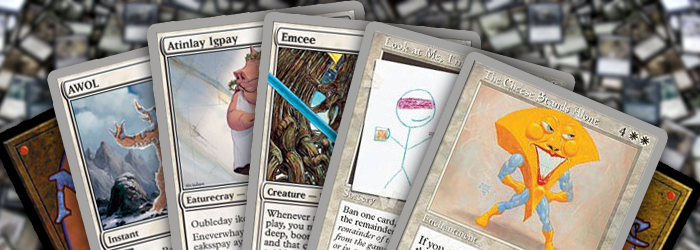
In this article’s “oraclization” of a selection of silver-bordered cards, cards that require a physical, non-die rolling component have been glossed over. This means this spoiler will not contain contact cards like [card]Charm School[/card] or [card]Volrath’s Motion Sensor[/card]. Cards with a verbal mechanic have been simplified to remove the verbal mechanic entirely where appropriate. Notably, without the verbal mechanic, many Un- cards remain relatively unimpressive. Cards referencing ½ or artists are similarly ignored, or in a few cases, appropriately modified. (It is this author’s opinion that playgroups willing to play with the physical and verbal impacting silver-bordered cards are already on the cutting edge of social contract technology and this article is not nearly as applicable to them.) Creature types have been updated where obvious (i.e. chicken to bird). For example, [card]Atinlay Igpay[/card] without the verbal mechanic becomes a straightforward 3/3 double strike boar for 5W. We’ll begin the first part of this article series with white.

In the spoiler below, flavor text has been ignored for brevity. Suggestions for deck construction, strategy, or finance are included after some cards.

White

[card]Atinlay Igpay[/card] 5W
Creature — Boar
Double strike
3/3


[card]AWOL[/card] 2W
Instant
Exile target attacking creature. This creature cannot be returned to the game for any reason.

This card is specifically effective against [card]Riftsweeper[/card] under narrow circumstances. It is not effective against commanders because the return to the command zone is a replacement effect.


[card]The Cheese Stands Alone[/card] 4WW
Enchantment
If you control no nontoken permanents other than The Cheese Stands Alone and have no cards in hand, you win the game.

This obviously combos with [card]Forbidden Ritual[/card] and any number of hand discarding effects in an Orzhov deck for an instant win. Additionally, it functions as a secondary copy of [card]Barren Glory[/card] in those types of combo decks. Remember, [card]The Cheese Stands Alone[/card] is state-based effect and not a triggered one.


[card]Double Dip[/card] 4W
Instant
Choose another player and gain 5 life. At the beginning of the next game with that player, gain 5 life. (Do this after each player has kept their opening hand.)

One of the challenges of applying modern templating to the Double cycle was determining when the delayed trigger would take place for the reminder text. In order to make [card]Double Cross[/card] work effectively, the delayed trigger needs to happen at the same time the Leyline cards would trigger. This is why all the Double cards should have reminder text to trigger after each player has kept their opening hand.

All the Double cards are strategically interesting in that they can create multiple delayed triggers for the next game that care not for what happens between games, which most importantly includes changing to a different deck (and potentially format if the playgroup’s social contract works that way). For example, someone might play a white-green deck with multiple [card]Regrowth[/card] effects to replay [card]Double Dip[/card] two or more games and then lose the game. The next game, depending on the social contract, that player might choose to switch to his or her [card]Erebos, God of the Dead[/card] deck and begin the game with even more life with which to draw cards. If this type of tactic becomes common under a particular social contract, the playgroup may possibly evolve and react. It is this type of social interaction which may be of interest for that playgroup and provide validity to Un- cards. While there’s potential for abuse here—particularly with [card]Double Play[/card]—there’s also possibility for additional strategic complexity. Whether these cards will work for a given playgroup will depend heavily on the social contract and metagame.


[card]Emcee[/card] 2W
Creature — Human Rogue
Whenever another creature enters the battlefield, you may put a +1/+1 counter on that creature.
0/1

A potentially political version of [card]Juniper Order Ranger[/card] for players looking to play more group hug/slug.


[card]I’m Rubber, You’re Glue[/card] WW
Enchantment
0: Change the target of target spell or ability that targets only you. The new target must be a player.

[card]I’m Rubber, You’re Glue[/card] is possibly undercosted, but it’s very similar to [card]Leyline of Sanctity[/card], [card]Solitary Confinement[/card], and [card]True Believer[/card] which aren’t banned.


[card]Knight of the Hokey Pokey[/card] WW
Creature — Human Knight
First strike
1W: The next time a source of your choice would deal damage to Knight of the Hokey Pokey this turn, prevent that damage.
2/2


[card]Look at Me, I’m the DCI[/card] 5WW
Sorcery
Name a card other than a basic land card. Exile all cards with that name. Search each player’s graveyard, hand, and library for any number of cards with that name and exile them. Then that player shuffles his or her library.

“Yes, your commander is definitely going back to the command zone.” [card]Look at Me, I’m the DCI[/card] is also the only card in Magic that allows someone to search through each player’s deck, giving an expensive method to peek through everyone’s deck in the late game after naming the card to see what tricks are left. It also allows for someone to dig their commander out of their deck and put it back into the command zone.


[card]Mesa Chicken[/card] WW
Creature — Bird
0: Mesa Chicken gains flying until end of turn.
2/2


[card]Miss Demeanor[/card] 3W
Creature — Angel
Flying, first strike
3/1


[card]Once More with Feeling[/card] WWWW
Sorcery
Exile all nontoken permanents and all cards from each player’s graveyard. Restart the game. Each player’s life total becomes 10. Exile Once More with Feeling. (Token permanents stay on the battlefield. Each player shuffles his or her current hand into their deck. Players draw a new hand of seven cards. Players may take mulligans. You start the game.)

[card]Sway of the Stars[/card] is banned in Commander, so this card should probably not be included in Commander despite the excellent Terese Nielsen artwork.


[card]Sex Appeal[/card] W
Instant
Prevent the next 3 damage that would be dealt this turn to any number of target creatures and/or players, divided as you choose.


[card]Staying Power[/card] 2W
Enchantment
Change the text of each spell or ability by removing all instances of “until end of turn” and “this turn” from them. (These effects end at end of turn if Staying Power leaves the battlefield.)

This card has no equivalent in current Magic to provide a modern templating philosophy analogue. The overload mechanic is possibly the closest mechanic with which to compare it. However, [card]Staying Power[/card] may be just too complicated to maintain an accurate game state and avoid trashing the social contract for cute interactions.

Until Next Time

With this list, it’s clear that white brings some useful tools to Commander decks. Combo gains redundancy with [card]The Cheese Stands Alone[/card]. Johnny players get to really mess with the game with [card]Staying Power[/card]. Aggressive token generating and political decks can use [card]Emcee[/card].

Blue and black will be covered in the next article in this series and even more tricks will be brought to the kitchen table.

Casually Infinite – Understanding Bots

On MTGO, interacting with bots ends up being a mandatory endeavor at some point. While trading between players is often the most profitable, sometimes you need to interact with a vendor with a large number of cards in order to pick up what you need. Bots drive the MTGO economy in very significant ways. We will be looking at how they work, the role they play, and how to best utilize them.

Ticket (‡) Based EconomyEvent Ticket

In MTGO, the only place you can directly spend money is at the Wizards Store. Here you can only buy product like booster packs, intro and Commander Decks, and tickets. Tickets can be used to enter events such as Draft, Sealed, and Constructed queues. The MTGO economy is entirely based on these tickets. A ticket’s value is pretty stable because they can always be spent to enter events that provide product and they always cost $1 from the store. While the value of cards fluctuate, they are tracked in their value of tickets. Sites like MTGGoldfish track the value of cards in tickets in the same way that TCGPlayer tracks price in dollars.

These prices are primarily determined by bots. Bots represent the stores of Magic Online. Larger stores like SCG are replaced with MTGOTraders. Software developers allow anyone to run his or her own bot just like a mom-and-pop card shop. Bots are regular MTGO accounts that are operated by automatic software that allow the exchange of cards and tickets. You interact with a bot by opening a trade window and picking the cards you want, or asking it to browse your collection for cards it is buying. Bots run 24 hours per day with the larger vendors running 10+ bots, meaning that up to ten people can be browsing a vendor’s wares at a time.

When you trade with a bot, you are being offered or paying very specific prices for your cards. This is broken down in ticket value to the hundred thousandth (.001‡). If you have more that 1.000 in credit, you can cash out for a ticket. If you don’t, the bot will happily hold onto your credit for you until there is a card you wish to purchase. Large vendors with multiple bots will share credit between their bots, meaning you can buy something from one of their bots and use the remaining credit on another. But credit can’t be transferred from a bot of one company to a bot of another company.

Moving the Market

There’s a few things that bots do to the market on MTGO. The first thing they do is play a role in stabilizing the market. If you were relying on the individual online players to determine the price of cards, then prices could fluctuate wildly over the course of a day just based on timezone. The fact that anyone can find numerous different sources to buy a specific card at comparable prices at any time, day or night, provides an effect similar to how cellphones and TCGplayer affect paper trades. I can go and look up what bots are selling a specific card for when deciding how much to trade for it.

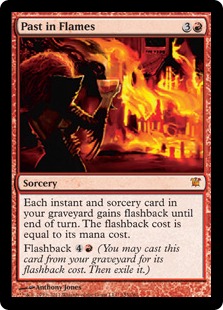
While bots stabilize the market, the global availability of cards allows the market to move much faster. During Pro Tour Born of the Gods, prices on cards like [card]Pyromancer Ascension[/card] and [card]Past in Flames[/card] tripled before the end of the weekend. While these cards have been moving in paper, the effect hasn’t been as quick. With global availability of cards, I can purchase a playset of cards and play with them immediately. I can put together and and play the Team Pantheon Storm Deck, played by Jon Finkel and Kai Budde, before they even get into day two of the Pro Tour. If I wanted to, I could sell the cards back before the end of the event. No waiting, no shipping, no additional fees.

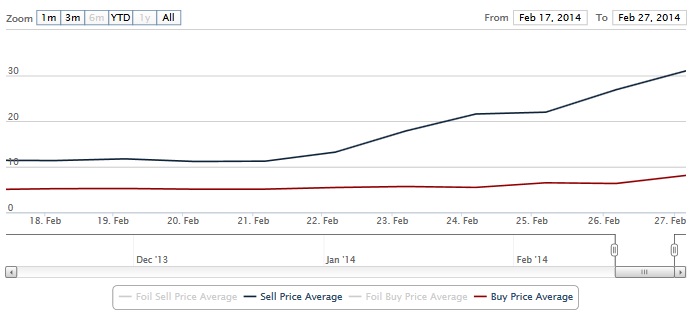
Past in Flames - Feb 2014

Past in Flames – Feb 2014

The other thing that bots do is control card prices in the market in two primary ways. First off, they push down the cost of cards that aren’t commonly used in competitive play. For example, [card]Traumatize[/card], which has some casual draw, runs about $1.50 to $2 on TCGplayer. On MTGO, it runs 0.051‡. Meanwhile, [card]Shivan Dragon[/card] runs the same 0.050‡ but only costs about $0.29 on TCG. This disparity is caused partially by MTGO being much more focused on competitive play, with people grinding daily events or queues and using the program to test out decks. It also is because of how the ticket/credit structure works.

In MTGO, cards tend to stick around certain prices that are advantageous to the bots. A card selling for 1.012‡ requires a buyer to spend 2‡ in your store. Imagine if instead of giving you back coins as change, your LGS could force you to buy something else or hold your credit for later. Bots frequently keep prices floating around 1.10‡ or jump them to something like 1.60‡. On the lower end, prices will float above 0.76‡, 0.51‡, 0.34‡, or 0.26‡. If a card falls below a four-per-ticket price point, it will generally quickly end up in the 0.03‡ to 0.05‡ range. Since no one needs more than a playset of a given card, any card that can’t be sold for better than four-for-a-dollar, at best, is going to get a vendor a minimum of one ticket anyway. Vendors don’t care if they have to throw in a few other low-value cards to make up the difference.

Making Money from Bots

In spite of their natural position to take advantage of you, bots can frequently be used to make money. My first trade experience in MTGO was buying 10 copies of M11 [card]Time Reversal[/card] at 1.00‡ from one bot and selling them to another bot for 1.10‡. I had to do this one at a time, because I only started with two tickets, but a few trades later, I had three tickets. If you’re going to try to work with bots, please pay attention to the following things:

1. Cards Per Ticket

Buying cards from Vendor A for 1.250‡ each is not basically the same thing as paying 1.255‡ each from Vendor B. While overall the 0.020‡ price difference is fairly insignificant, the fact that Vendor A takes five tickets per playset while Vendor B takes six tickets per playset is quite significant. If you’re buying a playset of cards for 1.02‡ total, you’re actually paying twice as much as if you’re paying 1.00‡ for the play set. When you can buy cards for a good price and leave as little credit as possible, you’re in much better shape than being stuck with a good deal and 0.89‡ in credit at a store you don’t want anything else from. You can also use the advantage of selling cards at even prices to move product. A card may be selling at 1.10‡ from bots, but you can sell it at 4‡ for a playset pretty easily.

2. Take your Tickets – Track your Credit

First off, if you have more than 1.000 credit with a vendor, take tickets. Tickets are always worth more than credit because all bots take tickets. Be careful that bots you’re trading with have tickets available to trade and never trade for credit with a bot that doesn’t have tickets available. It doesn’t matter if you’re offered 64‡ for your [card]Scavenging Ooze[/card], if you can’t cash the credit out for tickets, it is all just [card]conjured currency[/card]. I keep telling myself I should make a spreadsheet with credit at each bot, but at the very least add every bot you have more than 0.010‡ of credit with to your buddy list. You never know when it’ll come in handy if you’re trying to pick up one common you want for something. Being stuck with credit at reputable bots with a good stock, like MTGOTraders, MTGO_Bazzar, and MTGO_Academy, isn’t so bad. But a bot can always close up shop and then your credit will be [card]totally lost[/card].

3. Use Wikiprice

I don’t know how anyone turns a coin in MTGO without using Wikiprice to one degree or another. There may be other similar sites, but Wikiprice shows the highest-paying and cheapest-selling bots for a given card. It’s not uncommon for there to be a higher buying price at one bot than selling price at another. This is one way you can make sure you’re getting a bigger picture than just what the classifieds are showing you. Sometimes, during a big buyout, the price difference between buying and selling can be multiple tickets, allowing you to make an immediate profit.

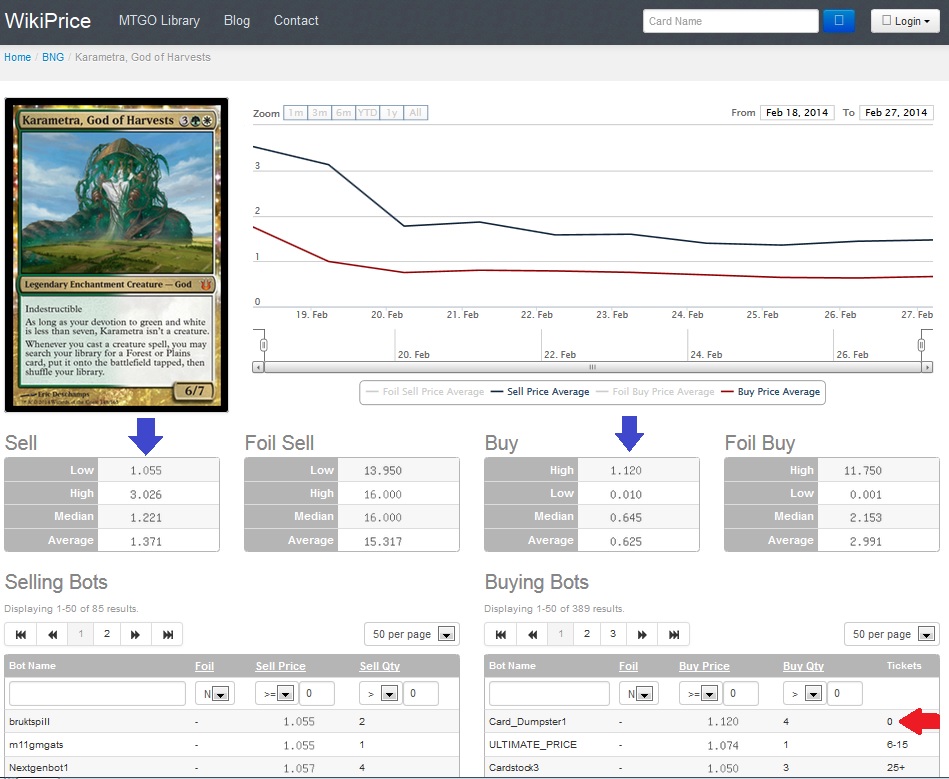
Blue Arrows point out a buying price higher than the selling price. Red arrow points out that the vendor has no tickets available.

Blue Arrows point out a buying price higher than the selling price. Red arrow points out that the vendor has no tickets available.

4. Don’t Be Afraid to Sell for More Than the Bots

I have, several times, bought cards from a bot and sold them minutes later through the classifieds for more than I paid at the bot. I’ve sold cards for more than bots are currently asking. This isn’t TCGplayer, where if your cards aren’t on the first page they’ll never be seen. Cards listed in the classifieds rarely show more than five to ten sellers, and a number of people would rather just pay the 3‡ for their cards than deal with finding a bot, pay 2.7‡, and figure out what to do with the remaining 0.3‡.

5. Pay Attention to Bot Prices and Stock

Prices can fluctuate quickly on MTGO. Keeping up with the value of your cards on bots can let you know when to sell them. Don’t be afraid to dump cards to bots when they’re buying. It is often better to sell out to a bot in the hype than try to extract a few more cents by listing the cards on the classifieds yourself. However, when bots don’t have a card in stock, prices can spike because that means people are buying them. It’s pretty easy to set up a tracker on MTGGoldfish for your trade stock and check it to see when prices are rising and falling.

That’s it for today. Have your own MTGO finance tips I may not have mentioned? Please share below!

Weekend Review March 7-9

“Leave the last 10 percent for the next guy.”  This sound line of reasoning has been promoted by the guys from the Brainstorm Podcast and I tend to agree, although it may seem counter-intuitive initially -“Why give up profit margins on my speculation targets that hit?”  Because cards are ultimately only worth what someone is willing to pay for them and while the value of a card may still be on the rise, it’s easier to move a card while it is still on the rise as opposed to trying to move it once it has peaked and is beginning to show signs of decline.  If you are holding Modern staples right now and considering whether or not to move them, I think that we are now in the time frame to make that sale.  Between now and the beginning of Modern season you’ll have the best opportunity to unload Modern staples at the best profit margin.Land Tax

At this point it is certainly unclear how much more valuable [card]Scalding Tarn[/card] and [card]Misty Rainforest[/card] can possibly get.  We are clearly nearing the top of the price point for these cards with Modern season looming and the hype following Grand Prix Richmond this weekend. We may in fact be nearing the top for all the fetch lands.  After all, Wizards has to be salivating at the incredible draw that the Modern format has become.  With the outlandish turn out at Grand Prix Richmond this weekend, any product Wizards produces with the word “Modern” on it will undoubtedly fly off shelves.  The Modern Event deck that is to be available on May 30, 2014, continues to demonstrate that Wizards will increase the supply of Modern staples as long as the demand remains.

Modern

Grand Prix Richmond Decklists

With five of the top 18 finishers of Grand Prix Richmond running Affinity, most of the contents of the deck have already increased in value.  While there is still room for growth, the card from the deck I am most bullish about is a repeat call from last week.  [card]Inkmoth Nexus[/card] is a multi-format staple, being a 4-of in most decks that chose to run it as an alternate win condition.  Sitting at $10 on TCG player, as well as most other major retailers, I feel that this card has not seen the exponential growth that some of the other major players in Modern have seen.  I think this means that this is still a card worth targeting and perhaps even purchasing despite its recent growth and success.  Given the number of decks capable of infinite life, or padding their life total through [card]Phyrexian Unlife[/card] and [card]Angel’s Grace[/card], having an alternate win condition is perhaps undervalued at this juncture.  By the way, if you want to go long on a spec, [card]Phyrexian Unlife[/card].  If you can still find them.  Go to your LGS and buy them up out of the bulk box.   They’re disappearing across the internet.

Affinity faced off against Kiki-Pod in the finals of the Grand Prix this weekend, pod strategies also managed five of the top 18 finishes.  While Affinity has already shown moderate gains, [card]Birthing Pod[/card] is selling for almost double what it cost Friday.  Many of the cards from the deck have also experienced similar astronomical growth in the past weekend.  One card that I feel strongly still has room for growth is [card]Restoration Angel[/card].  The gradual growth that [card]Restoration Angel[/card] has experienced encourages me to target it in trades, as they are occasionally still present in casual binders, you can often get rid of standard cards in exchange for this card that is still trending upward.

The Innistrad land cycle sees play in Modern, and although they don’t see play in incredibly high numbers, both this cycle of lands as well as the Scars of Mirrodin fast lands are all worth acquiring.  [card]Sulfur Falls[/card] and [card]Hinterland Harbor[/card] are likely the most popular Innistrad lands at this point, but they are all probably safe targets.Woodland Cemetery

Snapcaster Mage had climbed to $40.00 from some retailers as early as a week or so ago.  Any blue based decks that aren’t running [card]Snapcaster Mage[/card] likely have to question why they aren’t.    Copies can be had on TCG player at $30.00.  This is a card that will likely not see print in standard ever again, relegating any reprints to smaller sets.  $30.00 is likely the new floor for the foreseeable future.

[card]Blood Moon[/card] was such a successful strategy across several archetypes that for the Grand Prix this week, many shifted their entire mana bases so they could fight through a resolved [card]Blood Moon[/card].  This card is still punishing for so many greedy mana bases, that despite the handful of printings, [card]Blood Moon[/card] is well situated in both Modern and Legacy, and is a good trade target right now.

[card]Grafdigger’s Cage[/card] remains a highly-selected  and diverse sideboard card in both Modern and Legacy.  Foil copies are selling at $18.  I think the way in which foil copies are out pacing non-foil copies is indicative of the direction that this card will trend in the future.  Both clauses are relevant in both Modern and Legacy.

One of the major barriers to the entry to Modern not so long ago was the lack of availability of shock lands.  With Return to Ravnica having resolved that issue, shock lands took a [card]Plummet[/card], but keep an eye on shock land prices.  It is quite possible that they are currently as low as we will see them for some time.  While other cards may dip when they cycle out of Standard, many players will be waiting to swoop up all of the shock lands as they rotate, and I don’t expect much, if any of a dip in their price.  Now is likely a good time as any to pick up shock lands.  While [card]Steam Vents[/card] has been one of the least played during its stretch in Standard, and therefore the cheapest, it is highly played in Modern, and it’s future price will reflect this.

Modern cards are going to continue to fluctuate in value based on results from Modern tournament results, the next Modern Grand Prix the weekend of May 9-11 in Minneapolis.  As I said last week, Modern cards will remain the most financially-volatile assets in your collection.  Treat them as such.

C(ube)+C(ommander) Magic Factory #5 – Nature of the Beast Review

For the last installment in this series of C+C Magic Factory, we’ll be reviewing the Commander 2013 deck, Nature of the Beast.

Here’s a review of the grading system we’ll be using.  The first grade for each card is a Cube grade, the second is a Commander grade.

Cube:

[A+]: First-pick card on power level alone or tier-one for associated archetype(s).

[A]: High-powered alone or in the context of two or more archetypes.

[B]: High-powered in the context of one archetype.

[C]: Role-filler in a niche archetype or mid-powered utility card.

[D]: Might see play in large or restricted lists (e.g. peasant)

[F]: Not playable in Cube.


Commander:

[A+]: Best in class.  These cards are at the top of the list for any deck wanting the effect.

[A]:  Excellent card according to two or more of: power level, size-of-effect, card interaction, or politics.

[B]:  Excellent card according to one of: power level, size-of-effect, card interaction, or politics.

[C]:  Solid role-filler or theme-supporter.

[D]:  Playable, but better options exist.

[F]:  A knife at a gun fight.


Naya Deck: Nature of the Beast

Commanders: [card]Marath, Will of the Wild[/card] [F]/[A+], [card]Gahiji, Honored One[/card] [D]/[C], [card]Mayael the Anima[/card] [F]/[C]

As it turns out, Marath, the new commander with the biggest text box and recipient of errata before it even hit the shelves, is good.  Though I may be biased, just having won a small EDH tournament at my LGS with a decidedly untuned Marath build, the amount of interactions and single cards he enables cannot be ignored.  Whether you want to brew a Ghave-style token build or just have Marath be at the helm of a Naya beats pile of big dumb idiots, the elemental beast does whatever you want him to up to and including smashing face on-curve.  In my games I spammed 1/1s, went off with [card]Ashnod’s Altar[/card], threatened and achieved early lethal damage with [card]Mirror Entity[/card] and a juiced-up [card]Wild Beastmaster[/card], closed out a game by going to the dome, cast him as a 13/13 and got to play him after a [card]Mirari’s Wake[/card] and [card]Warstorm Surge[/card]. Even a card like [card]Trostani, Selesnya’s Voice[/card] that normally requires significant deck allocation to function is randomly turned on by Marath. This card is $1.50 in paper and $10 online, which is a reflection of the distribution disparity between the two media platforms, compounded with the fact that (spoiler alert) the rest of Nature of the Beast is lacking.  I would try to pick up any of these you may see in binders, because it is an excellent general from an unwanted product and $1.50 seems disproportionately low.

Alter by Sandreline

[card]Gahiji, Honored One[/card] saw a surprising amount of initial play in my groups despite the consensus that he was powered down from what should have been a 5/5 or at least a 5/4.  Anthem-on-a-stick is nice, but compared to Marath’s all-the-abilities-on-a-stick, Gahiji is nowhere near as good or interactive.  The political impact did not come up enough in games to make people stick with him, and I have not seen him recently except as support for Marath—a job he does well.  You could consider Gahiji for Cube if you have a token theme and include any shard cards, since the competition in Naya is so low.  Myself, I run [card]Realm Razer[/card] because [card]Armageddon[/card].

[card]Mayael the Anima[/card] is a decent reprint here as she has sweet art and can be built around in ways that don’t involve losing friends the way an inclusion like [card]Uril, the Miststalker[/card] would.  I get the sense that this may be her swan song, as the five-power matters theme seems so stale when compared with these new, more interactive options.  The saddest part of this inclusion is that her slot should be occupied by [card]Hazezon Tamar[/card], but the reserved list struck again.


New Cards

[card]Curse of Chaos[/card] [F]/[D]

See Power Hungry review.

[card]Curse of the Forsaken[/card] [F]/[D]

See Eternal Bargain review.

[card]Curse of Predation[/card] [A]/[C]

See Power Hungry review.

[card]Darksteel Mutation[/card] [D]/[C]

See Eternal Bargain review.

[card]From the Ashes[/card] [F]/[D+]

[card]From the Ashes[/card] is a metaphor for Nature of the Beast in that it’s intentionally underpowered.  The idea here seems to be land destruction minus the hurt feelings—except for the guy with the $500 mana base, who can stand being the butt of jokes from everyone while they search out their basics.  Personally, I prefer to just run [card]Ruination[/card] (which is unplayable in Cube), but if your social contract frowns on that, [card]From the Ashes[/card] may just be the tool you need to get your fix of LD.

[card]Mystic Barrier[/card] [F]/[C+]

Another card that seems custom-built for [card]Zedruu the Greathearted[/card], [card]Mystic Barrier[/card] is a fun political card ripe for exploitation.  I don’t think it’s at home here since Naya typically has creatures out, but for a combo deck, this is a [card]Moat[/card] that is weak to one player’s creatures rather than flyers.  If you play combo and still have friends to play multiplayer games with, give this card a shot—I think you will be pleasantly surprised.  If you hadn’t noticed, this card does stone nothing in 1v1.

[card]Naya Soulbeast[/card] [D-]/[F]

While a neat mechanic, [card]Naya Soulbeast[/card] is way too overcosted for anyone’s taste.  Maybe with 10 players at the table and a [card]Jace, the Mind Sculptor[/card] on your side, this card can pull its weight, but until Magic starts awarding achievements, no one is going to try that.  The flip side of this coin is that this beast is totally unplayable in 1v1.

[card]Restore[/card] [F]/[C+]

See Power Hungry review.

[card]Spawning Grounds[/card] [F]/[D-]

Effectively nine mana for your first 5/5, any deck running [card]Spawning Grounds[/card] needs to be cheating on mana in a big way to want this effect. Any sort of combo deck can likely make do with [card]Squirrel Nest[/card].  The effect is good, but paying retail seems not worth it.  If [card]Spawning Grounds[/card] cost half the mana, I think it would be exciting enough to see play. Five mana for a 5/5 is fine, and once it’s on the battlefield, it certainly applies pressure.

[card]Tempt with Discovery[/card] [F]/[B-]

Initially I was down on all the tempting offer cards except [card]Tempt with Vengeance[/card], but the amount of play [card]Tempt with Discovery[/card] is seeing in my groups makes me rethink this one.  The first observation I had is that people weren’t even playing by the rules: as soon as the spell hit the stack, everyone was rushing into his or her library.  Even once we started playing it correctly, each time the spell was cast, at least one person took the offer.  EDH players love ramping and [card]Tempt with Discovery[/card] has a subtle upside of playing into the psyche of your opponents.  Also, the floor for this card is not the worst, as you can grab a [card]Temple of the False God[/card] and make a reasonable [card]Explosive Vegetation[/card] impression.  Since the lands ETB untapped, if a couple opponents take the offer you can usually cast a spell after ramping, which hardly any other ramp spell lets you do.  Furthermore, this is the only tempting offer card which uses hidden information, thus giving your opponents opportunities to make mistakes.  None of this, however, means it will see any play in Cube.

[card]Terra Ravager[/card] [F]/[F]

See Mind Seize review.

[card]Witch Hunt[/card] [C-]/[C-]

[card]Witch Hunt[/card] is a neat card for a chaos game of EDH, in a Zedruu deck, or to hate on any life gain decks in your meta.  The random clause on this card makes it play very differently in multiplayer or 1v1. In a duel, the card just bounces back and forth. Most of the excitement over this card came from people touting it as the second coming of [card]Sulfuric Vortex[/card].  Vortex is the [A+] card for the mono-red burn archetype in Cube, so shouldn’t two Vortices stapled together with a mana discount be an auto-include?  As it turns out, the answer is no.  Yes, the mono-red deck wants a single 5-mana finisher with reach, but the problem is that there are many cards that can fill that role while still supporting other archetypes. [card]Thundermaw Hellkite[/card] tops the list, but even [card]Stormbreath Dragon[/card] or [card]Siege-Gang Commander[/card] are completely serviceable in that role while being nowhere near as narrow.  I drafted [card]Witch Hunt[/card] in my cube several times, each time picking it up late.  On each occasion, it would have fit perfectly but I always had something better to run at five mana.

Notable Reprints

[card]Avenger of Zendikar[/card] [A]/[A+]

Alter by Galli

Here we have the second reason to buy this product.  Avenger is the go-to target in any ramp deck. He scales very well from the mid- to late-game and can hit as early as turn four when preceded by a little work.  What’s beautiful is that this assessment applies to both Cube and Commander.  Like Myr Battlesphere, 40-card decks can get Avenger into play a myriad of ways, and at seven mana, not all of them have to be unfair.  He even blinks for sick value!  Unless you’re staring down an evasive army, [card]Avenger of Zendikar[/card] stabilizes in one turn and wins the game a couple turns later if not removed. This factor puts him head, shoulders, and rooty appendages above the other fat-and-green competition.  In EDH, Avenger is often built towards with cards like [card]Doubling Season[/card], [card]Boundless Realms[/card], and [card]Sylvan Primordial[/card].  What makes him so great is that he has a top-notch effect at a non-prohibitive cost.

[card]Eternal Dragon[/card] [D+]/[C]

Oh, how the mighty have fallen. Creature power creep has pushed both the Eternal and Dragon parts of [card]Eternal Dragon[/card] into obscurity, though plainscycling for two mana does its best to keep this card relevant.  It was recently squeezed out of my cube by cards that got drafted and did things, though I was saddened to see it go because landcycling is such a welcome effect.  In EDH, where you have more time to durdle, [card]Eternal Dragon[/card] still has a role helping you hit land drops or making an appearance as a 5/5 in the late game.  Never bad but rarely good, [card]Eternal Dragon[/card] is at its best when it’s covering up the fact that you’re running too few lands.

[card]Harmonize[/card] [B-]/[B+]

[card]Harmonize[/card]’s high rating is due mostly to the fact that unconditional card draw is such a rare yet in-demand effect in green.  Forests are to EDH what Islands are to 60-card Constructed, and in the format where color identity is a thing, tapping trees to cast blue spells is the best place to be.  In Cube, ramping and fixing are often one in the same, making [card]Harmonize[/card] good but less stellar, since it’s easy to cast Fact or Fiction off a blue splash.

[card]Rampaging Baloths[/card] [B]/[B]

Avenger’s older-but-less-abusive partner in crime is quite good for many of the same reasons Avenger is good.  Since you want to play Baloths and immediately trigger landfall, both cards are effectively seven-drops, with Avenger being the better of the two since you get most if its potential value immediately.  Any Cube (or Commander) deck that wants one will want the other and will likely run both, though I expect Avenger to be around in cubes much longer than [card]Rampaging Baloths[/card]. Baloths will have to compete with newer cards while Avenger looks down from its perch at the top of the heap.

[card]Wrath of God[/card] [B]/[A]

The OG board sweeper adds some much-needed value to this product.  “Wraths” are staples for both Cube and Commander and [card]Wrath of God[/card] is still among the best, even after all these years.  Anti-regeneration doesn’t come up very often, but when it does, you’re thankful for it.  The only reason Wrath doesn’t get a higher rating is that in Cube, there are enough functional replacements that control decks can afford to take their sweepers later. In EDH, tuck-Wraths like [card]Hallowed Burial[/card] and [card]Terminus[/card] may actually be better due to the life buffer and all the generals and indestructible dudes running around.

Notable Cards in All Five Decks

[card]Sol Ring[/card] [A+]/[A+], [card]Command Tower[/card] [F]/[A+], [card]Opal Palace[/card] [F]/[C-]

These three apply pretty much only to the Commander crowd, as any cube that wants a [card]Sol Ring[/card] has one by now.  As for [card]Sol Ring[/card] and [card]Command Tower[/card], best get them now while they are cheap, as any EDH deck would benefit from their power level.  Players in my groups rarely cannibalize decks to make new ones; most (me included) build new decks whenever something exciting is released.  New decks mean all the [card]Sol Ring[/card]s and [card]Command Tower[/card]s will find homes, so expect the price to rise accordingly.  [card]Opal Palace[/card], on the other hand, is not nearly as powerful as the first two and once the novelty wears off, it will probably only be at home in a deck that really wants the +1/+1 counters on its general, like Marath or Animar.

Overall – Value: [D] / Playability: [D]

Nature of the Beast has several problems from the perspective of both value and playability.  First and foremost is the lack of exciting new cards.  Marath is great and [card]Tempt with Discovery[/card] is good, but the rest of the new designs here suck.  Long-term, this will hurt the value of this precon.  Furthermore, there is no tier-one Constructed card, no P3K reprint, and no mono-colored general—small transgressions, but they add up.  There is some value in the reprints (Wrath & Avenger), but none of the depth seen in Evasive Maneuvers.  Playing the deck is basically a lesson on how to not play the cards in your hand, hope to hit your land drops, and dump all your mana into Marath since he’s so much better than anything else this deck can do.  Comparing any of the nine non-[card]Avenger of Zendikar[/card] 5+-power creatures to Marath is a joke, and with only ten total in the deck, Mayael has about as good a chance to whiff as to hit.  Nature of the Beast is about as cohesive as Mind Seize, but without any good cards. This is sad, because there are so many cool cards that could have been included to showcase how awesome Marath is. Let me know what you think in the comments!

Contact:

Email: djkensai at gmail dot com

Twitter: @djkensai

Pitt Imps Podcast #59 – Still No Playmat

In this weeks episode of the Imps we argue about how fun Sealed is then we go over GP Barcelona. After that rant we go into GP Melborne and SCG ATL. We decide weather or not to buy the Jace vs Vraska deck coming out, complain about being snubbed, and the new FNM Card. Then we ramble as we always do but actually keep it on mostly magic this week. Oh and Ryan tell you how his game day went. Hint: Look at the episode title.

Your hosts: Angelo & Ryan

Angelo’s Twitter: @Ganksuou

Ryan’s Twitter: @brotheryan

Show’s Email: [email protected]

Great Expectations

This is a headline that makes me chuckle every single time I read it:

“Apple posted quarterly results that beat estimates Monday … shares dropped more than 5%.”

For those who don’t follow non-Magic finance, the reason this happens (and it happens all the time to all kinds of companies) has to do with expectations. Apple beat the earnings estimates but it was expected to beat the estimates by even more. The stock price reflected the expectation (not the estimate) and it corrected downward when Apple came up short. The end result is a quarter that looked good on paper but resulted in a sharp drop in share price. It’s all about the expectation.

The thing is, Apple didn’t have a bad quarter. Yes, shares dropped 5%, but that was more a function of high expectations than poor performance. By objective measures, Apple was doing fine—a healthy, profitable company.

If you can sort through expectations and focus on actual performance, you will often find there are opportunities mixed in. A 5% discount on Apple shares just because someone else let their expectations get out of control? Works for me.

We can find similar opportunities in Magic finance.

Zoo

How about a tier-one Modern deck that put more players into day two at Pro Tour Born of the Gods than any other deck? A deck that will certainly remain relevant going forward and is capable of taking down any given Modern tournament if the meta suits it. The deck is Zoo, and it offers as good a buying opportunity as you will find for many of these cards.

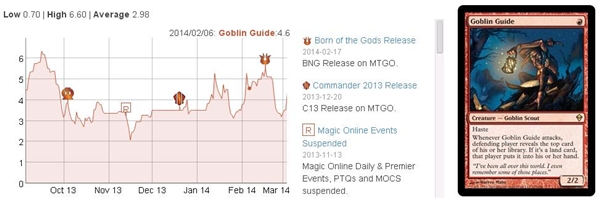
Check out [card]Goblin Guide[/card] on MTGO:

goblinguide

The card is down around 30% since the pro tour. Sure, Zoo didn’t do as well as we thought it would, but is that any reason to be down on [card]Goblin Guide[/card]? (Update: Sorry guys, this one rebounded in the day since I posted this. Magic finance moves quick, I guess.)

Guide is the definitive one-drop in red aggro decks, and one thing we know for sure is that red aggro decks will never go away. It was about this price just before the Nacatl unbanning, and that was all upside for [card]Goblin Guide[/card]—it still goes in mono-red like before and now it goes in (some) Zoo decks as well. Expectations of Zoo were too high and now [card]Goblin Guide[/card] is a buy on MTGO. I have bought and sold my playset of this card several times now, grinding out a few tix each time. I just picked them up yet again.

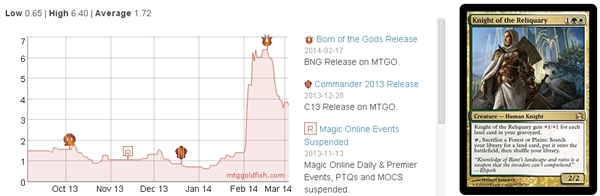
knight

[card]Knight of the Reliquary[/card] did something similar, plummeting almost 40% from its peak. This one is a little tougher since it really wasn’t doing anything prior to the Nacatl unbanning. It’s on the watch list for sure.

Heck, even [card]Tarmogoyf[/card] is down 10% from the pro tour peak on MTGO. This may not seem like a huge deal in a vacuum, but most other Modern prices are going through the roof. [card]Past in Flames[/card], [card]Geist of Saint Traft[/card], [card]Primeval Titan[/card], [card]Snapcaster Mage[/card], the list goes on. If a single Zoo list had landed in the top eight of the pro tour, ‘Goyf might be 100 tix right now. Instead, the buying window remains open for just a little bit longer. I don’t think this card stays at 80 tix for long and when it moves, it’s probably not coming back down unless it gets reprinted again.

The point is really not to call for buys on these particular cards, but to use Zoo at the pro tour as an illustration. When expectations are high and results don’t live up to them, you have to decide whether the pessimism is justified or the market is overshooting.

Zoo didn’t dominate the pro tour, but that was a big ask to begin with. There were plenty of copies of [card]Wild Nacatl[/card] in the top decks though, and this was in a meta where Zoo was basically guaranteed to be one of the most-played decks. I’m pretty sure that the Nacatl unbanning served as a telegraph that said, “If you only do one thing to prepare for this pro tour, make sure you can beat Zoo.” Accordingly, players packed a million copies of [card]Anger of the Gods[/card].

The deck is solid and the meta won’t always be this harsh. It will be harder to justify sideboard slots to hate out a deck that didn’t top eight the pro tour when Twin and Pod are running wild. In my mind, the market is overshooting. Zoo is a perfectly good Modern deck.

I’ve used MTGO examples here because the market adjusts so quickly. Paper prices don’t bounce all over like that, but I think you can still take advantage of this pessimism in trade. Players will be tripping over each other trying to give you out-of-favor stuff like Knights or Guides for the UWR staples that won the pro tour, [card]Amulet of Vigor[/card], or whatever else. Buy low, sell high—I know, I am a prodigy.

Now let’s take a slightly different angle on this idea.

Commander 2013

The expectation here was not performance-based, but supply-based. The word on this set was that it would be “printed to demand.” I believe this was established by Mark Rosewater, who stated on his Tumblr that Wizards would reprint these decks if demand dictated. Of course, this was a one-sentence answer and we were left to fill in the blanks. The conventional wisdom was that these would sell out around the holidays and then we would see a second wave in early 2014.

What we actually saw was the good decks (and not just Mind Seize) selling out quickly and the clunkers warming shelves until, in some cases, they went on clearance. I haven’t seen a restock of these decks. Most stores here have about two copies of the Naya deck still sitting around. Your mileage may vary, but it seems like a set is only as strong as its weakest deck.

I passed by quite a few Esper and Bant decks in my search for [card]True-Name Nemesis[/card] when the set was first released. Based on the information I had, I expected to sell off the Mind Seizes and then circle back to get whatever else I wanted on the restock. Nope.

There are some very good cards in this set, and they were prevented from being reprinted by the shelf-warmers. The end result is that the size of the print run didn’t meet expectation and certainly didn’t meet demand for the top decks. The market is very focused on Modern and the release of Born of the Gods and hasn’t quite realized this yet.

There is nothing tethering [card]True-Name Nemesis[/card] to a $30 price tag any longer, so the sky’s the limit on that guy. Toxic Deluge is very good and a strong buy in my opinion. When people do get around to acquiring these cards, I think they will be unpleasantly surprised to find there are fewer copies available than they thought.

Even the powerful new cards aimed at Commander and Cube players should see upward price movement before too long. [card]Primal Vigor[/card] and [card]Sudden Demise[/card] come to mind. I think [card]Sol Ring[/card] and [card]Baleful Strix[/card] will come roaring back much sooner than expected. Pretty much everything that synergizes with Nekusar already spiked, so I’m assuming $2 is not a realistic long-term price for him.

In Conclusion

There is a lot of money being thrown around the Magic secondary market these days. With the new breed of trigger-happy speculators in the mix, the strategy of being the first one into a spec is getting harder and harder to execute. Rushing into a spec will make you money sometimes but it will also lose you money sometimes. Being right once is better than being first ten times.

Understanding the expectations of the market will, in effect, allow you to speculate on the speculators. They provide the volatility, you capitalize on their mistakes. Buy good cards at good prices when they get it wrong, and sell into the hype when they come around. Strangely, it’s never been easier to make money in Magic finance than it is right now.

Thanks for reading.

Serum Visions – Tarmogoyf and Saaz: Kindred Spirits

Welcome back to Serum Visions, everyone!

I am writing a finance article this week! After a couple of months of process articles that weren’t particularly inspired by MTG, I think it’s time to take it back a little. With our favorite green creature reaching a very upsetting $200, and [card]Misty Rainforest[/card]s and [card]Scalding Tarn[/card]s both fetching $100 on SCG, it seems like a good time to talk about the supply and demand of our favorite green flower and it’s journey into scarcity and luxury.

tarmogoyf-reprinted

images


When I first started home brewing with some regularity, I was making trips to the local home brew shop (LHBS) almost weekly. As I have said before, I had multiple five-gallon carboys fermenting, one three-gallon carboy, and any number of one-gallon batches of beer going all at once. I was determined to try as many different hops as I could, and I apparently had little patience with that project. One beer that caught my attention was a Chzech Pilsner. I had just figured out that I could do a lager in the window space of my bedroom because it was winter. So, I found a recipe and trotted off to the LHBS to get my ingredients and my saaz hops. When I got there, I was dumbfounded to find that they had none at all. I was so confused—this was the noblest of noble hops and they didn’t have any! I called every week to see if the had come in, when the eventually had them in stock, they cost $4.50 an ounce! To put that in perspective, I could buy cascades now for $4.00 per two ounces. Right now, saaz costs only $5.50 for two ounces. I was joining the home brewing community late in one of the darker ages of craft beer and I had no idea. What in the world was going on?

In 2008, there was a hop shortage. There were not enough hops to go around. It was a similar situation to what we’re seeing now with ‘Goyf: an erroneously-printed card, tiny initial print run, Modern Masters creating demand for three more per one opened, the long run up to Modern PTQ season to allow for this inflation in such a visible and tangible fashion, and an explosion in player base. And a very similar thing happened with hops from the early 90s up to 2008.

Storming in Czechoslovakia

9785498175_7051a9784c_n

Starting in the early 90s, there was an incredible bumper crop of hops around the world. We reached an all-time high of hop acreage, coming close to 240,000 acres. At this time, the craft beer boom was only in its infancy, so the ever-growing demand for hops was only starting. Thus there was a surplus of hops on the market. Luckily, these hops were not wasted, as hops are easily turned into hop extract that can be stored for use at a later date. There was, however, such a surplus of hops at the time that the profitability of growing them was diminishing. Farmers did the intelligent thing and used their land to grow more profitable crops. After a long descent, the world hop acreage diminished to around 114,000 acres by 2006.

In 2007, Mother Nature got a little pissed off with the world and had her wrath. Here in Winnipeg, we had the flood of the century. The waters climbed to the highest they had been in over 100 years and forced thousands from their homes. Across the world in Czechoslovakia and Slovenia, the climate as well as an ice storm that hit just before the harvest season for hops, had the cumulative effect of bringing the countries’ harvests down by 30%. Along with only mediocre harvests from Germany and England, and the fact that the hop extract surplus had all but dried up, it was about time for a [card]Snapcaster Mage[/card]-style market correction.

What a Hop Shortage Looks Like

This is where my analogy breaks down a little bit. Hops are only good for one-time use. 8420446904_07e6532fd5_nYou can use a [card]Misty Rainforest[/card] 1,000,000 times, and so long as it has been sleeved, it will still have some life left in it. Cards are regularly being bought and sold as people get in and out of the game, but the supply never really runs out. Hops, on the other hand, are a little bit different. Hops are purchased on contract. This means that a brewery will purchase its hops at least one year in advance of them being produced. What this means to the LHBS and the really small microbreweries is that, if all the of the hops that were harvested have already been paid for, there are simply no hops available to buy. This is why when I wanted to make my own pilsner there was no saaz. It’s not like saaz were marked up to 20$ an ounce—no, there wasn’t any to purchase. No companies were coming in to sell their hops for a healthy profit, although I’m sure this happens at a higher level. The shop owner had to send email after email and make call after call to find someone who had a small stash of them that they were willing to let go of at whatever price. Many breweries had to formulate new beers depending on what hops they were able to get their hands on. It would not surprise me if I found out that some of the smaller breweries had to stop production altogether because they just couldn’t buy them.

Things turned around after the next harvest. Recovery was not immediate, but the market has a way a sorting itself out. Hop prices were high so there was lots of money to be made. Where there is lots of money to be made, there will be lots of people lining up to take advantage. There was at least one hop garden that opened up near Winnipeg due to the shortage. They now supply our microbrewery and our LHBS. Homebrewers can go out to the garden at the beginning of the season and buy pieces of the roots, called rhizomes, to grow their own hops. Adversity breeds opportunity, and so it has!

I would love to tell you that all is well now, five years later. But there is another phenomenon 7961645510_f132aef9c3_nthat is impacting the price of hops in a commandingly cryptic fashion. It’s a far happier problem though: the problem is that micro-breweries are opening at a rate of 1.6 per day across America. That is a lot of hops!

Alas, this is a story for another time.

 Style of the Week

The style of the week will obviously be double IPA!

This is the style that uses the most amount of hops possible. I recently listened to a podcast where the guest was responding to a question oft asked: “When should you add hops to your beer?” His reply? “Yes.”  Double IPAs will often boast well over 100 IBUs, even though the maximum solubility rate into beer is only about 104. But that’s okay—the more the better! I don’t need to say much other than it’s strong and hoppy! A well-balanced double IPA will not claw your face off with bitterness, but one with a more aggressive intent will indeed claw your face off with hops. Glorious! Here are the full tasting notes from the BJCP. Make sure to try and find a local version first. If you can’t, the most common styles you’ll find will be Dogfish Head 90-minute IPA, Rogue I2PA, Stone Ruination IPA, and Three Floyd’s Dreadnaught.

Thanks for hangin’, everyone!

Andrew

Brainstorm Brewery #90 – Dreams Denied

It’s a new finance landscape than it was a year ago and the gang is left with as many questions as answers as we watch cards that spiked to unprecedented levels are beginning to normalize. Pro Tour Born of the Gods made some people a lot of money, but who really benefitted? Was it a good idea to buy Azusa at $15, knowing what we know now? How significant is a card being out of stock on TCG Player? Jason shares a story about an unfilled order that doesn’t put the blame on who you might think. And are TCG Player sellers sometimes the victim of people gaming the system? Ryan shares his experience. Are these radial price spikes due to increased popularity of the game, a new wave of speculators or is Pro Tour hype that much more significant than it was a year ago? Are any of the spiking cards new? With decklists from the new duel deck spoiled and the gang spoiling exclusive cards from Booze Cube 2.0, you’re going to feel like you’re spoiled with all of the value. Someone goes full Vorthos, someone goes full pirate and someone goes full Vegas as bets are made. You won’t want to miss a second of this installment of your favorite podcast that will leave you wondering “How many times is Amulet of Vigor going to hit $4 before people stop calling it a bulk rare?” Join us for Brainstorm Brewery.


  • No guest this week. What, we’re not good enough for you?
  • Are the new price spikes real or the result of people being bad at this? Opinions vary.
  • When an order is cancelled or modified, do you always know the whole story?
  • Do these new price spikes mean we’re in a bubble of some sort?
  • What is Remand going to look like in 3 months?
  • Pick of the Week goes super deep and someone hedges!
  • How did friend of the cast Ray “Future Pro” Perez do in Valencia?
  • Pick of the Week is all about Modern and some are better than others
  • Got pics of you wearing our shirt or using our mat? Send them in for a chance at a prize!
  • The address is [email protected]


Cabe Riseau produced the intro and outro music for Brainstorm Brewery.


Contact Us

Brainstorm Brewerywebsiteemailtwitterfacebook

Ryan Bushardemailtwitterfacebookgatheringmagic.com

Corbin Hosleremailtwitterfacebook – quitespeculation.com

Jason E Altemailtwitterfacebookgatheringmagic.com – quitespeculation.com

Marcelemailtwitterfacebook

Pro Tour Born of the Gods: Modern Meta Analysis

Hello, fellow speculators!

It’s the week of Grand Prix Richmond, destined to be the most-attended Constructed tournament ever, and the format is Modern. Registration is already shattering previous records for every past event except Grand Prix Las Vegas, the Modern Masters Limited GP. I don’t know about you, but it seems to me that Modern is getting more hype than ever in recent months.

And the hype translate into higher prices. [card]Scalding Tarn[/card] and [card]Misty Rainforest[/card] hitting $70 on the Star City Games buylist is just the beginning. We can reasonably expect Modern staples to all climb as we draw closer to the Modern PTQ season. Players will need cards, and the demand will keep the prices inflated until the PTQ season is over.

So as players are gearing up their pet decks, their rogue brews, and decks built to the metagame for Grand Prix Richmond, where’s the best place to look for figuring out the new Modern metagame? What better way than to look back to the pro tour that happened just a week ago!

I was really stoked when Wizards of the Coast decided to post the top decklists for the Modern portion of the pro tour at the link here. It’s not something that’s happened for ages for MTGO daily event results, due to WotC fearing that players will use the data to solve the meta.

But now that we do have the data, let’s have some fun with it.

Meta Analysis

Top 50 Most-Played Creatures:

Rank (PT) Rank (MTGO) Deviation Card Name # Dominance

1

1

0

SnapcasterMage

94

21.17%

2

3

1

Tarmogoyf

88

19.82%

3

2

-1

Spellskite

82

18.47%

4

4

0

KitchenFinks

76

17.12%

5

6

1

NobleHierarch

69

15.54%

6

7

1

ScavengingOoze

61

13.74%

7

5

-2

BirdsofParadise

58

13.06%

8

45

37

FulminatorMage

53

11.94%

9

16

7

WildNacatl

52

11.71%

10

8

-2

DeceiverExarch

50

11.26%

11

15

4

VendilionClique

45

10.14%

12

22

10

VoiceofResurgence

42

9.46%

13

9

-4

RestorationAngel

40

9.01%

14

36

22

GoblinGuide

37

8.33%

15

50

35

GladecoverScout

36

8.11%

16

50

34

SlipperyBogle

36

8.11%

17

17

0

Pestermite

35

7.88%

18

27

9

SimianSpiritGuide

32

7.21%

19

50

31

GeistofSaintTraft

31

6.98%

20

19

-1

KirdApe

30

6.76%

21

37

16

DarkConfidant

28

6.31%

22

21

-1

Ghor-ClanRampager

28

6.31%

23

50

27

MonstrousCarabid

28

6.31%

24

50

26

StreetWraith

28

6.31%

25

50

25

WallofRoots

28

6.31%

26

50

24

DeadshotMinotaur

27

6.08%

27

50

23

Shriekmaw

27

6.08%

28

40

12

GoblinElectromancer

26

5.86%

29

50

21

IngotChewer

26

5.86%

30

35

5

MurderousRedcap

23

5.18%

31

25

-6

AvenMindcensor

22

4.95%

32

30

-2

ExperimentOne

22

4.95%

33

50

17

Thrun,theLastTroll

21

4.73%

34

13

-21

ArcboundRavager

20

4.50%

35

44

9

Kiki-Jiki,MirrorBreaker

20

4.50%

36

10

-26

Ornithopter

20

4.50%

37

11

-26

SignalPest

20

4.50%

38

12

-26

VaultSkirge

20

4.50%

39

20

-19

EtchedChampion

19

4.28%

40

50

10

KorSpiritdancer

19

4.28%

41

26

-15

LoamLion

19

4.28%

42

14

-28

SteelOverseer

18

4.05%

43

32

-11

QasaliPridemage

17

3.83%

44

50

6

FaerieMacabre

16

3.60%

45

49

4

Linvala,KeeperofSilence

16

3.60%

46

41

-5

PrimevalTitan

16

3.60%

47

24

-23

Sakura-TribeElder

16

3.60%

48

42

-6

GrimLavamancer

15

3.38%

49

29

-20

Memnite

15

3.38%

50

50

0

PaleRecluse

15

3.38%

Above you can see the top 50 most-played creatures among Modern pro tour decks that earned six wins or better. I compared these stats with the equivalent chart for MTGO events, which can be found on MTGGoldfish.com. The deviation calculates the difference between the rank for MTGGoldfish and the Pro Tour, calculated as the MTGGoldfish ranking number subtracted by the pro tour ranking number. To me, the higher the number, the better it is, because while the number for the pro tour is a static number, the same number on MTGGoldfish is a moving average, meaning that the MTGGoldfish data hasn’t had the time to fully adjust to the new meta.

Here are some interesting tidbits:

  1. Due to the success of [card]Living End[/card] at the pro tour (and also at the recent ChannelFireball 5K Modern event, where two Living Ends decks reached top 8), [card]Fulminator Mage[/card] got a bump from the 45th-most-played card in Modern to the 8th at the pro tour. That’s the biggest jump on the chart. The card is also played in variations of BGx, which also performed well at the pro tour.
  2. [card]Goblin Electromancer[/card] in Storm, [card]Goblin Guide[/card] in Burn, and [card]Gladecover Scout[/card] plus [card]Slippery Bogle[/card] in Bogles alll received a bump from being well-positioned in the meta. [card]Geist of Saint-Traft[/card] was played in a wide variety of successful decks, including but not limited to UWR, Tribal Zoo, and sideboard for Infect(!).
  3. [card]Shriekmaw[/card] saw widespread adoption in BGx, Melira Pod, and Living End. Noteworthy is that [card]Thrun, the Last Troll[/card] also placed in the top 50.
  4. Affinity underperformed compared to previous events, likely due to splash damage that [card]Anger of the Gods[/card] caused. [card]Sakura-Tribe Elder[/card] is the only card related to Scapeshift that made it onto the top 50 chart, and it placed much worse than expected.

Next, moving on to the top 50 most played spells:

Top 50 Most-Played Spells

Rank (PT) Rank (MTGO) Deviation Card Name # Dominance
1 1 0 LightningBolt 217 48.87%
2 2 0 PathtoExile 144 32.43%
3 7 4 LightningHelix 97 21.85%
4 4 0 Thoughtseize 95 21.40%
5 3 -2 SerumVisions 92 20.72%
6 13 7 AngeroftheGods 87 19.59%
7 5 -2 Remand 61 13.74%
8 6 -2 CrypticCommand 56 12.61%
9 8 -1 AncientGrudge 56 12.61%
10 21 11 Grafdigger’sCage 56 12.61%
11 14 3 SplinterTwin 55 12.39%
12 12 0 StonySilence 55 12.39%
13 15 2 BirthingPod 52 11.71%
14 25 11 SleightofHand 52 11.71%
15 23 8 AbruptDecay 49 11.04%
16 20 4 Dismember 49 11.04%
17 10 -7 ManaLeak 49 11.04%
18 27 9 InquisitionofKozilek 39 8.78%
19 26 7 Nature’sClaim 38 8.56%
20 50 30 DaybreakCoronet 36 8.11%
21 50 29 EtherealArmor 36 8.11%
22 50 28 Rancor 36 8.11%
23 11 -12 SpellSnare 36 8.11%
24 50 26 SwanSong 36 8.11%
25 30 5 ChordofCalling 35 7.88%
26 34 8 RestinPeace 35 7.88%
27 50 23 HyenaUmbra 34 7.66%
28 50 22 SpiderUmbra 34 7.66%
29 32 3 LeylineofSanctity 33 7.43%
30 40 10 LilianaoftheVeil 32 7.21%
31 50 19 ViolentOutburst 32 7.21%
32 24 -8 BloodMoon 31 6.98%
33 29 -4 GitaxianProbe 31 6.98%
34 9 -25 RelicofProgenitus 30 6.76%
35 50 15 Batterskull 29 6.53%
36 47 11 Dispel 29 6.53%
37 16 -21 Electrolyze 29 6.53%
38 50 12 DemonicDread 28 6.31%
39 50 11 Manamorphose 28 6.31%
40 50 10 PyreticRitual 28 6.31%
41 50 9 PyromancerAscension 28 6.31%
42 50 8 Negate 27 6.08%
43 50 7 BorosCharm 26 5.86%
44 36 -8 EngineeredExplosives 26 5.86%
45 50 5 DesperateRitual 25 5.63%
46 46 0 LingeringSouls 25 5.63%
47 50 3 Shatterstorm 25 5.63%
48 50 2 BeastWithin 24 5.41%
49 22 -27 Combust 24 5.41%
50 19 -31 MoxOpal 24 5.41%
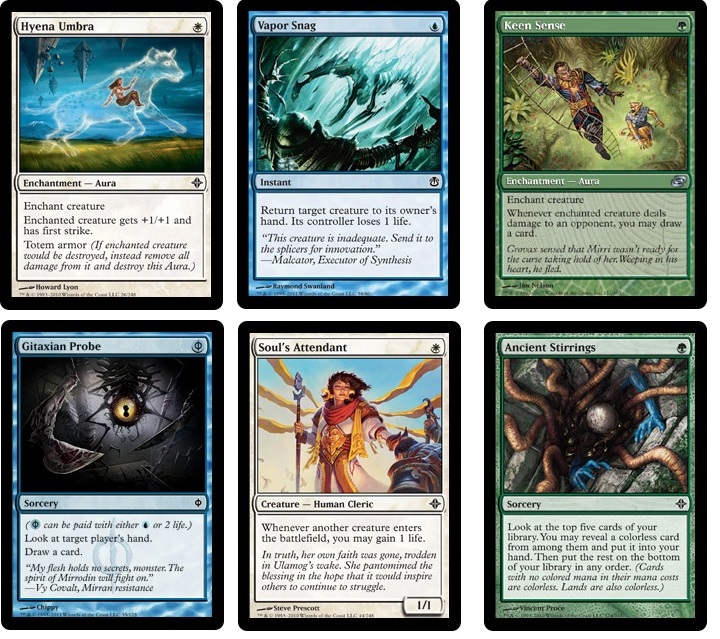
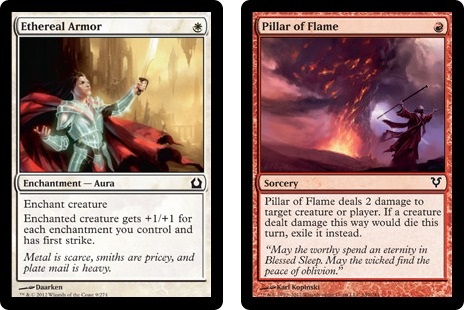
  1. The biggest winners here are the spells belonging to Bogles, including but not limited to [card]Daybreak Coronet[/card], [card]Ethereal Armor[/card], and [card]Rancor[/card].
  2. A few surprising cards: [card]Grafdigger’s Cage[/card] is now one of the top 10 most-played cards in Modern and 22nd on the Legacy list. [card]Sleight of Hand[/card] saw a surprising amount of play due to Storm, [card]Ad Nauseam[/card], and variations of [card]Splinter Twin[/card] and UR Delver. Theros cards [card]Swan Song[/card] and [card]Anger of the Gods[/card] also made appearances here.
  3. Affinity seem to have underformed once again, with [card]Mox Opal[/card] taking a nose dive in its ranking. The number of [card]Electrolyze[/card] also took a beating due to its weakness against Zoo.
  4. [card]Batterskull[/card] makes its first Modern appearance here. I would expect it to be more prevalent in the future, as lifelink on a 4/4 vigilant body is very relevant in Modern, even if it can’t be cheated out like in Legacy.

Lastly, here are the top 50 most-played lands:

Top 50 Most-Played Lands

Rank (PT) Rank (MTGO) Deviation Card Name # Dominance

1

2

1

MistyRainforest

207

46.62%

2

3

1

ScaldingTarn

197

44.37%

3

1

-2

Island

183

41.22%

4

7

3

VerdantCatacombs

177

39.86%

5

8

3

AridMesa

133

29.95%

6

5

-1

SteamVents

97

21.85%

7

6

-1

Forest

91

20.50%

8

4

-4

Mountain

82

18.47%

9

15

6

RazorvergeThicket

71

15.99%

10

12

2

TempleGarden

71

15.99%

11

11

0

StompingGround

63

14.19%

12

30

18

BlackcleaveCliffs

60

13.51%

13

22

9

OvergrownTomb

52

11.71%

14

27

13

SacredFoundry

50

11.26%

15

23

8

MarshFlats

49

11.04%

16

14

-2

CelestialColonnade

47

10.59%

17

13

-4

SulfurFalls

47

10.59%

18

28

10

HorizonCanopy

43

9.68%

19

16

-3

Swamp

43

9.68%

20

10

-10

TectonicEdge

42

9.46%

21

9

-12

Plains

37

8.33%

22

31

9

BloodCrypt

35

7.88%

23

21

-2

HallowedFountain

35

7.88%

24

20

-4

GavonyTownship

33

7.43%

25

42

17

GroveoftheBurnwillows

29

6.53%

26

17

-9

InkmothNexus

28

6.31%

27

18

-9

DarksteelCitadel

23

5.18%

28

36

8

GodlessShrine

23

5.18%

29

41

12

ShivanReef

22

4.95%

30

19

-11

BlinkmothNexus

20

4.50%

31

26

-5

Mutavault

20

4.50%

32

24

-8

Glimmervoid

18

4.05%

33

50

17

RagingRavine

18

4.05%

34

50

16

DryadArbor

17

3.83%

35

29

-6

BreedingPool

16

3.60%

36

35

-1

Valakut,theMoltenPinnacle

14

3.15%

37

25

-12

GhostQuarter

13

2.93%

38

45

7

TreetopVillage

13

2.93%

39

44

5

WoodlandCemetery

13

2.93%

40

50

10

TwilightMire

12

2.70%

41

33

-8

Urza’sMine

12

2.70%

42

32

-10

Urza’sPowerPlant

12

2.70%

43

34

-9

Urza’sTower

12

2.70%

44

50

6

CopperlineGorge

11

2.48%

45

38

-7

DarkslickShores

10

2.25%

46

50

4

CityofBrass

8

1.80%

47

37

-10

CreepingTarPit

8

1.80%

48

39

-9

GemstoneMine

8

1.80%

49

49

0

RiverofTears

8

1.80%

50

43

-7

SecludedGlen

8

1.80%

  1. Living End takes the spotlight here with [card]Dryad Arbor[/card], [card]Blackcleave Cliffs[/card], and [card]Blood Crypt[/card]. The surprising card here is [card]Raging Ravine[/card], which dropped out of the meta on MTGO but made an appearance here because of [card]Courser of Kruphix[/card] Jund.
  2. [card]Island[/card] is played more than twice as much as the next basic land, [card]Forest[/card]. Unsurprisingly, [card]Arid Mesa[/card] makes a jump here, but it is still far behind [card]Verdant Catacombs[/card].
  3. [card]Razorverge Thicket[/card] is ahead of [card]Blackcleave Cliffs[/card] now that Jund is less good, but if there’s anything that the Pro Tour tells us, it’s that Jund and BGx will still be top-level contenders.

The Decks

Let’s take a look at how the cards being played translated into the winning decks.

Day 1 to Day 2 Field

Archetype Day One %Field Day Two %Field %Change
Affinity

22

6.18%

12

5.24%

-15.20%

Amulet

5

1.40%

4

1.75%

24.37%

Blue Moon

8

2.25%

7

3.06%

36.03%

Bogle

24

6.74%

18

7.86%

16.59%

Burn

15

4.21%

6

2.62%

-37.82%

Faerie

6

1.69%

3

1.31%

-22.27%

Infect

7

1.97%

6

2.62%

33.25%

Jund

27

7.58%

10

4.37%

-42.42%

Kiki Pod

10

2.81%

7

3.06%

8.82%

Living End

14

3.93%

12

5.24%

33.25%

Melira Pod

33

9.27%

21

9.17%

-1.07%

Merfolk

8

2.25%

7

3.06%

36.03%

Scapeshift

14

3.93%

13

5.68%

44.35%

Storm

12

3.37%

9

3.93%

16.59%

Tron

8

2.25%

5

2.18%

-2.84%

Twin

45

12.64%

23

10.04%

-20.54%

UW Control

5

1.40%

3

1.31%

-6.72%

UWR

29

8.15%

19

8.30%

1.85%

Zoo

64

17.98%

44

19.21%

6.88%

Other

30

8.43%

22

9.61%

14.00%

Total

356

100.00%

229

100.00%

0.00%

From day one to day two, the decks that did well against the field are Blue Moon, Living End, Merfolk, and Scapeshift. Let’s dig further.

 Day 2 to 18+ Field

Archetype 18+ Points % Field %Change
Affinity

5

4.50%

-5.78%

Amulet

1

0.90%

-43.47%

Blue Moon

2

1.80%

-35.39%

Bogle

9

8.11%

13.06%

Burn

4

3.60%

50.75%

Faerie

2

1.80%

50.75%

Infect

2

1.80%

-24.62%

Jund

5

4.50%

13.06%

Kiki Pod

1

0.90%

-67.70%

Living End

7

6.31%

31.91%

Melira Pod

12

10.81%

29.21%

Merfolk

3

2.70%

-3.09%

Scapeshift

4

3.60%

-30.42%

Storm

7

6.31%

75.88%

Tron

2

1.80%

-9.55%

Twin

15

13.51%

47.47%

UW Control

1

0.90%

-24.62%

UWR

8

7.21%

-4.79%

Zoo

12

10.81%

-38.33%

Other

9

8.11%

-7.49%

Total

111

100.00%

0.00%

By the time we see the 18+-point decks, those with six or more wins in the Modern portion, the field dramatically shifts. Storm, Burn, Faeries, and Twin pull ahead as the clear winners.

 Day 2 to 20+ Field

Archetype 20+ Points % Field %Change
Affinity

4

6.56%

37.16%

Amulet

0

0.00%

-100.00%

Blue Moon

2

3.28%

17.56%

Bogle

5

8.20%

14.30%

Burn

2

3.28%

37.16%

Faerie

1

1.64%

37.16%

Infect

0

0.00%

-100.00%

Jund

2

3.28%

-17.70%

Kiki Pod

1

1.64%

-41.22%

Living End

2

3.28%

-31.42%

Melira Pod

3

4.92%

-41.22%

Merfolk

1

1.64%

-41.22%

Scapeshift

1

1.64%

-68.35%

Storm

4

6.56%

82.88%

Tron

1

1.64%

-17.70%

Twin

10

16.39%

78.90%

UW Control

1

1.64%

37.16%

UWR

7

11.48%

51.60%

Zoo

8

13.11%

-25.19%

Other

6

9.84%

12.22%

Total

61

100.00%

0.00%

Going beyond that, Storm and Twin remain solid. It’s not until you get near top of the field that UWR begin to gain dominance over the field.

 Day 2 to 22+ Field

Archetype 22+ Points % Field %Change
Affinity

1

2.86%

-40.24%

Amulet

0

0.00%

-100.00%

Blue Moon

1

2.86%

2.45%

Bogle

3

8.57%

19.52%

Burn

2

5.71%

139.05%

Faerie

0

0.00%

-100.00%

Infect

0

0.00%

-100.00%

Jund

1

2.86%

-28.29%

Kiki Pod

1

2.86%

2.45%

Living End

1

2.86%

-40.24%

Melira Pod

3

8.57%

2.45%

Merfolk

1

2.86%

2.45%

Scapeshift

0

0.00%

-100.00%

Storm

3

8.57%

139.05%

Tron

0

0.00%

-100.00%

Twin

6

17.14%

87.08%

UW Control

0

0.00%

-100.00%

UWR

2

5.71%

-24.51%

Zoo

4

11.43%

-34.81%

Other

6

17.14%

95.58%

Total

35

100.00%

0.00%

Last but not least, at the 22+ point mark, Storm and Twin have both absolutely outperformed the field. Burn also makes an appearance here, as expected in a field without [card]Deathrite Shaman[/card] for incidental life gain.

At the very top levels, Affinity underperformed, as did Living End, partially due to the decks’ inconsistencies. I would expect future Affinity builds to be more of the burn variant played by Mary Jacobson at the Channel FireBall 5K.

Interestingly enough, at the top of the field, the section “Other” actually performed very well. The decks under the section that achieved 22+ points are: two Ad Nauseam, two BG Obliterator, one Gifts, and one Jund. BGx variants definitely have a say in the new meta, and if combo becomes more of a factor going forward, which seems likely given the strength of Splinter Twin and Storm, then BGx will establish a strong foothold in the new meta to keep all the combo and shenanigans in check. Faeries will likely fill a similar role, given that it’s strong against combo and control yet weak to aggro.

Ad Nauseam is a rogue deck that is largely not acknowledged on paper, but it’s definitely near or at tier one based on results on MTGO, where it has secured as many daily event spots as the likes of Jund and Scapeshift. The deck can go off at instant speed with [card]Pact of Negation[/card] backup, which a good number of decks just can’t interact with.

Speculation Corner

What’s the point of all the data if it doesn’t point us toward anything?

[card]Grafdigger’s Cage[/card] look to be a strong pickup despite being a sideboard-only card. You can pick it up for less than $2, and it’s already over $3 on MTGO. It’s in the top 10 most-played spells in Modern, which is absolutely insane for a sideboard card. The current spread is only 22%.

I would speculate on the Ad Nauseam deck. [card]Ad Nauseam[/card] is heavily targeted already and foil copies are mostly out of stock, so I wouldn’t touch those. [card]Lotus Bloom[/card] and [card]Angel’s Grace[/card] have both had reprints, but [card]Phyrexian Unlife[/card] is largely untouched. If someone were to speculate on the deck, I would start there.

As powerful as Storm is in the format, I wouldn’t speculate on it at the moment. Everyone points to it as the most powerful deck, ignoring the fact that the successful pilots of Storm, Jon Finkel, Kai Budde, Ari Lax, Tom Martell, and Andrew Shrout, among others, are some of the best at the game and playing the deck. It’s also a deck that’s easy to hate out with sideboard cards like [card]Rest in Peace[/card] or mainboard cards like [card]Thalia, Guardian of Thraben[/card]. The results are reflected at the Channel Fireball Modern 5K: despite the strong showings, Storm did not top eight at the event.

[card]Fulminator Mage[/card] is likely to see a reprint in FTV: Annihilation, but until then, the prices will continue to trend upward. It’s one of the top 10 most-played creatures in Modern, and its strength is backed by Jund, BGx, and Living End, all of which are decks that are still top dogs. I wouldn’t recommend buying into the card, but trading for it seems like a solid option.

[card]Vendilion Clique[/card] and [card]Liliana of the Veil[/card] seem underpriced right now. They both have low spreads, 23% and 26% respectively, and the opportunity to go up. Everyone wants to trade for them on Deckbox, but no one wants to trade them away. A buyout for [card]Vendilion Clique[/card] seem imminent. TCGplayer now has only 59 vendor listings despite the card having three different printings.

[card]Thrun, the Last Troll[/card], is also an option now that Zoo will be less of a factor going forward. Equip any sword to it and go to town! It’s a mythic from a small set, and it’s been at $16 before. The spread is only 18%. It’s rare to ever find spreads that low.

Do you see anything in all the data that I missed? What are your picks from the Pro Tour? Share your specs!

See below for the download links to the excel sheets.

PT Valencia (2014) – Most Played

PT Valencia (2014) – Standings

Going Bigger and Attacking the Format

After introducing my Naya Midrange deck, I promised to go over changes I felt were optimal and that is exactly what we are going to do today. First, we’ll explore what changes I made for a local grand prix trial for GP Richmond. Afterward, we’ll get to how we can go bigger and effectively dismantle the format with a deck of this style.

The main changes that came out of my previous experience are the addition of one maindeck [card]Ajani Vengeant[/card] at the cost of the third [card]Domri Rade[/card], as well as the addition of a second [card]Kitchen Finks[/card] in the sideboard in the place of the now-maindecked Ajani. You’ll also notice there are no more [card]Bonfire of the Damned[/card] in the board. The card was mostly just not good enough in any situation and has been replaced by two copies of [card]Rest in Peace[/card]. This card can be pretty suboptimal with some of our cards, like [card]Knight of the Reliquary[/card] and [card]Tarmogoyf[/card], so maybe it is also incorrect, but mise.  All of these changes were options I considered in the first place, but were ultimately made because I know that the expected metagame in my area is heavier on aggressive strategies than average. For reference, the list I played looked like this:

[deck title=Naya Midrange]
[Creatures]
*4 Noble Hierarch
*2 Birds of Paradise
*2 Qasali Pridemage
*2 Thalia, Guardian of Thraben
*3 Tarmogoyf
*3 Voice of Resurgence
*2 Scavenging Ooze
*1 Kitchen Finks
*4 Loxodon Smiter
*4 Knight of the Reliquary
*1 Thundermaw Hellkite
[/Creatures]
[Spells]
*4 Lightning Bolt
*3 Path to Exile
*2 Domri Rade
*1 Ajani Vengeant
[/Spells]
[Land]
*3 Forest
*1 Plains
*4 Arid Mesa
*4 Verdant Catacombs
*2 Misty Rainforest
*2 Temple Garden
*2 Stomping Ground
*1 Sacred Foundry
*1 Kessig Wolf-Run
*1 Horizon Canopy
*1 Stirring Wildwood
[/Land]
[Sideboard]
*2 Choke
*1 Qasali Pridemage
*1 Ajani Vengeant
*2 Blood Moon
*2 Aven Mindcensor
*2 Linvala, Keeper of Silence
*2 Stony Silence
*1 Kitchen Finks
*2 Rest in Peace
[/Sideboard]
[/deck]

I played against Jund in every round except one, where I played against UWR Flash.  Being that most of games were wars of attrition, I began to notice one huge problem: card advantage. Who actually needs to draw cards? We do. We don’t need the velocity that blue decks do, but we do need to keep up. Unfortunately, [card]Abrupt Decay[/card] was out In full force, as I expected. It becomes obvious that the easiest ways to improve on the strategy we already have is to implement some more card advantage and threat diversity. Diversifying our threats can be tricky when we have to accommodate our [card]Domri Rade[/card]s, but it doesn’t need to be.

Going Bigger

A popular term that people use when describing a powerful game plan is to “go big” or to go “over the top.” This is a tried and true strategy that we can implement to make up for our lack of card advantage spells. If our cards are more powerful, we don’t need as many of them. We need to capitalize on our advantages in order to be successful. This is absolutely imperative, and this is a list that might do this effectively.

[deck title=Naya Midrange]
[Creatures]
*4 Noble Hierarch
*3 Birds of Paradise
*2 Qasali Pridemage
*2 Voice of Resurgence
*2 Scavenging Ooze
*2 Kitchen Finks
*4 Loxodon Smiter
*3 Knight of the Reliquary
*3 Restoration Angel
*2 Thundermaw Hellkite
[/Creatures]
[Spells]
*4 Lightning Bolt
*3 Path to Exile
*2 Domri Rade
*1 Ajani Vengeant
[/Spells]
[Land]
*3 Forest
*1 Plains
*4 Arid Mesa
*4 Verdant Catacombs
*2 Misty Rainforest
*2 Temple Garden
*2 Stomping Ground
*2 Sacred Foundry
*1 Kessig Wolf-Run
*1 Horizon Canopy
*1 Stirring Wildwood
[/Land]
[Sideboard]
*2 Choke
*1 Qasali Pridemage
*1 Ajani Vengeant
*2 Blood Moon
*2 Voice of Resurgence
*2 Linvala, Keeper of Silence
*2 Stony Silence
*2 Thalia, Guardian of Thraben
*1 Rule of Law
[/Sideboard]
[/deck]

I like this list. I like it a lot. At my heart, I am a midrange player who has a secret love affair with Valakut. [card]Restoration Angel[/card] might seem slightly out of place, but it can be a huge tempo boost against [card]Abrupt Decay[/card] and other spot removal. When you are playing such large threats, that tempo boost can put the game away rather quickly.

Previously, I could only justify a single [card]Thundermaw Hellkite[/card], but adding another [card]Birds of Paradise[/card] and another [card]Sacred Foundry[/card] lets us play another. I always want to draw it and the game-breaking effect it has is found nearly nowhere else in the format. I won’t turn this article in to a “why Thundermaw Hellkite is good” piece, since I believe Patrick Chapin already covered that before M13 was even released. The most important part of “Deathwing” (for all you WoW people) that isn’t the obvious 1/1 spirit (or faerie!) token disintegration, but the fact that it taps other flying creatures that don’t die. This lets all of our other creatures attack in most cases. I think this is the direction we want to move first.

Attacking the Format

Earlier I said that I leaned toward some life gain and defense in order to more easily combat aggressive strategies. I feel this was the correct choice, but I didn’t end up facing any of those decks. It is possible that I was wrong, but it is hard to know for sure. This new list solves some of our [card]Abrupt Decay[/card] problem, giving us more dangerous threats and allowing our opponents less time to react. The more resilient build should have success where the smaller build failed.

The larger threats in this new bulid may also require two-card answers or other suboptimals play from our opponents, which is what we want. Staying on the offensive and keeping your opponent on his heels is important, but knowing when to hold back and play defense is just the same. Another small tweak that I think would help us against the field in general is the fourth [card]Path to Exile[/card]. I feel like I always want it, but if we do add it, what to cut is controversial. Cutting a creature puts more pressure on Domri and our threat density, while cutting a spell is difficult since they all seem necessary. [card]Lightning Bolt[/card] is in an odd spot, since it kills all the things we generally don’t care about because of their small size. This is, of course, with the exceptions of [card]Pestermite[/card] and [card]Dark Confidant[/card].

Sideboarding

The sideboard is still strong against the format. This is how I generally board unless I see something spicy or plan on next-leveling somehow:

2 [card]Choke[/card]: Any time you see [card]Steam Vents[/card] or [card]Hallowed Fountain[/card], you probably want this. For best results, cast when your opponent is tapped out. Bring in against: Twin, UW(r) Flash, Delver.

1 [card]Qasali Pridemage[/card]: Versatile card that serves as a strong coverall and does well against [card]Birthing Pod[/card] and [card]Spreading Seas[/card]. We have two maindeck copies for a reason.  Exalted is also not irrelevant.

1 [card]Ajani Vengeant[/card]: This could be mainboard in some iterations. Add this against control, Jund, or any non-combo deck. I often cut a Pridemage for this.

2 [card]Blood Moon[/card]: I like this against UWR Control or Flash, as well as the UWR Twin variant. It’s straightforward and exists in the main of a breakout deck from Pro Tour Born of the Gods. Prepare to next level in game three, since opponents play around it if you do show it during game two. Do not forget that Tron is still hiding in the field.

2 [card]Voice of Resurgence[/card]: Straightforward protection that helps our lack of permission and disruption. Bring in against Control, Flash, anyone who is trying to play on your turn. Make them suffer for their insolence.

2 [card]Linvala, Keeper of Silence[/card]: Protection from [card]Kiki-Jiki, Mirror Breaker[/card], [card]Viscera Seer[/card], [card]Grim Lavamancer[/card], [card]Spellskite[/card], and anything else you see like this. Remember to board against  opponent’s cards, not decks. Board this in with your best judgment. I believe in you.

2 [card]Stony Silence[/card]: This is our silver bullet for Affinity. It’s also useful against Pod. Linvala may come in with this. Don’t forget it makes swords seem pretty dull (get it?).

2 [card]Thalia, Guardian of Thraben[/card]:  This card is cringeworthy for your Storm and control opponents. It’s a pet card of mine. Feel free to replace these with your own pet card, or indulge me and play them yourself. I promise they are good. HINT: Cut noncreatures for these, since you often also want [card]Choke[/card] in the same matchups.

1 [card]Rule of Law[/card]: This slot could be anything, but this card felt right as extra protection from combo. We probably want a, “Destroy target [card]Liliana of the Veil[/card]” card most.

Until Next Time

I hope this was a helpful insight into Modern, and I also hope to have more success than I did with the previous build. I’d like to write all about a big win soon! Please make any suggestions or ask questions in the comments or on Twitter, @InkwellLevitan. Until next time, where we’ll change it up again.

Praise Helix

JL

Getting L.U.C.K.y: Leaving Money On The Table

Recently I was conversing with a friend of mine on Standard. My opinion on Standard used to be: absolutely not. I couldn’t imagine spending $500 on something that was going to rotate out in a year. My argument was that Standard changes too much to try to keep up. On the other hand, Legacy seemed like a way better investment. Sure it was $2,000 or $3,000, but it only required one initial investment. Over a period of time, though, I’ve discovered that through smart trading, I can almost make Standard pay for itself.

My friend was telling me that he didn’t have the money to do it. I started to ask about his bulk and it turns out there’s quite a bit of it. If there is one thing that I can do, it’s grind value out of some bulk. He knows that I do this and quickly put in that he wasn’t about to spend hours finding five and ten cent cards just to pay for his Standard deck. Like many of us, he had the means, he just didn’t want to work hard enough.

I know it’s been said before that five cent cards aren’t worth pulling out, they are just a time and money waster. It costs way too much to ship them. I agree with this. Who says we have to ship them though? Why not just unload them at an event or to a local store? I do this through a process that I have been told is called “ogreing.” Ryan Bushard wrote a great article about it, so check it out. This saves both time and money.

How do I do it efficiently? Personally I use Trader Tools. It costs money, but for me, it more than pays for itself. Most people look up each card individually, which is a time waster. Don’t most of the collections that we get, including our own, stem from only a few blocks? The reason I love Trader Tools so much is I can pull up the set of Lorwyn, for example, as a whole and see what commons and uncommons are worth pulling.

Now all I have to do is to figure out which sets I have and ta-da, I know what to pull from each. If I have a ton of Eventide and Lorwyn, all I do is write down or print off the names of the cards I need to pull and I can quickly and efficiently ogre out my collection. If it is more than a couple of blocks, this isn’t nearly as efficient, but most of the time, it’s just fine.

What if I’m not going to an event in the near future? Number one, go to an event. Just do it. If that isn’t an option, though, find a local dealer. You can ask Carter Hatfield how many Tuesdays I have brought him 1,000 count boxes stuffed with low dollar stuff for him to look through. These guys are around just about every populace. If you don’t know any, look on Craigslist for MTG and someone will have a post that reads, “Looking to buy all Magic: The Gathering Cards” or “Paying top dollar for Magic cards.” Hit them up.

Talk to your LGS (Local Game Store). I talk to a few in the area that don’t even have a buylist. Some of the time they look through and want nothing unless they are paying bulk. That’s okay, just hold the small stuff until your next event. You’d be surprised at how often they have just taken the whole box off of me, though. It doesn’t cost anything to ask the owner and you’re going to be there anyway.

Be willing to put in the work. For some people, dealing with larger quantities of ten-cent cards might not be worth it. For some of us, though, they are. I will say that it takes a lot of work to get “L.U.C.K.y,” but unless you happen to have fifty grand just laying around waiting to be invested into the cardboard industry, it’s going to take some work.

Sure you may have put five hours in only to make twenty bucks, but you can turn that twenty into forty, forty into eighty, and slowly, painfully, get there. But you can get there. What were you doing with that time anyway? Some people spend it with family and it robs that time, I know. But many are just watching whatever is on TV, or trolling on Facebook, or something else irrelevant. When you are reading memes, you are making exactly zero dollarswhy not make five bucks instead? Is Peter Dinklage any less witty when you have cards in your hand?

I realize that we all need down time. I’m not saying don’t spend time with the family. I’m not saying we can all be sorting machines anytime we aren’t at work. What I am saying is that money’s there for anyone willing to grind. If you are willing to grind, you too can get “L.U.C.K.y.”

Question: How little value is too low for you to grind? At what point do you just consider it a waste of time?

Weekend of February 28-March 2 Review

You see, I’m a bit of a cynic.   While many if not most players believe that Wizards has been looking for the proverbial, “Sweet Spot,” with the banning and un-banning process in Modern, I believe that what is and will continue to actually happen is that Wizards will ban and un-ban cards as they see fit in order to keep the format fresh. Why, you ask? You see whenever a format is “solved” players begin to lose interest.  Wizards becomes pressured to print newer, more powerful cards, in order to maintain players’ interest. They then have to introduce these new cards, with the power level to change the face of Modern, through Standard. This is not an ideal world for Wizards because not every new set can contain the next [card]Deathrite Shaman[/card] or Standard becomes incredibly one-dimensional, and “solved” infinitely quicker. So how does Wizards accomplish keeping Modern exciting for the foreseeable future without being forced to inject new cards into the Modern format through Standard?
Faithless lootThey ban the crap out of the current most powerful thing, or unban something, or just ban island and see what happens for the season and then un-ban it for the next. You see, as long as Wizards keeps Modern fresh, they can continue to sell you more premium product, (think Modern Masters), which they can continue to print, because unlike Vinatge, Modern has no restricted list. With this model, Modern can continue to be a revenue generator for Wizards, and players will feel safer with their larger investment on their decks because Wizards can chose to ban or un-ban cards at a pace so that players don’t lose confidence in their investment, but still nuke enough decks per season that the format still generates a sizable revenue for Wizards of the Coast. I live in this cynical world and my mindset toward cards whose value is largely propped up by the Modern format is that they are and will continue to be the most financially-volatile assets in your collection. Treat them as such.

While Modern cards have been volatile in anticipation of Modern season, a number of cards that have already returned to earth([card]Bitterblossom[/card]) as the Modern format has started to shake out again following last weekend’s Pro Tour.  While many speculators continue to try and capitalize on the Modern format, perhaps the safer, if not better money can be found elsewhere.  There are undoubtedly fortunes to be made on the price volatility of cards played heavily in the format; however, as a speculator, Modern can be a rather risky endeavor.  Wizards can and will reprint any card on a whim.  I think many were somewhat blindsided by Wizard’s willingness to throw [card]Remand[/card] into a Duel deck.  But Wizard’s ability to reprint Modern staples will inevitably be a double-edged sword.  After all, this is one of the underlying rationales that Modern players will point to when supporting the long term viability of the format.  Meanwhile, holding on to original dual lands continues to be a lucrative, and more importantly, safer long-term choice.  As a speculator, it is important to remember these aspects of card values when trading.

Standard

SCG Open Atlanta Decklists

Grand Prix Melbourne 2014 Decklists

And Mono-Black devotion wins again.   Seriously?  This week Mono-black devotion managed to win both of the major events of the week.  What is of note is that both decklists have shifted what removal they are utilizing, both trimming copies of [card]Bile Blight[/card].  People over-hyped the versatility of this card as a removal option and the meta-game has also shifted.  The increasing popularity and winning ways of Red/Green and Jund strategies typically have four targets for [card]Bile Blight[/card] in [card]Elvish Mystic[/card] and that’s about it.  What is bothersome, is that in order to put its foot back on the format’s throat, all Mono-black had to do was change its removal suite.

The moment I saw Naya Hexproof pop up on stream this weekend I knew I had to mention it in my article.  Sporting quite the greedy mana base, this deck capitalizes on some of the tools that the past iteration of Hexproof decks ran.  Maybe it’s just a flash-in-the-pan, but this deck seems pretty explosive. I wish there were more to say from a financial standpoint, but outside of perhaps [card]Mizzium Mortars[/card] its hard to be bullish on any particular card in the deck.  The life gain that this deck is capable of gives it a lot of game against another strategy that I think might be poised for a resurgence.

Mono-Red managed a Top 8 at the Open this weekend.  I think that this type of strategy is due to spike a tournament simply due to the existence of [card]Burning Earth[/card] while it is counter-intuitive to be talking about this card while so many Mono-X devotion decks are running around, but with the prevalence of [card]Mutavault[/card] and scry lands, every other match-up seems to get infinitely better with this card coming in from the board.  Even Blue White control strategies are running extra scry lands in place of basic lands for the extra utility.  Red Green monsters has added black for [card]Rakdos’s Return[/card], which is coincidentally not a bad acquisition right now, either.

Legacy

SCG Atlanta Legacy Open

Inkmoth imageTom Ross has been fine tuning his Infect list for Legacy for a little while now, and even wrote about it here.  I really like this list from a financial aspect because [card]Inkmoth Nexus[/card] hasn’t made any drastic financial gains lately.  This new decklist may push the card to the front of people’s minds.

Another card that shows up in the Tom Ross list this week was [card]Mutagenic Growth[/card]  I think we’re reaching the end of the timeframe where, [card]Mutagenic Growth[/card], [card]Gitaxian Probe[/card], [card]Dismember[/card], can be swooped up by the arm load for virtually nothing.  Target foil copies and FNM promos in trades.  You can probably still get non-foil copies as throw-ins.

BBD ran a pretty sweet UWR Miracles list.  Unfortunately almost every card in the deck is already priced according to the high levels of play seen in similar decks.  Two cards in the list that I would target in trades would be [card]Terminus[/card] and [card]Sword of the Meek[/card].  Yes the latter is an uncommon, but it has only been printed once, in Future Sight. the combo with [card]Thopter foundry[/card] is just cute enough to drive players of all types to seek this card out giving you an [card]opportunity[/card] to trade up in value.

Despite my cynical mindset toward Wizards swinging their “ban-hammer” around.  If I am right, then a few things should follow.  Modern should remain a healthy and fresh format for years to come; by doing so will generate Wizards an additional revenue stream as they provide product to the Modern player base, this also allows for the Modern player base to grow, which means that Modern will be yet another reason why Magic the Gathering will continue on a path of success for the foreseeable future.

All Magic Has a Price #5 – Is It Time to Get Out?

True Cost:
The lowest amount of real cash needed to acquire a card.

All Magic Has a Price


Gravestorm
J. Graves
Tampa, FL

faceLogo

Let me know your thoughts at [email protected]
Follow @jwgravesFL


About AMHaP

All Magic Has a Price focuses on Magic: The Gathering finance from the player’s point of view. AMHaP discusses the true cost of playing Magic: The Gathering by reviewing strategies to acquire a playable collection of cards for Standard as a returning player, a new player, or a continuing player, and by discussing potential investment opportunities in older formats. AMHaP targets those of us that play casually and competitively on a local level, and AMHaP is written for casually-competitive players by a casually-competitive player. If one would like further explanation of the viewpoint and scope, please read: All Magic Has a Price Issue #1.

If you would like more information on determining true-cost value, please read: All Magic Has a Price Issue #3 – Accounting for MTG.

Visit my eBay Auctions.


Is It Time to Get Out?

I have divorced my third wife. I know, I knowI think my picker is broken. It is tax season, and I am working at least 50 hours a week. I have two intensive writing classes and I have this article. What little extra time I have will be devoted to getting out and to meeting people. Logo

MTG has taken a back seat to other needs, but I enjoy this game very much. I continue to read articles on brainstormbrewery.com and gatheringmagic.com, to study the top decks on tcgplayer.com, and to play the occasional game online or with a friend.

Knowing I would no longer be playing competitively, I began to wonder if I should get out of Standard. When is the best time to get out of Standard to retain the most true-cost value? The answer: a month ago.


What does one do until rotation?

That answer is simple: Limited. Draft is [arguably] the most fun, competitive, and compelling format of Magic: The Gathering. Sitting around the table and passing packs makes for a truly fun evening. Talking smack as one builds his or her deck and laughing at folks for passing a shock land is fantastic. In a past article, Limited Finances, I calculated the numbers and showed that Draft is an ideal method of receiving additional true-cost value while playing this beloved game. On a recent episode of Brainstorm Brewery, Marcel said he was going to focus on Modern and Legacy. As someone looking to sell out of Standard, Modern may be worth looking into.


Why Now?

Looking at the price-history curve on MTGprice.com, focusing on cards from Innistrad block and Magic 2013 before rotation, assisted in determining the answer to that question.

MTGprice.com allows one to see the historical pricing of Magic: The Gathering cards for up to two years. Several options for prices exist on MTGprice. However, knowing the true-cost system, one can imagine eBay pricing is preferred. The prices from Channel Fireball may help to smooth out times when the eBay prices are erratic. Mining data is not easy, and it is not concise.

The obvious start to a conversation about Return to Ravnica Standard is [card]Thragtusk[/card].

Logo

Bought

On December 2, 2012, I purchased Thragtusk x4 for $75.02 or 18.80 per card.


Sold

Logo

I bought the pieces for Bant Control, and the deck was almost immediately no longer tier-one. The Thragtusks were sold on February 28, 2013, for $46.99 plus 1.75 shipping (I offer free shipping now), equaling $48.74, or $12.18 per card. With PayPal fees, $47.02 was left. After eBay fees of 9%, I was left with a total of $42.79. Shipping was $0.66, lowering the final total to $42.13, or $10.53 per card.

Because eBay is the best way to unload cards (see All Magic Has a Price Issue #3 – Accounting for MtG), the eBay and PayPal fees become less relevant to the current conversation. In all situations, one would prefer to trade the cards for cards that will maintain true-cost value. Unfortunately, time to trade is not available, so eBay was utilized.

Logo


mtgprice.com

The first thing one might notice is the almost exact prices on the mtgprice.com chart. Looking at the chart for December 2, 2012, [card]Thragtusk[/card]s were selling at roughly $17 to $19, and looking at the chart at approximately February 2, 2013, they were selling at roughly $10 to $12. This verifies the accuracy of mtgprice.com. MTGgoldfish.com had similar results.

Using the full cost method, 44% true-cost value was lost in the [card]Thragtusk[/card] experiment. Between August 2013 and October 2013, [card]Thragtusk[/card]s would have only sold for $3 to $5 per card, raising the losses to 74% to 85%.


The Other Cards

Magic 2013. Viewing most of the currently top-selling cards from M13, the Thragtusk curve was obvious. From [card]Thundermaw Hellkite[/card] to [card]Sublime Archangel[/card], each of the cards in M13 had the same curve as Thragtusk.

Innistrad. In Innistrad, several cards break this curve. [card]Lilliana of the Veil[/card] began a steep rise in October of 2013, and has since continued her incline. [card]Snapcaster Mage[/card] has held value and is likely to see further play in Modern and Legacy. [card]Geist of Saint Taft[/card] saw the same decease as the M13 cards, but due to its recent Modern activity, Geist has begun to rise again. Other than these three cards, the rest of Innistrad follows the Thragtusk curve.

Dark Ascension. [card]Huntmaster of the Fells[/card], along with all other Dark Ascension cards, followed the Thragtusk curve.

Avacyn Restored. From Avacyn Restored, [card]Griselbrand[/card] and [card]Avacyn, Angel of Hope[/card] are increasing in value currently, but had very little-true cost value during their time in Standard. [card]Cavern of Souls[/card] did follow the Thragtusk curve, but is currently realizing a slight uptick. [card]Cavern of Souls[/card] was a pick by Jason on a recent episode of Brainstorm Brewery. CoS is an awesome pickup. Beginning with [card]Tamiyo, the Moon Sage[/card], the Thragtusk curve reappears.


Conclusion

Join Marcel and trade Return to Ravnica block and M14 cards for Modern, Legacy, or future Standard cards. Play Limited. With there being a total of six cards from M13, Innistrad, Dark Ascension, and Avacyn Restored that gained or maintained true-cost value after January of 2013,  this analyst has determined that the time to sell the cards rotating from Standard in October 2014 is: a month ago.

Visit my eBay Auctions.


$#%^&^%, I’m In.

The great Jason of the Brainstorm Brewery Podcast has bestowed, pun intended, a nickname upon me.

I AM GRAVESTORM!

I have enjoyed my time writing for www.brainstormbrewery.com, and I hope to continue the success I have found to date. I appreciate each and every one of the readers for taking time out of the day to read the amazing articles on www.brainstormbrewery.com. It is humbling and appreciated.


Mailbag #4

@CalebGothberg (check out Caleb’s – Getting L.U.C.K.Y. on www.brainstormbrewery.com) tweeted his appreciation for drafts.in. I am glad I was able to help you prepare for the prerelease, Caleb. Let us know how you did.

Logo

@sushihipster and I had a great discussion about Born of the Gods prerelease targets. Although I need to read the cards better, he and I did determine the targets would be [card]Spirit of the Labyrinth[/card] and [card]Brimaz, King of Oreskos[/card]. I still believe those are the only two cards worth targeting from the set. Born of the Gods does offer a nice selection of $3 to $7 playable rares that may be worth picking up in a month.

Once again, Nick pulls through, leaving a fantastic comment. Nick reminded me to talk about the Judge Joe Bono Limited Resources podcast. The Judge Joe Bono Rules podcast is usually the week before the set review. Listening to this podcast is very important to a successful prerelease weekend. Because I listened to this podcast before the Dragon’s Maze prerelease, I knew the rule surrounding [card]Runner’s Bane[/card]. I corrected a judge’s decision at the prerelease. He was appreciative, of course.

Thanks for the feedback guys.


Mailbag #5

Theros has been out for a while now, and prices have begun to stabilize. Now is the time to be picking up playable cards from Theros that can be sold or traded next January.

Logo
[card]Hero’s Downfall[/card] will be played in Standard after rotation in October. At its highest price, Hero’s Downfall was selling at 13 dollars. Currently, they are selling for five to six dollars. Hero’s Downfall is a great pick up right now.

What cards from Theros are you targeting right now?

Please guys, I need more feedback. I want to learn stuff, too. In a past article, I discussed how my mother would be a mad bro if I was not a success. Without your help this week, my mother is going to be one seriously mad and disappointed bro.

Email me [email protected]. Follow me on the Twitter machine @jwgravesFL and then tweet at me. If you would like to leave a comment on this article, all you need is a name and an email address. Love me, hate me…let me know!

The Puzzle Box – Larger Inside than Out: Infinity Drafting

“Are you a restrictions-breeds-creativity kind of guy?”

This is the question that our dear community manager, Jason Alt, asked me when I was wondering about what he wanted for the site. The answer was yes, but actually I had no idea how strongly that answer applies. I know that there are people who live outside of restriction and can create, but honestly, I have no idea what that would look like. I am currently working on a post for my blog that discusses this topic exactly, except the whole thing is on it, rather than just a brief intro. The long and short of it: it is larger inside the box, than the box is large. Some smarter people than me quoted this very publicly, so I am going to try and get a little mileage out of it.

“Thanks for the nonsense bro, but what does this have to do with Cube?”

It has everything to do with Cube.

Today we are going to discuss how the idea of “restrictions breed creativity” affects how we use our cube. As I said in User’s Manual, chances are pretty good that you may not have very many people to cube with. I know that this is the case for me much of the time. And if you are anything else like me, which WotC’s data is going to presume you are, you may only have one or two people that can get together to play Magic on a regular basis outside of FNMs.

I have a confession to make. The majority of my cube drafting has been done with only one other person. Does that intro to this article make sense yet? My friend and I were getting a little tired of the disjointed decks that are created by conventional two-man Draft formats such as Winchester and Winston. I will do an article on these draft formats in the future, but I’d rather start with a format that gets your hands on your cube and lets you learn it really well, even with only two people. This goes double for the Puzzle Box, because it is much smaller than the average cube.

5202298324_ba788921c6_m

Infinity Drafting

The main points of this format are to make a lot of decisions, do a lot of drafting, build two decks per person, play for a long time, and create a metagame within the match.

It’s called the Infinity Draft because of the shape the packs trace when passing them from person to person. Now that I have got at least 50 of these drafts under my belt, it is also reflective of the infinite amount of time it takes to start and finish the draft. I love it!

Drafting Method

Each person starts with six fifteen-card boosters, three on the left and three on the right.

Each person picks up the first pack to their right and makes their first pick, this card goes into their Deck 1. Then the same on their left pack, this card goes into Deck 2. Each pick made on your right hand side goes into Deck 1, and each on the left goes into Deck 2.

draft_lens20101645module163903681photo_1355166118_

The first passing of the packs is called a “pass.” This means that the pack to your right goes directly across the table to what would be your opponents left. And same goes for your left pack.

pass

You then make your picks in the same order of right pack to left.

The second passing of the packs is called the “switch.” This is the part that makes sure that the packs actually rotate so each deck sees each pack in the correct order. How this works: your right pack goes diagonally across the table to what would be your opponent’s right, and the opposite goes for the left pack. Each person then makes their pick.

switch

After your next pick, the next pass is the “pass,” the one after that is the “switch,” and so on…

It is very very easy to forget if your last pass was a pass or a switch. We used to use a copy of switcheroo to keep track of which one we were on, but it just got forgotten about and created more confusion. A foolproof way of keeping track of it is simply to count your cards. If you have an odd number of cards, your next move is to pass. If you have an even number of cards, your next move is to switch. Simple as that!

While you’re drafting, just have one person fan their cards out so they can make a quick count. You’ll do this often, I promise.  For each new pack, set aside the previously drafted cards and have the person counting start a new fan. This seems an odd detail to dwell on, but mixing up orders of packs has been bad news. Rinse and repeat until you’ve drafted all the packs. Then, of course, you build your decks.

The Mini Meta

So now that each person has two decks, you have to decide which deck to play. Here is where the protection from drafting one super deck and using the other as a hate draft pile comes in. At a minimum, you should be playing best three of five, but the format is even better if you have time for best four of seven.

Note: Deck selection and usage rules are confusing at first. They become obvious after you’ve played the format a couple times. They are are very important.

Each person can choose to play either deck for the first game, or you can determine randomly. If you choose your deck, you must switch decks for game two. After game two, you can use whichever deck you choose. If you had your deck randomly decided, you may choose to continue playing that deck in game two, or you may switch to the other one if you want.

The balancing act of the meta works out as such: after two losses, the person who has lost twice may then choose which deck his or her opponent will play in the next game. He or she does not, however, get to know any extra information about the opponent’s decks than is already known.

Example: If the match goes 0-2, the person with two losses chooses his opponent’s next deck. If the 0-2 then wins, bringing it to game four, the same player may again choose his opponent’s deck. If it goes to game five, the player that just lost his second game most recently gets to pick his opponent’s deck. Keep in mind that it just has to be two losses, not two losses in a row. So if one person goes to 1-2, he then gets to pick the other person’s deck.

Here is where we often decide that we want to go best four of seven. This is usually because we just want to keep playing within a match atmosphere and there’s not enough time for another draft.

Good Times

I cannot tell you how much fun I have had playing this format! You get to touch twelve packs each time you cube. The decks end up being very cohesive, so you really get to see which archetypes are good in your cube and which ones need work. When you move from this to drafting in a normal fashion, the choices become much easier, because you only have to think of one deck, not two. This format honestly feels like you are learning to cube draft at three times the speed of a normal draft because you are doing double the amount in the same amount of time.

There’s a lot of thinking going on in this article, but if you work your way through all of it, I promise it will pay off!

Thanks for hangin’, everyone.

Andrew

P.S. Only one puzzle box change this month to bring it from $207 to $199

$8 Goblin Guide ——> $.50 Reckless Waif

Brainstorm Brewery #89 – Brews and Ale

It’s a podcast mishmash as Houston Whitehead (@TNSGingerAle) from Tap ‘n’ Sac drops by to talk about scumbaggery, his article series on Brainstorm Brewery, and podcasting. How can you deal with a dealer who is severely underpricing cards in his or her case not knowing they went up? How do you make sure your trade partner doesn’t come down with a case of the feel-bads? In general, what kind of ethics should traders observe, and who even trades anymore?

Houston comes correct with Picks of the Week, the Magic Online prerelease shook things up, and there is even some crow to be eaten. Who is the second victim of the I-heard-this-from-a-judge, bad-information plague? What card did the Japanese bust wide open? What is “Financial 5” anyway? Find out the answer to all these and more on an episode of your favorite podcast that will have you asking, “How long should we remember the name of cards like Hellrider anyway?” Join us for Brainstorm Brewery.

  • Houston Whitehead is our special guest (@TNSGingerAle).
  • The Photoshop contest winners need prizes. We decided! It’s play mats!
  • Pick of the Week is all about Modern, and some are better than others.
  • Got pics of you wearing our shirt or using our mat? Send them in for a chance at a prize!
  • The address is brainstormbrew at gmail dot com.

Find more of Houston at Tap ‘n’ Sac or TNS Ginger Ale


Cabe Riseau produced the intro and outro music for Brainstorm Brewery.


Contact Us

Brainstorm Brewerywebsiteemailtwitterfacebook

Ryan Bushardemailtwitterfacebookgatheringmagic.com

Corbin Hosleremailtwitterfacebook – quitespeculation.com

Jason E Altemailtwitterfacebookgatheringmagic.com – quitespeculation.com

Marcelemailtwitterfacebook

The Value of a Common Man

Either as Magic players or Magic financiers, we each try to get the most value out of the things we do related to the game. It has turned into a lifestyle for many of us, but we all do it on the most basic levels. Before we got to where we are in regards to spotting potential value, though, we had to learn where to look.  Hopefully, I can add a bit of extra information that will help you eke out a little extra value. Today, we’ll be putting our focus on the most undervalued cards in Magic: the commons and uncommons.

Trash for Treasure

If you’re lucky enough to have a local game shop nearby, you will no doubt encounter people who draft there on Friday nights or other designated times. And where there are drafters, there are draft (junk) piles. And where there are draft piles, there is opportunity for trashed value.

After a draft, most participants only take the rares and foils out of their decks, leaving the rest of the cards (including unsorted basic lands, to the shopkeeper’s dismay) on the table. This includes uncommons such as [card]Bile Blight[/card], [card]Drown in Sorrow[/card], and [card]Searing Blood[/card], just to use some current examples. I’ve seen multiple copies of [card]Burning-Tree Emissary[/card] and even [card]Path to Exile[/card] left behind. Even if the value of a card at the time does not seem worth the effort, that exact mentality causes demand for such cards to go up later when people realize they don’t actually own any copies.

Value uncommons are not the only prime targets for pick-up, however. There are cards that sneak under the radar simply because they hold a price point under ten cents, despite seeing play. I am talking about commons as simple as [card]Ethereal Armor[/card]. With this in mind, let’s play a game.

What’s It Worth

Rather than the podcast variant where four hosts back-and-forth trying to catch each other unaware on products that hardly even relate to Magic (such as soda cans), I am just here to help you test your price knowledge on the cards of the least appreciated rarity, save for the few all-stars such as [card]Aether Vial[/card] and [card]Path to Exile[/card]. All of the cards shown below have a place in the Modern format, mostly because that’s what I prefer to focus on.

Let’s try the following six cards: [card]Hyena Umbra[/card], [card]Vapor Snag[/card]. [card]Keen Sense[/card], [card]Gitaxian Probe[/card], [card]Soul’s Attendant[/card], [card]Ancient Stirrings[/card].

Cardsnoprice

One card from Planar Chaos, two from New Phyrexia, and three from Rise of the Eldrazi. I probably could have chosen a broader selection from different sets, but these were the first few that came to me. Have you made a guess at the highest price yet?

Before I get to showing you the actual prices of these cards, let’s take a look at what these cards all have in common. First off, they all see play in the Modern format and in actual decks. Yes, I am acknowledging GW Hexproof and Soul Sisters as decks. People buy the cards for them and play them in a large enough quantity that it, in my book, makes them real.

Secondly, all of these cards are played in quantities larger than one, which means the demand is automatically doubled or tripled from that of a lonely one-of. It makes sense, of course, but it is worth noting.  Commons are common enough that finding one should not be a big deal. Finding a playset can be more troublesome to many unless it’s from a recent expansion.

Third, all of these cards were once less than ten cents (spoiler! Now you know these cards are worth more than that).  Just think about that when I show you the prices.

[card]Hyena Umbra[/card] : 0.50 – 0.75

[card]Vapor Snag[/card] : 0.50

[card]Keen Sense[/card] : 2.00 – 2.50

[card]Gitaxian Probe[/card] : 1.25 – 1.50

[card]Soul’s Attendant[/card] : 0.75 – 1.00

[card]Ancient Stirrings[/card] 0.75 – 1.00

cardprice2

All prices are from MagicCardMarket.eu and include only listings with three or more copies. People really aren’t going to get three copies of a common worth 0.25 and pay three times the shipping cost of 1.20 when they could get three copies for a little bit more and only pay that shipping fee once.

All of these cards were previously worth a lot less, from 10 to 25 cents each. Compare that to the price now and we wonder—why didn’t we pick up more copies when we could? Are there similar opportunities right now?  I dare say: yes.

The reason why these commons managed to hit such a low price point has largely to do with the sheer amount of copies that were being opened while the sets were being drafted. When a set is fresh and new, the commons are literally everywhere. People can’t even be bothered to look for them in their own homes because they know they can just fish a couple out of the generous common box at their LGS. People just don’t bother.

Over time, these commons rot away. They seem to have little purpose and then all of a sudden you need four of them. You dredge through your common box and you just can’t find four copies, if any. A lot of people don’t even bother looking through their bulk. They look to the people that have them for sale and just buy four. And let me tell you, the latter happens more than the former. An actual demand starts to grow.

And this is the point where we are at now. We know why some commons manage to demand the price that they do and what their value is upon release. Now it’s up to us to find out which commons show the most potential when a new set comes out so we can pick them up and get them thrown in with every trade we make until we sell them for a buck a piece a couple of years later (when we’ve largely forgotten about them).

I’d like to make a point for two cards that have seen the light of day in Modern, both recently and over a longer period of time. They go by the names of [card]Pillar of Flame[/card] and [card]Ethereal Armor[/card].

Cardsprice

Both of these cards are still under ten cents (0.04 – 0.08), and guess what? They both see play in Modern. [card]Pillar of Flame[/card] is more recent tech to fight Melira Pod, but [card]Ethereal Armor [/card] is the mainstay of GW Hexproof and the reason the deck even exists in the way we know it.

Both Avacyn Restored and Return to Ravnica are fresh on our minds. There is very little reason these cards won’t demand a decent price in a year or two (assuming they’re not reprinted), simply because of the way people treat commons.  If you want my advice, I would tell you to look at what people play or have played and acknowledge cards’ functions. If you find some oft-played but undervalued cards, pick them up. It’s not like you’re actually investing any real money.

That’s it for this installment. If you have any questions or concerns, you can always contact me by mail at [email protected] or hit me up on Twitter @TheMeddlingMage. Have a good financial week and remember to separate the wheat from the chaff!


Pitt Imps Podcast #58 – PT Born or the Gods

In this weeks episode of the Imps we spend a lot of time on the PT. We go over changes implemented during the event as well the new Modern Meta after the bannings/unbannings. We touch on SCG St.Louis and make mention of what your game day will be like.


Your hosts: Angelo & Ryan

Angelo’s Twitter: @Ganksuou

Ryan’s Twitter: @brotheryan

Show’s Email: [email protected]

Conjured Currency – Pod, Post-Prohibition

[Editor’s note: DJ submitted this article before the pro tour took place. Some of his metagame predictions didn’t turn out quite the way he thought they would, but the thought process behind them is still valuable and informative. DJ will be back next time to address what went wrong in assuming Kiki Pod would be more popular than Melira Pod, so stay tuned! In the meantime, enjoy a nice analysis by a player well experienced with the deck.]

Welcome back, readers!

With the recent updates to the Modern B&R list, players clamored over what new and old archetypes would be strong at the recent pro tour. Players wondered: will Faeries wake up from its dark slumber and annihilate everything we hold dear? Does the unbanning of [card]Wild Nacatl[/card] mean that Shards of Alara commons will spike to $2.00 retail? (Unfortunately, yes.) Am I sad that I currently own 20+ [card]Deathrite Shamans[/card]? A little bit, but I’m crossing my fingers that Legacy play and price memory won’t tank the price too hard. It was undoubtable that adding and removing three cards of this power level from the format would have a massive shakeup on the decklists at Pro Tour Born of the Gods. Almost every competitive Modern player on the internet was predicting what decks would become tier-one, what decks would become unplayable, and everything in between.

Today, I am going to take a slight detour from my normal financial advice column, and talk about a deck that became incredibly powerful with the new banned and restricted updates, but hasn’t been talked about nearly enough.

Which Pod is Best Pod?

When I ask you about [card]Birthing Pod[/card] in Modern, what deck do you think about? Does your mind whisk you away to images of [card]Melira, Sylvok Outcast[/card], [card]Viscera Seer[/card], and [/card]Kitchen Finks[/card] gaining a trillion life? I know mine used to. After winning multiple grands prix in the past year, many players consider Melira Pod the premier Pod deck, and as such, [card]Noble Hierarch[/card] spiked to nearly $60 when [card]Deathrite Shaman[/card] made its exit. However, in my opinion, there is another version of Pod that hasn’t gotten nearly enough attention for quite some time, and I feel that it has the edge over Melira. I am talking about Kiki Pod.

While Melira Pod is widely regarded as a midrange deck with a combo available as a plan B, Kiki Pod is on the opposite side of the spectrum. It usually wins using a two-card combo of [card]Kiki-Jiki, Mirror Breaker[/card] plus any one of [card]Deceiver Exarch[/card], [card]Restoration Angel[/card] or [card]Zealous Conscripts[/card]. It combos out far more often than it wins with fair creatures and sub-20,000 damage combat phases, but it can still tussle with the best of ‘em and fight out a fair game of Magic. For reference, here’s a sample list that I’ve been working with.

[deck title=Kiki-Pod]

[Creatures]

*4 Birds of Paradise

*4 Noble Hierarch

*3 Voice of Resurgence

*1 Wall of Roots

*1 Spellskite
*1 Qasali Pridemage

*1 Tarmogoyf

*1 Phantasmal Image

*1 Fauna Shaman

*2 Kitchen Finks

*1 Izzet Staticaster

*2 Deceiver Exarch

*1 Magus of the Moon

*1 Loxodon Smiter

*3 Restoration Angel

*1 Glen Elendra Archmage

*1 Linvala, Keeper of Silence

*1 Murderous Redcap
*1 Zealous Conscripts

*2 Kiki-Jiki, Mirror Breaker

[/Creatures]

[Spells]

*4 Birthing Pod

[/Spells]

[Lands]

*1 Plains

*1 Forest

*3 Arid Mesa

*4 Misty Rainforest

*4 Grove of the Burnwillows

*1 Stomping Ground
*1 Hallowed Fountain

*1 Breeding Pool

*1 Steam Vents

*1 Sacred Foundry

*1 Temple Garden
*2 Gavony Township

*1 Rugged Prairie
*1 Clifftop Retreat

[/Lands]

[Sideboard]

*1 Aven Mindcensor

*2 Scavenging Ooze

*1 Spellskite

*1 Huntmaster of the Fells

*1 Obstinate Baloth
*1 Voice of Resurgence

*1 Domri Rade

*1 Avalanche Riders

*1 Thalia, Guardian of Thraben

*1 Ancient Grudge

*1 Bant Charm

*3 Path to Exile

[/Sideboard]

[/Deck]

There are several reasons why I prefer this strategy to Melira Pod. Our combo only consists of two cards, while Melira requires three to be in play in order to go infinite. Also, [card]Restoration Angel[/card], [card]Deceiver Exarch[/card], [card]Zealous Conscripts[/card], and [card]Kiki-Jiki, Mirror Breaker[/card] have all proven their worth in their respective Standard formats, having solid combat stats or abilities that can be relevant to a board state that does not involve an infinite loop. On the other hand, [card]Melira, Sylvok Outcast[/card] is just a glorified [card]Grizzly Bears[/card] and [card]Viscera Seer[/card] is nothing to write home about on its own. Lastly, do we really think [card]Noble Hierarch[/card] can pull its weight so much that DRS won’t be missed? Deathrite was a large part of Melira’s fair gameplan, providing incremental advantage on the life pad, and exiling crucial opposing graveyard pieces. All in all, I don’t see a very strong argument for playing Melira in the new metagame.

Chaining Pod Activations: How Can We Kill?

This is an extremely complicated deck to play, and having Pod on the battlefield with at least one creature gives you a huge number of lines of play that you can take in any given turn. Unlike Melira Pod, our blue splash lets us “chain” our Pod activations multiple times in one turn, assembling the two card combo from what would at first appear to be nothing. Let’s go over the ways in which you can kill your opponent, assuming the required pieces are still in your deck:

  • Two-drop + one-drop + four Pod activations: This is the one that catches many players off guard: Pod your two-drop into a [card]Deceiver Exarch[/card], untapping Pod. Turn the one-drop into [card]Phantasmal Image[/card], copying Exarch and untapping Pod again. Because the Image copies the converted mana cost of Exarch, you can turn Image into a [card]Restoration Angel[/card], flickering Exarch and untapping Pod again. One more activation turns your angel into [card]Kiki-Jiki, Mirror Breaker[/card], and you can make a billion dudes with haste (unless you need to play around [card]Rakdos Charm[/card]).

  • A pair of two-drops + four Pod activations: The exact same as the above scenario, but the fact that we play two [card]Deceiver Exarch[/card]s allows us to substitute out [card]Phantasmal Image[/card] for the second Exarch.

  • Two-drop + three-drop + three Pod activations: Again, we start with a two-mana creature into Exarch, then a three-drop into [card]Restoration Angel[/card], blinking Exarch, untapping Pod, and then turning Angel into Kiki.

  • Two-drop + four-drop + two Pod activations: Identical to the chain directly above, but we save a mana and skip getting Angel because we already have a four-drop in play.

  • Two-drop + [card]Zealous Conscripts[/card] + three Pod uses: Chain from two-drop into  Exarch into [cardRestoration Angel[/card], blinking Conscripts to untap Pod. [card]Restoration Angel[/card] turns into Kiki-Jiki, and you can kill them with that + Conscripts.

  • Three-drop + [card]Zealous Conscripts[/card] + two Pod activations: Identical to above, we just skipped a step.

  • Three-drop + four-drop + three Pod activations: Pod the four-drop into [card]Zealous Conscripts[/card], untap Pod. Three-drop into Resto, blink Conscripts. Angel into Kiki, enjoy your army of 3/3s.

  • A pair of four-drops (or a single un-persisted [card]Murderous Redcap[/card]/[card]Glen Elendra Archmage[/card]) + two Pod activations: Pod into Conscripts, untap Pod. Pod remaining four-drop into Kiki-Jiki.

Why is this Deck Better Now than Before?

Birthing PodWell, hypothetical reader, I’m glad that you asked. Although our deck didn’t play Deathrite before the banning, and it doesn’t play [card]Bitterblossom[/card] or [card]Wild Nacatl[/card] now, before the bannings, Jund was one of our more even matchups. But now Jund has lost DRS, and Kiki-Pod has lost nothing.

We have the tools to fight a potential Fae deck in the forms of [card]Voice of Resurgence[/card], [card]Loxodon Smiter[/card], [card]Magus of the Moon[/card], [card]Izzet Staticaster[/card], and the fact that a good chunk of our cards have flash as well.

Out of the Zoo lists that I’ve seen, the scariest is the Tribal Domain deck that plans on casting [card]Tribal Flames[/card] for 5 damage on turn 3 while attacking with Wild Nacatls. Due to our life payments through our manabase and Pod, this is an unfavorable matchup. However, most of the Zoo lists I’ve played against have been the traditional Naya lists that advocate for just good old beatdown and burn. In my experience, Pod can attrition the deck through Voice tokens, Township activations, and Restoration Angels, finishing games with the combo. Just remember to play around [card]Lightning Bolt[/card] and [card]Lightning Helix[/card]. Do whatever you can to force them to give you Voice tokens.

One of my favorite things about this deck is the number of one-ofs that we can jam into the list to hose certain decks. Going four-color Kiki-Pod instead of three-color Melira allows us a much stronger variety of hate cards to slip into the list. These singleton hate cards will end up getting tweaked based on a given metagame. If creatureless combo has a massive prescence, we might be able to relegate [card]Linvala, Keeper of Deathrite Shamans[/card] to the sideboard. If there’s a Pod mirror in the finals of Valencia, than maybe [card]Aven Mindcensor[/card] gets moved to the mainboard over [card]Tarmogoyf[/card] in order to get an edge.

As someone who has been casting [card]Birthing Pod[/card] almost nonstop since it was introduced in 2011, the strongest aspect to the deck has always been its adaptability. It is very difficult to hate out a two-card combo deck that can just as easily beat your face in with an army of 6/6 elementals. To anyone looking to find a new Modern deck, Kiki-Pod is a strong choice that will also help you improve as a player due to all of the decision trees. I might make this article into a multi-part series, with future pieces going deeper into card choices, covering matchups seen at the pro tour, and examining niche lines of play that rarely come up (but can save your life). Let me know in the comments section below, on Reddit, or  on Twitter what you think of the deck.

Standard Commander Gatecrash Archetypes and Example Decks (Part 2)

Author’s note: Since this article series was started, Born of the Gods has been released. Its addition altered the Dimir, Simic, and Gruul decks enough to warrant a revision of the example deck lists.

For the Standard Commander format including Return to Ravnica block and Theros block, the addition of the Born of the Gods set does bring some interesting inclusions, particularly for Dimir and Gruul decks. Also, with the release of Born of the Gods, [card]Sylvan Primordial[/card] has been banned in the eternal Commander card pool. The Simic and Gruul decks in this article will reflect this in order to make the decks as compatible as possible with an unfamiliar playgroup.

Dimir

Dimir is defined in this Standard Commander format, specifically in Return to Ravnica and Theros Limited, primarily by its slow milling abilities. [card]Mirko Vosk, Mind Drinker[/card] might have been an appropriately thematic commander, but [card]Phenax, God of Deception[/card] really put a light onto a possible Standard Commander milling strategy. The main issue with Phenax is a heavy reliance on having multiple, non-attacking, and resilient creatures in play to tap. Alternatively, self-untapping creatures are possible inclusions. Phenax is also a prime candidate for a deck based on the inspired mechanic. Unfortunately, there are too few defensive inspired creatures in blue and black in the Standard card pool worth attempting to play in a Phenax deck outside of [card]Pain Seer[/card] and some others that fit the above criteria.

So with Born of the Gods failing to offer support for a substantial commander to a Dimir deck pilot, [card]Lazav, Dimir Mastermind[/card] is still best as the general. The Lazav player will need to play politically while protecting Lazav and capitalizing on milling effects and control elements. In true Dimir spirit, the player will direct attention elsewhere while setting up to stab someone in the back.

[deck title=Lazav Standard Commander]

[Creatures]
1 Clone
1 Diluvian Primordial
1 Wight of Precinct Six
1 Nighthowler
1 Lazav, Dimir Mastermind
[/Creatures]

[Deck milling]
1 Jace’s Mindseeker
1 Psychic Spiral
1 Jace, Memory Adept
1 Traumatize
1 Balustrade Spy
1 Returned Centaur
1 Lord of the Void
1 Consuming Aberration
1 Mirko Vosk, Mind Drinker
1 Phenax, God of Deception
1 Psychic Strike
1 Mind Grind
[/Deck milling]

[Creature removal]
1 Baleful Eidolon
1 Doom Blade
1 Asphyxiate
1 Hero’s Downfall
1 Gild
1 Grisly Spectacle
1 Far / Away
[/Creature removal]

[Card draw]
1 Thassa’s Emissary
1 Prognostic Sphinx
1 Thassa, God of the Sea
1 Opportunity
1 Jace, Architect of Thought
1 Erebos, God of the Dead
1 Read the Bones
1 Notion Thief
1 Pilfered Plans
[/Card draw]

[Board wipe]
1 AEtherize
1 Cyclonic Rift
1 Curse of Swine
1 Whelming Wave
1 Bile Blight
[/Board wipe]

[Counterspells]
1 Annul
1 Swan Song
1 Negate
1 Nullify
1 Cancel
1 Dissolve
1 Scatter Arc
[/Counterspells]

[Recursion]
1 Meletis Charlatan
1 Achaeomancer
1 Elite Arcanist
1 Mnemonic Wall
1 Sepulchral Primordial
1 Rise of the Dark Realms
[/Recursion]

[Life gain]
1 Servant of Tymaret
[/Life gain]

[Tutors]
1 Diabolic Tutor
1 Ring of Three Wishes
[/Tutors]

[Mana acceleration]
1 Crypt Ghast
1 Astral Cornucopia
1 Chromatic Lantern
1 Darksteel Ingot
1 Dimir Cluestone
1 Dimir Keyrune
1 Burnished Hart
[/Mana acceleration]

[Lands]
1 Dimir Guildgate
1 Encroaching Wastes
18 Island
1 Mutavault
1 Nykthos, Shrine to Nyx
1 Rogue’s Passage
14 Swamp
1 Temple of Deceit
1 Watery Grave
[/Lands]
[/deck]

This deck does not include [card]Duskmantle Seer[/card] as a possible damage condition. With the amount of decks running [card]Erebos, God of the Dead[/card], this may be a mistake, but there’s also a worse possibility of a tenuous board state thanks to [card]Duskmantle Seer[/card] itself.

Simic

Blue and green will quite possibly be the strongest color combination in a Standard Commander format. With mana acceleration to power card draw followed by speedy recovery after an opponent’s board wipe. The downside of the Simic color combination is the lack of quality creature removal.

Picking a Simic general is also going to result in quite different builds. [card]Vorel of the Hull Clade[/card] is going to allow the deck pilot to focus on evolve, monstrosity, charge counters, and hydras. Timmy/Johnny players will find Vorel to be the most engaging. However, Spike players will enjoy the raw power that [card]Prime Speaker Zegana[/card] brings to the table. In some games, just playing Zegana alone to draw two cards will be enough to pull ahead.

[deck title=Zegana Standard Commander]

[Creatures]
1 Clone
1 Diluvian Primordial
1 Stolen Identity
1 Witchstalker
1 Kalonian Hydra
1 Arbor Colossus
1 Progenitor Mimic
[/Creatures]

[Creature buff]
1 Archetype of Imagination
1 Crowned Ceratok
1 Nylea, God of the Hunt
1 Primeval Bounty
1 Bow of Nylea
1 Master Biomancer
1 Prophet of Kruphix
1 Vorel of the Hull Clade
[/Creature buff]

[Creature removal]
1 Polukranos, World Eater
[/Creature removal]

[Board wipes]
1 Blustersquall
1 Cyclonic Rift
1 AEtherize
1 Curse of the Swine
1 Whelming Wave
[/Board wipes]

[Counterspells]
1 Annul
1 Swan Song
1 Negate
1 Nullify
1 Cancel
1 Dissolve
1 Scatter Arc
1 Plasm Capture
1 Mystic Genesis
[/Counterspells]

[Noncreature removal]
1 Unravel the Æther
1 Artisan’s Sorrow
1 Fade into Antiquity
1 Bramblecrush
[/Noncreature removal]

[Card draw]
1 Thassa, God of the Sea
1 Garruk, Caller of Beasts
1 Zameck Guildmage
1 Fathom Mage
1 Prime Speaker Zegana
1 Kiora, the Crashing Wave
1 Unexpected Results
1 Urban Evolution
[/Card draw]

[Recursion]
1 Elite Arcanist
1 Archaeomancer
1 Elixir of Immortality
1 Strionic Resonator
[/Recursion]

[Graveyard hate]
1 Scavenging Ooze
[/Graveyard hate]

[Life gain]
1 Courser of Kruphix
1 Horizon Chimera
[/Life gain]

[Tutors]
1 Ring of Three Wishes
[/Tutors]

[Mana acceleration]
1 Elvish Mystic
1 Gyre Sage
1 Manaweft Sliver
1 Sylvan Caryatid
1 Voyaging Satyr
1 Karametra’s Acolyte
1 Into the Wilds
1 Ordeal of Nylea
1 Peregrination
1 Astral Cornucopia
1 Chromatic Lantern
1 Darksteel Ingot
1 Simic Keyrune
[/Mana acceleration]

[Lands]
1 Breeding Pool
1 Encroaching Wastes
16 Forest
14 Island
1 Mutavault
1 Nykthos, Shrine to Nyx
1 Rogue’s Passage
1 Simic Guildgate
1 Temple of Mystery
[/Lands]
[/deck]

Gruul

Gruul deck pilots will get to pick from [card]Borborygmos Enraged[/card], [card]Ruric Thar, the Unbowed[/card], and [card]Xenagos, God of Revels[/card]. [card]Seek the Horizon[/card] as the only enabler and a lack of card draw eliminates Borborygmos. A reliance on Standard Commander creatures without extremely strong and/or fun creature combos eliminates Ruric Thar. Luckily, Born of the Gods brings Xenagos to the game, giving repeatable creature buff each combat. However, with Xenagos, trample becomes incredibly necessary to ensure the damage gets over chump blockers.

[deck title=Xenagos Standard Commander]

[Creatures]
1 Satyr Rambler
1 Pyrewild Shaman
1 Ember Swallower
1 Fanatic of Mogis
1 Ogre Battledriver
1 Stormbreath Dragon
1 Molten Primordial
1 Purphoros, God of the Forge
1 Charging Badger
1 Mistcutter Hydra
1 Spire Tracer
1 Kalonian Hydra
1 Savageborn Hydra
1 Ghor-Clan Rampager
1 Polis Crusher
1 Rubblebelt Raiders
[/Creatures]

[Creature buff]
1 Legion Loyalist
1 Archetype of Aggression
1 Hammer of Purphoros
1 Boon Satyr
1 Nylea, God of the Hunt
1 Primeval Bounty
1 Bow of Nylea
1 Skarrg Guildmage
1 Xenagos, God of Revels
1 Prowler’s Helm
[/Creature buff]

[Creature removal]
1 Forgestoker Dragon
1 Five-Alarm Fire
1 Deadly Recluse
1 Arbor Colossus
1 Clan Defiance
[/Creature removal]

[Board wipes]
1 Street Spasm
1 Mizzium Mortars
[/Board wipes]

[Noncreature removal]
1 Reckless Reveler
1 Batterhorn
1 Wild Celebrants
1 Unravel the Æther
1 Artisan’s Sorrow
1 Fade into Antiquity
1 Bramblecrush
[/Noncreature removal]

[Card draw]
1 Chandra, Pyromaster
1 Garruk’s Horde
1 Garruk, Caller of Beasts
1 Warriors’ Lesson
1 Domri Rade
[/Card draw]

[Recursion]
1 Strionic Resonator
[/Recursion]

[Graveyard hate]
1 Scavenging Ooze
[/Graveyard hate]

[Life gain]
1 Courser of Kruphix
[/Life gain]

[Damage magnifier]
1 Burning Earth
[/Damage magnifier]

[Tutors]
1 Ring of Three Wishes
[/Tutors]

[Mana acceleration]
1 Elvish Mystic
1 Gyre Sage
1 Manaweft Sliver
1 Sylvan Caryatid
1 Voyaging Satyr
1 Karametra’s Acolyte
1 Into the Wilds
1 Ordeal of Nylea
1 Burning-Tree Emmissary
1 Zhur-Taa Druid
1 Xenagos, the Reveler
1 Gruul Keyrune
1 Burnished Hart
[/Mana acceleration]

[Lands]
1 Encroaching Wastes
17 Forest
1 Gruul Guildgate
13 Mountain
1 Mutavault
1 Nykthos, Shrine to Nyx
1 Rogue’s Passage
1 Stomping Ground
1 Temple of Abandon
[/Lands]
[/deck]

The Xenagos deck will suffer greatly from being an aggro deck without access to horizontal threat creation and global pump effects. The deck’s pilot will need to take out key enchantment threats such as opposing gods and use politics to encourage the group to gang up on the strongest player.

With the conclusion of the Gatecrash guild decks, this author has hoped to inspire some of the Standard players out there to consider an expanded use for their collections. With more than fifteen decks explored here, there’s certainly enough variety to play in a diverse environment. If there’s any serious criticism that can be leveled at a Standard Commander format, it’s the distinct lack of combo and the spells associated with that play style. Standard Commander will focus heavily on mid-range aggro and aggro-control strategies and encourages battlecruiser-style play. Fortunately, Standard Commander still has all the rest of Magic’s archetypes and can provide a continuously interactive game state for all active players. If a playgroup experiments with Standard Commander, any constructive feedback would be welcome.

A Constructed Player’s Finance Article: Two Approaches

Welcome back, brewers. This week, you’re getting a slightly different article. Considering that this is Brainstorm Brewery, I wanted to write a finance-related piece for once. Fair warning: I’m a player first and a financier second, but I thought it might be interesting to see how a player takes a look at finance. I also want to write generally and in doing so there will be exceptions to what I say (as is always the case with finance).

I’ve had my fair share of victories and defeats when it comes to the monetary side of MTG. When it comes to MTG finance, I think there are many different and successful paths one can take. I think it’s difficult for someone to talk about finance when not actually participating, and as such, I want to talk about two different approaches that I have taken and the outcome of each.

As players, we have a distinct advantage to finance: we (should) have a better ability to evaluate cards. Being able to determine the power level of a card when it is released can lead to understanding how often and where the card will be played. Understanding that the card will be a four-of in the most popular deck should lead to a higher price than if the card is a one-of in a sideboard. Understanding that a card will need a specific format to work in, or knowing that a card isn’t very good when other people are going gaga for it, can lead to gains. When we understand how the card will be used, we will win.

One approach is to take a look at cards from a new set and figure out which ones are really popular that no one is talking about. This is the approach that I took when Dragon’s Maze came out. I saw cards like [card]Voice of Resurgence[/card] (people were talking about this one) and [card]Advent of the Wurm[/card] and thought that the power level of these cards was very high. I started brewing decks, mixing these new cards with existing ones. I thought of how the metagame would exist with them. I built decks and played with them. I playtested and everything was going great. I saw [card]Scion of Vitu-Ghazi[/card] and the deck was complete. (Betcha thought you could make it through one of my articles without me mentioning GW Aggro, huh?) I was beating everything. I bought in.

voice

I was still fairly new to the speculation side of MTG finance, but I was hooked. I knew the power level of these new cards and no one else did.  I thought it was a slam dunk. I bought playsets of Voices for $25 to $30. I bought a playset of foils for $50 a piece. I bought [card]Advent of the Wurm[/card] at $5, convinced that it would be the next [card]Boros Reckoner[/card]-like spike. I bought plenty of [card]Loxodon Smiter[/card]s for $2. I bought Trostani. I bought [card]Armada Wurm[/card]. I bought foils of everything, convinced I broke the format.

I took the deck to FNM and I won. I tweaked it and I won more. I have never done so well with a deck before, let alone one that no one else was playing. I wasn’t even playing [card]Thragtusk[/card]! I was and still am convinced that Scion is just better. I played the deck at a classic and made top eight. The problem? No one else was playing it. I was speculating on cards that were definitely good, but no one was playing.  A lot of the green-white cards never really went up at all.

When trying to make money on a card, it doesn’t matter if you think it is good if no one else does. 

Another technique I like to use is to check the price differences between MTGO and paper. As many of you know, prices fluctuate very quickly online. People are able to buy very quickly and then sell just as quickly. Oftentimes, looking at MTGO discrepancies is a way to see what the card in paper will do. Other times, cards in real life and MTGO just behave differently. But I still like to look at the MTGO market and try to figure out what will happen in paper.

I don’t claim to be an MTGO finance expert. In fact, I don’t often speculate online because of the fickle nature of the economy. But understanding how a card is behaving online will help greatly in understanding its paper prospects. Constructed players can see what decks are doing best online and relate that knowledge to paper events. We can see how different decks are set up. How many of each card is played. We can anticipate shifts in the metagame and which cards will benefit. This is a great tool to know because people who play online tend to favor aggressive decks which skews the format. Each shift is an opportunity to make money.

One of the easier ways I have found to use MTGO as a tool is to see which cards are overpriced compared to their paper brethren. MTGO tends to have less expensive cards in general, so when I see a digital card that has a much higher price than the paper version, I tend to take notice. Then I try to understand why the card is worth more.

  • Were fewer printings available online?
  • Is it being used in a deck online that is more popular than real life?
  • Has the metagame adjusted online but not quite in real life yet?
  • Did it see a spike or steady rise online but not in paper?
  • What recent changes could have caused this card to move?

If I find a suitable card I will look closer.

  • Do I think this card is good?
  • Do other people think this card is good?
  • Is the deck good?
  • Is it seeing play in the maindeck or sideboard?
  • How many copies are seeing play?
  • Do I think this deck will catch on?
  • Is this the best at what it does?
  • What is this card good against?
  • Does the deck that plays this do well against my perceived meta?

And on and on, but you get the idea.

Let’s take a look at some recent examples of cards that this technique recently worked for.

threads

Several months ago, when Theros was just released, there was a little card named [card]Threads of Disloyalty[/card] that hit my radar. Modern decks were playing it as a way to take the best creatures in the format. Nothing was safe from the blue mage (at least with a mana cost of two or less). That Tarmogoyf is mine! That Dark Confidant is mine! Basically all the best creatures in the format could be stolen away. At the same time, blue decks seemed to be gaining in popularity. The card was around 18 tix online, but in real life, copies could still be purchased for around $5. I remembered playing against it back when it was Standard legal and it was annoying then. The card seemed to be the real deala good answer. I assumed that no one was paying attention to Modern at the time and associated that with the price discrepancy. I decided to pick up a few playsets, even though no one was talking about them at the time. The card caught on in a big way.


thundermaw

A more recent example was influenced by the latest bannings and unbannings in Modern. I missed the boat on the more obvious specs, deciding to sleep that night instead of waiting up and buying in. I waited a few days, watching all the blue/black stuff go up in price, and elected to try my luck with the tier-two specs: cards that would be affected if tier-one cards got big. I checked the prices online for a few cards and noticed a large discrepancy between the 20 tix that MTGO was requesting for [card]Thundermaw Hellkite[/card] and the $8 to $10 real-world price tag.

I really liked this card for four reasons:

1)      It was a very powerful standard card.

2)      Mythic

3)      It is a card that can be used against faeries

4)      I had previously seen a Jund deck that played this and [card]Lotus Cobra[/card]. Since Jund just lost [card]Deathrite Shaman[/card], it would be looking for a new shell to play with and I thought that this could be a good way to adapt.

I ended up getting several playsets locally for around $8. I also cashed in some online store credit, picking up nine more copies. Shortly after, the card started to move. It didn’t spike, but it has made slow gains and is currently up to about $15 TCGplayer mid. We will have to see what the Modern format has in store to see what happens next for [card]Thundermaw Hellkite[/card].

Using this system, let’s take a look and see if we can find a new spec target. I browsed and I saw a large price difference between [card]Geist of Saint Traft[/card] on MTGO (at about 28 tix) and real world at about $18 [Ed. note: at the time of this writing. Geist spiked to $18 over PT weekend]. Taking a look at the potential for Geist, we see:

geist

1)      The card was a powerhouse in Standard.

2)      Mythic, usually played as a three- or four-of.

3)      The card already sees some play in the UWR decks.

4)      The card is affected by the bannings as well and could be played in some versions of Zoo.

5)      The card appears to have bottomed out, but is already starting to rise.

The time may have passed to buy in deep, but this is a prime target for trading.


[card]Past in Flames[/card] is another card that could see a large increase in price for paper. The card is:

past

1)    Mythic.

2)    Played in Modern.

3)    Played sometimes in Legacy.

4)    Very good against Zoo.

The MTGO version is creeping up to 12 tix and the paper version is at $3.50.


So there you go: two very different approaches that a competitive player can use to help determine which cards could go up. I think both can be successful. Use your skills at evaluating good cards for Constructed and apply them to the finance game. Seeing as this is my first finance article, feel free to leave some comments or criticism below. Thanks for reading. I will be back next time with a look at GW in the new standard. Can we survive even with Karametra as our god? Find out next time.

The Spike Feed #26 – An Evening at SCG St. Louis

It only took 25 episodes, but we’ve finally recorded a live show together. Cameron gives a quick tournament report, Dustin complains about the state of trading, and Curtis prepares himself for an epic scrub-out at SCG St. Louis. We also have a quick conversation on the lack of gender diversity in MTG, and offer exactly zero solutions.

Our show: @SpikeFeedmtg

Your hosts:

Dustin Gore

Cameron McCoy: @cameron_mccoy

Curtis Nower: @CurtisNow

Music by: Micah Jones

I’m Dreaming of a Green Winter

Sometimes when you’re brewing, you strike gold with the first draft of your first list, and that’s exactly what happened here. I knew I wanted to brew a mono-green aggro/devotion deck that could easily abuse [card]Aspect of Hydra[/card]. As I feverishly began scribbling cards down that were reasonable in it, it began to feel more and more like the Dungrove Stompy list that I won a PTQ with, which excited me even further.

[deck title= Dungrove Stompy]
[Creatures]
4 Birds of Paradise
4 Llanowar Elves
4 Strangleroot Geist
4 Dungrove Elder
1 Champion of Lambholt
1 Borderland Ranger
2 Thrun, the Last Troll
3 Phyrexian Metamorph
1 Bellowing Tanglewurm
1 Wolfir Silverheart
1 Thragtusk
1 Acidic Slime
[/Creatures]
[Spells]
4 Green Suns Zenith
4 Rancor
2 Garruk Relentless
[/Spells]
[Land]
23 Forest
[/Land]
[Sideboard]
1 Melira Sylvok Outcast
3 Torpor Orb
2 Dismember
2 Beast Within
2 Crushing Vines
2 Fresh Meat
1 Thragtusk
2 Overrun
[/Sideboard]
[/deck]

There was nothing that could make it quite as consistent as the Dungrove Stompy list that I played, but I felt like I could make up for that with the redundancy of the two-drop slot of [card]Kalonian Tusker[/card] and [card]Swordwise Centaur[/card] to consistently have bigger starts that my opponents. After finishing my brewing articles from the last couple weeks, I acquired all the cards I needed for this deck and ran it through some testing. Without a sideboard, the deck beat Mono-Black Devotion 2-1, but unfortunately went 0-4 against an unorthodox UW Control deck running [card]Archangel of Thune[/card] in the main. Now I knew where I needed to focus my sideboarding strategy, which led me to this:

[deck title= Beast Wars]
[Creatures]
4 Elvish Mystic
4 Experiment One
4 Swordwise Centaur
4 Kalonian Tusker
4 Boon Satyr
4 Reverent Hunter
2 Polukranos, World Eater
3 Nylea, God of the Hunt
[/Creatures]
[Spells]
4 Aspect of Hydra
2 Bow of Nylea
2 Enlarge
[/Spells]
[Land]
3 Mutavault
20 Forest
[/Land]
[Sideboard]
2 Pithing Needle
3 Mistcutter Hydra
2 Plummet
2 Witchstalker
4 Nylea’s Disciple
2 Primeval Bounty
[/Sideboard]
[/deck]

Unfortunately, that was the extent of my testing with the deck before an event at Empire Game Center, which was to be my real testing for a PTQ in North Canton the following week. We got underway and it was announced that there were 81 players, meaning a total of seven rounds with a cut to top eight.

Round 1: B/R Midrange 2-0

Game 1 – I started off pretty quick while he played a couple swamps. On turn three, he finally played a [card]Lifebane Zombie[/card], and I followed it up with a [card]Bow of Nylea[/card]. I proceeded to keep dropping threat after threat, to which he responded by casting a [card]Dreadbore[/card] and an [card]Anger of the Gods[/card], but it wasn’t enough to stop me.

Game 2 – I started off even faster this time, but my opponent did even less this game. He cast a [card]Hero’s Downfall[/card] on turn three and followed it up with a [card]Desecration Demon[/card] on turn four, which I tapped down with a sacrificed [card]Mutvault[/card]. His next turn he was sitting at seven with the [card]Desecration Demon[/card] staring at my board of a 5/5 [card]Reverent Hunter[/card], a [card]Kalonian Tusker[/card], and a 2/2 [card]Experiment One[/card], and he tapped out for a [card]Whip of Erebos[/card] which allowed me to sacrifice the [card]Experiment One[/card] to tap down his [card]Desecration Demon[/card] and end the game.

Sideboarding: From what I saw, I assumed this was  Mono-Black Devotion with red for cards [card]Dreadbore[/card] and [card]Anger of the Gods[/card], so I sideboarded only partially for Mono-Black Devotion.

In:
2 [card]Witchstalker[/card]
2 [card]Primeval Bounty[/card]

Out:
2 [card]Aspect of Hydra[/card]
2 [card]Enlarge[/card]

Round 2: Bant Control 2-0

Game 1 – I kept a fairly slow hand, but was able to make him one for one me until he ran out of cards and I was left with a couple of fatties to finish him off.

Game 2 – He was able to keep me off balance with a [card]Last Breath[/card] into [card]Kiora, the Crashing Wave[/card] and then [card]Jace, Architect of Thought[/card]. Fortunately, I was able to keep some pressure on and killed his [card]Jace, Architect of Thought[/card] with a [card]Mistcutter Hydra[/card] for one when he decided to use it to draw some cards. Once that happened, I was able to kill [card]Kiora, the Crashing Wave[/card] to free up my big guys and take the match.

Sideboarding: This is my standard plan going in for U/W Control decks, and it seemed to be fine in this matchup as well.

In:
2 [card]Pithing Needle[/card]
3 [card]Mistcutter Hydra[/card]
2 [card]Witchstalker[/card]
2 [card]Primeval Bounty[/card]

Out:
1 [card]Reverent Hunter[/card]
4 [card]Aspect of Hydra[/card]
2 [card]Bow of Nylea[/card]
2 [card]Enlarge[/card]

Round 3: RUG Devotion 2-1

Game 1 – I opened with a very aggressive start, but he had [card]Turn // Burn[/card] and [card]Cyclonic Rift[/card] to slow me down. That didn’t last for long, as I was eventually able to outmaneuver him with bigger guys.

Game 2 – My sideboard plan really took away from my aggressiveness this game and he was able to assemble a planeswalker army to stall me out. He then cast a [card]Progenitor Mimic[/card] copying my [card]Reverent Hunter[/card] to keep making guys that were too big for me to handle.

Game 3 – I absolutely just ran my opponent over this game, opening on [card]Experiment One[/card] into [card]Kalonian Tusker[/card] into [card]Reverent Hunter[/card] for three (since he cast [card]Turn/Burn[/card] on the [card]Experiment One[/card] during combat) and finishing up with a [card]Polukranos, World Eater[/card] to force the victory.

Sideboarding: I sideboarded like this had more blue than it actually did, and realized it during game two, so I desideboarded and went with the original configuration.

In:
3 [card]Mistcutter Hydra[/card]
2 [card]Witchstalker[/card]

Out:
3 [card]Aspect of Hydra[/card]
2 [card]Enlarge[/card]

Round 4: R/W Burn 2-1

Game 1 – I knew this opponent was on a red deck going into the match, but didn’t realize it was the full-on burn deck. I started with a bit of a slow hand and he ran out a [card]Young Pyromancer[/card] and then a [card]Chandra’s Phoenix[/card]. I was sitting on lethal damage for him on the next turn when he burned me down to four, untapped, and cast a [card]Warleader’s Helix[/card] to finish me off.

Game 2 – I kept another slow hand, but this time with a [card]Bow of Nylea[/card] and [card]Nylea’s Disciple[/card] to gain back much of the expected life loss. And in the end, it came down to me having [card]Boon Satyr[/card] to flash in and block his [card]Satyr Firedancer[/card], allowing me to live to kill him on the next turn.

Game 3 – This was another slugfest, with me keeping a slower hand full of lifegain. This time it was simply his deck failing him as he hit three lands in a row to not be able to kill me in time.

Sideboarding: I sideboarded under the assumption that my opponent had some bigger stuff that would be slow enough for me to resolve a [card]Primeval Bounty[/card], in game three I took them back out for two [card]Aspect of Hydra[/card].

In:
4 [card]Nylea’s Disciple[/card]
2 [card]Primeval Bounty[/card]

Out:
4 [card]Aspect of Hydra[/card]
2 [card]Enlarge[/card]

Round 5: R/G Monsters 2-0

Game 1 – I kept a very beefy hand with a lot of [card]Kalonian Tusker[/card]s and [card]Swordwise Centaur[/card]s and was able to run over everything he was throwing in the way.

Game 2 – Now this was a game! He went turn-two double [card]Burning-Tree Emissary[/card] into [card]Sylvan Caryatid[/card], then on turn three played a [card]Nykthos, Shrine to Nyx[/card] to cast a [card]Nessian Wilds Ravager[/card]. I let him choose between a [card]Kalonian Tusker[/card] and [card]Elvish Mystic[/card] to fight, and he chose the [card]Kalonian Tusker[/card]. I ran out a couple more small guys on my turn, to which he followed up with a turn four [card]Sylvan Primordial[/card] blowing up one of my [card]Mutavaults[/card]. I then cast another creature into an 8/8 [card]Reverent Hunter[/card] to stonewall his big guys for a while. I eventually cast a [card]Polukranos, World Eater[/card] and he followed up with his own. He activated monstrosity for seven to try to kill mine, only to have me cast [card]Aspect of Hydra[/card] to kill his instead. From there, I was able to start attacking with my giant [card]Reverent Hunter[/card], having him lose a lot of ground by repeatedly chump blocking it and eventually losing his big guys to it. He was able to cast another [card]Polukranos, World Eater[/card] to kill off two more guys and block and kill my [card]Reverent Hunter[/card], but at that point it was too late for him and he was grasping at straws trying to topdeck anything relevant to no avail.

Sideboarding: I pretended to sideboard, and even shuffled a few cards in and took them back out. There were no cards in my sideboard that I really wanted against this deck, the main was already pretty well setup for this match.

Round 6: Mono Black Devotion 0-0-3

I.D.

Round 7: Mono Black Devotion 0-0-3

I.D.

Top 8 Quarterfinals: Bant Control 1-2

Game 1 – I kept a very aggressive hand, and his only piece of interaction was a [card]Last Breath[/card]. He was unable to find a [card]Supreme Verdict[/card] to keep from dying.

Game 2 – I had an awkward hand with multiple [card]Swordwise Centaur[/card] that he was able to neuter with a [card]Detention Sphere[/card] and a couple [card]Supreme Verdict[/card]s. Once I did find some more creatures, he had already cast [card]Elspeth, Sun’s Champion[/card] to lock me out of the game.

Game 3 – I kept a hand of [card]Forest[/card], [card]Experiment One[/card], [card]Elvish Mystic[/card], [card]Swordwise Centaur[/card], [card]Swordwise Centaur[/card], and [card]Boon Satyr[/card] and opened on the [card]Experiment One[/card]. hoping to hit a [card]Forest[/card] to really get aggressive. Instead, I missed my land drop and played the [card]Elvish Mystic[/card], which promptly took its [card]Last Breath[/card]. I did draw a [card]Forest[/card] on my next turn and cast a [card]Swordwise Centaur[/card] so I could get in for two. He had another [card]Last Breath[/card] for my 2/2 [card]Experiment One[/card]. I then cast another [card]Swordwise Centaur[/card], getting them both [card]Detention Sphere[/card]d. His next turn, he cast a [card]Brimaz, King of Oreskos[/card], which I couldn’t get past. It eventually killed me.

Sideboarding: I sideboarded the same as I did earlier with the other Bant Control deck. I still feel like this was the right way to sideboard against this deck, but I may want something other than [card]Primeval Bounty[/card].

In:
2 [card]Pithing Needle[/card]
3 [card]Mistcutter Hydra[/card]
2 [card]Witchstalker[/card]
2 [card]Primeval Bounty[/card]

Out:
1 [card]Reverent Hunter[/card]
4 [card]Aspect of Hydra[/card]
2 [card]Bow of Nylea[/card]
2 [card]Enlarge[/card]

The rest of the top eight consisted of two Bant Control, three Mono-Black Devotion, one Esper Control, and one Mono-Blue Devotion.

I decided that I needed two better sideboard cards to replace [card]Primeval Bounty[/card] against the U/W/x decks, and since the card I really needed to deal with was [card]Elspeth, Sun’s Champion[/card], I decided on a [card]Bramblecrush[/card] and an additional [card]Pithing Needle[/card]. With those changes, I unleashed the deck upon an unsuspecting PTQ.

Round 1: U/G Biovisionary 2-0

Game 1 – This was a pretty straightforward game of me putting more pressure on than he could handle, but it did take longer because he was able to generate a ton of chump blockers. I was able to clinch it with an [card]Aspect of Hydra[/card] to end the game before his [card]Progenitor Mimic[/card] could spit out any extra [card]Biovisionary[/card]s.

Game 2 – I started with some early pressure again, but walked into an [card]Aetherize[/card], which was unexpected. I was quickly able to recover and end the game before he was able to find any more shenanigans.

Sideboarding: He got real excited talking about how many cards he was boarding in, so I correctly put him on boarding in a bunch of bounce spells and counterspells.

In:
3 [card]Mistcutter Hydra[/card]
2 [card]Witchstalker[/card]

Out:
3 [card]Aspect of Hydra[/card]
2 [card]Enlarge[/card]

Round 2: Mono-Black Devotion 2-0

Game 1 – I opened on my most aggressive start possible with a turn-one [card]Experiment One[/card], a turn-two [card]Krosan Tusker[/card], and a turn-three [card]Boon Satyr[/card]. All he was able to muster up was a [card]Pack Rat[/card] and a couple of removal spells that came far too late to be useful.

Game 2 – I had another opening close to the one from game one, but this time he got stuck on [card]Swamp[/card], [card]Mutavault[/card], and a [card]Pack Rat[/card] for the whole game. He was unable to interact at all.

Sideboarding:

In:
2 [card]Plummet[/card]
2 [card]Witchstalker[/card]

Out:
2 [card]Aspect of Hydra[/card]
2 [card]Enlarge[/card]

Round 3: R/G Monsters 2-0

Game 1 – I opened on [card]Experiment One[/card] and quickly made it a 2/2 to get in some damage, but my opponent was able to hide behind a turn-two [card]Courser of Kruphix[/card] for a couple of turns until I cast [card]Enlarge[/card] to run over his guys. It was another couple of turns and the second [card]Enlarge[/card] that sealed the victory.

Game 2 – He was able to get up a double-[card]Courser of Kruphix[/card] wall very early, but I managed to get another [card]Enlarge[/card] to remove the road blocks. Unfortunately, he was able to hit his big guys, keeping me at bay. I eventually hit [card]Bow of Nylea[/card] plus [card]Nylea, God of the Hunt[/card] to get through for lethal. He tried to deactivate Nylea by activating monstrous on [card]Polukranos, World Eater[/card] in an attempt to kill my [card]Elvish Mystic[/card], only to get the hydra killed by an [card]Aspect of Hydra[/card] pumping the elf.

Sideboarding: I have no relevant cards to sideboard against this matchup.

Round 4: R/G Monsters 2-1

Game 1 – I was able to outmaneuver his slow start, but his army eventually grew large enough to keep me at bay. I finally drew an [card]Aspect of Hydra[/card] to deal the final points of damage.

Game 2 – I kept an awkward hand of two [card]Forest[/card],s two [card]Experiment One[/card]s, two [card]Elvish Mystic[/card]s, and a [card]Nylea, God of the Hunt[/card], figuring that I would draw some big guys to evolve the [card]Experiment One[/card]s. But I drew mostly [card]Forest[/card]s and got blown out by his turn-four [card]Mizzium Mortars[/card]. I was unable to recover.

Game 3 – I had a super aggressive start again with [card]Experiment One[/card] into [card]Kalonian Tusker[/card] into [card]Reverent Hunter[/card]. He played a couple of blockers, but it was over before it began for him.

Sideboarding: I have no relevant cards to sideboard against this matchup.

Round 5: G/W Aggro 2-1

Game 1 – I opened quickly again, but he kept pouring the blockers in the way. In the end it came down to me mowing stuff down with a giant [card]Reverent Hunter[/card] that gained trample from [card]Nylea, God of the Hunt[/card], despite his [card]Ajani, Caller of the Pride[/card], buffing his already-big guys each turn.

Game 2 – This game started in my favor until he slammed down guys way bigger than mine for three turns, I finally got him into a stalemate when he hit a [card]Brave the Elements[/card] to kill me on the spot.

Game 3 – We both mulliganed, and instead of going to five, I kept a one-land hand that was bonkers when I hit a second land. This game was quickly over when I hit my second land off the top to cast a [card]Swordwise Centaur[/card] evolving [card]Experiment One[/card] and he was unable to find a second land. I followed up with two more [card]Swordwise Centaur[/card] to ensure he had no outs, and he hit a second [card]Forest[/card], but was still unable to do anything.

Sideboarding: I have no relevant cards to sideboard against this matchup.

Round 6: Bant Control 2-1

Game 1 – I opened pretty aggressively, but he had all the right cards. I did get him as low as eight life before he clinched the game with an [card]Elspeth, Sun’s Champion[/card] to keep me from ever getting in again.

Game 2 – I opened a little less aggressively, but with an awkward draw for him to play against. I put him of the backfoot and then cast a [card]Pithing Needle[/card], naming the only card that beats me in this situation… [card]Kiora, the Crashing Wave[/card]. After the match, I found out that he did in fact have the [card]Kiora, the Crashing Wave[/card] in hand.

Game 3 – I opened super aggressively and put an early [card]Pithing Needle[/card] on [card]Elspeth, Sun’s Champion[/card] so he would have to deal with it if he ever wanted to use her. Doing this allowed me to resolve a [card]Nylea, God of the Hunt[/card], which he had to [card]Detention Sphere[/card], allowing me to cast a second one. He had to [card]Detention Sphere[/card] the second one as well, keeping him from using any of his card-draw spells. He ended up missing a land drop because of the lack of filtering, and then drew a scry land the next turn, leaving him dead because he couldn’t cast his [card]Elspeth, Sun’s Champion[/card].

Sideboarding:

In:
3 [card]Mistcutter Hydra[/card]
3 [card]Pithing Needle[/card]
2 [card]Witchstalker[/card]
1 [card]Bramblecrush[/card]

Out:
4 [card]Aspect of Hydra[/card]
2 [card]Bow of Nylea[/card]
1 [card]Reverent Hunter[/card]
2 [card]Enlarge[/card]

Round 7: B/W Midrange 0-0-3

I.D.

Round 8: Mono Black Devotion 0-0-3

I.D.

Top 8 Quarterfinals: Mono Black Devotion 1-2

Game 1 – I mulliganed to six, and kept a fairly mediocre hand. I was punished pretty quickly for it as my opponent had turn-one and turn-three [card]Thoughtseize[/card] backed by turn-four and -five [card]Desecration Demon[/card]s
to finish me off.

Game 2 – I kept a fairly fast hand, and was able to outpace him while he tried to get advantage with a [card]Nightveil Specter[/card]. He ended up casting a [card]Desecration Demon[/card], and I locked it down to swing for the win.

Game 3 – I kept a pretty awful hand of four [card]Forest[/card], [card]Plummet[/card], [card]Bow of Nylea[/card], and a [card]Nylea, God of the Hunt[/card], thinking I could attack him from a different angle. Unfortunately, he took my [card]Plummet[/card] with a [card]Thoughtseize[/card] and I drew four more [card]Forest[/card]s and another [card]Nylea, God of the Hunt[/card] as five of my next six draws. He quickly destroyed me with two [card]Desecration Demon[/card]s while I was unable to do anything.

Sideboarding:

In:
2 [card]Plummet[/card]
2 [card]Witchstalker[/card]

Out:
2 [card]Aspect of Hydra[/card]
2 [card]Enlarge[/card]

I was once again very happy with my deck. There were quite a few people in absolute shock that a mono-green deck was doing well, including some of my friends. As far as any further changes to the deck, after a combined record of 11-2-4 across two tournaments, I think I’ve nailed down the optimal build for now.

I would recommend this deck to anyone looking to get into Standard fairly cheaply, as the [card]Mutavault[/card]s are the only cards worth more than $10 currently, and they’re not absolutely necessary if you just want to have fun.

As always, if you have any questions or comments, please feel free to leave them for me and I will try to get back to everyone.

Thanks for reading,

Josh Milliken

@joshuamilliken

Pitt Imps Podcast – #57 Underdog

So apparently SCG fired the entire state of New Jersey so we got a little less to talk about. We go over the first Limited GP of Born of the Gods in Mexico City and lets not forget Legacy in Paris. Then Ryan goes over his Master Cruelties deck that he was challenged to make and do well with. He got some good results so I guess we should take this seriously.


Your hosts: Angelo & Ryan

Angelo’s Twitter: @Ganksuou

Ryan’s Twitter: @brotheryan

Show’s Email: [email protected]

Serum Visions: All-Grain Brewing

Hello, everyone, and welcome back to Serum Visions!

This has been a fun week for home brewing in the Colman house. I got to do some bottling of beer that has been in the fermenter for well over three months. It doesn’t take too long to bottle beer, but you need a friend to do it with you. Luckily, I got my friend Bryan to come over and give me a hand. We cracked one of my special beers for the evening’s drink: a barrel-aged Avery stout with 16.53 percent alcohol. Wow, it was an exquisite beer! I lucked out on my last trip to Denver by talking to the “beer guy” at the store I was at. After we talked for around 15 minutes he went to the back room and grabbed a few of the beers that they kept stowed awaythese were the special ones, saved for the right people.

Why am I telling you all of this? Because, these “beer guys” and “back rooms” are not all that uncommon. If you start really getting to know your beers and start understanding how everything is created, you’ll be able to engage in some real conversations with other beer nerds. If it so happens that one of these beer nerds works at a beer store, you might just get your hands on something really special. So I would like to encourage you to have some conversations at your craft beer store. You’ll find the people who work there will be more than happy to talk for hours about beer if they can get away with it.  You’re guaranteed to meet some awesome people and might make some new friends.

Now for today’s topic. We have arrived a the grand daddy of all home brewing techniques.

All-Grain Brewing

If you read the last installment of Serum Visions, you learned about most of the processes that go into turning malts into the sugars you need to make beer. The difference between a partial mash and all-grain is a fairly simple one. Instead of using malt extract to make up the bulk of your fermentable sugars, you are using  around 10 pounds of base malt, depending on what kind of beer you are making.

That seemingly small difference makes a huge difference in process. When you do a partial mash, you are usually only mashing a few pounds of grain to give the alcohol a little boost or adjust the fermentation characteristics of your beer. So if you were doing three pounds of grain, you would need to heat about a gallon of water. This you can do on the stove top in about 10 minutes, depending on its power. If you were to make an IPA at around 6.5%, you’ll be using around 12 pounds of base malt and at least a couple pounds of specialty malt to give it some character. This brings your total grain weight up to around 14 pounds, and now you are talking about 4.6 gallons of water to bring up to a boil. If you think about the water cooler at work, that holds 5 gallons. Imagine trying to bring that up to a boil on your stove top.  But not only that, you need to run some extra water or sparge water over your grains to make up the rest of the boil volume. If you are doing an hour boil, you need to account for the amount of evaporation that is going to happen during that time. This varies greatly for each person’s setup, but it is not uncommon to need 8.5 gallons of water for an hour-long boil. As you can imagine, needing to boil 8.5 gallons of water for an hour will require a massive pot and a lot of heating power.

Just for fun, we are going to look at a few different all-grain brew setups to see how impressive they can be.

Start Simple

IMG_0308

This first one is a fairly simple setup. You can see by the general lack of electronics that it is all gravity fed. On the top tier you will see the hot liquor tank (HLT). This is simply the vessel that holds the water while you get it up to its strike temperature. If you look closely, you’ll be able to see the flame coming up from underneath the HLT and the thermometer on the side of the pot. Once the thermometer gets to its strike temperature, probably around 174 degrees, the brewer releases the hot water into the cooler set up on the second tier down. The cooler will hold the grist (milled grains) and the hot liquor for an hour for the mash. After the mash is complete, the brewer will release the ball valve on the bottom of the cooler to release the wert into the boil kettle. The boil kettle is the on the third tier down. If you look on the floor underneath the boil kettle, you’ll see a propane tank that will fuel the hour boil.

Level Up

IMG_3194

This setup is one of the more common ones for an all-grain brewer. It is made of three full-sized kegs on a welded steel structure. The liquid is moved from the HLT to the mash tun to the boil kettle using a series of pumps (rather than using gravity). You can see that there is a burner situated under each of the kegs. In this picture, we do not see the propane tank, but this method too is propane powered. If you look at the top of the right keg, or the boil kettle, you’ll see two copper tubes sticking out the top. This is the wort chiller. This is made up of soft copper tubing that has been coiled to fit the size of one’s boil kettle. The input end of the wert chiller hooks up to a cold water source and the output end runs down a drain or into another storage vessel. After the boil has finished, you turn on the cold water and it runs into the input end and out the output end. It comes out at around the same temperature of the wert so you know when it is cool enough to move to your fermentation vessel.

Almost There

IMG_3387

This next one is “the cat’s ass”—it got that name from a beer judgeit is an TheElectricBrewery.com set up. There is no propane burning in this set up. Everything is electric, and there is an element inside of each of the pots. Those elements are controlled by that fancy-schmancy panel over there on the wall. All of the temperatures are set into the panel. There is a PID controller (proportional-integral-derivative) in each of the pots, which provides the panel with constant readings so that it can adjust the power going to the element to keep the water at precisely the right temperature. These setups can be hooked up to your computer so you can monitor the progress of your brew from another room, or record it for analysis at a later date. They can even be put on a timer, so if you want your brew day to end early in the afternoon, but don’t want to get up that early in the morning to get the HTL heating, it will wake up and turn itself on for you. You can see that this is probably in someone’s basement, so he or she has a full ventilation system to catch the steam and send it out into the world.

And We Got There

This, however, is not as cool as it gets. It is, I might guess, as efficient, convenient, and expensive as it gets, but it is not as cool as it gets. At brewingasart.wordpress.com, we find the coolest of the cool. Real live steampunk. I don’t think we should let the clever pun escape usthere is a lot of steam created in the process of brewing. I wont prattle on about how this one works. It makes beer, and it does so elegantly, stylishly, and commandingly. Go to the website and look at the photo gallery to see it in all of its steampunky glory!

109

It seems that I have been slacking in my assignments of style of the week, so I’ll pick the practice up here. This week’s style will be 19c, the American barley wine. Why? Because it will have the most amount of grains for our all-grain article. It is going to be strong, malty, and noticeably bitter, starting at around 8% and going up to 12%, according to the BJCP style guide. This is the highest percentage alcohol beerdue to the amount of grainsother than the eisbeer, which we already covered in a previous article. You can find the full tasting notes here. The commercial examples you’re most likely to find are Sierra Nevada Bigfoot and Anchor Old Foghorn. Make sure to look for a local version first, of course.

There is much more to know about all-grain brewing, so if you are interested, pick up Charlie Papzian’s book, The Complete Joy of Home Brewing, to get all of the real details.

And as always, thank for hangin’.

Andrew

Brainstorm Brewery #88 – Current Pro

Taking time out of his busy schedule of Pro Tour preparation, Ray Perez Jr. (@RayFuturePro) drops by the show to give us some inside info about how the member of a team like MTGMadness prepares for a Pro Tour stop, to tell us about the decks he likes in Modern, and to talk a little more about his experience. Which cast member did he meet for the first time at a Friday Night Magic, giving him his only loss of the night? Which deck was he surprised to find he likes in Modern, and what changes would he make to the deck? And which cast member is happy he made that choice? (I bet you can guess a few of these, but listen anyway.) With the first StarCi-tyGames Open in which Born of the Gods was legal just happening and the Super Sunday Super Series Sunday happening as well, what Born of the Gods cards are going to eke up a bit, and which should you drop like they’re hot? Whose noisy ice-cream-bowl antics disrupt the cast this time? With the finance advice slipped so subtly into what amounts to an entertaining chat with one of the best friends of the brand alive, you may not even notice you learned something. Find out the answer to all of those questions on an episode that will have you asking, “How long until Sam Stoddard snaps and starts post-ing Future Future League decklists online?” Join us for Brainstorm Brewery.

  • Ray Perez Jr. makes a special guest appearance (@RayFuturePro).
  • The Photoshop contest winners need prizes. What do they win? We still don’t know!
  • Pick of the Week is all about value this week, with Born of the Gods prices still not set in stone.
  • Which decks does Ray like in Modern? Which does he not like?
  • When did Ray first meet Ryan and Jason?


Cabe Riseau produced the intro and outro music for Brainstorm Brewery.


Contact Us

Brainstorm Brewerywebsiteemailtwitterfacebook

Ryan Bushardemailtwitterfacebookgatheringmagic.com

Corbin Hosleremailtwitterfacebook – quitespeculation.com

Jason E Altemailtwitterfacebookgatheringmagic.com – quitespeculation.com

Marcelemailtwitterfacebook