Episode Archives

Inventory Management Part V: Strategy

Welcome to the fifth and final part of my Inventory Management series.

Last week I took a break to write about counterfeits, and I really appreciate all the feedback and conversation. I thought it was worth breaking up this series to get that article out faster.

Today we’re talking general inventory strategy and some miscellaneous closing thoughts thrown in for good measure. I’ve written quite a bit about inventory management over the past six weeks, so there won’t be too much heavy lifting in the final installment. You can find the first four articles below and you should read them before you continue if you haven’t already.

Part I: The Basics
Part II: Tracking
Part III: Turnover
Part IV: Sunk Cost

Aligning Your Business

The first four parts of this series covered some important inventory management concepts, but they were somewhat out of context. Now it is up to you to put them together and craft the inventory strategy that best supports your business.

Some things to consider:

How much capital do you have? When and how will you be selling cards? To whom? What are your overheads and total cash flow requirements? The answers to these questions will dictate what and how much you carry in inventory.

Store owners, for example, have much higher overheads than traveling traders or casual speculators. For a store owner, keeping the doors open (paying rent, bills, the employees, etc.) is the most important thing. Steady cash flow is absolutely critical so you need to move a certain amount of inventory each month just to keep going. That probably means plenty of sealed product as well as Standard and casual singles. Maybe you have a Modern crowd, maybe Legacy, maybe other games, but the point is that your overheads dictate reasonably good inventory turnover even if the margin isn’t as great as you would like.

Conversely, you may have a day job and deal cards out of your house on the side. You have plenty of cash but limited time to sell cards at tournaments or shops or even to list cards on eBay. This is definitely grounds for tilting your inventory back toward slower moving, higher returning items. If you have the cash, why not buy in to some duals or other Reserved List favorites? If the rent money is coming from somewhere else, you can afford to sit on them for as long as you need.

Remember, your inventory is there to support your sales, not dictate them. The goal is not buy a bunch of stuff and then try to figure out how to sell it. Instead, think about how you are going to sell and then buy inventory that compliments that approach. If all you do is buylist, then MP or HP Legacy staples are going to be tricky. Maybe try snapping up casual collections instead. You get the idea.

The Price Is Right

In Part IV, I talked about sunk cost. One of the takeaways there was that the buy decision is over and done with by the time you sell, and you shouldn’t let that influence you. What you can do is ensure that you are making solid buy decisions in the first place.

The majority of making good buy decisions boils down to one little word: price. Anything can be a good buy if you get it cheaply enough. Do your homework and put some effort into acquiring your inventory as inexpensively as possible. The art of finding a good deal will never die. Leave no stone unturned and work on your negotiation skills. When you do spot a good deal, don’t hesitate to pull the trigger (if you are doing it right you will have some cash on hand for this type of thing). Your future self will thank you when it comes time to sell.

Diversification

It’s a basic concept, but it too often gets overlooked. Diversifying your inventory will take a significant amount of risk out of your operation. It’s going to do this in two ways.

1. If anything really bad happens, the damage will be limited in scope.

2. It will help smooth out the peaks and valleys in your sales.

I talked about some risks in Part I of this series so I will only discuss them briefly here. Risk of loss, damage, obsolescence (like rotation), banning, etc. all fall into the first category. If you can identify one single thing that will really ruin your day, you need to diversify now. And I’m not just talking about the guy who has 400 copies of [card]Snapcaster Mage[/card] and nothing else.

If your entire inventory is for the same format, you risk that format falling out of favor or losing tournament support. If your entire inventory is in one room, you risk losing everything to a fire or the sprinkler system or a break-in (are you insured?).  Heck, if all your money is tied up in Magic cards, you risk Magic losing popularity. It can happen. It’s not likely, but you should make sure that you can survive it if it does happen.

This might seem overboard if you are a casual speculator with a few long boxes of cards, but you wouldn’t feel that way if your livelihood depended on it. It’s worth the time to ponder all of these “what if” scenarios. Inevitably, you will find that you can reduce your risk exposure with relatively minimal effort.

Diversifying can do even more than that, however. Normal fluctuations in demand can be tougher on a business than you might think, and diversification can help smooth that out. I’m not talking about anything catastrophic, just a Standard season that isn’t particularly engaging (like this one) or a Modern season that sees low turnout because it got moved to the summer and everyone is at the beach.

Depending on the structure of your business, it doesn’t take much more than a few slow months to find yourself in an awkward position. A narrow inventory will make these scenarios even more likely. If you can stock at least something that moves well at each point throughout the year, it is probably a good move and worth going out of your way to do, even for casual speculators. It will keep the cash flowing which is super important for everyone, not just those paying for a brick and mortar store.

Wrapping Up

I’ve had a great time writing this series and I feel like I addressed the topic (specific to Magic) in more detail than previously available. That’s not to say I covered it all. I am going to explore the possibility of tackling other general business concepts and applying them to Magic in the future. All suggestions are welcome.

If you have any questions or thoughts, as always, find me on Twitter (@acmtg), on Reddit (acmtg) or write me here in the comments.
Thanks for reading.

Casually Infinite – JOU Standard Winners and Losers

With all of Journey into Nyx spoiled, the question to be asked is the effect these cards will have in Standard. While decks falling out of favor play a role to speculators, there is often little money to be made in a fall from grace. What we care most about is the ascent of tier-two and -three decks that can suddenly reach top-tier due to the new set. The primary focus for MTG finance is which undervalued cards will see a spike due to these changes. First, we’ll see how top-tier decks fare with the changes then look at some outlying decks and see what potential stars may be on the rise.

Tier-One Decks

Esper/Azorius Control

Very few changes are present for the primary control decks in the format. The addition of [card]Banishing Light[/card] adds some ability to combat [card]Detention Sphere[/card] in decks running white but it also gives these decks an additional removal tool for dealing with cards that can’t be killed. [card]Athreos, God of Passage[/card] could cause some problems for Esper by blanking much of the removal in the deck, but with as many as three possible ways to deal with gods, I don’t see this being too great a problem. I’d expect this to stay a staple in the format through rotation, when the loss of [card]Supreme Verdict[/card] will take this deck out of the top tier.

Mono-Black Devotion

I feel like there are a few new answers to some of the threats posed by mono-black in the format, while the deck itself doesn’t gain much of anything. The possibility of [card]Silence the Believers[/card] as a one- or two-of exists, but I don’t see having more powerful late game removal as benefiting the deck all that much. Having an answer to gods may be the best use of this card. I’m curious if the unimpressive [card]Oppressive Rays[/card] makes a showing to stave off the early [card]Pack Rat[/card] or if [card]Reprisal[/card] becomes a solid play against [card]Desecration Demon[/card]. Either way, this deck has made a strong enough showing that I’d be surprised to see it take a formidable hit by anything in Journey into Nyx.

Mono-Blue Devotion

While many people seem to be of the opinion that mono-blue would never last, it has still made a successful showing across Standard. It hasn’t stood as tall as it did during Pro Tour Theros, but it has remained a top-tier deck landing in top eights with moderate consistency. I do feel that the release of JOU is probably the nail in the coffin for mono-blue. One of the biggest threats the deck has offered is the three-mana god, which was easily activated and always played a big role in the deck. With the addition of new gods at a low casting cost and numerous ways to deal with them floating around the format, [card]Thassa, God of the Sea[/card] will suffer from the additional attention aimed at gods. Blue didn’t gain anything that it wants from this set except for a [card]Howling Mine[/card], and that is a risky proposal at best. Maybe the recent Azorious splash will give this deck some good control options, but I still feel that this deck is losing much more than it is gaining.

Gruul Monsters / Jund Monsters

I don’t see anything for Gruul Monsters besides the inclusion of [card]Magma Spray[/card] to even raise an eyebrow. Magma Spray deals with Pack Rat, other mana dorks, and other aggro decks. I don’t see this deck having many new tricks but I also don’t see them getting blown out either. The deck is based on big creatures hitting hard. This will still be a thing. Xenegos never really expected to be activated for this deck to succeed and the planeswalkers will likely be just as effective now as before.


Non-Top-Tier Decks

G/W Hexproof Auras

I feel this deck takes one of the largest steps forward with the release of JOU. One card is an amazing boon which might be enough to push this into being a top-tier deck. Cards like this play a major role in any deck focused on building up a creature, and this one is as threatening as ever. Of course, I’m talking about [card]Bassara Tower Archer[/card]. Having a hexproof two-drop will provide the middle coverage that the deck struggled with. While cards like [card]Voice of Resurgance[/card] and [card]Fleecemane Lion[/card] will still play a role, being able to get started building your creature when the [card]Gladecover Scout[/card] doesn’t start in your hand is a great boon. For the most part, this deck plays towards its goal on turn two and couldn’t really start putting together an oppressive creature until turn four or five. By then, the [card]Desecration Demon[/card]s were out, there were too many [card]Pack Rat[/card]s, or your opponent had managed to activate Thassa. Being able to attack with a 6/4 first strike on turn four changes this drastically.

Pickups: [card]Fleecemane Lion[/card], [card]Witchstalker[/card]

White Aggro

There have been a couple of different versions of white aggro floating around. Options range from  Boros, to all white, to Orzhov with [card]Xathrid Necromancer[/card]. I can’t say which deck will be the one to shine in the end here, but the addition of both Athreos and Iroas opens up white aggro to some truly impressive options. We also see some solid hate cards in the form of [card]Aegis of the Gods[/card] and [card]Eidolon of Retoric[/card], which can throw a notable loop into some other decks’ game plans. I expect to see a top-tier white aggro deck in Standard after Journey into Nyx. I’m not sure what the other color will be, but this deck has managed to put up solid showings and usually falls just short of true glory.

Pickups: [card]Soldier of the Pantheon[/card], [card]Precinct Captain[/card], [card]Xathrid Necromancer[/card]

Black Aggro

This is another deck that has floated around top eights at SCG Opens but never found its way to glory. The big change here is [card]Athreos, God of Passage[/card]. Any aggro deck that can get its creatures back or force damage to its opponent is a real threat. This deck benefits from the same opening plays as Mono-Black Devotion but has some crazy tempo plays that can really punish an opponent. I’m not sure if [card]Master of Feasts[/card] will find his way into this deck, but between that and Athreos, I don’t see this deck getting any weaker. It also gained [card]Banishing Light[/card] as a possible method for other removal that was otherwise missing, so I can see this deck taking the next step and ending games on turn five pretty easily.

Pickups: [card]Pain Seer[/card], [card]Herald of Torment[/card]

Golgari Graveyard

While Pharika may not be the god everyone wanted her to be, I think that some retooling of this deck could make her very powerful. We already learned from mono-blue what a three-mana god can do, and being able to turn your mana dorks into [card]Sedge Scorpion[/card]s is not an insignificant ability. Let’s not forget the addition of the G/B scry land, which alone managed to push control decks into the top-tier when [card]Temple of Enlightment[/card] became available. This deck hasn’t lost anything but has gained a few new tools, so I’d be surprised to see it dropping the ball. I don’t see a lot of solid pickups from this deck, since it is the most recent hype, but if it moves to a truly top-tier deck, all of its major cards could get another minor spike.

Pickups: [card]Herald of Torment[/card], [card]Deathrite Shaman[/card], [card]Nighthowler[/card]

Boros Burn

I don’t feel that we’re really looking at many changes for Boros Burn. [card]Magma Spray[/card] might fit into the deck, but we didn’t see [card]Shock[/card] playing a big role. [card]Eidolon of the Great Revels[/card] seems to hurt this deck more than help it; big cards like Keranos feel pretty slow. I’m pretty sure that I’d rather just throw another [card]Lightning Strike[/card] or [card]Annihilating Fire[/card] than spend five mana and wait to draw enough cards to burn out my opponent. I don’t see this deck reaching top-tier as it doesn’t get much help here and there are a few cards like [card]Eidolon of Rhetoric[/card] that can really punish the deck if it gets too far out front.

Chromanticore

While everyone agrees [card]Chromanticore[/card] is a powerful card, it has always been the five-color cost that is a deterrent. We’ve seen a showing of Cromanticore decks in Standard, with one even making a top eight in China. One thing that comes for this deck is [card]Mana Confluence[/card]. Having a five-color land makes the dream of playing Chromanticore on turn five a reality. With Mana Confluence and [card]Sylvan Caryatid[/card], we can realistically expect to find five colors of mana with some reliability on turn five. Unfortunately, all the problems with Chromanticore, such as dying to [card]Warleader’s Helix[/card] and [card]Mizzium Mortars[/card], as well as every kind of color hate like [card]Dark Betrayal[/card], [card]Gainsay[/card], and [card]Glare of Heresy[/card]. While I’m eternally hopeful and think that if ever Chromanticore had a moment it is now, I’m still doubtful that this will become a reality.

Have comments? Let me know below!

Getting LUCKy: Acting Too Quickly

Blue and Black, duh

Blue and Black, duh

It’s round four at SCG Detroit. Across from me is Joe, who is playing Mono-Black Devotion. He swings in with a [card]Nightveil Specter[/card] to deal two, but what do I care? I’m playing Gruul Aggro with [card]Skylasher[/card], [card]Titan’s Strength[/card], and [card]Armed // Dangerous[/card] in hand. He plays a second [card]Nightveil Specter[/card] and I panic. I still play my [card]Skylasher[/card] end of turn and pray for a [card]Ghor-Clan Rampager[/card]. Top-deck is…[card]Temple of Abandon[/card]. He’s only at 12. If I could just trample over it I’d be fine. Next turn he plays a [card]Desecration Demon[/card] and proceeds to pummel me.

After losing games two and three to Joe, Brainstorm Brewery’s very own Ryan Archer, who was playing next to me (who is now 3-1 to my 2-2) asked, “Why didn’t you block with [card]Skylasher[/card] that turn, you know he’s pro-blue?” My first thought was “And?” before it dawned on me that [card]Nightveil Specter[/card] is blue. I had game two won on turn four and didn’t slow down long enough to realize it. RTFC Caleb! How many times has this happened before? I knew this when I didn’t side them out game two but didn’t slow down enough to take advantage of it. All of this thanks to my ready, fire, aim mentality.

But Caleb, I know [card]Nightveil Specter[/card] is blue. I mean, half the card is colored blue. I know that all my readers out there know this and would have been 3-1 rather than 2-2. But how many times have we been hasty in other areas? How many sideboards have been made fifteen minutes previous to the tournament? How many cards have been sold only to peak a month or two later? When we aren’t “smelling the roses,” our decision making process has been crippled. There are decisions that we have made that we all wish we could go back and fix (*cough [card]True-Name Nemesis[/card]). But how do we make ourselves slow down?

Smell the Roses

Smell the Roses

Take a deep breath before every play. It sounds so cliche it’s not funny, but it’s cliche because it works. If we consciously take a breath before we move to attack step, we then realize [card]Arbor Colossus[/card] has reach. Probably not a good time to swing with [card]Stormbreath Dragon[/card], but awesome for our [card]Boros Reckoner[/card]. Maybe we were going to cast [card]Goryo’s Vengeance[/card] end of turn. Making a habit of breathing makes us reflect for just one second, makes us take a look at the whole picture. Most of the time our problems only need a single second to be discovered. I can’t count the number of times I have forgotten to play [card]Lightning Bolt[/card], only to remember during my untap step.

How does this help with finance, Caleb? Well, most of the time one breath won’t do. But my breath isn’t a breath at all. My breath is a tweet to #mtgfinance, a post to the QS forums, or even just an episode of Brainstorm Brewery. If the move I’m making lines up with what the Brew Crew is saying, we are probably on the right track. Without the “breath,” we tend to make decisions based on emotions, which can be wrong. There is plenty of sound financial support if we reach out. A second opinion is almost always relevant when money is involved.

Look at all your options. When playing, look at your entire hand and think of everything that could be in theirs. Is there a better play, or line of play that I could make? Should I be playing the safest line, or the fastest? What do I gain by going with one line over the other? These are all things we should look at before we make our plays. The better we get, the better our plays, but we must be careful not to let this keep us from thinking.

When we are dealing with finance we should also look to all options. Is it better to buylist this, or sell it on TCGplayer? Do I know someone local looking for this card? Could I trade up for something that helps me more? Is it worth taking a chance on this collection or would my money be better placed into speculations? Try to look at everything that could be done with cards/money before moving in on something. Jumping on the first thing you see is like keeping a hand when you’ve only seen one card in your hand.

Be conscious of your opponent’s pace. One of my favorite ways to throw an opponent off is to play faster that they are used to, or slower than they are used to. I know that if I can get them off their game, they will make mistakes. That is one of the reasons I picked Gruul Aggro. I have much experience with this kind of deck and it allows me to make opponents play at a pace that causes them to make mistakes. With an aggro deck, I’m able to capitalize on those mistakes very quickly. If your opponent is setting a pace that you aren’t comfortable with, slow it down. For one, you will make fewer mistakes. And two, you will cause opponents to make mistakes because they aren’t at their own comfortable paces anymore.

Buying, selling, and trading is the same way. One of the ways a shark will get you in a trade is by making you rush. When you are rushing, he will always win. Not that he shouldn’t win, but you should too. When buying, take your time, look at everything that you are buying. When you slow down, it will already put you at an advantage. Look closely at card condition, pause on certain cards. This will cause the seller to really think of what they have and reevaluate the value of his cards.  This is one of my favorite ways to keep sellers from having an inflated sense of where their cards’ real cash value is before I make an offer. If someone is moving too fast for me, I maintain my walk-away power. You don’t need to be swindled into overpaying or overtrading.

SGC Detroit did get a little better for me. I lost one more after that placing me at a 2-3 record. I decided since it was a $40 entry I may as well at least get my $40 worth out of the day. The next five games went without a serious hitch and I was able to finish with a 7-3 record for 60th place and a fifty-dollar bill, taking “The Price of Magic” down. I also beat Deshaun Baylock, which is always a goal for me, especially when he’s playing control (dude’s a beast with control, seriously). [card]Armed[/card] was the card of the day for me. I felt like I still got LUCKy, just not quite as LUCKy as I would have liked. And just like everyone else, if I want to start Getting LUCKy, I need to slow down.

What is your [card]Nightveil Specter[/card]? When should you have taken a “breath” before making a play/ buy/ sell/ trade?

Forced Fruition Episode 6: BTT Draft R/W Heroic

They Might be Heroes

Hello and welcome to the sixth installment of Forced Fruition! This week, I’ve brought you another Born-Theros-Theros draft where I find myself with some exciting white and red cards to make up a typical red/white heroic archetype. We get to play with some powerful creatures like [card]Ornitharch[/card], [card]Anax and Cymede[/card], and even the elusive [card]Gift of Immortality[/card] (that’s not a creature for the record). You’ll have to forgive me for not including a nice succinct playlist in the write-up this time. YouTube is being difficult and not allowing me to edit said playlist to be properly sequenced. That said, I hope you’ll come along for the ride and check out my latest draft episode!

Drafting Packs 1 and 2

[youtube www.youtube.com/embed/YeWj5bOKcAw]

Drafting Packs 3 and Deckbuilding

[youtube http://www.youtube.com/watch?v=0mjDxC5UrJ0&w=640&h=360]

[deck title= Red White Heroic]
[Creatures]

*1 Ornitharch

*1 Vanguard of Brimaz

*2 Cavalry Pegasus

*1 Spirit of the Labyrinth

*1 Setessan Battle Priest

*1 Purphoros’s Emissary

*1 Labyrinth Champion

*1 SpearPoint Oread

*1 Deathbellow Raider

*2 Impetuous Sunchaser

*1 Deathbellow Raider

*1 Anax and Cymede
[/Creatures]
[Spells]

*1 Gift of Immortality

*1 Battlewise Valor

*1 Gods Willing

*1 Pinnacle of Rage

*1 Bolt of Keranos

*1 Fearsome Temper

*1 Lightning Strike

*1 Titan’s Strength

*1 Dragon Mantle
[/Spells]
[Land]

*7 Plains

*9 Mountain

*1 Swamp
[/Land]
[/deck]

Match 1 Game 1

[youtube http://www.youtube.com/watch?v=qW-EkYFYm90&w=640&h=360]

Match 1 Game 2

[youtube http://www.youtube.com/watch?v=d0ajUfoSs2I&w=640&h=360]

Match 2 Game 1

[youtube http://www.youtube.com/watch?v=k60NsnNq27E&w=640&h=360]

Match 2 Game 2

[youtube http://www.youtube.com/watch?v=TBZrXazFnys&w=640&h=360]

Match 3 Game 1

[youtube http://www.youtube.com/watch?v=QhS6BZNAFu4&w=640&h=360]

Match 3 Game 1

[youtube http://www.youtube.com/watch?v=m_OphCUkvSw&w=640&h=360]

I’m Friends with RUG Monsters

Please allow me to introduce myself. My name is Ken Crocker, and some of you may know me as a Midwest Magic grinder. Others may know me as the guy who once threw his deck against a wall at a PTQ (long story, some other time). However, most of you know me from this.

Today I am going to break down the RUG Monsters/Superfriends deck I played at SCG Detroit. I’ll go over possible upgrades to the deck for SCG Cincinnati, where I will be battling with an upgraded list, including new Journey into Nyx cards.

For those of you who have never seen the deck in action before, and would to see me play it poorly (Magic is hard), the match at Detroit starts here.

Obviously I could have picked some more optimal lines, to say the least. However, I did finish the tournament with a record of 7-2-1, with an intentional draw in Round 10 with a friend of mine. That record and draw led to a 33rd place finish; .09% in tiebreakers between myself and 32nd place. Daggers.

But besides some unlucky tiebreaker math and some misplays on my part, the deck is both fun and great, yet more challenging than most control decks I have played. Keeping that in mind, let’s talk some theory and numbers.

When The Dream Was Still Alive…

For those of you who did not look at the deck tech, here are the 75 cards I registered:

[Deck title=RUG Monsters by Ken Crocker]

[Creatures]
4 Elvish Mystic
2 Scavenging Ooze
4 Sylvan Caryatid
4 Courser of Kruphix
3 Polukranos, World Eater
4 Stormbreath Dragon
1 Arbor Colussus
1 Aetherling
1 Sylvan Primordial
[/Creatures]
[Planeswalkers]
1 Chandra, the Pyromaster
3 Domri Rade
1 Kiora, the Crashing Wave
2 Ral Zarek
2 Xenagos, the Reveler
[/Planeswalkers]
[Spells]
2 Cyclonic Rift
1 Mizzium Mortars
[/Spells]
[Lands]
3 Forest
1 Mountain
4 Breeding Pool
4 Steam Vents
4 Stomping Ground
4 Temple of Abandon
4 Temple of Mystery
[/Lands]
[Sideboard]
1 Pithing Needle
3 Mistcutter Hydra
2 Negate
1 Simic Charm
2 Syncopate
2 Turn // Burn
1 Unravel the Aether
1 Ruric Thar, the Unbowed
1 Bow of Nylea
1 Mizzium Mortars
[/Sideboard]
[/deck]

So before getting into individual card choices, let’s talk macro theory.

Why Play RUG Instead of Jund (i.e. why play blue instead of black?)

This is a very popular question. There are several reasons:

1) Blue allows you to play Kiora and Ral Zarek (the king and queen of value town). These four-drops are much more powerful on their own than the alternatives in R/G Monsters, which is usually [card]Ghor-Clan Rampager[/card], and Jund Monsters, which is usually [card]Reaper of the Wilds[/card].

2) Blue allows you to play [card]Turn // Burn[/card]. The removal in Jund Monsters is all sorcery speed, so it has difficulty killing [card]Obzedat, Ghost Council[/card], [card]Master of Waves[/card] tokens (you cannot Burn the Master, nor can you fuse the spell when cast on Master of Waves, but if you just Turn it, the tokens lose their +1/+1), and hasty [card]Stormbreath Dragon[/card]s.

3) Blue allows for counterspells out of the sideboard. You can catch U/W/x players off guard with a timely [card]Negate[/card], along with any R/W Burn players.

4) Blue gives you access to more non-creature threats. There is a reason why Reid Duke built his Junk Midrange deck. It was because it ran [card]Abrupt Decay[/card] to take out non-creature problem cards (like [card]Underworld Connections[/card], [card]Detention Sphere[/card], etc.). Non-creature threats are much more difficult for Mono-Black Devotion and U/W/x control to deal with, as both decks usually only run four ways to deal with them ([card]Hero’s Downfall[/card] and [card]Detention Sphere[/card], respectively).

5) Since blue allows you to run more planeswalkers, cards like [card]Tidebinder Mage[/card] and [card]Lifebane Zombie[/card] are less threatening. What are normally problem cards are now answered by your planeswalkers, essentially for free.

As for individual card choices, let me explain…

  • The one-of [card]Arbor Colossus[/card] is a necessary evil because of [card]Desecration Demon[/card]. This will be a recurring theme…
  • The one-of [card]Chandra, Pyromaster[/card] is mostly for [card]Lifebane Zombie[/card]. Instead of [card]Lifebane Zombie[/card] two-for-oneing you, if it takes a creature, you do not have to waste a card killing it. Obviously, Chandra has other merits as well, but the prevalence of Mono-Black Devotion was relevant when making this addition.
  • The one-of [card]Sylvan Primordial[/card] is mostly for Elspeth. The plan is that they tap out on six and cast [card]Elspeth, Sun’s Champion[/card]. I tap out on seven (or more) and Primordial their Elspeth. Clean answers to difficult questions. It also helps against [card]Detention Sphere[/card].
  • The one-of [card]Kiora, the Crashing Wave[/card], was a mistake in hindsight. During playtesting, drawing the second Kiora was the second-worst feeling that the deck could create (the first is playing a land off the top of library with [card]Courser of Kruphix[/card], then revealing another land on top). This mistake will be fixed, as Kiora is amazing against [card]Desecration Demon[/card], and very helpful against [card]Thassa, God of the Sea[/card].
  • The two [card]Cyclonic Rift[/card], one [card]Mizzium Mortars[/card] split should be switched if new cards were not being released. [card]Cyclonic Rift[/card] is a higher variance card. It can be great in some matchups but only mediocre in others. [card]Cyclonic Rift[/card] does deal with [card]Desecration Demon[/card] for a turn, [card]Detention Sphere[/card], tokens from G/W Aggro, and turns off Thassa at instant speed.
  • So, if you watched the deck tech, I may have been mistaken about [card]Simic Charm[/card]. That 75th card can get you sometimes. It was okay a couple times, but most of the time it stayed in the sideboard and mocked me.

So, like I said, I went 7-2-1 in the tournament. I beat Naya Hexproof, R/W Burn twice, G/W Aggro, Mono-Black Devotion twice, and Jeff Hoogland’s Four-Color Midrange Brew. I lost to Esper Planeswalkers and G/W Aggro (somehow). Overall, I’d say most of my deck choices were solid. My play choices…on the other hand, were less solid.

RUG Garbage and MODO Problems

While I was somewhat happy with my result, I figured that the deck would be done; I had done a little deck tech, and all would fade into the aether. And then this happened.

That’s Magic Online streamer extraordinaire, Michael Jacob, trashing the deck I played. Of course, now I realized I made the big time.

Side note: I realize this is my first article, so you know little to nothing about me. But, it should be known that most of my deck choices are built primarily through theory-based analysis, as I do not have the ample free time to test (and thus the occasional suboptimal playing as well). I am a full-time graduate student, college lecturer, and work another job. Therefore, my “play testing” involves maybe five hours of Magic a week, watching streamers play when I can, and thinking about Magic when I’m not thinking about my school work. So, to me, it was a big deal to have Michael Jacob trash the deck I played.

So this is deck list after MJ made some changes:

[Deck title=RUG Monsters with Michael Jacob’s Updates]
[Creatures]
4 Elvish Mystic
4 Sylvan Caryatid
2 Scavenging Ooze
4 Courser of Kruphix
3 Polukranos, World Eater
1 Arbor Colossus
1 Prognostic Sphinx
4 Stormbreath Dragon
[/creatures]
[Planeswalkers]
2 Kiora, the Crashing Wave
2 Ral Zarek
1 Xenagos, the Reveler
1 Chandra, Pyromaster
2 Domri Rade
[/Planeswalkers]
[Spells]
2 Turn // Burn
2 Mizzium Mortars
1 Steam Augury
[/spells]
[Lands]
3 Forest
1 Mountain
4 Breeding Pool
4 Steam Vents
4 Stomping Ground
4 Temple of Abandon
4 Temple of Mystery
[/lands]
[Sideboard]
1 Pithing Needle
3 Mistcutter Hydra
2 Negate
1 Simic Charm
1 Syncopate
1 Aetherling
1 Ruric Thar, the Unbowed
1 Sylvan Primordial
2 Skylasher
1 Unravel the Aether
1 Bow of Nylea
[/sideboard]
[/deck]

Spoiler Alert: he ended up going 2-2 in a daily event, beating Junk Midrange and R/W Burn, losing to G/R Monsters and R/W Burn. The loss to R/W Burn was, to be completely honest, due to some fairly poor draws on our hero’s side.

However, this gives us some things to talk about.

Positives:

  • The second Kiora. That card is very good in this strategy. I talked to Chris Arnold (the guy who played a similar deck to a top eight at the recent SCG Invitational and the inspiration for my picking up the deck) and he does not like Kiora. I have to say I disagree with him. If there is any deck that takes full advantage of Kiora, it is this deck.
  • Moving the two [card]Turn // Burn[/card]s to the main deck. [card]Cyclonic Rift[/card] was supposed to be my main-deck, instant-speed answer to [card]Desecration Demon[/card] and [card]Thassa, God of the Sea[/card]. But [card]Turn // Burn[/card] is much better at that than [card]Cyclonic Rift[/card] ever could be. Oops.
  • [card]Prognostic Sphinx[/card]. Forgot about that card. However, I do not agree with it over [card]Aetherling[/card] in the main deck. While it dodges Elspeth’s -3 ability, it doesn’t hit hard enough to end the game before a [card]Sphinx’s Revelation[/card]. But it seems like it could be very good against Mono-Black (except for [card]Desecration Demon[/card]) and Mono-Blue. To the sideboard with you, Diabeetus Sphinx…for now.
  • Moving [card]Sylvan Primordial[/card] to the sideboard. Seven mana is a good amount of mana. It’s actually a little too much. The big guy had to go.

Negatives:

  • [card]Steam Augury[/card]. Look, I know MJ is a better Magic player than I am. I’m not even going to claim otherwise. But [card]Steam Augury[/card]? Really? That’s too deep even for me.
  • Completely cutting [card]Cyclonic Rift[/card]. Card is good in the right matchups. Definitely sideboard material. Better than [card]Simic Charm[/card].
  • [card]Skylasher[/card]. I get that MJ is worried about Mono-Blue. But this isn’t regular G/R Monsters. With Kiora and Ral Zarek there to pick up your slack, the Mono-Blue match-up is much easier than one would think.

There’s a Storm Coming, Mr. Wayne…

So where do we go from here? Journey into Nyx looks to be a powerful Magic set that will potentially bring in new archetypes, such as B/W Aristocrats and UWR Control, and boost up some existing fringe archetypes, such as Mono-Black Aggro and R/G Aggro. So what does Journey into Nyx bring to the RUG Monsters table?

As of today, I can think of three cards I would be happy to add straight into this deck without looking back:

[card]Mana Confluence[/card]
[card]Temple of Epiphany[/card]
[card]Keranos, God of Storms[/card]

The first two probably do not need much explaining. Since you will be adding more blue cards to your deck, adding the blue/red scry land seems like a thing. Also, who doesn’t like scrying in this deck?

[card]Mana Confluence[/card] is a little more controversial. But look, that basic [card]Mountain[/card] is awful. We need lands that come into play untapped, and shocking ourselves every time might be a problem in a world of Mono-Black Aggro. I would not add the entire playset anytime soon. But definitely replace that awful basic [card]Mountain[/card].

Finally, we get to the real spice. I had nine Planeswalkers, nine Monsters, and the King of Control in [card]Aetherling[/card]. But what’s a king to a god? [card]Keranos, God of Storms[/card], is a card I am very excited about trying. But, why is Keranos good in a deck like this?

Well, the deck everyone has been putting Keranos in is a UWR Control shell. I’m sure that Keranos will be fine in that shell. But, UWR Control does not do the following:

  • Continuously sculpt the top of its deck. With [card]Prophet of Kruphix[/card], [card]Domri Rade[/card], [card]Prognostic Sphinx[/card], and [card]Kiora, the Crashing Wave[/card], I can set up Keranos however I like. Need to draw a card because Mono-Black is making you discard? Leave that land on top. Jace got you down? How about a free Lightning Bolt to take care of him? Not only do we sculpt the top of our deck, we have information about what Keranos will do on upkeep. That allows us to play in a way where we can maximize this. Sure, your opponent may know as well, but there isn’t much she can do to stop it unless she can stop Keranos.
  • UWR Control doesn’t really take advantage of the [card]Lightning Bolt[/card] ability as well as we do. We have pressure. Lots of it. From multiple angles. The UWR shells I have seen have either been tempo-based decks, which will have trouble with Desecration Demon (who doesn’t?) and Polukranos and thus not be able to get in as much damage as we can. Alternatively, I’ve seen strict UWR control shells where the [card]Lightning Bolt[/card] is just a little value. I love value as much as the next person, but I want to take full advantage of that value.
  • The UWR shells are already drawing so many cards that the ability to draw an extra card in our deck means more. When you have access to [card]Sphinx’s Revelation[/card] and [card]Jace, Architect of Thought[/card], drawing one extra card is not as important to them it is to us.
  • The UWR shells that can awaken Keranos are tempo-based, and are required to flood the board in order to reach devotion. We, on the other hand, have all of these lovely non-creature permanents that slowly but surely add up our red and blue mana symbols. And if we never get devoted to Keranos, a free [card]Lighting Bolt[/card] a turn means much more to our creature plan.

So, it’s about time for a list, right? Here’s my first crack at the post-Journey into Nyx deck, after much careful consideration:

[Deck title=RUG Monsters with JOU Updates]
[Creatures]
*3 Elvish Mystic
*4 Sylvan Caryatid
*2 Scavenging Ooze
*4 Courser of Kruphix
*3 Polukranos, World Eater
*1 Prognostic Sphinx
*1 Arbor Colossus
*2 Keranos, God of Storms
*4 Stormbreath Dragon
[/Creatures]
[Planeswalkers]
*2 Domri Rade
*2 Ral Zarek
*2 Kiora, the Crashing Wave
*1 Chandra, Pyromaster
*1 Xenagos, the Reveler
[/Planeswalkers]
[Spells]
*2 Turn // Burn
*2 Mizzium Mortars
[/spells]
[Lands]
*3 Forest
*1 Mana Confluence
*4 Temple of Mystery
*3 Temple of Abandon
*1 Temple of Epiphany
*4 Stomping Ground
*4 Breeding Pool
*4 Steam Vents
[/lands]
[Sideboard]
*1 Pithing Needle
*3 Mistcutter Hydra
*2 Negate
*1 Aetherling
*1 Bow of Nylea
*2 Cyclonic Rift
*1 Unravel the Aether
*1 Syncopate
*2 Izzet Staticaster
*1 Anger of the Gods
[/sideboard]
[/deck]

Some quick hits about this decklist:

  • [card]Prognostic Sphinx[/card] makes his triumphant return. With the addition of Keranos, Sphinx earns its spot in helping sculpt the top of the deck’s curve. Furthermore, it adds devotion to Keranos and dodges Elspeth’s -3 ability.
  • Plus one [card]Mana Confluence[/card], plus one [card]Temple of Epiphany[/card], minus one [card]Mountain[/card], minus one [card]Temple of Abandon[/card]. We are adding blue cards to the main deck, so we need ways to cast them. While on paper this may look odd, what we really are doing is upping the blue mana count by two, keeping the red mana count the same, and lowering the green mana count by one.
  • [card]Chandra, Pyromaster[/card] earns her keep because of the abundance of X/1s in the format now and the expected increase in two-color aggro decks. Mono-Black Aggro with [card]Tormented Hero[/card], [card]Gnarled Scarhide[/card], [card]Spiteful Returned[/card], and [card]Lifebane Zombie[/card]. G/W Aggro with [card]Soldier of the Pantheon[/card] and [card]Dryad Miltant[/card]. This expected increase in X/1s is also the reason why [card]Izzet Staticaster[/card] has been added to the sideboard.
  • [card]Aetherling[/card] is relegated to the sideboard, since it is more expensive than [card]Prognostic Sphinx[/card], and we added more five-drops to the deck to cast in the first place. Furthermore, he only shines in control matchups, where you can board out cards like Polukranos and [card]Arbor Colossus[/card].
  • [card]Ruric Thar[/card] was cut to make room for [card]Aetherling[/card]. [card]Aetherling[/card] is better in the control matchup than Ruric, and there was only room for one of them. Same with [card]Sylvan Primordial[/card].
  • [card]Cyclonic Rift[/card] and [card]Anger of the Gods[/card] are hedges against any B/W Human/Athreos decks that might pop up. Plus, given that G/W Aggro will get better thanks to [card]Mana Confluence[/card], I want more answers to [card]Advent of the Wurm[/card] tokens and their G/W’s cavalcade of 3/3s. They must burn for their insolence.
  • I cut one [card]Elvish Mystic[/card] because it was card number 61. Turn-two Domri or Courser isn’t as important as having live draws in the late game.
  • Finally, some of the changes that MJ made have to stick. The two-Domri, one-Xenagos package is unfortunate, but necessary. Might be better to plus one Domri, minus one Kiora. Not sure. Main-deck [card]Turn // Burn[/card] should have been a thing in Detroit. Let’s not make the same mistake in Cincinatti.

I hope this article has been helpful, insightful, and entertaining. If you’re sick of playing the mono-colored decks in Standard, I suggest taking RUG Monsters for a spin, as it can be both a fun and rewarding experience. Feel free to leave comments on the lists or my thought processes, as I enjoy any and all feedback, even the terrible ideas and trolls.

Ken Crocker
@ideallydumb on Twitter

The Puzzle Box: Twos Four-Man Format, White Section

Hello, everyone, and welcome back to the Puzzle Box!Image-2

A couple of weeks ago, I introduced you to what is a staple format in my hometown of Winnipeg, called Twos. I also mentioned how card evaluation changes when you are considering this format. I linked to a really good list that has been built to best suit this format, but it is a powered-not-budget list, and that doesn’t quite fit the theme of this column. In this article, I’m going to go through the list and pick out the cards that are especially suited to playing Twos and swap them for existing Puzzle Box list that aren’t ideal. Many of them will be obvious, but others may not be as clear. This way, if you decide to build your cube around the Twos format, you’ll know what a good card for it looks like. Or if you are like me and play mostly one-on-one, you can create a Twos expansion. My main list is 420 cards and I have an expansion of around 35 cards to bring it up to a 450-sized cube. The reason I have the 5 extra cards is a house rule: if you open or get passed a pack with a creature with defender in it, you can opt to take it out of the pack and ask for a new card. I’ll talk more about this later on.  

A couple of words about the budget aspect of these swaps. The cards I will be advising to switch will not fall into our $200 budget. However, there are some cards that would be great in a twos list that we don’t have, such as [card]Enlightened Tutor[/card], that don’t specifically affect the multiplayer dimension. I will not be including any of these here. All of the cards that I am advocating for serve a purpose in the multiplayer environment. If you can’t afford them, don’t worry about it. Even if you are just playing with the stock Puzzle Box list, this format will still be a blast to play!

Right then, tight then, lets get into some cards

White Section

1. [card]Wall of Omens[/card] —> [card]Syndic of Tithes[/card] – a 2/2 for two with extort, this is a Twos dream. It comes in early, swings for two, and causes a four-point life swing with each extort trigger. If your opponents don’t bolt him the first time around…they will the second.

* General note regarding defenders – they are bad in this format. Because you always have two options of opponents to attack, there is a good chance that one of them will not have a blocker or you or your team mate (TM hereafter) will have a removal spell to get an attacker though.

2. [card]Calciderm[/card] —> [card]Kami of Ancient Law[/card] – Calciderm is not really good enough to be in most cube lists and is mostly in the Puzzle Box as a place holder while you acquire better cards. It’s an easy cut for a good Twos card. [card]Kami of Ancient Law[/card], however, does not seem like a good Twos card. This is folly. Because attacking and causing combat damage is so much more prevalent in this format, the effects that all of the equipment have is magnified because they are much more reliable. Also, there are a lot more enchainments in Twos that are really, really good and demand answers. Having access to an extra [card]Disenchant[/card] that can get in for some damage is really valuable here.

3. [card]Serra Angel[/card] —> [card]Aven Mindcensor[/card] – This swap I would only really recommend if you have fetch lands in your list. [card]Serra Angel[/card] is not bad in a budget-constricted format, but if you have fetch lands in your cube, it is no longer budget-constricted and she gets a lot worse, whereas [card]Aven Mindcensor[/card] gets way better. Image-1

4. [card]Shrine of Loyal Legions[/card] or ([card]Entreat the Angels[/card]) —> [card]Luminarch Ascension[/card] – Shrine and Entreat are simply too slow for this format. Ascension is absolutely bonker-pants! Seeing that they both make an absurd amount of myrs/angels, they seemed like a good swap. Lets look at why Ascension is so good here:

This card wins games on its own: it becomes the plan. Because you have two opponent’s, this counts for two end steps each turn, meaning it activates twice as fast. When playing one-on-one, your opponent can develop his resources for three turns and then just get in some damage when it’s convenient. In this format, opponent’s resources develop at half the speed comparatively and it forces your opponents to make really bad plays. They may send a bolt to your face just to buy an extra turn, or make bad attacks, trading cards they normally wouldn’t just to ding you for one. It’s no coincidence that [card]Cunning Sparkmage[/card] can be found later in the red section…

5. [card]Cloudgoat Ranger[/card] —> [card]Soldier of the Pantheon[/card] – Not much to say here. Five-drops are too slow here, even one this powerful, and swapping it out for a two-power one-drop if just what the doctor ordered.

6. [card]Sun Titan[/card] —> [card]Stonecloaker[/card] – Again, a six-drop that doesn’t just snap win the game is too slow. Even as a reanimation target, there are just better options. As for [card]Stonecloaker[/card], a 3/2 flash flying for three?  Why isn’t this guy in the regular list?  It even lets you re-use your [card]Snapcaster Mage[/card] if you’ve got it. Faster and powerful, that’s the name of the game here.

7. [card]Arrest[/card] —> [card]Path to Exile[/card] – This one is a no-brainer. The only reason Path isn’t in the normal list is cost. If you are moving to Twos, you are going to need faster removal than Arrest.

8. [card]Angel of Serenity[/card] —> [card]Elesh Norn, Grand Cenobite[/card] – Elesh Norn is a one-sided wrath plus team buff plus beater on her own. I realize that this is way out of our budget arena, but she really is much better than the angel in Twos. Its one of those creatures that snap wins the game. Angel does a reasonable impression by removing a pile of their creatures and setting a fast clock. Again, if she’s too much, don’t worry, the format will still be super fun!

9. [card]Gideon Jura[/card] —> [card]Elspeth , Knight Errant[/card] – Gideon is much more a control finisher where as Elspeth plays the aggro/tempo game much better. Seeing as this is an aggro/tempo format, this is an easy swap. 

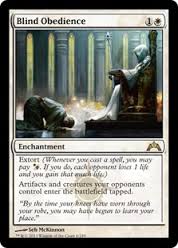
imgres-410. [card]Pacifism[/card] —> [card]Blind Obedience[/card] – Again, this is an easy swap. Pacifism is only a partial removal spell. Blind Obedience slows what blockers that do come down a whole turn while providing a way to extort that is not tacked on to a creature thus more difficult to remove. I went in to the virtues of extort in my introduction to this format. Check it out here.

Here’s what the final list will look like after all of the swaps are made.

[deck title= The List According to Type]
[1CC Creatures]
Elite Vanguard
Mother of Runes
Savannah Lions
Student of Warfare
Soldier of the Pantheon
[/1CC Creatures]

[2CC Creatures]
Accorder Paladin
Kami of Ancient Law
Kor Skyfisher
Lone Missionary
Soltari Monk
Soltari Trooper
Syndic of Tithes
[/2CC Creatures]

[3CC Creatures]
Aven Mindcensor
Porcelain Legionnaire
Blade Splicer
Fiend Hunter
Flickerwisp
Mirran Crusader
Stonecloaker
[/3CC Creatures]
[4CC Creatures]
Hero of Bladehold
Kor Sanctifiers[/4CC Creatures]

[6+CC Creatures]
Elesh Norn, Grand Cenobite
[/6+CC Creatures]

[Planeswalker]
Elspeth, Knight Errant
[/Planeswalker]
[Instant]
Condemn
Mana Tithe
Swords to Plowshares
Disenchant
Path to Exile
[/Instant]

[Sorcery]
Balance
Armageddon
Day of Judgment
[/Sorcery]

[Enchantment]
Luminarch Ascension
Journey to Nowhere
Blind Obedience
[/Enchantment]
[/deck]

Feel free to scour Gatherer and try to find some other cards in white that would be better than the ones we have (for the Twos environment, of course), and post them in the comments. This is not a heavily discussed format across the internet, so there might still be some gems out there that have been missed.

I need to give credit once again to PIDGEOT on CubeTutor for use of his list as a basis for these articles. Also, all of the guys at Fusion Games in Winnipeg who have been playing this format for years and who introduced it to me. Thanks very much!

Let me know if you have jammed this format yet and what you think of it. I’ll try to get two colors in for the next article, but there is so much new stuff to say about these cards that I make no promises. You can catch me at @awcolman on Twitter if you want to chat about this or anything else Cube- or beer-related.

Thanks for hangin’, everyone.

Andrew

Pitt Imps Podcast #66 – Road Kill Cafe

This weeks fan as host guest is Justin from the posse page on Facebook. We go over SCG Detroit and make mention of the lack of anything new. I’m ready for rotation. Anyway we also go into the spoilers for our traditional best of episode. In this we set categories and pick what we think the best of that is. Let’s also say we go over the worst card in the set which somehow we always seem to be wrong about.


Your hosts: Angelo & Ryan

Angelo’s Twitter: @Ganksuou

Ryan’s Twitter: @brotheryan

Show’s Email: [email protected]

Guest Host Justin. Twitter @IsayTheeNay


Art logo contest Rules. 

$100 prize to winner of the contest

Come up with the new logo for the Pitt Imps

Send submissions to above email

3 submissions per person accepted

Deadline for submission June 1st

Journey Into A New Standard

To start things off, my name is Deshaun Baylock. I recently started devoting myself to this game called Magic: The Gathering and the payoff has been huge. I started playing around the time of [card]Jace, the Mind Sculptor[/card]. Within a year of trying to go “pro,” I have scored a GP Top Eight, a GP Top 32, a GP Top 64, one PTQ win, and 10 pro points since PT Valencia, and I am currently qualified for PT Portland. I believe with hard work and a will to learn, you can do anything in this game. It’s not about how long you have been playing, it’s about how you approach every opportunity to get better.

This weekend, a new set is going to be introduced into Standard: Journey into Nyx. New decks are going to be made and a lot of old decks are going to be no longer playable. I am going to break down the three best archetypes and go into detail about how they are going to change with cards from the new set. I will not be talking about sideboards, as the metagame is currently unknown. Advice on what to bring in and take out would be basically lying to you. Sideboards depend on the metagame you expect to see.

Let’s start with my favorite archetype: control. Right now, there is a debate going on about whether going Blue-White or Esper is correct. With the new set fully spoiled, I believe 100% that Blue-White is strictly better.

Here is an example of an Esper list. Kyle Boggemes ran this list at Grand Prix Cincinnati. It went OK.

[deck title= Esper Control – Kyle Boggemes, 1st place at GP Cincinnati]
[Creatures]
*1 Aetherling
[/Creatures]
[Spells]
*4 Dissolve
*2 Doom Blade
*4 Sphinx’s Revelation
*4 Supreme Verdict
*4 Detention Sphere
*2 Thoughtseize
*2 Syncopate
*2 Azorius Charm
*1 Last Breath
*3 Elspeth, Sun’s Champion
*4 Jace, Architect of Thought
[/Spells]
[Land]
*4 Temple of Silence
*4 Temple of Deceit
*4 Temple of Enlightenment
*2 Mutavault
*2 Plains
*5 Island
*4 Hallowed Fountain
*1 Godless Shrine
*1 Watery Grave
[/Land]
[Sideboard]
*1 Thoughtseize
*1 Duress
*1 Pithing Needle
*2 Negate
*1 Revoke Existence
*4 Nightveil Specter
*2 Blood Baron of Vizkopa
*1 Ultimate Price
*2 Archangel of Thune
[/Sideboard]
[/deck]

The cards that can be cut from this list without any hesitation are [card]Last Breath[/card], [card]Thoughtseize[/card], [card]Doom Blade[/card], and [card]Azorius Charm[/card].

I would add two [card]Banishing Light[/card], two [card]Syncopate[/card]s and three [card]Deicide[/card].

The reason the cards I cut are no longer needed is because we don’t need to have answers that are not universal. We don’t know what the metagame is going to be so we want to have cards that can pretty much answer anything our opponent does. [card]Deicide[/card] and [card]Banishing Light[/card] allow us to play more universal answers without leaving us with a lot of dead cards.

Blue-White Devotion has been on the rise and I only think it’s going to get better. This deck was played by Jeffery Pyka at Grand Prix Cincinnati.

[deck title= Azorius Control – Jeffery Pyka GP Cincinnati]
[Creatures]
*4 Cloudfin Raptor
*4 Judge’s Familiar
*4 Tidebinder Mage
*4 Frostburn Weird
*4 Thassa, God of the Sea
*4 Nightveil Specter
*4 Master of Waves
*1 Ephara, God of the Polis
[/Creatures]
[Spells]
*4 Detention Sphere
*2 Bident of Thassa
*1 Rapid Hybridization
[/Spells]
[Land]
*4 Hallowed Fountain
*4 Temple of Enlightenment
*4 Mutavault
*1 Godless Shrine
*11 Island
[/Land]
[Sideboard]
*2 Glare of Heresy
*1 Revoke Existence
*2 Jace, Memory Adept
*2 Domestication
*2 Pacifism
*3 Gainsay
*2 Negate
*1 Rapid Hybridization
[/Sideboard]
[/deck]

This deck is going to be able to run a lot more smoothly. The addition of Mana Convergence to this deck is huge. This deck was giving up tempo to be a little bit more resilient by playing four [card]Temple of Enlightenment[/card] and [card]Detention Sphere[/card]. You now have a more stable mana base and the ability to play what I believe is going to be one of the best rares in the set.

Start By removing the Ephara, [card]Godless Shrine[/card], two [card]Temple of Enlightenment[/card], two [card]Island[/card]s, four [card]Detention Sphere[/card] and the [card]Rapid Hybridization[/card].

I would add two [card]Dispel[/card], two [card]Deicide[/card], four [card]Mana Convergence[/card], one [card]Nykthos, Shrine to Nyx[/card], and two Hypnotic Siren.

[card]Detention Sphere[/card] no longer will be safe with people playing [card]Banishing Light[/card] and [card]Deicide[/card]. It is no longer the [card]Vindicate[/card] that we were used to in the old format. This build of the deck is very lean and efficient. Tempo is the new face of Mono-Blue. [card]Dispel[/card] will protect your Thassa from Deicide and the Siren will allow game-changing plays while still being a decent one-drop because of its evasion.

Mono-Black Devotion has had a stranglehold on the format but now I believe that it is the worst of the tier-one decks. Here is an example build from Lauren Nolen played at SCG Detroit.

[deck title= Mono-Black Devotion – Lauren Nolen SCG Detroit]
[Creatures]
*4 Gray Merchant of Asphodel
*3 Lifebane Zombie
*2 Nightveil Specter
*4 Desecration Demon
*4 Pack Rat
[/Creatures]
[Spells]
*2 Bile Blight
*3 Temple of Deceit
*4 Hero’s Downfall
*3 Devour Flesh
*1 Ultimate Price
*4 Underworld Connections
[/Spells]
[Land]
*4 Mutavault
*4 Thoughtseize
*18 Swamp
[/Land]
[Sideboard]
*2 Dark Betrayal
*2 Erebos, God of the Dead
*3 Staff of the Death Magus
*4 Doom Blade
*4 Duress
[/Sideboard]
[/deck]

Mono-Black did not get a lot of tools in the new set, and a lot that it did get are situational.

I would remove one [card]Ultimate Price[/card] and four [card]Underworld Connections[/card].

I would add three [card]Read the Bones[/card], one [card]Whip of Erebos[/card], and one [card]Tormented Thoughts[/card].

[card]Underworld Connections[/card] may end up being unplayable in the new format because [card]Deicide[/card] and [card]Banishing Light[/card] will give more decks access to enchantment removal; [card]Read the Bones[/card] is a nice replacement to help with card advantage.

The last card I want to briefly talk about is [card]Tormented Thoughts[/card]. Playing this card allows you to turn the tide of games very quickly against all non-counterspell decks; forcing them to discard their whole hand is backbreaking. The reason I cut cards that are no longer good and switched them with situational cards is because with access to [card]Pack Rat[/card] and scry, you can discard the cards that aren’t good in the matchup or choose not to draw them unless you need them.

Summing Up

The power level of the format has increased and you should plan accordingly. If you don’t have a spell that interacts with the opponent on turn two, you must mulligan. No longer will the game start on turn three. This is what i believe the top decks from the old format should do to adjust and stay relevant.

Have comments? Please share below!

Conjured Currency #10: Which Spec is Right For You, Part II

Welcome back! Last week I briefly discussed how there are different kinds of speculation targets, and why they should be targeted in varying ways depending on factors such as your budget, whether you trade or buy, and whether you’re looking for long-term holds or quick flips. I had planned to go more in-depth and have all of the information be wrapped up into one article, but in the end decided to split it up to include a second piece. I’m going to analyze a couple more card types that you should be looking to pick up, how they’re different, the various methods that you should be using for each, then do a wrap-up summary.

Pre-Spike Buys:

[card]Ghave, Guru of Spores[/card], [card]The Mimeoplasm[/card], [card]Tropical Island[/card]

Yes, [card]Tropical Island[/card] and [card]The Mimeoplasm[/card] are being put in the same pile of related things for the first time since “That Guy” played his $4,000 Mimeoplasm combo EDH deck full of Alpha duals and Japanese foils. I recently stated on Twitter that Ghave was “the next Tropical Island”, and received some questioning and confused responses. Before [card]Tropical Island[/card] spiked, its best of friends [card]Underground Seas[/card] and [card]Volcanic Island[/card] were several weeks ahead of it.

The original Commander product is experiencing a similar situation, where the low supply of cards like [card]Damia, Sage of Stone[/card] and [card]Animar, Soul of Elements[/card] were realized, and they experienced a price correction. Ghave wasn’t far behind, and those who picked up copies for cheap will be happy they did. These are situations where (budget allowing), it’s a better idea to buy as many as you can afford at retail, and then look for a quick flip to buylists or TCGplayer/eBay. These are a better buy because the evidence supporting the spikes already exists, just look for the signs. Trading for copies is also obviously fine, but cards like these are usually relatively scarce in binders, and their owners may have the same goals as you.

Here are a few cards that I believe fall into the same category:

[card]The Mimeoplasm[/card]

[card]Damia, Sage of Stone[/card] is an $11 card. [card]The Mimeoplasm[/card] is a $3 card. Is there reason for this? No? Ok. There are only three existing BUG-colored commanders in the entire game, and this is the only graveyard-centered one. It also has a T-Rex for an arm. I will be shocked if this card is not $10 within the next couple of weeks.  If you want to play with these, or are willing to buy in to speculate, do it now.

[card]Karador, Ghost Chieftain[/card]

Karador just recently got a judge promo printing, but I don’t think that will discourage the original printing from jumping in price in a relatively soon time frame. In fact, a judge promo might be speeding up the process by introducing newer players to the card via the announcement of the promo. These are quickly diminishing in stock across the Internet, and people like casting things from the graveyard, and this is a unique Commander in that aspect.

Long-Term Trades

I was once asked by a player who was just getting into finance and speculation whether [card]Abrupt Decay[/card] was a good spec target. When I replied with an affirmative answer, he asked how many he should buy to turn a good profit, and was surprised when I answered “zero.” If you don’t intend on playing with the card, I don’t think you should be spending money on it at all. Instead, I would wait and look for the Ghaves that you can make an easy flip off of quickly. The following are examples of cards that I think are very strong to trade for, but wouldn’t input cash personally (unless I was playing them). Your wait on a significant return will be multiple months, and during that time you will most likely have several other opportunities to make money.

[card]Abrupt Decay[/card]

There aren’t a whole lot of Standard-legal $50 foils, but [card]Abrupt Decay[/card] is one of them. The reason being is that it’s extremely prevalent in Modern and Legacy over Standard, and players in eternal formats are much more likely to commit to foiling out their eternal decks. However, this isn’t something I would buy into now. Similar to [card]Griselbrand[/card], I think it’s safest to wait until rotation, or right before that, for the buy in on Decay. Even though it won’t drop much, I see it following the trend of “lose a couple of dollars, then slowly trend upward.” However, if you can lock these in during trades, I wouldn’t fault you. As we approach rotation, these may actually become more scarce in binders, because everyone knows that its price is based on eternal playability.

Shock Lands

After Wizards decided to print these to death in Dragon’s Maze, we finally saw the low point on these a few months ago at around $8 (depending on the colors). Did you know SCG is still paying $8 buylist on some of the shock lands? If that doesn’t show dealer confidence in these being a good pickup, I don’t know what does. Unless you’re okay with putting money away for several months, stick to trading away your plummeting RTR cards ([card]Desecration Demon[/card] and [card]Jace, Architect of Thought[/card] are examples of cards that you do not want to own if you are not playing them) for solid value that won’t budge downward. Pick them up at rotation from Standard-only players.

[card]Deathrite Shaman[/card]

This is a card that you may want to target and pick up based on the points I have made in the previous two paragraphs. I mention the elf shaman in this article only to point out that I strongly advise against speculating on it right now. I believe that there are two reasons this card is still $11 after its Modern bannings: the first is obviously that the card is extremely powerful in Legacy, and the second is that people who were speculating on the card before its banning refuse to dump them and accept that the card will take literally forever go go up. If you can trade these away at the price they are at now (or even better, sell them), do it. Even if you are a fan of long-term speculation targets, I would prefer to own shock lands, Decays, or other eternal staples.

Wrapping Up

Keep in mind, there’s not always “the next big spike” that you need to buy into right that moment. Part of MTG finance is knowing when to hold your money, and differentiating the Ghaves from the Abrupt Decays. However, your personal buying strategy should differ depending on how often you intend to resell, and what your outs are. If you prefer quick consecutive flips on faster-acting spikes, then you want to keep your ears to the ground and wait for the next [card]The Mimeoplasm[/card] or [card]Tropical Island[/card], depending on your budget. If you can afford the Trop, it’s probably better to buy that over dozens of Mimeoplasms. The dual land will be easier to move to a buyer. When your strategy involves shoving cards into a box and forgetting about them for several months at a time, then you could start stocking up on the well-known multi-format staples, or invest in some sealed product. The most important take-away is that while there are always multiple “good specs” out there, you should take into account the time it will take to obtain your return on investment, as well as your possibility of outing the various cards.

Did I miss anything? Is there a different breed of spec target that acts differently then the ones listed in the past two articles? Drop a comment in the section below, or hit me up on Twitter to discuss anything!

Brainstorm Brewery #97 – Nyxborn Jambalaya

More spoilers are out, the gang is adding more segments to keep the cast growing, and there are all kinds of stories of the great time that was had at Grand Prix Philly. It’s time for another installment of your favorite finance podcast. What from the new set has financial potential? Find out on an episode of your favorite podcast that will have you asking, “What was the story about the spider?”


  • How was Grand Prix Philly?
  • It appears that reader e-mail might become a regular segment.
  • Spoilers, spoilers, spoilers!
  • Pick of the Week sneaks in at the very end. It’s a photo finish!
  • There are still some tokens and mats left. E-mail us to get hooked up.
  • The address is brainstormbrew at gmail dot com.

Cabe Riseau produced the intro and outro music for Brainstorm Brewery.


Contact Us

Brainstorm Brewerywebsiteemailtwitterfacebook

Ryan Bushardemailtwitterfacebookgatheringmagic.com

Corbin Hosleremailtwitterfacebook – quitespeculation.com

Jason E Altemailtwitterfacebookgatheringmagic.com – quitespeculation.com

Marcelemailtwitterfacebook

Counterfeits On TCGplayer: My Experience

I have some good news and some bad news.

The bad news first: some of the Chinese counterfeit cards have found their way onto TCGplayer.com. In fact, I received three counterfeit Return to Ravnica [card]Hallowed Fountain[/card]s in a purchase from a TCGplayer.com vendor last week.

The good news is that they were very easy to identify and that TCGplayer.com’s response was awesome.

I’m writing this article for two main reasons:

  1. To give detailed information about the counterfeits for anyone who comes across suspect cards

  2. To talk about TCGplayer’s response so you know what to expect if it happens to you and so you can adjust your buying behavior if you feel it is necessary

I’ll walk through the whole experience from beginning to end for those interested. I am a Brainstorm Brewery writer after all, so nobody is getting out of here without sifting through at least 1,500 words (much more in this case). If you are only interested in how to identify the counterfeits, that’s fineskip straight to the “Identification” section toward the bottom.

Background

First, let me say that although I’ve played Magic for quite a long time, I had zero first-hand experience with counterfeits (that I know of) prior to last week. Many community members have dealt with previous counterfeiting attempts but I was coming in with a clean slate.

I was, however, well aware that the Chinese counterfeits existed and I had read a lot about them. To some extent, I knew what to look for. In the “Conclusions” section at the end of this article, I discuss whether the counterfeits would raise a red flag for someone who was totally in the dark. Spoiler alert: not necessarily.

Purchase

I purchased the [card]Hallowed Fountain[/card]s in a large cube update/spec buy that used several TCGplayer vendors. The Fountains were the only three cards I purchased from this particular vendor, and I’m not going to reveal that name because TCGPlayer is trying to determine intent. The Hallowed Fountains were the cheapest listed by a fair amount. They were $5.39 and the next cheapest was around $7.00. Take that for what it iscircumstantial evidence.

I checked the vendor’s store and he had only a few other things for sale, including a couple of [card]Overgrown Tomb[/card]s (also priced below market). I’ve had good luck with vendors like this beforenew sellers offering good deals until they build up their rating. I added the Fountains and the Tombs to my cart but the Tombs were gone by the time I checked out. I have to think the [card]Overgrown Tomb[/card]s were probably counterfeit as well. TCGplayer is looking into this, though I don’t expect that I will ever know the outcome.

The vendor shipped same day and with tracking. I ordered these Friday after lunch and had them in my hands Monday evening, which I thought was awesome (at the time). They were shipped in a padded mailer and each Hallowed Fountain was in its own semi-rigid plastic holder. They looked perfectly mint in the sleeve so I dropped them on my desk to wait for all the other cards I ordered without examining them further.

Nothing about the transaction itself raised a red flag. Actually, other than the fact that the cards would turn out to be counterfeit (granted, kind of a big deal), it was the best transaction of the several orders I placed that day.

By Wednesday, I had received enough of my other orders that I sat down to update my cube and file the specs away. Literally the moment I pulled the first Fountain out of the plastic, I knew it was not real. I’m talking, I still only had one hand on it from pulling it out of the sleeve and I already knew. If you handle Magic cards regularly, it’s that apparent.

The finish was the giveaway for me. It felt almost like a playing card. Everything I had read about the counterfeits said something like this: “They may look like good fakes in pictures, but you would never confuse them if they were in your hand.” That is exactly right. I’ve handled plenty of Magic cards in my lifeold ones, new ones, specialty products, you name itand these felt much different than any of them.

All three Fountains were the same. I tried the light test on all three (as well as a variety of real cards for comparison) and they failed. I looked at some other tests but I don’t own a jeweler’s loupe, wasn’t willing to rip the cards to check for the blue line or try the bend test until I talked to TCGplayer, and didn’t even bother to try the water test because the cards were so glossy there was no way water wouldn’t bead up on them.

I immediately emailed TCGplayer.com and then, without thinking too much, I tweeted about it.twitter1.jpg

Probably for the same reason I still get blown out by combat tricks in Limited, I totally underestimated how big a deal this was to so many people. It was slightly irresponsible to throw something like that out without solid backup. Within a few minutes, a number of people requested pictures but I decided a video was better. The texture was a big indicator and there was no way to show that in a picture

I posted this video on YouTube.

This was my attempt to explain my thinking 15 minutes after I discovered the cards. There was some good information that was left out because I rushed it. If I had done a little research and figured out what else to look for before I tweeted, I could have included more in the video. In my defense, I was on my third IPA.

Support

The community was awesome. You guys know this already, but it never fails.

I got a lot of advice from people who had dealt with counterfeits before, including this specific round. @TheCardNexus was especially helpful and told me about other potential differences I should check. He was spot on

Magic players are looking out for one another on this. If you ever have a question about card authenticity, Twitter is a great place to go. There is an incredible knowledge base out there and a lot of well connected people (Jason Alt, for example) who can get those questions in front of the people who can answer them best. Take advantage of it.

What wasn’t helpful was a number of people on YouTube definitively declaring the cards authentic Event Deck cards, this despite never having seen them in person and apparently ignoring part of the video (the light test). All this does is increase confusion for the other people reading and watching. The cards weren’t from an Event Deck. How did I know that? Because I’ve purchased Event Decks in the past, held the cards, and they didn’t feel anything like these. And guess what, Event Deck cards do pass the light test.

It was Wednesday evening when this happened and TCGplayer emailed back Thursday morning. In the very first email, they fully refunded my purchase and asked me (not told me) if I would send the cards to them for further evaluation if they paid shipping. They asked for all three cards and offered to call if I had questions.

I am in a customer-facing business so I appreciated this for several reasons. First, TCGplayer didn’t ask any questions, require any justification, or make me jump through any hoops before giving me a refund. If you sell anything to anybody, you are going to have to deal with some ridiculous claims. At this point, they had no idea if I knew what I was talking about or if I was just another idiot causing a stir. It is pretty tempting to say, “There is a 95% chance this guy is dead-ass wrong, let’s act accordingly,” but they didn’t.

They paid for the cards to be shipped overnight and even had the cards delivered to a home address since they would be arriving Saturday morning. On the following Monday (which was this past Monday), they let me know they had confirmed the [card]Hallowed Fountain[/card]s were not authentic and that they were shutting down the seller while they investigated intent. As I mentioned above, they are also reviewing other recent transactions from the seller.

The people I dealt with from TCGplayer were courteous and appreciative of my cooperation. Their response was quick and thorough, in my opinion. Thumbs up to TCGplayer.com all the way.

Identification

First, watch the video if you haven’t. Below are the things I saw when handling the counterfeits, including a couple that aren’t in the video.

As I said, I did not have a jeweler’s loupe and I did not perform any destructive tests because I anticipated sending the cards to TCGplayer. So this is certainly not a comprehensive list.

1. Gloss – This is the first thing I show in the video. Call it the “squeak test” or whatever, but the counterfeits are substantially glossier.

I did look at Event Deck, Duel Deck, and Commander cards that I had. Yes, some of them do feel slightly glossier but not close to the counterfeits. And the cards from supplemental products do, in fact, squeak if you rub them, although maybe not quite as much as cards from normal expansions.

2. Light Test – This is the second thing I did in the video. The iPhone flashlight works great here, and the difference is drastic. The light shines right through regular cards, including Event Deck cards and other supplemental products, but not the counterfeits. After trying a variety of cards (new, old, etc.), I found no exceptions with real cards. I could see the light clearly through all of them.

If I had only had one test to identify a counterfeit, this is what I would use. It is certainly the most practical and, as far as I know, it is very reliable as well.

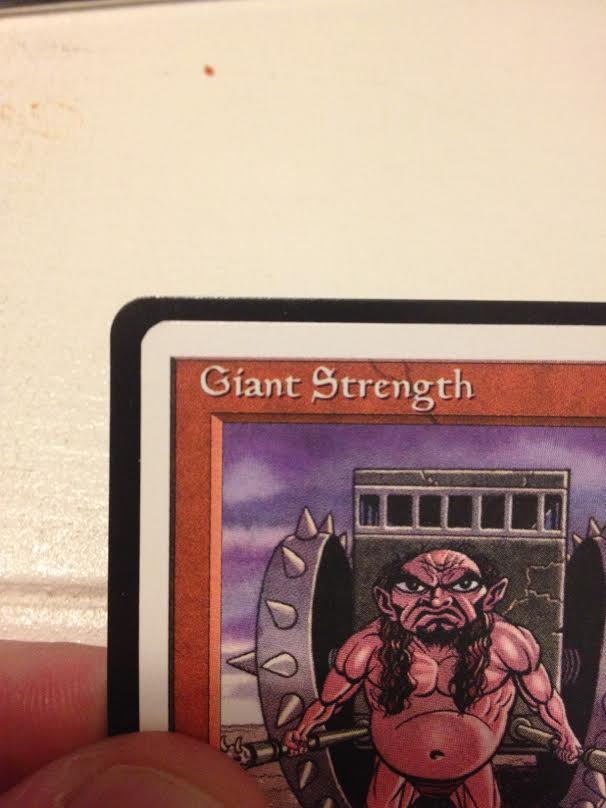
3. Corners – The corners of the counterfeits were miscut, they were round almost like Alpha corners.fountain 1.jpg
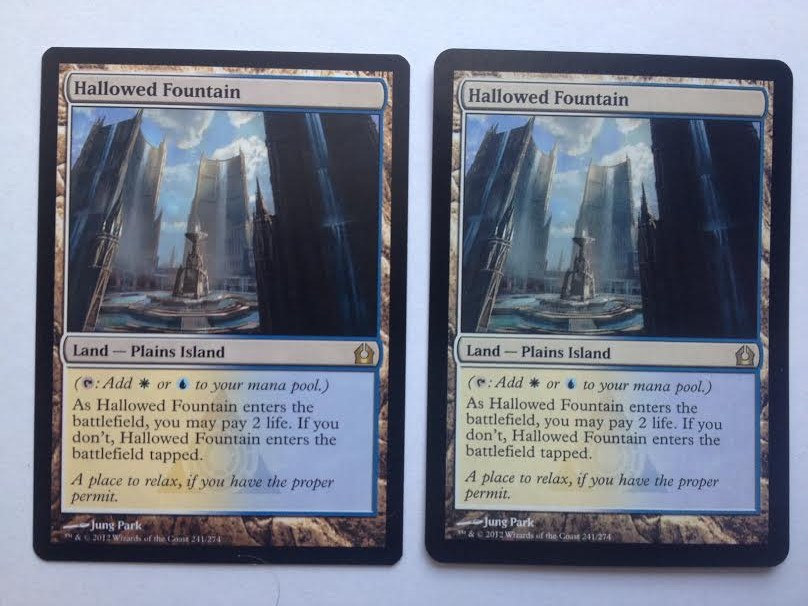
Legit copy of RTR Hallowed Fountain on the left, counterfeit on the right. Note the corners.
fountain 2.jpg

The corners again, comparing to a legit white bordered card, to the extent a 5th Edition Giant Strength can be considered legitimate.

4. Borders – In the first picture above, you may notice that the borders are thicker on the counterfeit. It’s not that the card itself is bigger, just that the middle of the card is a little smaller so the borders take up more of the face.

5. Size – The width of the counterfeits is very slightly smaller than authentic cards. Like, less than 1mm smaller. I believe the height is the same.fountain 4.jpg
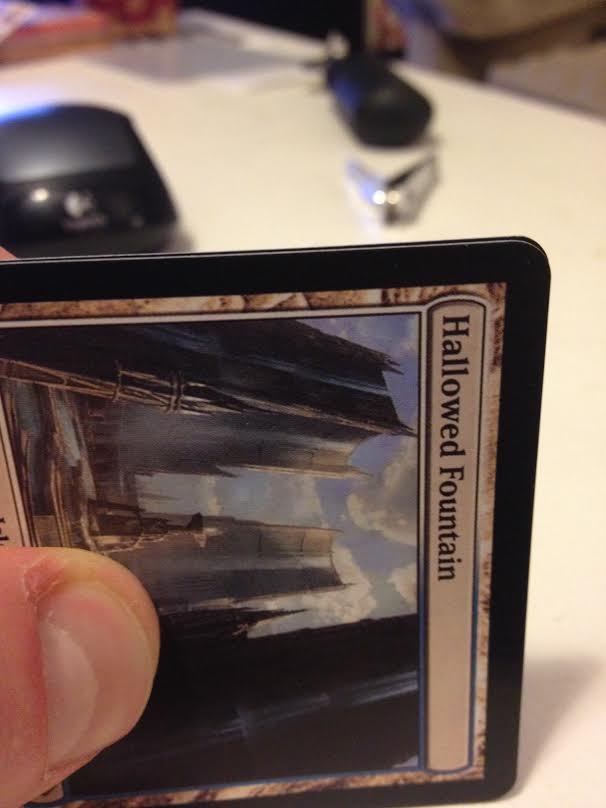
The width of the counterfeit (front card) is slightly smaller than the authentic card behind it.

6. Coloring – This is pretty hard to see in pictures (maybe if I had a better camera) but it was apparent when I had the cards in hand. The coloring of the counterfeits, especially the browns, was slightly washed out compared to the legit cards.
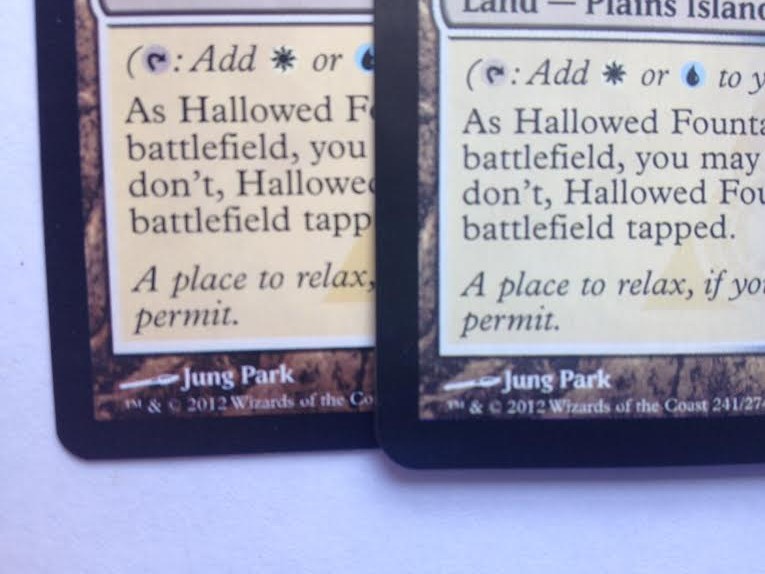
fountain 3.jpg

Legit copy on the left, counterfeit on the right. Note the coloring. The backs of the counterfeits were similarly washed out although I failed to get a good picture.

On the coloring, I really don’t think I would have noticed this if I wasn’t looking or if there was no other reason to question the authenticity.

Also, after looking back at other cards in my inventory, I definitely noticed plenty of color differences in authentic cards. I found a couple of [card]Birthing Pod[/card]s, for example, that have much more noticeable coloring differences than these two [card]Hallowed Fountain[/card]s, but both Pods passed all other tests. So I would say that coloring alone is not a good indication of authenticity and it should be used in conjunction with the other things I’ve mentioned.

7. Clarity – Again, I didn’t have a jeweler’s loupe but you could see that the print was slightly fuzzy in places on the counterfeits just by looking closely. The artists name in the picture above was one of those places, but there were others. Not sure if it comes across in the picture, but the authentic card was sharper.

Conclusions

The end result of all this for me is that I don’t feel the need to change my buying practices on TCGplayer.com very much. I’ll even continue to buy from new sellers if I see a good deal, although I never do that with expensive cards. Best case, I get some cheap cards while the seller builds feedback. Worst case, the cards are counterfeits but they get identified and taken out of the system at no cost to me instead of ending up in the hands of somebody who doesn’t know the difference. I feel adequately protected here.

Now, there will be people who don’t want to deal with this at all. While there was no financial cost to me, the whole thing did take up a bit of my time (although I got an article out of it) and I still don’t have any [card]Hallowed Fountain[/card]s. I didn’t look at it as a hassle, but some might. Buying only from reputable sellers on TCGplayer.com remains the first and best line of defense if you want to avoid this totally.

I am slightly more worried about buying from non-TCGplayer sources now. I know ebay/Paypal have good buyer protection, but those companies are not going to know anything about counterfeit Magic cards. Would it have taken longer to come to a resolution if this was eBay? I’m not sure. If you are dealing outside of those markets (or similar markets), buyer beware. You may have no protection whatsoever.

Another thing I am more worried about now is counterfeits finding their way to new players. The [card]Hallowed Fountain[/card]s looked very good in the sleeves to me and I didn’t notice anything different about them until I took them out. I can definitely imagine a newer player acquiring these cards unknowingly and jamming them right into sleeves and into a deck. If they didn’t notice the gloss initially, I doubt they will notice the rounded corners once in a sleeve. It’s going to be a feel-bad moment for everyone when these cards get discovered by a more experienced player. Whoever pawned them off on the new guy is obviously long gone at that point and there is probably no recourse.

Bottom line, I think these counterfeits are good enough to trick some newer players. That is a concern.

TCGplayer did respond well, but they still have a big challenge in front of them. Ultimately, taking counterfeits out of the system one at a time after they have been sold is going to be a long and expensive undertaking. Finding a way to prevent this from happening in the first place is the goal, but that won’t be easy. They mentioned that they are working on some videos. That is a good first step.

Lastly, I would stress to everyone that you are entitled to question the authenticity of your cards if you have doubts. Assuming you are legitimately concerned (not just being difficult) and assuming that you are asking in a civil way, don’t stop until you are satisfied. “I’m concerned about the counterfeits in the system, do you mind if I try the light test on these before we finish the trade?” is perfectly reasonable. Don’t forget that there is a list of the cards that were in this counterfeit print run.

Certainly, don’t be embarrassed if you question something and the cards turn out fine. You don’t have to make an accusation in order to get confirmation that the cards are authentic. If at any point the seller or other trader refuses your request or tries to embarrass you for asking the question, I would just walk away. No need to take that kind of risk.

That’s all I have. Thanks for reading and as always, hit me with any questions you have here or on Twitter (@acmtg).

The Spike Feed Episode 34 – That Dry Heat

In our 34th episode, we welcome Dustin back to the cast as he shares tales from GP Nagoya, Cameron plays pinball and Hearthstone in Las Vegas, and Curtis sleeves up some mountains for FNM. [card]Saytr Fire Dancer[/card] also makes a brief appearance, proving once again that Curtis can’t keep that card off the show. Thank you for your honor.

Your hosts:

Dustin Gore

Cameron McCoy – @cameron_mccoy

Curtis Nower – @CurtisNow

Our show – @SpikeFeedMTG

Music by Micah Jones

C(ube) + C(ommander) Magic Factory – Journey into Cube

Now that the full spoiler for Journey into Nyx is out, it’s time to theory-craft what the impact on Cube will be.  I will be holding off on a full review like the ones I did for the Commander 2013 series until I have a chance to play with these cards and see how they impact Commander tables.  For now, I’m going to write about the cards I will be testing in my cube and what applications I see them having for existing archetypes.

[card]Gnarled Scarhide[/card]

The one-armed cow-man will likely be making his way into more cubes than any other card from Journey by virtue of being accessible to C/Ubes and by providing valuable redundancy in the black aggro one-drop slot.  [card]Gnarled Scarhide[/card]’s bestow modes might actually push him to best-in-slot for that category depending on how relevant bestowing on your opponent’s guy plays out.  Turn one two-power one-drop into turn two disruption is a very solid archetype for black that is getting easier to support thanks to cards like the Scarhide.

[card]Nyx-Fleece Ram[/card]

White is the Dr. Jekyll and Mr. Hyde of Cube since it’s the only color that typically supports both aggro and control archetypes.  [card]Nyx-Fleece Ram[/card] clearly plays for the latter team but fills a role there that previously only [card]Wall of Omens[/card] and [card]Perimeter Captain[/card] volunteered for.  How it compares to those two remains to be seen, but I can definitely see how the extra toughness and incidental life gain could be worth a card in some matchups.  I will test it but it might have a tough time competing for a slot, unlike the next card.

[card]Banishing Light[/card]

[card]Oblivion Ring[/card] 2.0 is a snap include for pretty much every cube as [card]Oblivion Ring[/card] supports both the aforementioned control and aggro archetypes and is picked highly even in powered environments.  [card]Banishing Light[/card] is a functional reprint for our purposes since in practice the stack trick only ever comes up on creatures.

[card]Setessan Tactics[/card]

I run a larger cube (~640 cards) and green is the only color where the lack of depth is truly felt.  Even though I feel [card]Setessan Tactics[/card] may be weaker than any other Journey into Nyx card discussed in this article, I will be giving it a shot since it has a role to play.  Like in many other cubes, green aggro has fallen by the wayside in my list to support ramp and better midrange four- and five-drops.  In that paradigm shift, most combat tricks have made their way out (only [card]Vines of Vastwood[/card] remains).  Not only is green looking to improve card quality more than any other color, but [card]Setessan Tactics[/card] can fill the role of a trick while playing much better with green’s creatures, which are large enough to win combat anyway.  How it plays might show that it’s not good enough since attacking may just be better most of the time.  That said, it is green removal and sometimes you just need to kill that [card]Sower of Temptation[/card] or [card]Looter il-Kor[/card].
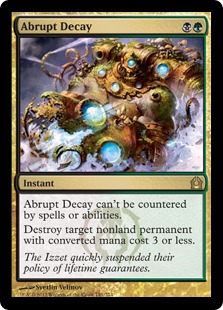
[card]Prophetic Flamespeaker[/card]

You know you want to…
(Alter by Gus S.)

The red Johnny Magic comes to the party with very exciting rules text, all for the low cost of 3 mana.  As soon as I saw this card I though “I want me some of that!”  The theory-crafting jury is still out on this guy, which is one of the prerequisites for a card to break out.  Even the question of whether the Flamespeaker slots better into aggro, control, or midrange is still unanswered.  What is known is that he has a strike against himhe needs some help to reach his full potential.  Luckily, he accepts it in all forms: pump spells, equipment, removal, burn or other creatures all get the Flamespeaker to connect.  Once he does, [card]Prophetic Flamespeaker[/card] helps himself quite well, as his trigger can pile on up to two cards of pressure per turn.  Card advantage considerations aside, double strike and trample on the same card threaten a huge amount of damage should anything be done to change that one power.  The fact that the printing of this guy makes me want to put [card]Reckless Charge[/card] back in my cube is making me really pay attention to him.  Of course, Cube might be the best format for him since that’s where he’ll get to play with the best toys like swords and [card]Umezawa’s Jitte[/card].

[card]Ajani, Mentor of Heroes[/card]

Gold cards are so difficult to evaluate for cube because they have to compete for five slots rather than 70 or more.  Ajani does compete and the easy cards to put him against are [card]Mirari’s Wake[/card] and [card]Gavony Township[/card].  Ajani is hands down a better anthem than both cards, but it is dangerous to stop thereWake was always played for the mana doubling and Township is so good because it’s a land.  In my list, I may actually just cheat and slide Township into my land section just to get some testing in.  Though Ajani doesn’t protect himself the way other ‘walkers do, waiting a turn to drop him so as to put three counters on a mana elf gets the job done.  What is clear is that Ajani passes the mustard for a spot on team Selesnya; what you cut comes down to preference.

[card]Keranos, God of Storms[/card]

Of all ten multicolour gods, Keranos may be the only one to get a slot in Cube.  Not even Xenagod made the cut in my list, even though he’s much better than some of the mono-colored cards I run.  Luckily for Keranos, his competition isn’t as stiff and his abilities line up well with what UR wants to do.  I’m not sure if drawing and casting [card]Lightning Bolt[/card] is always worth a card, but the board states where it’s not are few and far between.  He’s unlikely to be a creature very often, which is fine since he has enough value frontloaded on his enchantment half.  [card]Steam Augury[/card] has under-performed for me and will be making room for some playtests with Keranos.  You could also cut some low-impact cards: [card]Izzet Charm[/card], [card]Fire/Ice[/card], or the similar [card]Prophetic Bolt[/card] to make room for the god.

[card]Mana Confluence[/card]

Which 5-colour land would you rather go to?

I am slightly upset by the printing of this card since it seems marginally better than [card]City of Brass[/card], of which I have an original Arabian Nights version in my cube.  I could cut that, [card]City of Ass[/card] (not going to happen), or make room for a third five-color land.  I like this last option most, since in practice CoB sees as much play supporting two-colour decks that still need mana fixing late in the draft as it does supporting four- and five-colour decks.  When you think of it as a 10-way split card with a downside, [card]Mana Confluence[/card] definitely needs to “get in there.”

[card]Temple of Malady[/card]/[card]Temple of Epiphany[/card]

I will be testing [card]Temple of Epiphany[/card] in my cube, but not [card]Temple of Malady[/card].  I find the temples excellent lands for filling out each guild’s section but not as a 10-card land cycle for cube.  As we get more cubable dual lands, I feel like the musical chairs remaining after shocks/fetches/duals have taken their seats should be filled by lands that support each guild’s strategies.  For example, some guilds really need a land that is untapped on turn one.  Another example is how critical [card]Fetid Heath[/card] is for a B/W deck, even after most of the WW two-drops have been removed from Cube.  These two temples illustrate this effect perfectly.  B/G needs to have its green source untapped on turn one to cast an elf, but the best UR usually does on turn one is cast [card]Ponder[/card] or [card]Preordain[/card], which is an effect a free scry 1 emulates quite well.


So that’s it! With nine cards to test, six of which I believe will have a long-term stay in my cube, Journey into Nyx seems like a very good set for Cube.  Let me know in comments, by Twitter, or email what you think about JOU and what cards you will be testing.

Until next time,

Max Brett.

Contact:

Email: djkensai at gmail dot com

Twitter: @djkensai

MODO: djkensai

My Cube

Pitt Imps Podcast #65 – Wild Turkey

In this episode of the Imps, Ryan gets hammered. Our guest Sid Miester holds nothing back. Then I explain how to almost die due to alcohol poisoning. Good times. We also go over GP Philly and Nagoya. We talk about SCG Dallas. Then there is the spoilers. We go over a couple we like and look forward to picking our best ofs next week.

Your hosts: Angelo & Ryan

Angelo’s Twitter: @Ganksuou

Ryan’s Twitter: @brotheryan

Show’s Email: [email protected]

Forced Fruition, Episode 5: Sealed PTQ Practice

[youtube http://www.youtube.com/watch?v=videoseries?list=PLs4gxqbLAAD5WVijeszmqqm3j_YdC0BCI&w=640&h=360]

‘Tis the Season

It’s that time of year when we get to play Sealed PTQs. The format has its upsides and downsides and you’re certainly going to increase your odds of winning by practicing as much as possible. I like Sealed because it evens the playing field to a degree by emphasizing deckbuilding. I also dislike Sealed due to the high variance—you’re basically at the whims of the pack gods. That said, there is always a deck to be made and played, and the great players will make the best of what they’re given. So join me as I take on a Theros-Born Sealed eight-man.

Deckbuilding

[youtube http://www.youtube.com/watch?v=imqFnvZgelQ&w=640&h=360]

[deck title= PTQ Practice]

[Creatures]

*1 Prognostic Sphix

*1 Chorus of the Tides

*1 Nimbus Naiad

*1 Deepwater Hypnotist

*2 Meletis Astronomer

*1 Flitterstep Eidolon

*2 Shrike Harpy

*1 Returned Centaur

*1 Cavern Lampad

*1 Fleshmad Steed

*1 Nyxborn Eidolon

*1 Spiteful Returned

*1 Shipwreck Singer
[/Creatures]
[Spells]

*1 Sea God’s Revenge

*1 Whelming Wave

*1 Sudden Storm

*1 Crypsis

*1 Lash of the Whip

*1 Asphyxiate

*1 Read the Bones

*1 Grisly Transformation
[/Spells]
[Land]

*8 Island

*9 Swamp
[/Land]
[/deck]

Match 1 Game 1

[youtube http://www.youtube.com/watch?v=xl8ObtkQItk&w=640&h=360]

Match 1 Game 2

[youtube http://www.youtube.com/watch?v=gzL_aw0WZTM&w=640&h=360]

Match 2 Game 1

[youtube http://www.youtube.com/watch?v=n1lNlgLz2jo&w=640&h=360]

Match 2 Game 2

[youtube http://www.youtube.com/watch?v=4dqGIG67UpY&w=640&h=360]

Match 2 Game 3

[youtube http://www.youtube.com/watch?v=wKjPcWvRvNE&w=640&h=360]

Match 3 Game 1

[youtube http://www.youtube.com/watch?v=X064Rr3bcUw&w=640&h=360]

Match 3 Game 2

[youtube http://www.youtube.com/watch?v=JIzZUa35RIc&w=640&h=360]

Serum Visions – Things We Collaborate On

Hello, everyone, and welcome back to Serum Visions!

This week, WotC has announced that it is doing a set of “designer cards” with game designers from outside of Magic’s  R&D. This is a great opportunity to talk about an amazing part of the craft beer culture: collaboration beers [CB]. This is really exciting and quite timely because we just had the first Collaboration Beer Fest in March as a part of the Colorado Craft Beer Week.

There has been some pretty cool news on the mothership as of late regarding M15. This will be the set where we get the card that the community got to design: [card]Waste Not[/card]. It turns out that we are not the only ones from outside WotC that got to contribute to the design of this set.

There is a video of George Fan, the designer of the incredibly popular Plants vs Zombies, talking about how he was the one who designed [card]Genesis Hydra[/card]. It’s a pretty cool video—George talks about how he has been playing MTG since Revised and he had a mechanic in Plants vs Zombies, in initial testing, that was a direct inspiration from MTG. WotC got designers from some pretty big-name games to take part in their “designer cards” program, such as the creators of Penny Arcade, Minecraft, World of Warcraft, and Diablo 3, just to name a few.

Collaboration is a Beautiful Thing

Salvationimgres-2 OLYMPUS DIGITAL CAMERA

I’m not sure which was the first collaboration beer, but I can tell you which one really sparked the fire. The head brewers from Avery Brewing and Russian River Brewing, two very big names in the craft beer world, became friends. I’m sure it was over a beer that at some point they realized that they each had a belgian beer in their lineup called Salvation. In corporate America, this would have shattered the friendship instantly. They would have been on their phones, while still at the table, with their lawyers claiming they came up with it first and slapping each other with lawsuits before they finished the pint that was in front of them… Let’s thank God that didn’t happen! Instead of talking about who should give up the rights to the name, they decided to take an ecumenical approach to blend the beers. The name of the beer came from one of the the brewer’s wives who shouted, “We should call this “Collaboration, not Litigation Ale!” Two years later, they got together, took this idea, and made it big!

Just to be clear, this blending of beers is not the same as blending of wines. The two brewers sat together in a pub and discussed the highlights of each beer and then designed a recipe that would bring out the best of each of the two. This approach has now been adopted by enough brewers that there was, very recently, the first annual Collaboration Beer Festival in Denver.

Beer is Fun

Collaboration beers are such a natural evolution of the craft beer culture, I feel like the evolution itself needs a word. If we think about why many of us drink and love beer, the answer probably revolves around hangin’ with friends or meeting people. Almost all brewery owners started off as home brewers. Brewing is fun, but brewing with a company is more fun, and brewing with other brewers is way more fun! This is why I try to teach everyone I know how to brew. It was only a matter of time before the craft brewers of the world figured out that brewing with other brewers with other ideas is way more fun. Beer is fun, so the explosion of collaboration beers represents the furthest extension thus far of going out for beers with your friends.

When I say explosion of collaboration beers, I really mean explosion! Not ten years past the first big name CB do we have a festival with 37 different brews at it. The CB Beer fest was the headline event of the Colorado Craft Beer Week [CCBW]. It’s a nine-day event that features many of the breweries, brewpubs, and restaurants involved in the Colorado craft beer scene. This will be the first time in the history of CCBW that they will have breweries from outside of the state participating. There is actually one beer that had five different breweries collaborating on it. Does the final product taste any different than if it had only been four breweries? Maybe, maybe not, who cares?! It was a bunch of brewers getting together, hangin’ out, and doing something. It just so happens that they get to make awesome beer while they are hangin’, and we get to buy and drink it!

 Coveralls, Bands, and Beers

imgres-3

Collaborations do not just happen between breweries though. The most visible example of this is Bitches Brew, done by Dogfish Head. In the television show Brew Masters, a reality TV show that features the day-to-day of this brewery, Sam Calgioni got a call from Sony Music to make a beer for the 40th anniversary release of Miles Davis’s hugely influential album Bitches Brew. Bitches Brew introduced the fusion of electronic elements into the jazz idiom. It is widely acknowledged as the first fusion album. After seeing Jimmy Hendrix play, Miles took the instruments of the white rock and roll culture and blended them into the predominately black culture of jazz, creating fusion. This is the inspiration that Sony asked of Sam. Sam ended up blending a black imperial stout and a honey beer with gesho root. Sam actually wrote part of his business plan while listening to this album because it is what he wanted his brewery to be: different from everything that came before. They say nothing is new under the sun…Miles and Sam would disagree.

Collaboration beers don’t stop here, though. There is a brewery up here in Canada called Flying Monkeys that did a chocolate stout with the band Bare Naked Ladies. They collaborated to make an imperial chocolate stout to kick off their Symphony Barenaked tour that was about to start. Another collaboration that is happening right now is between the New Belgium Brewery and the work-wear company Carhartt. Carhartt has been making high-quality work-wear for 125 years and they decided to celebrate by being part of the design of a beer. Honestly, it’s part good marketing to jump on the booming craft beer collaboration movement. However, they also get to be a part of making beer with a company that shares their values in high quality products for craftsmen.

The trend that craft beer has been following lately has been of exponential growth. I see no reason why this trend should not cross over to collaboration beers. Keep your eye out for multiple logos on beers at you local beer store and be excited to pick them up and learn about what new thing is happening. This is an exciting time in the beer world!

Style of the Week

This week, there is no particular style to go out and explore. Go to your nearest liquor store and ask to see some collaboration beers. There is pretty good chance that you’ll find one. If the CB is a stout, see if you can find a stout by one (or both) of the breweries that participated in the CB. Take them home and do a side by side comparison between them and see what differences you can find.

Thanks for hangin’, everyone.

Andrew


P.S. If you are in the Greater Toronto Area in September and want to learn to brew, hit me up. You can find me on Twitter at @awcolman.

Brainstorm Brewery #96 – Bloom Tenders

In the wake of the April Fools’ Day gag, the cast is back in its real format and better than ever. With a lot to say about what seems like a small number of developments, the cast is packed to the rafters with value. Somehow, the cast finds a way to have four opinions about a yes-or-no question. Spoilers are discussed at length, and everything brought up refers to the spoiled cards in one way or another. How do they feel about the Gods and the new spoiled Planeswalker? What older cards could go up based on new keywords like constellation? Will they manage to fit in Pick of the Week in time? Can they keep it to an hour? (They can’t.) Find out the answers to all these questions and more on an episode of your favorite podcast that will have you asking, “Wait, did Jason actually call Prophet of Kruphix last week?”


  • Spoilers, spoilers spoilers!
  • How does the gang feel about Mana Bloom as a spec?
  • How are differing philosophies about the game informing which cards the gang likes?
  • Pick of the Week sneaks in at the very end. It’s a photo finish!
  • There are still some tokens and mats left. E-mail us to get hooked up.
  • The address is brainstormbrew at gmail dot com.


Cabe Riseau produced the intro and outro music for Brainstorm Brewery.


Contact Us

Brainstorm Brewerywebsiteemailtwitterfacebook

Ryan Bushardemailtwitterfacebookgatheringmagic.com

Corbin Hosleremailtwitterfacebook – quitespeculation.com

Jason E Altemailtwitterfacebookgatheringmagic.com – quitespeculation.com

Marcelemailtwitterfacebook

Conjured Currency #9: Which Spec is Right for You?

Welcome back, readers! If you keep up to date on price trends at all (which you should), then you know that [card]Tropical Island[/card] is approximately $200 TCGplayer median at the time that I am writing this (Monday, April 14th). In the weeks prior, when the card could be found for $100-120, you may have seen several prominent financiers recommending you buy the card. The increase was inevitable. There was no reason for [card]Tropical Island[/card] to be half the price of an [card]Underground Sea[/card] or [card]Volcanic Island[/card].

And they were right. Those who bought [card]Tropical Island[/card]s can be happy that they bought in at the lower price, and either play them, hold them, or resell them. But not everyone has the ability to drop hundreds or thousands of dollars on single cards. Today I want to go over where your budget lies for speculation, and the most effective way you can allocate that towards cards that you feel will rise in price. I’m going to take a look at a few cards in each price range that I feel have a strong chance moving forward.

Cheap Pickups

In this section, we will look at a few cards from recent sets with playability and strength that don’t match up evenly with their very low prices. For the sake of newer players, who are mostly relegated to FNM or casual Magic nights at the LGS, I am going to restrict this section to cards that were printed in the past couple of years. Snag these out of binders in trade, but don’t go rushing to buy out the internet. The upside isn’t extraordinarily high with the large print runs, and you won’t see 1000% increases. Regardless, these are cards that have (or are just starting to) proved their worth, and will continue to be in demand in the future.

[card]Rest In Peace[/card]

The most powerful graveyard hate spell ever printed costs approximately $1 with shipping. Of course, there’s a massive price discrepancy between the non-foil and the foil copies. Players who put RIP into their Modern and Legacy decks tend to stick with their decks longer, and therefore have a higher chance of wanting to foil out the deck. If the non-foil creeps up to $3 over the next few months as we approach Modern PTQ season, I don’t think that anyone will be surprised. If you have these in your binder, I would reconsider having them available for trade. I’m gladly snagging these at a dollar.

[card]Nighthowler[/card]

Until today, I had a bunch of these in my $.25 rare boxes that I let people pick through every week. I did not know they were up to $1.50. I don’t play Standard, so I don’t know if [card]Pharika, God of Affliction[/card] is good enough for Green-Black Dredge, but [card]Nighthowler[/card] is definitely a staple in that deck. I doubt it’s the next [card]Desecration Demon[/card], as so much of the deck is lost upon rotation, but go ahead and pick these up at near-bulk prices if you can find them, or trade for them at a dollar. I’d be happy if I could turn an [card]Underworld Connections[/card] into a RIP and a Nighthowler. Up to $4 doesn’t seem unreasonable for this guy, in my opinion. The bestow costing only one more mana than the actual creature makes me like him even more. I might actually play Standard again if this deck becomes good. It’s a very cheap list to build right now, so something will start jumping if it gains popularity.

[card]Pain Seer[/card]

No, this is not [card]Dark Confidant[/card] 2.0. However, it could find a place in black aggressive decks after rotation. Seer curves out nicely with [card]Tormented Hero[/card] and [card]Herald of Torment[/card]. This is another one that will take a while to come to fruition, but I don’t see it dropping below $2. Born of the Gods was a set that everyone mocked and bought less of when it was released, so these could be in short supply come rotation. As long as you’re trading away irrelevant stuff from RTR that’s on the downturn ([card]Jace, Architect of Thought[/card], [card]Desecration Demon[/card], etc.), I like this as a pickup in trade.

[card]Herald of Torment[/card]

Apparently, Wizards really wanted to make Black a strong color in Standard this time around, and not just as a support color. Where [card]Nighthowler[/card] is more of a short-term spec (short-term as in the span of a couple of months), I like Herald and Pain Seer going into next year’s Standard. They could also both see slight bumps before rotation hits. Herald is very aggressively costed in black, and just like Pain Seer, $2 seems like a low point.

Trade, or Buy?

While I understand that some (if not all) of these speculation targets have had their praises sung by other finance writers, I would like to impress how these pickups specifically should be acted upon differently than other cards. If you are new to the finance game, don’t have a lot of initial capital to dump on high-end Legacy cards, and don’t have a massive trade binder, then targeting the small stuff while getting rid of niche, less-desired cards will usually be the correct play.

When picking up cards like [card]Sigil of the Empty Throne[/card], [card]Endless Horizons[/card], or [card]Edric, Spymaster of Trest[/card] that have already spiked, it’s a better maneuver to actually buy the card from places where the price hasn’t yet been raised. Scour the internet (Cardshark, eBay, Amazon, and your LGS all exist. They are alternatives to TCGplayer and take longer to be bought out.) I managed to grab copies of all of these cards at their pre-spike prices from vendors at Grand Prix Philadelphia last weekend, so there’s definitely money to be made! Trying to trade for cards after their prices increase might work a few times, but it also has a real possibility of your partner looking up the card and seeing the real price and realizing you’re trying to shark them. Don’t be that guy. We’ve been over that.

I didn’t expect the part on extremely cheap trade targets to get this long, so I might turn this into a bit of a mini-series if I get enough positive feedback. The main point that I want to impart is that while we all have approximately the same goal (making Magic cheaper), we all have different budgets and incomes. Not everyone can buy into [card]Tropical Island[/card] at retail, and the people who can buy into dual lands at retail shouldn’t be buying 70+ copies of [card]Herald of Torment[/card], even if it is a “good spec.” Your targets should change as your budget does.

Loose Change

On another note, I asked last week if anyone had any questions for this article. One of the questions that a friend asked me after reading was why I haven’t played Standard at all. The answer goes back to the same article that the question came from. I absolutely hate switching decks every week, and Standard often requires one to do just that in order to keep up to the minute on metagame shifts. Even if a deck is still viable, the 75 cards in it may change drastically over a few months. I hate needing cards, so I would rather just keep to a format that I find fun, without having to change my deck. This isn’t to say that Standard is a bad format, it’s just not for everyone.

Have comments on today’s article? Sound off below!

How Not To Lose – Playing To Your Outs

Welcome back, brewers. Today we are going to take a look at a fundamental of Magic that many new players overlook: it’s called playing to your outs. Playing to your outs involves understanding game state and figuring out what you need to do to win the game. Sometimes it’s easy to know what you need to do to win. Let’s say you have a bunch of dudes out and you need your opponent to not draw a removal spell in order to just attack and win. Often, it is much harder and requires you to make plays that may seem counter intuitive. Later in the article we will take a look at some examples of some situations where the outlook is starting to look dire, and what we need to do in order to win. But first, let’s take a look at some different levels of players. After all, we all started somewhere.

The New Player

The new player, as the name suggests, is new to the game. He understands that he needs to use mana to cast his spells. He can do math but doesn’t really understand the deep mechanics of the game and the subtle nuances that graduates one to the next level of play.

The Experienced Player

The experienced player has been playing for a while. He understands the concepts of card advantage and maximizing his mana every turn. The problem is that he often fails to realize that these concepts are guidelines and not rules.

The Plays-to-His-Outs Player

This player has also been playing for a while, but his understanding is different. He can decide in the context of the game what the best plan of attack is depending on the situation. He knows that even when he is losing, he needs to make certain plays in order to maximize his chances of winning. Often this comes from making plays that others would not make, if those plays give him a chance to draw that one card of the top that will save him.

That’s what it is all about. Making plays that put you in a position to win the game, even when there is still only a small chance to win. You need to recognize that someday you will be put into a losing situation. Instead of rolling over and dying, you need to sit up straight (optional) and figure out what you need to do to win. Maybe it’s a card you need to draw. Maybe it’s a card you hope your opponent doesn’t have. Figure out the path to victory and figure out what you need to do in the game to put you in a position to win. Don’t be a mindless drone preaching about card advantage or any Magic concept. You may need to make plays that are card disadvantage in order to win.

Examples

For each example, I will explain what the situation is and explain how each person reacts. I will exaggerate for the purpose of teaching you. I will also try to make these examples as simple as possible to prove the point. Let’s go.

#1

The opponent’s board has three 4/4 creatures, one of them has flying and is tapped, and he has five cards. He’s playing green-black. He has no untapped mana. He is at six life.

Our board has three 3/3 creatures, we have no cards in hand, and have five untapped mountains. We are at 16 life.

Things don’t look good for us. With a hand full of cards, it’s likely he will keep playing creatures and beat us even if we are able to kill his current creatures. He probably also has a removal spell. Let’s take a look at what each of the different players will do.

Tyler – The New Player

“I don’t want to lose any of my awesome creatures so I better not attack. “ Tyler loses.

Steven – The Experienced Player

“Well… I could sit here and double block his guy and try to draw something better than all the cards in his hand.” Steven loses to his opponent playing lots of spells.

Billy – The Plays-to-His-Outs Player

“I’m probably not going to win this if I wait too long. I’ll attack with everything, knock my opponent down to three life, and hope to draw one of my burn spells. “ You know what happens? Billy attacks with everything and knocks his opponent down to three, his opponent attacks Billy to eight, then plays two more creatures. Billy draws [card]Lightning Strike[/card] and domes his opponent for the win. Way to go Billy! You the man!

deal with it

In this match, it is clear that we are going to lose based on card advantage alone, plus he has a flier to eat away at our life. He can also probably play more creatures. By attacking all out and losing some of our guys, we were able to have a turn to be able to draw the ability to win in an otherwise unwinnable position. You have to understand that even though we traded our board position for three damage, being able to ever attack was looking less and less likely. Figuring out what you can draw to win is key.

#2

Our opponent is playing Esper Control. We are GW Aggro. He has one [card]Sphinx’s Revelation[/card] in hand. We also have one card in hand, a creature. We both have lots of mana, and our opponent is at a low life total. You already have three creatures in play tapped after attacking. Should you play the last creature in hand?

verdict

Tyler – The New Player

“Of course I’m casting my creatures. I love creatures. [card]Craw Wurm[/card]. Go. “

Steven – The Experienced Player

“I don’t want to lose all my creatures if he has a [card]Supreme Verdict[/card]. I better wait.”

Billy – The Plays-to-His-Outs Player

“If he draws the Verdict, I’m basically dead either way, so I’m just going to play this guy to try to maximize my outs. If he has a sweeper, I’m not in a good spot, but I wasn’t winning that game anyway. If he only draws a removal spell, I’ll be in much better shape.”

Your opponent draws six cards off the Revelation. He doesn’t hit a Verdict and dies shortly afterward, not drawing an answer to all four of your guys. Billy’s going to win a PTQ.

#3

You and your opponent each have one card. Yours is a land. You’re pretty sure his is a combat trick. You know his next card is a removal spell (because you’re awesome). You have two 2/2 fliers and he has a 4/4 flier. If you can’t kill the flier you’re probably going to lose. He has more life so racing is not an option. He attacks with the flier. What do we do?

Tyler – The New Player

“I’m going to block with one of my fliers so that I don’t take damage. Plus I love mister birdsy (the other flier) and I don’t want him to die.”

Steven – The Experienced Player

“I’m not going to double block because I’m pretty sure he has a pump spell. I’ll take it.”

Billy – The Plays to His Outs Player

“I’m going to double block. If he has the pump spell, I’m not going to win anyway. I’m just going to have to hope he doesn’t have it.”(I don’t know why Billy is explaining his play when his opponent is right there.) You know what happens? His opponent had the combat trick and Billy lost. You know why? Because sometimes they are going to have it. Sorry, Billy. The point of playing to your outs is to give you the best chance of winning. Sometimes they are going to have the removal spell or the Verdict or the pump spell. Understanding what you need to do in each situation in order to win is key, especially when things are looking bad.

i Knew it

Have an example of a time you played to your outs and got there? Sound off in the comments. Thanks for reading.

The Spike Feed Episode 33 – Hallelujah

It’s just Curtis and Cameron this week, and the pair take a Journey into Nyx. We go deep on several of the newly spoiled cards, reviewing them with our patented “50%-ish” accuracy. Also, Cameron finally defeats his longtime nemesis and emerges from the experience a new man. Thank you for your honor.

Your hosts:

Cameron McCoy – @Cameron_McCoy

Curtis Nower – @CurtisNow

Our show – @SpikeFeedMTG

All Standard Wanted was a New RUG, Man

In very recent tournaments, there has been a Red/Blue/Green (RUG) Monsters deck seeing some success. I believe the deck was popularized by Sam Black. My friend and I have been playing and tuning a different type of RUG deck lately: RUG Midrange. I’ll be showing this deck to you, along with what card choices can likely change as well as sideboard plans against the common matchups. This deck is fun to play and can make for some pretty commanding board positions. This deck is not quite polished enough for your next large tournament, but let’s see if we can get it there. Without further ado:

[deck title=RUG Midrange]
[Creatures]
*4 Sylvan Caryatid
*2 Kiora’s Follower
*2 Scavenging Ooze
*4 Courser of Kruphix
*3 Master Biomancer
*3 Polukranos, World Eater
*4 Stormbreath Dragon
*1 Prime speaker Zegana
[/Creatures]
[Spells]
*4 Mizzium Mortars
*2 Divination
*2 Turn // Burn
*2 Kiora, the Crashing Wave
*3 Xenagos, the Reveler
[/Spells]
[Lands]
*4 Stomping Ground
*4 Breeding Pool
*2 Steam Vents
*4 Temple of Mystery
*4 Temple of Abandon
*3 Forest
*2 Island
*1 Mountain
[/Lands]
[Sideboard]
*2 Pithing Needle
*1 Chandra, Pyromaster
*2 Flames of the Firebrand
*1 Shock
*1 Unravel the Aether
*3 Mistcutter Hydra
*1 Scavenging Ooze
*2 Cyclonic Rift
*2 Negate
[/Sideboard]
[/Deck]

Card Choices

I’ll admit there are some unorthodox card choices in this list, but testing these is the best way to see if an underplayed card shines in the metagame. The ability to play [card]Kiora’s Follower[/card] is helpful, since it lets us get a little bit tricky by untapping creatures during combat. [card]Kiora’s Follower[/card] also works well with cards donning the inspired keyword. Similar synergies that have been overlooked may have been passed up because of the prevalence of [card]Thoughtseize[/card] and how it skews the viability of synergistic decks against decks that run individually powerful cards.

Currently, [card]Master Biomancer[/card] plays out well enough and can steal games fast enough that it is worth playing, even though it is not an individually powerful card. Notable cards that our pet four-drop plays nice with are [card]Xenagos, the Reveler[/card] and [card]Prime Speaker Zegana[/card], since drawing extra cards off of a giant monster and making large haste creatures for free are both proactive winning strategies. We found that the deck needed more card advantage sources, and [card]Prime Speaker Zegana[/card] seemed too good to pass up. [card]Divination[/card] is also in the deck to provide more consistent early-game velocity, which is especially helpful given  the three-drop slot is a bit light.

Sideboarding

Rather than giving you a card-by-card guide against popular decks, I prefer to list the cards in the sideboard and how they can help you increase your chances of winning in your post-sideboard games. I like the philosophy of sideboarding against cards rather than decks, since it often allows your choices to be more accurate. The cards you cut when sideboarding are heavily based on the cards you see and what you expect based on that, so I’ll leave that to all of you.

[card]Pithing Needle[/card] is necessary against [card]Aetherling[/card] and is helpful when trying to fight [card]Underworld Connections[/card] as well. This means you want it against blue control and likely Mono-Black Devotion, along with the other black variants.

[card]Chandra, Pyromaster[/card] is a solid source of card advantage that is also generally useful against [card]Sphinx’s Revelation[/card] and [card]Underworld Connections[/card]. Keeping up with these decks is a strong strategy since your cards are generally more powerful than theirs on a one-for-one basis. [card]Lifebane Zombie[/card] will likely be in the Connections decks, so we might want more than one of these in the board.

[card]Flames of the Firebrand[/card] and [card]Shock[/card] are there to kill those pesky tiny creatures that try to kill us before we get our plan of an early 5/5 going. [card] Scavenging Ooze[/card]  is strong here, too. We want the fourth Ooze against the Golgari graveyard deck that has been popping up lately.

[card]Unravel the Aether[/card] is self-explanatory, as is [card]Mistcutter Hydra[/card].

[card]Cyclonic Rift[/card] is a house against other creature decks, especially large creatures, since you are undoing their mana investments from multiple turns. This often wins the game when overloaded. Think of it as a [card]Bonfire of the Damned[/card] that doesn’t [card]Fireball[/card] them. Remember that card?

[card]Negate[/card] provides some insurance against large spells like [card]Sphinx’s Revelation[/card] and [card]Rakdos’s Return[/card]. The chance to counter an opponent’s entire turn definitely worth these slots in the board.

Cards We Can Consider

There are a lot of powerful cards in Standard, but we can’t play them all. Some honorable mentions of cards I’d like to play include [card]Domri Rade[/card], [card]Izzet Charm[/card], [card]Boon Satyr[/card], and [card]Nylea, God of the Hunt[/card]. [card]Prophet of Kruphix[/card] deserves a shot, too. Some of these cards would require us to build the deck differently, or push us in a direction that might not be best, but all are powerful enough in their own right to warrant some testing.

Let me know what you think. I encourage you to try this deck because it is definitely capable of powerful hands. Having multiple [card]Master Biomancer[/card] in play is very satisfying. Saying, “Dragon, 10 you?” sure does feel nice.

If you have comments or questions about the deck, please share below!

What’s in Your Spec Folder?

The MTG finance market is ever shifting.

If nothing else, it is one where you need to evaluate and re-evaluate cards in an ever-changing environment. It’s also one where no one really knows what they’re talking about, myself included.

An example straight from Reddit a month ago here:

Geist

Sometimes the experts make the wrong calls and everyone follows along. Corbin liked [card]Geist of Saint Traft[/card], and I suggested [card]Vengevine[/card] as an aside. And we were both wrong. [card]Geist of Saint Traft[/card] had a lot going for it at a time when the new Modern meta was still developing, but now it’s not even in the top 50 most played creatures in Modern. Are the prices going to climb back up? Eventually. It’s a mythic rare with hexproof. But for the time being, there’s some space for it to settle before casual demand picks it right back up.

Sometimes even with the best information, you can’t know where the prices will go. That’s why I thought it would be good to track my own buys and see how I did.

Accountability

Because the market is unstable, it’s important to keep track of the cards that you’ve bought and the prices you bought them at. I figured I would write an article to look at all my speculative purchases for MTG starting from January of this year on TCGplayer. It’s easy to call out others because it’s easy to remember the mistakes of others, but much harder to call out yourself.

I don’t speculate heavily, and for the cards I do go in on, I usually don’t go much more than $100. I hope to also provide some analysis on why I picked up each specific card, as well my future plans with them all. All prices listed include shipping. I chose to use TCG low prices to more accurately reflect prices copies can be sold.

So How Did I Do?

January 10: 28 copies at $2.81 each, 5 foil copies at $6.49 each ($3.00/$5.80 TCGplayer low)

Image

I bought this card because of the tight spread of 18% and because it was one of the top 20 most played cards in EDH at the time. Prices have gone up steadily since then, although it hasn’t doubled like some Modern and Legacy cards have during the same time period. Interestingly enough, foil prices have barely moved since then, despite it being a casual/EDH card. The opportunity cost is quite high for going into casual cards over Modern cards, but since buylist prices are now higher than my buy price, I can’t complain either. I plan on buylisting for profit sometime next year before Modern Masters 2, where the card might potentially be reprinted.


 January 14: 28 copies at $1.01 each ($5.42 TCG low)

WildNacatl

This spec more than quintupled immediately after [card]Wild Nacatl[/card] was unbanned. I don’t have much to say here other than sometimes you just get lucky. I sold each playset between $5 and $10 per copy and traded away the last playset to a Zoo player.


January 21: 3 foil copies at $16.80 each ($34.00 TCG low)

ThaliaGuardianOfThraben

I originally bought this card when [card]Spirit of the Labyrinth[/card] was spoiled for Legacy, but the card went up because GW Hate Bears in is now the fifth most-played archetype in Modern. Sometimes you’re totally wrong and get rewarded anyway. [card]Thalia, Guardian of Thraben[/card], is a long-term hold because of her Modern and Legacy applicability.


February 7 – 11: 4 foil copies at $27.71 each ($42.99 TCG low)

AbruptDecay

Have you caught on that I like foils and promos yet? [card]Deathrite Shaman[/card] was banned in Modern, and its foils were still more than twice the price of [card]Abrupt Decay[/card] at the time. That just seemed wrong to me. [card]Abrupt Decay[/card] is one of the top 10 most played cards in Legacy, so I figured that the foil prices have more room to grow. This card is a long-term hold.


February 18: 34 copies at $2.46 each ($4.39 TCG low)

Image (1)

I liked [card]Past in Flames[/card] a lot going into Pro Tour Valencia, but I don’t like having to hold the card right now. Although the price has more than doubled since I bought them, copies are near impossible to move. I’m glad that I buylisted 20 copies for $4.15 when I did, but I’m still holding onto extra copies until GP Minneapolis gains traction. The 166 vendor listings on TCGplayer suggest that I’ll likely be holding these copies for a while, at least until buylist prices go back up again.


March 1 – 3: 38 copies at $1.72 each ($1.55 TCG low)

Image (2)

I liked [card]Grafdigger’s Cage[/card] a lot after going through my analysis here. The card saw lots of play at Pro Tour Valencia, and it’s one of the top 25 most played cards in Legacy. [card]Grafdigger’s Cage[/card] is narrow enough that it doesn’t need to be reprinted, yet powerful enough that it stops multiple strategies, including the best creature in Modern, [card]Snapcaster Mage[/card]. I can see it being double digits by next year if there are no major changes in the Modern or Legacy metagame, despite it being just a sideboard card. I see it as a hold it until that time.


March 5: 8 copies at $8.49 each ($7.99 TCG low)

Image (4)

[card]Thrun, the Last Troll[/card] is a house in Modern against control decks, which have no real way to interact with it outside of [card]Wrath of God[/card] and [card]Hallowed Burial[/card]. Because two of the top decks in Modern, Melira Pod and RUG Twin, both employed a copy in the sideboard, and it’s a mythic rare from a small set that has seen higher prices before, I figured it was a no-brainer, especially with the spread at the time under 20%. I plan on holding these copies until Modern PTQ season and selling into buylist, for loss or profit, to free up capital.


March 19: 23 copies at $0.44 each ($0.19 TCG low)

Image (3)

In my defense, the buylist price was $0.40 per card at the time I bought it! I remember seeing it at closer to $1 last time I checked months prior, so spending $10 on a purely casual card seemed like a good call. The fact that it wasn’t banned at announcements was a good sign to me, even though it’s the culprit of a great deal of mischief and infinite combos. It’s cheap, and I don’t mind holding it for the time being.

Final Thoughts

With the entire Modern market up 38% and the Legacy market up 42% since the beginning of the year, it’s not hard to pick a card and double up with it. It helps to look up buylist prices and know what cards are being played in which formats, but a lot of the changes in price can be attributed to luck if nothing else. The important lesson I’ve learned is to avoid Standard like the plague. Not only is the metagame more difficult to read, but rotation puts a time limit on how long you can hold your specs. I look to be holding my Modern specs into Modern season and sell them at peak hype if at all possible. As for the Legacy staples, I plan on holding them until next year and re-evaluating then.

I highly encourage all readers to take the time to write down your specs and see how you did. Which specs did well? Which specs performed well? Which specs didn’t? Every spec that you buy is a learning experience.

Do look at the announcements at PAX East that happened last weekend to see if there are any news about MTG Conspiracy, M15, or the fall set (this was written before PAX). Any information announced here, especially about potential fetch land or other reprints, will be valuable going forward.

Spoilers for Journey into Nyx have been more exciting than Born of the Gods, as there are already a couple cards that look to be relevant in eternal formats. I am a fan of [card]Dakra Mystic[/card], and [card]Eidolon of the Great Revel[/card] looks to be an eternal RDW staple.

Grand Prix Minneapolis is less than a month away, and the format is Modern. If you are looking to pick up any Modern staples that you’re missing, I would highly advise you to do so before the Grand Prix (but after the PAX announcement), given what happened to card prices leading up to Grand Prix Richmond. Prices have stabilized near the bottom, but it’s only a matter of time before Modern PTQ season pick the prices right back up.

Feel free to share your best and worst specs in the discussion below!

Puzzle Box – Four-Person Cube Format: Twos

Hello, everyone, and welcome back to the Puzzle Box!

These last couple weeks have been pretty fun! I know there are at least a few of you who have been trying out the formats I’ve presented here. That is really flattering—thanks, guys! This week, I am going to be continuing of this meta-series (as Mark Rosewater puts it in his podcasts) of little-known Cube formats. This week I’ll be leaving the world of two-man formats and moving into four-man. This format is simply called “Twos.”

What is Twos and How Do You Play?

imgres

  • Twos is a format that has two teams of players who share a life total of 25. Teams are randomly chosen as team A and team B. Players sit in ABAB order to draft so team mates are not sitting beside each other. Draft as normal: three packs per person.
  • Once each person has his or her draft pool, players build their decks apart from one another so no one knows what’s in anyone else’s deck—including team members!
  • After all of the deck are built, players sit in the same order around the table—ABAB.
  • The person who plays first is randomly decided. Turns go in clockwise order, and the first player draws.
  • Each team member may attack either one of his opponents, and any damage that gets through decreases the team’s shared life total. Team members cannot block for each other. However, they can play spells that affect either a creature or spell that is targeting their other team mate. For example, if an opponent is attacking your teammate with a [card]Baneslayer Angel[/card] you can [card]Doom Blade[/card] it, but you can’t block it with your [card]Lingering Souls[/card] token. You can counter a [card]Lighting Bolt[/card] that is targeting a teammate’s face or creature, or counter a counter that is countering your teammate’s counter. All that is to say: everyone can affect everyone else within the normal rules of Magic.
  • No sideboarding
  • After the first game, the two team members on the losing team roll to see who goes first for the next game.
  • Discussion between team members is allowed. You can tell your teammate what’s in your hand and the contents of your entire deck. The catch: nothing can be said in secret—if you are going to say something it must be said so the opposing team can hear.
  • Best two out of three wins it.
  • At my local shop, players often put a few dollars on the line to make things extra spicy.

This Format is F-A-S-T

If you take a second to think about how fast the normal 1v1 cube environment is, you’ll realize that it is pretty fast. Two-power one-drops are an absolute staple, and as WotC continues to make better ones with fewer draw backs—like our dear friend [card]Carnophage[/card]—it is trending toward speeding up even further. Anything that costs five mana should be a game winner. Anything that costs six or more will require you to have a deck full of sweepers and counter spells, ways to ramp to it in the early parts of the game, or a plan on cheating it into play without paying its mana cost.

Now just take everything you just read, then remove any consistent expectation of blocking from the equation. Chances are good that either you or you teammate will not have a creature to block an opponent’s attacking creature, and if both of you do, the chances are equally as good that an opponent will have a way to clear the path.

Extort Matters!

Your valuation of cards changes drastically in this format as well. Here is a pack-one pick-one scenario that I saw a couple of weeks ago: the two cards in the pack that really mattered were [card]Skullclamp[/card] and [card]Guttersnipe[/card]. Snap [card]Skullclamp[/card], right? It goes in every deck with creatures and [card]Guttersnipe[/card] will wheel if you feel like playing that deck anyways…right?

WRONG!

Let me describe a late-game scenario that will show you the power of cards that specify “each opponent.”

It’s my turn five and I attack my opponent’s life total down to three. One of them does not have a blocker and my teammate has an army that only a sweeper could handle. We are 11 life. There’s a catch: the opponent to my left has a Guttersnipe out, three untapped mana and a single card in hand.

Spoiler Alert: Take a second to try and figure out what card that could be that would let them win on their upkeep.

Image

At the end of my turn, he plays a [card]Staggershock[/card] targeting my face for two. [card]Guttersnipe[/card]’s ability triggers and hits me for another two and then my teammate for two—that’s six damage for three mana at instant speed. [card]Staggershock[/card] then rebounds and domes us for another six, ending the game during my opponent’s upkeep. That is 12 damage for a total investment of six mana and two cards. This may sound like Magical Christmas land, but the guys that I have played with know the power of this card, so this Christmas scenario comes up often.

There is only one Twos list on Cube Tutor that I know of, and you may notice that some of the cards look pretty strange. As soon as you realize that all of those cards affect each of your opponents separately, and that teammates share life totals, those cards skyrocket in value! [card]Tithe Drinker[/card] is one of the best two-drops in the format because it attacks for two and drains the opposing team’s life total for two every time you extort, not to mention two life for you on each trigger. It’s not uncommon to see [card]Tithe Drinker[/card] lowering your opponents’ life total by four each turn it’s alive.

Potentially Very Different Lists

A cube list that is specialized towards playing Twos looks very different and tries to exploit speed and multiple-opponent effects. For instance, every cheap card with extort goes in, cards that are very good at blocking and stalling to get to the long game get cut. Cards like this would be [card]Wall of Omens[/card] and [card]Wall or Roots[/card], or anything that only blocks.

General value creatures that are above four mana need to be seriously reconsidered, and most likely replaced with a one- or a two-drop. Because of the higher concentration of X/1’s, cards like [card]Gut Shot[/card], [card]Lava Dart[/card], and even [card]Forge Devil[/card] become playable and often are key cards in a match.

You can, of course, use more of a standard cube and it will be just as fun. Just keep in mind the environment is really different.

In closing, if I haven’t conveyed that this format is a real blast to play, I’m afraid I haven’t done it justice! This is by far my most favorite way to cube. I like it better than 1v1 for sure, simply because of the team aspect of it. Trying to talk in code about whether or not to [card]Force of Will[/card] something, and then just giving up and talking about the cards in your hand, makes the mood really light and fun!

Alright, I’ll be back next week with substitutions for our current Puzzle Box list, but for now, give Twos a try! You’ll enjoy yourself immensely, I promise.

Thanks for hangin’, everyone!

Andrew


P.S. Shout out to PIDGEOT on Cube Tutor for letting me use his list as a reference. Here’s another link.

thumbs_43

Brainstorm Brewery #95 – A New Format

Based on some feedback, the gang has decided to reformat the show to make it conform to the consensus from the community. The cast has been streamlined and will follow a new, shorter format from now on. It is all the finance news you want in under five minutes, without all the filler.

  • What were the biggest winners and losers on MTGStocks?
  • Pick of the Week finishes in record time.
  • What cards are good pickups right now?
  • Outro


Umm…


The cast continues in the spirit of April Fools’ Day and invites Elliot Scott (@hackworth) on to talk about “casual” finance, Commander, speculation about the new Duel Decks, and more. It’s an extra-long After Hours installment that will have you saying, “I’m glad they put the podcast at the end so I can turn it off after five minutes.” Whose Pick of the Week costs more than a yearly subscription to StarCityGames Premium? Who is late to cast and doesn’t have the benefit of a good excuse? Who might be right after all about the plane where the fall set will take place? Find out all this and more on an extra-long After Hours!

  • The gang is joined by Elliot Scott (@hackworth) husband of @moxymtg and great guy
  • Commander (2013 Edition) is being reissued. How will prices be affected?
  • What could be in Duel Decks: Speed vs. Cunning? Eldrazi? Hellrider? Who knows?
  • How do you tell spikes on cards like Food Chain from spikes on cards like Teferi’s Puzzle Box?
  • Are Legacy duals going to go up forever, or is this an unsustainable peak?
  • Elliot buys and trades, hoping to make Modern affordable. How does he “finance”?
  • How does Elliot balance work and a family with a game that asks so much of our time?
  • Want to win prizes? Go to BrainstormBrewery.com, and caption some pics!
  • Have pics of you wearing our shirt or using our mat? Send them in for a chance at a prize!
  • There are still some tokens and mats left. E-mail us to get hooked up.
  • The address is brainstormbrew at gmail dot com.


Cabe Riseau produced the intro and outro music for Brainstorm Brewery.


Contact Us

Brainstorm Brewerywebsiteemailtwitterfacebook

Ryan Bushardemailtwitterfacebookgatheringmagic.com

Corbin Hosleremailtwitterfacebook – quitespeculation.com

Jason E Altemailtwitterfacebookgatheringmagic.com – quitespeculation.com

Marcelemailtwitterfacebook

Pitt Imps Podcast #64 – Rookie Mistake

In this episode of the Pitt Imps we had Judge Frank back on and he went over the two new mechanics as well as a little GP Primer for you new players that might of never been to one and might be going to your first soon. We also quickly went over the 3 large tournaments this past week although 2 of them was standard and the meta is getting a bit stale. Oh and did I mention spoilers. Yes, spoilers are back!

Your hosts: Angelo & Ryan

Angelo’s Twitter: @Ganksuou

Ryan’s Twitter: @brotheryan

Show’s Email: [email protected]