Episode Archives

Izzet Good? An Argument for R/u Devotion

I have a confession to make. I have an unhealthy obsession with [card]Ral Zarek[/card]. I’ve heard it all:

He’s just bad.”
“He doesn’t give you card advantage.”
“Nice untap.” 

Look, I get it. [card]Ral Zarek[/card] requires some help and his +1 ability is a bit underpowered. Using two loyalty to get a [card]Lightning Bolt[/card] is about on par nowadays, considering how much [card]Lightning Strike[/card] costs. Therefore, you are paying four mana for six damage. Even though we don’t really judge a planeswalker by its ultimate, Ral’s can definitely lead to one having a bad taste in his mouth (I ultimated Ral on an empty board against a Junk Midrange opponent. Good news: I hit the 1:32 odds. Bad news: It was the wrong way. I took zero extra turns with a [card]Stormbreath Dragon[/card] in hand).

So why play Ral Zarek, especially after such a glowing recommendation? Because he reminds me of two other planeswalkers that were underrated during their time in Standard: [card]Tezzeret, Agent of Bolas[/card] and [card]Venser, the Sojourner[/card]. Both of these Planeswalkers had some odd abilities that required you to build around them.  Venser couldn’t protect himself and both Ral and Tezzeret only marginally protected themselves.  But, just like Tezzeret and Venser, Ral is extremely powerful in the correct shell. So the question becomes, what shell do we use?

R/U Serious? 

History, as it tends to do, will lead us in the correct direction. Ryan Hipp played an Izzet Devotion list at the Star City Games Open in Cincinnati. The deck tech can be found here.

[deck title=R/u Devotion by Ryan Hipp]

[Creatures]
*4 Ash Zealot
*4 Boros Reckoner
*4 Burning-Tree Emissary
*4 Chandra’s Phoenix
*3 Fanatic of Mogis
*4 Frostburn Weird
*3 Stormbreath Dragon
*2 Purphoros, God of the Forge
[/Creatures]
[Planeswalkers]
*2 Ral Zarek
*2 Chandra, Pyromaster
[/Planeswalkers]
[Spells]
*1 Cyclonic Rift
*4 Turn // Burn
[/Spells]
[Lands]
*10 Mountain
*2 Mana Confluence
*4 Steam Vents
*4 Temple of Epiphany
*3 Nykthos, Shrine to Nyx
[/Lands]
[Sideboard]
*1 Stormbreath Dragon
*3 Aetherize
*2 Cyclonic Rift
*2 Negate
*2 Hammer of Purphoros
*1 Purphoros, God of the Forge
*1 Harness by Force
*3 Mizzium Mortars
[/Sideboard]
[/deck]

As you can see, this deck has some nice things going for it, and by that, I mean it has [card]Ral Zarek[/card]. Ryan finshed 7-2-1 for a 22nd-place finish. I talked to him about his deck around round five, and he claimed that he really wanted to add a fourth [card]Nykthos, Shrine to Nyx[/card], but I think he needed to add another Mountain in order to cast his [card]Stormbreath Dragon[/cards]s on time. Obviously, this is a good shell but there are some problems:

  • The deck is a bit too slow. If you’re trying to overload against Junk Midrange or B/G Devotion, you need to start early. Your aggression should start on turn 1 if you’re trying to attack for the win. You are not the R/W Burn deck, so their removal is actually quite good against you. Make them pay for their [card]Thoughtseize[/card]s.
  • [card]Ash Zealot[/card] is just not good enough anymore. It doesn’t usually get in for more than one attack nowadays, especially with [card]Sylvan Caryatid[/card] and [card]Courser of Kruphix[/card] everywhere. You usually want to get at least four damage out of it, and it sometimes does not even get in for two.
  • [card]Strombreath Dragon[/card] is an amazing card, no doubt about it. But, against a deck like Junk Midrange or B/G Devotion, sometimes they just handle it. If you have it in your hand, waiting to cast it (especially since you are only running 23 lands), it is not going to do much against these decks. And by the time you do get a chance to cast it, it will be too late.
  • [card]Frostburn Weird[/card] suffers the same problems that [card]Ash Zealot[/card] suffers from and more. Pumping mana into your [card]Frostburn Weird[/card] on turn 3 is a surefire way to get blown out. While I grant that it is an okay card against U/W/x Control decks, we need to find a better card in that slot that is better than being “mediocre at best.”

Luckily for us, most of our work has already been done for us.

Return of the King

As some of you may know, Gerry Thompson is no longer [card]chained to the rocks[/card] at Wizards of the Coast. When it comes to deck building and deck tweaking, I tend to defer to Gerry’s ideas and decisions because he builds decks in a similar manner to myself (i.e. theory-based crafting), but has been doing it longer and more successfully than I have (for now…). With that in mind, here’s the list that we will be working off of in order to make our [card]Ral Zarek[/card] dreams come true.

[deck title=R/b Devotion by Gerry Thompson]
[Creatures]
*4 Boros Reckoner
*4 Burning-Tree Emissary
*4 Fanatic of Mogis
*4 Firedrinker Satyr
*4 Frostburn Weird
*4 Eidolon of the Great Revel
*2 Purphoros, God of the Forge
[/Creatures]
[Planeswalkers]
*2 Chandra, Pyromaster
[/Planeswalkers]
[Spells]
*2 Hammer of Purphoros
*3 Dreadbore
*3 Mizzium Mortars
[/Spells]
[Lands]
*12 Mountain
*4 Blood Crypt
*2 Mana Confluence
*4 Temple of Malice
*2 Nykthos, Shrine to Nyx
[/Lands]
[Sideboard]
*4 Stormbreath Dragon
*1 Burning Earth
*2 Ultimate Price
*1 Hammer of Purphoros
*1 Chandra, Pyromaster
*4 Anger of the Gods
*1 Mizzium Mortars
*1 Nykthos, Shrine to Nyx
[/Sideboard]
[/deck]

As you can see, Gerry has made the proper adjustments to his deck.

  • By adding [card]Firedrinker Satyr[/card] and moving [card]Stormbreath Dragon[/card] to the sideboard, we have gotten much more aggressive.
  • [card]Eidolon of the Great Revel[/card] is a significant upgrade over [card]Ash Zealot[/card]. At worst, it trades for a removal spell and 2 damage, which is a higher lower-boundary than Ash Zealot had (since they could kill your Ash Zealot before it attacked). Furthermore, it has the opportunity of getting in about four to six damage before your opponent can deal with it.

However, I still have problems with this deck as well:

  • Gerry claimed that this is his “aggressive” version of his deck, but there are zero copies of [card]Chandra’s Phoenix[/card]. Obviously, this is because he has zero burn spells to get them back from the graveyard and only two copies of [card]Chandra, Pyromaster[/card]. Luckily, we’re going to fix that.
  • [card]Frostburn Weird[/card] still feels miserable. Especially so if we are trying to be aggressive.
  • [card]Burning-Tree Emissary[/card] is still awkward. With only two copies of [card]Nykthos, Shrine to Nyx[/card], it seems like its ability to help with devotion isn’t being fully optimized. Furthermore, we aren’t casting much with the trigger either.
  • If we’re an aggressive deck, do we really need removal that will kill our tempo? I get that cards like [card]Polukranos, World Eater[/card], [card]Desecration Demon[/card], and [card]Courser of Kruphix[/card] exist, but there have to be an easier way to deal with them than taking a turn off. Plus, given all of the answers to planeswalkers in the format, there seems to be a downward trend in playing them (trust me, if anyone hates not playing all the planeswalkers, it is me). Therefore, [card]Dreadbore[/card] doesn’t seem as good as it could be.

With all this in mind, let’s see where this leaves us:

[deck title=R/u Devotion by Ken Crocker]
[Creatures]
*4 Firedrinker Satyr
*4 Burning-Tree Emissary
*4 Eidolon of the Great Revel
*4 Mogis’s Warhound
*4 Boros Reckoner
*4 Chandra’s Phoenix
*4 Fanatic of Mogis
*1 Purphoros, God of the Forge
[/Creatures]
[Planeswalkers]
*2 Chandra, Pyromaster
*2 Ral Zarek
[/Planeswalker]
[Spells]
*3 Turn // Burn
[/Spells]
[Lands]
*11 Mountain
*4 Steam Vents
*4 Temple of Epiphany
*3 Nykthos, Shrine to Nyx
*2 Mana Confluence
[/Lands]
[Sideboard]
*2 Hammer of Purphoros
*1 Burning Earth
*2 Negate
*2 Mizzium Mortars
*1 Mountain
*4 Stormbreath Dragon
*2 Cyclonic Rift
*1 Harness by Force
[/Sideboard]
[/deck]

[card]Mogis’s Warhound[/card] is the answer we’re looking for. It plays well with [card]Burning-Tree Emissary[/card], allows us to punch through Caraytids, Coursers, and what not, helps against removal, and replaces the mediocre [card]Frostburn Weird[/card]. Also, we don’t need removal if we have [card]Turn // Burn[/card], as it answers everything we could want it to and helps get back our [card]Chandra’s Phoenix[/card].

The Dragons are in the sideboard because of the reasons I mentioned before. But we may need to add land if we’re going to bring them and the Hammer in versus control decks. Overall, I believe this is the best possible version of Red Devotion due to the versatility the planeswalkers give you, the pressure it places on your opponents, and the new angles of attack splashing blue can add to this deck. Play it and let me know what you think!

Bonus Content – New Divine Aristocrats List

I haven’t given up on my Divine Aristocrat list. Here’s some updates to it (sans sideboard):

[deck title=The Divine Aristocrats by Ken Crocker]

[Creatures]
*4 Voice of Resurgence
*4 Cartel Aristocrat
*4 Lotleth Troll
*4 Herald of Torment
*3 Varolz, the Scar-Striped
*2 Pharika, God of Affliction
*2 Athreos, God of Passage
*4 Reaper of the Wilds
*4 Desecration Demon
[/Creatures]
[Planeswalkers]
*2 Ajani, Mentor of Heroes
[/Planeswalkers]
[Spells]
*4 Abrupt Decay
[/Spells]
[Lands]
*4 Godless Shrine
*4 Temple Garden
*4 Overgrown Tomb
*4 Temple of Silence
*3 Temple of Malady
*1 Swamp
*3 Mana Confluence
[/Lands]
[/deck]

As you can see, we cut the cute stuff, like [card]Dark Prophecy[/card] and [card]Scourge of Skola Vale[/card]. Sometimes you just go to deep, right? [card]Polkuranos, World Eater[/card] has been replaced by [card]Reaper of the Wild[/card] because of its scry ability, ability to fight through ground creatures, and being easier to cast. The mana probably still needs some work. In all honesty, this deck is a strong FNM candidate and if there were a one-drop that gave us value when it died, then I could see this deck being tournament viable. Unfortunately, until the release of M15, all we have are [card]Festering Newt[/card] and [card]Slitherhead[/card], which do not inspire power and confidence. But I would keep this deck in mind when spoiler season starts, as it seems to be one of the better [card]Ajani, Mentor of Heroes[/card] decks I have seen in Standard.


Serum Visions: Brew Day in 15 Steps

Hello and welcome back to Serum Visions, everyone!

This week I am going over a much requested topic: the brew day. In this article I will be dealing with all of the gear and steps you’ll need to do you first steep brew. Think of it as a lesson in home-brew. At the end, there will be a final shopping list that you can take to you local home brew shop (LHBS) to get you started in one of the best hobbies one can enjoy!

These last couple weeks have been exciting in my beer world. During my career of making beer, I have had countless people ask me how to beer is actually made. It takes me about ten minutes to explain the whole process and about a third of the time the person I explained it to is intrigued enough to want to learn. It seems that now that my days in Winnipeg are numbered, it is crunch time for getting in all of these brewing lessons. Last week I did one on Monday and another on Tuesday and I have at least another two lined up in the next month; what fun!

Lesson Number Onerelax-don-t-worry-have-a-homebrew

Before we get into the step-by-step bit of the article, there is one thing that the new home-brewer must know and two lessons to be learned right from the beginning.

First thing: There is never such a thing as a perfect brew. Mistakes happen, and as long as you stay clean everything will be fine.

There are two sayings you need to remind yourself of as you absolve yourself from making a mistake in the brewing process.

1. RDWHAHB: “Relax, Don’t Worry, Have a Home Brew.” This is the famous line from Charlie Papazian, the author of the definitive home brewing book, The Complete Joy of Home Brewing. It is advised that when you are making beer you should be drinking a home-brew at the same time. If it is your first batch or you have poorly timeed your batches so you don’t have any HB left for your brew day, any good craft beer will do.

2. “It’ll be beer“:  I think this one came to me from the Home Brew Talk forums. This is one that I personally love. As you go though the process, you’ll miss temperatures and timings and forget things. As long as you are keeping everything clean with your non-rinse sanitizer, everything will be fine and you will end up with beer! So just say, “It’ll be beer…!”

The Process

Step One:
Pick a recipe at Brew Toad, and purchase your ingredients at your LHBS. The ingredients for a steep beer will include:

Malt extract
Specialty grains
Hops
Yeast

Simple enough.

Step Two:
Once the ingredients arrive in your kitchen, get out your brewing pot and fill it close to the top with cold water. The smallest pot you’ll want to use for this process is about 12 to 14 liters. Anything smaller and you are going to have trouble having enough room for all of your ingredients and a reasonable amount of water.

Step Three:
Place your specialty grains in a grain bag and that bag into the cold water. You’ll get this bag at you LHBS when you are getting your ingredients for the first time. I recommend a nylon one as it is easier to clean and won’t fall apart after a few uses.

Step Four:
Turn your stovetop to high and bring the water up to 170 degrees Fahrenheit; use a thermometer. As the temperature of the water rises, it will extract the unique flavoring characteristics from the specialty grain. Note: these grains will not add to the alcohol content of the beer using this procedure. They will only add flavor, color, aroma, and mouthfeel. If you let the water go too much above 170, it will start to extract undesired things from the grain such as tannins.

Step Five:
Remove grains from the water at 170 degrees and let the remainder of the wort drip from the bag. I do not squeeze the bag because this also extracts tannins from the grains. I believe some people do squeeze the bag and are happy with their beer. I’m not sure if this topic has been empirically explored yet, so I can only recommend not to on folk practices.

Step Six:
Bring pot up to a strong rolling boil.

Step Seven:
Start a timer for 60 minutes and start adding your hops according to your hop schedule. This will be included in the recipe for your beer. Note: when you see a hop addition with a number of minutes beside it, this indicates the remaining time left in the boil. For example, the hops added at the 60-minute mark will be boiled for 60 minutes. The hops added at the 10-minute mark will be boiled for 10 minutes before the element is turned off and cooling begins. Flame out hops are added to the “boil” when the element is turned off and cooling starts.

Step Eight:
With 15 minutes left, add the malt extract and stir until it is completely dissolved into the wort; this is to sterilize the extract. Take the pot off of the element and add your malt extract. It is very important to take the pot off of the heat so the extract does not scorch when it settles on the bottom of the pot. At this point, your 60-minute timer for your hop schedule is paused and you must wait for the wort to come to a boil again before resuming your hop schedule.

*Note: sanitary practices are extremely important for the remaining steps.

For this you’ll need a no-rinse sanitizer such as Iodophor or Starsan. I recommend Starsan, but I won’t use the space to go into all the reasons why.

Make a proper dilution of this sanitizer and put some in a spray bottle. Spray everything that comes in contact with your wort. This includes you hands after you have touched anything that is not sanitized.

Step Nine:
Turn off the heat source and start cooling the wort. If you are just starting out, chances are good that you won’t have a wort chiller. If you know you are going to be getting into the game of making beer for real, then I would recommend one strongly. It cuts cooling time drastically. If you do not have one, an ice bath in a kitchen sink with cold circulating water is the next best way of cooling down you wort. You can fill some 571ml pop bottles and add them to the sink of water to bring the temperature down lower than the tap. You will be adding water to your fermenter to bring it up to the 19-liter mark so that will cool it down as well. Here is a calculator to help you hit your final temperature target (around 72 degrees Fahrenheit ) by balancing out water temperatures and volumes.

Step 10:
Add your cooled wort, using a large funnel, to you carboy and top it off with water until you have reached a volume of 19 liters.

You may want to strain your hops out at this point through a metal strainer that has been sanitized. This may not be necessary if you haven’t used a lot of hops in your beer.

Step 11:
Airarate your wort by shaking the hell out of it inside the carboy for three to five minutes. Sanitize your rubber stopper and put in in the top of the carboy, then sanitize your hand and cover the small hole on the stopper and shake shake shake, shake shake shake, shake yo booty, shake yo booty. The oxygen that you mix in is necessary for the health of the yeast and fermentation.

Step 12:
Take a sample of your wort using your thief and take a gravity reading using your hydrometer. These are two indispensable tools for a home brewer. The thief allows you to take samples of your beer with out having to tilt the carboy over and disturb the fermentation. The hydrometer is the tool that tells you how much sugar is in your wort—which eventually converts to alcohol. Make sure to write down the gravity reading from the hydrometer in your brew log. I keep my brewlog in Evernote.

Step 13:
Add your yeast to your wort when it is between 68 and 78 degrees. A lower temperature is fine, but it will take longer for the yeast to start fermenting. A higher temperature should be avoided as it will create off characters in your beer. When you are starting out, I recommend using a dry yeast rather than a liquid one. The reason for this is tat there will most certainly be enough of a yeast cell count to ensure a properly fermented beer. Liquid yeast take a bit of finessing that is not necessary in the beginning stages. Do not shake the fermenter. Let the yeast spread across the top and fall on its own.

Step 14:
Put airlock in stopper and fill airlock with sanitzer solution and plug the top of your carboy. Be sure to move the carboy to a dark place in your home that has a fairly consistent temperature between 65 and 75 degrees. This is assuming you are brewing an ale. Let’s not worry about lager for now.

Step 15:
Wait. The fermentation of your beer will take around 7 to 10 days and will need an extra week in the carboy after that to clear. Most of the time there is no rush to bottle. I have left beers in a glass carboy for months with only positive effects. If you are using a plastic fermentation vessel of some kind, you are on more of clock, as the plastic will actually allow the beer to oxygenate, which is bad.

Step Infinity

This is not an exhaustive primer on how to make a steep beer, but it’s pretty good. There are some minor details that I have not had room for, so I do recommend that if you want to make beer, try to find someone to walk you through it your first time. If you don’t have that luxury, by following these steps and the steps to follow in the bottling portion, you should be able to get the hang of it. If you can get together with a friend, even if he or she knows nothing either, it will make for a much more relaxed and enjoyable experience.

If I have left something out or you want to include me on your first brew day, you can catch me on Twitter at @awcolman. Can’t wait to hear from you!

Thanks for hangin’, everyone.

Andrew

[deck title= Homebrew Starter Shopping List]
[Ingredients]
1 Malt Extract
1 Specialty Grains
1 Hops
1 Yeast
[/Ingredients]
[Big Stuff]
1 Twelve Litre Pot
1 Carboy
1 No-Rinse Santizer
1 Thief
1 Hydrometer
1 Thermometer
1 Spray Bottle
1 Funnel
[/Big Stuff]
[Little Stuff]
1 Grain Bag
1 Rubber Stopper
1 Airlock
[/Little Stuff]
[Sideboard]
6 Homebrew to drink
[/Sideboard]
[/deck]

Late Night Packs- Tokens Revealed

Brainstorm Brewery is blowing up all over the internet! Our latest is a feature on the Quad9s Youtube Channel.

Quad9s is a channel that profiles some MTGO gameplay. There are a lot of good Cube videos in the “Like a Johnny” series. The channel also features a lot of booster pack opening vids, and let’s face it; who doesn’t love to watch other people open packs? I totally, unironically do. If someone busts a pack of Beta and gets a Mox like MTG Headquarters did when Jeremy opened a Beta Ruby, you share in their jubilation. When they open a Deathlace like, well, MTG Headquarters also did, you get a little Schadenfreude to enjoy and you also get to think “I’m glad that wasn’t my $800”.

Quad9s recently ordered some of our tokens and opened them up as well as some booster packs in a ceremony that is as good as any to serve as a debut of our Rk Post Kraken tokens. Kiora is making waves (that pun was unintentional, I promise, but I’m going to leave it) at the Pro Tour right now, and if you plan to make a splash (last one, I promise) with Kiora in the new, post-rotation Standard, you don’t want to be playing some trifling 9/9 kraken you got in a booster pack like a poor person. You’re a fan of finance, and finance fans make tokens in style. Windmill one of our krakens, or, if that’s not your style, find an excuse to jimmy jam with a 1/1 Ray Perez Soldier by Derfington, a 1/1 flying Spirit by Inkwell Looter or a 2/2 Satyr token by Brian Clymer.

Here is the Quad9s video. Like it, share it, subscribe to the channel; go nuts. Let’s show our supporters some support and make the phrase “Brainstorm Brewery Bump” a real thing and not just something I say ironically when one of our writers get 2 new twitter followers. We sold a ton of tokens already over at our store and we have more on order as well as redesigned playmat. Watch the video and listen for episode 100 of the podcast coming next week.

This is your Brainstorm Brewery Overlord, Jason Alt signing off.

Forced Fruition Episode 9: Black Sheep Wall

[youtube http://www.youtube.com/watch?v=videoseries?list=PLs4gxqbLAAD5QRnOIQU0HvsrL2NMVKfW7&w=640&h=360]

Food for Thought

If I were to describe this draft with one phrase: Staying Alive. Right from the get go, our strategy started to form, mostly due to a couple sheepish picks that wound up dictating the rest of our draft. Adding in the Journey pack to this format helps even out the different draft strategies that are available by toning down white-based aggro (read: fewer Ordeals and [card]Wingsteed Rider[/card]s) and giving some of the weaker colors more to work with. I’m pretty happy with where its at and am excited to bring you guys some great JBT drafts. So breathe deep and join me for some games of Magic: The Gathering.

Drafting Pack 1 and 2

[youtube http://www.youtube.com/watch?v=td7GdwZFATA&w=640&h=360]

Drafting Pack 3 and Deckbuilding

[youtube http://www.youtube.com/watch?v=-fJbn4VM4CE&w=640&h=360]

[deck title= Black Sheep Wall]
[Creatures]

*1 Silent Sentinel

*1 Supply-Line Cranes

*2 Nyx-Fleece Ram

*1 Lagonna-Band Trailblazer

*1 Hopeful Eidolon

*1 Erebos’s Emissary

*2 Servant of Tymaret

*1 Grim Guardian

*1 Blood-Toll Harpy

*1 Baleful Eidolon

*2 Returned Reveler

*1 Burnished Hart
[/Creatures]
[Spells]

*1 Revoke Existence

*1 Oppressive Rays

*1 Ajani’s Presence

*1 Fated Return

*1 Lash of the Whip

*1 Viper’s Kiss

*1 Deserter’s Quarters

*1 Springleaf Drum
[/Spells]
[Land]

*8 Plains

*9 Swamp
[/Land]
[/deck]

Match 1 Game 1

[youtube http://www.youtube.com/watch?v=k2C1m-ivO2I&w=640&h=360]

Match 2 Game 1

[youtube http://www.youtube.com/watch?v=jXVfZkJvox8&w=640&h=360]

Match 2 Game 2

[youtube http://www.youtube.com/watch?v=L6-WIAp7-zs&w=640&h=360]

Match 3 Game 1

[youtube http://www.youtube.com/watch?v=MXqmkIn_NrE&w=640&h=360]

Match 3 Game 2

[youtube http://www.youtube.com/watch?v=VCz2su4iv2Y&w=640&h=480]

Match 3 Game 3

[youtube http://www.youtube.com/watch?v=Z30VngKlFqs&w=640&h=480]


Game over, man!

A Legacy Interview about Maverick, SCG Open Top 4

What’s up, brewers? Welcome back. Today we are going to talk about Legacy, and since I don’t know very much about Legacy, I decided to take the opportunity to talk to someone who does. This article will feature an interview of my good friend, Mr. Thomas Herzog. Tom is known locally as being an awesome Magic player. And he really proved that when there was a Legacy Open in his backyard. That’s right, Tom skipped out on spending Easter with his family to demolish the competition (the same one where I had a rather mediocre finish in Standard the day before).

Tom

This is a rather cool article for me to write because Tom got me back into competitive magic. He always wanted to test every format and it was fun to test with someone who was so good. His help pushed me to be the better player I am today and it’s always good to see someone who puts in the work succeed. Tom is no stranger to competition. Back in college, he used to play on the Michigan State basketball team, which is cool if you follow the second best school in Michigan for sporting events (for those of you from out of state, U of M would be the first).

Tom took his trusty Maverick deck, and even though some people think the deck is dead, Tom was able to place fourth, losing to RUG delver, the deck he was able to beat in his quarterfinals match. Maverick is a green-white good stuff deck, where you play a lot of reactive and proactive creatures. [card]Mother of Runes[/card] can shut down removal. [card]Thalia, Guardian of Thraben[/card] is key to stopping the combo decks. [card]Qasali Pridemage[/card] is very effective at destroying [card]Batterskull[/card] and [card]Umezawa’s Jitte[/card]. And [card]Knight of the Reliquary[/card] can quickly make your opponents dead.

Today I was able to sit down with Tom and ask him some questions about his deck, as well as some of the hard-hitting questions that everyone wants to know. Let’s go.

Tom you appear to be slightly taller than the average person. How tall are you?

213 centimeters. Feel free to convert that later. [Ed.—That’s just under 6’10”]

Do people assume you play basketball because you’re so tall?

Yeah, all the time. They say, “You’re tall; do you play basketball?” My response has become, “You’re short; do you play mini golf?”

Don’t you play basketball?

Yes.

Did they play minigolf?

Sometimes.

Anyways…what deck list did you settle on for the event?

[deck title=Maverick]

[Creatures]

*4 Deathrite Shaman

*4 Mother of Runes

*1 Noble Hierarch

*3 Qasali Pridemage

*1 Scavenging Ooze

*2 Stoneforge Mystic

*1 Gaddock Teeg

*4 Thalia, Guardian of Thraben

*4 Knight of the Reliquary

*1 Dryad Arbor

[/creatures]

[spells]

*1 Sword of Fire and Ice

*1 Sword of Light and Shadow

*2 Sylvan Library

*4 Swords to Plowshares

*1 Umezawa’s Jitte

*4 Green Sun’s Zenith

[/spells]

[Lands]

*2 Forest

*1 Plains

*1 Bayou

*1 Horizon Canopy

*2 Savannah

*1 Scrubland

*4 Verdant Catacombs

*4 Wasteland

*4 Windswept Heath

*1 Gaea’s Cradle

*1 Karakas

[/Lands]

[Sideboard]

*2 Ethersworn Canonist

*1 Qasali Pridemage

*1 Scavenging Ooze

*1 Choke

*2 Oblivion Ring

*2 Path to Exile

*1 Zealous Persecution

*1 Gaddock Teeg

*4 Thoughtseize

[/Sideboard]

[/Deck]

With Legacy so full of fun and interesting decks, why did you settle for this one?

Maverick really fits my play style. I really like to play a sort of aggro-control deck. You generally have a good matchup against any deck that combos off on turn one. The deck has solid mana and a brutally efficient curve. I like a deck without [card]Brainstorm[/card]s and counter magic. You can play hate bears to fill [the disruption] role, and hate bears attack.

What are Maverick’s best matchups?

Maverick is a very versatile deck. Because you play a lot of creatures with abilities, you can tune those creatures for whatever expected meta you think will be at any given tournament. Expect a lot of combo? Be ready with [card]Gaddock Teeg[/card] and [card]Ethersworn Canonist[/card]. Playing against creature decks? You have larger creatures and [card]Swords to Plowshares[/card].

Generally, any fair deck is a fairly good matchup. You have a lot of graveyard interaction. You have creature removal. You have [card]Mother of Runes[/card] to protect your threats. And you have the biggest creatures in Legacy. The whole deck is very synergistic. You also get to play [card]Stoneforge Mystic[/card]. The equipment is very good in this deck. You generally have multiple creatures in play and Jitte can easily take over a game. You also can play [card]Sword of Fire and Ice[/card] to attack through [card]True-Name Nemesis[/card].

Yeah, and [card]Batterskull[/card] is also pretty strong at stabilizing the game, right?

I don’t play [card]Batterskull[/card].

Why not?

It’s because I’m not as devoted to the Stoneforge plan. With only two Stoneforges, you draw the Skull without the Forge a lot more often. It sucks paying five mana to play [card]Batterskull[/card]. I want all of my cards to be good on their own, not just when I tutor them up. I’ve played four Stoneforges before, and in that deck, Skull is generally very good.

What are some of Maverick’s worst matchups?

Generally, the turn-one combo decks are a big problem. You don’t have any way to interact with them when they go first. Decks like Belcher and Sneak and Show can go off so fast and there is no way to beat their god hands. Generally, the only way to interact with them on turn one is [card]Swords to Plowshares[/card] and [card]Wasteland[/card]. If you make it to turn two though, you can usually be okay. You gain access to Thalia, [card]Qasali Pridemage[/card], and can have an active [card]Deathrite Shaman[/card]. All of which are very good in their respective matchups.

Maverick isn’t doing anything busted. If another deck has a very good draw, it is difficult for Maverick to win. In the Swiss matches, my only loss was to a Jund deck that cast [card]Punishing Fire[/card]. I just couldn’t stop it and he was able to kill all my guys.

What’s your favorite card in the deck?

That’s a tough one because the deck feels so cohesive. All the pieces generally work off each other to make the deck really powerful. My favorite card is always changing. Right now it’s between Thalia and Knight of the Reliquary.

Thalia is really good against all the combo decks and also really good against RUG Delver. Most of their deck gets hit and it basically doubles the casting cost of everything in their deck. I really like making [card]Brainstorm[/card] cost two. Thalia is so good that when I draw a hand against an unknown opponent and it doesn’t contain Thalia, I often think hard about whether the hand is a mulligan or not.

[card]Knight of the Reliquary[/card] is also very good. This deck plays [card]Wasteland[/card], so once you resolve Knight, you can start turning all your lands into Wastelands and just make it so your opponent can’t cast spells—all at the same time as growing Knight. Knight is also very good against [card]True-Name Nemesis[/card]. Generally your knight grows so large that they have to hold their TNN back. They can’t race your 10/10. Knight also lets you tutor for [card]Gaea’s Cradle[/card], if you need a lot of mana say for your equipment, or lets you get [card]Karakas[/card].

Is there anything you would change from your winning decklist?

I would cut an [card]Ethersworn Canonist[/card] for another [card]Zealous Persecution[/card]. They are both good against Elves, but Persecution is good against Delver decks and kills [card]True-Name Nemesis[/card]. It also blows out Death and Taxes. Other than that, I liked the deck that I played.

What was your favorite moment from the tournament?

It has to be my top eight match that was captured on camera. The board was me with an active [card]Mother of Runes[/card] with a [card]Sword of Fire and Ice[/card], and a summoning sick [card]Mother of Runes[/card]. I cracked a fetch on my turn to play around [card]Stifle[/card], but it put me to three. He had three [card]Nimble Mongoose[/card]s that all had threshold. He attacked with all his guys. I played [card]Zealous Persecution[/card]. I was able to block two Mongooses, save the non-active Mother, and go to one. He was left with only one sad, lonely goose and I was able to win from that position.

Whats your favorite thing about Magic?

I love competition. Magic is like basketball that you play with your mind.

Patrick Sullivan tweeted that you were the first D-1 athlete to top eight an open. Are you?

As far as I know. Probably. Anyone else out there, hit me up.

Some people are saying that you brought Maverick back, did you?

I’d like to think so.

Well there you go: a quick look at the inner workings of the GW deck of Legacy. Have a question about the deck? Sound off in the comments. Have a cool story about Legacy? Leave it in the comments. Also a D-1 athlete that top eighted a large Magic event? Leave your story in the comments. Thanks for reading, everyone.

Brainstorm Brewery #99.5 – Raw & Uncut (Ep.39 Digitally Remastered)

Will Corbin ever figure out how technology works? Has Ryan actually broken Modern? What’s the best name for a deck with Griselbrand and Borborygmos Enraged? Did Marcel manage to edit this cast into something that resembles continuity? Will Jason talk another five minutes with his mic turned off? Find out all this and more on another exciting installment of Brainstorm Brewery.


  • The Banned and Restricted List went up this week, and Bloodbraid Elf and Seething Song were both banned. Which cards are going up or down based on how the meta is going to change?
  • Wizards has announced that each booster of Dragon’s Maze will have a nonbasic land—this will increase the number of shock lands in print, but by how much? Hear both sides of the argument.
  • A card the entire cast called “much better than bulk” has increased even in excess of what the gang had hoped. Which card is finally capturing the imagination of the player base, selling for nearly five times its presale price even before the set is legal?
  • Which cards merit a second look based on how well they performed in Limited? Ryan’s Pick of the Week is a spicy card with a ton of potential. Is this card going to impact the format or will it be a solid card without a home? How deep do we go on this bulk rare?
  • Gatecrash sees its first $3 uncommon. How many of you can guess what it is?
  • The contest asking, “What do you call a Brainstorm Brewery listener?” from reddit continues into its third week. Can you beat the current frontrunner? There’s some merch in it for one lucky listener.


Cabe Riseau produced the intro and outro music for Brainstorm Brewery.


Contact Us

Brainstorm Brewerywebsiteemailtwitterfacebook

Ryan Bushardemailtwitterfacebookgatheringmagic.com

Corbin Hosleremailtwitterfacebook – quitespeculation.com

Jason E Altemailtwitterfacebookgatheringmagic.com – quitespeculation.com

Marcelemailtwitterfacebook


Conjured Currency #13: We Have a Modern Event Deck

Welcome back, readers! Last week I talked about how you can make a positive impact on your community by making sure they’re all aware that you are willing to pick up cards for competitive buylist values. This week, I’m going to go in a completely different direction, because that’s what I do. I scavenge for topic ideas at the last minute, and have little to no continuity between my articles. It’s like a whole new adventure each week, with no need to go back and read the first chapter to be up to date. You’re welcome.

Anyway, the Modern Event deck just got spoiled this past Tuesday. While the deck is indeed B/W Tokens as we all anticipated, there are no copies of [card]Marsh Flats[/card] to be found. No [card]Auriok Champion[/card]s, and not even a copy of [card]Scrubland[/card]. LAME. Well, maybe not. Here’s a copy of the decklist, so you can decide for yourself.

The Decklist

[deck title=Modern Event Deck]

[Creatures]

*2 Soul Warden

*3 Tidehollow Sculler

[/Creatures]

[Spells]

*3 Honor of the Pure

*2 Inquisition of Kozilek

*4 Intangible Virtue

*4 Lingering Souls

*3 Path to Exile

*4 Raise the Alarm

*2 Shrine of Loyal Legions

*4 Spectral Procession

*1 Sword of Feast and Famine

*3 Zealous Persecution

*1 Elspeth, Knight-Errant

[/Spells]

[Lands]

*4 Caves of Koilos

*2 City of Brass

*4 Isolated Chapel

*5 Plains

*4 Swamp

*1 Vault of the Archangel

*4 Windbrisk Heights

[/Lands]

[Sideboard]

*2 Burrenton Forge-Tender

*2 Dismember

*3 Duress

*2 Ghost Quarter

*3 Kataki, War’s Wage

*3 Relic of Progenitus

[/Sideboard]

[/Deck]

In addition to the 75 cards, you also receive 80 “exclusive card sleeves,” but the quality of those is probably questionable at best. Let’s not add those into the potential value of the deck. If we add up the value of every card in the deck, we get a TCGplayer low value of about $130. If we estimate and round down by eliminating the irrelevant commons/uncommons like basic lands, [card]Ghost Quarter[/card], [card]Duress[/card], and [card]Lingering Souls[/card], then I would put the deck at somewhere around $110 (again, we’re lowballing a bit). If you actually wanted a chunk of this deck to build the real BW tokens deck yourself, buying in at MSRP is fine. If you’re interested in buying out your LGS of these at MSRP in order to flip them online: first, you’re a jerk. Secondly , I don’t think you’ll make as much as you think you will.

Just Tell Me About the Prices

However, what will the ramifications be of this deck for the prices of the cards within? It’s hard to say. On one side is the traditional argument of, “The deck is introducing thousands more copies of [card]Elspeth, Knight-Errant[/card] and [card]Sword of Feast and Famine[/card] (which seems like a really weird inclusion to me, but whatever), so the prices will drop. This will affect cards like [card]Isolated Chapel[/card] and [card]Path to Exile[/card] even more, because they’re three- and four-ofs in the deck.” That’s certainly a valid point, but there’s more to it than that.

The other side of the coin is demand, and considering how much interest this will stir about Modern as a format. I’m sure that there are a non-zero number of Standard-only players who just recently started playing competitively, who have their [card]Godless Shrine[/card]s and [card]Thoughtseizes[/card], and are more than willing to shell out $75, touch up the deck a bit more, and jam Modern events at the FNMs they haven’t been able to play.

Our closest comparison for Modern reprints, Modern Masters, followed both of these trends. Reprints of stuff like [cardTarmogoyf[/card] increased interest in the format dramatically, and prices skyrocketed to beyond pre-reprint levels, while cards like [card]Divinity of Pride[/card] and [card]Kitchen Finks[/card] are no longer $8 to 10 dollars, and likely won’t be for several years. Overall, I don’t see Elspeth or the Sword dropping much, if at all. They’re both highly sought after in formats other than Modern, including Cube, EDH, and other casual formats (one of the strongest planeswalkers in the game, at 20 percent of the price of a [card]Jace, the Mind Sculptor[/card], and “Sword of X and Y” have always been casual home-runs).

On the other hand, I can see cards like [card]Burrenton Forge-Tender[/card], [card]Spectral Procession[/card], [card]Caves of Koilos[/card], and [card]Windbrisk Heights[/card] suffering in price even more severely, due to their limited versatility (they each really only go in one type of deck) and higher print run within the event deck.  If you have spare copies of these that you’re not using, I recommend buylisting or finding another way to get rid of them. For those who do buy the event deck for just the Elspeth/Sword/Paths/Inquisitions, you’ll see Processions/Caves/Heights sitting in binders for months. Expect the Procession to be a a dollar or less, Caves to be barely above a bulk rare, and Heights to take a hit of a couple dollars.

I think that the price of [card]Path to Exile[/card] is safe, due to the vast amount of varied play it sees in the format. Yes, it’s Path’s 100th printing, but it’s indisputable that it is the best white removal spell in Modern, and will continue to see infinite amounts of play. Maybe it dips by a dollar as people who bought the deck for profit try to unload copies quickly, but it won’t last. People will always need the card.

Who Should Buy This Product?

Overall, buy it if you’re a Standard player looking for a (relatively) cheap entry into Modern FNM. Don’t buy it if you’re trying to pick up 10 copies of the deck and flip them online. Elspeth, Sword, Path, and Inquisition won’t drop much (if at all), and I would like to casually mention to Wizards that we have had enough copies of [card]Lingering Souls[/card] in circulation for quite a while. Thank you Wizards, you have effectively printed it to death. My stack of [card]Lingering Souls[/card] is worth as much as a stack of [card]Charging Badger[/card]. I hope you’re happy.

Well, those are my thoughts on the event deck. Now let’s hear yours! Throw me a comment in the section below, or on Twitter if you want to discuss your thoughts or feelings about the deck. Should it have had a [card]Marsh Flats[/card]? [card]Bitterblossom[/card]? I’m curious to hear everyone’s opinions, and whether or not you agree with me. Until next time!

Rotation: How Soon is Now?

There are a number of basic concepts that you learn when starting in Magic finance. These are the building blocks that make Magic finance predictable enough to be profitablethe fundamentals that dictate supply and demand. I’m talking about things like rarity, big set versus small set, draft pack ratios, scarcity of older sets, and rotation. I’ve always thought rotation was the most tenuous of these. Why? There’s just not enough data. Rotation happens only once a year and Magic finance, in it’s current form, hasn’t been around that long. Truthfully, how many rotations have you been through where you were totally focused on the financial ramifications? For most people, it’s less than a handful, or maybe just one or two. Sure, there are store owners and dealers who have been doing this for ten years or more, but the Magic economy, and thus rotation, has changed drastically over that time. It continues to change every year. It’s always prudent to question conventional wisdom. Rotation is not some kind of immutable truth. It’s an event that happens once a year. Unless you think Magic in 2014 is exactly the same as it was last year or the year before or in 2010, you should be challenging the assumptions that are based on those data points.

The Modern Era

Modern has only existed through three rotations. It’s impossible to have more experience with the format than that. Pre-Modern rotation trends are not nearly as valuable as they once were. Of those three rotations, the first one is almost a mulligan because it happened two months after the format was introduced (with Zendikar block rotating out). It was far from certain that the format was even a real thing at that point. So really, all we have to go on is last year and the year before. That’s it. Most of what we assume about rotation this year is based on two data points. In a lot of cases, those two data points don’t even agree with each other. When Scars of Mirrodin block rotated in 2012, the prevailing theory seemed to be that Modern would mirror Extended when it came to rotation. The cards would drop in price when they left Standard, jump back up when Modern season came around, and then drop again when the season was over. How did that work out? Last year, when Innistrad rotated out of Standard, the theme seemed to be “Won’t Get Fooled Again.” [cardLiliana of the Veil[/card] made a mockery of the whole idea of rotation. Not only did the card fail to drop even a little bit, it has increased around 50% in the year since rotation. [card]Snapcaster Mage[/card] and [card]Geist of Saint Traft[/card] weren’t quite as resilient as Lilly, but they never got super cheap and certainly didn’t afford us long windows to get in. Two Modern rotations, two critically different outcomes.

Don’t Get Comfortable

If you assumed that Innistrad cards would behave the same as Scars cards when they rotated, you probably got burned. It took [card]Batterskull[/card] almost 18 months to get back to $25. It took Geist five months. I know I thought I had a lot more time to pick up Innistrad block staples, and I missed quite a few as a result. Let’s not make that mistake again this year. Return to Ravnica block is not going to behave exactly the same as Innistrad block. It’s certainly not going to behave the same as Scars block, or Zendikar block, or anything before it. Throw out conventional wisdom on rotation. I see a lot of opinions like this on Twitter and Reddit: “Shock lands will probably dip modestly over the summer before moving steadily upward starting early next year.”  That’s copy-and-paste logic from years past. I’m not saying it can’t turn out that way, just that we shouldn’t assume it because that’s what would happen if this was 2011. Getting it right this year is going to take real analysis. It’s not going to be as easy as saying “it will probably look the same as last year except the timeline will be moved up a month or two.” If that seems like an oversimplification, it is. The truth is that every rotation is different and conventional wisdom may or may not apply. We need to roll up our sleeves and figure it out. So let’s do it. We’ll start by asking ourselves two questions. What is different about rotation this year? How do those things change our approach?

RTR Rotation: What’s Different?

Quite a bit, actually.

  • Return to Ravnica had a weird block structure. This matters in a few ways. There is less Return to Ravnica out there than the usual first set and more Gatecrash out there than the usual second set.  Check out my article here for more info on draft ratios. This is interesting because most of the good Modern cards in this block (other than shock lands) are coming out of RTR and not GTC. Will we see more upward pressure on RTR cards than we did with Innistrad? I don’t know, but I’ll make sure I’m ready to jump if we do.
  • This block doesn’t have a format-defining Modern card. Well it did, but they banned it. Innistrad had both [card]Liliana of the Veil[/card] and [card]Snapcaster Mage[/card]. These were already two of the best cards in Modern when the set rotated, and that brought a lot of attention to their price movement. RTR has plenty of good Modern cards, but now that [card]Deathrite Shaman[/card] is gone, it doesn’t have that high-profile Modern headliner (other than shocks, but see my next bullet). It is possible that this entire block slides under the radar somewhat when it rotates, which might give us a longer window to buy. Might.
  • There were Modern-relevant reprints in a Standard set for the first time. The shock lands were significant for this reason. Don’t overlook that the Modern powerhouses of Innistrad and previous blocks were all originals. How does this change things? Well, you have to think that the market is pricing shock lands pretty efficiently. From the first day RTR hit the shelves, everyone knew that they needed a set of 40 shocks to hold if they had any interest in Modern at all. It has been clear for a long time exactly how good they are in Modern. For that reason, I’m really not sure if there will be any movement at all when these things rotate. That means I’m not waiting around to find outwhen I see a price I like, I’m a buyer of shock lands.
  • There were Modern-specific designs in this block. The Extended format was mostly just thatan extension of Standard. If a card or deck was very good in Standard, it had a shot to hang around. [card]Deathrite Shaman[/card] was a game-changer in that regard, the poster child for Modern-specific design. It was invisible in Standard but was awesome in Modern (too awesome, I guess). There are actually lots of cards like this in RTR block if you look. [card]Abrupt Decay[/card] is pretty obvious, but don’t forget about stuff like [card]Rest In Peace[/card] and [card]Counterflux[/card]. These cards were never big players in Standard (well, [card]Abrupt Decay[/card] was at least relevant) but definitely see Modern and sometimes Legacy play. They are going to behave differently than cards that were also good in Standard. If there was never any Standard demand to begin with, can we really expect the price to drop when these cards rotate? I don’t think so. So when is a good time to start buying? Now sounds about right. We already missed the boat on foils.
  • Dragon’s Maze was unpopular and was overshadowed by Modern Masters. I’m not saying there is anything from Dragon’s Maze you would actually want, but if there was, the supply would be tight. New Phyrexia was an insane set, but DGM was nothing of the sort. I still don’t think it’s totally clear whether [card]Voice of Resurgence[/card] is that good or whether the supply is just ridiculously small. The DGM supply situation is certainly relevant if something like [card]Beck // Call[/card] ever breaks out. It might be worth taking a flier on a cards like this or [card]Breaking // Entering[/card] for that reason.
  • Modern season is in the summer this year. Could this make rotating cards jump even before rotation? I actually have no idea what to think about this one. A big part of me believes that people are mostly stocked up on Modern after the rush last year, and also that people are going to want to go to the beach in the summer and not play Modern. I definitely don’t subscribe to the theory that everything is going to spike again just because Modern season is approaching. We will see.
  • This year can’t be as crazy as last year, right? We have to at least consider the possibility that last year’s Modern feeding frenzy was a one-time thing. If not one time, then a periodic thing but not directly tied to rotation. I’m not convinced it won’t happen again but understand that it won’t necessarily happen. Like I said above, you can’t take one data point and call it a trend.

Conclusion

My conclusion on rotation is simple. The days when we could definitively say “wait until July or August to buy” are over. The factors that made that good advice are no longer in place. It will be bad advice as often as good advice in the future.

There is a good chance shock lands bottomed three months ago. [card]Rest In Peace[/card] foils are $15. This is an article about rotation which will be published five months before it actually happens and it’s still too late on that stuff.

We’ll have to do this the old-fashioned way. When a card hits your buy price, buy. It doesn’t matter if it’s August or December or February. I don’t have all the answers, but I’m determined not to get blown out because I failed to see that this year was different.

Thanks for reading.

Modern Specs Despite All the Spikes

Hi all, first let me apologize for taking so long to write my follow up to my Defense of Star City Games. This article series sounded like a great idea to connect with the community I love so much, but when it came down to it, I was struggling to string together 500 words rather than the 2000 that made the articles worthwhile. But after the long interlude, I am refreshed and ready to start the grind of providing you with sound financial advice!

Making Money in Modern

Surprisingly or not, what got me motivated was an article I saw on another site about how we should have already bought into Modern. While it’s true that the moment for making crazy money on [card]Birthing Pod[/card] and [card]Celestial Colonnade[/card] might have passed, there are tons of new opportunities for longer picks.

First, a quick aside on [card]Celestial Colonnade[/card] and [card]Birthing Pod[/card]. While Pod has slipped back down to its pre-spike level of $10 on third-party sites like eBay and TCGplayer (TCG), I still like this card moving forward. Essentially, the card has not moved at all based on how most of us acquire cards. If you are trading for Pods using TCG, the price point has not moved and if you are a Star City Games (SCG) homer like me, then you are now giving up $15 on a card you can still sell for $10. Before I move off Pod, I also want to point out that the murmurs of ban talk have never materialized for this card and realistically we would need to see 30 percent or more of the field play this card before the hammer comes down.

[card]Celestial Colonnade[/card] is a nice comparison because the price on this gem has maintained its new price tag of $20. A couple points I want to bring up about this card: whether you are in the “American” or “Patriot” camp, new players are identifying “Patriot” UWR builds as the de facto control strategy for “pro” players to pick up. In my meta, the new Modern players poring through my binders are all looking for the same pieces: [card]Lightning Helix[/card], [card]Spell Snare[/card], [card]Path to Exile[/card], and the accompanying mana base. Colonnade is a solid four-of in those builds and I do not see the price going down until a reprint or ban, however unlikely, happens. More importantly in this discussion, Colonnade is sold out on SCG at $20 and selling at $20 on the third-party sites listed above. A price correction will happen, so now is the period where I would advocate heavily trading for this card. The spread is literally zero dollars and SCG will move to stay ahead of the market before too long.

Let the Path Guide You Into Making Money in the Future

[card]Birthing Pod[/card] and [card]Celestial Colonnade[/card] are both cards I have been sitting on since the Modern format was first created. It’s been nice seeing a healthy return from my investment, but rather than gloat about fat stacks, I’d like to point out a few cards that will be primed for spikes in the new future if you have time to wait on them. Listening to an old cast, Ryan Bushard identified [card]Stony Silence[/card] as a great long-term card to be picking up. I personally love that pick because it’s still under a $1 in trade and for cash pick-ups. More importantly, it’s a card I do not think players fully appreciate for its Modern applications.

As much as I like hijacking picks, I am super interested in [card]Grafidgger’s Cage[/card] and [card]Counterflux[/card], alongside a slew of other Modern playables that are under $1. Like the above, these are all cards that see play in a variety of decks and only have room to grow. Another reason I like them is I very rarely feel comfortable asking for throw-ins in a trade unless it’s for true bulk cards for my friends. But asking the Standard player to throw in a [card]Counterflux[/card] when that card hasn’t seen play since miracles is a no-brainer.

If I Had $100 to Spend…

Following the most popular question on Reddit, I am going to rapid-fire some picks I think are worth getting in on now and a brief explanation why. Also, unless I specify differently, I believe acquiring foils of the below to be worthwhile as well.

[card]Ghost Quarter[/card], FNM [card]Ancient Grudge[/card], [card]Obstinate Baloth[/card], and [card]Pithing Needle[/card] are super cheap but all see a decent amount of Modern play. Barring reprints, this is the ground floor for a card that I would put in a box and forget for a year.

[card]Abrupt Decay[/card], [card]Supreme Verdict[/card], [card]Slaughter Games[/card], [card]Detention Sphere[/card], and [card]Scavenging Ooze[/card] are not dipping at rotation, so pick them up now. Cards like Decay and Verdict may seem like no-brainers, but all of the above are priced at a point where I don’t see them getting cheaper when rotation hits. And if they do drop, the margin isn’t going to be large enough where it is worthwhile to reacquire at the “bottom.” The only upside is that the Standard-only player is the only person not looking for these at the trade tables.

[card]Gavony Township[/card], [card]Leonin Arbiter[/card], and [card]Blade Splicer[/card]. Two out of these three have seen small gains. How much longer do you think it’s going to take for Splicer to make a jump? And it may seem obvious, but if Township and Arbiter don’t see a reprint, they are not getting cheaper.

[card]Orzhof Pontiff[/card], [card]Scapeshift[/card], and [card]Prismatic Omen[/card] are extremely unique. With the exception of Omen’s ambiguity, I can’t see where a reprint for the other two fits in unless it’s a Dual Deck (DD) or From the Vault (FTV). I have been fearful of picking up Omen as a spec only because its ability essentially reads, “Hey, we fixed your mana,” and that might be fair enough for Standard or Modern Masters 2.

[card]Prophet of Kruphix[/card], [card]Anger of the Gods[/card], [card]Swan Song[/card], and [card]Springleaf Drum[/card] are almost draft leavings at this point. I am targeting Prophet and Anger because I think both are too powerful for the low cost. Commander players should buy Prophet while Modern keeps a stable floor on the other two. Drum is only uncommon, but it’s a four-of in one of the cheapest (read, easiest entry point) Modern tier-one decks.

Wrap Up

If you listen to any advice, take this to heart: any card that sees Modern play and is cheap right now will rise! Take the time to look at daily lists for cards that routinely show up as four-ofs and invest accordingly. It’s easy to buy in on [card]Fist of Suns[/card] before it spikes and sell when it doesif you know what to look for.

Casually Infinite – Turning your Five Tickets into Six

Here at Casually Infinite, I subscribe to the theory that my Magic Online experience shouldn’t cost me anything. An account with 1000 tickets has a lot of flexibility to vary between long- and short-term specs. New players, or players who have seen their accounts dwindle, are just looking at the first steps to move their bankroll up without having to stick more coins into the machine. This article is for you. Again, if you’d rather just pay $13 and jump into a draft, there are better articles for you. But if you’re looking for ways to move from the starting base of five event tickets to six, and six to seven, then my advice is aimed at you.

Winning New Player Events

At a cost of one event ticket and two new player tickets, the new player phantom drafts have a pretty good expected value. You pay one ticket and one of four people will win a pack. Overall, this has a negative EV, but the possibility of paying one ticket and winning one pack is pretty decent. The scheduled Sealed events are among the best possible value because getting two or more wins give you two event tickets out of the Deck Builder’s Essentials. The cost of five new player tickets is kind of steep and you can’t draft instead of playing Sealed, but the potential rewards are really good and it doesn’t cost you any of your initial event tickets.

Flipping Real Estate

Lands have been in solid demand since the beginning of Magic. Every Standard season has some dual lands that frequently dip down below the one ticket price range. Real estate moves quickly and when someone is making a deck, she will frequently just want to pickup her playset and move on. When looking at real estate to flip, look for lands that are priced just below advantageous price points such as .50‡, .66‡, .75‡, and 1‡. Sometimes you can also find lands that sit around prices over one ticket but you can pickup a play set for an even 4‡ or 5‡. Right now, a [card]Temple of Abandon[/card] or [card]Temple of Deceit/card] will run you .70‡, and a [card]Temple of Mystery[/card] can be grabbed for .40‡. Selling a play set of [card]Temple of Mystery[/card] for 3‡ or 4‡ for Abandon or Deceit is pretty easy. Just put it up in the classifieds and you’ll probably get an answer over the weekend. I have found that posting a playset of each of the cheaper lands in Standard for a ticket more than the playset cost me to buy has helped me sell two or three play sets a week.

Earlier-Run Standard Cards

The way bots calculate value of a card is based on how often that specific card sells. While you and I may not care if we buy a M13 or a M14 [card]Ajani, Caller of the Pride[/card], it often happens that the price of the current edition is rising while the cost of the older edition is falling. I’ve purchased [card]Steam Vents[/card] from original Ravnica for less than the current price of a Return to Ravnica one. In some ways, Return to Ravnica shock lands are better because they are available for redemption. But a large portion of buyers don’t care about this factor. If someone is looking for a card in his deck, he’ll take either one. There are far more shock lands being sold from RTR, so these prices move much more quickly than those in RAV. There was a period where an M11 [card]Glacial Fortress[/card] was available as low as .25‡ while a M13 one ran about 1‡. Buying M11 lands and then selling them at M13 prices can be quite profitable.

Playing in Promos

MTGO promos are a strange beast. Unlike most paper promos, they are generally worth less than their non-promo counterparts. They also frequently aren’t foil and they aren’t available for redemption. Something else I’ve found about promos is that bots seem to have difficulty recognizing them and pricing them correctly. On occasion you can find a popular standard card that is worth anywhere from 1‡ to 3‡ available as a promo for .05‡ from multiple bots. Much like cards from older sets, these cards frequently aren’t as active, causing a much lower price. For someone that isn’t interested in redemption, they don’t care if they’re playing a promo version of a card. I generally don’t advertise that my cards are promos but I’m always upfront about it when asked. There’s always going to be people out there that just don’t care and don’t spend the time to research it.

Conclusion

Regardless of how you move forward, there are a few important things not to do. First off, picking up bulk rares from a vendor isn’t a good idea. The specific values of cards in MTGO means you can easily spend a ticket to put together an acceptable casual deck by picking up four [card]Shivan Dragon[/card]s and four [card]Ogre Battledriver[/card]s then calling it a deck. However, many cards which have value in paper don’t translate to digital. These cards have essentially no value in MTGO. If you want to start working your way up, you have to buy something that people want. Bulk rares are not that. If it’s not worth .25 tickets, it isn’t worth anything. Just because someone could find it for cheaper doesn’t mean they won’t buy it from you.

Forced Fruition Episode 8: Grixis Cube Adventure

[youtube http://www.youtube.com/watch?v=videoseries?list=PLs4gxqbLAAD4K0f7xZAy6wqfKdBxdhI_O&w=640&h=360]

Magic is Difficult

And I have a lot to learn. If you’ve been following the series, you’re aware of this fact. I won’t try to hide itthere it is, out in the open. My friend Cory is a much better Magic player than I, so I enlisted his help to run through another Cube draft while its available this go around. The result is what you see here.

Drafting Pack 1 and 2

[youtube http://www.youtube.com/watch?v=MDRqbgWPy14&w=640&h=360]

Drafting Pack 3 and Deckbuilding

[youtube http://www.youtube.com/watch?v=Y2PkWaag0Kc&w=640&h=360]

[deck title= Cube Grixis Control]
[Creatures]

*1 Delver of Secrets

*1 Hypnotic Specter

*1 Vampire Nighthawk

*1 Wake Thrasher

*1 Bloodline Keeper

*1 Liliana’s Reaver

*1 Venser, Shaper Savant

*1 Thundermaw Hellkite

*1 Tombstalker
[/Creatures]
[Spells]

*1 Dreadbore

*1 Ultimate Price

*1 Sword of Fire and Ice

*1 Capsize

*1 Dissipate

*1 ThranDynamo

*1 Deep Analysis

*1 Fact or Fiction

*1 Gifts Ungiven

*1 Turnabout

*1 Chandra, the Firebrand

*1 Living Death

*1 Black Sun’s Zenith

*1 Bonfire of the Damned
[/Spells]
[Land]

*1 Dimir Aqueduct

*1 Sunken Ruins

*1 Sulfurous Springs

*1 Cascade Bluffs

*1 Shivan Reef

*1 Halimar Depths

*4 Island

*5 Swamp

*2 Mountain
[/Land]
[/deck]

Sometimes you don't draft correctly

Decklist from Forced Fruition Episode 8

Match 1 Game 1

[youtube http://www.youtube.com/watch?v=1GS0eOUy4gI&w=640&h=360]

Match 1 Game 2

[youtube http://www.youtube.com/watch?v=0_KlAcbblrM&w=640&h=360]

Match 2 Game 1

[youtube http://www.youtube.com/watch?v=xNmqSNd6RCM&w=640&h=360]

Match 2 Game 2

[youtube http://www.youtube.com/watch?v=3RdfsGAuPns&w=640&h=360]

Match 3 Game 1

[youtube http://www.youtube.com/watch?v=uRoSpfRKkak&w=640&h=360]

Match 3 Game 2

[youtube http://www.youtube.com/watch?v=CwcLDgleHNQ&w=640&h=360]

Serum Visions: Twos Four-Man Format, Blue Section

Hello, everyone, and welcome back to the Puzzle Box!

Image-2This week we are going to be continuing our exploration of the four-man cube format called Twos. If you are just tuning into this little mini-series, you can go back and find what this format is about and if it is right for you play group here

The section we are going to be looking at this week is blue, and it come with a little bit of a caveat: This list is untested when it comes to playing Twos. It is also considerably different from the tuned list that is Pidgeot’s on Cube Tutor. Aside from his list being powered, there is one very significant difference: his colors are not evenly balanced. This is not to say that is bad, it is just different. There are some distinct advantages to having an unbalanced cube, especially in this format. One of my first times playing Twos, while building my deck, I was given a piece of advice. 

“If you’re not drafting blue, you better hope you team mate is. And if you’re both drafting blue, you need to make sure you have a way to win.”

Image-3That is to say, you generally want at least one blue player on your team or you’re going to have some trouble. The problem then becomes: what if there aren’t enough blue cards in the draft pool to support two control decks? This is where the beauty of having an unbalanced cube comes in. If you just have more blue cards than the rest of the cards, then you’ll be able to support multiple blue decks. This concept, however, comes with built-in criticism. Namely, why do there have to be two blue control decks? But keep in mind that you can build the format however you want. If you want it to be a more white-control-focused format, you can double up on white cards and make that your main support color. Or you can have evenly distributed colors and let the cards come as they will. All of this is pretty pedantic and just goes to show you that your cube is yours and you can build it exactly how you and your play group likes it!

On to the Swaps

[card]Arcane Denial[/card] —> [card]Erayo, Soratami Ascendant[/card] – Arcane Denial is garbage. I think I am going to swap it out in the regular list for [card]Deprive[/card]. That being said, with four players playing cheap spells, two of whom want Erayo to flip, the Soratami is super easy to turn over and it counters each opponent. This is back breaking!

[card]Looter il-Kor[/card] —>[card]Spellstutter Sprite[/card] – Looting is great and this one carries equipment like a champ. I could be convinced to keep LIK as a reanimator support card but I think the two-drop slot can be better served. As for [card]Spellstutter Sprite[/card], she also carries equipment like a champ and is also a very real counter spell in this format. Because it’s so fast, one-mana spells are abundant, and you will counter something in a game with the sprite.

[card]Serendib Efreet[/card] —> [card]Mental Misstep[/card]  – The Efreet is a long game control card and these will not be long games. [card]Mental Misstep[/card] has the same virtue as [card]Spellstutter Sprite[/card] as being almost guaranteed to get something. This will be a theme in this article: cheap counters for cheap spells.

[card]Aetherling[/card] —> [card]Neurok Commando[/card] – Aetherling is a virtual seven-drop blue control finisher. In this format, the point of a blue deck is to support its teammate’s aggro deck and beat the other team down. Note that this does not include a plan to slam a giant fatty after garnering a game’s worth of incremental advantages. [card]Neurok Commando[/card] has shroud and draws cards when it connects. Again, as blocking is not a big part of this format, he’s going to draw you a pile of cards while putting your opponents on a clock.

[card]Enclave Cryptologist [/card]—>[card]Delver of Secrets[/card] – Spending three mana to get a looter that almost never attacks and barely blocks is just no good here. [card]Delver of Secrets[/card] doesn’t need much introduction. He’ll eventually flip and then he’ll eat a removal spell or win you the game.

[card]Frost Titan[/card] —> [card]Inkwell Leviathan[/card] – Combo decks such as the [card]Tinker[/card] decks and reanimator decks don’t have as much time to get online, so this is pulling out the other blue finisher and replacing it with a more combo-friendly card. This could be a worth-while swap of the Puzzle Box list to keep in mind for the next time we look at it.

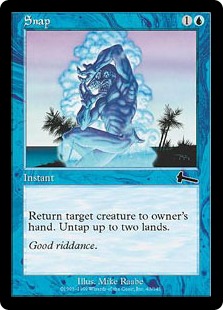
Image-1[card]Mulldrifter[/card] —> [card]Snap[/card] – Five mana for a 2/2 flyer that draws two cards is too slow, and three mana to draw two at sorcery speed is also too slow and it only affects you. [card]Snap[/card] highlights one of the very fun features of this format and how being on teams but taking separate turns creates extremely interesting board states. [card]Snap[/card] allows the person casting it to untap any two lands: including your teammates. So on your TM’s third turn, he can play a land, tap all three, you snap an opponent’s creature back to her hand and untap your TM’s land, giving him a total of five mana to work with while setting you opponent back a turn. How sweet is that?! [card]Frantic Search[/card] is an honourable mention that you can consider, but we wont be including in this iteration of the cube.

[card]Shelldock Isle[/card] —> [card]Spellsnare[/card] – Shelldock Isle is awesome when there is a real glut of huge creature to pick up and hide underneath it. Unfortunately for this situation, we have been cutting all of these creatures, so this amazing land gets way worse for us here. Spellsnare is going along with the more cheap counters for the increased number of cheaper cards. You’ll get something.

Image[card]Deep Analysis[/card] —> [card]Submerge[/card] – Drawing four cards for five mana and three life is great in long games, but not here. This is a card that looks very strange to be in a cube list, but considering that you always have the island and you have two other opponents who will probably have the forest, this spell is almost always free. Again cheap (or better yet, free), is the name of the game!

[card]Meloku the Clouded Mirror[/card] —> [card]Venser Shaper Savant[/card] – Here we have a scared cow being slaughtered. Meloku is an easily splashable, pack-one, pick-one in many, many cubes… but she’s five mana: cut. Venser is not in the regular list because he is expensive, but we are looking for as many counter spells to fit in here as possible to help blue in its ever supporting role.

[card]Control Magic[/card] —> [card]Brain Freeze[/card] – [card]Control Magic[/card] is a lot like Shelldock Isle, in that it’s awesome when there are tons of fatties running around. With four people playing lots of cheap spells interacting with each other, [card]Brainfreeze[/card] is a very real card and wins lots of games.

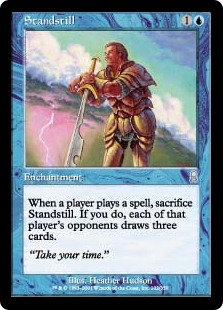
[card]Mind Control[/card] —> [card]Standstill[/card] – Same notes as [card]Control Magic[/card]. It is worth noting that [card]Mind Control[/card] is very good in the Puzzle Box list precisely because it is a much slower format. You can be sure that it will get something eventually as the game goes on. [card]Standstill[/card] is amazing in Twos. It will draw your team six cards for two mana so long as you have a slightly better board state than you opponents.

[card]Into the Roil[/card] —> [card]Curfew[/card] – [card]Into the Roil[/card] will usually only be an [card]Unsummon[/card], but its added flexibility is what makes it worth its inclusion in cube lists. [card]Curfew[/card] is the same cost as [card]Unsummon[/card] and you’ll often be able to sculpt a situation where it does twice as much work. Kind of making it four times as good as [card]Into the Roil[/card].

These are the cards that tend to highlight the nature of the format of twos. They may not be the optimal substitutions for the list, but they will send you well along your way to the more fun and complex states that exist in this format.

Other Options

You’ll also notice that the amount of counter spells has been ramped up. I have done this to try and emulate the format that I am familiar with. If you like the play style I described earlier in the post, you could go further and add in a bunch more blue cards, say an extra 15, to make the total size of the cube 275. Some other possible inclusions for that could be the following.

[Deck title=Possible Blue Inclusions for a Twos Cube]
[Spells]
Gitaxian Probe
Compulsive Research
Vapor Snag
Spell Pierce
Dispel
Negate
Complicate
Exclude
Remand
Essence Scatter
Windfall
Unsummon
Annul
[/spells]
[Creatures]
Calcite Snapper
Augur of Bolas
[/creatures]
[/deck]

A quick shout out to the Cubism Podcast. These guys are the real Twos gurus out there. They have been playing it for a long time and know the format inside and out. Check out their latest podcast for an in-depth look at Twos. Hit me up on Twitter, @awcolman, or leave a comment below if you have some ideas that could help me and the rest of us out with our Twos project.

Next time, we’ll cover the black section!

Thanks for hangin’.

Andrew

It Ain’t Easy Being Green

It’s been a long, hard couple of months after making top eight in back-to-back tournaments with my Mono-Green Beast Wars deck that I discussed here. Since then, I’ve been to two more PTQs and GP Cincinatti, but was unable to recapture the success I previously had with the deck. However, some others had quite a bit of success with different versions of Mono-Green.

Immediately after my first article went up, Stephen Girdner revised the list to his liking and made top eight of a PTQ.

[deck title=Mono-Green Aggro by Stephen Girdner]

[Creatures]
4 Experiment One
4 Elvish Mystic
4 Kalonian Tusker
3 Swordwise Centaur
2 Gyre Sage
4 Boon Satyr
2 Renegade Krasis
3 Nylea, God of the Hunt
4 Polukranos, World Eater
[/Creatures]

[Spells]
4 Aspect of Hydra
2 Bow of Nylea
1 Enlarge
[/Spells]

[Land]
3 Mutavault
20 Forest
[/Land]

[Sideboard]
3 Mistcutter Hydra
3 Pithing Needle
1 Tower Defense
2 Witchstalker
1 Bramblecrush
4 Nylea’s Disciple
1 Enlarge
[/Sideboard]
[/deck]

Later he revised it further and won a Magic Online Premier Event with it.

[deck title= Mono-Green Aggro by Stephen Girdner (TurboG73)]

[Creatures]
4 Elvish Mystic
4 Experiment One
4 Kalonian Tusker
3 Swordwise Centaur
2 Gyre Sage
4 Boon Satyr
4 Witchstalker
2 Nylea, God of the Hunt
3 Polukranos, World Eater

1 Mistcutter Hydra
[/Creatures]

[Spells]
4 Aspect of Hydra
2 Bow of Nylea
[/Spells]

[Land]
3 Mutavault
20 Forest
[/Land]

[Sideboard]
3 Mistcutter Hydra
3 Ranger’s Guile
1 Pit Fight
2 Tower Defense
1 Renegade Krasis
3 Nylea’s Disciple
2 Bramblecrush
[/Sideboard]
[/deck]

Mason Lange made the top eight of an SCG Open with a very different version.

[deck title=Mono-Green Aggro by Mason Lange]

[Creatures]
4 Brushstrider
4 Burning-Tree Emissary
4 Elvish Mystic
4 Experiment One
4 Kalonian Tusker
4 Reverent Hunter
2 Scavenging Ooze
3 Slaughterhorn
4 Boon Satyr
1 Nylea, God of the Hunt
[/Creatures]

[Spells]
2 Mending Touch
1 Ranger’s Guile
[/Spells]

[Land]
19 Forest
4 Mutavault
[/Land]

[Sideboard]
3 Dryad Militant
4 Mistcutter Hydra
4 Nylea’s Disciple
1 Scavenging Ooze
2 Mending Touch
1 Bramblecrush
[/Sideboard]
[/deck]

Recently, even Raphael Levy has taken up the Mono-Green mantle with this list.

[deck title= Raphael Levy – Mono Green Aggro]

[Creatures]
4 Experiment One
4 Elvish Mystic
3 Spire Tracer
4 Burning-Tree Emissary
3 Burshstrider
4 Kalonian Tusker
3 Scavenging Ooze
3 Reverent Hunter
[/Creatures]

[Spells]
4 Aspect of Hydra
3 Giant Growth
1 Ranger’s Guile
[/Spells]

[Land]
2 Mutavault
16 Forest
[/Land]

[Sideboard]
2 Mutant’s Prey
2 Ranger’s Guile
2 Hunt the Hunter
1 Gyre Sage
2 Plummet
1 Scavenging ooze
1 Skylasher
2 Unravel the Aether
1 Tower Defense
1 Reverent Hunter
[/Sideboard]
[/deck]

What comes next for Mono-Green, you ask? Well, I’m not entirely sure, but there are a ton of options including a splash with any other color. I’ll be covering what I would do with the deck with each color combination and a straight Mono-Green update below.

[deck title= Blue Splash]

[Creatures]
4 Experiment One
4 Elvish Mystic
4 Kalonian Tusker
4 Kiora’s Follower
4 Reverent Hunter
4 Boon Satyr
3 Nylea, God of the Hunt
2 Polukranos, World Eater
[/Creatures]

[Spells]
4 Aspect of Hydra
2 Simic Charm
2 Bow of Nylea
[/Spells]

[Land]
4 Breeding Pool
2 Temple of Mystery
4 Mana Confluence
3 Mutavault
10 Forest
[/Land]

[Sideboard]
3 Mistcutter Hydra
3 Setessan Tactics
2 Simic Charm
3 Witchstalker
4 Nylea’s Disciple
[/Sideboard]
[/deck]

The blue splash offers a couple interesting options for the main including [card]Kiora’s Follower[/card] for ramp/defensive purposes, and [card]Simic Charm[/card] which does absolutely everything you could want a card to do in this deck. The only real issue the blue splash has is that it can’t protect itself from [card]Supreme Verdict[/card], and that is a problem if control decks become more popular.

[deck title= Black Splash]

[Creatures]
4 Experiment One
4 Elvish Mystic
4 Kalonian Tusker
4 Swordwise Centaur
4 Reverent Hunter
4 Boon Satyr
3 Nylea, God of the Hunt
2 Polukranos, World Eater
[/Creatures]

[Spells]
4 Aspect of Hydra
2 Bow of Nylea
2 Putrefy
[/Spells]

[Land]
4 Overgrown Tomb
2 Temple of Malady
4 Man Confluence
3 Mutavault
10 Forest
[/Land]

[Sideboard]
3 Mistcutter Hydra
3 Thoughtseize
3 Golgari Charm
2 Putrefy
4 Nylea’s Disciple
[/Sideboard]
[/deck]

The black splash doesn’t offer much in the main deck outside of removal like [card]Putrefy[/card], but it does offer the best sideboard options of any of the color splashes. You gain protection from [card]Supreme Verdict[/card] with [card]Thoughtseize[/card] and [card]Golgari Charm[/card], and access to more removal with [card]Putrefy[/card]. I tried some of the various other removal earlier in the season, but [card]Ultimate Price[/card] and [card]Doom Blade[/card] were just too narrow when I needed to hit various threats. I came to the conclusion that [card]Putrefy[/card], which can hit pretty much anything, was the best option available.

[deck title= Wite Splash]

[Creatures]
4 Experiment One
4 Elvish Mystic
4 Kalonian Tusker
4 Voice of Resurgence
4 Reverent Hunter
4 Boon Satyr
3 Nylea, God of the Hunt
2 Polukranos, World Eater
[/Creatures]

[Spells]
4 Aspect of Hydra
2 Bow of Nylea
2 Selesnya Charm
[/Spells]

[Land]
4 Temple Garden
2 Temple of Plenty
4 Mana Confluence
3 Mutavault
10 Forest
[/Land]

[Sideboard]
3 Mistcutter Hydra
2 Deicide
3 Banishing Light
3 Ready//Willing
4 Nylea’s Disciple
[/Sideboard]
[/deck]

The white splash adds the second best sideboard options, and one of the best main deck cards among any of the versions of Mono-Green. Adding a card like [card]Voice of Resurgence[/card] adds a lot of protection against decks like Mono-Black Devotion, Esper Control, and U/W Control. The sideboard all-stars in this version are [card]Banishing Light[/card], allowing you to deal with nearly anything, [card]Deicide[/card], which lets you deal with those pesky [card]Detention Sphere[/card]s and gods, and [card]Ready // Willing[/card], allowing you to survive board wipes and occasionally get value with the other half.

[deck title= Red Splash]
[Creatures]
4 Experiment One
4 Elvish Mystic
4 Kalonian Tusker
4 Reverent Hunter
4 Boon Satyr
3 Nylea, God of the Hunt
2 Polukranos, World Eater
4 Ghor-Clan Rampager
[/Creatures]

[Spells]
4 Aspect of Hydra
4 Domri Rade
[/Spells]

[Land]
4 Stomping Ground
2 Temple of Abandon
4 Mana Confluence
3 Mutavault
10 Forest
[/Land]

[Sideboard]
4 Mistcutter Hydra
3 Setessan Tactics
4 Witchstalker
4 Nylea’s Disciple
[/Sideboard]
[/deck]

The red splash adds a lot to the main deck, but nothing relevant to the sideboard. Adding [card]Ghor-Clan Rampager[/card] adds the much-needed effect of allowing you to push through your opponent’s creatures with your efficient monsters. Speaking of which, [card]Domri Rade[/card] gives you a steady stream of gas that can push you through those board stalemates and wrath effects.

[deck title= Mono-Green]
[Creatures]
4 Experiment One
4 Elvish Mystic
4 Kalonian Tusker
4 Swordwise Centaur
4 Reverent Hunter
4 Boon Satyr
3 Nylea, God of the Hunt
2 Polukranos, World Eater
[/Creatures]

[Spells]
4 Aspect of Hydra
2 Setessan Tactics
2 Bow of Nylea
[/Spells]

[Land]
3 Mutavault
20 Forest
[/Land]

[Sideboard]
4 Mistcutter Hydra
2 Ranger’s Guile
2 Plummet
2 Setessan Tactics
2 Witchstalker
3 Nylea’s Disciple
[/Sideboard]
[/deck]

And finally, the mono-green version, which has the benefit of a mana base that won’t occasionally slow you down or cost you a bunch of life. This will likely be very relevant for the first few weeks of the format, as players like to push the most aggressive strategies available until those decks get put in check. The only card this version of the deck really gained is the green [card]Wrath of God[/card] in [card]Setessan Tactics[/card]. The biggest issue the mono-green deck faced before was its inability to remove threats from the board, but with [card]Setessan Tactics[/card], you not only get that ability, but you can now have an additional pump spell in the deck to push through those final points of damage.

That’s all I have for now. I’m very excited for the prospects of Mono-Green Aggro in the near future, and hopefully you are as well. If you have any questions or comments, please leave them below and I will try my best to give you an answer.

Thanks for reading,

Josh Milliken

@joshuamilliken on Twitter

P.S. – Hail Hydra!

Brainstorm Brewery #99 – Hill Giant

This is the set review to end all set reviews. Recognizing that a large part of finance is properly evaluating cards in terms of playability, the gang enlists the help of a living legend, Zac Hill (@zdch). Formerly of Wizards of the Coast R&D (lead game designer), writer of StarCityGames’s Chatter of the Squirrel column and current COO of the Future Project (www.thefutureproject.org), Zac brings a tremendous wealth of knowledge and experience to the cast. The cast goes long, and you won’t even care with in-depth discussion about the financial implication and playability of the rares and mythics in Journey into Nyx. There’re no games, no segments, no Magic 8 ball—just wall-to-wall finance talk that will have you saying, “That was a good episode; I rather enjoyed it.”


  • The gang is joined by a very special guest Zac Hill (@zdch).
  • Support our Teespring campaign, and order some merch! www.brainstormbrewery.com/store
  • Next week is Episode 100! Tune in for a very special episode.
  • Got an idea for how we can structure future set reviews? Let us know!
  • The address is brainstormbrew at gmail dot com

Cabe Riseau produced the intro and outro music for Brainstorm Brewery.


Contact Us

Brainstorm Brewerywebsiteemailtwitterfacebook

Ryan Bushardemailtwitterfacebookgatheringmagic.com

Corbin Hosleremailtwitterfacebook – quitespeculation.com

Jason E Altemailtwitterfacebookgatheringmagic.com – quitespeculation.com

Marcelemailtwitterfacebook

Conjured Currency #12: BYOB (Be Your Own Buylist)

I’m going to start this week’s article by linking to another person’s article from another website. Last week, Travis Allen explained how the margins on speculation are often lower and riskier than someone who is not accustomed to the workings of MTG finance would expect. As somewhat of a follow-up to that article, I’d like to explain one of the alternative methods to speculating that tends to yield a much higher return on investment, and at the same time can provide a valuable service to the community. Go ahead, read Travis’s piece. I’ll wait.

…. Are you back? Cool. It was an incredibly well written article that should hopefully help dispel the myth that speculators are making out like bandits when a card doubles, triples, or even quadruples in price. It’s very difficult to make significant money on actual blind speculation, not counting the [card]Master of Waves[/card]/[card]Thassa, God of the Sea[/card] situations where we have insider information from a pro tour leak.

The alternative method that I want to discuss this week does require a significant amount of disposable income, or the ability and dedication to make repeated short-term flips to maintain an open cash flow. It’s not for everyone, but my goal is that someone reads this article and realizes: “Hey, I could do that.” If the title is any indication, our discussion this week is on how you can act as your local area’s buylist. If you know that you can pay better than your LGS, or if you can work with your LGS when making buys, then you can help out the players in your area and sometimes even the local store. It’s a lot easier to make incremental increases in your inventory and funds when you make other people aware that you’re almost always willing to buy something for buylist prices, and then resell it at a later date.

Requirements

Be patient. If you go around on every Facebook page and constantly nag people about buying their cards at buylist, they won’t want to sell, and with good reason. Just be patient, friendly, and wait for opportunities. Magic is an expensive hobby, and people tend to overextend their budget into it. When life hands out unexpected inconveniences and people need to sell specific pieces of their collection, you can be ready with cash in hand.

About a month ago, I wrote about how we don’t necessarily need the cards that we think we do, we just want them. In my opinion, one of the core requirements to providing this service is that you make sure that when you buy cards at buylist prices, you don’t need the cards you buy. If you are offered to buy cards that you do actually want for personal deckbuilding objectives, then be honest with the person you’re doing business with, and offer up a little more than you normally would.

I recommend having access to the major retailers’ current buylists, so you always know how much to offer on a card. If you’re a Quiet Speculation Insider, you probably use Trader Tools at mtg.gg. If not, MTGPrice.com has its’ own free tool that collects current buylist prices and provides them for you to use. As a general rule, I try to almost match the highest current buylist price, so that if worst comes to worst, I can immediately out the card with no net loss.

Be fair with pricing even if you know they’ll accept less. If you buy a [card]Hallowed Fountain[/card] from one of your friends for $5, then don’t offer someone else $4 if you know they need the money badly for car repairs and you’re sure they’ll accept it. Pick a number and stick to it for as long as your inventory allows. If you start to buy too much to the point where you feel the need to lower your buy number, then you’re probably not performing enough inventory turnover, and I’ll redirect you to my fellow BSB writer Anthony Capece to learn about that issue. Keep your buy price static until you move what you have. Then there’s no cross talk between your customers about who got paid what.

What About the LGS?

If you’re still reading at this point, then you didn’t instantly close the browser when I mentioned the prospect of giving better prices than your LGS. Good. I’m sure that I lost quite a few people by bringing up the thought of purchasing cards at buylist prices instead of directing people to your friendly local game store, but hear me out. I’m not trying to say you should bring a massive trenchcoat to FNM and buy singles from under the store owner’s nose. Don’t do that. Don’t even pull the lame trick of going out into the parking lot/across the street to do your cash deals. The store owner has rent to pay, and he’s letting you play there. We all know it’s a dirty move. However, your LGS doesn’t have domain over the entire town or city that you reside in. They have their margins that they have to make, and you have yours. Yours are probably a bit more flexible because you don’t have to keep the lights on in a business. I don’t think it’s unethical to suggest offering higher prices than the store while outside of their domain.

In addition, I’ve been in multiple situations where it’s entirely possible to work together with your store so that literally everybody wins. If you’re lucky (or unlucky, depending on how you look at it) enough to have a store that doesn’t deal in singles, then you can be the one to provide that service, and get a ton of business by asking the owner to politely direct singles purchases towards you. At another store I’ve come across in my travels, the owner was only able to offer a miniscule amount of store credit for players’ singles, not cash. Since the player was going to spend the credit anyway, I proposed that I buy the cards for more cash than was being offered in store credit. I got the cards at buylist prices, the player got more value for his cards that he didn’t want anymore, and the store owner got actual cash in his register instead of just the player spending store credit. Everyone wins!

Be Your Own Buylist

Obviously some of these are pretty niche situations that won’t apply to a ton of readers, but the moral of the story is that it’s still entirely possible to buy cards at buylist prices locally if you’re patient, polite, and know your outs and margins well enough. I started out doing this a few years ago just by being the first to respond to Facebook posts of friends. If you have the income (or can flip the items you acquire for a fast profit), then this can be a way to help those in your community while increasing your available funds for Magic.

Do you disagree with any of my personal ethics on the area that an LGS has? Do you have any other suggestions that slipped my mind while writing the piece? Your comments are often just as important as what I write, so I’d love to hear them.

Pitt Imps Podcast #68 – OK We Ramble Alot

In this weeks installment of the Imps we begin to see what cards from Journey Into Nyx is going to be players in the upcoming standard season at SCG Cinci. We have posse member Walter on to go over this with us. Then we make sure you save your $$$ and not buy the new Event Deck. Seriously, this is one of the worst ever. Then as the title says….. well, you know

Your hosts: Angelo & Ryan

Angelo’s Twitter: @Ganksuou

Ryan’s Twitter: @brotheryan

Show’s Email: [email protected]

Guest  Walter

The View From 10,000 Feet

The popularity of Magic: The Gathering has exploded over the past few years.

There, I just taught you everything you need to know about Magic finance. I’m not kidding. Well, I’m sort of kidding.

The truth is that it’s been pretty easy to make money buying and selling Magic cards recently because the overall price level of cards has consistently risen. Modern cards have generally increased in price. Legacy cards have generally increased in price. Casual and/or Commander cards have generally increased in price. Standard cards bounce around for a while in the format and the playable ones eventually find their way into one of those groups and rise in price. So the basic strategy has been to buy Magic cards, wait until they go up, then sell them. Sure, some of the better speculators find cards that go up more or go up faster, but this basic approach works for mostly everyone. Don’t get me wrong, I’m not saying it’s impossible to lose money doing this. If you don’t understand transaction costs, don’t really understand Magic, or just don’t have decent business sense, I have no doubt you can fail at Magic finance. For the rest of us, though, buying good cards at reasonable prices is enough to stay in the black. You don’t have to be great at evaluating cards as long as you buy a good mix of stuff when you see good deals. Even reprintsformerly the most spectacular way to crash and burn on Magic specsdon’t seem that awful anymore. Modern Masters taught us that you’ll have to wait longer to cash out, but the ever-increasing player base will absorb the new copies just the same.

Macro View

It’s important to understand that all this is being caused by the larger upward trend in Magic’s popularity. We all felt like geniuses when our Modern specs started spiking last year until we realized that basically every Modern card was going to spike. It was about the larger trend of a format growing in popularity, not about the specific cards. The big picture at that point was that Modern was on fire. No other information needed. Playable Modern cards were either good, great, or amazing buys, even the ones that didn’t end up seeing much play. Again, some people did better than others, but the only real losers were the ones who didn’t play. Recognize the trend, jump in, profit. When you step back even further and get the 10,000-foot view, you realize that the most important call yet was not on a particular card, set, or even format, but on Magic as a whole. Sure, different sectors of Magic have jumped at different times. The Commander trend, the aforementioned Modern trend, the Legacy trend. But Magic taking off as a game was the trend that started all the other trends, and getting that call right has been, by far, the single biggest money-maker to date.

Flashback Time

Five years ago, Alara Reborn had just hit shelves. Magic finance wasn’t a thing (or it was just called “running a store”), and the new core set and Duels of the Planeswalkers were just getting ready to debut. American grands prix were starting to hit the 1,000-player mark consistently. All the ingredients were there. Hindsight is 20/20, but did you see it at the time? In all likelihood, you were just getting back into the game, oblivious to the fact that there were a million others just like you doing the exact same thing. If you could go back and talk to your 2009 self about Magic finance, what would you say? Sure, you could coach him up on specific cards that were in the pipelinetrade for fetches, pre-order [card]Jace, the Mind Sculptor[/card], find foil eldrazi, etc.but mostly you would just say, “Get as many Magic cards as you can. Get everything, and get a lot of it.” Is there really much that would have been a bad investment? Let me remind you that we live in a world where [card]Lord of Extinction[/card] is a $12 card. How about sealed product of pretty much any kind? Zendikar boxes? The Divine vs. Demonic Duel Deck that was just hitting shelves? All those soon-to-be Commander staples sitting in bulk boxes? No need to pretend that we could have foreseen $80 fetches since we would have been shoveling those into our binders along with everything else. Literally anything you could get your hands on at the time would turn out to be money well spent. Magic itself was a good investment. If you had your head buried in decklists and tournament reports, you may not have seen it happening around you. But if you had backed up and taken a broad look at the entirety of Magic, the 10,000-foot view, you may have seen surging tournament attendance, exciting new products, more powerful cards being printed, and renewed interest from old players. You may have noticed something was going on.

Take a Look Around

The question I want you to ask yourself is simply, “What’s going on with Magic right now?” I’m not asking what’s happened over the past six months or a year. I know Modern exploded in popularity. I know dual lands jumped in price. I have to chuckle whenever I see Magic financiers post something on Twitter like “don’t sell fetch lands yet, they are still going up and Modern season is this summer.” Thank you for the report. I’m asking what is going on right now, today, as we speak, in game shops, kitchens, and cafeterias all over. Wherever you were in 2009, did you know players were starting to flock to the game in record numbers? You probably missed it, even though you were right in the middle of it, because you were having so much fun that you forgot to look around. I did. Well, do you know what players are doing now? Are you again right in the middle of something and not seeing it? Are you looking? This isn’t the “pick a format that hasn’t spiked in a while and buy in” exercise. This is trying to understand the health and direction of the entire thing. And there is no answer in this article  because I don’t know for sure either. I’m writing to encourage you to spend time trying to figure it out. Do you think Magic has peaked? Why or why not? Are we just getting started, or somewhere in the middle? Do you have a good answer either way? If your default response is, “I think Magic is going to continue to increase in popularity because that’s what it’s been doing for the past few years,” you have some work to do. I’m not saying you are wrong, just that you are clearly guessing. If you have no idea, I suggest you start with Hasbro’s investor materials. Sure, it’s backward looking but it’s right from the horse’s mouth and they occasionally say something really interesting. Plus, with @time_elemental live-tweeting the earnings call, you have no excuse. On that subject, does this surprise you at all? timeelemental

There is a saying in financethey don’t ring a bell at the top. Magic could have peaked today for all we know. We wouldn’t notice it until it had declined somewhat. Any time you are at an all-time high, you are just one bad day away from having peaked. I don’t necessarily think that’s the case and I’m not trying to convince you of it here, but how are you planning to recognize this when it does happen? Then again, maybe this is only the beginning. Maybe Magic goes mainstream with the movie and the action figures and whatever else. Maybe the next generation grows up watching Adventures of the Planeswalkers on Saturday morning. We’ll look back and say, “This was about the time that 4,000 player GP’s started to happen more regularly.” If that is the case, it would be nice to figure it out now. So what would your 2019 self say to you about Magic finance today? Is it, “Get everything, and get a lot of it?” Or is it, “What was Magic finance?” There is a lot of money riding on the answer. Thanks for reading.

A Unified Theory of Commander

Commander is a complicated game. Despite being a “casual” format, the massive pool of playable cards, multiplayer politics, and varied expectations of what constitutes the “Spirit of Commander” can make trying EDH for the first time quite intimidating. The trouble finding sound advice on how to build and play a deck online doesn’t help the situation much for new players either. While veteran players in places like the EDH subreddit are happy to share their knowledge of the format with new players, their advice is often complicated, contradictory, and overly specific.

It’s no surprise then that new players often turn to a preconstructed product like the recent Commander 2013 decks or to copying a list they find online to get started. It often takes months of trial and error, adding and subtracting, and lots of long, difficult games before a player begins to understand what their deck really wants to do, let alone what cards are actually effective at helping them have fun and win a few matches along the way. This steep learning curve inspires some players to improve, but also drives some players clear out of the format.

Just imagine what he might tweet if someone tried to teach him Commander.

Just imagine what he might tweet if someone tried to teach him Commander.

Easy to Learn

Contrast this to any thread where a player asks for advice on how to draft for the first time. Veteran players virtually trip over each other to be the first to post the BREAD system for drafting. If you aren’t familiar with the system yourself, it provides a basic framework for how to draft an effective deck no matter what three packs the players are cracking at the table. It goes like this:

B is for Bombs – The first thing players should be looking for are cards that win the game. These are powerful cards that are difficult for opponents to deal with and usually either win the game immediately or put the player so far ahead that the opponent has little chance of coming back.

R is for Removal – After game winners, players need cards that remove or otherwise disable powerful creatures and other troublesome permanents played by their opponents.

E is for Evasion – Creatures that can fly, are unblockable, hexproof, or are otherwise good at pushing through damage are said to have evasion. While these cards don’t usually win the game themselves, they can put a player well ahead if left unanswered.

A is for Aggro – Aggressive cards are usually cheap or undercosted creatures and spells that let a player race ahead in damage.

D is for Duds – Usually the last few picks in any pack are the “bad” cards in the format, or at least the ones with very narrow utility. Pick these last, but look for cards in your colors that might provide a good sideboard option in a specific match-up.

No matter what set a player might be drafting, he or she can generally follow this advice and find success in an event. Each time the player picks up a stack of cards, whether its a “pack one, pick one” moment or the dregs of the third pack, evaluating the available picks using the BREAD system sets a player up for success. Of course there are other nuances to drafting, like knowing when to force a particular deck archetype or how to signal your picks to the table, but these additional elements are dependent on the player first applying the BREAD system effectively.

Difficult to Master

So why is it so easy to communicate a basic theory for drafting, but so difficult to offer sound advice on how to play Commander? Why can a five-letter acronym start any player off at Friday Night Magic, but building your first deck for a casual game of EDH requires multi-thousand word essays to explain? Some might argue that the complexity of the format demands this much detail. Others will suggest that since there is a wide spectrum of expectations for the format that fall somewhere between the casual “House Rules No Counterspells, No Attacking Until Turn Ten” and the cutthroat  “Stax Lockdown No One Plays But Me” playgroups, that any general advice is essentially meaningless.

I disagree. I believe that if you break Commander down into its constituent parts and examine every deck that successfully creates fun and interaction at the table, you can assemble a list of rules for EDH deckbuilding and playing that are as simple to learn and apply as BREAD. Whether you are building a casual squirrel tribal deck for laughs or assembling a competitive Animar list for a local tournament, I’d like to suggest a Unified Theory of Commander that can help inform your decisions both during deck construction and while you are slinging spells at the table.

While I don’t have an acronym like BREAD for you, I do have a mnemonic device to help you remember the theory. Repeat after me:

My Deck Tickled A Sliver.

My Deck Tickled A Sliver.

My Deck Tickled A Sliver.

Not sure I actually want to know what could make her giggle...

Not sure I actually want to know what could make her giggle…

No. I’m not advocating you do a little stand-up comedy in a brood pit. I want you to remember the five letters MDTAS in that particular order. My Deck Tickled A Sliver. MDTAS. Got it? Good. Now let’s learn what it means:

Mana, Draw, Threats, Answers, Synergy

Why is the order important? Because I believe that understanding the ordinal value of each of these elements can help players make good decisions about how to assemble a fun and functional EDH deck. Applying this theory to both building and playing a deck will cut down on the more frustrating parts of learning Commander and help new players start enjoying games more quickly. It might even teach a few veterans a thing or two as well.

So let’s do a brief introduction to each element of the theory.

Mana

Whether a player is attempting a [card]Hermit Druid[/card] combo deck meant to win every match (and lose all his friends) or a group hug [card]Phelddagrif[/card] deck with zero win conditions, playing cards in Magic requires access to mana. If a deck does not produce enough mana to reliably cast its spells, then the deck does not work. You cannot play the game without mana.

This may seem like a truism, but its a fact that is often lost on new players. They often run too few lands in their decks and when presented with the choice of adding a mana rock or another cool threat, they pick the threat. Unfortunately, that often means eight-drop game-winners end up as dead cards in their hands because they are stuck on six mana. So no matter your commander, your colors, your deck archetype, or your goals, the most important part of any Commander deck is access to mana.

Draw

Volumes of work have been written about how to define card advantage in Magic and not all accounts agree, so I won’t try to summarize or compete with the various arguments here. All you need to know for the purposes of this introduction to my Unified Theory of Commander: more cards is good. Fewer cards is bad. So drawing cards is one of the most important things your Commander deck can do.

Imagine for a moment that a game of Commander is a shoot out. Your hand is your gun and the cards in your hand are your bullets. The more bullets you’ve got access to, the more shots you can take and the more likely you are to start hitting your targets and eliminating threats. So run cards that reload your hand and keep you in the fight.

Threats

Brace yourself for another truism everyone: You must resolve threats to win a game of Commander. You need to play your cards to actually play the game, right? But what do I mean by threats? I mean cards that can win the game for you quickly if they go unanswered. Whether that means a giant creature, combo pieces, or an explosive spell, each deck should run enough game enders to make sure it can reliably have an impact on the board state in each game.

Now before players that pilot decks with goals other than winning the game grab their pitchforks, remember that for most players, the object is to win the game. So a threat is usually defined with that objective in mind. If you are piloting a deck with the goal to keep the game going until everyone has to concede and go home, then a “threat” means something different for you. It means a card that advances the mission of your deck.

Answers

This is perhaps the easiest element of my Unified Theory to explain, but potentially the most contentious part for new and casual players to swallow. Commander is not a four-man solitaire game. So even if you are running a theme deck with only a single, complicated win condition, it is not the responsibility of the rest of the table to let you play solo until you finally get that game ender online. It does not violate the spirit of Commander to interact with your janky deck.

It’s important for each deck builder to consider what removal options are available in her colors and which permanent types might be a problem. For instance, a monoblack player will likely need to consider some colorless options for removing enchantments. Do your homework and make sure your deck can respond to the win conditions other players drop on the table. Even a group hug deck needs to occasionally consider tucking someone’s commander to keep the game rolling and execute a political path to victory.

Synergy

The lowest ranked item on my list is perhaps the most discussed topic in any deck building thread. When a new player asks for advice online about getting into the format, the responses tend to be chock-full of suggestions about picking a commander and filling the deck with synergistic cards. But take a quick glance at the rest of my list and perhaps you’ll see why that’s a trap. Focusing on synergy can tend to make players overvalue cards that do not develop access to resources, threaten to win the game, or deal with the threats of others. Most sinister about this problem is that the synergy between cards can make the deck feel pretty good in certain instances, leaving players without a gut understanding of why its being ineffective.

Picking cards that synergize well with a commander must be less important than these other elements. Synergistic cards don’t matter if you can’t play them (lack of mana), can’t get them into your hand (lack of draw), can’t threaten to win the game (lack of power), or respond to the game plans being executed by other decks (lack of answers). Players have been advising each other to build their decks in reverse order. No wonder the format feels so difficult to understand.

Feeling Ticklish

Now you might have noticed that I didn’t include specific cards in this article. That’s because I didn’t want to distract you by talking about details. Like BREAD for drafting, the Unified Theory of Commander should be card agnostic. It’s a universal system that you can apply to any deck. But have no fear. I’ll be diving deep into each element of the theory in future articles. We’ve laid the foundation with My Deck Tickled A Sliver. Next we can start looking at what those tickle-fingers look like in practice.

The Divine Aristocrats

While I still intend to battle with my trusty RUG Monsters deck for the foreseeable future, that has not put a halt to my desire for a good brew. With that in mind, let’s talk about a spicy number that I have been thinking about since the Journey into Nyx prerelease.

[deck title=The Divine Aristocrats by Ken Crocker]
[Creatures]
*4 Cartel Aristocrat
*4 Voice of Resurgence
*4 Lotleth Troll
*3 Varolz, the Scar-Striped
*3 Athreos, God of Passage
*2 Pharika, God of Affliction
*2 Scourge of Skola Vale
*4 Desecration Demon
*3 Polukranos, World Eater
[/Creatures]
[Planeswalkers]
*2 Ajani, Mentor of Heroes
[/Planeswalkers]
[Spells]
*1 Dark Prophecy
*4 Abrupt Decay
[/Spells]
[Lands]
*4 Mana Confluence
*4 Temple Garden
*4 Overgrown Tomb
*4 Godless Shrine
*3 Temple of Malady
*3 Temple of Silence
*2 Swamp
[/Lands]
[/Deck]

Our Gods Are Awesome Gods

As always, it may be useful to go over some card choices:

  • Obviously, for an Aristocrats-style deck, we need to have some sacrifice outlets. [card]Varolz, the Scar-Striped[/card] and [card]Cartel Aristocrat[/card] fill that role nicely, but I felt we needed more. Thus, the two [card]Scourge of Skola Vale[/card].
  • Another key component of an Aristocrats deck is its difficult-to-answer threats. [card]Cartel Aristocrat[/card], [card]Varolz, the Scar-Striped[/card], [card]Lotleth Troll[/card], and both Gods fit that criteria rather nicely, each requiring different answers. Furthermore, our deck is also fairly [card]Supreme Verdict[/card] proof, given Lotleth Troll’s and Varolz’s regeneration, [card]Voice of Resurgence[/card]’s ability, and the gods being indestructible.
  • Value is the whole point of an Aristocrats deck. There is obvious value in Varolz’s ability (remember, a god is still a creature in the graveyard), but the added value of [card]Lotleth Troll[/card] pitching a God, and then scavenging it onto a [card]Cartel Aristocrat[/card] is something that cannot be ignored. Plus, both gods are gods of valuetown as it is!
  • Speaking of value, the one-of Dark Prophecy was just too juicy to not consider. It is triple black, helping turn on both gods, and it adds to the overall theme of value in our deck.
  • Topping out our curve at [card]Desecration Demon[/card], [card]Polukranos, World Eater[/card], and [card]Ajani, Mentor of Heroes[/card] is to make sure we still have threats that our opponent has to deal with, if they get past all the Aristocrat action. This might be one of the better Ajani decks, given that there are 30 targets in the deck for him to hit with his second +1 ability (29 if you count himself).
  • [card]Abrupt Decay[/card] handles [card]Detention Sphere[/card], one of the few ways that your creatures or gods can be dealt with permanently. It also has the added bonus of killing whatever might be in your way early on. It basically slices, dices, and makes Julian fries.
  • The mana base is skewed more toward black. Notice that you only have six comes-into-play-untapped lands. The rest are either scry lands or shock lands. This is not by mistake. You do not have any turn-one plays, so we do not need to pay life on turn one. However, there are more shock lands than scry lands because we want to curve out from turn two and onward.

But What Does It All Mean?

Undoubtedly, many of you have seen either B/W Athreos decks or B/G Dredge decks. Both are solid deck choices that other pros have written about extensively. Assuredly, they have tested them to a certain extent and nobody else that I have seen has written about a Junk Aristocrats deck. So what are the advantages of playing this deck over either one of those?

Divine Aristocrats vs. B/W Athreos

  • Divine Aristocrats gets more value out of the cards you are playing even if you opponent lets your creature cards go to the graveyard. Yes, [card]Athreos, God of Passage[/card] has a sweet ability, but remember, it is an ability that gives your opponent a choice. In a straight B/W Athreos deck, your opponent gets a chance to mitigate the damage of this choice by making the worst choice for you. In our Divine Aristocrats deck, even if our opponent chooses to take the damage, we get extra value vis-à-vis [card]Pharika, God of Affliction[/card] and [card]Varolz, the Scar-Striped[/card].
  • We get access to [card]Abrupt Decay[/card], Varolz, [card]Voice of Resurgence[/card], [card]Ajani, Mentor of Heroes[/card], and [card]Lotleth Troll[/card]. While B/W gets the sweet synergy of [card]Xathrid Necromancer[/card], our overall card quality is higher, all things being equal.
  • We do not get as blown-out by [card]Anger of the Gods[/card]. Yes, as of right now, nobody plays that card. But some of us diligent Magicians have placed it in our sideboards, just in case. While both decks suffer from Anger of the Gods, ours has plenty of cards that play around it, including [card]Desecration Demon[/card], [card]Polukranos, World Eater[/card], [card]Varolz, the Scar-Striped[/card], and [card]Lotleth Troll[/card].

Divine Aristocrats vs. B/G Dredge

  • Our deck does not rely as heavily on the graveyard. I have played from the B/G Dredge side of things. Cards like [card]Scavenging Ooze[/card], [card]Agent of Erebos[/card], [card]Crypt Incursion[/card], and [card]Tormod’s Crypt[/card] do exist. While only one of them sees any competitive play, if the B/G Dredge deck picks up any steam because of the addition of [card]Nyx Weaver[/card], then we could see an uptick in graveyard hate. Bad for us, worse for the Dredge player.
  • We get access to Athreos, [card]Voice of Resurgence[/card], and [card]Ajani, Mentor of Heroes[/card]. Once again, our card quality, on the face of it, seems higher than theirs, especially since their cards are much more reliant on synergy than ours.
  • Sometimes the B/G Dredge deck just misses. While it has been constantly upgraded with the release of every new set, the B/G Dredge deck does not actually play like a Legacy Dredge deck. It can be inconsistent and it can miss. If that happens, there is not much of a Plan B for the deck. The Divine Aristocrats has several plans, including backup plans to our backup plans. This is just another way of saying we are more consistent than the B/G Dredge deck.

There are two areas that these other decks have ours beat: they have been more thoroughly tuned and, as a result, their mana bases are better. My response to those who make these claims is: nobody has tested the Divine Aristocrats. So of course it will not be as tuned and, as a result, the mana base is probably not optimal. That’s where you lovely readers get to get your hands dirty.

Cards Not Included

Here are some cards that did not make the cut, and the reasons why:

[card]Xathrid Necromancer[/card]: Just not enough humans to take advantage of his ability. Would have to be a whole different deck in order to want to include him.

[card]Brain Maggot[/card]: Why did they have to change the templating!? If this would have stayed a [card]Mesmeric Fiend[/card], it would have been an easy four-of in the maindeck. As it stands, a 1/1 for two mana that does not get any value when dead does me no good.

[card]Nighthowler[/card]: This may actually work. As of right now, I feel like this card is too inconsistent in power level to include it. However, I would be willing to be shown I am incorrect.

[card]Herald of Torment[/card]: See Nighthowler above. The only difference is that this is less inconsistent. If I were to start tweaking and playtesting today, this would be the first card I would look to add. Probably in the [card]Dark Prophecy[/card] / [card]Scourge of Soka Vale[/card] spot.

Build a Better Sideboard

Some of you may have noticed that the decklist at the start of the article did not have a sideboard. There is good reason for that. Some people say that you should build a 75-card deck, figure out the best possible configuration, and make that your main, moving the other 15 cards to the sideboard. Others, like myself, think that you build your 60 card main deck, then look for places to shore up certain matchups with your sideboard. However, when I am theory-crafting, I tend to leave the sideboard out of the equation, in order to determine if the main deck is viable. But I won’t leave you completely stranded.

Obviously, we want some amount of discard for the U/W/x Control decks. Probably about four to five cards. So some mixture of [card]Thoughtseize[/card] and [card]Duress[/card] seems appropriate.

Mono-Blue is still going to be a deck. Better pack some hate. While [card]Mistcutter Hydra[/card] might be great here, I think I would rather have [card]Skylasher[/card]. Skylasher is capable of flashing in, is more mana efficient, and actually has a power/toughness for Varolz to scavenge later, if needed.

[card]Deicide[/card] is both good against us, and a powerful card to have access to for our sideboard.

Since we are very much aware of the B/G Dredge deck, packing some hate seems like a good idea. [card]Scavenging Ooze[/card] seems to be one of the best answers, and it has the added bonus of getting big enough to fight some of the creatures.

With all this (and more) in mind, here is my first complete decklist:

[deck title=The Divine Aristocrats by Ken Crocker]
[Creatures]
*4 Cartel Aristocrat
*4 Voice of Resurgence
*4 Lotleth Troll
*3 Varolz, the Scar-Striped
*3 Athreos, God of Passage
*2 Pharika, God of Affliction
*2 Scourge of Skola Vale
*4 Desecration Demon
*3 Polukranos, World Eater
[/Creatures]
[Planeswalkers]
*2 Ajani, Mentor of Heroes
[/Planeswalkers]
[Spells]
*1 Dark Prophecy
*4 Abrupt Decay
[/Spells]
[Lands]
*4 Mana Confluence
*4 Temple Garden
*4 Overgrown Tomb
*4 Godless Shrine
*3 Temple of Malady
*3 Temple of Silence
*2 Swamp
[/Lands]
[Sideboard]
*3 Thoughtseize
*2 Durress
*2 Scavening Ooze
*4 Skylasher
*1 Deicide
*1 Golgari Charm
*1 Whip of Erebos
*1 Pithing Needle
[/Sideboard]
[/Deck]

Feel free to leave any comments about the deck. May the gods be forever in your favor!

Pitt Imps Podcast #67 – Our Pre-Releases

In this weeks episode we have on Matt from the posse for the next listener guest. We go over the subject of phones. Then we ramble about banning Standard since Melira didn’t get banned. Oh yea there was some pre-release stories in there as well.

Your hosts: Angelo & Ryan

Angelo’s Twitter: @Ganksuou

Ryan’s Twitter: @brotheryan

Show’s Email: [email protected]

Guest – Matt   Twitter @stackopamcake

Brewing with Journey Into Nyx

Welcome back for Brewing with Journey into Nyx. I’m going to run you through some possibilities that this great new set has created for us. One thing I can’t do is provide complete sideboards, but I will provide some suggestions to look at when you decide to take one of these decks out for a spin. The other thing to remember is that these decks may require some tuning. As with every new set, the metagame shifts and makes it hard to predict the exact cards you will always want in your main deck.

Updating the Old

There are two decks that get cards that could be very good for them, but don’t really change how the deck looks, so let’s start off with those decks since I’m not going to bother with lists for them.

Mono-Black Devotion gains a few significant weapons with [card]Dictate of Erebos[/card], [card]Extinguish All Hope[/card], and [card]Silence the Believers[/card]. What [card]Dictate of Erebos[/card] means for this deck is not having to worry about dying to [card]Blood Baron of Vizkopa[/card] or hexproof creatures as often, as now you can just kill your own creatures to make them sacrifice theirs. [card]Extinguish All Hope[/card] provides a mid-game wrath effect that may or may not be good enough depending on hope the metagame develops. While [card]Silence the Believers[/card] is a pretty reasonable way to deal with gods and creatures, getting better the longer the game goes.

Mono-Blue Devotion gets a few cards that aren’t necessarily auto-includes, but are very solid none the less. One option is [card]Dakra Mystic[/card], which could replace [card]Judge’s Familiar[/card] to draw some extra cards when you run into a slow board state. The other card is [card]Hypnotic Siren[/card], which could also replace [card]Judge’s Familiar[/card], to allow you to steal your opponents creatures when you get into the late game, or even when you draw a [card]Nykthos, Shrine to Nyx[/card].

Brewing the New

[deck title= Selesnya Enchantress]

[Creatures]
4 Elvish Mystic
4 Voyaging Satyr
4 Voice of Resurgence
4 Eidolon of Countless Battles
4 Courser of Kruphix
4 Eidolon of Blossoms
[/Creatures]

[Spells]
4 Banishing Light
2 Unflinching Courage
3 Ajani, Mentor of Heros
3 Elspeth, Sun’s Champion
[/Spells]

[Land]
4 Temple Garden
4 Temple of Plenty
4 Mana Confluence
2 Nykthos, Shrine to Nyx
4 Plains
6 Forest
[/Land]
[/deck]

Enchantress has really only been a deck in Legacy for the last few years, but with [card]Eidolon of Blossoms[/card], it is now a possible strategy in Standard. Getting [card]Ajani, Mentor of Heros[/card], to get even more card advantage and [card]Banishing Light[/card] to deal with hard-to-answer permanents, this deck can compete with the rest of the field. Running [card]Nykthos, Shrine to Nyx[/card], allows for some very explosive draws since everything in the deck sticks around.
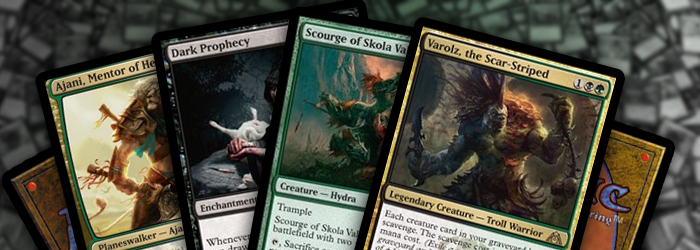
Sideboard Suggestions: [card]Arrest[/card], [card]Deicide[/card], [card]Rootborn Defenses[/card], and [card]Sphere of Safety[/card].

[deck title= White Weenie]

[Creatures]
4 Dryad Militant
4 Soldier of the Pantheon
4 Aegis of the Gods
4 Imposing Sovereign
4 Precinct Captain
4 Banisher Priest
3 Brimaz, King of Oreskos
[/Creatures]

[Spells]
3 Brave the Elements
3 Launch the Fleet
2 Spear of Heliod
2 Godsend
[/Spells]

[Land]
3 Mutavault
20 Plains
[/Land]
[/deck]

This classic strategy gets some very potent new toys with [card]Aegis of the Gods[/card] to slow the burn decks down and hinder [card]Thoughtseize[/card] until Aegis dies. [card]Launch the Fleet[/card] will be huge, allowing you to get in several extra points of damage while adding to your board presence. In addition, [card]Godsend[/card] is a very unique card that can push you through your opponent’s creatures. Expect mad rushes of white creatures in the immediate future.

Sideboard Suggestions: [card]Ajani’s Presence[/card], [card]Banishing Light[/card], [card]Deicide[/card], and [card]Fiendslayer Paladin[/card].

[deck title= Mono-Red Devotion]

[Creatures]
4 Frostburn Weird
4 Prophetic Flamespeaker
4 Boros Reckoner
4 Fanatic of Mogis
4 Stormbreath Dragon
[/Creatures]

[Spells]
1 Blinding Flare
3 Magma Jet
4 Mizzium Mortars
3 Hammer of Purphoros
2 Harness by Force
3 Chandra, Pyromaster
[/Spells]

[Land]
4 Sacred Foundry
4 Temple of Triumph
3 Nykthos, Shrine to Nyx
13 Mountain
[/Land]
[/deck]

This deck is set up to maximize a mana advantage with [card]Nykthos, Shrine to Nyx[/card], with a plan to abuse [card]Blinding Flare[/card] and [card]Harness by Force[/card] to the max. It is also set up to gain card advantage from [card]Prophetic Flamespeaker[/card] and [card]Chandra, Pyromaster[/card] while adding a lot of devotion to the board. Most of the creatures are reasonable threats by themselves as well. I won’t be surprised when I see this deck doing well in the near future.

Sideboard Suggestions: [card]Banishing Light[/card], [card]Chained to the Rocks[/card], [card]Deicide[/card], and [card]Eidolon of the Great Revel[/card].

[deck title= Jund Midrange]

[Creatures]
2 Scavenging Ooze
4 Sylvan Caryatid
4 Courser of Kruphix
3 Reaper of the Wilds
4 Stormbreath Dragon
[/Creatures]

[Spells]
4 Thoughtseize
2 Abrupt Decay
3 Mizzium Mortars
3 Underworld Connections
4 Hero’s Downfall
1 Whip of Erebos
2 Rakdos’s Return
[/Spells]

[Land]
4 Temple of Malice
4 Temple of Malady
4 Mana Confluence
4 Blood Crypt
4 Overgrown Tomb
2 Stomping Ground
2 Forest
[/Land]
[/deck]

Jund is a deck that I just keep coming back to every set, sometimes it’s good in the metagame and sometimes its not. This version should play out a lot like the Mono Black Devotions decks by generating massive amounts of card advantage. The new cards that really help Jund out are actually just some lands, as smoothing the mana out was a huge concern before.

Sideboard Suggestions: [card]Duress[/card], [card]Lifebane Zombie[/card], [card]Sire of Insanity[/card], and [card]Vraska the Unseen[/card].

[deck title= Mono-Black Aggro]

[Creatures]
4 Gnarled Scarhide
4 Rakdos Cackler
4 Tormented Hero
4 Pain Seer
4 Master of the Feast
4 Herald of Torment
3 Mogis’s Marauder
[/Creatures]

[Spells]
4 Thoughtseize
2 Bile Blight
3 Hero’s Downfall
[/Spells]

[Land]
4 Mutavault
20 Swamp
[/Land]
[/deck]

Mono-Black Aggro just keeps getting all the toys, this time getting [card]Gnarled Scarhide[/card] and [card]Master of the Feast[/card]. While adding these cards cuts back on the two-drop slot, they also allow you to play out two creatures on your second turn, more often leaving the three-drops still on curve but more dangerous.

Sideboard Suggestions: [card]Dark Betrayal[/card], [card]Duress[/card], [card]Gift of Orzhova[/card], and [card]Lifebane Zombie[/card].

[deck title= Orzhov Humans]

[Creatures]
4 Soldier of the Pantheon
4 Tormented Hero
4 Pain Seer
4 Cartel Aristocrat
3 Imposing Sovereign
3 Athreos, God of Passage
3 Brimaz, King of Oreskos
3 Mogis’s Marauders
4 Xathrid Necromancer
[/Creatures]

[Spells]
4 Bile Blight
[/Spells]

[Land]
4 Temple of Silence
4 Godless Shrine
4 Mana Confluence
3 Mutavault
4 Plains
5 Swamp
[/Land]
[/deck]

Kind of an alternate to Mono-Black Aggro, the Orzhov Humans deck got the super powerful [card]Athreos, God of Passage[/card] to punish the slower decks that can’t afford to pay the ferryman’s toll. It also gets to run lots of very good cards in the sideboard that can turn the tide on any matchup.

Sideboard Suggestions: [card]Fiendslayer Paladin[/card], [card]Lifebane Zombie[/card], [card]Sin Collector[/card], and [card]Thoughtseize[/card].

[deck title= Big Boros Devotion]

[Creatures]
4 Precinct Captain
4 Boros Reckoner
3 Brimaz, King of Oreskos
3 Iroas, God of Victory
4 Stormbreath Dragon
[/Creatures]

[Spells]
4 Chanined to the Rocks
4 Mizzium Mortars
4 Banishing Light
3 Chandra, Pyromaster
3 Elspeth, Sun’s Champion
[/Spells]

[Land]
4 Sacred Foundry
4 Temple of Triumph
4 Mana Confluence
3 Nykthos, Shrine to Nyx
5 Plains
4 Mountain
[/Land]
[/deck]

Just go bigger is this deck’s motto. It has removal and creatures at nearly every mana cost, putting a lot of devotion into play each turn as well. The big new cards for this deck are [card]Iroas, God of Victory[/card], and [card]Banishing Light[/card], allowing the deck to just keep pushing through damage.

Sideboard Suggestions: [card]Anger of the Gods[/card], [card]Assemble the Legion[/card], [card]Deicide[/card], and [card]Hammer of Purphoros[/card].

[deck title= Selesnya Flash]

[Creatures]
4 Elvish Mystic
4 Experiment One
4 Voice of Resurgence
4 Aegis of the Gods
4 Boon Satyr
3 Brimaz, King of Oreskos
[/Creatures]

[Spells]
3 Gods Willing
4 Selesnya Charm
4 Advent of the Wurm
3 Ajani, Mentor of Hope
[/Spells]

[Land]
4 Temple Garden
4 Temple of Plenty
4 Mana Confluence
2 Mutavault
6 Forest
3 Plains
[/Land]
[/deck]

This will be the deck to give Mono-Black Devotion and the U/W Control decks fits. Being able to run twelve creatures that you can push into play on their turn while having [card]Voice of Resurgence[/card] to keep them in check on your own can be a huge blowout quite often. I expect quite a few decks like this to be doing well early on while people push towards the old decks that they know.

Sideboard Suggestions: [card]Banishing Light[/card], [card]Deicide[/card], [card]Fiendslayer Paladin[/card], and [card]Unflinching Courage[/card].

[deck title= Golgari Rock]

[Creatures]
4 Elvish Mystic
2 Sylvan Caryatid
4 Courser of Kruphix
3 Pharika, God of Affliction
2 Polukranos, World Eater
3 Reaper of the Wilds
[/Creatures]

[Spells]
4 Thoughtseize
2 Abrupt Decay
3 Underworld Connections
4 Hero’s Downfall
1 Whip of Erebos
2 Silence the Believers
1 Dictate of Erebos
2 Vraska the Unseen
[/Spells]

[Land]
4 Overgrown Tomb
4 Temple of Malady
2 Mana Confluence
2 Mutavault
5 Forest
6 Swamp
[/Land]
[/deck]

Golgari Rock is another deck that I like to work on to see if it’s viable each new set. Just like the Jund Midrange deck, Golgari Rock games play out a lot like those of Mono-Black Devotion decks that currently have a stranglehold on Standard. It already gets to run [card]Thoughtseize[/card], [card]Underworld Connections[/card], and [card]Hero’s Downfall[/card], so adding [card]Pack Rat[/card] to the sideboard to make it a pseudo mirror against Mono-Black Devotion is a pretty solid choice.

Sideboard Suggestions: [card]Devour Flesh[/card], [card]Extinguish All Hope[/card], [card]Lifebane Zombie[/card], and [card]Pack Rat[/card].

That concludes this brewing article. I’ll be back soon with some updates to my Mono-Green “Beast Wars” deck that seems to have taken off. I also hope to be back for some brewing with M15 in a few months as well. If you have any questions or comments, feel free to leave them below and I will do my best to answer them.

Thanks for Reading,

Josh Milliken

@joshuamilliken

Forced Fruition Episode 7: Devotion to Cube

[youtube http://www.youtube.com/watch?v=videoseries?list=PLs4gxqbLAAD6dLhiofdGdf4zkIBkn0lQv&w=640&h=360]

Intro

Cube drafting as a format is wonderful because you get to make all kinds of crazy things happen. You get to play with powerful cards that span the entirety of Magic and use them to crush your opponents mercilessly. This week on Forced Fruition, join me as I power through an un-powered cube with a blue devotion deck? Yup that’s right, we picked up the two cards that hinge on the devotion mechanic in blue and use them to great effect (you’ll see why in Matchtrust me its good). Along the way, we’ll also encounter one of the most complicated board states I’ve developed. I hope you enjoy watching this episode as much as I enjoyed recording it. Please let me know what you think in the comments section and enjoy the ride.

Drafting Packs 1 and 2

[youtube http://www.youtube.com/watch?v=qX_L9CDA-pE&w=640&h=360]

Drafting Pack 3 and Deckbuilding

[youtube http://www.youtube.com/watch?v=4-cGP_3rrgY&w=640&h=360]

[deck title= Devotion to Cube]
[Creatures]

*1 Venser, Shaper Savant

*1 Master of Waves

*1 Thassa, God of the sea

*1 Coralhelm Commander

*1 Snapcaster Mage

*1 Phantasmal Bear

*1 Cursecatcher

*1 Wolfir Silverheart

*1 Thrun, the Last Troll

*1 Sylvan Caryatid

*1 Llanowar Elves

*1 Edri, Spymaster of Trest

*1 Myr Battlesphere
[/Creatures]
[Spells]

*1 Future Sight

*1 Mana Leak

*1 Miscalculation

*1 Preordain

*1 Ancestral Vision

*1 Genesis Wave

*1 Primal Command

*1 Plow Under

*1 Sylvan Library

*1 Thran Dynamo
[/Spells]
[Land]

*1 Tropical Island

*1 Scalding Tarn

*8 Island

*7 Forest
[/Land]
[/deck]

Match 1 Game 1

[youtube http://www.youtube.com/watch?v=P7Qw0dleGrM&w=640&h=360]

Match 1 Game 2

[youtube http://www.youtube.com/watch?v=jLSJnBPbTGE&w=640&h=360]

Match 2 Game 1

[youtube http://www.youtube.com/watch?v=kHjRTuBLVIw&w=640&h=360]

Match 2 Game 2

[youtube http://www.youtube.com/watch?v=fTj79aF9_Dg&w=640&h=360]

Match 2 Game 3

[youtube http://www.youtube.com/watch?v=ATVWYG2XxTE&w=640&h=360]

Match 3 Game 1 

[youtube http://www.youtube.com/watch?v=bpkYToyXSJ8&w=640&h=360]

Match 3 Game 2

[youtube http://www.youtube.com/watch?v=m48NoYxfk9A&w=640&h=360]

Match 3 Game 3

[youtube http://www.youtube.com/watch?v=9gA1e4qubok&w=640&h=360]

Serum Visions: The Biggest, Beeriest Beer

Hello, everyone, and welcome back to Serum Visions!

deschutes-barley-wine-bottle-squareThis week, we are going to be talking about the beeriest of all beers. The beer that takes the beer flavors you know and love and makes them larger than life. This week, we are talking about barley wine! The two examples I have of this style on my cellar-shelf at the moment are called Burleywine, by my local micro-brewery, and Thor’s Hammer, by Central City Brewing. You will more often than not find a barley wine with an epic name, because that’s just what the beer is: epic.
Barley wine is one of my favorite beers to bring to gatherings where the people who are in attendance are new to drinking good beer. This is happening more often, which is awesome, because of all the popularity that craft beer is gaining right now. Also, as soon as someone finds out I make beer, they ask me about the process. I’ve gotten my monologue of grain to glass in down to five minutes. After that, people just want to know what the beer I drink tastes like. They seem to have figured out that no one could be so passionate about yellow fizzy water, and so there must be something more to it.

Barley wine must be one of the “beeriest” tasting beers you can get. This is obviously debatable, but I would argue that the flavor of a well-balanced barley wine is almost a caricature of beer. There are simply more beer ingredients per gallon of water than any other classically produced beer (more on this in a bit).  A weak barley wine will weigh in at around eight percent ABV. A stronger example of the style could reside around 13 percent or more. It makes sense that this beer would really taste like beer. Let’s take a look at an edit of the tasting notes from an American barley wine.

Flavor: Strong, intense malt flavor with noticeable bitterness. Hop bitterness may range from moderately strong to aggressive. While strongly malty, the balance should always seem bitter. Moderate to high hop flavor (any variety). Low to moderate fruity esters. May have some bready or caramelly malt flavors, but these should not be high. Roasted or burnt malt flavors are inappropriate.

When I say caricature, I mean to say that all of the signature flavors of beer are accentuated in the same way a cartoonist would accentuate Jay Leno’s giant square chin. In the flavor portion of the BJCP tasting notes, we notice that the two main flavoring ingredients of beer (malt and hops) need to be strong, intense, and aggressive. It needs to be strongly malty but balanced toward bitterness. Any extra-fruity flavors from the esters or extra-malt flavors such as roast or burnt are simply called inappropriate. What I understand when I read these notes is, “We want to taste the ingredients used to make beer and nothing else!”

The way the brewers achieve these qualities is by using more of the ingredients. Ray Daniels, the author of the book Designing Great Beers has this to say about the making of Barley Wines:

“The making of barley wine often turns into an exercise in logistics. Grain brewers will find the limits of their systems severely challenged if they try to produce a full-sized batch of barley wine. In general everything will be bigger than you expect…”

To give some perspective on the amount of grain used to make one, any beer at 4.5 to five percent ABV will have around six pounds of grain per five gallons (the size of a home-brew batch)  This is just under a pound per gallon. A barley wine around 12 percent will have around 22 pounds of grain per five-pound batch. That is just over four pounds per gallon. That is a crazy amount of grain!

A Bit of History

barley-wine-barrels-005

The earliest development of the style is thought to come from the aristocratic houses of England. It was brewed for these houses first because to making it on a commercial scale at that point in England was not feasible.   Because England is not one of the great wine producers of the world, their supply was not always as reliable as might be desired. It was then used a a sort of back up and it would often age in barrels for an entire year before it made its way to the table. Their version of barley wine, which was described to have vinous nature, was brewed when supply of wine was short and there was a need for something to stand in its place at the table.

The first recorded barley wine was commercially produced in Burton upon Trent by Bass Ale. It was called No.1 Barley Wine. It was in both London and Burton where “strong ales” were mostly produced. The difference between the two of them came in part because of the water profile difference between the two cities. Burton on Trent is famous in the beer world because of mineral profile of its water. It has a naturally high carbonate and sodium chloride content which lends itself to sweeter, maltier beers. The London water had a lower content of these minerals and so the beers ended up having more of a hop character to them. It may not be a surprise to find out that London beers were indeed hopped more aggressively and heavily dry hopped. The Burton version of the beer would have little to no dry hopping.

Bass-Lable-BarleywineIt was eventually Bass from Burton that coined the term barleywine and thus set a real starting point for the style. It’s popularity has waxed and waned over the years. Rationing due to the wars and pressures from prohibition pushed the alcohol percentage lower and lower until it was no longer a barley wine. In the US, Anchor Steam picked up the style with Old Foghorn as well as Sierra Nevada with Big Foot. With the advent of the craft beer movement, and even more with the trend of extreme beers, the barley wine style is as healthy and popular as ever. It is often the defacto Christmas beer or specialty beer that a brewery will make in honor of an anniversary or some special occasion.

One reason for its celebratory status is that this is one of the few beers that can be aged for a few years and gain character rather than lose it. In fact, breweries that release a yearly barley wine will often label it with its vintage the same way a winery does. I do recommend that when you are picking up a barley wine to pick up as many bottles as you can justify. I have four beers of a six pack left of the barrel aged Burley Wine made by Half Pints, the one microbrewery in Winnipeg, from 2012. I had one a few months after getting it for Christmas with a friend. The flavor almost literally knocked me off my chair. It was so strong tasting I couldn’t believe it! I then had one a full year later and it had mellowed considerably and was far more enjoyable. I promise when I crack the next one I’ll let you all know how it is.

Style of the Week

Barley wine… of course! I don’t need to expound on it virtues any more. You can find the full BJCP tasting notes here. As always, try to find a local version first. If you can’t find on of those you should be able to find Fog Horn by Steam Anchor or Big Foot by Sierra Nevada.

Thanks for hangin’, everyone!

Andrew

Brainstorm Brewery #98 – Research and Development

No need to pinch yourself—you’re not dreaming. The very special guest for this episode is none other than Mr. Aaron Forsythe (@mtgaaron) himself. How can the gang cope with having a larger-than-life figure on their humble podcast? Will they manage to sneak in a Pick of the Week? What information can we glean about future sets, the future of Magic Online, and the upcoming Magic: The Gathering film? Is a third Un- set confirmed? Can they get Mr. Forsythe (as Jason insists that he insists on being called) to comment on the future of the Reserved List? There are quite a few lines to read between, but don’t pretend you don’t love to speculate. The typical format is abandoned this week in an episode that will have you sitting in your driveway to hear the end of. Join us for a very, very special Brainstorm Brewery.


  • The gang is joined by a very special guest: Wizards of the Coast R&D Director Aaron Forsythe (@mtgaaron).
  • There’s no reader e-mail this week, ending the streak at one episode.
  • How did Aaron Forsythe become involved in Magic: The Gathering?
  • How does a typical day for Aaron go?
  • Conversation leads to the marketability of Planeswalkers and the upcoming film.
  • How committed is Wizards to the Reserved List?
  • Modern Masters 2?
  • Why hasn’t the success of Duels of the Planeswalkers translated to Magic Online?
  • The address is brainstormbrew at gmail dot com.


Cabe Riseau produced the intro and outro music for Brainstorm Brewery.


Contact Us

Brainstorm Brewerywebsiteemailtwitterfacebook

Ryan Bushardemailtwitterfacebookgatheringmagic.com

Corbin Hosleremailtwitterfacebook – quitespeculation.com

Jason E Altemailtwitterfacebookgatheringmagic.com – quitespeculation.com

Marcelemailtwitterfacebook

Conjured Currency #11: Speculation for Annihilation

Welcome, speculators! Magic financiers, PTQ grinders, EDH junkies: you’re here because you want to not spend so much money on this game we all know and love, and are looking to find a place to learn to do just that. This is that place. If you keep up to date on spoilers for upcoming product, you’ll know that [card]Wrath of God[/card] is about to be printed for the fifteenth time, in the From the Vault: Annihilation product scheduled to be released this August. However, the other fourteen are currently a mystery. This week I want to take a look at some of the other candidates for reprint coming this summer based on the description of the product, and need for a reprint. For starters, let’s look at some of the higher priced, powerful spotlights that could be used to sell the product. I don’t think there will be more than one of the following in the product, but WotC has surprised us before.

Potential Chase Cards

[card]Damnation[/card]

They probably could have just named the product: From the Vault: Here’s your stupid Damnation reprint. While the color-shifted Wrath just recently made its ascension to the current absurd price of $45, I still think this is a strong candidate to be the “headliner” of the product. It was only around $28 when the product would have been designed 18 months ago, and it’s a strong casual favorite that does see fringe play in Modern. While I don’t think the card will plummet if it finds a home in Annihilation, it’s safe to say to stray away from buying these at the current $45 price tag, especially if you don’t actually need them to play with.

[card]Karn Liberated[/card]

Is there anything more annihilating than picking up every single card, board, hand, graveyard, exile and all, off of the table (except maybe Karn’s permanents), and shuffling them back into their owners’ decks? I’ll admit this one is a bit of a stretch, but it’s worth considering. Karn is an iconic planeswalker known for his worldshaping deeds, so maybe 18 months ago Wizards predicted that this guy would need a bit of a release valve and decided this was the appropriate slot. Wizards hasn’t exactly succeeded in matching the prices of the cards in these From the Vaults to add up to MSRP, so maybe Annihilation will give us a monster like Karn.

[card]Kozilek, Butcher of Truth[/card]

Well, he has the word “annihilate” printed on the card. In addition, he’s the only one among his siblings to not have an additional printing; [card]Ulamog, the Infinite Gyre[/card] has FTV: Legends, and [card]Emrakul, the Aeons Torn[/card] has the prerelease promo. If any of the eldrazi get reprinted in an attempt to put more in circulation and sell product, it’ll probably be this one.

Medium Value Candidates

Obviously all 15 cards can’t be valuable staples. For every [card]Maze of Ith[/card] and [card]Jace, the Mind Sculptor[/card], that they stick in these boxes, there will be follow ups of [card]Windbrisk Heights[/card] and [card]Green Sun’s Zenith[/card] that people shove in their EDH decks and cubes. Here are a few cards that fall in between the cracks of “Expensive spotlight card” and “Wizards, why is this even in the box?”

[card]Child of Alara[/card]

When Wizards mentioned in their announcement for FTV: Annihilation that the player would be able to “sweep the battlefield clean” with “superweapons.” this is the type of card that comes to mind. It’s legendary, mythic, and certainly fits the definition of “annihilation.’ I’m pretty sure EDH players love this card, but maybe I’m biased because I have a Child deck myself. Until we learn whether or not this card is included, I recommend staying away from picking them up. It’s a great long-term pickup, but you have time to wait and see the full spoiler before making that decision.

[card]Rout[/card]

Here’s a real old one that actually hasn’t been on the printers for 14 years. While [card]Fated Retribution[/card] was just printed, Rout is generally seen as the iconic “instant speed Wrath you” from ages ago, and it wouldn’t shock me if they brought it back to exist in foil for the first time. It’s sat at $4 for years now, and the creation of a foil copy would likely have a strong multiplier, similar to how the [card]Swords to Plowshares[/card] from FTV: 20 has a 3x multiplier because foils are hard to come by.

[card]Austere Command[/card]

Another Commander all-star, the white cycle of the commands is one of the more versatile wrath effects, customizable to the caster’s need. Maybe I’m overestimating the number of EDH staples that Wizards is going to throw into this Annihilation product, but it’s definitely the format where most of them shine. I can see this getting some sweet new art, even if it has experienced a reprint in the Heavenly Inferno Commander deck in 2011.

[card]Bonfire of the Damned[/card]

Did you know that this card is still $5.00? A large chunk of that is likely due to price memory; similar to how [card]Thragtusk[/card] is chilling at above-bulk prices. I wouldn’t put it past Wizards of the Coast to throw this spell into the set with its new foiling, and bring back the dark memories that those of us who played Standard during that era experienced when playing against it.

Bottom of the Barrel

Unfortunately, there has to be some cards that fill in the bottom end of the value spectrum. We were all let down when [card]Kessig Wolf Run[/card] and [card]Char[/card] were revealed as the “all-stars” of their respective years, and no panties were thrown when [card]Desert[/card] was spoiled for Realms. Every FTV has a few cards that end up rotting in binders for years after the release of the product, but let’s try to guess at what a few of those cards could be, even if there’s little financial value to be had.

[card]Decree of Annihilation[/card]

While Karn at least usually brings a quick and speedy death to the artificial “game two,” this doesn’t carry the same mercy, unless someone has a planeswalker ready to ultimate. That being said, I’m not sure how much Wizards wants to push these super-nukes that drag games on for turn after turn while everyone tries to reassemble the pieces of their broken drea- I mean board states. Maybe they’ll bring it back for simple nostalgia and flavor reasons, just to show the power of some of the older cards to new players. As with Kozilek, the card literally has the word annihilation on it.

[card]Novablast Wurm[/card]

There aren’t many Green ways to say, “Blow up all of the life that we enjoy creating,” but maybe this Worldwake mythic will be their way of adding a green thumb to what I expect to be a predominantly red, white, and black group of cards.

[card]Evacuation[/card]/[card]Upheaval[/card]

If they’re going to put blue cards in the set, I have to imagine it would be something similar to either of these. They both made their mark on history at one point or another, and have to be respected as the color-of-manipulation’s old way of cleaning house of every problem at once. I briefly considered [card]Cyclonic Rift[/card] in this spot, but I don’t think its non-overload cost is impactful enough to be let into the club.

I think the main takeaway point from a financial perspective is that the original prices of the cards that end up being in From the Vault: Annihilation won’t drop too drastically. The FTV sets have always been tagged to have an “extremely limited print run.” Their unique foiling process deters many players from using them in Constructed decks, and those who buy the complete set are often only looking for a couple cards and are willing to move the rest for less.

Even if I’m not shoving methods of how to make money down your throat, there’s always a bit of fun to be had speculating what cards will be in upcoming product, and it might help some people make decisions about what cards to buy before seeing the completed product contents. However, if you feel strongly about any of these being in the product this summer and you’ve been eyeing the cards to jam in EDH/casual/Modern, then it almost certainly won’t hurt to wait and see if you can snag one of these sets for MSRP. Based on the pattern of past FTVs, you won’t be disappointed.

How do you think my predictions will hold up? Are there any obvious inclusions that I completely missed on? Do you think one of my ideas is idiotic and would never see print ever? I’d love to hear your feedback and explanations.