Episode Archives

Brainstorm Brewery #102 – An Excellent Vintage

Back on track and in rare form, the gang launches headlong into the old format as seamlessly as a Marcel segue. Promised segments are delivered, old favorites are revisited, and so many knowledge bombs are dropped you’ll need the UN to help you put the pieces of your previous worldview back together. It’s all value all the time on an episode that will go down in history as “the episode between 101 and 103 of a popular podcast.” Who will punctuate awkward silences with a genuine cricket chirping in his house? Whose tangents threaten to derail the cast the most? With a recording session that promises to leave as much on the cutting room floor as it does in the can, and with four hosts who are all raring to go after so many weeks of very structured episodes, the relief is almost palpable, like taking your pants off after a long day at work. Take your own pants off, pull up a pew, and listen to an episode of your favorite cast that will have you asking, “When are they going to read my e-mail?”


  • The intro gets off to a rocky start, as usual.
  • Finance 101 is a regular segment, this week with advice on shipping.
  • A listener e-mail kicks off the cast on the right foot.
  • Remember Pick of the Week? The gang does, and they ship their first picks in months.
  • Vintage Masters is the elephant in the room. What’s this going to do to Magic Online?
  • Conspiracy has been out for a while. How do you draft this thing?
  • Contests are announced, and prizes are offered.
  • With any number of potential outros possible, it’s anyone’s guess to see how it ends.


Cabe Riseau produced the intro and outro music for Brainstorm Brewery.


Contact Us

Brainstorm Brewerywebsiteemailtwitterfacebook

Ryan Bushardemailtwitterfacebookgatheringmagic.com

Corbin Hosleremailtwitterfacebook – quitespeculation.com

Jason E Altemailtwitterfacebookgatheringmagic.com – quitespeculation.com

Marcelemailtwitterfacebook

Conjured Currency #18: Turning Tokens into Treasure

Note on last week: Welcome back, new buyers and sellers of bulk shipping supplies! Before I go on this week’s  rant, I want to take a moment of reflection on last week, and bring up a comment that Reddit User and store owner TheCardNexus brought to my attention. I showed you guys a place to order mass amounts of toploaders (Cardboardgold.com), but neglected to mention that you should always consider the size of the toploader, and how many cards each one can safely hold. The website I directed you to sells ones that will safely and easily hold two cards in one soft sleeve; anything more than that is a stretch. One method of packaging with toploaders that I have used in the past for larger orders is to use one soft sleeve per two cards, then sandwich the sleeves in between two empty toploaders. Lastly, wrap them up nice and safely with tape. I go for the sandwich route if the order is at least 6+ cards, but you can decide your own method that works for you. As long as the cards don’t move at all in transit, you should be fine.

Diamonds in the Rough

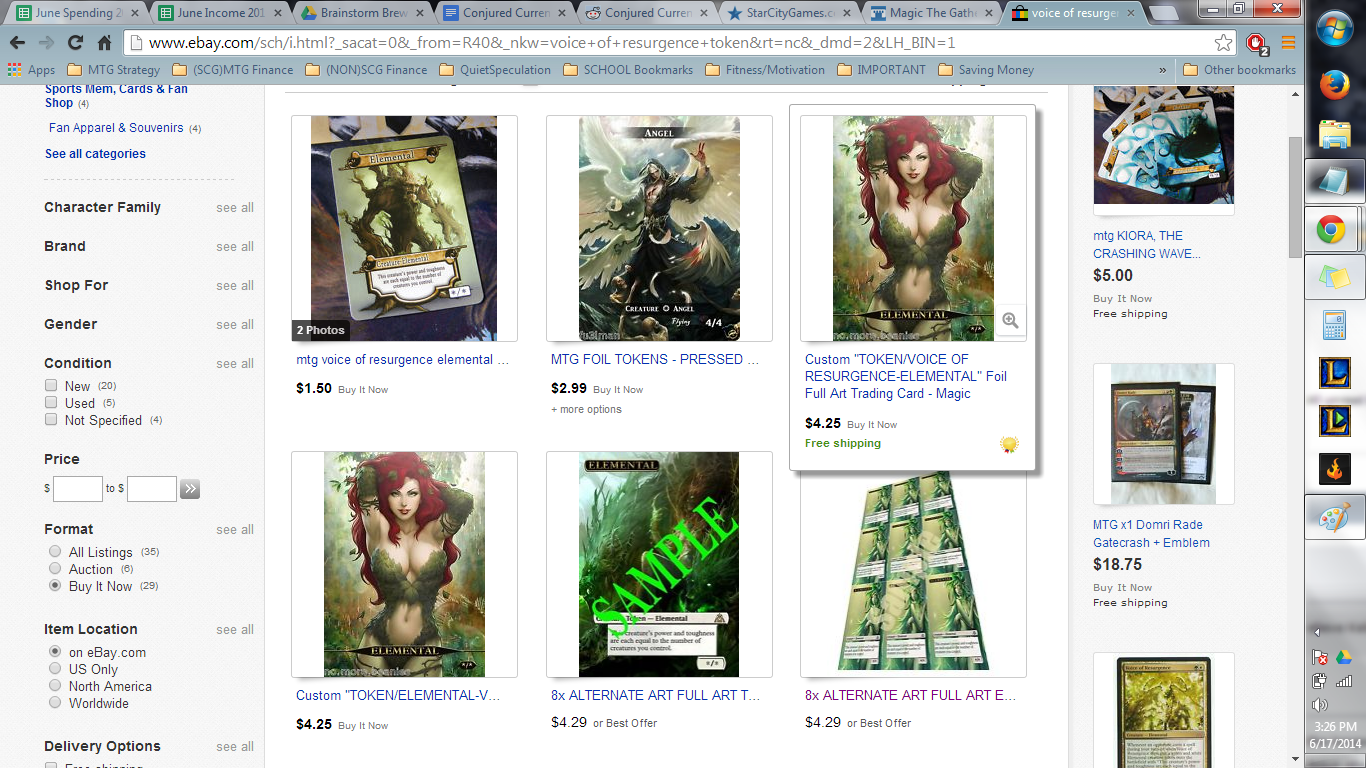
Magic players have a divided opinion on everything. The Reserved List, what deck is strong in a given metagame, fetch land reprints, and personal EDH banned lists. However, this week’s piece is going to discuss a certain subset of players who want to make their decks pretty, while also helping to clear up board staes. Some players are content to use coins, scraps of paper, or the back side of a draft common to represent their Spirits, Soldiers, and Angels. Others prefer to make their own tokens, as evidenced by the hundreds of custom-made [card]Voice of Resurgence[/card] Elementals on eBay right now:

Voice Tokens

Then there are the players who want the exact token from the original set featuring the token-maker. They want to use the blindfolded halo Angels from Zendikar for their [card]Luminarch Ascension[/card] (those are the best Angel tokens, by the way), original Wurms from Scars of Mirrodin for their [card]Wurmcoil Engine[/card]s, and the official 9/9 Kraken for [card]Kiora, the Crashing Wave[/card]. Some of these tokens are harder to come by than others, and therefore they cost money. If other people are willing to drop cash on tokens, then there’s definitely money in it for us to dig out the good, the bad, and even the ugly ones (seriously though, you couldn’t pay me to use a Scars of Mirrodin Goblin). Today, let’s learn something about token finance.

SOM Goblin

So ugly

What am I Looking For?

Traditionally, tokens that have been made by rare or mythic cards are harder to come by in the token slot. The previously mentioned [card]Voice of Resurgence[/card] Elemental is bought by SCG and Card Kingdom at $2.00 cash, and you can probably slide it in your trade binder and have people biting at a $4 price tag. Kiora’s Kraken goes for $1.20 to Card Kingdom, and the Wurmcoil twins sell for around $1 each, but I can always ship these in trades at $3. Another  good marker to go by for token value is whether the token is unique. There are many different variants of the 1/1 white Soldier, but there’s only one printing of the 1/1 lifelink Vampire from Dark Ascension, so it’s worth around a dollar.

However, it never hurts to check and be thorough with your search. Some stores are willing to buy random tokens for more than what you would expect. Card Kingdom is buying Modern Masters Elspeth Soldiers for $.54 each, which seems great considering that’s not even new 1/1 white Soldier art. Just off the top of my head, SCG, Card Kingdom, and ABUgames all have tokens on their buylists. I know SCG is infamous for being the “lowest of the low,” but I’m perfectly fine with dumping an infinite number of 1/0 water ponies from [card]Master of Waves[/card] on them for a quarter each.

Promo and Old Tokens

After scanning a couple of stores’ buylists, it looks like even more recent promo tokens from events like the Magic League can have value. That Sliver token from M14 looks absolutely amazing, and if you have zero interest in owning it, it can be turned into 50 cents cash very easily. Centaurs were handed out at the Return to Ravnica prerelease and birds for Dragon’s Maze, so it wouldn’t hurt to go around collecting any of the spares that players don’t care about at future prereleases. If you happen to own any of the older Unglued tokens, or perhaps some promos from years ago sitting in a box, I highly recommend you dig those out and look up some of the values. [card]Squirrel’s Nest[/card] just got a reprint, and some of those squirrel players will be wanting the old Odyssey token to pimp out their decks. As a general rule of thumb: If your token is old-bordered, it’s worth at least a few dollars.

Emblems

Also found in the token slot of some packs, the right planeswalker emblems can fetch a pretty penny. Elspeth’s [card]Indestructibility[/card] emblem from Modern Masters sells for almost $4.00 to Card Kingdom! If you leave the other emblems in your binder close to their respective planeswalkers, you can get a dollar or two extra out of a trade by offering the emblem to go with it (depending on the emblem, of course). Liliana’s [card]Lake of the Dead[/card] emblem might be worth less than a quarter to a buylist, but there are definitely other ways to find non-monetary value out of it. Sometimes when I sell a planeswalker over Facebook or TCGplayer, I include the emblem with the order as a special gift/surprise. A small amount of effort and care leads to some of the nicest feedback on my TCGplayer store, which leads to customers being more likely to do business with me in the future. I’ve also hidden emblems in the sleeve behind the respective ‘walker in my binder, so the person I’m trading with gets a pleasant surprise when she unsleeves it to put in her deck.

Other Alternatives

While eBay recently took down its option of free “Buy It Now” listings for those of us who aren’t large-scale sellers, there are still other options. Instead of posting a Craigslist ad of bulk commons and uncommons, try making one for tokens instead and see if you get any bites. Mix up a thousand random tokens after picking out the gems, and name a price you’re comfortable with getting per creature. Facebook very rarely lets me down when I’m trying to move something, and though I haven’t tried using it for selling tokens, it doesn’t hurt to make some lots and post on your groups to find the token enthusiasts of your community.

Closing Words

Normally I’d post about a card or two that I think is a strong pickup going forward. In the spirit of the theme this week, I’m going to suggest a couple of tokens to scavenge from your draft tables throughout the remaining time of Theros block. There are two gods who make tokens ([card]Heliod, God of the Sun[/card] and [card]Pharika, God of Affliction[/card]), and the Cleric and Snake seem to fit into their respective sets as a “rare” token. Don’t be surprised if a year from now these two enchantment creatures are among the ranks of Wurmcoil Wurms. The gods will always see EDH and casual play, and these two are in the three strongest token colors.

Thanks for reading!

The Spike Feed Episode 42 – People Can’t See Your Thumbs-Up

In our latest episode, Cameron talks about his star-studded weekend, Curtis dips his toe into trading, and Dustin starts buying collections. There’s also some serious hand wringing with regards to SCG’s adoption of Modern and WOTC’s bizarre sample pack policy. Thank you for your honor.

Your hosts:

Dustin Gore

Cameron McCoy – @Cameron_McCoy

Curtis Nower – @CurtisNow

Our show – @SpikeFeedMTG

Music by Micah Jones

Investing 205: Blind Shot Calling

“I took the liberty of bullshitting you.”
“Excuse me while I whip this out.”
“I have half a mind to join a club and beat you over the head with it.”

Hello, Brainstorm groupies! When last we left our intrepid heroes, we were learning about the investment styles that each host was using to amass his Magic fortune. We learned that Marcel likes to take his time and Jason likes to bang it out as quick as possible. We discovered that Ryan likes to “play it safe” and Corbin is willing to take risk in order get the payoff he is hoping will be delivered by a beautiful amphibian creature.

Have you plied your trades based on their advise? Are you following one of them or all of them? Have you been picking trades based on your own opinion and then using their opinions as reinforcement?

Well, it’s time for a  brand new season, but this time we are dealing with a different environment. In the previous season, the trades were from the release of the fall set until May. We then tracked those picks through the six months leading into the next rotation. This meant that all the picks were made with almost complete knowledge of the cards that were shaping the Standard and Modern formats. This allowed our protagonists to evaluate EV based on the thousand or so cards that mattered and the five or so tier-one decks running though tournament top eights. This gave them the picks that ended up significantly outperforming the market.

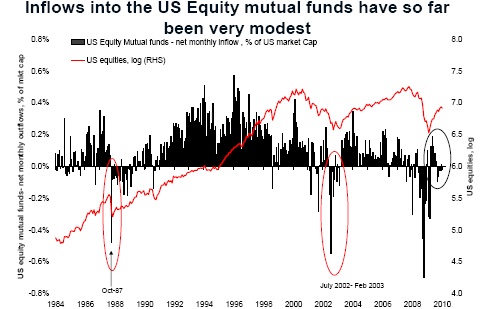
But this season, they had the exact opposite situation. Picks were chosen between May and the fall rotation (2013), and then we followed those picks from the release of Theros until the release of Journey into Nyx. Think about that: almost all the picks during this time period were made with zero-percent knowledge of devotion or gods, and half these picks were made before M14 was spoiled! If you don’t understand how hard it is to predict something with missing information, check this out:

Selling low and buying high?

Selling low and buying high?

This chart shows people plowing money into the stock market after it rises (peaks) and pulling money out of the market at the bottom of its cycles (valleys). As you can see by this graph, millions of people who do nothing but try to predict the stock market 24/7 literally bought high and sold low every time!

Before digging into today’s results, I also want to point out something know as The Observer Effect . The Brew Crew began tracking their picks in mid-2013 and I previously went over their individual results in the middle of their “season two” picks. This leads to some subtle changes in their behaviors you may notice as we dig in deep.

During this season, each individual made a different number of calls. This leads to some uneven comparisons if we compared each pick against each other pick. So we are going to instead pretend like you went out and spent $100 on each and every card they said buy, and by coincidence you sold exactly $100 worth of every card they said to sell (If your are spazzing about the math here, please read Investing 201). Then we divided the profits by the number of trades each of them sent your way. There are few discrepancies to sort out as well. If a host said something like “all Modern Masters rares” or “the 99 cards from Mind Seize not named [card]True-Name Nemesis[/card],” we did not include these as picks. Without naming a specific card, we can’t really specify a pick. We’ll consider those calls to be more general guidance and not, strictly speaking, actionable advice. Also, in the few instances where a target price was given, we assumed you followed directions and sold it even if the card price continued to go up afterwards.

Results

Let’s start with some short-term results. First, I calculated what would have happened if you had purchased each pick of the week and then checked the value 30 days later.

Corbin’s picks averaged just 3.47 percent profit per trade, and he only correctly predicted the direction of his picks 18 percent of the time.

Ryan’s picks averaged 14.02 percent profit per trade, and he correctly called the direction of his picks less than 35 percent of the time.

Let’s pause and look at these for a second. Corbin was not able to give the correct guidance over 80 percent of the time but was still able to produce a positive return. His losses were so small and gains so large that his low call percentage was completely overwhelmed by the gains on his hits. Ryan missed his mark two-thirds of the time and still managed double-digit monthly returns. It’s like a pitcher who leads the league in both walks and strikeouts. End aside.

Jason earned an average of 19.32 percent profit per trade and correctly called a card’s price direction 62 percent of the time.

Marcel was able to average 37.01 percent profit per trade and only made a call about 33 percent of the time.

Jason had only one pick that dropped more then 20 percent in the first 30 days and Marcel had two picks that hit triple digits in the same period!

Dear Marcel,

So now we are looking at returns where the crew predicted with greater then 50-percent accuracy what cards were going to rise in the next 30 days. This produced the kind of results that most fund managers would give their left nuts for (presumably the right ones are worth more?). What’s interesting is that each has his own style, but it appears that each is subconsciously using one of two investment concepts: Alpha or Beta (no, not that Alpha and Beta).

You see, when they evaluate their picks, they are not only calculating value in a vacuum—they are calculating your gain/loss potential versus a host of other cards. If five different cards can each go up by 50 percent, the best pick is actually the one with the lowest downside risk (Beta). If 10 different rares are all printed in the same quantity, the one that’s played as a four-of has a higher possible demand and a higher potential price (Alpha).

In the next couple articles, we will explore some longer-term results and see if the Crew has continued its previous performance and patterns. It will be interesting to see if their previous results have caused big changes to the way they see MTG finance. Until next time.

Junk Midrange Tournament Report

Junk Midrange has been one of the fastest-growing decks in Standard of late, especially after Jeff Hoogland’s third-place finish at SCG Cincinnati. You can see his list here. I first saw this deck shell when Ryan Gerhart posted a top four at SCG Detroit with his list. I fell in love. The [card]Underworld Connections[/card] plus [card]Courser of Kruphix[/card] interaction is sweet, and the chance of going off with an [card]Archangel of Thune[/card] and the multiple sources of incremental life gain are a constant threat during late game. [card]Scavenging Ooze[/card] is versatile, and the sideboard toolbox is amazing for coming back against the weaker control matchups and dominating other midrange decks. Aggro can be walled by turn-two [card]Sylvan Caryatid[/card] into a turn-three [card]Courser of Kruphix[/card], playing a land to kick off a virtual [card]Nyx-Fleece Ram[/card] with turn-by-turn life gain. [card]Advent of the Wurm[/card] seals the deal game one, especially if you are lucky enough for them to be swinging with a [card]Satyr Firedrinker[/card](happened one time!).

I played around with this deck over five small tournaments, leading into my recent SCG Indy run. I settled on a very awkward decklist, resolving to accept at least a 6-4 run and seeing how each card fared in various matchups. The idea here was that I could arrive at a compact, efficient list afterwards.

[deck title= Junk Midrange: SCG Indianapolis]
[Creatures]
*3 Scavenging Ooze
*4 Sylvan Caryatid
*3 Courser of Kruphix
*1 Brimaz, King of Oreskos
*1 Polukranos, World Eater
*1 Archangel of Thune
*2 Blood Baron of Vizkopa
*2 Obzedat, Ghost Council
[/Creatures]
[Spells]
*3 Abrupt Decay
*3 Advent of the Wurm
*4 Hero’s Downfall
*2 Banishing Light
*2 Underworld Connections
*2 Ajani, Mentor of Heroes
*2 Elspeth, Sun’s Champion
[/Spells]
[Land]
*3 Forest
*3 Godless Shrine
*1 Mana Confluence
*4 Overgrown Tomb
*4 Temple Garden
*3 Temple of Malady
*4 Temple of Plenty
*3 Temple of Silence
[/Land]
[Sideboard]
*2 Bile Blight
*1 Deicide
*2 Lifebane Zombie
*3 Mistcutter Hydra
*1 Pithing Needle
*2 Sin Collector
*3 Thoughtseize
*1 Underworld Connections
[/Sideboard]
[/deck]

This was the list I ran, which pains me every time I look at it. So many one-ofs! The upside was that I got very specific experience playing each card against a variety of decks. I felt lucky that I played a very diverse field: two Naya Aggro decks, two Burn, one U/W/g Control, one Mono-Black Devotion, one B/r Aggro, one U/w Aggro, and one Junk list with some interesting card choices.

Round 1: Naya Hexproof

Hexproof is a matchup I haven’t really tested against and don’t see my deck performing well against unless I can catch ,my opponent off guard with an [card]Advent of the Wurm[/card] or start pumping out [card]Elspeth, Sun’s Champion[/card] tokens. My opponent started game one with a mulligan to six, but he found a remarkably efficient hand. I probably should have mulliganed my [card]Temple of Silence[/card]-[card]Temple of Silence[/card]-[card]Temple of Plenty[/card]-[card]Courser of Kruphix[/card]-[card]Advent of the Wurm[/card]-[card]Hero’s Downfall[/card]-[card]Elspeth, Sun’s Champion[/card] hand, but it had three mana and I was playing the first match of my first-ever premier tournament. He beat me quickly when I drew a [card]Temple of Malady[/card] on turn turn three to play a turn-four Courser into an Advent of the Wurm that ended up blocking what became a 14/14 double striking, trampling [card]Witchstalker[/card], handing me lethal damage. I lost game two after a mulligan to five, something that will occasionally happen to a midrange deck with a weaker manabase.

0-1

Round 2: Brave Naya

I felt nervous but also more confident after round one. My opponent had lost his first game, I had a tad of experience playing this matchup, and I wasn’t going to make the wrong mulligan decisions because I was apprehensive. I lost quickly to an aggressive, drawing zero [card]Sylvan Caryatid[/card]s and only one Courser in two games. I had no real answer in my deck to a monstrous [card]Fleecemane Lion[/card]. Both of these games made me reconsider my deck’s position against the explosive aggro decks that exist in the metagame.

0-2

Round 3: R/w Burn

I was distraught. How could I have lost? Was my list that awkward? I was completely distracted leading into the third round, but I had practiced the Burn matchup and felt more confident in my ability to beat this deck. My opponent was unlucky his first matches and seemed very competent (I believe he went on to 7-3 the open). He won with a fairly awkward hand after I whiffed on two [card]Thoughtseize[/card]s, lost a [card]Scavenging Ooze[/card] to a [card]Searing Blood[/card], and lost a Courser to [card]Lightning Strike[/card] plus [card]Searing Blood[/card]. I was beating myself up to the extreme after game one, and I knew even then that my chances of winning two more in this mental state were slim. I basically resigned game two after playing the wrong lands to make my turn-two Caryatid into turn-three Courser start.

0-3

I wasn’t prepared to fail this badly. I definitely considered dropping, but that would have totally invalidated my trip. I knew all but one of my game losses were to avoidable, basic mistakes that I would deride any other player for making. I went and watched Kent Ketter, a fellow Bloomington resident, narrowly beat out Jeff Hoogland, one of my favorite players and the innovator for the list I was running. The winning attitudes of these powerful players definitely inspired me to sit down, think through a better sideboard plan, compose myself, eat, and basically prep myself for a comeback.

Round 4: Mono-Black Devotion

Luckily, I finally got matched up against the deck mine was designed to beat. I kept a great hand, Downfalled his first [card]Pack Rat[/card], slammed a turn-five [card]Blood Baron of Vizkopa[/card], and won easily. My opponent definitely went on tilt when faced with the prospect of starting the tournament 0-4. He missed two [card]Pack Rat[/card] activations on my end step and had some other minor technical issues, eventually losing to my [card]Underworld Connections[/card] drawing gas to outrace his removal spells.

1-3

Round 5: B/r Aggro

My opponent was nearly silent the entire match. I started game one with an awesome curve, getting a turn-two Caryatid, turn-three Courser, turn-four [card]Hero’s Downfall[/card] on his [card]Master of the Feast[/card] to draw into a turn-five [card]Obzedat, Ghost Council[/card], for a fast win. Game two I won after my flustered opponent put two [card]Madcap Skills[/card] on one [card]Herald of Torment[/card], which I [card]Abrupt Decay[/card]ed immediately. Obzedat was able to swing for exactly lethal on the pass back.

2-3


Round 6: Junk Midrange

I was on track now! I kept a fairly bad opening hand and the game turned into a long, grindy match where I eventually resolved an Obzedat drawn due to my engine of [card]Underworld Connections[/card] and [card]Ajani, Mentor of Heroes[/card] pumping gas. Game two, I took a mulligan to five, something that almost always dooms this deck. I feel like I gave him a good fight, stabilizing the board well but drawing into lands just when he started hitting flyers. Game three went the route of game one: extremely long and stupidly grindy. He played an [card]Angel of Serenity[/card], hitting my Obzedat that I had left back as a blocker, only to have me [card]Hero’s Downfall[/card] it at the end of that turn and push through sufficient damage to end game three. We discussed various card choices, and I felt confident after winning the mirror against a more solid opponent.

3-3

Round 7: Bant Control

Game one went 35 minutes long, finally ending with [card]Aetherling[/card]. I had gotten him to one life before he chained three [card]Sphinx’s Revelation[/card]s back to 20. Meanwhile, I had burned through nearly all of the threats in my deck. I won game two with Obzedat on turn five after he [card]Dissolve[/card]d my end-of-turn [card]Advent of the Wurm[/card]. With two minutes in the round, he told me his record was 2-1-3 and conceded, knowing a fourth draw would definitely knock him out of prize contention. This encouraged me greatly to win the rest of my matches, and I had the most fun in this match the whole tournament. My opponent was sportsmanlike, funny, and gave me the chance I needed to top 64.

4-3

Round 8: W/u Aggro

I was definitely surprised to find myself in a position where I could still make top 64. But then my opponent played [card]Soldier of the Pantheon[/card], [card]Precinct Captain[/card], [card]Brimaz, King of Ereskos[/card], [card]Ephara, God of the Polis[/card], and [card]Archangel of Thune[/card]. I lost that game. Game two, I had calculated that I could swing for lethal, but he pulled a [card]Mutavault[/card] out of the one pile all his lands were in, activated it, chump blocked, and swung back for the win. That is the type of mistake that every Magic player has a story about, where you want to blame your opponent for playing a tad shadily but you know that the blame really rests on yourself. I definitely felt a little bit cheated, especially because my hopes of hitting prize at my first ever open were gone, but I decided to play out the rest of my rounds to practice with my deck more.

4-4

Round 9: Mono-Red Burn

I was weary but cheerful. These games were disgusting, starting with a great hand leading into seven consecutive lands. Game two was in my control when he drew the exact burn spells he needed to take me from nine life while in topdeck mode, but I had made enough small misplays that I felt justified having lost. Note: I did get to play an [card]Advent of the Wurm[/card] into a swinging [card]Firedrinker Satyr[/card], costing him five life. At this point, my tournament partner and ride back home was pressing me to leave, soI decided to drop and watch the top eight from home.

4-5

Lessons

My experience in this tournament taught me a hell of a lot about my preparation, mental state, and attitude. I would like to think I lost a bunch but also learned a bunch. My 4-0 streak after feeling so down on myself definitely felt good, and knowing I had a chance in round eight had I been paying more attention definitely helped. I learned a good amount about my deck too, mainly deciding that my list was trying to do a bunch of different things and if I wanted to succeed, I would need to trim the list to more four-ofs for consistency.

I decided that there were two routes I could take with the deck, either going into a more consistent, lower-curve build, or top-loading the curve to have more power in the mirror. Most of my prototype lists, as well as feedback on my original article on Reddit, revealed that going lower-curve is something that turns the deck into a mono-black variant or a G/W aggro deck, as wanting to play [card]Brimaz, King of Oreskos[/card], [card]Courser of Kruphix[/card], and [card]Hero’s Downfall[/card] all in the same low-curve list isn’t going to work out. My current list cleans up the one-of’s, puts in [card]Golgari Charm[/card]s (which are absolutely invaluable, so one in the main for now), and tweaks the sideboard.

[deck title= Junk Midrange Version 2.0]
[Creatures]
*2 Archangel of Thune
*2 Blood Baron of Vizkopa
*4 Courser of Kruphix
*2 Obzedat, Ghost Council
*1 Sin Collector
*2 Scavenging Ooze
*4 Sylvan Caryatid
[/Creatures]
[Spells]
*3 Abrupt Decay
*4 Advent of the Wurm
*4 Hero’s Downfall
*1 Golgari Charm
*2 Banishing Light
*1 Underworld Connections
*2 Ajani, Mentor of Heroes
*1 Elspeth, Sun’s Champion
[/Spells]
[Land]
*3 Forest
*3 Godless Shrine
*1 Mana Confluence
*4 Overgrown Tomb
*3 Temple Garden
*3 Temple of Malady
*4 Temple of Plenty
*4 Temple of Silence
[/Land]
[Sideboard]
*2 Bile Blight
*1 Duress
*1 Golgari Charm
*2 Lifebane Zombie
*2 Mistcutter Hydra
*2 Nyx-Fleece Ram
*1 Sin Collector
*2 Thoughtseize
*2 Underworld Connections
[/Sideboard]
[/deck]

Sideboard Changes:

I moved an [card]Underworld Connections[/card] to the side, feeling that it is dead in too many game-one matchups. Having two in my opening hand is definitely not where I want to be in almost any game one. I moved a [card]Sin Collector[/card] to the main deck as a slight concession to the control matchup, but it’s also useful against some midrange decks as a cheap disruption spell. [card]Mistcutter Hydra[/card], while unpopular amongst the competitive community, continues to be a house against Burn as a racer, control as a powerful threat, and a card that just feels unfair against Mono-Blue Devotion. I just can’t justify cutting it just because it isn’t in the current trendy decklists. [card]Lifebane Zombie[/card] stays in to deal with those annoying Naya decks and also to help out in the mirror midrange matchups. [card]Bile Blight[/card] remains powerful against the ever-present black devotion decks. [card]Nyx-Fleece Ram[/card] is my most contentious choice, as it exists only for the burn matchup. I considered stocking additional copies of [card]Duress[/card] for versatility against control, but I think at this point that Burn will make up enough of the metagame to warrant two copies of this absurd turn-two play. I cut a [card]Thoughtseize[/card] to include more Burn hate, as I rarely found myself siding in all three copies.

Thanks for reading. Let me know if you have any comments or question on the deck!

Zane Grube lives in Bloomington, Indiana, and recently started playing magic competitively. His accomplishments include winning three pro tours playing in one SCG Open, sitting next to Chris VanMeter while charging his phone, and winning an FNM booster draft “that one time.”


Serum Visions: Bottling Day!

Hello, everyone, and welcome back to Serum Visions!

First things first, I must apologize for my absence these last two weeks. My wife and I are moving to Toronto and just did the big packing blitz. It left absolutely no room for writing. But here we are, back and ready to bottle! 

This week we’re going to be following up on Brew Day in 15 Steps. If you by chance actually brewed your first beer on that day, it’s time to bottle. I know this because I started a brew not long after that article was published, and it’s time to bottle that one. 

There are a few things that you need to do before you bottle your beer to ensure that you aren’t creating little exploding brew bombs. You are going to need to check your final gravity (FG) at least twice with your hydrometer, to make sure it has finished fermenting. If you remember from the brew day, we check the Starting Gravity (SG) to find out how much sugar is in the wort. This lets us know approximately what the final alcohol percentage will be. We check the gravity again, once the air lock has mostly stopped bubbling (probably seven to fourteen days after the brew), to find out how much sugar is left. Then we check again a few days later to make sure that the amount of sugar has not gone any lower: say from 1.013 down to 1.011. If you find this has happened, this means that the beer has not finished fermenting. Once you have checked your gravity twice a couple of days apart and it has not changed, you are ready to bottle.

BottleBombsTo understand why this is so important—because it is very important—I’ll need to explain what happens during the actual fermentation. Yeast is a living organism that feeds on sugar. Like all living organisms, it produces waste from what it eats. In the case of yeast, that waste is alcohol and carbon dioxide. Yeast will continue to consume the sugar until all of the digestible stuff is gone. So, if you bottle your beer before all of the initial sugar has been digested, and then, add more during the bottling process, there will be too much carbon dioxide inside of the bottle and it will explode. 

Steps to Bottling 

Step One: Clean and sanitize everything that will come in contact with your beer! Everything that touches, or even could touch, the beer at this point must be sanitized—no exceptions!

Step Two: Place your fermentor of beer on a raised surface, like a table or countertop. Then place your six-gallon bottling bucket right underneath a carboy on the floor (this is best done in the kitchen where you can get things wet with out being worried about it).

Step Three: Place your sanitized racking cane (which will be connected to about four to five feet clear vinyl tubing) into the brew. Try to keep the bottom of the cane about three to four inches away from the surface of the beer.

3282903853_cfa8b1603a_mStep Four: Syphon the beer from the fermentor into your bottling bucket. Try to leave as much of the sediment, or trub, on the bottom of the fermentor as possible. You will have to tilt your fermentor to keep your racking cane as far away from the trub for as long as possible. Don’t worry to much about getting every drop of beer.

A couple notes on this step:

    a. Many people (including myself) start the syphon with their mouths. If you are going to do this, you must sanitize you mouth and lips. I personally use some bad tequila as a mouth wash just before starting the syphon. 

     b. You must syphon “quietly.” This means you minimize the amount of splashing that happens during the transfer. If you mix in too much air/oxygen into your beer at this point, it will taste like green apples and you will be more inclined to dump your beer rather than drink it.

Step Five: Add priming sugar to your beer (the sugar that will make your beer carbonate). There are a couple different options for this step:

     Option 5A: Carbonation Drops – These are drops of sugar that are pre-made to be the correct amount of sugar to carbonate a single bottle of beer. To use these, you simply put one drop into each bottle and then fill each bottle. This is by far the easiest and safest way of carbonating beer for a beginner.

     Option 5B: Malt Extract or Dextrose Priming Sugar

Step 5B.1: Measure out 3/4 cup dextrose priming sugar or 1-1/4 cup of dry malt extract.

Step 5B.2: Boil chosen priming sugar with a cup or so of water for five minutes to sterilize.

Step 5B.3: Add to beer in bottling bucket and stir gently for ten to fifteen seconds. Do not mix in any air!

Step Six: Wash and sanitize all bottles! This means getting all debris and dirt out of the bottles and thoroughly coating the inside of the bottle with no-rinse sanitizer. Try to get as much of the sanitizer out as you can, but do not rinse.

Step Seven: Syphon beer into the bottles quietly: do not mix in air! Fill the bottles until the beer reaches the very top of the bottle—when you remove the bottling wand you’ll be left with the perfect amount of empty space.

For this step, you’ll be attaching your bottling wand to the other end of your tube that is connected to you racking cane. The bottling wand makes it so you have a controlled flow of beer into your bottles.

Again, if you are starting the syphon with your mouth (a great opportunity to have a couple of mouthfuls!), you need to sanitize your mouth and lips. 

KONICA MINOLTA DIGITAL CAMERAsuper-agata-bench-capper
Step Eight:
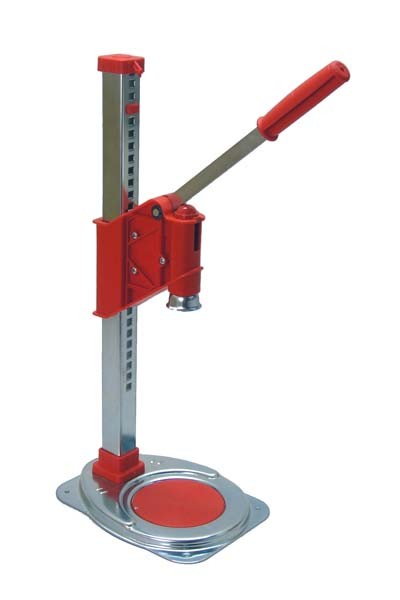
Cap bottles using sanitized caps. There are many types of cappers for glass bottles. If you get a floor capper, where you use a lever to push the caps on to the bottle, you can use any pop top beer bottle. If you are going to use a butterfly capper, you need to use bottles with short ridges underneath the top lip of the bottle. The easiest bottles like this to find are MGD, Heineken, Stella, and Corona. 

Please do not go out and buy a fresh case of these. You can go to vendors or local watering holes and ask to buy cases of empties. Not everyone will do this, but there’s a good chance that someone in your area will help you out.

Do not use twist-off style bottles! These may or may not seal. If they don’t, it will result in flat and oxidized beer!

Step Nine: Put your beer in a warm place to let it carbonate for two weeks. I do encourage you to try your beer after it has been in the bottle for only a week. It probably will not be very good, but you will start to learn what beer tastes like during different stages of its life. 

Step Ten: Your beer will be drinkable after two weeks in the bottle, pretty good after three to four weeks, and at its peak (most likely) from five to seven, depending on what kind you have made. One thing is always for certain: the longer you wait, the better it will be. And the last bottle is always the best!

[deck title= Bottling Apparatus List]
1 Bottling Bucket
1 Racking Cane
1 Bottling Wand
1 No Rinse Sanitizer
1 Priming Sugar or Carbonation Drops
1 Beer Bottle Capper
6 feet of vinyl tubing
56 Caps
56 Pop Top Bottles
[/deck]

This is the bare minimum set up one needs for bottling. If you would like to cut the bottle cleaning time by 75 percent, I recommend a bottle washer that you screw on to your tap in your kitchen, as well as a wonderful contraption called a Vinator bottle washer. If you are planning on getting into this hobby with any vigor, these two pieces are a must!

Now Drink

So there you have it! In Twenty-five steps and a little waiting is all it takes to have 56 beers that you crafted yourself! I love this hobby, and if you get into it, I know you’ll love it too!

If you noticed that I have missed anything, please let me know. If you have any questions or need any help, you can hit me up on Twitter at @awcolman.

Thanks for hangin’, everyone.

Andrew

Brainstorm Brewery #101 – Finance 101

Episode 100 is in the rearview mirror, and the gang looks forward to the next hundred. With that new focus comes a new focus on the basics. New people join the listenership all the time, and even veterans who have listened for years could use a refresher. Starting with this episode, the gang will be doing a few new segments. First is Finance 101, a brief look at a basic finance topic that some take for granted and others might want explained in detail. Is the world of Magic finance a little daunting? Do you listen to Brainstorm Brewery despite the finance content? Fear not—topics will be broken down and covered in detail. Also upcoming, the gang will commit to reading one listener-submitted e-mail per week. Do you have a question you’d like answered? A spec you want to suggest? A trade you’d like evaluated? Send your letters to brainstormbrew at gmail dot com. Episode 101 and the start of Finance 101 in an episode so good you’ll be left asking, “Wait, was that just a weird coincidence?”


  • Finance 101 is starting in a big way with a ton of topics!
  • The gang covers a few terms that they use every week and make sure they’re defined.
  • What constitutes a “staple”?
  • Why would anyone sell to a buy list?
  • What is spread, and how is it calculated?
  • Where does the gang receive its finance info?
  • What constitutes bulk?
  • What is a pick?
  • When is rotation, and what does it mean?
  • What are seasons, and how do they differ from rotation?
  • The gang reads an e-mail from a listener looking to trade into Modern. Send us one!
  • The address is brainstormbrew at gmail dot com.


Cabe Riseau produced the intro and outro music for Brainstorm Brewery.


Contact Us

Brainstorm Brewerywebsiteemailtwitterfacebook

Ryan Bushardemailtwitterfacebookgatheringmagic.com

Corbin Hosleremailtwitterfacebook – quitespeculation.com

Jason E Altemailtwitterfacebookgatheringmagic.com – quitespeculation.com

Marcelemailtwitterfacebook

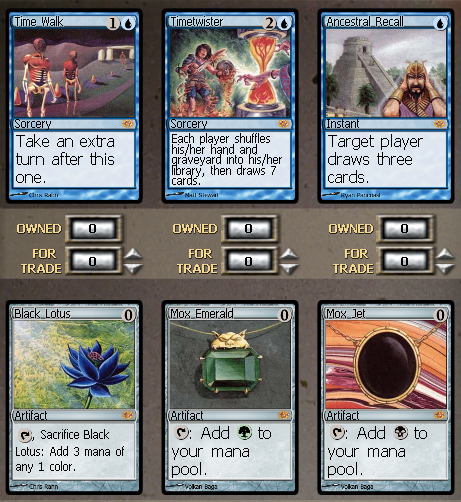
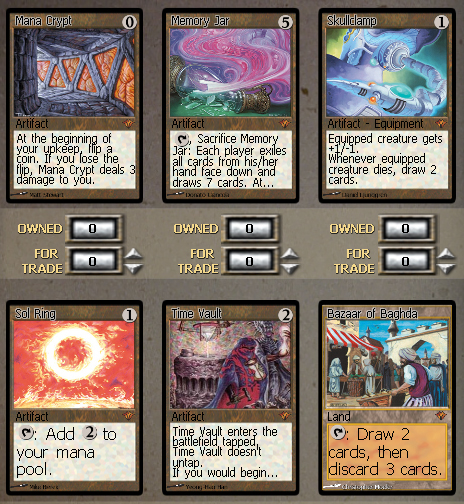
Vintage Masters Original Art Swap – Magic Online Patch

This patch is no longer being distributed, it contained images which violated WotC’s intellectual property rights.  I apologize for my transgressions. -Marcel

I am working on a tutorial on how to custom the card art for any card on Magic Online, it should be live before the new year at: http://brainstormbrewery.com/modo-art/


Change the art for MODO Holiday Cube back to the original artwork, see the Power 9 in their true glory. This file reverts all “modernized” artwork back to it’s first printing. Truly a beautiful thing.  UPDATED Version 1.1 – 6/13


Power New


By @MarcelMTG co-host of the Brainstorm Brewery podcast


**** To restore default art settings launch “Kicker.exe” and select “Repair” on the main screen ****

**** This works with Version 3 of MODO & the Beta Version, thanks to Jonas Hellström aka @Jonas_Hellstrm ****


Download the original art for every card that has new art for Vintage Master. Play with the Power 9 how they were intended, bring back the nostalgic feelings of playing with iconic cards in their original glory.  This simple patch is easy to apply and easy to remove if you don’t like the changes.


Myth OG


Included is a “skin” that switches Modern card frames to look like old border cards. Due to how the MODO client works the text boxes and art window have been adjusted to fit the Modern text alignment.

Because Modern cards use black text instead of white, card names & card types can be difficult to read on darker card frames i.e Black and Artifacts. The skin also swaps dual lands so they look like the original dual with the two color text box.


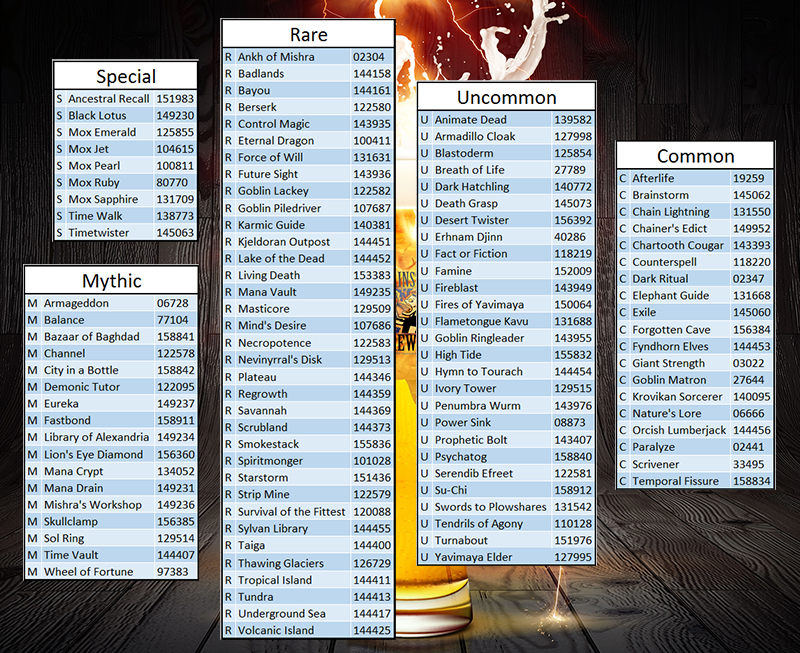
The Following Cards have an Art Swap:

cHANGED


Instructions for Original Art Swap

1- Close Magic Online if it is open.

2- Locate “Pics” folder: (main directory) > Program Files (x86) > Wizards of the Coast > Magic Online > Graphics > Cards > Pics

3- Open the Original Art Swap folder that came with this zip

4- Either select all or individual files in the Original Art Swap folder then drag and drop them into the Pics folder

5- Select Copy & Replace in the popup window

6- Launch Magic Online


 Instructions for Original Art Swap (Beta Client)
*** Make sure hidden files are visible: Control Panel > Folder Options > click “View” tab > under “Advanced Settings” click “Show hidden files,
folders, or drives.” ***

1- Close Magic Online if it is open.
2- Locate “Tier 1” folder: (Main Directory) > Users > (User Name) > AppData > Local > Wizards of the Coast > Magic Online > Images > ArtInFrame > Tier 1
3- Open the Original Art Swap folder that came with this zip
4- Either select all or individual files in the Original Art Swap folder then drag and drop them into the Pics folder
5- Select Copy & Replace in the popup window
6- Open the Beta Original Art Swap folder that came with this zip
7- Either select all or individual files in the Beta Original Art Swap folder then drag and drop them into the Pics folder
8- Select Copy & Replace in the popup window
9- Launch Magic Online


Instructions for Old Border Frame Swap

1- Close Magic Online if it is open.

2- Locate “Frame” folder: (main directory) > Program Files (x86) > Wizards of the Coast > Magic Online > Graphics > Cards > Frame

3- Open the Old Border Frames folder that came with this zip

4- Either select all or individual files in the Old Border Frames folder then drag and drop them into the Frame folder

5- Select Copy & Replace in the popup window

6- Launch Magic Online


If you have any questions or find any errors please contact me via Twitter at @MarcelMTG or email at [email protected]


Conjured Currency #17: Bulk What?

The Magic community has a lot of different definitions for the word bulk. Bulk rares are the [card]Conjured Currency[/card] and [card]Whims of the Fates[/card] of the world, the dregs of Magic cards that most often sit collecting dust until they’re shipped off to a dealer for $.10 or $.13 a piece. Bulk commons and uncommons are generally sold as collections of 1,000 cards that have been picked clean of all of the [card]Go for the Throat[/card]s and [card]Young Pyromancer[/card]s. The bulk rate for commons and uncommons is somewhere around $5.00 per thousand. These labels were attached because of the volume at which these types of cards normally move. There’s little point in sending 100 bulk rares to a dealer to get your $10.00 minus shipping costs. However, it makes more sense to get rid of 10,000 at once. In Magic, just like everywhere else, prices decrease as volume increases. But do we take advantage of bulk pricing as often as we should when the items aren’t trading cards?

Bulk Supplies

Today I want to share several websites with you where I buy my shipping and organizational supplies in bulk. I cringe when I look at some of the selling advertisements on Facebook and see people request $4 for shipping with tracking in a bubble mailer. When questioned, they defensively tell you that a bubble mailer costs at least a dollar and that the box of 50 toploaders they bought cost $5. These guys even go to the post office to pay for shipping, which is more expensive than the alternative. I’ll show you where I buy my own bubble mailers, toploaders, and 1,000 boxes. If you’re an FNM trader who doesn’t do a large volume of selling or trading online, this won’t be as useful as for someone who just opened up her TCGplayer store and wants to hit Level 4 ASAP.

Longboxes

I currently use BCW for any of my orders of “long boxes” of varying sizes. There’s a decent probability that your LGS buys its boxes from the same company. The listing says 800 count, but they’ll comfortably hold 1,000 Magic cards. I use the smaller-count boxes to organize my various specs, lands, and tokens. I often fill the 1Ks with bulk commons and uncommons and sell them on Craigslist for $6 to $7 per thousand. That’s more than you can get from a dealer, and casual players love getting tons of cards for not tons of money. BCW offers free shipping on most orders of $100 or more, so I’d only place an order if you have a lot of sorting to do, because the free shipping takes a huge chunk off of the cost. I particularly enjoy the 3×4 card house storage boxes that hold 12 of the 1K long boxes, but I’ve never ordered one from this site. They’re one of the items that aren’t free shipping eligible, and I haven’t needed to buy this many additional card houses in bulk. Still, once you get free shipping on the 1K boxes, the cost ends up being $.66 per box.

Bubble Mailers

So far, this is the best deal I’ve found on mass bubble mailers. They’re large enough that you should be able to ship any normal singles order, and a Paypal shipping label fits nicely on the front. Five hundred envelopes at $32.95 with free shipping equals approximately 6.5 cents per envelope. That’s certainly a huge mark down from picking them up from the drug store for $1.

Toploaders

If you do a lot of sending out cards and not a whole lot of buying cards, you’ll notice that you run out of these little guys fairly quickly. You can find them in almost every hobby shop, and even among the ripped-open packs of Pokemon cards in your local Walmart’s TCG aisle. However, we can do better than that. Buying in bulk from Cardboard Gold lets us find these for 4.7 cents each, and even less if we need 3,000 of them. Eating the initial cost sucks, but if you know you’ll still be using these months and years down the road, it’s financially smarter to bite the bullet now and enjoy not having to pay recurring costs down the road.

This is by no means an exhaustive list of sources to obtain bulk shipping supplies. I have not scoured the internet for weeks looking for these websites and prices, and I’m not guaranteeing you that they are the absolute, 100% best option for your situation. If you read this and know where to find a better deal than what I’ve provided, please mention it in the comments below, or send me a link on Reddit, Twitter, or Facebook so I can share it. That way we can all ship and store our products cheaper. I hope I managed to help a few people cut down their shipping costs today!

A Post-Script on Temples

I recently read a post on r/mtgfinance claiming that Temples from the Theros block were not very strong investments going into next year. The argument was that they are weaker than any of our previous recent dual-land friends, like the shock lands ([card]Hallowed Fountain[/card], check lands [card]Glacial Fortress[/card], or fast lands [card]Seachrome Coast[/card]. While Temples aren’t the strongest weapon in a hyperaggressive deck, I can’t remember the last time that a rare cycle of lands didn’t average out at around $10 during their second year in Standard (assuming a first printing). I don’t think Temples are any different, and I expect to see the $3 to $5 Temples join their brethren of [card]Temple of Enlightment[/card] and [card]Temple of Malady[/card] soon enough. Real estate is the golden egg of MTG finance, and I don’t see that changing this season.

Pitt Imps Podcast #73 – French Canada Invades

This week we go over SCG Providence and a bunch of small news items. Then this French Canadian comes on and tries to drive a rift between myself and Ryan. To be honest, he did a good job of it. Martin Brunet brings his Ban or Unban segment to the show and it was very welcome on a slow week.

Help Meagen : https://www.giveforward.com/fundraiser/78s4/mariah-s-medical-fund

Your hosts: Angelo & Ryan

Angelo’s Twitter: @Ganksuou

Ryan’s Twitter: @brotheryan

Guest Martin Twitter – @Martin_Brunet

Show’s Email: [email protected]

Command Theory: Power Without Gameplay

It’s not that I’m a pessimist. It’s true that I recommend you mulligan like one when you play Commander, but I’m actually a positive person in general. I look forward to every new Magic set release. I pay attention to spoilers and get excited about cards that might fit into one of my EDH decks or inspire a new one. But when Mark Rosewater confirmed via Tumblr that we will be getting a new Commander set every year, I was suddenly very nervous for the future of my favorite format.

Don’t get me wrong. The last two sets of Commander decks did a lot of good things for the format. They brought down the price of staple cards such as [card]Sol Ring[/card] and introduced cards like [card]Chaos Warp[/card], which help mitigate color-pie weaknesses that can make for very lopsided games. The first set also introduced sorely needed wedge-colored commanders to make previously non-viable color combinations accessible and fun. So with all the good things the Commander sets bring to the format, why am I so wary of the next one?

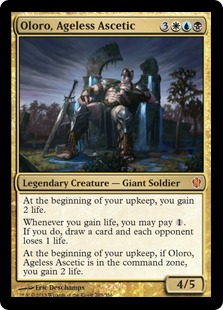
I’m worried we’ll get more cards like [card]Oloro, Ageless Ascetic[/card].

Please don’t take this as a personal slight if you play Oloro. It’s not your fault Wizards printed the card or that you are attracted to the Ageless Ascetic as a player. I also want to emphatically note that I don’t think Oloro is unfair or objectively “overpowered.” I just think the card demonstrates really, really bad game design.

Bad Designer. Bad. No Cookie.

Bad Designer. Bad. No Cookie.

Net Negative Fun

You could maybe dismiss the smallest problem I have with Oloro as a nitpick. The Commander 2013 decks, among other goals, are meant to introduce new players to the format. While Oloro seems to be pretty friendly to new players with all the free life he provides, he’s particularly unfriendly in that he creates a trigger that must be remembered every turn. It’s not a “may” trigger either, so not only is the card asking new players to remember the trigger, its suggesting the rest of the table does so as well.

My problem with Oloro goes a lot deeper than expecting the table to keep track of forgettable triggers. An incredibly important element of good multiplayer game design is that game objects shouldn’t add power without also adding gameplay. Oloro’s ability to trigger life gain every turn for absolutely zero cost breaks this rule in a particularly unfun manner.

I could buy a Foil Tarmogoyf if I had a nickel for every time...

I could buy a foil Tarmogoyf if I had a nickel for every time…

Why is giving players something good without asking them to pay a cost or perform a game action to get it a bad thing? Multiplayer games are generally at their best when all the players are treated as equals by the game rules and the outcome is measured based on all the choices the players are making over the course of the game. By providing power to a particular player without asking for anything meaningful in return, a game designer is essentially bending the game rules to give someone an advantage outside the context of player agency.

That might be fun for the player getting two life per turn, but the bent rules tend to create “net negative” fun in the overall game economy. The other players generally don’t enjoy that one Esper fellow getting to play with a slightly different set of rules than the rest of them.  And while Magic is a game of modifying the rules, those modifications almost always come in the form of cards, paid for by resources and in way that leaves room for other players to respond. But Oloro generally can’t be interacted with in the command zone, so he just sits there, bending the rules, providing power without gameplay and breaking a cardinal rule in good multiplayer game design.

Missing Interaction

The lack of interaction is where Oloro really fails both the opponents and the player at the helm of his deck. Most lifegain combos (or combos in general) require more than one card to execute and often those cards are of two different types. Any given deck might have a hard time interacting with one type of permanent, but might be well-equipped to deal with another. This makes combos tend to feel more manageable and certainly makes them more fun to play against. Oloro gets to provide some portion of these combos for “free” without asking a player to invest any game actions into getting him “online” and working as part of an engine.

In fact, its usually a bad idea to cast Oloro at all. Why risk your life gain engine getting tucked? Or hit with a [card]Darksteel Mutation[/card]? [card]Mind Control[/card]led? It’s too risky when you build your deck around the free power Oloro provides, and most players do just that. I’ve played dozens of games against Oloro decks and I believe I’ve seen him actually cast just one time. Ever. And all those players were completely justified in protecting their real source of power, even if it seems backwards to build a Commander deck that never wants to actually use its commander.

Of course there are a few ways to “interact” with Oloro, but they create net negative fun as well. Just cast [card]Erebos, God of the Dead[/card]. No lifegain until the Oloro player can deal with an indestructible enchantment. Seems good, right? You can also run [card]Rain of Gore[/card], [card]Leyline of Punishment[card], or [card]Sulfuric Vortex[/card]. These are all perfectly legitimate means of countering life gain. They also tend to completely hose Oloro players, particularly the newer players in the format who just wanted to build something fun around their life gain commander. These answers are not fun, meaningful kinds of player interaction.  Oloro being in a playgroup just tends to push the group in this direction.

Design Space

I’m a game designer too. So I understand the good intentions that created Oloro in the first place. Wizards clearly wants to explore the design space opened up by the format’s existence. Cards like [card]Marath, Will of the Wild[/card], and [card]Prossh, Skyraider of Kher[/card], are actually a good examples of using the unique attributes of commanders to create fresh designs and new avenues for fun. Oloro was just the worst idea to spring from this exploration that also survived the development process. I can’t fault them for the attempt. I’ve certainly made mistakes developing my own games in the past. I just hope Wizards is paying attention and understands why Oloro was a swing and a miss.

Exploring is Good

Exploring is Good

My precognitive abilities are telling me that the responses to this article are going to mainly consist of complaints about other commanders. Commenters will say “If you think Oloro is bad, you should try playing against X!” where X is Kaalia, Animar, Ghave, or whatever other legendary creature is currently a thorn in their sides. I’m just not that worried about those cards. Remember, this isn’t about power. It’s not even about a commander being annoying. It’s about designing commanders that encourage interaction and create net positive fun at your table.

While linear commanders like Nekusaur, with decks that virtually build themselves, aren’t that interesting to me, they do have a place in the format and help fill in certain niche roles that engage specific types of players. Oloro is a whole different kind of problem. “Styles of fun” aside, he’s designed to not ever be cast and to provide power that opponents can’t meaningfully interact with. Even if that is fun for a certain group of players, its not healthy for the format overall. I don’t believe any other commander-specific legendary creatures share that particular set of nasty design problems. Power without gameplay is fine in something like a single-player adventure game, but its toxic for a social format like Commander.

Dear Wizads: More of This Please!

Dear Wizards: More of this, please!

Assuming the fine folks at Wizards of the Coast are considering these tricky design issues, I suppose I can dial the format anxiety down a bit. Until they prove they are willing to make the same mistake twice, I should probably just keep hoping for an affordable [card]Xiahou Dun, the One-Eyed[/card] reprint. If we get awesome, flavorful new commanders in the vein of Conspiracy’s [card]Grenzo, Dungeon Warden[/card], who explores one of those underused design spaces really well, then I’ll be incredibly happy with future sets. Until then, consider me cautiously optimistic and hopeful that someone from the mothership is reading my design rants.

Immortal Constellation: A Historical Look At Standard Combo Decks

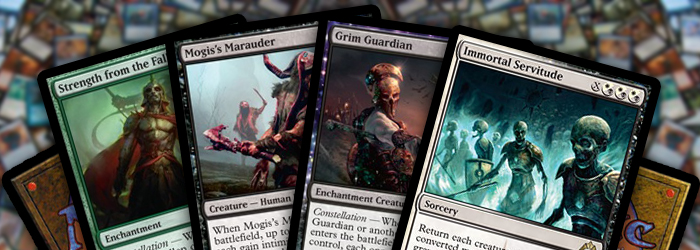
Cast [card]Immortal Servitude[/card] for X = 3get back my whole graveyard…triggers…kill you?”

Standard is not a format renowned for combo decks. Most of the time, we see a rock-paper-scissors metagame filled with aggro-midrange-control matchups, as opposed to the aggro-combo-control matchups we read and hear about when beginning to learn “Magic theory.”

However, this is not to say that there have not been competitively-viable combo decks in Standard as of late. Recent history has shown that if there is a combo deck to be found, it is usually only Standard legal for about six to nine months, which I assume Wizards of the Coast does in order to keep Standard from becoming a degenerate combo-oriented format. However, within that time frame, the combo deck has been shown to be competitive (i.e. it has won at least a couple Star City Games Open events or PTQs) and difficult for the format to deal with. Figuring out the timeline that Wizards has set for formats may unlock when a Standard tournament-viable combo deck will show up. With that in mind, let us look back at history to see if now is the time for that combo deck to appear.

We Have to Go Back!

Let us consider the more recent Standard formats:

Zendikar-Scars of Mirrodin Standard (after the [card]Jace, the Mind Sculptor[/card] and [card]Stoneforge Mystic[/card] bannings):

[deck title=U/R Twin by Anders Simpson Wolf]
[Creatures]
*4 Deceiver Exarch
[/Creatures]
[Spells]
*4 Shrine of Piercing Vision
*4 Splinter Twin
*2 Dismember
*4 Dispel
*2 Into the Roil
*2 Mana Leak
*2 Mental Misstep
*1 Twisted Image
*4 Gitaxian Probe
*4 Ponder
*4 Preordain
[/Spells]
[Lands]
*8 Island
*5 Mountain
*2 Arid Mesa
*2 Halimar Depths
*2 Misty Rainforest
*4 Scalding Tarn
[/Lands]
[Sideboard]
*2 Spellskite
*2 Azure Mage
*3 Grim Lavamancer
*1 Mental Misstep
*2 Mutagenic Growth
*2 Negate
*1 Shatter
*2 Pyroclasm
[/Sideboard]
[/deck]

This is the last time that Standard saw a viable two-card combo deck, and astute readers can see why. Look how powerful this deck is! Splinter Twin is a tier-one Modern deck now, both [card]Ponder[/card] and [card]Preordain[/card] are banned in Modern, and you got to play with fetch lands plus Ponder—a Legacy interaction staple? Jeez, we were basically just a [card]Brainstorm[/card] away from being the most broken deck of all time. Although this should not be too much of a shock to you readers who played competitively at this time, given that Wizards of the Coast had to ban both [card]Jace, the Mind Sculptor[/card] and [card]Stoneforge Mystic[/card] from Standard (and then later, Modern) during [card]Splinter Twin[/card]’s time in Standard. Of course, once Innistrad was released, [card]Splinter Twin[/card] rotated out, and that was the end of combo in Standard until…

Scars of Mirrodin – Innistrad – M13

 [deck title=Mono-Green Infect, by Greg Galloway]
[Creatures]
*4 Ichorclaw Myr
*1 Spellskite
*1 Blight Mamba
*4 Glistener Elf
*1 Viridian Corrupter
[/Creatures]
[Spells]
*2 Livewire Lash
*4 Rancor
*4 Wild Defiance
*2 Apostle’s Blessing
*2 Gut Shot
*1 Hunger of the Howlpack
*2 Mental Misstep
*4 Mutagenic Growth
*3 Ranger’s Guile
*2 Titanic Growth
*1 Green’s Sun Zenith
[/Spells]
[Lands]
*14 Forest
*3 Cathedral of War
*4 Inkmoth Nexus
*1 Sunpetal Grove
[/Lands]
[Sideboard]
*1 Ratchet Bomb
*3 Spellskite
*1 Diregraf Escort
*1 Ulvenwald Tracker
*2 Viridian Corrupter
*1 Apostle’s Blessing
*1 Dismember
*1 Gut Shot
*1 Mental Misstep
*1 Melira, Sylvok Outcast
*2 Green Sun’s Zenith
[/Sideboard]
[/deck]

This Mono-Green Infect deck was about a tier-1.5 deck during its time in Standard. Many of you may not remember seeing much of it, since [card]Delver of Secrets[/card] was busy completely dominating the format, along with a bevy of Phyrexian mana spells and [card]Snapcaster Mage[/card]. However, Mono-Green Infect could occasionally give Delver a run for its money, and the deck did top eight several Star City Games Opens. Sadly, the deck was only viable for about three months, since the release of Return to Ravnica meant that all of the infect cards were rotating out of Standard, and the deck only became tournament-competitive with the additions of [card]Cathedral of War[/card] and [card]Wild Defiance[/card] out of M13.

Innistrad – Return to Ravnica

[deck title=Human Reanimator, by Brian Braun-Duin]
[Creatures]
*4 Angel of Glory’s Rise
*4 Cartel Aristocrat
*1 Cathedral Sanctifier
*4 Fiend Hunter
*4 Huntmaster of the Fells
[/Creaturs]
[Spells]
*4 Grisly Salvage
*4 Faithless Looting
*4 Farseek
*4 Mulch
*4 Unburial Rites
[/Spells]
[Lands]
*1 Blood Crypt
*4 Cavern of Souls
*2 Clifftop Retreat
*1 Godless Shrine
*1 Overgrown Tomb
*1 Sacred Foundry
*4 Stomping Ground
*3 Sunpetal Grove
*2 Temple Garden
*4 Woodland Cemetery
[/Lands]
[Sideboard]
*3 Cathedral Sanctifier
*2 Purify the Grave
*3 Ray of Revelation
*4 Appetite for Brains
*3 Slaughter Games
[/Sideboard]
[/deck]

Reanimator decks were all the rage last year. We all remember the eternal struggle between U/W/x Flash decks, Junk Reanimator, and Jund Midrange last Standard season, but there were some fringe combo decks as well. Human Reanimator attempted to gain infinite life and make infinite Wolf tokens via the interaction with [card]Fiend Hunter[/card], [card]Angel of Glory’s Rise[/card], and [card]Huntmaster of the Fells[/card]. From there, it was elementary on how you killed your opponent. Further versions of this deck used cards like [card]Burning-Tree Emissary[/card] and [card]Undercity Informer[/card] to mill opponents out on the same turn as one cast [card]Unburial Rites[/card].

Aside: I am aware that there were other combo decks in the format. Some might call the Hexproof decks of both today and last year combo decks. Or the Aristocrats deck with [card]Boros Reckoner[/card], [card]Blood Artist[/card], and [card]Blasphemous Act[/card] a combo deck. Or even the old UWR Flash decks that could gain infinite life with [card]Boros Reckoner[/card], [card]Azorious Charm[/card], and [card]Boros Charm[/card]. These decks have combo elements, but I wouldn’t consider them combo decks. The distinction may be small, but it is there.

After Innistrad rotated out, we moved on to Theros. Now that the full block has been released, let us see if there is any competitive combo decks that are playable in today’s Standard.

Here We Are Now, Entertain Us

As we can see from the examples above, Wizards of the Coast seems okay printing the types of cards that lead to three categories of “combo” strategies in Standard:

  • Two-card combos
  • Damage/pump spell based combos
  • Graveyard reanimation combos

Now, it is my belief that it will be a very long time before Wizards ever prints another two-card combo in Standard, especially with the amount of permission and deck sculpting that the U/R Splinter Twin decks had in Zendikar – Scars of Mirrodin Standard. Therefore, I find it more likely to find combo decks in this Standard format in the other two areas.

Damage + Pump Spells Combo

We are already aware of this combo deck. Brad Nelson and Jeff Hoogland have been champions of it since [card]Mana Confluence[/card] was spoiled.

[deck title=Brave Naya, by Brad Nelson]
[Creatures]
*4 Dryad Militant
*4 Fabled Hero
*4 Fleecemane Lion
*4 Ghor-Clan Rampager
*4 Soldier of the Pantheon
*4 Voice of Resurgence
[/Creatures]
[Spells]
*2 Boros Charm
*4 Brave the Elements
*4 Giant Growth
*4 Selesnya Charm
[/Spells]
[Lands]
*2 Plains
*4 Mana Confluence
*4 Sacred Foundry
*4 Stomping Ground
*4 Temple Garden
*1 Temple of Abandon
*3 Temple of Plenty
[/Lands]
[Sideboard]
*4 Fiendslayer Paladin
*2 Boros Charm
*3 Domri Rade
*2 Glare of Heresy
*4 Mizzium Mortars
[/Sideboard]
[/deck]

For Jeff Hoogland’s build, see his article here.

As both Jeff and Brad have written extensively on this deck, I will not contribute anything else except to say that if this deck is capable of pulling Jeff away from his midrange brews (I mean, we’re talking about a guy who has successfully won tournaments with RUG Flash and Junk Midrange for about two years now), then there is probably something to it. This deck is very powerful and capable of killing your opponent out of nowhere. If you’re a B/g Devotion player, I’d think twice about tapping out ever against this deck.

Graveyard Reanimation Combos

Well, the bad news is that [card]Unburial Rites[/card] is not walking through that door. And [card]Rescue from the Underworld[card] is not a suitable replacement.

But we’re not looking to reanimate one creature. We’re looking to reanimate them all.

[deck title=Immortal Constellation, by Ken Crocker]

[Creatures]
*4 Boon Satyr
*4 Herald of Torment
*4 Grim Guardian
*4 Nyx Weaver
*4 Courser of Kruphix
*2 Mogis’s Marauder
*4 Satyr Wayfinder
*3 Nighthowler
[/Creatures]
[Spells]
*4 Commune with the Gods
*3 Immortal Servitude
*2 Strength of the Fallen
[/Spells]
[Lands]
*4 Temple of Malady
*4 Overgrown Tomb
*2 Mana Confluence
*6 Swamp
*6 Forest
[/Lands]
[/deck]

Obviously, this deck is extremely similar to the B/G Dredge decks (both with and without [card]Strength of the Fallen[/card]) and B/G Constellation decks. But its major goal is to place a good amount of three-drop creatures into the graveyard, cast [card]Immortal Servitude[/card] for X=3, get back a [card]Grim Guardian[/card] with several other enchantment creatures, and hit your opponent for a ton of life. [card]Mogis’s Marauder[/card] is also in the deck as a three-drop that can be reanimated and kill your opponent by giving all your creatures haste and intimidate on the turn you cast [card]Immortal Servitude[/card]. There is redundancy in the combo as well, as even if you mill [card]Immortal Servitude[/card], you are capable of retrieving it, thanks to [card]Nyx Weaver[/card].

I may have hedged too much by including some copies of both [card]Strength of the Fallen[/card] and [card]Nighthowler[/card], but both cards seemed like they were powerful enough on their own to warrant inclusion. If one was to go completely all-in on the reanimator strategy (which may be the correct move), then I would cut them for some number of [card]Master of Feasts[/card] and/or [card]Oakheart Dryads[/card]. And, yes, [card]Nighthowler[/card] is a “non-bo” with [card]Immortal Servitude[/card], but since we’re hedging towards being a B/G Dredge deck anyways, some amount of them seemed correct.

And before anyone asks, [card]Kruphix’s Insight[/card] is not included because we have enough to do on turn three. The deck needs two drops. Thus the reason for the singleton [card]Mana Bloom[/card] as well.

Overall, the deck functions without the reanimation plan as a simple green-black beatdown deck. And, just like most reanimation strategies, its power level is determined by the amount of [card]Scavenging Ooze[/card] and [card]Rest in Peace[/card] seeing play.

But it seems that Wizards has once again given us an opportunity to play a powerful combo deck in Standard—an opportunity we should not squander. If you have any suggestions or comments on the deck, please leave them below.

The Spike Feed 41 – Pillaging Merfolk

This week, Cameron dodges Conspiracy, Curtis gives his PTQ report, and Dustin forgets that we’re a PG-13 podcast when talking about Magic Online. Even more concerning, Dustin woke up early, shaved, and combed his hair to be on this week’s show. Thank you for your honor.

Your host:

Dustin Gore

Cameron McCoy – @Cameron_McCoy

Curtis Nower – @CurtisNow

Our show – @SpikeFeedMTG

Music by Micah Jones

Ginger Journey #3 – Grand Prix Atlanta

The professor walks in on the first day of classes with a gleaming smile that could make your stomach turn to knots. There’s no way someone can be that happy. It’s the first day of MTG Appreciation 2100 [Ed. note: this explains why he’s so happy]. As an introduction, Professor Brightflame feels we should take turns informing the class of our name and one fact about the kind of MTG player we are. The kid next to me pushes his glasses up his nose, takes a couple deep breaths, and stands up. After satisfying the itch in his well-knotted neckbeard he blurts, “My name’s Jani White and I love to gain life. Nothing better than a triple digit life total.” Brightflame gives a slight nod in my direction to inform me I was next to speak. “Sup, nerds! I’m the coolest ginger you know, Ginger Ale, and I hate Limited.”

gp atl matNo, but really: I hate Limited grands prix. If by chance I could get shipped a decent Sealed pool in my direction, my first three or four rounds would be in my favor. I consider myself a slightly above-average player and feel I could outplay the first few opponents of an event, even if they have more card power than me (better rares or just more synergestic color combinations). By round five or so, I assume I’ll be battling that double mythic player and all the players in the right color combinations to slice through the competition with ease. How could I enjoy a format leaning so much on the power of a random pool plus the diabolical variance waiting in the wings to color screw you at the most inconvenient of times? Why put myself through the mental hype of taking down a grand prix? So when I signed up for Grand Prix Atlanta, I didn’t.

For fifty bucks I pick up a sexy [card]Batterskull[/card] promo, $15 side-event voucher, and six packs (my Sealed pool). Deal! Regardless of if I win, I was going to have a good time with friends, escape financial troubles for a weekend, and enjoy an environment dedicated to the game I love. No matter what, I would have a good time with a mediocre Sealed deck and play my hardest until my third loss is recorded. I wanted to learn something about the format every round, meet some new people, and test my ability to read players, decipher possible cards, and go for the win without scum bagging or sharking.

Constructing a Monster

Everything was going to plan until I was passed this Sealed pool.

[deck title= B/W Midrange]
[Creatures]
*1 Hopeful Eidolon
*1 Asphodel Wanderer
*1 Nyxborn Shieldmate
*1 Bloodcrazed Hoplite
*2 Nyxborn Eidolon
*1 Returned Centaur
*2 Eagle of the Watch
*1 Strike Harpy
*1 Griffin Dreamfinder
*1 Keepsake Gorgon
*1 Erebos’s Emissary
*1 Brimaz, King of Oreskos
*1 Master of the Feast
*1 Agent of the Fates
*1 Heliod, God of the Sun
[/Creatures]
[Spells]
*1 Font of Return
*1 Cruel Feeding
*1 Asphyxiate
*1 Banishing Light
*1 Sip of Hemlock
*1 Pharika’s Cure
[/Spells]
[Land]
*1 Unknown Shores
*7 Plains
*9 Swamp
[/Land]
[/deck]

One Round at a Time

I’ll be the first to admit I was blessed with nothing short of what the denizens of Theros would label as “godly.” I had zero byes so I started round one hoping my mana base would be kind to me. Wanting double black or double white on turn three can make some opening hands harder to hold on to. My first round opponent was the type of MTG player I call, “The Readers.” If you can’t guess by the title, he had to read almost every card I played. Do I have a problem with reading every card? No, but your decisions should be slightly quicker to make up for that time loss. I kindly asked him in the middle of game two if he could speed up some of his plays since we had nineteen minutes on the round clock. He was ahead at that time but all I needed to swing things back in my favor was one of my four bombs hiding somewhere at the bottom of my library. The round resulted in a draw with my [card]Brimaz, King of Oreskos[/card] eventually leading the charge in game three only needing a few more turns to seal the deal.
agent of the fatesThe next five rounds resulted in some tough games but eventually resulted in the wins I was striving for. Round six was against Swedish pro Rasmus Björklund. To sum the match up in one word, I’d choose “demolished.” If you could hand pick a G/W Heroic deck and play it against Rasmus’s concoction, it wouldn’t stand a chance. In game three I played a turn three Brimaz and felt behind.

I 2-0’d both rounds seven and eight to sit down for the ninth and final round. My first win-and-in! I blasted through game one with a turn-three Brimaz and a turn-five [card]Master of the Feasts[/card]. My opponent ended the game lacking the double white needed to cast his splashed [card]Elspeth, Sun’s Champion[/card]. Game two almost convinced me I could be dreaming.

Turn 1: Swamp, Pass
Turn 2: Plains, Pass
Turn 3: Swamp, cast [card]Agent of the Fates[/card] (kills it with [card]Pharika’s Cure[/card])
Turn 4: Swamp, cast [card]Master of the Feasts[/card] (kills it with [card]Lash of the Whip[/card])
Turn 5: Plains, cast Brimaz and [card]Font of the Return[/card] ([card]Banishing Light[/card] on the Font)
Turn 6: Swamp, swing with Brimaz (kills it with [card]Asphyxiate[/card] on his turn)
Turn 7: Swamp, cast [card]Banishing Light[/card] targeting his [card]Banishing Light[/card] and pop the Font at the end of his turn to return Brimaz, [card]Agent of the Fates[/card], and [card]Master of the Feasts[/card] to my Hand.
Turn 8: Play Brimaz and [card]Master of the Feasts[/card]
Turn 9: Swamp, Play [card]Agent of the Fates[/card] and bestow [card]Nyxborn Eidolon[/card], making him sacrifice his only creature. Swing with Brimaz and Master
Turn 10: Rip [card]Heliod, God of the Sun[/card] to play and give the whole team vigilance.
*Handshake*

I did it! I made day two of my second career grand prix!

Half Way There

master of the feastsMy work wasn’t over yet. After a much-needed meal, we made it back to the hotel rooms. My friends and teammates Cameron, Flynn, and Tim sat down with a stack of unopened Journey into Nyx prize packs to discuss pack-one-pick-one’s (we couldn’t buy Theros or Born of the Gods packs due to the vendor restrictions at Limited GP’s).

The overwhelming support from a friend wanting me to succeed would have brought me to tears if I wasn’t a man. *sniff* It’s a part of the community I have always heard about but never experienced. After meeting with your friends between rounds for win/loss updates, you always wish them good luck when the next round pairings are posted. What you probably haven’t experienced is when that support multiplies when someone from the group makes day two. Everyone was going to bat for me and wanted to do everything in their power to make sure I succeeded. No one was mad I made day two and they didn’t. No one wanted to party Saturday night to disregard my early morning schedule. Though many of them wanted to get up early and play Sunday tournaments anyway, I still felt like they would rather sacrifice their plans of extra fun to help increase my chances in a strong day two performance. The fact that a competitive one-on-one game breeds teamwork at par with cooperative games makes me so proud to be a part of this community.

So what about day two?

doomwakeDay 2, Draft 1

I sat down for my first timed draft somewhere around 9 a.m. without the level of nervousness I mentally prepared for the night before.

Journey into Nyx: Pick one was horrendous, forcing me to take the only playable in the pack, [card]Pharika’s Chosen[/card].  Pick three was [card]Doomwake Giant[/card] and a sign black had to be wide open.  Twelve of my pack=one picks were black playables, including [card]Grim Guardian[/card] so I expected the trend to continue.

Born of the Gods: That trend I was counting on fell off like the 2005 popped collar. There was only one playable black card in this pack. I found a few average white and blue playables, but not cards you ever want to take in the first half of a pack.

Theros: I knew I needed a bomb to pull me over to white or blue. This was a more realistic wish than a pile of black playables coming my direction.  A fourth- or fifth-pick [card]Spear of Heliod[/card] really helped my second color decision but I was still praying for one Gary ([card]Grey Merchant of Asphodel[/card]) to upgrade this pile from miserable to doable.

The draft ended with zero copies of Gary and an all-around stack of mediocrity. If I outplayed my opponents, a 2-1 record for draft one would be possible—and give me more joy that it ever should. Unfortunately, I lost every game three with each opponent under five life and a threat on the table. All I really wanted at the end of the first draft was a flash drive containing all my matches. It’s easy to say, “If I only had a better deck,” but my lack of experience may have blinded me to some possible lines of play or interactions.  You’re going to draft an average deck more often than a bomb-filled masterpiece or a heaping pile of poop.

Day 2, Draft 2

I tried to keep my head up, but my second draft deck would land on the heaping pile of poop side of the scale.  A pile of R/G monsters with three pieces of removal wasn’t where I wanted to be. I knew 3-0’ing this draft was the only way I could place in Top 100.  My first opponent had a nasty sequence of the following:

Turn 3: [card]Grim Guardian[/card]

Turn 4:[card]Grim Guardian[/card]

Turn 5: [card]Whip of Erebos[/card]

Turn 6: [card]Spear of Heliod[/card]

goblin bullyThe man was a monster.  I actually dealt with the [card]Whip of Erebos[/card] my next turn but fell quickly to the power of [card]Spear of Heliod[/card].  I couldn’t play the waiting game due to the impact of any future enchantments he could draw.  Also, my pair of [card]Lightning Strike[/card]s couldn’t do a lot to the large-butted [card]Grim Guardian[/card]s.

I was out of contention to prize but I found no reason to quit.  My thought was that this could be my only day-two experience in my MTG career, so I figured I might as well go down with the ship.  I won the next match against a G/B flyers deck.  My final match was against the other red/green drafter.  Every creature I played in games one and two outmatched his until he dropped [card]Forgestoker Dragon[/card]. That single-handedly won him both matches.  A large amount of playful banter was exchanged throughout the match resulting in a good end the day.

I joined my friends at their side events. Tim Rivera was undefeated in the Super Sunday Series going into the sixth or seventh round while my buddy Ed Rickman suggested to his finals opponent of a side event draft (that just scouted Ed’s semifinals match) he would split the packs if he gets the Grand Prix Atlanta playmat.

“Did you see my deck?! I mean, we can play if you want but…”

                -Ed Rickman

We now call this tactic flexing your deck.

Wrap Up

With the grand prix winding down, we all piled in for a quick trip back to Murfreesboro, Tennessee, filled with stories of crazy board states, winning top decks, and the lack of green in our wallets.  I wouldn’t trade these experiences for anything, except for maybe paying off my student loans.

As always, thanks for reading.

@TNSGingerAle

Forced Fruition Episode 12: Tribal Cube Angels

[youtube http://www.youtube.com/watch?v=videoseries?list=PLs4gxqbLAAD5bqyn6vroWK-yjZRSEO3J7&w=640&h=360]

Divine Favor

This week I’m pleased to welcome my good friend Jan (pronounced “Yawn,” he’s a dude) to the show to help take me through an MTGO Cube draft! As the title indicates, we wound up with most of the angel cards in the cube and played them to great success. This week I’m also introducing a new segment on the show, a “Beer of the Week” which I (and any of my guests) enjoy during the draft. We’ll talk about it right after deckbuilding moving forward. If anyone has had this week’s brew (Titan IPA from Great Divide Brewing), I’d love to hear what you think of it! Cheers!

Drafting Pack 1 and 2

[youtube http://www.youtube.com/watch?v=mCAn6U9inUY&w=640&h=360]

Drafting Pack 3 and Deckbuilding

[youtube http://www.youtube.com/watch?v=V5PYHktsz9A&w=640&h=360]

[deck title=Tribal Cube Angels]
[Creatures]
*1 Exalted Angel

*1 Wall of reverence

*1 Restoration Angel

*1 Blade Splicer

*1 Mulldrifter

*1 Glen Elendra Archmage

*1 Old Man of the Sea

[/Creatures]
[Spells]
*1 Decree of Justice

*1 Oust

*1 Upheaval

*1 Tidings

*1 Compulsive Research

*1 Impulse

*1 Preordain

*1 Wildfire

*1 Sphinx’s Revelation

*1 Prophetic Bolt

*1 Engineered Explosives

*1 Gilded Lotus

*1 Vedalken Shackles

*1 Coalition Relic

*1 Basalt Monolith

*1 Sphere of the Suns
[/Spells]
[Lands]
*1 Ancient Tomb

*1 Flooded Strand

*1 Mystic Gate

*1 Tundra

*1 Shivan Reef

*1 Sacred Foundry

*3 Plains

*8 Island
[/Lands]
[/Deck]


And Blue cards

There are white cards

Beer of the week

[youtube http://www.youtube.com/watch?v=IU59Qp1fxlc&w=640&h=360]

Match 1 Game 1

[youtube http://www.youtube.com/watch?v=5YjQD8ZEGFU&w=640&h=360]

Match 1 Game 2

[youtube http://www.youtube.com/watch?v=YTpZDDWKaXg&w=640&h=360]

Match 2 Game 1

[youtube http://www.youtube.com/watch?v=lQK1bFC026E&w=640&h=360]

Match 2 Game 2

[youtube http://www.youtube.com/watch?v=-6pmfBLXbuI&w=640&h=360]

Match 3 Game 1

[youtube http://www.youtube.com/watch?v=qINZR6IdvPw&w=640&h=360]

Match 3 Game 2

[youtube http://www.youtube.com/watch?v=lc1PG1b_1JQ&w=640&h=360]

Pitt Imps Podcast #72 – State of Play

This week Ryan returns to go over the SCG Indy as well as the Two GP’s. We look over the full Conspiracy spoiler. We have some bad news about a fellow player that needs our help desperatly. Then I announce our 3 finalists in the Pitt Imps Logo Challenge. Congrats to Steven Raffeal, Pit Scorpion, and 1866. You sent some killer submitions in. Now its up to the voting.

Help Meagen : https://www.giveforward.com/fundraiser/78s4/mariah-s-medical-fund

Your hosts: Angelo & Ryan

Angelo’s Twitter: @Ganksuou

Ryan’s Twitter: @brotheryan

Show’s Email: [email protected]

Eyes of the Watcher: A Prophetic Sauna


Last week in Eyes of the Watcher I discussed my first card: [card]Grove of the Burnwillows[/card]. I was trying a new style of writing in an attempt to engage my readers but I did not quite succeed.

reddit

These first two articles were originally together as one, discussing two cards instead of the single one, which left the first half feel a little lackluster. It also appeared that my conversion rates were not as clear as I had hoped.


tweet


I’ve revisited the way I list the prices in the EU and in the US and hope it has all become clearer for you, my readers. After all, if you can’t understand what I am trying to convey, then why would I be writing? That’s why I appreciate the feedback I get and it’s why I like to show you guys that I also take it to heart. But enough of that, lets get to that article!


This week I’d like to highlight an innocuous little card from Theros called [card]Steam Augury[/card]. It’s made its way onto my list of cards to keep an eye out for. Let’s look at the basics again, shall we? [card]Steam Augury[/card] was the recipient of a lot of early hype when the card was first spoiled (with the normal amount of skepticism, of course). It did not take long before several pronounced writers took the task upon them to report on [card]Steam Augury[/card]’s existence, from first thoughts to in-depth analyses comparing the intricate gameplay of the new card to its older counterpart, [card]Fact or Fiction[/card]. Thus far, however, the strongest point made against [card]Steam Augury[/card] has been [card]Sphinx’s Revelation[/card]’s existence in the Standard format. With such drawing power available, why would anyone care to deviate into red for a weaker card? And those people were right for not playing it over [card]Sphinx’s Revelation[/card]. The difference in power level is simply too substantial.

Image-8


However, [card]Sphinx’s Revelation[/card]’s reign is slowly coming to an end with the introduction of Khans of Tarkir on September 26, 2014. The new set will usher in an era with limited amounts of drawing power. Behold, the Theros-block drawing cards:

Image (4)

[card]Font of Fortunes[/card], [card]Divination[/card], [card]Interpret the Signs[/card], [card]Thassa’s Bounty[/card], and [card]Steam Augury[/card] are currently the only raw card-drawing cards out there in the format. The options aren’t very enticing—a six-mana draw-three or a three-mana draw-two? [card]Dictate of Kruphix[/card] helps your opponents too. [card]Erebos, God of the Dead[/card] and [card]Keranos, God of the Storms[/card] are the only other reliable card-drawing engines available for control decks. Once you bounce all the options off each other, you can quickly determine that only one fits a control in terms of sheer volume of cards for the cost: [card]Steam Augury[/card].

Barring the printing of another very powerful card-drawing spell, [card]Steam Augury[/card] appears to be the way forward. However, Wizards of the Coast isn’t blind to the fact that [card]Sphinx’s Revelation[/card] was the dominating force in the previous year of Standard and that it is still a very powerful role player now. Much akin to [card]Opposition[/card], once a card visibly changes its respective format around it, WOTC won’t be that eager to bring it, or something similar, back too soon. R&D has learned that lesson.

Another compelling argument in [card]Steam Augury[/card]’s favor is the post-rotation removal we currently have available. With both [card]Lightning Strike[/card] and [card]Anger of the Gods[/card] as early removal, red becomes a lot more lucrative as a color pairing for blue.

I very much feel like [card]Steam Augury[/card] is being completely ignored and disregarded as just, “That card drawing spell that isn’t [card]Sphinx’s Revelation[/card].” But is this disregard completely justified as we’re closing in on the rotation? With copies drifting around 0.35 USD / 0.20 EUR, are we going to be regretful that we all glanced past the piece that may just define the card-drawing power of new control decks? While no guesses can be completely accurate, there are only two sets left to fill that gap and only one set’s worth of time for us to act. Can we be certain we’re not going to be in a sour position come October? There’s only one way to find out: keeping an eye on it.

Do you have any comments, questions, or concerns regarding the lurking opportunity of a new control-defining card in [card]Steam Augury[/card]? Hit me up on Twitter! You can contact me personally at @TheMeddlingMage. Do you need more than 140 characters? Send me an email at [email protected]. See you all next time!

Metagame Breakdown, Part Uno

Currently Standard is just a big ole mess. Right now the options are endlessor so we believe. After a couple of weeks of tournaments, the metagame has been broken down and it seems you can’t just play what you want. Let me tell you why.

[deck title=B/g Devotion, Andrew Tenjum, 1st Place, SCG Open Cincinatti]
[Creatures]
*4 Pack Rat
*4 Lifebane Zombie
*4 Desecration Demon
*4 Gray Merchant of Asphodel
[/Creatures]
[Spells]
4 Thoughtseize
3 Devour Flesh
3 Abrupt Decay
4 Hero’s Downfall
4 Underworld Connections
1 Vraska the Unseen
[/Spells]
[Lands]
4 Temple of Malady
2 Golgari Guildgate
4 Mutavault
4 Overgrown Tomb
11 Swamp
[/Lands]
[Sideboard]
2 Dark Betrayal
2 Erebos, God of the Dead
2 Pharika’s Cure
1 Devour Flesh
2 Golgari Charm
2 Doom Blade
4 Duress
[/Sideboard]
[/Deck]

New formats mean new cardsor again, so we thought. This list contains four new cards, and they are wonderful lands. I was wrong. Mono-Black Devotion is still the best. All hail the king.  In all seriousness, if you don’t have a good matchup against this deck, don’t play in tournaments if you are trying to win.

I love almost everything about this deck. But now that the metagame is fully developed, we can be a little bit more aggressive about our card choices.

-1 [card]Vraska the Unseen[/card]

+1 [card]Abrupt Decay[/card]

The reason this is correct is [card]Abrupt Decay[/card] has almost the same effect as [card]Vraska the Unseen[/card]. And in most matchups, Vraska tends to come down, kill one [card]Detention Sphere[/card] or similar card, then sit around doing nothing. We aren’t talking about corner caseswe are talking about what happens most of the time Vraska comes down. [card]Abrupt Decay[/card] has mostly the same effect, except it doubles as removal and allows you to gain a couple percentages in your not-so-good matchups. Going forward, I believe this is a four-of in any devotion decks.

[deck title=U/W Control, Eric Rill, 2nd Place, SCG Open Cincinatti]
[Creatures]
[/Creatures]
[Spells]
4 Azorius Charm
1 Syncopate
1 Elixir of Immortality
1 Negate
2 Celestial Flare
4 Dissolve
1 Banishing Light
4 Detention Sphere
4 Supreme Verdict
4 Jace, Architect of Thought
2 Elspeth, Sun’s Champion
1 Jace, Memory Adept
4 Sphinx’s Revelation
[/Spells]

[Lands]
4 Temple of Enlightenment
1 Temple of Deceit
1 Temple of Silence
4 Azorius Guildgate
3 Mutavault
4 Hallowed Fountain
5 Island
5 Plains
[/Lands]
[Sideboard]
2 Nyx-Fleece Ram
1 Deicide
2 Celestial Flare
1 Aetherling
1 Blind Obedience
1 Dispel
1 Negate
1 Pithing Needle
2 Gainsay
3 Last Breath
[/Sideboard]
[/Deck]

Blue and white! [card]Jace, Architect of Thought[/card] and [card]Elspeth, Sun’s Champion[/card] are still the tag-team masters of the world if you ask me. This deck is very, very good. Once you stop everything that your opponent has tried to do, you value them out with Jace or just ultimate a Elspeth and end the game. You can’t be greedy and you need to play very tight. If you think that’s something that you are into, I recommend taking this list and not putting it down till the end of the season. This deck now has access to a lot of card’s that allows you to have game in every matchup.

The changes i would make to the list are very subtle. With the metagame being this defined, you don’t need to make a lot of change to be successful.

-3[card]Last Breath[/card]

+1 [card]Nyx-Fleece Ram[/card]

+2 [card]Reprisal[/card]

Blitz decks are coming and every single game that I have played against them with [card]Nyx-Fleece Ram[/card] hasn’t been close. Every aggro deck must overextend to have a chance to beat this card. If they don’t, they can’t win. And if they do…well, they still can’t win. This card doesn’t allow aggro to nickel and dime you out of a game.

As for the others, I don’t know if people have forgotten about [card]Reprisal[/card], but this card is the real deal. With the Junk deck seeing more play, you need a way to deal with all the troublesome cards in that deck. It is threat dense and you can’t rely on being able to counter everything that they do.

[deck title=Junk, Jeff Hoogland, 3rd Place, SCG Open Cincinatti]
[Creatures]
4 Sylvan Caryatid
4 Courser of Kruphix
1 Lifebane Zombie
3 Scavenging Ooze
2 Archangel of Thune
2 Blood Baron of Vizkopa
1 Obzedat, Ghost Council
[/Creatures]
[Spells]
3 Abrupt Decay
4 Hero’s Downfall
2 Banishing Light
2 Underworld Connections
4 Advent of the Wurm
2 Ajani, Mentor of Heroes
1 Elspeth, Sun’s Champion
[/Spells]
[Lands]
1 Mana Confluence
1 Swamp
2 Forest
3 Temple Garden
3 Godless Shrine
4 Overgrown Tomb
3 Temple of Malady
4 Temple of Plenty
4 Temple of Silence
[/Lands]
[Sideboard]
2 Bile Blight
1 Erebos, God of the Dead
2 Lifebane Zombie
2 Sin Collector
1 Obzedat, Ghost Council
1 Underworld Connections
2 Golgari Charm
2 Thoughtseize
2 Putrefy
[/Sideboard]
[/Deck]

This deck is a nightmare for the top two decks in the format. That being said, I don’t know how it fares against the random decks in the format. If you know you are going to a tournament with a ton of Spikes in attendance, this deck should be in the forefront of your mind. The threat count of this deck is off the charts. Almost any one of the creatures in this deck can swing the game in your favorand that’s why the top two decks have trouble executing a game plan against this one.

-1 [card]Lifebane Zombie[/card]

+1 [card]Abrupt Decay[/card]

Looking at this deck, it seems well thought out and very strong in the current metagame, so you don’t need to change much until the format shifts. [card]Lifebane Zombie[/card] is a fine card, but I don’t think this is a deck that wants a ton of this type of effect in the 75. [card]Archangel of Thune[/card] is the number one reason i don’t believe you need Lifebane versus RG Monsters. The deck is set up very well. It has plenty of game versus every single midrange and control deck in the format. You really just want to be able to start deploying your threats before you die.

Knowing the Format

This format is about knowing your deck and playing well. This isn’t a format where you just choose a deck and go to a tournament and win. You need to know what the cards your deck can’t deal with and find ways to not lose to those cards. You may believe that these decks are old, but I believe that you don’t need to fix what’s not broken. After some research, I think these are the best decks for this metagame.

Let me know what you think about this series. My plan is that about every two weeks, I will be doing a breakdown of the Star City Games Standard series. Many people consider me to be an expert in the Legacy community, so if you guys want to hear about that format, let me know. I will also be in the Reddit comments replying to everything I get a chance to. Thanks for reading and don’t be afraid to follow me on Twitter—I try to respond to every question.

@Deshaunbaylock3

Brainstorm Brewery #100 – The Promised Land

You’ve waited, and now the wait is over. No gimmicks, no tricks, no Episode 99.99—it’s here! Nearly two hours of greatest hits are ready to go! So, how did they all meet? What got them started on a podcast? What have been their greatest successes? How have the various cast members stuck their feet in their mouths over the years? If you’re joining us late, get a glimpse into how the cast started. If you’ve been with us since day one, see your favorite moments and be reminded of some good times you may have forgotten. You have a lot of listening to do, so we won’t hold you up any longer. This is the Episode 100 extravaganza.


  • How did the cast come together?
  • How did adding a fourth member work out?
  • The gang spotlights the fan base.
  • What were the best Corbin moments?
  • What is a “Fogo bet?”
  • What were the best Ryan moments?
  • How did being added to Gathering Magic help the cast?
  • What is “After Hours”?
  • Grand Prix Las Vegas was a once-in-a-lifetime event. Hear it recapped.
  • What were the best Marcel moments?
  • Who have been the gang’s favorite guests over the years?
  • What were the best Jason moments?
  • How did adding a content website change things?
  • Grand Prix Montreal was supposed to be Vegas 2.0. How did it go?
  • What does the future hold for the cast?


Cabe Riseau produced the intro and outro music for Brainstorm Brewery.


Contact Us

Brainstorm Brewerywebsiteemailtwitterfacebook

Ryan Bushardemailtwitterfacebookgatheringmagic.com

Corbin Hosleremailtwitterfacebook – quitespeculation.com

Jason E Altemailtwitterfacebookgatheringmagic.com – quitespeculation.com

Marcelemailtwitterfacebook

Conjured Currency #16: “Lik Dis If U Buy Evertim”

About Last Week

Welcome back, readers! Well, hopefully I still have a readerbase after last week’s article. If you’ll read last week’s Reddit thread for the article, you’ll see that several people brought up very valid arguments against my theory, and slapped me with some issues that I had left out. It’s enough for me to accept the possibility of an Onslaught reprint in a core or fall set in the next couple years. The huge reply to the piece was a good example of how I genuinely appreciate feedback on my writing and my opinions. Just because I write for this website doesn’t make me better than anyone else than this, and none of my opinions are immune to criticism. Thanks to everyone who provided reasonable input on the topic of fetch land reprints.

About This Week

Now, onto this week’s subject. For those of you who don’t have a Facebook account, this article will be less useful to you than it would be to those who do. Many moons ago (i.e. only a few months ago), I wrote a “Finance 101” sort of piece, listing your various outs for when you acquire a card and want to turn a profit on it, whether by trading up or selling out. One of the listed outs was social media, including Twitter, Facebook, etc. all in one lump. Today I want to go in depth into Facebook specifically, and look at some of the larger groups that players have come up with to trade, buy, or sell cards over the internet and through the mail. We’ll go over what each group specializes in, some of their basic rules and etiquette, and how you can go about being a part of the wonderful world of internet trading. Having a local Facebook MTG group to buy and sell cards from is great, but having access to a half dozen more across the world can’t hurt your profits too much, can it?

High End Magic stuff for sale!

[Editor’s note: Much as it pains me, I’m not going to correct these group titles, since that may impact readers’ abilities to find them. These are listed exactly as they are in Facebook.]

Do you ever feel pretty good about the amount of Magic cards you own? Are you proud of a specific card in your collection? Do you want that feeling to abruptly stop and sink to the bottom of your stomach? Look no further than the Facebook group, “High End Magic stuff for sale!” where the cover photo is dozens of [card]Black Lotus[/card]es placed on the floor to create a message spelling out “Not High End?” If you’re the lucky one who picked up a NM [card]The Tabernacle at Pendrell Vale[/card] out of a Craigslist collection, this is a great place to unload it. The group is full of some of the most famous collectors in the community who have amazing reputations. And the folks here have the money to spend on foil, upside down, miscut, Klingon [card]Brainstorm[/card]s.

However, it’s definitely not the place to post a list containing a dozen copies of each shock land. It’s stated in the rules of the group (which you should always, always read if you intend to engage in business while using one of these groups as an outlet) that posts containing sub-$50 cards will usually be removed. This is an example post for what you can expect to see on the group:

example high end

Some groups disallow auctions. This is not one of them, and that can work in your favor. Collectors who are looking to acquire the weird and rare cards of the universe may tend to aggressively outbid each other if you have something that’s hard enough to come by. This group also asks that with every post, each card (or whole item, like a deck) comes with a listed price. Whether that be a firm price, an “or best offer” situation, or a starting bid, posts just asking for offers will be deleted. If you don’t know what your foreign foil gem is worth and you can’t find it anywhere else on the internet, give this group a try:

Magic the Gathering Card Price Request

I just joined this group myself while searching for additional content to include in this article. Although it doesn’t look too terribly trafficked, it’s still something that doesn’t hurt to have in your back pocket for when you pick up a strange foreign/foil/promo card that doesn’t have completed listings on eBay. You won’t sell any cards in this group, but it’s helpful if you can receive a fair price quote on the Russian foil [card]Glissa, the Traitor[/card] that you own and someone else in your local community wants.

Magic: The Gathering misprints and oddities

Similar to the high-end group, you won’t be finding cheap stuff here. The group is stricter than you might be on what should be allowed to be posted. If your [card]Charging Badger[/card] is slightly off-center, don’t freak out and upload a picture. It says in the rules document of the group: “Is your card miscut? Great! Does it show a part of another card? No? Don’t post it.” Even if you don’t buy or sell a whole ton of misprinted cards, it’s good to have an outlet in case you pick something unexpected up in a collection. You can also learn a lot about the value of misprints and miscuts by simply watching posts and conversations. I’m awful at telling the difference between 4th Edition and Alternate 4th, and probably wouldn’t spot something like Dark Beta at first glance.

If you want to learn more about the world of misprints, miscuts, and other alternate printings, I recommend following themisprintguy on YouTube. He knows what he’s talking about.

Misprint

Here’s a couple examples of misprints someone might be interested in on that group. Yes, they’re commons, but they’re also foil and showing other cards.

MAGIC THE GATHERING buy/sell/trade

This is the largest Facebook MTG group that I am a part of, and it is by far my favorite to sell from. The group holds every single type of player, from beginning casuals to competitive Legacy enthusiasts. There’s something for everyone here, and there are a lot of great people active in the group. You can easily find that sweet spot between immediately buylisting and waiting forever for an item to sell on TCGplayer. As a bonus, you can earn some “good person who goes on the Internet and doesn’t scam you” points as well.

The group recently cleaned up all of the posts that were not related to buying, selling, or trading, so if you previously left the group due to the posts that looked like, “OMG I just pulled a god card, guys!” I highly recommend you rejoin. All of the non-finance discussions have moved to a separate sister group (MAGIC THE GATHERING discussions, if you’re interested), so the only posts left are those of cards waiting to be bought, sold, or traded. It’s a great place to pick cards up at slightly lower than TCG low (although some people try to sell firm at TCG mid, they don’t get far) for decks that you need, and almost everyone in the group (in my experience) trades at TCG mid. Remember that in this group, asking for a gift or an extra percentage to cover the PayPal fee is strictly prohibited, unlike in other groups.

In Closing

That’s definitely not all of the MTG Facebook groups you should be a part of, but I’m running low on words and want to cover a few other things. For all of these groups, remember to protect yourself while conducting business. Facebook MTG in general uses a reference system, so only send first if your partner has a sizable list of people to back up his or her honesty. It’s not worth it to risk losing cards or coin on something that looks like a sweet deal, but could very well be too good to be true. If you feel something isn’t right with your transaction, I highly recommend contacting  Onar Bargior (on Twitter as @Bargior). He is an admirable crusader against the numerous scumbags who try to rip others off, and he has a large collection of confirmed scammers’ names to cross-reference against.

As always, I welcome your feedback and responses. Since I can’t cover everything within my word limit every week, I often tend to leave out something—that’s where you come in! What groups do you find helpful in your Magic financial pursuits?

Bonus! Random Thoughts

[card]Eidolon of Blossoms[/card] seems like a strong pickup moving forward into rotation. I don’t think you should go out and buy out TCGplayer right now, but get them if you need your set for Standard. It still probably won’t make [card]Mana Bloom[/card] playable, but green and black have proven to have a very strong constellation shell, and the colors have enchantments that are good on their own, like [card]Courser of Kruphix[card] and [card]Herald of Torment[/card]. Eidolon has a promo version, but so did [card]Supreme Verdict[/card] and [card]Sylvan Caryatid[/card], and they’re still financially relevant.

Unified Theory of Commander: Mana Follow-Up

I advised my readers in my previous article that acquiring mana was a big deal in Commander. As it turns out, it’s such a big deal that I wasn’t able to contain it all in one post. After we published the first piece, so many comments, questions, and (gasp!) criticisms came pouring in that I felt like a follow-up was warranted.

Now equipped to our mana discussion

Now equipped to our mana discussion

Unified Theory Operations Division

The first point I want to clarify is the difference between order of importance and order of operations in our Unified Theory of Commander. As I said last time, editing an EDH deck is a process, and so is applying the MDTAS system to effectively build and improve a deck. Mana is first in the order of importance. A deck is dead in the water (there I go with the boat analogies again) without access to the mana necessary to cast cards. So it simply has to come first in importance while deckbuilding.

This doesn’t mean that a player will lock in her mana sources before she adds any other cards. And it certainly doesn’t mean she won’t come back later to edit the mana sources according to the other cards that ended up in the deck. This where the Order of Operations is applied. Expect that mana will likely be both the first and the last steps in any deck building process. No wonder it ranks so high in importance.

Mulligan Like a Pessimist

The second point I want to clarify is how to add extra cards to the sample size portion of a hypergeometric calculation when accounting for mulligans. I noted in the last article that a friendly mulligan may allow you to see up to seven additional cards at the start of the game, inflating the sample size used to hit your critical mana by quite a bit. Also recall that I said I try not to rely too heavily on that number. Why? Because it assumes that I saw zero lands in hand out of my first seven and grabbed a fresh seven off the top to find my land drops. That rarely happens in practice, so the “additional seven” figure is overly optimistic for our system. Always assume fewer than that when doing your mana calculations that include mulligans or just leave them out entirely.

Mulligan math is hard...

Mulligan math is hard

So in practice, how should you mulligan? I believe that for most decks, it’s best to mulligan aggressively for lands and cheap sources of card draw. Yes, [card]Elesh Norn, Grand Cenobite[/card] is a fantastic card for closing out games. She also costs seven mana and if you are looking at a one-land hand, its better to shuffle her away and go digging for lands. After all, it is an EDH deck. It probably has another bomb or two to draw into later.

More on Mana Rocks

The discussion on mana rocks also appears to have touched a nerve with quite a few players, so let’s take a moment to expand on that topic. In particular, readers wanted to debate about the value of “fast mana” like [card]Sol Ring[/card] and how cheap, artifact-based ramp leads to explosive, game-breaking starts. For instance, a [card]Jor Kadeen[/card] deck that opens with a [card]Mountain[/card], into a [card]Sol Ring[/card], and then a [card]Boros Signet[/card] is in a prime position to run away with the game, isn’t it? Absolutely. That deck also better be prepared to face the combined wrath of the table if it doesn’t win before the other players all get some answers in hand.

A Format Staple for a Reason

A format staple for a reason

Fast mana from [card]Sol Ring[/card] and its kindred can be an incredible leg up for decks that want to run fast and hot, but it doesn’t fully shield the player from the consequences of running so far ahead so fast. As I mentioned in my last article, those artifacts are vulnerable to removal and they don’t replace themselves. So leaning too heavily on them can be a kind of all-or-nothing play, especially if the removal-heavy player sitting at the table doesn’t appreciate taking 12 damage before he even played a single creature.

So its important to have balance in any multiplayer deck that isn’t specifically utilizing the artifact ramp strategy as a win condition. It’s also useful to look for mana rocks that provide some additional value, utility, or synergy once on the battlefield. [card]Darksteel Ingot[/card] is indestructible and produces mana of any colorthat’s value. [card]Mind Stone[/card] can be used to draw a card once artifact ramp becomes unnecessarythere’s your utility. And Everflowing Chalice can be kicked multiple times to multiply existing ramp into an even bigger spell the following turn. That’s synergy, and it also leads us into our final follow-up topic.

Mana Flood (And Other Aquatic Puns)

As much as I discussed having enough mana in the previous article, I neglected to discuss what to do about having too much. It wasn’t really fair of me to discuss “mana screw” without also addressing “mana flood.” Neither situation is fun and both generally stem from the same lack of consideration during the construction of a deck. Doing a little bit of math can go a long way to improving both ends of the mana problem spectrum.

So how much mana is too much? The “too much” threshold is going to be different for every deck, but generally it means that a deck has exceeded its time to critical mana threshold and continues to have a high probability of drawing mana sources rather than threats and answerscards that advance the goal of the deck.

To illustrate, let’s think back to my friend’s Omnath deck from the last article. Assuming that he heeded my advice and added about three more mana sources to his deck, he can now expect to consistently hit his six-mana threshold by turn six roughly 80 percent of the time without aggressive mulligans. So assume we’re measuring games where Omnath is actually able to stick, protected by [card]Whispersilk Cloak[/card] or [card]Asceticism[/card]. What are the chances the deck gets flooded instead of mana screwed?

[card]It That Betrays[/card] is at the top of the deck’s curve with a mana cost of 12, so we’ll assume that’s about the maximum amount of mana the deck wants to see in the early turns. In about 20 percent of the games where Omnath sticks, the deck will still end up with 12 mana sources online from its pool of 44 by the tenth turn. So one in every five games, the deck is going to be particularly heavy on mana and have only drawn into five to six other playable cards. If its pilot draws into [card]Dictate of Karametra[/card] or [card]Unravel the Aether[/card] at this point, the deck starts to feel a little anemic despite the massive pool of mana available. All the mana in the world goes to waste if there isn’t anything awesome to spend it on.

So what should a deck that relies on early ramp do to make sure to improve its draws? Well, one solution is to draw a lot of cards to go find the threats necessary to advance the game, but we’ll be covering card draw and threats in the coming weeks (they are the D and T of MDTAS), so let’s set that aside for now. An immediately relevant answer, and one our Omnath example deck does pretty well, is to provide “mana sinks” that can take maximum advantage of all that excess mana. That’s where cards like [card]Everflowing Chalice[/card] come into this discussion again. Mana sinks are cards that get better the more mana is available to “sink” into them, or at least those that have a repeatable effect where excess mana can be spent for value.

A great example of a mana sink in the Omnath deck is [card]Wolfbriar Elemental[/card]. If an Omnath player is sitting on a huge store of excess green mana and top-decks this particular threat, he is able to pay any amount extra to create a massive army of 2/2 wolf tokens. [card]Hydra Broodmaster[/card] is another great sink in this Omnath deck. My friend recently activated it to put forty-seven 47/47 hydra tokens into play. Is that Timmy enough for you?

Hydra Sinkmaster

Hydra Sinkmaster

Of course, the other colors have mana sinks available as well. Black is notorious for fantastic X-costed spells like [card]Exsanguinate[/card] to sink its excess mana. Blue has X-costed draw spells, red has X-costed burn, and even white gets into the game with token producers such as [card]Sacred Mesa[/card] or [card]Decree of Justice[/card]. Quite a number of powerful commanders in the format have these types of abilities as well. [card]Oona, Queen of the Fae[/card], [card]Memnarch[/card], and [card]Sliver Queen[/card] all immediately spring to mind.

Once a deck has access to enough mana, make sure to do a little math to make sure it isn’t sitting on too much as well. If the deck relies on early ramp or requires particularly high critical mana points to succeed, make sure it’s also running effective mana sinks to keep excess mana from going to waste. The more the deck wants to ramp, the more necessary those mana sinks become. This editing process will take time, but it doesn’t have to be scary or frustrating if deck builders are aware of how to diagnose the mana problems outlined in these articles.

Conclusion

So despite the fact that mana is first in our order of importance, you really don’t have to give up and play green to be effective in Commander. Every color combination has access to the mana necessary to succeed. Every mana problem has a solution. So pick a commander that speaks to you and then make sure your deck has all the resources it needs to succeed.

The Spike Feed Episode 40 – If I Die, Don’t Let Dustin In

This week we’re joined by Tap N Sac’s own Jon Celso, who will likely never mentally recover from his time with us. We cover Cameron’s disastrous TCG States, Curtis finding some unexpected inspiration, Dustin bailing on Indy, and Jon fishing for lobster. Thank you for your honor.

Dustin Gore

Cameron McCoy – @cameron_mccoy

Curtis Nower – @CurtisNow

Jon Celso – @BalduvianBears

Music by Micah Jones

Getting LUCKy: Slowing Your Roll

Newton’s First Law of Motion states, “An object at rest stays at rest and an object in motion stays in motion.” 

At two separate parts in my financing “career,” I have slowed buying cards in order to catch up on other things. The second time this happened, I had a lot of unexpected expenses come up and had just aquired a few collections. I took my time with grinding—slowed my roll a bit. The slower my roll became, the less I was making. As the weeks rolled by, I started trying to blame everything but myself.

“This place was slow at paying me.”

“I can’t pick up more cards until I figure out what to do with these.”

“My whole collection will go up in a few months.”

As those few weeks turned into a month, then two months, I began to realize that something had to give. I can only control me. My results are based on me—no one else has control over what I’m doing. I took the little money I did have left and bought $100 worth of cards and set to a full day of grinding. It was painstaking, pulling more nickels and dimes out of those boxes than ever before, but as the piles began to build, I started to remember why I started this in the first place. Then with the money I earned, I started looking (and I mean looking) for more to buy. The truth of the matter is that I’m still not fully recovered. I am yet to be dropping a few grand a month on cards, but the ball is in motion. Once it starts, it is much easier to keep going.

Taking Blame for What is Happening is Always the First Step Toward Getting LUCKy

You can only fix you. David Neagle says “It’s your fault that you are dying: you were born.” That is the only outlook that will breed results. Once the blame game starts, that means I am justifying. One of my favorite sayings is, “Justifiably wrong is still wrong.” If you have to justify it, it’s probably wrong. As soon as it is someone else’s fault, you can’t do anything about it. The only way that I have found is to just take the blame for everything, because then you can fix it.
Start with a Fearless Inventory of Yourself

If you don’t know what the problem is, how can you fix it? What keeps you from accomplishing what you want to accomplish with Magic? I don’t care if it’s playing or financing—put these on paper. Here are some of my examples:

Finance

I let my playing get in the way of my income.
I don’t keep current enough on prices.
I let price memory guide my buying instead of solid information.
I get too attached to certain cards.
I use my income from Magic to purchase other things (food, soda, sleeves, etc.).
I rush through things instead of making sure I do them right.
I try to give more money than I should so people will like me (this isn’t always bad, but I take it too far).
I am completely unorganized when it comes to Magic.
I don’t write things down.

Playing

I don’t RTFC (read the fantastic card) before making decisions.
I hurry when shuffling so I don’t make my opponent wait.
I play completely reactively.
I don’t believe that certain players can beat me, so I quit playing good Magic.
I forget triggers.
I don’t study the meta enough (this affects my financing too).
When I think I have won the game, I ease up.
I don’t playtest enough before big tournaments.

I could go on and list them all. I have about forty in each category, but I think by now you should get the point. Make a thorough list of all of your downfalls, pitfalls, and whatever separates you from where you want to be.

Find Someone Who Plays or Finances Like You Want To

It’s not enough to make a list if you don’t figure out how to solve the problem. For financing, this is a little harder, but the good news is that it’s a business. Though there are differences between Magic and other ventures, you would be surprised at the many similarities. Find someone with some good business sense and buy them a cup of coffee or a burger at McDonald’s. Sit down and let them know you are trying to succeed in business and would like some help. You would be surprised at how good that five-dollar investment really is. Even outside of Magic, you can learn plenty that applies. One thing I have learned is that you can divide your bank account down the middle, almost like a room divider, and have one section for Magic and the other for personal finances (most banks will let you have a dozen little dividers in your account). Just that can help tremendously when you are looking at financing in the Magic realm.

Write It Down

I know I say it all the time, but the best information in the world can’t help you if you can’t remember it. This is one of my biggest downfalls. Had I kept an spreadsheet of my purchases and revenue, I would have realized from times before that when my spending fell under $1,000 a month, my profit fell even more drastically. For some reason, I can’t keep the ball rolling uphill—it just keeps coming back at me. It also lets me see if I have been declining, growing, or stagnating. I learned all of this from someone who doesn’t know why there are different colors on the cards.

Keep Moving Forward

I don’t know anything that you win at by standing still. You can’t make money in Magic if you aren’t buying; you can’t win games that you aren’t playing. We are right back to the Newton’s Law of Motion. I’ve talked in past articles about places to find buying oportunities, but it won’t help if you don’t do it. Something I learned from a non-Magic player was that money is active. Even in the bank or under the bed, it is doing something. If you let it, it can be even more active. It works best when you have it flowing, even if it’s only in one hand and out the other.

I sat down with my collection the other day and did some figuring. I haven’t gained much monetarily from Magic finance, but what I do have is an investment that keeps growing. I started out with $300 worth of cards and without outside money going into it, it has turned into a $4,500 collection. Before I stagnated, it was getting closer to $10,000, but I already covered that. For some people that might not seem like much: only $4500? But the way I see it is that this represents a 1500-percent increase in two years. Where else can I go and get that kind of return? To be fair, I’ve made up for not putting extra money in with lots of time. If you start from where you are, with a bit of effort, you will be amazed where you can get.

C(ube) + C(ommander) Magic Factory #8: Disruption in EDH, Part 1

Play more spot removal. Play less spot removal. Play enchantment removal, some of which must exile or tuck. Play counters. Play mana ramp. Play wraths. Play enough threats. Don’t dilute your game plan. Play artifact removal. Play board wipes. Play enough lands (seriously, play enough lands.)

Deckbuilding mantras for EDH come at us constantly.  If we took them all with us to the deckbuilding table, EDH would be a 256-card format.  So how is the brewer to sort it all out?

My take is that many of these statements can be simmered down to a single statement: play disruption. Disruption is a blanket term for anything that messes with what your opponent has planned; anything that cancels one or more of an opponent’s cards, even temporarily, falls into this category.  My goal in this two-part series is to provide a framework for classifying types of disruption and identifying which types fit which archetypes. To do so, I scoured my 13 EDH decks as well as my cube and pulled pieces of EDH-playable disruption.  After sorting, I ended up with 13 distinct categories of disruption.  I’ll be breaking down the analysis according to: The Good, The Bad, and Who Wants It.

1. Spot Removal

The Good: Spot removal tends to be the best way to get something off the table at the time that’s best for you and worst for your opponent.  The best spot removal is instant-speed and cheap.  Some of it even tucks, which for EDH could be a category of disruption all on its own.  Ironically, spot removal is at its best when it’s in your hand, not on the stack, as the threat of efficiently killing an opponent’s dude is only good as long as there’s a bullet in the gun.

The Bad: Card disadvantage, namely one card for each additional opponent at the table.  Assuming your EDH games host three or four players, you need a pretty good reason to use a spell slot on something that puts you and one opponent down a card with respect to the rest of the table.

Who Wants It: A master pilot can actually turn the disadvantage of spot removal into card advantage thanks to the little type lineinstant.  If you can effectively put the fear of retribution into the minds of your opponents to the point where their attacks are being directed elsewhere, that potential lost card has turned into a gained card many times over for each sideways creature heading into an opponent’s red zone.  A deck with a lot of instant-speed card draw and counters will appreciate spot removal since it fits the theme of playing reactively on your opponents’ turns. This type of deck will also be able to leverage that threat turn after turn without giving up mana.  Most of my spot removal is in my [card]Thraximundar[/card] and [card]Jeleva, Nephalia’s Scourge[/card] Grixis deck for just that reason.

2. Wraths

The Good: Here we have the old standby.  When in doubt, kill all the things.  Since EDH is predominantly a creature format, a well-timed wrath can turn the tide of battle and, at the very least, allow you to live another untap step.  [card]Wrath of God[/card] and friends don’t suffer the card-disadvantage-in-multiplayer stigma that spot removal does, and therefore can be slotted without special considerations into more decks. What is even better about WoG and friends is that sometimes that’s the topdeck the table is clamoring for once someone starts running away with the game.  One of my favorite games in recent memory is one where I had my Karador engine running full-bore until the player to my right ripped [card]Terminus[/card]. I didn’t win that game.

The Bad: Wraths are usually expensive and sorcery-speed, which make them difficult to set up.  They also don’t discriminate and force you to neuter your board position when you pull the trigger.  This can be mitigated in a variety of ways, but all the bad things to say about wraths can be boiled down to difficult timing.

Who Wants It: All but the most aggressive of decks will run one WoG effect, with many creature-light decks loading up on five or more.  In combo and control decks, wraths are all-stars, providing ample time to set up as well as crushing the opposition with the card advantage provided by their lopsided “symmetry.”  In midrange builds, wraths simply provide a safety valve that can be crafted to be advantageous at various states of the game.

3. Board Wipes

The Good: Similar to wraths in many ways, board wipes provide the ultimate doomsday device secret weapon. With minor differences between them, they all reset the board in one way or another.  Often, one or more permanent types will be left unscathed, thus allowing for some card-advantage crafting.  Board wipes have the advantage over wraths by being able to hit the combo and control players as hard if not harder than the decks with durdles, though they require even more setting up to take advantage of.

The Bad: Board wipes are wraths with bacon, cheese, and all the super-sized combo add-ons.  So they cost more and can be even slower, sometimes providing an entire turn-cycle window before the red button can be pressed.  Also, it’s very difficult to be ahead of the table once one of these resolves.

Who Wants It: Decks with very few permanents will love these, though any deck that wants only one or two sweepers may opt for one of these nukes just to be sure the reset button does what it says on the box.  Also, decks with a heavy recursion theme may run more of these than usual since if your graveyard is your hand…

4.  Catch-alls


The Good:
  What do you get when you cross spot removal with board wipes? The catch-alls, is what. This is the Swiss Army Knife class of disruption, allowing the wielder to get any one thing off the table. They come in cheaper than their global counterparts and will even sometimes get cast at instant speed. What this class of disruption gives you is flexibility, since its members can target any permanent and ask nothing more of your deck construction than a slot in the 99.

The Bad:  Like spot removal, catch-alls suffer from the card disadvantage problem, but unlike most spot removal, being sorcery speed makes threat-of-retribution not an option.  Also, catch-alls are purely reactive and will rarely synergize with your other 99 cards; running them can dilute your deck’s effectiveness.

Who Wants It:  Decks that rely on heavy board presence like my Marath deck will tend toward running catch-alls, since they can’t afford to run sweepers without stunting their development.  Also, decks that are very tight for space may opt for one or two catch-alls, since if you only have a couple slots for removal, might as well make sure it can kill what you need it to.

5. 187s

The Good: As much as it seems like [card]Shriekmaw[/card] and [card]Doom Blade[/card] are similar cards, they are actually miles apart.  [card]Shriekmaw[/card], like any of these 187s, gives the caster card advantage since you get a threat to go with one of your opponents being down a card.  Furthermore, many other EDH decks have a creature recursion theme, which means that the CA spread is likely to keep growing as the game goes long.

The Bad:  Just like 187s avoid the drawbacks of spot removal spells, in doing so they also give up the advantages. Gone are the one and two casting-cost instants that are the makings of blowouts.  Instead, 187s are the epitome of the grind and the two-for-one.

Who Wants It: Decks with creatures that aren’t of the group hug variant will default to jamming as many of these value dudes as possible to fill out their curves.  If you can recur, blink, flicker, bounce, tutor for, or otherwise get the ETB effect with any regularity, the stock of these 187s goes up even further.  Their ideal vacation starts with [card]Deadeye Navigator[/card] taking them on a trip to the [card]Recurring Nightmare[/card] before dropping them back home to [card]Karador, Ghost Chieftain[/card] and [card]Roon of the Hidden Realm[/card].

6. Artifact/Enchantment Removal

The Good: How good artifact and enchantment removal is depends very much on your meta.  Since many decks are guaranteed to jam at least one [card]Sol Ring[/card], finding room for a few [card]Naturalize[/card] effects will never be the worst (even though actual [card]Naturalize[/card] is).  This class of disruption does two things: kills said [card]Sol Ring[/card] and breaks up combos.  Artifact and enchantment removal doesn’t need to be instant-speed, since combos involving those card types don’t generally use the combat step. As you can see from the picture, I prefer my [card]Naturalize[/card] effects to either hit multiple permanents, be repeatable, or have legs.  What’s best about this sort of disruption is that it has a moderate floor but a ridiculous ceiling, since some decks can’t play Magic when there is an [card]Aura Shards[/card] on the table.

The Bad: Devoting a spell slot to a narrow piece of removal is a losing proposition. However, if you have lots of gods in your meta, [card]Deglamer[/card] becomes quite playable since it will answer a card that your opponent will be guaranteed to play. Generally, 187-[card]Naturalize[/card]s will never be bad but may not be that great either.

Who Wants It: This one is meta dependent.  Decks with lots of artifacts or enchantments require more hate.  If you play fast decks, be aggressive and eschew the spot removal.  If you play slower decks, make room for some [card]Disenchant[/card]s so that you can execute your game plan before your opponent can do the same for her own. Always opt for card advantage versions when possible.

There Will Be More

So that’s it for part one of Disruption in EDH. In part two, I’ll be breaking down the remaining seven disruption types.  As a teaser, [card]Manabarbs[/card] will be a referenced card.

Until next time,

Max Brett

Contact:

Email: djkensai at gmail dot com

Twitter: @djkensai

MODO: djkensai

My Cube

Pitt Imps Podcast #71 – Bad Tuna

After Ryan ate something that didn’t agree with him he had to bail out on this one. Luckily, my planned guest this week was Celso and he was able to pick up the slack. We went over GP ATL and SCG Jersey. Then holy crap did we go over a bunch of spoilers and myself and the bear are pumped for Vintage Masters. Unfortunately we had to also talk about raccoons.


Email – [email protected]


Host – Angelo    Twitter – @ganksuou

Cohost – Ryan   Twitter – @brotheryan

Guest – Celso    Twitter – @BalduvianBears