Episode Archives

Andrew Colman – The Puzzle Box: A New Take on Starting a Cube

Here we are again with an introduction to a new series. If you didn’t read my last article, allow me to introduce myself. My name is Andrew Colman, and I live in Winnipeg, Manitoba, Canada, just a few hours north of the North Dakota border. If you did read it, you’ll know a bit more about who I am and a lot about my experience brewing beer.

I’d like to establish the goal of this column right off the bat: I want to build a more affordable cube for people who are just starting out in the format, but don’t want to play janky cards like [card]Quirion Dryad[/card] as a replacement for [card]Tarmogoyf[/card]’s two-drop slot in green. I plan on doing this a wee bit differently than your standard “budget cube” build. This is going to be an experiment, so feel free to let me know how it is going at any point during the process. The goal of this cube is to keep the same play experience whilst spending significantly less money.

Let me spoil the [card]Tarmogoyf[/card] replacement mystery for you right now: there isn’t one. If there was, then it wouldn’t be as bloody expensive as it is. So with that in mind, how is it, you ask, that we are going to get the same play experience of playing this cube, as a regular cube, for less money, without [card]Tarmogoyf[/card]?

Let me answer the question I just asked on your behalf with another question. Have you ever drafted a cube and had [card]Tarmogoyf[/card] not show up in any packs? That’s kind of the point of having a cube larger than the size of your regular playgroup, so you don’t see all the cards all the time. This is the key concept we’ll be working with here. We are just going to cut [card]Tarmogoyf[/card] from the cube. In fact, we are going to cut many cards, as we are going to be building a cube that is only large enough for a six-man team draft: 270 cards. And just to be clear, we are not going to be foiling at any point. There will be price restrictions on this project, so I will happily choose a card that is heavily played or gold bordered if it means the difference between inclusion and exclusion from the list. The focus of this list will be play experience at all costs. I do include some gold-bordered cards in my own cube, and also have a whooped-ass copy of a Beta [card]Earthquake[/card] that I got for $12. I say all this to point out that I will not be choosing cheaper cards for this project than I would for my own cube.

Let’s start with some cube basics and then move on to some number crunching. The first thing we need to establish is from which list we are going to work . Now, I would use my own list, but I favor more of a “modal” feel to my cube, meaning I like having more dials to turn during game play as well as having some unknowns. The list that we will be working from will be wtwlf’s list discussed at length on MTGSalvation.com, which you can draft at cubetutor.com.

A few words on why I chose this list: first of all, it is probably the most widely discussed list on the internet for better or for worse. If you want to know why a card is in this list you need only to go to its forum thread and search it and you will be sure to find out why. Another reason is because it is really tight. Meaning, each card has a purpose and outside of archetype supporters there are very few fringe playable cards. (As an aside, there are lots of fringe cards in mine, mostly because I love how [card]Mul Daya Channelers[/card] plays, even though I understand it is not a tier-one card.) Some archetypes won’t make it into our list because they barely have enough support in a 450-card cube, so in a 270-card cube there would be no way to bring it together.

Archetypes are one thing that we are going to need to address closely as per the aforementioned issues. The artifact theme will probably end up being cut, mostly because we won’t be playing Moxen. We also can’t have the Tezzerets taking up space in our blue sections if they are not grabbing free mana or making free 5/5’s. These are just a couple examples, but we will address all of this in more detail later. I think a smaller, more focused cube will make for a much cleaner playing experience.

Number Crunching:

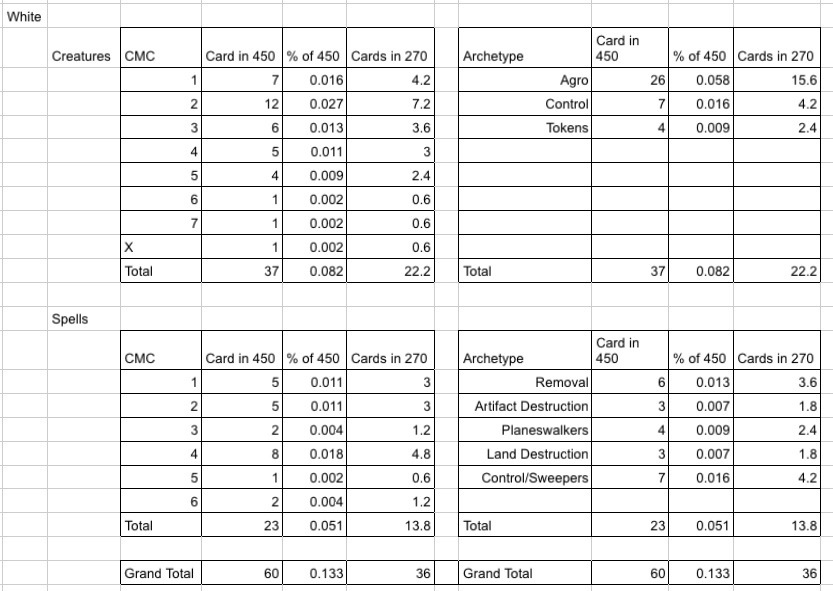
In our model cube there are 60 cards per color which equals 13.3% of the total cards which gives us 36 cards per colored section to work with. To give you an idea of how I’ll keep the archetypes consistent and balanced, I’ve done up a little spread sheet setting out the number of cards per CMC and archetype. I am no mathematician so if there is something a little wonky about the numbers let me know.

20131105-001413.jpg

Theoretically, if we have the same density of one-drop white creatures we should be able to draft the same quality of white weenie deck.

The idea behind this type of build is that it is a starting point. My personal cube has [card]Tarmogoyf[/card], [card]Dark Confidant[/card], [card]Jace, the Mind Sculptor[/card], [card]Liliana of the Veil[/card], and other expensive cards. I think they are important to the overall experience of the cube format, but I don’t think they should be a barrier to entry. We’ll start by getting an initial list together, and from there it’s up to you to use the financial knowledge you’ve learned from the Brainstorm Brewery podcast to get those money cards without having to shell out.

Okay, let’s do a poll. How should we structure the limitations of the dollars being spent on the cube? Note that I have intentionally not determined the total cost of the model list because I don’t want to be biased towards a higher or lower number. Help me determine what to spend below, and we’ll start building next time!

[poll id=”3″]


Brainstorm Brewery #75 – Sesquicentennial

Brainstorm Brewery turns 75 this week and shows no signs of pumping the brakes. You shouldn’t pump your brakes, anyway- most cars these days have ABS and you’re not doing anyone any good. This episode is a back-to-basics, no-nonsense cast that is short on dilly-dallying and long on both values and hyphens. With a few brews, both of the alcohol and deck variety, a fan letter, some discussion about what to do with upcoming product and some killer picks of the week, there’s more value here than you can haul off in a cloth bag with a dollar sign on the side. Who doesn’t know the name of their own general? Who suggested that it was reasonable to cut card draw from an aggro deck? Who watched too much Jeopardy this week because their Pick of the Week comes in question form? You’ll find out the answer to all these questions and more. Sit back, pour your favorite brew and kick your feet up because you’re about to get both barrels with this installment of your favorite finance podcast that will have you asking “What DO you cut from Merfolk to make room for True Name Nemsis?” Join us for Brainstorm Brewery.

  • You wanted a chance to own a Tee with the logo on the front. Buy our merch and help support your favorite podcast.
  • Pick of the Week goes deep this week and you may learn how to evaluate the MODO market a little better if you didn’t already. Does it always translate to paper? Is Merfolk going to be a contender in Legacy? What is poised to go up? Find out!
  • What should you do with Commander decks? The answer may surprise you, looking at historical trends.
  • True to their word, the gang keeps their commitment to read one fan letter a week. Want yours read on the cast? Hit up [email protected] !
  • There is a newer offering coming to Brainstormbrewery.com and it may be relevant to your interests. Find out what it is!
  • Interested in contributing to Brainstormbrewery.com as a writer? Submit your credentials to [email protected]. ?We have already published articles written by other fans- don?t miss your chance to be part of one of the fastest-growing brands in the game.


Cabe Riseau produced the intro and outro music for Brainstorm Brewery.


Contact Us

Brainstorm Brewerywebsiteemailtwitterfacebook

Ryan Bushardemailtwitterfacebookgatheringmagic.com

Corbin Hosleremailtwitterfacebook – quitespeculation.com

Jason E Altemailtwitterfacebookgatheringmagic.com – quitespeculation.com

Marcelemailtwitterfacebook

Jason Alt – The MTGO Zero Gets Online

The MTGO Zero Gets Online

Wassup, adoring public?

We’re now two installments deep on this crazy project and this week I went through the process of getting everything set up so we can go to town on some MODO finance. Before I start mentally spending my millions, I decided to make sure I had everything in place for when I made my first card purchases. I am starting from literal scratch, never having even downloaded MODO in my life. I’m sure I’m like a lot of you in that regard. Given my relative lack of experience I decided not to get any help because I thought it would be funny if I fumbled around like a total noob, but fortunately for me and unfortunately for those of you who were looking forward to me making a hilarious, embarrassing mistake that you probably also made, but get to pretend you didn’t, it’s actually not that hard to get started.

I figured the most intuitive place to go would be the mothership. It was simpler than I could have dreamed; I navigated over to the “Digital Games” tab and clear as day, right in the middle of the page I found an icon to help me create an account. I figured that was probably the best first step, but as it turns out, it wasn’t necessary yet. If you type something like “Download Magic Online” into Google, you can download the software without making an account. When you install and open the software, you’ll get the following screen:

Home screen

The prompts at the bottom will either let you play a free trial or create an account. I feel silly telling all of you this because there’s a good chance you know it already, but shut up, I didn’t.

Now I went through the process of creating an account. I ended up with the username JAlt, but only because there was an issue with trying to pay with Paypal. Every time I selected it as my payment method and tried to pay, it kicked me off of the screen, but said the username I had picked was already taken. So I went through JasonEAlt, JasonEAltMTG and xXBigSexyDaddyXx before I finally got it to accept a username and payment method combination that didn’t give it a conniption fit. We were off to a pretty rocky start. I’d like to tell you the MODO Beta Client is easy to use, free from bugs, and runs smoothly and expeditiously, and also that the sisters left Andy Dufresne alone, but life is not a fairy tale. I’m using the MODO Beta Client instead of V3 because if you’re downloading this as late as I am, you have to use it, and I’m no MTGO Zero if I’m not on MTGO.

I restarted my computer after the installation process and logged in. I told you all my username because you’ll never guess in a million year that my password is “Kittensarecute.” Log in and you’ll get to a different screen. Eventually. Hopefully.

Your entire collection is stored on the server, which is probably wise because if it were stored on your computer it would be vulnerable to tomfoolery and possibly even hijinks. Upon logging in, the weird, Bruce Willis-with-hair-looking Gideon is replaced with a weird, Bill Nighy-looking Gideon and you’ll see a bar at the top of the screen with a bunch of options:

Home, Collection, Play Lobby, Store, Trade, Account, Help, Chat.

I had next to nothing on my home screen. It featured a tournament that was half over, displayed my buddies (I don’t have any yet but add me if you want), and had a few brief announcements. I figured “Collection” was where it’s at, so I clicked over.

I had nothing in my collection except a “New Player Stimulus Package” or whatever they call it. Clicking on it gave me the option to open it up. Inside I found five generic tickets (they’re called tix or ticks. I’m not sure which. I don’t see it spelled that often) and 20 “New Player Points” which get you into special noob drafts or sealed events so you can learn the interface without getting your pants pulled down by some pro who is double queuing and makes you wait until his round clock is nearly out before he comes over to spank you. You’ll also get some avatars which I guess you can use as your face. They may or may not be random – I didn’t see one I liked. It’s not certain I’ll be playing matches so avatar be damned, let’s see what else we got. “What else we got” amounts to a pile of poop – random M14 commons and uncommons. People tell me you can’t sell them because they’re tied to your account, but there was no value there anyway.

So I had five generic tix to my name. Not the most auspicious way to start a card empire, but a journey of a thousand miles begins with a single step. If I’m going to Journey all the way to Nyx…no, there’s no way to make that funny. Moving on. If I’m going to actually make any money at this I am going to need a lot more buying power than five tix. Even if I had money, I’m not sure I would know what to do with it.

The next tab is “Play Lobby” and I noped right out of there in a hurry. It’s full of people, playing Magic, and that’s not really something I want any part of.

The next tab after that is “Store” and we need to go to this tab. For those of you playing along at home, you’ll need to decide your budget right now. Or, later, I guess, but I decided my budget already so I knew what to do right away. There are a bunch of categories of products in a menu on the left. The very top one is “event ticket” and while I don’t know if I’ll be playing events, I’m pretty sure this is the in-game currency everyone refers to as “tix.” I wanted to be sure so I looked around for other kinds of tickets and couldn’t find any. Priced at $1 a ticket these will be our bankroll. I put 100 of the bad boys in my shopping cart and bought them.

Armed with 105 tickets I was ready to conquer the world. But before I could turn in for the night, I knew I had a bit more investigation to do. I ignored the “Accounts,” “Help,” and “Chat” tabs and stared with intent at “Trade” which I could only assume was what I was looking for.

Ladies and gentlemen, “Trade” is going to be our home for the duration of this experiment. I am going to buy cards with my “tix” and see how long I can go buying and selling until I run out or make enough money that I can sell my tix and buy a private island that I can stock with poor people whom I will hunt for sport.

I figured before I called it a night (it had been a long one at this point – MODO runs at its own pace), I should try and figure out how to buy a card. It was not as easy as I had thought. The procedure, I figured out, went like this:

Right away, I messed up by not knowing my tix weren’t tradeable. Go to collection, right click on the tix and select “add all to active trade binder.” This makes them tradeable.

If you want to buy a card, say, Rubblebelt Raiders because you think it will go up, type the card’s name into the search bar. It will bring up bots and people who are advertising that card. I recommend finding a bot with a large inventory. Click “trade” over on the left and it will take you to a screen with the bot’s inventory and a chat window. You need to pay attention to both. If your computer wigs out and keeps the chat window behind the inventory screen you’re going to be confused as hell. When you click a card, the bot will display the price in the chat window, or the human will tell you what they want for it. Double clicking the card will add it to the trade inventory on the left. I found a bot that was selling four copies of [card]Rubblebelt Raiders[/card] for 0.05 tix each. A nickel for a rare? That’s not bad! I jammed all four copies into my trade area and waited for something to happen.

Nothing happened. I read every line of text on the chat window and it turns out the bot had given me instructions for how to prompt it. Every bot seems different, but the one I traded with told me to type “done” when I had enough cards. Since the four [card]Rubblebelt Raiders[/card] only cost 0.05 tix and it had to take a whole ticket, it banked 0.80 tix as “credit” for future purchases. This meant I had to remember this bot. I added it to my buddy list by going to “add buddy” on the home page and pasting its name in. Now whenever I want to buy more cards, I can click on its icon on the home page and start a trade with my banked credit.

I figured out how to make an account, download the client, trade tix, buy cards, bank credit, and add a buddy. This was a productive day. I have 104 tix, four [card]Rubblebelt Raiders[/card], 0.80 tix in banked credit and a lot of work ahead of me. I want to start being a little more aggressive with my buys in the meantime because I want to be ahead of MODO redemption. The next installment should be a barn burner. I think. I actually don’t get that idiom at all. If I owned a barn, I can’t imagine I’d want it burned. Wait a minute, what if it’s a terrible barn and I have it insured? Okay, makes sense now. Next installment will be more value than burning down your barn for the insurance money. See you then!

(Almost) Getting There With Scion of Vitu-Ghazi – Open Top 4

Welcome Brew Crew. First some introductions, my name is Ryan Archer and I am a member of Team RIW. I’ve been playing Magic for a long time, but recently focused on my goal of making the Pro Tour. When Dragon’s Maze was released, it introduced some of my favorite Standard cards: [card]Advent of the Wurm[/card] and [card]Voice of Resurgence[/card]. I really liked the power level of both of these cards and was surprised that no one was as excited about them as I was. I began my journey towards creating the deck that I am now playing GW Aggro.

voice

Why Brainstorm Brewery? Well, probably like most of you reading this, I am also interested in MTG Finance. I have been working for RIW Hobbies for almost ten years now and as such, have seen the cyclical rising and falling of Standard card prices, the slow rise of eternal-playable card prices, and the crazy spikes from EDH cards. I have always been involved in MTG finance but it wasn’t until I tuned into the Brainstorm Brewery podcast that the fire was ignited. I have been making money on Magic more now than ever, and I have these guys to thank.

I read [card]Scion of Vitu-Ghazi[/card] and I immediately thought the guy was the Nutter Butters. I thought to myself, “I am going to go deep on this guy and am going to make a lot of money.” I got in cheap enough that even if it didn’t hit big I wouldn’t lose much. No one was playing it, so I decided I would brew a deck that did and then surely the price would go up. All I would have to do is win a few events, with a deck that no one’s seen, playing a card no one thought was good, and that would be enough. Well, I accomplished the first part but the price on Scion still hasn’t budged. It’s time to keep trying.

Why should you care about what I have to say about this GW Deck? On several occasions I have been called the GW master (I said it about myself – still counts). I also have been tearing up the Constructed scene here in Michigan. I won the Professional Events Services-sponsored Michigan states tournament. I also came in second and third at the Michigan TCG states one week later.

Screenshot_2013-11-06-12-36-04

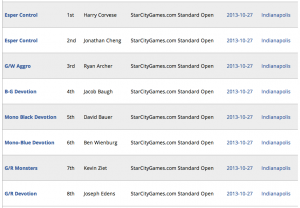
That’s right, I got to be state champion for a whole week. With all the states tournaments next year we should take all the winners and make them play out a top eight to see who the real state champion is. Most recently, I took the GW deck to a third-place finish at the SCG Open in Indy.
Screen shot 2013-11-03 at 8.44.33 PM

All right, enough of the sick brags (though making second and third at the same tournament kind of warrants them). It’s time for the real reason you’re here. Let’s discuss the deck list I played at the Open.

I primarily expected a lot of Mono Black, Mono Blue, and Esper Control decks. This GW deck has a pretty good game against Mono Black and Esper, along with any aggro or midrange deck that don’t play [card]Nykthos, Shrine to Nyx[/card]. Mono Blue is an okay matchup but if they ever play [card]Master of Waves[/card], you cannot win. Also, [card]Thassa, God of the Sea[/card] is a huge beating to play against.

For this article, I don’t want to do a tournament report. Because the deck is fairly unknown, I feel it is better to go over the card choices and explain the numbers and why certain cards made the cut.

I was fortunate enough not to have to play against Mono Blue all day. I had a bit of bad luck in some of the matches I lost, but that’s Magic. It’s very difficult to not run into bad luck when you play twelve matches.

Onto the card choices:

4 [card]Experiment One[/card]

Against certain decks it’s very important to put a lot of pressure on them from the beginning. Experiment One does a good job at attacking early while still growing and being relevant in the late game. His regenerate ability is especially good against removal from Mono Black and [card]Supreme Verdict[/card] because you have no shortage of creatures to start growing him again.

3 [card]Fleecemane Lion[/card]

Like I said, early pressure is important and the lion has decent stats. I think his monstrosity ability is just okay, because he either gets outclassed by larger monsters, or their decks have sacrifice cards like [card]Far // Away[/card] or [card]Devour Flesh[/card]. He also doesn’t match up well against [card]Blood Baron of Vizkopa[/card].

4 [card]Voice of Resurgence[/card]

I don’t know what else to tell you about this card you haven’t heard already. It is awesome. Good against every deck. Some of the removal in this format targets attacking creatures, which can be very awkward when staring down a Voice. The token gets huge and can be populated. Do not sideboard this card out.

2 [card]Vitu-Ghazi Guildmage[/card]

LOL wut? Don’t laugh, this card is great. It can break open midrange mirrors by populating two wurms a turn. It is also a good top deck against Mono Black or Esper when they have spent all their resources to kill your team and you’re both low on cards. Play this and kill them with an army of centaurs. Guildmage is better later in the game so only two are necessary.

4 [card]Loxodon Smiters[/card]

I’ve seen some recent lists move away from this guy but I don’t understand why. A 4/4 for three is great. Sometimes your blue opponent will pass the turn with mana up hoping to counter your spell and you play this guy. Frown town for your opponent. He smashes in for a lot and is a great blocker against the aggro decks. I have yet to make my opponent target him with a [card]Thoughtseize[/card] but I’m going to keep trying.

4 [card]Boon Satyr[/card]

Alright! The card I was most excited about from Theros. This card has been an all-star. It has flash against Esper decks. It makes combat math a nightmare for your midrange opponent. You have not lived until you bestow [card]Boon Satyr[/card] onto your wurm token. There’s one more trick but I’m saving it to mention with Scion.

1 [card]Banisher Priest[/card]

I have to admit I don’t love this guy, but he does fill a role. That role? Kill [card]Master of Waves[/card]. Sure, he can do other things, like make your opponents waste their removal on him. But you really need to kill the blue menace. I made space for one in the main to help out the Mono Blue match (he can also eat a devoted Thassa). He wasn’t bad in the GR matchup either, so there is that. I would not play more in the main because he is so bad against Esper.

4 [card]Advent of the Wurm[/card]

If I have to explain to you why a 5/5, for four mana, at instant speed, that has trample, should be in your GW deck, you’re playing the wrong game. I would rather populate the wurm than an elemental in most cases, just to let you know. Also of note, he is only green which means he wins fights with Blood Baron.

1 [card]Polukranos, World Eater[/card]

Come on, this guy eats worlds, how could you not love him? He passes the Blood Baron test and also kills [card]Master of Waves[/card]. Basically a 5/5 for four in this deck but he earns his keep.

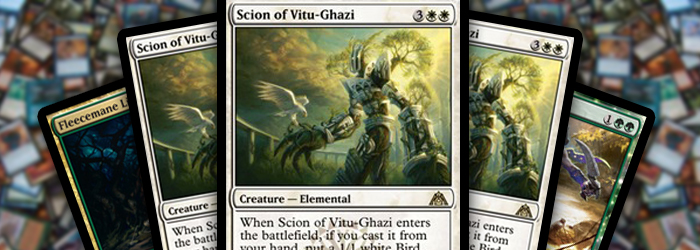
3 [card]Scion of Vitu-Ghazi[/card]

Oh boy, strap yourself in. I have a lot to say about this guy. But first, a short story of the time I met Ryan Bushard:

It’s July 2013. M14 just came out. I’m playing in the SCG Classic in Lansing. I’m playing a pre-rotation version of the GW deck. Basically the same deck, because not much rotated. Round four, I play against someone whose friend is next to him wearing a Brainstorm Brewery Shirt. I tell him I like that podcast and he says Ryan is here if you want to meet him. I say naw, trying not to seem too eager. I finish the tournament in the top eight but before it’s announced I run into the same guy who is with Ryan. I shake Ryan’s hand and explain that I really like the show and that it got me into speculating. He asks what cards I’m looking at and I explain that I went deep on Scion of Vitu-Ghazi. He smiles and explains to me that the card could be a good choice because the casual crowd could like it one day. He is obviously trying to be nice, but I can tell he doesn’t approve. I smile and explain that I just made top eight with three copies in the main deck. He stares at me blankly before smiling and congratulating me. Later on, Ryan Tweeted “just bought 174 Scion of Vitu-Ghazi #mistake?” I laughed to myself reading it, and on the next Brainstorm Brewery podcast Jason’s pick of the week was [card]Advent of the Wurm[/card] and Ryan’s was [card]Scion of Vitu-Ghazi[/card]. Just wanted to let you know, Ryan, that I am still working on making this a profitable spec.

Okay, back to Scion. Let me first explain why the other choices for five drops are bad. The answer is: all the one-for-one removal that is getting played right now. Both [card]Kalonian Hydra[/card] and [card]Archangel of Thune[/card] do nothing when immediately targeted by a [card]Doom Blade[/card]. I need a little more resistance from my five drop.

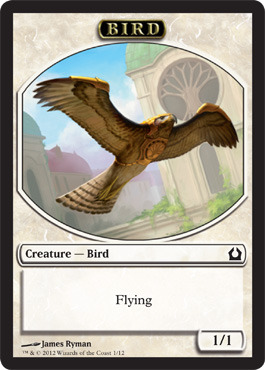
So Scion, with nothing on the board, is a five-mana 4/4 that makes two birds. That’s six power for five mana spread across three bodies and two of those bodies have evasion. When they [card]Doom Blade[/card], you’re still left with two guys. Some sweet plays that Scion enables:

  • Against midrange decks you can live the dream and cast turn-four Advent, untap, cast turn-five Scion. That’s fifteen power when you had none. Their one-for-one removal is not so good now, huh?
  • That same play is also good enough to seal away most games against aggro decks.
  • The three creatures power up an elemental token from out of nowhere and Scion can make more elementals.
  • The birds are great creatures to feed to a [card]Desecration Demon[/card].
  • The birds can fly over a stalled ground board state.
  • The birds are really good at attacking planeswalkers.
  • The birds can be suited up with [card]Boon Satyr[/card] to take huge chunks out of your opponents life (or planeswalkers).
  • Your opponent can’t play an [card]Elspeth, Sun’s Champion[/card] and -3 to kill all your creatures because the birds survive and kill Elspeth.
  • The birds can block your opponents flying creatures.
  • The birds can fly over Blood Baron.
bird

Caw!

I’m making a case for the birds because if you ever populate something bigger you’re probably winning already and you don’t need me to tell you that’s good. By the way, all of these situations have happened to me while playing, and yes, they did feel great.

4 [card]Selesnya Charm[/card]

This charm does everything. Sometimes it’s an early attacker that can be populated. Sometimes it’s a combat trick that your opponent must respect (which can allow you to get some free attacks in). Most of the time it’s a removal spell for the cards you can’t deal with, the big ones. I’ve removed huge [card]Revenant Hunter[/card]s, [card]Polukranos, World Eater[/card] in response to monstrosity, [card]Desecration Demon[/card]s, and it’s also a great answer to the gods.

2 [card]Rootborn Defenses[/card]

A nice answer to removal, but mostly just there to beat [card]Supreme Verdict[/card]. If you can save your team from a Verdict and make your opponent waste his turn you have probably already won. I do sometimes cast it just to make a wurm.

[deck title= G/W Aggro]

[Land]
*9 Forest

*7 Plains

*4 Temple Garden

*4 Selesnya Guildgate

[/Land]

[Creatures]
*4 Experiment One

*3 Fleecemane Lion

*4 Voice of Resurgence

*1 Banisher Priest

*4 Boon Satyr

*4 Loxodon Smiter

*1 Polukranos, the World Eater

*3 Scion of Vitu-Ghazi

*2 Vitu-Ghazi Guildmage

[/Creatures]

[Spells]

*4 Advent of the Wurm

*4 Selesnya Charm

*2 Rootbound Defenses

[/Spells]

[Sideboard]

*2 Pithing Needle

*2 Banisher Priest

*3 Mistcutter Hydra

*1 Scion of Vitu-Ghazi

*2 Unflinching Courage

*1 Brave the Elements

*1 Druid’s Deliverance

*1 Gods Willing

*1 Last Breath

*1 Trostani, Selesnya’s Voice

[/Sideboard]

[/deck]

This article has already gone long, so in my next article I will cover the sideboard and any changes I would make to the deck. In Constructed Magic, formats are constantly shifting so you should be adapting your deck to beat what decks you expect. Just be sure to not change so much that your deck is not accomplishing its original goals.

Please let me know what you think in the comments and make suggestions of any future topic you would like me to cover. I’m a tournament player first and a financier second, so I can discuss a wide range of decks across multiple formats. I like the idea of reviewing some format or deck and then giving feelings on the financial opportunities from a tournament player’s perspective. Let me know if that’s something that interests you. Thanks for reading.

Jim Casale – Long-Term Plans

In this corner, the greenest merfolk to ever walk into an arena, weighing in at 2UUGG, standing a measly 1/1 before coming in to play, [card]Prime Speaker Zegana[/card]! And in the challenger’s corner, the weirdest wizard you’ve ever met, weighing in at a whopping 4UR, and standing an impressive 2/4, [card]Melek, Izzet Paragon[/card]! Ready? Fight!

If EDH battles were like boxing matches, that’s how I figure my decks would be introduced. But now I’m on a mission to broaden my horizons as well as yours. To meet this goal I’d like to introduce you to a new article series, [card]Long-Term Plans[/card]. In this series, I’ll detail the never-ending project that is creating an EDH deck and eventually come to two different decks for different levels of financial investment: budget and big spender. Budget players’ decks will include – you guessed it – budget versions of other cards that can be purchased at your game store to get playing. The goal of the big spender is to create the most extravagant yet effective deck possible. There are no monetary considerations when building this kinds of deck and it will be assumed everyone that wants to play it can afford to buy whatever it needs.

To start off the project, I will first run a poll to determine which and how many colors the Commanders will be. I have to advise everyone that the website http://magiccards.info/ is pretty crucial to everything I’m doing here and recommend everyone to get familiar with the advanced search functions because they are far more intuitive and accurate than even those on Gatherer.

Making a Commander deck is an art, some might say. Playing it is like enjoying a fine wine and some smelly cheese but it also requires a lot of thought and preparation to truly enjoy. I have a few steps that I take when building a deck to make sure I come out with a good prototype to iterate upon. The best (or possibly worst) thing about decks in eternal formats like Commander is that they are never truly complete. But starting from scratch, there are a few key steps of which we need to be mindful:

  1. Choose the Commander’s color(s): This should be pretty self explanatory. As a Commander’s color identity is the most important thing to consider when building a deck, we need to strongly consider its color(s).
  2. Choose a Commander: Yep, choosing the Commander is less important than the color(s). There are a lot of Commanders and narrowing down the color identity before choosing the creature makes the process less overwhelming.
  3. Create a manabase: This includes non-land cards such as Signets that you will use to generate mana. Nothing is worse than playing a game of Magic and getting mana screwed. We also want to play all these sweet 7+CMC spells so making the manabase first gives us a good idea of what we can and can’t cast.
  4. Choose core cards: These usually work with the Commander toward a common goal. The set of support cards you use changes the most out of any cards in the deck but also have the largest impact on gameplay.
  5. Choose your staple “good cards”: These cards are catch-alls that are included because of their color, utility, or just general power level. Sometimes there are good reasons to exclude them but most people want to play with as many of them in their colors as possible.
  6. Play a game and revise: Commander does not have a clear-cut deck-building process. There are lots of tweaks and changes that are made throughout a deck’s life that require you to constantly iterate to get the best results.
  7. Make another deck!: Most people, once they start Commander, don’t just stop at one deck. As much fun as a deck can be, it can get boring or monotonous when your deck is so finely tuned that it always does the same thing every game. Having another deck or two to work on keeps the creative juices flowing and keeps the game enjoyable for you and your opponents.

I am going to try to address one of these bullets in each article, which will hopefully be once per week. This means that our Journey to Nyx, or wherever our Commander is from, will take about six weeks and while doing this we will create two Commander decks! With that being said, let’s get started on the point of order on our agenda.

What color or colors should my Commander be? There are a lot of things to consider but there are some important things to keep in mind that are always true:

  1. As you increase the number of colors in your deck, your mana gets worse and the number of cards you want but can’t fit increases.
  2. There are no four-color Commanders at all (some house rules allow you to play nephilim but they’re pretty abysmal as Commanders so I wouldn’t bother).
  3. Colorless Commander decks have the opposite problem of many-color Commander decks: there are not very many cards that you can play.
  4. Some Commanders may be fun for you but are not very fun to play against.

Some very broad advantages to some color combinations exist but as a general rule, the most cost effective, fun to play with and against, and powerful EDH decks are one or two colors. The fact that Return to Ravnica is a Standard set that introduced a ton of juicy gold cards, as well as a few in neighboring Theros, means for a budget player, one- or two-color decks are an easy goal to hit.

Three-color decks come in two varieties, wedges and shards. If you’re unfamiliar with the terms, shards are a color and its two allies (i.e. the Esper shard is blue with its allied colors white and black), wedges are a color and its two enemies (i.e. the fan-named “Ceta” wedge is blue with its enemy colors red and green). If your goal is to play powerful gold cards then typically wedges are a bad choice. There are not as many cards of those colors and even fewer possible Commanders (remember we need a legendary creature that is all three colors). With the new Commander decks right around the corner, it’s also a lot easier to get access to shard-colored cards.

The final behemoths of Commander decks are the colorless and five-color decks. These both have huge problems with mana. The lands required to play the decks with any success are expensive, hard to find, and fold to non-basic-land hoser cards fairly frequently. That being said, I don’t recommend people suiting up [card]Ruination[/card] or [card]Back to Basics[/card] in their EDH decks because nothing is worse than not being able to cast spells. It’s arguably worse than having all of your spells countered (which everyone also loves, right?). These decks, however, wield massive amounts of power because they can freely play some of the most powerful cards in the game.

But enough of my babbling, what kind of deck should we make? Join me next week when I discuss our Commander card options.

[poll id=”2″]

Enmou Gao – Intro to Speculation

The Intro:

So it looks like I’m keeping my position after blundering on a key term in my last article and asking Jason to eat a shoe. If you don’t know what I’m talking about, let’s keep it that way :)

A short belated introduction, my name is Tim Enmou Gao and I graduated last year with an undergraduate degree in economics and accounting. I picked up Magic again after a ten-year hiatus and went straight to Modern. I am a Modernophile at heart and prefer to play tempo decks. I am currently playing Jeff Hoogland’s UR Spellstutter deck.

Today, I wanted to cover the topic of speculation.

What is a speculation? A speculation is by definition a conjecture, there are no 100% speculations in Magic because Wizards of the Coast can at any moment make a new announcement. However, that doesn’t mean that all speculations are made equal.

I believe that experience is the best teacher, so I’ll be going over my first experience speculating. I hope that you’ll be able to find some value in reading the article.


The Deck:

Image

I first had the idea speculating on [card]Restore Balance[/card] deck in July this year after seeing the deck 4-0/3-1 on a couple Modern Daily Events within a week. Being that the deck didn’t really make any sense by looking at it, I started play testing a [card]Restore Balance[/card] deck on TappedOut.net because as with all things Modern, I wanted to figure out how the deck worked.

Let me explain.

Image (4)Image (3)Image (5)

By casting [card]Violent Outburst[/card], [card]Ardent Plea[/card], or [card]Demonic Dread[/card], the deck can effectively cascade into its key card, [card]Restore Balance[/card]. The deck runs a redundant number of cascade spells because it usually doesn’t run any innate draw or search mechanics. Casting a Modern-legal [card]Balance[/card] isn’t a big deal, but there are ways for the [card]Restore Balance[/card] deck to abuse the [card]Balance[/card] effect.

Image (2)

First and foremost, suspending a [card]Greater Gargadon[/card] before cascading into [card]Restore Balance[/card] adds an [card]Armageddon[/card] to the [card]Wrath of God[/card] effect! You can sacrifice all your lands to make your opponent sacrifice all his/her land while [card]Restore Balance[/card] is on the stack.

But it gets even better.

Image (6)Image (8)Image (9)

By having a hand of cheap suspend creatures, we can add on a [card]Mind Sludge[/card] discard effect to our third-turn [card]Wrath of God[/card]-plus-[card]Armageddon[/card]. [card]Simian Spirit Guide[/card] lets us play it out even faster and makes the opponent discard more cards.

The deck finishes by powering through with its many suspend creatures, usually with [card]Beast Within[/card] backup, because all its creatures are larger than the 3/3. By this point, the opponent should have few if any cards, few if any lands, and practically no board presence.


The Factors:

After playtesting the deck for about a week, I knew that there was no way that [card]Restore Balance[/card] is a $0.50 card when it had the potential to be the most powerful spell in Modern. Here are some other attributes going for the deck:

  1. The deck does not rely on the graveyard, any specific type of permanent, and there are currently no hate cards in the Modern meta that are widely played (i.e., [card]Ethersworn Canonist[/card], [card]Rule of Law[/card]). I didn’t realize this until a few days into playtesting and finally giving up the Borderpost version in favor of being free from hate cards.
  2. There is a close to zero chance of a reprint because Modern Masters, the last set in a while to have the the Suspend mechanic, skipped over the card. Suspend is largely an unpopular mechanic for Wizards because it is confusing for newer players.
  3. There is a Johnny element to this deck. It is fun to “go off” and wipe out the opponent’s lands, creatures, and hand, after which your suspend creature takes over the board. Total devastation is the name of the game.

There are a few other reasons why I felt that [card]Restore Balance[/card] was a spec that can reasonably hit.

  1. At the time, [card]Living End[/card] had recently risen in popularity because of GP Kansas City, where the [card]Living End[/card] deck reached second place. In terms of the main combo, the decks were very similar. However, whereas Living End was a $10 card at the time, Restore Balance was only $0.50.
  2. Theros was the next set to be released, and it was rumored to be based around enchantments. [card]Restore Balance[/card] is also the only deck in Modern that can play [card]Idyllic Tutor[/card] as a way to find [card]Ardent Plea[/card] to cascade, and it was conceivable that Theros would provide better 3CMC enchantment-tutor targets.
  3. I began to see copies on the internet disappearing at the $0.50 price point, and it was clear to me that I wasn’t the only who saw the opportunity to go deep. This was an opportunity for me to experience speculating first hand.

It should come as no surprise that I also have a number of caveats with any spec. The following is a list of reasoning that it might not be the right the spec for me.

  1. I haven’t hit a spec before, and the question was whether I wanted to throw over $100 on a single card that has no real precedent. That’s a lot of money to potentially throw away.
  2. The weakness of the [card]Restore Balance[/card] deck is that it folds to consistency and discard. If it becomes a deck, it would be the one and only five color Modern deck. There is no precedent of a five-color combo deck, as redundant as its cards may be.
  3. With a good amount of playtesting, the deck loses to early discard, and its manabase is not always going to get there no matter how many all color lands it runs. Consistency is an issue in larger tournaments that have more rounds, and it could very well be that [card]Restore Balance[/card] would never be a competitive deck.


The Actions:

With all these factors in mind, I’ve decided to go as reasonably deep into the spec as I can, because I am reasonably confident that the price isn’t going to be any cheaper and the card has great upside. In my first round of buying I went about 100 cards deep, which came out to be about $60 at $0.60 each after shipping.

On the same night, I contacted Jason Alt with a full list of reasons why I think the spec could hit and what he thought about the spec. It felt far-fetched that a pro financier would respond to a random Redditor, but I thought it was worth a shot. I was pleasantly surprised when he quickly responded affirming the spec. Here are a few quotes of what he wrote:

“If you bought restore balance at $0.60 you almost can’t lose.”

“It seems like the card keeps popping up. You’re doing everything I’d do and your thought process seems solid. I can’t find any fault. Take a chance on this. Go a little deeper.”

“You are confident in this spec – enough to buy 100 copies before even running it by me. I take it you’ve never hit before and that’s why you’re reluctant. Go deep. You can lose, but you can’t lose TOO much and if you hit, this card could be a few bucks on a buylist.”

I then stayed up another hour and bought some 75 more copies of the card, culminating in an average price of $0.62. Amazing things happen when you hear what you want to hear!


The Present:

Today, the median TCG price is $1.64, down from $1.78 from about a week ago. Prices have risen over the past few months and show no signs of stopping from doing so.

So far, I’ve sold a playset on eBay for $10.06 and another 51 cards off a buylist for $1.15 each for a total of $58.65. Not even remotely close to amazing, but I’m happy about my first spec!

RestoreBalance

I currently hold another 120 copies, averaging at $0.37 per copy, so I’m quite certain I’m in the money for this spec.


The Takeaway:

  1. Do your homework. This is the foremost factor for how you can hit a spec. While you can’t have a spec that will hit 100% of the time, you can do your best to make sure that the chances are as good as you’re willing to risk.
  2. The old adage stands, “Buy low, sell high.” Find a card that you believe is underpriced, preferably bulk or close to bulk, and go as deep as you reasonably can. You can lose, but you can’t lose too much, and the potential for upside is worth the risk.
  3. Keep track of all your cards, prices, copies, in an Excel file to know where you are. I can’t imagine trying to figure out whether I’m losing, breaking even, or making money on a spec without keeping track.

20131031_220145

I wish I can figure out which vendor sent me this “NM” copy…

Lastly, here’s another excerpt from Jason because all you readers obviously don’t get enough of him from just his weekly Quietly Speculation Alticle. All the value!

“One technique if the price goes up and you don’t know whether it will go up again is to sell enough copies at the first bump that you break even, then you hold the rest. If they go up more, it’s all profit. If they go down, it’s still all profit. If they stay the same – guess what! Profit. Breaking even as early as possible is the single most important lesson I can teach for your first spec.”


Thanks for reading!

Enmou (Tim) Gao

@TimEnGao on Twitter

Serum Visions – An Introduction

Hello everyone and thanks for being here with me today. I’d like to start by introducing myself, to let you know a little bit about who I am, where I come from, and why it is that the great guys at Brainstorm Brewery think I might have something worth saying to y’all.

My name is Andrew Colman, and I live in Winnipeg, Manitoba, Canada, just a few hours north of the North Dakota border. My official schooling has nothing to do with beer or cube. I did an undergrad degree at the University of Manitoba in jazz trumpet performance. It took me seven years to complete and I figured out in my third year that I wasn’t going to be a musician in life, and yet I would not take a moment of it back. I learned mostly about learning which in my opinion is the most valuable thing one can learn. I have just begun my Masters of Divinity degree from Trinity College at the University of Toronto distance education in Winnipeg. I’ll be moving out there next September with my beautiful wife to fully engage in the program over a three-year period. So if you are from Winnipeg or Toronto hit me up and we can drink some beer and cube!

Well, that’s quite enough of a bio for now, I’ll be telling stories about making beer like there is no tomorrow because I came at this hobby via the school of hard knocks! I remember talking to my cousin about when he used to make beer in college, they would always make two batches: one an experiment and the other they tried their hardest to recreate every week. They eventually got close to consistency but never really nailed it. I’ll talk about this later in a post on the topic of why we as brewers and beer drinkers actually need to respect the makers of Budweiser even if the beer really sucks!

Anyways, after learning that making beer at home was a thing, it bubbled in my mind for about six months. One day at school I was just blabbing on about whatever, and the fact that I wanted to make beer came up. It just so happened that one of my friends knew how to make beer. Bam, that weekend we were brewing! My first beer deserves its own 1200 words so I wont go into detail here, but I will say, if there are 10 steps to making beer, we did 15 of them wrong. We also made a few people pretty ill along the way. But that’s for another time.

After that I took a little hiatus to recover and it wasn’t until I started working at Chapters, a Canadian version of Barnes and Noble, that I started noticing all of the literature on beer. I did a little research and figured out that the Complete Joy of Home Brewing by Charlie Papazian is arguably one of the greatest home brewing books ever written, rivaled only by John Palmer’s How to Brew. Again we have a topic for another post. I bought the Papazian book and read it cover to cover, and then cover to cover again, and then cover to cover again! It was at this point I had to give my then girlfriend, now wife, the book to hold on to because it consumed my life.

Lo and behold we have this thing called the internet! I had spent a little time on the forum www.homebrewtalk.com, which is analogous to MTG Salvation, except I find it to be a lot more helpful. I spent as much time crawling every topic I could find on this forum as I did doing anything else. During this time I was making a beer every two weeks – as soon as the fermentation of one beer was finished and the yeast had been cleaned, I was bottling and making a new batch. At one point I had two carboys, one bucket, one half carboy, and three one-gallon test batches going in my room while in university. During the winter I would seal off the little window cubby hole and make one gallon batches of lager in there. It was perfect, the temperature had to be just above freezing and I could adjust the amount of ambient room air to keep that little space at the perfect temp.

After a year or two of working at Chapters as just a lowly grunt I was promoted to a regular grunt (cashier). I was then transferred to the music department which is a sequestered area surrounded my tons of music and was rarely very busy. This was a turning point. I could read for eight hours per shift if I wasn’t bothered by any customers and that is exactly what I did! Not only did I read every book on beer in the store, but I was taking out books from the library to read when I had burned though the other ones. It was awesome!

Every mad obsession must come to and end. The summer after I graduated I took up landscaping which zapped all of my energy. It wasn’t until about a year and half later that I picked up brewing again. I had made the odd batch of beer here and there and it was always the best beer in the room, which eventually got people asking if I would teach them to make their own beer. And so it started again: I have taught three people to brew in the last year or so and I have a schedule of people I need to teach before I head out to Toronto.

This series actually got spurred on by the beer that is being made for the cast. They asked for some comments and I wrote an article on what kind of beer they should make, and after some discussion, here I am.

I have one main goal with this series: make sure that my readers are beer literate. If people read this column I’d like them to be able to talk about beer intelligently, be able to taste beer and know what they are tasting, and have a bit of a working knowledge on the history of beer. Forgive me if this seems a bit noble, but it’s the goal…and I am listening to some very noble sounding music.

My next article will be on how beer is made from field to glass. If you know this, everything else going forward will have a frame of reference. Think of it like learning how to build an Esper Control versus an RDW deck. If I say Sphinx’s Revelation is bad in RDW, you would have no idea what I was talking about if you didn’t have the fundamentals down first.

Going forward from there, each post will be inspired by the MTG community in one way or another. For instance, with the pro tour having been in Dublin recently, I would have written on the amazing history of Guinness and how in Ireland if you ask for a pint, they automatically hand you a Guinness whether it was what you wanted or not. Or the utter dominance of the mono-blue deck may have led me to write about Blue Moon “craft” beer which is actually owned by one of the BMC companies, and has attempted to squeeze real craft brewers out of the market. Or with the release of True-Name Nemesis, I might have written on the brewery named Dogfish Head in Delaware. They make absolutely insane beers there, like Chicha, which is a beer that is mashed (terms to be learned in next post) by humans chewing it rather than being soaked in 154 degree water for an hour. If there is something I am just burning to write on, I’ll pull some tricky linguistics and make it fit to a pertinent MTG topic of the week.

Well, if I have piqued your interest, let me know in the comments section. If you have any feedback or suggestions of topics I should keep in mind let me know.

Thanks for hangin’

Andrew

Brainstorm Brewery #74 – Mailbagstravaganza

It’s a comedy of errors as the gang deals with a series of unfortunate events that all conspired to make sure an episode wasn’t recorded this week. Deciding to save some of the headier topics for another week, the gang digs into a mailbag backlog and finds some great topics. E-mails ranged from timely topics to requests for general advice to requests that Corbin acquire a microphone that picks up his voice as well as it picks up his ice cream-related exploits. The Rate My Trade segment is announced as a regular segment in a big way with the gang tackling several proposed trades and giving their analyses. You wanted another mailbag episode, and you got it. If you’d like your e-mail read on the cast and your name’s pronunciation butchered by Ryan or Marcel, send in a question or a trade you recently completed to brainstormbrew at gmail dot com. How do you evaluate a trade that is straight-across in value? How does the Magic Online market differ? Find out the answers to all these questions and more in a listener-mail episode that will rival the exactly one other time the gang did an episode like this. Join us for “Mailbag 2: Electric Mail Boogaloo” on your favorite Magic podcast that will have you saying, “Why’d they read that guy’s e-mail and not mine?” This is Brainstorm Brewery.

  • The new Commander preconstructed decks are jimmy-jammed with value. What should your investment strategy be?
  • E-mails, e-mails, e-mails. So many were read, and so many more remain to be read. Keep them coming!
  • The gang evaluates some trades. If you want yours evaluated, e-mail in a list of all the cards involved and remember not to tell on which side of the trade you were so you don’t bias the decision.
  • Want to write for the site? E-mail brainstormbrew at gmail dot com! A ton of great submissions have gone up already, and a lot are from Brainstorm Brew Crew members just like yourself. You could be the next great discovery!


Cabe Riseau produced the intro and outro music for Brainstorm Brewery.


Contact Us

Brainstorm Brewerywebsiteemailtwitterfacebook

Ryan Bushardemailtwitterfacebookgatheringmagic.com

Corbin Hosleremailtwitterfacebook – quitespeculation.com

Jason E Altemailtwitterfacebookgatheringmagic.com – quitespeculation.com

Marcelemailtwitterfacebook

Corbin Hosler – Building A Brand

Today I want to do something a little different. With a Standard metagame that’s offering fewer and fewer opportunities for the next month or two and Modern still a long way off, I’d rather not look at the minutia of Magic finance at the moment.


My Story

I know we have a lot of people new to the Magic finance reading this right now, and I know that the whole “Magic finance” thing can be a little intimidating at first. A few days ago I was battling against somebody with my (nearly) foiled out Modern merfolk deck, when he started to ask me the prices of several of the cards. Understandably, he was a little taken aback by some of the answers, like [card]Cursecatcher[/card] at $15 (and sold out at $6 regular on SCG, by the way. Thanks True-Name Nemesis!) or [card]Aether Vial[/card] at $25.

While talking about the deck, his friend asked him if he had any plans to foil out his Goblin deck. His response?

“Maybe if I was born into money.”

I let the comment slide, but the first thought that went through my head was that it doesn’t take money, it just takes time and hard work.

I’ve written about it before in several places, but the fact is that I was in his position just a few years ago – a broke college student losing to [card]Baneslayer Angel[/card]s because he couldn’t afford $50 mythics. Playing Magic was hard and keeping up with Magic was even harder.

Fast forward a few years. Today I write Magic finance articles, I co-host a popular podcast that is sponsored, I run a Magic singles store out of my LGS, and I’m able to foil out my merfolk deck without breaking the bank.


You Get What You Put In

You cannot have a defeatist attitude about this stuff. Rather than look at my merfolk and lament that you won’t ever get there because you didn’t have the same opportunities I did, make those opportunities yourself. I didn’t sit around being upset that I didn’t play when Power 9 was readily available. Instead, I worked hard and took advantage of good opportunities, to the point where I’ve used money from Magic to buy a fancy fridge as a housewarming gift for my wife as well as her engagement ring.

I know you can’t have a defeatist attitude because I went through that same process. I started just before Shards of Alara and was disappointed that I couldn’t have all those fancy, expensive Lorwyn cards like everyone else. Seeing prices on dual lands made me cry. But like I always advocate, where others see risk, find the opportunity.

I found my opportunity. The first big one was Zendikar fetchlands, and I accumulated more than 100 through trade when they began to bottom out in price.

The saying is opportunity looks a lot like hard work, and it’s absolutely true. I’m in a pretty good place in terms of Magic finance right now, both in terms of the passive income I make from it and the fortunate position I’m in being given a place to write, but it’s taken thousands of hours of work to get here. I think that’s the most important lesson for anyone looking to get into Magic finance, or really whatever else it is that interests you. There is no “easy flip.” No “I have $100, tell me where to put it right now so I have $500 a month from now.” Things aren’t that simple. They take time. They take research and dedication. They take work.


Building Your Brand

Most of you already know of this though, right? If you’ve been around the MTG finance game for a while, you certainly do. You know that scouring collections for those 50-cent cards is just as important as predicting the next [card]Nightveil Specter[/card] like we did in this column a few months back. The difference between success and failure in MTG finance and life is made in the margins. If not for those small victories like grinding collections that are more hard work than any particular brilliance, it would be much more difficult to get through the missed calls like [card]Splinterfright[/card] or [card]Master of the Pearl Trident[/card].

But there’s more to it than that, if you want there to be. If you are content just making your money and moving on, that’s fine. But I know that many of us want more than that, and I have something to share on the subject: no one is more important in making that happen than you are.

Let me explain: yes, I’m very lucky that someone I know bought one of the local Magic stores here and yet didn’t want to run a singles business so he hired me to do so. But that’s just the end result, the opportunity, the product of the hard work that went into it.

So what was that work? For me, it was about building a brand: myself. A fair number of local players and dealers in the region know who I am or recognize my name. But everyone recognizes Bernie Madoff’s name too. The important thing is that they recognize what I represent – a small-time dealer who is easy to work with and above all trustworthy.

Someone walked into my shop a few days ago hoping to buy a playset of [card]Green Sun’s Zenith[/card] from me. I had several that are in the mail but hadn’t arrived yet. I started to tell the guy that I didn’t have any for him right then, but then someone from a table next to me handed me his playset to sell. I told him I’d be happy to trade for them or buy them from him, but he just told me to not worry about it and I could replace them when mine came in.

I’ve told stories like this in the past and gotten the typical “must be nice, people are dumb, etc…” responses. Some value traders or grinders just can’t comprehend someone passing up an opportunity to “make value” at any cost. But the fact is we’re all surrounded by generous people like this, you just have to earn that respect.

I can’t offer you a step-by-step roadmap of how to get there, I just know that it’s something I’ve seen far too many people bypass in order to extract maximum value from a situation, whether that’s a trade or a friendly storeowner or whatever.

For me, I try to keep it simple. When I trade I don’t scumbag the other person or lie to them, and I’m as friendly as possible. I’ve met some great friends this way. Likewise, I go out of my way to help other players whenever possible. I freely loan away my cards and I’ll sometimes tell people just to keep stuff later on. I was lucky enough to meet several people who did the same for me when I started, and I want to pass that on.

“Being a good guy” is a great start, but it goes further than that. Here are a few things I consider instrumental to my journey to where I’m at today.


  • Creating a Twitter account. Why? Because it gives you access to a bunch of people you wouldn’t have otherwise. One of the best early things that happened to me when I was new to Magic finance and Twitter was getting into a public disagreement with Jonathan Medina over Venser, the Sojourner. He was convinced it was going to be a $40 card a few months out, and I thought it would be below $15. Interacting with a known commodity in the MTG Finance community (and beating him on that bet) was a great start.
  • Asking for a shot. This is absolutely the most important thing. How did I get my start writing Magic finance (for DoublingSeason.com, a short-lived website that was the precursor to any Magic finance site on the internet)? I asked. Then I wrote an article. Then I wrote another. Before too long, I got the hang of it and people kept coming back.
  • Conducting myself professionally. This is something that people overlook simply because they don’t realize how far it extends. I don’t curse on social media and very rarely on the podcast, I don’t speak in slang, I approach every email professionally. Basically, you have to be on your guard to put your best foot forward at all times, because you never know who is reading. And they are reading.
  • Be consistent. Nothing is more important to building a brand than consistency. Good-but-not-great content produced consistently is statistically more important to building a readership than producing something great every two months. You have to be there, week after week, if you want your readers to come back.
  • Staying up-to-date and accessible. I may not love all of Reddit, but I have an account and I try to be active on the forums I enjoy, like the MTGFinance subreddit. I stay active in the Quiet Speculation forums. I go out of my way to give every person I meet or trade with my full attention, and if they ask me for advice I try to give detailed answers instead of blowing people off with a quick response. After all, the very first thing I ever wrote about Magic finance was “It’s about making friendships, not matching dollar signs,” and I firmly believe that to be true.
  • As you’re building your brand, don’t forget where you came from. Think about it in comparison to competitive Magic players. Many people don’t want to go to PTQs because of all the “jerks and rules-lawyers there.” You don’t hear these stories about the pros like Brian Kibler or LSV, you hear them about the mid-level player who’s had a taste of success and is so desperate for more he’s willing to compromise his own ideals to get there. Don’t ever begin to think you’re entitled to something because you wrote an article for a website or because you’re a well-respected player or trader in your area.
  • You’re only as good as your next piece. I’ve made some nice calls in the past and hopefully written some good articles, but remember that there is always someone to whom you have no history at all. They don’t care that you called Stoneforge Mystic two years ago, and they don’t care that you played on the Pro Tour that one time. Don’t forget that.


So that’s my spiel. I’m incredibly lucky to be writing to you from a website titled after my own podcast, but there’s been a lot of work that’s gone into it. None of us got here through purely through luck, though there was certainly some of that involved. Jason will try to tell you he hit the lottery by becoming a podcast regular after coming in 10 or so episodes in, but it’s not true. He worked hard to get there and is responsible for many of the steps forward we’ve taken since then. That’s not luck, it’s hard work.

So I’ll leave you with this. What’s your goal in Magic? If you don’t have one, get one. Write it down, write the steps you need to get there, and make it happen. It’s not going to be easy, but it’s worth it. And figure out why you want to reach that goal. Is it to play whatever you want without budget concerns? Is it to make a name for yourself in the Magic community? Everything you want to do is possible, but it’s up to you to get there. Maybe then, when someone comes up to you and looks over your expensive Legacy deck and makes a comment about how they wish they could have the same opportunity, you’ll smile a little because you know just how wrong they are.

A wise man once said that people insist on calling it luck. I still have big goals for my career in Magic. Do they have my name on them? I don’t know. But I’m going to find out.


Thanks for reading,

Corbin Hosler

@Chosler88 on Twitter

Sander van der Zee – Boxing Season

In my previous article I delved into the financial merits of cards that have recently rotated out of the standard format and how you, as a player or financier, can try to make the best of it. And for those who commented on the glaring exclusion of a particular card, I have put the data for [card]Thalia, Guardian of Thraben[/card] in a link at the bottom of this article. But this time I would like to talk about something different. Lets talk about sets.

Let’s talk about sets, maybe. Lets talk about all the good things and the bad things that may be. So let’s talk about sets!

Salt-N-Pepa talking about Magic sets.

Salt-N-Pepa talking about Magic sets.

All ridiculousness aside, I do want to talk to you about Magic sets, in particular sealed booster boxes. In the last year I’ve been picking up hints of an on-going trend with the booster box products. Boxed product has been shooting up in value, the most recent example being Innistrad, now sitting at a solid 140EU/$170. What makes this so special, you might wonder? The set has barely been out more than two years!

So what does this mean for boxed product in general? Let’s first take a look at five sets which have seen dramatically increased booster box prices over the past year:


Darksteel – 200EU/$300

Ravnica, City of Guilds – 260EU/$450

Future Sight – 350EU/$470

Lorwyn – 275EU/$500

Zendikar – 350EU/$375


All of the sets listed above have something in common: they each have a number of Modern mainstays. By mainstays I mean cards that see play in multiple decks and cards that will maintain their play value even if their respective decks disappear from the metagame. Even though many of these cards have seen a reprint in some form or fashion, the old boxes that they are in still maintain their value. It may be for the original art, the foil version of that art, the draft experience, or other reasons.

Staples

[card]Arcbound Ravager[/card], [card]Dark Confidant[/card], [card]Tarmogoyf[/card], [card]Cryptic Command[/card], and [card]Thoughtseize[/card] all see a ton of play in Modern, Legacy, and even Vintage. (Though I do not wish to stir the [card]Thoughtseize[/card] versus [card]Duress[/card] argument right now, I do believe it has a place in Vintage.) [card]Dark Confidant[/card], [card]Tarmogoyf[/card], and [card]Thoughtseize[/card] make their way into the top 10 most played Modern cards as numbers eight, four, and three respectively, only being beaten by Lightning Bolt and another card we will come back to later in the article.

Similarly and unsurprisingly, Zendikar fetchlands are mainstays of the format. Remember that most lists run between five and eleven fetchlands. [card]Misty Rainforest[/card] is third on the list of the top-10 most-played lands in Modern, beaten only by two basic lands (Island and Mountain). [card]Verdant Catacombs[/card] comes in fourth, [card]Scalding Tarn[/card] sixth, and [card]Marsh Flats[/card] ninth. Where is [card]Arid Mesa[/card], you might wonder? It’s sitting on the bench as the eleventh most played land in Modern, beaten by [card]Stomping Ground[/card] at 10.

Source: MTGGoldfish, October 28th

After seeing this it should become clear why Innistrad has followed a similar pattern right after the print run of the set ended. If we just take look on Gatherer and search for cards from the set, an immediate few jump to our attention.[card]Liliana of the Veil[/card], [card]Snapcaster Mage[/card], and [card]Geist of Saint Traft[/card]are the three most notable cards that create the demand for sealed product.


StaplesInnistrad


So, let us recapture what we’ve learned so far. From simply looking at the data and the cards within the set that drive the overall set price, we managed to conclude the following: Boxes of sets that contain mainstay cards of eternal formats will shoot up in price the moment the set is out of its print run. That sounds pretty logical. A simple matter of supply and demand kicks in after a while when people realize that they can’t just go out and buy boxes of the set anymore. Well, they can for a little while, but it won’t be long until everyone realizes that they want these cards and buys out stores at the retail price, causing the effect that we’ve seen with Innistrad. Did you know these aforementioned criteria fit a particular set that is still In its print run right now?


RTR_BoosterBox


Return to Ravnica, the fall 2012 set. Incredibly popular and opened tons and tons because of the excitement of return to the (previously) all-time favourite setting of Ravnica, which we last visited in 2005. It was opened so much that some local stores no longer had any product to sell the day after release! Boxes were selling well above retail for an entire week, until Wizards released a second wave in the second week, dropping the price back down to retail. The current price on a sealed booster box of Return to Ravnica is 80EU/$90.

You can probably find them a little cheaper if you search for them right now. While it is best to wait to purchase ex-Standard staples until they have rotated, it is better to get in on boxed product a year after its release when the cards in the set have had a year to prove their worth, yet before the price backlash kicks in.

Aside from the hype that developed around the set, take a look at the cards Return to Ravnica has to offer Modern. Ten items currently stand at the top of the list. [card]Abrupt Decay[/card], [card]Deathrite Shaman[/card], [card]Supreme Verdict[/card], [card]Sphinx’s Revelation[/card], [card]Loxodon Smiter[/card] accompanied by the five shock lands: [card]Temple Garden[/card], [card]Blood Crypt[/card], [card]Steam Vents[/card], [card]Hallowed Fountain[/card], and [card]Steam Vents[/card].

StaplesRTR

Deathrite Shaman, Abrupt Decay and the shocklands have become mainstays in Modern!

All of these cards see play, and regularly.[card]Deathrite Shaman[/card] finds a home in all the Jund lists that tend to have the same 12+X creature base ([card]Deathrite Shaman[/card],[card]Dark Confidant[/card], [card]Tarmogoyf[/card]). It also sees play in Melira Pod and various types of Rx burn decks, making it the 2nd most played card in Modern. [card]Abrupt Decay[/card] finds its way in many Jund and Pod lists as well! You can often find multiple copies of [card]Sphinx’s Revelation[/card] in the UW and UWx lists with a few of [card]Supreme Verdict[/card]s scattered through the main and sideboard of these decks, as well. These help to shore up card advantage against more aggressive opponents, and have completely replaced [card]Blue Sun’s Zenith[/card] and [card]Wrath of God[/card].

The shocklands of the set are three of the most commonly played ones. [card]Steam Vents[/card], [card]Blood Crypt[/card], [card]Temple Garden[/card], [card]Overgrown Tomb[/card], and [card]Hallowed Fountain[/card] make their way into nine, six, five, five, and three different decks respectively.

My advice? If you do not mind sitting on sealed product for a while, you should definitely pick up a few boxes for normal retail prices while you can. Because remember, the printrun ends on November 31, 2014!

That concludes my thoughts on the recent surge in sealed booster box prices and the opportunities in this playing field. And as I promised, below you can find last week’s document reworked to now include [card]Thalia, Guardian of Thraben[/card] in both Modern and Legacy. I also added some colors to make it easier to read. If you have any comments, questions, or concerns you can always reach me at [email protected] or Tweet at me @TheMeddlingMage on Twitter.


InnistradModernMetagameOctober2013


Josh Milliken- Brewing With Young Pyromancer

Brewing with Young Pyromancer

It started out as a joke; something fun to play at a Modern tournament at one of my local shops. As I played it I was joking around and my opponents were laughing as well. My record with the deck is no laughing matter though, as I went 11-1 in matches over the course of three tournaments.

I had haphazardly thrown this list together in about twenty minutes a couples days before the tournament since I wouldn’t have time to build anything else because of my work schedule. I had been wondering for a couple days what to play for the upcoming Modern tournament waffling between my norm of RUG Delver and something with [card]Scavenging Ooze[/card] or [card]Young Pyromancer[/card] when it hit me that I could just run Izzet with [card]Young Pyromancer[/card]. This led me to the thought that I would be playing strictly tempo as there would be no beefy win condition like I had in RUG Delver with [card]Tarmogoyf[/card].

This is where I ended up after that mad twenty minutes of brewing.

[deck title= Izzet Pyromancer 1.0]

[Lands]
*4 Steam Vents
*1 Sulfur Falls
*4 Misty Rainforest
*4 Scalding Tarn
*4 Island
*1 Mountain

[/Lands]

[Creatures]

*2 Grim Lavamancer
*4 Delver of Secrets
*4 Young Pyromancer
*4 Snapcaster Mage
*3 Vendilion Clique

[/Creatures]

[Spells]
*3 Vapor Snag
*4 Gitaxian Probe
*4 Serum Visions
*4 Lightning Bolt
*3 Izzet Charm
*4 Remand
*3 Electrolyze

[/Spells]

[Sideboard]

*1 Grim Lavamancer
*1 Vapor Snag
*2 Spell Pierce
*2 Smash to Smithereens
*2 Jace Beleren
*2 Vedalken Shackles
*3 Blood Moon
*2 Dismember

[/Sideboard]

[/deck]

Tournaments

Tournament #1

Round 1 – Selesnya Hatebears 2-0

Round 2 – Simic Delver 2-0

Round 3 – R/W/U Control 2-0

Round 4 – Mono Green Aggro 2-1

I felt like I was going to get crushed going into the tournament, but was pleasantly surprised when I ended up dropping only a single game due to my own negligence against Mono Green. I did however feel like my sideboard needed a lot of work afterwards. I also only played against one deck I would expect to play against at a high-level Modern tournament, which may be one reason why the deck did so well.

After giving it a try for the first tournament I decided some changes were in order, mostly for the sideboard. So the next day I spent three hours or so poring over the cards that want to be in the main and what I needed in the sideboard. Some of the cards I looked at pretty hard but they didn’t quite make it due to a lack of space.

Here’s where I ended up after I looked over everything, and what I played the next three weeks for Modern.

[deck title= Izzet Pyromancer 2.0]

[Lands]
*4 Steam Vents
*1 Sulfur Falls
*4 Misty Rainforest
*4 Scalding Tarn
*4 Island
*1 Mountain

[/Lands]

[Creatures]
*2 Grim Lavamancer
*4 Delver of Secrets
*4 Young Pyromancer
*4 Snapcaster Mage
*2 Vendilion Clique

[/Creatures]

[Spells]

*4 Vapor Snag
*4 Gitaxian Probe
*4 Serum Visions
*4 Lightning Bolt
*3 Izzet Charm
*4 Remand
*3 Electrolyze

[/Spells]

[Sideboard]
*1 Grim Lavamancer
*2 Pillar of Flame
*3 Spell Snare
*2 Smash to Smithereens
*2 Deprive
*2 Dismember
*3 Blood Moon

[/Sideboard]

[/deck]

The [card]Vendilion Clique[/card], while good, just didn’t do as much work as the [card]Vapor Snag[/card] did; I felt like the deck was a little creature-heavy as well. This sideboard was better thought-out after seeing some of the deck’s strengths and weaknesses, though I still need to play against some combo decks to get a better idea of whether anything else is needed.

The Mana Base

After playing RUG Delver for almost the entirety of the Modern formats existence I knew I wanted to run as few lands as possible. Keeping the deck two colors allowed me to go as low as eighteen lands as long as I ran a significant amount of cantrips and I didn’t add any lands that produce colorless mana. Being in two colors also means I need to run four [card]Steam Vents[/card] and eight fetchlands to hit my mana consistently, and running the eight blue fetchlands allows the deck to run [card]Blood Moon[/card] without having to worry about getting hurt by it. I still needed two more red sources, so I put in a [card]Sulfur Falls[/card] and a [card]Mountain[/card], then rounded the mana base out with four [card]Island[/card].

The other lands I considered were [card]Faerie Conclave[/card], [card]Desolate Lighthouse[/card], [card]Halimar Depths[/card], [card]Mutavault[/card], and [card]Ghitu Encampment[/card]. Some number of these may prove to be useful in the future, but as of right now there’s just not enough room in the mana base for them.

The Creatures

It was pretty easy to pick the creatures this deck needed to function, using [card]Young Pyromancer[/card] as a starting place. I knew I needed to play a lot of spells quickly, so keeping the instant and sorcery high limited me to which creatures I could play. With that in mind I needed to find a way to use this to my advantage. The core creatures became [card]Delver of Secrets[/card] and [card]Snapcaster Mage[/card] to team up with those [card]Young Pyromancer[/card] in an aggressive way. Some form of disruption was needed to keep creatures off the board and nasty cards out of my opponents’ hands, and that led to [card]Grim Lavamancer[/card] and [card]Vendilion Clique[/card].

The other creatures I considered were [card]Goblin Guide[/card] and [card]Spellstutter Sprite[/card], which, while they do play well with the rest of the deck the other creatures, are just better choices when considering what the vision of the deck is.

The Spells

I knew to maximize the effectiveness of [card]Young Pyromancer[/card], I needed to run a bunch of cheap spells and cantrips. The starting point was the two most efficient of each in the format [card]Lightning Bolt[/card] and [card]Serum Visions[/card]. It was a little more difficult from there as there were a lot of close choices. One of the tough choices was in [card]Remand[/card] versus [card]Mana Leak[/card], but the tempo of [card]Remand[/card] won out in the end. Another was [card]Gitaxian Probe[/card] versus [card]Thought Scour[/card], but being able to cast [card]Gitaxian Probe[/card] for free and the information it gets you in game one felt a lot more important than getting extra cards into the graveyard. As it became more of a tempo deck [card]Vapor Snag[/card] became a great choice to fight bigger creatures and clear the board for the onslaught of weenies. I still felt like there was still some more removal, counterspells, card draw needed, and [card]Izzet Charm[/card] fit the bill as an all-in-one stop. And to top out the curve I decided some [card]Electrolyze[/card] were needed to slow creature assaults and to get an edge on some of the decks that it takes longer to win against.

There were quite a few more spells that I considered that didn’t make it like [card]Into the Roil[/card], [card]Dispel[/card], [card]Burst Lightning[/card], [card]Forked Bolt[/card], [card]Flame Slash[/card], [card]Turn/Burn[/card], [card]Searing Blaze[/card], [card]Mizzium Skin[/card], [card]Cryptic Command[/card], and [card]Sage’s Dowsing[/card]. Many of these I intend to try out in the future, but testing that many cards one event per week could take the rest of the year.

The Sideboard

There were a lot of cards I wanted in my sideboard, but I ended up having to shave numbers to cover all the major bases. The first auto include was [card]Blood Moon[/card] to steal a lot of games the deck doesn’t have any business winning otherwise. The next was [card]Dismember[/card], as big creatures like [card]Tarmogoyf[/card] and [card]Restoration Angel[/card] are pretty difficult to deal with in Blue and Red. After testing I felt like a hard counter was needed against other decks with counterspells and combo decks, the winner there was [card]Deprive[/card] due to it only costing two mana. Next, I needed a way to deal with [card]Tarmogoyf[/card] and [card]Snapcaster Mage[/card] without letting them resolve, this led to [card]Spell Snare[/card] which lets me deal with lots of things even when I’m on the draw. Next was dealing with artifacts in a semi-profitable way; there are a few other options but I felt like [card]Smash to Smithereens[/card] was the best use of resources. Playing against [card]Kitchen Finks[/card] and [card]Voice of Resurgence[/card] made me realize that I needed [card]Pillar of Flame[/card] to not get destroyed by card disadvantage against them. And lastly, I decided an extra [card]Grim Lavamancer[/card] was needed against the aggressive decks, because if he sticks for a turn he can turn the whole game around quite quickly.

Tournament #2

Round 1 – Mono Green Aggro 2-0

Round 2 – Red Affinity 2-1

Round 3 – Jund 2-0

Round 4 – Gruul Zoo 2-1

Round 5 – R/W/U Control 2-1

With another tournament undefeated I really couldn’t think of any changes I wanted to make to the deck that would benefit against a normal metagame. I did play against four decks I would expect to see at a high level of play this time though, leaving me with a few more game losses than the last tournament.

Tournament #3

Round 1 – Mono Black Vampires 2-0

Round 2 – Mono Green Aggro 2-0

Round 3 – Bogles 1-2

I had been researching ways to fight the Bogle deck if I were to play against it for a few days prior to this tournament, and had heard about the card [card]Aura Barbs[/card] but was unable to get any to try. I also learned that [card]Hibernation[/card] is Modern-legal as well after this event, and would definitely consider it if you expect a lot of Bogles running rampant. This time I only played against one deck I would expect to see, and I lost to it due to keeping one land hands in both games two and three. I would expect to lose to this deck pretty consistently though, as it had some pretty terrible draws against me.

After my loss to Bogles I felt I needed more ways to interact after Sideboard so I added black to disrupt my opponent’s plans. This gives an added advantage against the combo decks in the format as well as the ability to cast [card]Dismember[/card] without losing any life.

[deck title= Izzet Pyromancer 3.0]

[Lands]

*3 Steam Vents
*2 Watery Grave
*4 Misty Rainforest
*4 Scalding Tarn
*4 Island
*1 Mountain

[/Lands]

[Creatures]
*2 Grim Lavamancer
*4 Delver of Secrets
*4 Young Pyromancer
*4 Snapcaster Mage
*2 Vendilion Clique

[/Creatures]

[Spells]
*3 Vapor Snag
*4 Gitaxian Probe
*4 Serum Visions
*4 Lightning Bolt
*2 Spell Snare
*2 Izzet Charm
*4 Remand
*1 Dismember
*2 Electrolyze

[/Spells]

[Sideboard]
*3 Thoughtseize
*2 Pillar of Flame
*2 Smelt
*2 Devour Flesh
*2 Bonfire of the Damned
*3 Blood Moon
*1 Dismember

[/Sideboard]

[/deck]

If you want something fun to try out for your next Modern tournament I would suggest giving Izzet Pyromancer a try, I’m not sure I want to play anything right else now.
If you have any questions or comments feel free to leave them below, and I will try to get to them.

Thanks for Reading,

Josh Milliken
@joshuamilliken of Twitter

Matt Crocker – Dealing With Draft Addiction

Cracking Packs

Going infinite in Momir Basic DEs is all fine and good (and a lot better now that M14 has rotated out of prize payouts) but let’s face it, it’s not that glamorous. Momir is fun but it doesn’t add cards to your collection and doesn’t give you that lovely addictive mp3 of a pack being ripped open.

It’s time to talk about drafting.

Feeding the Bots

If you have any interest in “going infinite,” you’ll already know that you should be avoiding 4-3-2-2 queues like the plague. However, EV is difficult to calculate for all draft queues because we need to assign a value to the cards we pull. At the time of writing, Theros was just released so card prices are artificially inflated. As a result, we are better off trying to calculate the value of a stable format like triple M14.

It’s very unusual on MTGO for a money common or uncommon to really blow up, so I think it’s reasonable to only model rares and mythic rares when it comes to pack value. We’ll take the 1-in-8 probability of getting a mythic as read and ignore foils – with the probability of a foil rare or mythic being so low their effect on the EV calculation is absolutely minimal. We’ll also assume that all players are playing greedily (i.e. they always take the rare/mythic first pick in every pack). This is not the optimal strategy and some extra EV can be achieved by getting good at deciding when it is better to raredraft and when it is better to draft for a better deck – more on this later.

(Author note: these prices are from before the Pro Tour. Everything blew up!)

Pack value = 7/8 * (mean rare price) + 1/8 * (mean mythic price)

Using current M14 buy values from supernovabots:

Pack value = (7/8 * 0.438) + (1/8 * 4.77)
Pack value = ~0.98

Using this figure and current M14 pack prices (sell 2.83, buy 2.74):

EV Event = (Expected prizes) – (3 * (2.83 – 0.98) + 2)
EV Event = (Expected prizes) – 7.55

50% win rate

4-3-2-2 queue EV = -3.78
Swiss queue EV = -3.44
8-4 queue EV = -3.44 (NB: this is expected – the number of packs paid out is the same and this theoretical player has no edge over the field so the top heavy payout neither hurts nor harms their EV (although is higher variance))

55% win rate

4-3-2-2 queue EV = -3.25
Swiss queue EV = -3.03
8-4 queue EV = -2.41

60% win rate
4-3-2-2 queue EV = -2.69
Swiss queue EV = -2.62
8-4 queue EV= -1.24

65% win rate (Probably near the top win rate that can be expected)
4-3-2-2 queue EV = -2.08
Swiss queue EV = -2.21 (!)
8-4 queue EV = +0.09

70% win rate (Starting to enter Magical Christmas Land)
4-3-2-2 queue EV = -1.43
Swiss queue EV = -1.80
8-4 queue EV = +1.58

Limited Value

As you can see, it is very difficult to be a winning player in drafts. Sadly, the value just isn’t there. However, from running the figures we can still draw some interesting conclusions that may not be obvious:

  • As everyone already knew, you shouldn’t be playing 4-3-2-2 queues. Ever.

  • Unless you lose more often than you win, theoretically you also shouldn’t ever play in Swiss queues.

  • In reality, the line for this is slightly higher because Swiss queues have worse players and so your Match Win % will be better in Swiss than in 8-4s.

  • In a strange twist, top players should be avoiding Swiss events more than 4-3-2-2s despite the higher total pack payout.

  • If you’re not the Kenji Egashiras and Brian Wongs of the world drafting will always cost you money, and you should accept this.

On that last point, I mean it. An important part of bankroll management is keeping yourself in check and honest. If you are able to go infinite from drafting you are either one of the top Limited players in the world or the singles market is completely busted and pack value is through the roof. For us mere mortals, drafting will cost us money and tix.

And that is fine.

As long as we know this is the case, we can handle it elsewhere. The main thing to do is to budget for it. I suggest either having a dedicated cash budget for drafting or funding it through Constructed DEs. If you are choosing the latter option, set yourself a line in the sand for your bankroll under which you don’t draft at all – have a look at Part 1 of this article series and set the line at 5% risk of ruin or lower.

Stopping the Rot

The other thing to do is to squeeze as much EV from each draft as possible. Others have discussed this in the past, but it’s always good to refresh the basic principles:

Play 8-4s: I covered this already, but unless you’re outclassed as a player it is always correct to play 8-4 queues over every other format.

Learn how to rare draft: There’s a balance to be struck between taking the rare or mythic in a pack and taking the best card to improve your Match Win %. As the figures above show, a 5% increase in Match Win % is worth around 1-1.5 tix (increasing as your Match Win % gets higher). In practice, this means it’s certainly not worth raredrafting bulk and probably not worth it unless that card is worth a ticket or two (in which case it’s probably helping your deck as well).

Split: If you make the final of an 8-4, always split the packs unless you legitimately feel your deck is the absolute nuts. This doesn’t improve your EV but it does significantly reduce your variance.

Play your A game: A common suggestion in poker is to avoid playing when you’re not playing your best. In reality this isn’t practical, but the spirit of it should be taken on board – avoid the draft queues when it’s obvious you’re not at your best.

Improve all your games: This can come in many forms. Reading articles and learning more about the format will improve your best games. Learning to handle tilt properly will improve your worst games. I highly recommend reading The Mental Game of Poker by Jared Tendler for more information on this – the wisdom contained within is easily applied to Magic.

Keep an eye on the market: Drafting provides you with a lot of cards, which means you’re inadvertently catapulted into the world of Magic finance. You can easily improve your drafting EV by making sensible decisions about when to sell cards. For example, I recently ripped a Chandra, Pyromancer and flipped it immediately for 11.5 tickets. Mono-Red has continued to be a force in Standard and I could now get 16.8 from a bot. That’s nearly the cost of a whole draft down the drain because I didn’t feel out the market correctly or (and!) was impatient.

Sell to humans where you can: You can squeeze out some extra parts of tickets if you sell directly to people rather than bots. I actually quite like bots for the convenience but it obviously comes at the cost of not getting full value. This will take time and your time is worth something, so make a sensible decision based on your view of it and remember that you can always quickly compare the buy prices of various bots.

Play the value formats: Not all formats are created equal. Your Match Win % may be better in DGR block drafts than in triple Theros. M14 pack values may stomp all over both. It’s not that difficult to calculate EVs and in the future I might release a quick online calculator to show you the best online draft formats. Pay special attention to “retro” draft formats – there are often some disgusting chase money rares in these that absolutely warp the expected pack value. Roll on Mirage…

The Elephant in the Room

It needs to be said – the big winner when it comes to drafting is Wizards of the Coast. Drafts are so unprofitable because they cost so much to enter. Assuming that the values of cards would stay the same if nix tix drafts were brought in (a faulty assumption but necessary for simplicity) it would reduce the necessary Match Win % to be profitable from ~64% to ~57%, which is far more attainable.

Sadly, this will never happen. Wizards have quite clearly set their stall out to extract as much value from their customer base as possible and I don’t see them giving back $16 per draft, regardless of how many extra packs nix tix queues would shift. I’m not an economist, but I doubt the increased sales would make up for it.

Brainstorm Brewery #73 – Ray Current Pro

Raymond “@RayFuturePro” Perez is going to need a new nickname after finishing an astonishing eleventh place at the Pro Tour in Dublin, netting $5,000, an invite to Valencia, and a spot on Team Brainstorm Brewery. Back again to regale the gang with tales of the Pro Tour, muse about the future of splashy weekend decks, and give some analysis in the form of Picks of the Week, this is one episode you won’t want to miss. A contentious topic for the finance community also broached in this episode, this will be one for the history books. What should be done about stores that cancel card orders after cards spike? How do you beat the best decks from the Pro Tour? Who has decided to jump into Magic Online finance in a big way? Find out the answer to all these questions and more on a jimmy-jam-packed episode of your favorite podcast that will leave you feeling like you ingested so much value you’ll explode like the guy in that Monty Python sketch. Join us for Brainstorm Brewery.

  • Raymond Perez “@rayfuturepro”, drops by to talk all about the Pro Tour in Dublin.
  • What are the ethical issues surrounding canceled card orders? How should the community deal with shops that cancel or alter orders when cards spike? The gang weighs in, and the discussion grows heated. You’d swear they weren’t all agreeing with each other.
  • Pick of the Week is nutty, as way more than five cards are discussed. There were a lot of cards that spiked over the weekend, what should you do with them? Can the difference between Magic Online and paper sometimes lead to poor decisions? If you misevaluate a card but don’t lose money, should you consider it a miss? The gang goes fully down the rabbit hole.
  • Ray recounts his experience in Dublin and talks about his matchups, his preparation, and even his breakfast. You won?t want to miss a word of this story or of his article on Brainstormbrewery.com.
  • Interested in contributing to Brainstormbrewery.com as a writer or editor? Submit your credentials to brainstormbrew at gmail dot com. We have already published articles written by other fans?don?t miss your chance to be part of one of the fastest-growing brands in the game.


Cabe Riseau produced the intro and outro music for Brainstorm Brewery.


Contact Us

Brainstorm Brewerywebsiteemailtwitterfacebook

Ryan Bushardemailtwitterfacebookgatheringmagic.com

Corbin Hosleremailtwitterfacebook – quitespeculation.com

Jason E Altemailtwitterfacebookgatheringmagic.com – quitespeculation.com

Marcelemailtwitterfacebook

Jason Alt – MTGO Zero

MTGO Zero

You see what I did there? I made a clever pun at the expense of “FNM Hero” which was a series about someone who fancied himself very good at trading and winning FNM.

You all know me. I don’t have to actually poll all of you to know the answer to the question “How much would you like an article series from me about my experiences playing Magic?” would be “somewhere between “Hepatitis from licking a toilet seat” and “Shotgun blast to the torso.” I know that. I want to write that series roughly as much. The only thing I play right now is EDH, and we all know I play EDH for the same reason that guys in their 30s suddenly take up whiffleball – sometimes it’s the only way to get someone to play with you. For me it’s not a three-year-old like in the whiffleball scenario but rather someone who has roughly the same table manners as a three-year-old – my wife, Brittany. If I want to play Magic and include her at all, it’s going to be EDH and she is going to use the same general for the rest of her life. One a scale from 1-10 in terms of mental stimulation with 1 being watching MtV for 30 minutes and 10 being differential equations, it’s rapidly approaching 1, but really, it’s not that bad. It’s not like I’m desperate to play some really high quality games of EDH and she is holding me back.

I just don’t play a ton. That’s fine – for a guy who doesn’t really play a ton of Magic I’ve managed to go pretty deep on this game. If I were still grinding the PTQ circuit you would never have heard of me. So, great, I’ve managed to carve out a bit of a niche for myself. Financier, podcaster, curmudgeon. Who needs to play?

But isn’t actually playing Magic well and consistently the greatest possible challenge? Does it get any more difficult than unseating Finkel and Budde as the greatest of all time, and at this point in my life? Not in terms of Magic, no. But we’ve already established that no one wants me to try. You wouldn’t be interested in the process, and I would be, frankly, out of my depth taking another run at it. No, I was never super serious about playing this game to perfection and it’s best that I don’t pretend I ever was. But that doesn’t mean there isn’t a longing there – a desire to be challenged.

The idea came on very suddenly, but I immediately recognized it as my destiny.

I am going to enter the world of Magic Online Finance.

And I am going to fall on my ass.

At least at first. I don’t have Magic Online installed on my computer. I don’t know anything about buying or selling cards on MODO other than that I know that “bots” are involved. I am vaguely aware that the currency is “tickets” which people call “tix” because they think that sounds cool (they’re kinda right) and sometimes when a card is the equivalent people call it “a tick” which I think is silly and fun. I know a few websites to check prices and I know that the prices are going to confuse the heck out of me. I know that set redemption is a big deal and how to prepare for it. And I know that it’s a much more efficient market than paper and it moves at the speed of light. This is the closest I can get to the stock market without abandoning all of my knowledge about the game and wading into the shark-infested waters of the NYSE or the FTSE (how funny is it that they call it the “footsie?”).

Some of you know a lot about MODO finance. You’re probably going to laugh at me at first. Good. I welcome it. This is going to be a real shit show at first and people who know a lot about MODO are going to get an even bigger kick out of it than most people. It will be like a private, inside joke that the two of us will share. I welcome your ridicule – it will fill me with purpose and make me resolve to make you rue the day you scorned me by building an impressive MODO portfolio that has so much value that I can afford to hire someone to kill you.

Some of you know very little about MODO finance. You’re probably going to get as much out of this as the people who are laughing at me for being a total noob at first. You can learn along with me, and best of all, you can watch me make mistakes with my own money and learn costly lessons for free. We can grow as MODO financiers together, you and I. It will be like a private study session the two of us share. You can send me tips, warn me of mistakes I am about to make, or thank me for teaching you something new. If it’s really obvious, this thing you’re thanking me for teaching you, the experienced guys might laugh at us. Don’t worry about it, I already indicated that I’m going to have them killed. I’m thinking I’ll have the hitman choke them out but then turn on some porn on their computer and pull their pants down to simulate what the coroner is going to euphemistically refer to as a “death by misadventure” and their parents will get really quiet when people ask what happened…but I’m getting ahead of myself, here. Back to the article. But, you know, between you and me, there will be rueing.

The initial plan for this article series was for it to be a once-a-month series, but that doesn’t seem like it holds much value. The market moves super fast and going a month between installments is not going to get there. But I certainly don’t want to write these weekly, especially given that I am the guy who pays people on this website and if I paid myself what I’d like to be paid for these, words like “embezzlement” and “police” and “not as good as his QS articles” are going to get thrown around and no one wants that. So I think we can all live with two of these a month. That will be frequently enough that it will feel like a smooth learning curve and infrequently enough that I don’t climb a clock tower.

Was this entire article a delay tactic to distract from the fact that I still haven’t downloaded MODO? Not really, considering I could have published this whenever I wanted. No, readers, this is to serve as an announcement of my intention to add another skill to my toolbox and bring something to the podcast as well. Lots of you want to hear more about MODO on the podcast, and I hear you loud and clear. This series is going to chronicle my journey and hopefully in a few months I’ll be chiming in with Marcel on MODO finance tips.

  • I will be building a virtual portfolio and tracking the cards I keep, buy and sell.
  • In the spirit of the “hero” series I am lampooning, I am going to start with a fixed budget of 100 tickets and if I run out. Ummmm…. what did Medina do when he ran out? Anyway, I’m not going to run out because you aren’t going to let me do anything that stupid. Remember, this is about those of you who know a lot about this helping to teach people who don’t, so you’re going to advise me not to do anything stupid. Besides, this isn’t a totally new game, it’s just a different market.
  • I am going to try and hijack the podcast every once in a while to give updates on how my portfolio is doing. If I can’t do that, I’ll at least update on Twitter. You all follow me there, right? @JasonEAlt ? Ringing any bells? If you’re not following me on twitter, follow me now and I’ll pretend like I didn’t notice. If you don’ have a twitter account, have a twitter account. They’re useful. I will be tweeting and retweeting about finance, both #MTGFinance and #MODOFinance. Those are like 140 character bonus articles except I can write them on the toilet.
  • A year from now I am going to cash out all of my tix (I already love typing that) and throw all of you a pizza party!
  • I probably won’t throw all of you a pizza party.

And that’s really all there is to it! The comments field on this article is a great place to ask questions, troll me preliminarily, and get engaged with this silly project I’m embarking on. If you think this is incredibly derivative of project that Jon Medina and Chas Andres have done already, I guess all I can do is point out that the value in this is watching me learn how to engage in MODO finance and not so much in coming up with an entirely new premise. Like anyone can come up with a new premise in Magic writing at this point. Besides, I think I may be the first person doing a series like this to show how bad they are. This is going to be fun, I just know it.

Enmou Gao – Limited Supply

Limited Supply

Introduction

One of the oddballs in recent times has been how chase M14 Mythics have more or less maintained their prices despite seeing close to zero competitive play. There have been a few theories in response to this new trend, one being that casuals have started taking up more Magic. Ryan Bushard wrote an article about the phenomenon where casuals in addition to competitive players have begun to shape the prices of cards here:

But I don’t think that’s the whole story. One of the newer concepts in economics is that to a small degree, supply affects demand. The most relevant example here is the case of San Diego Comic Con Black on Black Planeswalkers. Without even any original demand for the product, because players know that the card is extremely limited in supply, the demand goes up. Players who aren’t normally collectors will want to get in for cheap. This effect is closely related to the concept of anchoring, which is the value that people tie to cards that may imperceptibly affect the value even though the prices themselves may not be in line with reality.

Theory

The net effect is simple. Because supply is down, which in turn increases demand (albeit by a small amount), price shoots way up.

Going forward, I think we’ll see other sets with relatively small prints where the key cards, because of a more limited supply, have a real chance to go up much higher than expected just because of the supply.

Application

To apply the example, I would argue that one of the biggest spec target for current times to be cards from FTV 20 and other limited releases. The supply limit is real deal here, partially because people who end up with boxes don’t want to open it up. Why open the box when the box can easily double in price five years from now? Even if the cards go up in value, because a sealed box is worth more than an opened box, players have an incentive to keep it sealed.

Looking closely at the 20 FTV cards, the FTV 20 card that the least number of vendor listings is [card]Gilded Lotus[/card], lower than [card]Jace, the Mindsculptor[/card]. On TCGPlayer, the card is already at a supply that is about half of other FTV 20 cards at 35 vendor listings selling copies ([card]Jace, the Mindsculptor[/card] at 58, [card]Hymn to Tourach[/card] at 66, [card]Swords to Plowshares[/card] at 60, and [card]Dark Ritual[/card] at 72). The example obviously doesn’t hold perfectly because for some of the cards like [card]Chainer’s Edict[/card], there are only 48 vendor listings selling copies, but each vendor listing has more copies.

[card]Gilded Lotus[/card]

GildedLotus(mtgstocks)

I would argue that [card]Gilded Lotus[/card] is the card in FTV 20 with the most growth potential for the following reasons:

1. EDH is the real deal in driving prices, and foil just makes it sweeter. Gilded Lotus is and will be one of the top played EDH cards, it is currently the 14th most played card in EDH based on metamox.com

2. The new art is by far the best. I forgot who said it, but the picture is actually a “gilded lotus” (for those who are English illiterate like myself, gilded means covered in gold paint). I also doubt that the art will see a reprint anytime soon because other FTV cards with new art have not.

3. I distinctly remember a tweet that Jason tweeted about his wife wanting a foil Gilded Lotus #CreatedAMonster I have no idea why I remember this or why this is even listed as a reason. :)

[card]Strip Mine[/card]

StripMine(mtgstocks)

Strip Mine from FTV Exiled (released in August 28th, 2009) is the card that most resembles Gilded Lotus. It’s a new art that is sweet on a card that is primarily played in EDH at 681 copies based on metamox, and I estimate that the supply of non-FTV version is about the same based on the number of eBay listings (221 total for Gilded Lotus and 209 otal for Strip Mine). However, you can see that the FTV Strip Mine has doubled up year over year and shows no signs of stopping from doing so.

4th(blacklotusproject)

On the other hand, the prices of the 4th Strip Mine, at 131 vendor listings currently, has remained largely stagnant over the three years since the release of FTV Realms. The difference in art, the new and only foil, and the low supply are the contributing factors.

Antiquities(blacklotusproject)

(Data for Antiquities [card]Strip Mine[/card] is unavailable from the Black Lotus Project)

Likewise, the black bordered Antiquities [card]Strip Mine[/card] has also stagnated over the past year due to the larger supply. While there are no vendor listings on TCG, there are 93 listings on eBay for Antiquities [card]Strip Mine[/card], 63 for 4th Edition, versus 4 for FTV.

I’ve acquired 14 copies of [card]Gilded Lotus[/card] at $4.50 each after shipping and have traded for 2 more copies. I’ll be actively trying to trade for more as the prices have already bottomed. Just as a side note, if people think that [card]Chromatic Lantern[/card] at 693 times used in EDH decks, [card]Thespian’s Stage[/card] at 330 times, and [card]Vesuva[/card] at 393 times are good bets, then [card]Gilded Lotus[/card] at 697 times used is probably a safe bet too (data based on metamox.com) especially considering the shortage in supply AND the new art.

[card]Jace, the Mind Sculptor[/card]

JacetheMindSculptor(mtgstocks)

Because of the limit in supply, another card that great potential, as obvious as it may be, is [card]Jace, the Mind Sculptor[/card]. Since Starcity has chosen to double down on having Legacy Sunday on all its weekend tournaments in 2014, Legacy will likely continue gaining popularity in the upcoming years. Jace is the 12th most played spell in Legacy and is also widely played in any EDH deck containing blue, making it a multi-format all-star.

Is this the bottom of the card? I don’t know. In the stock market, a general advice is to not try to catch a falling knife. You don’t want to be that guy buying in too early because it’s easier to buy into an upswing. But it’s definitely worth keeping a watch on the value of a sealed FTV 20 and also the price of [card]Jace, the Mind Sculptor[/card].

For reference, here a couple of the past FTV cards that are widely played in multiple formats:

[card]Grove of the Burnwillows[/card]

GroveoftheBurnwillows(mtgstocks)

FTV Realms was released in August 31st 2012, a year before FTV 20. Since then, [card]Grove of the Burnwillows[/card] has more than doubled in price. There are currently two listings on the card, the FS set at 48 vendor listings and the FTV Realms at 19 vendor listings. [card]Grove of the Burnwillows[/card] is the 30th most played land in Modern and also 20th most played land in Legacy [card]Punishing Fire[/card] combo.

[card]Sensei’s Divining Top[/card]

Sensei'sDiviningTop(mtgstocks)

One of the most ridiculously played cards, SDT is the 10th most played spell in Legacy and the 7th most played card in EDH at 881 copies. FTV Exiled is from a set in 2009, so prices have gone up since then. You can bet that even though its original printing was an uncommon, that the FTV card price will continue to shoot up even though there are 152 vendor listings for the CHK one AND the artwork is the same between the new and the old.

Conclusion

I hope that I’ve made my case that supply can be a real driver in card prices as long as there is a demand. Cards in FTV are in particular worth looking at because the supply is already known to be artificially low, and the demand will be based on the eternal formats that the cards see play in. The same can also be said for Judge Promos, as well as Full Art Promos and other special items. Sometimes, it doesn’t matter how many printings of the other versions of the card there are. Promo textless [card]Lightning Bolt[/card], the most common card in Modern by far and the 9th most common spell in Legacy, will always have a market even if the common [card]Lightning Bolts[/card] are at $1 each.


EDIT: As RichJMoney has noted, Grove of the Burnwillows has a different art and frame between the Future Sight and the FTV: Exiled prints.

Sander Van Der Zee – Eternally Innistrad

Eternally Innistrad

Theros has been on the market for about a month now and card prices are slowly settling in after the results of Pro Tour Theros. While everyone busies themselves with the acquisition and distribution of Theros singles with an eye on what the current Standard format has to offer, I prefer to take a financial look back at what has only recently left us by enlightening you how our Innistrad-block staples are fairing in the non-rotating format of Modern and how that still affect their prices in both the US and the EU.


Innistrad block was a flavourful trio set that offered standard a lot of playable and very powerful cards that have defined the format for the past two years. Many of these cards even overshadowed the Return to Ravnica block cards that are only just seeing the constructed play! As you are reading this there are probably a couple of cards that instantly come to mind. Allow me make it easy for you by compiling all of the most impactful rare and mythic cards from Innistrad block in a list below.

Innistrad Dark Ascension Avacyn Restored
[card]Champion of the Parish[/card] [card]Gravecrawler[/card] [card]Restoration Angel[/card]
[card]Snapcaster Mage[/card] [card]Huntmaster of the Fells[/card] [card]Entreat the Angels[/card]
[card]Liliana of the Veil[/card] [card]Sorin, Lord of Innistrad[/card] [card]Terminus[/card]
[card]Past in Flames[/card] [card]Tamiyo, the Moon Sage[/card]
[card]Garruk Relentless[/card] [card]Griselbrand[/card]
[card]Geist of Saint Traft[/card] [card]Bonfire of the Damned[/card]
[card]Olivia Voldaren[/card] [card]Vexing Devil[/card]
[card]Clifftop Retreat[/card] [card]Craterhoof Behemoth[/card]
[card]Gavony Township[/card] [card]Cavern of Souls[/card]
[card]Hinterland Harbor[/card]
[card]Isolated Chapel[/card]
[card]Sulfur Falls[/card]
[card]Woodland Cemetery[/card]


Most of these cards have already been dropping in price in the time leading up to the release of Theros and many cards will continue to do so for probably another two or three months before they reach their bottom value before they go up again. This is usually the best time to pick up cards- when they’re at their low value and you can sit on them as a small and safe investment. But how do you determine which cards you should snap up in trades? It is simple! We will just look at the facts.


One of the first things we have to do is decide which cards will still see play after they have done their time in Standard. (Hint: They have all done their time now) The most secure way of determining that is by looking at their playability in eternal formats. Keep in mind that I am eschewing casual formats for the sake of this article for now, but do not hesitate to use your gut feeling and a bit of nosing around to see if other cards like [card]Parallel Lives[/card] have made their way to the EDH and kitchen table in the past two years.


The tools I use to help me get a view of the amount of play these cards see up to this day are MTGGoldfish and MTGtop8. Both of these websites give you a nice list of how many decks play a certain card, how many copies that deck plays of the card and what percentage of the metagame that deck makes up. Let us take a look at how explosive the card [card]Sulfur Falls[/card] from Innistrad performs in the eternal metagame!


Sulfur Falls


According to the sources there is a total of five different decks running [card]Sulfur Falls[/card] in Modern right now. (UWR control, Splinter Twin, UR Delver, Seismic Assault and UWR Twin) After looking at the numbers, we can see that [card]Sulfur Falls[/card] is currently being played in 21,10% of the Modern decklists. Pretty sweet, right?

UWR Control 11,07%
Splinter Twin 6,57%
UR Delver 1,73%
Seismic Assault 1,38%
UWR Twin 0,35%
Total 21,10%


SulfurGraph


But now we need to relate this to the finance side of things. We have determined that there will still be a demand for the card using both the numbers and a little bit of gut feeling. Let us look at how the price on [card]Sulfur Falls[/card] has been doing as our second statistic benchmark and evaluate the price versus the amount of play it sees. This time I will make use of the open-market information sources of TCGplayer.com and Magiccardmarket.eu.


MCMSulfurFalls


We have seen a bit of a drop in the months leading up to the rotation, but as of now the card is slowly creeping up again, reaching the 4,50 Euro (6$) range. I have applied a bit of gut feeling and common sense to these numbers and came up with the following conclusion. If it is already going up in price now now even after the rotation, I do not see this card going down any more before it gets a solid reprint. I can see this card reaching filter land price status, but it will take a lot of time before the demand for this card reaches a point where that will be the case. Financial opportunity? Certainly there, certainly low!


Next we shall take a look at one more card before I shall give a short fact-sheet on each card from Innistrad block I listed before. I picked [card]Geist of Saint Traft[/card], a card that has haunted Standard in Delver and Hexproof decklists for two entire years!


Geist


UR Delver 1,63%
Domain Zoo 1,30%
Zur Auras 0,65%
Esper Aggro 0,33%
Total 3,91%


GeistGraph


The quantifiable metagame results from the last month do not prove positive for our shortly deceased cleric. Only 3,91 percent of the decks with a good result ran one or more copies of [card]Geist of Saint Traft[/card]. Now, how does this influence our evaluation?

This is when we take a step back again and look at the other set of data we have, the price versus the potential, because we are aware that the card is not being played very much right now. If we take a look at both Magiccardmarket and TCGplayer we can see that the prices are at 15 euro and 17 dollars USD respectively. In the height of its play the card has seen a pricepoint between the thirty and fourty dollars USD with a large portion of the metagame consisting of decks that included [card]Geist of Saint Traft[/card]. How likely is it that the percentage of decks within the metagame playing [card]Geist of Saint Traft[/card] increases from 3,91% up to 10% or more? That is where gut feeling and common sense come into it again.


MCMGeist


[card]Geist of Saint Traft[/card] has always been a hard-to-deal-with threat that can close out games for decks that are capable of running it, which previously they had not. Answers usually consist of cards that get around [card]Geist of Saint Traft[/card]’s hexproof; most commonly known as “Edict” effects, one of which is stuck on a planeswalker that sees a lot of play in the Modern Format. The non-rotating formats do change over time, though slowly, long enough for [card]Geist of Saint Traft[/card]’s price to erode ever so slightly over time until decks running [card]Liliana of the Veil[/card] grow less popular or another card gets added to the [card]Geist of Saint Traft[/card] decks. Oh, and do not forget that [card]Noble Hierarch[/card] is still a card. Financial opportunity? Slow but high!


That wraps up my article on the Innistrad cards using these two examples. In the link below you can find the excel-sheet containing all of the cards modern metagame percentage and current pricepoints so you can apply your own gut feeling and common sense to them to make your own conclusions. If you find any that you feel are great financial opportunity or you think are dangerous traps for people to walk into? Feel free to share them in the comments below. If you want to reach me you can find me on twitter @TheMeddlingMage or contact me at [email protected]


InnistradModernMetagameOctober2013


Brainstorm Brewery #72 – Inside the Matty Studio

It’s a mini Meavy Meta meetup! Matthew Bartholomew Beverly (Total guess on the middle name, but tease him as though that?s accurate) a.k.a @MattyStudios drops by to talk finance both of the paper and MODO variety. The gang talks about movers in Theros and other Standard-legal sets, good online resources for tracking prices and Matty only has to be reminded that he’s a guest and not the actual host of the podcast two or three times. It’s like the Vegas extravaganza Meavy Meta episode all over again only way more coherent. Somewhat ironically, this may be one of the most finance-focused casts the gang has ever managed. Whether he likes it or not, Matty is quickly becoming a go-to guy for MODO finance information and he talks all about how he decided he wanted to step his game up and all of the techniques he employed to get there. Maybe the rest of the cast will follow suit and not leave it all to Marcel. So who is conspicuously absent from this installment? Who makes a bold prediction about a card that may be the “new Huntmaster?” Find out the answer to all these questions and more on the Meaviest episode yet that will have you saying “Mama MIA, that’s a spicy meatball!” because you say stuff like that, now- join us for Brainstorm Brewery.

  • Matthew Beverly a.k.a. @MattyStudios drops by to talk MODO finance and the surprises from the first two weeks of legality.
  • The gang wants to do a new running segment where they evaluate a trade you were part of. Send a list of the cards involved in the trade to [email protected] to get their feedback and have your name read on the cast. Some light mockery is a possibility if the trade was lopsided or your name is silly.
  • Interested in contributing to Brainstormbrewery.com as a writer or editor? Submit your credentials to [email protected].
  • “What’s it Worth?” contains a very nice mix of MODO and paper picks, and as usual they don’t try to limit themselves to four picks. Enjoy all the value, you lucky so and so.


Cabe Riseau produced the intro and outro music for Brainstorm Brewery.


Contact Us

Brainstorm Brewerywebsiteemailtwitterfacebook

Ryan Bushardemailtwitterfacebookgatheringmagic.com

Corbin Hosleremailtwitterfacebook – quitespeculation.com

Jason E Altemailtwitterfacebookgatheringmagic.com – quitespeculation.com

Marcelemailtwitterfacebook

Ray Perez – My First Pro Tour Experience

My First Pro Tour Experience

First thing, allow me to introduce myself! My name is Raymond Perez Jr. I have played competitive Magic since the tail end of 2010 where I thought I was an insane player but was proven wrong when I went to my first GP. Fast forward to today and I think I have improved slightly but still have lots of room to grow. That’s the fun part, though!

I recently won my first PTQ a few months ago and was finally able to qualify for the Pro Tour in Dublin, Ireland for the first time ever. I worked hard the last few years to be able to do such a thing and was excited to finally get to the big stage. The thing that everyone forgets to tell you is that it’s just the beginning of an insane battle. No one warns a new guy like myself about all the stress, time, money and other things you must sacrifice just to prepare for this one tournament. That was a wake up call for me to know how much this all meant to me. It’s a sad moment when you realize just how hard and grueling it is to prepare if you ever want to play a PTQ or get qualified for the PT again as someone without a full pro team or people that know what is going on or what to expect. I’m getting ahead of myself, though. Let us start from the beginning.

Winning a PTQ

The first time I ever won a PTQ was for Dublin. This meant two things:

1. I was finally qualified for the Pro Tour! “Everything is paid for (outside of hotel and food) so it will be a nicer trip to attend!” This is what I thought, ignorantly, about the trip.

2. I would need a passport now to even attend. No biggie; I need one anyway so this will just speed up that process. Another hidden cost I forgot to total in my head for the grand scheme of things.

So, lucky for me, I had a couple months to “prepare” for the Pro Tour. I thought that would be plenty of time to figure out standard, get guys together to test and draft and save money for the trip so I could enjoy myself while I was there. I did lots of things right, but I also did more things wrong to prepare. This will be my attempt to let others like myself know how to do things differently so they don’t become stressed as much as I did.

I want to address a few misconceptions that a first-timer might have.

The illusion That You Will Have Optimal lists

First off, I am a horrible deck builder. In the past, I usually just scanned the internet for the best deck and tuned it. Once I knew I loved control I was able to tune my lists way easier week to week than if I were to pick up a different deck like Jund. This was my strength going in. I knew that if I were to build a control deck from scratch, I would have gotten most of the things right on the first time. The thing about control, though, is you need to build for what you’ll face. This was where the optimal lists came in.

My buddy Mike McShane and I built a gauntlet of the decks we decided we would face. A majority of them were just saying “Hey, we should make a red deck.” and throwing cards that seem like they would fit in there into the deck. This led to us having some very rough decks and not much time to tune them as we had to keep figuring decks out. This let me to believe certain things about my deck that most likely weren’t true. One such example was that I was favored against the red decks with my control decks. We never spent too much time on the decks and when they Fanatic of Mogis version debuted at SCG two weeks before the PT, we had to readjust and go from there.

That People Will Have Time to Help

This was my biggest concern and what caused the most stress. Knowing that you aren’t testing in groups with pros such as Jon Finkel or even insane players like Gerry Thompson etc. feels like you are fighting a battle that you cannot win. They will be miles ahead of you due to the fact they have a team of like-minded individuals that can shed light on lists, draft strategies etc.

Going in, a had multiple people saying they would help me with testing, drafting, etc. Well, life happens and people will be people. The biggest thing I can say is don’t count on anyone to do what you cannot do yourself. I lucked out – my buddy Mike McShane was able to spend hours on hours during the day before I went to work and he was the reason I was able to come to understand the standard format. He was willing to jam deck after deck against me and had that not taken place – well, let’s just say calling me “stressed out” would be an understatement.

Drafting was also a huge thing. Ryan Bushard, one of the Brainstorm Brewery podcasters and my sponsor, bought me 3 cases to draft with. Sounds insane, right? Well, only if you have people willing to draft. It was hard enough just finding people that would actually draft at the same time and also hard to find people that I could actually learn something from. The random Joe Smith at the stores will not help me understand the limited format for a PT so I was forced to be picky. Even after assembling a fine draft crew, I still didn’t learn a ton. Whatever we played, I already knew from the few drafts I did personally at prereleases the weekend prior. It also didn’t help that when you have people who are biased towards certain archetypes, you tend to get a repetitive draft atmosphere where certain people are just taking RB because they like it and the rest don’t mind as they like something else.

I also underestimated how much time it would take to draft then play rounds. I never considered how long it would take before as it was only for me when I drafted and if I lost then I can find another draft or just move on. We only ended up getting through 2 boxes of product for drafts before everyone left. Definitely not where I wanted to be a few weeks before the PT. This is where MTGO comes in. Thankfully, they made Theros live on MTGO the weekend before the PT and that is where I would recommend getting reps in for drafts if you have the same issue as I did with groups. I drafted for a solid 16-18 hours doing three drafts at a time to prepare. This is where I learned everything I knew about the format. I was able to draft multiple different decks and find the one that I thought would give me the best chance at winning my draft rounds at the PT. When in doubt, MODO it out.

Cash Rules Everything Around Me

A usual Magic weekend for me ranges from $180-260 to get a hotel, food, events etc. This is what I was assuming would be the same range of costs for me at this tournament. The huge flaw I looked over in that thought process was that all those trips I have my buddies with me to share expenses. Going to the PT meant I was traveling alone and most likely rooming alone for the first one. Those were costs I had to factor in and definitely did not think about it when I was prepping until later on. Don’t be an idiot like me – draw up a plan. Try to find people to go with as it makes for a better experience as well as cheaper expenses. I ended up staying by myself across the event center which was super convenient but was boring once the night was over.

Try to research how expensive things are there. I was blown out by not knowing what I would paying, on average, per day for meals and transportation. People in Europe were telling me that Ireland is expensive on its own and even more so to Americans as the Euro is worth more than the dollar. I usually spent around 15-20 Euro on a meal and would spike a good deal every now and then for 10 Euro. That adds up when you stay there for multiple days.

Which leads me into my last words of advice.

Play The Game, See The World

I chose to fly in Wednesday morning and leave Monday morning. This was a mistake to the fullest. I missed out seeing some of what Dublin had to offer because I just didn’t have enough time. I really wanted to go to the countryside and also other bar districts to see what those were like but ran out of time fast. Even if you don’t have a team of players getting a house for a month prior the tournament, try to get at least a week to spend around town. Getting to travel to other countries is something I never thought I would have been able to do a few years ago playing this game and now that I was able to, I wish I was able to take advantage of that. DON’T DO WHAT I DID! See the beautiful sites!

I was able to qualify for Valencia, Spain which is the next PT, so I will be more equipped this time around. Less stress is always a good thing in life and these were the major issues I had with prepping for the PT. I hope you all get to go to a PT yourself as it’s such an insane time. Getting to travel to play a game you love is always a good time and getting to meet so many new people is also always a great thing in life. Hope this will help anyone expect the unexpected in their PT preparation and if you have any other questions about what to expect, I will always be happy to chat about them! All you have to do is find me on Twitter, MTGO or message me on Facebook.

Till next time,

RayFuturePro

Twitter: @RayFuturePro

Facebook: Raymond Perez Jr.

Magic Online: RayFuturePro


Bonus Section

Because you asked, here is the deck Ray played at the PT

[deck title= Esper Control]

[creatures]

*1 aetherling

[/creatures]

[planeswalkers]

*1 Elspeth, Sun’s Champion

*3 Ashiok, Nightmare Weaver

*4 Jace, Architect of Thought

[/planeswalkers]

[spells]

*2 dissolve

*2 syncopate

*1 scatter

*2 far

*1 doom blade

*4 supreme verdict

*4 azorius charm

*3 Sphinx’s Revelation

*2 detention sphere

*3 Hero’s Downfall

[/Spells]

[Lands]

*3 plains

*4 island

*4 temple of silence

*4 temple of deceit

*4 watery grave

*4 hallowed fountain

*4 Godless Shrine

[/lands]

[sideboard]

*1 ashiok, nightmare weaver

*1 aetherling

*1 detention sphere

*1 duress

*1 jace, memory adept

*2 glare of heresy

*2 blood baron of vizkopa

*4 thoughtseize

*2 negate

[/sideboard]

[/deck]

Matt Crocker- You Are Going Broke, Not Infinite

Originally published on 60cards. Price data is from June 2013 – payouts and prices have since changed but those provided are a good example of a “normal” MTGO economy.

Introduction

One of the most famous articles on “going infinite” is Beginner’s Guide to Going Infinite on Magic Online by Brandon Large over at StarCityGames.com. On the surface, the advice he offers is solid; get a few tickets together, get into cheap formats such as Momir Basic or Pauper and then play Daily Events to build up a sizable stash of tickets in order to branch out into the more expensive Constructed formats. There is, however, one sizable flaw with his plan:

The bankroll.

In poker, one of the first concepts we try to drive into the minds of beginning players is the importance of bankroll management. If you had $100, you could quite happily go and enter a $100 poker tournament and there’d be nothing stopping you. After all, the prizes on offer would dwarf those of a $1 tournament. The problem, however, is that even as one of the greatest players on the planet you are still subject to the gods of variance and there’s no guarantee of winning any money. The risk of going broke is huge.

There has been quite a lot of talk in articles and discussions about going infinite around the concept of Expected Value (EV). A concept shared with poker and investment, EV in this context is simply the expected profit or loss from a wager or investment. When talking about Magic Online, we use EV to work out whether playing a particular event is profitable; however, no thought at all is given to whether the event is affordable. In Brandon’s article he suggests a starting “bankroll” of 15 tickets, from which the Momir Vig avatar has to come from as well as the entry fee to a Daily Event. If this advice was to be followed to the letter you’d be in exactly the same situation as the person with $100 to play poker with. This is where the concept of Risk of Ruin comes into play. In fact, you go broke 90% of the time using this strategy.

How can we not go broke?

The idea behind looking at our Risk of Ruin is to work out what a “safe” bankroll is for playing Daily Events on Magic Online. To calculate it, we need to know how much we expect to win from an average tournament. To make this easy to begin with, we’ll assume a win-rate of 50% – perfect for Momir Vig. (I’ve included the maths at the bottom of this article for those interested in how we’ve gotten to these figures)

Momir Basic DEs at Current Pack Prices
Risk of Ruin Tickets Required
50% 37
25% 75
10% 124
5% 161
2% 210
1% 248
0.5% 285
0.1% 371
0.01% 495

This table gives us both good news and bad news. The good news is that at the current pack prices it’s still profitable to play Momir Vig with the expected 50% win rate (a fairly safe assumption – even with excellent/awful play this won’t vary much due to the inherent randomness of the format). The bad news is that we’re vastly underestimating the number of tickets we need to safely play the format. As you can see from the table, a bankroll of 40 tickets still sees us eventually going broke half of the time. In poker we generally look to have a Risk of Ruin of 5% or less. From this, we can draw our first conclusion:

At the current pack prices Momir Vig DEs require around 25-40 tournament buy-ins (150-240 tickets) to be safe to grind.

The problem is that prize support varies immensely depending on the current set and how long that set has been out. A couple of months ago, just before the release of Dragon’s Maze, the support was 11-6 packs of Gatecrash which was at an all-time low value. The lowest value (2.49) would go as far as to make Momir Vig DEs unprofitable but that was very much a spike, so let’s instead take a look at how careful we have to be assuming an average pack price of 3.0 (which happens to be where Gatecrash boosters were for most of their time as a prize pack):

Momir Basic DEs at an Average Pack Price of 3.0
Risk of Ruin Tickets Required
50% 66
25% 131
10% 218
5% 284
2% 370
1% 436
0.5% 501
0.1% 654
0.01% 872
As you can see, the effect on bankroll requirements when the prize support becomes less valuable is huge. Our 30 buy-in bankroll just doesn’t cut it any more, going broke a whopping 17% of the time. In the cold wastelands of poor prize support it becomes necessary to have a much deeper bankroll stretching as far as 50-100 tournament buy-ins.

Bankroll requirements are incredibly sensitive to fluctuations in the value of the prizes.

So far we’ve looked at a simple model of winning 50% of our games represented handily by our good friend Momir Vig. But what of the big formats? We can bump our Match Win % (and thus our EV) which should present a rosier picture. Let’s pretend that we have a format-destroying Standard deck that allows us to win 70% of our matches.

Standard DEs with a 70% Match Win, Current Pack Prices
Risk of Ruin Tickets Required
50% 6
25% 12
10% 20
5% 26
2% 34
1% 40
0.5% 46
0.1% 60
0.01% 81

The bankroll requirements here become trivial. If you are confident that you can raise your win % this high (you probably can’t) there’s basically no chance of going broke as long as you keep 60 tickets in your account. Here we’ve made the situation more favorable by bumping our Match Win % but it would work just as well to bump the value of the prizes – either works to increase our EV and reduce our Risk of Ruin.

A high enough Match Win % (or prize support) makes correct bankroll management trivial.

It should be noted that this situation is in stark contrast to what happens in the poker world and is one big advantage Magic Online has over poker – the prize structures that exist in Magic Online have much lower variance than those in poker tournaments and as such there’s a lower risk of going broke.

Conclusions

So what have we learned from all of this?

  • Magic players may have taken the idea of EV on board but they are still likely to go broke because they don’t consider the size of their bankroll.
  • Momir Vig & Pauper are still very good ways to start accumulating tickets but the old ideas on the number of tickets required are really, really wrong
  • Having 160 tickets to play Daily Events is “safe” assuming the prize support is as it is currently
  • When prize support hits 33 tix/18 tix, it’s probably not worth playing Daily Events for profit, unless:
  • You’re one of the best players/best decks around then things are always peachy and you will rarely need more than 100 tickets behind you

In Part 2, I’ll be taking a look at bankroll requirements in the dark, scary world of Limited.

Thanks

Thanks to my partner and house stats geek Harriet Robinson for looking over my calculations and to numerous poker authors, forum posters and others for putting the hard graft in.

Calculations & Assumptions

Current pack prices: RTR 3.86, GTC 3.42, DGM 2.6
Current prize support in DEs: 4-0 = 3 RTR, 4 GTC, 4 DGM. 3-1 = 2/2/2

EV of a DE = (x^4 * 35.66) + (x^3 * (1-x) * 19.76) – 6, where x is your Match Win %

Risk of Ruin = e^((-2 * EV * BR) / (σ^2)), where BR is your Bankroll and σ is your Standard Deviation.

The Risk of Ruin formula is the one presented by DR Cox and HD Miller in The Theory of Stochastic Processes and was suggested as a solid approximation by 2+2 and EarnForex.

Brainstorm Brewery #71 – Ice Cream and Brews

Jeff Hoogland (@JeffHoogland) swings by the cast to talk all about the art of brewing. With spicy brews for both Modern and Standard, Jeff weighs in on the playability potential of a few key cards and that translates into great insight about the financial future of cards as well. Find out what he likes, what he doesn’t like and hear some of his surprising picks for playable cards. Jeff went all sabre metrics on the format and analyzed removal spells. Check out his analysis here. Some removal spells we thought were good just don’t get there right now. But Jeff isn’t all shotcalls and moneyballs, he also comes correct with a bag of brewery tricks, including a spicy standard list with some unorthodox picks that Jeff has tested and found to be the correct choices. Not a one-trick pony, he brewed up a modern deck that likely has a lot of your favorite cards. Check out our website for a full article write-up of the deck. Who gets some good news when Jeff is persuaded to consider trying their choice of Modern deck? Whose tin can is malfunctioning tonight? The student has become the master- who is the new official segue champion? Find out the answer to all these questions and more on another installment of your favorite MTG Finance podcast that’s richer than a good heavy stout and sweeter than ice cream- join us for Brainstorm Brewery.

  • The cast is joined by Midwest grinder Jeff Hoogland (@JeffHoogland)
  • There are quite a few tournament results. Hear Jeff’s take on the metagame and what could change.
  • Does Modern need bannings or unbannings? The gang and guest weigh in.
  • Could the Gods sustain their current price?
  • Jeff discusses the importance of going through your lines of play to help your stream viewers, and the importance of telling them when they’re wrong.
  • Pick of the Week is as lively as ever, and the gang has a hard time keeping to just 4 picks.
  • Corbin got some good news this week and it will affect how he spends this weekend at Grand Prix Oklahoma City.


Cabe Riseau produced the intro and outro music for Brainstorm Brewery.


Contact Us

Brainstorm Brewerywebsiteemailtwitterfacebook

Ryan Bushardemailtwitterfacebookgatheringmagic.com

Corbin Hosleremailtwitterfacebook – quitespeculation.com

Jason E Altemailtwitterfacebookgatheringmagic.com – quitespeculation.com

Marcelemailtwitterfacebook

Ice Cream Scepter – A Delicious Modern Brew by Jeff Hoogland

Isochron Scepter in Modern

GP Detroit has come and gone, Theros has entered the standard card pool, and yet I still can’t help but have modern on the brain! The format is very diverse and I feel that so long as you are playing a powerful combination of cards you are going to be able to win plenty of matches.

One card I’ve also been enamored with is [card]Isochron Scepter[/card] . This card has a powerful effect that you can easily abuse if you build your deck correctly. The first step to this abuse is building a deck that can survive in the current metagame.

Are you aware of how hard it is to play a deck based on a two mana permanent in a format that contains [card]Abrupt Decay[/card]? Here is a dirty little secret – it isn’t if you are doing it right. Let me introduce you to my little friend:

BorosCharm

[card]Boros Charm[/card] doesn’t care that [card]Abrupt Decay[/card] “can’t be countered”. You know what else [card]Abrupt Decay[/card] can’t do? It can’t destroy things that are indestructible.

With that in mind I’d like to talk about two deck lists today that utilize [card]Isochron Scepter[/card] and [card]Boros Charm[/card].

[deck title= Ice Cream Scepter]

[Lands]

*4 Arid Mesa

*2 Celestial Colonnade

*1 Hallowed Fountain

*1 Island

*1 Mountain

*1 Plains

*2 Sacred Foundry

*4 Scalding Tarn

*1 Seachrome Coast

*1 Shivan Reef

*3 Steam Vents

*1 Sulfur Falls

[/Lands]

[Creatures]

*4 Delver of Secrets

*3 Snapcaster Mage

*1 Spellskite

[/Creatures]

[Spells]

*1 Apostle’s Blessing

*4 Boros Charm

*4 Lightning Bolt

*4 Lightning Helix

*4 Magma Jet

*3 Mana Leak

*2 Muddle the Mixture

*1 Remand

*3 Spell Pierce

[/Spells]

[Artifacts]

*4 Isochron Scepter

[/Artifacts]

[Sideboard]

*2 Dispel

*1 Faith’s Shield

*1 Magma Spray

*1 Negate

*4 Path to Exile

*1 Redirect

*3 Sowing Salt

*1 Spellskite

*1 Wear//Tear

[/Sideboard]

[/deck]


First – the name. The name comes from what I am assuming was an auto-complete error a friend of mine made while messaging me about the deck list. I was amused by it, so it is staying as such.

Now – on to the actual cards! I really enjoy this deck because it can assume one of a few different roles depending on your draw. Sometimes you play a [card]Delver of Secrets[/card] on turn one, flip him to a [card]Boros Charm[/card] on two and then [card]Remand[/card] or [card]Mana Leak[/card] your opponent’s relevant spells until they die.

Other times, you are just a burn deck. We sport a whopping forty-eight points of reach in our main deck – not counting our three [card]Snapcaster Mage[/card]. Once your opponent shocks themselves or fetches a few lands, it is not hard to close out a game. I do not think I have ever lost a game with this deck where my opponent had an active [card]Dark Confidant[/card] – because while it is drawing them more cards, it is also getting them dead faster!

Finally, we can assume a more controlling role – this is where the Scepters really shine. Our nine main deck pieces of counter magic combined with twelve pieces of spot removal can make it extremely difficult for opposing decks to maintain a board presence. Once you get to four mana you can slam an [card]Iscochron Scepter[/card] and attach a [card]Boros Charm[/card] or [card]Lightning Helix[/card] to it. There aren’t many decks in the format that can keep up with a six point life swing every turn that doesn’t cost you any cards!

Don’t have a [card]Lightning Helix[/card]? How about we just dome our opponent for four damage every turn with a [card]Boros Charm[/card]? No charms around either? Slide a [card]Magma Jet[/card] onto that Scepter and ensure you will almost never draw a bad card for the rest of the game while you kill small creatures or chew away at your opponent’s life total.

That leaves me with just three other cards I’d like to touch on before I get to the side board. First we have a couple more pieces of Scepter protection:

bless skite

[card]Spellskite[/card] is a modern powerhouse that really doesn’t need further introduction.

[card]Apostle’s Blessing[/card] is a card that sees far less play. Blessing is a card that can easily save either our [card]Delver of Secrets[/card] or [card]Isochron Scepter[/card] for just a single mana. Unlike the [card]Spellskite[/card] which sits on the table, Blessing forces our opponent to pull the trigger on trying to kill our threat, and then blows them out.

The last card I’d like to mention is [card]Demonic Tutor[/card], err, [card]Muddle the Mixture[/card] :

muddle

Need a Scepter to strap that sweet spell onto? Transmute your Muddle and go find one. Already have a sweet spell, but need a Scepter to put it on? Transmute Muddle for one! Already have both pieces of your combo are you are worried your opponent has a removal spell? Transmute Muddle for an [card]Apostle’s Blessing[/card]. Your opponent is trying to kill your Delver with a [card]Lightning Bolt[/card]? Counter it with Muddle.

It slices, it dices, and it gets us whatever we want in our deck full of awesome two drops.

The sideboard is still a work in progress, but I’ll share my logic on why the slots currently are what they are.

We start with three additional methods of protecting our Scepter from removal:

red spell shield

That gives us nine protection spells post board – this should be far more than any deck has in terms of removal for our scepter.

Next we supplement our main deck counter magic:

disgate

As well as improve some of our removal for decks with fat/resilient creatures:

magma path

Lastly, we play a few hate cards for Robots and Tron – popular decks online:

wearing salt

At this point I’ve played a couple of daily events with this deck list as well as a number of two/eight man queues. From my experience I would evaluate its matchups against the more popular decks in the field as follows:

Good Matchups:

  • Robots
  • Pod
  • Fish
  • BGx decks
  • Creature Decks

50-50 Matchups:

  • UWR
  • Twin
  • Living End

Bad Match Ups:

  • Tron
  • Storm


[deck title= BWR Scepter]

[Land]

*3 Arid Mesa

*3 Blackcleave Cliffs

*1 Blood Crypt

*1 Godless Shrine

*4 Marsh Flats

*1 Mountain

*3 Mutavault

*1 Plains

*2 Sacred Foundry

*1 Swamp

*1 Temple Garden

*1 Urborg, Tomb of Yawgmoth

[/Land]

[Instants]

*4 Boros Charm

*2 Funeral Charm

*4 Lightning Bolt

*4 Lightning Helix

*2 Magma Jet

*2 Path to Exile

[/Instants]

[Creatures]

*4 Dark Confidant

*4 Deathrite Shaman

*4 Gravecrawler

[/Creatures]

[Sorceries]

*2 Inquisition of Kozilek

*2 Thoughtseize

[/Sorceries]

[Artifacts]

*4 Isochron Scepter

[/Artifacts]

[/deck]

This next deck list is a bit less tested than the UWR Scepter deck, but I think it also has a few fairly powerful things going for it. The first is the ability to lock our opponent out of drawing cards by strapping a [card]Funeral Charm[/card] to our [card]Isochron Scepter[/card]. A second is the sweet interaction that we had in standard for a few months:

grave vault

So on top of our Scepter providing us a constant flow of action we will have a steady stream of zombies beating down on the ground.

It is very possible that this deck want some number of [card]Young Pyromancer[/card] since using the [card]Isochron Scepter[/card] counts as “casting” a spell. I am worried about getting too gummed up with two drop permanents with [card]Dark Confidant[/card], [card]Isochron Scepter[/card] and [card]Young Pyromancer[/card].

I’ve yet to put together a sideboard for this list, but if I were to do so it would start with filling out the set of [card]Path to Exile[/card] and at least a couple more pieces of hand disruption.

Wrap Up

I hope you enjoy activating [card]Ischron Scepter[/card] as much as I do. I definitely think the UWR version of the deck is competitive and from the few games I played with it, the BWR version might have something to it as well.

My next major modern event is the TCGPlayer Invitational 50k at the beginning of November – it is split standard/modern formats. I’m heading to Cleveland this weekend though to battle it out in standard and legacy at the Starcity Open. If you see me there, feel free to say hello.


Cheers,

~Jeff Hoogland

Brainstorm Brewery #70 – Plain Mono White Tease

The Theros pre-release is behind us and it’s time to take a look back at what we learned and how that might bode for the future of this children’s card game we all know and love. To properly recount the experience, the gang enlists the help of Erin Campbell (@OriginalOestrus). It wasn’t too long that Jason was a guest on Erin’s cast, The Deck Tease, and the gang is delighted to have Erin come by and visit. Who’s brewing with some very unconventional cards and color combinations? Who sparked a controversy with a strong opinion about what is widely regarded as a safe financial investment? Who’s not happy about the winning beer flavor from the contest? Does Theros play at all like we expected? Find out the answer to all these questions and more when the Deck Tease herself stops by the playground to mix it up with the boys of finance in what is one of the best episodes yet of your favorite MTG Finance podcast, Brainstorm Brewery.

  • First and foremost, the gang wants to do a new running segment where they evaluate a trade you were part of. Send a list of the cards involved in the trade to [email protected] to get their feedback and have your name read on the cast. Some light mockery is a possibility if the trade was lopsided or your name is silly.
  • Interested in contributing to Brainstormbrewery.com as a writer or editor? Submit your credentials to [email protected].
  • The winning beer variety from the poll from two weeks ago is Black IPA. @MMotyka and @SlickJagger are already getting to work brewing up a special batch in time for?
  • GP Montreal which promises to be GP Vegas 2.0. Hear all about the plans; the booze cube train ride, the after party, the format (who cares? It’s Vegas 2.0!). You won?t want to miss your chance to party with the brew crew and pick up your very own bottle of Brainstorm Brew or a Brainstorm Brewery pint glass to enjoy it in.
  • How was Theros limited? Opinions are mixed, but no punches are pulled.
  • Erin comes prepared with her own Pick of the Week to join the rest of the crew in your favorite segment.
  • Jason has a very controversial opinion about Shock Lands and the entire crew weighs in. This is a segment that is going to be talked about for months.
  • Special thanks to our guest, Erin Campbell AKA @OriginalOestrus on twitter. Check out her podcast on LegitMTG.com, iTunes or Stitcher and follow her on twitter.


Contact Us

Brainstorm Brewerywebsiteemailtwitterfacebook

Ryan Bushardemailtwitterfacebookgatheringmagic.com

Corbin Hosleremailtwitterfacebook – quitespeculation.com

Jason E Altemailtwitterfacebookgatheringmagic.com – quitespeculation.com

Marcelemailtwitterfacebook

Brainstorm Brewery #69 – Theroasted

It’s set review time again, and everyone is excited except for our hosts. With a big old bag of Mythics and Rares to go through, the gang is back at it again, recording their educated guesses for posterity with the hopes of making you some money, or helping you save some, this pre-release weekend. The same scale from last time with A denoting a card you should buy with cash right now all the way to E/F for cards to stay away from and sell on sight, you’ll get a clear picture of which cards to target at the prerelease and maybe even a few you want to preorder right now. No segments, no songs, no gimmicks, just wall to wall set review in a jam packed episode that will have you wishing you could sew more pockets in your pants to hold all the value. Tune in to a special, extra long episode of your favorite podcast that will have you asking “How many decks DOES Thoughtseize get played in?” Tune in for false equivalencies, a little hedging and a lot of top-notch finance info on Brainstorm Brewery.

  • First and foremost, the gang wants to do a new running segment where they evaluate a trade you were part of. Send a list of the cards involved in the trade to [email protected] to get their feedback and have your name read on the cast. Some light mockery is a possibility if the trade was lopsided or your name is silly.
  • Interested in contributing to Brainstormbrewery.com as a writer or editor? Submit your credentials to [email protected].
  • The set review doesn’t leave time for much else this week.
  • Marcel mentions the 0-2 drop party from GP Oakland. Want to watch? Feast your eyes.


Cabe Riseau produced the intro and outro music for Brainstorm Brewery.


Contact Us

Brainstorm Brewerywebsiteemailtwitterfacebook

Ryan Bushardemailtwitterfacebookgatheringmagic.com

Corbin Hosleremailtwitterfacebook – quitespeculation.com

Jason E Altemailtwitterfacebookgatheringmagic.com – quitespeculation.com

Marcelemailtwitterfacebook

Delving in Detroit- Jeff Hoogland’s GP Detroit Action Report

Delving in Detroit

This past weekend I had a chance to partake in the largest sanctioned event to date for one of my favorite formats (modern) – GP Detroit. If you’ve been following my stream then you know I’ve been trying a variety of different cards inside of the UR Tempo shell I played at GP Kansas city. I ended registering the following 75 cards Saturday morning:

[deck title= UR Delver]

[Lands]

*4 Mutavault

*4 Scalding Tarn

*3 Misty Rainforest

*4 Steam Vents

*1 Sulfur Falls

*5 Island

*1 Mountain

[/Lands]

[Creatures]

*4 Delver of Secrets

*4 Snapcaster Mage

*4 Spellstutter Sprite

*2 Vendilion Clique

[/Creatures]

[Spells]

*3 Spell Pierce

*2 Spell Snare

*4 Remand

*4 Mana Leak

*2 Pillar of Flame

*4 Lightning Bolt

*4 Magma Jet

*1 Sword of Light and Shadow

[/Spells]

[Sideboard]

*3 Stone Rain

*2 Blood Moon

*2 Dismember

*3 Magma Spray

*1 Negate

*1 Dispel

*2 Spellskite

*1 Sword of Light and Shadow

[/Sideboard]

[/deck]

Why Delvers?

A question have I been asked by a number of people is why I ended up playing [card]Delver of Secrets[/card] in Detroit. For most the previous two weeks I’d been streaming with [card]Scion of Oona[/card] in that slot and was fairly happy with the change.

The main reason for swapping back to Delvers was:

In my last stream before the event I tested [card]Sword of Light and Shadow[/card] with [card]Delver of Secrects[/card]. I was very impressed with this addition.

Sword allows us to grind card advantage in midrange matches by returning Sprites and Snapcasters to our hand and allows us to stabilize with a higher life total against aggressive decks. Speaking of Sprites – the +2/+2 allows us to clock our opponents with a Spellstutter much quicker as well.

The protection is not irrelevent, either. While protection from black only protects against a couple of common cards such as Disfigure and Dismember, protection from white does all sorts of wonderful things in this format. It allows our creatures to attack through a [card]Restoration Angel[/card], while blanking [card]Path to Exile[/card] and [card]Lightning Helix[/card].

So, obviously the Sword is awesome. Why does that mean we cannot play [card]Scion of Oona[/card]? Simple – Scion gives creatures Shroud. This means that while a Scion is on the table you cannot gear up your Sprites, Clique or [card]Mutavault[/card]s. If you get two Scions on the table, then you can’t gear up Scion either. This means if we want to play Swords, Scion has to go.

The Event Itself

At the GP itself I finished an unimpressive 141st place. My final record was 9 – 6, that means after you subtract the three byes I came in with I finished exactly even in terms of Wins : Losses at 6 : 6. The following is a short overview of the twelve rounds I played.

Round 4 – Lingering Jund

Normal Jund or GBx is fairly close to a 50-50 match up for the URx Fae deck. When they add [card]Lingering Souls[/card] to the mix things get tricky though. I win the die roll and win a very close game one off of a mulligan to six.

In game two I am in control most of the way. I [card]Spell Pierce[/card] the front half of a [card]Lingering Souls[/card] and [card]Remand[/card] the back half. I end up getting in a pair of hits with the [card]Sword of Light and Shadow[/card] before he finds an [card]Abrupt Decay[/card] – this card advantage closes out any chance he has of winning.

4 – 0

Round 5 – UWR Control

The was an…interesting match. I mulligan a no-land seven, into a five-land six, into a no-land five, into a no-land four. My three cards are:

[card]Snapcaster Mage[/card]
[card]Snapcaster Mage[/card]
[card]Misty Rainforest[/card]

He is on the play and makes the play of [card]Celestial Colonnade[/card] pass.

My first draw step is a [card]Delver of Secrets[/card] – I go into the tank. Do I play this Delver and try to win this game being three cards down? I come to the decision of “no”. I simply pass the turn back while my opponent plays magic. I scoop game one before I have to discard to hand size.

Game two, I [card]Stone Rain[/card] him on turn three and then [card]Blood Moon[/card] him on turn four – he packs it in a few turns later.

The final game goes long, but my combination of [card]Spellskite[/card] wearing a [card]Sword of Light and Shadow[/card] closes it out eventually.

5 – 0

Round 6 – Kibler Naya

The Kibler Naya deck is another rough matchup. Where were all the combo decks I wanted to beat? Like clockwork he has two [card]Loxodon Smiters[/card] three games in a row. I am able to steal game one with my main deck [card]Sword of Light and Shadow[/card], but then proceed to lose two fairly close games two/three. My mulligan to five in game three didn’t help matters any.

5 – 1

Round 7 – GB Rock

I had an interesting decision come up in the first game of this match I’d like to discuss. The situation is the following:

I’m on five lands and have been clocking my opponent with a pair of Mutavaults. My hand consists of:

[card]Spell Snare[/card]
[card]Spell Pierce[/card]

He has a Liliana of the Veil I’ve been ignoring because he is going to be dead long before Liliana goes ultimate. He has five lands in play, three cards in hand and pushes his Liliana up yet again.

I opt to discard my [card]Spell Pierce[/card], at five lands it isn’t going to counter any removal that he plays. [card]Spell Snare[/card] on the other hand will catch [card]Tarmogoyf[/card], [card]Scavenging Ooze[/card] or [card]Dark Confidant[/card] – all of which can stop my [card]Mutavault[/card]s from killing him next turn.

After I bin the [card]Spell Pierce[/card], he slams a main deck [card]Batterskull[/card]. Hind sight being 20/20, I’d have won that game easily if I’d have kept the Pierce. Do you think I made the wrong play?

Game two I kept a very powerful five spell, two-land hand on the play. Turn nine rolled around and the only spell I’d drawn was a [card]Snapcaster Mage[/card] 0- which did not flip my [card]Delver of Secrets[/card]. I died a few turns later to a [card]Thrun, the last Troll[/card].

5 – 2

Round 8 – Robots

Finally! A deck I want to play against.

I win the die roll and keep a decent opening hand on the play. I drop a fetch land and pass. On his turn he vomits his hand forth onto the table, including an [card]Arcbound Ravager[/card] that runs right into my [card]Spell Snare[/card]. I am able to slowly pick apart his Robot army and eventually win game one.

Game two I mulligan to six and keep four-lander (including a [card]Mutavault[/card]), [card]Snapcaster Mage[/card], and [card]Magma Spray[/card] on the draw. Sadly, I am unable to keep from flooding out and scoop the second game about a dozen turns in.

In game three I was able to punish a play from my opponent. Because I had a [card]Spellskite[/card] on the table I let his [card]Arcbound Ravager[/card] resolve. He was stuck on two land and a [card]Mox Opal[/card] as mana sources, he then drew a second [card]Mox Opal[/card]. As affinity players so often do – he sacrificed his first Opal to his [card]Arcbound Ravager[/card] and then played the second – right into my [card]Spellstutter Sprite[/card]. I Cliqued him the following turn, revealing his hand full of blue cards he could no longer cast.

6 – 2

Round 9 – Scapeshift

Two good matches in a row you say? I was truly excited when my opponent suspended a [card]Search for Tomorrow[/card] in the first game of my “bubble” match (for those that don’t know, a “bubble” match is where the winner makes the second day of the event, while the loser does not). I successfully execute my game plan, which is stopping his game plan.

I win a fairly quick 2 – 0

7 – 2

Round 10 – Robots Again

I had seen my opponent the previous day and I am fairly certain he is playing [card]Splinter Twin[/card] – it turns out he wasn’t. My seven card hand that is amazing VS twin is very lack luster against Robots on the draw.

In the second game I have a very embarrassing misplay that lead to a loss. My opponent is dead to a pair of Insectile Aberration plus my reach when he slams a [card]Spellskite[/card] off of the top of his deck – this will prevent me from killing him the following turn. I opt to [card]Magma Jet[/card] his face so I can still untap and kill him.

Before I made this play I did not consider his board state. You see, he has two [card]Cranial Platings[/card], an [card]Inkmoth Nexus[/card], and mana to activate and equip both platings. He does so and I promptly die, all while staring at the [card]Spellstutter Sprite[/card] in my hand that could have traded with the [card]Inkmoth Nexus[/card] when it attacked in.

7 – 3

Round 11 – Melira Pod

This loss was a bit frustrating. I mulligan to five and still almost win game one, at one point I put a [card]Vendilion Clique[/card] on the bottom of my deck that likely could have won me the game had I kept it. How was I supposed to know he was going to draw a [card]Reveillark[/card]?
Game two I get him down to two life. There is a [card]Pillar of Flame[/card] in my graveyard and I’ve only played one other removal spell this game. That gives me a minimum of twelve cards to kill him on the spot.

I miss.

A few turns later I have beaten him back down to five life after he podded a[card] Kitchen Finks[/card] into an [card]Obstinate Baloth[/card]. I have a Snapcaster in hand, [card]Lightning Bolt[/card] in my graveyard and an Insectile Aberration in play. He has exactly one untapped land in play after activating his [card]Gavony Township[/card] to remove the minus counter from his Finks. The last card in his hand has to be either a fetch land or a basic forest to avoid falling to three and dying to my Snapcastered Bolt. He plays a [card]Misty Rainforest[/card] and pods his Finks into a [card]Murderous Redcap[/card], killing my Insectile Aberration. I Snapcaster-Bolt his face at end step anyway, giving myself the five outs of three more bolts or either of my two swords.

I miss again.

7 – 4

Round 12 – Living End

I bear a slightly sarcastic smile as I mulligan to five for the countless time this weekend. Thankfully the five I keep is insane in this matchup:

Land
Land
[card]Snapcaster Mage[/card]
[card]Mana Leak[/card]
[card]Remand[/card]

I end up drawing a [card]Spellstutter Sprite[/card] and deploy the [card]Snapcaster Mage[/card] at the end of his second turn to start the beat down. I quickly take game one.

In game two, I mulligan to five yet again, just looking for land – again I am rewarded with an insanely good five cards.

8 – 4

Round 13 – UWR Control Again

I lose a close game one, steal game two yet again with a [card]Blood Moon[/card] and keep a hand in game three that lacks a red source. I proceed to draw all red cards without finding a red producing land until turn 10+

8 – 5

Round 14 – Naya Midrange Again

This opponent was playing a few more planeswalkers than Kibler’s latest deck lists had featured recently – this enabled my [card]Spell Pierce[/card]s to be insane. I beat double [card]Loxodon Smiter[/card] in game one and was able to take down the second game on the back of [card]Sword of Light and Shadow[/card].

9-5

Round 15 – GB Midrange Again

In game one I “flood” on countermagic while I get ground out by a [card]Deathrite Shaman[/card].

Game two I have an aggressive draw and am able to keep him from resolving anything relevant.

In game three he casts three discard spells in the first three turns, shredding my hand. He then proceeds to only draw three lands the entire match – the rest of his cards are all gas – including two [card]Abrupt Decay[/card]s for both my Swords (even after I Cliqued one out of his hand).

9 – 6 and 141st Place

Wrap-Up

So over all I finished in 141st place, just inside the top ten percent of players at the 1461 player Grand Prix. While this is nothing to write home about, I was happy with my deck choice and came to a number of conclusions throughout the two day event.

First, [card]Stone Rain[/card] was far too narrow of a sideboard selection. Still not sure what I would like in its place, but it needs to be something that can help against Tron and still be live in other match ups. [card]Stone Rain[/card] was not nearly the card I wanted it to be against UWR.

Second, [card]Sword of Light and Shadow[/card] was an insane addition. As you know from reading my round break down – it took home a number of match ups. I would 100% continue playing this card in the future.

Finally, you honestly can never know what to expect to play against going into a modern event. Saturday morning there were a ton of [card]Splinter Twin[/card] and Tron decks in the room – I never played against a single one. While I expected to run into UWR and GBx decks during the course of the event – I did not expect to play against them seven out of my twelve rounds.

If I knew that going in, I likely would have picked a different deck list. The UR Tempo deck is at best 50-50 in both of these matchups, and that is not where you want to be going into a GP. That being said, the UR deck has a number of good match ups in the field and I would play it again at a modern event tomorrow. For those wanting an updated deck list I would recommend starting here:

[deck title= Improved UR Delver]

[Lands]

*4 Mutavault

*4 Scalding Tarn

*3 Misty Rainforest

*4 Steam Vents

*1 Sulfur Falls

*5 Island

*1 Mountain

[/Lands]

[Creatures]

*4 Delver of Secrets

*4 Snapcaster Mage

*4 Spellstutter Sprite

*2 Vendilion Clique

[/Creatures]

[Spells]

*3 Spell Pierce

*2 Spell Snare

*4 Remand

*4 Mana Leak

*2 Pillar of Flame

*4 Lightning Bolt

*4 Magma Jet

*1 Sword of Light and Shadow

[/Spells]

[Sideboard]

*2 Turn//Burn

*1 Counterflux

*2 Blood Moon

*2 Dismember

*3 Magma Spray

*1 Negate

*1 Dispel

*2 Spellskite

*1 Sword of Light and Shadow

[/Sideboard]

[/deck]

Personally, I am looking forward to get working on Theros Standard now that GP Detroit is over with. I have standard events every weekend in October. If you plan to be at SCG Cleveland or Milwaukee I’ll see you there.

Cheers,

~Jeff Hoogland

Brainstorm Brewery #68 – The Once and Future Pro

Ryan gets a visitor at home, and when your visitor is none other than Pro Tour qualifier and future BrainstormBrewery.com writer Ray Perez (@RayFuturePro) you let him on the cast. With a new crop of Theros spoilers, the lame duck season on MODO extending another month and a surprising amount of developments in the sports world, there’s plenty to talk about. When is it funnier to use a non curse word? Is “FNM grinder” an actual thing? Who gets put in charge of saying everyone’s name from now on? With double the talent, will anything get done? Find out the answer to all these questions and more, including whether Ray ever plans to get his article turned in on your favorite Finance podcast- Join us for another exciting episode of Brainstorm Brewery.

  • Ray Perez aka Raymond-Future Pro now and forever Perez Jr. (@RayFuturePro) stops by to translate that gang’s card evaluations into fluent spike-ese. Ray has a mind of his own, and he may change yours about a few cards
  • With so many updates to the spoiler, there’s a lot to talk about. Find out about Planeswalkers new and old, whether it’s going to be worth it to build around Heroic and which new spells help which archetypes the most.
  • The food bets get even more obscure this week with Jason betting Ryan a lifetime supply of meals at a local poultry farm that Ryan can’t guess Jason’s pick of the week- see how close he gets.
  • Ray’s pick of the week makes a compelling point and someone whips out their credit card to prove how wrong everyone else is about the current price.
  • Executive orders have mandated that the case not exceed an hour as often as they have, but will the gang ever manage to finish in time? There’s so much to discuss!
  • What other Theros cards are people excited about? Tune in to find out!


Cabe Riseau produced the intro and outro music for Brainstorm Brewery.


Contact Us

Brainstorm Brewerywebsiteemailtwitterfacebook

Ryan Bushardemailtwitterfacebookgatheringmagic.com

Corbin Hosleremailtwitterfacebook – quitespeculation.com

Jason E Altemailtwitterfacebookgatheringmagic.com – quitespeculation.com

Marcelemailtwitterfacebook