Episode Archives

Holiday Cube Original Art Swap

[download id="66"]

Change the art for MODO Holiday Cube back to the original artwork, see the Power 9 in their true glory. This file reverts all “modernized” artwork back to it’s first printing. Truly a beautiful thing. Included as well is a skin to convert modern card frame into older border.

[download id="66"]

Read More

Brainstorm Brewery #80 – Sticking Your Neck Out

The cast turns eighty, which is old enough to drive a car into a farmer’s market and blame it on the floor mat. This episode starts with a bang—do financiers tend to hedge their bets because they’re afraid to be wrong? It doesn’t let up, as the gang goes down a laundry list of finance trends and happenings as well as some discussion of the evolving Standard format. Which price spike this week was a classic Aluren scenario? Who’s going the broadest with his Pick of the Week? What should you do when an old block becomes available for Magic Online Draft? Find out the answer to all these questions and more, including a listener-submitted trade proposal that the gang seems genuinely split on. Join us for another hour of your favorite Magic podcast that will have you asking, “Promo Priest of Titania is worth how much!?” This is Brainstorm Brewery.


  • An old sore subject is a good jumping-off point for a discussion about hedging from the finance community. What responsibility does the finance-writing community owe its readership, and what should the readers demand? Are writers too afraid to be wrong? Is it impossible to cover every contingency?
  • A Modern card went up and is already back down again following a brief frenzy seemingly backed by no demand. How do we know if a price spike is the genuine article? What are some quick ways to mentally check yourself at checkout?
  • All roads lead to and from Pick of the Week, as selling tips for TCGplayer, old cards whose prices we thought were set in stone, and the future openness of the Standard format are all discussed. You won’t want to miss a second.
  • A listener sends in a letter proposing a trade. Which side do you want to be on? The gang weighs the pros and cons.
  • Magic Online is seeing Modern Masters Drafts for a limited time. The gang dispenses valuable advice.
  • Is the podcast not enough of a finance fix? Check out the articles at the cast’s own website or spend some time on Reddit so you don’t miss a thing.


Cabe Riseau produced the intro and outro music for Brainstorm Brewery.


Contact Us

Brainstorm Brewerywebsiteemailtwitterfacebook

Ryan Bushardemailtwitterfacebookgatheringmagic.com

Corbin Hosleremailtwitterfacebook – quitespeculation.com

Jason E Altemailtwitterfacebookgatheringmagic.com – quitespeculation.com

Marcelemailtwitterfacebook

Josh Milliken – Jund: The Villain is Now the Hero

I knew my fascination with Jund was more than just my unwillingness to move on from Innistrad Standard, but over the course of a month I couldn’t even get a winning record at an FNM with it. And then I realized that I was playing terribly because I was simply burned out on Magic and needed a break. No matter how much I wanted to play, I forced myself to not play Magic. Now I’m back, and with Matt Costa’s recent victory with Jund at SCG Providence, I’m in a good position to discuss where Jund should go from here.

This is where I started for with Jund for this Standard season.

[deck title= Jund Midrange by Josh Milliken]

[Creatures]
*4 Sylvan Caryatid
*3 Scavenging Ooze
*4 Reaper of the Wilds
*4 Stormbreath Dragon
[/Creatures]

[Spells]
*1 Abrupt Decay
*2 Magma Jet
*4 Mizzium Mortars
*3 Hero’s Downfall
*3 Read the Bones
*1 Rakdos Keyrune
*1 Whip of Erebos
*2 Chandra Pyromaster
*1 Vraska the Unseen
*2 Rakdos’s Return
[/Spells]

[Land]
*4 Temple of Abandon
*4 Overgrown Tomb
*4 Blood Crypt
*4 Stomping Ground
*3 Rakdos Guildgate
*2 Golgari Guildgate
*1 Gruul Guildgate
*3 Swamp
[/Land]

[Sideboard]
*4 Thoughtseize
*2 Pharika’s Cure
*1 Dreadbore
*2 Golgari Charm
*2 Anger of the Gods
*1 Whip of Erebos
*1 Vraska the Unseen
*2 Sire of Insanity
[/Sideboard]
[/Deck]

As you can see, I was very prepared for aggressive decks, but also kept the flexibility to really go after control decks post sideboard. The biggest issues the deck had included a horrible matchup against WBR midrange and matches that took forever against Esper decks.

Fast forward a month and I hear that someone is tearing it up with Jund at SCG Providence. This didn’t surprise me, given how good the deck should be against the Mono-Blue Devotion and Mono-Black Devotion decks that have been dominating the format. I found myself rooting for Matt to take down the tournament, and was not surprised when he swept through a sea of Mono-Blue decks to win.

[deck title= Jund Midrange by Matt Costa]

[Creatures]
*3 Reaper of the Wilds
*3 Scavenging Ooze
*4 Stormbreath Dragon
*4 Sylvan Caryatid
*2 Polukranos, World Eater
[/Creatures]

[Spells]
*4 Abrupt Decay
*4 Hero’s Downfall
*2 Anger of the Gods
*1 Mizzium Mortars
*2 Rakdos’s Return
*3 Read the Bones
*3 Thoughtseize
[/Spells]

[Land]
*3 Forest
*1 Mountain
*5 Swamp
*4 Blood Crypt
*4 Overgrown Tomb
*4 Stomping Ground
*4 Temple of Abandon
[/Land]

[Sideboard]
*2 Mistcutter Hydra
*1 Sire of Insanity
*2 Underworld Connections
*2 Doom Blade
*2 Golgari Charm
*2 Anger of the Gods
*2 Duress
*1 Rakdos’s Return
*1 Thoughtseize
[/Sideboard]
[/Deck]

The biggest issue I see with Matt’s list is that he’s not running enough sweepers in the main – this is a format dominated by decks that are forced to overextend to win. The other problem is [CARD]Thoughtseize[/CARD] in the main deck with so many decks that push through super quick damage.

With the metagame pushing more and more towards Mono-Blue Devotion, Mono-Black Devotion, and a hint of Esper, this is where I ended up:

[deck title= Jund Midrange by Josh Milliken]

[Creatures]
*3 Scavenging Ooze
*4 Sylvan Caryatid
*2 Polukranos, World Eater
*3 Reaper of the Wilds
*4 Stormbreath Dragon
[/Creatures]

[Spells]
*2 Abrupt Decay
*2 Dreadbore
*3 Mizzium Mortars
*3 Read the Bones
*2 Anger of the Gods
*4 Hero’s Downfall
*1 Whip of Erebos
*2 Rakdos’s Return
[/Spells]

[Land]
*4 Blood Crypt
*4 Overgrown Tomb
*4 Stomping Ground
*4 Temple of Abandon
*3 Rakdos Guildgate
*3 Swamp
*2 Forest
*1 Mountain
[/Land]

[Sideboard]
*4 Thoughtseize
*2 Pharika’s Cure
*1 Mizzium Mortars
*2 Golgari Charm
*2 Underworld Connections
*1 Anger of the Gods
*1 Whip of Erebos
*2 Sire of Insanity
[/Sideboard]
[/DECK]

With [CARD]Pack Rat[/CARD] being a very prevalent threat, my primary sweeper of choice is [CARD]Mizzium Mortars[/CARD], which gives me a turn-two answer but also provides a sweeper that kills [CARD]Gray Merchant of Asphodel[/CARD] and [CARD]Frostburn Weird[/CARD]. Also, with instant speed mattering much less on [CARD]Abrupt Decay[/CARD], I moved toward [CARD]Dreadbore[/CARD] to be able to deal with planeswalkers and [CARD]Desecration Demon[/CARD] more easily. Bringing in [CARD]Whip of Erebos[/CARD] allows me to occasionally race aggro decks while also providing additional threats against Esper.

Sideboarding

Here’s how I would sideboard against the top three decks in the format:

Mono-Blue Devotion

In
2 [Card]Golgari Charm[/Card]
1 [Card]Mizzium Mortars[/Card]
1 [Card]Anger of the Gods[/Card]

Out
1 [Card]Abrupt Decay[/Card]
1 [Card]Whip of Erebos[/Card]
2 [Card]Rakdos’s Return[/Card]

Mono-Black Devotion

In
1 [Card]Mizzium Mortars[/Card]
2 [Card]Underworld Connections[/Card]
1 [Card]Whip of Erebos[/Card]
4 [Card]Thoughtseize[/Card]

Out
2 [Card]Anger of the Gods[/Card]
2 [Card]Polukranos, World Eater[/Card]
3 [Card]Read the Bones[/Card]
1 [Card]Rakdos’s Return[/Card]

Esper Control

In
4 [Card]Thoughtseize[/Card]
2 [Card]Golgari Charm[/Card]
2 [Card]Underworld Connections[/Card]
1 [Card]Whip of Erebos[/Card]
2 [Card]Sire of Insanity[/Card]

Out
2 [Card]Abrupt Decay[/Card]
3 [Card]Scavenging Ooze[/Card]
3 [Card]Mizzium Mortars[/Card]
2 [Card]Anger of the Gods[/Card]
1 [Card]Read the Bones[/Card]

It’s great to be back after what feels like an eternity away from Magic, and I hope to see you all out there in the trenches slinging the cards we all love. If you have any questions or comments please feel free to leave them below and I will try to reply.

Thanks for reading,

Josh Milliken

@joshuamilliken on Twitter

Marc DeArmond – Casually Infinite: 10 Rules for Profit, Part Two

Today, we’re picking up where we left off last time, with rules six through ten of my 10 rules for profit. Check out last week’s post for rules one through five.

Rule #6 – Understand Estimated Value (Don’t Play 4-3-2-2)

When it comes to prizes, the 4-3-2-2 format has the very worst payout for the cost. While it feels like it is a small step up from Swiss, it is actually a step down. In Swiss, three of the four players that lose the first round will get prizes. If you are confident that this won’t be you, then you should be playing 8-4s. In an 8-4, if you get to the finals, you’ll pull down a significant number of packs. If you can’t make it to the finals on a regular basis, you’ll do better in Swiss. There are only 11 prize packs in a 4-3-2-2 as opposed to 12 in both Swiss and 8-4. If you’re good enough to get into the top 50%, you’re better off competing over 12 packs than 11.

It is the Limited community’s hope that someday 4-3-2-2s will become 5-3-2-2s (we now see this in Constructed queues), which would be awesome. But until this happens, friends don’t let friends play 4-3-2-2s. Each time you do, you are giving up about .37 tix. This means that instead of paying 11 tix to play you’re paying 11.37 tix. It adds up the more you play, but the most important reason not to play 4-3-2-2s is that if people stop playing, WOTC will have to make the prize structure worth it – some day.

Rule #7 – Selling Cards in Multiples is Easier

With the exception of really expensive cards, playsets of cards worth .25 to four tix are far easier to sell than single cards. A player looking for an [card]Imposing Sovereign[/card] is more likely to need four. Many would rather pay six tix for the playset than try to work out deals with multiple dealers to end up paying 1.25 tix each. After all, if you pay 1.25 from four different bots, it will end up costing you eight tix and you’ll be stuck with .75 credit at four different stores. Better to buy and sell in multiples. It tends to take less time and draw more interest from buyers. Plus, if someone needs one of a card you’re selling as a playset, they are still likely to contact you.

Selling multiples also gives you more control over the price of your cards. If I’m trying to sell off my playset of [card]Heliod, God of the Sun[/card], I can price the cards at 2.5 each by selling the set for 10 tix, or I can set the price at 2.75 and sell the set for 11 tix. If I’m trying to sell cards individually, my only real options are two or three tix, because trying to work out trades for .25 tix can be a real pain.

Rule #8 – Understand How Bots Work

The MTGO classfied ads are filled with a large number of automated stores called bots. Most bots offer buying, selling, and trading functions. If you purchase a card worth .5 tix, a bot will save your leftover credit for a later purchase or to pay you back on a future sale. I’ve learned the hard way that .25 tix in credit stored on four different bots is not the same thing as having a ticket in your hand.

It is important to pay attention to how much you’re paying a bot for a card. Bots will sometimes price cards at odd numbers like 1.002, .667, or .502 tix. This means if you want to purchase cards, even multiples from them, you’ll end up having to pay an additional ticket and get something like .992 credit. Sometimes this isn’t a big deal, as you can spin off a handful of commons to make up the difference. But sometimes the “great deal” you just found ends up costing you more than you intended to pay. If you’re purchasing at prices like this, you’re better off doing so at more established stores such as MTGO Traders or Supernova Bots, because you’re likely to find a good use for the credit.

Don’t forget to add any bot that owes you credit as a buddy. I don’t know how many times I’ve traded with a random bot and found credit I’d forgotten about. It is also probably worth keeping a log of how much credit bots owe you. Once you start trading with bots, it’s almost impossible to get your credit down to zero. If I find myself close to a full ticket in value on a bot I’ll generally open up my entire collection as tradeable and see if there’s anything I can let go for a couple cents to bring the balance up and get a ticket.

If you ever have a full ticket in credit, take a ticket instead of leaving the credit. Also, be weary of bots with good prices and no tickets available to trade. It doesn’t matter if you get 25 credits for a 10-ticket card if the bot charges one credit for commons.

Rule #9 – Learn What Bulk Means

Bulk rares on MTGO generally cost around .05 tix, but can only be sold for around .01. Sometimes bulk rares will take off and gain some value, but these are the exceptions. This means that you can put together a very playable non-net deck for just a couple of tix. But those values won’t go anywhere – most of the time. When they do, you’ll see massive profits, but this can be very difficult to predict. I suggest listening to Marcel and the other guys on the Brainstorm Brewery Podcast for ideas about what bulk rares have the potential to go off. But otherwise, be very careful about dropping money into bulk rares.

Rule #10 – Set a Goal

Having a goal really helps you reach for something. As a school teacher, I’ve noted that nothing drives a student to success as much as when he sets his own goals and then strives to reach them. My first goal on MTGO was to get enough money to play in a Draft. I started with an initial two tix, two packs, and a handful of mostly-worthless cards. To make a Draft happen, I needed to turn my starting set into another pack. With only two tickets this was a significant challenge. Some of the first trades I made included buying copies of Magic 2011 [card]Time Spiral[/card] for .9 tix from one bot and selling them for one ticket to another bot. The first bot had enough available that I was able to gain a ticket through buying and selling 10 copies of [card]Time Spiral[/card].

After I played in a few Drafts, I decided to set a new goal. I wanted a full set of Magic 2012. The idea of paying $5 for a full set of cards sounded great to me. So I began to work toward this goal. It took me over a year to complete, but without spending any additional cash, I was able to put together an entire set of Magic 2012 for redemption. After completing this set, I took a break.

My next goal was formed when I saw a Facebook post that my best friend and first Magic opponent from middle school, David Guskin, was the lead developer for Magic 2014. Given our history, I felt like I owed it to him to play the set that he could call his. I could see a number of elements included in the set that reminded me of how we used to play back in the day, so I decided I wanted to build a complete set. This was just before the prerelease and I had a glorious two tix in my account. I set the goal of playing a release sealed queue at a 26-ticket entry fee. It took me a couple weeks, but by selling off uncommons and commons, as well as buying and selling rare lands, I was able to get the tickets together. I managed to place second in the one I played. All in all, 26 tickets bought me a [card]Liliana of the Dark Realms[/card], an [card]Imposing Sovereign[/card], and a [card]Witchstalker[/card], as well as eight packs of M14. I was on my way to my goal.

When you have a goal, you have a reason to come back. By having something left incomplete, you will be drawn to return. If you don’t have a goal, you won’t have anything to do at a given time. Maybe you want to create a cool EDH deck or make your current one all foil. Maybe you want a playset of a 30-ticket card or you want to move in on that new Standard deck. Setting goals is what drives us to better ourselves. I can’t tell you what a good goal for you will be, but I know that without one you are much more likely to quit.

Conclusion

Many of these rules will surely end up with their own post at some future point, going into further detail of why and how they are best observed. However, rule #1 (pennies matter, don’t give them up) is the most important and will be a running theme in all my articles. In order to play infinitely, you can’t look at .5 tix and consider it nothing. It is half a ticket, 1/7th of a pack, 1/25th of a draft. If you can squeeze .33 tix out of a trade three times, it is money in the bank. Use these rules to help you play smarter and eek out an edge. Playing infinitely is all about not giving up free money and taking every advantage you can get.

Have comments? Please post below!

DJ Johnson – Trading to Your Outs

Hello again! For those of you who took the time to read my last article and still bothered to click on the link to my second piece, I thank you. I hope I was able to share enough information to make it worth your while. If you’re just jumping on this article series (if you can call it a “series”…I don’t even have a cool name for it), you can read my last piece here.

Last time, I mentioned that I would be discussing your “outs” to make the most out of every card you own. To some of us MTG financiers (someone really needs to come up with a better name for those of us who dabble in the MTG finance market), the things I’m about to list are common knowledge, but I hope that everyone reading this learns something. Either way, I’d greatly appreciate any constructive criticism or feedback on my writing to help me improve the reading experience for you.

Somewhere in your Magic lifetime, a friend may have walked up to you after you scooped up your cards in the face of overwhelming odds and told you that you still had “outs.” This means that, no matter how small a chance, there was a sequence of events that could have followed that ended with you pulling an amazing comeback and taking the game for yourself. Barring situations where you concede to save time on the round clock, it’s generally correct to play the game until your possible outs approach as close to zero as possible.

This philosophy of playing to your “outs” applies to the financial world of Magic as well. If you picked up [card]Master of Waves[/card] at $12 in the middle of its massive spike before the Pro Tour, then you were probably happy when it proceeded to climb as high as $25. However, if you didn’t get rid of them immediately, then you were gradually less happy as it progressively dropped back down to $12 where it is now. If you have all of the knowledge in the world of when a card will spike in price, that doesn’t help you at all unless you can actively get rid of it (unless your goal is to just get cards cheaply for decks, making Magic less expensive to play competitively). Let’s discuss a few “outs” you can use to get value out of your cards when they hit that sweet spot on the top of the price graph.

1. Trading:

This is the most obvious method. Trading off cards that have spiked (i.e. [card]Hero’s Downfall[/card]) to Standard FNM players for sleepers looking to spike soon (i.e.[card]Inkmoth Nexus[/card] and [card]Birthing Pod[/card]. How are these not $10 yet?) is a good way to continuously increase the invisible value of your binder and make connections with your local community. The downside is that you don’t see any actual cash return by solely doing this. As much as we wish they did, Magic cards don’t pay the rent, or help towards gas and hotel costs when traveling to events. However, trading is a good way to get full retail value for cards, considering most people trade at TCG average or SCG.

If you plan on trading a lot, it’s important to remember to see as many binders as possible. I know that I am personally guilty of only going to a very small LGS because it’s five minutes away from where I live. After a while, trading can get quite stale. Take advantage of opportunities to broaden your connections, and you’ll meet many new players who need your cards!

1.5. Pucatrade:

Pucatrade.com is a website that just recently came out of beta and is now in revised (ha). You put up a list of cards you have for trade and send them to people who have that card on their want list. When the recipient confirms he or she got the card, you receive the cards’ value in “PucaPoints.” Once you’ve accumulated some points, you put cards on your own want list, and people can send you those cards in exchange for your PucaPoints. Unfortunately, there are some features that are behind a paywall, so if you’re looking for things like foil cards, e-mail notifications, or an advanced search feature, there’s a subscription fee involved.

Personally, I’ve had great success using the site to trade off cards that are hard to move in my local area (getting $72 in trade for a [card]Rishadan Port[/card] and $90 for a [card]Polluted Delta[/card] seems fine, especially when there is nobody else in my local area who plays Legacy). I can save these points to get other cards for speculating or foils for my EDH decks. It’s also a good way for players who don’t have high-dollar cards to slowly trade smaller cards into bigger ones little by little. If you don’t care about special features and just want to trade, the site is free to use, so I highly recommend trying it out regardless of if you can afford the paid benefits. Just take Nick Becvar ‘s word for it, he’s certainly using it to his advantage to speculate on targets such as Forced Fruition, foil Griselbrand, and foil ZEN basics.

bevcarpuca

Also, if you’re not following Becvar on Twitter, you should be. He’s often ahead of the curve on price spikes, and is good at pointing out cards with stupidly low spreads (the difference between the highest buy price and the average sell price). You can find him @Becvar, because he’s probably the only person in the world with that last name [Ed. Note: except possibly for his dad].

2. eBay and TCG Player:

I’m going to lump both of these outlets together because they are very similar. I have personally sold very little on eBay but am max level on TCG Player. Both websites provide a solid way to turn your collection into cash (well, money directly deposited into your bank account, but you get the point). From here on out, when I refer to eBay, I am talking about BIN (Buy it Now) listings and not auctions. Here are some benefits and downsides to each site, so you can figure out which works best for you.

  • Cost to list: eBay’s listings are free initially, but cost an insertion fee once you pass 50 listings in a month. Listing a card on TCG Player is free no matter what. If you plan on selling more than 50 items in a month, but don’t want to set up an official eBay store, then TCG Player might be better for you. You don’t want to eat the costs for putting up items that may not even sell, and that will happen on eBay.

  • Fees: TCG Player’s fee for selling a card is 11% + $.50 per order, not taking shipping into account. eBay’s fees are 12.9% of your sale (10% goes to eBay, 2.9% goes to PayPal), also not including shipping. Given these fees, it is more cost-efficient to sell cheaper cards on eBay, and more expensive cards on TCG Player. I believe that the tipping point for being better to sell on TCG Player is approximately $26.00 for a listing (my math skills are really bad, and that may or may not be correct. Feel free to correct me).

  • Time to list: Multiple friends of mine who sell on eBay (including Brainstorm Brewery’s own Jason Alt, @JasonEAlt on Twitter. If you’re not following him, you have me honestly astounded) have informed me that it takes much longer to list cards on eBay. One of the reasons is that eBay will no longer accept stock pictures of cards from Gatherer, so you would have to take the picture yourself and upload it. Doing that for every listing takes much more time. As financiers, we all know: time is money.

  • Extra options: eBay gives you the option to pay $50 and become an “eBay store”, which grants access to lower fees and more free listings. This is obviously a benefit if you would have otherwise spent over $50 in fees while selling on eBay.

  • Navigation: The storefront on TCG Player is extremely easy to navigate and is very user-friendly. For example: when listing a card, TCG Player will bring up the current lowest price + shipping per card, per listing. This is very helpful when trying to match the lowest price to ensure your card sells quickly.

In the end, it’s up to you to take these pros and cons and figure out which of these sites is right for you. The nice thing is that neither service requires you to take much time out of your day. Just a few clicks on a computer or phone, and a few minutes to package and ship.

To me, it appears that TCG Player is a better out if you want to get rid of higher-valued cards at a slower pace, especially if you don’t have much time. eBay looks to be your better option if you plan on doing a much higher volume of sales and have more time on your hands to spend listing items.

3. Social Media

Most of you reading this article (if I have a readerbase large enough that the word “most” can mean two or three, I’ll be overjoyed) probably have a Facebook, or some other form of social media. Making an Excel spreadsheet of the cards you have for sale and slapping it onto the page of your local Facebook MTG group can net you a surprising number of sales (don’t have a local Facebook MTG group? Make one. It’s an excellent way to keep in touch with everyone you regularly play or trade with, and allows you to contact all of them at once).

You can list cards for the TCG low, or a certain percentage under the average, and still make more money then listing on eBay or TCG, because you won’t have to deal with fees, shipping, or supplies like toploaders, sleeves, printer ink, and envelopes. This is personally my favorite way to sell cards. You can almost always meet face-to-face to check condition of cards, you build a reputation as an honest seller, and both parties have the opportunity to negotiate. If my [card]Hero’s Downfall[/card]s aren’t selling on TCGplayer at $13.00, and I list them on my spreadsheet that I’m selling them at $11, I’ll probably take $10 if someone asks, considering the highest buylist price right now is $8.00.

3.5. Craigslist:

Craigslist doesn’t have to be the land of $300 shoeboxes of Ice Age commons. In addition to Facebook, posting reasonably-priced singles on Craigslist might bring players out of the woodwork. I’ve also heard that this is a good place to unload bulk commons and uncommons for anywhere from $8-$10 per thousand, where most retail stores will only give you $5 per thousand. This also beats dragging massive amounts of bulk to larger events, or eating shipping costs by sending it to stores in the mail.

4. Sell for your LGS:

This option will be feasible for fewer readers then the previous three, but I feel the need to mention it because it is a huge boon to the community if you can pull it off. I have lived in two cities in the past three years where the LGS was unable to sell MTG singles. While you do need a larger collection to attempt this, it’s an option to offer a deal with your LGS owner: if they can provide you with the space to sell cards, then they can take a cut of your profits. Even if they don’t have a spare glass display case, you can generally find those on Craigslist for only a couple hundred dollars, a cost you might be able to split with the LGS.

If you’re a regular FNM goer, this doesn’t have to be much more effort than you already put into MTG finance. Just restock the case when you stop by as you normally would. Selling cards out of a display case also gives you an opportunity to get cards for buylist prices.

5. Buylists:

I have to admit, I cringe at the word “buylist” sometimes. To a lot of players, buylisting means getting rid of cards at much lower than full value, taking hours to fill an online shopping cart, sort the cards in the correct set order, and then waiting forever to get paid, only for the store to reduce your payment because they felt that the cards were not up to their standards of NM. Sometimes these things can indeed happen.

Buylisting is my least favorite part of making money off of Magic, but sometimes it can be a necessary evil. Buylisting copies of [card]Dark Confidant[/card], [card]Snapcaster Mage[/card], and other liquid staples generally isn’t the correct play, but where else are you going to get someone to pay you the TCG mid price of $.50 for each of your [card]Judge’s Familiar[/card]s or [card]Selesnya Charm[/card]s? This is where buylisting comes in handy, especially if you tend to purchase a lot of collections, since you probably have a lot of playable commons and uncommons around.

Since buylisting is so boring and time-consuming (well, at least for me. If you actually enjoy the process, you might be able to market yourself off to lazier financiers such as myself), some noble paragons from the MTG finance heavens have created tools to help us quickly determine which stores have the highest buylist prices. Quiet Speculation’s Trader Tools, a wonderful little program found at mtg.gg, lets you search for the highest buylist price of any card. If you want to see which store is offering that price, though, you’ll have to subscribe to become an Insider at the site, which grants a bunch of other neat features. MTG Price also offers a buylist aggregator on its website, so you can figure out exactly to which store you should send your 10+ copies of [card]Exsanguinate[/card]. Each program has some stores that the other doesn’t, so using both can secure you maximum value. In my experience, Card Kingdom, ABU Games, Adventures On, and Troll and Toad consistently have the highest buy prices and process orders quickly.

Now You Know Your Outs

I hope that at least some of this information was new to everyone, because it’s a goal of mine as a writer to make sure that readers walk away with something new every piece. I know that this article could be improved, so please use the comment section below. Have constructive criticism as to outlets left out? Care to critique the content of the article itself? Here’s your chance. I want to learn from my readers as much as you do from me. Also, I’m looking to name my column, and am very open to ideas. Thanks for reading!

Michael Cuevas – Weekend Recap 12/13-12/15


My name is Michael Cuevas, and like many other players, I remember playing Magic: the Gathering, as a young kid.  I also remember giving my collection away around the age of 14 because cool kids weren’t supposed to play magic; wow do I regret that decision. I am 27 now, and a couple of years ago, due to a bit of nostalgia, and a coupon that came in the mail from my LGS, I decided to buy a few booster packs. Remember kids, the first one is always free. I then played a couple of FNMs with a white weenie pre-con from the Innistrad block, which of course snowballed into me picking up the game again.

Building a collection of Magic cards can be a daunting task and can be very expensive no matter what kind of budget you are working with.  It is equally frustrating when the cards you purchase lose their value within mere months.  I learned very quickly how to parlay the value of my cards from one standard rotation to the next, and through that process, became quite involved with the financial aspect of the game.  Following the release of Return to Ravnica, I began a “pack to power” project, with a pack a friend had decided had  no value and gave to me. [card]Wild Beastmaster[/card] was the rare.  The only card of note was a [card]Selesnya charm[/card], which became a [card]Lingering Souls[/card], which started the chain of trades.  Around nine months later, I finished my project, trading the contents of my binder for a Beta [card]Time Twister [/card]with moderate play.  (Full disclosure, the twister’s border was inked by a previous owner to cover the wear on the whitening edges, but I still consider this a success.)  I’ve also spent some time traveling to magic events across the Midwest.

Through my experience, I will look to provide insight into which cards are poised to move based on tournament results.  The purpose of this column, will be to recap the events of the weekend, point out cards on the move, and identify emerging archetypes.  This weekend in particular was choc-full of magic events, with both the Star City open and invitational events taking place in Las Vegas.

The safe bet this weekend in standard was once again Mono-black devotion which was the deck of choice for both Timothy Rivera, the Standard Open champion, and Maxwell Brown, the Invitational champ.  Both players moved to four mainboard copies of [card]Pack Rat[/card].  This is something that Mono-black has been trending toward, and something that Haibing Hu had done last week in his Mono Black list he Top 8’d with at Grand Prix Dallas/Fort Worth.  In the finals of the invitational, Max Brown was quite dominant, not dropping a single game throughout the Top 8. Despite the Mono-black deck’s dominance this weekend, Standard has been quite diverse as of late.

Consider Jim Davis’ Naya Devotion decklist.   He was able to pilot this list to a 7-1 record through the standard portion of the tournament, a record that no mono-black pilot was able to match.  This deck ran two copies of [card]Mindsparker[/card];  not a card that has seen a lot of attention at the top tables, but one can see how this card can be effective in this shell, and the 3/2 first strike with upside can be an effective clock on its own.  This deck also has access to [card]Domri Rade[/card], [card]Chandra, Pyromaster[/card] and [card]Xenagos, the Reveler[/card].  Chandra’s first two abilities are very powerful, and as demonstrated by the price spike this card made earlier this year, I am not the only one who feels that this card has the potential to dominate the standard format.  The planeswalkers that this Naya deck presents are resilient threats in a removal-heavy format.  The premise of the Naya devotion deck is essentially the same as the R/W devotion list, and as many players were packing the R/W, this Naya list could potentially just be better suited to the meta-game that has developed.

Andrew Shrout brought a unique take on the G/W aggro archetype to the invitational this weekend.  His build seems like an effective way to combat the Esper, U/W control, and the Mono-blue decklists that made up a larger part of the meta-game at the invitational.  This deck is pre-boarded for basically any blue deck with 4 [card]Skylasher[/card], and 4 [card]Mistcutter Hydra[/card] in the mainboard.  [card]Skylasher[/card] currently is a bulk rare.  With the U/W and the G/W scry land seeing print in the next set, smoothing out the mana for the U/W control list, as well as the G/W creature based decks that would be interested in the ‘lasher, this could be a relevant threat.  At bulk rare prices, [card]Skylasher[/card] can’t go any lower.  At any rate, I like the idea of acquiring a few extra playsets of the cards that are staples in the G/W archetype.  TCG is listing [card]Advent of the Wurm[/card] at $2.71 with shipping included, copies of [card]Fleecemane Lion[/card] can be picked up at $2.73, and [card]Boon Satyr[/card] at $2.34.  I don’t necessarily advocate buying these cards in cash, but these are cards I am targeting out of trade binders.  When a new set is released, aggressive decks are often successful in the first few weeks, and this is when I would be looking to see the G/W cards see a spike in their values.  Shrout’s deck was also innovative in that it had a transformational sideboard to where it could become a pseudo-hexproof deck.  Capitalizing on the same enchantment, [card]Unflinching Courage[/card] that was quite popular before the last rotation.  This transformational strategy was likely quite useful in matchups against other aggressive strategies.

[card]Ratchet Bomb[/card] made an appearance as a 3-of in the sideboard of Gregory Hatch’s Mono-blue decklist.  [card]Ratchet Bomb[/card] answers a vast number of threats, and frees threats from [card]Detention Sphere[/card].  In a recent article, Reid Duke identified [card]Ratchet Bomb[/card] as a “hidden gem” of standard.  I tend to agree and have been baffled why this card hasn’t seen more attention.  Copies can be picked up for $1.49 on TCGplayer.  On its versatility alone, [card]Ratchet Bomb[/card] is probably a safe trade target, and it may see more attention if the aforementioned G/W aggro strategies are token based, or adapt Shrout’s hexproof approach.

We also saw a lot of Legacy this weekend.  Likely as a nod to [card]True-Name Nemesis[/card], Jund made a resurgence this weekend.  Jund packs several answers to the mini-[card]Progenitus[/card] and is a potent strategy in its own right.  The problem with Jund is that it is weaker to combo strategies, and many players who wish to ignore [card]True-Name Nemesis[/card] outright have moved to combo strategies.  That didn’t stop two of the players who made the cut to top 8 at the invitational from piloting the deck successfully through the legacy portion of the tournament.  Notably, [card]Deathrite Shaman[/card] is a four-of in Jund, Elves, and Esper Death-Blade lists. That’s just legacy.  It also sees a ton of play in Modern in some of the most successful archetypes, and it’s still standard legal.

Max Brown, the eventual winner of the invitational decided to run Omni-tell this weekend, and proclaimed that part of the allure of the deck was the lack of following that it had.  I think this is the deck’s appeal over the Sneak and Show version.  It is of note that Brian Braun-Duin utilized [card]Ashen Rider[/card] out of the sideboard in his Sneak and Show list.  This is an adaptation that many are making in their sideboards to combat the sneak and show strategy.  [card]Ashen Rider[/card] has nearly reached bulk mythic prices, and is poised to see as much attention as [card]Angel of Despair[/card] from competitive players.  What is curious to me is whether the driving force behind [card]Angel of Despair[/card]’s value is due to competitive play, or rather, due to its casual appeal.  Either way, picking up [card]Ashen Rider[/card]s at their current value in trade is likely a safe long-term play.  It is probable that you can get these as throw-ins in trades from disinterested players.

The Legacy open maintained the trend we saw earlier in the weekend with two copies of Jund in the top 8.  I think it is very telling when a grizzled RUG Delver veteran, such as Jacob Wilson moves away from playing RUG, and opts for a different deck.  Moving to the top 4 of the Legacy open, three of the four players were on a Delver variant.  One of Jund’s best matchups is RUG Delver.  RUG generally has very few ways to create card advantage, and Jund will simply one for one with them gaining card advantage at every turn.  Facing down three Delver players, I felt that this was Jund’s tournament to lose.  Ultimately the Jund player, Cory Teran, fell to Jacob Wilson in the finals.  I think Jund at least for now, is the format’s answer to [card]True-Name Nemesis[/card].

I can imagine a day where players opt to play [card]Geist of Saint Traft[/card] over [card]True-name nemesis[/card] because the former doesn’t die to [card]Golgari Charm[/card].  The Legacy meta-game is shifting due to [card]True-Name Nemesis[/card], and the full impact of the card on the format is likely yet to be seen.

I am very excited at the opportunity that the gang from Brainstorm Brewery has presented me in bringing you a synopsis of the action from the weekend, and giving some insight in what cards are trending.  I look forward to feedback from readers and providing more analysis to you in the upcoming weeks.


[poll id=”5″]

Houston Whitehead – The Financial Five: Mono-Colored Devotion

When you were younger, did you and your friends ever race up the stairwell at school? “Race you to the top, Jimmy!”  Well, I was the freakishly tall kid that could climb two stairs per step and could beat even the fastest one-step-at-a-time friends. That freakishly tall kid is devotion.  This new Theros mechanic has created not only a new way to play but a new way to build decks.  Now you can accelerate your mana while also playing creatures that matter.  All your opponent can do is throw marbles (i.e. removal spells) up the stairs and hope you fall on your face, or at least force you to take one step at a time like everyone else.  My point is that devotion is here to stay.  Sometimes you ramp up a nut draw (three stairs at a time) and sometimes your opponent can keep your devotion under three to force fair play (one stair at a time).

devotion

Devotion has also transformed the CMC (converted mana cost) category in card evaluation.  We all wanted to play [card]Phyrexian Obliterator[/card], but many times the mana cost just couldn’t justify hedging the mana base that far for a single card. Now the mana cost is less of a restriction and more of a perk, giving life to four, five, and six drops that come down one or two turns early without the hassle of mana rocks (Cluestones, [card]Chromatic Lantern[/card]) or mana dorks ([card]Elvish Mystic[/card], [card]Sylvan Caryatid[/card]).

We have all seen the price spike of cards like [card]Boros Reckoner[/card], [card]Nightveil Specter[/card], [card]Pack Rat[/card], [card]Lifebane Zombie[/card], and [card]Tidebinder Mage[/card], partially due to their utility of keeping devotion high. I’ve picked five cards from most of the color wheel that could see a similar jump with the release of Born of the Gods and forward.

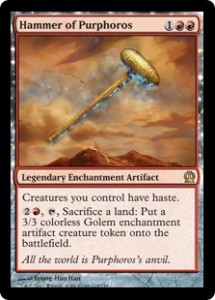
[card]Hammer of Purphoros[/card] ($1)

hammer of pIt still blows my mind that this card is sitting at a dollar.  Everyone seems to currently be hyped up on the Mono-Black Devotion train. This just makes me picture [card]Purphoros, God of the Forge[/card] sitting in the corner hitting nails into a wooden 2 x 4. Turn 2 [card]Ash Zealot[/card], T3 [card]Burning-Tree Emissary[/card] + [card]Hammer of Purphoros[/card] + [card]Nykthos, Shrine to Nyx[/card] = Early smoke/food/restroom break.  Giving haste to all your top decks and making extra lands into 3/3’s lets red decks do what they usually can’t: win through a flood.  I call my mono-red devotion deck “Moses said so,” because not even a sea can stand in the way of these devoted red creatures. I know it’s a rare from one of the largest selling sets in Magic: The Gathering history, but trust me when I say, cards get hard to come by when the next set comes out.

[card]Heliod, God of the Sun[/card] ($5)

heliodThis card need a solid two-drop (CMC WW, of course) for consistent success in competitive play. Ramping out tokens with the extra mana may not increase devotion, but playing just enough creatures to keep devotion at five or six can apply pressure while also preparing for a post-board sweeper hand vomit.   The card has a $5 price tag, the cheapest of the first five gods. Picking up three for yourself and three to trade off later could set you up for some quick profits.  As a mythic and a poster child of the Theros set, all it takes is a two or three copies in a top-eight list to set up a profitable dump.

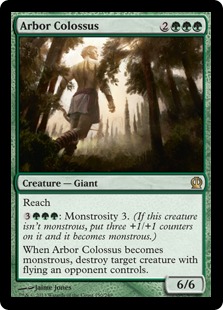
[card]Arbor Colossus[/card] ($1)

arbor colossusGGG and 2 colorless has never been so easy to cast as in this two-color-or-less format.  A 6/6 creature with reach that can swat down anything in the skies of Standard AND shoots down a flier next turn! What’s not to love? This, my friends, is not a dollar rare.  Nothing about this card should place it in the box of bulk rares you put in a shoe box under your bed.  If curving out into odd CMCs (3, 5, 7) is a goal for green decks in future Standard, this guy will be first in line.  Pick up as many of this monster as you can, as long as you don’t make [card]Polukranos, World Eater[/card] (aka Pocahontas, World Eater) jealous.  That guy knows how to fight….

[card]Boon Satyr[/card] ($3)

boon satyrI like to think of this guy as a five-turn clock with an upside.  This card is a beast and when I started picking copies up it was sitting at a dollar.  It is now up to $3 but still has potential to rise.  Knowing this is an enchantment-based block, any efficient bestow creatures or powerful enchantment amplifiers can crank his potential up another notch.  [card]Ethereal Armor[/card] is already a built-in combo!  He trades with almost every creature on the ground and makes every control player cry when he survives a [card]Supreme Verdict[/card] (when bestowed of course).  I can see, at minimum, a price double to $6 in the near future.

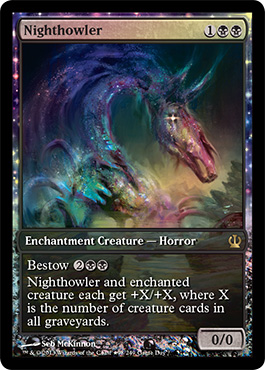
[card]Nighthowler[/card] ($.50)

nighthowler promoWith the G/B scry land coming to a pack near you, I see [card]Nighthowler[/card] being a part of a tier-one self-mill strategy.  I know cards like this have been printed in the past, but the bestow ability could give this card the playability it needs to break into Standard.  [card]Commune with the Gods[/card] and [card]Grisly Salvage[/card] both help you grow his power and toughness, and one at instant speed.  Even scrying off the new G/B scry dual land or a [card]Reaper of the Wilds[/card] trigger could increase the consistency of your “build your own fattie.” Honestly, you could probably trade the lint in your belly button for this guy right now.  All it takes is a playable two- or three-drop trampler to give [card]Nighthowler[/card] a chance to show howl hard he can punch.

Final Thoughts

Sadly, many of the black and blue devotion playables have saturated Top 8’s enough recently to create a higher demand and price.  Keep an eye on these staples when these strategies fall out of favor and drop to a reasonable level.  With so many more cards yet to spoil in future expansions, there’s a good chance those strategies will eventually be reincarnated to fight the future metas.

Houston ‘Ginger Ale’ Whitehead
Follow: @TNSGingerAle
Listen: Tap N Sac Podcast (RSS Feed)
Read: TNSGingerAle.com

MtG After Hours #5 – Technologically Inept

This weeks episode is from episode 81 of Brainstorm Brewery.  Listen to Ryan moan and groan his way to publishing his first article on BrainstormBrewery.com. See he has submitted articles before, but doesn’t understand the work involve on the next step.  It doesn’t sound like much, but it is quite the hilarious experience.

MtG After Hours is basically all the good shit that gets cut on the editing floor. Often while recording a podcast, the banter that’s not being recorded for the show can sometime be better than the actual episode. Get a rare behind the scenes in to the minds of your favorite podcasters, the featured podcast will rotate each week.

Andrew Colman – Serum Visions: Pro Tour – Brews of the Gods

Welcome back to Serum Visions everyone!

It’s been a busy time in the craft beer/home brew world of my home town, Winnipeg. We recently had the inaugural Half Pints Pro-Am Brew Challenge  (both professional and amateur brewers can enter), hosted by our local home-brew club, the Winnipeg Brew Bombers (WBB), named after our CFL football team, the Winnipeg Blue Bombers. The competition was a monumental success! It had just over 400 entries, which is amazing for a first-time competition. The WBB brought in all the best judges from Western Canada and they had nothing but great things to say about the how the event was run. The winning brew was a spruce-tip-infused beer by a brewer from Saskatoon, Saskatchewan. I would describe it as a rogue beer, bringing up images of John Loucks winning a PTQ with a rogue [card]Kiki-Jiki, Mirror Breaker[/card] build, but there is a popular brewery called Rogue from Oregon and this brewer does not work for it.

I decided to write on this topic this week because I was encouraged to enter the competition by the Vice President of WBB (@Phillips_Global). I heard about the event when it was originally announced, but I wasn’t too concerned about entering. It seemed like every person I knew was asking me if I was going to enter, and I responded to all, “No, that’s not why I brew beer.” But eventually I was convinced, and after having gone through the process and the excitement of it all, let me tell you, I’ll be mailing my beer across the country to enter other brew contests. What’s so cool about it? Let me explain with an MTG metaphor.

Making your beer is like building a deck. The first time you build one, you’re probably going to end up with an 86-card pile that runs triple-red costed spells that you think are good because you’ve got three Mountains in the pile! This is similar to what my first beer was like, an absolute disaster. (Incidentally, my first deck was a precon, the M11 blue starter with a foil [card]Stormtide Leviathan[/card], and it’s still probably my favorite deck ever.)

Once you learn enough about brewing, you’ll start making beer that people will happily drink and enjoy. This is like FNM – it’s fun and enjoyable, but it doesn’t mean you’re good enough to compete at a GP. Before this competition, this is where I was at in the beer-making world.

Since I hadn’t really planned on entering a beer, I entered one already in the brewing process that had just started carbonating in the bottle. It was meant to be a Cascadian dark ale, or black IPA, but my friend and I were a bit tipsy by the time we were adding the final water to the carboy and we added two extra liters. So It went from being a CDA to a dark version of an APA. That’s not all bad though, because it meant we had two liters more beer! It was, however, detrimental for my grading in the competition. I’ll explain the mechanics of how a beer judging goes so you’ll understand why.

How Beer is Judged

The whole process starts out with an organization called the BJCP, Beer Judge Certification Program. This is basically the equivalent of Magic’s DCI. The BJCP trains judges and there are different levels of judges depending on experience. One neat thing is that a judge can enter a competition in which he or she is judging, meaning a judge can make his beer and drink it too! So what the BJCP has done is set out a document called the BJCP Style Guide that describes each type of beer that will be judged. There are are 23 main categories and most of those have subcategories. You can find a link to the style guide here.

Here’s an example of how one would classify a Guinness:

13A. Dry Stout (which incidentally is the style of the week. Read these notes and then go check out some local versions and see how they stand up to the BJCP)

Aroma: Coffee-like roasted barley and roasted malt aromas are prominent; may have slight chocolate, cocoa, and/or grainy secondary notes. Esters medium-low to none. No diacetyl. Hop aroma low to none.

Appearance: Jet black to deep brown with garnet highlights in color. Can be opaque (if not, it should be clear). A thick, creamy, long-lasting, tan- to brown-colored head is characteristic.

Flavor: Moderate roasted, grainy sharpness, optionally with light to moderate acidic sourness, and medium to high hop bitterness. Dry, coffee-like finish from roasted grains. May have a bittersweet or unsweetened chocolate character in the palate, lasting into the finish. Balancing factors may include some creaminess, medium-low to no fruitiness, and medium to no hop flavour. No diacetyl.

Mouthfeel: Medium-light to medium-full body, with a creamy character. Low to moderate carbonation. For the high-hop bitterness and significant proportion of dark grains present, this beer is remarkably smooth. The perception of body can be affected by the overall gravity with smaller beers being lighter in body. May have a light astringency from the roasted grains, although harshness is undesirable.

Overall Impression: A very dark, roasty, bitter, creamy ale.

Vital Statistics:                         OG: 1.036 – 1.050 (original gravity/sugar content)

IBUs: 30 – 45  (bitterness)    FG: 1.007 – 1.011 (final sugar content)

SRM: 25 – 40  (colour)           ABV: 4 – 5% (alcohol by volume)


This is only half of the style guide, but for the sake of word count, it’s the “important half.”

Judges go through years of training to understand what each beer descriptor means so that they can objectively judge a beer on its merits rather than on how much they enjoy it. Each judge is assigned a style for a judging session, and each style is assigned to at least three judges. So, every beer will be tasted by three judges who will all score the beer individually. They get served the beer in a small, clear plastic cup with one to two ounces of beer per sample. If they were judging a Guinness, they would consider how it compares to the other entries with regards to aroma, appearance, flavor, and mouthfeel, finishing with an overall impression. Each of these categories is assigned a certain amount of points and you get a final score out of 50. The judges need to be within seven points of each other – if they are more than seven points apart, they discuss the beer and then adjust their scores. However, considering all three judges scored me at 19/50, I am pretty confident in their objectivity and accuracy!

Each category and subcategory has a first, second, and third place beer, and the winning brewers receive medals. The event culminates with the award for the first, second, and third place best-of-show beers.

So How Did It Go?

There was one gentleman there who is basically the Reid Duke of the Canadian home-brewing scene – there was actually one category where he won all three medals. I stopped counting how many medals he won somewhere after ten. A home brewer like this will end up entering 15+ beers and just shoot to win as many as he can. Last year he was named by the BJCP as the winningest brewer in the country!

So, if you’ll recall, I topped up my beer with two liters too much water. What does this do to a beer? It [card]goblin grenade[/card]s it so far out of its category it’s note even funny. In fact, it’s down right depressing. The beer is good – I have gotten lots of compliments on it from a couple of proper beer snobs – but it was just not to style. Therefore, it couldn’t possibly score very well. I have come to describing it like this: “I entered a good pink painting into red painting contest.” It just had no chance.

There is a light at the end of this tunnel though! This is beer, not Magic, and beer falls into the grocery line of my budget. If Magic did too, I’d be playing in GPs, but my wife and I wouldn’t be eating. I certainly plan on entering more competitions, but next time I’ll do it proper. And I’m gonna win!

Thanks for hangin’.

Andrew

Ryan Bushard – Toronto: A Story of Charity and Chill

At the beginning of this month I took a road trip with my fellow co-host, Jason Alt, to the great land of Canada for Grand Prix Toronto.  Both of us went into the weekend planning on hanging out with friends rather than concentrating on selling and trading.  Overall, that goal was achieved and I was not disappointed with the result.  I was able to see people with whom I would normally only have internet contact, and I also participated in one of the cooler events I have ever had the pleasure to attend.

We left Friday and managed our way into town after hitting the border with relative ease early in the evening.  We found our way to the site but had a tough time finding anyone, so we got out of there quickly, ending up with a relatively quiet night of Commander and relaxation.  Refreshed and ready, the next day we got back to the convention center just in time for the start of round one…at noon (yes, you read correctly). Glad to not be one of those unfortunate souls in the extended main event, I shuffled around and sold some cards and caught up with my friends among the dealers.

After I made what money I needed, I headed over to find Jason, knowing that he was working at the charity event that was being held in the hall.  After I finally tracked him down, I found myself spending the rest of the day behind the booth gun slinging and chatting with fans and friends alike.  I had a great time and want to publicly thank everyone involved.

I was jamming every format all day and became particularly fond of some of Jason’s Commander decks, specifically [card]Mayael of the Anima[/card].  Participants could donate $2 for the chance to win a pack of Theros, or they could choose to donate more for a chance at some larger prizes.  Tons of people were behind planning this event, but spearheading was Ryan Abcede.  Beyond his masterminding, Matty Studios, Derf, Jason, Scotty Mac, and I spent a large chunk of our day behind the table getting our game on. I always love helping a good cause, so I was stoked to see how busy we were all weekend. Again, thanks to anyone who made it to the booth.

If you were not able to make the event and are still interested in donating, here is the link to do so.  Gamers playing for a good cause has always been a big deal for me and I really hope to see these types of events continue in the future.

Beyond the event itself, the weekend was very enjoyable – with the exception of the return border crossing.  When we came back into America, we stopped to turn our plastic back to paper and in the process took an 8.5% hit, which did not reflect our experience on the way in.  I was more than disgruntled to lose $100+ on the transaction, but what can you do?

A trip to Canada comes with the usual fries and gravy, but this time we also managed to find ourselves in a steakhouse with Matty Studios, Derf, Jason, and Ryan.  Fun was had by all and I was given a heckling for my Vorthos view of the upcoming year.  The steaks were great and the company was welcome, but I was glad to be home after all was said and done.  I spent the majority of the weekend with friends and hanging out with the walking form of sarcasm that is Jason, meaning I got little in the way of buying or selling done, but I did have a few sweet pickups including an artist proof [card]Underground Sea[/card] that has not been blemished by the ink of a pen.  Beyond that, I found a few more JSS [card]Elvish Champion[/card]s that I so love to pick up, as well as two German Commander decks. Eventually, Jason dragged me out of the hall to keep me from expending more.

I want to thank everyone again who made it out and for all of the companies and individuals that made the charity even work – smoother than the main event, I might add. Here’s some of the prizes that were donated:

Anonymous Donations by Local Players

[card]Scrubland[/card]

[card]Abrupt Decay[/card] (Foil)

[card]Grindstone[/card]

[card]Keiga, the Tide Star[/card] (Foil)

Worlds Collide

$400 worth of merchandise (added to raffle)

Cardboard Classic Games

EDH Bundle (highlights were foil [card]Arcum Dagson[/card] and a regular [card]Avacyn, Angel of Hope[/card], plus a box of their pins made out of cards and packs)

Various Judges

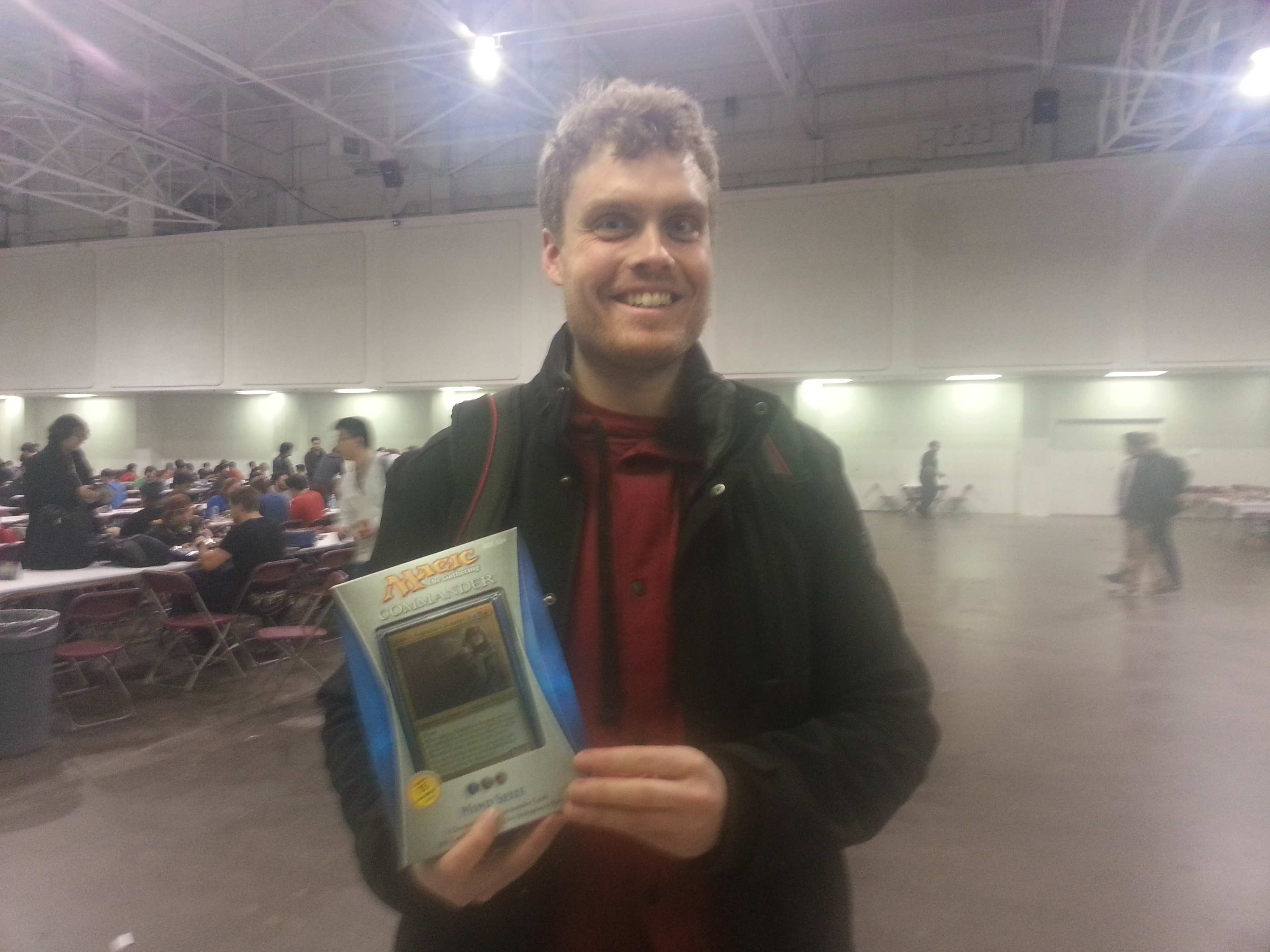
Two copies of Mind Seize, Commander 2013 (added to raffle)

Judge foils:

[card]Bribery[/card]

[card]Sword of Light and Shadow[/card]

[card]Genesis[/card]

[card]Crucible of Worlds[/card]

[card]Command Tower[/card]

Artist Donations

Custom sketch art playmat – Noah Bradley

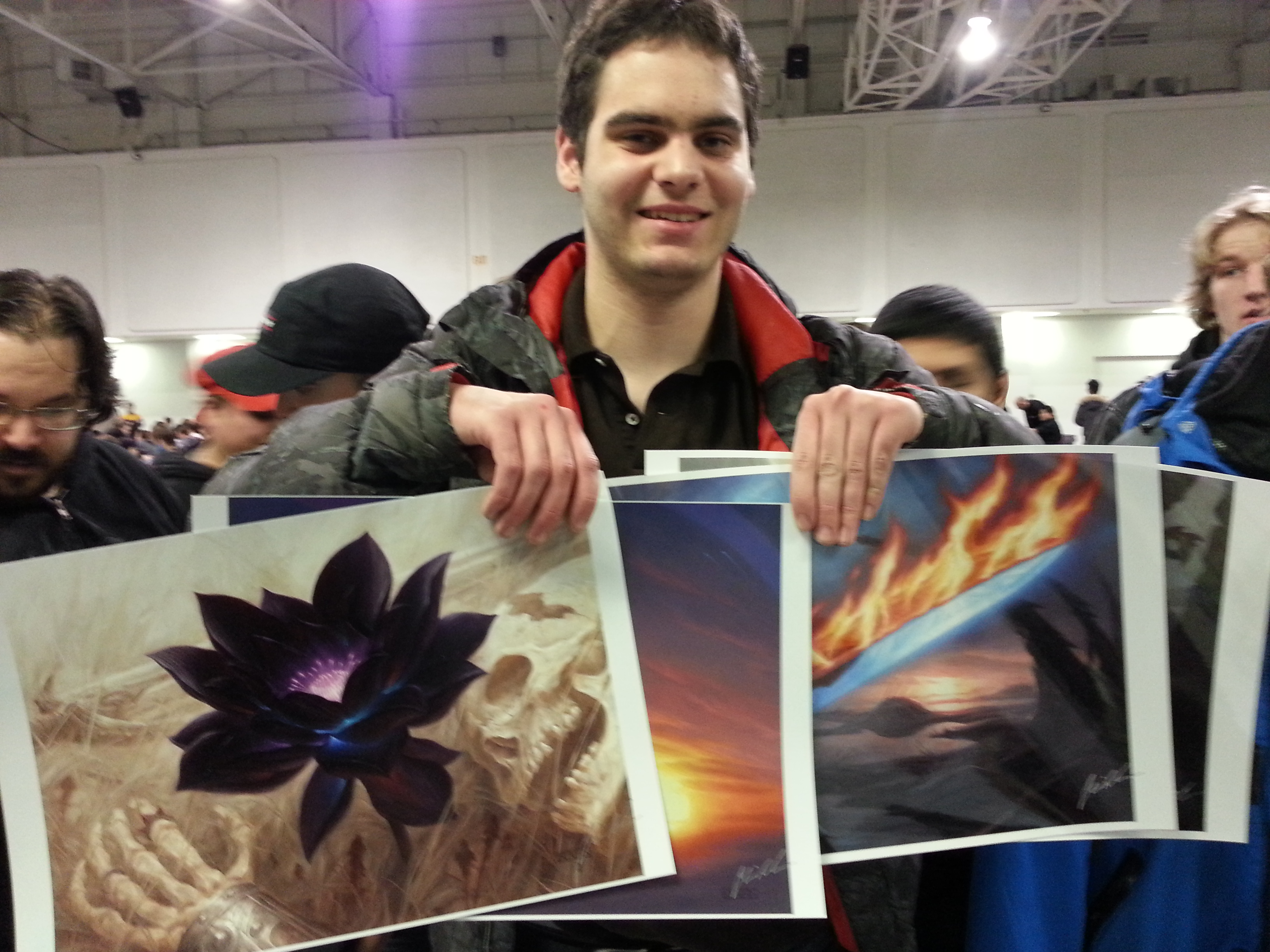
Signed prints: [card]Black Lotus[/card], [card]Time Walk[/card], [card]Sword of Fire and Ice[/card], [card]Sword of Light and Shadow[/card]

Luis Scott-Vargas

Foil LSV tokens, signed by the man himself!

Box of returned stolen goods that were not claimed
HairyT, Westcan Events, and Bulldog Games

Provided booster packs for the spell slinging

20131130_212411

20131130_212001

20131130_210920


20131130_203229


20131130_204434

20131130_210704

20131130_210647

There were some awesome prizes avaiable, and I saw tons of people walk away with not just a prize, but a story that made their weekend. I personally enjoyed crushing a particular gentleman with a full foil combo deck who expected to crush a lowly podcaster. Instead, he was met with a [card]Worldspine Wurm[/card] strapped up with a [card]Bear Umbra[/card] which found an [card]It That Betrays[/card] to seal his fate on turn six.  Nothing makes me happier than crushing people who can pick a single card from their deck that is worth more than the entirety of mine.

I can’t wait for a runback with this awesome crowd in Montreal come the beginning of next year, but until then, Toronto is in the books and I am back in this frigid state that might as well be Canada.  My next article will likely involve some gaps in memory as the guys are insisting that we will not be sober for the majority of the weekend.  Thanks for reading and if you have any questions, hit me up on Twitter or in the comment section below.


Ryan Bushard

@CryppleCommand


Marc DeArmond – Casually Infinite: 10 Rules for Profit, Part One

Below are the 10 rules that I follow to be able to play infinitely on Magic Online. Many of these rules will probably garner their own articles to fully explain the reasoning behind them and how I enact them. But the first step is to give tips that will help you to stop making decisions that work against you. If you’ve already made bad choices before you have even entered a queue, you’re going to have a rough road ahead of you. Avoid the blunders and follow the rules below, even if you have extra cash to throw around.

Rule #1 – Pennies Matter, Don’t Give Them Up

I play Magic, I collect Magic, I trade and sell Magic, and I think about Magic as a hobby. I much prefer when my hobbies don’t cost me money or, better yet, make me money. However, I’m not in the business of Magic. I’m not trying to cover the cost of a vacation with my Magic cards (again). I enjoy getting good deals, spinning them around for tickets, and building my collection without throwing more money at it. I’m a school teacher with a house, a wife, and two kids. I just don’t have a lot of money to spend on my hobbies.

This is not how many people play Magic. Some people look at $15 and see that as a totally fair price to spend for a night of drafting. I’d actually agree that $15 is indeed a pretty good price for a night’s entertainment – if I find myself off my island for a Limited release event, I’d love to give it a try. However, I do live on an island and I don’t want to spend $15 every time I want to draft in order to keep up my game. I’d rather spend some time working good deals and try to make the 15 tix I need to play.

I get more thrills from making a good trade than I do from winning a casual game. So if the option is between trading and playing without a prize, I’d rather trade. If you’re one of those players for whom money isn’t really a factor with regards to playing Magic, then we approach the game very differently. While much of what I say is still relevant to managing your collection, it probably isn’t worth 30 minutes of trading for you to come out two or four tix ahead. But for me, that’s my definition of a good time.

Rule #2 – Never Buy Booster Packs from the Store

Booster packs from the store cost retail price – $3.99. Living in Washington, I pay tax on that, too. Almost every bot seller will sell boosters for less than retail price in tickets. If you’re going to pay cash, buy tickets and then buy packs from bots. Boosters can easily fall under three tix for many sets, especially core sets and third sets in a block. If you can save almost $1 per booster by buying from a bot in tickets, you should never buy from the store.

It is also important to realize that when playing Limited events, there are multiple options for entry fees. You can pay with tickets or product plus tickets. Never pay in just tickets unless it is an event with no other options (like a prerelease, Sealed release event, or some flashback queues). Entering a Draft queue costs either 14 tix or three boosters plus two tix. If you buy the boosters for three tix each, it will only cost you a total of 11 tix to enter the draft. In a case like this, you’ve saved yourself three tix before you even started playing. Even if the boosters are just down to 3.66, you’re still saving yourself a ticket by buying from bots instead of the store.

Rule #3 – Don’t Open Your Booster Packs

Just opening your packs instead of playing them in Limited is a terrible idea. Current sets will occasionally reach the point where you can expect 1.5 tix of value from opening a pack. Considering you bought that pack for around three tix (not $3.99 from the store), you’re probably going to lose at least 1.5 tix of value by opening the booster. Also, packs that sell for three tix are generally worth less than one ticket in average value once opened. In general, you can expect to lose about two tix in value whenever you open a pack. That is, unless you open it in a queue.

Playing Limited queues of any type provides much better returns than just opening a pack. Playing a Swiss Draft (the easiest to get prizes), costs two tix and three packs. You still get to open three packs. However, those two additional tickets give you a good chance of winning more packs, which can be turned into more tickets. In Swiss, you play three games no matter what (unless you drop). Winning one game gives you one pack, two games gives you two packs, and three games gives you three packs. Only one person who enters a Swiss Draft will lose all three games and get no packs. So unless you’re that person, you’ll come out ahead by playing in a Draft. You may even win three packs, essentially paying two tix for three packs in addition to whatever you opened in the packs you drafted. Playing in a Swiss Limited queue is a far better option than just opening your packs.

Rule #4 – This Isn’t Paper

The MTGO economy doesn’t function like the paper Magic economy. Price fluctuations happen more quickly, bulk rares are worth much less, and some things that are rare in paper aren’t necessarily as rare online. In contrast with Limited print runs in paper, there is often infinite product available on MTGO. While a paper product may sell out before it ever hits the shelves, it may be available for months online, allowing for many more copies to be in circulation. Older sets can show up as a flashback queues in MTGO, allowing for more packs to be introduced to the market years after the set has gone out of print.

Redemption also plays a big part of card value online. Full sets can be redeemed for paper cards up to two years after the initial period following a set’s release. When redemption goes live, a large flood of cards moves out of MTGO and into the paper market. This can cause cards to spike when redemption goes live (and people are trying to complete their sets) or after redemption (when so many cards were redeemed that there may now be a shortage online). After two years, cards approaching the redemption cutoff tend to rise in value only to drop shortly afterwards. However, post redemption, valuable cards are likely to rise if they have a home in Modern. Some sets are not redeemable but this doesn’t mean they have no value. Also, Wizards recently raised set redemption prices from $5 to $25. It’s not entirely clear what this will do to the market, but it doesn’t seem to have thrown anything too far out of whack.

Overall, the paper market tends to lag behind the MTGO market. It is important to realize the effect this has. Cards seeing play during pro tour weekends will jump within hours, not days or weeks. Also, the MTGO market has immediate transactions between all players. You buy the card, you get it right away. Not within a week, not within a few weeks. Sellers can’t cancel orders, and once you’ve sold a card, you immediately get the tickets.

Rule #5 – Rare Draft

I actually stopped playing Draft in favor of Sealed because of this particular topic, but if you’re going to play non-phantom Drafts, you need to come up with a price point for rare drafting. When you rare draft you pick a card that is worth tickets instead of a card that goes in your deck. For example, back in a Magic 2012 Draft, in the third pack I picked a [card]Garruk, Primal Hunter[/card] without another green card in my deck. While I’d never try to move into green during the third pack for a 2GGG-cost card, the fact that it was worth 15 tix meant that it would pay for my entire Draft. I could have grabbed the [card]Doom Blade[/card] instead, but it wasn’t going to make as much of a difference as grabbing the 15-ticket planeswalker. By taking Garruk, I made sure that even if I lost the entire Draft, I’d still come out a couple of tickets ahead.

Finding your own price is important and comparing the cards you’d draft instead of the rare card also matters. For me, I’ll always grab a card that’s worth three tix or more. After the first pick of a pack, I’ll pretty much always grab a one-ticket card rather than let it pass. Once things get down to 10+ picks, I’ll generally grab an uncommon over commons that I won’t play, simply because I can sell it to a bulk buyer for .01 or .02 tix. There’s more danger rare drafting in larger tournaments and even in 8-4 Drafts than in Swiss. But regardless of what queue you’re drafting in, you need to know your price points and card values for the set(s) you’re drafting.


That’s all for this time. Join me next week for part two, where I will detail steps six through ten.

Enmou Gao – Intermediate Speculation

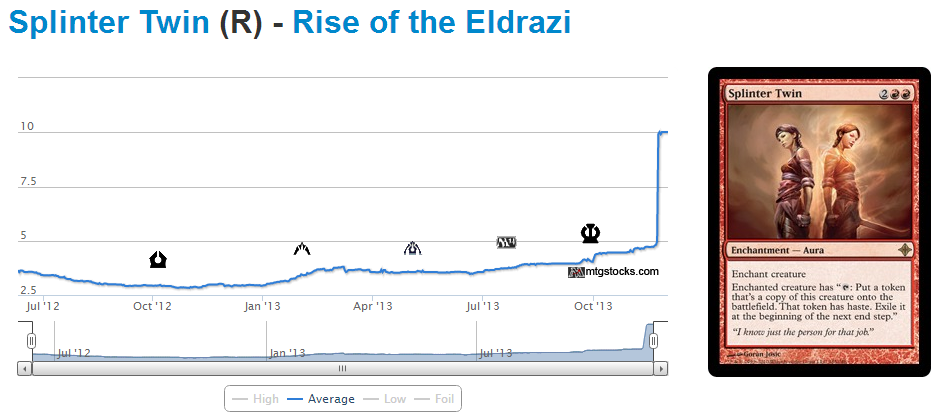
I’ve been getting lucky with specs lately, calling both [card]Threads of Disloyalty[/card] and [card]Splinter Twin[/card], but maybe, just maybe, I’ve figured something out. Many speculators will already know the information in this article, but since information tends to be asymmetrical (in that people don’t always know the same information), I think it will be helpful to many to put down in words some ideas on the process of speculation.

The reason that you want to familiarize with the thought process behind speculation is that it is something literally anyone can do. Think of the below steps as a check list, if you will, that can help to give you a green light on a spec before you have to consult anyone else about it. The best part is that with this information, you’ll be able to convey the spec to fellow financiers so that others can give opinions. You’ll also be able to add to the conversation when other speculators make calls.

But first, a word of clarification. Speculation means different things depending on who you ask.

There’s long-term speculation, which Quiet Speculation-writer Sigmund Ausfresser recommends. This involves buying sealed booster boxes and long-term-outlook cards, like [card]Restoration Angel[/card], [card]Cavern of Souls[/card], and [card]Geist of Saint Traft[/card], that will likely gain 20% or more per year.

Then there’s the bulk speculation that Brainstorm Brewery members Jason Alt, Ryan Bushard, Marcel White, and Corbin Hosler favor. The basic idea is to buy an underpriced card like [card]Desecration Demon[/card] at a near-bulk price, hoping that the card eventually becomes competitively viable as the meta shifts.

Lastly, there is the short-term speculation that will be discussed in the context of this article, which favors a smaller inventory and faster turnover. The idea is to buy in to a card, like [card]Threads of Disloyalty[/card] and [card]Splinter Twin[/card], at the point right before the card takes off.

So how do we get in on the right cards at the right time?

I’ve listed a series of questions to ponder in trying to answer the question. The question of when and on what to speculate is a tremendously difficult question that needs to be broken up into parts.

Question 1: Is the card a staple in a format?

By far, this is the question that narrows down the most number of cards. Yes, some research is required on your part, such as looking up the information on MTGGoldfish, Metamox, MTGTop8, or MTGIndex. I tend to use MTGGoldfish because the data is directly correlated to the results to the Daily Events on MODO, which makes it incredibly up-to-date and a good reflection of the current meta. However, MTGGoldfish is likely to not do a great job for the time being since Daily Events are down until December 11.

The idea behind the question is this: is there a demand for this card? I remember that there was someone on Reddit who had over 7,000 copies of [card]Worldslayer[/card]. However, because no one else wants the card, there is little value to hoarding copies of it (aside from personal value).

Question 2: How many copies are available on TCGPlayer?

Now we get to the supply side of things. I sincerely believe that supply is a greater driver of price than demand, although some level of demand has to exist for the supply to matter. The fact of the matter is that while demand is fickle, supply will more or less be consistent and predictable. You can read more about why supply matters from my previous article here.

The magic number of vendor listings that will pique my interest is 100 or less, including damaged cards and other conditions. You can adjust the exact number based on the circumstances, but once the number of vendor listing goes below 50, you can expect prices will begin spiking.

If there are multiple printings of the card, the supply is more complicated. For the most part, different arts will have similar prices, although that’s not always the case (see [card]Thoughtseize[/card]). Cards with multiple printings generally aren’t good spec targets except for the long-term.

On a similar vein, if a card’s lowest TCG shipped price is close to its TCG mid price, it’s also a positive signal for trades because you’ll be getting close to complete value for your trades. Being able to sell a card at close to its TCG mid price is attractive because it means that card is that much more liquid.

Question 3: Are copies sold out on other major online vendor websites?

Another way to gauge supply is to check the number of copies available at other websites. This is key to determining that it’s not just a few people deciding to buy out TCG Player. The biggest vendor is, of course, Star City Games, but others, like eBay, Amazon, Card Kingdom, Channel Fireball, Troll and Toad, and Cool Stuff Inc., are also good indicators. The key question to answer here is whether the spec is real or just a localized fluke.

Question 4: What is the current spread for the card?

Perhaps the easiest question of the bunch, you can go on MTG.GG to access Quiet Speculation’s free tool showing TCG mid prices and the highest buylist prices. The lower the spread, the better, and if it’s 0 or negative, bingo! Ideally, you want a card that the dealers are noticing, as well. If dealers are also interested in the card, it bodes well for lowering the supply of low-priced copies on the market, eventually raising the overall price.

Question 5: What is the MTGO price for the card?

While not necessarily a driver of physical prices, MTGO prices can be telling about the true competitive demand for a card in question. Do keep in mind that mythics tend to be overvalued on MTGO and rares undervalued due to redemption. With these factors in mind, when a rare is much higher on MTGO than its paper version and is played competitively, it may be ready for a price hike (see [card]Fulminator Mage[/card]). However, because of the difference in casual markets between MTGO and the paper game, the price correlation isn’t always going to exist.

Question 6: What do I do with all the information?

Like with all decisions, you weigh the costs and benefits. The cost you already know: it is the current price of the card plus shipping. The benefit is a weighted average between the spec hitting and not hitting, the chances of those respective scenarios, and the monetary value/trade value that can be gained in each scenario.  Remember, not all of your specs will hit, and certainly not at the time that you predict. However, by answering these questions correctly, your spec is more likely to hit quickly.

Post Modern

There hasn’t been any talk about shock lands for a while, so I thought I’d necro the shock land discussion!

To me, the shock lands have been following the projected prices. I may or may not be right, but I think I have the right idea.

[card]Blood Crypt[/card], [card]Hallowed Fountain[/card], [card]Overgrown Tomb[/card], [card]Steam Vents[/card], and [card]Temple Garden[/card] will likely see price increases come February or March, while [card]Breeding Pool[/card], [card]Godless Shrine[/card], [card]Sacred Foundry[/card], [card]Stomping Ground[/card], and [card]Watery Grave[/card] have likely already passed their high points.

Please see the graphs below for examples.

Woodland Cemetery

[card]Woodland Cemetery[/card] reached its highest point about a month after its Return to Ravnica equivalent, [card]Overgrown Tomb[/card], was printed.

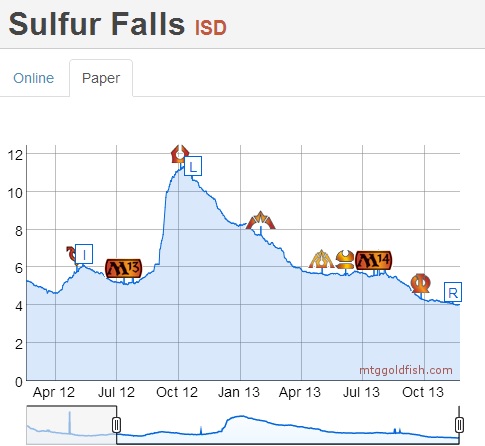
Sulfur Falls

[card]Sufur Falls[/card] reached its peak right as its Return to Ravnica equivalent, [card]Steam Vents[/card], was released.

Isolated Chapel

Do you see the pattern yet? [card]Isolated Chapel[/card] was at its zenith right after its Gatecrash equivalent, [card]Godless Shrine[/card], entered the market.

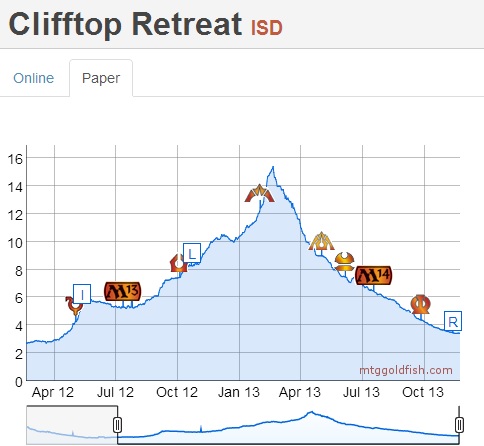
Clifftop Retreat

One more for good measure! [card]Clifftop Retreat[/card] was at its highest price point about a month after its Gatecrash equivalent, [card]Sacred Foundry[/card] was available.

Hinterland Harbor

Here’s a black sheep. [card]Hinterland Harbor[/card] never went anywhere, and I’m guessing that’s because Simic as a color combination was never all that competitive in Standard.

Takeaways

The color of the lands available in Standard is very important. Not only does it heavily sway which color combinations are played, but it also affects the prices of available lands.

Being that the color combination of scry lands in Theros are Boros, Dimir, Gruul, Orzhov, and Simic, we can reasonably expect that shock land equivalents have already passed their peaks.

On the other hand, the scry lands that are yet to be released, Azorius, Izzet, Golgari, Rakdos, and Selesnya, may have a short span to reach new heights. I do have my doubts about [card]Steam Vents[/card], a card that has found a home in Modern more than Standard. Of the rest, I am most bullish on [card]Overgrown Tomb[/card] because of the controlling nature of the color combination ([card]Blood Crypt[/card] is more aggressive), the lack of reprints ([card]Hallowed Fountain[/card] was reprinted in the Theros event deck), and the cheaper current price ([card]Temple Garden[/card] is about $1.50 more on TCG).

Something else to note is that the prices of shock lands were invariably tied to the Innistrad buddy land equivalents. [card]Steam Vents[/card] never took off just as [card]Sulfur Falls[/card] never reached the heights that [card]Isolated Chapel[/card], [card]Clifftop Retreat[/card], and [card]Woodland Cemetery[/card] reached. However, I wouldn’t expect this trend to continue, given that scry lands favor more controlling strategies, whereas shock lands favor more aggressive strategies (buddy lands being somewhere in between).

Lastly, I would not recommend buying into [card]Overgrown Tomb[/card] because the expected gain may not be enough to make a profit. Trading is a good plan now that players have loosened their grips on shock lands. Card prices will likely have bottomed in December and January, so this will be the last chance to get in before Standard season is in full swing.

Thank you for reading this article, I hope that it was informative. Please comment below or on the article’s thread on Reddit that will be posted soon under “Spec’s Corner.” You can find me on Twitter @fyawm.

Sander van der Zee – Setting Your Goals, Part 2 (Electric Boogaloo)


Last week, I started discussing the importance of goals in your life. These principles apply to almost everything, even the act of playing and trading Magic: The Gathering. I talked about determining what is important to you in life, basing your long-term goals around it, and how to formulate them in a SMART way (Specific, Measurable, Attainable, Relevant and Time-related). Now it is time to pick up where we left off and polish your newfound goal-making skills with some finishing touches.

Make It Postive

You’ve done your brainstorming and have managed to narrow down your goals and made them SMART. It’s easy for humans to focus on the bad side of things. It’s in our nature to emphasize the negative situations in our lives and that leads us to formulate our goals the same way. Stating a goal in a positive fashion, however, helps your commitment to the goal. Rather than looking at it as if you are pulling yourself out of a bad situation, you can experience your goal as a way to grow towards a greater version of yourself.

186_wildfield

Incremental Goals

Once you’ve decided on your long-term goals, it’s time to cut them down into smaller, more grokkable steps. Having hard-to-achieve long-term goals can be intimidating. If you have decided that your goal is to accumulate $2500 by flipping [card]Birthing Pod[/card]s within the next five years, you need to set some incremental goals to get there. Setting smaller goals that are directly related to your long-term goal help you maintain your focus and allow you to adjust your strategy.

Rather than shoot for highly-visible community positions such as streaming or podcasting professionally, I knew I had to take it slow. Going from zero to hero doesn’t come naturally and certainly can’t be expected in one week. When I decided to contribute to my community on a more local level, I knew that it was just a way to grow. A stepping stone, and at the same time, a measurable checkpoint. Had I just kept my eye on the greater goal at the top, I would have just given up. Even thinking about all the work that had to be done was overwhelming. But determining the steps that had to be taken to help out as tournament organizer was a lot easier for me to do. After I managed that, I made my next goal to become a valuable member of the Brainstorm Brewery team. And look where I am now.

Keeping Track

If you formulated your goal following the SMART ruleset, then there is really no excuse not to track your progress. Remember that M stands for measurable and T for time-related. If we want to sell $2500 worth of [card]Birthing Pod[/card]s within five years, we know exactly where we have to be at every moment along the way.

You could set a goal where you want to have $125 from your [card]Birthing Pod[/card] sales after three months. After those three months, you can check if you have met your goal, and if not, adjust accordingly. If you’re short on sales, you might want to reconsider the way you’re trying to sell your product or the price at which you buy in. If these variables are hard or impossible to change, then your last resort is to adjust your goal, either by decreasing the amount of dollars you want to earn or increasing the amount of time you give yourself.

Knowing where you are and where you need to be gives you a clear view of what has to be done to get from point A to point B. If you have no roads, how will you ever arrive in Rome? Take note of what you have to do to get to your main goal and then do the same for your incremental goals. You will find it gets a lot easier to move along toward your destination!

Purely from a financial perspective, it is wise to always keep track of whatever you buy and sell, whether you’re setting goals or not. The [card]Birthind Pod[/card] example above is a very simplistic goal. It doesn’t consider anything aside from the money earned over time as you sell copies of [card]Birthing Pod[/card]. That’s neither complicated nor elaborate. More realistically, you probably have many different cards in stock that you intend to sell and each might be part of a goal you’re trying to set.

I recommend using Excel spreadsheet to keep track of every transaction you make. Whenever you buy something, write down how much you paid. And whenever you sell something, mark that down, too. You can get fancy and incorporate other information in your bookkeeping, but that’s up to you. Having this information available to you lets you quickly see how far you are in meeting your goals, but also shows how effective you are. If you don’t do this already, I can only suggest you start now.

faiths-reward

Rewarding Your Progress

Reaching your goals may take a while, and sometimes they can end up on the backburner along the way. It’s common for people to become demotivated just because of the sheer amount of work that has to be done to reach a larger goal. It’s not wrong to reward yourself for reaching milestones on your way toward your goals! Treat yourself to something nice every time you reach one. Not only does it keep you motivated, it also gives you the opportunity to look back at what you’ve learned, and sometimes just taking a moment to think about that is a reward in and of itself.

You’ve Done It!

After all this hard work, you are well on your way towards reaching the top, or wherever you intend to go! Keeping these steps in mind will truly help you on any part of your life, even playing Magic.

Do you have stories to tell about reaching your goals or what you are currently doing to reach one? Don’t shy away, tell us in the comments!  You can always contact me on Twitter @TheMeddlingMage or by email at [email protected].


MtG After Hours #4 – Foot in the Mouth

This weeks episode is a throwback from episode 39 of Brainstorm Brewery.  As usual a whole podcast was recorded before they recorded the actual podcast.  Only this time some of the pregame made the cut, while the rest can never be released to the public. :P  You also get to hear about the infamous Fogo bets.

MtG After Hours is basically all the good shit that gets cut on the editing floor. Often while recording a podcast, the banter that’s not being recorded for the show can sometime be better than the actual episode. Get a rare behind the scenes in to the minds of your favorite podcasters, the featured podcast will rotate each week.


Andrew Colman – The Puzzle Box: Black & Tan & Blue

Welcome back to The Puzzle Box everyone,

First of all, just in case you thought the title implies that I’m going to cover the blue, black, and artifact sections in this article, sorry to disappoint, I’m not. A Black & Tan is a mixed beer drink, and if you haven’t had one, I recommend it!

This week we’re going to dig into the blue and black sections of our cube as well as talk about the value of a card slot.  Blue is typically recognized as the strongest color and black the weakest color in Cube. Blue is strongest for obvious reasons: [card]Ancestral Recall[/card], [card]Force of Will[/card], [card]Jace the Mind Sculptor[/card], [card]Time Walk[/card], and as we are all very aware, the list goes on an on and on. As of very recently, we even got an affordable (CMC wise) [card]Progenitus[/card] in the blue corner. Rumblings are often heard that WOTC hates blue and continues to nerf it. It turns out with [card]True-Name Nemesis[/card] that they are still just as much in love with the color as ever.

As for black, the problem became apparent as I was trying to find the core things that the color does. Basically, it kills creatures, trades life for resources, and brings things back to life. This is where I think the small size of this cube is really going to shine! Black will be a worthy aggro color, because the concentration of one and two drops it has is comparable to red. It has a high enough concentration of reanimator spells versus discard outlets that reanimator is going to be very strong. Finally, black control might just be a thing if it splashes for some support from another color.

Before we look at the lists for these sections, I will note that this cube is going to be far more balanced than many other cubes, as the cards that really push blue over the top are so expensive. The cards that we do have access to are still strong, but more in line with the strength of the rest of the colors in the cube. This leads us into how it is that we choose specific cards and why we pick them.

The Value of a Card Slot

One thing that I like about this list is the minimal amount of [card]Control Magic[/card] effects. This actually reflects my personal cube list closer than most. In many lists you see [card]Bribery[/card], [card]Treachery[/card], and [card]Control Magic[/card]. I personally dislike this type of effect (not to mention the art of the original [card]Control Magic[/card]) so much that I’ve decided to run [card]Mind Control[/card] instead. In place of extra [card]Mind Control[/card]effects, I run [card]Sakashima’s Student[/card], which is a really fun [card]Clone[/card] variant.

As I have said many times, this list is just a starter list that will get you playing a very powerful Limited format consistently. Because we have such a small list it opens the doors for many more archetypes to be considered viable. For instance, if you would like your blue section to be more tempo oriented, it has a much better shot of being competitive in this size of a list over even a 360 because you’ll see more or the same types of cards more often. It’s all about concentration.

This format is meant to let you decide the archetypes and strategies you and your group want to play – if someone in your regular playgroup only ever wants to mill people out, here we have small enough cube that you can get in enough mill cards to make that consistently viable. However, there is a bit of a caveat for those of you who have not really spent a lot of time considering what a card slot in a cube is really worth. A question: how many mill cards do you need in a deck to reliably mill someone out? I don’t know if there’s a “correct” answer, but let’s say it’s eight. We then need to replace at least 12 cards in the list below with mill cards. So here’s your challenge: pick 12 cards you want to replace with mill and then look at them and ask whether having a mill archetype in your cube is really worth not playing with these 12 cards. If the answer is yes, sweet, do it to it! If the answer is no, then you know how I feel. I would love to get mill in here, but all of the mill cards we have access to are just not flexible enough to warrant a slot.

This brings us to the point that is at the nub of cube card selection: let’s talk about the flexibility of a card, or card elasticity, if you like. Each inclusion in your cube should be considered with this question in mind: how many roles does this card fill? If it’s only one, then it bloody well do something seriously powerful (think [card]Tinker[/card]). If it is something like [card]Mind Sculpt[/card], which fills its role powerfully but in any other context does absolutely nothing, then you have to ask, is the play experience of this card worth its reduced flexibility?

The Lists

Blue

If you take a close look, you’ll see we are firmly rooted in the realm of control. There isn’t much room for a blue tempo deck even though it’s been unlocked for us with [card]True-Name Nemesis[/card] and [card]Thassa, God of the Sea[/card]. Nor do we get the artifact deck, as its cards are too narrow when you don’t have inherent support like the Moxen.

For finishers, we are reaching a bit into cube past and pulling out [card]Frost Titan[/card] and [card]Sphinx of Jwar Isle[/card]. [card]Meloku the Clouded Mirror[/card] was never too expensive but with the recent MM printing, she is even more affordable and will have a happy home here as one of the best blue cards in the list.

As for counterspells and draw spells, the expensive ones were naturally scaled out with the decrease in size, so again, the concentration is bang on.  As a bit of a glance to future sections, it looks like Izzet is going to be pretty strong in this cube because the concentration of good cheap spells and the cards that interact favorably with them is going to be pretty high.

[deck title= The List According to Type]
[1CC Creatures]
Enclave Cryptologist
[/1CC Creatures]
[2CC Creatures]
Looter il-Kor
Phantasmal Image
[/2CC Creatures]
[3CC Creatures]
Man-o’-War
Pestermite
Sea Gate Oracle
Serendib Efreet
[/3CC Creatures]
[4CC Creatures]
Phyrexian Metamorph
[/4CC Creatures]
[5CC Creatures]
Meloku the Clouded Mirror
Mulldrifter
[/5CC Creatures]
[6+CC Creatures]
Frost Titan
Sphinx of Jwar Isle
[/6+CC Creatures]
[Planeswalker]
Jace Beleren
[/Planeswalker]
[Instant]
Brainstorm
Force Spike
Arcane Denial
Counterspell
Daze
Impulse
Into the Roil
Mana Leak
Memory Lapse
Miscalculation
Forbid
Thirst for Knowledge
Fact or Fiction
Condescend
[/Instant]
[Sorcery]
Ponder
Preordain
Tinker
Deep Analysis
Upheaval
[/Sorcery]
[Enchantment]
Control Magic
Mind Control
[/Enchantment]
[Artifact] Crystal Shard
[/Artifact]
[Land] Shelldock Isle
[/Land]
[/deck]

[deck title= List According to Cost]
[$3+]
Phantasmal Image
Jace Beleren
[/$3+]
[$2-$2.99]
Tinker
[/$2-$2.99]
[$1-$1.99]
Phyrexian Metamorph
Fact of Fiction
Upheaval
[/$1-$1.99]
[$.50-$.99]
Daze
Brainstorm
Serendib Efreet
[/.50-$.99]
[$.25-$.49]
Arcane Denial
Crystal Shard
Meloku the Clouded Mirror
Ponder
Frost Titan
Control Magic
Forbid
[/.25-$.49]
[$.01-$.24]
Pestermite
Thirst for Knowledge
Force Spike
Mana Leak
Preordain
Enclave Cryptologist
Sea Gate Oracle
Impulse
Sphinx of Jwar Isle
Condescend
Deep Analysis
Mulldrifter
Mind Control
Memory Lapse
Miscalculation
Man-o’-War
Into the Roil
Looter il-Kor
Counterspell
[/.01-$.24]
[/deck]

Black

The key archetypes in black we’re going to support are reanimator, control, and black aggro, the last of which is enabled by the smaller cube, giving us the ability to have a higher concentration of low-cost creatures.

As a little aside, I’d like to point out a brand new card, [card]Curse of Shallow Graves[/card]. Because we are missing cards like [card]Bitter Blossom[/card], the power level of our cube will inevitably be lower, so taking things that are close analogues to the high-powered missing cards will garner us some serious advantage. Curse goes well with creatures. The same could be said about the Mirrodin swords! Yes, I’ve just compared [card]Curse of Shallow Graves[/card]to [card]Bitter Blossom[/card] and the swords, which could get someone kicked out of the MTG community. But this card has been doing some work, so I say take it high and play it often.

With reanimator decks, we will often have to reach into other colors for our bombs because [card]Griselbrand[/card] is on his way up in price and would eat up half of our budget. However, [card]Massacre Wurm[/card] should shine in this list due to a high concentration of aggro creatures.

[deck title= The List According to Type]
[1CC Creatures]
Carnophage
Diregraf Ghoul
Gravecrawler
Tormented Hero
Vampire Lacerator
[/1CC Creatures]
[2CC Creatures]
Nezumi Graverobber
Oona’s Prowler
Pack Rat
Vampire Hexmage
[/2CC Creatures]
[3CC Creatures]
Bone Shredder
Geralf’s Messenger
Hypnotic Specter
Vampire Nighthawk
[/3CC Creatures]
[4CC Creatures]
Skinrender
[/4CC Creatures]
[5CC Creatures]
Bloodgift Demon
Shriekmaw
[/5CC Creatures]
[6+CC Creatures]
Massacre Wurm[/6+CC Creatures]

[Instant]
Dark Ritual
Doom Blade
Go for the Throat
Dismember
Makeshift Mannequin
Snuff Out
[/Instant]
[Sorcery]
Despise
Duress
Reanimate
Chainer’s Edict
Exhume
Hymn to Tourach
Sign in Blood
Consuming Vapors
Black Sun’s Zenith
Profane Command
[/Sorcery]
[Enchantment]
Animate Dead
Curse of Shallow Graves
Necromancy
[/Enchantment]
[/deck]


[deck title= List According to Cost]
[$3+]
Reanimate
[/$3+]
[$2-$2.99]
Massacre Wurn
Gravecrawler
Pack Rat
[/$2-$2.99]
[$1-$1.99]
Necromancy
Oona’s Prowler
Geralf’s Messanger
Black Sun’s Zenith
[/$1-$1.99]
[$.50-$.99]
Chainer’s Edict
Go for the Throat
Consuming Vapors
Animate dead
Hypnotic Specter
[/.50-$.99]
[$.25-$.49]
Dark Ritual
Profane Command
Shriekmaw
Dismember
Hymn to Tourach
Exhume
[/.25-$.49]
[$.01-$.24]
Vampire Nighthawk
Curse of the Shallow Graves
Bloodgift Demon
Nezumi Graverobber
Makeshift Mannequin
Skinrender
Carnophage
Diregraph Ghoul
Snuff Out
Despise
Doom Blade
Bone Shredder
Vampire Lacerator
Sign in Blood
Duress
Tormented Hero
Vampire Hexmage
[/.01-$.24]
[/deck]

Well, that’s that. I think there are some serious talking points regarding these two lists. If you think I am totally out to lunch on card selections or observations I’ve made please leave a comment! I think these will be the most debatable sections in this cube, so let’s get the debate started.

And as always, thanks for hangin’.

Andrew (@awcolman on Twitter)

Brainstorm Brewery #79 – How the Cookie Crumbles

Some big news in the world of Magic Online has broken and everyone is wondering how the market will be affected. Has Wizards finally gotten it together and fixed the MODO problem? Does any of the gang have confidence in MODO going forward? How do we respond to sudden price spikes in Modern and Legacy staples and what constitutes a spike? This episode is all value wall to wall as the gang delves into some controversial topics. But are they a little too distracted this week? Who is responsible for the distraction? Find out the answer to all these questions and more in a jam-packed episode of your favorite Magic podcast that will leave you asking “What’s so dangerous about just clicking a link?” Join us for Brainstorm Brewery.


  • The episode almost doesn’t get off the ground when Jason furnishes everyone with A LINK YOU SHOULD DEFINITELY NOT CLICK
  • It’s a Pick of the Week extravaganza as someone picks 99 cards. Someone has to mute their mic a second and when their pants are down, their pick gets stolen. Who is the thief? Listen to find out!
  • The winner of the drawing will be announced NEXT WEEK, and all other entrants will be sent their consolation prizes. Stay tuned for the announcement on a future episode.
  • What constitutes a spike? What role do speculators play? How do you know a spike is sustainable? The gang weighs in on a controversial subject that is not as well understood as they may have thought.
  • MODO is fixed! (?) With Daily Events returning very soon, how will market prices be affected? Is there still time to buy in?
  • Interested in contributing to Brainstormbrewery.com as a writer? Submit your credentials to [email protected].  We have already published articles written by other fans- don’t miss your chance to be part of one of the fastest-growing brands in the game.
  • New announcements will be coming all the time on the website so don’t forget to check often.


Cabe Riseau produced the intro and outro music for Brainstorm Brewery.


Contact Us

Brainstorm Brewerywebsiteemailtwitterfacebook

Ryan Bushardemailtwitterfacebookgatheringmagic.com

Corbin Hosleremailtwitterfacebook – quitespeculation.com

Jason E Altemailtwitterfacebookgatheringmagic.com – quitespeculation.com

Marcelemailtwitterfacebook

Ryan Archer – Making Your Opponents See Red in Legacy

Today I’m going to do something that may seem crazy to those of you who have been following my articles here on Brainstorm Brewery: I’m not going to talk about green-white in Standard. Lately, there have been next to zero Standard tournaments in my area, and as such, I have been focusing my attention on another format. A format which which I am not so familiar – a format called Legacy.

You may be asking, “Why do I need to care about Legacy?” Well for starters, it’s one of the most skill-intensive and fun formats around. It’s half of the tournament for Star City invitationals, where you can win a ton of money and other fabulous prizes. (Fabulous prizes equal getting your likeness turned into a goat.) That’s why I decided to take the plunge into Legacy: the invitational. I don’t necessarily care much about the token part, though during the car ride to Indianapolis my group and I tried to decide which token we would make when we won. Many great choices were thrown around including a [card]Pack Rat[/card] token, a wurm token, an ooze token, and my pick, an angel token, because you never really see any male angels. Also, I’m slightly overweight so could you imagine this fat flying male angel coming to save the day? I wish I would have won that tournament.

So let’s go back. I just made top eight at the SCG classic in Lansing. All of a sudden I’m qualified for my first invitational. I know nothing about the format. I don’t know how the decks interact. I know nothing. I also don’t have a lot of time. I decide that since I don’t understand the other decks well that I should play a combo deck. I start looking at deck lists. I find nothing. Then all of a sudden I see Reuben Bresler make the finals of an open with the following red monster. I know, I know, it’s not a GW midrange deck, but it’ll do. I changed the [card]Ratchet Bombs[/card] in the board to [card]Tormod’s Crypts[/card] to handle [card]Emrakul, the Aeons Torn[/card] and arrived at this:

[deck title= Imperial Painter]

[Creatures]

*1 Goblin Welder
*1 Jaya Ballard, Task Mage
*1 Phyrexian Revoker
*1 Spellskite
*2 Magus of the Moon
*4 Imperial Recruiter
*4 Painter's Servant
*4 Simian Spirit Guide

[/Creatures]

[Spells]

*2 Chandra, Pyromaster
*3 Sensei's Divining Top
*4 Grindstone
*4 Blood Moon
*3 Lightning Bolt
*3 Pyroblast
*3 Red Elemental Blast

[/Spells]

[Land]

*3 Arid Mesa
*4 Ancient Tomb
*4 City of Traitors
*9 Mountain

[/Land]

[Sideboard]

*1 Magus of the Moon
*1 Phyrexian Revoker
*1 Red Elemental Blast
*1 Manic Vandal
*4 Thorn of Amethyst
*2 Ratchet Bomb
*4 Ensnaring Bridge
*1 Pyroblast

[/Sideboard]

[/deck]

This deck had everything that I wanted. It was a combo deck. It seemed easy to play and it seemed a little more forgiving than something like storm where if you make a mistake while comboing off you will lose. It also plays maindeck [card]Blood Moon[/card]. That’s right, in a world where everyone loves to play duals and fetch lands you get to play maindeck [card]Blood Moon[/card]. I figured in a format in which I know nothing, I might as well play a card that, against a lot of decks, completely shuts off their ability to play the game. Some lists play zero basics. I got no practice, but that’s okay because I had to work the Friday of the Invitational and missed it, instead playing in the two SCG opens on Saturday and Sunday.

The Legacy open went nowhere. I was tired from having to wake up early for top four of the Standard open. My opponents drew very well and I mulliganed a lot. I went 1-2, not really learning anything interesting about the format other than my opponents’ nut draws. I vowed that next time I would be ready for Legacy.

Since then, I’ve stuck with the deck, learned to play it, and have gotten better with the various lines of play. Since there haven’t been any large local Legacy tournaments, I figured I’d do a tournament report based on some smaller local Legacy events. But first, some quick discussion on how the deck works and some subtle nuisances. I’m going to assume you know nothing about the deck so some of the first few points may seem obvious.

  • The deck’s primary win condition is to play both [card]Painter’s Servant[/card] and [card]Grindstone[/card], which combine to mill your opponent out with only one activation. [card]Painter’s Servant[/card] turns all cards to the chosen color everywhere, including your opponent’s library, so no matter which two cards are milled with [card]Grindstone[/card], the milling will continue until there are no cards left in your opponent’s deck.
  • When you play [card]Painter’s Servant[/card], you should almost always name blue. You play six maindeck [card]Red Elemental Blast[/card] effects, which are already good at countering counterspells, but with Servant in play they become [card]Vindicate[/card] or a one-mana straight-up [card]Counterspell[/card]s. Same with [card]Jaya Ballard, Task Mage[/card].
  • Against multicolored decks you should try to play a [card]Blood Moon[/card] as soon as possible. They usually play very few basic lands and you want to turn off their fetch lands so they can’t fetch up a basic.
  • [card]Phyrexian Revoker[/card] can stop mana abilities of permanents. This is useful against decks that play [card]Lion’s Eye Diamond[/card], and is different than how [card]Pithing Needle[/card] works.
  • You can fetch any creature in your deck with [card]Imperial Recruiter[/card]. Most times you probably just get [card]Painter’s Servant[/card], but there are times you want your silver bullets.
  • Don’t be afraid to beat down your opponent with your small creatures. I’ve won several games by locking out the opponent and just attacking for the win.
  • If you play [card]City of Traitors[/card] and cast a [card]Blood Moon[/card], you can play more land without having to sacrifice your [card]City of Traitors[/card].
  • If you have a [card]Goblin Welder[/card] and a [card]Grindstone[/card] in play with a [card]Painter’s Servant[/card] in the graveyard, you can activate the [card]Grindstone[/card] and activate the Welder in response, exchanging [card]Grindstone[/card] and [card]Painter’s Servant[/card]. The [card]Grindstone[/card] ability will resolve and everything will be blue, milling out your opponent.

So now that you’re an [card]Imperial Painter[/card] expert, on to the matches.

Tournament 1

Round 1 Against the Local Ringer Playing Elves

So I know my opponent and I know what he’s playing. I curse my bad luck because not only is he good (placing top eight at several Legacy opens), he’s also playing a mono-color deck. “So much for those awesome [card]Blood Moon[/card]s,” I think to myself. I really miss those [card]Ratchet Bomb[/card]s now. I don’t really know this matchup, but I do know we are both combo decks racing to win.

Game one, I mulligan and keep a hand with a [card]Lightning Bolt[/card], a combo piece, some lands, and a [card]Blood Moon[/card]. I play out my [card]Grindstone[/card]. He plays some elves. I draw a [card]Sensei’s Divining Top[/card], play it, and bolt an elf. He plays some more elves. I play [card]Blood Moon[/card], having nothing else to do, but at least it shuts off his [card]Gaea’s Cradle[/card]. He plays more elves and creates a bunch of mana off of [card]Heritage Druid[/card]. He plays [card]Natural Order[/card], finds [card]Craterhoof Behemoth[/card], and attacks me for lethal.

I sideboard in [card]EnsnaringBridge[/card] and anything else I can find for the [card]Blood Moon[/card]-type cards. Game two, I play [card]Ensnaring Bridge[/card] early to stop him from attacking – or so I think. He builds an army and casts [card]Green Sun’s Zenith[/card] to find [card]Viridian Shaman[/card], then proceeds to kill me the exact same way.

We played about eight matches afterword so I could learn the matchup. I won one. I really don’t have any advice to help with this one except hope to avoid playing against it.

Round 2 Against Esper Stoneblade

My hand is great and has both combo pieces, until he casts [card]Thoughtseize[/card] on both turn one and two to strip away both of them. I have some time to set up, but the turn before I can mill him, he attaches [card]Batterskull[/card] to [card]True-Name Nemesis[/card] and attacks for exactsies.

Game two, I board in more [card]Blood Moon[/card]s and counterspells. Again, he turn-one [card]Thoughtseize[/card]s me, taking my combo piece, then casts [card]Surgical Extraction[/card] to rid me of the rest of them. I now have no choice but to beat him down with creatures. I start destroying his lands with [card]Wasteland[/card]. He plays a [card]Stoneforge Mystic[/card], which fetches a [card]Batterskull[/card] before dying to my [card]Lightning Bolt[/card]. We trade resources for a while and both end up low on cards. I play [card]Blood Moon[/card] and he concedes. A little premature, I think, with a [card]Batterskull[/card] in hand and me having to attack to win. Game three, he plays [card]Tundra[/card]. I play turn-one [card]Blood Moon[/card] that doesn’t get countered and he concedes again.

Round 3 Against Death and Taxes

I draw well in game one. He plays [card]Aether Vial[/card]. I play [card]Phyrexian Revoker[/card] naming [card]Aether Vial[/card]. He doesn’t really mount any kind of offense before I assemble the combo and beat him. Game two, I play some disruptive creatures but I also play some creatures that prevent him from attacking. [card]Imperial Recruiter[/card] is able to find [card]Painter’s Servant[/card] and also block, which helped a lot, as a lot of his guys only had one toughness. Eventually, I find the land I’m lacking and combo him out.

I end up going 2-1 which is good enough for third place.

Tournament 2

Round 1 Against Dredge

I keep a hand of both combo pieces, a [card]Sensei’s Divining Top[/card], and lands, including [card]Ancient Tomb[/card]. I have the option to play Servant first, but choose not to so I can cast Top and [card]Grindstone[/card]. This turns out to be a mistake, as I draw [card]City of Traitors[/card], so instead of killing him on turn two, he gets an extra draw step. Luckily, he doesn’t dredge anything relevant.

Game two, my hand is decent while his hand is [card]Lion’s Eye Diamond[/card], [card]Lion’s Eye Diamond[/card], [card]Golgari Grave-Troll[/card], and four irrelevant cards. He says, “Hope this is enough,” cracks a Diamond to get the Troll into the graveyard, dredges nothing relevant, and passes. I play [card]Grindstone[/card] with Servant in hand. He dredges again and hits [card]Cabal Therapy[/card] and [card]Narcomoeba[/card]. Sacking the [card]Narcomoeba[/card], he correctly names [card]Painter’s Servant[/card]. He sacks the second Diamond, again just to get the Troll into the graveyard. He dredges one more time, and again hits nothing relevant. The next turn he has to draw a card instead of dredge – a good position for me. I eventually draw [card]Imperial Recruiter[/card] to find [card]Painter’s Servant[/card] and finish him off.

Round 2 Against Belcher

I know my opponent but I don’t know what he’s playing. He wins the roll and starts playing spells gaining mana. I pretend to think about whether or not I want to [card]Force of Will[/card] something, but eventually with six red mana, he casts [card]Burning Wish[/card] to find [card]Empty the Warrens[/card], making 14 goblins. I concede before he sees a card from my deck.

Game two, I mulligan to six but keep a first-turn [card]Thorn of Amethyst[/card] hand. The Thorn is too much and I combo him out quicker than he can combo me out. Game three is wild. I play an early Revoker naming [card]Goblin Charbelcher[/card]. I also play an early [card]EnsnaringBridge[/card] to stop the goblin tokens. I then play a Thorn and he starts to build his hand. I play another Thorn and he sighs, but continues building his hand. I play every defensive card I draw,  just in case. I end up with tons of permanents but fail to draw a [card] Painter’s Servant[/card] or [card]Imperial Recruiter[/card]. I just end up milling him out the natural way with [card]Grindstone[/card] over many turns.

Round 3 Against RWU Delver

We both keep our initial seven cards. He starts things off with a [card]Stoneforge Mystic[/card] fetching a [card]Batterskull[/card], something about which my deck cares almost zero. I play [card]Grindstone[/card] and get a [card]Painter’s Servant[/card] [card]Force of Will[/card]ed. He is applying almost no pressure and I play [card]Imperial Recruiter[/card], getting another servant. I am able to stick one this time, and when he goes to make it a farmer with [card]Swords to Plowshares[/card], I have a [card]Red Elemental Blast[/card] waiting. I untap and mill him out.

Game two is awesome for me. He plays [card]Tundra[/card] and casts a [card]Ponder[/card]. I play [card]Ancient Tomb[/card], exile a [card]Simian Spirit Guide[/card] for mana, and cast [card]Magus of the Moon[/card], which he doesn’t counter. From then on I have every answer for everything he does. Turn two, he plays [card]Grim Lavamancer[/card] and I follow up [card]Spellskite[/card]. He plays [card]Sword of Feast and Famine[/card], I play [card]Phyrexian Revoker[/card]. I end up drawing the combo and mill him out while he has six mountains in play and a hand full of cards.

3-0 which, because of tie-breakers, is good enough for first place.

Summing Up

I think that this deck is great for anyone trying to get into Legacy. Now obviously, I’m not trying to claim that I’m the best by showing you some small tournament results, but the deck is fun and interactive and I wanted to demonstrate that. You are really able to punish some of the greedy mana bases that the format has to offer, especially now that everyone is going ga-ga for [card]True-Name Nemesis[/card].

Do you have a suggestion for someone new to Legacy? What’s your opinion of the new [card]True-Name Nemesis[/card] format? Sound off in the comments. Thanks for reading.

Jim Casale – Long-Term Plans: The Mana

Welcome, ladies and gentlemen, to another installment of Long-Term Plans! Today, we’ll discuss the most important part of any Commander Deck: the mana!  But before that, I have a few Commander-related finance calls that I’d like to share with you.

$$$

Commander 2013 was a set with only 51 new cards. Among them are [card]True-Name Nemesis[/card] and [card]Toxic Deluge[/card], but there are some less obvious picks from this set. There are a number of cards, like [card]Restore[/card], that are in multiple decks despite being new cards, but there are cards that are especially powerful and only in one deck.  My pick from black for the long term is [card]Baleful Force[/card]. This card is a huge creature that comes stapled to an ability that is like a [card]Phyrexian Arena[/card] stapled to [card]Verdant Force[/card].  For each of your opponents that does not kill it, it gains you card advantage.  I expect this to be a good long-term spec because it is the most powerful of the Commander “forces.” The only possible downside is the fact that [card]Baleful Force[/card] is in the Grixis deck that is currently being popped left and right for the chase merfolk.  A lot of this card’s supply will not end up on kitchen tables and it shouldn’t be terribly difficult to find compared to my other picks from Commander 2013.

Green has two very powerful cards that I think can see a lot of long-term increases in price.  [card]Primal Vigor[/card] is a sweet green enchantment that reads a lot like [card]Doubling Season[/card], which is still about $15, even after its reprinting.  There is enough difference between the two that [card]Primal Vigor[/card] will probably never reach the same value, but it’s currently one-third of the price for a lot of the same effect.  The other long-term spec I think will be good is [card]Bane of Progress[/card].  It’s a reasonably-costed Commander card that has a unique effect and I think could also be a Legacy player later.  It’s a great reanimation target and can act like a giant wrecking ball through a lot of non-green Commander mana bases.  I have added this guy to my [card]Prime Speaker Zegana[/card] deck and I think he’s probably the best six-drop I have.

My last pick is for sealed product of Commander 2013.  I think the decks that will be in most demand are the ones with the worst singles.  People that buy sealed Commander decks want the whole deck because they will likely play most of it as is.  Decks that seem to be selling poorly because speculators and Legacy players aren’t buying them are prime targets for long-term sealed specs. The Heavenly Inferno deck from the original Commander series has some of the worst singles from the five decks in the series but it is worth the most sealed.  My theory is that people that cracked and sold the singles of the more popular decks ended up with a lot more of the important cards as singles and a lot of the decks did not end up with kitchen-table Magic players.  Nobody opened Heavenly Inferno and that is partially the reason why [card]Kaalia, of the Vast[/card] is so much more expensive than the other Commanders from the series, even though she is a pretty abysmal one.  My pick of the Commander 2013 sealed product is the Naya deck because of its lack of good singles and its strong and unique Commanders.

Mana Time

Now on to the mana!  Most Commander decks want a pretty substantial portion to be made up of land. Being able to cast your expensive spells often requires upwards of six mana in play.  As a general rule of thumb, I try to play at least 45 lands in all of my decks to start because it’s so much worse to have a handful of uncastable spells than it is to draw too many lands. I have found the website http://manabasecrafter.com/ to be a great resource to use to start picking out lands for decks.  This website includes a filter for your Commander so you can see which lands are legal to include.

Grixis won the poll last time, so [card]Nicol Bolas[/card] will be our budget Commander and [card]Nekusar, the Mindrazer[/card] will lead our big-spender deck.

Let’s start with [card]Nekusar, the Mindrazer[/card], because there are some important lessons to learn when you have every card at your disposal. It’s easy to think that if you can play any card you should always play non-basic lands over basic lands in three-color decks because they will almost always be superior.  It’s important to note that there is a lot of opportunity cost to tapped lands and we should mitigate that as often as possible. That being said, we want to start first with a mana base that uses the maximum number of reasonable color fixers (no [card]Shimmering Grotto[/card]s, for example) and we will refine it later once we determine the breakdown of our spells.

For our [card]Nekusar, the Mindrazer[/card] deck, we’ll be starting with these lands:

[deck title=Nekusar, the Mind Razer]

[Commander]

*Nekusar, the Mindrazer

[/Commander]

[Lands]

*1 Badlands

*1 Underground Sea

*1 Volcanic Island

*1 Steam Vents

*1 Watery Grave

*1 Blood Crypt

*1 Blood-Stained Mire

*1 Scalding Tarn

*1 Polluted Delta

*1 Cascade Bluffs

*1 Graven Cairns

*1 Sunken Ruins

*1 Crumbling Necropolis

*1 Command Tower

*1 Opal Palace

*1 Dimir Aqueduct

*1 Izzet Boilerworks

*1 Rakdos Carnarium

*1 Darkslick Shores

*1 Blackcleave Cliffs

*1 Temple of the False God

*1 Dragonskull Summit

*1 Sulfur Falls

*1 Drowned Catacomb

*1 Shivan Reef

*1 Underground River

*1 Sulfurous Springs

*1 Darwater Catacomb

*1 Shadowblood Ridge

*1 Bojuka Bog

*1 Halimar Depths

*1 Cephalid Coliseum

*1 Urborg, Tomb of Yawgmoth

*1 Reflecting Pool

*1 Cabal Coffers

*1 Creeping Tarpit

*1 Lavaclaw Reaches

*3 Island

*3 Swamp

*2 Mountain

[/Lands]

[/deck]

I know what you’re thinking!  I’m aware we don’t really have any utility lands, but don’t worry about that for now.  We will add those to the deck later, when we know what spells are in it.  A lot of utility lands, like [card]Academy Ruins[/card], require a certain density of synergistic cards before  we can consider putting them into a deck. Nothing is more embarrassing than playing an [card]Academy Ruins[/card] in your deck when the only artifact you can put on top of your deck is a mana rock.

Now I know I said I really don’t like lands that come into play tapped, but the Ravnica bounce lands are one of the big exceptions to the rule.  They help you reuse some lands like [card]Bojuka Bog[/card] and [card]Halimar Depths[/card], which is very useful. Even better, drawing one of them is like drawing two lands, because although you must bounce a land to play them, since they make two mana you need fewer lands in play to cast all of your spells. The fact that they also make more than one color of mana is just icing on the cake.

For [card]Nicol Bolas[/card] we need to get a little creative and break some of our rules to achieve a true budget goal.  This is my suggestion for him.

[deck title=Nicol Bolas]

[Commander]

*Nicol Boals

[/Commander]

[Lands]

*1 Bad River

*1 Grixis Panorama

*1 Rocky Tar Pit

*1 Evolving Wilds

*1 Teramorphic Expanse

*1 Dimir Guildgate

*1 Izzet Guildgate

*1 Rakdos Guildgate

*1 Akoum Refuge

*1 Jwar Isle Refuge

*1 Salt Marsh

*1 Urborg Volcano

*1 Frost Marsh

*1 Tresserhorn Sinks

*1 Transguild Promenade

*1 Rupture Spire

*1 Crosis’s Catacombs

*1 Crumbling Necropolis

*1 Command Tower

*1 Opal Palace

*1 Dimir Aqueduct

*1 Izzet Boilerworks

*1 Rakdos Carnarium

*1 Temple of the False God

*1 Bojuka Bog

*1 Halimar Depths

*1 Cephalid Coliseum

*7 Island

*4 Swamp

*7 Mountain

[/Lands]

[/deck]

We definitely need to add more basics to the deck to keep our chances of an uptapped land on our critical turn high, but also because there are not many non-basic lands that produce multicolored mana at common and uncommon. Although both of these mana bases are extremely rough, they each give us a basis on which to build our decks, and we can always tweak the lands as we move forward.

Commander decks are not something you just build in a night (well, some are but they end up not being very good) and with this first step we can start brainstorming spells to use in our deck.  As an aside, if anyone has been paying attention to the price of weird Commander cards, I think a lot of new [card]Nekusar, the Mindrazer[/card] players are causing a rise in the price of [card]Forced Fruition[/card].

Join me next time when we continue our pursuit of building two sweet Commander decks! Have thoughts? Let me know in the comments.

Anthony Capece – Anatomy of a Spike

The price spike can be the most exciting, terrifying, confusing, profitable, and potentially disastrous phenomenon in Magic finance. It’s equal parts the reason we do this and the thing we hate most about it. With [card]Splinter Twin[/card] still fresh on everyone’s mind, today I’m going to talk about what causes these spikes, how you can prepare for them, and how you should react when you see them.

If you haven’t listened to the most recent episode of Brainstorm Brewery, I recommend you do that before continuing. It’s a good primer on [card]Splinter Twin[/card] and some previous price spikes.

I’ll start by dividing price spikes into three categories:

  1. Real demand spikes

  2. Price corrections

  3. Speculative spikes

Understanding the differences and being able to recognize the type of spike in real time is critically important to a financier.

The Real-Demand Spike

This  type of spike is the easiest to identify and explain. It happens when any card sees a large, sudden increase in real demand. When I say “real demand,” I mean playability-driven demand. This usually means that someone just crushed a major tournament with it – see [card]Nightveil Specter[/card] at Pro Tour Theros for a great recent example.

Here, demand increases sharply as players try to get their hands on the new tech (while supply remains unchanged), leading to a price increase. It’s simple and fundamental, and in that way a real-demand spike seems like the most “legitimate” type of spike.

How can you predict these? It’s hard, and you have to keep your ear to the ground. At the very least you should be combing decklists from any major event and following pros on Twitter, and you might even try brewing and testing yourself. If you had spent the week before Pro Tour Theros testing Standard, or if you knew some good players who were testing and could give you their results, you may have figured out that the blue and black devotion decks were the real deal before the tournament. Easier said than done, but not impossible.

It’s generally fine to buy into these spikes on two conditions. First, you have to verify that the demand is legitimate. You might use event coverage or a player source for this. Then, you have to make sure you are getting in at the ground floor or very close to it to ensure that there is an opportunity for profit.

If you can’t find any evidence that the card is actually breaking out, do not buy in. There are not that many ways to lose a lot of money quickly in Magic finance, but buying in to a spike at elevated prices only to find out that the demand wasn’t real is one of them. The fact that a card is “good in testing” is not enough on its own, you really need it to place in a major tournament or get some camera time. Also, if the price has already increased substantially, I would advise against buying in. Your profit will be limited at that point, and there is downside risk if the metagame shifts quickly. Wait for the next one.

A card that has seen a real demand spike will hold its new price as long as the demand stays in place (in other words, as long as the deck is still good). There is a such thing as a “one event deck,” so be careful.

Before I continue on, I want to point out that the next two types of spikes are often confused. It can be very hard to tell them apart when they are happening, although hindsight will always clear it up (for as much help as that is). Most people can identify a real-demand spike easily enough, but you will really have an advantage if you can tell a price correction from a speculative spike in real time.

The Price Correction

A price correction is a sudden increase in the price of an undervalued card without a clear catalyst. This means that supply and demand already indicate that the card should be more expensive, and the spike is simply the market waking up and realizing it. If you aren’t paying close attention, these seem to happen out of nowhere.

I think the fetch lands are a good example here. The fetch lands have been the cornerstones of Modern since day one, so why would [card]Misty Rainforest[/card] spike last fall around the release of Return to Ravnica?

It wasn’t a real-demand spike – Misty was never not one of the most played cards in Modern. It was just a collective realization by the market that one of the most important cards in the format was a little on the cheap side.

Determining whether or not a card is undervalued is very difficult in its own right. Suffice to say that you must be able to back up any claim that a card is undervalued. “This card is way too good to be $5” is not a compelling case.  Further, identifying that a card is undervalued does not tell you when it will spike, just that it is likely to get back in line with other cards at some point in the future. Don’t forget about supply here – a very good card can be inexpensive and fairly valued if the supply is large enough.

The quickest and easiest way to tell if a card is undervalued is to use comps. Two weeks ago, if you were to compare Splinter Twin to other small-set rares printed around that time that see significant Modern play you may have used this list: [card]Celestial Colonnade[/card], [card]Birthing Pod[/card], [card]Spellskite[/card]. Colonnade was $10, Spellskite was $8 before also jumping, and Pod was a little over $5 (note that Spellskite and Pod were printed a year later and thus have a larger supply). Based on those prices, you would have concluded that Twin was slightly undervalued at worst and had plenty of upside at under $5. I believe [card]Splinter Twin[/card] was a textbook price correction.

If you look back at the [card]Misty Rainforest[/card] chart, you can see that it resumed its normal growth after the spike – this is a clear indicator of a price correction. After snapping back in line, the card returned to what it was doing before. The market sometimes overshoots on spikes but, in general, price corrections are supported by supply and demand fundamentals and should hold up well.

I would buy into price corrections under the same conditions as real-demand spikes.  Make sure it’s real (check your comps) and make sure you aren’t too late. Ideally, though, a good financier need not buy into price corrections after they have started – he should already have plenty of copies in his binder. Remember, all the information you need to identify the undervalued cards is out there beforehand, you just have to put it together before the rest of the market.

The Speculative Spike

A speculative spike is basically a bank run on Magic cards. It is not demand driven at all, in fact just the opposite. A speculative spike is ignited by a lack of supply (illiquidity), which is often caused by a buyout. This can lead to “fake” prices as the very few copies left on the market get re-listed at arbitrary new highs.

Let’s step through one of these to help us understand it.

  1. Someone buys most or all of the available copies of a card. This is really not practical with newer cards because of the print runs, so it is almost always an old card. We’ll use [card]Aluren[/card] as an example.

  2. Now that supply has disappeared completely, anyone who has this card sitting around will rush to list it. The problem is that there is no information on what price is appropriate for the market. If the market sold out of [card]Aluren[/card] at $5, any price higher than that is fair game. The sellers choose an arbitrary price, in this case $25.

  3. Ostensibly, the new price of the card is $25, but who is buying? No one really wanted this card at $5 except for the buyout agent anyway. Very few copies if any will sell at this price, which is why many people refer to it as fake.

  4. The people who will buy at the new price are those buying out of fear (missing their last chance at the card) or greed (hoping to find the Greater Fool that Jason talked about in one his articles). The buyout agent is depending on these people to help him cash out. The most important thing is that you are not one of them.

  5. The price slowly comes back down as people realize that there is nothing to support this card at $25. If the buyout agent found some panic buyers, he made some profit. If not, he has a ton of [card]Aluren[/card]s that are once again $5.

The buyout agent is not necessarily malicious. In the case of [card]Aluren[/card], there was speculation that an [card]Imperial Recruiter[/card] reprint would make the [card]Aluren[/card] deck more popular in Legacy. If that had actually happened, we would be looking at a real-demand spike. As it was, most savvy financiers recognized that the [card]Aluren[/card] deck wasn’t even very good to begin with.

Don’t think that people are making a ton of money like this. Remember how difficult it can be to out a ton of cards in time to catch a real-demand spike. Now imagine trying to do that with $20 [card]Aluren[/card]s that nobody wanted at $5. Buylists often don’t adjust in these situations, they just wait it out. Trying something like this is just as dumb as it seems.

Telling Them Apart

This is where, in my opinion, you can really level up as a financier. It is easy to see the differences between the examples above in hindsight, but can you do it in real time? When prices are spiking, you have to move quickly if you want to participate. Here are some guidelines:

  1. Identify undervalued cards ahead of time. If you already know a card like [card]Birthing Pod[/card] is undervalued, you won’t need to think about it when it spikes. And even better, you can make sure you have plenty of copies.

  2. If you do not see the spiking card as undervalued, then always, always, always verify the demand. If you do not, you risk buying into a speculative spike, and it is far better to miss a price correction than it is to buy into a speculative spike.

  3. Watch for the signs of an oncoming price correction if you are still struggling. The spike happens when the market wakes up, but there are usually signs of the market rolling over and yawning first.

A week before the actual spike, there were signs on eBay that the price on [card]Splinter Twin[/card] was moving. Similarly, the cheapest copies of a card disappearing on TCGPlayer is a good indicator. Word on Twitter was that Twin’s price had jumped in Europe the week before. If you see these warnings signs, even if you don’t view the card as undervalued, it points toward a price correction instead of a speculative spike. Speculative spikes are dependent on removing most or all of the supply at once, so there is rarely that much warning. It tends to be more like, “I woke up this morning and the internet was sold out of Alurens.”

Once you identify a speculative spike, stay away at all costs. If you are not 100% sure what you are dealing with, don’t buy! Here is an example of something that looked a lot like a price correction but seems to have been more speculative in hindsight:

Trust me, you are not a happy camper if your binder is full of $80 Force of Wills that you bought because “it was your last chance before they went to $100.” When in doubt, especially with older cards, don’t buy. Getting stuck in one of these is the actual worst thing you can do in Magic finance.

The Mix

I’ll add one final nuance and then call it a day. You may see elements of all three categories of spikes mixed together at times. Commonly, a real-demand spike will have a speculative element tacked on, causing an overshoot. [card]Master of Waves[/card] is a good example of this – Pro Tour Theros was definitely responsible for the initial jump, but you still had plenty of people buying vendors out at $15 because they didn’t want to miss the next Jace. As a result, Master came down significantly from its high but still settled at $12, which was double the original price.

[card]Shared Animosity[/card] is one that I see as a speculative spike on an undervalued card. Sure, $7 is way too high for a card that doesn’t really see play, but at the same time $0.50 for an old rare that has potential to be Modern playable is too low. This one is still shaking out and I expect it to come back down quite a bit, but not all the way to near-bulk.

Since this article is already very long, I’ll be talking about other cards that I think are due for price corrections on Twitter this week. Don’t worry, I’ll come up with something more creative than [card]Spellskite[/card] and [card]Birthing Pod[/card]. (But for the record, Pod is a decent target and I would lay off of Spellskite now that it has moved again.) Follow at @acmtg.

Thanks for reading.

All Magic Has a Price – #2 – Supporting the Local Card Shop

All Magic Has a Price


J. Graves
Tampa, FL

faceLogo

Let me know your thoughts at [email protected]
Follow @jwgravesFL


Supporting the Local Card Shop

Intro

Thanks for all the wonderful feedback on the first issue of All Magic Has a Price. I appreciate each comment. Toward the end of this article, I will talk about my thoughts on last week’s mailbag question. I have had an opportunity to think about the opinions shared in the comments and to formulate my own. Like last time, unless otherwise stated, all values referenced below represent true-cost value. The MTG economy is fluid. All true-cost values can and will change. True-cost value is arbitrary, and is best determined with a little research on eBay.

Supporting the Local Card Shop

I thought I was a good Magic: The Gathering player. I could beat my buddies in our multiplayer kitchen table games. [card]Circle of Protection: Red[/card] with [card]Inferno[/card] and [card]Orcish Artillery[/card]. How cool was I? I took my best deck to the card shop, because I was taking this pro, baby.

First round, [card]Swamp[/card], [card]Mox Jet[/card], [card]Dark Ritual[/card], [card]Juzam Djinn[/card]Logo go. I sat there mouth gaping open thinking, Holy %$^% what just happened? No more than four turns later I hear, “Sideboard?” Besides thinking “What the hell is sideboard?” I remember coming to the realization I was not as good at this game as I thought.

Fast forward about three to five years, and a shift occurs. The card shop becomes an important thing. Now instead of going exclusively to play in tournaments, the card shop is a mecca for meeting Magic players. A Magic community is forming. Most of my friends play MTG, and I met most of them at the card shop. The game is being honed; drafts are more prevalent but still young. This is a golden age for Magic: The Gathering.

When evaluating purchases using the true-cost method, examining the last 10 auctions on eBay or the low on TCG Player is prudent; however, the card shop should not be forgotten in the process.

One way I have been successful at continuing to support my local card shop while focusing on minimizing the true cost of playing Magic is by checking each card I’m considering purchasing on the local card shop’s website to see if it has a similar or better price than the true-cost value. For example, I wanted four [card]Sulfur Springs[/card] for whatever American net deck I wanted to play. I looked up the cards on eBay, and I found a playset going for $16 true cost. Before I bid, I checked my local card shop’s website, Anthem Games in Tampa, FL. Anthem had the [card]Sulfur Springs[/card] for $5 apiece. I decided to buy the cards from Anthem. I spent an extra $4, but I picked up the cards immediately.

Opportunity Cost – The cost of an alternative that must be forgone in order to pursue a certain action. Put another way, the benefits you could have received by taking an alternative action.

This begs the question of whether the opportunity cost is equal to or greater than the actual cost. In other words, was having the cards four to six days earlier and supporting the local shop worth spending the extra $4? The [card]Sulfur Springs[/card] are only one example of many.

Another way to support the local card shop is to utilize the additional services the shop offers. Buy all your gaming supplies from the card shop. Wal-Mart might be cheaper, but the premium paid on money spent at the local card shop will produce a higher return on your investment. Also, if the card shop has food and drinks, buy them there instead of going to 7-Eleven. If the shop offers meals, plan to eat while at the shop. You have to eat, right? Uncommon and common cards can be purchased cheaply and without the need to wait for the mail.

So considering it this way, the $4 extra dollars I spent on the [card]Sulfur Springs[/card] is among the best money I have spent. Chock the extra dollars to entertainment and supporting the MTG community. Hopefully our shop owners are making a profit, because they’re providing us a place to play the game and meet other players. Every dollar one can justify spending at a local card shop is an investment in one’s local MTG community. Whenever it is prudent, I try to purchase items from a local store, and if the local card shop doesn’t have the inventory, only then might I decide to purchase online.

Limited Finances

I have not been playing much Limited recently because I’ve had the Standard bug. Thus, I am not as up to date on the current archetypes in Theros. But recently, I had an urge to draft. An overwhelming urge that could only be squelched by cracking a pack. Hearing that foil crinkle as I ripped a pack open to reach the nummy goodness inside was the only thing that could relieve the hunger. I exaggerate, but I do enjoy it.

I get in a draft and the judge says, “Open your first pack”. Cracking the pack, I rifle to the back to see what awesomeness was awaiting me, and the pack did not disappoint. [card]Thassa, God of the Sea[/card], sweet.

Logo That paid for the draft. After the first pick, I am at $12.75 in true cost. I know that I am going to be playing blue. I notice the guy next to me is also picking blue. I grab a [card]Nylea’s Emissary[/card] as my fourth pick. I believe the two people in front of me are not in green. The first pack continues around the table, and I assemble what I think is a decent blue/green start. I do not know the format well, but MTG is MTG. Playable creatures, a good curve, and whatever removal or tricks one can grab will always result in a decent deck.

Second pack , I open [card]Temple of Abandon[/card]. A prime example of the discussion between picking money versus picking to win. The point of drafting is to bring in the most true-cost value. The choice is [card]Temple of Abandon[/card], true cost $3.25, or a [card]Griptide[/card]. If I take the [card]Griptide[/card], I have a better chance to win. [card]Griptide[/card] is a blowout in Limited, and specifically with all the enchantments in Theros. Even at a relatively-low $3.25 true cost and knowing that I have a play set, I can not pass up a playable card that will have value for the next 20 months. I take the [card]Temple of Abandon[/card], and I am now at $16 true cost. Good start.

Third pack, I opened [card]Triad of Fates[/card]. I did not know the true cost or value of this card, but after reading the card I judged it to be terrible. Later I saw that [card]Triad of Fates[/card] is 19 cents. I evaluated correctly. I picked a [card]Griptide[/card], and late in the pack I picked up two [card]Nimbus Naiad[/card]s. I finished with a decent blue-green deck with a good curve and lots of Bestow.

I went 3-1. I lost the last match because it was an 11-man pod and I was the only 3-0. Otherwise, I most likely would have split. Fortunately, I still won the draft because of tie breakers, and I received seven packs.

My value cards were:
[card]Underworld Cerberus[/card] – 2.50
[card]Triad of the Fates[/card] – Bulk
[card]Boon Satyr[/card] – 2.50
[card]Whip of Erebos[/card] – 1.25
[card]Ashiok, Nightmare Weaver[/card] – 11.50
[card]Bow of Nylea[/card] – 1.50
[card]Abhorrent Overlord[/card] – Bulk
Foil [card]Yoked Ox[/card] – 1.00
[card]Magma Jet[/card] – .75

Between the draft cards and the prize packs, I ended up with cards worth a true-cost value of $37. All this for playing a game for three hours – doesn’t sound like a bad use of one’s time.

I played the next Wednesday and went 2-1. I placed fourth and received one pack. I picked a scry land in the draft, and I had a [card]Firedrinker Satyr[/card] in the prize pack. In this case, I spent $12 and received $4 in true-cost value. But think of it this way: a movie costs $11 dollars. Magic: The Gathering is substantially more fun, and only $8 was spent in true cash value.

We go to the shop to play some cards. We buy the packs to have some fun. We play to win the game.

LogoLogo
Pick a Card

Scrying my eyes out

Saying “[card]Taiga[/card], [card]Kird Ape[/card], go” is one of my favorite memories of MTG. Having the right mana is important in a game of Magic: The Gathering.

In order to build good decks for Standard, a healthy mana base is a good place to start. Knowing that scry lands will be legal in Standard until October 2015, purchasing a playset of the Theros scry lands will give high value per dollar spent. I have purchased my playsets. At under $4 apiece, there is little risk in the price declining, and there’s a chance the scry lands spike after rotation.

Of the top decks on TCG Player, two of the top-ten decks are mono-color. Mono-blue is a great deck at the moment, but who knows if it will hold up? Mono-red is, and will always be, a thing. [card]Burning Earth[/card] is a concern, but is not in a lot of sideboards. When I played with [card]Burning Earth[/card], it was clunky, and most of the time I would have preferred to have the card I sided out. Besides these two decks, to be competitive in standard, one will want to have a playset of the Theros scry lands.

Dual lands are some of the most sought after Magic: The Gathering cards for a reason. The ability to play the cards in one’s hand allows one to play the game of Magic: The Gathering. Having the wrong color mana is a great way to watch the opponent play. Few games have I wished I had fewer colors of mana. With a high potential for upside and with a low risk in value lost, the Theros scry lands – [card]Temple of Silence[/card], [card]Temple of Deceit[/card], [card]Temple of Abandon[/card], [card]Temple of Mystery[/card], and [card]Temple of Triumph[/card] – are great cards for the current Standard environment, and have the potential to be even better after Return to Ravnica rotates out of Standard.

Mailbag

From the comments of my previous article All Magic Has a Price:

Garrett – “I personally buy from my local shop i know i can get it online for 20% cheaper. I personally like that im supporting a shop that supports the community.”

Garrett, this is the right thing to do. If one is able to afford purchasing cards at one’s local card shop, the community thanks him or her for it. If one likes to shop and enjoys purchasing cards, he or she will have the cards immediately with which to play.

I enjoy buying (and somewhat selling) cards. I limit myself to $25 per week to buy cards and play one or two drafts. I attempt to retain value in what I do choose to purchase. For me, the financial part of MTG is almost as fun as playing the game.

Garrett, I appreciate your commitment to your local card shop and to the MTG community.

Issue 1 Mailbag Question
Logo

We received good opinions on [card]Voice of Resurgence[/card]’s future after rotation from Standard. Several people felt Voice would be a surefire hit. Others felt as if the price would range from $10-20. At the card shop, unprompted, a friend said he believed Voice would be a nickel card after rotation.

I do not agree Voice will not lose all value after rotation; however, believing that Voice will fare as well as [card]Snapcaster Mage[/card] is difficult. Snapcaster is being sold $17 true cost. Even If Voice does as well as Snapcaster, one stands to lose $30-50 for a playset in true-cost value for only five to ten months of Standard play. Justin suggested a more apt comparison is [card]Geist of Saint Traft[/card]. Geist sells for $12.50 true cost.

[card]Voice of Resurgence[/card] appears to be fun to play, but at $30 true cost, the chance of losing $30-50 dollars in true-cost value is a tough pill to swallow. The comments were insightful and well articulated. I believe that purchasing a playset of [card]Voice of Resurgence[/card] now would not be the best value for my limited MTG budget. For those speculating Voice will retain value, I hope you are right. I will then be wishing I would have played [card]Voice of Resurgence[/card].

Thanks for all the wonderful input.

Before anyone asks, no, I am not an employee or an owner of Anthem Games in Tampa, FL. I like to rep the people who provide me with value.

Issue 2 Mailbag Question
Logo

Now is a good time to buy Theros cards. One will have the most use of the card, and the price of the cards are stabilizing after release.

[card]Boon Satyr[/card] has a true cost value of $2.25. Buying a playset will set us back $9 dollars, and [card]Boon Satyr[/card] is likely to see play into the next rotation. In my opinion, buying a playset is high value at low cost.

The week’s question is:

What value-priced card available in Theros do you believe will see play over the next 18-20 months?

All one needs to add a comment is an email address and a name. If you have those two things, please take the time to give your thoughts on the mailbag question or anything else. Without you, this will not be a success, and my mom will be disappointed. You don’t want my mom to be disappointed, do you? So my mom doesn’t get mad, please leave comments below.

Follow me on the Twitter machine @jwgravesFL

MtG After Hours #3 – Two Birds, One Stone

MtG After Hours is basically all the good shit that gets cut on the editing floor. Often while recording a podcast, the banter that’s not being recorded for the show can sometime be better than the actual episode. Get a rare behind the scenes in to the minds of your favorite podcasters, the featured podcast will rotate each week.

This weeks episode is what occurred after Heavy Meta episode 55 was recorded. Kevy Metal (@KevyMetall) tells Marcel (@MarcelMTG) about a time he was in a sticky situation.

0-2 Drop After Party at GP Oakland 2013

Sign In Blood presents the 0-2 Drop After Party at GP Oakland, August 24th 2013. Kevy Metal from Heavy Meta is performing with his band The Barstool Saints. They burn the building down playing songs from their unreleased album. Marcel from Brainstorm Brewery is behind the camera making sure you get to see all the action. Even Conley Woods from Channel Fireball stops by despite X-1 the event. Heavy Meta SVU this video is for you!

Andrew Colman – Serum Visions: #MTGOpocalypse

Last week we started from the absolute basics, but this time we are going to jump to the furthest reaches of craft beer, the extreme eisbeer beer movement.

As I said previously, all of the posts from now on will be inspired by the MTG community, and I would be remiss to look past the #MTGOpocalypse! The end of Magic as we know it…looks like WotC has killed Magic again! Part of me wonders if there is a running joke in the pit where the personification of WotC is the card [card]Zombie Infestation[/card]. Because it seems like the repeated situation is that a negative action results in a huge benefit for WotC because the change is structured correctly. I don’t know, it’s just a hypothesis, and probably a bad one at that. But enough preamble, here we go!

Question: What do Snake Venom, The Bismarck, Penguins, and the Apocalypse have in common?

Answer:

They all either are, or have been, the strongest beer in the world at one point or another. The weakest of all the previously-named beers is Tactical Nuclear Penguin, by the brewery Brew Dog in Scotland, weighs in at a massive 32% ABV (alcohol by volume)! Before we get into the exciting rivalry between the Scots and the Germans over the last few years, we’ll talk about how you get beer up to such a ridiculous alcohol percentage.

You may remember from my previous article that there are two main types of beer yeast, the first being lager and the second being ale. The most robust of these yeasts will only be able to ferment up to around 10-11% alcohol – and this is really pushing it – until the alcohol content becomes too high and the yeast just stops working (read: gets pass-out drunk). After the ale yeast is done fermenting to its capacity, brewers will use champagne yeast. This will dry the beer right out and push the alcohol up to around 16% if there is enough sugar left for the yeast to munch on. This is still a far, far cry from 32%.

In order to increase the alcohol content even higher, brewers use a process called freeze distilling. This works because alcohol freezes at a lower temperature than water. So at just the right temperature, the water turns to ice but the alcohol stays liquid. Once this slushy state has been reached, they separate the two. For Tactical Nuclear Penguin, the brewery does this process a number of times until they get to their target alcohol percentage.

I’m not sure which came first, the chicken or the egg, nor am I sure who made the “strongest beer in the world” claim before this madness got started, but it was Schorschbrau who was the first to strike back.
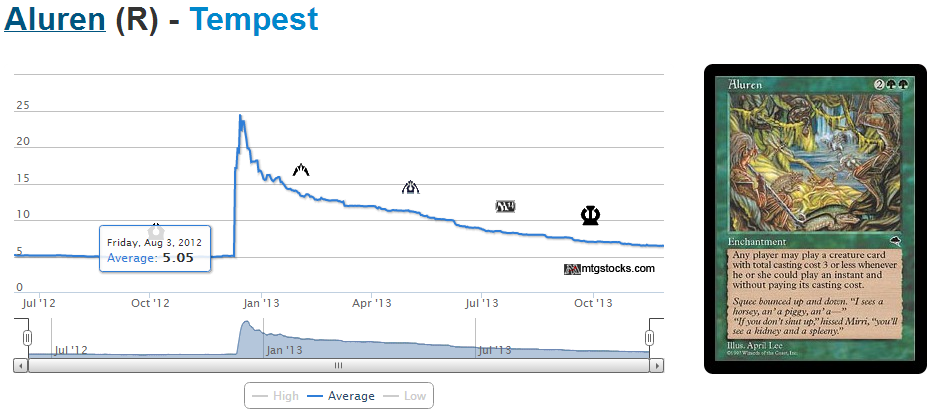
Schorschbrau is a German brewery that only makes Eisbeer. They retaliated against the Tactical Nuclear Penguin with a beer called called Schorschbock35, at a whopping 35% ABV. Brew Dog would then make a beer called Sink the Bismarck! (sic) at an outrageous 41% ABV. We have now gone above the standard spirits (like vodka and rum) alcohol percentage of 40% ABV. Schorschbrau quickly bounced back with Schorschbock43, at 43% ABV, continuing what I’m dubbing The Battle of Ridiculosity. There is a bit of a note to be made here.
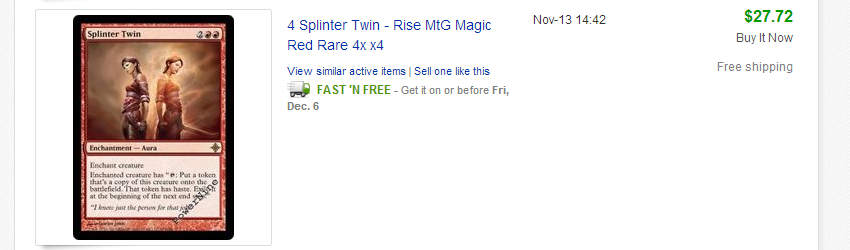
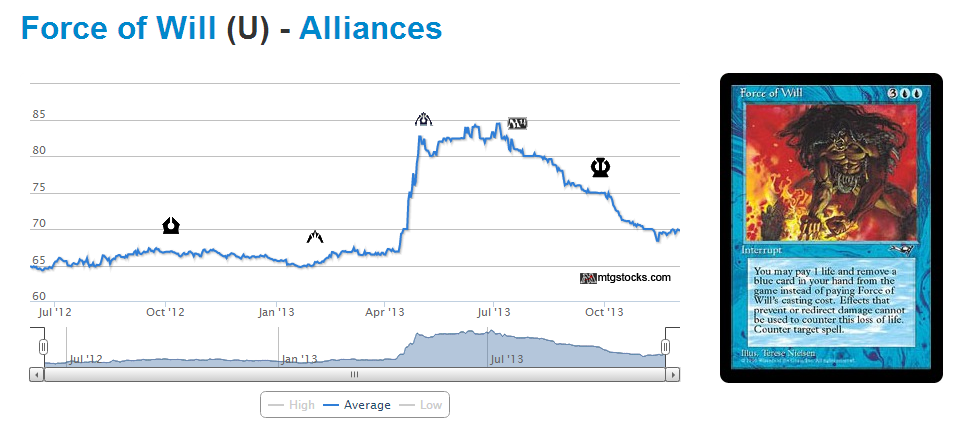
Tactical Nuclear Penguin was a stout that was barrel aged for 18 months before it was put though the freeze-distilling process. This ensured that it had a full and round enough flavor profile to stand up to the much higher alcohol content that was intended for it. In the later parts of this war of high-booze beers, the response beers from each brewery were coming out faster and faster. I haven’t tried any of these beers, so I can’t say for certain, but I think that the shorter time frame might be at a bit of a sacrifice to the beer’s integrity – more on this later.

The battle does not end with Schorschbock43, though. Brew Dog fought back, but this time they were set on putting an end to it all, and thus they named their beer The End of History. The end of History is a beer pushed into the range of what actual distilled alcohol is when it comes from the still: 55% ABV. That it is just absolutely insane! We are well above spirits level at this point. But wait, it’s not even over here…

Brewmeister, another brewer from Scotland, decided to play God and show us that there was life after life after death. So they threw their hat into the ring and produced a beer at an “insert upper-limit adjective here” 65% ABV. However, apparently this wasn’t good enough, Brewmeister has announced yet a stronger beer called Snake Venom… are you getting bored yet? This beer is marked at 67.5% ABV. This beer comes with a big warning label on the neck of the bottle saying its dangerous to consume more than 35ml per sitting.

You may be wondering if these are still yet considered beers, and the answer is indeed, yes. Further pondering might yield the thought…are they worth drinking? Well if you take a look at all of these beers on ratebeer.com, you’ll find that the higher the alcohol percentage goes, the lower the rating. So I’ll put it to you: is there a point to all of this? I probably don’t need to express my opinion directly because I think it is fairly well laid out between the lines.

There is a light at the end of this frozen and refrozen tunnel, and I think it is appropriate that the beer is called Utopiasby. The Boston Beer Company from the good ol’ U.S.A. is responsible for this one. This beer is at a paltry 27% ABV but is not an Eisbock. This means that yeast, not temperature, did all the work, but how? To be honest, I’m not sure, but that’s not actually my point. The beer is a barley wine and it has been around for quite a long time. Where all of these other beers were made for the purpose of beating each other, this one was made to be beautiful. Some of the beers used during blending have been aged in the brewery’s barrel room for up to 20 years.

And there we have it. From beer basics last time, to beer ballistics this time. Who knows what it will be next time…maybe beer gymnastics or scholastics?

As always, thanks for hangin’.

Andrew

Style of the Bi-Week – Double IPA

Last week was pilsner, which is arguably the most accessible of respectable craft beers. If you are interested in a little bit more extreme beer, but still accessible, hunt down a double IPA. It will have a robust 8-12% ABV (which seems pitiful given the above beers) and if it’s a good one, 80-100 IBU’s of hoppy goodness. Most local craft breweries will usually have an offering at least seasonally. As far as tasting notes go, these can be all over the place depending on the hops and malts used by the brewery. Competition tasting notes are as follows:

14C. Imperial IPA: A prominent to intense hop aroma that can be derived from American, English, and/or noble varieties (although a citrusy hop character is almost always present). Most versions are dry hopped and can have an additional resinous or grassy aroma, although this is not absolutely required. Some clean malty sweetness may be found in the background.

The (self-proclaimed) holy grail of these beers is Dogfish Head’s 120 Minute Double IPA. If you can ever get your hands on it, snap it up and enjoy!

Brainstorm Brewery #78 – Apparently Sesquicentennial Means 150

Not a whole lot happened in the last week outside of a temporary decline in MODO prices brought on by the unscheduled maintenance and a lack of confidence in the long-term viability of MODO, but prices have already returned to normal mostly. The gang doesn’t want to take any of that out on you and manages to find quite a bit to talk about instead of resorting to a guest appearance or a gimmick to cope with the down time. Making like they’re employees at a Build-A-Bear workshop and your head is the limp, empty shell of some manner of stuffed animal and sweet nuggets of financial goodness are the stuffing, you’re going to get some wisdom piped into your dome whether you signed up for it or not. With questions about the viability of Legacy staples as long-term holds, financial opportunities in unexpected places and the sky falling on MODO, this won’t feel like an off week at all. It will feel like the boys are taking you to school.


  • MODO prices tanked briefly but seem to have stabilized for the most part. Is there still opportunity here? What could be causing the prices to come back up?
  • Pick of the Week covers all formats this week and deals with prices that make no sense.
  • The winner of the drawing will be announced soon, and all other entrants will be sent their consolation prizes. Stay tuned for the announcement on a future episode.
  • The T-shirts were printed this week. Thank you to all who supported the cast. Future merch is announced.
  • A Legacy Grand Prix happened in DC over the weekend. What was exciting about it?
  • Some Legacy cards appear to be going down and some going up. What should you do if you’re looking to invest? The gang presents several opinions.
  • Interested in contributing to Brainstormbrewery.com as a writer? Submit your credentials to [email protected].  We have already published articles written by other fans- don’t miss your chance to be part of one of the fastest-growing brands in the game.


Cabe Riseau produced the intro and outro music for Brainstorm Brewery.


Contact Us

Brainstorm Brewerywebsiteemailtwitterfacebook

Ryan Bushardemailtwitterfacebookgatheringmagic.com

Corbin Hosleremailtwitterfacebook – quitespeculation.com

Jason E Altemailtwitterfacebookgatheringmagic.com – quitespeculation.com

Marcelemailtwitterfacebook

The Recession

Author’s Foreword

Due to the news of Premier Events returning to MTGO, the main premise of the article, that the MTGO market may not yet be at its bottom, has become outdated. Certain parts of the article have been rewritten to fit with the new information. However, I feel that the thrust of the article, that the fundamental problems of MTGO’s platform structure have not been resolved and that the market will be bearish in the long term, still stands.

The Stock Market

I first started speculating in the stock market freshman year of college during the 2008-2009 stock market crash.

Here is a graph of the Dow Jones Industrial Average (DJIA or Dow 30) over the period from August 1, 2008, to October 31, 2008, which was around the period that I first started speculating.

graph1

A quick introduction to the index used to create this graph. The Dow 30 is a stock market index that keeps track of 30 blue-chip stocks listed on the New York Stock Exchange.

You can see that there is a sharp drop of 25% over the course of a month from mid-September to mid-October. This isn’t your average day stock market that moves 1-2% up or down every day. After the crash, however, you can see the stocks beginning to stabilize by October.

The market crashed because the fundamentals for the stock market were lacking. Financial instruments backing mortgages were expected to continue an unreal rate of increase in value because houses were exponentially growing in value. When the housing market crashed, the value of these assets plummeted. To give you an idea, Citigroup, one of the largest bank holding companies in the US, lost over $27.7 billion in the year 2008. Without the US government to back up the giant bank through TARP and other regulatory programs, the third-largest bank in the US would most likely have gone bankrupt.

There are a lot of other things that happen during a bear market (bear because a bear mauls downwards, as opposed to bull markets because a bull thrusts its horns up).

  1. In a bear market, volatility goes way up because no one knows where the market is going. Volatility is defined as the variation of price of a financial instrument over time. Because any point in a bear market could be the turning point or just another point where the prices are ready to tank more, speculators tend to overreact to the changes in price from day to day.
  2. No one knows when a recession will end. This point is key as to why the sell offs continue in a recession. Prices go up and down without any regard for fundamentals of a stock’s value. To avoid being stuck with a stock that is diving in prices, shareholders exit their positions, adding to the already-depressed levels.
  3. This third point is huge. Recessions are the best opportunities to pick up on underpriced stocks, especially on stocks with good fundamentals and strong balance sheets/income statements. More on this point later.

So what happened next? Did the stock market stabilize like at the tail end of the graph?

graph2

Here is another graph of the Dow 30 over the period of October 31, 2008, to May 1, 2009, continuing from where we left off on the last graph.

The market continued to plunge over the course of another five months, reaching its lowest point on March 9, 2009, at 6,547, down from the highest point in 2007 of 14,164, or more than a 50% loss. Just because there was a previous drop and a stabilization doesn’t mean that trend will continue going forward.

Keep in mind that these aren’t your average stocks but the most conservative, the cream-of-the-crop stocks (e.g., Exxon Mobil, McDonald’s, Nike, Microsoft, Coca-Cola, etc.). The market can be unpredictable at times, and it’s difficult to tell where the turning points are.

The MTGO Market

I will now bring the article back to MTGO. My point isn’t to say that the sky is falling and that everyone should sell all their cards on MTGO and hide their tickets under a couch. What I’m trying to convey is that there is a real possibility that we haven’t seen the worst yet.  Even though the Premier Events will be back, the MTGO program being used is still as broken as ever.

There are a number of similarities between the stock market crash and the current market condition of MTGO. The fundamentals are lacking for both markets. MTGO is a terrible excuse of a program for the number of players throwing money at it. There is also a high degree of uncertainty about where the light at the end of the tunnel is, especially given that Wizards of the Coast doesn’t have a good track record in dealing with the software side of things.

However, I believe the other side has some very good reasons as to why it may be a good time to be buying in.

Here are what I believe are the points in favor that the worst has passed:

  1. Prices have depreciated enough from the previous level that even if prices drop further, you’ll still get cards at a discount. You might lose, but you probably won’t lose a whole lot.
  2. Prices seem to have become more stable over the past week now that we are past the initial sell-offs, most particularly due to the effects of redemption creating a price floor.
  3. Wizards of the Coast cannot leave PTQs and the Magic Online Championship Series down for too long because of the loss of potential profits.

I believe that the bearish outlook will continue as platform issues have yet to be resolved, although the near term will be bullish because of the incoming demand since Premier Events will be back.

  1. I highly recommend reading the articles from Hipsters of the Coast (see article here) and toordeforce (see article here). As it stands, the estimate for the downtime is anywhere from four to six months, and it may take up to three years for next version of MTGO to be available. The longer the systems are down, the more likely it is that card prices will go down further because fewer players will be playing the game.
  2. The central issue that there is only one master server for the multiple servers that are running the games. Until this key architectural flaw can be worked around, the delay and lag and time outs on MTGO will be here to stay. MTGO Version 4.0 has been around for more than a year and is expected to replace the current MTGO Version 3.0, yet there has been little progress in improving MTGO Version 4.0.
  3. There is a very careful balance between letting the servers go down for upgrades/redo’s and further agitating players because of the instability of the current servers. Wizards is in a tough spot because both neither option is pretty. Change in MTGO is long overdue, but change isn’t going to be easy for a program on which hundreds of thousands of players are depending.

Whatever you decide to do with your MTGO cards, please do so with the fundamentals of MTGO in mind. The truth of the matter is that MTGO hasn’t been fixed yet and the root architectural problem is still unresolved. Whether Wizards announced that Premier Events to be back for revenue reasons or because the system is better now, there will come a time when the system will be down again.

Thank you for reading article, I hope that it was informative. You can find me on Twitter @fyawm